


Introduction
Grazing sea urchins play a key ecological role in many shallow marine benthic ecosystems (Andrew et al., Reference Andrew, Agatsuma, Ballesteros, Bazhin, Creaser, Barnes, Botsford, Bradbury, Campbell, Dixon and Einarsson2002; Bak et al., Reference Bak1984; Brady and Scheibling Reference Brady and Scheibling2005; Byrnes et al., Reference Byrnes, Johnson, Connell, Shears, McMillan, Irving, Buschmann, Graham and Kinlan2013a; Carpenter Reference Carpenter1988; Gizzi et al., Reference Gizzi, Monteiro, Silva, Schäfer, Castro, Almeida, Chebaane, Bernal-Ibáñez, Henriques, Gestoso and Canning-Clode2021; Guzman Reference Sangil and Guzman2016; Hughes et al., Reference Hughes, Reed and Boyle1987; Humphries et al., Reference Humphries, McClanahan and McQuaid2020; Lessios et al., Reference Lessios, Cubit, Robertson, Shulman, Parker, Garrity and Levings1984a; Lessios et al., Reference Lessios, Garrido and Kessing2001; Moreira‐Saporiti et al., Reference Moreira‐Saporiti, Hoeijmakers, Reuter, Msuya, Gese and Teichberg2023: Sangil and Ling et al., Reference Ling, Scheibling, Rassweiler, Johnson, Shears, Connell, Salomon, Norderhaug, Pérez-Matus, Hernández and Clemente2015). Sea urchin gonads (roe) are an economically important fisheries resource with 117,000 tonnes of sea urchins harvested annually worldwide (Andrew et al., Reference Andrew, Agatsuma, Ballesteros, Bazhin, Creaser, Barnes, Botsford, Bradbury, Campbell, Dixon and Einarsson2002; Campbell and Harbo Reference Campbell and Harbo2020; Furesi et al., Reference Furesi, Madau, Pulina, Sai, Pinna and Pais2016; Keesing and Hall Reference Keesing and Hall1998; Parvez et al., Reference Parvez, Rahman and Yusoff2016; Scheibling and Mladenov Reference Scheibling and Mladenov1987; Sun and Chiang Reference Sun, Chiang, Brown and Eddy2015).
Since they are both ecologically and economically important, the reproductive biology of regular echinoids has gained considerable attention and has been well-studied in many diverse habitats around the world for several decades (Arafa et al., Reference Arafa, Chouaibi, Sadok and El Abed2012; Bronstein et al., Reference Bronstein, Kroh and Loya2016; Byrne et al., Reference Byrne, Andrew, Worthington and Brett1998; Cunningham et al., Reference Cunningham, Gibbs and Watts2023; Drummond Reference Drummond1995; Hernández et al., Reference Hernández, Clemente and Brito2011, Reference Hernández, Sangil and Lorenzo‐Morales2020; Himmelman Reference Himmelman1978; Iliffe and Pearse Reference Iliffe and Pearse1982; Limatola et al., Reference Limatola, Chun and Santella2020; Machado et al., Reference Machado, Moura, Pereira, Vasconcelos and Gaspar2019; Paine and Vadas Reference Paine and Vadas1969; Shpigel et al., Reference Shpigel, McBride, Marciano and Lupatsch2004; Villalba et al., Reference Villalba, Chan, Diaz, Jimenez, Osorio, Longoria and Arce2021; Wangensteen et al., Reference Wangensteen, Turon, Casso and Palacin2013; Williamson and Steinberg Reference Williamson and Steinberg2002).
Most sea urchins reproduce by releasing gametes through spawning. The duration of gamete production and seasonality of gamete release/spawning varies considerably, not only among different species but also within the same species in different geographical regions (Bronstein et al., Reference Bronstein, Kroh and Loya2016; Iliffe and Pearse Reference Iliffe and Pearse1982; Lawrence Reference Lawrence2020; Lessios Reference Lessios1981, Reference Lessios2013; Randall et al., Reference Randall, Schroeder and Starck1964). Numerous factors have been shown to induce the spawning of echinoderms: photoperiod or light intensity (Alsaffar and Lone Reference Alsaffar and Lone2000; Pearse et al., Reference Pearse, Pearse and Davis1986; Shpigel et al., Reference Shpigel, McBride, Marciano and Lupatsch2004; Wangensteen et al., Reference Wangensteen, Turon, Casso and Palacin2013), time of day, sea water temperature (Bronstein et al., Reference Bronstein, Kroh and Loya2016; Byrne Reference Byrne1990; Coppard SE and Campbell AC Reference Coppard and Campbell2005), phytoplankton/phytodetritus abundance (Bronstein et al., Reference Bronstein, Kroh and Loya2016), lunar cycle (Coppard SE and Campbell AC Reference Coppard and Campbell2005), tides/currents (Boolootian et al., Reference Boolootian, Giese, Tucker and Farmanfarmaian1959; Coppard SE and Campbell AC Reference Coppard and Campbell2005), salinity (Giese et al., Reference Giese, Krishnaswamy, Vasu and Lawrence1964), inter-population and inter-individual communications (Giese and Pearse Reference Giese and Pearse1974; Lamare and Stewart Reference Lamare and Stewart1998). Individual or combinations of multiple factors are known to induce the spawning of particular sea urchin species in a particular geographical region. A proper understanding of urchin reproductive biology and spawning seasonality is key to explaining the recruitment patterns of a particular species.
Percentage Gonadosomatic Index (% GSI)/gonad retrieval rate combined with histological analysis is used to determine the reproductive seasonality of many sea urchins. % GSI can vary depending on the availability of food and its nutritional value (Tsuda et al., Reference Tsuda, Hoshikawa, Agatsuma and Taniguchi2006; Meidel and Scheibling Reference Meidel and Scheibling1998, Reference Meidel and Scheibling1999) where higher % GSI values have been recorded in habitats with abundant food/algae than areas of food/algae scarcity (Kelly Reference Kelly2001; Meidel and Scheibling Reference Meidel and Scheibling1998; Minor and Scheibling Reference Minor and Scheibling1997; Sánchez-España et al., Reference Sánchez-España, Martínez-Pita and García2004). Sea urchins are capable of not only changing their body size and Aristotle’s lantern size depending on the availability of food but can also alter their reproductive output. Sea urchins from kelp beds have been documented to have a higher % GSI compared to the same species from barrens (Ebert Reference Ebert1980; Gonor Reference Gonor1973; Meidel and Scheibling Reference Meidel and Scheibling1998). The reproductive effort of Diadema antillarum is also known to be density-dependent (Levitan Reference Levitan1989, Reference Levitan1991). Lower reproductive output has been recorded for Paracentrotus lividus in the Mediterranean at higher sea urchin densities (Tomas et al., Reference Tomas, Romero and Turon2005). Decreased gamete production due to low food availability can be compensated by increased fertilization success when urchin densities are high (Hernández et al., Reference Hernández, Brito, García, Gil-Rodríguez, Herrera, Cruz-Reyes and Falcón2006).
Some sea urchin species are known to exhibit limited feeding during the spawning season (Lawrence Reference Lawrence2020; Muthiga Reference Muthiga2003; Fuji 1963). Percentage Repletion Index (% RI) has been used in past studies as a measure of gut fullness and as a tool for predicting the extent of feeding. A high % RI has been recorded in Tripneustes gratilla in Madagascar after spawning and after initiation of gametogenesis (Vaitilingon et al., Reference Vaitilingon, Rasolofonirina and Jangoux2005). Increased food consumption has been recorded during the gonad maturation period (Belkhedim et al., Reference Belkhedim, Dermeche, Chahrour and Boutiba2014).
Many temperate urchin species (Paracentrotus lividus in the Mediterranean, Strongylocentrotus spp. in North America and Japan, Psammecanus miliaris in Europe, Evechinus chloroticus in New Zealand and Heliocidaris erythrogramma and Centrostephanus rodgersii in Australia) have been extensively studied because of their economic importance (Andrew et al., Reference Andrew, Agatsuma, Ballesteros, Bazhin, Creaser, Barnes, Botsford, Bradbury, Campbell, Dixon and Einarsson2002; Byrne Reference Byrne1990; Byrne and Andrew Reference Byrne, Andrew and Lawrence2020; Keesing Reference Keesing and Lawrence2020; Shpigel et al., Reference Shpigel, McBride, Marciano, Ron and Ben-Amotz2005). There are nine species of the genus Centrostephanus (Kroh and Mooi Reference Kroh and Mooi2025). Of these commercial fisheries only exist in eastern Australia, for C. rodgersii (Andrew and Byrne Reference Andrew, Byrne and Lawrence2007; Byrne and Andrew Reference Byrne, Andrew and Lawrence2020; Keesing and Hall Reference Keesing and Hall1998) and there is a small developing C. tenuispinus fishery in western Australia (pers. observ.). The other common species of the genus in the Mediterranean (C. longispinus) and Pacific (C. coronata) are not fished (Andrew and Byrne Reference Andrew, Byrne and Lawrence2007).
Among southern temperate species, C. rodgersii has been well-studied during the last few decades, not only for their potential economic value but also for their ecology and recent range expansion influencing the ecology of newly established habitats (Byrne et al., Reference Byrne, Andrew, Worthington and Brett1998; Day et al., Reference Day, Knott, Ayre and Byrne2023; King et al., Reference King, Hoegh-Guldberg and Byrne1994; Ling et al., Reference Ling, Johnson, Frusher and Ridgway2009; Ling and Johnson Reference Ling and Johnson2009; Pecorino et al., Reference Pecorino, Lamare and Barker2013a, Reference Pecorino, Lamare and Barker2013b; Thomas et al., Reference Thomas, Liggins, Banks, Beheregaray, Liddy, McCulloch, Waters, Carter, Byrne, Cumming and Lamare2021). On the other hand, its congener Centrostephanus tenuispinus on the west coast of Australia is least studied. The reproduction and larval development of C. rodgersii has been studied (Byrne and Andrew Reference Byrne, Andrew and Lawrence2020), but no previous studies have been conducted on the reproductive periodicity of C. tenuispinus. Hall Bank Reef, Western Australia, deviates from other temperate reefs due to the high level of scleractinian coral cover and absence of macroalgae by C. tenuispinus grazing (Thomson and Frisch Reference Thomson and Frisch2010). The correlation between the high abundances of C. tenuispinus and low macroalgae at Hall Bank suggests the potential for the urchin to form and maintain barrens. Although it is evident that C. tenuispinus has an immense impact on its habitat; a lack of knowledge on its reproductive cycle hampers understanding of the recruitment and behaviour of this particular urchin.
The focus of this study is to understand the reproductive cycle, reproductive seasonality, and factors impacting the spawning of a high density/small test size population of C. tenuispinus at Hall Bank Reef, Western Australia where monthly percentage gonadosomatic index combined with histological analysis was used for analysis of gametogenesis and reproductive seasonality. The reproductive output of C. tenuispinus at the coral-dominated Hall Bank Reef was compared with that of a low-density/large test-size population at the macroalgae-dominated Minden Reef.
Materials and methods
Study sites
This study was carried out at Hall Bank Reef (32°2.002′S and 115°42.957′E) and Minden Reef (32º 04.320′S and 115º 43.782′E) between 2014 and 2017 (Figure 1). Hall Bank Reef (Figure 2) is a small patch of elevated limestone reef (around 2 ha) located 3 km northwest of the Fremantle Harbour in Western Australia. The top of the reef lies at a depth 7–10 m and is dominated by merulinid corals, which abruptly descend to the surrounding seagrass bed (depth 15 m). Minden Reef (Figure 2) is a macroalgae-dominated reef located 5 km south-east of Hall Bank Reef and is approximately 6 m in depth. Unlike Hall Bank Reef, this site exhibits typical characteristics of high latitude reefs (high abundance of macroalgae and soft corals and low coral cover).
Map showing the location of the Hall Bank Reef and Minden Reef in Western Australia.

A. Hall Bank Reef, Western Australia. A reef dominated by merulinid corals. B. Minden Reef, Western Australia, a reef dominated by macroalgae adjacent to seagrass beds. Photographed in July 2016 by R.M.G.N. Thilakarathna.

Sea urchin sampling and laboratory procedures
Approximately 26 sea urchins were collected per month through SCUBA diving and a total of 390 individuals were collected from October 2014 to February 2016. The urchins were transported to the laboratory on ice and dissected within the same day. Urchins were blotted dry and weighed with an electronic balance (±0.001 g); test diameter and height were measured to two decimal places using Vernier calipers. Samples were dissected carefully, gonad weight was measured. Gut was extracted separately without losing gut content and total gut weight was measured, One gonad from each sample was preserved in Bouin’s fluid (formaldehyde: picric acid: glacial acetic acid 75 mL: 25 mL: 5 mL) for 24 hours and transferred into 70% ethanol for histological analysis. Gonads were embedded in paraffin and sectioned (7 μm). Gonad sections were stained using the haematoxylin-eosin aqueous method (Bancroft and Gamble Reference Bancroft and Gamble2008) and these sections were used to determine the gender and maturity stage of the urchins. Gonad stages were classified into six maturity stages (Recovery, Developing, Premature, Mature, Partially spent, and Spent) following King et al. (Reference King, Hoegh-Guldberg and Byrne1994)
An additional ten sea urchins per site were collected in each of winter 2016 and summer 2017 for comparison of reproductive output between Hall Bank Reef and Minden Reef (N = 40) and the above procedure was followed for the analysis.
Estimating sea urchin density and size structure
Surveys were carried out to estimate sea urchin density and size structure from October 2014 to February 2016 at Hall Bank Reef and Minden Reef (monthly). For each survey, ten haphazard transects (20 m) were laid at each site. Eight transects were deployed at 10 m depth and two transects were deployed at 12 m in Hall Bank Reef. Sea urchins were counted to 0.5 m of each side of the transect lines (belt transect, 20 × 1 m). The density of urchins was calculated per square meter.
Considering the higher number of urchins at Hall Bank Reef compared to Minden Reef, only urchins in two transects were used for size structure study at Hall Bank Reef. Test diameters of all urchins from transect 1 and transect 10 were measured using Vernier calipers (± 0.01 mm) at the Hall Bank site. Urchins from all transects (10) at Minden Reef were used for this study. Urchins from the two study sites were categorized into size classes of 5 mm intervals.
Environmental parameters measurements
Sea water temperature was obtained using an in-situ temperature logger (HOBO-UA-002-64) at Hall Bank Reef (data logger at Hall Bank deployed by CSIRO). Day-length data were obtained from Geosciences Australia, Australian Government.
Percentage gonadosomatic index (% GSI) and percentage repletion index (% ri)
Gonad weight was used for the calculation of the Percentage Gonadosomatic Index (% GSI). This indicates the size of gonads with respect to the body size as a percentage (equation 1).
 \begin{equation}\,\% \,GSI = \frac{{Gonad\,weight}}{{Total\,body\,wet\,weight}}\,X\,100\end{equation}
The maturity of each individual was estimated based on the gonadal maturity stage. The sex ratio, as the proportion of females to the total, was estimated with respect to size and time.
Percentage Repletion index, which is an indicator of gut fullness, was calculated according to the following equation for each individual (equation 2).
 \begin{equation}\% \,RI = \,\frac{{Gut\,wet\,weight}}{{Total\,body\,wet\,weight}}\,X\,100\end{equation}
Statistical analysis
Data were tested for normality (Levene’s test). Differences in % GSI between sexes and months were analysed using two-way ANOVA followed by post hoc tests (Tukey’s HSD). Correlations between sea water temperature, day length, and % GSI, and between % RI and % GSI, were tested using Pearson’s correlation coefficient. All statistical analyses were carried out using SPSS 24.
Results
Seasonal changes in percentage gonadosomatic index (% GSI) in hall bank reef
Reproduction of Centrostephanus tenuispinus is seasonal, and gametogenesis in males and females was synchronized in the C. tenuispinus population at Hall Bank Reef. Mean % GSI ranged from 2.76 ± 0.11% to 6.89 ± 0.58% (mean ± SE) and 2.95 ± 0.31% to 6.93 ± 0.57% (mean ± SE) for males and females respectively. The highest mean % GSI was recorded in July 2015 for both sexes (6.93 ± 0.57 (mean ± SE) for females and 6.89 ± 0.58 (mean ± SE) for males) (Figure 3). A clear increase in mean % GSI from March to July was evident in both genders (females 5.30 ± 0.56 – 6.93 ± 0.57%, males 4.47 ± 0.54 – 6.89 ± 0.58%).
Monthly % Gonado Somatic Index (mean ± SE) of females (black line) and males (dotted line) of C. tenuispinus in Hall Bank Reef (Males; n = 208, Females; n = 182).

Two-way ANOVA revealed a significant interaction between gender and month (F (14,390) = 1.866, p = 0.028), such that males had higher % GSI values in February 2015 (5.40 ± 0.25%), and females had higher % GSI values in January 2015 (4.91 ± 0.31%), March 2015 (5.30 ± 0.56%), June 2015 (6.14 ± 0.90%) and November 2015 (5.50 ± 0.91%). Although there was a significant main effect of monthly % GSI (F (14,390) = 9.812, p < 0.001), no significant differences were observed between overall monthly male and female % GSI (F (1,390) = 0.109, p = 0.741).
Tukey’s HSD test indicated that the mean % GSI for pooled data was significantly higher in July than the rest of the year (6.90 ± 0.02%) (mean ± SE). The mean % GSI in March, April, and June were similar when gametogenesis was proceeding. The mean % GSI in November 2015 (5.00 ± 0.51%) was significantly higher than the other months except January to July (period of gametogenesis). No significant differences were observed in % GSI between the years of 2014 and 2015 in the months of October (p = 0.631) and December (p = 0.147). Similarly, no significant differences were recorded between the year of 2015 and 2016 in January (p = 0.400) and February (p = 0.824).
Percentage repletion index (% RI)
The highest percent repletion indices (% RI) were recorded in February 2015 (18.11 ± 0.60% for females and 16.59 ± 0.62% for males) and September 2015 (18.29 ± 0.10% for females and 16.10 ± 0.61% for males). The lowest % RI was recorded in January 2016 for females (13.48 ± 1.15%) and in January 2015 for males (12.16 ± 0.85%) (Figure 4). Significant differences were observed between female and male % RI (two-way ANOVA, F (1,390) = 11.151, p < 0.001). Female % RI was higher than male % RI in most months. Further, monthly differences in % RI were significant (F (14,390) = 7.165, p < 0.001).
Monthly % RI (Mean ± SE) of C. tenuispinus (n = 390) from October 2014 – February 2016. Male % RI and female % RI represented by broken line and solid line, respectively.

Pearson correlation revealed that there was no significant correlation between % GSI and % RI for pooled data for genders (Pearson correlation = 0.008, p = 0.880).
Influence of seawater temperature and photoperiod on % GSI
There was no correlation between male and female % GSI and seawater temperature (Males: Pearson correlation (PC) = −0.152, p = 0.122, Females PC = −0.137, p = 0.640). Male % GSI is moderately correlated with day length (Pearson correlation = −0.566, p = 0.035) (Figure 5).
Monthly variations of seawater temperature (°C), day length (hrs), and % GSI of C. tenuispinus at Hall Bank Reef.

Gametogenesis and gonad histology
Gonads of both genders were categorized into six stages: Recovery, Developing, Premature, Mature, Partially spent, and Spent, following King et al. (Reference King, Hoegh-Guldberg and Byrne1994).
Oogenesis stage I: Recovery stage
The recovery stage can be further categorized into three stages. At the initial stage, all relict ova were absorbed by nutritive phagocytes. Secondly, the lumen started to fill with densely eosinophilic nutritive phagocytes. Scattered brown pigments (lipofuscin) were present throughout the gonad tissue (Figure 6). Finally, occasional basophilic oocytes started to align with the tube wall. Initiation of primary oocytes was observed in December 2014 samples. While relict ova were being reabsorbed by nutritive phagocytes, at the periphery of the tubule occasional primary oocytes were appearing. The recovery phase was first observed in October 2015, 2 months after initial spawning, although no recovery stages were observed in the October 2014 samples.
Ovarian histology of C. tenuispinus (A – Late Recovery stage; B – Initiation of oogenesis; C – Developing stage; D – Premature stage; E – Mature stage; F – Partially spent stage; G – spent stage; H–Initial Recovery stage; a – Oocytes; b – Nutritive phagocytes; c – Lipofuscins; d – Developing ova; e – Mature ova; f – Relict ova).

Stage II: Developing stage
Developing basophilic oocytes lined most of the gonad wall forming a ring and the process was accelerated in March (Figure 6B). By April all individuals were in the process of gametogenesis. Vitellogenesis progressed from April. These oocytes progressed towards the lumen utilizing the nutrients stored in nutritive phagocytes. Initially, these extended to an oval shape and tended to separate from the gonad wall and migrate towards the gonad lumen (Figure 6C). These ova consisted of a nucleus surrounded by nutrient stores. As they concentrated in the lumen, they tended to mature. All samples in April and June were in the developing phase, and 27% of the July population was composed of ova in the developing phase (Figure 7).
Temporal variation (October 2014–February 2016) of percentage gametogenic stages in female C. tenuispinus (n = 182).

Stage III: Premature stage
At this stage, the majority of ova were concentrated in the gonad lumen (Figure 6D), although new oocytes were still developing along the tubule wall. With time, mature ova tended to occupy most of the lumen. Forty-six percent of the population was in the premature stage in July; July was the only month in which the premature stage was observed (Figure 7).
Stage IV: Mature stage
In this stage, the gonad lumen was full of mature ova, with the ova tightly packed and a very thin layer of nutritive phagocytes (Figure 6E). Mature ova first appeared in July (27.2%) and were present in sampled populations from July to November (August – 20%, September – 45.4%, October – 30.7%, November – 15.4%) (Figure 7).
Stage V: Partially spent stage
Only 25–30% of the gonad was spawned (Figure 6F). This stage was observed in October (23%) and November (15.4%) (Figure 7).
Stage VI: Spent stage
Gonads with empty lumens were considered as spent (Figure 6G). Occasional unshed ova were recorded at this stage, and nutritive phagocytes were absent. Eighty percent of samples were in the spent stage in August, 54.5% in September 2015, 38.5% in October 2015, 38.5% in November, and 10% in December 2015 (Figure 7). No spent stage gonads were observed in the December 2014 samples, yet they were observed in December 2015. All the gonads entered the recovery stage after November.
Spermatogenesis stage I: Recovery stage
The lumen started to fill with densely eosinophilic nutritive phagocytes. Unshed sperm were re-absorbed. Brown pigments (lipofuscins) were scattered in the tubule lumen. Basophilic spermatozoa were aligned with the tubule wall (Figure 8A). The recovery stage in males was first observed in December (62.5%). The majority of the sampled population was in the recovery stage from December to April (January – 66.7%, February and March – 100%, April – 79.9%). The last traces of recovery stages were observed in June (7.1%) (Figure 9).
Histology of C. tenuispinus testes (A – Late Recovery stage; B – Initiation of spermatogenesis; C – Developing stage; D – Premature stage; E – Mature stage; F – Partially spent stage; G – Spent stage; H – Initial Recovery stage; a – Initiating sperm strands; b – Developing sperm strands; c – Mature sperm; d – Lipofuscins).

Temporal variation (October 2014 – February 2016) of percentage gametogenic stages in male C. tenuispinus (n = 208).

Stage II: Developing stage
Developing strands of sperm (basophilic) were observed (Figure 8B). These strands were arising along the tubular wall and tended to extend towards the lumen (perpendicular to the tubule wall). In April, 23% of the sampled population was in the developing stage. The majority of the population was in the developing stage by June (92.8%); 6.75% of the July sample was also in the late developing stage (Figure 9).
Stage III: Premature stage
At this stage, sperm had accumulated in the tubule lumen and were in the process of maturing (Figure 7D), but sperm strands continued to gather in the lumen. 46.7% of the population was in premature stage in July and 12.5% in August (Figure 9).
Stage IV: Mature stage
The gonad lumen was full of mature sperm. Clusters of basophilic sperm in sections were visible to the naked eye. By this stage, the gonad wall and nutritive phagocyte layer were very thin (Figure 8E). The presence of mature sperm in July (46.7%) indicates readiness for spawning. Mature sperm were present from July to December 2015 (August – 43.8%, September – 46.8%, October – 61.6%, November – 38.5%, December – 6.3%) over 6 months. The highest percentage of mature stage testes was observed in October (Figure 9). Note that there was a complete absence of mature sperm in the December 2014 sample.
Stage V: Partially spent stage
Gonads with over 70% of sperm remaining were considered as partially spawned. This stage was observed in August (25%), September (13.3%), October (15.4%), November (23.8%), and December (25%) (Figure 9).
Stage VI: Spent stage
Spent testes were first observed in August (18.5%) (Figure 9). The highest percentage of spent testes from the sampled population was recorded in September (40%), and this stage was present until January (for 6 months).
Sex ratios
Variations in sex ratios (female/male) were observed throughout the year but remained close to 1:1 (χ 2, p = 0.19).
Comparison of population density, size structure, and gonad indices between Hall Bank reef and Minden reef
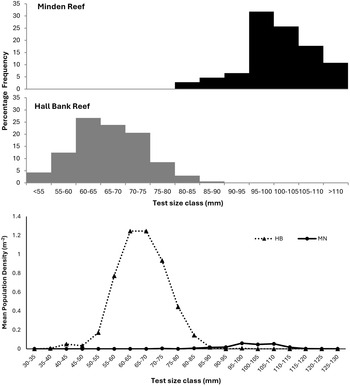
The sea urchins collected from Minden Reef (83−118 mm) were larger than urchins from Hall Bank Reef (range 38–98 mm) (Table 1) (p < 0.001). Mean test diameters were 66.23 ± 0.24 mm and 100.69 ± 0.45 mm (monthly mean ± SE) at Hall Bank and Minden Reef respectively. One-way ANOVA conducted for each site separately (season as a factor) revealed there were no differences in seasonal densities of C. tenuispinus in two study sites (Hall Bank Reef – F (4,102) = 2.340, p = 0.060; Minden Reef – F (4,88) = 1.046, p = 0.389).
Comparison of % GSI of C. tenuispinus (mean ± SE), % RI (mean ± SE) mean test diameter (mm), and sea urchin density (m−2) between Hall Bank Reef and Minden Reef in winter and summer (n = 40)

The majority of the population (71.19%) was between 60 and 75 mm at Hall Bank Reef. Size class <60 mm made up 16.72% and size class >75 mm made up 12.08% of the population at Hall Bank Reef as well (Figure 10). On the other hand, the percent frequency of urchins <85 mm, 85–100 mm, and >100 mm were 8.26%, 36.78%, and 54.96%, respectively, at Minden Reef. These results reflect the high abundance of intermediate-sized urchins at Hall Bank and the higher frequency of large urchins at Minden Reef despite lower density (Figure 10). The population structure of C. tenuispinus in both sites was unimodal, with intermediate-size urchins more dominant at Hall Bank Reef and large sizes dominant at Minden Reef.
Upper panel. Population size distribution of the C. tenuispinus population at Hall Bank Reef (grey bars) (n = 1142) and Minden Reef (black bars) (n = 242). Lower panel. Variation of population density of C. tenuispinus with the test size class at Hall Bank Reef (dotted line) (n = 1142) and Minden Reef (Solid line) (n = 242).

Sea urchins from Minden Reef had relatively large gonads (two times and three times of % GSI of Hall Bank in winter and summer respectively F (1,40) = 91.50, p < 0.001). Two-way ANOVA revealed a significant interaction effect between site and seasons (F (1,40) = 17.038, p < 0.001) (Table 2), with higher % GSI values in Minden Reef compared to Hall Bank. Similarly, winter had a higher % GSI over summer (Table 3/4) (F (1,40) = 22.391, p < 0.001). This indicates similar patterns with C. tenuispinus reproductive cycle in 2014 and 2015. Further, this confirms the synchronized reproductive patterns of the Minden Reef population with the population in Hall Bank Reef. The mean % RI was higher in Minden Reef urchins than that of urchins from Hall Bank Reef in winter and summer (Tables 1 and 3) (F (1,40) = 16.033, p < 0.001).
Source of variance table for the two-way ANOVA of mean % GSI of Site (Hall Bank Reef and Minden Reef) and season (winter and Summer) as factors (n = 40), (α = 0.05)

* P < 0.001
Source of variance table for the two-way ANOVA of mean % RI of Site (Hall Bank Reef and Minden Reef) and season (winter and Summer) as factors (n = 40), (α = 0.05)

* P < 0.001
Discussion
This study revealed that as with many sea urchins with temperate to subtropical distributions, Centrostephanus tenuispinus also exhibits a clear synchronized annual reproductive cycle, gametogenesis initiating in autumn and spawning in winter. Many such species tend to spawn in optimal weather conditions ensuring larval survival (Bronstein et al., Reference Bronstein, Kroh and Loya2016). Seasonal reproduction has also been witnessed in other temperate urchins Psammechinus miliaris, Arbacia lixula, Paracentrotus lividus (Shpigel et al., Reference Shpigel, McBride, Marciano and Lupatsch2004), Centrostephanus rodgersii, Heliocidaris erythrogramma, and Evechinus chloroticus (Brewin et al., Reference Brewin, Lamare, Keogh and Mladenov2000; Byrne et al., Reference Byrne, Andrew, Worthington and Brett1998; Dix Reference Dix1977; King et al., Reference King, Hoegh-Guldberg and Byrne1994; Lamare et al., Reference Lamare, Brewin, Barker and Wing2002; McShane et al., Reference McShane, Gerring, Anderson and Stewart1996; Pecorino et al., Reference Pecorino, Lamare and Barker2013a; Walker Reference Walker1982).
Reproduction of many species is influenced by day length, seawater temperature or both (Bronstein et al., Reference Bronstein, Kroh and Loya2016; Byrne Reference Byrne1990; Kelly Reference Kelly2001; Pearse et al., Reference Pearse, Pearse and Davis1986). Although there was no correlation between % GSI and seawater temperature/day length in this study, histological analysis revealed that the reproduction of C. tenuispinus is influenced by lower temperatures and short daylight hours. Gametogenesis was initiated by lowering sea water temperature and decreasing day length. Although a few studies suggest that seawater temperature does not play a central role in regulating reproductive cycles in Indo-Pacific sea urchins (Drummond Reference Drummond1991; Pearce and Scheibling Reference Pearce and Scheibling1991). Seawater temperature is known to influence reproduction in many sea urchin species at different scales (Byrne Reference Byrne1990; Drummond Reference Drummond1995; González-Irusta et al., Reference González-Irusta, De Cerio and Canteras2010). Coppard SE and Campbell AC (Reference Coppard and Campbell2005) recorded increased reproductive output of Diadema savignyi in response to increasing temperature in Fiji. Gametogenesis of Diadema antillarum in Bermuda is known to favour seawater temperatures above 20°C. Yet, temperatures over 25°C are known to inhibit the gonad growth of D. antillarum (Iliffe and Pearse Reference Iliffe and Pearse1982). In contrast, the gametogenesis of T. gratilla in Madagascar is influenced by decreasing temperature and short days (Vaitilingon et al., Reference Vaitilingon, Rasolofonirina and Jangoux2005). The majority of temperate urchins are known to spawn in spring, summer or autumn when the temperature is higher than the rest of the year (Brewin et al., Reference Brewin, Lamare, Keogh and Mladenov2000; Byrne Reference Byrne1990; Dix Reference Dix1977; González-Irusta et al., Reference González-Irusta, De Cerio and Canteras2010; Lamare et al., Reference Lamare, Brewin, Barker and Wing2002; Walker Reference Walker1982). Hemicentrotus pulcherrimus in Fukui, Japan spawns in response to decreasing temperature from 13 °C to 10 °C; thus, spawning initiates in winter. The same species in southwest Japan has delayed spawning in spring, in response to increasing temperatures 6–13 °C. This indicates that this species spawns in a similar range of temperatures despite the location. A few species, such as C. rodgersii in Australia and Strongylocentrotus purpuratus in the northern hemisphere, are also known to spawn in winter when the seawater temperature is at its lowest, showing a similar trend to C. tenuispinus in the current study (Byrne et al., Reference Byrne, Andrew, Worthington and Brett1998; King et al., Reference King, Hoegh-Guldberg and Byrne1994; Ling et al., Reference Ling, Johnson, Frusher and King2008). This could be related to a long planktonic larval stage.
Diadematoid sea urchins are well known to be impacted by the lunar cycle, mostly spawning at the new moon or full moon (Coppard SE and Campbell AC Reference Coppard and Campbell2005; Kennedy and Pearse Reference Kennedy and Pearse1975). Spawning of C. rodgersii in New South Wales is closely related to short day length and lunar cycle corresponding with the winter solstice (Byrne et al., Reference Byrne, Andrew, Worthington and Brett1998). Monthly sampling was carried out for this study and was not focused on lunar synchronization. But as with other diadematoids, the potential of C. tenuispinus spawning in response to the lunar cycle should be considered.
The reproductive cycle of C. tenuispinus shows similar trends to that of C. rodgersii, its congener on the east coast of Australia. The gametogenesis process in both species was initiated in March, and similarities in the gonad histological process during gametogenesis were also witnessed during this study (Byrne et al., Reference Byrne, Andrew, Worthington and Brett1998; King et al., Reference King, Hoegh-Guldberg and Byrne1994). The cellular process of gonads during these periods was similar to other regular echinoids as well (Byrne Reference Byrne1990). C. tenuispinus initiated spawning in July-August, while C. rodgersii has been recorded to spawn during the winter solstice (June) in New South Wales (Byrne et al., Reference Byrne, Andrew, Worthington and Brett1998; King et al., Reference King, Hoegh-Guldberg and Byrne1994). Variations in spawning duration (1–5 months) of C. rodgersii have been documented over the range of 7° of latitude in New South Wales, leading to prolonged spawning at higher latitudes. C. tenuispinus in this study has also exhibited prolonged spawning (5 months), similar to C. rodgersii in southern temperate regions of the east coast (Eden 37°S) (Byrne et al., Reference Byrne, Andrew, Worthington and Brett1998). In contrast to the latitudinal trend observed on the mainland coast of eastern Australia, Tasmanian populations (41°–43°) of C. rodgersii have a short spawning season (1–2 months) (Ling et al., Reference Ling, Johnson, Frusher and King2008). Similarly, C. rodgersii in New Zealand (36°S) is known to have a shorter spawning period (Pecorino et al., Reference Pecorino, Lamare and Barker2013a).
In scenarios where reproduction is restricted to certain times of the year, reproductive cycles in different populations are synchronized as well. Lytechinus variegatus exhibited greater seasonal synchrony in high-latitude populations than near the equator. Reproduction of C. rodgersii in northern New South Wales is known to be highly synchronized, yet southern temperate areas of the eastern coast of Australia are weakly synchronized (Byrne et al., Reference Byrne, Andrew, Worthington and Brett1998). Prolonged spawning in southern temperate regions could also be associated with weak synchronization. Although C. tenuispinus exhibit prolonged spawning, their reproductive cycle was well synchronized between sexes at Hall Bank Reef. Reproductive synchrony has also been observed in many other diadematoid sea urchins (Drummond Reference Drummond1995; Pearse Reference Pearse1970).
The interaction of % GSI between genders and month/season is observed when gonads of one gender are larger compared to the other gender or one gender is capable of spawning more gametes (Grant and Tyler Reference Grant and Tyler1983). High % GSI values of C. tenuispinus recorded prior to spawning indicate that the gonads are full of mature gametes in both males and females at that time. Inconsistency of % GSI values for both genders with histological analysis indicates that changes in % GSI values alone do not provide proper understating of the reproductive cycle (Byrne et al., Reference Byrne, Andrew, Worthington and Brett1998). Presence of early developing stages in June and July indicated prolonged spawning in this species. These individuals were responsible for late spawning events (September–December). Gametogenesis of C. tenuispinus females (March) was initiated one month earlier than males (April). Since female gonads are nutrient reserves for future larvae, these tend to accumulate a lot of nutritive phagocytes reabsorbing unshed gametes from the previous cycle. In most cases, non-feeding larval survival depends upon stored energy resources derived from the egg. The short premature stage observed in both genders indicates a short and rapid maturation period. This has been recorded for C. rodgersii as well (Pecorino et al., Reference Pecorino, Lamare and Barker2013a). The presence of lipofuscin in gonads indicated the recovery stage. Lipofuscin is known as the `wear and tear pigment’, and is responsible for reabsorbing unshed ova/sperm; it is common in gonads in the recovery stage (King et al., Reference King, Hoegh-Guldberg and Byrne1994). Slight differences in the composition of gametogenic stages in December 2014 and 2015 could be attributed to external factors in the environment.
C. tenuispinus showed omnivory and is known to feed on a considerable amount of animal tissues (Thilakarathna Reference Thilakarathna2017; Vanderklift et al., Reference Vanderklift, Kendrick and Smit2006). High levels of nutrients in their diets due to increased feeding on animal tissues in summer and autumn can also influence the initiation of gametogenesis. The influence of diet on reproductive maturation and growth rate has been demonstrated in previous studies on Strongylocentrotus sp. and Paracentrotus sp. (Cook and Kelly Reference Cook and Kelly2007; Jacquin et al., Reference Jacquin, Donval, Guillou, Leyzour, Deslandes and Guillou2006: McBride et al., Reference McBride, Price, Tom, Lawrence and Lawrence2004; Meidel and Scheibling Reference Meidel and Scheibling1998). Diets of high-quality food in high abundance accelerate not only growth rate and gonad quality but also enhance the survival of juveniles and young adults as well (Meidel and Scheibling Reference Meidel and Scheibling1999). The ability of nutritive phagocytes to respond to food of different quality is used by fisheries and aquaculture to enhance gonad output through the control of diet. (Cook and Kelly Reference Cook and Kelly2007; Jacquin et al., Reference Jacquin, Donval, Guillou, Leyzour, Deslandes and Guillou2006; McBride et al., Reference McBride, Price, Tom, Lawrence and Lawrence2004; Pearce et al., Reference Pearce, Daggett and Robinson2004; Shpigel et al., Reference Shpigel, McBride, Marciano, Ron and Ben-Amotz2005).
C. rodgersii is known to attain a sexual maturity test diameter of 40 mm to 60 mm in Australia and New Zealand (King et al., Reference King, Hoegh-Guldberg and Byrne1994; Pecorino et al., Reference Pecorino, Lamare and Barker2013a). There is no previous data on size at maturity for C. tenuispinus. The smallest individual of C. tenuispinus observed in the field was 38 mm (Thilakarathna Reference Thilakarathna2017). All samples collected were sexually mature and immature samples were not observed. Due to the lack of smaller individuals, estimating the size at sexual maturity for C. tenuispinus was not possible in this study. The scarcity of small individuals of C. tenuispinus was also observed by Vanderklift and Kendrick (Reference Vanderklift and Kendrick2005) at Stragglers Rocks, Mewstone Rock, and Carnac Island. A few reasons could explain the absence of small individuals, such as the cryptic behaviour of small urchins, low recruitment or lower settlement of juveniles.
The close relationship between feeding and gonad growth has been recorded in many regular echinoids. Food ingestion is important to gonad growth and gonads are a major nutrient storage organ in sea urchins. Food abundance and nutritive quality of the food directly impact the gonad size and quality (Byrne Reference Byrne1990; Byrne et al., Reference Byrne, Andrew, Worthington and Brett1998). C. rodgersii have shown differences in relation to food availability in Australia and New Zealand. The average % GSI for males ranges from 7.6 ± 4.4% to 21.9 ± 3.9% for female 6.8 ± 1.9% to 16.1 ± 4.4% for New Zealand population of C. rodgersii in the Mokohinen Island (Pecorino et al., Reference Pecorino, Lamare and Barker2013a). According to Ling et al. (Reference Ling, Johnson, Frusher and King2008), the Tasmanian population has a range of 18.4–20.1% in % GSI, attributed to differences in diets; this has been previously recorded in other temperate species as well (Meidel and Scheibling Reference Meidel and Scheibling1998). Higher % GSI values have been recorded for sheltered subtidal populations of Paracentrotus lividus, compared to exposed intertidal populations on the west coast of Ireland (Byrne Reference Byrne1990). C. tenuispinus at Minden Reef was larger and had a lower density of urchins compared to Hall Bank Reef (Thilakarathna Reference Thilakarathna2017). Thus, the cumulative impacts of higher population density and food scarcity have been attributed to the decrease in reproductive output in Hall Bank. Similarly, an inverse relationship between population density and gonad size has been documented for Evechinus choloroticus in New Zealand.
Similar trends in gametogenesis and spawning for C. tenuispinus were recorded for samples collected from Minden Reef. Higher gonad indices of these urchins were attributed to higher food availability at Minden Reef (Thilakarathna Reference Thilakarathna2017). By comparison, low gonad indices in urchins at Hall Bank Reef reflect food scarcity in this habitat. Turf algae are the most abundant substrate category in Hall Bank Reef whereas macroalgae and seagrass are abundant in Minden Reef (Thilakarathna Reference Thilakarathna2017). Further red turf algae (Polysiphonia) are the most abundant dietary item in Hall Bank reef population while the diets of Minden reef are mostly composed of foliose brown algae (Thilakarathna Reference Thilakarathna2017). High diversity and abundance of food have influenced high gonado somatic indices in Minden Reef population. Differences in gonad growth and quality in fringe areas and barrens is well known in other geographical areas (Byrne et al., Reference Byrne, Andrew, Worthington and Brett1998) although Day et al. (Reference Day, Knott, Swadling, Ayre, Huggett and Gaston2024) found that a diverse diet including drift algae and invertebate food items contributed to a similar nutritive state of C. rodgersii in barrens and non-barrens. The inverse relationship between the percentage Repletion Index (% RI, index of gut fullness) and % GSI has been recorded in some sea urchin populations. The significant differences recorded for RI are influenced by seasonal variation in food availability as well. Higher % RI of C. tenuispinus in February (initiation of gametogenesis) and in September (post-spawning) could be attributed to seasonal food availability, and energy requirements pre- and post-reproduction. A high % RI has been recorded in T. gratilla in Madagascar after spawning and after initiation of gametogenesis (Vaitilingon et al., Reference Vaitilingon, Rasolofonirina and Jangoux2005).
Many urchin species have a short larval stage before settling and evidence suggests that temperature plays a major role in larval development (Hart and Scheibling Reference Hart and Scheibling1988). Centrostephanus rodgersii is known to have a long free-swimming larval phase of 40 days (Mos et al., Reference Mos, Byrne and Dworjanyn2020; Mos and Dworjanyn Reference Mos and Dworjanyn2016) to 100 days (Huggett et al., Reference Huggett, King, Williamson and Steinberg2005) before settling and metamorphosing as juveniles (Huggett et al., Reference Huggett, King, Williamson and Steinberg2005). The larva is mainly developed through spring during a period of high food abundance and tends to settle in summer. Since C. tenuispinus shares similarities with the reproductive cycle of C. rodgersii (Huggett et al., Reference Huggett, King, Williamson and Steinberg2005), the development and recruitment of the larval stages have the potential to follow the same patterns as its eastern Australian counterpart. Further, the prolonged planktonic larval stage in C. rodgersii has been one of the main reasons for the expansion of its range to New Zealand following the East Australian Current. C. tenuispinus being an omnivore, has the potential to create barrens (Thilakarathna Reference Thilakarathna2017). Thus, knowledge of larval recruitment will also be beneficial for better management and conservation of C. tenuispinus dominated reefs where it has been shown to be an important as a grazer and bioeroder maintaining space for coral growth on high latitude reefs (Thilakarathna et al., Reference Thilakarathna, van Keulen and Keesing2022).
Acknowledgements
As this study is part of PhD study of RMGN Thilakarathna, Murdoch University is greatly acknowledged for awarding the Murdoch International Postgraduate Scholarship. Damian Thomson (CSIRO) is gratefully acknowledged for providing water temperature data. We appreciate Gordon Thomson for his generous support and advice with histology work. Support for the field work from Steven Goynich, Michael Taylor, Claudia Muller, Ian Dapson, Amy Kirke, Phillip Good, Brodee Elsdon, and Peter Howie are greatly appreciated.
Author contributions
All authors, RMGN Thilakarathna, Mike van Keulen and John K. Keesing contributed to the study conception and design. Material preparation, data collection, and analysis were performed by RMGN Thilakarathna under the supervision of Mike van Keulen and John K. Keesing. The first draft of the manuscript was written by RMGN Thilakarathna, and all authors commented on previous versions of the manuscript. All authors read and approved the final manuscript.
Financial support
As this study is part of PhD study of RMGN Thilakarathna, Murdoch University is greatly acknowledged for awarding the Murdoch International Postgraduate Scholarship.
Conflicts of interest/competing interests
None of the authors have any conflict of interest associated with this publication, and there has been no significant financial support for this work that could have influenced its outcome.
Availability of data and material
Data generated during and/or analysed in this study are available from the corresponding author upon reasonable request.
Ethical standards
No approval of research ethics committees was required to accomplish the goals of this study because experimental work was conducted with an unregulated invertebrate species.




 Open access

