

To outsiders, insularity can appear as stagnation or cultural decline, but for the communities that practice it, turning inward can serve as a deliberate way to reinforce cohesion and autonomy. The term “insular” is most often used to describe a condition of detachment or limited outward engagement—whether defined as disinterest in external ideas and peoples, a focus on one’s own group to the exclusion of others, or the quality of being isolated. However, such a definition risks flattening the complexity of the phenomenon. Historical and ethnographic research shows that orientations described as insular are not passive withdrawals but strategic response to external pressures—mechanisms for preserving independence and sustaining traditions on local terms (Lankov Reference Lankov2013; Scott Reference Scott2009). Drawing on examples from the Mediterranean, Knapp (Reference Knapp, Antoniadou and Pace2007) frames insularity as generative rather than reductive, producing new forms of social coherence that reflect conscious cultural choices rather than being dictated by geography. Recognizing this perspective calls for closer attention to how such decisions materialize in the archaeological record. Practices such as keeping iconography within local boundaries can instead be understood as deliberate strategies of symbolic containment, ritual regulation, and social boundary-making. Drawing on Barth’s (Reference Barth and Barth1998) theory of boundary maintenance, this study frames insularity as an active process—not disconnection but selective engagement—enacted through the material practices of everyday life.
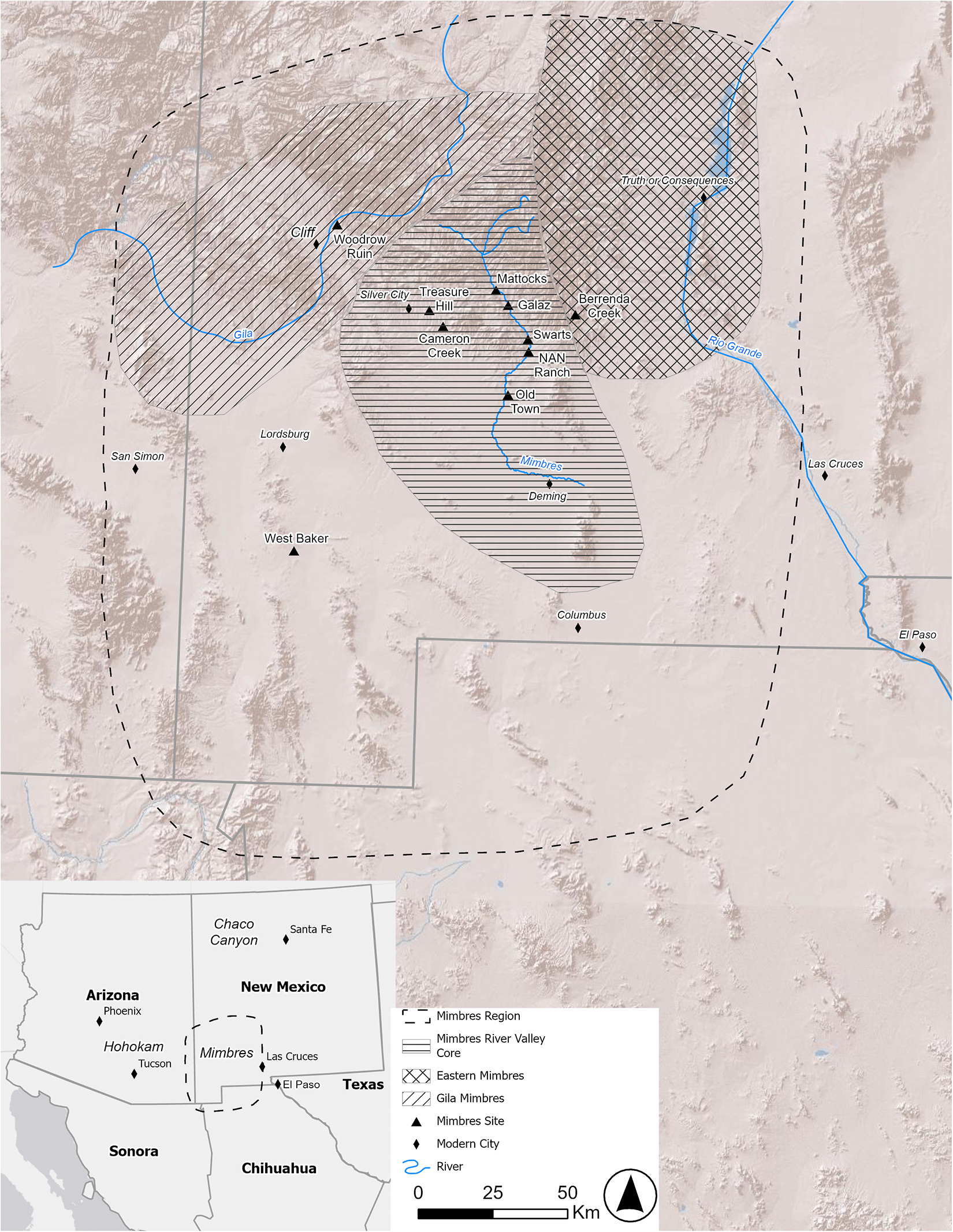
To ground this approach, I focus on the prehispanic US Southwest and Mexican Northwest (SW/NW), an archaeological region with a long and varied record of middle-range agricultural societies that never developed into state-level polities. Within this setting, this case study centers on the Mimbres River Valley (MRV) in southwestern New Mexico (Figure 1), a cultural branch of the Mogollon archaeological tradition defined by Haury (Reference Haury1936). Although the broader Mimbres region extends into parts of Arizona and northern Mexico, its cultural core was centered along the Mimbres River and its tributaries in Grant and Luna Counties. Although less widely known outside SW/NW archaeology than monumental regional centers such as Chaco Canyon in northwestern New Mexico, the MRV has long been central to scholarly discussions of ceramic production and iconography, ritual practice, and architectural change (Hegmon Reference Hegmon2002; LeBlanc Reference LeBlanc1983; Lekson Reference Lekson2006; Nelson and Hegmon Reference Nelson and Hegmon2010; Roth et al. Reference Roth, Gilman and Anyon2018). Much of what archaeologists know about the people who lived in the MRV derives from the Classic period (AD 1000–1130 [all dates are AD]; Anyon et al. Reference Anyon, Creel, Gilman, LeBlanc, Miller, Nash and Nelson2017), based on excavations at sites along the Mimbres River such as Mattocks, Galaz, Swarts, NAN Ranch, and Old Town (Anyon and LeBlanc Reference Anyon and LeBlanc1984; Cosgrove and Cosgrove Reference Cosgrove and Cosgrove1932; Creel Reference Creel2006a; Gilman and LeBlanc Reference Gilman and LeBlanc2017; Shafer Reference Shafer2003). Evidence from these and other sites in the Mimbres region indicates a society marked by population growth linked to intensified maize agriculture (Blake et al. Reference Blake, LeBlanc and Minnis1986; Minnis Reference Minnis1985), a transition from pithouse to pueblo architecture (Gilman et al. Reference Gilman, Creel, Gruber, Roth, Gilman and Anyon2018; Sedig et al. Reference Sedig, Lekson, Roth, Roth, Gilman and Anyon2018; Shafer Reference Shafer1995), and the emergence of one of prehispanic North America’s most distinctive painted ceramic types: Mimbres Classic Style III Black-on-white (Brody Reference Brody2004).
Map of the Mimbres region showing main sites discussed in the text, including the Mimbres River Valley core, the Gila Mimbres area, and the Eastern Mimbres area. The boundaries and locations of these areas are approximate and adapted from Hegmon (Reference Hegmon2002:Figure 1) and Hegmon, Schollmeyer, and Nelson (Reference Hegmon, Schollmeyer and Nelson2021:Figure 1). Map by Sean G. Dolan. (Color online)

After more than a century of excavation and study, archaeologists have often remarked on the homogeneity of Classic period material culture. Hegmon (Reference Hegmon2002:339), for instance, described Mimbres society as “somewhat inward focused and isolated,” a view echoed in subsequent scholarship (Creel and Anyon Reference Creel and Anyon2003:87–89; Hegmon et al. Reference Hegmon, Nelson and Ruth1998:158, Reference Hegmon, Nelson and Schollmeyer2016:58). Yet the broader historical and theoretical implications of this inward turn remain underdeveloped. This article addresses that gap by situating Mimbres Classic insularity within the wider context of SW/NW regional developments. Specifically, I examine how insularity functioned as a mode of social organization in the MRV and how it was materially expressed. I argue that Mimbres insularity was not the product of environmental or geographic constraints but a deliberate, historically situated response to expanding political centralization and integration elsewhere. In contrast to contemporaneous centers such as Chaco Canyon—which emphasized hierarchy, monumentality, and large-scale connectivity (Kohler and Ellyson Reference Kohler, Ellyson, Kohler and Smith2018; Lekson Reference Lekson2009, Reference Lekson and Wallace2014, Reference Lekson2015; Plog and Heitman Reference Plog and Heitman2010; Plog et al. Reference Plog, Heitman, Watson, Mills and Fowles2017)—MRV communities developed an alternative rooted in household ritual, symbolic regulation, and bounded interaction. Authority remained decentralized, and material practices were closely managed to preserve cultural sovereignty and local coherence. This insular orientation began in the 900s, reached its peak in the Classic period, and declined after 1130 as the valley became largely depopulated. During this same span, Chaco Canyon forged integration through great houses, road systems, and long-distance exchange beginning in the late 800s and continuing until about 1130/1150. Viewed together, these contrasting trajectories suggest that Mimbres insularity was not withdrawal but a conscious alternative to Chaco’s outward-looking strategies—an inward orientation rooted in household autonomy and ritual regulation.
This article unfolds in three parts. First, I develop a theoretical framework for understanding insularity as a dynamic, strategic practice rooted in comparative, historical, and archaeological perspectives. I then provide context for the MRV and broader Mimbres region from circa 750 to 1300, focusing on shifts in domestic and communal architecture, painted ceramics, mortuary practices, and regional interaction to trace how insularity materialized over time. Rather than presenting data from new fieldwork, I draw on existing syntheses and peer-reviewed literature to build a comparative, theory-driven interpretation of Mimbres Classic insularity. Finally, I briefly compare MRV material patterns to contemporaneous developments in Chaco Canyon to explore how cultural boundaries were maintained and negotiated. By shifting the analytical lens from integration to autonomy, this study contributes to broader discussions of how communities construct sovereignty, regulate identity, and sustain continuity through material means. It shows how Classic period society in the MRV, in its historical context, demonstrates that inwardness could serve as a generative and intentional strategy of social organization.
Framework for Understanding Insularity
Earlier models often portrayed inward-oriented societies as passive, treating them as the “leftovers” of world systems or stages of social evolution (Service Reference Service1962; Wallerstein Reference Wallerstein1974). However, insularity can instead be understood as an active and dynamic process through which communities turn inward—not to retreat from the world but to strengthen identity, cohesion, and autonomy. Practices such as ritual formalization, material homogeneity, and localized exchange reflect not an absence of external ties but deliberate decisions about how to (1) participate in broader networks, (2) regulate the flow of knowledge and goods, and (3) sustain alternative forms of governance rooted in place. This perspective encourages archaeologists to examine the historical contexts in which inward-facing strategies emerged, particularly among small-scale middle-range societies negotiating autonomy within competitive, extractive, or colonial landscapes (Borck Reference Borck and Karen2018; Liebmann Reference Liebmann2012; Lightfoot Reference Lightfoot2005). Rather than treating social boundaries as natural or inevitable, this approach reveals them as contingent, constructed, and maintained through practice. Insularity, therefore, becomes a lens for understanding how communities actively manage their relations with outsiders while cultivating distinct internal worlds.
Although this framework draws on examples from ancient North America, comparable dynamics appear globally. Much of twentieth-century scholarship depicted peripheral communities as static bystanders to dominant historical forces, with social development framed in terms of urbanization and centralization (Simmel Reference Simmel and Wolff1950; Wirth Reference Wirth1938). However, more recent work complicates this narrative. Scott (Reference Scott2009), for example, reframes withdrawal from dominant systems as a form of strategic evasion—a deliberate tactic to avoid incorporation into hierarchical states—and Wolf (Reference Wolf1982) highlights how groups often perceived as marginal are embedded within broader networks of power, trade, and meaning. From this perspective, insularity is not a symptom of isolation but a strategy of selective engagement that regulates the circulation of people, objects, and ideas to maintain distinct systems of cultural reproduction. Archaeological studies further underscore this point. Lightfoot (Reference Lightfoot2005) and Liebmann (Reference Liebmann2012) discuss how Native American groups negotiated colonial pressures through spatial and ritual strategies that preserved degrees of autonomy, whereas Yoffee (Reference Yoffee2005) notes the independent innovation of peripheral societies that shaped their own trajectories outside dominant centers of power. Across these cases, insularity is enacted through symbolic containment, spatial regulation, and the transmission of specialized knowledge within bounded social worlds.
Understanding insularity also requires attention to how boundaries are socially produced. Barth (Reference Barth and Barth1998) shifted the focus from internal group traits to the ways boundaries are created and maintained through interaction, inclusion, and exclusion. Cultural distinctiveness, then, is not simply inherited or geographically determined but actively produced through selective engagement. Building on this, Stone (Reference Stone2003) suggests that boundaries are situationally expressed; that is, identities may be highlighted, muted, or ignored depending on context. Such boundaries must be continually negotiated and reasserted, often through material or ritual markers that signal “we/they” distinctions, although, at times, difference may be downplayed to facilitate cooperation. Archaeologically, this means boundaries materialize in distinctive practices and circulation patterns, but their visibility shifts as communities respond to political, economic, or ecological pressures. As Duff (Reference Duff2002) and Lyons and Clark (Reference Lyons, Clark, Webster and McBrinn2008) note, variation in material culture cannot be separated from demographic and historical conditions, which shape whether diversity or uniformity reflects meaningful boundaries. Extending Barth’s (Reference Barth and Barth1998) model, identities are negotiated within particular domains of practice, where groups and individuals adjust affiliations depending on perceived benefits. Boundary making, in this sense, is always contingent, shaped by population dynamics and the strategic choices of actors.
Comparative examples from both state and nonstate polities illustrate the varied ways that insularity is practiced and maintained. In centralized polities—such as North Korea under the Juche ideology (Frank Reference Frank2005; Lankov Reference Lankov2013) or Albania under Enver Hoxha (Dervishi and Johnson Reference Dervishi, Johnson, Fiorito, Scheall and Suprinyak2020)—insularity was imposed from the top down through strict control of trade, media, and contact with the outside world, all in service of preserving state sovereignty and ideological purity. By contrast, in smaller-scale or nonstate societies, insularity often emerges through decentralized practices rooted in kinship, ritual, and subsistence. Scott (Reference Scott2009) shows that upland Zomia groups in Southeast Asia maintained autonomy not by isolation alone but by deliberately evading incorporation into surrounding states. They did so through mobility, reliance on oral rather than written traditions, and settlement patterns that made taxation and control difficult. In a different context, the Amish in North America sustain their cultural boundaries through conscious restrictions on technology, formal education, and participation in mainstream economic life (Hurst and McConnell Reference Hurst and McConnell2010). The Sentinelese of the Andaman Islands, meanwhile, maintain an extreme form of insularity shaped by colonial violence and sustained by both internal resistance and external legal protections against contact (Sasikumar Reference Sasikumar2018).
Graeber (Reference Graeber2013) reframes cultural distinctiveness not as the absence of influence but as the result of what he terms “creative refusals.” Rather than simply failing to adopt traits from their neighbors, communities often rejected them deliberately as acts of differentiation and self-definition. Such refusals were not merely reactive but generative, producing new political forms, ritual practices, and material traditions. Drawing on the concept of “schismogenesis”—the process by which groups define themselves through progressive differentiation—Graeber (Reference Graeber2013) discusses that the key analytical question is not why traits spread but why they did not. His examples range from effigy-mound builders who resisted Mississippian hierarchies to Bronze Age “heroic societies” that turned away from bureaucratic states.
These comparisons highlight an important distinction. Whereas state-level insularity relies on centralized authority, smaller-scale societies often enact insularity through household-based and ritualized practices. The point is not to equate these contexts but to underscore that insularity is a flexible strategy observable across scales, always materialized through symbolic and practical acts of boundary making. Viewed through this lens, the prehispanic SW/NW provides particularly clear examples of how selective engagement unfolded in practice given that communities remained connected in certain ways while actively resisting incorporation into external hierarchies.
Using schismogenesis as a framework, Cooper and coauthors (Reference Cooper, Ferguson and Hill2025) argue that Late Developmental period (900–1200) Ancestral Pueblo communities in the Northern Rio Grande, New Mexico, actively distinguished themselves from the Chaco regional system. Ceramic evidence from the Pojoaque Grant site shows ongoing interaction with Chacoan communities, but the absence of hallmark traits such as great-house architecture reflects not isolation but deliberate resistance, given that Northern Rio Grande groups chose not to fully engage with Chaco’s ceremonial and political order. This distinction between interaction and participation highlights how communities were able to remain embedded in exchange networks while rejecting incorporation into external hierarchies. Cooper and coauthors (Reference Cooper, Ferguson and Hill2025) interpret these patterns as a form of cultural refusal (sensu Graeber Reference Graeber2013), in which local architectural and material traditions served as vehicles for autonomy and cultural differentiation within an interconnected world.
The Gallina region of northern New Mexico also illustrates a related but distinct strategy of resistance (Borck Reference Borck and Karen2018). Between 1100 and 1300, Gallina communities deliberately resisted the dominant regional patterns by rejecting the hierarchy and aggregation occurring in much of the Four Corners, where Chaco Canyon was a major actor. In place of these institutions, the Gallina emphasized dispersed settlements, limited regional exchange, and uniform material traditions. Borck (Reference Borck and Karen2018) argues that the Gallina practiced an atavistic social movement of earlier lifeways—a conscious return to ancestral principles. This differs from Wallace’s (Reference Wallace1956) concept of a revitalization movement, which he defines as a deliberate, future-oriented effort to create a more satisfying cultural system. Where Wallace (Reference Wallace1956) emphasized innovation directed toward the future, Borck (Reference Borck and Karen2018:99) highlights intentional reengagement with the past given that Gallina households curated older nonlocal sherds as ancestral “memory maps” while excluding contemporary wares that signaled conformity. Their dispersed architecture and absence of centralized ritual spaces further underscore their commitment to household autonomy and boundary making.
Taken as a whole, these perspectives reframe insularity as a generative mode of social organization rather than a marginal condition. States enforce insularity through centralized control, whereas smaller-scale societies cultivate it through household ritual, boundary making, and selective interaction. In both contexts, insularity had materialized through practices that make boundaries real, regulating flows of goods, information, and participation to sustain distinctive cultural trajectories. What unites these varied cases is the recognition that turning inward is not about withdrawal but about presence—the deliberate construction of alternatives to dominant systems. This framework provides the foundation for examining how communities in the MRV used architecture, painted ceramics, mortuary practices, and regional interaction, not simply to distance themselves from their neighbors but to actively materialize a distinctive cultural world grounded in autonomy and ritual sovereignty.
Pathways to Mimbres Insularity
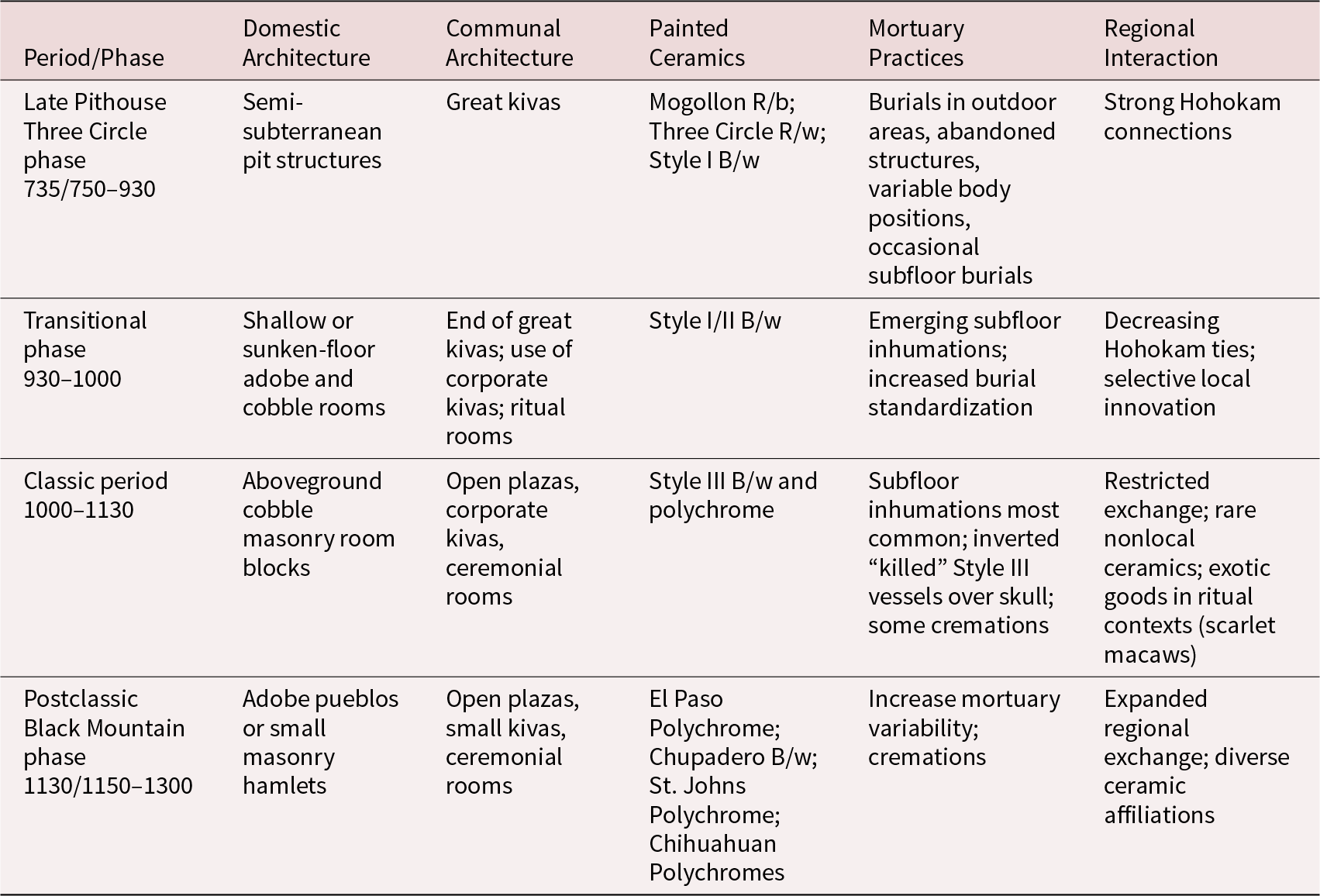
The following sections trace how MRV communities expressed insularity through architecture, painted ceramics, mortuary practices, and regional interaction. These strategies of symbolic containment and internal cohesion first took shape in the 900s during the Late Pithouse (735/750–930) and Transitional phase (930–1000) and reached its fullest expression in the Classic period. After 1130, however, many of these practices gave way to more varied outward-looking patterns. Insularity, in other words, was not static but a historical process—emerging, flourishing, and eventually receding through shifting material expressions. Table 1 summarizes the general patterns explored in the following sections.
Notable Characteristics during the Late Pithouse, Classic, and Postclassic Periods.

Sources: Based on Anyon and coauthors (Reference Anyon, Creel, Gilman, LeBlanc, Miller, Nash and Nelson2017) and Sedig (Reference Sedig2020).
Domestic Architecture
From approximately 200 to 1000, households in the MRV lived in semi-subterranean pithouses (Anyon et al. Reference Anyon, Creel, Gilman, LeBlanc, Miller, Nash and Nelson2017; Diehl and LeBlanc Reference Diehl and LeBlanc2001). These dwellings—used for cooking, storage, and sleeping—typically included central hearths, roof-support posts, and plastered walls, with lateral ramps providing access. Clusters of two to four households often surrounded great kivas (discussed below). Larger villages such as Galaz contained more than 100 pithouses, with Late Pithouse period populations reaching 200 or more residents (Anyon and LeBlanc Reference Anyon and LeBlanc1984; Anyon and Roth Reference Anyon, Roth, Roth, Gilman and Anyon2018; Sedig et al. Reference Sedig, Lekson, Roth, Roth, Gilman and Anyon2018).
By the early to mid-900s, communities began a gradual architectural shift that reflected deeper social, environmental, and cosmological transformations. Excavations at NAN Ranch along the Mimbres River (Shafer Reference Shafer1995, Reference Stone2003) and Woodrow Ruin in the Gila (Sedig Reference Sedig2020) show that this was not a sudden break but an incremental remodeling of existing pithouses alongside experiments with new construction methods. Lateral entrances were blocked, roof hatchways and ventilator shafts were introduced, and circular hearths were replaced by rectangular slab-lined versions. Some structures were rebuilt with shallow adobe-lined foundations, transitional forms bridging fully subterranean pithouses and surface pueblos. These changes coincided with episodes of drought in the 900s, linking environmental precarity with reorganization of household space and ritual life (Creel Reference Creel, Doyel and Dean2006b; Sedig Reference Sedig2020).
These architectural changes were not merely functional; instead, they were materialized evolving cosmological beliefs. Shafer (Reference Shafer1995, Reference Shafer2003, Reference Shafer, Powell-Martí and Gilman2006) interprets the adoption of roof-entry dwellings as embodying a layered universe, with descent through hatchways replicating emergence narratives. He goes on to suggest that the ceiling hatchway could have served as a symbolic portal, with the ladder functioning as an axis mundi that connected different worlds. Climbing the ladder, in this view, may have reenacted the emergence from one realm into another (Shafer Reference Shafer1995:43). In addition, hearths and ventilators formalized interior divisions, aligning daily activities with cosmological order. As Sedig (Reference Sedig2020) argues, this reconfiguration paralleled the retirement of great kivas (discussed below) and the dispersal of ritual into household and plaza settings. Homes became symbolic centers of authority, embedding resilience and spirituality within the architecture of everyday life.
By the Classic period, domestic architecture had shifted fully to aboveground cobble masonry pueblos, often constructed directly atop earlier pithouse locations (Anyon and LeBlanc Reference Anyon and LeBlanc1984; Creel Reference Creel2006a; Sedig Reference Sedig2020; Shafer Reference Shafer2003). Pueblo room blocks were typically arranged around open courtyards or plazas (Creel and Shafer Reference Creel and Shafer2015; Shafer and Drollinger Reference Shafer and Drollinger1998). At Galaz and Swarts, spatial layouts sometimes reflected principles of north–south dualism centered with cosmological order (Cosgrove and Cosgrove Reference Cosgrove and Cosgrove1932; Sedig Reference Sedig2020:34). Certain elements recurred widely, such as roof hatchways, modular suites combining multi-use rooms with smaller storage chambers, blocked doorways, and intentional roof sealing, although architectural expression was far from uniform (Gilman Reference Gilman, Powell-Martí and Gilman2006; Hegmon et al. Reference Hegmon, Brady, Nelson, Powell-Martí and Gilman2006; Shafer Reference Shafer, Powell-Martí and Gilman2006). For example, excavations at Galaz reveal large, aggregated room blocks (Anyon and LeBlanc Reference Anyon and LeBlanc1984), whereas Mattocks shows smaller compounds with variable hearth placement and interior arrangements (Gilman and LeBlanc Reference Gilman and LeBlanc2017). Taken together, such evidence demonstrates that Classic period pueblos in the MRV retained variation in construction and layout, underscoring the persistence of household autonomy rather than adherence to centralized architectural prescriptions (Hegmon et al. Reference Hegmon, Brady, Nelson, Powell-Martí and Gilman2006).
The transition from pithouse to pueblo marked not only a structural shift but also a profound reorientation of domestic life. Whereas earlier pithouses accommodated mobility and flexible subsistence, pueblos materialized permanence, enclosed space, and a deeper embedding of ritual authority in the household. Across sites, households employed a recognizable architectural grammar that signaled cultural belonging while still allowing variation. Practices such as blocking entrances and ceilings, installing slab-lined hearths, and placing burials beneath floors (discussed later) instantiated cosmological principles within domestic space (Shafer Reference Shafer1995). Yet the variability in how these practices were combined underscores that domestic architecture was not standardized. Instead, Classic period pueblos represented a field of bounded distinctiveness, meaning there was visible coherence coupled with strong internal diversity. This pattern exemplifies Mimbres insularity as a social strategy—rejecting conformity while cultivating recognizable but flexible markers of identity at the household scale.
Communal Architecture
For hundreds of years in the Mimbres region and across the broader Mogollon world, people constructed and used great kivas—large, semi-subterranean structures that served as venues for communal gatherings and ritual life (Stokes et al. Reference Stokes, Dungan and Sedig2023). These buildings brought households together for religious, political, and social purposes, helping to forge interhousehold ties, mediate disputes, and establish collective claims to resources such as water and land. Unlike smaller domestic pithouses, great kivas were much larger—typically between 35 and 175 m2—and they featured benches, central hearths, entry ramps, roof supports, and sipapus, or small openings symbolizing emergence from the underworld (Creel and Shafer Reference Creel and Shafer2015; Creel et al. Reference Creel, Anyon and Roth2015; Gilman and Stone Reference Gilman and Stone2013). Their construction was itself a ritual act, often marked by dedicatory offerings (Creel et al. Reference Creel, Anyon and Roth2015; Roth and Romero Reference Roth and Romero2022).
In the early 900s, however, communities in the MRV began to dismantle this long-standing tradition. Great kivas were deliberately closed in termination ceremonies as roof supports were removed, offerings deposited, and the structures set ablaze. At Galaz, the fires were so intense that they vitrified adobe walls (Anyon and LeBlanc Reference Anyon and LeBlanc1984:124; Creel and Anyon Reference Creel and Anyon2003, Reference Creel, Anyon, Nelson and Hegmon2010). These closures were not signs of conflict, disease, or decline but intentional acts designed to release accumulated ritual power and end the sacred functions of the structures (Creel and Anyon Reference Creel and Anyon2003). Whereas Mogollon groups continued building great kivas into the 1300s, MRV communities chose another path. As Gilman and coauthors (Reference Gilman, Thompson and Wyckoff2014) and Anyon (Reference Anyon, Stokes, Dungan and Sedig2023:244) note, this break marked a profound ideological shift: ritual authority was no longer centered in valley-wide ceremonial institutions but instead relocated to the household scale. Around the same time, by the start of the Classic period, new practices emerged, such as the introduction and use of scarlet macaws for rituals and the appearance of Mesoamerican-inspired motifs on Classic Style III pottery (Gilman et al. Reference Gilman, Thompson and Wyckoff2014).
The retirement of great kivas did not eliminate communal ritual but redirected it into new architectural and social forms. For example, Classic period communities replaced enclosed ceremonial structures with open plazas situated between room blocks (Anyon and LeBlanc Reference Anyon and LeBlanc1980; Creel and Shafer Reference Creel and Shafer2015). This shift created gathering places that were both communal and embedded within domestic compounds. In contrast to great kivas, smaller kivas or large surface rooms—what Shafer (Reference Shafer2003, Reference Shafer, Powell-Martí and Gilman2006) calls corporate kivas—were now integrated into village architecture and served localized or lineage-based groups, whereas plazas hosted ceremonies that linked clusters of families. Rather than being centered in a single great kiva that united the entire community, ritual activity was now spread across multiple settings. This reorganization reduced valley-wide integration while reinforcing local, kin-based ceremonial life in the MRV.
Shafer (Reference Shafer2003, Reference Shafer, Powell-Martí and Gilman2006) situates these architectural changes within a broader restructuring of social organization. He argues that Classic Mimbres society in the MRV was organized around corporate groups, likely kin-based and perhaps like the lineage or clan systems of the Western Pueblos. Evidence for this includes the emergence of formal indoor cemeteries and the decline of great kivas, suggesting that ceremonies once performed in large communal structures shifted into the more restricted domain of corporate groups. Beginning in the 900s, burials were placed in subfloor cemeteries beneath habitation rooms, accessible only through roof entryways, which emphasized their exclusivity. This time is also when the tradition of placing “killed” ceramic vessels over the deceased’s skull began, further underscoring the growing ritual formalism, marking a shift in how death and ceremony were managed at the household scale (see the mortuary practice discussion later). For an illustration of this mortuary practice, see Figure 8 in Shafer (Reference Shafer1995). By the Classic period, many rooms originally built as habitation spaces were remodeled into corporate kivas: enlarged rooms within room blocks used by family lineages who likely held claims to prime agricultural land (Shafer Reference Shafer2003, Reference Shafer, Powell-Martí and Gilman2006). This link between ritual authority and access to subsistence resources reinforced the close relationship between community identity and the control of productive landscapes (Stokes Reference Stokes and Stokes2019).
Corporate kivas were marked by distinctive features such as underlying cemeteries, floor vaults, wall niches, benches, and shelves (Shafer Reference Shafer, Powell-Martí and Gilman2006). Classic room blocks often consisted of contiguous suites, some likely occupied by related families, which reinforced the kin-based character of social organization. According to Shafer (Reference Shafer, Powell-Martí and Gilman2006), this system reached its height between 1060 and 1100, a period when favorable rainfall and the production of Classic Style III pottery created ideal conditions for corporate groups to flourish. Architectural innovations also carried symbolic weight. Shafer (Reference Shafer1995) argues that elements such as ceiling hatchways and subfloor cemeteries embodied a cosmological model of a layered universe, materially linking the living with the dead. Restricted access to these features would have intensified the secrecy and exclusivity of corporate rituals, marking a decisive shift away from valley-wide ceremonial institutions and toward household-centered religious life.
At the same time, plazas emerged as the other major locus of communal practice in the MRV during the Classic period. Evidence from Swarts and NAN Ranch shows that plazas were not empty spaces but curated ritual landscapes (Creel and Shafer Reference Creel and Shafer2015; Shafer and Drollinger Reference Shafer and Drollinger1998). Repeated resurfacing, adobe-lined pits, cremations, caches of artifacts, and structured deposits demonstrate that these spaces served as arenas for ceremonial activity embedded within domestic life. The east plaza at NAN Ranch, for instance, contained the largest known Classic period cremation cemetery (Shafer Reference Shafer2003; Shafer and Drollinger Reference Shafer and Drollinger1998). However, plaza contexts at many MRV sites remain only partially investigated, leaving an incomplete picture of their full range of uses (Creel and Shafer Reference Creel and Shafer2015). More targeted excavation of these spaces is needed to better understand their ceremonial and social roles.
Together, these changes marked a decisive turn in communal architecture. The shift from great kivas to plazas and corporate kivas was not a move toward architectural standardization but toward bounded distinctiveness—practices widely recognizable as Mimbres yet variable from site to site. Classic period communal architecture materialized insularity by relocating ritual sovereignty to household compounds, embedding authority within kin-based groups, and reaffirming community identity through inward-facing ceremonial practices. In this way, the MRV turned away from participation in larger, valley-wide ritual activity, embodying a strategy of insularity that balanced cohesion with autonomy.
Painted Ceramics
As architecture in the MRV became more inwardly focused, similar shifts unfolded in the production, circulation, and use of painted ceramics. Potters first made painted ceramics in the Late Pithouse period, with Mogollon Red-on-brown appearing by 650 and Three Circle Red-on-white by 730 at NAN Ranch (Shafer and Brewington Reference Shafer and Brewington1995). By 750, Mimbres potters developed black-on-white vessels, including Boldface Style I with simple geometric designs and Transitional Style II by 880, which introduced more complex compositions and early figurative motifs (Brody Reference Brody2004; Shafer and Brewington Reference Shafer and Brewington1995). These developments expanded the symbolic vocabulary of the region while reflecting ongoing interaction with neighbors, as seen in stylistic parallels to Hohokam Red-on-buff pottery from Arizona (Hegmon and Nelson Reference Hegmon, Nelson, Sullivan and Bayman2007). There are numerous published sources that illustrate Mimbres Style I, II, and III pottery vessels in detail, and readers are referred to these works for representative examples (e.g., Brody Reference Brody2004; Gilman and LeBlanc Reference Gilman and LeBlanc2017:Appendix 15; Shafer Reference Shafer2003:Appendix I).
This trajectory culminated in the Classic period with Style III Black-on-white vessels, perhaps the most distinctive markers of Mimbres identity (Brody Reference Brody2004; Creel Reference Creel2022; Gilman et al. Reference Gilman, Creel, Gruber, Roth, Gilman and Anyon2018; Hegmon and Kulow Reference Hegmon and Kulow2005; Hegmon et al. Reference Hegmon, McGrath, O’Hara III, Russell, Roth, Gilman and Anyon2018; Hegmon, Russell, et al. Reference Hegmon, Russell, Baller, Peeples and Striker2021). Around 1060, potters even began producing some of the earlier polychrome designs in the SW/NW (Shafer and Brewington Reference Shafer and Brewington1995). Unlike most painted pottery elsewhere in the SW/NW during the 1000s, which tended toward abstract motifs or limited depictions of living beings, Classic Style III vessels stood out for their fine-line geometric designs and figurative imagery of humans, animals, and mythological beings, sometimes performing various activities. Used in both the serving of food and ritual contexts, especially as burial goods, these vessels localized outside influences such as Mesoamerican-inspired motifs within a distinctly Mimbres symbolic grammar (Brody Reference Brody2004; Gilman et al. Reference Gilman, Thompson and Wyckoff2014; Hegmon, Russell, et al. Reference Hegmon, Russell, Baller, Peeples and Striker2021). What defined them was not rigid uniformity but the cultivation of a recognizable and bounded style that made the pottery designs immediately identifiable as Mimbres.
Although individual painters developed distinctive brushwork and themes (LeBlanc Reference LeBlanc, Powell-Martí and Gilman2006; Russell and Hegmon Reference Russell and Hegmon2015), the iconography remained coherent across the Mimbres region. Conventions of form and design provided cohesion, yet subject matter and composition varied widely, producing a system of bounded distinctiveness rather than strict standardization (Hegmon and Kulow Reference Hegmon and Kulow2005; Hegmon et al. Reference Hegmon, McGrath, O’Hara III, Russell, Roth, Gilman and Anyon2018; Hegmon, Russell, et al. Reference Hegmon, Russell, Baller, Peeples and Striker2021). As LeBlanc (Reference LeBlanc, Nelson and Hegmon2010:75) observes, “Something in Mimbres culture enabled and encouraged artistic expression and innovation for several generations.” Insularity may have created the conditions for this flourishing as household autonomy and symbolic containment fostered a social setting where creativity could thrive within shared cultural roles. Potters adhered to common vessel shapes and a consistent visual framework, yet they retained freedom in imagery and execution. This balance of cohesion and variation contrasts with more prescriptive ceramic traditions in Chaco or Hohokam centers, where production tended to be more uniform and left little room for individual creativity.
Mimbres Classic Style III vessels often feature structured layouts—single figures, paired motifs, or narrative scenes (Hegmon and Kulow Reference Hegmon and Kulow2005; Hegmon, Russell, et al. Reference Hegmon, Russell, Baller, Peeples and Striker2021)—that fit Plog’s (Reference Plog, Conkey and Hastorf1990:62) description of iconological style: conservative, symbolically rich, and culturally meaningful. Certain motifs—such as birds, mammals, and reptiles—were shared widely across sites, reinforcing unity through a common visual language (Creel Reference Creel2022; Hegmon et al. Reference Hegmon, McGrath, O’Hara III, Russell, Roth, Gilman and Anyon2018; Hegmon, Russell, et al. Reference Hegmon, Russell, Baller, Peeples and Striker2021). Their broad circulation, especially of vessels with only geometric designs, suggests they were public affirmations of identity. As Hegmon, Russell, and coauthors (Reference Hegmon, Russell, Baller, Peeples and Striker2021:37) put it, these bowls conveyed a powerful social message: “I belong here, I accept and am part of the Mimbres way of life.” In this sense, pottery served not only as functional objects or funerary offerings but also as material declarations of belonging, anchoring Mimbres distinctiveness at the regional scale.
At the same time, geographic variation marked the limits of this symbolic system. Whole or partial Style III vessels and sherds with figurative imagery (e.g., people and animals) are relatively uncommon outside the MRV, though sherds with figurative designs have been recovered from many contemporaneous sites in the Jornada Mogollon region in south-central New Mexico and Trans-Pecos Texas. In contrast, vessels with only geometric designs circulated more widely (Gilman Reference Gilman and Karen2018; Gilman et al. Reference Gilman, Jakob and Darrell2019; Hegmon, Russell, et al. Reference Hegmon, Russell, Baller, Peeples and Striker2021). Apart from the Jornada case, which will be discussed later, this distribution pattern suggests deliberate boundary maintenance: geometric vessels expressed shared identity across the Mimbres region, whereas figurative imagery was more tightly controlled and retained within core valley communities. The absence of Style III figurative vessels from major SW/NW centers further underscores this distinction. Despite Chaco Canyon’s extensive exchange networks, no Mimbres vessels—or even sherds—have been recovered there. As Lekson (Reference Lekson2015:47) notes about Chaco, “It could have had anything it wanted, and it didn’t want Mimbres pottery.” The same pattern holds in southern Arizona in the Phoenix and Tucson basins, where only a handful of Style III sherds have been documented (Minnis Reference Minnis1985:170). Their scarcity cannot be explained by lack of access, given that long-distance interaction and exchange connected the region. Instead, it suggests that communities in the MRV deliberately restricted the movement of their most symbolically charged vessels, keeping them more local.
Classic Style III Black-on-white ceramics were therefore more than artistic achievements; they were instruments of cultural enclosure. Their circulation was carefully managed, their imagery encoded shared meanings, and their mortuary role made them powerful statements of belonging. By embedding visual communication in a bounded symbolic framework, Mimbres potters sustained a distinctive cultural world. These dynamics align with Scott’s (Reference Scott1990) concept of “hidden transcripts”: vessels that expressed identity and sovereignty within controlled, local domains even as surrounding regions pursued monumentality and integration, particularly Chaco Canyon. The shift from Late Pithouse ceramic-design experimentation to Classic Style III distinctiveness reflects not a move toward standardization but a deliberate cultivation of cultural boundaries. Like architecture and mortuary practices (see below), painted ceramics embodied an insular strategy—locally variable yet collectively distinctive, bounded against external traditions while nurturing internal creativity.
Mortuary Practices
Mortuary practices offer critical insight into shifting ritual priorities, household authority, and concepts of identity over time in the MRV. From the Late Pithouse through the Classic periods, burial customs moved from diverse, loosely organized traditions to a bounded repertoire of practices that defined regional distinctiveness. During the Late Pithouse period, the deceased were interred in outdoor cemeteries, abandoned rooms, construction fill, or beneath household floors, with little consistency in body positioning or associated goods (Gilman Reference Gilman1990; Livesay and Gilman Reference Livesay, Gilman, Watson and Rakita2020; Roth and Baustian Reference Roth and Baustian2015). Inhumation was the most frequent treatment, often accompanied by multiple vessels and objects—although cremation was also present, if less common (Creel Reference Creel1989). This diversity reflects the broader tradition in which households exercised autonomy in managing death, accommodating multiple ritual pathways without a single prescriptive model. Variability in mortuary practices should therefore be understood not as inconsistency but as flexibility—a system that allowed communities to integrate the dead into social and cosmological life in multiple ways.
Livesay and Gilman’s (Reference Livesay, Gilman, Watson and Rakita2020) study shows that between 880 and 950, mortuary practices in the MRV shifted from diverse forms to more standardized traditions. This consolidation of burial customs occurred before the full architectural transition to pueblos but coincided with the ritual closure and burning of great kivas—transformations that later became central to Classic period Mimbres identity. Subfloor inhumations grew increasingly common through time, often placed in homes with evidence of long-term occupation such as superimposed floors and curated hearths (Roth and Baustian Reference Roth and Baustian2015; Shafer Reference Shafer1995, Reference Shafer, Farmers and Koontz2022). As mentioned earlier in the Communal Architecture section, the restricted and repeated placement of such burials within household spaces reinforced secrecy, exclusivity, and the authority of corporate groups—at least at NAN Ranch. These mortuary practices embedded ancestors directly within domestic space, materializing connections to lineage and affirming household sovereignty. Burying the dead beneath house floors or within closed structures allowed people to live with their ancestors as members of society, thereby legitimizing both long-standing and newly asserted claims to land (Shafer Reference Shafer1995, Reference Shafer2003; Stokes Reference Stokes and Stokes2019).
Individuals were typically interred in semiflexed positions within oval pits, accompanied by a single Classic Style III bowl (geometric or figurative) inverted over the skull and ritually “killed” with a puncture through its base (Bartlett Reference Bartlett2013; Gilman Reference Gilman1990, Reference Gilman, Powell-Martí and Gilman2006:68; Shafer Reference Shafer1995, Reference Shafer, Farmers and Koontz2022). Shafer (Reference Shafer2003:214) argues that this placement was not merely symbolic but transformative; the ceramic vessel acted as a mask for the deceased, converting the dead into a supernatural being or oracle. Far from simple grave goods, the vessels were active instruments of ritual and memory. They functioned as portals between worlds, encoding sacred knowledge and anchoring the dead within a bounded symbolic system (Livesay Reference Livesay2017). These practices reflected a tripartite cosmos in which subfloor burials connected the deceased to the underworld, the living household enacted the middle world, and the dome-like form and imagery of mortuary ceramic vessels evoked the otherworld—a cosmological framework that bound memory, ancestry, and ritual sovereignty together, as Shafer (Reference Shafer1995) illustrates in his Figure 12.
Despite the increasing prominence of subfloor burials, variation persisted in ways that reinforced household autonomy during the Classic period. Some graves included vessels placed at the feet or pelvis, or pottery sherds scattered in the fill—continuities with earlier traditions that illustrate how flexibility remained embedded within a shared ideological grammar (Livesay and Gilman Reference Livesay, Gilman, Watson and Rakita2020). At the same time, cremation continued as an alternative mortuary treatment. Creel (Reference Creel1989, Reference Creel and Wallace2014:541–542) discusses cremations during the Late Pithouse and Classic periods, most of which were secondary deposits of calcined bone placed in pits or vessels. In the Classic period, cremations were often placed in plazas rather than within domestic rooms, suggesting that this mortuary practice was associated with communal rather than household ritual. Shafer (Reference Shafer2003) estimates that 50 cremations are present at NAN Ranch, but the actual number is unknown (Creel Reference Creel and Wallace2014:541). These plaza-based cremations were often accompanied by projectile points, stone censors, palettes, Glycymeris shell bracelets, and other objects that were typically not interred with inhumations (Creel Reference Creel1989; Creel and Shafer Reference Creel and Shafer2015). Like the “killing” of bowls in inhumations, these acts of fiery destruction emphasized transformation, release, and cosmological renewal, distinguishing cremation as a communal form of ritual sovereignty complementary to the household focus of inhumation.
In sum, Classic period mortuary practices reveal a dual structure that balanced cohesion with variation. Subfloor inhumations with “killed” ceramic vessels created a consistent, regionally distinctive practice that visually reinforced cultural belonging and embedded ancestors within domestic life, whereas plaza cremations offered a parallel mode of ritual emphasizing transformation, collectivity, and public expression. This was not rigid standardization; instead, it was bounded distinctiveness with a series of practices that anchored identity in the MRV while preserving household autonomy and ritual flexibility. Mortuary ritual, like architecture and painted ceramics, materialized MRV insularity not as isolation but as a carefully managed balance of diversity and distinctiveness that reinforced local coherence.
Regional Interaction and Nonlocal Objects
Material culture—especially painted ceramics, motifs, and symbolic imports—provides important insight into how people in the MRV positioned themselves within broader SW/NW networks. Rather than operating in isolation, they engaged selectively, making deliberate choices about when and how to participate. From the Late Pithouse through the Classic periods, interaction reflected shifting strategies of negotiation. For example, Lekson (Reference Lekson2015:42) describes the Mimbres as a cultural “weathervane,” meaning that during the Late Pithouse period, they turned to the Hohokam for knowledge but later turned their interest northward toward the Ancestral Pueblo and Chaco in response to changing regional dynamics. Building on this perspective, archaeologists have compared the MRV with other areas of the Mimbres world, and recent work has expanded these comparisons by showing that variation in interaction, participation, and material culture complicates earlier narratives of uniformity (Gilman Reference Gilman and Karen2018; Whisenhunt and Gilman Reference Whisenhunt and Gilman2025).
During the Late Pithouse period, people in the MRV were strongly connected to regional networks, particularly with the Hohokam (Brody Reference Brody2004:81–86; Creel Reference Creel and Wallace2014:537–544; Creel and Anyon Reference Creel and Anyon2003; Hegmon and Nelson Reference Hegmon, Nelson, Sullivan and Bayman2007; LeBlanc Reference LeBlanc1983). These ties, strongest in the 800s, helped shape early development in the MRV. Hohokam irrigation practices influenced local agricultural intensification, which supported population growth and larger pithouse settlements, although irrigation canals remained smaller in scale than in southern Arizona (Creel Reference Creel and Wallace2014; Creel and Anyon Reference Creel and Anyon2003). Hohokam ceramic iconography, such as long-necked birds and horned toads, also suggest symbolic influence (Brody Reference Brody2004; Hegmon and Nelson Reference Hegmon, Nelson, Sullivan and Bayman2007), as do stone palettes in the Mimbres region (Garcia de Quevedo Reference Garcia de Quevedo2004). Yet this borrowing was never wholesale; Hohokam elements were integrated into local frameworks, reshaped to fit Mimbres priorities.
By the early Classic period, MRV communities began to distance themselves from Hohokam influence. At Galaz, for example, Hohokam-style imagery on Mimbres ceramics declined after 1020, marking a conscious turn toward more localized identities (Hegmon and Nelson Reference Hegmon, Nelson, Sullivan and Bayman2007:95–96). Lekson (Reference Lekson1993, Reference Lekson2009, Reference Lekson and Wallace2014, Reference Lekson2015) characterizes this shift as a northern pivot, reflected in closer alignment with Ancestral Pueblo features, including pueblo-style architecture and the adoption of indented corrugated pottery. Even so, direct Mimbres connections to Chaco Canyon remain debated, with Hegmon and Nelson (Reference Hegmon, Nelson, Sullivan and Bayman2007:79) cautioning that evidence for sustained ties is limited.
At the same time, southern connections became more visible as MRV potters began incorporating Mesoamerican-like motifs into Classic Style III ceramics, and scarlet macaws appeared in ritual contexts (Gilman et al. Reference Gilman, Thompson and Wyckoff2014). Other exotic materials, such as Gulf Coast shell (Bradley Reference Bradley and Hegmon2000) and copper bells (Vargas Reference Vargas1995), also entered the MRV in small numbers, though recent research suggests that some of these items may have originated closer to home. For instance, scarlet macaws may have been bred at Old Town (Conrad et al. Reference Conrad, Wurth, Tenner, Naes, LeBlanc, Creel, Williams and Beacham2023), and copper bells may have been made locally (Adams Reference Adams2025). Alongside these imported goods, there are signs that outsiders themselves were present in the valley. Ancient DNA reveals that one individual from NAN Ranch had ancestry linked to Mesoamerica (Snow et al. Reference Snow, Shafer and Smith2011), and Creel (Reference Creel and Wallace2014:541) suggests that some cremated individuals at Mimbres sites may have been ethnic Hohokam; however, there is no definitive evidence, and further research is needed to clarify this possibility. Together, these cases demonstrate that insularity did not entail absolute exclusion but rather a system in which difference—whether in objects, imagery, or people—was selectively incorporated into ritual life while maintaining local sovereignty.
Interaction with Jornada Mogollon groups adds another dimension to sustained eastward interaction (Miller Reference Miller, Harry and Herr2018). Mimbres pottery, including Classic Style III sherds with figurative imagery, has been documented at Jornada sites, and there are similarities between motifs on Mimbres pottery and rock art—for example, the “goggle-eye” figures also found in Jornada imagery—that point to long-standing shared religious traditions (Miller Reference Miller, Harry and Herr2018; Miller et al. Reference Miller, Creel and Geib2024). These parallels indicate that Classic Mimbres and Jornada Mogollon groups engaged selectively through overlapping cosmological frameworks, reinforcing local cohesion while participating in broader symbolic landscapes.
Despite such connections, MRV communities were distinctive in how they regulated external material culture. Non-Mimbres painted pottery is almost absent from Classic period assemblages. At NAN Ranch, nonlocal vessels accounted for less than 0.5% of the total (Shafer Reference Shafer2003:187), with similarly low frequencies reported at Mattocks, Swarts, and Galaz (Anyon and LeBlanc Reference Anyon and LeBlanc1984:153; Cosgrove and Cosgrove Reference Cosgrove and Cosgrove1932:92–99; Gilman and LeBlanc Reference Gilman and LeBlanc2017:247–248). Furthermore, Classic Style III vessels featuring geometric and figurative designs were widely used within the MRV, but those depicting humans, animals, or ritual scenes were uncommon outside the valley. However, some sites—such as West Baker, located 90 km southwest of Old Town (McCluney Reference McCluney1968)—do contain examples of figurative pottery, suggesting that these restrictions were not absolute and that selective exchange or movement of such vessels did occur.
At core MRV sites such as Mattocks, Galaz, Swarts, NAN Ranch, and Old Town, figurative designs make up 30%–34% of vessels. At Classic period sites to the west, including Cameron Creek and Treasure Hill, proportions were slightly lower but still substantial at 27% and 24%, respectively (Gilman Reference Gilman and Karen2018:280). However, the pattern shifts beyond this area. Gilman (Reference Gilman and Karen2018:295–296) notes that although Mimbres wares appear in the Gila and San Simon valleys, those communities—who she states are “Mimbres”—did not adopt figurative imagery or related practices, such as scarlet macaw use. Hegmon, Russell, and coauthors (Reference Hegmon, Russell, Baller, Peeples and Striker2021:29) likewise emphasize this restricted distribution. They found that at 166 sites with Mimbres pottery, assemblages generally contain either very low (<10%) or very high (>90%) proportions, a polarized pattern that reflects intentional decisions of inclusion or exclusion. Data from the Eastern Mimbres area reinforces this boundary. At Classic period sites near the Rio Grande, no reconstructible vessels contain figurative imagery, although some sherds show fragments, with Berrenda Creek standing as the exception where two Classic Style III vessels with figurative motifs were found (Hegmon, Schollmeyer, and Nelson Reference Hegmon, Schollmeyer and Nelson2021:419). The Jornada evidence adds nuance: although complete figurative vessels remain relatively uncommon outside the MRV, sherds with figurative imagery demonstrate that some narrative designs did circulate eastward, although probably in limited and controlled ways.
In conclusion, the Mimbres case demonstrates that interaction and insularity were not opposite but complementary strategies. Communities borrowed selectively from neighbors, occasionally incorporated exotic goods, and maintained ties with regions such as the Jornada, yet they consistently regulated what entered and what left the MRV. Nonlocal objects were incorporated into ritual rather than economic exchange, and figurative Classic Style III vessels acted as boundary objects that were tightly managed to mark inclusion and exclusion. Interaction with Jornada groups highlights that symbolic ties could extend outward, but always in ways that reinforced rather than undermined MRV identity. Together, these patterns reveal a strategy of symbolic regulation through which MRV communities asserted sovereignty over exchange, embedded outside elements into local frameworks, and restricted the circulation of their most powerful symbols. This balance of selective engagement and controlled distinctiveness sustained internal coherence while allowing participation in a broader ideological world.
Life after the Classic Period
The end of the Classic period, around 1130, in the MRV coincided with drought and environmental stress. These challenges, combined with growing populations and competition for limited resources, contributed to the depopulation of the MRV and the dissolution of Classic period institutions (Minnis Reference Minnis1985; Schollmeyer Reference Schollmeyer2011). Shafer (Reference Shafer2003:216) attributes this rupture to agricultural failure and the loss of irrigation water, which undermined the material and ritual foundations of community life. Because identity in the MRV was deeply rooted in household ritual and ancestral ties to the land, the breakdown of these relationships destabilized the symbolic order expressed in Classic Style III pottery. What had once been a coherent, insular system began to fragment under mounting pressures, and communities reorganized along new lines.
People in the MRV did not vanish after 1130; instead, they reorganized into smaller, more flexible settlements, many of which relocated to the Eastern Mimbres and Rio Grande drainages where populations became dispersed and settlements contracted (Hegmon et al. Reference Hegmon, Nelson, Anyon, Creel, LeBlanc and Shafer1999; Hegmon, Schollmeyer, and Nelson Reference Hegmon, Schollmeyer and Nelson2021; Nelson Reference Nelson1999; Nelson et al. Reference Nelson, Hegmon, Kulow and Schollmeyer2006; Schollmeyer et al. Reference Schollmeyer, Nelson, Hegmon, Roth, Gilman and Anyon2018). However, some groups remained in the middle to lower MRV, such as at Old Town, where research shows that villages were more numerous than once recognized, though overall population levels declined sharply from their Classic period peak (Anyon and LeBlanc Reference Anyon and LeBlanc2024; Putsavage and Taliaferro Reference Putsavage, Taliaferro, Roth, Gilman and Anyon2018). This dispersal marked more than demographic decline; it reflected a fundamental reorientation of social life (Hegmon et al. Reference Hegmon, Nelson and Schollmeyer2016). The bounded distinctiveness that had defined the Classic period gave way to variability, experimentation, and more fluid external affiliations. In this sense, the Postclassic was not an epilogue to collapse but a new phase in which insularity was renegotiated under shifting conditions.
One of the clearest indicators of this transformation was the end of local painted pottery production. Classic Style III bowls, which had been the primary medium of symbolic communication, ceased to be produced in the MRV (Creel Reference Creel2022). Instead, potters transformed bowl interiors, abandoning complex painted imagery in favor of undecorated or smudged black surfaces. This change marked a conscious rejection of the highly visible narrative imagery that had once defined Classic period insularity. At the same time, communities relied increasingly on imports such as Chupadero Black-on-white, Tularosa Black-on-white, St. Johns Polychrome, and El Paso Polychrome. Local manufacture shifted toward utilitarian wares, including smudged and Playas pottery. In the Eastern Mimbres, small quantities of Classic Style III Black-on-white vessels continued to be produced after 1130, but this ended by around 1200, even as nonlocal types grew dominant (Hegmon et al. Reference Hegmon, Nelson, Anyon, Creel, LeBlanc and Shafer1999; Nelson et al. Reference Nelson, Hegmon, Kulow and Schollmeyer2006). Potters also experimented with hybrid forms that combined local materials with Cibola-style designs, signaling technological exchange, cross-cultural interaction, or migration (Hegmon et al. Reference Hegmon, Nelson and Ruth1998).
Architecture followed a similar trajectory. Classic period households had expressed a recognizable grammar—roof entry, slab-lined hearths, and subfloor burials—that tied domestic space to cosmological principles. After 1130, settlement layouts became more variable as household norms loosened and planning diminished (Hegmon et al. Reference Hegmon, Nelson and Ruth1998). During the first part of the Postclassic, which archaeologists call the Black Mountain phase (1150/1200–1300s), puddled adobe construction was common, and ceramic assemblages include wares from northern Chihuahua (Hegmon et al. Reference Hegmon, Nelson, Anyon, Creel, LeBlanc and Shafer1999; Putsavage and Taliaferro Reference Putsavage, Taliaferro, Roth, Gilman and Anyon2018). This variability reflects experimentation and new affiliations, with identities becoming more fluid and regional networks more porous. Yet amid these shifts, some ritual continuities endured. Subfloor burials with “killed” vessels persisted into the late 1100s and 1200s (Anyon and LeBlanc Reference Anyon and LeBlanc2024:243–258). Although the pottery used in these contexts came from nonlocal traditions, the act of embedding ancestors beneath floors shows that the logic of household ritual remained powerful. Similarly, cremation—which occurred during the Classic period—expanded after 1130 and became more common (Creel Reference Creel1989). These continuities underscore that change did not erase all the frameworks of the Classic period. Instead, communities retained, reworked, or extended familiar practices in ways that ensured coherence within new material and social conditions.
Life after 1130 in the MRV reveals a profound reconfiguration. The coherence that had defined the Classic gave way to heterogeneity, external affiliations, and more open forms of interaction. This shift was disruptive, yet it also carried elements of persistence, such as households that adapted by reworking familiar practices within new contexts. The unraveling of Classic period forms did not mark an end but a transformation, with descendants of the Classic period continuing to persist in ways that were altered yet still culturally recognizable.
Discussion
This study has shown that Classic period communities in the MRV pursued a distinctive strategy of insularity that shaped architecture, ritual, mortuary practice, and symbolism. Authority rested in kinship-based corporate groups that concentrated religious practice within domestic contexts (Shafer Reference Shafer1995, Reference Shafer, Powell-Martí and Gilman2006). Subfloor lineage cemeteries, the remodeling of habitation rooms into corporate kivas, and the placement of “killed” vessels with the dead reinforced secrecy, control, and household autonomy. As Shafer (Reference Shafer2003) further notes, the transformation of ceramic vessels into masks during mortuary rites symbolically reconfigured the dead as oracles, embedding cosmological authority more deeply within the household. These practices unfolded alongside a tightly regulated iconographic system that contained meaning within a bounded symbolic order. Importantly, this system of coherence was sustained without coercion, as suggested by the absence of fortifications or widespread violence (Baustian Reference Baustian2018).
In this sense, Mimbres insularity exemplifies the dynamics of boundary maintenance and creative refusal, showing how differentiation from powerful neighbors could itself generate new forms of social order. Broader theoretical perspectives sharpen this interpretation. Barth’s (Reference Barth and Barth1998) concept of boundary maintenance emphasizes how material practices actively marked cultural distinctiveness, whereas Graeber’s (Reference Graeber2013) notion of creative refusals highlights how rejecting external models could itself generate novel forms of social life. Knapp’s (Reference Knapp, Antoniadou and Pace2007) discussion of insularity reinforces this view, demonstrating that inward orientations often functioned as purposeful strategies to preserve autonomy and articulate distinct identities. Taken together, these perspectives suggest that Mimbres insularity was not conservatism but creativity—a conscious refusal of regional integration and hierarchy that intensified household-centered ritual and symbolic control.
Placing this evidence within a broader regional frame highlights the MRV not as peripheral but as an active participant in wider dynamics, negotiating its place through deliberate strategies of refusal and differentiation. Insularity was not a passive outcome of geography or isolation but an active strategy of coherence grounded in household sovereignty, symbolic containment, and the regulation of external connections. Collectively, these practices suggest an alternative model of social organization that sustained stability and identity without reliance on monumentality, centralization, or expansive regional networks.
Much of this study has shown how people in the MRV practiced insularity, but the next question is why they adopted such an orientation in the first place. Although the precise reasons cannot be known with certainty, there are strong indications that this choice was deliberate. It appears to have been a calculated response to broader regional dynamics, shaped by selective engagement, boundary making, and the cultivation of ritual sovereignty at the household level. Two of Lekson’s (Reference Lekson2009:8–9) principles reinforce this point: (1) “everyone knew everything” and (2) large-scale cultural developments were rarely coincidental. These insights remind us that even seemingly local decisions—such as the Mimbres turn inward—were likely made with an awareness of regional trends. Mimbres insularity should therefore be understood not as an isolated development but as part of a wider eleventh-century conversation in the SW/NW, where communities positioned themselves in relation to one another, particularly in response to the rise of Chaco Canyon in the northern San Juan.
Across the region, strategies of engagement with Chaco varied. As mentioned earlier, people in the Northern Rio Grande selectively participated in Chacoan systems while resisting elements of its ceremonial core (Cooper et al. Reference Cooper, Ferguson and Hill2025). By contrast, Gallina groups adopted what Borck (Reference Borck and Karen2018) terms atavistic revival after Chaco’s decline, drawing on older traditions as a means of differentiation. Against this backdrop, it is reasonable to infer that MRV communities were similarly aware of Chaco and pursued their own alternative. But the Mimbres strategy differed in important ways. Chaco invested in monumentality—great houses, engineered roads, and ceremonial complexes—that created suprahousehold integration and long-distance connectivity (Plog and Heitman Reference Plog and Heitman2010; Plog et al. Reference Plog, Heitman, Watson, Mills and Fowles2017). Communities in the MRV during the Classic period, by contrast, embedded ritual within domestic compounds, regulated imagery within a bounded symbolic order, and organized communal practice in open plazas and corporate kivas rather than great kivas. Chaco used visibility, scale, and regional networks to integrate communities; Mimbres turned inward, cultivating cohesion through secrecy, repetition, and symbolic containment. The fact that these divergent orientations unfolded contemporaneously in the 900s and 1000s makes it unlikely that they were unrelated (Lekson Reference Lekson2009, Reference Lekson2015:40–48).
Recognizing these parallels underscores both the distinctiveness and the limits of Mimbres insularity. After 1130, the conditions that had sustained Classic society gave way, and inward-looking strategies no longer ensured stability. Yet the significance of this trajectory lies less in its eventual decline than in the alternative social order it embodied. Mimbres communities demonstrated that durable collective life could be maintained without monumentality, hierarchy, or expansive exchange. Their experience shows that insularity can function as a creative and contingent strategy—effective under certain historical circumstances but vulnerable when those circumstances shift. More broadly, the Classic period provides a comparative example of how communities across time and space have preserved autonomy and coherence through deliberate strategies of refusal and differentiation, contributing to wider anthropological debates about the diversity of social organization beyond centralized or hierarchical systems.
Conclusions and Future Directions
Archaeologists have described Mimbres Classic society as “somewhat inward focused and isolated” (Hegmon Reference Hegmon2002:339). Yet this observation has usually remained a side note rather than a fully developed interpretive framework. This study has sought to make insularity central to our understanding of the Classic period in the MRV. Across architecture, painted ceramics, mortuary practices, and regional interaction, the evidence shows that insularity was not an accident of geography or environmental constraint but a historically situated cultural strategy. Communities along the Mimbres River crafted coherence through symbolic containment, ritual sovereignty, and tightly managed material flows—practices that sustained autonomy even as surrounding regional centers such as Chaco Canyon invested in monumentality, hierarchy, and expansive integration.
Although many scholars have examined critical aspects of Mimbres Classic society, which I have highlighted in this article—for example, Shafer’s (Reference Shafer1995) study linking architecture, mortuary practices, and cosmology, as well as subsequent work by Creel and Anyon (Reference Creel and Anyon2003) and Gilman and coauthors (Reference Gilman, Thompson and Wyckoff2014)—these insights have rarely been synthesized within a single framework. By situating them in the context of insularity, this study demonstrates that practices such as the retirement and burning of great kivas, the placement of subfloor ancestor burials, and the “killing” of highly stylized Classic Style III vessels were not isolated traditions but interconnected strategies. Taken together, they materialized an inward-facing orientation that emerged in the 900s, reached its peak in the Classic period, and diminished after 1130.
The comparative perspective used here highlights that Mimbres insularity did not develop in isolation; it developed contemporaneously with Chaco’s rise. Whereas Chaco integrated communities through great houses, engineered roads, and long-distance exchange, Mimbres households cultivated cohesion through secrecy, repetition, and symbolic containment. These contrasting orientations illustrate how regional dynamics in the 900s–1000s produced divergent experiments in social order: one outward-looking and monumental, the other inward-looking and household-centered. Framing Mimbres Classic society in this way underscores that insularity was not withdrawal but a deliberate alternative to the integrative strategies unfolding elsewhere.
This perspective highlights several broader contributions. First, it underscores how household-centered ritual and bounded distinctiveness could provide social stability in the absence of centralized institutions. Second, it demonstrates that uniformity in material culture should not be read as evidence of cultural decline but as an intentional practice of differentiation. Third, it shows that insularity was both resilient and fragile: it was effective for more than a century but ultimately vulnerable to climatic and demographic stresses in the 1100s. These insights suggest that MRV communities developed an alternative model of resilience—one rooted not in scale or hierarchy but in the governance of boundaries, interaction, and ritual. In this sense, the Classic period is best understood not as an era of isolation but as a time when looking inward became a source of cultural strength.
From this foundation, new questions emerge for future research. One avenue is to examine how insularity functioned in other societies of the SW/NW and beyond, testing whether strategies of symbolic containment and household sovereignty appear under comparable historical pressures. Another is to consider its relational dimensions: how boundaries were negotiated with neighbors in the Upper Gila, San Simon, and Rio Grande (e.g., Gilman Reference Gilman and Karen2018), and how selective engagement shaped broader ideological landscapes. Population movement also presents a critical area of inquiry. During the Classic period, the MRV grew rapidly, likely through in-migration, whereas the Gila drainage declined (Blake et al. Reference Blake, LeBlanc and Minnis1986; Hegmon et al. Reference Hegmon, Nelson and Schollmeyer2016:61–63). Seen through insularity, this shift suggests that the MRV was not simply a geographic basin but the constructed center of Mimbres society, drawing people inward as a focus of ritual and identity. Future work should explore how migrants were incorporated into local symbolic systems and whether these movements contributed to household inequality and land tenure (e.g., Stokes Reference Stokes and Stokes2019; Vésteinsson et al. Reference Vésteinsson, Hegmon, Arneborg, Rice and Russell2019).
Finally, by centering insularity, this study contributes to broader anthropological and archaeological theory. Inward-facing strategies should not be treated as exceptions to dominant narratives of growth and integration but as historically contingent, creative alternatives. The Mimbres Classic case illustrates that societies can flourish by turning inward, cultivating ritual sovereignty, and regulating external ties. As a comparative framework, insularity allows archaeologists to better account for the diverse ways that communities across time and space have sustained autonomy, identity, and meaning in the face of political and environmental challenges.
Acknowledgments
I am especially thankful to Patricia Gilman, Roger Anyon, and Jakob Sedig for their thoughtful comments on earlier drafts that helped refine the ideas presented here. I would also like to thank the five anonymous reviewers, whose suggestions further strengthened the arguments and clarity of this article. Finally, I thank the contributions of the Mimbres and Jornada Mogollon archaeological community, whose decades of work provided the comparative and regional data essential to this study.
Funding Statement
This research received no external funding. All analysis and interpretation are based on existing archaeological data and published sources.
Data Availability Statement
No new data were generated or analyzed in this study. All data used are derived from previously published sources cited in the article.
Competing Interests
The author declares none.

 Open access

