





1. Introduction
The banner term “pragmatics”, which broadly refers to the study of language in its communicative function, comprises many different phenomena in relation to language. In particular, it features in two different strands of bilingual acquisition studies, both of which can be considered “late acquired”, which means that acquisition might still be ongoing during primary school. Firstly, the acquisition of pragmatics is studied from the point of view of communication, focusing on the development of socio-communicative skills (e.g., Antoniou et al., Reference Antoniou, Veenstra, Kissine and Katsos2020), i.e., to the ability to successfully cooperate in a conversation, conveying and interpreting not only the literal meaning of expressions, but also the underlying intended messages and goals of communication. This line of research has largely shown that growing up with two languages constitutes an advantage, even if the respective phenomena are acquired at a relatively late age. Indeed, several studies found no difference between bilingual and monolingual children (e.g., Antoniou et al., Reference Antoniou, Veenstra, Kissine and Katsos2020; Syrett et al., Reference Syrett, Austin, Sanchez, Germak, Lingwall, Perez-Cortes, Arias-Amaya and Baker2017); some even found a bilingual advantage, resulting in earlier development (e.g., Siegal et al., Reference Siegal, Iozzi and Surian2009, Reference Siegal, Surian, Matsuo, Geraci, Iozzi, Okumura and Itakura2010; Yow & Markman, Reference Yow and Markman2015), arguably due to better executive control (Bialystok, Reference Bialystok2017; Siegal et al., Reference Siegal, Iozzi and Surian2009). The second type of research in relation to pragmatics involves the so-called interfaces, i.e., those phenomena that involve an interplay between language-specific skills and pragmatic inferencing or the integration of (non-linguistic) contextual information. In this type of phenomena (such as the use of referential expressions, just to name one), the ability to interpret the context and to make pragmatic inferences has a direct impact on the appropriate production and interpretation of linguistic expressions in the target language (e.g., the appropriate use of a certain type of pronoun in a certain context). Such phenomena are challenging for monolingual learners, but even more for early bilingual learners (e.g., Laleko & Polinsky, Reference Laleko and Polinsky2015; Serratrice, Reference Serratrice2013; Serratrice et al., Reference Serratrice, Sorace and Paoli2004).
In this paper, we investigate the bilingual acquisition of rhetorical questions (henceforth RhQs), a phenomenon which shares some aspects with both aforementioned lines of research. In terms of communication, when uttering a RhQ (1), a speaker does not intend to ask for a piece of missing information, because they think that the answer to the question is already obvious (Biezma & Rawlins, Reference Biezma and Rawlins2017; Caponigro & Sprouse, Reference Caponigro, Sprouse and Puig-Waldmüller2007; Rohde, Reference Rohde2006 a.o). On the contrary, the speaker uses the interrogative form to point out that the answer is obvious, and they wish to put forth a “rhetorical point” (Farkas, Reference Farkas2023) (in (1), that cooking liver is absurd and the idea should be abandoned).
(1) The speaker's husband wants to cook liver for a dinner with friends. The speaker finds it absurd, because obviously no one likes it. She says:
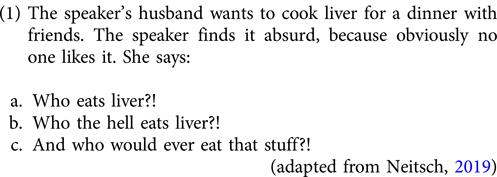
Thus, RhQs constitute an indirect form of language: while they retain interrogative syntax and the semantic form of a question, pragmatically they “feel” more like an assertion (Biezma & Rawlins, Reference Biezma and Rawlins2017; Caponigro & Sprouse, Reference Caponigro, Sprouse and Puig-Waldmüller2007). Moreover, RhQs are used by the speaker as a rhetorical strategy to express an opinion or a point of view, to challenge the interlocutor (e.g., Ilie, Reference Ilie1994; Rohde, Reference Rohde2006), or to strengthen a previous point (Ilie, Reference Ilie1994). Thus, they are always strictly connected to the discourse context and the situation, and they often express the speaker's emotive attitude (see Neitsch, Reference Neitsch2019 for a comprehensive overview). In this respect, RhQs are part of socio-communicative speech, similar to ironic language and conversational understanding, since they require complex reasoning on the participant's intentions and goals and the interpretation of a mismatch between literal and intended meaning.
In addition, RhQs constitute a multiple interface, since they require the integration of different types of linguistic cues, lexical, prosodic and syntactic, with the pragmatic function of the question. For example, (1a) is neutral and may be distinguished from a canonical information-seeking question (ISQ) only through the context or by a different prosodic form (Dehé et al., Reference Dehé, Braun, Einfeldt, Wochner and Zahner-Ritter2022). (1b) contains the expression who the hell, which overtly expresses the speaker's negative attitude (den Dikken & Giannakidou, Reference den Dikken and Giannakidou2002). (1c) contains an initial and, which connects the utterance to the context, the conditional would and the adverb ever, which convey that the event is impossible to happen, and a lexical expression with a negative connotation (that stuff). Here, different cues combine to express beyond doubt the speaker's intended meaning. Crucially, the use of such cues provides the listener with a more or less direct indication that the question should be interpreted rhetorically, but none of them is obligatorily present in a RhQ, nor are they markers of “rhetoricity” themselves. Additionally, such cues are language specific, so bilingual speakers need to learn the individual cues of each of their languages.
The duality between the communicative function of RhQs and their interface nature makes them an interesting, yet unexplored topic in bilingual acquisition. Tsimpli (Reference Tsimpli2014) distinguishes between early, late, or very late acquired phenomena. By age 5, children have acquired the formal properties of their native language(s) if they are exposed to them early enough. Phenomena that involve semantic computation and/or discourse integration are acquired later (around 6 years), and the decisive factor in determining their acquisition in bilinguals is the amount of language experience (e.g., quantification and exhaustivity in wh-questions or appropriate use of passives, reflexives and anticausative verbs, cf. Tsimpli, Reference Tsimpli2014, p. 293-295). Phenomena that require a more developed pragmatic competence and the integration of language external (cognitive control, inferencing, social cognition) and language internal aspects, such as pronominal reference, are acquired even later (in later childhood or later adolescence) and are thus even more vulnerable to reduced language experience (Tsimpli, Reference Tsimpli2014, p. 295). We expect optional pragmatic marking in RhQs to fall within the latter category. By contrast, the conversational competence necessary to acquire RhQs as a pragmatic category, while still late acquired, is not expected to pose a greater challenge for bilingual children. Therefore, there is a conflict between bilingual children's potential difficulties with language-specific interface phenomena vis-à-vis their early pragmatic (and metalinguistic) awareness.
In this paper, we investigate the patterns of optional pragmatic marking in RhQs in Italian monolingual and bilingual children aged 6-9 years. For the bilingual children, Italian is the home language (or heritage language [HL]), while their majority language is German. In what follows (section 2), we describe the patterns of optional RhQ modification in Italian and review facts on pragmatic acquisition in monolingual and bilingual children. Section 3 presents the goal and research questions of this study. Sections 4 and 5 describe methods and results of the study. We conclude with a discussion (Section 6).
2. Background
2.1 Rhetorical questions in Italian (and German)
As discussed in the introduction, RhQs can be explicitly marked by several linguistic cues. These, however, are not obligatory, as there is no single cue that must necessarily be present if a question is rhetorical. Moreover, many cues, even when present, are not direct markers of rhetoricity, but they contribute to the pragmatic interpretation of the question in combination with other cues and with the context. While several studies have investigated RhQs in Italian (e.g., Fava, Reference Fava, Lupu and Renzi1994; Hinterhölzl & Munaro, Reference Hinterhölzl, Munaro, Trotzke and Villalba2021; Obenauer & Poletto, Reference Obenauer and Poletto2000; Stati, Reference Stati1982), they have focused only on certain aspects of possible linguistic marking, and they were qualitative in nature. A first quantitative study which aimed at describing the variety and frequency of cues marking RhQs in Italian was carried out by Ferin (Reference Ferin2024). Ferin elicited RhQs with an intended negative answer (e.g., “Who eats liver?!” = “No one eats liver!”), used as negative retorts or as criticism, the same type of communicative context used in the present study. Ferin found that several types of cues occurred with different frequencies in this type of RhQs. Here, we shall focus only on those cues that are relevant to the study: the particles ma ‘but’, e ‘and’, mai ‘ever’, verbs with conditional morphology, reflexive verbs, and clitic right dislocation (CLRD).
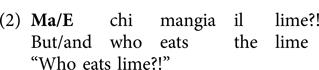
The sentence-initial particle ma, as in (2), was the most frequent cue in Ferin (Reference Ferin2024). Ma corresponds in its base function to adversative ‘but’; when used as a discourse particle introducing a question, ma takes a counter-expectational value (Giorgi & Dal Farra, Reference Giorgi and Dal Farra2019), indicating that there is a conflict between the proposition and the speaker's previous knowledge. As such, ma can occur in any non-canonical question that expresses this kind of negative bias, including but not restricted to RhQs (Giorgi & Dal Farra, Reference Giorgi and Dal Farra2019; Hinterhölzl & Munaro, Reference Hinterhölzl, Munaro, Trotzke and Villalba2021; Ippolito, Reference Ippolito2021). Additionally, given its adversative origin, it is compatible with a context in which the speaker wants to challenge the interlocutor. Sentence-initial e “and” is less frequent in RhQs; like ma, e links the question to the context of utterance. Though e can also give rise to an effect of opposition, it is likely to be a secondary effect of its additive meaning (Umbach, Reference Umbach2005).
Another particle found in RhQs is mai, corresponding to the temporal adverb “ever/never”, with the properties of a negative polarity item (see Panizza & Romoli, Reference Panizza, Romoli and Fӑlӑuş2013 for the semantics of mai). It can appear either in the same position as the corresponding temporal adverb (3a) or immediately after the wh-word (3b,c). In the former case, the verb must have conditional morphology (see below); in the latter case, the verb can also be indicative. As to its interpretation, mai is ambiguous between a rhetorical reading and an “extreme ignorance” reading (Coniglio, Reference Coniglio2008; Hinterhölzl & Munaro, Reference Hinterhölzl, Munaro, Trotzke and Villalba2021; Obenauer & Poletto, Reference Obenauer and Poletto2000), whereby the speaker expresses their inability to find an acceptable answer to the question. Different interpretations are sometimes mapped onto the different syntactic positions mentioned above (Coniglio, Reference Coniglio2008; Hinterhölzl & Munaro, Reference Hinterhölzl, Munaro, Trotzke and Villalba2021; Obenauer & Poletto, Reference Obenauer and Poletto2000) and there is some variability in the interplay between syntactic position, pragmatic interpretation, and frequency of use in different varieties of Italian (Ferin, Reference Ferin2024). In general terms, mai contributes to the meaning of the question by conveying that it is impossible to find a true answer to it.

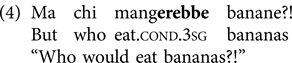
In some RhQs, the verb is marked with conditional morphology. Although a question with a conditional verb can also be information-seeking, a conditional introduces irrealis modality to the event expressed in the proposition, which becomes non-assertive. In (4), the event of eating bananas is presented by the speaker as hypothetical: the speaker is uncertain whether it would happen in the world. In the context of negative-answer RhQs, this strengthens the idea that the event of eating bananas did not happen at all, as (it is obvious that) no one did.
Another cue is the use of the reflexive clitic si. While in Italian si is usually used with a true reflexive meaning (e.g., washing one's hands) or in inherently reflexive verbs (e.g., arrabbiarsi “to get angry”), in special contexts it is used with affective value as an intensifier of the verb, conveying the speaker's attitude towards the utterance (Cordin, Reference Cordin, Renzi, Salvi and Cardinaletti1995).
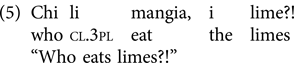
RhQs frequently present clitic right dislocation (CLRD) of the object, as in (5), where the object DP is dislocated to the right edge of the sentence and resumed sentence-internally by the clitic pronoun li. This syntactic structure marks a familiar topic, indicating that the dislocated constituent is already given in the context of utterance (Benincà et al., Reference Benincà, Salvi, Frison, Renzi, Salvi and Cardinaletti1995). Although CLRD is also compatible with an ISQ reading of the question, it is particularly frequent in RhQs. This may stem from the fact that the speaker is presenting the answer to the question as shared knowledge, thus using CLRD to (indirectly) link to this common knowledge (Berruto, Reference Berruto and Stammerjohann1986; Crocco, Reference Crocco2013).
In German, RhQs are often marked by discourse particles, such as denn and schon (Bayer & Obenauer, Reference Bayer and Obenauer2011; Biezma & Rawlins, Reference Biezma and Rawlins2017). An example is provided in (6). Denn is compatible both with an ISQ and a RhQ; similarly to CLRD in Italian, it establishes a link to the context. Conversely, when used as a discourse particle, schon is considered an unambiguous signal for RhQs, although it is homophonous with the temporal adverb schon “already”.

In summary, RhQ marking is a non-unitary phenomenon, since there is no one-to-one correspondence between form and meaning. It can have various linguistic components, each with their own pragmatic shades, which converge in conveying rhetorical meaning.
2.2 The (bilingual) acquisition of pragmatics
The acquisition of RhQs has only been investigated in three studies so far (Ferin & Geiss, Reference Ferin and Geiss2022; Geiss et al., Reference Geiss, Ferin, Marinis and Kupisch2023; Recchia et al., Reference Recchia, Howe, Ross and Alexander2010). Recchia et al. (Reference Recchia, Howe, Ross and Alexander2010) have investigated irony in naturalistic speech, including RhQs, focussing on their contextual dimension. They found that 4- and 6-year-old children could both produce and appropriately respond to RhQs and other forms of irony, older children more frequently than younger children. Thus, young children can produce or interpret an interrogative utterance without necessarily interpreting it as a request for information. Ferin and Geiss (Reference Ferin and Geiss2022) and Geiss et al. (Reference Geiss, Ferin, Marinis and Kupisch2023) focussed on the acquisition of linguistic cues in RhQs, showing that Italian–German children, in both of their languages, exploited a combination of lexical-syntactic and prosodic cues to discriminate between ISQs and RhQs in comprehension. Questions were presented out of context, so that children had to rely exclusively on the linguistic form of the question. The results showed no difference based on proficiency across children in their dominant language (Geiss et al., Reference Geiss, Ferin, Marinis and Kupisch2023), while language experience affected the children's performance in the HL (Ferin & Geiss, Reference Ferin and Geiss2022).
RhQs require the ability to detect the discrepancy between the form of the utterance (a question) and the real intention of the speaker when uttering it (the rhetorical point). Thus, the interpretation of this type of language relies on context and world knowledge, and it requires additional mental effort to integrate background information and interpret the speaker's intentions. In this respect, RhQs are similar to a number of some other pragmatic phenomena, which fall into the category of late acquired phenomena.
RhQs are often discussed in relation to irony (Neitsch, Reference Neitsch2019)Footnote 1, which is still developing around age 6, both for monolingual children (Banasik, Reference Banasik2013; Falkum & Köder, Reference Falkum and Köder2020; Giustolisi et al., Reference Giustolisi, Panzeri and Bogani2017) and bilingual children (Banasik & Podsiadło, Reference Banasik and Podsiadło2016). Similarly, for the acquisition of conversational maxims (in Grice's, Reference Grice1989 sense), the years between 5 and 6 seem to be an important cut-off point: only after this point are children able to detect violations to conversational maxims (Foppolo et al., Reference Foppolo, Guasti and Chierchia2012; Siegal et al., Reference Siegal, Iozzi and Surian2009, Reference Siegal, Surian, Matsuo, Geraci, Iozzi, Okumura and Itakura2010). Interestingly, bilingual children outperformed age-matched monolingual peers in this task, even if their L2 vocabulary was comparatively delayed (Siegal et al., Reference Siegal, Iozzi and Surian2009, Reference Siegal, Surian, Matsuo, Geraci, Iozzi, Okumura and Itakura2010), showing a more developed competence in conversational reasoning.
A fair number of studies have been concerned with scalar implicatures. Foppolo et al. (Reference Foppolo, Guasti and Chierchia2012) found a cut-off point at 6 years in children's ability to derive scalar implicatures, which requires both the lexical-semantic knowledge of the quantifiers (some, all), their ordering in a scale (semantic knowledge), and pragmatic reasoning. Children younger than 6 years varied substantially in their responses and some were unable to derive the implicature correctly, even if they already had knowledge of conversational maxims and lexical-semantic knowledge of the quantifiers (Foppolo et al., Reference Foppolo, Guasti and Chierchia2012). This indicates that even when children have all the necessary components in place, linguistic (representation) and pragmatic (reasoning), they may still struggle to integrate them. Relatedly, Papafragou et al. (Reference Papafragou, Friedberg and Cohen2018) demonstrated that five-year-old children could already reason on the speaker's mental state when interpreting a semantic phenomenon, which is relevant to computing scalar implicatures. Bilingual children were shown to have more difficulties in computing implicatures than monolingual children (Syrett et al., Reference Syrett, Austin, Sanchez, Germak, Lingwall, Perez-Cortes, Arias-Amaya and Baker2017), but when a richer pragmatic context was provided, making the computation of the implicature conversationally relevant, their performance improved to adult-like levels. Antoniou et al. (Reference Antoniou, Veenstra, Kissine and Katsos2020) tested monolingual, bilingual, and bidialectal children aged 10 to 12 years on a range of pragmatic tasks based on Gricean maxims, including scalar implicatures. Although bilingual children had lower vocabulary scores, their pragmatic skills did not differ from those of monolingual children. The study found neither a bilingual advantage (perhaps because older children were tested), nor a disadvantage, suggesting that pragmatic skills are independent of language-specific competence.
In summary, pragmatic competence is generally late acquired (5 years or later), but bilingual children don't seem to show any disadvantages; if anything, they appear to benefit from their wider language experience. The picture is quite different for phenomena that require integration of pragmatic competence with language-specific phenomena. This has been studied mostly in the context of referential expressions, with bilingual children using null or overt pronouns at different rates than monolingual children (Hulk & Müller, Reference Hulk and Müller2000; Serratrice et al., Reference Serratrice, Sorace and Paoli2004), but also in discourse-based word order patterns used by Italian–German bilingual children (Listanti & Torregrossa, Reference Listanti and Torregrossa2023).
2.3 Optionality and variation
Markers of rhetoricity are optional because RhQs can be produced without any lexical or syntactic cues. Therefore, there is variability in the manifestation of RhQs. Several studies have investigated the acquisition of other variable phenomena. For example, adjectives in the Romance languages can be pre- or postnominal, and each position comes with a slightly different meaning (e.g., Nicoladis, Reference Nicoladis2006); the presence or absence of determiners with plural nouns in the Germanic languages signals a specific vs. generic reading (Kupisch, Reference Kupisch2012; Serratrice et al., Reference Serratrice, Sorace, Filiaci and Baldo2009); the presence or absence of pronouns signals contrast or topic shift (e.g., Serratrice et al., Reference Serratrice, Sorace and Paoli2004). These phenomena have been of particular interest in studies of early bilinguals, especially when one of the two languages in contact language did not exhibit variation. The prediction was that the option that is present only in one language (i.e., prenominal adjectives, overt articles, overt pronouns) would be overused at the expense of the option that is present only in one language.
Crucially, in the aforementioned examples, each option comes with a difference in meaning and the languages provide contextual cues to infer these meanings, even if subtle. The situation is different with RhQs, because markers of rhetoricity are “truly” optional, as RhQs can exist without any cues to rhetoricity. They are part of colloquial language, showing subtle linguistic abilities that allow the speaker to express attitudes or epistemic relations between participants in a conversation. It is unclear how bilinguals deal with this type of variation. Bilinguals might not use any optional markers as a strategy of representational simplification, or they may use them more abundantly because pragmatic marking can be transferred more easily between languages.
3. Research questions
This study aims at investigating how Italian monolingual and bilingual children produce RhQs and whether they exploit the optional pragmatic markers available in Italian. For bilingual children, we focus on their HL. We address the following research questions.
RQ1. At what age do children acquiring Italian mark information-seeking and rhetorical questions differently?
RQ2. Are there differences between monolingual and bilingual children in a heritage language setting?
RQ3. Do proficiency in Italian and language dominance play a role?
Ferin and Kupisch (forthcoming) showed that at the group level monolingual Italian children aged 6 to 9 (the same children who serve as baseline in the present study) could appropriately exploit the same types of cues as adults in RhQ marking, with a progressive development from age 6 to age 9; 9-year-olds showed an adult-like pattern in every condition. What do we predict for bilingual children? Bilingual children may show effects of crosslinguistic influence (CLI). Classically, CLI has been discussed in terms of acceleration, delay (henceforth “deceleration”) and transfer (Paradis & Genesee, Reference Paradis and Genesee1996). In the case of acceleration, bilingual children are expected to use rhetorical markers at an earlier point in time compared to age-matched monolinguals. Acceleration may not necessarily be induced by the influence of German (the majority language) but rather from a general pragmatic advantage in bilingual children (see §2.3): bilingual children's earlier ability to interpret speaker intentions and knowledge may manifest itself as an earlier awareness of the opportunity of overtly marking RhQs. In the case of deceleration, children would use rhetorical markers later compared to monolingual children of the same age. Deceleration may be caused by a number of reasons: lack of lexical knowledge of the specific cues, lack of knowledge of their specific pragmatic function, or difficulty at integrating different dimensions of language. Transfer could consist in the use of specific markers in language B that are absent in language A (e.g., the translation equivalent of a German marker along with its syntactic properties in an Italian context, or a lexical item borrowed from German in Italian). Children may be aware that they need to use some form of marking but may use the resources of the majority language (German), using a German marker in an Italian RhQ to achieve the goal, which would result in transfer.
Finally, since the phenomenon is optional and late acquired, we expect to find high variability based on bilingual children's proficiency, on the one hand, and on language dominance on the other. We tease apart proficiency from a broader dominance measure for the following reason. By zooming in on the bilingual children's competence in the HL, we can compare them to monolinguals based on the same measures. By means of a dominance measure, instead, we can see the bilinguals’ two languages in relation to each other. The dominance measure goes beyond just proficiency and additionally includes linguistic experience (Treffers-Daller, Reference Treffers-Daller2019).
4. Method
In order to elicit RhQs and ISQs, we designed a production task as part of a larger battery of tasksFootnote 2. All the tasks were presented as a game, set in a fictional detective school where children took part in a detective training. This served the purpose of motivating the tasks and holding children's attention. Within the same setting, children were also administered a narrative task (MAIN narrative task, Gagarina & Bohnacker, Reference Gagarina and Bohnacker2022) to obtain some independent measures of language proficiency, further explained below. For all children, the experiment took place online, in a Zoom© videocallFootnote 3. The experimenter shared their screen and computer audio with the participant and recorded the tasks with Audacity®, using the loopback function. The narrative task was administered before the production task. Bilingual children completed the tasks in both Italian and German, with a break of at least one week in-between. The order of the two languages was pseudo-randomised across children.
Participants were recruited through personal contacts, social media, and with the help of schools, Italian consulates, and cultural associations. Parents were informed of the purpose of the study and gave their informed consent; prior to the testing sessions, they filled in a questionnaire on the child's language history. After the last session participants received an electronic gift card for a bookstore chain. All procedures contributing to this study comply with the ethical standards of the University of Konstanz Research Ethics Committee on human experimentation and with the Helsinki Declaration of 1975, as revised in 2008.
4.1 Participants
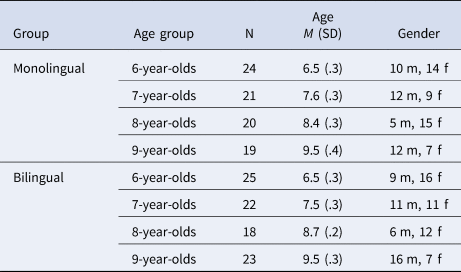
88 Italian–German bilingual children and 84 Italian monolingual children took part in the study. Children were aged 6-9 years and were divided into four age groups (6-, 7-, 8- and 9-year-olds); age and gender statistics are summarised in Table 1. The bilingual children were born in Germany or they immigrated to Germany with their parents; all were exposed to Italian since birth, while the age of onset for German ranged from birth to 7 years. 15 6-year-olds still attended kindergarten and the remainder attended primary school. Some children (n = 33) had one German-speaking and one Italian-speaking parent (mostly first-generation immigrants; seven were heritage speakers of Italian themselves). For the others, both parents were Italian speakers, mostly first-generation immigrants (n = 46); in a few cases (n = 9) either one or both parents were heritage speakers of Italian.
Summary of participants.
4.2 Production task
Procedure and materials
RhQs and ISQs were elicited by presenting them as the typical form of interaction of four different characters. Two characters (Olaf and Rapunzel) were introduced as curious, inquisitive, and always asking questions to their friends; they were used to elicit ISQs. The other two characters (Drizella and Grumpy) were presented as unfriendly and unkind, especially towards a secondary character (Cinderella and Snow White respectively) and were used to elicit RhQs. Each character was introduced visually as part of a PowerPoint presentation, focusing on the character's attitude. The friendly characters used ISQs to ask novel information to their friends, while the grumpy characters used RhQs to reply unkindly to the interlocutor. A summary of each character's introduction is reported in Table 2 (see Appendix A1 for full instructions and contexts).
Summary of contexts and model questions in the elicitation task.
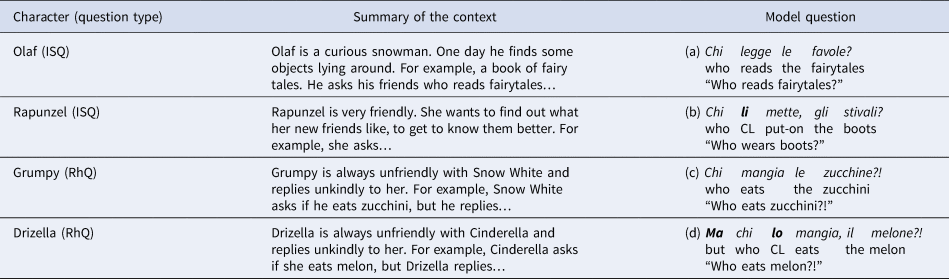
After the character's introduction, the child heard a “model question” for that character, i.e., an example of a typical ISQ or RhQ that they would utter in the context (see (a-d) in Table 2). The four model questions were recorded by four different native speakers of Italian, with appropriate intonation. The model questions for RhQs were presented in two forms. One was unmodified, presenting the minimal question form of wh+verb+object (c). The second one, instead, included some additional cues: the sentence-initial particle ma and CLRD (d). This choice was motivated by the lack of clear predictions on the age of acquisition of the cues under analysis. We reasoned that, if the children did not use any additional marking spontaneously, they would (perhaps) at least correctly interpret and re-use the cues of the model question. The role of the model question is addressed in the results and in the discussion. The four characters were presented in a pseudo-randomised order across children; some children encountered the modified model sentence first, while others encountered the unmodified one first.
After hearing the character's introduction and the model question, children were instructed to impersonate the character and use similar sentences, either to ask questions to the character's friends (ISQs) or to retort to the secondary character (RhQs). For each experimental item, the experimenter showed the picture of the target object (e.g., a cherry), saying: “Now Rapunzel would like to know who [among her friends] eats cherries, so she asks…”, letting children produce a question of the type “Who eats cherries?”. Children were free to add particles, other lexical material or syntactic modifications to the question. Eight questions were elicited in each context, but the first two were discarded as practice items. Thus, the final dataset consisted of 12 ISQs and 12 RhQs for each participant.
In summary, children encountered one character at a time; the character was introduced and uttered the model question, then a set of eight questions was elicited for that character (six of which were test items). Only then was the next character introduced.
Analysis
Children's productions were transcribed; non-target sentences (polar questions such as “Does anyone eat bananas?/?!”, or exclamative utterances such as “But no one eats bananas!”) were removed from the datasets (n = 7). The final dataset consisted of 4121 questions. Questions were tagged for lexical-syntactic cues. Any relevant lexical addition or morpho-syntactic modification of the base form wh+verb+object was tagged by type of cue, assigning “1” if a cue was present and “0” if it was not present. We calculated the sum of the number of cues modifying a sentence; a sentence may be modified by no additional cue, by one cue, or by more than one at the same time.
Statistical analyses were conducted in R by fitting linear regression models with the function lm in the stats package (R Core Team, 2023) or linear mixed-effect regression models with the lmer function (lme4 package, v. 1.1.34, Bates et al., Reference Bates, Maechler, Bolker and Walkers2015). Estimated marginal means, trends, and post-hoc comparisons were obtained with the emmeans and emtrends functions (emmeans, v. 1.8.7, Lenth, Reference Lenth2023).
4.3 Proficiency and language dominance measures
We conceive of language dominance as a multidimensional concept that combines the differential in linguistic proficiency in the two languages, operationalized directly through linguistic tasks and indirectly through reported information (Treffers-Daller, Reference Treffers-Daller2019).
For direct measures, all children were administered the Italian version of the MAIN narrative task (Levorato & Roch, Reference Levorato and Roch2020) in the retell modality; the standard MAIN procedure was adapted for online testing. Bilingual children were administered also the German version (Gagarina et al., Reference Gagarina, Klop, Kunnari, Tantele, Välimaa, Bohnacker and Walters2019). The narratives were recorded and later transcribed in the CHAT format with the software CLAN (MacWhinney, Reference MacWhinney2000). Two measures were extracted (with the KIDEVAL function): VOCD and speech rate. Both are considered possible measures of linguistic proficiency in bilingual speakers (Benmamoun et al., Reference Benmamoun, Montrul and Polinsky2013). VOCD is a measure of vocabulary diversity, while speech rate is calculated as words per second, excluding the pauses between utterances. For bilingual children, the measures were extracted in both languages.
Indirect measures of language dominance represent the children's language experience, as reported by the parents. The questionnaire gathered information about the amount of Italian and German experience in the family, during free time, and in educational settings, the number of people the child speaks Italian and German to, length and frequency of periods spent in Italy, and use of Italian and German for reading and multimedia activities. We calculated four sub-scores (‘formal quantity’, ‘formal quality’, ‘informal quality’ and ‘informal quantity’ of exposure in each language, considering only current exposure). Each sub-score was proportioned to a maximum of five points each; the four sub-scores were added to calculate an ‘Italian experience score’ and a ‘German experience score’.
Analysis
Following Listanti and Torregrossa (Reference Listanti and Torregrossa2023), a composite dominance score based on an exploratory factor analysis (EFA) was calculated. We combined two measures of objective linguistic proficiency (speech rate and VOCD) and the language experience scores calculated from the parental questionnaire. First, we calculated the differentials for each measure, subtracting the Italian from the German value, such that a higher value indicates relatively higher strength of German. Subsequently, we conducted the EFA, confirming that the three differentials loaded into a single underlying factor, which may be interpreted as the underlying assumption of linguistic dominance. Afterwards, we ran the factor analysis and extracted the loadings of each differential, i.e., the strength of the correlation with the underlying factor. Finally, we obtained a unique Dominance score for each bilingual child by calculating a weighted sum for each child, i.e., adding each differential multiplied by the factor loading (see Appendix A2 for details).
Results
Table 3 reports the aggregated measures for VOCD and speech rate values for all children, as well as the language experience scores for bilingual children. Mean values for Italian VOCD show a different pattern across age groups for bilingual and monolingual children. While the monolinguals’ VOCD increases from age 6 (M = 21.7) to age 9 (M = 29.4), this is not observed in the bilingual group (age 6: M = 20.7; age 9: M = 21.8). Speech rate in Italian was overall higher for monolingual children; 6-year-olds uttered on average 1.8 words per second (SD = 0.4) and 9-year-olds 2 words per second (SD = 0.4), with 7- and 8-year-olds in-between. The pattern observed for the bilingual children was less linear, with 7-year-olds having the lowest speech rate (M = 1.4, SD = 0.6) and 8-year-olds the highest (M = 1.9, SD = 0.3)Footnote 4.
Aggregate measures of VOCD, speech rate and language experience divided by group and age group.
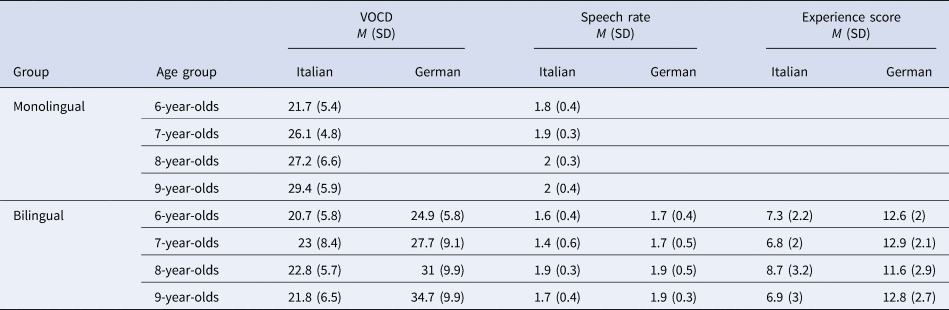
Table 4 reports dominance measures for bilingual children, i.e., VOCD, speech rate and language experience differentials, as well as the composite dominance score. At the group level, the mean scores were close to 0, indicating relative balance between the languages. At the individual level, children ranged from negative to positive scores, indicating that the relative strength of Italian and German varied in the sample.
VOCD, speech rate and language experience differentials, calculated as [German value – Italian value], and composite Dominance score.

5. Results
5.1 Quantitative analysis of additional modification
We first investigated how many cues on average modified each type of question. We fitted a linear mixed-effects regression model to see if the number of cues modifying a question was predicted by Group (2 levels: Monolingual vs Bilingual), AgeGroup (4 levels: 6 vs 7 vs 8 vs 9) and Condition (2 levels: RhQ vs ISQ). To control for possible effects of linguistic proficiency, we included also Italian VOCD (continuous) and Italian speech rate (continuous) as fixed effects. The model included three three-way interaction terms between Group, Condition, and AgeGroup/VOCD/Speech rate respectively. Participant and Item were included as random effects. Categorical variables were treatment-coded.
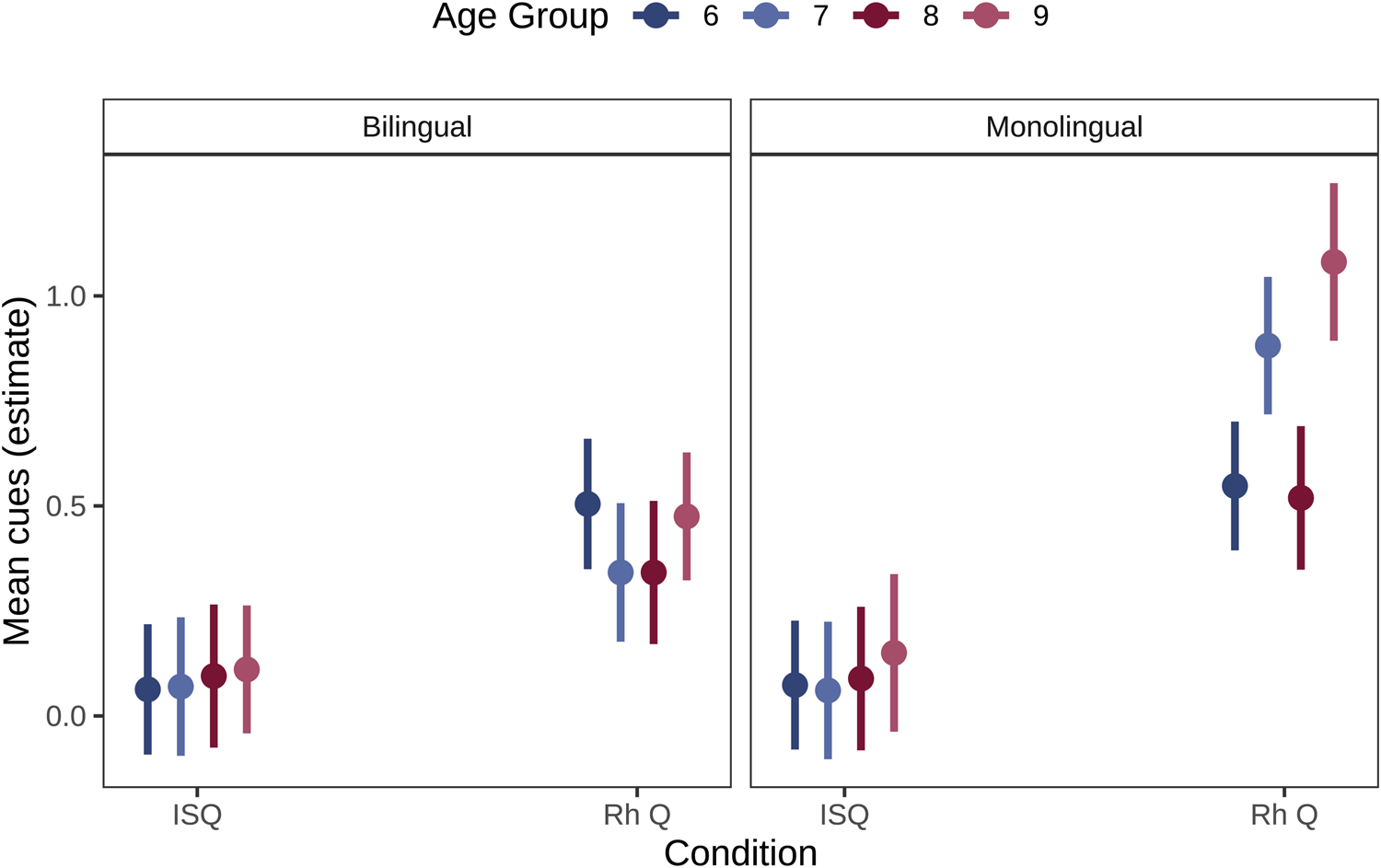
The three interactions were statistically significant. Firstly, Group, Condition and AgeGroup interacted significantly (χ2 = 67, p < .001), as shown in Figure 1. The interaction plays out as follows. In both groups, ISQs did not receive much additional modification, neither by monolingual (M = 0.09, SE = 0.05) nor by bilingual children (M = 0.08, SE = 0.04). There was no difference between groups, nor between different age groups. In contrast, RhQs were modified at different rates by monolinguals (M = 0.76, SE = 0.05) and bilinguals (M = 0.42, SE = 0.05), and the difference was significant (β = -0.34, SE = 0.06, z = -5.85, p < .001). Furthermore, within RhQs, an effect of age group was found only for monolinguals, but not for bilinguals. Within monolingual children, 9-year-olds modified substantially more than the other groups (M = 1.1, SE = 0.1). 7-year-olds were in-between (M = 0.88, SE = 0.08), while 6- and 8-year-olds used fewer cues (6: M = 0.55, SE = 0.08; 8: M = 0.52, SE = 0.09). The difference between 9- and 7-year-olds on the one hand, and 6- and 8-year-olds on the other hand was statistically significant. For bilinguals, on the other hand, no difference was observed between age groups. All the comparisons are reported in Appendix A3.
Estimated mean number of cues modifying each question type (ISQ vs RhQ), by group and age group.
We further found a significant interaction between Group, Condition and Italian VOCD (χ2 = 25.04, p < .001), represented in Figure 2 (top panel). Higher vocabulary did not affect the rate of modification of ISQs in either group (Monolingual: β = 0.01, SE = 0.01, z = 1.43, p = .14; Bilingual: β = 0.002, SE = 0.01, z = 0.34, p = 0.73), nor that of RhQs for monolingual children (β = 0.003, SE = 0.01, z = 0.45, p = .65). However, it did have a positive effect on RhQ modification in bilingual children (β = 0.02, SE = 0.01, z = 3.14, p = .002). The effect is substantial: while at very low VOCD values bilingual children used almost no additional cues (VOCD[10]: M = 0.15), higher vocabulary knowledge predicted a substantially higher use of cues (VOCD[40]: M = 0.74).
Effect of Italian VOCD (top) and Italian speech rate (bottom) on the estimated mean number of cues per sentence, by group and age group.
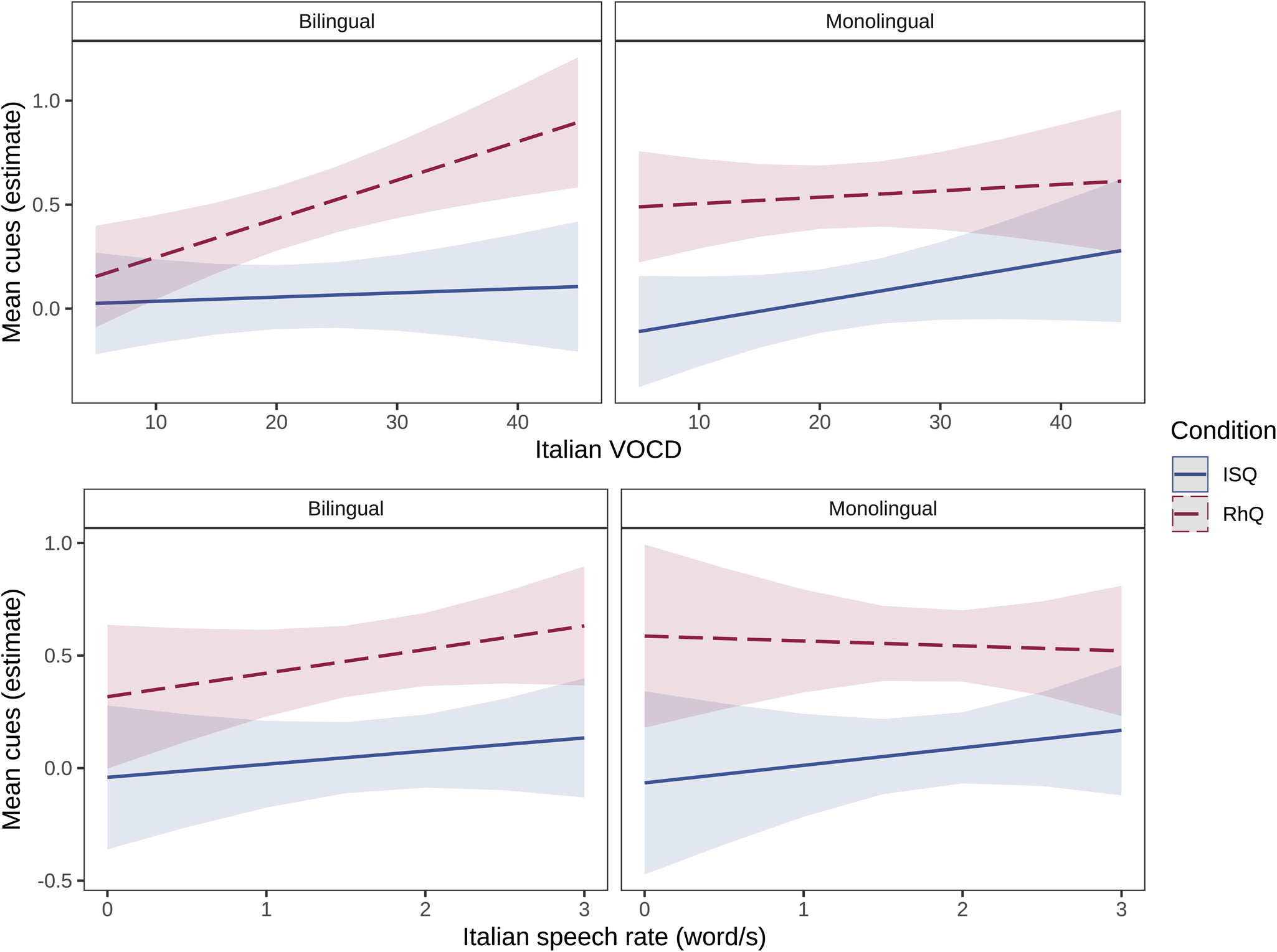
Finally, the overall interaction between Italian speech rate, Condition and Group was significant (χ2 = 4.41, p = .035), but the pattern was less clear than for VOCD. None of the slopes shown in Figure 2 (bottom panel) was significant (see Appendix A3).
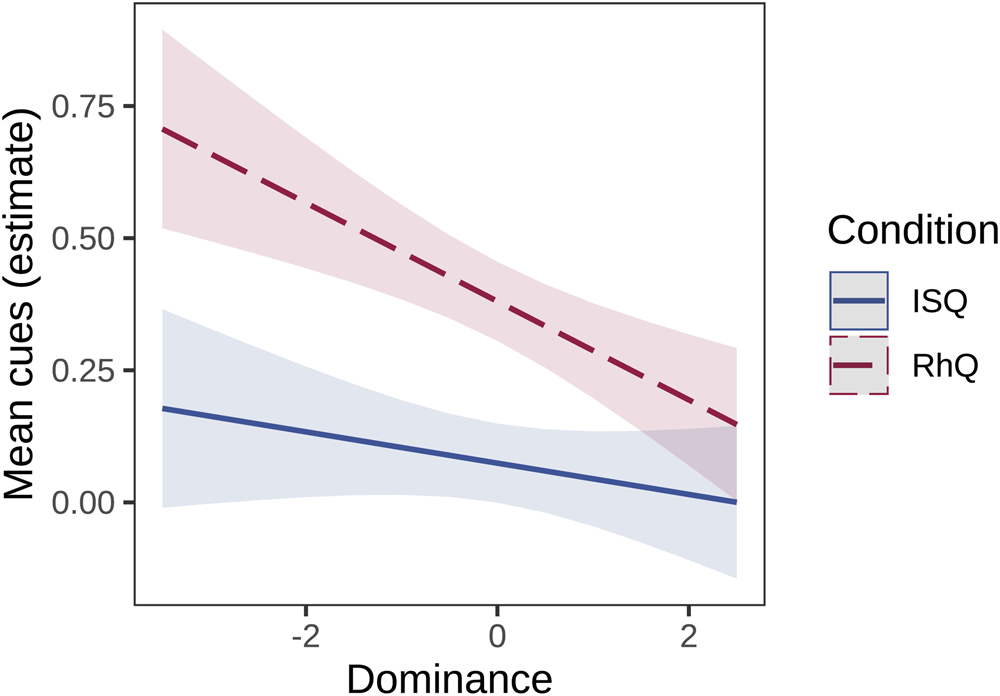
A second model was fitted to test for the effect of dominance on the rate of modification in bilingual children. The model included Dominance (continuous, corresponding to the composite dominance score) and Condition (2 levels: ISQ vs RhQ) as independent variables, with an interaction between the two. Participant and Item were set as random intercepts. The interaction was significant (χ2 = 22.11, p < .001), indicating that dominance had no effect on ISQs (β = -0.03, SE = 0.03, t = -1.18, p = .24) but it negatively predicted the rate of modification in RhQs (β = -0.09, SE = 0.03, t = -3.70, p < .001), such that children who were more German dominant modified RhQs less than children whose Italian was relatively stronger, as shown in Figure 3.
Effect of dominance (positive indicates German dominance) on the estimated mean number of cues per sentence in bilingual children, by condition.
5.2 Types of cues
The results examined in the previous section reveal that bilingual children modify RhQs quantitatively less than monolinguals and do not show a significant increase with age. The question then arises which types of cues bilingual children use for RhQ marking, and whether they use the same types as monolingual children (and adults).
Table 5 reports how many sentences were modified by each cue, divided by group and condition. The number in brackets indicates the percentage over the total number of questions in that condition; each number is independent of each other, as one question could be modified by more than one cue. As was evident also from the quantitative analysis, ISQs received hardly any additional modification in either group; therefore, they will not be considered any longer in the qualitative analysis. As to RhQs, the same types of cues appear in both groups: the particles ma, e, mai, conditional or reflexive verbs, CLRD. Three lexical elements (già “lit: already”, ora “lit: now”, ancora “lit. still”) are found in bilingual but not in monolingual children (see below for discussion). In both groups, sentence-initial ma was the most frequent cue (32% and 18% sentence respectively). In monolingual children, CLRD was the second most frequent cue, distinctly more frequent than the remaining ones (21%), which occurred at low frequencies (1-5%), indicating that only a few children made use of them. For bilingual children, CLRD was within the same range as the other cues (1-4%).
Absolute number and percentage of sentences modified by each cue.

Figure 4 shows in more detail the frequencies of each cue divided by age group. Remarkably, all types of cues are already present in the group of the 6-year-olds (with the exception of e, which however is one of the low-frequency cues and is present at age 7). This indicates that, at the group level, all the examined options of pragmatic marking are available from the start of the investigated age range, and at least a few children use them.
Rate of modification for each cue, by group and age. For each cue, the percentage indicates how many sentences (in %) it modifies. Each percentage is independent.
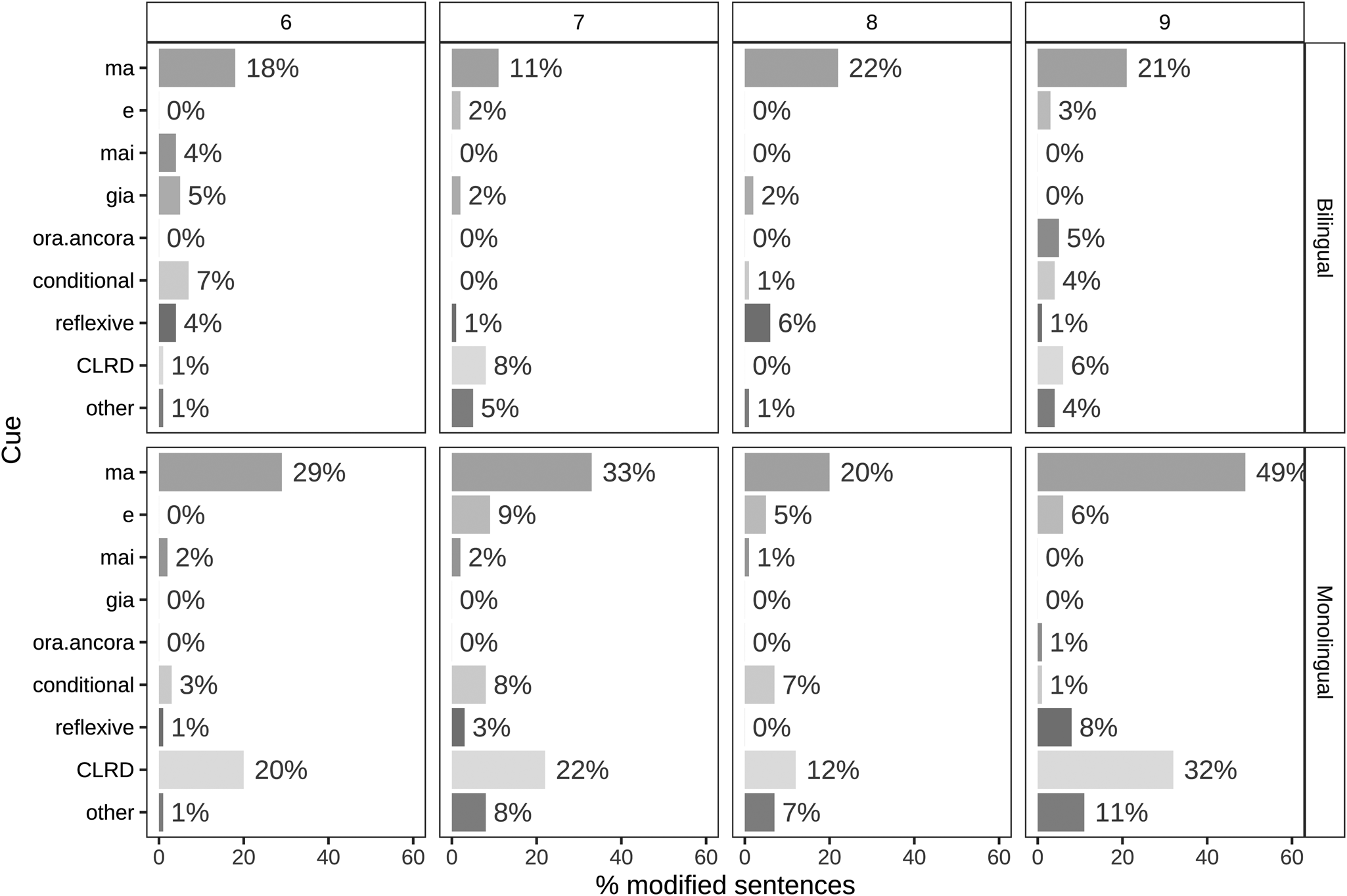
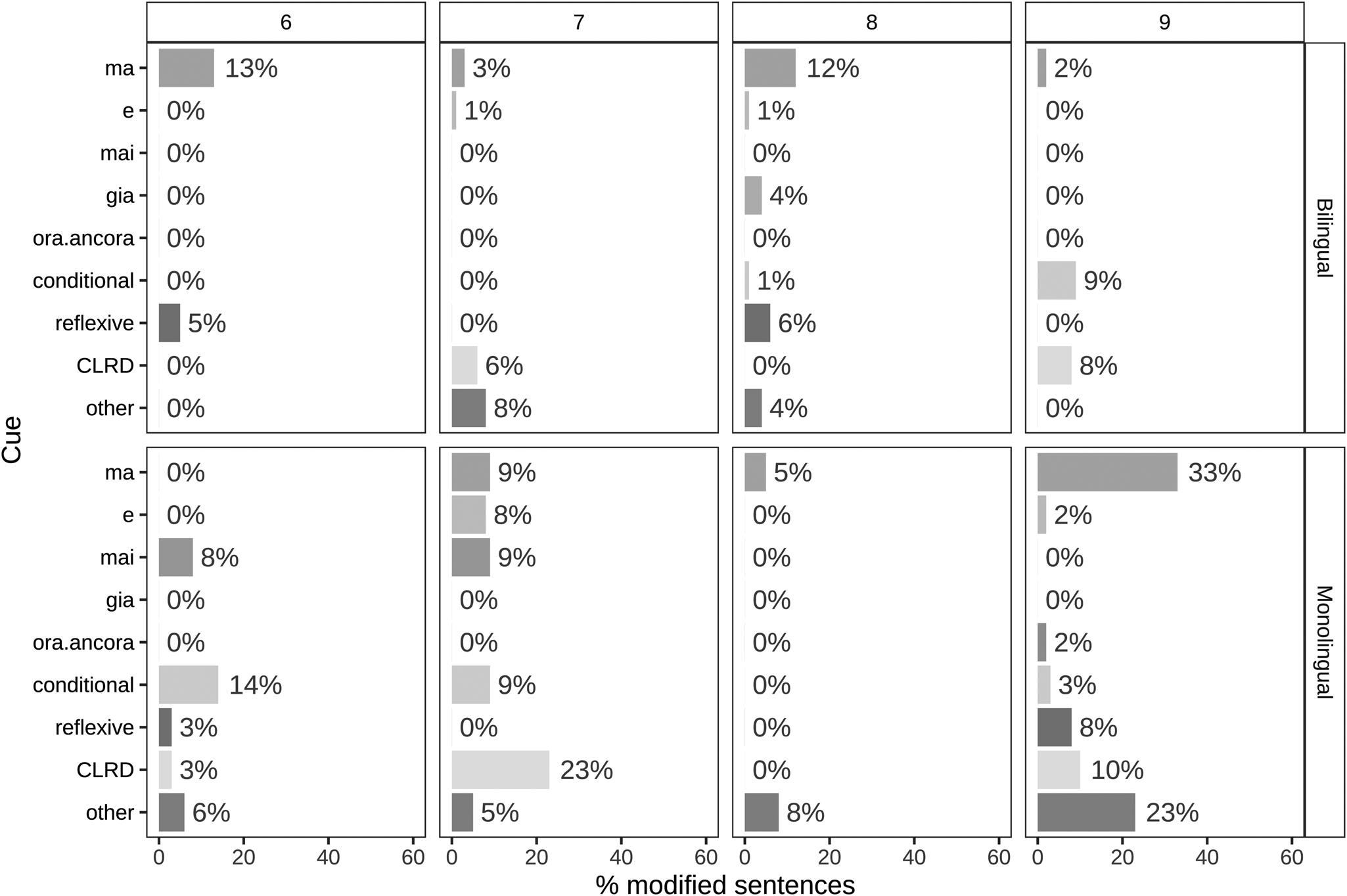
The sharp difference in frequency between ma and CLRD on the one hand (the latter only for monolinguals), and all other cues on the other hand, corresponds to the findings of Ferin (Reference Ferin2024). However, this may be a task effect: as described in §4.2, one of the two model questions was modified by ma and CLRD. Therefore, it is possible that children were primed by the model question. Given that the order of characters was pseudo-randomised, we were partially able to check this possibility. Figure 5 shows the distribution of cues for a subset of participants and of items: only those participants who encountered the unmodified model question first (i.e., model question (9) in Table 2 above), and only the RhQs elicited in that context. This amounts to about 1/4 of total elicited RhQ, which were elicited when the participant had not heard the modified model question yet. In this context, any additional cue would have been produced spontaneously. Figure 5 reveals a difference between monolingual 9-year-olds and all other groups. While the former used ma as their most frequent cue, even when not prompted with it, the latter did not do so consistently; in particular, 9-year-old bilinguals showed a much sparser use of additional cues and no use of ma at all.
Rate of modification for each cue, by group and age, in the unprompted condition.
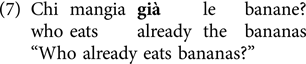
One last observation is that bilingual children use a lexical element to mark RhQs that is not found in monolingual productions: già, as in (41). In Italian, già is a temporal adverb meaning “already”. This element is used by five bilingual children (two 6-year-olds, two 7-year-olds, one 8-year-old). Già is the direct translation of the German temporal adverb schon, which is a strong marker of rhetoricity when used as a discourse particle. In Italian, its use in (7) is inappropriate in this context.
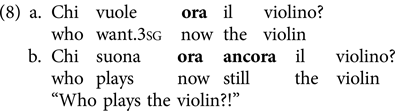
Another difference from the monolingual productions is the presence in one 9-year-old of the temporal adverb ora “now”, sometimes combined with the adverb ancora “still”. The evidence for a translation from German is less straightforward in this case. While both the German counterparts (nun and noch) can in principle be used as modal particles in other contexts, several native informants have noted that the translated counterpart would not sound natural in German in this type of RhQ.
6. Discussion
6.1 Optional modification of RhQs
We investigated at what age Italian monolingual and bilingual children use optional pragmatic cues to mark RhQs (RQ1), whether monolingual and bilingual children differ from each other (RQ2), and whether proficiency and dominance play a role (RQ3). Both groups of children were found to use a variety of cues to mark RhQs: the particles ma “but”, e “and”, and mai “ever”, conditional morphology, affective reflexives and clitic right dislocation. Only bilingual children used the particle già “already” (and, in one case, ora “now” and ancora “still”). Thus, children of both groups used appropriate cues for the type of RhQ we elicited (the case of già will be discussed below). These findings indicate that the use of such cues is already available to children from 6 years of age onwards, and that, when present, they are used in a pragmatically appropriate way. This was not unexpected, considering that age 6 was found to be an important cut-off point in the development of children's pragmatic abilities (e.g., Siegal et al., Reference Siegal, Iozzi and Surian2009, Reference Siegal, Iozzi and Surian2010), also in connection with language (e.g., Foppolo et al., Reference Foppolo, Guasti and Chierchia2012). This is not to say that all children have already acquired this phenomenon. Rather, we have provided evidence that at least some children are able to use the cues at this age. Meanwhile, the absence of markers at the individual level cannot be interpreted as non-acquisition because the markers are optional. However, we can draw inferences by looking at patterns at the group level.
In quantitative terms, bilingual and monolingual children used the same number of cues (tokens) at age 6, but the older groups differed: the rate of cues increased for monolingual 7- and 9-year-olds, but not for bilinguals. In qualitative terms, children's behaviour partially depended on having heard a modified sentence before their own productions (e.g., Ma chi le mangia, le banane?). In the unprompted condition, both groups used all types of cues, showing that some children could produce them completely spontaneously. However, in this condition, the bilingual group did not use much modification at all (Figure 5). Additionally, in neither group was ma “but” the most frequent cue, if children were not primed by the model sentence, but both groups used it if they were primed. This indicates that ma belongs to their linguistic repertoire. The only exception were monolingual 9-year-olds, who, according to Ferin and Kupisch (forthcoming), were adult-like both in qualitative and quantitative terms. This was not true for bilingual children instead.
Taken together, the quantitative and qualitative patterns of RhQ markers show that the expression of RhQs is developing between the ages of 6 and 9 years in monolinguals, but not in bilingual children. These results tie in with Tsimpli's (Reference Tsimpli2014) predictions for very late acquired phenomena, confirming that the timing of acquisition of a certain phenomenon matters for the outcome of bilingual acquisition (see also Schulz & Grimm, Reference Schulz and Grimm2019). Such phenomena are predicted to be more sensitive to changes in language experience. Thus, to better understand the nature of the difference between monolingual and bilingual children, we looked at external measures of language proficiency (for both groups) and of dominance (for bilinguals specifically).
6.2 Effects of proficiency and language dominance
First, we determined the effect of Italian vocabulary size and speech rate for both groups. For bilinguals, there was a noticeable effect of vocabulary: children with a wider vocabulary in their HL used substantially more cues than children with a smaller vocabulary. In other words, children with smaller vocabularies are also more likely to lack knowledge of the individual cues. This could play out in different ways. One possibility is that children have never (or seldomly) heard the relevant cue because they do not have enough language experience. This is very unlikely, since the lexical elements are highly frequent in other contexts, where they appear as conjunctions (ma “but”, e “and”) or adverbs (mai “ever/never”), express verbal properties (conditional mood, reflexive), or encode discourse management (CLRD). Alternatively, children may lack knowledge of their specific pragmatic use in the given contextFootnote 5. For example, children may know mai as a temporal adverb, but they may not be aware that it can be used to express extreme ignorance in questions, which can lead to a rhetorical interpretation (Ferin, Reference Ferin2024). The last possibility is that children do have the relevant lexical/syntactic knowledge but avoid using the cues because of processing costs in integrating the lexical, syntactic, and pragmatic requirements to use them appropriately. While the effect of vocabulary knowledge on cue frequency speaks in favour of the representational account, the facilitative effect of the prompting condition may indicate that priming of some cues alleviated processing costs in the production. In fact, the two accounts need not be mutually exclusive, but may apply differently to individual children, based on their level of proficiency and/or experience with Italian.
The effect of speech rate was not as clear as that of vocabulary: while speech rate did account for some of the variance in the model, its effect was not significant within the groups. Thus, vocabulary was a more appropriate proxy for the phenomenon at hand. The explanation may be that speech rate is primarily a matter of how much experience children have in actively using the language, independently of the quality of language use, while vocabulary depends on quantitative and qualitative language experience. Bilingual children further showed a robust effect of language dominance: the stronger their German compared to Italian, the fewer cues they used.
Taken together, our findings indicate that bilingual children do not have a bilingual advantage in the acquisition of the appropriate patterns of modification in the HL. If anything, there is evidence of deceleration: while monolingual children gradually become more adult-like with increasing age, bilingual children do not follow the same path. For bilingual children, the crucial contributing factor does not appear to be age, but relative proficiency and language experience with Italian. In this age span, children are increasingly exposed to the majority language, both in educational and social contexts, thus receiving a higher amount and a greater diversity of input in their majority language. Our results strongly indicate that children can only acquire and exploit the fine patterns of pragmatic expression through linguistic means if they are sufficiently exposed to their HL, Italian, in quantitatively and qualitatively rich contexts.
Finally, some bilingual children used the temporal adverb già “already” in Italian RhQs. While its use in (7) is not appropriate in Italian, Italian–German bilinguals might produce such structures as a result of transfer from the majority to the HL: già is the direct translation of the German temporal adverb schon, which is a strong marker of rhetoricity when used as a discourse particle (e.g., Biezma & Rawlins, Reference Biezma and Rawlins2017). Apart from the lexical equivalence, two arguments speak in favour of its interpretation as transfer. First, all five children who used già in Italian used schon in the German production task to modify RhQs. Second, all five children had a dominance score above the mean of their age group, ranging between 0.1 and 1.8 standard deviations above it, indicating that their German was stronger than their Italian. In sum, we found evidence for both deceleration and transfer.
6.3 Implications for the acquisition of pragmatics
In section 3, we outlined two possible opposing scenarios for bilingual acquisition, based on the two strands of research on the acquisition of pragmatics: acceleration (suggesting a bilingual advantage in pragmatic competence) and deceleration (suggesting very late acquisition of interface phenomena). In terms of overt linguistic marking, the data seem to indicate a tendency towards deceleration, mediated by proficiency and dominance, as discussed above. However, this does not exclude the possibility of acceleration, or of no difference from monolinguals at the purely pragmatic level in the acquisition of RhQs: the acquisition of RhQs as a pragmatic category and of their overt language-specific marking may not go hand in hand.
Whether or not the children in our study have acquired RhQs as a pragmatic category is not easy to determine with the data at hand. When children do use overt pragmatic markers, we can infer that they are able to mark a certain attitude or epistemic stance in a question. For example, several children (three monolinguals, one bilingual) combine mai with a conditional verb. This combination is ambiguous between a rhetorical and an “extreme ignorance” question (Coniglio, Reference Coniglio2008); while it indicates that at least some children can express either one of these two pragmatical readings in a question, it is not obvious whether children interpret it as one or the other. A stronger indication that some children produce questions as rhetorical comes from questions that are modified by more than one cue. While each single cue is ambiguous, the combination of several strengthens the rhetorical interpretation. For example, a monolingual 7-year-old combined sentence-initial and, an affective reflexive, and a conditional verb in (9). Three was the maximum number of cues that children, especially 9-year-olds, produced in their questions; only one of these utterances was produced by a bilingual child.

The presence of già “schon” in bilingual productions brings additional evidence for the acquisition of RhQs as a pragmatic category: given that the German counterpart is a strong rhetorical marker, its use seems to indicate that children wanted to mark RhQs explicitly and, lacking the means to do so with the HL, they transferred a strategy from the majority language. The presence of ora “now” and ancora “already” may be interpreted in a similar vein: although the use of these particular markers in this context is inappropriate in either language, the child knows that RhQs require some overt marking. To this aim, she accommodated a “German” strategy (using temporal adverbs as discourse particles) to Italian. Importantly, direct transfer (già) from German or the “indirect accommodation” (ora, ancora) suggests that, for the children who use it, the relevant pragmatic interpretation is already in place. In this respect, we see a facilitative effect of the majority language on the expression of a certain function in the minority language, an effect that has been previously discussed in the acquisition of syntax as bilingual bootstrapping (Gawlitzek-Maiwald & Tracy, Reference Gawlitzek-Maiwald and Tracy1996; see also Bernardini & Schlyter, Reference Bernardini and Schlyter2004).
In summary, what do these data tell us on the acquisition of pragmatics? For the production of optional pragmatic markers, the bilingual data show deceleration and the possibility of developing a different path (as shown by the instances of transfer and deceleration). Importantly, the acquisition of RhQ marking depends on the amount of input and proficiency in the HL, thus placing it among the very late acquired interface phenomena (Tsimpli, Reference Tsimpli2014). This result is partially in contrast with what we know about other pragmatic phenomena, such as the acquisition of irony and of conversational competence. The contrast can be explained by the fact that we have investigated the linguistic expression of a pragmatic phenomenon, not just at the development of pragmatic ability itself. Our results do not exclude the possibility that bilingual children learn that a question can be rhetorical on par with monolingual children, or even earlier. What is more, although RhQs are often investigated together with different forms of irony (e.g., sarcasm), as they are both non-literal forms of language, there is a difference: sarcasm and figurative language pertain to the dimension of meaning only, as they present a discrepancy between the proposition and the state of the world. RhQs, in contrast, present a mismatch between the clause type (interrogative) and its communicative function (normally information-seeking, but not when the question is rhetorical). Thus, the potential parallels in the acquisition of RhQs and other pragmatic and communicative phenomena should be the subject of further investigation.
7. Conclusion
Monolingual and bilingual children acquiring Italian aged 6-9 years use a variety of cues to mark RhQs, including particles, conditional morphology, affective reflexives and clitic right dislocation, and they use them in a pragmatically appropriate way. While younger bilingual and monolingual children use a similar number of cues, we found differences amongst the older children, suggesting that the expression of RhQs may not develop in all bilingual children as a function of age, but as a function of proficiency. These results are in line with Tsimpli's (Reference Tsimpli2014) predictions for very late acquired phenomena, confirming that the timing of acquisition of a certain phenomenon matters for the outcome of bilingual acquisition. Unlike for some other communicative, pragmatic phenomena, the bilingual children do not have a bilingual advantage. Instead, vocabulary knowledge and language experience determined the degree to which bilingual children displayed the patterns typical for age-matched monolinguals or a deceleration and (in some cases) different acquisition paths via transfer.
Acknowledgments
The study was funded by the Deutsche Forschungsgemeinschaft (DFG, German Research Foundation), project KU 2439/5-1 “Non-Canonical Questions in Early and Late Bilingual Language Acquisition” of the FOR2111 “Questions at the Interfaces”. The project was done in collaboration with Miriam Geiss. We thank Sebastiano Arona, Alexandra Besler, Sara Cavaglià, Federica De Cristofaro, Noemi Furlani, Mariapaola Piccione and Laura Steck for help with data collection and analysis. We also wish to thank the audience at the third Workshop on Heritage Language Syntax (Paris, October 2022) for helpful comments.
Competing interest
The authors declare none.


 Open access

