




Introduction
There are well-established links between access to transportation and health and well-being in older adult populations (Chapelle, Reference Chapelle, Rootman, Edwards, Levasseur and Gunberg2021; Chihuri et al., Reference Chihuri, Mielenz, DiMaggio, Betz, DiGuiseppi, Jones and Li2016; Kerr et al., Reference Kerr, Rosenberg and Frank2012). Transportation is a critical link that enables older adults to connect with family and friends and access health care services, recreational opportunities, and other essential goods and services. As such, the World Health Organization identified transportation as one of the eight domains of action in the guide for age-friendly cities and communities (World Health Organization, 2007). Multiple cities and communities across Canada have since expressed formal commitment to becoming age-friendly (Public Health Agency of Canada, 2023); however, there is still much progress to be made to ensure older adults have access to reliable transportation options. Multiple studies in the Canadian context document the concerns older adults have around driving cessation (Hansen et al., Reference Hansen, Newbold, Scott, Vrkljan and Grenier2020; Stasiulis et al., Reference Stasiulis, Rapoport, Sivajohan and Naglie2020) and the barriers they face in using other modes of transportation (Mitra et al., Reference Mitra, Siva and Kehler2015; O’Rourke & Dogra, Reference O’Rourke and Dogra2022; Ravensbergen et al., Reference Ravensbergen, Newbold, Ganann and Sinding2021). With a growing population of older adults who will be needing accessible transportation options, greater policy attention to this topic is needed.
Age-related changes in physical ability and cognition often limit older adults’ ability to drive and mobility more generally. Even for those who have never driven or live in areas with relatively good access to alternative modes of transportation, public transportation systems and built environments are not always designed to accommodate the needs of older adults. Transportation barriers reported in previous research include unsuitable public transport routes and timetables, challenges walking to and from bus stops, uneven sidewalks, and traffic signals that do not allow enough time for seniors to cross, amongst others (Luiu et al., Reference Luiu, Tight and Burrow2018b; Mitra et al., Reference Mitra, Siva and Kehler2015; Ravensbergen et al., Reference Ravensbergen, Newbold, Ganann and Sinding2021). A literature review on the unmet travel needs of older adults found that about a third of older adults reported unmet transportation needs, and that unmet needs were more commonly reported by women and increased with age (Luiu et al., Reference Luiu, Tight and Burrow2017). However, none of the studies included in this review of unmet travel needs were from Canada.
An overwhelming majority of older adults wish to age in place, that is, to continue to live at home for as long as possible (Pani-Harreman et al., Reference Pani-Harreman, Bours, Zander, Kempen and van Duren2021). With an aging population, more people in Canada are experiencing, or soon will be, age-related changes that limit their ability to drive, walk, and/or use conventional public transit. At the same time, governments at all levels are faced with tackling the climate crisis and implementing accessibility legislation mandated by the Accessible Canada Act to ensure a barrier-free Canada for people with disabilities (Government of Canada, 2022). This presents an opportunity to align efforts to improve older adults’ access to transportation with other pressing priorities of reducing the transport sector’s impact on the environment and removing transport barriers for people with disabilities. Implementing policies, programs, and interventions that support older adults to get around using shared and active modes of transportation can improve the situation for those (of all ages and abilities) who do not drive while making progress towards a more sustainable future.
In the context of these policy opportunities, this study aimed to provide evidence that would support researchers, practitioners, and policy makers to advance research and policy to improve older adults’ access to transportation. The last comprehensive national profile of older adults’ transportation patterns in Canada was based on data that is now over 13 years old (Turcotte, Reference Turcotte2012). Further, to our knowledge, there has been no nationwide analysis that characterizes the older adult population that self-reports transportation as a barrier to reaching out-of-home activities. Past research on older adults’ transportation emphasizes the importance of not only considering the trips that are made but also the desired trips that cannot be made because of a lack of suitable transportation options (Luiu et al., Reference Luiu, Tight and Burrow2017). The Canadian Longitudinal Study on Aging (CLSA), the larger study from which data are drawn for this research, includes questions that enabled the investigation of unmet travel needs and those trips that are not made because of transportation problems. In addition to identifying the populations that report unmet travel needs, we also investigated associations between unmet travel needs and self-reported health and social connectedness. This evidence can inform which populations might benefit the most from improved transportation resources, and the extent to which meeting unmet travel needs is associated with health and social outcomes – the goal of age-friendly cities and communities.
To this end, this study leveraged data from the CLSA to 1) characterize older adults’ mobility and travel behaviour patterns, 2) characterize the older adult population that self-reports unmet travel needs, and 3) quantify associations between having an unmet travel need and measures of health and social connectedness. We hypothesized that those who reported an unmet travel need would have poorer health status and lower levels of social connectedness.
Methods
We adopted a cross-sectional study design using data from the second follow-up of the CLSA. The CLSA is a national longitudinal study on aging that is tracking a sample of approximately 50,000 Canadians aged 45 to 85 over a 20-year period (Raina et al., Reference Raina, Wolfson, Kirkland, Griffith, Oremus, Patterson, Tuokko, Penning, Balion, Hogan, Wister, Payette, Shannon and Brazil2009). Since data collection at baseline (2011–2015), two follow-up rounds of data collection have been completed and a third is currently underway. We used data from the second follow-up to provide researchers and practitioners with an analysis of the most recent data available. There are two cohorts: the Comprehensive cohort and the Tracking cohort. The Comprehensive cohort includes participants who live within 25–50 km of one of the eleven CLSA data collection sites across Canada and involves both in-depth interviews and in-person data collection (n = 30,097 participants at baseline). The Tracking cohort consists of participants recruited across age and sex strata in the ten provinces and involves a telephone interview only (n = 21,241 at baseline). Detailed information on the CLSA study design and data collection procedures is available on the website (www.clsa-elcv.ca). This study received ethics approval from the Simon Fraser University Ethics Board (#30001226).
Study sample
As the Tracking cohort is more representative of the Canadian population and the diversity of geographic contexts in which the population lives, we restricted the analysis to the Tracking cohort. Further, since we aimed to summarize older adults’ transportation patterns, we restricted the analysis to participants aged 55 years or older. There were 14,848 participants who completed the second follow-up survey, and 14,167 of them were 55 years and older (analytic sample). It is important to note that data collection for the second follow-up occurred from 2018 to 2021 – spanning the COVID-19 pandemic. Just under half of the analytic sample (44.6%, n = 6,314) completed the survey after the pandemic was declared in Canada (March 2020 onwards); travel behaviour for these participants was therefore influenced by social distancing orders which advised against unnecessary travel. Accordingly, we considered the time of survey completion in adjusted regression models and further reflected on the implications of the pandemic in the discussion section. For descriptive analyses, we excluded participants with missing data in the calculation of proportions. The unweighted sample size across variables ranged from 12,634 (11% missing) for annual household income to 14,167 (0% missing) for age and province.
Variables
Mobility and travel behaviour variables
We used variables from the Basic Activities of Daily Living, Instrumental Activities of Daily Living, and Transportation, Mobility, and Migration modules of the CLSA survey to characterize participants’ mobility travel behaviour. These modules included questions related to mobility and functional limitations, modes of transportation typically used, types of trips made in a week, and driving status and cessation. The full list of mobility and travel behavior variables that we used and the corresponding survey questions are provided in Table A1 in the Supplementary Appendix.
Sociodemographic variables
We used measures for age (55–64, 65–74, 75–84, and 85+), gender (woman, man), urban environment (urban, rural), household income (<20 K, 20–49 K, 50–99 K, 100–149 K, 150+ K), and living arrangement (lives alone, lives with others) as stratifiers and/or covariates. The urban/rural classification provided in the CLSA dataset is based on Statistics Canada’s Postal Code Conversion File (PCCF) that links postal codes to Statistics Canada’s standard definitions of geographies (Canadian Longitudinal Study on Aging, 2018). We collapsed the urban/rural variable into two categories by recoding the categories as follows: rural = rural, urban = urban core, urban fringe, urban population centre outside census metropolitan areas and census agglomerations, secondary core, and postal code link to dissemination area.
Unmet travel needs
We adopted our definition of unmet needs from Luiu et al. (Reference Luiu, Tight and Burrow2017)’s review on the topic: “desired or essential trips that people would like to make, but for a variety of reasons are prevented from doing so”. The questions available in the CLSA survey on transport barriers are listed in Table 1. With the exception of the question in the ‘Wealth’ module, the questions were only asked to the sub-sample of participants who first indicated they had wanted to participate in more social or physical activities than they did, had not seen a medical professional, or felt they had not received the health care they felt they needed. Telephone interviewers asked these questions as open-ended questions (i.e., did not list possible response options) and coded in real-time if ‘transportation’ came up as a barrier; multiple responses were allowed. We constructed a binary variable of unmet travel need (yes/no) by categorizing participants who indicated transportation was a barrier for at least one of the questions as having an ‘unmet travel need’, and all others as not having an unmet travel need.
CLSA survey questions used to derive unmet travel need

Self-reported health and social outcomes
To investigate associations between unmet travel needs and health and social outcomes, we used four self-reported health and social measures: self-reported general health, self-reported mental health, frequency of feeling isolated from others, and sense of belonging to one’s local community. Self-reported general health was captured by asking participants: “In general, would you say your health is excellent, very good, good, fair, and poor” and similarly for self-reported mental health, “In general, would you say your mental health is excellent, very good, good, fair, and poor”. For regression models, we created the binary outcome variable: 0 = excellent, very good, or good; 1 = fair or poor. The frequency of feeling isolated from others was captured by asking participants: “How often do you feel isolated from others?”. The binary outcome variable we created was: 0 = hardly ever, 1 = some of the time or often. Sense of belonging to one’s local community was captured by asking participants, “How would you describe your sense of belonging to your local community? Would you say it is very strong, somewhat strong, somewhat weak, very weak”. The binary outcome variable was: 0 = very or somewhat strong, 1 = somewhat or very weak.
Analysis
All analyses were conducted using R version 4.3.1. We applied post-stratification inflation weights to all analyses to make the sample more representative of the underlying population based on age, gender, education, and province. As per guidance from the CLSA, we used the inflation weights for descriptive analyses and analytic weights for inferential analyses (Canadian Longitudinal Study on Aging, 2020). Table 2 compares the analytic sample with the underlying population based on 2016 Canadian census data from the Public Use Micro Data file (Statistics Canada, 2019). After applying survey weights, the weighted analytic sample is representative of the underlying population based on age, gender, household income, province, and urban environment, but underrepresents racialized populations and people with lower education levels.
Study sample compared to the Canadian population
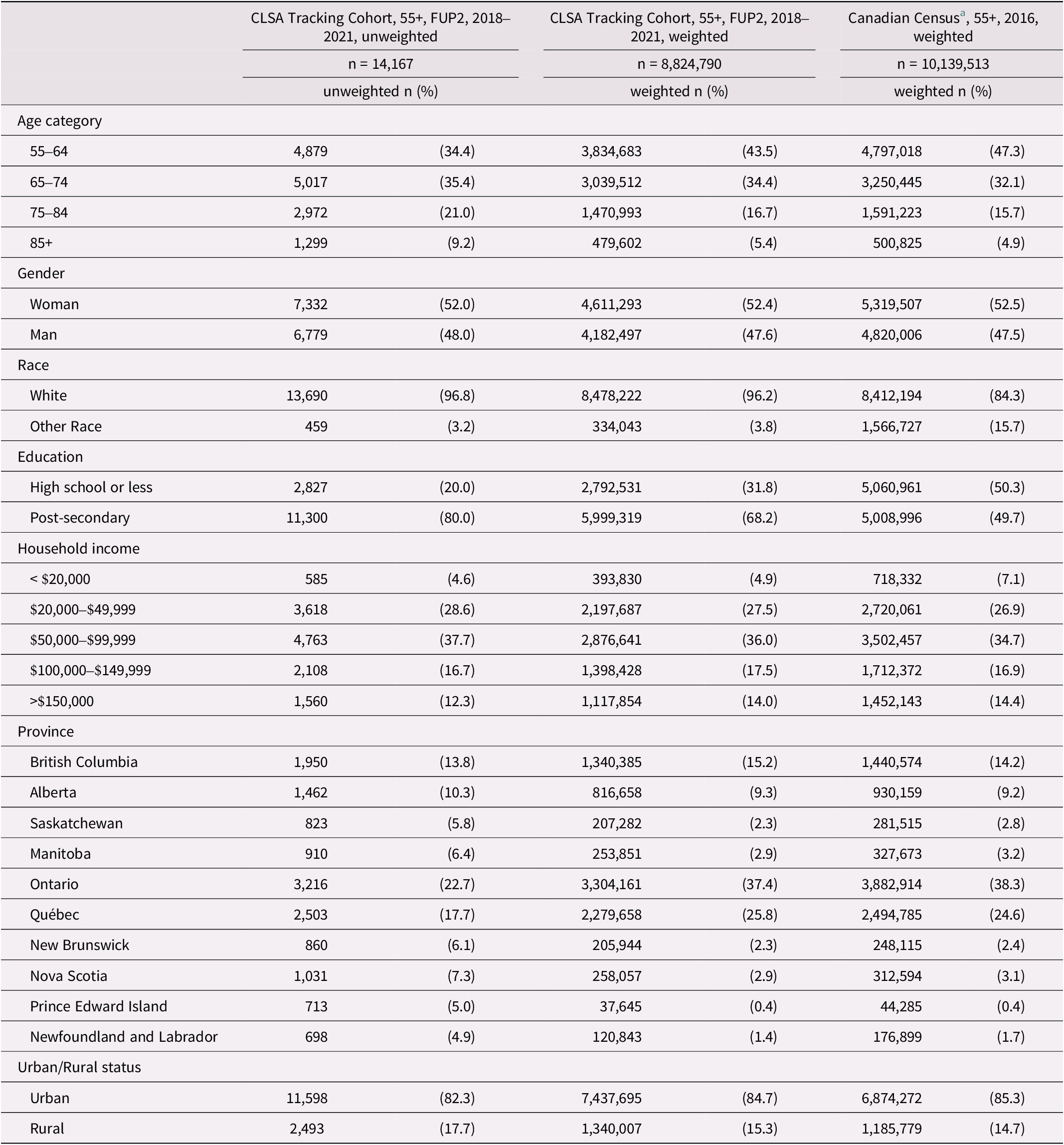
a Estimates of the Canadian population for age, gender, race, education, household income, and province are obtained from Statistics Canada’s 2016 Public Use Microdata file (Statistics Canada, 2019), and estimates for urban and rural dwelling from Statistic Canada’s 2016 Annual Demographic Estimates (Statistics Canada, 2022b).
Objective 1: Profile of older adults’ mobility and travel behaviour
We used descriptive statistics to summarize the mobility and travel behaviour variables by 10-year age category (55–64, 65–74, 75–84, 85+) and aggregated results for the population aged 65 years and older, the age that many government and social programs use to define ‘seniors’. Previous studies have reported large differences in driving status and habits by gender and urban/rural status (Hansen et al., Reference Hansen, Newbold, Scott, Vrkljan and Grenier2020; Turcotte, Reference Turcotte2012), therefore we explored how driving status was distributed by age, gender, and urban/rural status.
Objective 2: Profile of older adults with unmet travel needs
Descriptive analyses were used to estimate the prevalence of older adults with unmet needs and to compare sociodemographic, household, and travel characteristics according to unmet travel need status. We used chi-square independence tests to identify which characteristics statistically differed (p < 0.05) between those who reported an unmet travel need and those who did not.
Objective 3: Associations between having an unmet travel need and health and social outcomes
We used binary logistic regression to quantify associations between reporting an unmet travel need and each of the health and social outcomes. We conducted both unadjusted and adjusted logistic regression models. Adjusted regression models controlled for age, gender, household income, living arrangement, and urban/rural status. The selection of these variables was guided by the demographic characteristics included in Luiu et al.’s conceptual framework of unmet needs in later life (Luiu et al., Reference Luiu, Tight and Burrow2018a), and that were also known to be independent predictors of the health and social outcomes of interest. To control for the effects of the pandemic, we also included a variable in the adjusted regression model to indicate whether the respondent completed the survey pre- or post-pandemic. All survey respondents who completed the survey prior to March 11, 2020, the date the World Health Organization declared a pandemic, were assigned as pre-pandemic and those who completed the survey March 11, 2020 onwards as post-pandemic. We calculated generalized variance inflation factors to assess for multicollinearity in adjusted models. The inflation factors for variables across models did not exceed 5, the threshold below which inflation factors are deemed to be in an acceptable range (Shrestha, Reference Shrestha2020). Thus, multicollinearity was not a concern in our models.
Results
The results section is organized according to our three research objectives. The first section characterizes older adults’ mobility and travel behaviour patterns, the second characterizes the older adult population that self-reports unmet travel needs, and the third quantifies associations between having an unmet travel need and health and social outcomes.
Part 1: Profile of older adults’ mobility and travel behaviour
Table 3 summarizes older adults’ mobility limitations and travel behaviour for those aged 65 years or older and by age group. The proportion reporting personal mobility and functional limitations increased with age, with the most notable increase occurring after the age of 85. Approximately 1 in 6 (16.8%) older adults aged 85 years or older reported requiring help walking, either from a person or with the use of a mobility aid; 13.0 per cent reported needing some help to get to places out of walking distance; and 15.9 per cent reported needing some help with grocery shopping.
Driving, either as driver or passenger, is the most common way older adults get around, followed by walking, public transit, accessible transit, taxi, and cycling. The proportion who drove as their main form of transportation is substantially higher in the youngest (82.6%) compared to the oldest age group (54.6%); however, driving continues to be the most common form of transportation even for those in the oldest age groups. Only 3.3 per cent of adults 65 years or older used public transit as their main form of transportation. Those who were 85 years or older were the most likely to report using accessible transit (3.2%), taxi (3.3%), or walking or wheeling (6.0%) as their main form of transportation.
Over half (65.6%) of older adults reported using more than one mode in the past month. After driving, the most commonly reported mode used in the past month was walking (59.9%), followed by public transit (13.1%), cycling (9.4%), taxi (8.6%), accessible transit (2.2%), and wheelchairs (2.1%). Driving, public transit use, walking, and cycling all decreased with age; conversely, the use of accessible transit, taxi services, and wheelchairs increased with age.
Three-quarters (76.4%) of older adults aged 65 years or older reported travelling to at least three different types of destinations weekly. The most common trip type was grocery shopping – with 84.1 per cent making a trip to a grocery store in a typical week. Other common destinations were to visit with friends and family (65.5%) or to go to shops and restaurants (56.6%). Less common trip destinations in a typical week were for religious service (25.8%), medical appointments (21.1%), or commuting to or from work (12.0%). The number of different trip types in a typical week decreased with age; however, grocery shopping and visiting with friends and family continued to be the most common trip types reported by those 85 years or older.
Mobility limitations and travel behaviour for older adults 65+ and by age category, CLSA Tracking Cohort, Follow-up 2

The vast majority of older adults had a valid driver’s licence (Table 4). In the overall sample, 92.8 per cent had a valid driver’s licence, 4.3 per cent had a driver’s licence at one point but currently did not, and 2.9 per cent had never had a driver’s licence. Across all age groups, women were less likely than men to have a driver’s licence and people who lived in urban settings were less likely to have a licence: the widest gaps were within the oldest age group.
Proportion of older adults with a valid driver’s licence, overall and by gender, CLSA Tracking Cohort, Follow-up 2

Driving habits also varied across age groups, gender, and urban/rural status (Table 5). The proportion who drove four times or more per week decreased consistently with age; just over half (53.1%) of people aged 85 years or older drove four times or more per week compared to 79.6 per cent aged 55 to 64 years. Women drove less frequently than men, and older adults in rural settings drove less than their urban counterparts. In addition to driving less frequently, people who were older reported more caution around driving. The top three situations that older adults avoided were driving in heavy rain or snow, in heavy traffic, and at night.
Approximately 1 in 6 (15.9%) older adults had spoken with a medical professional about their driving safety. Those who were older were more likely to have spoken with a medical professional compared to younger older adults, but there were no substantial differences by gender or urban/rural status. Of those who had spoken with a medical professional, the most common topics discussed were possible safety issues related to a medical condition they had (39.4%), general information or advice on driving (33.0%), or referral for a driving assessment with licensing authority (22.6%).
Driving habits for the weighted sub-sample with a valid driver’s licence (n = 8,006,742), CLSA Tracking Cohort, Follow-up 2

Former drivers were asked to indicate all of the reasons they gave up their driver’s licence (Table 6). The two most common reasons for giving up a driver’s licence were: no longer feeling like a safe driver (24.5%) or having a condition or limitation that prevented them from driving (23.4%). There were differences in the reasons given by gender. One of the most commonly selected reasons for women was no longer enjoying driving (20.3%), which was only selected by 3.2 per cent of men. Men were more likely to indicate a health limitation (e.g., physical condition, deteriorating vision) as one of the reasons for giving up their driver’s licence.
Reasons for giving up driver’s licence for the weighted sub-sample who no longer had a driver’s licence (n = 368,655), CLSA Tracking Cohort, Follow-up 2

Part 2: Profile of older adults with unmet travel needs
Approximately 4 per cent of the overall sample had an unmet travel need. Of those who were categorized as having an unmet travel need, 64.0 per cent indicated transportation costs were a barrier to accessing places they wanted to go, 22.0 per cent indicated transportation problems were a reason for not accessing more social opportunities, 13.9 per cent for not accessing healthcare or having an unmet health need, and 8.4 per cent for not accessing more physical activity opportunities.
Table 7 contrasts sociodemographic, household, and travel characteristics according to unmet travel need status. Based on chi-square independence tests, most characteristics differed according to unmet travel need status and were in the expected direction. In terms of sociodemographic characteristics, older adults with an unmet travel need were more likely to be women, have lower education levels and household incomes, and have a mobility limitation. We expected those with an unmet travel need to be older, but age was one characteristic that did not differ between the two groups. The most notable findings according to the province were on the east coast of Canada: people who lived in Québec were less likely to report an unmet travel need, while those who lived in the maritime provinces, in particular New Brunswick and Nova Scotia, were more likely to report an unmet travel need. Unmet travel needs were more commonly reported by people in rural settings (compared to urban settings), by those who lived in apartments, townhouses, or seniors housing (compared to single-family homes), and by those who lived alone (compared to those who lived with others). Older adults with unmet travel needs were more likely to be passengers or use shared or sustainable modes of transportation for their main mode (51.1% compared to 21.1% for those without an unmet transportation need). In a typical week, older adults with unmet travel needs were less likely to make trips to organized social activities, shopping and restaurants, parks and outdoor spaces, grocery shopping, and work, relative to those without an unmet travel need (Figure 1).
Comparison of sociodemographic, household, and travel characteristics by unmet travel need status, CLSA Tracking Cohort, Follow-up 2

Note: Significant difference in proportions according to Chi-square independence tests at p < 0.05 are in bold.
Abbreviations: χ2 = chi-squared test statistic.
Destinations in a typical week stratified by unmet travel need status, CLSA Tracking Cohort, Follow-up 2, 2018–2021.
*Significant difference in proportions according to Chi-square independence tests at p < 0.05.

Part 3: Associations between having an unmet travel need and health and social outcomes
There were notable differences in health and social outcomes by unmet travel need status (Table 8). Across all four outcomes, the population with unmet travel needs fared worse than those who did not have an unmet travel need. People with an unmet travel need were three times as likely to self-report fair or poor general health compared to those who did not have an unmet travel need (40% compared to 13%), and two and a half times as likely to report fair or poor general mental health (17% compared to 6%). Over half (51%) of people with an unmet travel need reported feeling isolated from others some of the time or often compared to only 22% amongst those who did not have an unmet travel need. A weak sense of belonging to the local community was also more likely to be reported by those with an unmet travel need (43% versus 33%).
Self-reported measures of health and social connectedness stratified by unmet travel need status, CLSA Tracking Cohort, Follow-up 2

Note: Significant difference in proportions according to Chi-square independence tests at p < 0.05 are in bold.
Abbreviations: χ2 = chi-squared test statistic.
Having an unmet travel need was associated with poorer self-reported health status and social connectedness, even after controlling for age, gender, household income, living alone, urban/rural status, and timing of survey completion (Table 9). In bivariate analyses, statistically significant associations were observed between having an unmet travel need and each of the outcomes. Adjusting for sociodemographic characteristics attenuated the effect size, but the associations remained significant. The largest effect sizes were observed for outcomes related to general health and frequency of feeling isolated. After adjusting for the sociodemographic characteristics and timing of survey completion, people with an unmet travel need had 2.7 times the odds of reporting fair or poor general health (OR = 2.66, 95% CI = 2.19, 3.22) and 2.9 times the odds of reporting feeling isolated some of the time or often (OR = 3.10, 95% CI: 2.57, 3.72) compared to those without an unmet travel need.
Logistic regression models for associations between self-reported unmet travel needs and measures of health and social connectedness, CLSA Tracking Cohort, Follow-up 2

Note: Statistically significant associations at p < 0.05 are in bold font.
Abbreviations: OR = Odds ratio; 95% CI: 95% Confidence Intervals.
a Reference category is good, very good, or excellent general health.
b Reference category is good, very good, or excellent general mental health.
c Reference category is hardly ever feeling isolated from others.
d Reference category is somewhat or strong sense of belonging to local community.
Discussion
This study characterized older adults’ travel behaviour and unmet transportation needs in the Canadian context drawing on data from the CLSA. In doing so, we provide a national benchmark on older adults’ travel behaviour and extend the literature on unmet travel needs which contained limited insights from the Canadian context. Like many countries around the world, Canada’s population is aging (Statistics Canada, 2022a). Almost one in five Canadians (18.8% of the population; ~7.3 million people) was 65 years or older in 2022, and this share is expected to increase over the next few decades (Government of Canada & Statistics Canada, 2022; Statistics Canada, 2022a). Adapting transportation systems to meet the needs of the aging population is thus a pressing policy priority, and if not addressed, will only become increasingly so as the population continues to grow older. Below we discuss our results in relation to existing evidence and policy implications. For comparisons of travel behaviour with the national profile of older adults’ transportation habits from 2009 (Turcotte, Reference Turcotte2012), we report only on trends where there were substantial differences in prevalence estimates as the generalizability of the two samples differed in terms of level of education and race (Raina et al., Reference Raina, Wolfson, Kirkland, Griffith, Balion, Cossette, Dionne, Hofer, Hogan, van den Heuvel, Liu-Ambrose, Menec, Mugford, Patterson, Payette, Richards, Shannon, Sheets, Taler and Young2019); two sociodemographic characteristics associated with travel behaviour (Jamal & Newbold, Reference Jamal and Newbold2020).
Travel behaviour
Our findings indicate that driving, either as a driver or passenger, continues to be the main way older adults get around. This is the same result from over a decade ago (Turcotte, Reference Turcotte2012); although our analysis showed even greater reliance on the car for getting around in older age than was reported previously. Driving was the main form of transportation for over half (54%) of older adults aged 85 years and older compared to only 31 per cent of older adults aged 85 years and over in 2009 (Turcotte, Reference Turcotte2012). The increased reliance of older adults on the car than previously reported is worth underscoring in the context of climate change. Policies targeted at shifting older adults’ travel to sustainable modes of transportation can help reduce greenhouse gas emissions while providing the opportunity for people to become comfortable with other modes before they give up their driver’s licence.
The gap in the proportion of men and women who have a driver’s licence persisted but has since narrowed. We found there was only a 9 per cent gap in the proportion of men and women aged 65+ that had a driver’s licence (95% men, 86% women), compared to a 25 per cent gap reported in 2009 (89% men, 63% women) (Turcotte, Reference Turcotte2012). This trend was expected since the population of older adults from a decade ago consisted of a larger number of women who had never driven compared to the current population of older adults. Not surprisingly, older adults in rural settings were more likely to retain their driver’s licence longer than their urban counterparts. This aligns with findings from previous research conducted in the Canadian context (Spinney et al., Reference Spinney, Newbold, Scott, Vrkljan and Grenier2020; Turcotte, Reference Turcotte2012). Even though driving was the most commonly reported mode, over half (66%) had used more than one mode of transportation in the previous month. After driving, walking was the next most commonly reported mode (59% had walked in the past month) followed by public transit (13%). Driving, public transit use, walking, and cycling all decreased with age; conversely, the use of accessible transit, taxi services, and wheelchairs increased with age.
Our results corroborate previous work that describes driving cessation as a gradual process whereby older adults tend to self-regulate driving behaviour as they age (Ang et al., Reference Ang, Oxley, Chen, Yap, Song and Lee2019; Hansen et al., Reference Hansen, Newbold, Scott, Vrkljan and Grenier2020). Those in the oldest age groups drove less frequently and reported there were more situations they tried to avoid. There were clear differences in driving habits by gender, with women driving less frequently than men across all age groups. Gender has been reported to be a strong predictor of self-regulating driving behaviour (Ang et al., Reference Ang, Oxley, Chen, Yap, Song and Lee2019) – with one explanation being that women are already more likely to rely on alternative modes of transportation (Barrett et al., Reference Barrett, Gumber and Douglas2018). The top three situations that older adults avoided were driving in heavy rain or snow (54%), heavy traffic (49%), and at night (45%). Of those who had given up their driver’s licence, the reasons for giving up a driver’s licence were more commonly related to personal assessments (e.g., no longer feeling safe, a health condition, no longer needing to drive) rather than external assessments (e.g., doctor or driver’s licence requirement or advised from friends or family).
Studies in multiple contexts have found that early planning for driving cessation can help ease the transition and lessen the negative health and social impacts (Musselwhite & Shergold, Reference Musselwhite and Shergold2013; Pellichero et al., Reference Pellichero, Lafont, Paire-Ficout, Fabrigoule and Chavoix2021; Sanford et al., Mar-Apr Reference Sanford, Naglie, Cameron MSc and Rapoport2020), yet driving cessation continues to be a topic that is largely avoided at the individual and systems level. The Neurodegeneration in Aging and Dementia Team refers to this as the ‘paradox of driving cessation’ (Stasiulis et al., Reference Stasiulis, Rapoport, Sivajohan and Naglie2020). Only 16 per cent of older adults in the current study had spoken with a medical professional about driving safety. Evidence from the U.S. context also shows that relatively few older adults have had a conversation with a medical professional about driving safety, or even with family members (Betz et al., Reference Betz, Villavicencio, Kandasamy, Kelley-Baker, Kim, DiGuiseppi, Mielenz, Eby, Molnar, Hill, Strogatz, Carr and Li2019). There are examples of evidence-based initiatives that work to normalize the conversation of driving cessation and provide resources to ease the transition. Two such examples are the Driving and Dementia Roadmap in Canada (drivinganddementia.ca) and CarFreeMe in Australia (carfreeme.com.au).
Our paper also provides evidence on where older adults typically travel on a weekly basis. The most common destinations were grocery stores, visits with friends and family, places for recreation, and restaurants. These findings align with previous research on older adults’ travel behaviour and travel needs (Hjorthol, Reference Hjorthol2013; Winters et al., Reference Winters, Voss, Ashe, Gutteridge, McKay and Sims-Gould2015). Travel for shopping and recreational purposes is often overlooked in data collection efforts and transportation planning which tend to prioritize commuters. As one example, the Canadian census only captures the main mode of commuting for employed persons who commute to work (Statistics Canada, 2022b); thus, this data source fails to describe travel patterns for retired or non-working older adults, but also by women, children, and people with disabilities who make up a larger share of the unemployed population. This limits the types of questions and inferences that can be drawn from journey to work mode share census data – a widely used data source in transportation research (Branion-Calles et al., Reference Branion-Calles, Teschke, Koehoorn, Espin-Garcia and Harris2021). Our finding that the most common weekly destinations for older adults are for shopping, social, and recreational purposes emphasizes the need for transportation researchers to consider a broader set of destinations than workplaces in data collection efforts and analyses.
Unmet travel needs
In addition to understanding older adults’ travel behaviour more generally, an important contribution of this paper is the focus on understanding the profile of older adults that self-report unmet travel needs. There is a large body of work in transport planning that identifies areas of high and low accessibility through quantitative measures of accessibility that combine a transportation component (e.g., travel time) and land use component (e.g., number of grocery stores) (Handy, Reference Handy2020). Much less work has focused on people’s individual experience of accessibility in their cities and whether they are able to meet their needs with the available transportation options (van Wee, Reference van Wee2016). In the case of older adults, there are other considerations for accessibility that cannot be captured in quantitative measures. For example, Ravensbergen et al. (Reference Ravensbergen, Newbold, Ganann and Sinding2021) describe the additional ‘mobility work’ experienced by some older adults when using public transportation including travelling long distances to walk to and from bus stops, challenges boarding the bus with a mobility device, and worrying about getting a seat, amongst others (Ravensbergen et al., Reference Ravensbergen, Newbold, Ganann and Sinding2021).
Evidence on the sociodemographic, household, and travel behaviour characteristics of the population that self-reports an unmet travel need can help inform the types of populations that could benefit most from improved access to transportation. Women, people with lower education levels and incomes, and those who lived in apartments and lived alone were more likely to report an unmet travel need. People who required assistance walking, either from a person or the use of a mobility aid, disproportionately made up the population with unmet travel needs. This provides an impetus for more action on transportation to be taken to meet the goals of the Accessible Canada Act – the national accessibility legislation – of a barrier-free Canada for people with disabilities by 2040 (Government of Canada, 2022). In addition, we found that people with an unmet travel need were more likely to use alternative forms of transportation as their main mode, including public transit, paratransit, and active modes of transportation. This calls for greater prioritization of investments in shared and sustainable modes of transportation to make them competitive and attractive alternatives to driving. Further qualitative research with the population groups identified from this analysis could be used to better understand the experiences of people with unmet travel needs and explore possible solutions.
Our analysis provides strong support for the link between transportation and health (Widener & Hatzopoulou, Reference Widener and Hatzopoulou2016). People who reported an unmet travel need had higher odds of self-reporting poorer health and social outcomes relative to those who did not have an unmet travel need, even after adjusting for sociodemographic characteristics. This highlights the vested interest that the healthcare sector has in advocating for better access to transportation, particularly for those populations that report an unmet travel need.
Limitations
We suspect that the prevalence of unmet travel needs in our study sample (4.1%) is an underestimate of unmet needs in the older adult population in Canada. A few reasons for this may be due to limitations in the generalizability of the CLSA sample, the timing of data collection which spanned the onset of the pandemic, and the survey design. First, while the CLSA sample is generalizable to the Canadian population in terms of age, gender, marital status, household income, and province of residence, it is healthier and more educated than the underlying population (Raina et al., Reference Raina, Wolfson, Kirkland, Griffith, Balion, Cossette, Dionne, Hofer, Hogan, van den Heuvel, Liu-Ambrose, Menec, Mugford, Patterson, Payette, Richards, Shannon, Sheets, Taler and Young2019); which could contribute to the lower estimate of unmet travel needs than expected. The CLSA sample also underrepresents racialized populations in Canada, which limits the generalizability of the findings from this study. Moreover, the small sample sizes across different races precluded stratifying results by race. Second, nearly half of the sample completed the survey in the context of the COVID-19 pandemic. Transportation may not have surfaced as prominently as a barrier during this time because of restrictions on social gatherings and unnecessary travel. Studies leveraging CLSA data in future follow-ups can help determine the longer-term impacts the pandemic has had on older adults’ travel behaviour. Third, in terms of survey design, the survey questions we used to derive the binary indicator of unmet travel needs were asked as open-ended questions; there was no prompting from the telephone interviewer to indicate ‘transportation problems’ as a reason for not reaching desired or essential destinations. Other studies on unmet travel needs typically include survey questions that specifically ask about transportation barriers (Luiu et al., Reference Luiu, Tight and Burrow2017). While the open-ended question format likely resulted in underestimating the prevalence of unmet travel needs in the older adult population, an advantage of this approach is that we likely captured those who experience transportation barriers most acutely rather than those for whom it may be a barrier only occasionally. Finally, for investigating associations between unmet travel needs and health and social outcomes, we accounted for several demographic confounders but did not adjust for all potential confounders. Future research could investigate the causal relationship between unmet travel needs and health and social outcomes by considering a wider set of confounders and by leveraging the longitudinal nature of the CLSA.
Conclusion
We leveraged a large national dataset to provide a national benchmark on older adults’ travel behaviour and unmet needs in the Canadian context. Driving continues to be the main way older adults get around; however, most older adults report using more than one mode, with walking being the next most common mode of transportation. The most common trips made by older adults are for shopping, social, and recreational purposes. We found increased rates of unmet travel needs amongst women, people with lower education levels and incomes, people who lived in apartments or seniors housing or lived alone, people with mobility limitations, and those who used alternative modes of transportation to driving. Those with unmet travel needs reported travelling to fewer different types of destinations in a typical week and reported worse health and social outcomes, relative to those without an unmet travel need. Taken together, the findings from our study identified patterns in older adults’ travel behaviour and unmet needs. These findings can be used to inform transportation planning policies that improve access to transportation so that older adults can remain connected and engaged in their communities.
Supplementary material
The supplementary material for this article can be found at http://doi.org/10.1017/S0714980824000254.
Acknowledgements
This research was made possible using the data/biospecimens collected by the Canadian Longitudinal Study on Aging (CLSA). Funding for the Canadian Longitudinal Study on Aging (CLSA) is provided by the Government of Canada through the Canadian Institutes of Health Research (CIHR) under grant reference: LSA 94473 and the Canada Foundation for Innovation, as well as the following provinces, Newfoundland, Nova Scotia, Quebec, Ontario, Manitoba, Alberta, and British Columbia. This research has been conducted using the CLSA Baseline Tracking Dataset – Version 4.0 and Follow-up 2 Tracking Dataset – Version 1.0, under Application Number 2206016. The CLSA is led by Drs. Parminder Raina, Christina Wolfson and Susan Kirkland. We used questions from the Transportation, Mobility, and Migration Module of the CLSA which was supported in part by the Ontario Ministry of Transportation.
Financial support for this analysis was provided to Kate Hosford through the Canadian Institutes of Health Research’s (CIHR) Health System Impact Fellowship, which is cofounded by CIHR, United Way British Columbia, and Mitacs.


 Open access

