
 Z
Z





1. Introduction
A basic principle in the study of group actions and their operator-algebraic crossed products is that dynamical towers produce matricial structure, and that dynamical towers with Følner (i.e. approximately invariant) shapes produce approximately central matricial structure.
In the case of a free measure-preserving action of a countable amenable group on a standard probability space, a theorem of Ornstein and Weiss gives the existence of a family of disjoint Følner-shaped towers which cover all but a small piece of the space [Reference Ornstein and WeissOW87]. The smallness of this remainder, expressed in terms of the measure, means that the multimatrix algebras generated by the towers partition the unit of the von Neumann algebra crossed product up to a small error in the trace norm. When combined with the approximate centrality that ensues from the Følnerness of the tower shapes, this yields local approximation by finite-dimensional $^*$
-subalgebras and hence hyperfiniteness of the crossed product,Footnote
1
and if the action is ergodic, one obtains the unique hyperfinite II
$^*$
-subalgebras and hence hyperfiniteness of the crossed product,Footnote
1
and if the action is ergodic, one obtains the unique hyperfinite II $_1$
factor.
$_1$
factor.
The analogous C $^*$
-theory involving actions of countable amenable groups on compact metrizable spaces is more complicated and, despite many significant advances, still incomplete. While a variety of different tools and techniques have been developed over the last four decades [Reference PutnamPut90, Reference Elliott and EvansEE93, Reference Lin and PhillipsLP04, Reference Lin and PhillipsLP10, Reference Strung and WinterSW11, Reference Toms and WinterTW13], in large part stimulated by new ideas that have emerged from the Elliott classification program, a basic pattern has crystallized through the course of recent progress, which we can summarize as follows.
$^*$
-theory involving actions of countable amenable groups on compact metrizable spaces is more complicated and, despite many significant advances, still incomplete. While a variety of different tools and techniques have been developed over the last four decades [Reference PutnamPut90, Reference Elliott and EvansEE93, Reference Lin and PhillipsLP04, Reference Lin and PhillipsLP10, Reference Strung and WinterSW11, Reference Toms and WinterTW13], in large part stimulated by new ideas that have emerged from the Elliott classification program, a basic pattern has crystallized through the course of recent progress, which we can summarize as follows.
A major point of departure from the measure-theoretic setting is the presence of dimensionality, which means that matrix models coming from the dynamics will need to be continuous instead of discrete, or that they will need to be reconceptualized as order-zero maps from matrices into the algebra. The first of these options, which connects to ideas of dimension-rank ratio and dimension growth, is particularly powerful when dimensional regularity hypotheses on the space (e.g. finite covering dimension) are replaced by more general ones on the dynamics such as zero mean dimension or the small boundary property, which have so far only yielded to this approach. In this case, the goal has been to show that the C $^*$
-algebra crossed product is
$^*$
-algebra crossed product is ${\mathcal{Z}}$
-stable, which has been achieved in the case of free minimal
${\mathcal{Z}}$
-stable, which has been achieved in the case of free minimal $\mathbb{Z}^d$
-actions with zero mean dimension [Reference Elliott and NiuEN17, Reference NiuNiu24], although it seems to be a difficult problem to establish similarly general statements for other acting groups (see, however, [Reference NiuNiu22]).
$\mathbb{Z}^d$
-actions with zero mean dimension [Reference Elliott and NiuEN17, Reference NiuNiu24], although it seems to be a difficult problem to establish similarly general statements for other acting groups (see, however, [Reference NiuNiu22]).
The second option can be developed in two different ways. In general, one is confronted with the problem that, unlike for the trace norm approximations in the von Neumann algebraic setting, the operator norm approximations that are essential for unraveling C $^*$
-structure cannot be done by purely spatial means and instead must be implemented with the help of spectral constructions, even if the space is zero-dimensional. This is true both for the approximation of the unit in the tower configurations and for the approximate centrality demanded of the matrix models. One possibility is to drop the Følner requirement and allow enough overlap between towers so that the bump functions implementing approximate centrality will form a genuine partition of unity. Control on the multiplicity of this overlapping will lead to estimates on the nuclear dimension of the crossed product [Reference Winter and ZachariasWZ10, Reference Hirshberg, Winter and ZachariasHWZ15, Reference SzabóSza15, Reference Szabó, Wu and ZachariasSWZ19], and can be formalized at the dynamical level through the notions of dynamic asymptotic dimension [Reference Guentner, Willett and YuGWY17] and tower dimension [Reference KerrKer20]. Another idea, formalized in the definition of almost finiteness (see § 2), is to insist on the Følnerness and disjointness of the towers and express the shortfall in the partitioning by means of a topological version of Cuntz subequivalence, which is then sufficient to imply that the crossed product is
$^*$
-structure cannot be done by purely spatial means and instead must be implemented with the help of spectral constructions, even if the space is zero-dimensional. This is true both for the approximation of the unit in the tower configurations and for the approximate centrality demanded of the matrix models. One possibility is to drop the Følner requirement and allow enough overlap between towers so that the bump functions implementing approximate centrality will form a genuine partition of unity. Control on the multiplicity of this overlapping will lead to estimates on the nuclear dimension of the crossed product [Reference Winter and ZachariasWZ10, Reference Hirshberg, Winter and ZachariasHWZ15, Reference SzabóSza15, Reference Szabó, Wu and ZachariasSWZ19], and can be formalized at the dynamical level through the notions of dynamic asymptotic dimension [Reference Guentner, Willett and YuGWY17] and tower dimension [Reference KerrKer20]. Another idea, formalized in the definition of almost finiteness (see § 2), is to insist on the Følnerness and disjointness of the towers and express the shortfall in the partitioning by means of a topological version of Cuntz subequivalence, which is then sufficient to imply that the crossed product is ${\mathcal{Z}}$
-stable [Reference KerrKer20]. The two approaches are connected at the dynamical level by the observation that a free action on a space of finite covering dimension is almost finite if its dynamic asymptotic dimension or tower dimension is finite (see [Reference Kerr and SzabóKS20, Corollary 6.2] and [Reference KerrKer20, Theorem 5.14]). The first approach has proven to be very effective for certain classes of groups, as in the recent paper [Reference Conley, Jackson, Marks, Seward and Tucker-DrobCJM+23] where finite dynamic asymptotic dimension (and hence also almost finiteness) is established for free actions of many solvable groups, including polycyclic groups and the lamplighter group, on zero-dimensional compact metrizable spaces. On the other hand, such use of the dimensional idea of controlled overlapping from which a proof of finite nuclear dimension can be derived has invariably required the space to have finite covering dimension and the group to have finite asymptotic dimension, the latter being a property that excludes many amenable groups. From this perspective almost finiteness has turned out to be more broadly applicable, and indeed has been shown to hold for free minimal actions of groups with local subexponential growth on zero-dimensional compact metrizable spaces [Reference Downarowicz and ZhangDZ23], as well as for a generic free minimal action of any countably infinite amenable group on the Cantor set [Reference Conley, Jackson, Kerr, Marks, Seward and Tucker-DrobCJK+18]. Moreover, by [Reference Kerr and SzabóKS20, Theorem 7.6], for a fixed countably infinite group G, if every free action of G on a zero-dimensional compact metrizable space is almost finite, then every free action of G on a finite-dimensional compact metrizable space (and in fact every free action with the topological small boundary property) is almost finite.
${\mathcal{Z}}$
-stable [Reference KerrKer20]. The two approaches are connected at the dynamical level by the observation that a free action on a space of finite covering dimension is almost finite if its dynamic asymptotic dimension or tower dimension is finite (see [Reference Kerr and SzabóKS20, Corollary 6.2] and [Reference KerrKer20, Theorem 5.14]). The first approach has proven to be very effective for certain classes of groups, as in the recent paper [Reference Conley, Jackson, Marks, Seward and Tucker-DrobCJM+23] where finite dynamic asymptotic dimension (and hence also almost finiteness) is established for free actions of many solvable groups, including polycyclic groups and the lamplighter group, on zero-dimensional compact metrizable spaces. On the other hand, such use of the dimensional idea of controlled overlapping from which a proof of finite nuclear dimension can be derived has invariably required the space to have finite covering dimension and the group to have finite asymptotic dimension, the latter being a property that excludes many amenable groups. From this perspective almost finiteness has turned out to be more broadly applicable, and indeed has been shown to hold for free minimal actions of groups with local subexponential growth on zero-dimensional compact metrizable spaces [Reference Downarowicz and ZhangDZ23], as well as for a generic free minimal action of any countably infinite amenable group on the Cantor set [Reference Conley, Jackson, Kerr, Marks, Seward and Tucker-DrobCJK+18]. Moreover, by [Reference Kerr and SzabóKS20, Theorem 7.6], for a fixed countably infinite group G, if every free action of G on a zero-dimensional compact metrizable space is almost finite, then every free action of G on a finite-dimensional compact metrizable space (and in fact every free action with the topological small boundary property) is almost finite.
Given this dynamic picture it comes as quite a surprise that, for unital simple nonelementary separable C $^*$
-algebras, finite nuclear dimension is actually equivalent to
$^*$
-algebras, finite nuclear dimension is actually equivalent to ${\mathcal{Z}}$
-stability (the forward implication was proven in [Reference WinterWin12], while the backward implication was recently established in [Reference Castillejos, Evington, Tikuisis, White and WinterCET+21] after a string of partial results beginning with the breakthrough in [Reference Matui and SatoMS14]). The significance of these two regularity properties and their equivalence in this context is that the class of unital simple separable C
${\mathcal{Z}}$
-stability (the forward implication was proven in [Reference WinterWin12], while the backward implication was recently established in [Reference Castillejos, Evington, Tikuisis, White and WinterCET+21] after a string of partial results beginning with the breakthrough in [Reference Matui and SatoMS14]). The significance of these two regularity properties and their equivalence in this context is that the class of unital simple separable C $^*$
-algebras having finite nuclear dimension and satisfying the universal coefficient theorem (UCT) is classified by the Elliott invariant (ordered K-theory paired with tracial states) [Reference KirchbergKir94, Reference PhillipsPhi00, Reference Gong, Lin and NiuGLN20a, Reference Gong, Lin and NiuGLN20b, Reference Elliott, Gong, Lin and NiuEGL+25, Reference Tikuisis, White and WinterTWW17], and every stably finite member of this class is an inductive limit of subhomogeneous C
$^*$
-algebras having finite nuclear dimension and satisfying the universal coefficient theorem (UCT) is classified by the Elliott invariant (ordered K-theory paired with tracial states) [Reference KirchbergKir94, Reference PhillipsPhi00, Reference Gong, Lin and NiuGLN20a, Reference Gong, Lin and NiuGLN20b, Reference Elliott, Gong, Lin and NiuEGL+25, Reference Tikuisis, White and WinterTWW17], and every stably finite member of this class is an inductive limit of subhomogeneous C $^*$
-algebras whose spectra have covering dimension at most two [Reference ElliottEll96] (see [Reference Tikuisis, White and WinterTWW17, Theorem 6.2(iii)]). The crossed product of a free minimal action of a countable amenable group on a compact metrizable space will therefore be covered by these classification and structure results as soon as it is known to have finite nuclear dimension, or equivalently be
$^*$
-algebras whose spectra have covering dimension at most two [Reference ElliottEll96] (see [Reference Tikuisis, White and WinterTWW17, Theorem 6.2(iii)]). The crossed product of a free minimal action of a countable amenable group on a compact metrizable space will therefore be covered by these classification and structure results as soon as it is known to have finite nuclear dimension, or equivalently be ${\mathcal{Z}}$
-stable (note that the UCT is automatic by [Reference TuTu99], and that amenability implies the existence of an invariant Borel probability measure and hence of a tracial state, which ensures stable finiteness in view of simplicity). That
${\mathcal{Z}}$
-stable (note that the UCT is automatic by [Reference TuTu99], and that amenability implies the existence of an invariant Borel probability measure and hence of a tracial state, which ensures stable finiteness in view of simplicity). That ${\mathcal{Z}}$
-stability does not always hold in this context, even for free minimal
${\mathcal{Z}}$
-stability does not always hold in this context, even for free minimal $\mathbb{Z}$
-actions, was shown in [Reference Giol and KerrGK10].
$\mathbb{Z}$
-actions, was shown in [Reference Giol and KerrGK10].
In this paper we establish the following theorem, which generalizes the almost finiteness result from [Reference Conley, Jackson, Marks, Seward and Tucker-DrobCJM+23]. By definition, the class of elementary amenable groups is the smallest class of groups which contains all finite groups and Abelian groups and is closed under taking subgroups, quotients, extensions, and direct limits. This class includes all solvable groups, is closed under taking wreath products, and contains many groups with both exponential growth and infinite asymptotic dimension, such as $\mathbb{Z}\wr\mathbb{Z}$
. A finitely generated infinite amenable group cannot be elementary amenable if it has intermediate growth [Reference ChouCho80], like the prototypical Grigorchuk group [Reference GrigorchukGri84], or if it is simple, like the commutator subgroup of the topological full group of a minimal subshift [Reference MatuiMat06, Reference Juschenko and MonodJM13].
$\mathbb{Z}\wr\mathbb{Z}$
. A finitely generated infinite amenable group cannot be elementary amenable if it has intermediate growth [Reference ChouCho80], like the prototypical Grigorchuk group [Reference GrigorchukGri84], or if it is simple, like the commutator subgroup of the topological full group of a minimal subshift [Reference MatuiMat06, Reference Juschenko and MonodJM13].
Theorem A. Every free continuous action of a countably infinite elementary amenable group on a finite-dimensional compact metrizable space is almost finite.
By [Reference Kerr and SzabóKS20, Theorem 7.6], as mentioned three paragraphs above, it is enough to prove the theorem in the case of zero-dimensional compact metrizable spaces, which is what we will do, also without the assumption that the countable group be infinite (for finite groups, an action as in Theorem A is almost finite if and only if the space is zero-dimensional, and so Theorem A is actually false in this case, and [Reference Kerr and SzabóKS20, Theorem 7.6] is only valid when the group is infinite). In other words, we will establish that every countable elementary amenable group G satisfies the following property.
-
(⋆) Every free continuous action of G on a zero-dimensional compact metrizable space is almost finite.
As is clear from the quantification over finite subsets in the definition of almost finiteness, property ( $\star$
) is preserved under taking countable direct limits. In Theorem 3.1 we prove that property (
$\star$
) is preserved under taking countable direct limits. In Theorem 3.1 we prove that property ( $\star$
) is preserved under finite extensions, while in Theorem 5.4, to which most of our efforts will be devoted, we show that property (
$\star$
) is preserved under finite extensions, while in Theorem 5.4, to which most of our efforts will be devoted, we show that property ( $\star$
) is preserved under extensions by
$\star$
) is preserved under extensions by $\mathbb{Z}$
. Actually none of these three permanence properties require the zero-dimensionality hypothesis on the space, but in order to bootstrap our way to the final result we will rely on the fact that property (
$\mathbb{Z}$
. Actually none of these three permanence properties require the zero-dimensionality hypothesis on the space, but in order to bootstrap our way to the final result we will rely on the fact that property ( $\star$
) holds for the trivial group, as can be seen from the definition of almost finiteness (see § 2) by taking the tower bases therein to form a fine enough clopen partition of the space and the proportionally small subsets of the tower shapes to be empty. To conclude that property (
$\star$
) holds for the trivial group, as can be seen from the definition of almost finiteness (see § 2) by taking the tower bases therein to form a fine enough clopen partition of the space and the proportionally small subsets of the tower shapes to be empty. To conclude that property ( $\star$
) holds for all countable elementary amenable groups we can then appeal to a theorem of Osin [Reference OsinOsi02] which, refining a result of Chou [Reference ChouCho80], characterizes this class as the smallest class of groups that contains the trivial group and is closed under taking countable direct limits and extensions by
$\star$
) holds for all countable elementary amenable groups we can then appeal to a theorem of Osin [Reference OsinOsi02] which, refining a result of Chou [Reference ChouCho80], characterizes this class as the smallest class of groups that contains the trivial group and is closed under taking countable direct limits and extensions by $\mathbb{Z}$
and finite groups. Note that, in view of [Reference Downarowicz and ZhangDZ23], we actually obtain property (
$\mathbb{Z}$
and finite groups. Note that, in view of [Reference Downarowicz and ZhangDZ23], we actually obtain property ( $\star$
) and hence also Theorem A for a broader class of groups, namely the smallest class that contains all countable groups of local subexponential growth and is closed under taking countable direct limits and extensions by
$\star$
) and hence also Theorem A for a broader class of groups, namely the smallest class that contains all countable groups of local subexponential growth and is closed under taking countable direct limits and extensions by $\mathbb{Z}$
and finite groups.
$\mathbb{Z}$
and finite groups.
One of the novelties of the proof of Theorem 5.4 is that it integrates conceptual aspects from all three of the approaches that we sketched above (corresponding to the regularity properties of zero mean dimension, finite dynamic asymptotic dimension, and almost finiteness). The argument proceeds by applying a recursive disjointification procedure to an initial collection of overlapping open towers whose levels have boundaries of upper H-density zero. The shapes of these towers are Følner rectangles in the semidirect product $H\rtimes\mathbb{Z}$
, and the towers generated by the restrictions of these shapes to H cover all but a piece of the space with small upper H-density, as can be arranged using the hypothesized almost finiteness of the H-action. When H is infinite these rectangles are chosen to be thin in the
$H\rtimes\mathbb{Z}$
, and the towers generated by the restrictions of these shapes to H cover all but a piece of the space with small upper H-density, as can be arranged using the hypothesized almost finiteness of the H-action. When H is infinite these rectangles are chosen to be thin in the $\mathbb{Z}$
direction and tall (i.e. much larger) in the H direction, in which case the multiplicity of the overlapping of the towers is small in proportion to the size of their shape in the H direction, very much in the spirit of the small dimension-rank ratios that appear in the proof of
$\mathbb{Z}$
direction and tall (i.e. much larger) in the H direction, in which case the multiplicity of the overlapping of the towers is small in proportion to the size of their shape in the H direction, very much in the spirit of the small dimension-rank ratios that appear in the proof of ${\mathcal{Z}}$
-stability from zero mean dimension in [Reference Elliott and NiuEN17] and in the general study of inductive limits in classification theory. This allows us to generate, by a recursive Ornstein–Weiss-type disjointification process as in [Reference Conley, Jackson, Kerr, Marks, Seward and Tucker-DrobCJK+18, Reference Kerr and SzabóKS20], a collection of open towers whose shapes will be Følner as long as they are proportionally not too small within the ambient shapes of the initial towers from which they are created. The union of the towers whose shapes are not sufficiently Følner can be divided into two subsets, one which is small in upper H-density and the other whose points can be donated to the Følner towers without significantly affecting the approximate invariance of the tower shapes. The set with small upper H-density can be absorbed, via comparison, using the almost finiteness of the H-action. In fact the initial towers will themselves need to be shaved down a little bit at the outset in order to achieve the Følner disjointification (via the tiling argument captured in Lemma 4.1), but this loss will also be small in upper H-density and can likewise be absorbed.
${\mathcal{Z}}$
-stability from zero mean dimension in [Reference Elliott and NiuEN17] and in the general study of inductive limits in classification theory. This allows us to generate, by a recursive Ornstein–Weiss-type disjointification process as in [Reference Conley, Jackson, Kerr, Marks, Seward and Tucker-DrobCJK+18, Reference Kerr and SzabóKS20], a collection of open towers whose shapes will be Følner as long as they are proportionally not too small within the ambient shapes of the initial towers from which they are created. The union of the towers whose shapes are not sufficiently Følner can be divided into two subsets, one which is small in upper H-density and the other whose points can be donated to the Følner towers without significantly affecting the approximate invariance of the tower shapes. The set with small upper H-density can be absorbed, via comparison, using the almost finiteness of the H-action. In fact the initial towers will themselves need to be shaved down a little bit at the outset in order to achieve the Følner disjointification (via the tiling argument captured in Lemma 4.1), but this loss will also be small in upper H-density and can likewise be absorbed.
Unlike in an Ornstein–Weiss tiling, we do not need to repeat the disjointification process across different scales, as the geometry of our situation ensures that the tower shapes will already be Følner if they are proportionally greater than some small $\varepsilon$
in the ambient initial tower. In the Ornstein–Weiss setting this Følnerness can only be guaranteed if the proportion is greater than
$\varepsilon$
in the ambient initial tower. In the Ornstein–Weiss setting this Følnerness can only be guaranteed if the proportion is greater than $1-\varepsilon$
for some small
$1-\varepsilon$
for some small $\varepsilon$
, a situation which occasions the additional recursion over different scales in order to geometrically increase the amount of coverage.
$\varepsilon$
, a situation which occasions the additional recursion over different scales in order to geometrically increase the amount of coverage.
By our discussion prior to the statement of Theorem A, we obtain the following corollary. The precise link to ${\mathcal{Z}}$
-stability is given by [Reference KerrKer20, Theorem 12.4], which asserts that, given an almost finite free minimal action
${\mathcal{Z}}$
-stability is given by [Reference KerrKer20, Theorem 12.4], which asserts that, given an almost finite free minimal action $G\curvearrowright X$
of a countably infinite group on a compact metrizable space, the crossed product
$G\curvearrowright X$
of a countably infinite group on a compact metrizable space, the crossed product $C(X)\rtimes G$
is
$C(X)\rtimes G$
is ${\mathcal{Z}}$
-stable (note that almost finiteness implies that G is amenable and so the reduced and full crossed products coincide in this case).
${\mathcal{Z}}$
-stable (note that almost finiteness implies that G is amenable and so the reduced and full crossed products coincide in this case).
Corollary B. The crossed products of free minimal actions of countably infinite elementary amenable groups on finite-dimensional compact metrizable spaces are classified by their Elliott invariant and are simple inductive limits of subhomogeneous C $^*$
-algebras whose spectra have covering dimension at most two.
$^*$
-algebras whose spectra have covering dimension at most two.
Theorem A also has consequences for topological full groups and homology. Let $G\curvearrowright X$
be free continuous action of a countably infinite elementary amenable group on the Cantor set. Denote by
$G\curvearrowright X$
be free continuous action of a countably infinite elementary amenable group on the Cantor set. Denote by $[[G\curvearrowright X]]$
the topological full group of the action and by
$[[G\curvearrowright X]]$
the topological full group of the action and by $[[G\curvearrowright X]]_0$
the subgroup of
$[[G\curvearrowright X]]_0$
the subgroup of $[[G\curvearrowright X]]$
generated by the elements of finite order whose powers have clopen fixed point sets. In [Reference MatuiMat12, 7], Matui defines an index map I from
$[[G\curvearrowright X]]$
generated by the elements of finite order whose powers have clopen fixed point sets. In [Reference MatuiMat12, 7], Matui defines an index map I from $[[G\curvearrowright X]]$
to the first homology group
$[[G\curvearrowright X]]$
to the first homology group $H_1 (G\curvearrowright X)$
with integer coefficients. The fact that the action
$H_1 (G\curvearrowright X)$
with integer coefficients. The fact that the action $G\curvearrowright X$
is almost finite implies, by [Reference MatuiMat12, Corollary 7.16], that I is surjective and has kernel
$G\curvearrowright X$
is almost finite implies, by [Reference MatuiMat12, Corollary 7.16], that I is surjective and has kernel $[[G\curvearrowright X]]_0$
, so that it induces an isomorphism
$[[G\curvearrowright X]]_0$
, so that it induces an isomorphism $H_1 (G\curvearrowright X) \cong [[G\curvearrowright X]]/[[G\curvearrowright X]]_0$
. If the action is in addition minimal then the commutator subgroup of
$H_1 (G\curvearrowright X) \cong [[G\curvearrowright X]]/[[G\curvearrowright X]]_0$
. If the action is in addition minimal then the commutator subgroup of $[[G\curvearrowright X]]$
is simple (by [Reference MatuiMat15, Theorem 4.7]) and equal to the alternating group
$[[G\curvearrowright X]]$
is simple (by [Reference MatuiMat15, Theorem 4.7]) and equal to the alternating group ${\sf A} (G\curvearrowright X)$
(by [Reference MatuiMat15, Theorem 4.7] and [Reference NekrashevychNek19, Theorem 4.1]).
${\sf A} (G\curvearrowright X)$
(by [Reference MatuiMat15, Theorem 4.7] and [Reference NekrashevychNek19, Theorem 4.1]).
While this paper was being revised for publication, the second author discovered a simple proof of Theorem 5.4 which also works more generally when the extension of H by $\mathbb{Z}$
is replaced by any countable extension G of H (see [Reference NaryshkinNar24]), thereby delivering a considerably larger class of amenable groups for which the conclusion of Theorem A holds. Instead of verifying almost finiteness directly as we do here, the argument in [Reference NaryshkinNar24] proceeds by establishing comparison for the action
$\mathbb{Z}$
is replaced by any countable extension G of H (see [Reference NaryshkinNar24]), thereby delivering a considerably larger class of amenable groups for which the conclusion of Theorem A holds. Instead of verifying almost finiteness directly as we do here, the argument in [Reference NaryshkinNar24] proceeds by establishing comparison for the action $G\curvearrowright X$
through the use of the action of G on the space of H-invariant Borel probability measures together with the castles and multiset comparison that the almost finiteness of the H-action furnishes.
$G\curvearrowright X$
through the use of the action of G on the space of H-invariant Borel probability measures together with the castles and multiset comparison that the almost finiteness of the H-action furnishes.
The main body of the paper begins in § 2 with some general terminology and notation. The case of finite extensions (Theorem 3.1) is treated in § 3, while §§ 4 and 5 are devoted to extensions by $\mathbb{Z}$
(Theorem 5.4). Section 4 contains two technical lemmas for use in the proof of Theorem 5.4, which occupies the bulk of § 5.
$\mathbb{Z}$
(Theorem 5.4). Section 4 contains two technical lemmas for use in the proof of Theorem 5.4, which occupies the bulk of § 5.
2. General terminology and notation
We write e for the identity element of a group.
For finite sets K and F of a group G, we define the K-boundary of F by
 \[\partial_K F = \{ t\in G : Kt \cap F\neq\emptyset \text{ and } Kt \cap (G\setminus F)\neq\emptyset \} . \]
For $\delta \gt 0$
, we say that F is (left)
$\delta \gt 0$
, we say that F is (left) $(K,\delta )$
-invariant if
$(K,\delta )$
-invariant if $|\partial_K F| \leq\delta |F|$
. By the Følner characterization of amenability, the group G is amenable if and only if it admits a nonempty finite
$|\partial_K F| \leq\delta |F|$
. By the Følner characterization of amenability, the group G is amenable if and only if it admits a nonempty finite $(K,\delta )$
-invariant set for every finite set
$(K,\delta )$
-invariant set for every finite set $K\subseteq G$
and
$K\subseteq G$
and $\delta \gt 0$
.
$\delta \gt 0$
.
Let $G\curvearrowright X$
be a free continuous action of a countable group on a compact metric space (we only consider free actions in this paper). By a tower we mean a pair (S,V) where S is a finite subset of G (the shape) and V is a subset of X (the base) such that the sets sV for
$G\curvearrowright X$
be a free continuous action of a countable group on a compact metric space (we only consider free actions in this paper). By a tower we mean a pair (S,V) where S is a finite subset of G (the shape) and V is a subset of X (the base) such that the sets sV for $s\in S$
(the levels) are pairwise disjoint. The tower is open if V is open and clopen if V is clopen. The footprint of the tower is the set SV.
$s\in S$
(the levels) are pairwise disjoint. The tower is open if V is open and clopen if V is clopen. The footprint of the tower is the set SV.
A castle is a finite collection $\{ (S_i ,V_i ) \}_{i\in I}$
of towers such that the sets
$\{ (S_i ,V_i ) \}_{i\in I}$
of towers such that the sets $S_i V_i$
for
$S_i V_i$
for $i\in I$
are pairwise disjoint. The castle is open if each of the towers is open and clopen if each of the towers is clopen. The footprint of the castle is the set
$i\in I$
are pairwise disjoint. The castle is open if each of the towers is open and clopen if each of the towers is clopen. The footprint of the castle is the set $\bigsqcup_{i\in I} S_i V_i$
.
$\bigsqcup_{i\in I} S_i V_i$
.
Let A and B be subsets of X. We say that A is subequivalent to B and write $A\prec B$
if for every closed set
$A\prec B$
if for every closed set $C \subseteq A$
there are finitely many open sets
$C \subseteq A$
there are finitely many open sets $U_1 , \dots , U_n$
which cover C and elements
$U_1 , \dots , U_n$
which cover C and elements $s_1 , \dots , s_n \in G$
such that the sets
$s_1 , \dots , s_n \in G$
such that the sets $s_i U_i$
for
$s_i U_i$
for $i=1,\dots , n$
are pairwise disjoint and contained in B. For a nonnegative integer m we write
$i=1,\dots , n$
are pairwise disjoint and contained in B. For a nonnegative integer m we write $A\prec_m B$
if for every closed set
$A\prec_m B$
if for every closed set $C\subseteq A$
there are a finite collection
$C\subseteq A$
there are a finite collection $\mathscr{U}$
of open subsets of X which cover C, an
$\mathscr{U}$
of open subsets of X which cover C, an $s_U \in G$
for every
$s_U \in G$
for every $U \in \mathscr{U}$
, and a partition of
$U \in \mathscr{U}$
, and a partition of $\mathscr{U}$
into subcollections
$\mathscr{U}$
into subcollections $\mathscr{U}_0 , \dots , \mathscr{U}_m$
such that for every
$\mathscr{U}_0 , \dots , \mathscr{U}_m$
such that for every $i = 0,\ldots,m$
the sets
$i = 0,\ldots,m$
the sets $s_U U$
for
$s_U U$
for $U \in \mathscr{U}_i$
are pairwise disjoint and contained in B.
$U \in \mathscr{U}_i$
are pairwise disjoint and contained in B.
The action $G\curvearrowright X$
has comparison if
$G\curvearrowright X$
has comparison if $A\prec B$
for all nonempty open sets
$A\prec B$
for all nonempty open sets $A,B\subseteq X$
which satisfy
$A,B\subseteq X$
which satisfy $\mu (A) \lt \mu (B)$
for every G-invariant Borel probability measure
$\mu (A) \lt \mu (B)$
for every G-invariant Borel probability measure $\mu$
on X. It has m-comparison for a nonnegative integer m if
$\mu$
on X. It has m-comparison for a nonnegative integer m if $A \prec_m B$
for all nonempty open sets
$A \prec_m B$
for all nonempty open sets $A,B \subseteq X$
which satisfy
$A,B \subseteq X$
which satisfy $\mu (A) \lt \mu (B)$
for all G-invariant Borel probability measures
$\mu (A) \lt \mu (B)$
for all G-invariant Borel probability measures $\mu$
on X. In these definitions one can equivalently take A to range over closed sets instead of open ones [Reference KerrKer20, Proposition 3.4].
$\mu$
on X. In these definitions one can equivalently take A to range over closed sets instead of open ones [Reference KerrKer20, Proposition 3.4].
The action $G\curvearrowright X$
is almost finite if for every
$G\curvearrowright X$
is almost finite if for every $n\in\mathbb{N}$
, finite set
$n\in\mathbb{N}$
, finite set $K\subseteq G$
, and
$K\subseteq G$
, and $\delta \gt 0$
there exist:
$\delta \gt 0$
there exist:
-
(i) an open castle $\{ (S_i , V_i ) \}$
each of whose shapes is
$(K,\delta )$
-invariant and each of whose levels has diameter less than
$\delta$
; and
$\{ (S_i , V_i ) \}$
each of whose shapes is
$(K,\delta )$
-invariant and each of whose levels has diameter less than
$\delta$
; and -
(ii) sets
$S_i' \subseteq S_i$
such that
$|S_i' | \leq |S_i |/n$
and
$X\setminus \bigsqcup_{i\in I} S_i V_i \prec \bigsqcup_{i\in I} S_i' V_i$
.



Note that the shape condition in part (i) implies that G is amenable. In the case that G is finite, the action $G\curvearrowright X$
is almost finite if and only if X is zero-dimensional (note that for
$G\curvearrowright X$
is almost finite if and only if X is zero-dimensional (note that for $n \gt |G|$
the sets
$n \gt |G|$
the sets $S_i'$
in the above definition will have to be empty).
$S_i'$
in the above definition will have to be empty).
It is worth noting (although we will not need this fact) that when X is zero-dimensional we can characterize almost finiteness by the existence, for every finite set $K\subseteq G$
and
$K\subseteq G$
and $\delta \gt 0$
, of an open castle whose shapes are
$\delta \gt 0$
, of an open castle whose shapes are $(K,\delta )$
-invariant and whose footprint is the entire space X (see [Reference KerrKer20, Theorem 10.2]).
$(K,\delta )$
-invariant and whose footprint is the entire space X (see [Reference KerrKer20, Theorem 10.2]).
When G is amenable, the upper and lower densities (or G-densities if we wish to emphasize the acting group) of a set $A\subseteq X$
are defined by
$A\subseteq X$
are defined by
 \begin{gather*}\overline{D}_G (A) = \inf_F \sup_{x\in X} \frac{1}{|F|} \sum_{s\in F} 1_A (sx)\quad \text{and}\quad\underline{D}_G (A) = \sup_F \inf_{x\in X} \frac{1}{|F|} \sum_{s\in F} 1_A (sx),\end{gather*}
where F ranges in both cases over the nonempty finite subsets of G. Writing $M_G (X)$
for the set of all G-invariant Borel probability measures on X, we can alternatively express the upper density as
$M_G (X)$
for the set of all G-invariant Borel probability measures on X, we can alternatively express the upper density as $\sup_{\mu\in M_G (X)} \mu (A)$
when A is closed and the lower density as
$\sup_{\mu\in M_G (X)} \mu (A)$
when A is closed and the lower density as $\inf_{\mu\in M_G (X)} \mu (A)$
when A is open (see [Reference Kerr and SzabóKS20, Proposition 3.3]).
$\inf_{\mu\in M_G (X)} \mu (A)$
when A is open (see [Reference Kerr and SzabóKS20, Proposition 3.3]).
Almost finiteness in measure for the action $G\curvearrowright X$
is defined in the same way as almost finiteness except that condition (ii) is replaced by the requirement that
$G\curvearrowright X$
is defined in the same way as almost finiteness except that condition (ii) is replaced by the requirement that $X\setminus \bigsqcup_{i\in I} S_i V_i$
have upper density less than
$X\setminus \bigsqcup_{i\in I} S_i V_i$
have upper density less than $\delta$
(uniform smallness in measure). By [Reference Kerr and SzabóKS20, Theorem 5.6], the action
$\delta$
(uniform smallness in measure). By [Reference Kerr and SzabóKS20, Theorem 5.6], the action $G\curvearrowright X$
is almost finite in measure if and only if it has the small boundary property, which asks that X have a basis of open sets whose boundaries are null for every G-invariant Borel probability measure on X. By Theorem 6.1 of [Reference Kerr and SzabóKS20] the following are equivalent:
$G\curvearrowright X$
is almost finite in measure if and only if it has the small boundary property, which asks that X have a basis of open sets whose boundaries are null for every G-invariant Borel probability measure on X. By Theorem 6.1 of [Reference Kerr and SzabóKS20] the following are equivalent:
-
(i) the action is almost finite;
-
(ii) the action is almost finite in measure and has comparison;
-
(iii) the action is almost finite in measure and has m-comparison for some m.
3. Finite extensions
Let G be a finite extension of a countable group H. Let $G\curvearrowright X$
be a free continuous action on compact metrizable space.
$G\curvearrowright X$
be a free continuous action on compact metrizable space.
Theorem 3.1. Suppose that the restricted action $H\curvearrowright X$
is almost finite. Then the action
$H\curvearrowright X$
is almost finite. Then the action $G\curvearrowright X$
is almost finite.
$G\curvearrowright X$
is almost finite.
Proof. Since the action $H\curvearrowright X$
is almost finite, by the results recalled in § 2 it has the small boundary property. Since every G-invariant Borel probability measure on X is also H-invariant, it follows that the action
$H\curvearrowright X$
is almost finite, by the results recalled in § 2 it has the small boundary property. Since every G-invariant Borel probability measure on X is also H-invariant, it follows that the action $G\curvearrowright X$
has the small boundary property. Thus to show that
$G\curvearrowright X$
has the small boundary property. Thus to show that $G\curvearrowright X$
is almost finite it suffices, again by the discussion in § 2, to prove that it has m-comparison for some m. Suppose that for some open sets
$G\curvearrowright X$
is almost finite it suffices, again by the discussion in § 2, to prove that it has m-comparison for some m. Suppose that for some open sets $A, B \subseteq X$
we have
$A, B \subseteq X$
we have $\mu(A) \lt \mu(B)$
for every G-invariant Borel probability measure
$\mu(A) \lt \mu(B)$
for every G-invariant Borel probability measure $\mu$
on X. Let
$\mu$
on X. Let $g_1, \dots, g_n$
be representatives for the left cosets of H in G with
$g_1, \dots, g_n$
be representatives for the left cosets of H in G with $g_1 = e$
. Since the action
$g_1 = e$
. Since the action $H\curvearrowright X$
is almost finite, it follows from the proof of [Reference Kerr and SzabóKS20, Lemma 7.4] that the set A can be covered by
$H\curvearrowright X$
is almost finite, it follows from the proof of [Reference Kerr and SzabóKS20, Lemma 7.4] that the set A can be covered by $n+1$
open sets
$n+1$
open sets $A_1 , \dots , A_{n+1}$
such that
$A_1 , \dots , A_{n+1}$
such that $\nu(A_i) \lt ({1}/{n})\nu(A)$
for every i and every H-invariant Borel probability measure
$\nu(A_i) \lt ({1}/{n})\nu(A)$
for every i and every H-invariant Borel probability measure $\nu$
on X (to construct the
$\nu$
on X (to construct the $(n+1)$
th set take the closed complement of the footprint of the open castle in the proof of [Reference Kerr and SzabóKS20, Lemma∼7.4] and enlarge it to an open set whose measure is only slightly larger for every H-invariant Borel probability measure, as is possible by [Reference KerrKer20, Lemma 3.3]). Given such a measure
$(n+1)$
th set take the closed complement of the footprint of the open castle in the proof of [Reference Kerr and SzabóKS20, Lemma∼7.4] and enlarge it to an open set whose measure is only slightly larger for every H-invariant Borel probability measure, as is possible by [Reference KerrKer20, Lemma 3.3]). Given such a measure $\nu$
, the Borel probability measure
$\nu$
, the Borel probability measure
 \[\overline{\nu}(D) = \frac{1}{n}(\nu(g_1D) + \nu(g_2D) + \cdots + \nu(g_nD)) \]
is G-invariant, and for every $i = 1,\dots ,n+1$
we have
$i = 1,\dots ,n+1$
we have
 \begin{align*}\nu(A_i) \le n\overline{\nu}(A_i) \lt \overline{\nu}(A)< \overline{\nu}(B) &=\frac{1}{n}(\nu(g_1B) + \cdots + \nu(g_nB)) \\&\le \nu(g_1B \cup \cdots \cup g_nB).\end{align*}
Given a closed subset C of A and taking closed sets $C_i \subseteq A_i$
such that
$C_i \subseteq A_i$
such that $C = \bigcup_{i=1}^{n+1} C_i$
, the fact that the action of H has comparison (by virtue of being almost finite) thus yields, for every i, pairwise disjoint open sets
$C = \bigcup_{i=1}^{n+1} C_i$
, the fact that the action of H has comparison (by virtue of being almost finite) thus yields, for every i, pairwise disjoint open sets $U_{i, 1}, \dots, U_{i, k_i}\subseteq g_1B \cup \cdots \cup g_nB$
and
$U_{i, 1}, \dots, U_{i, k_i}\subseteq g_1B \cup \cdots \cup g_nB$
and $h_{i,1} , \dots , h_{i,k_i} \in H$
such that
$h_{i,1} , \dots , h_{i,k_i} \in H$
such that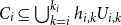 $C_i \subseteq\bigcup_{k=i}^{k_i} h_{i,k} U_{i,k}$
. For every
$C_i \subseteq\bigcup_{k=i}^{k_i} h_{i,k} U_{i,k}$
. For every $1 \le i \le n+1$
and
$1 \le i \le n+1$
and $1 \le j \le n$
the sets
$1 \le j \le n$
the sets $W_{i,j,k} := g_j^{-1}(g_jB \cap U_{i, k})$
for
$W_{i,j,k} := g_j^{-1}(g_jB \cap U_{i, k})$
for $k=1,\dots ,k_i$
are pairwise disjoint and contained in B, and we have
$k=1,\dots ,k_i$
are pairwise disjoint and contained in B, and we have $C \subseteq \bigcup_{i=1}^{n+1} \bigcup_{j=1}^n \bigcup_{k=1}^{k_i} h_{i,k} g_j W_{i,j,k}$
. This shows that
$C \subseteq \bigcup_{i=1}^{n+1} \bigcup_{j=1}^n \bigcup_{k=1}^{k_i} h_{i,k} g_j W_{i,j,k}$
. This shows that $G\curvearrowright X$
has
$G\curvearrowright X$
has $n(n+1)$
-comparison.
$n(n+1)$
-comparison.
4. Two lemmas
We collect here two lemmas that will be needed for the proof of Theorem 5.4. The first concerns conditions under which the join of finitely many disjoint collections of subsets of a group, when restricted to an ambient Følner set S, will mostly consist of Følner sets, where the degree of approximate invariance is prescribed but necessarily much lower than that of S, and ‘mostly’ is understood in the sense that the exceptional sets will have collective size proportionally small relative to $|S|$
. The second lemma is a version of the implication (ii)
$|S|$
. The second lemma is a version of the implication (ii) $\Rightarrow$
(i) in [Reference Kerr and SzabóKS20, Theorem 6.1] in which the hypotheses are relativized to a subgroup.
$\Rightarrow$
(i) in [Reference Kerr and SzabóKS20, Theorem 6.1] in which the hypotheses are relativized to a subgroup.
Let $\mathscr{F}$
be a collection of subsets of G. We say that a set
$\mathscr{F}$
be a collection of subsets of G. We say that a set $A\subseteq G$
is
$A\subseteq G$
is $\mathscr{F}$
-tileable if there is a
$\mathscr{F}$
-tileable if there is a $T\subseteq G$
and sets
$T\subseteq G$
and sets $F_t \in \mathscr{F}$
for
$F_t \in \mathscr{F}$
for $t\in T$
such that the sets
$t\in T$
such that the sets $F_t t$
for
$F_t t$
for $t\in T$
form a partition of A.
$t\in T$
form a partition of A.
Lemma 4.1. Let $n\in\mathbb{N}$
. Let K be a finite subset of G and
$n\in\mathbb{N}$
. Let K be a finite subset of G and $\delta \gt 0$
. Let
$\delta \gt 0$
. Let $\mathscr{F}$
be a finite collection of
$\mathscr{F}$
be a finite collection of $(K,\delta^3 /(8|K|^2 n))$
-invariant finite subsets of G, and writing
$(K,\delta^3 /(8|K|^2 n))$
-invariant finite subsets of G, and writing $D = (\bigcup\mathscr{F} )(\bigcup\mathscr{F} )^{-1} $
let S be a
$D = (\bigcup\mathscr{F} )(\bigcup\mathscr{F} )^{-1} $
let S be a $(D^2 ,\delta^2 /(4|K|))$
-invariant finite subset of G. For each
$(D^2 ,\delta^2 /(4|K|))$
-invariant finite subset of G. For each $i=1,\dots ,n$
let
$i=1,\dots ,n$
let $\{ B_{i,1} , \dots , B_{i,m_i} \}$
be a finite disjoint collection of
$\{ B_{i,1} , \dots , B_{i,m_i} \}$
be a finite disjoint collection of $\mathscr{F}$
-tileable finite subsets of G. For every
$\mathscr{F}$
-tileable finite subsets of G. For every $I\subseteq \{ 1,\dots ,n \}$
set
$I\subseteq \{ 1,\dots ,n \}$
set $\Omega_I = \prod_{i\in I} \{ 1,\dots , m_i \}$
and for every
$\Omega_I = \prod_{i\in I} \{ 1,\dots , m_i \}$
and for every $\omega\in\Omega_I$
set
$\omega\in\Omega_I$
set
 \[B_\omega = \bigg( S \cap \bigcap_{i\in I} B_{i,\omega_i } \bigg)\setminus \bigg( \bigcup_{i\in I^\textrm{c}} \bigsqcup_{j=1}^{m_i} B_{i,j} \bigg). \]
Then the set $\Omega_0$
of all
$\Omega_0$
of all $\omega \in\Omega := \bigsqcup_{I\subseteq \{ 1,\dots ,n\}} \Omega_I$
such that
$\omega \in\Omega := \bigsqcup_{I\subseteq \{ 1,\dots ,n\}} \Omega_I$
such that $B_\omega$
fails to be
$B_\omega$
fails to be $(K,\delta )$
-invariant satisfies
$(K,\delta )$
-invariant satisfies $|\bigcup_{\omega\in\Omega_0} B_\omega | \leq \delta |S|$
.
$|\bigcup_{\omega\in\Omega_0} B_\omega | \leq \delta |S|$
.
Proof. Note that the sets $B_\omega$
are pairwise disjoint. Set
$B_\omega$
are pairwise disjoint. Set $S_0 = S\cap \partial_{D^2} S$
. Then
$S_0 = S\cap \partial_{D^2} S$
. Then $|S_0| \leq| \partial_{D^2} S| \leq \delta^2 (4|K|)^{-1} |S|$
. By
$|S_0| \leq| \partial_{D^2} S| \leq \delta^2 (4|K|)^{-1} |S|$
. By $\mathscr{F}$
-tileability, for every
$\mathscr{F}$
-tileability, for every $i=1,\dots ,n$
and
$i=1,\dots ,n$
and $j=1,\dots ,m_i$
there are a
$j=1,\dots ,m_i$
there are a $T_{i,j} \subseteq G$
and
$T_{i,j} \subseteq G$
and $F_{i,j,t} \in\mathscr{F}$
for
$F_{i,j,t} \in\mathscr{F}$
for $t\in T_{i,j}$
such that
$t\in T_{i,j}$
such that $B_{i,j} = \bigsqcup_{t\in T_{i,j}} F_{i,j,t} t$
. Write
$B_{i,j} = \bigsqcup_{t\in T_{i,j}} F_{i,j,t} t$
. Write
 T_{i,j}'$
for the set of all
T_{i,j}'$
for the set of all $t\in T_{i,j}$
such that
$t\in T_{i,j}$
such that $F_{i,j,t} t \subseteq S$
, and
$F_{i,j,t} t \subseteq S$
, and $T_{i,j}''$
for the set of all
$T_{i,j}''$
for the set of all $t\in T_{i,j}$
such that
$t\in T_{i,j}$
such that $F_{i,j,t} t \subseteq S\setminus \partial_D S$
. Observe that, since
$F_{i,j,t} t \subseteq S\setminus \partial_D S$
. Observe that, since $FF^{-1} (S\setminus \partial_D S)\subseteq S$
for every
$FF^{-1} (S\setminus \partial_D S)\subseteq S$
for every $F\in\mathscr{F}$
, if
$F\in\mathscr{F}$
, if $F_{i,j,t} t\cap (S\setminus \partial_D S)$
is nonempty for some
$F_{i,j,t} t\cap (S\setminus \partial_D S)$
is nonempty for some $t\in T_{i,j}$
then taking any element s in this intersection we have
$t\in T_{i,j}$
then taking any element s in this intersection we have $F_{i,j,t} t \subseteq F_{i,j,t} F_{i,j,t}^{-1} s \subseteq S$
and hence
$F_{i,j,t} t \subseteq F_{i,j,t} F_{i,j,t}^{-1} s \subseteq S$
and hence $t\in T_{i,j}'$
.
$t\in T_{i,j}'$
.
For every $I\subseteq \{ 1,\dots ,n\}$
set
$I\subseteq \{ 1,\dots ,n\}$
set $\Gamma_I = \prod_{i\in I} \{ (j,t) : 1\leq j\leq m_i ,\, t\in T_{i,j}'' \}$
. For each
$\Gamma_I = \prod_{i\in I} \{ (j,t) : 1\leq j\leq m_i ,\, t\in T_{i,j}'' \}$
. For each $\gamma = ((j_i , t_i ))_{i\in I} \in\Gamma_I$
define
$\gamma = ((j_i , t_i ))_{i\in I} \in\Gamma_I$
define
 \[E_\gamma = \bigg(\bigcap_{i\in I} F_{i,j_i ,t_i} t_i \bigg)\setminus \bigg(\bigcup_{i\in I^\textrm{c}} \bigsqcup_{j=1}^{m_i} B_{i,j} \bigg) \subseteq S\setminus \partial_D S \]
and note that these sets over all $\gamma\in \Gamma := \bigsqcup_{I\subseteq\{ 1,\dots ,n\}} \Gamma_I$
are pairwise disjoint. By the observation at the end of the first paragraph, for every
$\gamma\in \Gamma := \bigsqcup_{I\subseteq\{ 1,\dots ,n\}} \Gamma_I$
are pairwise disjoint. By the observation at the end of the first paragraph, for every $\gamma\in \Gamma$
we have
$\gamma\in \Gamma$
we have
 \[E_\gamma = \bigg(\bigcap_{i\in I} F_{i,j_i ,t_i} t_i \bigg)\cap \bigg(\bigcup_{i\in I^\textrm{c}} \bigsqcup_{j=1}^{m_i}\bigsqcup_{t\in T_{i,j}'} (G\setminus F_{i,j,t} t)\bigg), \]
and therefore
 \begin{gather}\partial_K E_\gamma \subseteq \bigcup_{i=1}^n \bigsqcup_{j=1}^{m_i} \bigsqcup_{t\in T_{i,j}'} \partial_K F_{i,j,t} t .\end{gather}
Write $\Gamma_0$
for the set of all
$\Gamma_0$
for the set of all $\gamma\in\Gamma$
such that
$\gamma\in\Gamma$
such that $E_\gamma$
fails to be
$E_\gamma$
fails to be $(K,\delta /2)$
-invariant. Since the sets
$(K,\delta /2)$
-invariant. Since the sets $E_\gamma$
are pairwise disjoint, each element of G belongs to
$E_\gamma$
are pairwise disjoint, each element of G belongs to $\partial_K E_\gamma$
for at most
$\partial_K E_\gamma$
for at most $|K|$
many
$|K|$
many $\gamma$
, and so
$\gamma$
, and so
 \begin{gather}\sum_{\gamma\in\Gamma} |\partial_K E_\gamma |\leq |K| \bigg|\bigcup_{\gamma\in\Gamma} \partial_K E_\gamma \bigg| .\end{gather}
Also, since the sets $F_{i,j,t} t$
for
$F_{i,j,t} t$
for $t\in T_{i,j}'$
are subsets of S and each element of S is contained in at most n of them, we have
$t\in T_{i,j}'$
are subsets of S and each element of S is contained in at most n of them, we have
 \begin{gather}\sum_{i=1}^n \sum_{j=1}^{m_i} \sum_{t\in T_{i,j}'} |F_{i,j,t} t | \leq n|S| .\end{gather}
We therefore obtain

Set $S_1 = S_0 \cup \bigsqcup_{\gamma\in\Gamma_0} E_\gamma$
. Then
$S_1 = S_0 \cup \bigsqcup_{\gamma\in\Gamma_0} E_\gamma$
. Then
 \[|S_1 | \leq |S_0 | + \sum_{\gamma\in\Gamma_0} |E_\gamma |\leq \frac{\delta^2}{4|K|} |S| + \frac{\delta^2}{4|K|} |S|= \frac{\delta^2}{2|K|} |S| . \]
Writing $\Omega_1$
for the set of all
$\Omega_1$
for the set of all $\omega\in\Omega$
such that
$\omega\in\Omega$
such that $|B_\omega \cap S_1 | \gt \delta (2|K|)^{-1} |B_\omega |$
, we thereby obtain
$|B_\omega \cap S_1 | \gt \delta (2|K|)^{-1} |B_\omega |$
, we thereby obtain
 \begin{gather*}\bigg|\bigsqcup_{\omega\in\Omega_1} B_\omega \bigg|= \sum_{\omega\in\Omega_1} |B_\omega |< \frac{2|K|}{\delta} \sum_{\omega\in\Omega_1} |B_\omega \cap S_1 |\leq \frac{2|K|}{\delta} |S_1 |\leq \delta |S| .\end{gather*}
To complete the proof it is therefore enough to verify that $\Omega_0 \subseteq\Omega_1$
.
$\Omega_0 \subseteq\Omega_1$
.
Let $\omega\in\Omega\setminus\Omega_1$
. Then there is a
$\omega\in\Omega\setminus\Omega_1$
. Then there is a $\Gamma_\omega \subseteq \Gamma$
such that
$\Gamma_\omega \subseteq \Gamma$
such that $(S\setminus S_0 )\cap B_\omega = (S\setminus S_0 )\cap\bigsqcup_{\gamma\in\Gamma_\omega} E_\gamma$
and
$(S\setminus S_0 )\cap B_\omega = (S\setminus S_0 )\cap\bigsqcup_{\gamma\in\Gamma_\omega} E_\gamma$
and $E_\gamma \subseteq B_\omega$
for all
$E_\gamma \subseteq B_\omega$
for all $\gamma\in\Gamma_\omega$
, in which case we can write
$\gamma\in\Gamma_\omega$
, in which case we can write $B_\omega$
as the union of
$B_\omega$
as the union of $B_\omega \cap S_1$
and
$B_\omega \cap S_1$
and $\bigsqcup_{\gamma\in\Gamma_\omega \setminus\Gamma_0} E_\gamma$
, so that
$\bigsqcup_{\gamma\in\Gamma_\omega \setminus\Gamma_0} E_\gamma$
, so that
 \begin{align*}|\partial_K B_\omega |&\leq |\partial_K (B_\omega \cap S_1 )|+ \sum_{\gamma\in\Gamma_\omega \setminus\Gamma_0} |\partial_K E_\gamma | \\&\leq |K||B_\omega \cap S_1 |+ \frac{\delta}{2} \sum_{\gamma\in\Gamma_\omega \setminus\Gamma_0} |E_\gamma | \\&\leq |K|\cdot \frac{\delta}{2|K|} |B_\omega | + \frac{\delta}{2} |B_\omega | \\&= \delta |B_\omega | .\end{align*}
This shows that $\omega\notin\Omega_0$
and hence that
$\omega\notin\Omega_0$
and hence that $\Omega_0 \subseteq\Omega_1$
.
$\Omega_0 \subseteq\Omega_1$
.
Lemma 4.2. Let G be an amenable group and H a subgroup of G. Let $G\curvearrowright X$
be a free action on a compact Hausdorff space. Suppose that (i) the restricted action
$G\curvearrowright X$
be a free action on a compact Hausdorff space. Suppose that (i) the restricted action $H\curvearrowright X$
has comparison, and (ii) for every finite set
$H\curvearrowright X$
has comparison, and (ii) for every finite set $K\subseteq G$
and
$K\subseteq G$
and $\delta \gt 0$
there is an open castle
$\delta \gt 0$
there is an open castle $\{ S_i ,V_i \}_{i\in I}$
for the G-action such that each
$\{ S_i ,V_i \}_{i\in I}$
for the G-action such that each $V_i$
has diameter smaller than
$V_i$
has diameter smaller than $\delta$
, each shape
$\delta$
, each shape $S_i$
is
$S_i$
is $(K,\delta )$
-invariant, and the upper H-density of
$(K,\delta )$
-invariant, and the upper H-density of $X\setminus \bigsqcup_{i\in I} S_i V_i$
is less than
$X\setminus \bigsqcup_{i\in I} S_i V_i$
is less than $\delta$
. Then the action
$\delta$
. Then the action $G\curvearrowright X$
is almost finite.
$G\curvearrowright X$
is almost finite.
Proof. If H is finite then every subset of X of upper H-density less than $|H|^{-1}$
is empty, so that when
$|H|^{-1}$
is empty, so that when $\delta \lt |H|^{-1}$
the castles in part (ii) are clopen and have footprint equal to X, from which we deduce that
$\delta \lt |H|^{-1}$
the castles in part (ii) are clopen and have footprint equal to X, from which we deduce that $G\curvearrowright X$
is almost finite. We may thus assume that H is infinite. Let K be a finite subset of G and
$G\curvearrowright X$
is almost finite. We may thus assume that H is infinite. Let K be a finite subset of G and $0 \lt \delta \lt 1$
. Choose a finite set
$0 \lt \delta \lt 1$
. Choose a finite set $e \in K' \subseteq H$
with
$e \in K' \subseteq H$
with $|K'| \gt 1/\delta$
. By assumption, there is an open castle
$|K'| \gt 1/\delta$
. By assumption, there is an open castle $\{ (S_i ,V_i ) \}_{i\in I}$
for the G-action whose shapes are
$\{ (S_i ,V_i ) \}_{i\in I}$
for the G-action whose shapes are $(K \cup K',\delta )$
-invariant and the complement of whose footprint has upper H-density at most
$(K \cup K',\delta )$
-invariant and the complement of whose footprint has upper H-density at most $\delta$
. In particular, it satisfies the first condition in the definition of almost finiteness with respect to K and
$\delta$
. In particular, it satisfies the first condition in the definition of almost finiteness with respect to K and $\delta$
. Choose a set R of representatives for the right cosets of H in G. For each
$\delta$
. Choose a set R of representatives for the right cosets of H in G. For each $i \in I$
partition
$i \in I$
partition $S_i$
into subsets of right cosets of H, i.e.
$S_i$
into subsets of right cosets of H, i.e.
 \[S_i = \bigsqcup\limits_{g \in R}B_{i, g}g, \]
where each $B_{i, g}$
is contained in H. Note that left translation by K’ preserves the right cosets of H. If
$B_{i, g}$
is contained in H. Note that left translation by K’ preserves the right cosets of H. If $B_{i, g}$
for some
$B_{i, g}$
for some $g\in R$
has cardinality less than
$g\in R$
has cardinality less than $1/\delta$
then all of its elements belong to
$1/\delta$
then all of its elements belong to $\partial_{K'} B_{i, g}$
and so
$\partial_{K'} B_{i, g}$
and so $| \partial_{K'} B_{i, g}| \geq |B_{i, g}|$
. Writing L for the set of all
$| \partial_{K'} B_{i, g}| \geq |B_{i, g}|$
. Writing L for the set of all $g\in R$
such that
$g\in R$
such that $0 \lt |B_{i, g}| \lt 1/\delta$
, it follows that
$0 \lt |B_{i, g}| \lt 1/\delta$
, it follows that
 \[\sum_{g\in L} |B_{i,g} |\leq \sum_{g\in L} | \partial_{K'} B_{i, g}|\leq | \partial_{K'} S_i |\leq \delta |S_i|, \]
i.e. most elements of $S_i$
share a coset with at least
$S_i$
share a coset with at least $1/\delta$
other elements. For each
$1/\delta$
other elements. For each $i \in I$
and
$i \in I$
and $g \in R$
choose a set
$g \in R$
choose a set $B_{i, g}' \subseteq B_{i, g}$
with cardinality equal to
$B_{i, g}' \subseteq B_{i, g}$
with cardinality equal to $\lceil{\delta}/({1-\delta})|B_{i, g}|\rceil$
. Set
$\lceil{\delta}/({1-\delta})|B_{i, g}|\rceil$
. Set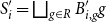 $S_i' = \bigsqcup_{g \in R} B_{i, g}' g$
and note that when
$S_i' = \bigsqcup_{g \in R} B_{i, g}' g$
and note that when $|B_{i,g} | \geq 1/\delta$
we have
$|B_{i,g} | \geq 1/\delta$
we have $|B_{i, g}'|\leq {\delta}/({1-\delta})|B_{i, g}| + 1 \leq 2\delta |B_{i,g} |$
, so that
$|B_{i, g}'|\leq {\delta}/({1-\delta})|B_{i, g}| + 1 \leq 2\delta |B_{i,g} |$
, so that
 \[|S_i' |\leq \sum_{g\in L} |B_{i,g} | + \sum_{g\in R\setminus L} |B_{i,g}' |\leq 3\delta |S_i |. \]
Let $\mu$
be any H-invariant Borel probability measure on X. By construction, the set
$\mu$
be any H-invariant Borel probability measure on X. By construction, the set $\bigsqcup_{i\in I} S_i' V_i$
has
$\bigsqcup_{i\in I} S_i' V_i$
has $\mu$
-measure at least
$\mu$
-measure at least ${\delta}/({1-\delta})\mu(\bigsqcup_{i\in I} S_i V_i)$
, which is greater than or equal to
${\delta}/({1-\delta})\mu(\bigsqcup_{i\in I} S_i V_i)$
, which is greater than or equal to $\delta$
. On the other hand, since the closed set
$\delta$
. On the other hand, since the closed set $X\setminus \bigsqcup_{i\in I} S_i V_i$
has upper H-density less than
$X\setminus \bigsqcup_{i\in I} S_i V_i$
has upper H-density less than $\delta$
its
$\delta$
its $\mu$
-measure is less than
$\mu$
-measure is less than $\delta$
, and so our hypothesis that the H-action has comparison yields
$\delta$
, and so our hypothesis that the H-action has comparison yields
 \[X\setminus \bigsqcup_{i\in I} S_i V_i \prec \bigsqcup_{i\in I} S_i^\prime V_i. \]
Since we can take $\delta$
to be as small as we wish, this shows that the action
$\delta$
to be as small as we wish, this shows that the action $G\curvearrowright X$
is almost finite.
$G\curvearrowright X$
is almost finite.
5. Extensions by
$\mathbb{Z}$

Our goal here is to prove Theorem 5.4. We will need a version of the Ornstein–Weiss quasitiling theorem [Reference Ornstein and WeissOW87], which we record as Corollary 5.2. The statement is a simple consequence of the following more usual version, which we reproduce in the form presented in [Reference Kerr and LiKL16]. A finite subset K of a group G is said to be $\varepsilon$
-quasitiled by a finite collection
$\varepsilon$
-quasitiled by a finite collection $\mathscr{F} = \{ F_1 , \dots , F_n \}$
of finite subsets of G if there are sets
$\mathscr{F} = \{ F_1 , \dots , F_n \}$
of finite subsets of G if there are sets $C_1 , \dots , C_n \subseteq G$
and
$C_1 , \dots , C_n \subseteq G$
and $F_{i,c} \subseteq F_i$
with
$F_{i,c} \subseteq F_i$
with $|F_{i,c} | \geq (1-\varepsilon )|F_i|$
for every
$|F_{i,c} | \geq (1-\varepsilon )|F_i|$
for every $i=1,\dots , n$
and
$i=1,\dots , n$
and $c\in C_i$
such that (i) the union
$c\in C_i$
such that (i) the union $\bigcup_{i=1}^n F_i C_i$
is contained in K and has cardinality at least
$\bigcup_{i=1}^n F_i C_i$
is contained in K and has cardinality at least $(1-\varepsilon )|K|$
, and (ii) the collection
$(1-\varepsilon )|K|$
, and (ii) the collection $\{ F_{i,c}c : 1\leq i\leq n, \, c\in C_i \}$
is disjoint. As in § 4, we say that K is
$\{ F_{i,c}c : 1\leq i\leq n, \, c\in C_i \}$
is disjoint. As in § 4, we say that K is $\mathscr{F}$
-tileable if there are sets
$\mathscr{F}$
-tileable if there are sets $C_1 , \dots , C_n \subseteq G$
such that the collection
$C_1 , \dots , C_n \subseteq G$
such that the collection $\{ F_i c : 1\leq i\leq n, \, c\in C_i \}$
partitions K.
$\{ F_i c : 1\leq i\leq n, \, c\in C_i \}$
partitions K.
Theorem 5.1. Let G be a group. Let $0 \lt \varepsilon \lt 1/2$
and let
$0 \lt \varepsilon \lt 1/2$
and let $m\in\mathbb{N}$
be such that
$m\in\mathbb{N}$
be such that $(1 - \varepsilon /2)^m \lt \varepsilon$
. Let
$(1 - \varepsilon /2)^m \lt \varepsilon$
. Let $e\in F_1 \subseteq F_2 \subseteq\cdots\subseteq F_m$
be finite subsets of G such that for each
$e\in F_1 \subseteq F_2 \subseteq\cdots\subseteq F_m$
be finite subsets of G such that for each $k=2,\dots ,m$
the set
$k=2,\dots ,m$
the set $F_k$
is
$F_k$
is $(F_{k-1} , \varepsilon /8)$
-invariant. Then every
$(F_{k-1} , \varepsilon /8)$
-invariant. Then every $(F_m ,\varepsilon /4)$
-invariant finite subset of G is
$(F_m ,\varepsilon /4)$
-invariant finite subset of G is $\varepsilon$
-quasitiled by
$\varepsilon$
-quasitiled by $\{ F_1 , \dots , F_m \}$
.
$\{ F_1 , \dots , F_m \}$
.
Corollary 5.2. Let G be an amenable group. Let $0 \lt \varepsilon \lt 1/2$
. Let K be a finite subset of G and
$0 \lt \varepsilon \lt 1/2$
. Let K be a finite subset of G and $\delta \gt 0$
. Then there exists a finite collection
$\delta \gt 0$
. Then there exists a finite collection $\mathscr{F}$
of
$\mathscr{F}$
of $(K,\delta )$
-invariant finite subsets of G containing e such that for every
$(K,\delta )$
-invariant finite subsets of G containing e such that for every $(\bigcup\mathscr{F} ,\varepsilon /4)$
-invariant finite set
$(\bigcup\mathscr{F} ,\varepsilon /4)$
-invariant finite set $E\subseteq G$
there is an
$E\subseteq G$
there is an $\mathscr{F}$
-tileable
$\mathscr{F}$
-tileable $E' \subseteq E$
satisfying
$E' \subseteq E$
satisfying $|E' | \geq (1-\varepsilon )|E|$
.
$|E' | \geq (1-\varepsilon )|E|$
.
Proof. Let $m\in\mathbb{N}$
be such that
$m\in\mathbb{N}$
be such that $(1 - \varepsilon /2)^m \lt \varepsilon$
. Since G is amenable we can find
$(1 - \varepsilon /2)^m \lt \varepsilon$
. Since G is amenable we can find $e\in F_1 \subseteq F_2 \subseteq\cdots\subseteq F_m$
as in the statement of Theorem 5.1. Write
$e\in F_1 \subseteq F_2 \subseteq\cdots\subseteq F_m$
as in the statement of Theorem 5.1. Write $\mathscr{F}$
for the (finite) collection of all sets F such that for some
$\mathscr{F}$
for the (finite) collection of all sets F such that for some $j=1,\dots ,m$
we have
$j=1,\dots ,m$
we have $F\subseteq F_j$
and
$F\subseteq F_j$
and $|F| \geq (1-\varepsilon )|F_j|$
. In view of the definition of
$|F| \geq (1-\varepsilon )|F_j|$
. In view of the definition of $\varepsilon$
-quasitiling, Theorem 5.1 then tells us that for every
$\varepsilon$
-quasitiling, Theorem 5.1 then tells us that for every $(F_m ,\varepsilon /4)$
-invariant finite set
$(F_m ,\varepsilon /4)$
-invariant finite set $E\subseteq G$
there is an
$E\subseteq G$
there is an $\mathscr{F}$
-tileable
$\mathscr{F}$
-tileable $E' \subseteq E$
such that
$E' \subseteq E$
such that $|E' | \geq (1-\varepsilon )|E|$
. As
$|E' | \geq (1-\varepsilon )|E|$
. As $F_m = \bigcup\mathscr{F}$
this yields the conclusion.
$F_m = \bigcup\mathscr{F}$
this yields the conclusion.
Let H be a countable group and $\alpha$
an automorphism of H, and form the corresponding semidirect product
$\alpha$
an automorphism of H, and form the corresponding semidirect product $H\rtimes\mathbb{Z}$
. Inside
$H\rtimes\mathbb{Z}$
. Inside $H\rtimes\mathbb{Z}$
we view
$H\rtimes\mathbb{Z}$
we view $\mathbb{Z}$
multiplicatively as the group
$\mathbb{Z}$
multiplicatively as the group $\langle g \rangle$
with generator g satisfying
$\langle g \rangle$
with generator g satisfying $g^m tg^{-m} = \alpha^m (t)$
for all
$g^m tg^{-m} = \alpha^m (t)$
for all $m\in\mathbb{Z}$
and
$m\in\mathbb{Z}$
and $t\in H$
. When we say an interval in
$t\in H$
. When we say an interval in $\langle g \rangle$
we mean a set of the form
$\langle g \rangle$
we mean a set of the form $\{ g^m , g^{m-1} , \dots , g^n \}$
for some integers
$\{ g^m , g^{m-1} , \dots , g^n \}$
for some integers $m\leq n$
, and by the length of this interval we mean
$m\leq n$
, and by the length of this interval we mean $n-m$
.
$n-m$
.
Lemma 5.3. Let $H\rtimes\mathbb{Z} \curvearrowright X$
be a continuous action on a compact metrizable space. Then
$H\rtimes\mathbb{Z} \curvearrowright X$
be a continuous action on a compact metrizable space. Then $\overline{D}_H (gA) = \overline{D}_H (A)$
for all
$\overline{D}_H (gA) = \overline{D}_H (A)$
for all $A\subseteq X$
.
$A\subseteq X$
.
Proof. For every $A\subseteq X$
we have, with F ranging over the nonempty finite subsets of H,
$A\subseteq X$
we have, with F ranging over the nonempty finite subsets of H,
 \begin{align*}\overline{D}_H (A)= \inf_F \sup_{x\in X} \frac{1}{|F|}\sum_{s\in F} 1_A (sx)&= \inf_F \sup_{x\in X} \frac{1}{|F|}\sum_{s\in F} 1_{gA} (gsx) \\&= \inf_F \sup_{x\in X} \frac{1}{|\alpha (F)|}\sum_{s\in F} 1_{gA} (\alpha (s)gx) \\&= \inf_F \sup_{x\in X} \frac{1}{|\alpha (F)|}\sum_{t\in \alpha (F)} 1_{gA} (tgx) \\&= \overline{D}_H (gA) .\\[-32pt]\end{align*}
Theorem 5.4. Let $H\rtimes\mathbb{Z} \curvearrowright X$
be a free continuous action on a compact metric space. Suppose that the restricted action
$H\rtimes\mathbb{Z} \curvearrowright X$
be a free continuous action on a compact metric space. Suppose that the restricted action $H\curvearrowright X$
is almost finite. Then the action
$H\curvearrowright X$
is almost finite. Then the action $H\rtimes\mathbb{Z} \curvearrowright X$
is almost finite.
$H\rtimes\mathbb{Z} \curvearrowright X$
is almost finite.
Proof. Let $0 \lt \varepsilon \lt 1/6$
. Let K be a finite subset of H. Take an
$0 \lt \varepsilon \lt 1/6$
. Let K be a finite subset of H. Take an $r\in\mathbb{N}$
large enough so that any interval in
$r\in\mathbb{N}$
large enough so that any interval in $\langle g \rangle$
of length at least
$\langle g \rangle$
of length at least $\varepsilon^5 r$
is
$\varepsilon^5 r$
is $(\{ g \},\varepsilon )$
-invariant. Denote by A the symmetric interval
$(\{ g \},\varepsilon )$
-invariant. Denote by A the symmetric interval $\{ g^{-r} ,\dots ,g^r \}$
.
$\{ g^{-r} ,\dots ,g^r \}$
.
Set $K' = \bigcup_{m=-4r}^{4r} \alpha^m (K)$
and
$K' = \bigcup_{m=-4r}^{4r} \alpha^m (K)$
and $K'' = \bigcup_{m=-4r}^{4r} \alpha^m (K') = \bigcup_{m=-8r}^{8r} \alpha^m (K)$
. By Corollary 5.2 there is a finite collection
$K'' = \bigcup_{m=-4r}^{4r} \alpha^m (K') = \bigcup_{m=-8r}^{8r} \alpha^m (K)$
. By Corollary 5.2 there is a finite collection $\mathscr{F}$
of
$\mathscr{F}$
of $(K'',\varepsilon^{15} /(8|K'|^2 (2r+1)r^{15}))$
-invariant finite subsets of H containing e such that for every
$(K'',\varepsilon^{15} /(8|K'|^2 (2r+1)r^{15}))$
-invariant finite subsets of H containing e such that for every $(\bigcup\mathscr{F} ,\varepsilon /(8r))$
-invariant finite set
$(\bigcup\mathscr{F} ,\varepsilon /(8r))$
-invariant finite set $F\subseteq H$
there exists an
$F\subseteq H$
there exists an $\mathscr{F}$
-tileable
$\mathscr{F}$
-tileable $F' \subseteq F$
satisfying
$F' \subseteq F$
satisfying $|F' | \geq (1-{\varepsilon}/{2r} )|F|.$
Since $H\curvearrowright X$
is almost finite it is almost finite in measure, we can find an open castle
$H\curvearrowright X$
is almost finite it is almost finite in measure, we can find an open castle $\{ (S_k , V_k ) \}_{k=1}^n$
for this action whose shapes are
$\{ (S_k , V_k ) \}_{k=1}^n$
for this action whose shapes are $(((\bigcup\mathscr{F} )(\bigcup\mathscr{F} )^{-1} )^2,\varepsilon^{10} /(4|K'|r^{10})))$
-invariant and whose footprint
$(((\bigcup\mathscr{F} )(\bigcup\mathscr{F} )^{-1} )^2,\varepsilon^{10} /(4|K'|r^{10})))$
-invariant and whose footprint $\bigsqcup_{k=1}^n S_k V_k$
has lower H-density at least
$\bigsqcup_{k=1}^n S_k V_k$
has lower H-density at least $1-{\varepsilon}/{2r}$
. The proof of [Reference Kerr and SzabóKS20, Theorem 5.6] shows that we may assume the boundary of each level of each tower in the castle to have zero upper H-density. By [Reference Kerr and SzabóKS20, Theorem 5.5], for any
$1-{\varepsilon}/{2r}$
. The proof of [Reference Kerr and SzabóKS20, Theorem 5.6] shows that we may assume the boundary of each level of each tower in the castle to have zero upper H-density. By [Reference Kerr and SzabóKS20, Theorem 5.5], for any $k\in \{ 1,\dots , n\}$
we can find a finite disjoint collection
$k\in \{ 1,\dots , n\}$
we can find a finite disjoint collection $\mathscr{U}$
of open subsets of
$\mathscr{U}$
of open subsets of $V_k$
whose diameters are as small as we wish such that the set
$V_k$
whose diameters are as small as we wish such that the set $V_k \setminus \bigcup\mathscr{U}$
has zero upper H-density. Since the action
$V_k \setminus \bigcup\mathscr{U}$
has zero upper H-density. Since the action $H\rtimes\mathbb{Z} \curvearrowright X$
is free, we may therefore furthermore assume, by replacing each tower
$H\rtimes\mathbb{Z} \curvearrowright X$
is free, we may therefore furthermore assume, by replacing each tower $(S_k ,V_k )$
with a collection of towers with shape
$(S_k ,V_k )$
with a collection of towers with shape $S_k$
whose bases are the members of a suitable collection of open subsets of
$S_k$
whose bases are the members of a suitable collection of open subsets of $V_k$
of the type just described, that
$V_k$
of the type just described, that $(A^2 S_k , V_k )$
is a tower for every
$(A^2 S_k , V_k )$
is a tower for every $k=1,\dots ,n$
. For each
$k=1,\dots ,n$
. For each $k=1,\dots ,n$
, since the shape
$k=1,\dots ,n$
, since the shape $S_k$
is
$S_k$
is $(\bigcup\mathscr{F} ,\varepsilon /(8r))$
-invariant we can find, by the previous paragraph, an
$(\bigcup\mathscr{F} ,\varepsilon /(8r))$
-invariant we can find, by the previous paragraph, an $\mathscr{F}$
-tileable
$\mathscr{F}$
-tileable $B_k \subseteq S_k$
satisfying
$B_k \subseteq S_k$
satisfying $|B_k | \geq (1-{\varepsilon}/{2r} )|S_k |$
.
$|B_k | \geq (1-{\varepsilon}/{2r} )|S_k |$
.
Set $\mathscr{F}' = \{ \alpha^m (F) : -4r\leq m\leq 4r, \, F\in\mathscr{F} \}$
. Since each member of
$\mathscr{F}' = \{ \alpha^m (F) : -4r\leq m\leq 4r, \, F\in\mathscr{F} \}$
. Since each member of $\mathscr{F}$
is
$\mathscr{F}$
is $(K'',\varepsilon^{15}/(8|K'|(8r+1)r^{15}))$
-invariant, each member of
$(K'',\varepsilon^{15}/(8|K'|(8r+1)r^{15}))$
-invariant, each member of $\mathscr{F}'$
is
$\mathscr{F}'$
is $(K',\varepsilon^{15}/(8|K'|(8r+1)r^{15}))$
-invariant, as is easily checked using the boundary commutation formula
$(K',\varepsilon^{15}/(8|K'|(8r+1)r^{15}))$
-invariant, as is easily checked using the boundary commutation formula $\partial_{K'} \alpha^i (F) = \alpha^m (\partial_{\alpha^{-m} (K')} F)$
for
$\partial_{K'} \alpha^i (F) = \alpha^m (\partial_{\alpha^{-m} (K')} F)$
for $m\in\mathbb{Z}$
and finite sets
$m\in\mathbb{Z}$
and finite sets $F\subseteq H$
. Moreover, the fact that each
$F\subseteq H$
. Moreover, the fact that each $B_k$
is
$B_k$
is $\mathscr{F}$
-tileable implies that for every
$\mathscr{F}$
-tileable implies that for every $k=1,\dots ,n$
and
$k=1,\dots ,n$
and $m=-4r,\dots ,4r$
the set
$m=-4r,\dots ,4r$
the set $\alpha^m (B_k )$
is
$\alpha^m (B_k )$
is $\mathscr{F}'$
-tileable.
$\mathscr{F}'$
-tileable.
We now carry out a recursive disjointification process over k. This will be similar to the Ornstein–Weiss-type argument in [Reference Conley, Jackson, Kerr, Marks, Seward and Tucker-DrobCJK+18, Reference Kerr and SzabóKS20] for producing dynamical tilings, but with two significant differences: (i) we carry out the disjointification procedure in one single recursion without having to repeat it across different scales, and (ii) the decision to retain a new piece at a given stage depends on whether its proportion in the ambient tile is greater than $\varepsilon$
(actually
$\varepsilon$
(actually $\varepsilon^4$
in our case) instead of greater than
$\varepsilon^4$
in our case) instead of greater than $1-\varepsilon$
(the latter is what makes the recursion over different scales in the Ornstein–Weiss setting necessary, since at every scale only a small part of the space gets covered).
$1-\varepsilon$
(the latter is what makes the recursion over different scales in the Ornstein–Weiss setting necessary, since at every scale only a small part of the space gets covered).
Write $\mathscr{T}_k$
for the collection of all subsets of
$\mathscr{T}_k$
for the collection of all subsets of $AB_k$
. Write
$AB_k$
. Write $\mathscr{T}_k^+$
for the collection of all
$\mathscr{T}_k^+$
for the collection of all $T\in\mathscr{T}_k$
such that
$T\in\mathscr{T}_k$
such that $|T|\geq \varepsilon^4 |AB_k |$
. We will recursively construct sets
$|T|\geq \varepsilon^4 |AB_k |$
. We will recursively construct sets $Z_1 , \dots , Z_n \subseteq X$
and (not necessarily open) castles
$Z_1 , \dots , Z_n \subseteq X$
and (not necessarily open) castles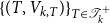 $\{ (T,V_{k,T} ) \}_{T\in\mathscr{T}_k^+}$
for
$\{ (T,V_{k,T} ) \}_{T\in\mathscr{T}_k^+}$
for $k=1,\dots , n$
such that
$k=1,\dots , n$
such that $Z_k = Z_{k-1} \sqcup \bigsqcup_{T\in\mathscr{T}_k^+} TV_{k,T}$
for
$Z_k = Z_{k-1} \sqcup \bigsqcup_{T\in\mathscr{T}_k^+} TV_{k,T}$
for $k=2,\dots , n$
. Many of the sets
$k=2,\dots , n$
. Many of the sets $V_{k,T}$
will be empty, in part because nonemptiness forces some extra structure on the corresponding T (as explained below), but we will worry about this after the construction so as to not complicate notation.
$V_{k,T}$
will be empty, in part because nonemptiness forces some extra structure on the corresponding T (as explained below), but we will worry about this after the construction so as to not complicate notation.
We begin by setting $V_{1,T} = V_1$
for
$V_{1,T} = V_1$
for $T=AB_1$
and
$T=AB_1$
and $V_{1,T} = \emptyset$
for
$V_{1,T} = \emptyset$
for $T\neq AB_1$
. We also put
$T\neq AB_1$
. We also put $Z_1 = AB_1 V_1$
.
$Z_1 = AB_1 V_1$
.
Suppose now that $1 \lt k \le n$
and that we have constructed
$1 \lt k \le n$
and that we have constructed $Z_1 , \dots , Z_{k-1}$
and the castles
$Z_1 , \dots , Z_{k-1}$
and the castles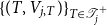 $\{ (T,V_{j,T} ) \}_{T\in\mathscr{T}_j^+}$
for
$\{ (T,V_{j,T} ) \}_{T\in\mathscr{T}_j^+}$
for $j=1,\dots , k-1$
. For each
$j=1,\dots , k-1$
. For each $T\in\mathscr{T}_k$
set
$T\in\mathscr{T}_k$
set
 \begin{gather}V_{k,T} = V_k \cap \bigg(\bigcup_{s\in AB_k \setminus T} s^{-1} Z_{k-1} \bigg)\cap \bigg(\bigcup_{s\in T} (X\setminus s^{-1} Z_{k-1} ) \bigg) .\end{gather}
Then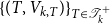 $\{ (T,V_{k,T} ) \}_{T\in\mathscr{T}_k^+}$
is a castle and we define
$\{ (T,V_{k,T} ) \}_{T\in\mathscr{T}_k^+}$
is a castle and we define $Z_k$
to be the union of the two sets
$Z_k$
to be the union of the two sets $Z_{k-1}$
and
$Z_{k-1}$
and $\bigsqcup_{T\in\mathscr{T}_k^+} TV_{k,T}$
, which are disjoint (in this construction we only care about
$\bigsqcup_{T\in\mathscr{T}_k^+} TV_{k,T}$
, which are disjoint (in this construction we only care about $V_{k,T}$
for
$V_{k,T}$
for $T\in\mathscr{T}_k^+$
, but for later use we have defined
$T\in\mathscr{T}_k^+$
, but for later use we have defined $V_{k,T}$
above for all
$V_{k,T}$
above for all $T\in\mathscr{T}_k$
). This completes the recursion. A very important observation is that, setting
$T\in\mathscr{T}_k$
). This completes the recursion. A very important observation is that, setting $V_k^+ = \bigsqcup_{T\in\mathscr{T}_k^+} V_{k,T} \subseteq V_k$
, we have
$V_k^+ = \bigsqcup_{T\in\mathscr{T}_k^+} V_{k,T} \subseteq V_k$
, we have
 \begin{align}Z_k = \bigcup_{j=1}^k AB_jV_j^+.\end{align}
Write Q for the remainder $X\setminus \bigsqcup_{k=1}^n B_kV_k$
of the castle
$X\setminus \bigsqcup_{k=1}^n B_kV_k$
of the castle $\{ (B_k ,V_k )\}_{k=1}^n$
. It will be convenient to have the following dual picture of the tower partition
$\{ (B_k ,V_k )\}_{k=1}^n$
. It will be convenient to have the following dual picture of the tower partition $Q\sqcup \bigsqcup_{k=1}^nB_kV_k$
in terms of the partial orbits within each tower. We define the equivalence relation E on X as the smallest under which xEgx whenever x is in some base
$Q\sqcup \bigsqcup_{k=1}^nB_kV_k$
in terms of the partial orbits within each tower. We define the equivalence relation E on X as the smallest under which xEgx whenever x is in some base $V_k$
and g is in the corresponding shape
$V_k$
and g is in the corresponding shape $B_k$
. Each equivalence class
$B_k$
. Each equivalence class $[x]_E$
either belongs to a unique tower
$[x]_E$
either belongs to a unique tower $B_kV_k$
or is a singleton in the remainder Q. For
$B_kV_k$
or is a singleton in the remainder Q. For $m\in\mathbb{Z}$
we have
$m\in\mathbb{Z}$
we have
 \[X = g^m \bigg(Q\sqcup \bigsqcup_{k=1}^nB_kV_k \bigg) = g^m Q \sqcup \bigsqcup_{k=1}^n (g^mB_kg^{-m})g^mV_k, \]
that is, X is also partitioned by the castle $\{(g^mB_kg^{-m}, g^mV_k )\}_{k=1}^n$
together with its remainder
$\{(g^mB_kg^{-m}, g^mV_k )\}_{k=1}^n$
together with its remainder $g^mQ$
. We denote the corresponding equivalence relation by
$g^mQ$
. We denote the corresponding equivalence relation by $(g^m)_*E$
. Note that
$(g^m)_*E$
. Note that $[x]_{(g^m)_*E} = g^m([x]_E)$
and therefore
$[x]_{(g^m)_*E} = g^m([x]_E)$
and therefore $x(g^m)_*Ey$
if and only if
$x(g^m)_*Ey$
if and only if $g^{-m}xEg^{-m}y$
. For
$g^{-m}xEg^{-m}y$
. For $q\in\mathbb{N}$
define
$q\in\mathbb{N}$
define
 \begin{gather*}E^q = \bigcap_{m=-q}^q (g^m)_*E.\end{gather*}
Observe that for any $1 \leq k \leq n$
it follows from (5.2) that if
$1 \leq k \leq n$
it follows from (5.2) that if $xE^ry$
then
$xE^ry$
then
 \[x \in Z_k \Leftrightarrow y \in Z_k. \]
Now let $x \in V_k$
for some
$x \in V_k$
for some $1\leq k\leq n$
and consider the set
$1\leq k\leq n$
and consider the set $AB_kx \setminus Z_{k-1} = AB_kx \setminus \bigcup_{j=1}^{k-1}AB_jV_j^+$
. For a fixed element
$AB_kx \setminus Z_{k-1} = AB_kx \setminus \bigcup_{j=1}^{k-1}AB_jV_j^+$
. For a fixed element $h \in B_k$
the set
$h \in B_k$
the set $Ahx \setminus Z_{k-1}$
has the form
$Ahx \setminus Z_{k-1}$
has the form $A_h hx$
where
$A_h hx$
where $A_h$
is a subinterval of A. Moreover, if
$A_h$
is a subinterval of A. Moreover, if $h^\prime x \in [hx]_{E^{2r}}$
then
$h^\prime x \in [hx]_{E^{2r}}$
then $g^mh^\prime x \in [g^mhx]_{E^{r}}$
for every
$g^mh^\prime x \in [g^mhx]_{E^{r}}$
for every $m=-r, \ldots, r$
and therefore
$m=-r, \ldots, r$
and therefore $A_{h^\prime} = A_h$
. In other words, the interval
$A_{h^\prime} = A_h$
. In other words, the interval $A_h$
only depends on the
$A_h$
only depends on the $E^{2r}$
-equivalence class of hx.
$E^{2r}$
-equivalence class of hx.
Consider now an equivalence relation $E^\prime$
defined by setting
$E^\prime$
defined by setting $h_0xE^\prime h_1x$
if
$h_0xE^\prime h_1x$
if $A_{h_0} = A_{h_1}$
. By the previous observation, every
$A_{h_0} = A_{h_1}$
. By the previous observation, every $E^\prime$
-equivalence class is a disjoint union of
$E^\prime$
-equivalence class is a disjoint union of $E^{2r}$
-equivalence classes. The set of points in
$E^{2r}$
-equivalence classes. The set of points in $AB_kx$
that are not covered by
$AB_kx$
that are not covered by $Z_{k-1}$
, which is equal to Tx where
$Z_{k-1}$
, which is equal to Tx where $T\in\mathscr{T}_k$
is such that
$T\in\mathscr{T}_k$
is such that $x\in V_{k,T}$
, can be partitioned into ‘rectangles’ of the form
$x\in V_{k,T}$
, can be partitioned into ‘rectangles’ of the form $A_B Bx$
where Bx is an
$A_B Bx$
where Bx is an $E^\prime$
-equivalence class and
$E^\prime$
-equivalence class and $A_B$
is equal to
$A_B$
is equal to $A_h$
for any h with
$A_h$
for any h with $h\in B$
. By identifying T with Tx via
$h\in B$
. By identifying T with Tx via $t\mapsto tx$
this yields a partition of T itself into sets of the form
$t\mapsto tx$
this yields a partition of T itself into sets of the form $A_B B$
, and this partition is the same for all x in
$A_B B$
, and this partition is the same for all x in $V_{k,T}$
.
$V_{k,T}$
.
Write $\mathscr{N}_k$
for the collection of all
$\mathscr{N}_k$
for the collection of all $T\in\mathscr{T}_k$
for which
$T\in\mathscr{T}_k$
for which $V_{k,T}$
is nonempty. Let
$V_{k,T}$
is nonempty. Let $T\in\mathscr{N}_k$
. Write
$T\in\mathscr{N}_k$
. Write $\mathscr{B}_{k,T}$
for the collection of all sets B appearing in the common partition of T into rectangles of the form
$\mathscr{B}_{k,T}$
for the collection of all sets B appearing in the common partition of T into rectangles of the form $A_B B$
for points in
$A_B B$
for points in $V_{k,T}$
, as described above. We can thus express T as
$V_{k,T}$
, as described above. We can thus express T as $\bigsqcup_{B\in\mathscr{B}_{k,T}} A_B B$
. Write
$\bigsqcup_{B\in\mathscr{B}_{k,T}} A_B B$
. Write $\mathscr{C}_{k,T}$
for the collection of all
$\mathscr{C}_{k,T}$
for the collection of all $B\in\mathscr{B}_{k,T}$
such that B is
$B\in\mathscr{B}_{k,T}$
such that B is $(K',\varepsilon )$
-invariant. Set
$(K',\varepsilon )$
-invariant. Set $C_{k,T} = \bigsqcup \mathscr{C}_{k,T}$
. Since
$C_{k,T} = \bigsqcup \mathscr{C}_{k,T}$
. Since $S_k$
is
$S_k$
is $(((\bigcup\mathscr{F} )(\bigcup\mathscr{F} )^{-1} )^2,\varepsilon^{10} /(4|K'|r^{10}))$
-invariant, the members of
$(((\bigcup\mathscr{F} )(\bigcup\mathscr{F} )^{-1} )^2,\varepsilon^{10} /(4|K'|r^{10}))$
-invariant, the members of $\mathscr{F}'$
are
$\mathscr{F}'$
are $(K',\varepsilon^{15} /(8|K'|(8r+1)r^{15}))$
-invariant, and the sets
$(K',\varepsilon^{15} /(8|K'|(8r+1)r^{15}))$
-invariant, and the sets $\alpha^m (B_k )$
for
$\alpha^m (B_k )$
for $m=-4r,\dots ,4r$
and
$m=-4r,\dots ,4r$
and $k=1,\dots , n$
are
$k=1,\dots , n$
are $\mathscr{F}'$
-tileable, we can apply Lemma 4.1 (taking there
$\mathscr{F}'$
-tileable, we can apply Lemma 4.1 (taking there $n=8r+1$
,
$n=8r+1$
, $\delta = (\varepsilon/r)^5$
,
$\delta = (\varepsilon/r)^5$
, $K=K'$
and the sets
$K=K'$
and the sets $B_{i,j}$
to be the right translates of
$B_{i,j}$
to be the right translates of $\alpha^i (B_k )$
which are at play in the description of an intersection pattern within an orbit) to see that
$\alpha^i (B_k )$
which are at play in the description of an intersection pattern within an orbit) to see that
 \begin{align}|C_{k,T} | \geq (1-(\varepsilon/r)^5 ) |B_k | \gt (1-\varepsilon^5 ) |B_k | .\end{align}
Set $\mathscr{N}_k^+ = \mathscr{T}_k^+ \cap \mathscr{N}_k$
and
$\mathscr{N}_k^+ = \mathscr{T}_k^+ \cap \mathscr{N}_k$
and $\mathscr{N}_k^- = \mathscr{N}_k \setminus \mathscr{T}_k^+$
.
$\mathscr{N}_k^- = \mathscr{N}_k \setminus \mathscr{T}_k^+$
.
Given a $T\in\mathscr{N}_k^+$
, let us verify that it is
$T\in\mathscr{N}_k^+$
, let us verify that it is $(K\cup \{ g \} ,2\varepsilon )$
-invariant. Define
$(K\cup \{ g \} ,2\varepsilon )$
-invariant. Define $F_{k,T,1} = \bigsqcup_{h\in C_{k,T}} A_h h$
where
$F_{k,T,1} = \bigsqcup_{h\in C_{k,T}} A_h h$
where $A_h$
is such that
$A_h$
is such that $A_h h V_{k,T} = Ah V_{k,T} \setminus Z_{k-1}$
(in accordance with our orbitwise discussion above), and set
$A_h h V_{k,T} = Ah V_{k,T} \setminus Z_{k-1}$
(in accordance with our orbitwise discussion above), and set $F_{k,T,0} = T \setminus F_{k,T,1}$
. By the definition of
$F_{k,T,0} = T \setminus F_{k,T,1}$
. By the definition of $C_{k,T}$
and the boundary commutation formula
$C_{k,T}$
and the boundary commutation formula $\partial_K (g^m F) = g^{-m} \partial_{\alpha^{-m} (K)} F$
for
$\partial_K (g^m F) = g^{-m} \partial_{\alpha^{-m} (K)} F$
for $m\in\mathbb{Z}$
and finite sets
$m\in\mathbb{Z}$
and finite sets $F\subseteq H$
, the set
$F\subseteq H$
, the set $F_{k,T,1}$
is
$F_{k,T,1}$
is $(K,\varepsilon )$
-invariant, and since
$(K,\varepsilon )$
-invariant, and since

we thus see that the set $T = F_{k,T,0} \sqcup F_{k,T,1}$
is
$T = F_{k,T,0} \sqcup F_{k,T,1}$
is $(K,2\varepsilon )$
-invariant. On the other hand, defining
$(K,2\varepsilon )$
-invariant. On the other hand, defining $D_{k,T,0}$
to be the set of all
$D_{k,T,0}$
to be the set of all $h\in B_k$
such that
$h\in B_k$
such that $|A_h | \leq \varepsilon^5 r$
and setting
$|A_h | \leq \varepsilon^5 r$
and setting $D_{k,T,1} = B_k \setminus D_{k,T,0}$
, we have
$D_{k,T,1} = B_k \setminus D_{k,T,0}$
, we have
 \[\bigg|\bigsqcup_{h\in D_{k,T,0}} A_h h \bigg| \leq \varepsilon^5 r |B_k | = \varepsilon^5 \cdot \frac{r}{2r+1} |AB_k |\leq \varepsilon^5\cdot \frac{1}{3\varepsilon^4}|T| \lt \varepsilon |T| \]
while $\bigsqcup_{h\in D_{k,T,1}} A_h h$
is
$\bigsqcup_{h\in D_{k,T,1}} A_h h$
is $(\{ g \} , \varepsilon )$
-invariant by our choice of r, so that
$(\{ g \} , \varepsilon )$
-invariant by our choice of r, so that $T = \bigsqcup_{h\in D_{k,T,0}} A_h h \sqcup \bigsqcup_{h\in D_{k,T,1}} A_h h$
is
$T = \bigsqcup_{h\in D_{k,T,0}} A_h h \sqcup \bigsqcup_{h\in D_{k,T,1}} A_h h$
is $(\{ g \} , 2\varepsilon )$
-invariant.
$(\{ g \} , 2\varepsilon )$
-invariant.
Now let $T\in\mathscr{N}_k^-$
and define
$T\in\mathscr{N}_k^-$
and define $B_{k,T,0}$
to be the set of all
$B_{k,T,0}$
to be the set of all $h\in B_k$
such that
$h\in B_k$
such that $|A_h | \leq \varepsilon r$
(with
$|A_h | \leq \varepsilon r$
(with $A_h$
having the same meaning as above with respect to k and T) and set
$A_h$
having the same meaning as above with respect to k and T) and set $B_{k,T,1} = B_k \setminus B_{k,T,0}$
. Then
$B_{k,T,1} = B_k \setminus B_{k,T,0}$
. Then
 \begin{align*}|B_{k,T,1} | \cdot \varepsilon r \leq |T| \lt \varepsilon^4 |AB_k | = \varepsilon^4 (2r+1)|B_k |,\end{align*}
and hence
 \begin{align}|B_{k,T,1} | \lt 3\varepsilon^3 |B_k |,\end{align}
a fact that we will use later. Recall that $Z_n = \bigsqcup_{k=1}^n \bigsqcup_{T\in\mathscr{N}_k^+} TV_{k,T}$
(the footprint of the castle we have recursively constructed) and set
$Z_n = \bigsqcup_{k=1}^n \bigsqcup_{T\in\mathscr{N}_k^+} TV_{k,T}$
(the footprint of the castle we have recursively constructed) and set
 \[W = \bigsqcup_{k=1}^n B_kV_k \setminus Z_n. \]
We will next carry out a process by which we donate some of the points of W to the towers in our recursively constructed castle. By splitting up the towers according to how their shapes have been amplified orbit by orbit through this donation process, we obtain a new castle with a much larger collection of towers. The donation process will be carried out so that the amplified shapes are proportionally not much larger and hence still approximately invariant, and it will be sufficiently algorithmic so that the boundaries of the levels of the new towers will still have zero upper H-density. Once we have done this, it will remain to shave off the boundaries of the tower levels so that the towers become open, which will involve discarding a set of zero upper H-density, and then finally check that the remainder of the resulting castle has small H-density, for then we can apply Lemma 4.2 to finish.
To set up the donation operation, suppose that we have a subset of W of the form Jx for some $x \in X$
and some (possibly infinite) interval J in
$x \in X$
and some (possibly infinite) interval J in $\langle g \rangle$
which is maximal with respect to the inclusion of Jx in W. We will either donate none of Jx or all of it.
$\langle g \rangle$
which is maximal with respect to the inclusion of Jx in W. We will either donate none of Jx or all of it.
If $|J| \gt \varepsilon r$
we do not donate Jx. Assume then that
$|J| \gt \varepsilon r$
we do not donate Jx. Assume then that $|J| \le \varepsilon r$
. By replacing x if necessary, we may assume that J has the form
$|J| \le \varepsilon r$
. By replacing x if necessary, we may assume that J has the form $\{ g^0 , g^{1} , \dots , g^q \}$
. Consider the point
$\{ g^0 , g^{1} , \dots , g^q \}$
. Consider the point $g^{-1}x$
. Since it is not in W, it is either in
$g^{-1}x$
. Since it is not in W, it is either in $Q = X \setminus \bigsqcup_{k=1}^n B_kV_k$
or in
$Q = X \setminus \bigsqcup_{k=1}^n B_kV_k$
or in $Z_n$
. In the first case, we do not donate Jx and only note that
$Z_n$
. In the first case, we do not donate Jx and only note that $Jx \subseteq \{g^1, \ldots, g^{\lceil \varepsilon r \rceil + 1}\}Q$
. Suppose now that
$Jx \subseteq \{g^1, \ldots, g^{\lceil \varepsilon r \rceil + 1}\}Q$
. Suppose now that $g^{-1}x \in Z_n$
, that is,
$g^{-1}x \in Z_n$
, that is, $g^{-1}x = ty$
for some
$g^{-1}x = ty$
for some $y \in V_{k, T}$
and
$y \in V_{k, T}$
and $t \in T \in \mathscr{N}_k^+$
. Consider the equivalence class
$t \in T \in \mathscr{N}_k^+$
. Consider the equivalence class $[ty]_{E^{2r}}$
. If it is
$[ty]_{E^{2r}}$
. If it is $(K^\prime, \varepsilon)$
-invariant then we donate Jx to the tower containing Ty, thereby enlarging the partial orbit Ty within this tower. Otherwise, we again do not donate Jx.
$(K^\prime, \varepsilon)$
-invariant then we donate Jx to the tower containing Ty, thereby enlarging the partial orbit Ty within this tower. Otherwise, we again do not donate Jx.
Note that the sets $W, Q, TV_{k, T}$
, and
$W, Q, TV_{k, T}$
, and $Z_n$
are
$Z_n$
are $E^r$
-invariant, as can be easily seen from (5.2). Hence, if the interval Jx was donated to a tower via the partial orbit Ty, then, in fact, the whole set
$E^r$
-invariant, as can be easily seen from (5.2). Hence, if the interval Jx was donated to a tower via the partial orbit Ty, then, in fact, the whole set $Jg[g^{-1}x]_{E^{2r}}$
was donated to this tower via Ty. Through this procedure we obtain a new collection of towers
$Jg[g^{-1}x]_{E^{2r}}$
was donated to this tower via Ty. Through this procedure we obtain a new collection of towers $(T^\sharp , V_{k, T^\sharp} )$
. These clearly form a castle, which we denote by
$(T^\sharp , V_{k, T^\sharp} )$
. These clearly form a castle, which we denote by $\mathscr{L}_0$
. By our definition of K’ and the boundary commutation formula
$\mathscr{L}_0$
. By our definition of K’ and the boundary commutation formula $\partial_K (g^m F) = g^{-m} \partial_{\alpha^{-m} (K)} F$
for all
$\partial_K (g^m F) = g^{-m} \partial_{\alpha^{-m} (K)} F$
for all $m\in\mathbb{Z}$
and finite sets
$m\in\mathbb{Z}$
and finite sets $F\subseteq H$
, we see that each new shape
$F\subseteq H$
, we see that each new shape $T^\sharp$
is still
$T^\sharp$
is still $(K\cup \{ g \} , \varepsilon )$
-invariant (the invariance in the
$(K\cup \{ g \} , \varepsilon )$
-invariant (the invariance in the $\mathbb{Z}$
-direction only improves since the
$\mathbb{Z}$
-direction only improves since the $\langle g \rangle$
cross-sections can only become longer intervals). Given that the set
$\langle g \rangle$
cross-sections can only become longer intervals). Given that the set $H \cup \{ g \}$
generates
$H \cup \{ g \}$
generates $H\rtimes\mathbb{Z}$
, a standard exercise then shows that we can make the shape as left invariant as we wish by making an appropriate choice of K and taking
$H\rtimes\mathbb{Z}$
, a standard exercise then shows that we can make the shape as left invariant as we wish by making an appropriate choice of K and taking $\varepsilon$
small enough.
$\varepsilon$
small enough.
By Lemma 5.3, the collection of subsets of X with upper H-density zero is $H\rtimes\mathbb{Z}$
-invariant, and so the sets
$H\rtimes\mathbb{Z}$
-invariant, and so the sets $g(V_k \setminus V_k^\circ )$
for
$g(V_k \setminus V_k^\circ )$
for $k=1,\dots ,n$
and
$k=1,\dots ,n$
and $g \in H\rtimes\mathbb{Z}$
all belong to this collection given that each
$g \in H\rtimes\mathbb{Z}$
all belong to this collection given that each $V_k \setminus V_k^\circ$
does. Since this collection is also an algebra we therefore deduce, in view of the algorithmic way in which the above construction proceeded based on intersection patterns, that the boundaries of the levels of the tower in
$V_k \setminus V_k^\circ$
does. Since this collection is also an algebra we therefore deduce, in view of the algorithmic way in which the above construction proceeded based on intersection patterns, that the boundaries of the levels of the tower in $\mathscr{L}_0$
all have zero H-density. In view of the uniform continuity of the individual homeomorphisms making up the action of
$\mathscr{L}_0$
all have zero H-density. In view of the uniform continuity of the individual homeomorphisms making up the action of $H\rtimes\mathbb{Z}$
, we can also make the levels of the towers in
$H\rtimes\mathbb{Z}$
, we can also make the levels of the towers in $\mathscr{L}_0$
have as small a diameter as we wish by taking the diameters of the bases
$\mathscr{L}_0$
have as small a diameter as we wish by taking the diameters of the bases $V_1 , \dots , V_n$
of the initial towers to be sufficiently small.
$V_1 , \dots , V_n$
of the initial towers to be sufficiently small.
Write $\mathscr{L}$
for the open castle consisting of the towers
$\mathscr{L}$
for the open castle consisting of the towers $(T^\sharp , V_{k,T^\sharp}^\circ )$
. This castle will be our witness for the almost finiteness of the
$(T^\sharp , V_{k,T^\sharp}^\circ )$
. This castle will be our witness for the almost finiteness of the $H\rtimes\mathbb{Z}$
-action. It remains to check that its remainder satisfies the smallness condition in the definition of almost finiteness, and for this it suffices to show that it is small in upper H-density, since the restriction action
$H\rtimes\mathbb{Z}$
-action. It remains to check that its remainder satisfies the smallness condition in the definition of almost finiteness, and for this it suffices to show that it is small in upper H-density, since the restriction action $H\curvearrowright X$
has comparison and we can apply Lemma 4.2.
$H\curvearrowright X$
has comparison and we can apply Lemma 4.2.
More precisely, we will verify that the remainder of the castle $\mathscr{L}$
has upper H-density at most
$\mathscr{L}$
has upper H-density at most $7\varepsilon$
. By construction, it is contained in the union of the sets:
$7\varepsilon$
. By construction, it is contained in the union of the sets:
-
(i)
$g(V_{k} \setminus V_{k}^\circ)$
for all k and
$g \in H\rtimes\mathbb{Z}$
; -
(ii)
$\{g^1, \ldots, g^{\lceil \varepsilon r \rceil + 1}\}Q$
; -
(iii) the union of all intervals of the form Jx in W with
$|J| \gt \varepsilon r$
, denoted
$W^\prime$
; and -
(iv) the union of sets of the form
$\{g^1, \ldots, g^{\lceil \varepsilon r \rceil + 1}\}[x]_{E^{2r}}$
for all
$[x]_{E^{2r}}$
that are not
$(K^\prime, \varepsilon)$
-invariant.








We already observed that the sets in part (i) have zero upper H-density. For part (ii), recall that $X \setminus \bigsqcup_{k=1}^n S_kV_k$
has upper H-density less than
$X \setminus \bigsqcup_{k=1}^n S_kV_k$
has upper H-density less than $1 - {\varepsilon}/{2r}$
and that
$1 - {\varepsilon}/{2r}$
and that $|B_k| \gt (1 - {\varepsilon}/{2r})|S_k|$
. It follows that
$|B_k| \gt (1 - {\varepsilon}/{2r})|S_k|$
. It follows that $\overline{D}_H(Q) \lt \varepsilon/r$
and therefore
$\overline{D}_H(Q) \lt \varepsilon/r$
and therefore
 \[\overline{D}_H(\{g^1, \ldots, g^{\lceil \varepsilon r \rceil + 1}\}Q) \le \lceil \varepsilon r \rceil\overline{D}_H(Q) \lt \varepsilon. \]
To estimate part (iii), consider a point $x \in V_{k, T}$
for some
$x \in V_{k, T}$
for some $T \in \mathscr{N}_k$
and let
$T \in \mathscr{N}_k$
and let $hx \in B_kx \cap W^\prime$
. As hx is not in
$hx \in B_kx \cap W^\prime$
. As hx is not in $Z_n$
, we conclude that
$Z_n$
, we conclude that $T \in \mathscr{N}_k^-$
. Moreover, it is clear that
$T \in \mathscr{N}_k^-$
. Moreover, it is clear that $|A_h| \gt \varepsilon r$
and thus
$|A_h| \gt \varepsilon r$
and thus $h \in B_{k, T, 1}$
. Applying (5.4) then yields
$h \in B_{k, T, 1}$
. Applying (5.4) then yields
 \[|W^\prime \cap B_kx| \lt 3\varepsilon^3|B_k| \]
for any $k=1, 2, \ldots, n$
and any
$k=1, 2, \ldots, n$
and any $x \in V_k$
. Thus,
$x \in V_k$
. Thus,
 \[\overline{D}_H(W^\prime) \le 3\varepsilon^3\overline{D}_H\bigg(\bigsqcup_{k=1}^nB_kV_k\bigg) + \overline{D}_H(Q) \lt \varepsilon. \]
Finally, to estimate part (iv), let $x \in X \setminus \bigcup_{m=-2r}^{2r}g^mQ$
and suppose that
$x \in X \setminus \bigcup_{m=-2r}^{2r}g^mQ$
and suppose that $[x]_{E^{2r}}$
is not
$[x]_{E^{2r}}$
is not $(K', \varepsilon)$
-invariant. Clearly,
$(K', \varepsilon)$
-invariant. Clearly, $x = hy$
for some
$x = hy$
for some $y \in V_k$
and
$y \in V_k$
and $h \in B_k$
and Lemma 4.1 shows (see (5.3) for a similar calculation) that there are at most
$h \in B_k$
and Lemma 4.1 shows (see (5.3) for a similar calculation) that there are at most $(\varepsilon/r)^5|B_k|$
such points x in the set
$(\varepsilon/r)^5|B_k|$
such points x in the set $B_ky$
. Thus, the set in item (iv) has upper H-density at most
$B_ky$
. Thus, the set in item (iv) has upper H-density at most
 \[(4r + \lceil \varepsilon r \rceil + 1)\overline{D}_H(Q) + \lceil \varepsilon r \rceil (\varepsilon/r)^5 \lt 5\varepsilon. \]
Since upper H-density is monotone with respect to inclusions and subadditive with respect to finite unions, we conclude from the above estimates that the remainder of the castle $\mathscr{L}$
has upper H-density at most
$\mathscr{L}$
has upper H-density at most $7\varepsilon$
. By hypothesis the restricted action
$7\varepsilon$
. By hypothesis the restricted action $H\curvearrowright X$
is almost finite and hence has comparison, and so it follows by Lemma 4.2 that the action
$H\curvearrowright X$
is almost finite and hence has comparison, and so it follows by Lemma 4.2 that the action $H\rtimes\mathbb{Z} \curvearrowright X$
is almost finite, as desired.
$H\rtimes\mathbb{Z} \curvearrowright X$
is almost finite, as desired.
Acknowledgements
The first author was partially supported by NSF grant DMS-1800633. The second named author was partially supported by the Dynasnet European Research Council Synergy project – grant number ERC-2018-SYG 810115, as well as the Marvin V. and Beverly J. Mielke Endowed Fund through the Institute of Advanced Study. Funding was also provided by the Deutsche Forschungsgemeinschaft (DFG, German Research Foundation) under Germany’s Excellence Strategy EXC 2044-390685587, Mathematics Münster: Dynamics–Geometry–Structure, and by the SFB 1442 of the DFG. Both authors were affiliated with Texas A&M University during the initial stages of this work. We thank Xin Ma and Brandon Seward for comments and corrections.
Conflicts of interest
None.
Journal information
Compositio Mathematica is owned by the Foundation Compositio Mathematica and published by the London Mathematical Society in partnership with Cambridge University Press. All surplus income from the publication of Compositio Mathematica is returned to mathematics and higher education through the charitable activities of the Foundation, the London Mathematical Society and Cambridge University Press.


 Open access

