


Introduction
Presidential impeachment has traditionally been seen as a clear manifestation of accountability (Pérez-Liñán, Reference Pérez-Liñán2007; Monaghan et al., Reference Monaghan, Huq, Flinders, Monaghan, Flinders and Huq2024b). However, impeachment has largely been absent from classic studies of executive-legislative relations, which have overlooked it as a realistic solution for political crises (Shugart and Carey, Reference Shugart and Carey1992; Cheibub, Reference Cheibub2006; Shugart, Reference Shugart, Binder, Rhodes and Rockman2009). The growing number of impeachment attempts, both successful and unsuccessful, has increasingly attracted scholarly attention. Since 1977, impeachment has replaced military coups as the primary means of resolving political crises in Latin America (Pérez-Liñán, Reference Pérez-Liñán2007: 62). To date, impeachment proceedings have taken place in countries as diverse as Brazil, Lithuania, Madagascar, South Korea, and the United States. Recently, however, some impeachment trials, such as those of Dilma Rousseff in Brazil and Martín Vizcarra in Peru, have led to public backlash (Polga-Hecimovich, Reference Polga-Hecimovich, Monaghan, Flinders and Huq2024).
The literature on presidential instability has highlighted a number of explanatory variables, including economic crises (Carlin et al., Reference Carlin, Love and Martínez-Gallardo2015), judicial action (Lee, Reference Lee, Monaghan, Flinders and Huq2024), party system institutionalization (Martínez, Reference Martínez2021), and military intervention (Botelho and Barretos, Reference Botelho and Luiza Pereira Barretos2023). Studies explaining presidential impeachment (or the lack thereof) can be divided into three main streams. One group of studies highlights the importance of a “legislative shield” (Pérez-Liñán, Reference Pérez-Liñán2014; Pérez-Liñán and Polga-Hecimovich, Reference Pérez-Liñán and Polga-Hecimovich2017). From this perspective, a shield is formed when the president enjoys a high degree of legislative support that blocks impeachment (Micheli et al., Reference Micheli, Sanchez-Gomez and Roberts2022). A second group points to the importance of corruption scandals involving the president or a member of their circle (Pérez-Liñán, Reference Pérez-Liñán2007). Third, mass mobilization has been highlighted as an important determinant of impeachment (Hochstetler, Reference Hochstetler2006; Kim, Reference Kim2014). According to this view, mass mobilization reflects lower presidential approval, making them more vulnerable to impeachment (Llanos and Pérez-Liñán, Reference Llanos and Pérez-Liñán2021).
This article contributes to the literature by highlighting the importance of elite polarization, both the ideological and affective variants. With a few notable exceptions (Cameron, Reference Cameron2002; Jacobson, Reference Jacobson2020), polarization has largely been absent from studies of presidential impeachment. In addition, studies examining polarization and impeachment have focused almost exclusively on the United States (Healy, Reference Healy2022). The rise of ideological and affective polarization among elites worldwide (McCarty, Reference McCarty2019) makes the study of polarization even more relevant. While scholars have traditionally focused on ideological polarization (Dalton, Reference Dalton2021), recent scholarship has examined the rise of affective polarization and its interaction with ideological polarization worldwide (Webster and Abramowitz, Reference Webster and Abramowitz2017; Gidron et al., Reference Gidron, Adams and Horne2023).
Elite polarization is relevant to presidential impeachment in three ways. First, ideological polarization can lead to deadlock between the executive and the legislative branches. In such a context, elites are more likely to weaponize impeachment to remove the president regardless of their approval ratings (Helmke, Reference Helmke2017). Second, affective polarization implies negative “affect” towards the out-group (Tajfel and Turner, Reference Tajfel, Turner, Austin and Worchel1979; Iyengar et al., Reference Iyengar, Sood and Lelkes2012). Presidents who belong to a different party than the legislative majority suffer more from this negative affect and are, thus, more likely to be impeached. Donald Trump’s two impeachment trials in 2019 and 2021 fall within this category (Healy, Reference Healy2022). Third, both ideological and affective polarization can lead to deadlock within the legislature by inducing intra-party (or intra-coalition) cohesion. That is, the more polarized legislators are, the less likely they are to agree on impeachment, even in cases of evident presidential wrongdoing (Iyengar et al., Reference Iyengar, Lelkes, Levendusky, Malhotra and Westwood2019). Polarization, thus, hardens partisan identity, making the activation of the legislative shield to protect the president even more likely.
We do not argue that elite ideological and affective polarization are the sole predictors of presidential impeachment. The aim is to demonstrate how polarization contributes to explaining impeachment in interaction with the other variables highlighted in the literature, including mass mobilization, corruption scandals, and the legislative shield. Our analysis, therefore, takes a configurational approach to account for such interactions using crisp-set qualitative comparative analysis (QCA). This set-theoretic method is best suited to unpack configurations of variables that are necessary and/or sufficient for presidential impeachment (Schneider and Wagemann, Reference Schneider and Wagemann2012). There have been a few attempts to use QCA in the literature on presidential impeachment (e.g., Pérez-Liñán, Reference Pérez-Liñán2007). However, previous analyses have not covered the global sample of cases examined in this article.
Presidential impeachment is a rare phenomenon, as calls for impeachment rarely translate into an impeachment motion (Llanos and Pérez-Liñán, Reference Llanos and Pérez-Liñán2021). We theorize impeachment as a multi-hurdle process by examining the determinants of overcoming two primary hurdles: a pro-impeachment lower house vote (the first hurdle) and removal from office (the second hurdle). As we will explain later, some impeachment cases (e.g., Trump in 2019 and 2021) pass the first hurdle, but not the second one.Footnote 1 We argue that polarization, both ideological and affective, is crucial in overcoming these hurdles. We conduct two sets of crisp-set QCA analyses to examine the configurations of variables that explain the success of impeachment attempts in passing both hurdles. The article examines the determinants of passing the two impeachment hurdles in 44 cases across different world regions between 1992 and 2022. This helps in moving beyond the literature dominated by single-case studies and small-N comparisons (Pérez-Liñán, Reference Pérez-Liñán2007). There are a few notable cross-national examinations of impeachment. For instance, Kim’s (Reference Kim2014) cross-national analysis of impeachment stops in 2003, whereas the important works by Aníbal Pérez-Liñán and colleagues (Pérez-Liñán, Reference Pérez-Liñán2014; Pérez-Liñán and Polga-Hecimovich, Reference Pérez-Liñán and Polga-Hecimovich2017) have primarily focused on Latin America.
The results uncover three paths of impeachment: polarized, scandalized, and mobilized. Notably, elite polarization, be it affective or ideological, is the primary trigger of impeachment in several cases or can be a facilitator of impeachment in the presence of other triggers such as corruption scandals or mass mobilization. While both ideological and affective polarization facilitate a pro-impeachment vote in the lower house, it is affective polarization that drives removal from office in several cases in the absence of a legislative shield. The results withstand several robustness tests, including sensitivity ranges, consistency thresholds, fit-oriented robustness, and cluster analysis. The article, therefore, highlights the growing significance of elite polarization in explaining impeachment and underscores the complexity of the paths by which presidents can be removed from office.
The article is organized as follows. The next section outlines the theory and elaborates on the various hypotheses. Next, we explain the research design. The following section presents the empirical results of impeachment and non-impeachment. This is followed by conducting robustness tests, undertaking a formal theory evaluation, and discussing the findings with illustrative cases. The last section offers some concluding remarks.
Theory: elite polarization and presidential impeachment
Impeachment, we argue, is a complicated process that cannot be detached from the “perils of presidentialism” as Juan Linz observed more than three decades ago (Linz, Reference Linz1990). Under presidential systems, the executive and the legislature enjoy dual legitimacy. This complicates one of the legislature’s primary functions of holding the executive to account (Przeworski, Reference Przeworski, Smulovitz and Peruzzotti2006) and could potentially lead to unrestricted executives (O’Donnell, Reference O’Donnell2007).
Consequently, impeachment can be considered the legislature’s “strongest weapon” to hold the executive accountable (Fagbadebo, Reference Fagbadebo2020). In the Federalist Papers, Alexander Hamilton argued that presidential impeachment is “a bridle in the hands of the legislative body upon the executive servants of the government” (Healy, Reference Healy2022: 769).Footnote 2 Impeachment is traditionally embedded in the Constitution both as a deterrent and as a last resort against the abuse of executive power (Helmke, Reference Helmke, Brinks, Levitsky and Murillo2020: 99–100). Following Pérez-Liñán (Reference Pérez-Liñán2007: 6), we define presidential impeachment as “a particular trial of the president by which Congress (sometimes with the necessary agreement of the judiciary) is allowed to remove the president from office.” As a result, our focus is on presidential impeachment, rather than no-confidence motions in prime ministers in parliamentary systems.
We theorize impeachment as a multi-hurdle process. One could imagine several hurdles associated with impeachment, including placing impeachment on the political agenda, mobilizing legislative support to form a committee to consider an impeachment motion, and persuading the legislature to organize a vote on an impeachment motion (Pérez-Liñán, Reference Pérez-Liñán2007; Monaghan et al., Reference Monaghan, Flinders and Huq2024a). Once the lower house votes for impeachment, the president can then be removed based on a Senate trial (e.g., the United States), a public referendum (e.g., Romania), or a Supreme Court decision (e.g., South Korea). While all hurdles are equally important, our focus is on the last two hurdles: a pro-impeachment lower house vote and removal from office. It is worth noting that we use a lower house vote as a shortcut for the first hurdle. However, this does not apply in all cases: in the Czech Republic, for instance, the Senate initiates impeachment proceedings while the lower house is responsible for removal from office.
The focus on those two hurdles is warranted, given the higher threshold they require. Mobilizing a pro-impeachment legislative majority, which is the standard in many jurisdictions, is a hefty endeavor, as is the decision to remove the president from office. This is also a pragmatic decision since examining the other hurdles requires data that is not readily available and is thus beyond the scope of this article. Below, we theorize how elite polarization and the other variables interact to overcome the two hurdles: a lower house vote (considered here as the first hurdle) and removal from office (regarded as the second hurdle). We do not develop separate theoretical expectations for each hurdle, as we argue that it is the interaction between elite polarization and the other variables that leads to overcoming both hurdles. In the empirical analysis, we distinguish between the two hurdles and show that ideological and affective elite polarization indeed matter for overcoming both hurdles.
While essentially a legal procedure, impeachment has increasingly become politicized (Monaghan et al., Reference Monaghan, Huq, Flinders, Monaghan, Flinders and Huq2024b) by polarized elites. The scholarship distinguishes between two types: ideological polarization and affective polarization. On the one hand, ideological polarization is defined as the increasing distance between elites or masses on the ideological spectrum (Webster and Abramowitz, Reference Webster and Abramowitz2017; Dalton, Reference Dalton2021). Research has shown that ideological polarization has been on the rise in the United States and elsewhere (Comellas and Torcal, Reference Comellas and Torcal2023).
On the other hand, affective polarization refers to increasing positive feelings (i.e., affect) towards the in-group and hostile feelings towards the out-group (Iyengar et al., Reference Iyengar, Sood and Lelkes2012). Affective polarization has its roots in social identity theory, which posits that the mere identification of individuals with a group leads to a positive attachment towards the in-group and negative views of the out-group (Tajfel and Turner, Reference Tajfel, Turner, Austin and Worchel1979). Recent research has shown that affective polarization has also been on the rise in the United States, Europe, and elsewhere (Reiljan et al., Reference Reiljan, Garzia, Silva and Trechsel2024).
Given their distinctive origins and dynamics, ideological and affective polarization can affect presidential impeachment in different ways. High ideological polarization entails that parties have different priorities and worldviews that cater to their constituencies. Regardless of whether presidents are independents or partisans, advancing their legislative agenda requires building legislative coalitions (Shim and Farag, Reference Shim and Farag2025). Ideological polarization between parties makes compromises less likely, thus leading to potential legislative-executive deadlock. In the United States, for instance, ideological polarization has led to “gridlock, shutdowns of government, a competitive “team” mentality that has encouraged parties to use (or abuse) procedural rules to their advantage, a weakened committee structure, more power shifted to party leaders, and an all but eliminated representation of moderates in the electorate” (Hollis-Brusky, Reference Hollis-Brusky2021: 505). This harms both the president and the various political parties represented in the legislature, as a deadlock might signal to voters that elites are not trustworthy and cannot perform the job for which they are elected.
Fearful of electoral consequences, legislators may view impeachment as a way out of this deadlock. However, this is more likely in cases involving scandals that implicate the president or a member of their circle (Pérez-Liñán, Reference Pérez-Liñán2007). The focus here is on corruption scandals, rather than other forms of scandals, since empirical research has shown that corruption scandals, in particular, affect public approval ratings (Carothers, Reference Carothers2020), making presidents more vulnerable to impeachment.Footnote 3
H1: Presidential impeachment is more likely amid elite ideological polarization and corruption scandals.
Even in cases where the president has a direct or indirect legislative shield, impeachment remains a possibility. A legislative shield exists when the president, either directly through their party or indirectly through a coalition, has enough legislative seats to block impeachment. Corruption scandals can sway coalition partners away from the governing coalition, allowing them to protect their reputation and increase their electoral prospects in future elections. At the same time, coalition partners might fear that deserting the president could jeopardize their chances of joining future governments if the president’s party wins future elections.
Their willingness to impeach the president increases in the case of mass mobilization. In other words, “crises, scandals and protest…matter, in part, because they create permissive conditions or pretexts for coalition partners to escape from alliances that no longer serve them. This may be especially true in ideologically misaligned coalitions that are tactical and contingent in character” (Micheli et al., Reference Micheli, Sanchez-Gomez and Roberts2022: 309). People who take to the streets, calling for the president to be held accountable, lend legitimacy to accountability agencies investigating corruption and signal to the president’s party and their coalition partners that the president’s public approval is low.
H2: Presidential impeachment is more likely amid elite ideological polarization, corruption scandals, and mass mobilization, regardless of a legislative shield.
Affective polarization, on the other hand, does not require any triggers for impeachment. Affective polarization has recently received increasing scholarly attention following seminal works on the United States and elsewhere (Iyengar et al., Reference Iyengar, Sood and Lelkes2012; Reiljan et al., Reference Reiljan, Garzia, Silva and Trechsel2024). While the negative effects of affective polarization are more evident in two-party systems, they also exist in multi-party systems (Wagner, Reference Wagner2021). From an affective polarization perspective, having a president from a different party than the legislative majority is something that elites might consider an existential threat. For them, out-group members are perceived as non-patriots and represent a serious threat to the country and democracy (Iyengar et al., Reference Iyengar, Lelkes, Levendusky, Malhotra and Westwood2019).
In such a charged environment, elites do not need a corruption scandal as a trigger. They could base their impeachment on shaky legal grounds. In such a context, “the basic dilemma is that we observe easily enough the universe of premature presidential ousters, but often have incomplete or conflicting accounts about whether ousted presidents committed an impeachable offense, and/or whether full-term presidents did not” (Helmke, Reference Helmke, Brinks, Levitsky and Murillo2020: 99–100). Polarized elites could even twist evidence in the search for wrongdoing, as has been the case in the United States (Cameron, Reference Cameron2002: 657).
H3: Presidential impeachment is more likely in the presence of elite affective polarization, regardless of a corruption scandal.
Research design
The article analyzes 44 cases of presidential impeachment and non-impeachment between 1992 and 2022. This aims to capture the dynamics of impeachment during the third wave of democratization, given the numerous transitions to democracy that occurred in Africa, Asia, and Latin America in the late 1980s and early 1990s. We include cases that pass or fail two impeachment hurdles, namely a lower house vote and removal from office. This is important to avoid selection bias on the dependent variable (Geddes, Reference Geddes1990). The cases are collected via two sources. First, we start with the impeachment cases by Kim (Reference Kim2014) and Pérez-Liñán (Reference Pérez-Liñán2018). Second, given the temporal limit of the former and the regional focus of the latter, an additional search was done using Web of Science on 14 June 2023.Footnote 4 The search used the keyword “impeachment” and returned 248 academic articles in English. We utilized academic studies to gather information on the list of impeachment cases, and we relied on secondary news articles when it was unclear whether a president had been impeached.Footnote 5
Cases identified via this additional search included, for instance, Trump’s impeachment trials in 2019 and 2021 (Healy, Reference Healy2022). Given that our interest is in cases that passed (or failed to pass) the two hurdles, we only include cases where a legislative committee was formed in the lower house to investigate impeachment (e.g., Bill Clinton 1998 in the United States) or cases where the Supreme Court approved a parliamentary inquiry about impeachment (e.g., Lucio Gutierrez 2005 in Ecuador). By doing this, we exclude cases where calls for impeachment did not translate into practical steps (e.g., Fernando Henrique Cardoso in 1999 in Brazil). In total, the article examines a list of 44 cases as follows: 29 cases passed the first hurdle (i.e., a pro-impeachment lower house vote) and 20 cases passed the second hurdle (i.e., removal from office). We operationalize both hurdles as binary. That is, cases that receive a pro-impeachment lower vote are coded as 1, and 0 otherwise. Similarly, cases where presidents were removed from office based on an upper house trial or a public referendum are coded as 1 and 0 otherwise.
In line with our theoretical expectations, we employ five variables that are considered to be associated with impeachment.Footnote 6 First, affective polarization at the elite level (elap) is measured using the V-Party’s political opponents variable (v2paopresp_ord). This variable is based on expert coding of the frequency (ranging from usually to not at all) by which elites use severe personal attacks or tactics of demonization against their opponents. The variable is weighted by the seat shares of parties, given our interest in examining elite affective polarization within the legislature. V-Party, like other V-Dem datasets, is based on expert coding and has been widely used in the literature (Medzihorsky and Lindberg, Reference Medzihorsky and Lindberg2024; Davis et al., Reference Davis, Goodliffe and Hawkins2025). While an alternative operationalization based on elite survey data, compared to V-Party’s expert coding, would have been preferable, the literature to date lacks such comparative datasets. For instance, the Comparative Study of Electoral Systems (CSES) has a variable on out-party dislike, which has been used to operationalize affective polarization.Footnote 7 However, the CSES does not cover all cases included in this article and only measures mass, not elite, affective polarization.
Second is elite ideological polarization (elip). The variable is calculated using Dalton’s polarization index (Dalton, Reference Dalton2008). It measures the right-left scores of political parties in the legislature during the electoral term where impeachment took place based on V-Party’s expert coding of the economic left-right scale (v2pariglef) variable. Similar to affective polarization, the V-Party dataset is suitable here, given that alternative datasets such as the expert-coded Chapel Hill Expert Surveys (CHES) do not cover all the cases examined here (Jolly et al., Reference Jolly, Bakker, Hooghe, Marks, Polk and Rovny2022). The right-left scores are weighted by the seat shares of parties in the legislative elections (Shim and Farag, Reference Shim and Farag2025). Possible values range from 0 (no ideological divergence between parties) to 10 (extreme divergence). To demonstrate the validity of V-Party’s coding, we examined its correlation with the DW-NOMINATE scores and with expert coding from CHES. We found that V-Party’s coding of the right-left ideological positions of parties is strongly correlated with the DW-NOMINATE scores in the United States since 1970 (r = 0.98 Pearson and r = 0.84 Spearman) and with CHES expert coding of the right-left positions of parties in Europe (r = 0.82 Pearson and r = 0.83 Spearman). This lends confidence in the validity of V-Party’s expert coding.
The third variable is the legislative shield (les), which is coded as the absolute difference between the president’s coalition lower house seat share and the seat share needed to block impeachment. For example, if the constitution requires a two-thirds majority in the lower house and the president’s coalition holds only 40 percent of the seats in the lower house, then the difference is 26.6 (66.6–40). Values are negative when the president’s coalition lacks a legislative shield and positive when such a shield exists. The legislative majority (president’s coalition seat share) needed for blocking impeachment is based on two V-Party variables (v2paseatshare and v2pagovsup), which are used to sum the seat shares of all parties that support the government. The constitutional threshold for impeachment is calculated based on the Comparative Constitutions Project.Footnote 8
Fourth, mass mobilization (mam) is operationalized as the total sum of participants in protests in the year of (non-)impeachment and the previous year of (non-)impeachment. Only mobilizations with one of their requests as the removal of politicians are counted. This is done to avoid protests with policy demands or protests against police violence in comparison to those that requested the impeachment of presidents, as was the case in Brazil in 2016. Such operationalization is preferable to alternatives such as V-Dem’s mass mobilization variable, because it lists the purpose of mobilization. The source for the data is the widely used Mass Mobilization Data Project.Footnote 9
The last variable is corruption scandals (csca) that involve the president and senior officials in their party or government, as with the scandal that implicated Collor de Mello in Brazil. This calculation is based on data from Carothers (Reference Carothers2020), Pérez-Liñán (Reference Pérez-Liñán2018), and Kim (Reference Kim2014), and is supplemented by a secondary search of news sources using the keywords “president name” and “corruption.” While corruption can include a variety of actions, we focus primarily on the scandals that involve the illegal receipt of monetary or material benefits by the president or one of their associates.
The article adopts crisp-set qualitative comparative analysis (QCA). It is both a set-theoretic method and an approach developed by Ragin (Reference Ragin1987) and further refined over the past few decades (see, for instance, Schneider and Wagemann, Reference Schneider and Wagemann2012; Oana et al., Reference Oana, Schneider and Thomann2021). QCA is well-suited to test our hypotheses for two reasons. First, it can examine the interaction between several variables (known as conjunctural explanations in the methodological literature) in line with our theoretical expectations. Second, it can be used to test for both the presence and absence of the two hurdles. That is, we can test the configuration of variables that lead to the passing (or lack thereof) of one or both hurdles. QCA has been applied widely to issues ranging from democratic backsliding and democratic consolidation to policy issues. The method is based on set theory and Boolean algebra, in which relations are not based on correlations. Instead, the relations between variables are based on relations of necessity and sufficiency (Thomann and Maggetti, Reference Thomann and Maggetti2020).
While claims of sufficiency and necessity exist in the literature, QCA formalizes these relationships by classifying cases as being within or outside sets. Consider, for instance, the group of all impeached presidents. Dilma Rousseff, Brazil’s former president, will be classified within the set of impeached presidents who overcame both hurdles, namely a lower house vote and subsequent removal from office. In contrast, Michel Temer, who succeeded her, is outside this set for failing to pass both hurdles. Donald Trump, in contrast, is classified within the set of presidents who passed the first hurdle, but outside the set of presidents who were removed from office.
This logic can be applied to more than one variable to understand which cases belong to a specific configuration of variables and a particular outcome. Central to this are the concepts of equifinality and conjuncturality. Equifinality captures empirical complexity in the sense that an outcome can be explained by more than one combination of variables. In the democratization literature, for example, democracies could have elite origins, structural roots, or a combination of both. Conjuncturality is the idea that it is the interaction of more than one variable (rather than a single one) that makes them together sufficient for an outcome. This is particularly the case with rare phenomena, such as presidential impeachment, which can hardly be attributed to a single variable but requires the interaction of more than one variable for the outcome to occur.
To assess whether one or more variables are necessary or sufficient for a particular outcome, the raw data needs to be calibrated (Dusa, Reference Dusa2019). Calibration, the process of transforming raw data into set data, involves deciding whether each case in the dataset falls within or outside the set representing the outcome. Set scores can be binary (known as crisp in the QCA literature) or non-binary (i.e., fuzzy), ranging between 0 and 1. Of particular importance is the 0.5 score (referred to as the crossover point), which determines whether a case is within or outside the dataset. Turkey, for instance, as a hybrid regime mentioned above, is classified by V-Dem as an electoral autocracy, thus falling outside the set of democratic regimes. In contrast, Poland is classified as an electoral democracy, despite its recent backsliding between 2015 and 2023, and thus falls within the set of democracies.
Based on the calibrated data, the analysis of necessity and sufficiency follows. The analysis of necessity means that an outcome (i.e., impeachment) cannot take place without the presence of one or a configuration of variables. Sufficiency depicts the relationship in the opposite way by positing that the presence of one or more variables increases the likelihood of the outcome. Given the higher claim of necessity, its analysis is subject to higher thresholds (Thiem, Reference Thiem2016). The analysis of sufficiency often starts by developing a truth table that allocates cases to all theoretically possible configurations of the variables. Truth table rows that lack empirical cases are then minimized via an algorithm based on theoretical expectations about the effects of particular variables (referred to as the intermediate minimization strategy) or, in the absence of such expectations, the most parsimonious result (i.e., “parsimonious solution”). The minimization procedure returns what is called a “solution” that usually consists of terms (i.e., configurations of variables) that are together necessary and/or sufficient for an outcome.
The results are then subjected to several robustness tests that have recently been developed to address previous critiques of QCA and to ensure the reliability of the results (Oana et al., Reference Oana, Schneider and Thomann2021, chapter 5). QCA has been criticized for being sensitive to empirical thresholds concerning calibration or consistency. However, the recent methodological advances in QCA introduced several robustness tests to increase the transparency and reliability of the results (Schneider and Wagemann, Reference Schneider and Wagemann2012; Fiss et al., Reference Fiss, Marx and Rihoux2014; Oana et al., Reference Oana, Schneider and Thomann2021). In this spirit, the article adopts 10 analytical steps and robustness tests presented in Online Appendix 1 to ensure the robustness of the findings.
Results: overcoming impeachment hurdles
Before delving into the analysis, a note on the calibration process is in order. Calibration is the process of transforming raw data into set data by setting empirical thresholds to determine whether cases lie within or outside the set for a particular variable. Given that we have two binary outcomes, the five variables must be calibrated in a similar manner to avoid biased results (Schneider and Wagemann, Reference Schneider and Wagemann2012). Online Appendix 1 contains the complete raw dataset, while Online Appendices 2 and 3 contain the calibration thresholds and full set data, respectively. To ensure that the calibration does not lead to skewed set data, skewness tests are performed (Online Appendix 4). While some variables are skewed, the theoretical justification for calibration makes such skewness understandable. Furthermore, in the robustness tests section, we replicate the analysis using different thresholds to demonstrate that our results are not sensitive to changes in the calibration thresholds. All in all, the calibrated set data is close to the recommended 80:20 threshold (Oana et al., Reference Oana, Schneider and Thomann2021).
In line with standard practice, we begin our analysis by examining necessity before proceeding to sufficiency.Footnote 10 We conduct two sets of necessity analyses: one where the outcome is the lower house vote and a second where the outcome is removal from office. It is worth noting that the number of cases differs between the two analyses: 44 and 29, respectively. In the first analysis, we included all 44 cases; in the second, we only included cases that passed the first hurdle (i.e., the lower house vote) to avoid including redundant cases. The analysis of necessity for both outcomes reveals no single necessary variable or disjunctions (See Online Appendix 5).
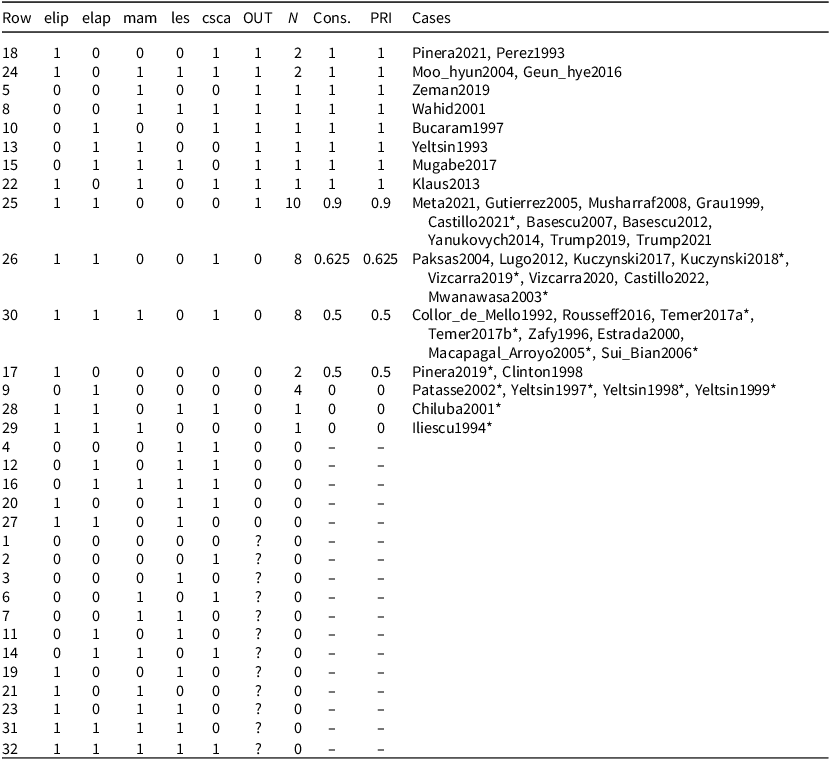
We now proceed to analyze sufficiency, beginning with the construction of the truth table. As outlined above, the truth table is one of the primary tools of QCA, serving an important descriptive function by allocating cases to configurations of variables. Similar to the necessity analysis, we carry out separate analyses for each outcome. Table 1 presents the complete truth table for hurdle 1 (lower house vote). The truth table illustrates that out of the 32 theoretically possible configurations of the five variables, 15 have empirical cases. We set the consistency threshold at 0.9 for three reasons. First, this threshold minimizes the inclusion of deviant consistency cases (Schneider and Wagemann, Reference Schneider and Wagemann2012). In fact, there is only one such deviant case in row 25 (Castillo 2021). However, given the high consistency and PRI scores of this row, and the fact that it covers an additional nine cases, it is justifiable to include this configuration in further analysis. Second, it aligns with the consistency threshold required in the literature (Ragin, Reference Ragin2008). Third, the nine configurations included (i.e., those over 0.9) cover 20 out of 29 cases of a pro-impeachment lower house vote (69 percent).
Truth table for lower house vote
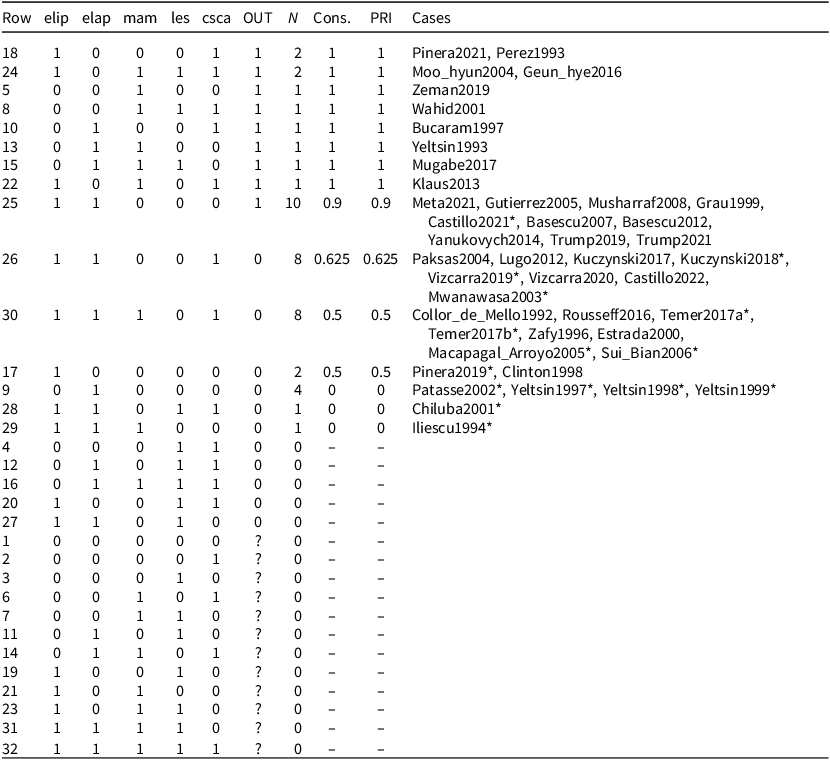
Notes: Consistency threshold = 0.9. N frequency = 1. Abbreviations are as follows: elip (elite ideological polarization), elap (elite affective polarization), mam (mass mobilization), les (legislative shield), csca (corruption scandal), OUT (hurdle 1: lower house vote). N (number of cases), Cons. (consistency), PRI (proportional reduction of necessity). (*) refers to deviant consistency cases.
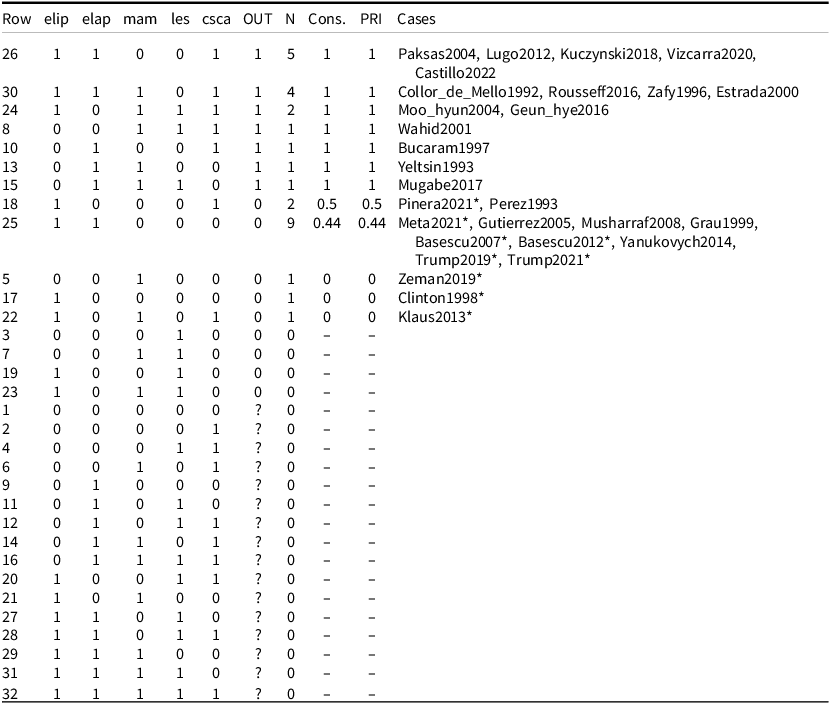
Table 2 presents the truth table for hurdle 2 (removal from office). The truth table illustrates that, of the 32 theoretically possible configurations for all five variables, 12 have empirical cases. For this analysis, the consistency is set at 1.0, indicating that there are no deviant cases in the included rows. The nine configurations included (i.e., those at 1.0) cover 15 out of 20 cases of removal from office (75 percent).
Truth table for removal from office
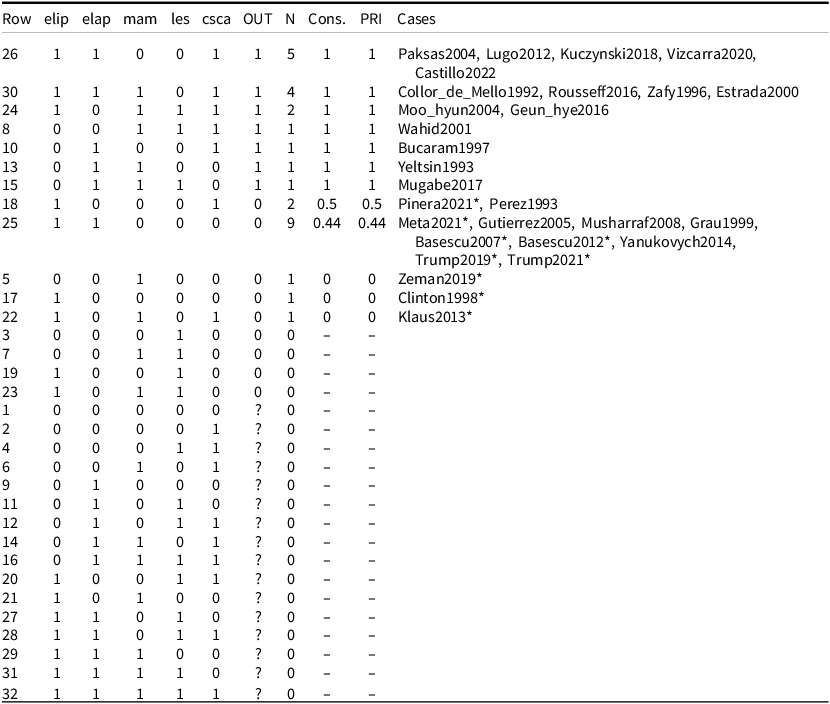
Notes: Consistency threshold = 1.0. N frequency = 1. Abbreviations are as follows: elip (elite ideological polarization), elap (elite affective polarization), mam (mass mobilization), les (legislative shield), csca (corruption scandal), OUT (hurdle 2: removal from office). N (number of cases), Cons. (consistency), PRI (proportional reduction of necessity). (*) refers to deviant consistency cases.
The next step entails minimizing the truth table using the intermediate strategy, given the theoretical expectations that can be generated from the literature. We, thus, set the theoretical directional expectations for the minimization as follows: the absence of a legislative shield and the presence of mass mobilization and a corruption scandal. We leave elite affective polarization and elite ideological polarization without directional expectations (i.e., neither presence nor absence) for two reasons. First, they are part of the hypotheses that we aim to test. Second, as outlined in the theory section, it is hypothesized that they can facilitate or hinder impeachment based on the interaction with other variables.
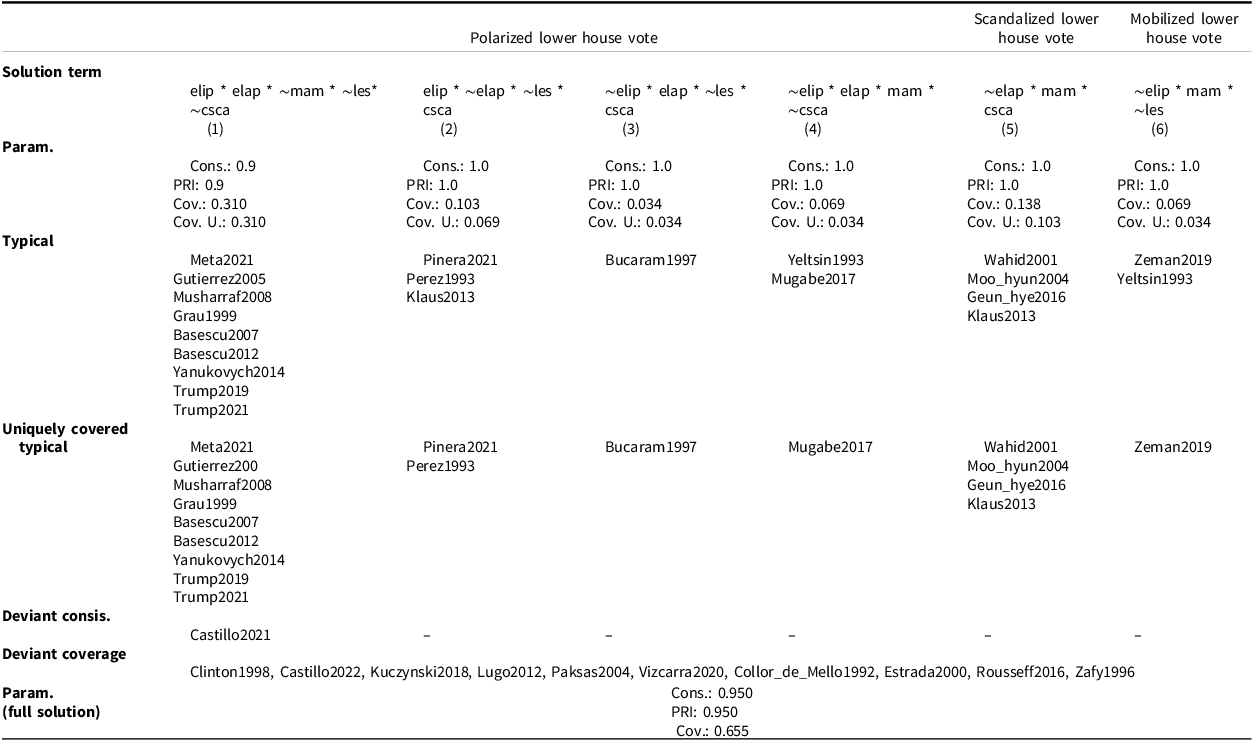
Table 3 presents the enhanced intermediate solution for the lower house vote. Online Appendix 6 includes plots for each of the six solution terms that together constitute a sufficient configuration for a pro-impeachment lower house vote, and contains the enhanced parsimonious solution. The enhanced intermediate solution yields more robust results, as it mitigates contradictions to necessity, implausible assumptions, and most importantly, simultaneous subset relations (Schneider and Wagemann, Reference Schneider and Wagemann2012; Dușa, Reference Dușa2022). This last issue ensures that rows used in the minimization process for the two outcomes (i.e., pro-impeachment lower house vote or removal from office) are excluded from the analysis, given their redundancy.
Enhanced intermediate solution for lower house vote (sufficiency analysis)
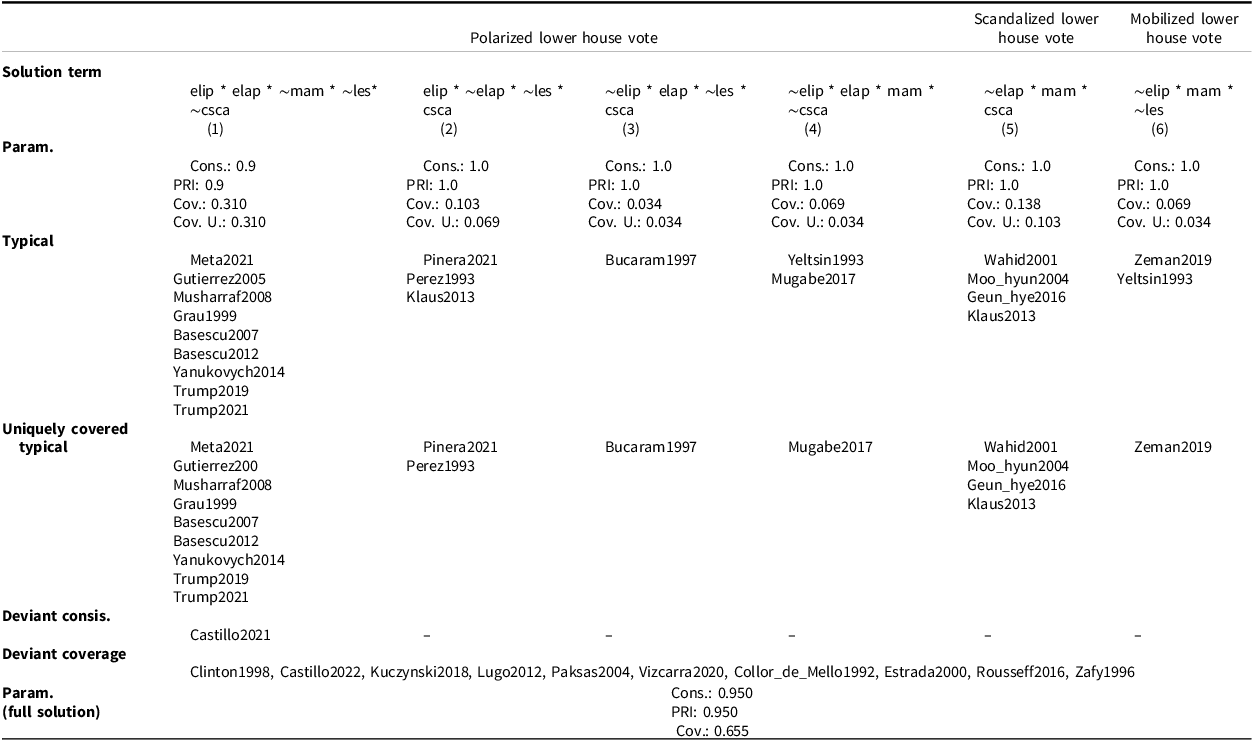
Notes: Consistency threshold = 0.9. N frequency = 1. (*) refers to logical AND. (∼) refers to the absence of the variable. Abbreviations are as follows: elap (elite affective polarization), elip (elite ideological polarization), les (legislative shield), mam (mass mobilization), csca (corruption scandal). Cons. (consistency), PRI (proportional reduction of necessity), Cov. (coverage), Cov. U. (unique coverage).
In our case, there were no simultaneous subset relations. However, we found five rows that constituted incoherent counterfactuals, which were excluded from the minimization. The full solution exhibits good consistency and coverage parameters (0.950 and 0.655, respectively), indicating that the six solution terms account for around two-thirds of the cases where a pro-impeachment lower house vote occurred. The individual solution terms also have similar acceptable consistency and coverage parameters. The six solution terms can be classified into three types: polarized impeachment, scandalized impeachment, and mobilized impeachment. The results are consistent with the hypotheses, highlighting the interaction between affective and ideological polarization, on the one hand, and legislative impeachment, mass mobilization, and corruption scandals, on the other.
The polarized impeachment sub-types (i.e., solution terms 1–4) demonstrate how affective and/or ideological polarization facilitates a pro-impeachment lower house vote. Subtype 1, in particular, demonstrates how a lower house vote is triggered by the interaction between ideological and affective polarization, in the absence of all other variables. It is noteworthy that this solution term, on its own, explains over a third of the cases where a pro-impeachment lower house vote occurred, including the important cases of Trump in 2019 and 2021. This finding aligns with recent research demonstrating how ideological and affective polarization mutually reinforce each other (Webster and Abramowitz, Reference Webster and Abramowitz2017; Lelkes, Reference Lelkes2018; Comellas and Torcal, Reference Comellas and Torcal2023).
Subtype 2 shows that, in the absence of affective polarization and a legislative shield, the interaction of elite ideological polarization and corruption scandals can lead to a pro-impeachment vote in the lower house, as was the case with Chilean President Sebastián Piñera in 2021. In such cases, corruption scandals are exploited by a polarized opposition to push towards impeachment when the president lacks a legislative shield. In contrast, subtype 3 shows how affective polarization interacts with corruption scandals in the absence of a legislative shield and ideological polarization. This was the case with Ecuadorian President Abdala Bucaram in 1997. In such cases, it is not ideological difference, but the perceived threat from the out-group that drives impeachment. Subtype 4 demonstrates how affective polarization and mass mobilization can facilitate a lower house vote in favor of impeachment, as was the case with Russia’s Boris Yeltsin in 1993. Extreme affective polarization between political parties in the shadow of mass mobilization led to such an outcome.
The solution term “scandalized lower house vote” refers to cases driven mainly by corruption scandals that sway public opinion against the president, leading to mobilization in the absence of elite polarization. The impeachment of Park Geun-hye in 2016 is an exemplary case here. In such cases, corruption scandals serve as a mobilizing factor, thus changing elites’ preferences, including the president’s co-partisans, regarding impeachment.
The solution term “mobilized lower house vote” captures cases that are motivated by mass mobilization in the absence of elite ideological polarization and a legislative shield. Miloš Zeman in 2019 is a case in point here, where “Je to na nás!” protests represented the biggest protests in Prague since 1989. The protests, which were primarily directed against the Prime Minister, also criticized Zeman. The Senate took up this criticism, as it was also critical of Zeman for domestic and international issues, including his pro-Russia leaning positions.
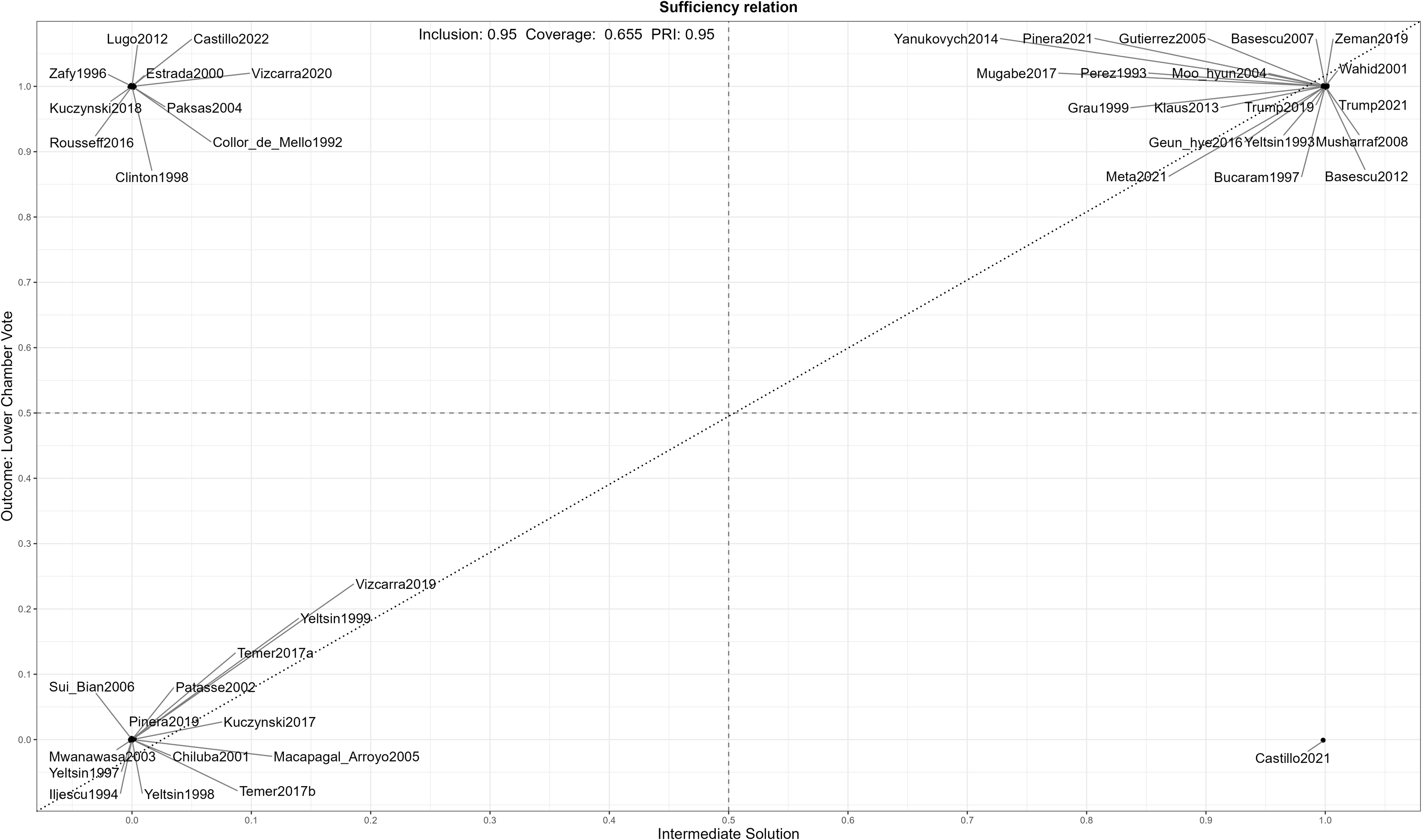
In terms of deviant cases, there is only one deviant consistency case, namely that of the Peruvian president Pedro Castillo in 2021, as outlined in the bottom right quadrant of Figure 1. However, as the analysis below shows, Castillo was impeached the following year. Ten deviant coverage cases are not explained by the current configurations. It is worth noting that six (out of the ten) deviant coverage cases are from Latin America. Two of the six cases (Collor de Mello 1992 and Rousseff 2016), however, are explained in the following analysis on removal from office. This is a point that we return to when carrying out the regional cluster analysis. While higher coverage would be desirable, the objective of this article is not to explain all cases of presidential impeachment.Footnote 11 Instead, the aim is to demonstrate the significance of affective and ideological polarization for impeachment.
Enhanced intermediate solution and covered cases (lower house vote).
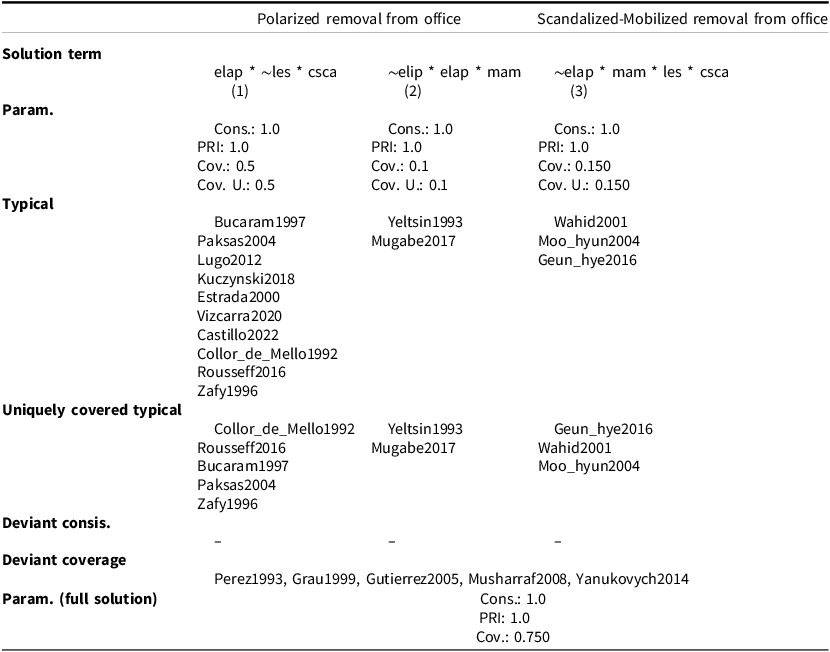
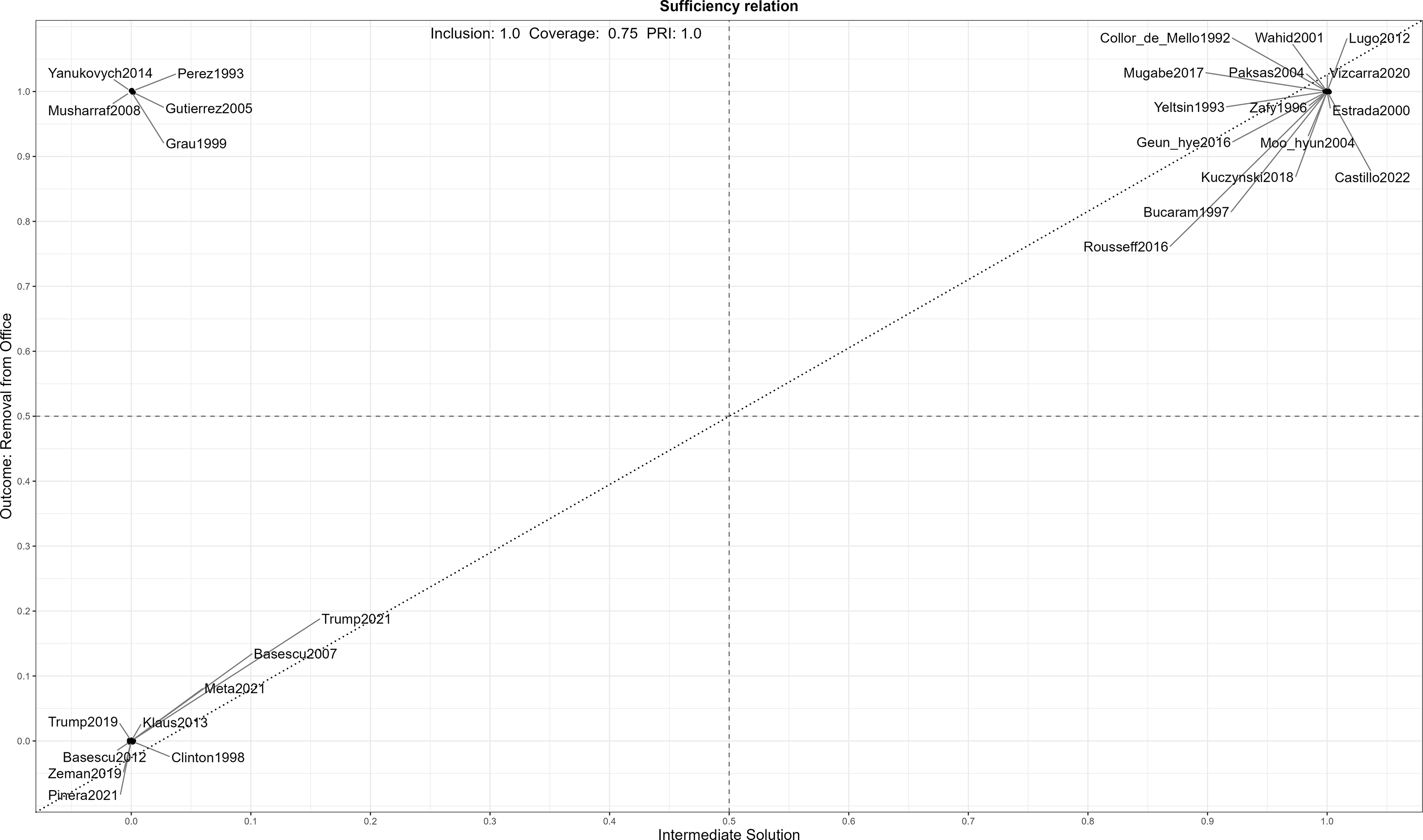
The article now moves to examining the second hurdle: removal from office. Table 4 presents the results of the enhanced intermediate solution. Online Appendix 7 includes plots for each of the three solution terms that, together, are sufficient for removal from office, and also includes the enhanced parsimonious solution. When calculating the enhanced intermediate solution, there were no simultaneous subset relations; however, four rows represented difficult counterfactuals and were therefore removed from the minimization. The three solution terms can be classified into two main types: polarized and scandalized-mobilized removal from office. The full solution exhibits perfect consistency and good coverage (1.0 and 0.75, respectively), indicating that the three solutions collectively account for 75 percent of all presidents who were removed from office, as outlined in Figure 2.
Enhanced intermediate solution for removal from office (sufficiency analysis)
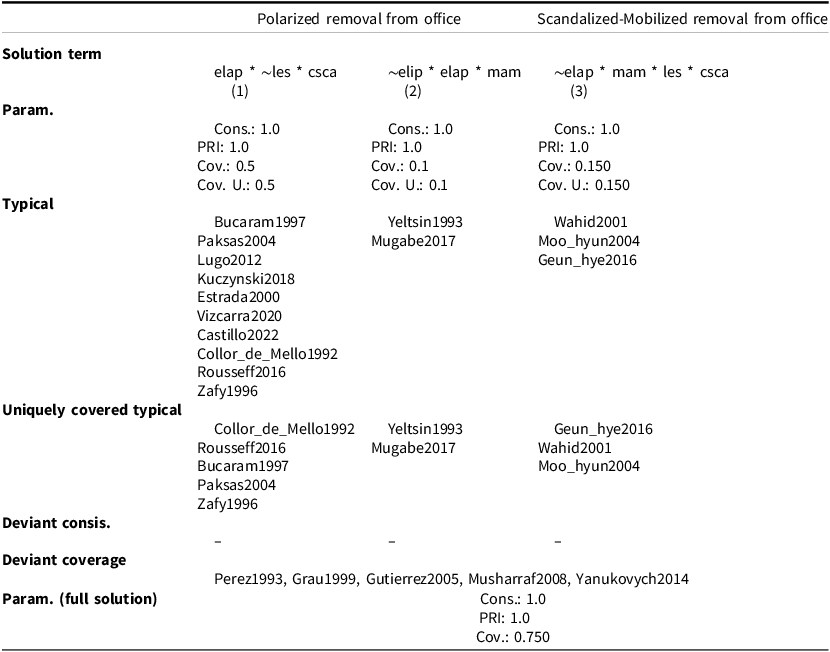
Notes: Consistency threshold = 1.0. N frequency = 1. (*) refers to logical AND. (∼) refers to the absence of the variable. Abbreviations are as follows: elap (elite affective polarization), elip (elite ideological polarization), les (legislative shield), mam (mass mobilization), csca (corruption scandal). Cons. (consistency), PRI (proportional reduction of necessity), Cov. (coverage), Cov. U. (unique coverage).
Enhanced intermediate solution and covered cases (removal from office).
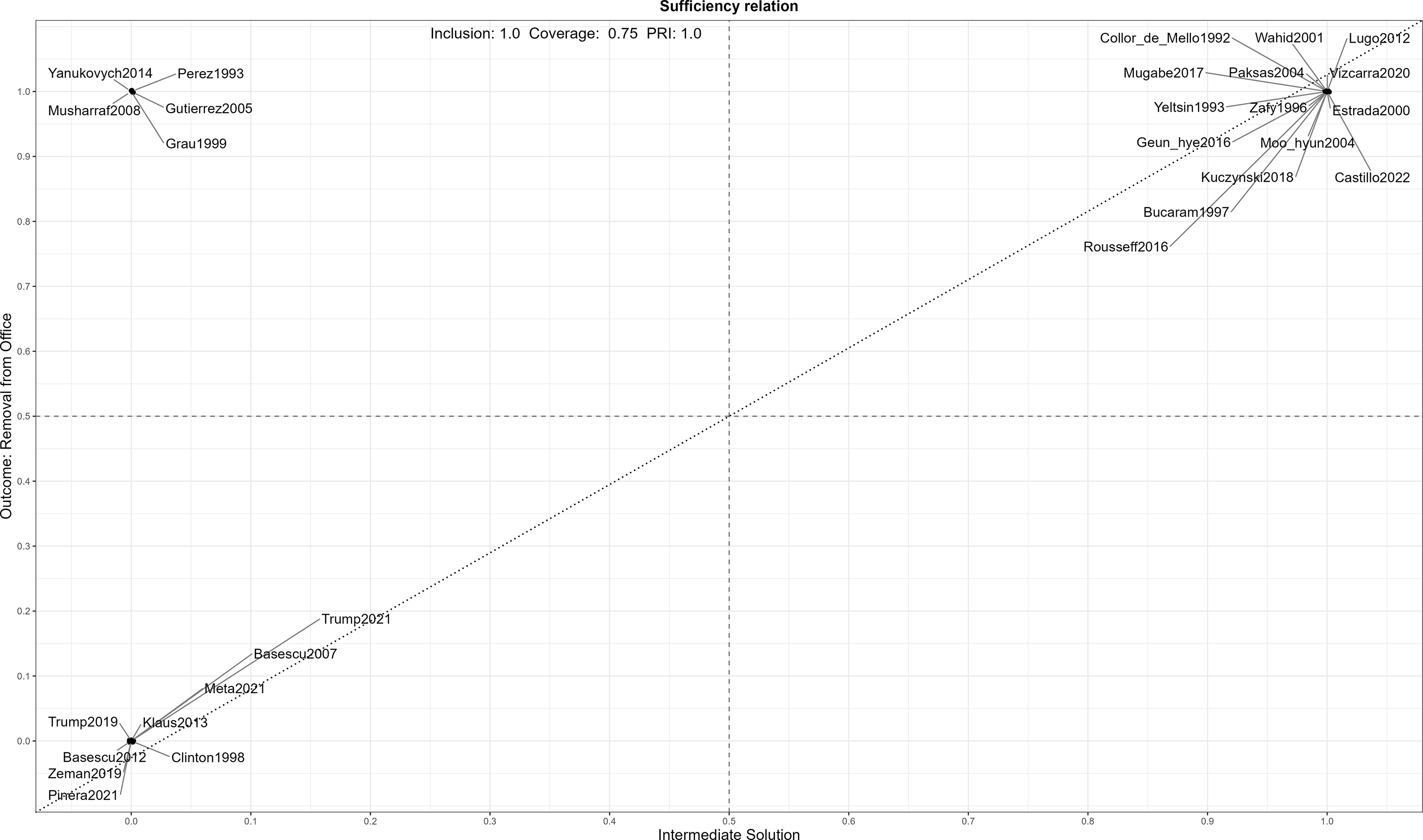
The polarized removal from office solution term, which has two variants, is significant in highlighting how affective, not ideological, polarization matters for impeachment amid corruption scandals (subtype 1) or mass mobilization (subtype 2) in the absence of a legislative shield. This solution term has the highest coverage (i.e., 0.5), thus explaining half of the cases removed from office. The solution lacks deviant consistency cases but has five deviant coverage cases. In the context of impeachment, while ideological polarization, in interaction with other variables including affective polarization, can lead to a pro-impeachment vote in the lower house (outcome 1), it is affective polarization that drives removal from office (outcome 2). The solution term “scandalized-mobilized removal from office” demonstrates how corruption scandals and mass mobilization can lead to overcoming presidential legislative shields. The case of Park Geun-hye in 2016 reflects this pattern, where the lower house’s vote in favor of impeachment was later confirmed by the Supreme Court, thus leading to her removal from office.
To make sure that the uncovered cases by the three solution terms are not explained by omitted variables, Online Appendix 8 presents data on three additional variables: economic crisis, level of democracy, and presidential powers. The cases display heterogeneous scores on all three variables, thus showing that the results are not implicated by the non-inclusion of a certain variable. Those understudied cases would benefit from case studies to examine the specific dynamics of impeachment.
We do not develop specific theoretical expectations about the drivers of non-impeachment, that is, cases that fail to pass either hurdle. However, in line with standard practice, we report the necessity and sufficiency analyses for the two non-outcomes in Online Appendices 9 and 10, respectively. The results show that there are no necessary conditions for both outcomes: an anti-impeachment vote in the lower house and non-removal from office. Moving to sufficiency analysis, the results demonstrate that non-impeachment is not only a function of a legislative shield (Pérez-Liñán, Reference Pérez-Liñán2014). In some cases, non-impeachment can follow from either ideological or affective polarization in the absence of a legislative shield. Such results, notwithstanding, need to be interpreted with caution given their low coverage.
Discussion: robustness tests, theory evaluation, and illustrative cases
In this section, we present the main results, report a series of robustness checks, assess the evidence in light of our hypotheses, and draw on illustrative cases to contextualize the findings. Taken together, the results indicate that elite ideological and affective polarization can operate either as primary triggers of impeachment or as facilitating conditions in the presence of additional triggers.
First, high levels of both elite ideological and affective polarization can independently trigger a pro-impeachment vote in the lower house, even in the absence of corruption scandals or mass mobilization. This configuration accounts for 31 percent of the pro-impeachment lower house votes in our sample. With only one deviant consistency case (Pedro Castillo in 2021), the pattern is largely consistent across cases. These findings extend existing research on the mutually reinforcing effects of ideological and affective polarization at the mass level (Webster and Abramowitz, Reference Webster and Abramowitz2017; Lelkes, Reference Lelkes2018; Comellas and Torcal, Reference Comellas and Torcal2023) by demonstrating that similar reinforcement dynamics operate among political elites in the context of presidential impeachment.
Second, elite polarization also functions as a facilitating condition. In combination with corruption scandals and mass mobilization, polarization increases the likelihood that elites will pursue impeachment. This pathway characterizes approximately one-fifth of the cases in which a pro-impeachment lower house vote occurred.
While both ideological and affective polarization facilitate a pro-impeachment vote in the lower house, it is affective polarization that drives removal from office in the absence of a legislative shield. However, given the higher threshold required to remove a president from office, elite affective polarization is only a facilitator when combined with corruption scandals and/or mass mobilization. This explains 60 percent of the cases where the president was removed from office. The analysis on removal from office does not return any deviant consistency cases, making the results perfectly consistent and highly reliable.
Online Appendix 11 presents a range of sensitivity and fit-oriented robustness tests. Most importantly, the robustness tests show that the results are robust to alternative calibration thresholds for both elite ideological polarization and elite affective polarization. This demonstrates that the results are not sensitive to changing the crossover calibration threshold for elite ideological polarization (from 5 to 4) and for elite affective polarization (from 1 to 1.5).
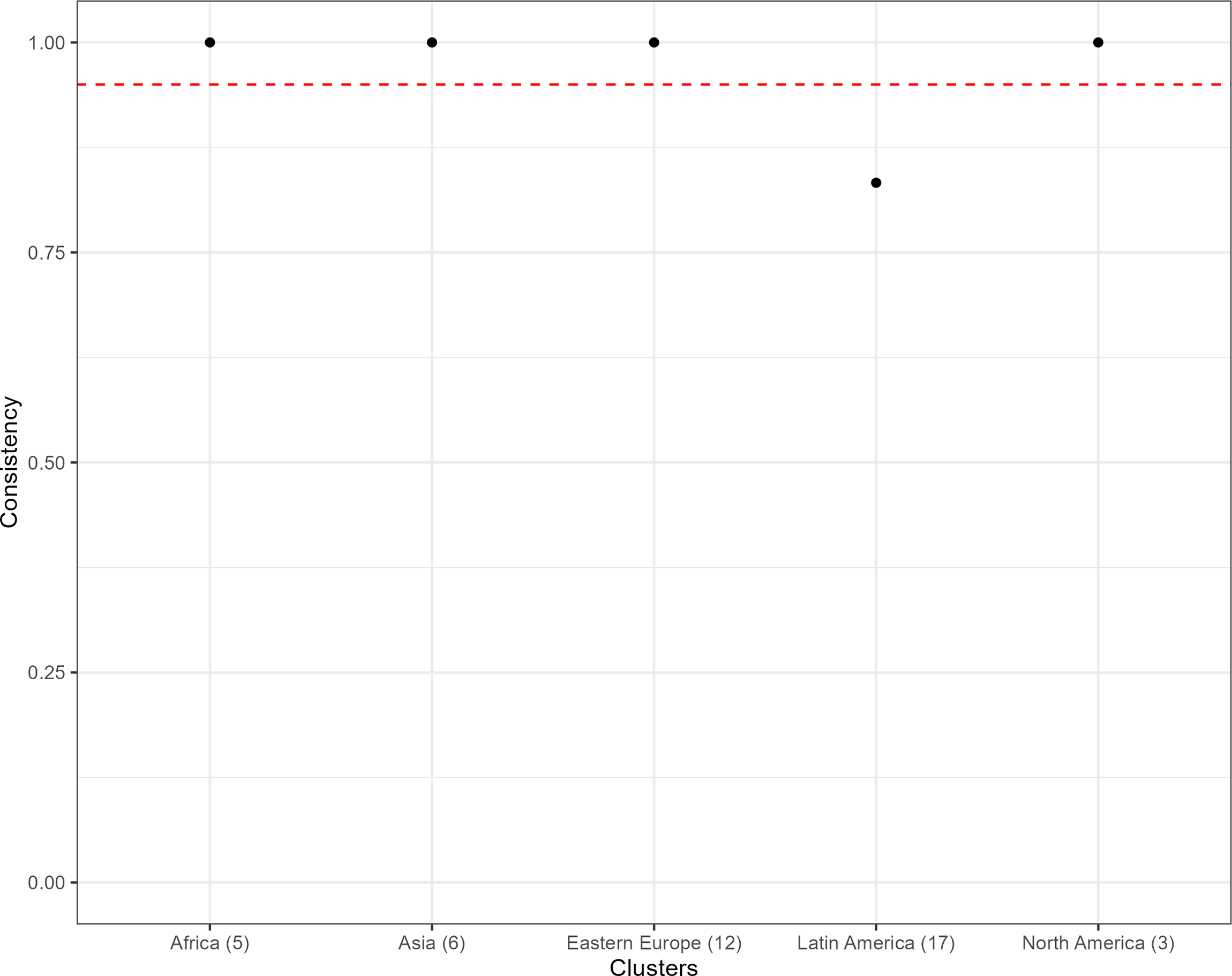
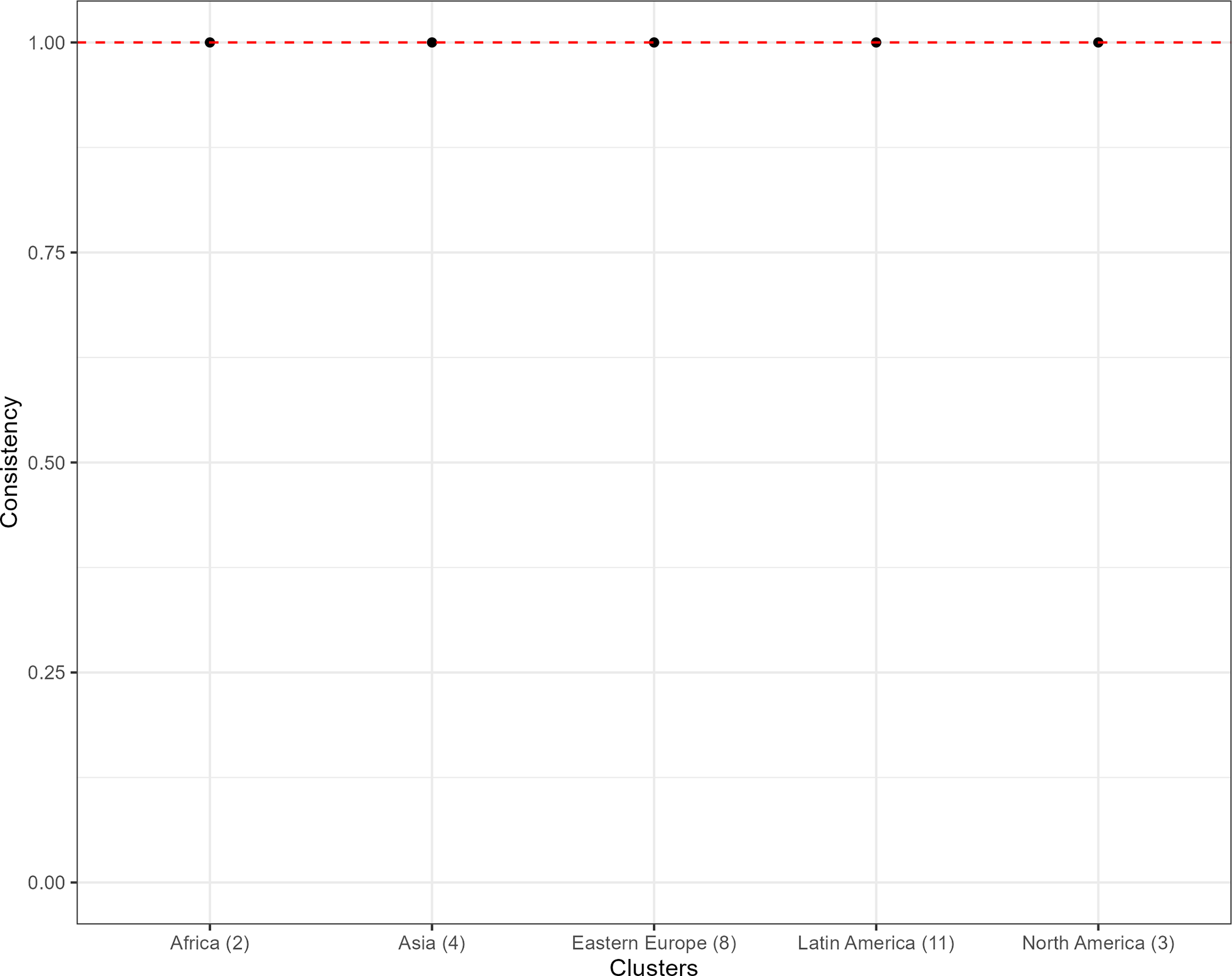
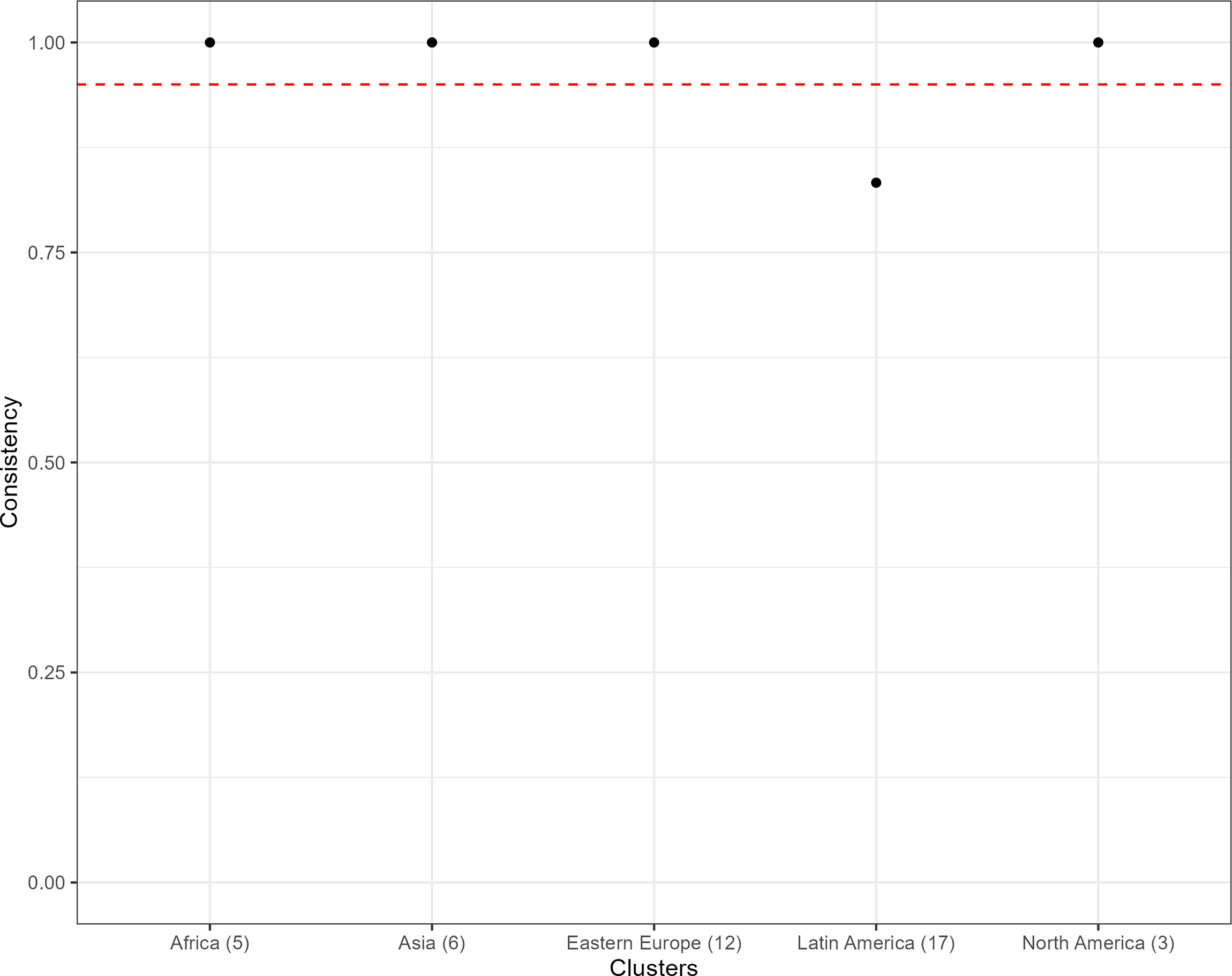
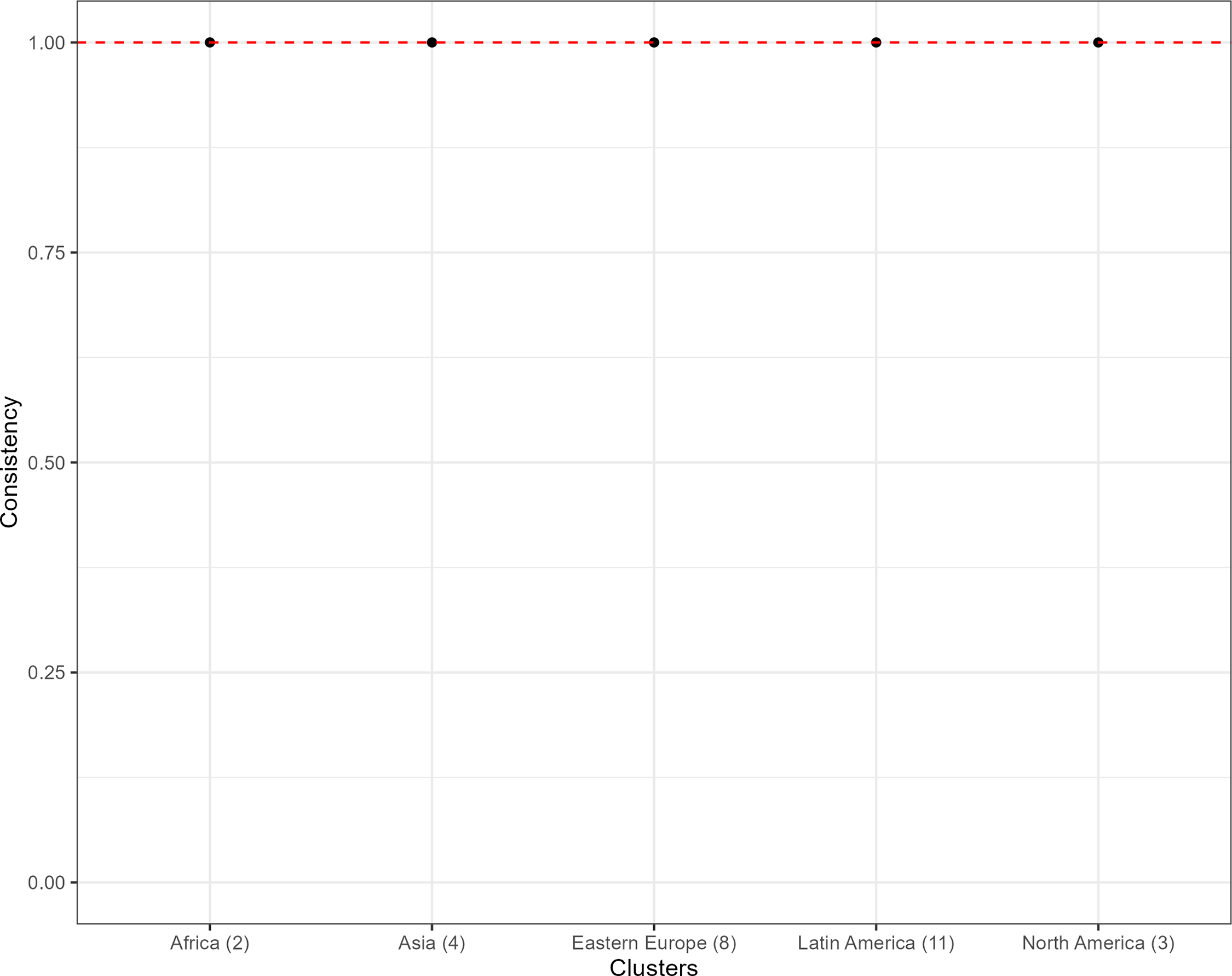
To ensure that the results are not driven by impeachment cases in certain regions, such as Latin America, we implement a cluster analysis (see Figures 3 and 4). The results are very consistent across all regions except for slight clustering in Latin America, the only region that is under the horizontal line for the lower house vote. This might be explained by additional variables outlined in the literature, including judicial action (Mendes et al., Reference Mendes, Gargarella and Guidi2022) or military involvement (Botelho and Barretos, Reference Botelho and Luiza Pereira Barretos2023). This is one area for further research.
Cluster analysis by world region for lower house vote.
Cluster analysis by world region for removal from office.
Recent advances in QCA allow for carrying out formal theory evaluation. This is achieved by comparing the results retrieved by the enhanced intermediate solution with the hypotheses. The full theory evaluation of the outcome is presented in Online Appendix 12. Two important observations are in order. First, 62.07 percent of cases with pro-impeachment lower house votes and 50 percent of removal-from-office cases that are covered by the results are also covered by the hypotheses. For such configurational hypotheses, this indicates that the theoretical expectations derived from the polarization literature have some empirical support. Second, only one case (i.e., Castillo 2021 in Peru) is captured by the hypotheses but not by the results, lending further support to the derived hypotheses.
A potential concern is that the results reported in this article are affected by selection bias arising from the chosen sample of cases. Specifically, one might argue that including additional president-years could alter the configurational results. To assess this possibility, we replicated the analysis using a simulated dataset that adds one additional president-year for each observed case. In constructing the simulated data, we proceeded as follows. First, we coded the outcome (removal from office) as 0 for all simulated president-years. Second, we set the values of mass mobilization and corruption scandals to 0, irrespective of their observed values. Third, we retained the original values of elite ideological polarization, elite affective polarization, and legislative shield, as these factors are unlikely to vary substantially from one year to the next. We then applied the same calibration thresholds used in the main analysis.
The full simulated dataset is presented in Online Appendix 13, which also reports the corresponding sufficiency analysis. The results for removal from office replicate the main findings: the same configurations emerge as sufficient for overcoming impeachment hurdles. By contrast, the results for non-removal differ somewhat from those reported in Online Appendix 10. However, the primary aim of this article is to explain the conditions under which impeachment succeeds, rather than why attempts fail. From this perspective, the replication with simulated president-years reinforces confidence in the robustness of our core findings.
The article uses mass mobilization as a proxy for public discontent. We replicate the analysis by using public approval ratings as an alternative operationalization. We measure public disapproval using data from the Executive Approval Database, which compiles public approval and disapproval ratings for 113 countries. However, the available data covers only 32 (out of the 44) impeachment cases we examine. There is some variation of public disapproval, ranging from 33.73 percent (Viktor Yanukovych of Ukraine in 2014) up to 71.84 percent (Miloš Zeman of the Czech Republic in 2019). We code presidential disapproval as 1 when their disapproval ratings are higher than 50 percent and 0 otherwise. The sufficiency analysis proceeds as the main analysis by only replacing mass mobilization with public disapproval. The results in Online Appendix 14 demonstrate that elite ideological or affective polarization explain both lower house vote and removal from office on their own or in interaction with the other variables including public disapproval, lending further confidence in our results.
Another potential concern is that the findings are sensitive to the set-theoretic logic of QCA and that regression analysis might lead to completely different results. In Online Appendix 15, we report and interpret the results from several binomial logit regression models only as a methodological exercise. Generally, the results—despite lacking significance—point to similar directions, thus highlighting that elite polarization matters for impeachment.
To further explain the results, we use two illustrative cases (Online Appendix 16) and report only a summary here. First, the impeachment trials of Donald Trump in 2019 and 2021 are used to show how elite polarization can lead to a pro-impeachment lower house vote (subtype 1). Trump was the most polarizing president in the history of the United States, and it is no coincidence that he was also the first U.S. president to be impeached twice (Jacobson, Reference Jacobson2020: 763). In both trials, partisanship shaped how Democrats and Republicans saw the facts of the case. For Democrats, Trump represented a “danger” and a “threat” for democracy, whereas the majority of Republicans viewed impeachment as a politically-motivated “witch hunt” (Mangan, Reference Mangan2021; Bose and Burnett, Reference Bose and Burnett2022). As a result, “heightened polarization has made it almost impossible for partisans to abandon their party’s candidates” (Iyengar, Reference Iyengar, Hannon and de Ridder2021: 98).
The first impeachment in December 2019 centered around allegations that Trump had abused his power by soliciting foreign interference in the 2020 presidential election, specifically by pressuring Ukraine to investigate Joe Biden and his son Hunter. Trump was also charged with obstruction of Congress for blocking investigation efforts. At the time, the Democrats controlled the House of Representatives with 233 seats out of 435, leading to a vote largely along party lines: 230–197 in favor of impeachment. However, the Republican-controlled Senate (53 Republicans out of 100 seats) acquitted Trump, with only one Republican, Mitt Romney, breaking ranks to vote for conviction on one of the articles.Footnote 12
The second impeachment occurred in January 2021, following the storming of the U.S. Capitol by Trump supporters on January 6. The charge this time was “incitement of insurrection,” asserting that Trump had incited the violent attack aimed at overturning the 2020 election results. The House, still under Democratic control, swiftly moved to impeach with a 232-197 vote, including support from 10 Republicans. Despite this bipartisan support in the House and concerted efforts by Democrats to appeal to Republicans, the Senate, evenly split 50-50 but controlled by Democrats through Vice President Kamala Harris’s tie-breaking vote, fell short of the two-thirds majority required to convict, with a 57–43 vote. In short, the deep polarization increased loyalty to party lines in the US Senate, thus shaping the outcomes of both impeachment trials of Trump (Jacobson, Reference Jacobson2020; Healy, Reference Healy2022).
Second, Dilma Rousseff’s removal from office in 2016 is utilized to demonstrate how elite polarization leads to removal from office. The impeachment of Dilma Rousseff was prompted by the Petrobras corruption scandal and occurred under the shadow of elite polarization. Already in the second year of the investigation, public prosecutors formally accused 110 people of corruption, concealment, and other financial crimes, including ministers, members of the Chamber of Deputies, and several other senior officials. As of March 2015, several protests against the government brought together hundreds of thousands of people across the country to ask, among other demands, for the impeachment or the resignation of Rousseff (Mourão, Reference Mourão2019). Rousseff’s low approval ratings reflected unpopularity in the whole political spectrum, but most notably among the conservatives. Several conservative civil society groups thus organized protests in São Paulo against Rousseff (Bedinelli and Martin, Reference Bedinelli and Martin2015).
Those conservative groups contributed to further polarizing the political spectrum and the Brazilian society overall (Bülow, Reference Bülow and Youngs2018). In addition to public discontent, elite affective polarization had already been on the rise in Brazil even before the Petrobras corruption scandal. For example, Aécio Neves, from the Brazilian Social Democracy Party (PSDB), refused to concede his loss against Rousseff in the 2014 presidential run-off elections and tried to interrupt Rousseff’s second term, alleging that her party, the Workers’ Party (PT), was a “criminal organization” (Nunes and Melo, Reference Nunes and Ranulfo Melo2017). Eduardo Cunha, the President of the Chamber of Deputies, accepted a request to impeach Rousseff, whereas the Brazilian Democratic Movement Party (PMDB) withdrew from the government’s ruling coalition. The formal impeachment proceedings of Dilma Rousseff started on December 2, 2015, and were concluded on August 31, 2016, when the Senate removed Rousseff from office by a 61–20 vote, finding her guilty of breaking Brazil’s budget laws.
We also use the case of Brazilian President Michel Temer, who survived two impeachment attempts in August and October 2017, to examine why some presidents are not impeached despite corruption scandals. The current literature explains this puzzle in terms of Temer providing concessions to the elite, thus buying their support, something that his predecessor, Dilma Rousseff, failed to do. While this argument is intuitive, we also highlight two factors. First, is the lack of massive mobilization compared to that which erupted against Rousseff. The second factor lies in the fact that he was a temporary president, thus giving little incentive for the elite to impeach him. The elite, hence, were able to buy time until his term came to an end. Online Appendix 17 illustrates the dynamics of Temer’s case.
Conclusion
This article has theorized presidential impeachment as a multi-hurdle process by focusing on two main hurdles: a pro-impeachment lower house vote and removal from office. Both hurdles are distinct from each other, as some cases only pass the first but not the second hurdle. Using crisp-set QCA to examine 44 cases of successful and failed impeachment, the results uncover three pathways to impeachment: polarized, scandalized, and mobilized impeachment. Notably, elite ideological and affective polarization can be the primary triggers of a pro-impeachment lower house vote or can be facilitators for subsequent removal from office in the presence of other triggers such as corruption scandals or mass mobilization. While both ideological and affective polarization facilitate a pro-impeachment vote in the lower house, it is affective polarization that drives removal from office in several cases in the absence of a legislative shield. The results withstand a variety of robustness tests.
This article has focused on the determinants of overcoming two impeachment hurdles. Future research could examine the reasons for overcoming additional hurdles, such as putting impeachment on the political agenda or examining why impeachment attempts fail. We have shown that the lack of a legislative shield is vital in explaining removal from office. However, a legislative shield alone is not sufficient for non-impeachment, a topic that requires further research. An additional important issue that requires further consideration is why some presidents are not impeached despite being involved in corruption scandals (e.g., Michel Temer in Brazil). Legislators may decide, for a variety of electoral or strategic reasons, to either not respond to corruption scandals at all or to respond to them using legislative accountability mechanisms that are short of impeachment.
From a comparative perspective, the growing levels of affective and ideological polarization worldwide could result in an increase in attempts to impeach presidents. Recent research has shown there is an ever-increasing level of affective polarization toward leaders compared to their political parties (Reiljan et al., Reference Reiljan, Garzia, Silva and Trechsel2024). This suggests that polarization could fuel mass mobilization, putting pressure on elites to impeach presidents. Additionally, the increasing ideological polarization among elites can lead to government gridlock (Lee, Reference Lee2015) and make citizens more likely to support parties or presidents with authoritarian ambitions (Svolik, Reference Svolik2019). One promising area for future research is understanding how affective polarization at the mass level drives impeachment. While there is an established body of literature on how elite cues are influential (Guisinger and Saunders, Reference Guisinger and Saunders2017), the interests of the masses also shape elite preferences.
In such a context, impeachment as a constitutional tool might be weaponized, leading to an “impeachment trap” by increasing the number of impeachment attempts (Polga-Hecimovich, Reference Polga-Hecimovich, Monaghan, Flinders and Huq2024). Polarization can also lead to within-legislature deadlock by hardening partisan identity and increasing partisan (or coalition) cohesion. This, in turn, increases the likelihood of activating the legislative shield, including in cases of executive wrongdoing. When impeachment attempts are shaped by such a “partisan motivation, they lose their legitimacy as a tool of accountability. They do not bring political stability either, as caretakers may be disliked or even rejected by people” (Llanos and Marsteintredet, Reference Llanos, Marsteintredet, Llanos and Marsteintredet2023: 23). With the legitimacy of impeachment undermined, supporters of impeached elites can thus counter-mobilize against impeachment. This can induce a military coup or lead the impeached president to refuse to leave office. Either way, democracy is undermined.
Supplementary material
The supplementary material for this article can be found at https://doi.org/10.1017/S1755773926100484.
Data availability statement
The data and R replication script for all the analyses in the article and the online appendix are available on Harvard Dataverse at: https://doi.org/10.7910/DVN/A5Q3OC.
Acknowledgments
We would like to thank the three anonymous reviewers and the editors for their very helpful comments which substantially improved the article. Previous drafts of this paper were presented at the 2024 Congress of the German Political Science Association and the 2021 ECPR General Conference. We would like to thank the discussants and participants for their comments and suggestions.
Funding statement
The authors declare no funding.
Competing interests
The authors declare no conflicts of interest.
Ethical standards
Not applicable.



 Open access

