


Soft red winter wheat is grown on over 300,000 ha in the Mid-Atlantic region of the United States (USDA 2015). Winter wheat in this region provides a fall-planted crop that increases the diversity of farmers’ rotations. Also, the ability to plant soybean [Glycine max (L.) Merr.] immediately after wheat harvest in this region allows for an additional grain marketing opportunity.
Winter annual weeds, both broadleaf and grass species, are problematic for small grains. Farmers in the mid-Atlantic region have successfully used acetolactate synthase (ALS)-inhibiting herbicides since early 1990s as their mainstay for weed control. As a result, there has been a shift towards species that are not effectively controlled with this herbicide family, such as henbit (Lamium amplexicaule L.), ivyleaf speedwell (Veronica hederifolia L.), and annual bluegrass (Poa annua L.) (BA Scott, personal observation). In addition, there are confirmed ALS-resistant biotypes of common chickweed [Stellaria media (L.) Vill.], Italian ryegrass (Lolium perenne L. ssp. multiflorum (Lam.) Husnot), and horseweed [Conyza canadensis (L.) Cronq.]. The prevalence of these species has forced farmers to seek alternative herbicides for small grain production.
Metribuzin is an herbicide that may improve small grain weed control for growers in the mid-Atlantic region. Research has demonstrated that metribuzin can effectively control broadleaf and grass species in small grains (Blackshaw Reference Blackshaw1990; Grey and Bridges Reference Grey and Bridges2003; Shaw and Wesley Reference Shaw and Wesley1991). Metribuzin has provided good to excellent POST control of henbit, ivyleaf speedwell, and common chickweed in local herbicide efficacy trials when applied alone at rates lower than those reported in previous research (MJ VanGessel, unpublished data). In addition, metribuzin provides an alternative mode of action herbicide for small grains to assist with herbicide-resistance management.
Previous research has demonstrated a risk of crop injury when metribuzin is used in small grains, although cultivars differ in their sensitivity to metribuzin (Blackshaw Reference Blackshaw1993; Shaw and Wesley Reference Shaw and Wesley1991). However, most of the cultivars used in the previous research on this topic are no longer used (Grey and Bridges Reference Grey and Bridges2003; Schroeder et al. Reference Schroeder, Banks and Nichols1985; Shaw and Wesley Reference Shaw and Wesley1991) or trials were conducted with hard red wheat (Blackshaw Reference Blackshaw1993; Runyan et al. Reference Runyan, NcNeil and Peeper1982; Wicks et al. Reference Wicks, Nordquist and Schmidt1987). Also, most of the previous research examining wheat’s response to metribuzin either used application rates much higher than those needed to control ALS-resistant chickweed or ivyleaf speedwell on coarse-textured soils, or they did not include multiple application timings.
Research using low metribuzin rates has been conducted using a commercial herbicide mixture that also contains flufenacet (Axiom® DF, Bayer CropScience, Research Triangle Park, NC) applied either PRE or shortly after wheat emergence (Grey et al. Reference Grey, Cutts, Sosnoskie and Culpepper2012; Koepke-Hill et al. Reference Koepke-Hill, Armel, Bradley, Bailey, Wilson and Hines2011; Ritter and Menbere Reference Ritter and Menbere2002). However, this rate and application timing is unique to the commercial product used in this research. Currently, the label recommendation for metribuzin is that it should be applied from the 2 -leaf to four-tillers stages.
This experiment was conducted to evaluate winter wheat safety and yield response when treated with metribuzin at various times during the growing season. This information is vital to farmers in the region that have had inconsistent crop safety results when using metribuzin. Recommendations need to strike a balance between crop safety and maintaining excellent weed control.
Materials and Methods
Trials were conducted for three seasons beginning in 2012 at the University of Delaware’s Research and Education Center located near Georgetown, DE (38.64°N, 75.46°W). The experimental sites were conventionally tilled with chisel plowing and discing in the fall, and field cultivation immediately prior to planting. Plots were 7.6 m long and 3 m wide, and rows were 18 cm apart (16 rows per plot). The soil was a Rosedale loamy sand (loamy, siliceous, mesic Arenic Hapludult), with a pH range of 5.9 to 6.1, and an organic matter rang of 0.8% to 1.5%. Sites planted in 2013 and 2014 had access to irrigation to supplement rainfall. A total of 145 kg ha−1 of nitrogen was applied with three applications, one at planting (33 kgha−1) and two in the spring (40 kg ha−1 followed by 60 kg ha−1). To eliminate weed competition, all plots were treated in the spring with thifensulfuron plus tribenuron (17 and 9 g ai ha−1, respectively) (Harmony® Extra SG 25DF, E.I. DuPont de Nemours and Company, Wilmington, DE) and a non-ionic surfactant at 0.25% v/v (Scanner®, Loveland Products, Greeley, CO). The research sites do not have ALS-resistant weeds.
Planting dates were October 23, 2012; October 28, 2013; and October 20, 2014; and the seeding rate was 168 kg ha−1 (1,900,000 seeds ha−1) (Table 1). ‘Shirley’ (Dyna-Gro, Loveland, CO) was planted in 2012 and 2014 and ‘USG 3555’ (UniSouth Genetics, Dickson, TN) was planted in 2013. Both cultivars are rated susceptible to very susceptible to metribuzin (Burgess et al. Reference Burgess, Allen, Bullard, Varner, Rowe, Ingram, Singleton, Johnson, Starkey, Larson, Reginelli, Eubank, Hankins, Carson and Haire2013; Thomason et al. Reference Thomason, Griffey, Behl, Black, Mall and Hokanson2015). Plots were planted with a no-till drill (Great Plains, Salina, KS) at a depth of 2.5 to 3.8 cm.
Planting and application dates, maximum air temperature on day of application, average maximum air temperature on the first 3 d after treatment (DAT), and rainfall within 10 DAT for studies on the response of winter wheat to metribuzin.

a Temperature is maximum daily temperature on day of application, and average maximum temperature for the first 3 d after treatment (DAT).
b Rainfall is amount (cm) and DAT it occurred.
Metribuzin (Glory® 75DF, Makhteshim Agan of North America, Inc., Raleigh, NC) was applied at 105 or 210 g ai ha−1 with a non-ionic surfactant at 0.25% v/v (Scanner®). Herbicide treatment was applied at one of four timings: immediately after planting, which will be referred to as the PRE-fall treatment; when the wheat plants were at the 2-leaf growth stage (Feekes stages 1 and 2), which will be referred to as the 2-leaf-fall treatment; in the early spring at the time of wheat green-up (Feekes stages 3 and 4; March 11 to 19), which will be referred to as the early-spring treatment; or 3 to 4 wk after the early-spring treatment (Feekes stages 4 to 6), which will be referred to as the late-spring treatment (Table 1). All combinations of the two metribuzin rates and four application timings were included in the study, along with a non-treated check.
Treatments were applied with a hand-held, CO2-pressurized backpack sprayer while traveling at 4.8 km hr−1. Spray volume was 187 L ha−1, nozzles were 11002 Greenleaf AirMix® (Greenleaf Technologies, Covington, LA), and the pressure was 276 kPa. All treatments were replicated three times, and the trial was arranged as a factorial design with metribuzin rate and application timing as main effects.
Wheat response was rated visually throughout the growing season on a scale of 0 to 100, in which 0 indicates no response and 100 indicates plant death. A 2-m-wide swath of wheat was harvested with a combine when it reached physiological maturity. Yields were adjusted to 13.5% moisture content.
Injury data were transformed with arcsine square root prior to data analysis, and untransformed data are presented in the tables. Statistical analyses were conducted with PROC MIXED in SAS® version 9.4 (SAS Institute Inc., Cary, NC), using replication as random effect. Fisher’s protected LSD was used for mean separation at P=0.05. To test the relationship between wheat injury and yield, PROC CORR was used to calculate correlation coefficients.
Results and Discussion
There was year-by-treatment interaction for wheat injury, so data for each year has been analyzed and presented separately. The wheat cultivars used in this research have similar levels of sensitivity to metribuzin, so the interaction cannot be fully explained by differences in cultivars.
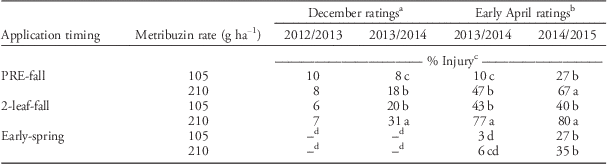
Visual ratings of crop injury following the fall treatments were recorded in December in two of the three years (Table 2). For the 2012/2013 season, crop injury ratings following the fall-applied treatments did not differ significantly between treatments, and ranged from 6% to 10% injury. For 2013/2014, a rate-by-timing interaction was observed with metribuzin applied at the 2-leaf-fall timing at 210 g ha−1 resulting in the highest level of injury: 31%. Metribuzin at 105 g ha−1 applied at the 2-leaf-fall timing and at 210 g ha−1 applied at the PRE-fall timing had similar responses, with 18% to 20% injury. Metribuzin at 105 g ha−1 applied at the PRE-fall timing had the least amount of injury: 8%.
Winter wheat response to metribuzin applied at two rates and three application timings.
a December ratings were 2 and 1 wk after the 2-leaf-fall applications in 2012/2013 and 2013/2014, respectively. December ratings were not recorded in the 2014/2015 crop year.
b April ratings were recorded 3 wk after the early-spring application in both years.
c Values within a column followed by the same letter are not significantly different at α=0.05.
d Early-spring applications had not been applied at time of the December ratings.
Crop injury levels for both of the fall applications and the early-spring application were rated in early April of 2014 and 2015 (Table 2). No ratings were recorded in April of the 2012/2013 season. The early-spring treatment resulted in ≤6% injury regardless of application rate in 2013/2014, while application at the 2-leaf-fall timing resulted in 43% to 77% injury. For the 2014/2015 season, 210 gha−1 metribuzin applied at the PRE-fall and 2-leaf-fall timings exhibited over 67% injury, while all other treatments resulted in from 27% to 40% injury. By late April in each year, injury from early-spring applications was ≤7% (data not shown), so injury appears to have been temporary. Speed of recovery from early-spring application may be associated with rapid growth during the Feekes stages 5 through 7.
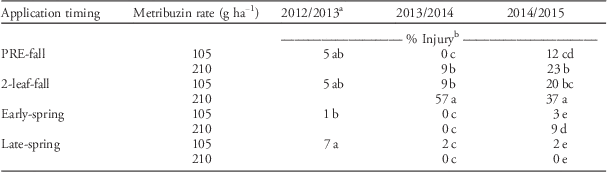
In May of 2013, ratings were 7% or less for all treatments (Table 3). In May 2014, the lowest levels of injury were observed with both spring timings and fall-PRE application at the 105 g ha−1 rate. Metribuzin at 210 g ha−1 applied at 2-leaf-fall stage resulted in 57% injury. In 2015, the late-spring application timing (regardless of rate) and early-spring with 105 g ha−1 of metribuzin resulted in the least injury, 3% or less. Early-spring application with 210 gha−1 and PRE-fall application of 105 g ha−1 metribuzin resulted in 9% to 12% injury, while all other treatments resulted in greater than 20% injury.
Winter wheat response to metribuzin applied at two rates and four application timings. Ratings were recorded in May of each year, at least 4 wk after the late spring application.
a Data are averaged over metribuzin rate because this variable and the interactions were not significant.
b Values within a column followed by the same letter are not significantly different at α=0.05.
Environmental conditions may explain some of the differences in observed injury, however, the pattern was not consistent. There was more injury associated with the fall treatments in 2013/2014 and 2014/2015 than there was in 2012/2013 (Table 3). The reason for the lower levels of injury associated with the PRE-fall treatment in 2012/2013 may be that there was significantly more rainfall shortly after application that year (Table 1). This high rainfall amount may have moved the herbicide out of the upper soil profile such that it was not available to the developing seedlings. Metribuzin readily moves downward in the soil profile in sandy soils with low organic matter (Shaner Reference Shaner2014). The scenario in 2012/2013 that metribuzin was moved downward due to significant rainfall is further supported by reduced weed control in early April of 2013 (data not shown). Weed control in early April of 2013 was significantly less for the PRE-fall treatments than metribuzin applications at the 2-leaf stage. Wheat injury in December was less in 2012/2013 compared to the other two years (Tables 2 and 3) and this also might be explained by rainfall shortly after application (Table 1). In 2012/2013, the site received 0.3 cm at 7 DAT, and an additional 1.3 cm 17 DAT. In the other two years at least 2.6 cm occurred within 7 DAT which may have moved more metribuzin to the root zone and resulted in more metribuzin uptake by the root systems. Previous research has reported more injury when rainfall occurred after fall applications at sites with coarse-textured soils (Blackshaw Reference Blackshaw1993; Shaw and Wesley Reference Shaw and Wesley1991).
Rainfall after the early-spring application may explain the higher ratings in 2014/2015 compared to 2012/2013 or 2013/2014 (Table 2). In 2014/2015, the site received 2.3 cm of rainfall the day following application, while the other two sites received ≤0.8 cm within 7 DAT (Table 1). Temperatures at the time of the fall or spring applications do not appear to have influenced the results. Injury from the early-spring metribuzin application was only temporary, probably due to rapid wheat growth during March, while injury from the fall application timings continued to be apparent months after application (Tables 2 and 3).
Shaw and Wesley (Reference Shaw and Wesley1991) observed ≤6% injury for fourteen soft red wheat cultivars planted in silt clay soils when sprayed with metribuzin in early February. Higher levels of wheat injury were observed in a separate study conducted on sandy loam soils, and the authors attributed these differences to changes in the soil type. In addition, wheat injury from metribuzin in coarse-textured soils was much greater when metribuzin was applied PRE than when it was applied in December at the 2-leaf stage.
Grey and Bridges (Reference Grey and Bridges2003) used a metribuzin-sensitive cultivar and higher rates of metribuzin (420 g ha−1) than this trial, and observed less injury with application at tillering than at the two- or three-leaf stages. They did not examine later application timings. Yields from the tillering application timing were lower than the highest-yielding treatments in their trial; however, their trial was not conducted under weed-free conditions.
In the work presented here, wheat yields in the non-treated checks were 3,580, 5,290, and 4,370 kgha−1 in 2013, 2014, and 2015, respectively (data not shown). Analysis of variance conducted as a randomized complete block, which included the non-treated check, showed yield for the non-treated check was not significantly different than the highest yielding treatments in 2012/2013 and 2013/2014. In 2014/2015, metribuzin at 210 g ha−1 applied in the early spring had a higher yield than the non-treated check. Shaw and Wesley (Reference Shaw and Wesley1991) observed increased wheat yields when treated with BAY SMY 1500 (a metribuzin analog) compared with the non-treated check. Although, increased wheat yield may be due to effect of BAY SMY 1500 reducing weed competition rather than a direct effect on the wheat.
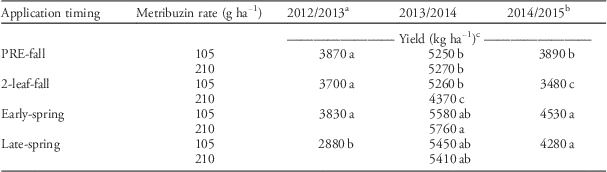
A factorial analysis of variance for 2012/2013 yield data was similar for all application timings except late spring, regardless of metribuzin rate (Table 4). In 2013/2014, metribuzin applications in the spring resulted in the highest yields, regardless of specific timing or metribuzin rate. Metribuzin at 210 g ha−1 applied in the early spring resulted in a higher yield than any of the fall treatments, and metribuzin at 210 g ha−1 applied at the 2-leaf-fall timing resulted in the lowest yield. In 2014/2015, the main effect of metribuzin rate was significant: all plots treated with 105 g ha−1 metribuzin had an average yield of 4266 kg ha−1, and all plots treated with 210 g ha−1 metribuzin had an average yield of 3829 kg ha−1 (data not shown). The main effect of application timing was also significant, with early- or late-spring treatments having higher yields than either of the fall timings (Table 4). Applications at the 2-leaf-fall timing resulted in a lower yield than applications at the PRE-fall timing.
Winter wheat yield after treatment with metribuzin at two rates and four application timings.
a Data are averaged over metribuzin rate because this variable and the interactions were not significant.
b Data are averaged over metribuzin rate because only the rate main effects were significant; the interaction was not significant.
c Values within a column followed by the same letter are not significantly different at α=0.05.
There was a high correlation between percent yield and injury ratings recorded in late April, with correlation coefficients of −0.63, −0.80, and −0.70 for 2013, 2014, and 2015, respectively (data not shown). Correlation between percent yield and injury ratings recorded in early April or May had lower correlation coefficients.
Injury caused by fall applications of metribuzin can be severe, even when the metribuzin is applied at rates lower than those previously reported in studies. Late-spring applications of metribuzin caused yield loss in one out of three years. However, an early spring application resulted in only temporary injury, which did not reduce the final yield. The risk of wheat injury from early-spring applications could be lessened if applications are postponed when heavy rainfall is forecast. Furthermore, the early-spring timing has provided excellent control of susceptible winter annual weed species (MJ VanGessel, unpublished data). Additional research is needed to determine if winter wheat cultivars with better tolerance to metribuzin will allow for a wider application window.



