


1. Introduction
The megatrend digitalization has been at the forefront of the manufacturing industry for more than a decade. This technological progress opens up new potential and opportunities for shaping future business activities. This change process, also known as digital transformation, must be anchored in a company’s business and corporate strategy. At the same time, the manufacturing industry is facing the challenges of sustainable development (Acatech, 2021). Stricter legislation and social pressure are forcing companies to act more sustainably. In this context, the circular economy concept has emerged as a promising model (Ellen MacArthur Foundation, 2013). The core of the circular economy is to extend the end-of-life concept by reducing, reusing, and recycling materials along the entire value chain. By this, circular economy contributes to increasing the value of resources used along the entire value chain and simultaneously contributes to sustainable development (Ellen MacArthur Foundation, 2013; Kirchherr et al., Reference Kirchherr, Yang, Schulze-Spüntrup, Heerink and Hartley2023). To meet these aspects of circular transformation, companies need to align their business models, product design, value creation, and management to the requirements of the circular economy. At the same time, this transformation is leading to an adjustment of the product lifecycle (Reference Ertz, Sun, Boily, Kubiat and QuenumErtz et al., 2022). Processes that were not previously considered, such as reverse logistics or the remanufacturing of products, must be integrated into the product lifecycle. As a result, the general phases of Begin of Life, Mid of Life and End of Life are changing, in some cases significantly. Information about the location, condition, or availability of products can help companies efficiently carry out the necessary processes, for example, remanufacturing (Reference Antikainen, Uusitalo and Kivikytö-ReponenAntikainen et al., 2018). However, the necessary information is often limited or unavailable to companies (Ellen MacArthur Foundation, 2013a). Digitization is seen as a driver of the circular economy (Reference Antikainen, Uusitalo and Kivikytö-ReponenAntikainen et al., 2018). Through the use of digital technologies, various data from products can be generated and processed to provide the information needed to operationalize the circular economy (Reference Pagoropoulos, Pigosso and McAloonePagoropoulos et al., 2017). In general, digital technologies are essentially understood as technologies that support the collection, linking, processing, storage, visualisation or transfer of data and information (Reference StählerStähler, 2002). Based on this understanding, companies can offer intelligent solutions that, for example, reduce energy consumption during the use phase of a product (Ellen MacArthur Foundation, 2015). Moreover, digital technologies offer the prospect of optimising internal processes, such as product design and production, to reduce material use (Reference Antikainen, Uusitalo and Kivikytö-ReponenAntikainen et al., 2018). Considering the inherent capacity of digital technologies to facilitate the implementation of the circular economy, a significant paradigm shift requires the simultaneous operationalisation of the transition to digitalisation and the circular economy. Consequently, it is imperative to systematically consider the interactions between these two domains to proactively exploit potential synergies. However, businesses in particular are faced with a lack of expertise and understanding of the impact of digital technologies on the circular economy and the methods by which they can accelerate the circular transformation. The challenges outlined above give rise to two main research questions.
Which digital technologies promote the principles of the circular economy?
How can digital technologies be used to support the circular economy?
The aim of the paper is a framework for visualizing the interaction between relevant digital technologies and the principles of slowing, narrowing, and closing loops for the circular economy. For this purpose, a systematic literature review was conducted to identify existing use cases of digital technologies in the context of the circular economy.
2. State of the art
In the existing literature, first approaches to describe the influence of digital technologies on the circular economy can be found. Bressanelli et al. (Reference Bressanelli, Adrodegari, Perona and SaccaniBressanelli et al., 2018a) investigated the influence of big data and analytics solutions and the Internet of Things (IoT) regarding the potential for life extension, resource efficiency, and closing loops. To this end, the authors identified the general functionalities of the digital technologies under consideration. In addition, the authors focus on the design of service-oriented business models and place the application of IoT and data analytics in the context of the business model. The interrelationships are described in more detail using a use case. However, the focus on IoT and data analytics does not address the full range of possible applications of digital technologies in the circular economy. In addition, the possible applications relate to the realisation of business models, which means that internal processes such as production are only tangentially considered (Reference Bressanelli, Adrodegari, Perona and SaccaniBressanelli et al., 2018a).Jabbour et al. (Reference Lopes de Sousa, Jabbour, Godinho and RoubaudLopes de Sousa Jabbour et al., 2018) have analyzed the impact of Industry 4.0 technologies on the circular economy. The authors’ argumentation is based on the Ellen MacArthur Foundation’s ReSOLVE framework (Ellen MacArthur Foundation, 2015). Furthermore, the authors consider three phases in the context of Industry 4.0: Product Design, Product Production, and Logistics/Reverse Logistics. The authors identify four key digital technologies: the Internet of Things, cloud manufacturing, additive manufacturing, and cyber-physical systems. Based on the defined requirements, the authors analyzed the respective technologies concerning their possible applications. They assigned them to the aspects of the ReSOLVE framework and the considered phases of Industry 4.0. In addition, the authors derive a research agenda to investigate further the existing barriers on the part of the industry. The work of Jabbour et al. illustrates that digital technologies in the context of Industry 4.0 have a particular impact on the product creation process in the context of the circular economy. By placing it in the ReSOLVE framework, the authors align themselves with a well-known framework (Reference Lopes de Sousa, Jabbour, Godinho and RoubaudLopes de Sousa Jabbour et al., 2018).In summary, the existing literature only partially describes the interactions between digital technologies and the circular economy. A holistic analysis of digital technologies concerning their influence on the circular economy is necessary. This results in the need for a model with a holistic view of the interactions between digital technologies and the circular economy. In the following, the applied research design for the development of the model for an integrative perspective on digital technologies and the circular economy is described.
3. Research methodology
The model for an integrative perspective on digital technologies and the circular economy was developed by conducting a Systematic Literature Review (SLR). An SLR is based on the structured approach to collecting and analyzing relevant literature published by Xiao and Watson (Reference Xiao and WatsonXiao & Watson, 2019). Four phases were carried out (see Figure 1), which are described below.
Overview of the conducted research methodology

Database selection: Relevant databases with comprehensive, high-quality publications were selected for the well-founded and detailed conducting of the SLR. Due to the extensive library of peer-reviewed articles in the circular economy research field and the use of digital technologies, the three databases Scopus, Science Direct and ProQuest were selected.
Search String definition: Based on the research questions, the following three-part search term was formulated.
“Circular Economy” AND (“digital technolog*” OR “industry 4.0” OR “digitalization”) AND (“Use Case” OR “Case stud*” OR “Application”)
A total of 464 potentially relevant articles were identified for the study.
Conducting the search: The search was conducted in five steps. In the first step, book chapters and non-English-language papers were excluded, resulting in 452 eligible papers. In the next two steps, the papers were screened at title and abstract level by two researchers. The resulting 32 papers were analyzed at the full-text level. After the full-text screening, 8 papers were classified as not relevant. In the final step, a supplementary literature search was performed using the AI tool Connected-Papers. The AI tool accesses many articles in the scientific database Semantic Scholar. Starting from an initial article, Connected Papers generates a graph of similar scientific articles. The similarity graphs are created based on common citations and references to the source paper, considering papers that do not directly cite each other. In this case, the five most cited papers and two other papers with the most relevant citations were selected. For each of the seven papers, a similarity graph in related papers was created. All papers with a similarity greater than 20% were analyzed in more detail. All duplicates between the most similar papers of all seven similarity graphs and the papers already analyzed in the SLR were removed. This resulted in 18 papers that were screened based on title and abstract. 3 papers were classified as relevant and included in the paper database for this work.
Paper analysis: The paper analysis is based on grounded theory and open coding according to Strauss and Corbin (Reference Strauss and CorbinStrauss & Corbin, 1990). The full papers and their data were read and analyzed based on the research questions. Relevant text passages that addressed digital technologies in the circular economy and their potential applications were taken as direct quotations. In the next step, the text passages were grouped into themes. The result of this step was the digital technologies used in the circular economy that were mentioned in these passages. In addition, the relevant capabilities of digital technologies were derived. Based on the codes, significant opportunities for operationalizing the digital technologies in the respective use case or the resulting benefits were described.
Based on the resulting codes, overarching processes and benefit groups were clustered by the operationalization and benefit codes described above. For this, all codes were clustered thematically into meaningful processes and overarching benefits. Figure 2 represents the exemplary clustering of the operationalization codes to the processes. The benefit groups were clustered analogues. In total, eleven processes and seven benefit groups were derived from the respective codes. These processes are orientated by the fundamental understanding of the product lifecycle. This includes the dimensions of Begin of Life (BoL), Mid of Life (MoL) and End of Life (EoL). After this, the benefit groups were allocated to digital technologies. The detailed visualization of the results is mentioned in the next section.
Exemplary clustering of the operationalization codes to processes (Excerpt)

4. Results
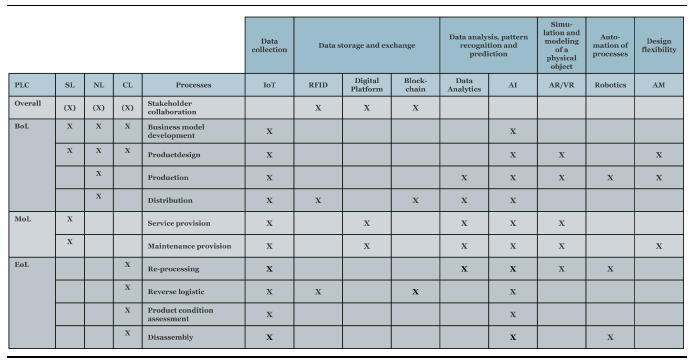
In the course of a systematic literature review, nine digital technologies were identified that make a significant contribution to the implementation of the circular economy. These technologies are used in eleven different processes, which were methodically divided into the Beginning of Life (BoL), Mid of Life (MoL) and End of Life (EoL) phases of the product life cycle according to (Reference KiritsisKiritsis, 2011) and into the core principles of the circular economy - Slowing Loop (SL), Narrowing Loop (NL) and Closing Loop (CL) (Reference Bocken, Pauw, Bakker and van der GrintenBocken et al., 2016). In the BoL phase, the focus is on business model development (Reference Ingemarsdotter, Jamsin and BalkenendeIngemarsdotter et al., 2020; Reference Rossi, Bianchini and GuarnieriRossi et al., 2020), product design (Pathan et al., Reference Pathan, Richardson, Galvan and Mooney2023; Toth-Peter et al., Reference Toth-Peter, Torres de Oliveira, Mathews, Barner and Figueira2023), production (Laskurain-Iturbe et al., Reference Laskurain-Iturbe, Arana-Landín, Landeta-Manzano and Uriarte-Gallastegi2021; Okorie et al., Reference Okorie, Russell, Cherrington, Fisher and Charnley2023) and logistics (Ranta et al., Reference Ranta, Aarikka-Stenroos and Väisänen2021; Schöggl et al., Reference Schöggl, Rusch, Stumpf and Baumgartner2023). The development of business models and product design are strategically oriented processes in which product characteristics and functionalities are defined that influence not only the sustainability of the products during their production, but also in their use phase, and thus contribute to all three principles of the circular economy. Optimizations in production and logistics, such as minimizing production waste or increasing the efficiency of logistics routes, primarily affect the circular business principal NL (Reference Bocken, Pauw, Bakker and van der GrintenBocken et al., 2016).
The MoL defines the usage phase of the product, with the processes of service provision (Pathan et al., Reference Pathan, Richardson, Galvan and Mooney2023; Rosário & Dias, Reference Rosário and Dias2022) and maintenance (Bressanelli et al., Reference Bressanelli, Adrodegari, Perona and Saccani2018b; Ingemarsdotter et al., Reference Ingemarsdotter, Jamsin and Balkenende2020). Service provision includes services such as product upgrades through digital updates and services for regular preventive maintenance, such as instructions on the correct cleaning of the product (Reference Rossi, Bianchini and GuarnieriRossi et al., 2020). Maintenance refers to the repair measures offered by the manufacturer. This includes predictive maintenance measures to replace components to ensure the continued use of the product (Reference Wu and PiWu & Pi, 2023). These activities are aimed at extending the product life cycle (SL) (Reference Bocken, Pauw, Bakker and van der GrintenBocken et al., 2016).
The EoL begins when the product has reached the end of its useful life. It includes processes such as the reverse logistics (Ranta et al., Reference Ranta, Aarikka-Stenroos and Väisänen2021; Rosário & Dias, Reference Rosário and Dias2022), product condition assessment (Krstić et al., Reference Krstić, Agnusdei, Miglietta, Tadić and Roso2022; Schöggl et al., Reference Schöggl, Rusch, Stumpf and Baumgartner2023), disassembly (Arana-Landín et al., Reference Arana-Landín, Oliveira-Lizarribar, Laskurain-Iturbe, González, García Márquez, Segovia Ramírez, Bernalte Sánchez and Del Muñoz Río2023; Krstić et al., Reference Krstić, Agnusdei, Miglietta, Tadić and Roso2022), and re-processing (Pagoropoulos et al., Reference Pagoropoulos, Pigosso and McAloone2017; Uriarte-Gallastegi et al., Reference Uriarte-Gallastegi, Landeta-Manzano, Arana-Landín and Laskurain-Iturbe2022). Reverse logistic consists of the downstream logistics processes required to return the products from the field to the product manufacturer. During the product condition assessment, the decision is made whether the product or its components should be disassembled and used for re-processing to be fed into a new life cycle, or whether they need to be disposed of. These processes are aimed at the CL business principle (Reference Bocken, Pauw, Bakker and van der GrintenBocken et al., 2016). The process of stakeholder collaboration is a process that spans the entire product life cycle and represents the information and communication flows between the various stakeholders (Balder et al., Reference Balder, Mathi, Hagedorn and Stark2023; Okorie et al., Reference Okorie, Russell, Cherrington, Fisher and Charnley2023; Toth-Peter et al., Reference Toth-Peter, Torres de Oliveira, Mathews, Barner and Figueira2023). Stakeholder relationships are a key factor in the development of circular value chains and indirectly influence all three principles of the circular economy.
The allocation of digital technologies to specific processes illustrates the diversity of possible applications of digital technologies in different life cycle phases and their contribution to the principles of the circular economy. Based on the findings of the systematic literature review, the digital technologies were assigned specific capabilities that enable a deeper understanding of their potential applications. These digital technologies and their associated capabilities are described in detail below.
Data collection: The ability to collect data is a crucial factor in the modern, digitalized world, enabling organizations to optimize processes and drive innovation. Digital technologies with this capability facilitate the collection of real-time data and its integration into decision-making processes, making organizations more agile and adaptable (Reference Fraga-Lamas, Lopes and Fernández-CaramésFraga-Lamas et al., 2021).
Internet of Things (IoT) devices collect data from their environment via sensors. This data can include temperature, location, humidity and much more. These devices exchange the collected information via the Internet to enable useful actions or support decisions (Reference Fiorini, Seles, Lackner, Sajjadi and ChenFiorini & Seles, 2022). Users can control and manage IoT devices remotely over the internet (Reference Ingemarsdotter, Jamsin and BalkenendeIngemarsdotter et al., 2020).
Data storage and exchange: Digital technologies, which can store and exchange data, are at the heart of the information revolution. They make it possible to secure large amounts of information and effectively transfer it between users and systems worldwide. Radio Frequency Identification (RFID) is a technology that uses electromagnetic fields to automatically identify, and track tags attached to objects (Reference Cagno, Neri, Negri, Bassani and LamperticoCagno et al., 2021). These tags contain electronically stored information that can be read by an RFID reader without the need for a direct line of sight (Reference Lopes de Sousa, Jabbour, Godinho and RoubaudLopes de Sousa Jabbour et al., 2018). RFID is used in a variety of applications, from goods logistics to access control and inventory management, by providing an efficient and accurate method of data capture and tracking (Pagoropoulos et al., Reference Pagoropoulos, Pigosso and McAloone2017; Rosário & Dias, Reference Rosário and Dias2022). Digital platforms are online-based technology frameworks that not only enable interaction and exchange between users, providers and consumers of products, services or information but also play a central role in the provision and analysis of data (Reference Balder, Mathi, Hagedorn and StarkBalder et al., 2023). They act as intermediaries or marketplaces that efficiently bring supply and demand together, while at the same time storing, processing and utilizing large volumes of data (Reference Toth-Peter, Torres de Oliveira, Mathews, Barner and FigueiraToth-Peter et al., 2023). Blockchain is a decentralized technology or distributed ledger that stores data in a chain of blocks that are linked and secured by cryptographic procedures. Each block contains a series of transactions that are transparent and immutable to all participants in the network, making manipulation difficult (Reference Lopes de Sousa, Jabbour, Godinho and RoubaudLopes de Sousa Jabbour et al., 2018). This technology enables secure and transparent transactions without the need for a central authority, making it ideal for applications such as tracking goods and property (Reference Cagno, Neri, Negri, Bassani and LamperticoCagno et al., 2021). Blockchain promotes trust between parties in a network by ensuring the integrity and traceability of data (Reference Okorie, Russell, Cherrington, Fisher and CharnleyOkorie et al., 2023).
Data analysis, pattern recognition and prediction: Digital technologies that specialize in data analysis, pattern recognition and prediction use advanced algorithms and machine learning to gain valuable insights from large amounts of data (Reference Fiorini, Seles, Lackner, Sajjadi and ChenFiorini & Seles, 2022). They enable trends to be identified, future events to be predicted and decision-making processes in companies and organizations to be significantly improved (Reference Krstić, Agnusdei, Miglietta, Tadić and RosoKrstićet al., 2022). Data analytics refers to the process of systematically examining data sets to identify and interpret patterns, trends and relationships in the data (Reference Sivarajah, Kamal, Irani and WeerakkodySivarajah et al., 2017). This analysis uses statistical methods, algorithms, and software to extract valuable insights from large amounts of data to help inform decision-making (Reference Rosário and DiasRosário & Dias, 2022). Data analytics is used in various fields such as business, science, and technology to optimize processes, predict future events and make strategic decisions based on data rather than assumptions (Reference Fiorini, Seles, Lackner, Sajjadi and ChenFiorini & Seles, 2022). Artificial intelligence (AI) deals with the creation of computer systems that can perform tasks that typically require human intelligence. These include understanding natural language, recognizing patterns and images, making decisions based on complex data and learning from experience (Fraga-Lamas et al., Reference Fraga-Lamas, Lopes and Fernández-Caramés2021; Sivarajah et al., Reference Sivarajah, Kamal, Irani and Weerakkody2017). AI systems can be programmed to improve with increasing amounts of information, allowing them to act and learn autonomously without being explicitly programmed (Reference Bressanelli, Adrodegari, Perona and SaccaniBressanelli et al., 2018a).
Simulation and modelling of a physical object: Digital technologies focused on the simulation and modelling of physical objects enable the virtual replication of real structures and processes with high fidelity (Bressanelli et al., Reference Bressanelli, Adrodegari, Perona and Saccani2018a; Ingemarsdotter et al., Reference Ingemarsdotter, Jamsin and Balkenende2020). These capabilities are critical for optimizing design and analysis by providing insights into behaviour and performance under different conditions without the need for physical prototypes (Reference Cagno, Neri, Negri, Bassani and LamperticoCagno et al., 2021). Augmented reality (AR) and virtual reality (VR) are two technologies that enable immersive experiences by extending or creating digital worlds (Reference Laskurain-Iturbe, Arana-Landín, Landeta-Manzano and Uriarte-GallastegiLaskurain-Iturbe et al., 2021). AR superimposes digital information onto the real world by making virtual objects or information visible in real-time via the camera of a smartphone or special AR glasses, allowing users to interactively experience their physical environment with digital data. VR, on the other hand, creates a completely virtual environment that the user can immerse themselves in using VR headsets, isolated from the real world to provide a fully immersive experience (Rossi et al., Reference Rossi, Bianchini and Guarnieri2020; Toth-Peter et al., Reference Toth-Peter, Torres de Oliveira, Mathews, Barner and Figueira2023).
Automation of processes: Digital technologies specializing in process automation are transforming the way workflows are designed and executed by reducing manual intervention and increasing efficiency (Reference Uriarte-Gallastegi, Landeta-Manzano, Arana-Landín and Laskurain-IturbeUriarte-Gallastegi et al., 2022). They enable seamless integration and coordination of tasks, saving time, reducing defects, and significantly increasing productivity across industries (Reference Bressanelli, Adrodegari, Perona and SaccaniBressanelli et al., 2018b). Robotics is the development and use of robots that are controlled by software and equipped with sensors, actuators, and data processing components (Reference Okorie, Russell, Cherrington, Fisher and CharnleyOkorie et al., 2023). This technology enables robots to perform complex tasks in a variety of environments autonomously or under human supervision (Reference Arana-Landín, Oliveira-Lizarribar, Laskurain-Iturbe, González, García Márquez, Segovia Ramírez, Bernalte Sánchez and Del Muñoz RíoArana-Landín et al., 2023). By integrating advanced algorithms and machine learning, robots can learn to adapt and improve (Reference Chi, Liu, Wang and OsmaniChi et al., 2023).
Design flexibility: Digital technologies that offer design flexibility enable users to respond quickly and efficiently to changes and develop customized solutions (Reference Gebhardt, Kopyto, Birkel and HartmannGebhardt et al., 2022; Reference Pagoropoulos, Pigosso and McAloonePagoropoulos et al., 2017). These technologies support agile product development and adaptation by allowing designs to be iteratively modified and optimized to best meet customer needs and market requirements (Reference Toth-Peter, Torres de Oliveira, Mathews, Barner and FigueiraToth-Peter et al., 2023). Additive manufacturing, also known as 3D printing, is a manufacturing process in which material is applied layer by layer to create three-dimensional objects directly from digital models. This technology enables the production of complex geometries and customized parts with a high degree of design flexibility that would often not be possible or economically viable with traditional manufacturing methods (Krstić et al., Reference Krstić, Agnusdei, Miglietta, Tadić and Roso2022; Laskurain-Iturbe et al., Reference Laskurain-Iturbe, Arana-Landín, Landeta-Manzano and Uriarte-Gallastegi2021).
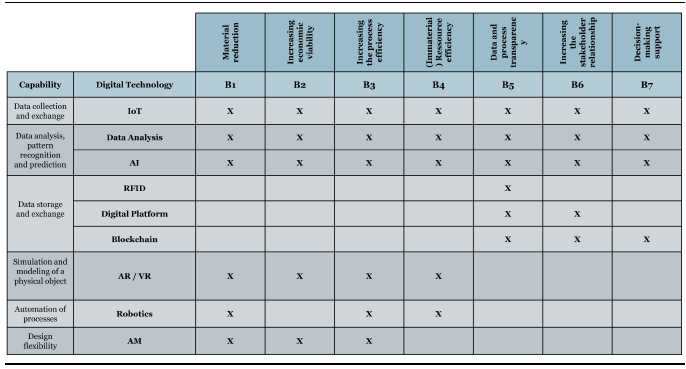
Based on a systematic literature review, the potential for improvement arising from the implementation of digital technologies in companies was summarized in seven main categories, the so called “benefits groups” (see Table 2). This categorization serves to highlight the diverse opportunities that digital technologies offer for the transformation towards a circular economy. However, it should be underlined that the companies described in the use cases analyzed are mostly still at the beginning of this transformation, therefore it is currently only possible to refer only to potential improvements. The exact quantification of the results is often not possible yet or was not described in detail in the sources. The benefit groups of potential improvements and their allocation to specific digital technologies are shown in Table 2. The diversity of improvement potentials through digital technologies results from their variable use across the phases of the product life cycle and the related processes. Further on in the text, the different manifestations of this potential are discussed to illustrate how the use of digital technologies can increase process efficiency, optimize resource utilization, and improve sustainability. This in-depth analysis enables companies to develop targeted strategies for the use of digital technologies in the circular economy.
As illustrated in Table 1, digital technologies that provide data collection and exchange capabilities as well as data analysis, pattern recognition and prediction have a central role in all processes along the entire product life cycle. The combination of IoT with advanced data analysis methods or the use of IoT together with AI is a common practice (Bressanelli et al., Reference Bressanelli, Adrodegari, Perona and Saccani2018a; Schöggl et al., Reference Schöggl, Rusch, Stumpf and Baumgartner2023). Data analysis technologies are primarily used when it comes to extracting relevant information from the mass of data to make data-based decisions (Reference Bressanelli, Adrodegari, Perona and SaccaniBressanelli et al., 2018a). AI goes one step further by being able to independently recognize patterns in the data, predict future trends or events and make independent decisions based on the learned data and patterns, for example by reducing waste and optimizing machine utilization and logistics routes (Pathan et al., Reference Pathan, Richardson, Galvan and Mooney2023; Wu & Pi, Reference Wu and Pi2023). This group of digital technologies comprehensively addresses all seven main categories of improvement potential, as shown in Table 2. Due to their broad applicability and high potential for increasing efficiency and effectiveness in various areas, these technologies are considered fundamental building blocks for the digitalization of processes and products (Rossi et al., Reference Rossi, Bianchini and Guarnieri2020; Uriarte-Gallastegi et al., Reference Uriarte-Gallastegi, Landeta-Manzano, Arana-Landín and Laskurain-Iturbe2022). They enable efficient and intelligent control of the product life cycle and are crucial for the successful implementation and advancement of the principles of the circular economy (Bressanelli et al., Reference Bressanelli, Adrodegari, Perona and Saccani2018b; Schöggl et al., Reference Schöggl, Rusch, Stumpf and Baumgartner2023). Their universal applicability and significant potential for improvement underline the importance of this technology group as a basic prerequisite for the digital transformation towards a more sustainable economy (see Figure 3: Basis Technology ). Digital technologies that specialize in the storage and exchange of data are used in processes where information needs to be shared between different stakeholder groups (Reference Gebhardt, Kopyto, Birkel and HartmannGebhardt et al., 2022). These include distribution in upstream logistics, reverse logistics in the downstream phase, interaction with customers during the utilization phase and collaboration with value-creation partners (Reference Balder, Mathi, Hagedorn and StarkBalder et al., 2023; Reference Ingemarsdotter, Jamsin and BalkenendeIngemarsdotter et al., 2020). Their ability to communicate information effectively between external players makes them key tools for promoting efficient communication and coordination along the entire value chain (Reference Okorie, Russell, Cherrington, Fisher and CharnleyOkorie et al., 2023; Reference Ranta, Aarikka-Stenroos and VäisänenRanta et al., 2021). The targeted use of these technologies creates the basis for cooperative collaboration, which is essential for the management and successful implementation of projects. They enable transparent and agile data exchange between organizations, which not only improves mutual understanding and transparency between partners but also optimizes stakeholder relationships (Reference Toth-Peter, Torres de Oliveira, Mathews, Barner and FigueiraToth-Peter et al., 2023). In addition, the increased transparency in the activities of the value-creation partners leads to more efficient decision-making processes (Reference Cagno, Neri, Negri, Bassani and LamperticoCagno et al., 2021). In this context, technologies that store and exchange data form a key technology group: connectivity technologies . Digital technologies such as AR/ VR, robotics, and additive manufacturing (3D printing) are revolutionizing processes across all phases of the product lifecycle through their unique ability to support or replace the execution of tasks. These technologies differ from other digital solutions due to their direct connection with physical objects and their immediate impact on the physical world. In addition to significantly increasing process efficiency, they offer the potential to reduce the use of materials and optimize profitability and the use of intangible resources such as knowledge and energy (Arana-Landín et al., Reference Arana-Landín, Oliveira-Lizarribar, Laskurain-Iturbe, González, García Márquez, Segovia Ramírez, Bernalte Sánchez and Del Muñoz Río2023; Laskurain-Iturbe et al., Reference Laskurain-Iturbe, Arana-Landín, Landeta-Manzano and Uriarte-Gallastegi2021; Rossi et al., Reference Rossi, Bianchini and Guarnieri2020). Due to their ability to actively intervene in processes, AR/VR, robotics, and additive manufacturing form a group of executive technologies .
Overview of the derived technology groups

Overview of relevant digital technologies and their influence on dedicated processes

Assignment of digital technologies to the benefit groups

5. Discussion and limitations
This paper provides a comprehensive overview of the integrative perspective on how digital technologies can support the fundamental principles of the circular economy. To address the first research question, a total of nine digital technologies were identified based on the coding process, incorporating a synergistic behaviour towards the circular economy. Furthermore, dedicated application areas for each technology were documented and subsequently analyzed. From these application areas, 11 overarching processes were derived, associating them with the phases of the product life cycle: Begin of Life, Mid of Life, and End of Life of a circular product. This highlights the extent to which the fundamental consideration of a product’s life cycle needs to change in the context of the circular economy. Moreover, specific benefits from the perspective of the circular economy and sustainability were deduced from the given database. These seven groups of benefits were then attributed to the digital technologies based on the data foundation. Building on this analysis, the paper outlines how and to what extent the identified digital technologies support the principles of the circular economy. From the alignment of digital technologies with processes (Table 1) and benefit groups (Table 2), three technology clusters with thematic focuses were formed. Within the realm of foundational technologies (Basis Technology), companies can generate added value throughout the entire life cycle with the help of IoT, data analytics, and artificial intelligence. Connectivity technologies are characterized by the capture and transmission of data across organizational boundaries. Particularly, technologies such as RFID, digital platforms, and blockchain have emerged as key players in this domain. The last cluster, Execution Technologies, stands out for supporting physically executed processes. Using additive manufacturing, AR/VR, and robotics, companies can standardize core processes like the dismantling of old products or the production of customer-specific spare parts. With the help of the model presented, companies can also align appropriate circular economy strategies with the company’s internal digitalisation strategy and define synergetic actions. In contrast to the analyzed state of the art (Reference Lopes de Sousa, Jabbour, Godinho and RoubaudLopes de Sousa Jabbour et al., 2018), the presented model not only addresses individual technologies such as IoT or Data Analytics but provides a holistic view of the employed technologies. Furthermore, the deployment of digital technologies is examined throughout the entire life cycle, representing an extension of works by, for example, Ranta et al., (Reference Ranta, Aarikka-Stenroos and MäkinenRanta et al., 2018) who particularly focused on the perspective of circular business models. Thus, the model presented here offers a comprehensive overview of the phases in the product life cycle where digital technologies can be applied and the added value they can bring to companies. The presented technology clusters and their allocation to specific processes provide companies with the opportunity to tailor the use of digital technologies to specific operations or introduce new ones. From a research perspective, the model presented represents an initial step toward a comprehensive examination of a digitized circular economy. However, there are some limitations to consider in this paper. Within the scope of the systematic literature review, only the databases Scopus, ProQuest, and Science Direct were analyzed. Therefore, it cannot be guaranteed that all relevant publications have been considered. Additionally, the results are based on a theoretical model derived from practical experiences. To assist companies in selecting suitable technologies, a methodical approach is necessary. Technical dependencies between the technologies are not explicitly highlighted in this model. Investigating the combination of different technologies, especially, should be explored more thoroughly in future research.



 Open access

