

Introduction
Later life is not what it used to be. In contrast with traditional models defining ageing as an irreversible process of decline and older age as a period of frailty and decadence, in recent decades, we have witnessed the emergence of alternative and more positive views of ageing, which include the possibility of growth and development as intrinsic features of older age. Concepts such as successful ageing (Rowe and Kahn, Reference Rowe and Kahn2015) and active ageing (Faber, Reference Faber2015) are epitomes of this counterbalancing movement, both in academic and social policy arenas.
In light of this optimistic view of ageing, research has tried to identify the gains, strengths and positive features of a ‘rejuvenated’ older adult. Erikson's (Reference Erikson1963) concept of generativity, originally proposed as a mid-life defining challenge and grounded on leaving meaningful legacies and being concerned for the next generations, could be a good candidate in this respect. The presence of generativity has been associated with positive outcomes in later life, such as satisfaction with life (McAdams et al., Reference McAdams, de St Aubin and Logan1993; Sheldon and Kasser, Reference Sheldon and Kasser2001), eudaimonic wellbeing (Serrat et al., Reference Serrat, Villar, Pratt and Stukas2018), and satisfaction of the needs for relatedness, competence and autonomy (Hofer et al., Reference Hofer, Busch, Au, Poláčková Šolcová, Tavel and Tsien Wong2016).
As a consequence, some authors have proposed generativity as an essential component of successful ageing (Fisher, Reference Fisher1995; Versey et al., Reference Versey, Stewart and Duncan2013) and as one integral element of a normative definition of an ideal state in this stage of life (Baltes and Baltes, 1990). This potential led authors such as Schoklitsch and Baumann (Reference Schoklitsch and Baumann2012: 270) to conclude that ‘generativity is a promising construct for gerontology in the future’, while similarly, Villar (Reference Villar2012: 1100) claimed that ‘generativity in older age is a promising framework for studying the positive social and individual aspects of ageing’.
If we take Erikson's (Reference Erikson1980) paper as the pioneering publication in a journal explicitly relating generativity to later life (considered in this study as the period of life after 60 years old), after 40 years of research effort, maybe it is time to wonder if the promise that generativity posed for understanding and promoting successful ageing is being fulfilled. The goal of this article is to answer this question by carrying out a scoping review on generativity in later life, the first one conducted on this topic as far as we know. We will try to show how studies in this area have evolved, which aspects of generativity in later life have been studied and the methodological approaches that are dominant in this area of inquiry. The results of this review will also allow the identification of critical gaps and future avenues of research on generativity in later life.
Erikson's concept of generativity and its evolution
Erikson (Reference Erikson1963) coined the concept of generativity 70 years ago, and he defined it as ‘the concern in establishing and guiding the next generation’ (Erikson, Reference Erikson1963: 267). For him, generativity was a challenge associated with the seventh stage of his psychosocial developmental model, a challenge that adults have to confront in mid-life, once their identity has consolidated (the task of the fifth stage, in adolescence) and they have committed themselves to long-term intimate relationships (the task of the sixth stage, in young adulthood). The successful resolution of the generativity challenge at mid-life involves mastering the competence of care and prepares the individual for the eighth stage, integrity, which involves feeling that one's life has been full and worthwhile, and accepting one's approaching death. According to Erikson (Reference Erikson1963), having and raising children is the prototypical way of channelling generative needs and expectations. However, generativity also covers a broad range of activities, such as teaching and mentoring younger generations, and maintaining and strengthening the societal institutions and natural resources needed to assure the survival of successive generations (Erikson et al., Reference Erikson, Erikson and Kivnick1986).
The concept of generativity was largely neglected for some decades after Erikson's work. However, in the early 1980s, John Kotre rediscovered the concept and enriched it by including two novelties. Firstly, he redefined generativity as ‘a desire to invest one's substance in forms of life and work that will outlive the self’ (Kotre, Reference Kotre1984: 10), which was meant to decouple generativity from parenting and expand it to other roles in society, some of them not particularly anchored to a specific age. Secondly, Kotre identified different types of generativity, namely biological, parental, technical and cultural. All of them have a common core, the idea of ‘outliving the self’ by contributing to others, but that core could indeed be expressed by following diverse avenues expressed differently depending on the lifestage.
After Kotre's contributions, Dan McAdams made the next significant theoretical advancement within the generativity field. He proposed a processual model of generativity including different types of motivations and expressions of the generative potential in adulthood, including seven interlinked components (McAdams and de St Aubin, Reference McAdams and de St Aubin1992; McAdams, Reference McAdams and Lachman2001). In his model, he identified two initial sources of generativity, (a) an inner desire grounded both in a drive for leaving a lasting legacy that survives the self and an impulse to be needed by others and be useful, and (b) a cultural demand, representing social expectations to play mentoring, supporting and leading roles in the family, community or the institutions of the wider society. This combines with (c) a belief in the species as a kind of confidence in the self. Such motives help to create (d) a generative concern in adults, understood as a general disposition towards generativity, which in turn, leads to the commitment to (e) generative goals. Such goals, ideally, will be embodied in (f) generative actions, involving creating, maintaining or offering acts concerning the next generations (McAdams and de St Aubin, Reference McAdams and de St Aubin1992). The final component of the model is (g) generative narrative, representing life stories that describe how the person has made efforts to contribute to subsequent generations (by creating, maintaining or offering acts) and how these outcomes would ultimately outlive the self, connecting all the components of the model and giving meaning to the whole lifespan (McAdams and Guo, Reference McAdams and Guo2015).
This diversity of generative phenomena has an important methodological implication since each one could be assessed using different data-gathering methods. Importantly, McAdams proposed some of these methods, which have promoted the expansion of generativity as a concept that can be studied empirically. Maybe the most widely used is the Loyola Generativity Scale (LGS), which measures generative concern and has become a de facto standard for those approaches interested in including generativity in empirical quantitative models, both as a predictor and as an outcome of psychological phenomena. To assess generative behaviours, he constructed the Generative Behavior Checklist (GBC), which is a catalogue of different activities that encapsulate the generative acts of creating, maintaining and offering. In the case of generative narration, McAdams proposed a qualitative approach, designing a life-story interview protocol that allows the capture of small or larger life stories in which generative sequences can be identified (McAdams and Guo, Reference McAdams and Guo2015).
The expansion of generativity into later life
Following Erikson's proposal to anchor generativity to mid-life (according to him, approximately between 40 and 60 years old), most of the early empirical work did not examine adults aged 60 and over. As we have seen, Kotre's and McAdams’ original proposals did not explicitly have a focus on ageing either. However, these authors paved the way to expand generativity into later life. Using these models, later-life generativity may differ from mid-life generativity by emphasising certain dimensions or components of the concept, and not other ones. For instance, according to Kotre, different types of generativity could appear at different stages during adult life, with biological generativity having a far earlier onset than cultural generativity. His emphasis on generativity as a way of transcending one's existence and achieving ‘symbolic immortality’ (Maxfield et al., Reference Maxfield, Greenberg, Pyszczynski, Weise, Kosloff, Soenke, Abeyta and Blatter2014) might make particular sense in later life, and would induce ego-transcending goals in terms of generativity. Similarly, some components of McAdams’ model, such as narrative generativity, are likely to be particularly relevant later in life, when people are thought to be motivated to create a complete and meaningful version of their personal life story (Schoklitsch and Baumann, Reference Schoklitsch and Baumann2012). These ideas also found fertile ground in the new active and successful models of ageing, which emphasise the feasibility (and even the necessity) of maintaining mid-life goals into older age.
Another way of defining generativity in later life is by adding new qualities or proposing new styles of being generative which were not present in generativity when defined as a mid-life challenge. In fact, Erikson himself, in his later writings (Erikson et al., Reference Erikson, Erikson and Kivnick1986), proposed that a transformed version of generativity, referred to as ‘grand-generativity’, may emerge in later life. Grand-generativity recognises the fact that many older adults continue to show a strong commitment to the promotion and development of future generations, by acting as grandparents, mentors or advisers. Unlike mid-life generativity, which implies taking direct and day-to-day responsibility for the next generation, grand-generativity represents caring for others and improving communities more indirectly. It involves balancing such outward interests with an inward-looking interest connected to the evaluative life-review task that is especially salient in later life.
Such a conceptual expansion of generativity into older age creates some methodological challenges when it is translated into empirical studies. For instance, one may want to focus the study of generativity just on older samples or, alternatively, compare generativity in samples including different periods of adulthood, including later life. In this case, the change or stability of generativity could be explored by using cross-sectional (e.g. Sheldon and Kasser, Reference Sheldon and Kasser2001) or, even better, longitudinal studies (e.g. Einolf, Reference Einolf2014). Each option has its strengths and limitations, in terms of cost and time, but also regarding the extent to which the study could really capture the developmental nature of generativity, which has been highlighted as one of its main contributions to the successful and active ageing paradigm (Villar, Reference Villar2012).
The translation of generativity into empirical studies necessarily implies taking epistemological decisions. One of these is related to the role that generativity plays in empirical models. Thus, generativity could be understood as an antecedent, that is, as a variable that predicts other kinds of phenomena, such as adjustment or wellbeing (e.g. Grossman and Gruenewald, Reference Grossman and Gruenewald2020), or as an outcome that is predicted by independent variables (Grossman and Gruenewald, Reference Grossman and Gruenewald2017). Other studies have avoided these mechanistic models based on quantitative relationships between independent and dependent variables, and adopted an alternative concept of generativity as a phenomenon linked to experience, focusing on meaning rather than on predictive power as statistically determined (e.g. Hannum et al., Reference Hannum, Black, Rubinstein and de Medeiros2017). Such approach recognises that the experience of generativity can be diverse and it could differ among specific populations or groups. Accordingly, such studies tend to choose qualitative methods that let participants express generativity in their own terms (rather than using standardised instruments), thus contributing to a more nuanced view of generative phenomena and their relationship with life experiences or with historical or cultural factors.
Another axis of analysis concerns the degree of abstraction and breadth of generativity in later life. Thus, on the one hand, it may be understood as a non-specific phenomenon, something similar to a trait of personality or a global attitude (a ‘concern’ in Erikson's or McAdams’ words) that has sense in itself, regardless of its application in different contexts. On the other hand, generativity may also be conceived as an embodied specific activity linked to definite local domains or roles. In this sense, we can identify at least two main contexts in which generativity in later life has been studied: the family and the community.
In the case of family, grandparenting has been identified as a particularly suitable avenue for expressing generativity in later life. Grandparenting serves as an opportunity to pass on family values, leave a legacy and make significant contributions to the next generation (Thiele and Whelan, Reference Thiele and Whelan2008), and at the same time is an activity that boosts the sense of utility and self-worth as a key element within the family (Villar et al., Reference Villar, Celdrán and Triadó2012). In the case of the community, with the extension of working lives, generativity can be expressed in paid later-life employment (e.g. Micheel, Reference Micheel2021). Once older people have left paid work, volunteering is the most frequent activity associated with generativity in later life. Generativity has been mentioned as one of the main reasons why older people engage in volunteering, since such activity provides a meaningful role in fulfilling desires to give back to their communities and to keep on contributing in later life (Narushima, Reference Narushima2005; Warburton et al., Reference Warburton, McLaughlin and Pinsker2006).
Finally, generativity may be studied in normative samples or, in contrast, in specific and particular populations according to their cultural origin, personal and lifecourse circumstances, health conditions and other variables. Such emphasis on diversity rather than simply on mainstream samples, and particularly on samples that could have specific facilitators or barriers to the development or expression of generativity, could help to understand the potential beneficial role, but also the limits and constraints, to generativity in later life.
Objective
The objective of this study is to analyse critically existing knowledge, in the form of published articles in academic journals, concerning generativity in later life. Specifically, we want to explore the following topics:
• Number, growth, nature (empirical or not) and geographical location (taking into account where the sample was gathered) of studies on generativity in later life.
• Methodological status of generativity research in later life. That is, we will explore whether empirical papers have focused just on later life or if they have approached generativity through an age-comparative framework, the use of cross-sectional versus longitudinal designs, the use of quantitative versus qualitative data-gathering strategies, and the strategies and instruments to operationalise generativity.
• Epistemological status of generativity in later-life studies. In particular, we are interested in checking whether generativity has mainly been used as an antecedent, as an outcome or as an experiential phenomenon in empirical models; to what extent generativity is conceived as a trait-like and context-free concept, or alternatively, as an activity-linked and context-embedded phenomenon (and in this latter case, what kind of activities and contexts have been associated with generativity in later life); and to what extent it has been studied in diverse samples.
Methods
We carried out a scoping review of the research literature on generativity in later life. The aim of this type of review is to summarise current knowledge on a topic and identify gaps in current research. To conduct the scoping review, we relied on the five-step framework proposed by Arksey and O'Malley (Reference Arksey and O'Malley2005), and modified by Levac et al. (Reference Levac, Colquhoun and O'Brien2010).
Step 1: Identification of the research question(s)
We propose two specific research questions for this review:
(1) What is the current knowledge on generativity in later life?
(2) What are the gaps that future research on generativity in later life should address?
Step 2: Identification of relevant studies
We relied on the expertise of a professional librarian to carry out an iterative search of terms and databases to select the most appropriate studies. The final search was carried out in June 2018 (and updated in April 2020) in five databases (PubMed, Scopus, Sociological Abstracts, Web of Science and PsycINFO) that were wide and diverse enough to cover virtually all the papers published in Psychology and Social Science, the fields that were most relevant in relation to generativity. We used the following keywords adjusted to each database: (ageing OR aging OR aged OR old age OR older people OR older persons OR older adults OR seniors OR senior citizens OR elder* OR later life OR third age) AND (generativity). The results were limited to papers published in English (which needs to be taken into account to interpret some of the results, as we will mention below) and peer-reviewed papers (consequently, documents belonging to the so-called ‘grey literature’ were not taken into account, as they were not part of our objectives). No year of publication limits were applied.
Step 3: Selection of studies
Titles and abstracts of the papers resulting from the searches were scanned by FV and RS to check if they met the following inclusion criteria: (a) the focus of the paper was on generativity; (b) the focus of the paper was on older people (defined in operational terms as those aged 60 years or older) or as part of a comparison between younger and older age groups. As a result, papers in which the focus was not on generativity or which had a broader focus were excluded, as well as publications in which the focus was not on later life or which included older adults but did not analyse results in relation to age. When the information contained in the title and abstract did not allow us to make this decision, then the full text was reviewed. A second researcher cross-checked the selection of studies. In case of doubt, the decision was made by the three members of the research team.
Step 4: Data charting
Key information in each paper was extracted and charted using a form created in Microsoft Excel (Arksey and O'Malley, Reference Arksey and O'Malley2005). This data form was developed and updated following team discussions at the beginning and middle of the charting process. Data extracted included geographical origin of the papers (to assign a geographical origin, we took into account the country where the empirical data were collected, and empirical studies conducted in multiple countries were categorised more than one time), type of paper (empirical, conceptual or review), empirical papers’ key methodological characteristics (sample, design, instruments, etc.) and key content characteristics (features of the McAdams and de St Aubin (Reference McAdams and de St Aubin1992) model included, context of the expression of generativity, etc.). The main results and conclusions were also extracted. This process was carried out independently by FV and RS. Discrepancies, when they appeared, were discussed until agreement was reached.
Step 5: Summary and reporting of results
The fifth step involved a quantitative and qualitative analysis of the papers included in the sample (Arksey and O'Malley, Reference Arksey and O'Malley2005; Levac et al., Reference Levac, Colquhoun and O'Brien2010). The results are reported in three sections. First, we describe the expansion and extension of research on generativity in later life. Second, we analyse the methodological approaches used in research into this topic. Finally, we focus on the content of the papers, analysing the epistemological status that research has so far given to generativity in later life.
Results
The initial search identified 439 papers (without duplicates). A total of 174 papers were excluded as a result of screening titles and abstracts or full text when deemed necessary. Of the excluded papers, 96 were not focused on generativity or had a broader focus, and 78 were not focused on older adults or included older adults and younger people but did not analyse results as a function of age (Figure 1).
Flow chart: scoping review on generativity in late life.

Expansion and extension of research on generativity in later life
The 265 articles included in the scoping review were published between 1980 and 2020. In Figure 2 we see that the number of publications has increased significantly during the last 40 years, with two remarkable surges, one in 2003 (the number of articles increased from four to eight) and another one in 2012 (the number of articles increased from nine to 15). However, the graph also shows how, after peaking in 2016 with 25 articles, the number has decreased in recent years.
Number of publications on generativity in later life, by type of participation and year of publication, 1980–2020.
Note: N = 265.

Most papers included in this analysis were empirical (220 out of 265, 83.0%), with a smaller proportion of conceptual papers (25 articles, 13.2%) and only a few review papers (ten articles, 3.8%). In some review papers, generativity in later life was not the central topic of analysis, but an additional aspect for analysing, for instance, intergenerational relationships (e.g. Knight et al., Reference Knight, Skouteris and Hooley2014; Merrill and Fivush, Reference Merrill and Fivush2016), grandchildless elders (Van Wormer, Reference Van Wormer2019), crafts and serious hobbies (Adams-Price and Morse, Reference Adams-Price and Morse2018), and death anxiety and retirement (Osborne, Reference Osborne2017). The only review focused solely on generativity and later life, authored by Schoklitsch and Baumann (Reference Schoklitsch and Baumann2012), was not systematic.
Looking at the geographical origin of the articles (taking into account where empirical data were collected), we can see that studying generativity in later life has mainly been an American endeavour (see Table 1). More than half of the total articles (146 out of 265, 55.1%) come from the United States of America (USA). Its dominance is even greater in conceptual (25 out of 35, 68.5) and review (seven out of 10, 70.0%) papers than in empirical ones (115 out of 220, 52.3%).
Geographical origin of the articles on generativity and later life
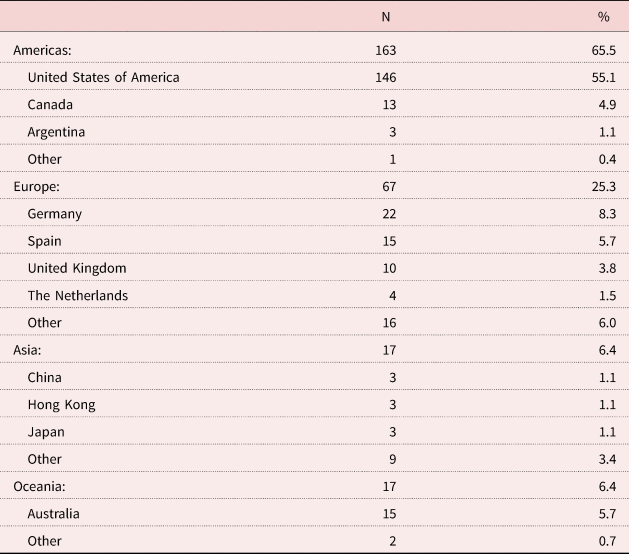
Notes: N = 265. To assign a geographical origin, we took into account the country where the empirical data were collected. Empirical studies conducted in multiple countries were categorised more than once. Countries with frequencies below three are included in ‘Other’.
Europe accounts for just a quarter of the total articles, with Germany being the most productive country (22 articles, 8.3%). Other English-speaking countries have also been relatively prolific in terms of publications on generativity in later life. For instance, Australia (15 articles) and Canada (13 articles) were the fourth and fifth most productive countries, just behind the USA and Germany, and with similar numbers to those of Spain (15 articles). At the other extreme, 17 articles (6.4%) were published in Asia, without any country accounting for more than three papers. In our sample, there was no article written by African scholars as the corresponding authors.
The methodological approach to generativity in later life
In terms of methodology (see Table 2), most empirical papers used quantitative designs (128 out of 220, 58.2%). Sixty-three out of the 220 empirical papers were qualitative studies (28.6%), while mixed-method studies were less represented, accounting for only 13.2 per cent of the studies (29 out of 220). When the study was quantitative, the mean sample size was 501.47 participants (standard deviation (SD) = 723.21). In contrast, the mean sample size in qualitative studies was 48.43 participants (SD = 85.27), while in mixed-method studies the mean was 322.31 (SD = 896.80).
Empirical papers’ key methodological characteristics

Note: N = 220.
Most papers adopted a cross-sectional (88.4%) design, with longitudinal designs being far less frequent (17.7%). Longitudinal studies include those exploring the trajectory of generativity across different lifestages, including later life (e.g. Einolf, Reference Einolf2014), or others predicting later-life outcomes based on generativity in previous lifestages (e.g. Landes et al., Reference Landes, Ardelt, Vaillant and Waldinger2014; Serrat et al., Reference Serrat, Villar, Pratt and Stukas2018).
Similarly, almost nine out of ten empirical studies collected purposively selected samples (88.2%), which were gathered specifically for the study (84.1%), that is, providing primary data, instead of using existing databases. In the 35 articles using secondary data, the specific databases were very diverse, and only Midlife in the United States (MIDUS), with nine studies (e.g. Einolf, Reference Einolf2014; Grossman and Gruenewald, Reference Grossman and Gruenewald2017), the Generativity and Lifestyles of Older Women, with four studies (e.g. Hannum et al., Reference Hannum, Black, Rubinstein and de Medeiros2017), and the Foley Longitudinal Study of Adulthood (FLSA), with three studies (e.g. Ko et al., Reference Ko, Hooker, Geldhof and McAdams2016), were used in more than two articles. Fifteen out of the 35 articles using secondary data followed, at the same time, a longitudinal design, using the MIDUS or the FLSA in most cases.
When dealing with generativity in later life, most empirical papers focused on people 60 years old and over, whereas only a quarter compared older samples with younger ones.
Finally, as showed in Table 3, generativity was operationalised using questionnaires or scales in 131 studies (59.5%). Among them, there is a great diversity of instruments used to assess generativity, but the LGS was by far the most popular one, since it was used in 65 different studies. Other instruments specifically designed to assess generativity were, at least in comparison, rarely used. It was also remarkable that 21 studies used ad hoc questions with quantitative answers to assess generativity. Among studies that did not assess generativity using questionnaires or scales with quantitative answers, interviews were the most popular data-gathering method, being used in 70 studies (31.8%). Other data-collection strategies, such as registering behaviours considered as generative (e.g. older people participating in volunteering activities, as in Serrat et al., Reference Serrat, Villar, Warburton and Petriwskyj2017), document analysis (e.g. written legacy texts, as in Johnston et al., Reference Johnston, Lawton and Pringle2017) or using focus groups (e.g. Carragher, Reference Carragher2017) were far less frequent.
Ways of operationalising generativity in empirical papers’ key content

Notes: N = 220. As some studies operationalised generativity in more than one way, the sum of categories is greater than the total number of studies.
The epistemological status of generativity in later life
Concerning conceptual aspects (see Table 4), most papers considered generativity as a predictor or antecedent of another variable (53.2%) or as a result variable, considered as an outcome or result of some other factor (34.5%). Thus, on the one hand, generativity has been studied as a predictor of wisdom (e.g. Ardelt et al., Reference Ardelt, Gerlach and Vaillant2018), eudaimonic wellbeing after retirement (Serrat et al., Reference Serrat, Villar, Pratt and Stukas2018), fear of death (Major et al., Reference Major, Whelton, Schimel and Sharpe2016), cognitive function (Maselko et al., Reference Maselko, Sebranek, Mun, Perera, Ahs and Østbye2014) or for social status, such as parenting (Newton and Baltys, Reference Newton and Baltys2014). On the other hand, generativity has also been considered an outcome predicted by variables such as educational level (Muñoz-Rodríguez et al., Reference Muñoz-Rodríguez, Serrate-González and Navarro2019) and, obviously, age (Hoppman and Blanchard-Fields, Reference Hoppmann and Blanchard-Fields2010), as well as by more complex phenomena such as perceived respect from or rejection by younger generations (Tabuchi et al., Reference Tabuchi, Nakagawa, Miura and Gondo2015), participation in intergenerational programmes (Gruenewald et al., Reference Gruenewald, Tanner, Fried, Carlson, Xue, Parisi, Rebok, Yarnell and Seeman2016) or certain parental relationships in childhood (Urrutia et al., Reference Urrutia, Moisset de Espanes, Villar, Guzmán and Dottori2016). In contrast to its role as an antecedent or outcome variable, the focus on generativity as an experience in itself, not as a component of an explicit or implicit predictive model, was only present in 39 articles, that is, 17.7 per cent of the empirical papers selected for this review (e.g. Celdrán et al., Reference Celdrán, Serrat, Villar, Pinazo and Solé2018).
Empirical papers’ key content characteristics

Note: N = 220.
Similarly, concerning the components of McAdams’ and de St Aubin's model of generativity that have been taken into account, we found that generative concern was the component most present in empirical articles: 77.3 per cent considered this attitudinal domain of generativity. Generative behaviours were present and assessed in 81 articles (36.8%). Among these, we found a broad range of behaviours, including diverse altruistic behaviours (Theurer and Wister, Reference Theurer and Wister2010), mentoring and giving advice (e.g. Chan and Nakamura, Reference Chan and Nakamura2016), donating (Roberts and Maxfield, Reference Roberts and Maxfield2019), quilting (Cheek and Piercy, Reference Cheek and Piercy2008) and writing a legacy document (Goddard et al., Reference Goddard, Speck, Martin and Hall2013).
Other components within McAdams’ model were less present in our sample of papers. For instance, generative personal narratives were considered by just 32 studies (14.5%), almost all of them of a qualitative nature, and generative goals were only considered by 25 papers (11.4%). Cultural demand (13 papers, 5.9%) and inner desire (one study, 0.5%) have been studied even less.
Approximately one-half of the papers (52.7%) studied generativity in a decontextualised way, without taking into account the specific fields, environments or activities in which it appeared. In the other half, community context has been, by far, the most studied. It includes papers on volunteering (e.g. Pillemer et al., Reference Pillemer, Wells, Meador, Schultz, Henderson and Cope2017), political participation (e.g. Serrat et al., Reference Serrat, Villar, Warburton and Petriwskyj2017) and leisure activities (Maselko et al., Reference Maselko, Sebranek, Mun, Perera, Ahs and Østbye2014). Beyond these community studies, papers focused on the family were also present, with grandparenting (Moore and Rosenthal, Reference Moore and Rosenthal2015) being the main focus of studies, and with parenting (Newton and Baltys, Reference Newton and Baltys2014) or care-giving for dependent adult relatives (e.g. Grossman and Gruenewald, Reference Grossman and Gruenewald2017) attracting far less attention. A third and less frequent (21 articles, 9.5%) context of generativity in later life was work (Micheel, Reference Micheel2021).
Most articles selected for our review dealt with non-specific populations, but slightly more than one-third (36.3) did study generativity in later life associated with a definite type of older adult. Many of them were focused on women's generativity, like grandmothers (Villar et al., Reference Villar, Celdrán and Triadó2012), mothers (James and Zarrett, Reference James and Zarrett2005), childless women (Rubinstein, Reference Rubinstein1996), women committed to romantic relationships in later life (e.g. Moore and Sailor, Reference Moore and Sailor2018) or older nuns (Black et al., Reference Black, Hannum, Rubinstein and de Medeiros2016), to name a few. Beyond gender, other studied profiles have been older people with disabilities or diseases (e.g. Greer et al., Reference Greer, Hermanns and Cooper2015), racial or cultural minorities (Lewis, Reference Lewis2014), LGBT older adults (Bower et al., Reference Bower, Lewis, Bermúdez and Singh2019), the oldest older adults (e.g. Tomás et al., Reference Tomás, Sancho, Gutiérrez and Galiana2014), war veterans (Ardelt et al., Reference Ardelt, Landes and Vaillant2010) and holocaust survivors (Grünberg, Reference Grünberg2007).
Only a few articles (23, 10.5%) were focused on applied topics, such as intervention programmes or therapies. Almost all of them referred to intergenerational programmes (e.g. Ehlman et al., Reference Ehlman, Ligon and Moriello2014) or programmes to promote volunteering (e.g. Warner et al., Reference Warner, Jiang, Chong, Li, Wolff and Chou2019).
Finally, just nine out of the 220 empirical articles (4.1%) compared samples from different countries. Four of these cross-cultural studies were carried out by the same research group, headed by Jan Hofer in Germany, and included samples from Germany, Cameroon, China and the Czech Republic (e.g. Hofer et al., Reference Hofer, Busch, Au, Poláčková Šolcová, Tavel and Tsien Wong2016, Reference Hofer, Busch, Au, Poláčková Šolcová, Tavel and Tsien Wong2020).
Discussion
This study aimed to analyse critically existing literature concerning generativity in later life, identifying knowledge gaps and proposing new directions for research.
Our scoping review shows that research into generativity in later life has grown steadily over the past 30 years, and particularly during the last decade, which echoes the emergence and surge of similar concepts, such as successful and active ways of ageing, both in the academic literature (e.g. Foster and Walker, Reference Foster and Walker2014; Rowe and Kahn, Reference Rowe and Kahn2015) and in social policy areas (e.g. Faber, Reference Faber2015; World Health Organization, 2017). However, our review also revealed a certain slowdown in the last two or three years. Whether this slowdown is merely accidental or implies some kind of exhaustion of the concept is not yet clear, and is something to ascertain in the next few years.
In addition, our analysis identified four critical gaps and leading-edge research questions that should be at the forefront of future research into generativity in later life, gaps that reflect biases in the existing literature identified in the study.
The methodological gap
Our results show how most research on generativity in later life so far has used standardised instruments, those designed by McAdams (the LGS and the GBC) being the most popular. Their psychometric properties have room for improvement, with internal consistency and temporal stability indexes that are only moderately high and rarely above 0.75 (Villar et al., Reference Villar, López and Celdrán2013), and they may be marred by social desirability biases (Ochse and Plug, Reference Ochse and Plug1986; Schoklitsch and Baumann, Reference Schoklitsch and Baumann2012). Despite this, they provide an easy and ready-made way to include generativity in many empirical designs and boost its study, which explains their popularity but, at the same time, involves a twofold cost.
Firstly, using quantitative instruments consolidates an individualistic and correlational approach to generativity, considering it as a single variable that predicts certain results or that, in turn, is an outcome predicted by other variables. So, the use of standardised and quantitative instruments reinforces (and is reinforced by) certain epistemological decisions, which in turn explains why alternative views of generativity as an experience or as a narrative have been sidelined by mainstream research in this area. We will come back to this issue below, when we discuss the contextual gap.
Secondly, both the LGS and GBC were designed with a ‘middle-aged’ view of generativity in mind. For instance, the LGS contains items that are rarely applicable to older adults (e.g. ‘If I were unable to have children of my own, I would like to adopt children’ or ‘I think I would like the work of a teacher’), and some generative actions listed on the GBC may be difficult for certain older adults (e.g. ‘Became a parent (had a child, adopted a child, or became a foster parent)’). Such bias consolidates viewing generativity in later life as a mere extension of generativity in the earlier stages of life. To solve this problem, some instruments specifically adapted to older people have been proposed (e.g. Schoklitsch and Baumann, Reference Schoklitsch and Baumann2012), but they have not been widely used to date. This issue is related to developmental and cross-cultural variations in generativity, which will be dealt with below.
The developmental gap
Generativity has its roots in developmental psychology, a discipline that has at its core the concept of change, and particularly changes involving increasing growth and maturity. Thus, when applied to later life, it implies viewing the final decades of life from a radically optimistic perspective, as a period of life in which gains are possible, even if losses are also present. So, generativity in later life is postulated as a way to find meaning and transcendent values. Similar concepts, such as active ageing and successful ageing, although sharing with generativity the emphasis on older people's contributions, lack the developmental edge underlining personal growth, a key that makes it easier to understand the motives for contributing and the benefits that sustain such contributions over time.
However, the analysis of literature on generativity in later life suggests that, so far, this developmental edge has not been fully taken advantage of. As we have seen when exploring the methodological approach, most studies have been cross-sectional, the majority of them having a single-stage nature, gathering and studying exclusively older samples, and instruments not fully adapted to later life (such as the LGS or the GBC) have mainly been used. So, the very notion of change in generativity from middle-age to older age has been largely neglected by previous studies. They seem to propose that generativity, which appears in mid-life, is simply extended into later life, its benefits and outcomes being basically identical. In this respect, if generativity is an expression of ‘ageing well’, it proposes basically the same as other related concepts: the ‘good’ older age is that which resembles middle age. That is, our goal for ageing well is getting old without being old, and maintaining mid-life goals, interests and lifestyles (Timonen, Reference Timonen2016).
Such emphasis on the conceptual stability of generativity regardless of lifestage hides the fact that generativity in later life, compared to mid-life generativity, could have different meanings and be expressed in different ways. That is, generativity could also develop over the second half of life. This idea was expressed by Erikson himself, who proposed a particular form of generativity, grand-generativity, as its typical expression in later life. The compound model of Kotre (Reference Kotre1996) also opens the possibility of different types of generativity in different lifestages. Similarly, Stewart and Vandewater (Reference Stewart, Vandewater, McAdams and de St Aubin1998) proposed a lifecourse pattern of change in generativity, distinguishing between generative desires and generativity accomplishments. However, according to our scoping review, such theoretical insights have had little impact on the literature on generativity in later life, which has been mainly (and paradoxically) epistemologically understood in static terms, and when developmental changes are considered, such changes are quantitative, without conceiving that the nature of generativity could change from mid-life to later life, and even throughout later life itself.
The contextual gap
The results of our study suggest that most of the literature on generativity in later life conceives generativity as an intra-personal characteristic, similar to a personality trait in which people, including older adults, differ. As mentioned above, the prevailing methodological options reinforce such a view: most reviewed studies measured generativity in quantitative terms, using instruments such as the LGS, which in fact has become the ‘gold standard’ and the option ‘by default’ when researchers are interested in including generativity in their research designs.
Accordingly, in terms of McAdams’ dimensional model of generativity, almost three out of four studies conceive generativity as ‘generative concern’, a personal interest or generic attitude often without any specific reference to any object towards which generativity is expressed or any context in which generativity is enacted. In fact, around half of the studies focus on generativity without referring to any specific context. Such emphasis on generativity as an abstract personal quality, which is present in a range of degrees among older people (or even that is not present at all in some of them), has the risk of ignoring at least three interesting and interrelated phenomena.
Firstly, it might lead us to think that behaving in a generative way depends exclusively on the inner ‘reserve’ of generative interest we are able to keep, or on our desire to be generative, overlooking the fact that generativity is expressed in social contexts and through social institutions, which act as facilitators or as barriers. However, the literature has paid scarce attention to the role of contexts and institutions, a limitation echoing some critiques of similar concepts such as successful or active ageing (see e.g. Katz and Calasanti, Reference Katz and Calasanti2015), which have been accused of conveying an extreme individualistic ideology in which ageing well is considered a matter of individual choice, and consequently the person is entirely responsible for their own successes and failures. This de-contextualised view misses the fact that generativity is unavoidably enacted in a social structure of differential opportunities and relations of social inequality. That is, not only can individuals be more or less generative, but social contexts can also favour or hamper generativity. In other words, as well as being a property of individuals, generativity is also a property of communities, societies and cultures (de St Aubin et al., Reference de St Aubin, McAdams and Kim2004).
Closely connected to this prevailing individual approach to generativity in later life is the relative neglect of applied studies. Generativity seems to be conceived as something that older people have, or something that can predict a number of (mostly positive) outcomes in later life, but not something that can change or be promoted by specific, intentional contextual modifications or by long-term social policies. This ‘depoliticised’ version of generativity is particularly problematic in the case of older adults, since pervasive phenomena in this lifestage, such as poverty, loneliness, age segregation and ageism, could decisively curtail possibilities for being generative. So, we need studies to assess to what extent certain policies and interventions are able to reverse such situations and increase older people's contributions to their families, their communities and to society as a whole. However, studies focused on deprived older people's collectives are scarce in the literature.
Finally, a context-free view of generativity also ignores the role of culture and its impact on generativity in later life, as well as the value of cross-cultural studies to understanding the manifestations and the very possibility of generativity in later life. Although the decision to include just papers published in English might have played a role, our analysis indicated clearly that generativity seems to be a Western (including Western European countries and Anglo-Saxon countries in America and Oceania), accomplishment, as most studies come from this part of the world. Cross-cultural studies are conspicuous by their absence, even though, in the original Eriksonian proposals, and also in McAdams’ and Kotre's models, sociocultural expectations play a major role in the development of generativity. In Kotre's (Reference Kotre, de St Aubin, McAdams and Kim2004) words, generativity makes sense in a specific shared system of meaning, in a particular ‘cultural atmosphere’. The few studies focused on the expectations and expressions of generativity in older adults in Eastern countries (including China, Japan, Korea and South-Eastern Asian countries, e.g. Cheng et al., Reference Cheng, Chan and Chan2008) suggest that values and beliefs embedded in cultural practices and meanings could have a decisive, though so far greatly neglected, impact on the generative potential of later life.
The ‘dark-side’ gap
The gerontological literature on generativity has almost exclusively taken a positive point of view of generativity as a key to ageing successfully and having a meaningful life. With its emphasis on caring for the next generation and leaving a legacy, it has been framed as a win–win scenario, in which personal and social development feed each other: generativity leads to personal growth, wellbeing and other positive outcomes in later life, while it contributes to building better integrated, stronger families, communities and societies, thus transforming older people from being a social burden to being a social resource (Villar and Serrat, Reference Villar, Serrat, Rojo-Pérez and Fernández-Mayoralas2021). The notions of ‘legacy’ or ‘contribution’ cannot be expressed in a value-free context, and sometimes, as well as positive outcomes, they may also have negative personal and social outcomes. So, despite being overlooked, there is a possibility of leaving a ‘heritage of destruction’ and of ‘channeling generativity into vice as well as into virtue’ (Kotre, Reference Kotre1996: 9).
From a social point of view, some contributions can benefit some individuals or groups, but at the expense of others. Thus, for instance, some older lobbyists could fight for (and succeed in getting) benefits for certain interest groups, and would thus be described as ‘generative’ accordingly, but we cannot assume that these efforts always contribute to the common good, and some authors argue that in some cases such actions could lead to potential social and intergenerational conflicts (Binstock, Reference Binstock2010).
From an individual perspective, the very fact of enshrining generativity in older age as a gold standard of what it is to be a good old person and a good old citizen (Martinson and Halpern, Reference Martinson and Halpern2011) might indeed help to stigmatise and disempower those who are unable or unwilling to express generativity in later life. In other cases, generativity may also result in negative experiences and involve significant personal costs, which have been largely neglected by literature in this area. For instance, passing on a positive legacy is not always easy, as shown by Grünberg (Reference Grünberg2007) in their studies of holocaust survivors. In other cases, being unable to attain generative goals seems to hamper life satisfaction in mid- to later life (Grossman and Gruenewald, Reference Grossman and Gruenewald2020), a phenomenon that has been coined by Celdrán et al. (Reference Celdrán, Serrat, Villar, Pinazo and Solé2018) as ‘generative frustration’. In their study, Celdrán et al. (Reference Celdrán, Serrat, Villar, Pinazo and Solé2018) described how being an older mentor may involve bitter experiences alongside successes. In fact, some of their older volunteers even abandoned their role as a result of the accumulation of failures during the process of mentoring young entrepreneurs. Some older people may transform negative experiences into growth and extract vauable lessons from them (e.g. Serrat et al., Reference Serrat, Chacur-Kiss and Villar2021), but there is no guarantee that this will always happen, and we know little about how this process occurs when it does.
Exploring this ‘dark side’ of the quest for and experience of generativity could allow a more nuanced understanding of what it means to be generative in later life. It will help to optimise the opportunities and experiences of older people who choose to be generative, as well as allowing the concept to be placed in a more complex ethical framework.
Conclusion
Research on generativity in later life has experienced a steady increase over the past three decades, reinforcing a new view of older persons that, far from the traditional images of disability, dependence and frailty, recognises their capacities and potential to continue growing, while underlining their participation and contributions to families, communities and society. In this respect, generativity is a fresh approach to the notion of ageing well, including a developmental approach that takes into account the interaction both among generations and between the individual and their micro and macro contexts.
However, our results show how such growing interest has focused on certain methodological approaches (generativity assessed quantitatively by standardised questionnaires), epistemological frameworks (generativity as a predictor or as an outcome in cross-sectional designs) and cultural contexts (generativity as an individual trait-like dimension, culture- and context-free). We have identified at least four gaps (methodological, developmental, contextual and ‘dark-side’ gaps) that future research should fill if we want generativity to continue being a useful concept with which to tap and promote the potential and resources of older adults.
Financial support
This work has been supported by the Spanish Ministry of Industry and Competitiveness (PSI2016-77864-R). Rodrigo Serrat is a Serra Húnter Tenure-Track Lecturer at the University of Barcelona.


 Open access

