

Gender bias persists across various contexts, influencing the way that individuals perceive and evaluate one another. Theoretical frameworks such as social-role theory and expectancy-value theory suggest that individuals often evaluate others based on stereotypical gender roles (Eagly, Woo, and Diekman Reference Eagly, Woo, Diekman, Eckes and Trautner2000; Hyde Reference Hyde2014). For example, women frequently are expected to exhibit nurturing and supportive characteristics and men often are associated with authority and competence (Lee, Hu, and Li Reference Lee, Hu and Li2020). These expectations can skew perceptions, favoring biased perceptions over objective assessments (Liu, Devine, and Gauder Reference Liu, Devine and Gauder2020).
In educational settings, particularly within student evaluations of teaching (SET), gender bias has significant implications for educators’ careers and reputations because many institutions consider SET when making tenure, compensation, and other human-resource decisions (Mitchell and Martin Reference Mitchell and Martin2018). In political science, gender bias in SET may be particularly prevalent, given that teaching political science often requires faculty to connect classroom learning to current events, engage students in discussions on controversial topics, and foster critical thinking. These activities are complicated further by polarization, wherein issues such as gender equity are central to contentious debates. Despite many instructors’ efforts to remain neutral and objective, students nevertheless may project or infer an instructor’s political leanings—sometimes inaccurately—further influencing their perceptions of the instructor (Mariani and Hewitt Reference Mariani and Hewitt2008; Woessner and Kelly-Woessner Reference Woessner and Kelly-Woessner2009).
In addition, students can penalize instructors who defy gender stereotypes (Martin Reference Martin2016). For instance, women instructors who exhibit traits such as ambition, assertiveness, and authority may be judged harshly in evaluations for not aligning with students’ expectations of them to be nurturing and sensitive (Martin Reference Martin2016). This tendency creates challenges for women instructors of political science, particularly when their teaching requires them to adopt leadership roles in the classroom. Research in this regard has shown that men instructors often are viewed more favorably than women instructors, particularly when the comparison emphasizes learning outcomes (Clayson Reference Clayson2020). Given these challenges, an increasing body of literature in political science and other social sciences has sought to address gender equity by critically examining the biases in SET.
Despite growing awareness of the biases, SET remains the primary tool for assessing faculty teaching performance in most higher education institutions. Whether used alone or with other measures, the easily interpretable quantitative scores from SET often make it central to teaching-merit assessments—not to mention that alternative evaluation tools also may introduce other types of biases (Bacher-Hicks et al. Reference Bacher-Hicks, Chin, Kane and Staiger2017). Together, the challenges caused by using SET call for systematic strategies to mitigate and overcome gender bias in SET. Interventions including bias mitigation and training sessions are possible approaches for reducing individuals’ implicit biases in general (Peterson et al. Reference Peterson, Biederman, Andersen, Ditonto, Roe and Wilson2019). Yet, studies examining their effects are limited in the field of political science and the context of SET, such that gender bias in SET may be particularly pronounced due to the nature of the subject matter (Dovi Reference Dovi2025; Han and Heldman Reference Han and Heldman2019; Ozer Reference Ozer2023). Moreover, few studies examine whether prolonged exposure to gender education may shape evaluation patterns.
To address these gaps, this study conducted an experiment in a general education social science course at a mid-sized, Midwestern nonprofit Catholic university. We investigated whether short-term bias mitigation prompts and prolonged gender education reduce gender bias in SET and foster greater self-reflection among students.
GENDER, STUDENT EVALUATION, AND BIAS MITIGATION
Whether SET can be a place in which instructors with different gender identities are evaluated differently remains contested because prior research reveals contradictory results regarding the existence of gender bias (Binderkrantz, Bisgaard, and Lassesen Reference Binderkrantz, Bisgaard and Lassesen2022). On the one hand, a series of studies found null, small, and mixed results about differences in the SET results between women and men instructors (Bennett Reference Bennett1982; Feldman Reference Feldman1992, Reference Feldman1993). Constand, Clarke, and Morgan (Reference Constand, Clarke and Morgan2018) reported insignificant and weak differences in students’ ratings of performance between women and men instructors. They argued that SET may be more closely related to other factors such as discipline, student interest, class level, and instructor competence.
On the other hand, other researchers found that women instructors often are rated lower than their men counterparts, even when accounting for course materials and instructor quality in the experimental and quasi-experimental settings (Chávez and Mitchell Reference Chávez and Kristina2020; MacNell, Driscoll, and Hunt Reference MacNell, Driscoll and Hunt2015). Specifically, gender bias is pronounced in traditionally men-dominated fields (e.g., STEM disciplines) in which men often are perceived as more competent by default (Potvin and Hazari Reference Potvin and Hazari2016). Similar trends have been documented in political science that women instructors frequently receive lower ratings than their men counterparts, even when controlling for teaching effectiveness and course content (Mitchell and Martin Reference Mitchell and Martin2018). Recent studies confirm that women instructors are judged more harshly and are subject to irrelevant critiques (Chávez and Mitchell 2020; Gelber et al. Reference Gelber, Brennan, Duriesmith and Fenton2022). Moreover, gender bias is compounded when an instructor’s identity intersects with course content. Huston (Reference Huston2006) demonstrated that women teaching “politically charged” topics face a unique penalty because students often dismiss their expertise as personal activism rather than objective scholarship. This creates a “double penalty” wherein the combination of marginalized identity and sensitive subject matter triggers harsher evaluations than those received by men colleagues teaching the same material.
Furthermore, women may be penalized for not conforming to gendered expectations, such as being perceived as too assertive or not nurturing enough (Bennett Reference Bennett1982). The bias extends beyond ratings and is evident in students’ qualitative feedback. For instance, students more frequently refer to women as “teachers” and to men as “professors,” which suggests an implied difference in status or rank (Miller and Chamberlin Reference Miller and Chamberlin2000). Women instructors also are more likely to receive comments on their appearance and personality whereas men instructors are more likely to be evaluated on their knowledge and authority (Mitchell and Martin Reference Mitchell and Martin2018).
A potential reason for gender bias is motivated reasoning in which individuals seek out and favor information that confirms their preexisting beliefs, including implicit bias (Bodishtianu, Gaozhao, and Zhang Reference Bodishtianu, Gaozhao, Zhang and Popov2025; Gaozhao Reference Gaozhao2021). Masculine characteristics frequently are described as congruent with the expectations of faculty and feminine characteristics are not (Binderkrantz, Bisgaard, and Lassesen Reference Binderkrantz, Bisgaard and Lassesen2022). Therefore, when students evaluate women instructors, they are likely to perceive those who exhibit feminine characteristics as corresponding poorly with the profession (Kreitzer and Sweet-Cushman Reference Kreitzer and Sweet-Cushman2022). Even if women instructors attempt to compensate for this disadvantage by exhibiting more masculine characteristics, students may interpret this behavior negatively as deviating from their gendered expectations of them. For example, women instructors who maintain professional boundaries—such as asking students to address them formally rather than by their first name—are more likely to face criticism for not conforming to the stereotypical expectations of being “friendly” and “approachable” (Gelber et al. Reference Gelber, Brennan, Duriesmith and Fenton2022).
Although there are studies that reveal little or no difference between women and men in SET results, a preponderance of the literature argues the opposite, illustrating reasons why women are or may be disadvantaged when students are asked to complete the SET. Based on this literature that illustrates how—regardless of which type of characteristics and personality traits women instructors display—there are reasons why students would perceive them negatively compared to men. Therefore, we expected that:
H1: Women instructors receive lower SET ratings than men instructors.
Mitigating and overcoming this gender bias can be challenging due to its deep roots in social norms. People develop biases from the environment to which they have been exposed, which means that their biases are relatively stable, automatically activated, continually reinforced, and difficult to displace (Peterson et al. Reference Peterson, Biederman, Andersen, Ditonto, Roe and Wilson2019). Nevertheless, several possible interventions can mitigate or overcome these biases.
One strategy involves increasing bias awareness. Studies have shown that when students are informed about the potential existence of gender bias, they are more likely to reflect on their evaluations and adjust for potential bias (Boring and Philippe Reference Boring and Philippe2021; Peterson et al. Reference Peterson, Biederman, Andersen, Ditonto, Roe and Wilson2019). The broader literature on bias correction also suggests that motivating people to recognize their bias and to make fair and accurate evaluations reduces the impacts of bias (Adame Reference Adame2016; Guess et al. Reference Guess, Lerner, Lyons, Montgomery, Nyhan, Reifler and Sircar2020). Thus, we hypothesized that:
H2: Compared to students who are not made aware of potential gender biases, those who receive bias mitigation prompts are more likely to show reduced gender-based disparities in their rating of women and men instructors.
In addition to the short-term mechanism, prolonged exposure to the awareness and discussion of gender issues is likely to reduce gender bias. Research on confirmation bias suggests that repeating a 30-minute training session over multiple days to educate participants on cognitive biases can be effective in terms of limiting those biases in their attitudes and decisions (Clegg et al. Reference Clegg, McKernan, Martey, Taylor, Stromer-Galley and Kate Kenski2015). This type of long-term exposure is believed to be more effective than a single awareness-raising session, given that short-term intervention effects tend to weaken within days (Guess et al. Reference Guess, Lerner, Lyons, Montgomery, Nyhan, Reifler and Sircar2020). A continuous engagement in gender education, therefore, may instill a deep understanding of gender bias in students, making them internalize the lessons learned and apply them in daily life. Furthermore, prolonged exposure creates an environment for people to challenge biased thinking in themselves and in their peers. Thus, individuals are more likely to break their original biases (Carnes et al. Reference Carnes, Devine, Manwell, Byars-Winston, Fine, Ford and Forscher2015). This reasoning motivated the following hypothesis:
H3: Students in courses that focus on gender-related topics are more likely to show reduced gender-based disparities in their rating of women and men instructors compared to students in courses without this focus.
METHOD AND DATA
To test our hypotheses, we conducted a survey experiment at a mid-sized, Midwestern nonprofit Catholic university for its required social science general education course. The course, titled Social Science Interdisciplinary (SSC), is a sophomore-level course designed to ensure that all students, regardless of major, engage with social science research and understand its relevance for addressing societal problems. A key feature of SSC is its theme-based structure, wherein each section focuses on a unique theme selected by the instructor. Some themes are gender-related—for example, Ending Gender Violence and Gendered Global Inequality. Although all SSC courses are taught by different instructors using varying themes, they share five common learning objectives to ensure consistency in student learning outcomes. Notably, a majority of SSC instructors are in the political science department, and many of the course themes are related directly or indirectly to politics. This disciplinary emphasis provides a unique lens through which to examine biases in SET because political topics often intersect with polarized issues and controversial debates. Such themes may amplify the challenges of instructor neutrality and student perception, which makes SSC an ideal setting to explore the role of gender bias in SET. Furthermore, because these themes structure the semester, they create natural student subgroups based on long-term exposure to (non)gender-related education. We used this nonexperimental, preexisting variation in a subgroup analysis to explore the associations between course themes and students’ evaluation patterns.
Procedures
We contacted all instructors teaching in-person SSC during the Fall 2023 semester and requested their permission to administer the study at the end of the semester. A total of 17 instructors, encompassing 28 of 35 sections, agreed to collaborate, and 432 students participated in the survey experiment, 407 of whom completed it in full (Gaozhao, Liu, and Brough Reference Gaozhao, Liu and Brough2026). Three research assistants (all white women) were trained to administer the experiment. They visited the SSC sections at the beginning of the class sessions, read the survey instructions, and provided students with a QR code to access the experiment through Qualtrics.
Experimental Design
During the experiment, we invited students to participate in a SET and randomly assigned them into two groups. Participants in the control group were given only short instructions about the evaluation, as follows: “On the next page, please answer the following questions about your SSC instructor and your SSC course. Your instructor will not see your responses, and all information will be kept confidential.” They then were asked to evaluate on the following four SET dimensions on a 5-point Likert scale:
-
• The instructor demonstrated a genuine interest in my success.
-
• The feedback provided by the instructor improved my learning.
-
• I am always prepared for class (e.g., assignments and assigned readings completed on time or before class).
-
• I know what I was expected to accomplish in this course.
The first two dimensions focus on the instructors’ performance and the last two are more student-focused and based on their self-reflection. These dimensions are institutionally validated measures used by the university to evaluate instructor performance, capturing both direct instructional behaviors and students’ perceptions of course structure and clarity shaped by the instructor. We refer to these four measures as “interest,” “feedback,” “preparedness,” and “expectation,” respectively.
Participants in the treatment group were presented with the same instructions and asked to evaluate on the same SET dimensions as the control group. However, before they responded, they were given the following bias mitigation prompts:
Student evaluations of teaching play an important role in the review of faculty. Your opinions influence the review of instructors that takes place every year.
The University recognizes that student evaluations of teaching often are influenced by students’ unconscious and unintentional biases about the race and gender of the instructor.
Women and instructors of color are systematically rated lower in their teaching evaluations than white men, even when there are no actual differences in the instruction or in what students have learned.
As you fill out the course evaluation, please keep this in mind and make an effort to resist stereotypes about professors. Focus on your opinions about the content of the course (the assignments, the textbook, the in-class material) and not unrelated matters (the instructor’s appearance).
Similar statements have been used by peer universities, including Iowa State University and Ohio State University (Genetin et al. Reference Genetin, Chen, Kogan and Kalish2022; Peterson et al. Reference Peterson, Biederman, Andersen, Ditonto, Roe and Wilson2019).
After the students’ evaluations, we collected information about their major, gender, race, and other characteristics. Participants also were asked to enter the section code of their course to identify the instructors’ gender and the course themes.
RESULTS
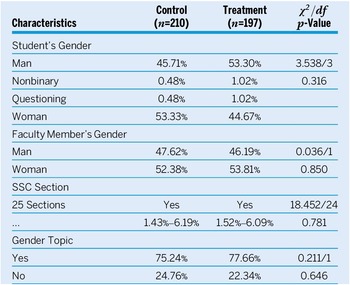
We first conducted a balance test using chi-squared tests to examine whether our randomization was successful. Test results are presented in table 1, confirming that participants in the control and treatment groups did not have statistically significant differences at the group level in the tested dimensions.
Balance Test

Table 1 Long description
Starting from the top, the table is divided into four main characteristic groups: Student’s Gender, Faculty Member’s Gender, S S C Section, and Gender Topic. For Student’s Gender, the rows list Man, Nonbinary, Questioning, and Woman. For Man, control is 45.71 percent, treatment is 53.30 percent, test statistic is 3.538 all over 3. For Nonbinary, control is 0.48 percent, treatment is 1.02 percent, p-value is 0.316. For Questioning, control is 0.48 percent, treatment is 1.02 percent, no test statistic or p-value is given. For Woman, control is 53.33 percent, treatment is 44.67 percent, no test statistic or p-value is given. Next, Faculty Member’s Gender includes Man and Woman. For Man, control is 47.62 percent, treatment is 46.19 percent, test statistic is 0.036 all over 1. For Woman, control is 52.38 percent, treatment is 53.81 percent, p-value is 0.850. The S S C Section group lists 25 Sections, with both control and treatment marked Yes, test statistic is 18.452 all over 24. The next row shows a range: control is 1.43 percent to 6.19 percent, treatment is 1.52 percent to 6.09 percent, p-value is 0.781. The final group, Gender Topic, lists Yes and No. For Yes, control is 75.24 percent, treatment is 77.66 percent, test statistic is 0.211 all over 1. For No, control is 24.76 percent, treatment is 22.34 percent, p-value is 0.646. All percentages and statistics are presented as shown in the table.
Recall that our participants evaluated four dimensions on a 5-point Likert scale. These evaluations are skewed, as shown in figure 1; therefore, we used the Kruskal-Wallis test and Dunn’s test to compare the differences between the control and treatment groups. Figure 1 presents box plots for each dimension to provide a comparison of central tendencies and variability.
Boxplots of Participants’ SET Responses by Groups
Note: Green bars represent medians.

Figure 1. Long description
From left to right, each panel displays boxplots for student evaluation scores labeled as Interest, Feedback, Preparedness, and Expectation. The y-axis ranges from 1 to 5. Each panel contains four boxplots representing Control Man Instructor, Control Woman Instructor, Treatment Man Instructor, and Treatment Woman Instructor, colored blue, yellow, gray, and red respectively. Green bars indicate medians. Kruskal-Wallis p-values are shown: 0.099 for Interest, 0.0029 for Feedback, 0.014 for Preparedness, and 0.024 for Expectation. The legend below identifies group colors and box styles.
Regarding the participants’ evaluation of their instructors’ “interest” in their success, there was no statistically significant difference between the faculty member’s gender and treatment conditions (p>0.05, Kruskal-Wallis test). For the rating on “feedback,” the differences were pronounced (p=0.003, Kruskal-Wallis test). The bias mitigation prompts led to a decrease in the participants’ evaluation of men instructors’ feedback compared to women instructors’ (p=0.003, Dunn’s test). In the “preparedness” dimension, participants in the treatment group evaluated their preparedness levels significantly lower than their counterparts in the control group, regardless of their instructors’ gender (for participants with a woman instructor, p=0.041, Dunn’s test; for participants with a man instructor, p=0.015, Dunn’s test). This suggests that students in the treatment group may have been more critical and self-reflective about their own performance—a possible result of the treatment. Finally, in the “expectation” dimension, the results again showed a significant difference (p=0.024, Kruskal-Wallis test): treatment-group participants with a man instructor stood out by giving lower ratings compared to other experimental conditions. These results mean that women instructors in our experiment tended to receive similar if not higher SET ratings than men instructors. Moreover, the treatment appeared to motivate a more critical view of men instructors among participants.
We then investigated interaction effects between the treatment and certain aspects of the course: the faculty member’s gender and the course content (as subgroup analysis rather than treatment). The results are presented in table 2.
Ordinal Logistic Regression Results
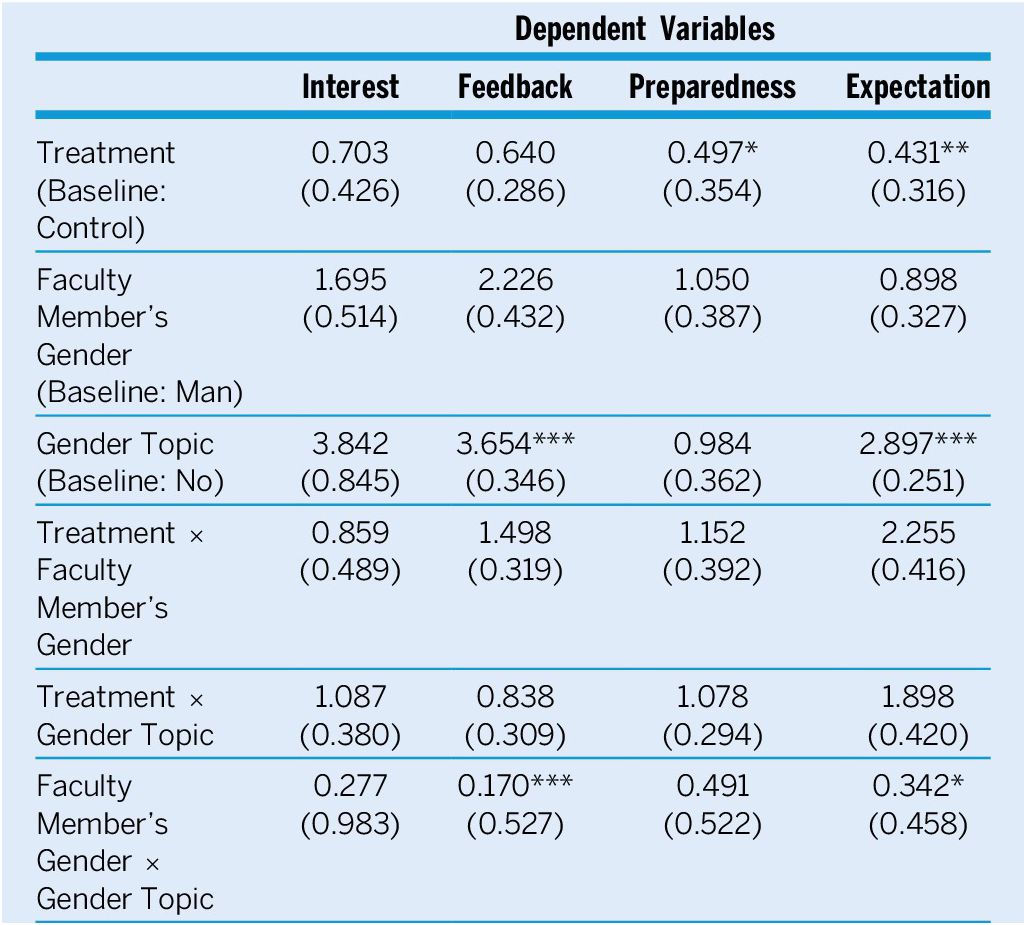
Table 2. Long description
The table presents ordinal logistic regression results with four dependent variables as columns: Interest, Feedback, Preparedness, and Expectation. Each column contains odds ratios followed by standard errors in parentheses. The first row lists the predictor Treatment with odds ratios: Interest 0.703 (0.426), Feedback 0.640 (0.286), Preparedness 0.497* (0.354), Expectation 0.431** (0.316). The next predictor, Faculty Member’s Gender (baseline: Man), has odds ratios: Interest 1.695 (0.514), Feedback 2.226 (0.432), Preparedness 1.050 (0.387), Expectation 0.898 (0.327). For Gender Topic (baseline: No), odds ratios are: Interest 3.842 (0.845), Feedback 3.654*** (0.346), Preparedness 0.984 (0.362), Expectation 2.897*** (0.251). The interaction Treatment times Faculty Member’s Gender shows: Interest 0.859 (0.489), Feedback 1.498 (0.319), Preparedness 1.152 (0.392), Expectation 2.255 (0.416). The interaction Treatment times Gender Topic: Interest 1.087 (0.380), Feedback 0.838 (0.309), Preparedness 1.078 (0.294), Expectation 1.898 (0.420). The interaction Faculty Member’s Gender times Gender Topic: Interest 0.277 (0.983), Feedback 0.170*** (0.527), Preparedness 0.491 (0.522), Expectation 0.342* (0.458). Statistical significance is indicated by asterisks: one for p less than 0.05, two for p less than 0.01, and three for p less than 0.001. Standard errors are clustered at the course-section level.
Notes: Odds ratios (OR) are reported. Standard errors in parentheses are clustered at the course-section level.
$ \ast p<0.05 $
 ;
$ \ast \ast p<0.01 $
;
$ \ast \ast p<0.01 $
 ;
$ \ast \ast \ast p<0.001 $
;
$ \ast \ast \ast p<0.001 $
 .
.
Specifically, the treatment group’s odds of reporting higher preparedness (OR=0.497, p<0.05) and expectations (OR=0.431, p<0.01) were notably reduced compared to the control group, suggesting that the treatment unintentionally may have lowered respondents’ self-evaluations. Meanwhile, the long-term exposure to gender topics significantly boosted the odds of higher student assessment of “feedback” (OR=3.654, p<0.001) and “expectation” (OR=2.897, p<0.001). Faculty members’ gender, although not a significant factor on its own, interacted meaningfully with the discussion of gender topics. For instance, the odds of receiving higher ratings on instructors’ “feedback” when gender topics are discussed were significantly lower (OR=0.170, p<0.001) when the faculty member was a woman, as well as the odds of higher “expectations” (OR=0.342, p<0.05). Across four dimensions, the interaction between an instructor’s gender and the course topic consistently pointed in a negative direction.
DISCUSSION
Our findings provide insights into the complex dynamics of gender bias in SET and the potential effects of bias mitigation strategies. Contrary to H1, which posits that women instructors would receive lower SET ratings than their men counterparts, the results reveal that gender bias—as manifested in this context—did not uniformly disadvantage women. In fact, women instructors tended to receive similar if not higher SET ratings compared to men instructors across various dimensions in our study. This outcome aligns with an increasing body of research recognizing that women educators do not necessarily receive lower SET scores. This suggests that the relationship between gender and SET ratings may be more nuanced than previously understood.
The introduction of bias mitigation prompts yielded mixed results, providing opposite evidence for H2. Although the treatment did not fully reduce the gender-based disparities in ratings between women and men instructors, it appeared to influence students’ perceptions in unexpected ways. Specifically, the treatment led to a more critical evaluation of men instructors, particularly on the dimension of “feedback.” One possible explanation is that men instructors previously may have benefited from a “rose-colored glasses” effect (MacNell, Driscoll, and Hunt Reference MacNell, Driscoll and Hunt2015), wherein students rated them more favorably regardless of their quality of teaching. The inclusion of the bias mitigation prompts may have disrupted this effect, resulting in students evaluating their men instructors more critically and on a par with their women counterparts
The results also provide mixed, correlational evidence for H3 regarding prolonged exposure to gender topics. The odds of reporting higher levels of interest and feedback were elevated significantly, by approximately threefold, when gender topics were in the curriculum. This suggests that engaging students in gender-related conversations may heighten their awareness of biases and encourage more thoughtful evaluations of their instructors. This underscores the critical role of these discussions in addressing gender bias in SET. However, the interaction between a faculty member’s gender and gender discussions produced surprising results: the positive impact of gender discussions on SET was markedly diminished when the instructor was a woman. This finding indicates a complex interplay between faculty members’ gender and gender education. Although gender-focused education can substantially enrich certain aspects of the educational experience, its effects are contextually dependent on the gender dynamics within the classroom. This also implies that students’ expectations of women instructors are sensitive to the context of gender discussions, potentially reflecting stereotypes that are difficult to mitigate even through a semester-long exposure.
However, the interaction between a faculty member’s gender and gender discussions produced surprising results: the positive impact of gender discussions on SET was markedly diminished when the instructor was a woman.
Additionally, the bias mitigation prompts had an unexpected effect of lowering students’ self-evaluations, as revealed in the reduced ratings of self-preparedness and self-expectations in the treatment group. The statement appeared to encourage greater self-reflection, prompting students to critically evaluate not only their instructors’ but also their own role in the learning process. These results suggest that the intervention may have disrupted the unearned advantages that men instructors previously had. Moreover, the intervention seemed to foster a more self-critical stance among students, which led them to reassess their own performance.
Based on our results, gender equity in a SET should not be understood solely as the absence of statistically significant differences between women and men faculty members’ scores. Rather than aiming only for numerical parity, SET practices should foster an evaluative environment in which students critically assess teaching quality without reliance on gendered assumptions. Simply achieving comparable scores may obscure the additional labor that women faculty members often must expend to receive evaluations similar to those of their men colleagues, thereby masking persistent inequities. The inclusion of bias mitigation prompts appears to encourage students to engage more thoughtfully with their evaluations and move beyond surface-level characteristics that frequently are shaped by implicit bias. Moreover, our results highlight the complexity of addressing such biases because the observed reduction in leniency toward men instructors raises questions about whether this change reflects a true decrease in bias or an influence of other unexamined mechanisms. Accordingly, future research should investigate how bias mitigation interventions shape students’ evaluative processes and whether they can promote more equitable outcomes without inadvertently introducing new forms of disparity.
ACKNOWLEDGMENTS
This study drew on research conducted as part of the 2023 Gender Equity Research Fellowship. We acknowledge the Provost’s Office and the Women’s Center at the University of Dayton for their support in hosting the fellowship. We thank our research assistants, Hannah Kling, Isabella Thomeier, and Veronica Vasko, for their contributions to data collection and analysis throughout the study. We also thank the anonymous reviewers and editors for their constructive comments.
DATA AVAILABILITY STATEMENT
Research documentation and data that support the findings of this study are openly available at the PS: Political Science & Politics Harvard Dataverse at https://doi.org/10.7910/DVN/50RFDZ.
CONFLICTS OF INTEREST
The authors declare that there are no ethical issues or conflicts of interest in this research.



 Open access

