





1 Introduction
The theory of higher-order Fourier analysis, initiated by the work of Gowers in arithmetic combinatorics [Reference Gowers22], is part of a revolutionary development in mathematics from the early 2000s, which has led to a much deeper understanding of Szemerédi’s famous theorem on arithmetic progressions [Reference Szemerédi62], and of additive structures in general. Other parts of this development occurred in hypergraph theory (via refinements of Szemerédi’s regularity lemma and its extensions for hypergraphs [Reference Gowers23, Reference Rödl, Nagle, Skokan, Schacht and Kohayakawa56, Reference Tao65]), and in ergodic theory (in directions stemming from Furstenberg’s approach to Szemerédi’s theorem [Reference Furstenberg19], especially the structure theory of characteristic factors [Reference Host and Kra43, Reference Ziegler73]). A common goal of these topics is to understand higher-order correlations and interactions in complex structures. This development has had a profound impact in several areas in addition to the aforementioned ones, particularly in number theory (a landmark being the Green-Tao theorem [Reference Green and Tao33]) and in theoretical computer science [Reference Hatami, Hatami and Lovett40, Reference Trevisan70].
Progress in higher-order Fourier analysis in the last two decades includes the discovery and advancement of general foundations for this theory, which involve nilpotent structures [Reference Camarena and Szegedy5, Reference Candela and Szegedy11, Reference Green and Tao34, Reference Green, Tao and Ziegler35, Reference Host and Kra44]. However, on one hand the proofs are often long and intricate, which can make the field less accessible to nonexperts, and on the other hand, the development of these foundations has so far focused on the theory rather than on potential practical applications. Yet, classical Fourier analysis is one of the most important tools in modern science, and there are good reasons to believe that its higher-order extensions can also become powerful practical tools. Therefore, there is a strong motivation for finding new approaches that can advance this field, including its foundations, in more elementary and applicable directions. In this paper we introduce such an approach, with the goal of bridging the gap between theory and practice.
The theoretical part of this approach consists in connecting higher-order components of functions on abelian groups (generalizations of Fourier characters, detailed below) with eigenvectors of certain operators constructed from such functions. The construction of these operators is elementary and is outlined in Subsection 1.1 of this introduction. In the first part of the paper, we provide initial results establishing the aforementioned connection at a relatively elementary level. The second part of the paper (starting in Section 4) delves into deeper reasons for this connection, which involve what can be viewed as a constituent of the foundations of higher-order Fourier analysis, namely nilspace theory (discussed further below). Our results in this part include a new structure (or regularity) theorem for Gowers norms on finite abelian groups, which decomposes functions into sums of certain generalizations of Fourier characters that we call nilspace characters, which are nearly orthogonal (Theorem 5.1). Consequences of this result include an inverse theorem involving such nilspace characters (Theorem 5.2), and new approximate diagonalizations and Parseval identities for Gowers norms (Theorems 5.7 and 5.4). These theoretical results are discussed in more detail in Subsection 1.3 of this introduction.
To demonstrate the applicability of these results, we provide simple algorithms which use the above-mentioned spectral data to recover the higher-order decompositions, and which do not require detailed knowledge of the deeper aspects of the theory. While the general pattern for these algorithms is easily formulated for any higher order (see Remark 1.4), in this paper we focus on fully demonstrating such algorithms in the case of quadratic Fourier analysis. This is outlined in Subsection 1.2 in this introduction, where we present our main theorems in this case (Theorems 1.1 and 1.6) and formulate the resulting algorithms (Algorithms 1 and 2). These algorithms can be implemented straightforwardly using the spectral decomposition of self-adjoint matrices and the (fast) Fourier transform. Algorithm 1 could be used in the prediction of missing data (or to carry out what could be called quadratic denoising) in ordered data sets and thus in time series prediction, analogously to how the usual Fourier transform is currently used for such tasks (a basic illustration is given in Figure 2). The decomposition into quadratic characters given by Algorithm 2 could be used to identify important components of a function, similarly to principal component analysis (see also Remark 2.14). These aspects will be further explored in a more applied follow-up work, which will focus on the practical aspects of our methods, including experiments and refinements.
To begin explaining and motivating our spectral approach in more detail, let us first recall here some basic ideas of higher-order Fourier analysis. The Gowers norms (or uniformity norms) are among the most important notions in this theory. For each integer
$k\geq 2$
 , the k-th Gowers norm (or
$U^k$
, the k-th Gowers norm (or
$U^k$
 -norm) is defined on the space of complex-valued functions f on a finite abelian group,Footnote 1 the norm
$\|f\|_{U^k}$
-norm) is defined on the space of complex-valued functions f on a finite abelian group,Footnote 1 the norm
$\|f\|_{U^k}$
 consisting of an average over configurations known as k-dimensional cubes on the group (the formula is recalled in equation (1.3) below). The
$U^2$
consisting of an average over configurations known as k-dimensional cubes on the group (the formula is recalled in equation (1.3) below). The
$U^2$
 -norm of f is equal to the
$\ell ^4$
-norm of f is equal to the
$\ell ^4$
 -norm of the Fourier transform of f, thereby connecting the
$U^2$
-norm of the Fourier transform of f, thereby connecting the
$U^2$
 -norm with classical (first-order) Fourier analysis. The role of the
$U^{k+1}$
-norm with classical (first-order) Fourier analysis. The role of the
$U^{k+1}$
 -norm in k-th order Fourier analysis centers on providing a useful concept of a function being noise of order k (or quasirandom of degree k), namely, a function having small
$U^{k+1}$
-norm in k-th order Fourier analysis centers on providing a useful concept of a function being noise of order k (or quasirandom of degree k), namely, a function having small
$U^{k+1}$
 -norm. This in turn yields, in a dual way, a notion of a function being structured of order k, namely, a function being nearly orthogonal to any noise of order k. The Gowers norms form an increasing sequence (meaning that
$\|f\|_{U^k}\leq \|f\|_{U^{k+1}}$
-norm. This in turn yields, in a dual way, a notion of a function being structured of order k, namely, a function being nearly orthogonal to any noise of order k. The Gowers norms form an increasing sequence (meaning that
$\|f\|_{U^k}\leq \|f\|_{U^{k+1}}$
 for every k and f), and this implies that, as k increases, fewer functions are classified as noise, and the notion of structured function becomes more inclusive and subtle. Major efforts in this field have gone into describing, as precisely as possible, these higher-order structured functions, in particular by seeking fundamental k-th order structured functions that could act adequately as generalizations of Fourier characters. As we shall see in this paper, the above-mentioned nilspace characters are functions of this type. A fascinating aspect of this subject is that, whereas the geometric object underlying classical Fourier characters is the circle group, the higher-order structured functions can involve nonabelian nilpotent structures such as the Heisenberg nilmanifold. In these directions, two central and interrelated themes have developed: on one hand, the so-called inverse theorems for Gowers norms, which establish that functions with nonnegligible
$U^{k+1}$
for every k and f), and this implies that, as k increases, fewer functions are classified as noise, and the notion of structured function becomes more inclusive and subtle. Major efforts in this field have gone into describing, as precisely as possible, these higher-order structured functions, in particular by seeking fundamental k-th order structured functions that could act adequately as generalizations of Fourier characters. As we shall see in this paper, the above-mentioned nilspace characters are functions of this type. A fascinating aspect of this subject is that, whereas the geometric object underlying classical Fourier characters is the circle group, the higher-order structured functions can involve nonabelian nilpotent structures such as the Heisenberg nilmanifold. In these directions, two central and interrelated themes have developed: on one hand, the so-called inverse theorems for Gowers norms, which establish that functions with nonnegligible
$U^{k+1}$
 -norm correlate nontrivially with some k-th order generalization of a Fourier character; on the other hand, decomposition theorems (or regularity lemmas), which express any bounded function essentially as a sum of a structured part and a noise part of order k.
There is by now extensive literature in higher-order Fourier analysis proving inverse theorems for Gowers norms in various families of abelian groups, often with the remarkable additional feature of giving effective bounds for the result (see for instance [Reference Candela and Szegedy12, Reference Gowers22, Reference Gowers and Milićević26, Reference Gowers and Milićević27, Reference Green and Tao32, Reference Green, Tao and Ziegler35, Reference Jamneshan and Tao46, Reference Jamneshan, Shalom and Tao47, Reference Leng, Sah and Sawhney51, Reference Manners52, Reference Milićević53, Reference Milićević54, Reference Tao and Ziegler67, Reference Tao and Ziegler68]). There are also many works proving higher-order decompositions of functions and regularity lemmas for Gowers norms (e.g., [Reference Gowers24, Reference Gowers and Wolf28, Reference Gowers and Wolf29, Reference Green and Tao31, Reference Green and Tao33, Reference Host and Kra42, Reference Tao64]). However, works providing algorithmic implementations of the above results are fewer, with notable examples being the paper by Tulsiani and Wolf introducing quadratic analogues of the Goldreich–Levin algorithm [Reference Tulsiani and Wolf71], and the more recent paper of Kim, Li, and Tidor on the cubic case [Reference Kim, Li and Tidor48]. The algorithms in these works are probabilistic, involve iterative processes [Reference Tulsiani and Wolf71, See §3], and are specialized to the finite-field setting (of central interest in theoretical computer science). The new algorithms that we begin to explore in this paper are based on spectral decompositions of operators associated with functions, are more direct (in particular, essentially noniterative), and applicable on any finite abelian group.
This new spectral aspect of higher-order Fourier analysis has quite natural motivations. One such motivation is the well-known connection between classical Fourier analysis and spectral decompositions. Fourier characters on abelian groups are eigenvectors of shift operators. More generally, if a linear operator is shift-invariant (i.e., it commutes with every shift), then every Fourier character is an eigenvector of that operator. This property enables Fourier analysis to be recovered from spectral theory (see Subsection 2.2). The results in this paper describe a similar connection between higher-order Fourier analysis and spectral theory through adequate generalizations of shift-invariant operators and Fourier characters. Another motivation for using spectral methods comes from Szemerédi’s regularity lemma for graphs [Reference Szemerédi63], which is a precursor of the intricate regularity lemmas in higher-order Fourier analysis. The spectral nature of graph regularization was first highlighted by Frieze and Kannan in [Reference Frieze and Kannan18]. Subsequently, the third author showed in [Reference Szegedy61] that Szemerédi-type regular partitions (even in their stronger forms [Reference Alon, Fischer, Krivelevich and Szegedy3]) can be obtained from the dominant eigenvectors of adjacency matrices. The deep connection between eigenvectors and regularization in graph theory is part of a rich algorithmic framework that includes principal component analysis, low-rank approximations, spectral clustering, and dimensionality reduction more broadly. An important aim of this paper is to position higher-order Fourier analysis within this framework by describing its spectral aspects, with emphasis on regularization.
1.1 Outline of the spectral approach
Given a finite abelian group
$\operatorname {\mathrm {Z}}$
 and a function
$f:\operatorname {\mathrm {Z}}\to \mathbb {C}$
and a function
$f:\operatorname {\mathrm {Z}}\to \mathbb {C}$
 , a first key step in this approach consists in turning f into a matrix in
$\mathbb {C}^{\operatorname {\mathrm {Z}}\times \operatorname {\mathrm {Z}}}$
, a first key step in this approach consists in turning f into a matrix in
$\mathbb {C}^{\operatorname {\mathrm {Z}}\times \operatorname {\mathrm {Z}}}$
 (or a
$\operatorname {\mathrm {Z}}$
(or a
$\operatorname {\mathrm {Z}}$
 -matrix, as we shall call it; see Definition 2.1). We consider various choices for how to do this, all of which proceed by applying a (typically nonlinear) transformation
$K:\mathbb {C}^{\operatorname {\mathrm {Z}}}\to \mathbb {C}^{\operatorname {\mathrm {Z}}}$
-matrix, as we shall call it; see Definition 2.1). We consider various choices for how to do this, all of which proceed by applying a (typically nonlinear) transformation
$K:\mathbb {C}^{\operatorname {\mathrm {Z}}}\to \mathbb {C}^{\operatorname {\mathrm {Z}}}$
 to every so-called
$\operatorname {\mathrm {Z}}$
to every so-called
$\operatorname {\mathrm {Z}}$
 -diagonal function of the rank-1 matrix

a
$\operatorname {\mathrm {Z}}$
 -diagonal being a set of entries whose indices have fixed difference in
$\operatorname {\mathrm {Z}}$
-diagonal being a set of entries whose indices have fixed difference in
$\operatorname {\mathrm {Z}}$
 (see Definition 2.1).
The matrix
$f\otimes \overline {f}$
 is a natural and convenient object to consider in higher-order Fourier analysis, since its
$\operatorname {\mathrm {Z}}$
is a natural and convenient object to consider in higher-order Fourier analysis, since its
$\operatorname {\mathrm {Z}}$
 -diagonal function with entry-difference t is the multiplicative derivative

which plays a key role in this theory (notably in proofs of inverse theorems). The matrix
$f\otimes \overline {f}$
 thus encapsulates in a useful way all the multiplicative derivatives of f.
In general, given a map (or operator)
$K:\mathbb {C}^{\operatorname {\mathrm {Z}}}\to \mathbb {C}^{\operatorname {\mathrm {Z}}}$
 and a matrix
$M\in \mathbb {C}^{\operatorname {\mathrm {Z}}\times \operatorname {\mathrm {Z}}}$
and a matrix
$M\in \mathbb {C}^{\operatorname {\mathrm {Z}}\times \operatorname {\mathrm {Z}}}$
 , we denote by
$\mathcal {K}(M)$
, we denote by
$\mathcal {K}(M)$
 the matrix obtained by applying K to every
$\operatorname {\mathrm {Z}}$
the matrix obtained by applying K to every
$\operatorname {\mathrm {Z}}$
 -diagonal function of M. To ensure that
$\mathcal {K}$
-diagonal function of M. To ensure that
$\mathcal {K}$
 is well-behaved, we require the operator K to commute with complex conjugation and the shift action of
$\operatorname {\mathrm {Z}}$
is well-behaved, we require the operator K to commute with complex conjugation and the shift action of
$\operatorname {\mathrm {Z}}$
 on functions in
$\mathbb {C}^{\operatorname {\mathrm {Z}}}$
on functions in
$\mathbb {C}^{\operatorname {\mathrm {Z}}}$
 (in which case we call K an invariant operator; see Definition 2.10). If these conditions are satisfied, then
$\mathcal {K}$
(in which case we call K an invariant operator; see Definition 2.10). If these conditions are satisfied, then
$\mathcal {K}$
 preserves the property of being a self-adjoint (or Hermitian) matrix. In particular
$\mathcal {K}(f\otimes \overline {f})$
preserves the property of being a self-adjoint (or Hermitian) matrix. In particular
$\mathcal {K}(f\otimes \overline {f})$
 is self-adjoint, so it has real eigenvalues and orthogonal eigenvectors. (In this paper, the linear-algebraic notions pertaining to
$\operatorname {\mathrm {Z}}$
is self-adjoint, so it has real eigenvalues and orthogonal eigenvectors. (In this paper, the linear-algebraic notions pertaining to
$\operatorname {\mathrm {Z}}$
 -matrices, including their eigenvalues, are normalized in coherence with the probability Haar measure on
$\operatorname {\mathrm {Z}}$
-matrices, including their eigenvalues, are normalized in coherence with the probability Haar measure on
$\operatorname {\mathrm {Z}}$
 and the corresponding inner-product on the space
$\mathbb {C}^{\operatorname {\mathrm {Z}}}$
and the corresponding inner-product on the space
$\mathbb {C}^{\operatorname {\mathrm {Z}}}$
 , a space on which
$\operatorname {\mathrm {Z}}$
, a space on which
$\operatorname {\mathrm {Z}}$
 -matrices act as kernels of linear integral operators; see Definition 2.3 and the discussion preceding it.)
It turns out that the spectral data associated with
$\mathcal {K}(f\otimes \overline {f})$
 carries important information to perform k-th order Fourier analysis on f. Let us formulate this as the following principle, which captures in general terms a phenomenon that is central to this approach.
Order increment principle: If
$K:\mathbb {C}^{\operatorname {\mathrm {Z}}}\to \mathbb {C}^{\operatorname {\mathrm {Z}}}$
 maps functions in
$\mathbb {C}^{\operatorname {\mathrm {Z}}}$
maps functions in
$\mathbb {C}^{\operatorname {\mathrm {Z}}}$
 to their k-th order structured parts, then for
$f\in \mathbb {C}^{\operatorname {\mathrm {Z}}}$
to their k-th order structured parts, then for
$f\in \mathbb {C}^{\operatorname {\mathrm {Z}}}$
 the spectral decomposition of
$\mathcal {K}(f\otimes \overline {f})$
the spectral decomposition of
$\mathcal {K}(f\otimes \overline {f})$
 can be used to obtain the
$(k+1)$
can be used to obtain the
$(k+1)$
 -th order structured part (and corresponding useful decomposition) of f.
This principle can be used to turn k-th order Fourier analysis into
$(k+1)$
 -th order Fourier analysis. A precise form of this principle was observed in the ultralimit setting in [Reference Szegedy59].
Sketch of the spectral approach to higher-order Fourier analysis.

Figure 1 Long description
The diagram consists of two large rounded rectangles labeled function on the left in light green and operator on the right in light red.
In the function panel, the top line shows f maps Z to C. Below this, it states For every t in Z, Delta sub t f maps to K open parenthesis Delta sub t f close parenthesis. This is followed by eigenfunctions f sub 1, f sub 2, and eigenvalues lambda sub 1 is greater than or equal to lambda sub 2. A downward arrow points to two bullet points: regularization of f of order k plus 1, and correlating characters of order k plus 1.
In the operator panel, the top line shows f tensor f-bar maps Z cross Z to C. A downward arrow labeled order k regularization of diagonals points to script K open parenthesis f tensor f-bar close parenthesis maps Z cross Z to C.
Four blue arrows connect the panels. A solid arrow points from the function f to the tensor product in the operator panel. A solid arrow points from the script K operator back to the eigenvalues and eigenfunctions in the function panel. Two dotted arrows form a cross-pattern in the center, connecting the Delta sub t f expression to both the tensor product and the script K operator.
A simple choice for K is the averaging operator (mapping f to the constant functionFootnote 2
$\mathbb {E}_{x\in \operatorname {\mathrm {Z}}} f(x)$
 ), which pertains to
$0$
), which pertains to
$0$
 -th order Fourier analysis. In this case the eigenvectors of
$\mathcal {K}(f\otimes \overline {f})$
-th order Fourier analysis. In this case the eigenvectors of
$\mathcal {K}(f\otimes \overline {f})$
 are the Fourier characters of f, and the eigenvalues are the squares of the absolute values of the corresponding Fourier coefficients. This illustrates how
$0$
are the Fourier characters of f, and the eigenvalues are the squares of the absolute values of the corresponding Fourier coefficients. This illustrates how
$0$
 -th order Fourier analysis is turned into first order, classical Fourier analysis (we discuss this in more detail in Subsection 2.2).
The next logical step is to progress from first-order to quadratic Fourier analysis using the above principle. This step requires an operator K that extracts the Fourier-structured component of a function f in an adequate way. Finding such an operator is challenging because of a lack of uniqueness. Indeed, while in an appropriate limit setting (such as the setting of [Reference Szegedy59]), there exists a unique, and even linear, operator that isolates the structured part (consisting of conditional expectation relative to an appropriate
$\sigma $
 -algebra), the counterparts in finite settings exist only in an approximate and nonlinear way. There are various possible choices, many of which depend on additional parameters. In this work, we introduce such an operator with especially useful analytic properties, which we call the Fourier denoising operator, and we develop several tools for its application.
To define this operator, recall first that for a character
$\chi $
 in the dual group
$\widehat {\operatorname {\mathrm {Z}}}$
in the dual group
$\widehat {\operatorname {\mathrm {Z}}}$
 (where
$\operatorname {\mathrm {Z}}$
(where
$\operatorname {\mathrm {Z}}$
 is a finite abelian group), we define the corresponding Fourier coefficient of f by

Then, for a fixed (typically small) constant
$\varepsilon>0$
 , our denoising operator is defined by

Note that there is a simpler operator (that we can call the Fourier cut-off operator) which sets Fourier coefficients with absolute value smaller than
$\varepsilon $
 to
$0$
to
$0$
 and keeps the remaining terms in the Fourier decomposition unchanged. The main problem with the Fourier cut-off operator is that it is not continuous and has inconvenient properties for calculations. Instead, the operator
$K_\varepsilon $
and keeps the remaining terms in the Fourier decomposition unchanged. The main problem with the Fourier cut-off operator is that it is not continuous and has inconvenient properties for calculations. Instead, the operator
$K_\varepsilon $
 applies the continuous function
$x\mapsto \mathrm { ReLU}(x-\varepsilon )$
applies the continuous function
$x\mapsto \mathrm { ReLU}(x-\varepsilon )$
 to the magnitudes of the Fourier coefficients while keeping their phases. Here, ReLU is the function
$x\mapsto (x+|x|)/2=\max (x,0)$
to the magnitudes of the Fourier coefficients while keeping their phases. Here, ReLU is the function
$x\mapsto (x+|x|)/2=\max (x,0)$
 known from machine learning. It turns out that
$K_\varepsilon $
known from machine learning. It turns out that
$K_\varepsilon $
 is a contraction in
$L^2$
is a contraction in
$L^2$
 and has other pleasant properties while being sufficiently similar to the cut-off operator. Related to the operator
$K_\varepsilon $
and has other pleasant properties while being sufficiently similar to the cut-off operator. Related to the operator
$K_\varepsilon $
 we introduce the operator
$\mathcal {K}_\varepsilon :\mathbb {C}^{\operatorname {\mathrm {Z}}\times \operatorname {\mathrm {Z}}}\to \mathbb {C}^{\operatorname {\mathrm {Z}}\times \operatorname {\mathrm {Z}}}$
we introduce the operator
$\mathcal {K}_\varepsilon :\mathbb {C}^{\operatorname {\mathrm {Z}}\times \operatorname {\mathrm {Z}}}\to \mathbb {C}^{\operatorname {\mathrm {Z}}\times \operatorname {\mathrm {Z}}}$
 which applies
$K_\varepsilon $
which applies
$K_\varepsilon $
 to all
$\operatorname {\mathrm {Z}}$
to all
$\operatorname {\mathrm {Z}}$
 -diagonals of a matrix in
$\mathbb {C}^{\operatorname {\mathrm {Z}}\times \operatorname {\mathrm {Z}}}$
-diagonals of a matrix in
$\mathbb {C}^{\operatorname {\mathrm {Z}}\times \operatorname {\mathrm {Z}}}$
 . A more detailed discussion of the Fourier denoising operator begins in Subsection 2.5.
1.2 Main results with algorithmic consequences
Let us begin by recalling the formula for the Gowers norms from [Reference Gowers22, Lemma 3.9] (see also [Reference Tao and Vu66, Definition 11.2]). For each integer
$k\geq 2$
 , the
$U^k$
, the
$U^k$
 -norm of a function
$f\in \mathbb {C}^{\operatorname {\mathrm {Z}}}$
-norm of a function
$f\in \mathbb {C}^{\operatorname {\mathrm {Z}}}$
 is defined by

where
$\mathcal {C}$
 denotes the complex conjugation operator and
$|v|:=\sum _{i=1}^k v(i)$
denotes the complex conjugation operator and
$|v|:=\sum _{i=1}^k v(i)$
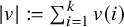 .
.
The dual of the
$U^k$
 -norm, defined by
$\|f\|_{U^k}^*:=\sup _{g\in \mathbb {C}^{\operatorname {\mathrm {Z}}}, \|g\|_{U^k}\leq 1} \mathbb {E}_{x\in \operatorname {\mathrm {Z}}} f(x)\overline {g(x)}$
-norm, defined by
$\|f\|_{U^k}^*:=\sup _{g\in \mathbb {C}^{\operatorname {\mathrm {Z}}}, \|g\|_{U^k}\leq 1} \mathbb {E}_{x\in \operatorname {\mathrm {Z}}} f(x)\overline {g(x)}$
 , is a useful tool to measure the extent to which a function is structured in the sense of
$(k-1)$
, is a useful tool to measure the extent to which a function is structured in the sense of
$(k-1)$
 -th order Fourier analysis, as we will explain in more detail later (see Subsection 2.3). These dual norms have been analyzed previously, notably in the work of Host and Kra [Reference Host and Kra42]. Their earlier work [Reference Host and Kra45] already studied analogous dual objects for uniformity seminorms, and the work of Tao [Reference Tao64] introduced closely related uniform almost-periodicity norms, also mentioned later below. In this paper, we shall use the dual norms especially to define the quantitative and relatively elementary concept of structured function of order
$k-1$
-th order Fourier analysis, as we will explain in more detail later (see Subsection 2.3). These dual norms have been analyzed previously, notably in the work of Host and Kra [Reference Host and Kra42]. Their earlier work [Reference Host and Kra45] already studied analogous dual objects for uniformity seminorms, and the work of Tao [Reference Tao64] introduced closely related uniform almost-periodicity norms, also mentioned later below. In this paper, we shall use the dual norms especially to define the quantitative and relatively elementary concept of structured function of order
$k-1$
 (see Definition 2.23).
The next theorem is one of the main results in this paper. It provides a regularity (or decomposition) result for functions in quadratic Fourier analysis, expressing the quadratically structured part of the function in terms of the dominant eigenvalues and corresponding eigenvectors of the appropriate
$\operatorname {\mathrm {Z}}$
 -matrix. Thus it connects regularity with spectral methods in the quadratic setting. This provides a theoretical basis for Algorithm 1 below.
Theorem 1.1 (Spectral
$U^3$
 -regularization).

For every
$\rho _0\in [0,1)$
 there exists
$\varepsilon _0>0$
there exists
$\varepsilon _0>0$
 such that the following holds. Let
$\operatorname {\mathrm {Z}}$
such that the following holds. Let
$\operatorname {\mathrm {Z}}$
 be a finite abelian group and let
$f:\operatorname {\mathrm {Z}}\to \mathbb {C}$
be a finite abelian group and let
$f:\operatorname {\mathrm {Z}}\to \mathbb {C}$
 be a 1-bounded function. Then there exists
$\rho \in [\rho _0/2,\rho _0]$
be a 1-bounded function. Then there exists
$\rho \in [\rho _0/2,\rho _0]$
 and
$\varepsilon \in [\varepsilon _0,1]$
and
$\varepsilon \in [\varepsilon _0,1]$
 with the following property. Let
$f_{\text {reg}}$
with the following property. Let
$f_{\text {reg}}$
 be the projection of f to the linear span of the eigenspaces of
$\mathcal {K}_\varepsilon (f\otimes \overline {f})$
be the projection of f to the linear span of the eigenspaces of
$\mathcal {K}_\varepsilon (f\otimes \overline {f})$
 with corresponding eigenvalues at least
$\rho $
with corresponding eigenvalues at least
$\rho $
 . Then
$\|f-f_{\text {reg}}\|_{U^3}\le 2\rho ^{3/8}$
. Then
$\|f-f_{\text {reg}}\|_{U^3}\le 2\rho ^{3/8}$
 and there exists
$h:\operatorname {\mathrm {Z}}\to \mathbb {C}$
and there exists
$h:\operatorname {\mathrm {Z}}\to \mathbb {C}$
 such that
$\|f_{\text {reg}}-h\|_2\le \rho $
such that
$\|f_{\text {reg}}-h\|_2\le \rho $
 and
$\|h\|_{U^3}^*=O_{\rho }(1)$
and
$\|h\|_{U^3}^*=O_{\rho }(1)$
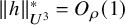 .
.
The conclusion involving the approximating function h, of bounded
$U^3$
 -dual-norm, can be summarized as saying that
$f_{\text {reg}}$
-dual-norm, can be summarized as saying that
$f_{\text {reg}}$
 is a structured function of order 2 (see Definition 2.23). Note also that, as mentioned earlier, eigenvalues here are taken in a normalized form (see Definition 2.3).
Remark 1.2. Analogous to Szemerédi’s regularity lemma for graphs [Reference Szemerédi63], arithmetic regularity lemmas (such as Theorem 1.1) exist in multiple versions [Reference Gowers24, Reference Green and Tao31], each balancing the trade-off between the strength of the statement and the quality of the bounds. For instance, the weak regularity lemma by Frieze and Kannan [Reference Frieze and Kannan17] provides a more limited approximation for graphs but achieves significantly better bounds, making it suitable for practical applications. Szemerédi’s original formulation [Reference Szemerédi62] occupies a middle ground in this trade-off: it does not provide effective bounds, but it has stronger theoretical implications. The primary goal of Theorem 1.1 is to present a concise, representative member of a broader family of regularity lemmas that connect higher-order Fourier analysis with spectral theory. In fact, the version of Theorem 1.1 that we actually prove, namely Theorem 7.12, is already finer and more flexible (though also more technical). In future papers, we will explore other versions of the result, including stronger formulations, to extend its applicability and impact.
The calculation of
$f_{\text {reg}}$
 in Theorem 1.1 is efficient in practice. It involves
$|{\operatorname {\mathrm {Z}}}|$
in Theorem 1.1 is efficient in practice. It involves
$|{\operatorname {\mathrm {Z}}}|$
 independent applications of the operator
$K_\varepsilon $
independent applications of the operator
$K_\varepsilon $
 (which can be executed in parallel) and the computation of dominant eigenvectors and eigenvalues of a single
${\operatorname {\mathrm {Z}}}\times {\operatorname {\mathrm {Z}}}$
(which can be executed in parallel) and the computation of dominant eigenvectors and eigenvalues of a single
${\operatorname {\mathrm {Z}}}\times {\operatorname {\mathrm {Z}}}$
 matrix. Each application of
$K_\varepsilon $
matrix. Each application of
$K_\varepsilon $
 can be done using a fast Fourier transform, a simple coefficient truncation, and an inverse fast Fourier transform. The whole process depends on the original function f defined on
${\operatorname {\mathrm {Z}}}$
can be done using a fast Fourier transform, a simple coefficient truncation, and an inverse fast Fourier transform. The whole process depends on the original function f defined on
${\operatorname {\mathrm {Z}}}$
 , as well as on two positive parameters
$\varepsilon $
, as well as on two positive parameters
$\varepsilon $
 and
$\rho $
and
$\rho $
 . The details of this calculation are outlined in the following pseudocode.

Algorithm 1 Long description
The algorithm is titled Algorithm 1 U super 3 regularization algorithm.
Input line: f maps Z to C, rho and epsilon are elements of R sub greater than 0.
Line 1: M is assigned f tensor product f-bar, which is an element of C to the power of Z times Z.
Line 2: for t element of Z do.
Line 3: M open parenthesis dot plus t, dot close parenthesis is assigned K sub epsilon open parenthesis M open parenthesis dot plus t, dot close parenthesis close parenthesis.
Line 4: end.
Line 5: The sequence of pairs open parenthesis mu sub 1, v sub 1 close parenthesis through open parenthesis mu sub absolute value Z, v sub absolute value Z close parenthesis is assigned Eigendecomposition of M.
Output line: f sub reg is assigned the summation over mu sub i greater than or equal to rho of the inner product of f and v sub i times v sub i, and the set of pairs open parenthesis mu sub 1, v sub 1 close parenthesis through open parenthesis mu sub absolute value Z, v sub absolute value Z close parenthesis cubed.
Remark 1.3 (Choice of parameters).
In practice, there is no definitive choice for the parameters
$\rho $
 and
$\varepsilon $
and
$\varepsilon $
 in Algorithm 1. The optimal values depend heavily on the nature of the dataset the algorithm is applied to. Adjusting these parameters allows for analyzing the quadratic structure of a function at different levels of resolution. Practical aspects of how to choose these parameters will be investigated in a paper focusing on applications.
Remark 1.4 (Higher-order versions).
Let us denote the outcome of Algorithm 1 by
$H_{\varepsilon ,\rho }(f)$
 . It is easy to see that for fixed positive
$\varepsilon $
. It is easy to see that for fixed positive
$\varepsilon $
 and
$\rho $
and
$\rho $
 , the operator
$f\mapsto H_{\varepsilon ,\rho }(f)$
, the operator
$f\mapsto H_{\varepsilon ,\rho }(f)$
 commutes with shifts and conjugation. Thus, by applying it to the
$\operatorname {\mathrm {Z}}$
commutes with shifts and conjugation. Thus, by applying it to the
$\operatorname {\mathrm {Z}}$
 -diagonals of
$f\otimes \overline {f}$
-diagonals of
$f\otimes \overline {f}$
 , we obtain a self-adjoint matrix. By choosing a new value
$\kappa>0$
, we obtain a self-adjoint matrix. By choosing a new value
$\kappa>0$
 and projecting f onto the space spanned by the eigenvectors of this matrix with eigenvalue at least
$\kappa $
and projecting f onto the space spanned by the eigenvectors of this matrix with eigenvalue at least
$\kappa $
 , we obtain a new operator
$f\mapsto H_{\varepsilon ,\rho ,\kappa }(f)$
, we obtain a new operator
$f\mapsto H_{\varepsilon ,\rho ,\kappa }(f)$
 which approximates the structured part of f in cubic Fourier analysis. By further iterating this process, we obtain a spectral approach to k-th order Fourier analysis based on a regularization operator
$f\mapsto H_{\varepsilon _1,\varepsilon _2,\dots ,\varepsilon _k}(f)$
which approximates the structured part of f in cubic Fourier analysis. By further iterating this process, we obtain a spectral approach to k-th order Fourier analysis based on a regularization operator
$f\mapsto H_{\varepsilon _1,\varepsilon _2,\dots ,\varepsilon _k}(f)$
 with k parameters. However, we do not pursue the analysis of this general algorithm here, as its rigorous validation requires work beyond the scope of this paper. Indeed, while several central tools for such a general validation are already established below (see especially Theorem 5.1, valid for all orders), some key results and finitary notions are only established in the quadratic setting in this paper (a central example being the Fourier denoising operator and the related Proposition 3.17, which are important for the proof of the main result validating Algorithm 1, namely Theorem 6.1). Nevertheless, we strongly believe that such higher-order algorithms can be validated rigorously; this belief is supported notably by related perspectives in nonstandard analysis (see Subsection 1.4).
Remark 1.5 (Continuous versions).
Note that the output
$H_{\varepsilon ,\rho }(f)$
 of Algorithm 1 is not continuous in its input
$f\in \mathbb {C}^{\operatorname {\mathrm {Z}}}$
of Algorithm 1 is not continuous in its input
$f\in \mathbb {C}^{\operatorname {\mathrm {Z}}}$
 for fixed positive
$\rho ,\varepsilon $
for fixed positive
$\rho ,\varepsilon $
 . To see this, fix some
$\rho ,\varepsilon $
. To see this, fix some
$\rho ,\varepsilon $
 and let
$\operatorname {\mathrm {Z}}= \mathbb {Z}_p$
and let
$\operatorname {\mathrm {Z}}= \mathbb {Z}_p$
 for some prime p,
$g(x):=e^{2\pi i x^2/p}$
for some prime p,
$g(x):=e^{2\pi i x^2/p}$
 , and
$c\in \mathbb {R}_{\ge 0}$
, and
$c\in \mathbb {R}_{\ge 0}$
 . It is easy to see that
$\mathcal {K}_\varepsilon ((cg)\otimes \overline {(cg)})=[\sqrt {c^2-\varepsilon })g]\otimes \overline {[\sqrt {c^2-\varepsilon })g]}$
. It is easy to see that
$\mathcal {K}_\varepsilon ((cg)\otimes \overline {(cg)})=[\sqrt {c^2-\varepsilon })g]\otimes \overline {[\sqrt {c^2-\varepsilon })g]}$
 for
$c^2>\varepsilon $
for
$c^2>\varepsilon $
 , and
$0$
, and
$0$
 otherwise, so
$H_{\varepsilon ,\rho }(cg(x))=(\sqrt {c^2-\varepsilon })g$
otherwise, so
$H_{\varepsilon ,\rho }(cg(x))=(\sqrt {c^2-\varepsilon })g$
 if
$\rho <c^2-\varepsilon $
if
$\rho <c^2-\varepsilon $
 and
$0$
and
$0$
 otherwise. There is therefore a discontinuity in the output
$H_{\varepsilon ,\rho }(cg)$
otherwise. There is therefore a discontinuity in the output
$H_{\varepsilon ,\rho }(cg)$
 as the parameter c in the input
$cg$
as the parameter c in the input
$cg$
 increases past
$\sqrt {\rho +\varepsilon }$
increases past
$\sqrt {\rho +\varepsilon }$
 .
.
There exist continuous variants of
$H_{\varepsilon ,\rho }$
 , which are worth mentioning since these variants can be convenient for instance in computer experiments. An example of a continuous version is
$H^{\prime }_{\varepsilon ,\rho }(f):=\mathbb {E}_{\rho '\in [\rho /2,\rho ]}H_{\varepsilon ,\rho '}(f)$
, which are worth mentioning since these variants can be convenient for instance in computer experiments. An example of a continuous version is
$H^{\prime }_{\varepsilon ,\rho }(f):=\mathbb {E}_{\rho '\in [\rho /2,\rho ]}H_{\varepsilon ,\rho '}(f)$
 . It is easy to see that
$H^{\prime }_{\varepsilon ,\rho }$
. It is easy to see that
$H^{\prime }_{\varepsilon ,\rho }$
 can also be computed efficiently, with complexity similar to
$H_{\varepsilon ,\rho }$
can also be computed efficiently, with complexity similar to
$H_{\varepsilon ,\rho }$
 . To achieve this, the formula for the projection in
$H_{\varepsilon ,\rho }$
. To achieve this, the formula for the projection in
$H_{\varepsilon ,\rho }$
 must be augmented with certain weight terms that depend on the eigenvalues. Recall that the Fourier cut-off operator mentioned earlier suffered from a similar continuity problem, and was replaced by the continuous denoising operator
$K_\varepsilon $
must be augmented with certain weight terms that depend on the eigenvalues. Recall that the Fourier cut-off operator mentioned earlier suffered from a similar continuity problem, and was replaced by the continuous denoising operator
$K_\varepsilon $
 to obtain our proofs in the quadratic setting. Besides producing more stable and precise outcomes, continuous versions also appear to be more suitable when moving to higher orders via the order increment principle. These and other refinements of the algorithm lie outside the scope of this paper and will be explored in future work.
Removing added random noise from a quadratic structured function by a version of Algorithm 1 on the cyclic group
$\mathbb {Z}_{500}$
 . A window of length
$50$
. A window of length
$50$
 is plotted for illustration. In this example, the function
$f(i):=\sin (8i^2+3i+1)$
is plotted for illustration. In this example, the function
$f(i):=\sin (8i^2+3i+1)$
 ,
$i\in [500]$
,
$i\in [500]$
 (green graph) is perturbed by random noise, resulting in the function
$g=f+r$
(green graph) is perturbed by random noise, resulting in the function
$g=f+r$
 (red graph). The spectral algorithm is applied to g and the reconstruction
$f_2$
(red graph). The spectral algorithm is applied to g and the reconstruction
$f_2$
 of f (blue graph) is obtained by the projection of g to the space spanned by the
$6$
of f (blue graph) is obtained by the projection of g to the space spanned by the
$6$
 leading eigenvectors of the operator constructed from g. The plot highlights the reconstruction error
$|f(i)-f_2(i)|$
leading eigenvectors of the operator constructed from g. The plot highlights the reconstruction error
$|f(i)-f_2(i)|$
 .
.

Figure 2 Long description
A line graph plotted on a vertical axis ranging from negative 1 to 1. At the top, a legend identifies three series. Green circles represent function f. Red circles represent f plus noise. Blue circles represent the reconstruction of f. The horizontal axis represents a window of 50 points from a cyclic group of 500. The red line shows high-frequency random fluctuations. The green line shows the underlying smooth quadratic structure. The blue line closely tracks the green line, demonstrating the effectiveness of the spectral algorithm. Black vertical bars between the green and blue points indicate the reconstruction error. Purple boxes highlight specific data points where the error is less than 0.05 (light purple) or less than 0.01 (dark purple). The reconstruction error is most visible at the peaks and troughs of the noisy red signal but remains small relative to the noise amplitude.
A deeper and more sophisticated version of our spectral algorithm focuses on the meaning of the individual eigenvectors of the operator
$\mathcal {K}_\varepsilon (f\otimes \overline {f})$
 . It turns out that these eigenvectors can give further information on the quadratic structured part of f. In particular, if the corresponding eigenvalue is large enough and well-separated from other eigenvalues, such an eigenvector behaves as a quadratic generalization of a Fourier character, and has large inner product with f. This generalization is an interesting notion in itself and can be defined in a basic way. The initial observation for this is that a classical Fourier character
$\chi $
. It turns out that these eigenvectors can give further information on the quadratic structured part of f. In particular, if the corresponding eigenvalue is large enough and well-separated from other eigenvalues, such an eigenvector behaves as a quadratic generalization of a Fourier character, and has large inner product with f. This generalization is an interesting notion in itself and can be defined in a basic way. The initial observation for this is that a classical Fourier character
$\chi $
 (or a constant multiple of it) is defined by the property that for every t the multiplicative derivatives
$\Delta _t\chi $
(or a constant multiple of it) is defined by the property that for every t the multiplicative derivatives
$\Delta _t\chi $
 is a constant function, and that constant functions are the structured functions in
$0$
is a constant function, and that constant functions are the structured functions in
$0$
 -th order Fourier analysis (this is proved, in greater generality, in Lemma 2.26). Going one degree higher, we obtain the following basic notion: a function
$f\in \mathbb {C}^{\operatorname {\mathrm {Z}}}$
-th order Fourier analysis (this is proved, in greater generality, in Lemma 2.26). Going one degree higher, we obtain the following basic notion: a function
$f\in \mathbb {C}^{\operatorname {\mathrm {Z}}}$
 is a quadratic character if for every
$t\in \operatorname {\mathrm {Z}}$
is a quadratic character if for every
$t\in \operatorname {\mathrm {Z}}$
 the multiplicative derivative
$\Delta _t f$
the multiplicative derivative
$\Delta _t f$
 is Fourier structured (of first order) in the sense of Definition 2.23. This notion of quadratic character depends on two parameters that measure the extent to which the multiplicative derivatives are Fourier structured; more precisely f is a quadratic character of complexity R and precision
$\delta $
is Fourier structured (of first order) in the sense of Definition 2.23. This notion of quadratic character depends on two parameters that measure the extent to which the multiplicative derivatives are Fourier structured; more precisely f is a quadratic character of complexity R and precision
$\delta $
 if for every t there is
$g_t\in \mathbb {C}^{\operatorname {\mathrm {Z}}}$
if for every t there is
$g_t\in \mathbb {C}^{\operatorname {\mathrm {Z}}}$
 such that
$\|\Delta _t f -g_t\|_{L^2}\leq \delta $
such that
$\|\Delta _t f -g_t\|_{L^2}\leq \delta $
 and
$\|g_t\|_{U^2}^*\leq R$
and
$\|g_t\|_{U^2}^*\leq R$
 . Let us mention straightaway that a central result in this paper connects this basic notion of a quadratic character with the 2-step case of the deeper notion of nilspace characters mentioned earlier (we discuss this central result in the next subsection). We also introduce basic notions of characters of order k for each
$k\geq 2$
. Let us mention straightaway that a central result in this paper connects this basic notion of a quadratic character with the 2-step case of the deeper notion of nilspace characters mentioned earlier (we discuss this central result in the next subsection). We also introduce basic notions of characters of order k for each
$k\geq 2$
 , studied in Subsection 2.4 (see Definition 2.29).
It turns out that the quadratically structured part of f given by Theorem 1.1 can be decomposed in terms of quadratic characters of bounded complexity, and that our second algorithm is able to find (good approximations of) those characters. To state our main result validating this second algorithm, we use the following terms. For a self-adjoint
$\operatorname {\mathrm {Z}}$
 -matrix A, we denote by
$\mathrm{Spec}_{\rho }(A)$
-matrix A, we denote by
$\mathrm{Spec}_{\rho }(A)$
 the set of eigenvalues of A larger than
$\rho $
the set of eigenvalues of A larger than
$\rho $
 , and we denote by
$\text {Eigen}_\rho (A)\subset \mathbb {C}^{\operatorname {\mathrm {Z}}}$
, and we denote by
$\text {Eigen}_\rho (A)\subset \mathbb {C}^{\operatorname {\mathrm {Z}}}$
 the subspace spanned by eigenvectors of A corresponding to eigenvalues in
$\mathrm{Spec}_{\rho }(A)$
the subspace spanned by eigenvectors of A corresponding to eigenvalues in
$\mathrm{Spec}_{\rho }(A)$
 . We also say that a set
$X\subset \mathbb {C}$
. We also say that a set
$X\subset \mathbb {C}$
 is
$\delta $
is
$\delta $
 -separated if for every
$x,y\in X$
-separated if for every
$x,y\in X$
 with
$x\not =y$
with
$x\not =y$
 we have
$|x-y|\ge \delta $
we have
$|x-y|\ge \delta $
 . We can now state the main result in question.
Theorem 1.6. For every
$\rho _0\in [0,1/10]$
 , there exists
$\varepsilon _0>0$
, there exists
$\varepsilon _0>0$
 such that for any finite abelian group
$\operatorname {\mathrm {Z}}$
such that for any finite abelian group
$\operatorname {\mathrm {Z}}$
 and any 1-bounded function
$f:\operatorname {\mathrm {Z}}\to \mathbb {C}$
and any 1-bounded function
$f:\operatorname {\mathrm {Z}}\to \mathbb {C}$
 , there exists
$\rho \in [\rho _0/2,\rho _0]$
, there exists
$\rho \in [\rho _0/2,\rho _0]$
 and
$\varepsilon \in [\varepsilon _0,1]$
and
$\varepsilon \in [\varepsilon _0,1]$
 satisfying the following property. Let h be a function in
$\text {Eigen}_\rho \big (\mathcal {K}_\varepsilon (f\otimes \overline {f})\big )\subset \mathbb {C}^{\operatorname {\mathrm {Z}}}$
satisfying the following property. Let h be a function in
$\text {Eigen}_\rho \big (\mathcal {K}_\varepsilon (f\otimes \overline {f})\big )\subset \mathbb {C}^{\operatorname {\mathrm {Z}}}$
 with
$\|h\|_2\le 1$
with
$\|h\|_2\le 1$
 such that
$\mathrm{Spec}_{\rho ^7}\big (\mathcal {K}_\varepsilon (h\otimes \overline {h})\big )$
such that
$\mathrm{Spec}_{\rho ^7}\big (\mathcal {K}_\varepsilon (h\otimes \overline {h})\big )$
 is
$\rho ^7$
is
$\rho ^7$
 -separated and has cardinality equal to
$|\mathrm{Spec}_{\rho }\big (\mathcal {K}_\varepsilon (f\otimes \overline {f})\big )|$
-separated and has cardinality equal to
$|\mathrm{Spec}_{\rho }\big (\mathcal {K}_\varepsilon (f\otimes \overline {f})\big )|$
 . Then for every unit eigenvector v of
$\mathcal {K}_\varepsilon (h\otimes \overline {h})$
. Then for every unit eigenvector v of
$\mathcal {K}_\varepsilon (h\otimes \overline {h})$
 corresponding to an eigenvalue in
$\mathrm{Spec}_{\rho ^7}\big (\mathcal {K}_\varepsilon (h\otimes \overline {h})\big )$
corresponding to an eigenvalue in
$\mathrm{Spec}_{\rho ^7}\big (\mathcal {K}_\varepsilon (h\otimes \overline {h})\big )$
 , there is a quadratic character g of complexity
$O_{\rho }(1)$
, there is a quadratic character g of complexity
$O_{\rho }(1)$
 and precision
$\rho $
and precision
$\rho $
 satisfying
$\|v-g\|_{L^2}\leq 56\rho ^{7/2}$
satisfying
$\|v-g\|_{L^2}\leq 56\rho ^{7/2}$
 and
$|\langle f,g\rangle |\ge \sqrt {\rho /4}$
and
$|\langle f,g\rangle |\ge \sqrt {\rho /4}$
 .
.
Remark 1.7. Theorem 1.6 is a simpler version of the result that we actually prove, namely Theorem 7.15. In this introductory setting, let us mention informally just one of the additional features of the latter theorem: there is in fact a bijection between the eigenvectors of
$\mathcal {K}_\varepsilon (h\otimes \overline {h})$
 with large eigenvalues and the dominant 2-step nilspace characters of f given by the new decomposition result proved in this paper (Theorem 5.1, discussed in the next subsection). In particular, every such nilspace character can be recovered from these eigenvectors (up to a small error).
A typical situation enabling a simple application of Theorem 1.6 is when the 1-bounded function
$f:\operatorname {\mathrm {Z}}\to \mathbb {C}$
 has the largest eigenvalues of
$\mathcal {K}_\varepsilon (f\otimes \overline {f})$
has the largest eigenvalues of
$\mathcal {K}_\varepsilon (f\otimes \overline {f})$
 sufficiently separated. Then, taking h to be the structured part
$f_{\textrm {reg}}$
sufficiently separated. Then, taking h to be the structured part
$f_{\textrm {reg}}$
 given byFootnote 4 Theorem 1.1, the spectral assumptions in Theorem 1.6 are satisfied, and we can then directly obtain the dominant quadratic characters of f from the eigenvectors associated with those large eigenvalues (see Lemma 7.18). This situation is actually generic, in a sense that we can use in order to handle the cases where those spectral assumptions might fail. Indeed, in such cases, we show that one can use a randomized procedure, consisting essentially in calculating the dominant eigenvectors and eigenvalues of
$\mathcal {K}_\varepsilon (h\otimes \overline {h})$
given byFootnote 4 Theorem 1.1, the spectral assumptions in Theorem 1.6 are satisfied, and we can then directly obtain the dominant quadratic characters of f from the eigenvectors associated with those large eigenvalues (see Lemma 7.18). This situation is actually generic, in a sense that we can use in order to handle the cases where those spectral assumptions might fail. Indeed, in such cases, we show that one can use a randomized procedure, consisting essentially in calculating the dominant eigenvectors and eigenvalues of
$\mathcal {K}_\varepsilon (h\otimes \overline {h})$
 where h is a random combination of the dominant eigenvectors of
$\mathcal {K}_\varepsilon (f\otimes \overline {f})$
where h is a random combination of the dominant eigenvectors of
$\mathcal {K}_\varepsilon (f\otimes \overline {f})$
 . We show that, with high probability, this procedure yields a function h to which Theorem 1.6 applies, thus resulting in a decomposition of the structured part of f into quadratic characters (see Subsection 7.2.1). The formalization of this probabilistic procedure is given in Theorem 7.24 and Remark 7.25. Theorems 1.6 and 7.24 together validate Algorithm 2 below.

Algorithm 2 Long description
The pseudocode begins with Input: f maps Z to C, and rho, epsilon, delta are elements of R greater than 0.
Line 1: f sub reg, open parenthesis mu sub 1, v sub 1 close parenthesis, ..., open parenthesis mu sub absolute value of Z, v sub absolute value of Z close parenthesis is assigned from Algorithm 1 with parameters f, rho, epsilon.
Line 2: S is assigned the maximum i such that mu sub i is greater than or equal to rho.
Line 3: If IsSeparated with parameters delta and the set mu sub 1 greater than or equal to ... greater than or equal to mu sub S then
Line 4: h is assigned f sub reg.
Line 5: else
Line 6: h is assigned RandomUnitVector with parameters v sub 1, ..., v sub S.
Line 7: end.
Line 8: f prime sub reg, open parenthesis mu prime sub 1, v prime sub 1 close parenthesis, ..., open parenthesis mu prime sub absolute value of Z, v prime sub absolute value of Z close parenthesis is assigned from Algorithm 1 with parameters h, delta, epsilon.
Line 9: S prime is assigned the maximum i such that mu prime sub i is greater than or equal to delta.
Output: The set of v prime sub i such that i is an element of S, and the boolean result of IsSeparated with parameters delta and the set mu prime sub 1 greater than or equal to ... greater than or equal to mu prime sub S prime, and absolute value of S equals absolute value of S prime.
For a 1-bounded function
$f:\operatorname {\mathrm {Z}}\to \mathbb {C}$
 , Algorithm 2 finds a decomposition of f into quadratic characters (the
$ v_i'$
, Algorithm 2 finds a decomposition of f into quadratic characters (the
$ v_i'$
 in the first output) if the second output equals True (which happens with high probability under appropriate choices of parameters, e.g.,
$\delta =\rho ^7$
in the first output) if the second output equals True (which happens with high probability under appropriate choices of parameters, e.g.,
$\delta =\rho ^7$
 as in Theorem 1.6). The following auxiliary routines are used:
$\mathbf {IsSeparated}(\delta ,\{\mu _1\ge \cdots \ge \mu _S\})$
as in Theorem 1.6). The following auxiliary routines are used:
$\mathbf {IsSeparated}(\delta ,\{\mu _1\ge \cdots \ge \mu _S\})$
 , which returns true only if
$|\mu _i-\mu _{i+1}|\ge \delta $
, which returns true only if
$|\mu _i-\mu _{i+1}|\ge \delta $
 for all i, and
$\mathbf {RandomUnitVector}(v_1,\ldots ,v_S)$
for all i, and
$\mathbf {RandomUnitVector}(v_1,\ldots ,v_S)$
 , which returns a uniformly chosen random unit vector in the subspace
$\langle v_1,\ldots ,v_S\rangle $
, which returns a uniformly chosen random unit vector in the subspace
$\langle v_1,\ldots ,v_S\rangle $
 with respect to the
$L^2$
with respect to the
$L^2$
 norm.
norm.

1.3 Nilspace theoretic foundations for the spectral method
From Section 4 onwards, our main proofs rely strongly on the nilspace approach to higher-order Fourier analysis, which is summarized in Figure 3. Nilspaces are algebraic structures that emerge naturally from the large scale behavior of functions on abelian groups relative to the Gowers norms. Despite having been introduced relatively recently [Reference Camarena and Szegedy5], nilspaces are treated in various works (see in particular [Reference Candela6, Reference Candela7, Reference Candela and Szegedy12, Reference Gutman, Manners and Varjú37, Reference Gutman, Manners and Varjú38, Reference Gutman, Manners and Varjú39]). We shall recall some basic background on nilspace theory in Section 4.
The nilspace approach to k-th order Fourier analysis.

The nilspace approach yields a regularity theorem for the Gowers norms which holds in particular on any finite abelian group, and which is a key ingredient in this paper [Reference Candela and Szegedy12, Theorem 1.5]. According to this theorem, a 1-bounded function f on a finite abelian group
$\operatorname {\mathrm {Z}}$
 has a structured part of order k that is a so-called k-step nilspace polynomial, that is, a function of the form
$F\operatorname {\mathrm {\circ }}\phi $
has a structured part of order k that is a so-called k-step nilspace polynomial, that is, a function of the form
$F\operatorname {\mathrm {\circ }}\phi $
 , where
$\phi :\operatorname {\mathrm {Z}}\to \operatorname {\mathrm {X}}$
, where
$\phi :\operatorname {\mathrm {Z}}\to \operatorname {\mathrm {X}}$
 is a nilspace morphism from
$\operatorname {\mathrm {Z}}$
is a nilspace morphism from
$\operatorname {\mathrm {Z}}$
 (viewed as a 1-step nilspace) into a k-step nilspace
$\operatorname {\mathrm {X}}$
(viewed as a 1-step nilspace) into a k-step nilspace
$\operatorname {\mathrm {X}}$
 which is compact and of finite rank (in particular
$\operatorname {\mathrm {X}}$
which is compact and of finite rank (in particular
$\operatorname {\mathrm {X}}$
 is a finite-dimensional manifold), and F is a 1-bounded Lipschitz complex-valued function on
$\operatorname {\mathrm {X}}$
is a finite-dimensional manifold), and F is a 1-bounded Lipschitz complex-valued function on
$\operatorname {\mathrm {X}}$
 (see Definition 4.1). The pair
$(\operatorname {\mathrm {X}},F)$
(see Definition 4.1). The pair
$(\operatorname {\mathrm {X}},F)$
 is in some sense a compressed version of
$(\operatorname {\mathrm {Z}},f)$
is in some sense a compressed version of
$(\operatorname {\mathrm {Z}},f)$
 which contains information on the k-th order structure of f at a given “resolution”.
In this paper we refine this regularization technique by combining it with a generalized Fourier decomposition of F. To this end, we use the fact that the compact and finite-rank (cfr) nilspace
$\operatorname {\mathrm {X}}$
 has the structure of an iterated principal abelian bundle, with structure groups
$\operatorname {\mathrm {Z}}_1(\operatorname {\mathrm {X}}),\operatorname {\mathrm {Z}}_2(\operatorname {\mathrm {X}}),\dots ,\operatorname {\mathrm {Z}}_k(\operatorname {\mathrm {X}})$
has the structure of an iterated principal abelian bundle, with structure groups
$\operatorname {\mathrm {Z}}_1(\operatorname {\mathrm {X}}),\operatorname {\mathrm {Z}}_2(\operatorname {\mathrm {X}}),\dots ,\operatorname {\mathrm {Z}}_k(\operatorname {\mathrm {X}})$
 which are compact abelian Lie groups (see [Reference Candela7, Proposition 2.1.9]). The last structure group
$\operatorname {\mathrm {Z}}_k(\operatorname {\mathrm {X}})$
which are compact abelian Lie groups (see [Reference Candela7, Proposition 2.1.9]). The last structure group
$\operatorname {\mathrm {Z}}_k(\operatorname {\mathrm {X}})$
 acts on
$\operatorname {\mathrm {X}}$
acts on
$\operatorname {\mathrm {X}}$
 freely by nilspace automorphisms. This can be used to decompose a Lipschitz function
$F:\operatorname {\mathrm {X}}\to \mathbb {C}$
freely by nilspace automorphisms. This can be used to decompose a Lipschitz function
$F:\operatorname {\mathrm {X}}\to \mathbb {C}$
 uniquely as a series
$F=\sum _{\chi \in \widehat {\operatorname {\mathrm {Z}}_k(\operatorname {\mathrm {X}})}}F_\chi $
uniquely as a series
$F=\sum _{\chi \in \widehat {\operatorname {\mathrm {Z}}_k(\operatorname {\mathrm {X}})}}F_\chi $
 converging uniformly. This yields the decomposition of the structured part of f as

Our main theoretical results describe how this additional decomposition of the structured part further enhances the framework provided by the nilspace regularity theorem [Reference Candela and Szegedy12, Theorem 1.5], especially when this decomposition is combined with the strong equidistribution property of
$\phi $
 (known as balance) given by this theorem. Below, we summarize the main results that we obtain in this direction, and their connection with our spectral approach.
Nilspace characters. In Section 4 we introduce the generalizations of Fourier characters mentioned previously in this introduction, namely nilspace characters, and we describe their fundamental properties. Nilspace characters are basically the functions of the form
$F_\chi \operatorname {\mathrm {\circ }}\phi $
 obtained in the decomposition (1.4) (for their formal description see Definition 4.5). These functions provide a nilspace theoretic generalization of Fourier characters, valid on any finite abelian group. In the specific setting of cyclic groups, they are closely related (though not identical) to the notion of nilcharacter from [Reference Green, Tao and Ziegler35]. A central task in our study of nilspace characters is to connect this notion with the more elementary notion of a character of order k mentioned in the previous subsection (and formalized in Definition 2.29). Note that both notions are parametric (i.e., they depend on additional parameters, such as a complexity parameter). This is analogous to other concepts, such as being a “structured” or “quasirandom” function, which are also parametric, and become exact (i.e., parameter-free) only in a limit setting (see for instance [Reference Szegedy58, Reference Szegedy59, Reference Szegedy60]). A central result in Section 4 is Theorem 4.19, which focuses on the quadratic case and establishes, informally speaking, that 2-step nilspace characters are quadratic characters under an appropriate transformation of their parameters.
Decompositions with nilspace characters. In Section 5 we prove a refined version of the nilspace regularity theorem which implements the additional decomposition (1.4) of the structured part as a sum of nilspace characters; see Theorem 5.1. Moreover, using the balance property of the underlying morphism
$\phi $
 , this theorem guarantees that the nilspace characters satisfy approximate orthogonality properties which are crucial for our purposes. This new formulation of the nilspace regularity theorem also brings higher-order Fourier analysis more in line with classical Fourier analysis, in particular by yielding a new result constituting a generalization of Parseval’s identity (see Theorem 5.7). A result of this kind has been called for in several works as a desirable tool for higher-order Fourier analysis (see in particular [Reference Gowers25, Section 16], and [Reference Host and Kra42, end of Section 1]). Another new result of this type is an approximate diagonalization formula for the Gowers norms in terms of nilspace characters (see Theorem 5.4).
The bridge between spectral decompositions and higher-order characters. In Section 6, we prove Theorem 6.1, which links the spectral properties of the operators
$\mathcal {K}_\varepsilon (f\otimes \overline {f})$
 with the quadratic nilspace character components of f given by Theorem 5.1. An informal version of this theorem asserts that

where
$\varepsilon $
 is a small, appropriately chosen number, the functions
$g_\chi :=F_\chi \operatorname {\mathrm {\circ }}\phi $
is a small, appropriately chosen number, the functions
$g_\chi :=F_\chi \operatorname {\mathrm {\circ }}\phi $
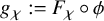 are the dominant 2-step nilspace character components of f for some finite set S, and the matrix E is a small error. In particular, by the orthogonality properties of the functions
$g_\chi $
are the dominant 2-step nilspace character components of f for some finite set S, and the matrix E is a small error. In particular, by the orthogonality properties of the functions
$g_\chi $
 , this theorem implies that each
$g_\chi $
, this theorem implies that each
$g_\chi $
 is a so-called pseudoeigenvector of
$\mathcal {K}_\varepsilon (f\otimes \overline {f})$
is a so-called pseudoeigenvector of
$\mathcal {K}_\varepsilon (f\otimes \overline {f})$
 (see Definition 7.1). As a consequence, one obtains that the corresponding pseudoeigenvalue is close to some proper eigenvalue
$\lambda $
(see Definition 7.1). As a consequence, one obtains that the corresponding pseudoeigenvalue is close to some proper eigenvalue
$\lambda $
 . Furthermore, if
$\lambda $
. Furthermore, if
$\lambda $
 is well separated from other eigenvalues, then the corresponding eigenvector v is close to
$g_\chi $
is well separated from other eigenvalues, then the corresponding eigenvector v is close to
$g_\chi $
 . This phenomenon yields a direct connection between the eigenvectors of
$\mathcal {K}_\varepsilon (f\otimes \overline {f})$
. This phenomenon yields a direct connection between the eigenvectors of
$\mathcal {K}_\varepsilon (f\otimes \overline {f})$
 and the nilspace characters
$g_\chi $
and the nilspace characters
$g_\chi $
 .
.
1.4 Connection with the ultralimit setting
To close this introduction, let us mention that the spectral approach to higher-order Fourier analysis is deeply motivated by an analogous construction in the ultralimit setting [Reference Szegedy58, Reference Szegedy59, Reference Szegedy60], which, on one hand, is more exact (not depending on various parameters), and on the other hand is intrinsically qualitative (in particular not yielding effective bounds). This construction involves measurable functions on ultraproducts of abelian groups. In particular, the Gowers norms become seminorms on such groups. In general, a major benefit of this ultralimit approach is its simpler and more algebraic language. This is illustrated by the following facts that hold in this setting: the notion of noise of order
$k-1$
 becomes exact, namely, it becomes the property of having
$U^k$
becomes exact, namely, it becomes the property of having
$U^k$
 -seminorm equal to 0; then, every bounded measurable function f can be uniquely decomposed as
$f = f_s + f_r$
-seminorm equal to 0; then, every bounded measurable function f can be uniquely decomposed as
$f = f_s + f_r$
 , where
$f_r$
, where
$f_r$
 is noise of order
$k-1$
is noise of order
$k-1$
 and
$f_s$
and
$f_s$
 is a structured function of order
$k-1$
is a structured function of order
$k-1$
 , that is, is orthogonal to any noise function of order
$k-1$
, that is, is orthogonal to any noise function of order
$k-1$
 . Moreover, it can be proved that there is a sub-
$\sigma $
. Moreover, it can be proved that there is a sub-
$\sigma $
 -algebra
$\mathcal {F}_{k-1}$
-algebra
$\mathcal {F}_{k-1}$
 on any such group such that a function g is
$\mathcal {F}_{k-1}$
on any such group such that a function g is
$\mathcal {F}_{k-1}$
 -measurable if and only if g is structured of order
$k-1$
-measurable if and only if g is structured of order
$k-1$
 . Hence, the structured part
$f_s$
. Hence, the structured part
$f_s$
 can be obtained as the conditional expectation
$\mathbb {E}(f|\mathcal {F}_{k-1})$
can be obtained as the conditional expectation
$\mathbb {E}(f|\mathcal {F}_{k-1})$
 relative to the
$\sigma $
relative to the
$\sigma $
 -algebra
$\mathcal {F}_{k-1}$
-algebra
$\mathcal {F}_{k-1}$
 . In this setting, the spectral approach simplifies to applying the map
$g \mapsto \mathbb {E}(g|\mathcal {F}_{k-1})$
. In this setting, the spectral approach simplifies to applying the map
$g \mapsto \mathbb {E}(g|\mathcal {F}_{k-1})$
 to each
$\operatorname {\mathrm {Z}}$
to each
$\operatorname {\mathrm {Z}}$
 -diagonal function of
$f \otimes \overline {f}$
-diagonal function of
$f \otimes \overline {f}$
 , yielding the unique self-adjoint operator
$M(f,k)$
, yielding the unique self-adjoint operator
$M(f,k)$
 .
.
Quite surprisingly, and nontrivially, the eigenvectors of
$M(f,k)$
 are structured functions of order k and their multiplicative derivatives are structured of order
$k-1$
are structured functions of order k and their multiplicative derivatives are structured of order
$k-1$
 (see [Reference Szegedy58, Theorem 2] and [Reference Szegedy59]). This constitutes a limit-setting analogue of the notion of k-th order character introduced in this paper (Definition 2.29). Another useful property of
$M(f,k)$
(see [Reference Szegedy58, Theorem 2] and [Reference Szegedy59]). This constitutes a limit-setting analogue of the notion of k-th order character introduced in this paper (Definition 2.29). Another useful property of
$M(f,k)$
 is that the k-th order structured part of f is equal to the projection of f onto the space spanned by the eigenvectors of
$M(f,k)$
is that the k-th order structured part of f is equal to the projection of f onto the space spanned by the eigenvectors of
$M(f,k)$
 with nonzero eigenvalues. The resulting decomposition of the structured part of f into these eigenvectors is a higher-order generalization of the ordinary Fourier transform.
The ultralimit setting serves as a valuable framework for envisioning further results in higher-order Fourier analysis and deriving them at a qualitative level. This will be explored in future work in connection with the spectral approach, especially in the general k-th order case. On the other hand, for the aim of making higher-order Fourier analysis practical, it becomes vital to introduce useful notions of a finite (usually parametric) type, and in this effort one is also aided by the deeper insights provided by the structures underlying higher-order decompositions, such as nilmanifolds and, more broadly, nilspaces. Hence this paper’s focus on developing new connections between these structures, spectral properties, and higher-order decompositions.
2 Basic notions
Throughout this paper, by
$\operatorname {\mathrm {Z}}$
 we will denote a finite abelian group, unless we explicitly say otherwise. Much of our work will involve the following special type of square matrices.
Definition 2.1 (
$\operatorname {\mathrm {Z}}$
-matrices).

Let
$\operatorname {\mathrm {Z}}$
 be a finite abelian group. A
$\operatorname {\mathrm {Z}}$
be a finite abelian group. A
$\operatorname {\mathrm {Z}}$
 -matrix is a matrix in
$\mathbb {C}^{\operatorname {\mathrm {Z}}\times \operatorname {\mathrm {Z}}}$
-matrix is a matrix in
$\mathbb {C}^{\operatorname {\mathrm {Z}}\times \operatorname {\mathrm {Z}}}$
 . Given such a matrix M and an element
$t\in \operatorname {\mathrm {Z}}$
. Given such a matrix M and an element
$t\in \operatorname {\mathrm {Z}}$
 , we call the set of pairs
$\{(z+t,z): z\in \operatorname {\mathrm {Z}}\}$
, we call the set of pairs
$\{(z+t,z): z\in \operatorname {\mathrm {Z}}\}$
 , viewed as a set of indices of entries of M, the
$\operatorname {\mathrm {Z}}$
, viewed as a set of indices of entries of M, the
$\operatorname {\mathrm {Z}}$
 -diagonal of M at level t (or the t-th
$\operatorname {\mathrm {Z}}$
-diagonal of M at level t (or the t-th
$\operatorname {\mathrm {Z}}$
 -diagonal of M), and we denote it by
$\operatorname {\mathrm {diag}}(t)$
-diagonal of M), and we denote it by
$\operatorname {\mathrm {diag}}(t)$
 . The
$\operatorname {\mathrm {Z}}$
. The
$\operatorname {\mathrm {Z}}$
 -diagonal function of M at level t is the function

We then define the map
$\mathfrak {D}_M:\operatorname {\mathrm {Z}}\to L^2(\operatorname {\mathrm {Z}})$
 as
$t\mapsto \mathfrak {D}_{M,t}$
as
$t\mapsto \mathfrak {D}_{M,t}$
 .
.
An important type of
$\operatorname {\mathrm {Z}}$
 -matrix for us will be the rank-1 examples of the form
$M=f\otimes \overline {f}$
-matrix for us will be the rank-1 examples of the form
$M=f\otimes \overline {f}$
 for
$f\in \mathbb {C}^{\operatorname {\mathrm {Z}}}$
for
$f\in \mathbb {C}^{\operatorname {\mathrm {Z}}}$
 , that is,
$M(x,y)=f(x)\overline {f(y)}$
, that is,
$M(x,y)=f(x)\overline {f(y)}$
 for
$x,y\in \operatorname {\mathrm {Z}}$
for
$x,y\in \operatorname {\mathrm {Z}}$
 . In this case, note that
$\mathfrak {D}_{f\otimes \overline {f},t}(z)=\Delta _tf(z)$
. In this case, note that
$\mathfrak {D}_{f\otimes \overline {f},t}(z)=\Delta _tf(z)$
 .
.
Remark 2.2. Thus
$\operatorname {\mathrm {Z}}$
 -matrices have an abelian group structure on the index set of their rows and columns. The term “diagonal” is inspired by the case where
$\operatorname {\mathrm {Z}}$
-matrices have an abelian group structure on the index set of their rows and columns. The term “diagonal” is inspired by the case where
$\operatorname {\mathrm {Z}}$
 is a finite cyclic group
$\mathbb {Z}_N$
is a finite cyclic group
$\mathbb {Z}_N$
 , identified with the set of integers
$\{0,1,\ldots , N-1\}$
, identified with the set of integers
$\{0,1,\ldots , N-1\}$
 with addition modulo N. In this case, labeling the rows and columns of M in order by
$0,1,\ldots , N-1$
with addition modulo N. In this case, labeling the rows and columns of M in order by
$0,1,\ldots , N-1$
 , the
$\operatorname {\mathrm {Z}}$
, the
$\operatorname {\mathrm {Z}}$
 -diagonals are indeed diagonal subsets of the matrix. For a general finite abelian group
$\operatorname {\mathrm {Z}}$
-diagonals are indeed diagonal subsets of the matrix. For a general finite abelian group
$\operatorname {\mathrm {Z}}$
 , we can fix an arbitrary ordering of the elements of
$\operatorname {\mathrm {Z}}$
, we can fix an arbitrary ordering of the elements of
$\operatorname {\mathrm {Z}}$
 (with 0 as the first element) and use this ordering for rows and columns. However, in general the
$\operatorname {\mathrm {Z}}$
(with 0 as the first element) and use this ordering for rows and columns. However, in general the
$\operatorname {\mathrm {Z}}$
 -diagonals no longer look like diagonal subsets of the matrix (take, for instance,
$\operatorname {\mathrm {Z}}=\mathbb {Z}_2^2$
-diagonals no longer look like diagonal subsets of the matrix (take, for instance,
$\operatorname {\mathrm {Z}}=\mathbb {Z}_2^2$
 ).
).
We equip
$\operatorname {\mathrm {Z}}$
 with its probability Haar measure (i.e., normalized counting measure). This induces the standard inner-product operation
$\langle f,g\rangle := \mathbb {E}_{x\in \operatorname {\mathrm {Z}}} f(x)\overline {g(x)}$
with its probability Haar measure (i.e., normalized counting measure). This induces the standard inner-product operation
$\langle f,g\rangle := \mathbb {E}_{x\in \operatorname {\mathrm {Z}}} f(x)\overline {g(x)}$
 for any functions
$f,g\in \mathbb {C}^{\operatorname {\mathrm {Z}}}$
for any functions
$f,g\in \mathbb {C}^{\operatorname {\mathrm {Z}}}$
 , with the associated
$L^2$
, with the associated
$L^2$
 -norm
$\|f\|_{L^2}=\langle f,f\rangle ^{1/2}$
-norm
$\|f\|_{L^2}=\langle f,f\rangle ^{1/2}$
 . In what follows, the notation
$\|\cdot \|_2$
. In what follows, the notation
$\|\cdot \|_2$
 will always indicate this normalized
$L^2$
will always indicate this normalized
$L^2$
 -norm when applied to functions in
$\mathbb {C}^{\operatorname {\mathrm {Z}}}$
-norm when applied to functions in
$\mathbb {C}^{\operatorname {\mathrm {Z}}}$
 . When we wish to use instead the Euclidean norm of a vector without normalization, then we will signal this explicitly by writing
$\|\cdot \|_{\ell ^2}$
. When we wish to use instead the Euclidean norm of a vector without normalization, then we will signal this explicitly by writing
$\|\cdot \|_{\ell ^2}$
 instead of
$\|\cdot \|_2$
instead of
$\|\cdot \|_2$
 (thus
$\|f\|_{\ell ^2}=(\sum _{x\in \operatorname {\mathrm {Z}}} |f(x)|^2)^{1/2}$
(thus
$\|f\|_{\ell ^2}=(\sum _{x\in \operatorname {\mathrm {Z}}} |f(x)|^2)^{1/2}$
 ).
).
It will be useful to view
$\operatorname {\mathrm {Z}}$
 -matrices as kernels of integral linear operators on
$L^2(\operatorname {\mathrm {Z}})$
-matrices as kernels of integral linear operators on
$L^2(\operatorname {\mathrm {Z}})$
 relative to the normalized Haar measure (in particular, in this sense the concept of
$\operatorname {\mathrm {Z}}$
relative to the normalized Haar measure (in particular, in this sense the concept of
$\operatorname {\mathrm {Z}}$
 -matrix extends naturally to compact abelian groups). However, this view entails an associated normalization of certain operations, which we shall use throughout the paper and which we underline as follows.
Definition 2.3. For any
$\operatorname {\mathrm {Z}}$
 -matrix
$M\in \mathbb {C}^{\operatorname {\mathrm {Z}}\times \operatorname {\mathrm {Z}}}$
-matrix
$M\in \mathbb {C}^{\operatorname {\mathrm {Z}}\times \operatorname {\mathrm {Z}}}$
 and any function
$f\in \mathbb {C}^{\operatorname {\mathrm {Z}}}$
and any function
$f\in \mathbb {C}^{\operatorname {\mathrm {Z}}}$
 , we define the function
$Mf\in \mathbb {C}^{\operatorname {\mathrm {Z}}}$
, we define the function
$Mf\in \mathbb {C}^{\operatorname {\mathrm {Z}}}$
 by
$Mf(x)= \mathbb {E}_{y\in \operatorname {\mathrm {Z}}} M(x,y)f(y)$
by
$Mf(x)= \mathbb {E}_{y\in \operatorname {\mathrm {Z}}} M(x,y)f(y)$
 . Accordingly, the product of two
$\operatorname {\mathrm {Z}}$
. Accordingly, the product of two
$\operatorname {\mathrm {Z}}$
 -matrices M,
$M'$
-matrices M,
$M'$
 is the
$\operatorname {\mathrm {Z}}$
is the
$\operatorname {\mathrm {Z}}$
 -matrix
$MM'$
-matrix
$MM'$
 defined by
$(MM')(x,y)=\mathbb {E}_{z\in \operatorname {\mathrm {Z}}} M(x,z)M'(z,y)$
defined by
$(MM')(x,y)=\mathbb {E}_{z\in \operatorname {\mathrm {Z}}} M(x,z)M'(z,y)$
 (thus
$MM'$
(thus
$MM'$
 is the kernel of the composition of the linear integral operators with kernels
$M,M'$
is the kernel of the composition of the linear integral operators with kernels
$M,M'$
 ). The notions of eigenvector and eigenvalue of a
$\operatorname {\mathrm {Z}}$
). The notions of eigenvector and eigenvalue of a
$\operatorname {\mathrm {Z}}$
 -matrix are also normalized accordingly, thus a vector
$v\in \mathbb {C}^{\operatorname {\mathrm {Z}}}$
-matrix are also normalized accordingly, thus a vector
$v\in \mathbb {C}^{\operatorname {\mathrm {Z}}}$
 is an eigenvector of M with eigenvalue
$\lambda \in \mathbb {C}$
is an eigenvector of M with eigenvalue
$\lambda \in \mathbb {C}$
 if
$\mathbb {E}_{y\in \operatorname {\mathrm {Z}}} M(x,y)v(y)=\lambda v(x)$
if
$\mathbb {E}_{y\in \operatorname {\mathrm {Z}}} M(x,y)v(y)=\lambda v(x)$
 for every
$x\in \operatorname {\mathrm {Z}}$
for every
$x\in \operatorname {\mathrm {Z}}$
 . Finally, note that when we use the notation
$\|\cdot \|_2$
. Finally, note that when we use the notation
$\|\cdot \|_2$
 with a
$\operatorname {\mathrm {Z}}$
with a
$\operatorname {\mathrm {Z}}$
 -matrix, we always mean the version of the Euclidean norm (or Hilbert-Schmidt norm, or Schatten 2-norm) compatible with the normalized inner-product on
$\mathbb {C}^{\operatorname {\mathrm {Z}}}$
-matrix, we always mean the version of the Euclidean norm (or Hilbert-Schmidt norm, or Schatten 2-norm) compatible with the normalized inner-product on
$\mathbb {C}^{\operatorname {\mathrm {Z}}}$
 specified above, so
$\|M\|_2:=(\mathbb {E}_{x,y\in \operatorname {\mathrm {Z}}} |M(x,y)|^2)^{1/2}$
specified above, so
$\|M\|_2:=(\mathbb {E}_{x,y\in \operatorname {\mathrm {Z}}} |M(x,y)|^2)^{1/2}$
 .
.
We have seen above that from a
$\operatorname {\mathrm {Z}}$
 -matrix we obtain a map
$\mathfrak {D}_M:\operatorname {\mathrm {Z}}\to L^2(\operatorname {\mathrm {Z}})$
-matrix we obtain a map
$\mathfrak {D}_M:\operatorname {\mathrm {Z}}\to L^2(\operatorname {\mathrm {Z}})$
 sending each element of
$\operatorname {\mathrm {Z}}$
sending each element of
$\operatorname {\mathrm {Z}}$
 to its corresponding
$\operatorname {\mathrm {Z}}$
to its corresponding
$\operatorname {\mathrm {Z}}$
 -diagonal function in M. We can invert this map.
Definition 2.4. Given
$F:\operatorname {\mathrm {Z}}\to L^2(\operatorname {\mathrm {Z}})$
 , we define the
$\operatorname {\mathrm {Z}}$
, we define the
$\operatorname {\mathrm {Z}}$
 -matrix
$\widetilde {M}(F)(x,y):=[F(x-y)](y)$
-matrix
$\widetilde {M}(F)(x,y):=[F(x-y)](y)$
 .
.
In this notation
$[F(x-y)](y)$
 , the square brackets enclose the function
$F(x-y)\in L^2(\operatorname {\mathrm {Z}})$
, the square brackets enclose the function
$F(x-y)\in L^2(\operatorname {\mathrm {Z}})$
 , and the subsequent term
$(y)$
, and the subsequent term
$(y)$
 indicates the argument at which the function
$F(x-y)$
indicates the argument at which the function
$F(x-y)$
 is evaluated.
Lemma 2.5. For any
$\operatorname {\mathrm {Z}}$
 -matrix M we have
$\widetilde {M}(\mathfrak {D}_M) = M$
-matrix M we have
$\widetilde {M}(\mathfrak {D}_M) = M$
 , and for any map
$F:\operatorname {\mathrm {Z}}\to L^2(\operatorname {\mathrm {Z}})$
, and for any map
$F:\operatorname {\mathrm {Z}}\to L^2(\operatorname {\mathrm {Z}})$
 we have
$\mathfrak {D}_{\widetilde {M}(F)} = F$
we have
$\mathfrak {D}_{\widetilde {M}(F)} = F$
 .
.
Proof. We have
$\widetilde {M}(\mathfrak {D}_M)(x,y) = [\mathfrak {D}_M(x-y)](y) = [z\mapsto M(z+x-y,z)](y) = M(x,y)$
 . Conversely, for any
$F:\operatorname {\mathrm {Z}}\to L^2(\operatorname {\mathrm {Z}})$
. Conversely, for any
$F:\operatorname {\mathrm {Z}}\to L^2(\operatorname {\mathrm {Z}})$
 and
$x,y\in \operatorname {\mathrm {Z}}$
and
$x,y\in \operatorname {\mathrm {Z}}$
 , we have
$[\mathfrak {D}_{\widetilde {M}(F)}(x)](y) = [z\mapsto \widetilde {M}(F)(z+x,z)](y) = \widetilde {M}(F)(x+y,y) = [F(x)](y)$
, we have
$[\mathfrak {D}_{\widetilde {M}(F)}(x)](y) = [z\mapsto \widetilde {M}(F)(z+x,z)](y) = \widetilde {M}(F)(x+y,y) = [F(x)](y)$
 .
.
Next, we give an alternative description of the product of two
$\operatorname {\mathrm {Z}}$
 -matrices
$M,{M'}$
-matrices
$M,{M'}$
 , consisting in writing the product in terms of the
$\operatorname {\mathrm {Z}}$
, consisting in writing the product in terms of the
$\operatorname {\mathrm {Z}}$
 -diagonal functions of the matrices (rather than in terms of rows and columns as usual). To do so, let us view the
$\operatorname {\mathrm {Z}}$
-diagonal functions of the matrices (rather than in terms of rows and columns as usual). To do so, let us view the
$\operatorname {\mathrm {Z}}$
 -matrix
${M}$
-matrix
${M}$
 as the sum of the restrictions of
${M}$
as the sum of the restrictions of
${M}$
 to its
$\operatorname {\mathrm {Z}}$
to its
$\operatorname {\mathrm {Z}}$
 -diagonals:
${M}(x,y)=\sum _{t\in \operatorname {\mathrm {Z}}} 1_{\operatorname {\mathrm {diag}}(t)}(x,y) {M}(x,y)$
-diagonals:
${M}(x,y)=\sum _{t\in \operatorname {\mathrm {Z}}} 1_{\operatorname {\mathrm {diag}}(t)}(x,y) {M}(x,y)$
 .Footnote 5 Note that
$1_{\operatorname {\mathrm {diag}}(t)}(x,y)$
.Footnote 5 Note that
$1_{\operatorname {\mathrm {diag}}(t)}(x,y)$
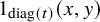 for
$x,y\in \operatorname {\mathrm {Z}}$
for
$x,y\in \operatorname {\mathrm {Z}}$
 is a permutation matrix, so
$1_{\operatorname {\mathrm {diag}}(t)}(x,y) {M}(x,y)$
is a permutation matrix, so
$1_{\operatorname {\mathrm {diag}}(t)}(x,y) {M}(x,y)$
 can be regarded as a weighted permutation
$\operatorname {\mathrm {Z}}$
can be regarded as a weighted permutation
$\operatorname {\mathrm {Z}}$
 -matrix, denoted
${M}_t$
-matrix, denoted
${M}_t$
 . We then have the following formula.
Lemma 2.6 (Product of weighted permutation
$\operatorname {\mathrm {Z}}$
-matrices).

Given two weighted permutation
$\operatorname {\mathrm {Z}}$
 -matrices
$M_t$
-matrices
$M_t$
 and
$ M^{\prime }_{t'}$
and
$ M^{\prime }_{t'}$
 , their product is a weighted permutation
$\operatorname {\mathrm {Z}}$
, their product is a weighted permutation
$\operatorname {\mathrm {Z}}$
 -matrix, supported on the
$\operatorname {\mathrm {Z}}$
-matrix, supported on the
$\operatorname {\mathrm {Z}}$
 -diagonal at level
$t+t'$
-diagonal at level
$t+t'$
 , with
$(x,y)$
, with
$(x,y)$
 -entry given by the following formula:

Proof. We have

Here
$1_{\operatorname {\mathrm {diag}}(t)}(x,v) 1_{\operatorname {\mathrm {diag}}(t')}(v,y)=1(x=v+t)1(v=y+t'=x-t)$
 , so the last average above equals

as claimed in (2.2).
Now we can give the formula for multiplication of
$\operatorname {\mathrm {Z}}$
 -matrices via
$\operatorname {\mathrm {Z}}$
-matrices via
$\operatorname {\mathrm {Z}}$
 -diagonals.
Proposition 2.7. Let
$\operatorname {\mathrm {Z}}$
 be a finite abelian group and let
$M, M'\in \mathbb {C}^{\operatorname {\mathrm {Z}}\times \operatorname {\mathrm {Z}}}$
be a finite abelian group and let
$M, M'\in \mathbb {C}^{\operatorname {\mathrm {Z}}\times \operatorname {\mathrm {Z}}}$
 . Then for every
$w\in \operatorname {\mathrm {Z}}$
. Then for every
$w\in \operatorname {\mathrm {Z}}$
 we have

Proof. Using (2.2) we have that

and this equals
$\mathbb {E}_{t \in \operatorname {\mathrm {Z}}} \;\mathfrak {D}_{M,t}(z+w-t)\; \mathfrak {D}_{M',w-t}(z)$
 , as claimed.
Remark 2.8. Proposition 2.7 is useful in particular because it implies that if
$\mathcal {A}$
 is a shift-invariant algebra of functions (i.e., closed under addition, multiplication, and shifting) and every
$\operatorname {\mathrm {Z}}$
is a shift-invariant algebra of functions (i.e., closed under addition, multiplication, and shifting) and every
$\operatorname {\mathrm {Z}}$
 -diagonal of M and
$M'$
-diagonal of M and
$M'$
 is a function in
$\mathcal {A}$
is a function in
$\mathcal {A}$
 , then this also holds for the
$\operatorname {\mathrm {Z}}$
, then this also holds for the
$\operatorname {\mathrm {Z}}$
 -matrix product
$MM'$
-matrix product
$MM'$
 . (This observation is used for instance in Lemma 2.48.)
Remark 2.9. Among the notions introduced above and in what follows, many are easily extended to all compact abelian groups, and some even to locally compact abelian groups. Similarly, most proofs extend to compact abelian groups. We have nevertheless restricted our notation and treatment to finite abelian groups
$\operatorname {\mathrm {Z}}$
 , because the main applications of algorithmic type concern primarily such groups, but also because this restriction simplifies the treatment markedly, avoiding various analytic issues related to measurability or convergence (especially once we start using Fourier analysis below).
2.1 Invariant operators
In what follows we shall often refer to maps
$\mathbb {C}^{\operatorname {\mathrm {Z}}} \to \mathbb {C}^{\operatorname {\mathrm {Z}}}$
 as operators (which will not necessarily be linear). We will apply such operators to
$\operatorname {\mathrm {Z}}$
as operators (which will not necessarily be linear). We will apply such operators to
$\operatorname {\mathrm {Z}}$
 -matrices along the
$\operatorname {\mathrm {Z}}$
-matrices along the
$\operatorname {\mathrm {Z}}$
 -diagonals, and the main operators that we shall apply have a specific invariance property, defined as follows.
Definition 2.10. Let
$\operatorname {\mathrm {Z}}$
 be a finite abelian group, let K be any operator
$\mathbb {C}^{\operatorname {\mathrm {Z}}} \to \mathbb {C}^{\operatorname {\mathrm {Z}}}$
be a finite abelian group, let K be any operator
$\mathbb {C}^{\operatorname {\mathrm {Z}}} \to \mathbb {C}^{\operatorname {\mathrm {Z}}}$
 , and let M be a
$\operatorname {\mathrm {Z}}$
, and let M be a
$\operatorname {\mathrm {Z}}$
 -matrix. We denote by
$\mathcal {K}(M)$
-matrix. We denote by
$\mathcal {K}(M)$
 the
$\operatorname {\mathrm {Z}}$
the
$\operatorname {\mathrm {Z}}$
 -matrix
$\widetilde {M}(K\operatorname {\mathrm {\circ }} \mathfrak {D}_M) = \widetilde {M}(K( \mathfrak {D}_M))$
-matrix
$\widetilde {M}(K\operatorname {\mathrm {\circ }} \mathfrak {D}_M) = \widetilde {M}(K( \mathfrak {D}_M))$
 . For a function
$f:\operatorname {\mathrm {Z}}\to \mathbb {C}$
. For a function
$f:\operatorname {\mathrm {Z}}\to \mathbb {C}$
 and
$h\in \operatorname {\mathrm {Z}}$
and
$h\in \operatorname {\mathrm {Z}}$
 , let
$T^hf$
, let
$T^hf$
 denote the function
$x\mapsto f(x+h)$
denote the function
$x\mapsto f(x+h)$
 . We say that the operator K is invariant if
$K(T^hf)=T^hK(f)$
. We say that the operator K is invariant if
$K(T^hf)=T^hK(f)$
 and
$K(\overline {f})=\overline {K(f)}$
and
$K(\overline {f})=\overline {K(f)}$
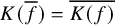 , and we then say that the associated matrix operator
$\mathcal {K}$
, and we then say that the associated matrix operator
$\mathcal {K}$
 is also invariant.
Remark 2.11. Here and throughout the paper, note that given a map
$K: \mathbb {C}^{\operatorname {\mathrm {Z}}}\to \mathbb {C}^{\operatorname {\mathrm {Z}}}$
 , for any
$\operatorname {\mathrm {Z}}$
, for any
$\operatorname {\mathrm {Z}}$
 -matrix M we use the calligraphic notation
$\mathcal {K}(M)$
-matrix M we use the calligraphic notation
$\mathcal {K}(M)$
 to denote the matrix obtained by applying K to each
$\operatorname {\mathrm {Z}}$
to denote the matrix obtained by applying K to each
$\operatorname {\mathrm {Z}}$
 -diagonal of M.
We shall apply such invariant operators to self-adjoint matrices M, such as rank-1 matrices of the form
$f\otimes \overline {f}$
 for
$f\in \mathbb {C}^{\operatorname {\mathrm {Z}}}$
for
$f\in \mathbb {C}^{\operatorname {\mathrm {Z}}}$
 . The following lemma shows that invariance of K suffices to ensure that
$\mathcal {K}(M)$
. The following lemma shows that invariance of K suffices to ensure that
$\mathcal {K}(M)$
 is also self-adjoint.
Lemma 2.12. If
$M\in \mathbb {C}^{\operatorname {\mathrm {Z}}\times \operatorname {\mathrm {Z}}}$
 is self-adjoint and K is invariant, then
$\mathcal {K}(M)$
is self-adjoint and K is invariant, then
$\mathcal {K}(M)$
 is self-adjoint.
Proof. We need to show that for all
$x,y\in \operatorname {\mathrm {Z}}$
 we have
$\mathcal {K}(M)(x,y) = \overline {\mathcal {K}(M)(y,x)}$
we have
$\mathcal {K}(M)(x,y) = \overline {\mathcal {K}(M)(y,x)}$
 . By definition we have
$\mathcal {K}(M)(x,y) = \widetilde {M}(K(\mathfrak {D}_M))(x,y) = [K(\mathfrak {D}_M)(x-y)](y)= [K(\mathfrak {D}_{M,x-y})](y)$
. By definition we have
$\mathcal {K}(M)(x,y) = \widetilde {M}(K(\mathfrak {D}_M))(x,y) = [K(\mathfrak {D}_M)(x-y)](y)= [K(\mathfrak {D}_{M,x-y})](y)$
 . Recall that
$\mathfrak {D}_{M,x-y}(z)=M(z+x-y,z) = \overline {M(z,z+x-y)}$
. Recall that
$\mathfrak {D}_{M,x-y}(z)=M(z+x-y,z) = \overline {M(z,z+x-y)}$
 , where in the last equality we used that M is self-adjoint. Let
$t\in \operatorname {\mathrm {Z}}$
, where in the last equality we used that M is self-adjoint. Let
$t\in \operatorname {\mathrm {Z}}$
 . Applying the shift operator
$T^t$
. Applying the shift operator
$T^t$
 to this function, we have
$T^t\mathfrak {D}_{M,x-y}(z) = \overline {M(z+t,z+t+x-y)}$
to this function, we have
$T^t\mathfrak {D}_{M,x-y}(z) = \overline {M(z+t,z+t+x-y)}$
 . Letting
$t:=y-x$
. Letting
$t:=y-x$
 , we further obtain
$T^{y-x}\mathfrak {D}_{M,x-y}(z) = \overline {\mathfrak {D}_{M,y-x}}$
, we further obtain
$T^{y-x}\mathfrak {D}_{M,x-y}(z) = \overline {\mathfrak {D}_{M,y-x}}$
 .
.
Since K is invariant, for any
$t\in \operatorname {\mathrm {Z}}$
 and
$f\in L^2(\operatorname {\mathrm {Z}})$
and
$f\in L^2(\operatorname {\mathrm {Z}})$
 , we have
$T^{-t}K(T^t f) = K(f)$
, we have
$T^{-t}K(T^t f) = K(f)$
 . In particular,
$\mathcal {K}(M)(x,y)=[K(\mathfrak {D}_{M,x-y})(z)] (y)= [T^{-t}K(T^t \mathfrak {D}_{M,x-y}(z))](y) = [K(T^t \mathfrak {D}_{M,x-y}(z))](y-t)$
. In particular,
$\mathcal {K}(M)(x,y)=[K(\mathfrak {D}_{M,x-y})(z)] (y)= [T^{-t}K(T^t \mathfrak {D}_{M,x-y}(z))](y) = [K(T^t \mathfrak {D}_{M,x-y}(z))](y-t)$
 . Letting
$t:=y-x$
. Letting
$t:=y-x$
 , we have
$\mathcal {K}(M)(x,y) = [K(\overline {\mathfrak {D}_{M,y-x}})(z)](x)$
, we have
$\mathcal {K}(M)(x,y) = [K(\overline {\mathfrak {D}_{M,y-x}})(z)](x)$
 . As K commutes with complex conjugation, we have
$[K(\mathfrak {D}_{M,x-y})(z)] (x)=\overline {[K(\mathfrak {D}_{M,y-x})(z)](x)}$
. As K commutes with complex conjugation, we have
$[K(\mathfrak {D}_{M,x-y})(z)] (x)=\overline {[K(\mathfrak {D}_{M,y-x})(z)](x)}$
 , and this is by definition equal to
$\overline {\mathcal {K}(M)(y,x)}$
, and this is by definition equal to
$\overline {\mathcal {K}(M)(y,x)}$
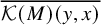 .
.
Using various invariant operators
$K:\mathbb {C}^{\operatorname {\mathrm {Z}}}\to \mathbb {C}^{\operatorname {\mathrm {Z}}}$
 on the diagonals, and then taking the spectral decomposition of the resulting matrices, we obtain eigenvectors with various properties. Let us fix such an operator K and let
$f:\operatorname {\mathrm {Z}}\to \mathbb {C}$
on the diagonals, and then taking the spectral decomposition of the resulting matrices, we obtain eigenvectors with various properties. Let us fix such an operator K and let
$f:\operatorname {\mathrm {Z}}\to \mathbb {C}$
 . As noted earlier, the matrix
$f\otimes \overline {f}$
. As noted earlier, the matrix
$f\otimes \overline {f}$
 is a rank-1 self-adjoint matrix. Let
$Q:=\mathcal {K}(f\otimes \overline {f})$
is a rank-1 self-adjoint matrix. Let
$Q:=\mathcal {K}(f\otimes \overline {f})$
 . Since Q is Hermitian by Lemma 2.12, we can apply the classical spectral theorem, obtaining the decomposition
$Q=\sum _{i=1}^n \lambda _i\, v_i\otimes \overline {v_i}$
. Since Q is Hermitian by Lemma 2.12, we can apply the classical spectral theorem, obtaining the decomposition
$Q=\sum _{i=1}^n \lambda _i\, v_i\otimes \overline {v_i}$
 , where
$n=|\operatorname {\mathrm {Z}}|$
, where
$n=|\operatorname {\mathrm {Z}}|$
 , the
$v_i$
, the
$v_i$
 are eigenvectors of Q forming an orthonormal basis of
$\mathbb {C}^{\operatorname {\mathrm {Z}}}$
are eigenvectors of Q forming an orthonormal basis of
$\mathbb {C}^{\operatorname {\mathrm {Z}}}$
 , and for each
$i\in [n]$
, and for each
$i\in [n]$
 the real scalar
$\lambda _i$
the real scalar
$\lambda _i$
 is the eigenvalue of Q corresponding to
$v_i$
is the eigenvalue of Q corresponding to
$v_i$
 . We can also assume (by permuting if necessary) that
$\lambda _1\geq \lambda _2\geq \dots \geq \lambda _n$
. We can also assume (by permuting if necessary) that
$\lambda _1\geq \lambda _2\geq \dots \geq \lambda _n$
 . The general idea of our spectral approach is that eigenvectors of Q corresponding to the largest eigenvalues are interesting “components” of the function f. The coefficients
$c_i:=\langle f,v_i \rangle $
. The general idea of our spectral approach is that eigenvectors of Q corresponding to the largest eigenvalues are interesting “components” of the function f. The coefficients
$c_i:=\langle f,v_i \rangle $
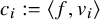 are also important, and their relation with the eigenvalues
$\lambda _i$
are also important, and their relation with the eigenvalues
$\lambda _i$
 is often nontrivial.
In this section, we give various more detailed illustrations of this phenomenon, while keeping the involved machinery at a relatively simple level (in particular, not yet requiring deeper background such as nilspace theory).
2.2 A simple instance of the spectral approach: recovering classical Fourier analysis
As a first illustration of our use of invariant operators, let us detail here the remark made in the introduction, namely that if we apply to
$f\otimes \overline {f}$
 the operator consisting in simply averaging out each
$\operatorname {\mathrm {Z}}$
the operator consisting in simply averaging out each
$\operatorname {\mathrm {Z}}$
 -diagonal, then the spectral decomposition of the resulting matrix (over
$\mathbb {C}$
-diagonal, then the spectral decomposition of the resulting matrix (over
$\mathbb {C}$
 ) yields essentially the Fourier decomposition of f.
To see this in more detail, let K be the invariant operator consisting in averaging the function
$f:\operatorname {\mathrm {Z}}\to \mathbb {C}$
 over the group
$\operatorname {\mathrm {Z}}$
over the group
$\operatorname {\mathrm {Z}}$
 , that is
$K(f)=\mathbb {E}_{\operatorname {\mathrm {Z}}}(f)$
, that is
$K(f)=\mathbb {E}_{\operatorname {\mathrm {Z}}}(f)$
 . Note that K is the orthogonal projection to the subspace of constant functions in
$\mathbb {C}^{\operatorname {\mathrm {Z}}}$
. Note that K is the orthogonal projection to the subspace of constant functions in
$\mathbb {C}^{\operatorname {\mathrm {Z}}}$
 . In this case, one can easily show that the classical Fourier characters
$\chi \in \widehat {\operatorname {\mathrm {Z}}}$
. In this case, one can easily show that the classical Fourier characters
$\chi \in \widehat {\operatorname {\mathrm {Z}}}$
 are eigenvectors of
$\mathcal {K}(f\otimes \overline {f})$
are eigenvectors of
$\mathcal {K}(f\otimes \overline {f})$
 , and the eigenvalue corresponding to a character
$\chi $
, and the eigenvalue corresponding to a character
$\chi $
 is the squared magnitude of the corresponding Fourier coefficient, that is,
$|\widehat {f}(\chi )|^2$
is the squared magnitude of the corresponding Fourier coefficient, that is,
$|\widehat {f}(\chi )|^2$
 . Indeed, using the standard Fourier expansion
$f = \sum _{\chi \in \widehat {\operatorname {\mathrm {Z}}}} \langle f,\chi \rangle \chi $
. Indeed, using the standard Fourier expansion
$f = \sum _{\chi \in \widehat {\operatorname {\mathrm {Z}}}} \langle f,\chi \rangle \chi $
 , we have

Remark 2.13. Note that even though the previous calculations tell us that Fourier characters are eigenvectors, we may not be able to recover all of them from the previous decomposition using only spectral analysis. To illustrate this, consider
$f=\chi +\chi '$
 for two Fourier characters
$\chi \not =\chi '$
for two Fourier characters
$\chi \not =\chi '$
 on
$\operatorname {\mathrm {Z}}$
on
$\operatorname {\mathrm {Z}}$
 . Then, looking at the spectrum of Q as described above, we will just find an eigenspace generated by
$\chi $
. Then, looking at the spectrum of Q as described above, we will just find an eigenspace generated by
$\chi $
 and
$\chi '$
and
$\chi '$
 for the eigenvalue 1, and another eigenspace of eigenvalue 0 generated by all other characters. Thus, if we want to recover the Fourier decomposition using this procedure, then we need a way of finding individual characters (such as
$\chi ,\chi '$
for the eigenvalue 1, and another eigenspace of eigenvalue 0 generated by all other characters. Thus, if we want to recover the Fourier decomposition using this procedure, then we need a way of finding individual characters (such as
$\chi ,\chi '$
 here) inside eigenspaces of dimension greater than 1. The same phenomenon can occur in the higher-order versions of this spectral approach, and will be addressed in Subsection 7.2.
Remark 2.14. This example, involving the averaging operator K, enables us to highlight the connection between our approach and principal component analysis. More precisely, note that the operator
$\mathcal {K}(f\otimes \overline {f})$
 in this case is equal to the Gram matrix of the shifts of f, which can also be viewed as a covariance matrix. Thus, this operator is positive semidefinite, and the eigenvectors corresponding to dominant eigenvalues of this operator are the principal components of the set of shifts of f.
In what follows, we shall apply more subtle invariant operators than the averaging K in the above example. In particular, by applying an operator which keeps only the large Fourier coefficients of each
$\operatorname {\mathrm {Z}}$
 -diagonal of
$f\otimes \overline {f}$
-diagonal of
$f\otimes \overline {f}$
 (roughly speaking), we will see that the resulting dominant eigenvectors are important quadratic-Fourier-analytic components of f. This is the first nonclassical level of the general order-increment principle mentioned in the introduction. To detail all of this, we first need to discuss more precisely the notions of higher-order structures and characters that we will be able to capture in the spectral approach. We do this in the next two subsections.
2.3 Structured functions of order k
An important principle in higher-order Fourier analysis is the dichotomy between structure and randomness relative to the Gowers norms. A 1-bounded function
$f:\operatorname {\mathrm {Z}}\to \mathbb {C}$
 is said to be quasirandom of order k if
$\|f\|_{U^{k+1}}\le \delta $
is said to be quasirandom of order k if
$\|f\|_{U^{k+1}}\le \delta $
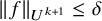 for some small
$\delta>0$
for some small
$\delta>0$
 , and a more precise aspect of the dichotomy is the decomposition of a function into a sum of a quasirandom part and a structured part, where structure of order k can be defined in various interrelated ways based on the idea of being orthogonal to all quasirandom functions of order k. In infinite settings, such as the ergodic theoretic one [Reference Host and Kra43], or the ultraproduct setting [Reference Szegedy58], this orthogonality can be defined exactly, and the notion of structure is captured in an exact way by certain subspaces of a Hilbert space, corresponding to certain
$\sigma $
, and a more precise aspect of the dichotomy is the decomposition of a function into a sum of a quasirandom part and a structured part, where structure of order k can be defined in various interrelated ways based on the idea of being orthogonal to all quasirandom functions of order k. In infinite settings, such as the ergodic theoretic one [Reference Host and Kra43], or the ultraproduct setting [Reference Szegedy58], this orthogonality can be defined exactly, and the notion of structure is captured in an exact way by certain subspaces of a Hilbert space, corresponding to certain
$\sigma $
 -algebras or factors (see also Remark 2.28). However, in the setting of finite abelian groups, which we focus on in this paper, the notion of higher-order structure takes approximate and quantitative (or parametric) forms. In this subsection we give the precise definition of structured function of order k that we shall use in the rest of the paper. We discuss this first for order
$1$
-algebras or factors (see also Remark 2.28). However, in the setting of finite abelian groups, which we focus on in this paper, the notion of higher-order structure takes approximate and quantitative (or parametric) forms. In this subsection we give the precise definition of structured function of order k that we shall use in the rest of the paper. We discuss this first for order
$1$
 , and then generalize to higher orders.
For order 1 (i.e., in the setting of classical Fourier analysis), we use the following notion.
Definition 2.15 (Fourier-structured functions).
Let
$\operatorname {\mathrm {Z}}$
 be a finite abelian group. A function
$f:\operatorname {\mathrm {Z}}\to \mathbb {C}$
be a finite abelian group. A function
$f:\operatorname {\mathrm {Z}}\to \mathbb {C}$
 is
$(R,\delta )$
is
$(R,\delta )$
 -Fourier-structured if there is a function
$g:\operatorname {\mathrm {Z}}\to \mathbb {C}$
-Fourier-structured if there is a function
$g:\operatorname {\mathrm {Z}}\to \mathbb {C}$
 that is a linear combination of at most R Fourier characters on
$\operatorname {\mathrm {Z}}$
that is a linear combination of at most R Fourier characters on
$\operatorname {\mathrm {Z}}$
 and that satisfies
$\|f-g\|_2\leq \delta $
and that satisfies
$\|f-g\|_2\leq \delta $
 .
.
Remark 2.16. This property is almost identical to the notion of quantitative almost-periodicity from [Reference Tao and Vu66, Definition 10.34], but note that we do not require the coefficients in the linear combination to be 1-bounded. For functions f satisfying
$\|f\|_2\leq 1$
 , the two properties are equal. Indeed, if f is
$(R,\delta )$
, the two properties are equal. Indeed, if f is
$(R,\delta )$
 -Fourier-structured and
$\|f\|_2\leq 1$
-Fourier-structured and
$\|f\|_2\leq 1$
 , then we can see that f is
$(R,\delta )$
, then we can see that f is
$(R,\delta )$
 -almost-periodic as follows. Letting
$g=\sum _{i=1}^R c_i\chi _i$
-almost-periodic as follows. Letting
$g=\sum _{i=1}^R c_i\chi _i$
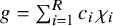 be the linear combination of characters
$\chi _i$
be the linear combination of characters
$\chi _i$
 with
$\|f-g\|_2\leq \delta $
with
$\|f-g\|_2\leq \delta $
 , we know that the orthogonal projection to the subspace spanned by these characters, namely
$g'=\sum _{i=1}^R \widehat {f}(\chi _i)\chi _i$
, we know that the orthogonal projection to the subspace spanned by these characters, namely
$g'=\sum _{i=1}^R \widehat {f}(\chi _i)\chi _i$
 , satisfies
$\|f-g'\|_2\le \delta $
, satisfies
$\|f-g'\|_2\le \delta $
 . Moreover, it follows from Parseval’s identity that
$|\widehat {f}(\chi _i)|\leq \|f\|_2\leq 1$
. Moreover, it follows from Parseval’s identity that
$|\widehat {f}(\chi _i)|\leq \|f\|_2\leq 1$
 for each i, and f is thus
$(R,\delta )$
for each i, and f is thus
$(R,\delta )$
 -almost-periodic as per [Reference Tao and Vu66]. Naming this property in terms of structure rather than almost-periodicity, as we do, is motivated by the developments below, which will introduce higher-order generalizations of this property that have a more direct connection with the notion of structure (as in the structure-randomness dichotomy) than with almost-periodicity.
Before we motivate Definition 2.15 further, let us recall other known tools to measure the Fourier structure of a function. These involve certain norms. A central example is the Wiener norm (also known as the algebra norm, or the spectral norm; see [Reference Green and Sanders30, Reference Tao64]), which we recall here.
Definition 2.17. The Wiener norm of a function
$f:\operatorname {\mathrm {Z}}\to \mathbb {C}$
 is
$\|f\|_{A(\operatorname {\mathrm {Z}})}:=\|\widehat {f}\|_{\ell ^1}$
is
$\|f\|_{A(\operatorname {\mathrm {Z}})}:=\|\widehat {f}\|_{\ell ^1}$
 .
.
Being
$(R,\delta )$
 -Fourier-structured is closely related to being bounded in the Wiener norm. We first show that the latter property implies the former, using the next lemma.
Recall that for a metric space X and a function
$f:X\to \mathbb {C}$
 , the support of f, denoted
$\operatorname {\mathrm {Supp}}(f)$
, the support of f, denoted
$\operatorname {\mathrm {Supp}}(f)$
 , is the closure of the set
$\{x\in X:f(x)\not =0\}$
, is the closure of the set
$\{x\in X:f(x)\not =0\}$
 .
.
Lemma 2.18. Let S be a finite set, let
$f:S\to \mathbb {C}$
 , and let
$\delta>0$
, and let
$\delta>0$
 . Let
$g:S\to \mathbb {C}$
. Let
$g:S\to \mathbb {C}$
 be the function
$g(s)=f(s)\,\mathbf {1}(|f(s)|\geq \delta )$
be the function
$g(s)=f(s)\,\mathbf {1}(|f(s)|\geq \delta )$
 . Then
$|\operatorname {\mathrm {Supp}}(g)|\leq \delta ^{-1}\|f\|_{\ell ^1(S)}$
. Then
$|\operatorname {\mathrm {Supp}}(g)|\leq \delta ^{-1}\|f\|_{\ell ^1(S)}$
 and
$\|f-g\|_{\ell ^2(S)}\leq \delta \|f\|_{\ell ^1(S)}$
and
$\|f-g\|_{\ell ^2(S)}\leq \delta \|f\|_{\ell ^1(S)}$
 .
.
Proof. It is clear that
$\delta \,|\operatorname {\mathrm {Supp}}(g)|\leq \|g\|_{\ell ^1}\leq \|f\|_{\ell ^1}$
 , which proves the first claim. On the other hand, by Hölder’s inequality we have
$\|f-g\|_{\ell ^2}\leq \|f-g\|_{\ell ^\infty }\|f-g\|_{\ell ^1}\leq \delta \|f\|_{\ell ^1}$
, which proves the first claim. On the other hand, by Hölder’s inequality we have
$\|f-g\|_{\ell ^2}\leq \|f-g\|_{\ell ^\infty }\|f-g\|_{\ell ^1}\leq \delta \|f\|_{\ell ^1}$
 .
.
Corollary 2.19. For any
$\delta>0$
 , any function
$f:\operatorname {\mathrm {Z}}\to \mathbb {C}$
, any function
$f:\operatorname {\mathrm {Z}}\to \mathbb {C}$
 is
$(\delta ^{-1}\|f\|_{A(\operatorname {\mathrm {Z}})}^2,\delta )$
is
$(\delta ^{-1}\|f\|_{A(\operatorname {\mathrm {Z}})}^2,\delta )$
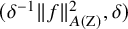 -Fourier-structured.
Proof. Applying Lemma 2.18 with
$\widehat {f}$
 and
$\delta>0$
and
$\delta>0$
 , we obtain that there is a function
$\widehat {g}:\widehat {\operatorname {\mathrm {Z}}}\to \mathbb {C}$
, we obtain that there is a function
$\widehat {g}:\widehat {\operatorname {\mathrm {Z}}}\to \mathbb {C}$
 whose support has size at most
$\delta ^{-1}\|f\|_{A(\operatorname {\mathrm {Z}})}$
whose support has size at most
$\delta ^{-1}\|f\|_{A(\operatorname {\mathrm {Z}})}$
 and such that
$\|\widehat {f}-\widehat {g}\|_{\ell ^2}\leq \delta $
and such that
$\|\widehat {f}-\widehat {g}\|_{\ell ^2}\leq \delta $
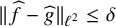 . The reverse Fourier transform g of
$\widehat {g}$
. The reverse Fourier transform g of
$\widehat {g}$
 is a linear combination of at most
$\delta ^{-1}\|f\|_{A(\operatorname {\mathrm {Z}})}$
is a linear combination of at most
$\delta ^{-1}\|f\|_{A(\operatorname {\mathrm {Z}})}$
 characters, and satisfies
$\|f-g\|_2=\|\widehat {f}-\widehat {g}\|_{\ell ^2}\leq \delta $
characters, and satisfies
$\|f-g\|_2=\|\widehat {f}-\widehat {g}\|_{\ell ^2}\leq \delta $
 . Thus f is
$(\delta ^{-1}\|f\|_{A(\operatorname {\mathrm {Z}})},\delta \|f\|_{A(\operatorname {\mathrm {Z}})})$
. Thus f is
$(\delta ^{-1}\|f\|_{A(\operatorname {\mathrm {Z}})},\delta \|f\|_{A(\operatorname {\mathrm {Z}})})$
 -Fourier-structured, whence, changing
$\delta \|f\|_{A(\operatorname {\mathrm {Z}})}$
-Fourier-structured, whence, changing
$\delta \|f\|_{A(\operatorname {\mathrm {Z}})}$
 to
$\delta $
to
$\delta $
 , the result follows.
Remark 2.20. More generally, if for some
$\alpha \in (0,1]$
 the norm
$\|\widehat {f}\|_{\ell ^{2-\alpha }}$
the norm
$\|\widehat {f}\|_{\ell ^{2-\alpha }}$
 is bounded above by some constant C, then for every
$\delta>0$
is bounded above by some constant C, then for every
$\delta>0$
 it follows similarly that f is
$(C/\delta ^{2-\alpha },\delta ^\alpha C)$
it follows similarly that f is
$(C/\delta ^{2-\alpha },\delta ^\alpha C)$
 -Fourier-structured. In particular, this is the case for the
$U^2$
-Fourier-structured. In particular, this is the case for the
$U^2$
 -dual norm, since we have the well-known formula
$\|f\|_{U^2}^*=\|\widehat {f}\|_{\ell ^{4/3}}$
-dual norm, since we have the well-known formula
$\|f\|_{U^2}^*=\|\widehat {f}\|_{\ell ^{4/3}}$
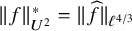 .
.
Let us now consider the converse direction, that is, whether
$(R,\delta )$
 -Fourier-structure implies being bounded in the Wiener norm or in the
$U^2$
-Fourier-structure implies being bounded in the Wiener norm or in the
$U^2$
 -dual norm. We first recall the following example, which rules out a naive converse to Corollary 2.19.
Example 2.21. Let
$\mathbb {Z}_N$
 be the finite cyclic group of order N, and let
$f:\mathbb {Z}_N\to \{0,1\}$
be the finite cyclic group of order N, and let
$f:\mathbb {Z}_N\to \{0,1\}$
 be the indicator function of the interval
$[1,\lfloor N/2\rfloor ]$
be the indicator function of the interval
$[1,\lfloor N/2\rfloor ]$
 . We have the well-known fact that
$\|f\|_{A(\operatorname {\mathrm {Z}})}=\Omega (\log N)$
. We have the well-known fact that
$\|f\|_{A(\operatorname {\mathrm {Z}})}=\Omega (\log N)$
 , whereas any norm
$\|\widehat {f}\|_{\ell ^p}$
, whereas any norm
$\|\widehat {f}\|_{\ell ^p}$
 with
$p>1$
with
$p>1$
 is bounded independently of N. In particular
$\|f\|_{U^2}^*$
is bounded independently of N. In particular
$\|f\|_{U^2}^*$
 is bounded, so by Remark 2.20 the function f is
$(O(\delta ^{-2/3},O(\delta ^{4/3}))$
is bounded, so by Remark 2.20 the function f is
$(O(\delta ^{-2/3},O(\delta ^{4/3}))$
 -Fourier-structured for every
$\delta $
-Fourier-structured for every
$\delta $
 , independently of N.
Notwithstanding this example, we have the following equivalence result, providing an alternative expression for Fourier structure, using the
$U^2$
 -dual norm instead of the Fourier transform.
Lemma 2.22. Consider the following properties of functions
$f:\operatorname {\mathrm {Z}}\to \mathbb {C}$
 .
.
-
(i) For some $R> 0$
and
$\delta \in [0,1]$
, the function f is
$(R,\delta )$
-Fourier-structured. -
(ii) For some $R'> 0$
and
$\delta '\in [0,1]$
, there exists
$g:\operatorname {\mathrm {Z}}\to \mathbb {C}$
with
$\|g\|_{U^2}^*\leq R'$
and
$\|f-g\|_2\leq \delta '$
.


These properties are equivalent in the following sense: if
$(i)$
 holds with
$(R, \delta )$
holds with
$(R, \delta )$
 then
$(ii)$
then
$(ii)$
 holds with
$\delta '=\delta $
holds with
$\delta '=\delta $
 and
$R'=R^{3/4}\|f\|_2$
and
$R'=R^{3/4}\|f\|_2$
 ; conversely, if
$(ii)$
; conversely, if
$(ii)$
 holds with
$(R', \delta ')$
holds with
$(R', \delta ')$
 then, for every
$\alpha>0$
then, for every
$\alpha>0$
 ,
$(i)$
,
$(i)$
 holds with
$R=\alpha ^{-6}{R'}^4(\|f\|_2+1)^2$
holds with
$R=\alpha ^{-6}{R'}^4(\|f\|_2+1)^2$
 and
$\delta =\alpha +\delta '$
and
$\delta =\alpha +\delta '$
 .
.
Proof. If
$(i)$
 holds, then, letting g be the projection of f to the linear span of the given R characters, we know that
$\|f-g\|_2\leq \delta $
holds, then, letting g be the projection of f to the linear span of the given R characters, we know that
$\|f-g\|_2\leq \delta $
 , and g has Fourier coefficients of modulus at most
$\|f\|_2$
, and g has Fourier coefficients of modulus at most
$\|f\|_2$
 , so
$\|g\|_{U^2}^*\leq R^{3/4} \|f\|_2$
, so
$\|g\|_{U^2}^*\leq R^{3/4} \|f\|_2$
 , whence
$(ii)$
, whence
$(ii)$
 holds as claimed.
If
$(ii)$
 holds, then we claim that for any
$\gamma>0$
holds, then we claim that for any
$\gamma>0$
 the function g is
$(\gamma ^{-2}(\|f\|_2+1)^2,\gamma ^{1/3}{R'}^{2/3})$
the function g is
$(\gamma ^{-2}(\|f\|_2+1)^2,\gamma ^{1/3}{R'}^{2/3})$
 -Fourier structured. Indeed, let
$S=\{\chi \in \widehat {\operatorname {\mathrm {Z}}}: |\widehat {g}(\chi )|>\gamma \}$
-Fourier structured. Indeed, let
$S=\{\chi \in \widehat {\operatorname {\mathrm {Z}}}: |\widehat {g}(\chi )|>\gamma \}$
 , and define
$h(x):=\sum _{\chi \in S} \widehat {g}(\chi ) \chi (x)$
, and define
$h(x):=\sum _{\chi \in S} \widehat {g}(\chi ) \chi (x)$
 . By Plancherel’s theorem we have
$\|g-h\|_2^2=\sum _{\chi \not \in S} |\widehat {g}(\chi )|^2\leq \gamma ^{2/3} \,\|\widehat {g}\|_{\ell ^{4/3}}^{4/3}\leq \gamma ^{2/3}{R'}^{4/3}$
. By Plancherel’s theorem we have
$\|g-h\|_2^2=\sum _{\chi \not \in S} |\widehat {g}(\chi )|^2\leq \gamma ^{2/3} \,\|\widehat {g}\|_{\ell ^{4/3}}^{4/3}\leq \gamma ^{2/3}{R'}^{4/3}$
 . We also have
$\gamma ^2|S|\leq \|g\|_2^2\leq (\|f\|_2+\delta ')^2$
. We also have
$\gamma ^2|S|\leq \|g\|_2^2\leq (\|f\|_2+\delta ')^2$
 . Our claim follows. Then the original function f is
$(\gamma ^{-2}(\|f\|_2+1)^2,\gamma ^{1/3}{R'}^{2/3}+\delta ')$
. Our claim follows. Then the original function f is
$(\gamma ^{-2}(\|f\|_2+1)^2,\gamma ^{1/3}{R'}^{2/3}+\delta ')$
 -Fourier structured. Choosing
$\gamma $
-Fourier structured. Choosing
$\gamma $
 so that
$\gamma ^{1/3}{R'}^{2/3}=\alpha $
so that
$\gamma ^{1/3}{R'}^{2/3}=\alpha $
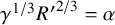 , we obtain that
$(i)$
, we obtain that
$(i)$
 holds as claimed.
The statement of property
$(ii)$
 in Lemma 2.22 clearly suggests the following natural generalization to higher orders. This is the main notion of higher-order structure used in this paper.
Definition 2.23 (Structured functions of order k).
Let k be a positive integer. We say that a function
$f:\operatorname {\mathrm {Z}}\to \mathbb {C}$
 is
$(R,\delta )$
is
$(R,\delta )$
 -structured of order k if there is a function
$g:\operatorname {\mathrm {Z}}\to \mathbb {C}$
-structured of order k if there is a function
$g:\operatorname {\mathrm {Z}}\to \mathbb {C}$
 satisfying
$\|g\|_{U^{k+1}}^*\leq R$
satisfying
$\|g\|_{U^{k+1}}^*\leq R$
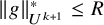 and
$\|f-g\|_2\leq \delta $
and
$\|f-g\|_2\leq \delta $
 .
.
Remark 2.24. Since the
$U^k$
 norms form an increasing sequence (i.e.,
$\|f\|_{U^k}\leq \|f\|_{U^{k+1}}$
norms form an increasing sequence (i.e.,
$\|f\|_{U^k}\leq \|f\|_{U^{k+1}}$
 for all k), the
$U^k$
for all k), the
$U^k$
 -dual norms form a decreasing sequence. It follows that
$(R,\delta )$
-dual norms form a decreasing sequence. It follows that
$(R,\delta )$
 -structure of order k becomes a weaker (more inclusive) property as k increases.
Remark 2.25. There are other higher-order parametric notions of structure, for instance the one based on the uniform almost-periodicity norms introduced by Tao in [Reference Tao64, Definition 5.2], which proceeds by generalizing the Wiener norm instead of the
$U^2$
 -dual norm. The notion in Definition 2.23 turned out to be sufficiently natural and technically convenient for us.
We know, by Lemma 2.22, that structure of order 1 means proximity in
$L^2$
 to a combination of a few Fourier characters. Before we develop further aspects of structure of order k for general
$k>1$
to a combination of a few Fourier characters. Before we develop further aspects of structure of order k for general
$k>1$
 , let us observe that structure of order
$0$
, let us observe that structure of order
$0$
 also has a useful meaning, even though this case is peculiar in the sense that
$\|f\|_{U^1}:=|\mathbb {E}_{x\in \operatorname {\mathrm {Z}}} f(x)|$
also has a useful meaning, even though this case is peculiar in the sense that
$\|f\|_{U^1}:=|\mathbb {E}_{x\in \operatorname {\mathrm {Z}}} f(x)|$
 is a seminorm and not a norm. Indeed, let us say that a function
$f:\operatorname {\mathrm {Z}}\to \mathbb {C}$
is a seminorm and not a norm. Indeed, let us say that a function
$f:\operatorname {\mathrm {Z}}\to \mathbb {C}$
 is
$(R,\delta )$
is
$(R,\delta )$
 -structured of order 0 if there exists
$g:\operatorname {\mathrm {Z}}\to \mathbb {C}$
-structured of order 0 if there exists
$g:\operatorname {\mathrm {Z}}\to \mathbb {C}$
 such that
$\|f-g\|_2\leq \delta $
such that
$\|f-g\|_2\leq \delta $
 and such that the seminorm
$\|g\|_{U^1}^*:=\sup _{h:\operatorname {\mathrm {Z}}\to \mathbb {C},\,\|h\|_{U^1}\leq 1} |\langle g,h\rangle |$
and such that the seminorm
$\|g\|_{U^1}^*:=\sup _{h:\operatorname {\mathrm {Z}}\to \mathbb {C},\,\|h\|_{U^1}\leq 1} |\langle g,h\rangle |$
 is at most R.
Lemma 2.26. A function
$f:\operatorname {\mathrm {Z}}\to \mathbb {C}$
 is
$(R,\delta )$
is
$(R,\delta )$
 -structured of order 0 for some R if and only if there is a constant function g such that
$\|f-g\|_2\leq \delta $
-structured of order 0 for some R if and only if there is a constant function g such that
$\|f-g\|_2\leq \delta $
 .
.
Proof. For the forward implication, let g be such that
$\|f-g\|_2\leq \delta $
 and
$\|g\|_{U^1}^*\leq R$
and
$\|g\|_{U^1}^*\leq R$
 . Note that, for each nontrivial character
$\chi \in \widehat {\operatorname {\mathrm {Z}}}\setminus \{\mathrm {id}\}$
. Note that, for each nontrivial character
$\chi \in \widehat {\operatorname {\mathrm {Z}}}\setminus \{\mathrm {id}\}$
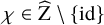 , we have
$\|\chi \|_{U^1}=0$
, we have
$\|\chi \|_{U^1}=0$
 . Hence, for every integer
$n\ge 1$
. Hence, for every integer
$n\ge 1$
 , we have
$\|n\chi \|_{U^1}\leq 1$
, we have
$\|n\chi \|_{U^1}\leq 1$
 and therefore
$n|\widehat {g}(\chi )|=|\langle g,n\chi \rangle |\le \|g\|_{U^1}^*\le R$
and therefore
$n|\widehat {g}(\chi )|=|\langle g,n\chi \rangle |\le \|g\|_{U^1}^*\le R$
 , whence
$|\widehat {g}(\chi )|\le R/n$
, whence
$|\widehat {g}(\chi )|\le R/n$
 . Taking the limit as
$n\to \infty $
. Taking the limit as
$n\to \infty $
 we deduce that
$\widehat {g}(\chi )=0$
we deduce that
$\widehat {g}(\chi )=0$
 for all
$\chi \not =\mathrm {id}$
for all
$\chi \not =\mathrm {id}$
 , so g is constant.
For the converse, note that if g is constant and
$\|f-g\|_2\leq \delta $
 , then
$\|g\|_{U^1}^*=|g|\leq \|f\|_2+\delta $
, then
$\|g\|_{U^1}^*=|g|\leq \|f\|_2+\delta $
 , so f is
$(R,\delta )$
, so f is
$(R,\delta )$
 -structured of order
$0$
-structured of order
$0$
 for
$R=\|f\|_2+\delta $
for
$R=\|f\|_2+\delta $
 .
.
To elucidate further the structure of order k property from Definition 2.23, and for other uses later on, let us establish the following equivalent formulation.
Proposition 2.27. Consider the following two properties of functions
$f:\operatorname {\mathrm {Z}}\to \mathbb {C}$
 .
.
-
(i) The function f is $(R,\delta )$
-structured of order k. -
(ii) For every 1-bounded function $h:\operatorname {\mathrm {Z}}\to \mathbb {C}$
satisfying
$\|h\|_{U^{k+1}}\leq a\leq 1$
, we have
$|\langle f,h\rangle | \leq b$
.




For 1-bounded functions
$f:\operatorname {\mathrm {Z}}\to \mathbb {C}$
 , these properties are equivalent in the following sense: if
$(i)$
, these properties are equivalent in the following sense: if
$(i)$
 holds with
$(R, \delta )$
holds with
$(R, \delta )$
 then
$(ii)$
then
$(ii)$
 holds with any a and
$b=Ra+\delta $
holds with any a and
$b=Ra+\delta $
 ; conversely, if
$(ii)$
; conversely, if
$(ii)$
 holds with
$(a,b)$
holds with
$(a,b)$
 , then
$(i)$
, then
$(i)$
 holds with some
$R=O_{a}(1)$
holds with some
$R=O_{a}(1)$
 and
$\delta =2(a^{1/2}+b^{1/2})$
and
$\delta =2(a^{1/2}+b^{1/2})$
 .
.
Proof. If
$(i)$
 holds with
$(R, \delta )$
holds with
$(R, \delta )$
 , then
$|\langle f,h\rangle |\leq |\langle g,h\rangle | + |\langle f-g,h\rangle |\leq \|g\|_{U^{k+1}}^*\|h\|_{U^{k+1}} + \|f-g\|_2 \|h\|_2\leq Ra+\delta $
, then
$|\langle f,h\rangle |\leq |\langle g,h\rangle | + |\langle f-g,h\rangle |\leq \|g\|_{U^{k+1}}^*\|h\|_{U^{k+1}} + \|f-g\|_2 \|h\|_2\leq Ra+\delta $
 , so
$(ii)$
, so
$(ii)$
 holds as claimed.
For the converse, suppose that
$(ii)$
 holds with
$a,b$
holds with
$a,b$
 . Let
$ \nu>0$
. Let
$ \nu>0$
 (to be fixed later) and
$\mathcal {G}:\mathbb {R}_+\to \mathbb {R}_+$
(to be fixed later) and
$\mathcal {G}:\mathbb {R}_+\to \mathbb {R}_+$
 be the function
$\mathcal {G}(m)=\frac {\nu }{2(m+1)}$
be the function
$\mathcal {G}(m)=\frac {\nu }{2(m+1)}$
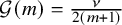 . By a standard regularity lemma, for example, [Reference Gowers24, Corollary 5.2],Footnote 6 there is
$R=R(\nu ,\mathcal {G})>0$
. By a standard regularity lemma, for example, [Reference Gowers24, Corollary 5.2],Footnote 6 there is
$R=R(\nu ,\mathcal {G})>0$
 such that we have a decomposition
$f=f_s+f_e+f_r$
such that we have a decomposition
$f=f_s+f_e+f_r$
 where
$\|f_s\|_{U^{k+1}}^*\leq R$
where
$\|f_s\|_{U^{k+1}}^*\leq R$
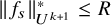 ,
$\|f_e\|_2\leq \nu /2^{3/2}$
,
$\|f_e\|_2\leq \nu /2^{3/2}$
 ,
$\|f_r\|_{U^{k+1}}\leq \mathcal {G}(\|f_s\|_{U^{k+1}}^*)$
,
$\|f_r\|_{U^{k+1}}\leq \mathcal {G}(\|f_s\|_{U^{k+1}}^*)$
 , and
$|f_r|\leq 2$
, and
$|f_r|\leq 2$
 . Note that
$|\langle f,f_r\rangle |=|\langle f_s,f_r\rangle +\langle f_e,f_r\rangle +\|f_r\|_2^2|\geq \|f_r\|_2^2-|\langle f_s,f_r\rangle |-|\langle f_e,f_r\rangle |\geq \|f_r\|_2^2-\|f_s\|_{U^{k+1}}^*\,\frac {\nu } {2(\|f_s\|_{U^{k+1}}^*+1)}-2^{1/2}\nu /2^{3/2}\ge \|f_r\|_2^2-\nu $
. Note that
$|\langle f,f_r\rangle |=|\langle f_s,f_r\rangle +\langle f_e,f_r\rangle +\|f_r\|_2^2|\geq \|f_r\|_2^2-|\langle f_s,f_r\rangle |-|\langle f_e,f_r\rangle |\geq \|f_r\|_2^2-\|f_s\|_{U^{k+1}}^*\,\frac {\nu } {2(\|f_s\|_{U^{k+1}}^*+1)}-2^{1/2}\nu /2^{3/2}\ge \|f_r\|_2^2-\nu $
 . Hence
$\|f_r\|_2\leq (|\langle f,f_r\rangle |+\nu )^{1/2}$
. Hence
$\|f_r\|_2\leq (|\langle f,f_r\rangle |+\nu )^{1/2}$
 , so
, so

Let
$\nu = a$
 (and so,
$R=O_a(1)$
(and so,
$R=O_a(1)$
 ) and note that, if
$h=f_r/2$
) and note that, if
$h=f_r/2$
 , we have
$\|h\|_\infty \le 1$
, we have
$\|h\|_\infty \le 1$
 and
$\|h\|_{U^{k+1}}\le \frac {\nu }{4(\|f_s\|_{U^{k+1}}^*+1)}\le a$
and
$\|h\|_{U^{k+1}}\le \frac {\nu }{4(\|f_s\|_{U^{k+1}}^*+1)}\le a$
 . Hence, applying
$(ii)$
. Hence, applying
$(ii)$
 with this function h, we have
$|\langle f,f_r/2\rangle |\leq b$
with this function h, we have
$|\langle f,f_r/2\rangle |\leq b$
 , so by (2.4) we deduce that
$\|f-f_s\|_2\leq a+(2b+a)^{1/2}$
, so by (2.4) we deduce that
$\|f-f_s\|_2\leq a+(2b+a)^{1/2}$
 . Hence
$(i)$
. Hence
$(i)$
 holds with R and
$\delta $
holds with R and
$\delta $
 as claimed.
Remark 2.28. Property
$(ii)$
 in Proposition 2.27 is a formulation of k-th order structure which is strongly motivated from several viewpoints on higher-order Fourier analysis in infinite settings. Specifically, in the ergodic-theory setting from [Reference Host and Kra43], as well as in the ultralimit setting of [Reference Szegedy58], or in the setting of cubic couplings [Reference Candela and Szegedy11], the notion of higher-order structure is captured by certain
$\sigma $
in Proposition 2.27 is a formulation of k-th order structure which is strongly motivated from several viewpoints on higher-order Fourier analysis in infinite settings. Specifically, in the ergodic-theory setting from [Reference Host and Kra43], as well as in the ultralimit setting of [Reference Szegedy58], or in the setting of cubic couplings [Reference Candela and Szegedy11], the notion of higher-order structure is captured by certain
$\sigma $
 -algebras (the Host–Kra characteristic factors in [Reference Host and Kra43] and their generalizations in [Reference Candela and Szegedy11], or the higher-order Fourier
$\sigma $
-algebras (the Host–Kra characteristic factors in [Reference Host and Kra43] and their generalizations in [Reference Candela and Szegedy11], or the higher-order Fourier
$\sigma $
 -algebras in [Reference Szegedy58]), where measurability relative to such a
$\sigma $
-algebras in [Reference Szegedy58]), where measurability relative to such a
$\sigma $
 -algebra of order k can be defined as orthogonality to every function with vanishing
$U^{k+1}$
-algebra of order k can be defined as orthogonality to every function with vanishing
$U^{k+1}$
 -seminorm (see [Reference Szegedy58, Theorem 1] or [Reference Candela and Szegedy11, Lemma 5.8]). Property
$(ii)$
-seminorm (see [Reference Szegedy58, Theorem 1] or [Reference Candela and Szegedy11, Lemma 5.8]). Property
$(ii)$
 above is a finite analogue of this.
2.4 Characters of order k
Here we use the notion of higher-order structured function from the previous subsection to define higher-order analogues of Fourier characters on abelian groups. In particular, quadratic (i.e., order 2) characters will play a key role in our algorithmic applications. By
$\operatorname {\mathrm {Z}}$
 we continue to denote a finite abelian group, but note that many of the following notions still hold for more general compact abelian groups.
Definition 2.29. Let k be a positive integer. An
$(R,\delta )$
 -character of order k on a finite abelian group
$\operatorname {\mathrm {Z}}$
-character of order k on a finite abelian group
$\operatorname {\mathrm {Z}}$
 is a function
$f:\operatorname {\mathrm {Z}}\to \mathbb {C}$
is a function
$f:\operatorname {\mathrm {Z}}\to \mathbb {C}$
 with
$\|f\|_2\leq 1$
with
$\|f\|_2\leq 1$
 such that for every
$t\in \operatorname {\mathrm {Z}}$
such that for every
$t\in \operatorname {\mathrm {Z}}$
 , the multiplicative derivative
$\Delta _t f$
, the multiplicative derivative
$\Delta _t f$
 is
$(R,\delta )$
is
$(R,\delta )$
 -structured of order
$k-1$
-structured of order
$k-1$
 . We refer to R as the complexity parameter, and refer to
$\delta $
. We refer to R as the complexity parameter, and refer to
$\delta $
 as the precision parameter. When it is unnecessary to specify these parameters, we simply call f a character of order k on
$\operatorname {\mathrm {Z}}$
as the precision parameter. When it is unnecessary to specify these parameters, we simply call f a character of order k on
$\operatorname {\mathrm {Z}}$
 .
.
Many central examples of such characters are actually 1-bounded functions. The weaker bound
$\|f\|_2\leq 1$
 in the definition is useful from linear-algebraic and functional-analytic viewpoints.
Remark 2.30. Using that the
$U^k$
 -dual norms decrease with k (see Remark 2.24), we see that for every function
$f:\operatorname {\mathrm {Z}}\to \mathbb {C}$
-dual norms decrease with k (see Remark 2.24), we see that for every function
$f:\operatorname {\mathrm {Z}}\to \mathbb {C}$
 with
$\|f\|_2\leq 1$
with
$\|f\|_2\leq 1$
 , we have
$\|f\|_{U^{k+1}}^*\leq \|f\|_{U^2}^*\leq |\operatorname {\mathrm {Z}}|^{3/4}$
, we have
$\|f\|_{U^{k+1}}^*\leq \|f\|_{U^2}^*\leq |\operatorname {\mathrm {Z}}|^{3/4}$
 , so any such function is a
$(|\operatorname {\mathrm {Z}}|^{3/4},0)$
, so any such function is a
$(|\operatorname {\mathrm {Z}}|^{3/4},0)$
 -character of order k. The notion of
$(R,\delta )$
-character of order k. The notion of
$(R,\delta )$
 -character of order k is interesting only when
$\operatorname {\mathrm {Z}}$
-character of order k is interesting only when
$\operatorname {\mathrm {Z}}$
 is large, R is bounded and
$\delta $
is large, R is bounded and
$\delta $
 is small. In what follows, we will see examples and theorems involving such characters where R depends on
$\delta $
is small. In what follows, we will see examples and theorems involving such characters where R depends on
$\delta $
 but not on
$|\operatorname {\mathrm {Z}}|$
but not on
$|\operatorname {\mathrm {Z}}|$
 .
.
Before we look at some basic examples of higher-order characters, let us briefly recall the notion of Gowers
$U^k$
 -products [Reference Tao and Vu66, p. 419] and the Gowers-Cauchy-Schwarz inequality [Reference Tao and Vu66, (11.6)].
Definition 2.31 (Gowers
$U^k$
-product).

Let
$\operatorname {\mathrm {Z}}$
 be a finite abelian group,
$k\ge 1$
be a finite abelian group,
$k\ge 1$
 , and let
$\{f_v\in \mathbb {C}^{\operatorname {\mathrm {Z}}}\}_{v\in [\![ k]\!] }$
, and let
$\{f_v\in \mathbb {C}^{\operatorname {\mathrm {Z}}}\}_{v\in [\![ k]\!] }$
 be a set of functions (where
$[\![ k]\!] $
be a set of functions (where
$[\![ k]\!] $
 denotes
$\{0,1\}^k$
denotes
$\{0,1\}^k$
 ). The Gowers
$U^k$
). The Gowers
$U^k$
 -product
$\langle (f_v)_{v\in [\![ k]\!] }\rangle _{U^k}$
-product
$\langle (f_v)_{v\in [\![ k]\!] }\rangle _{U^k}$
 of these functions is defined as
$\mathbb {E}_{x,t_1,\dots ,t_k\in \operatorname {\mathrm {Z}}}~ \prod _{v\in \{0,1\}^k}\mathcal {C}^{|v|}f_v(x+v(1)\, t_1+\cdots +v(k)\,t_k)$
of these functions is defined as
$\mathbb {E}_{x,t_1,\dots ,t_k\in \operatorname {\mathrm {Z}}}~ \prod _{v\in \{0,1\}^k}\mathcal {C}^{|v|}f_v(x+v(1)\, t_1+\cdots +v(k)\,t_k)$
 . The Gowers-Cauchy-Schwarz inequality states that
$|\langle (f_v)_{v\in [\![ k]\!] }\rangle _{U^k}|\le \prod _{v\in [\![ k]\!] }\|f_v\|_{U^k}$
. The Gowers-Cauchy-Schwarz inequality states that
$|\langle (f_v)_{v\in [\![ k]\!] }\rangle _{U^k}|\le \prod _{v\in [\![ k]\!] }\|f_v\|_{U^k}$
 .
.
Example 2.32. The most basic example of a character of order k is a global polynomial phase function of degree k on
$\operatorname {\mathrm {Z}}$
 , that is, a function
$\phi :\operatorname {\mathrm {Z}}\to \mathbb {C}$
, that is, a function
$\phi :\operatorname {\mathrm {Z}}\to \mathbb {C}$
 such that
$\Delta _{t_1}\cdots \Delta _{t_{k+1}}\phi (x)=1$
such that
$\Delta _{t_1}\cdots \Delta _{t_{k+1}}\phi (x)=1$
 for all
$x,t_1,\ldots , t_{k+1}\in \operatorname {\mathrm {Z}}$
for all
$x,t_1,\ldots , t_{k+1}\in \operatorname {\mathrm {Z}}$
 . Indeed, such a function is in fact a
$(1,0)$
. Indeed, such a function is in fact a
$(1,0)$
 -character of order k. To see this, note that it follows from the definition of
$\phi $
-character of order k. To see this, note that it follows from the definition of
$\phi $
 that
$|\phi (x)|=1$
that
$|\phi (x)|=1$
 for all
$x\in \operatorname {\mathrm {Z}}$
for all
$x\in \operatorname {\mathrm {Z}}$
 . Then, for any fixed
$t\in \operatorname {\mathrm {Z}}$
. Then, for any fixed
$t\in \operatorname {\mathrm {Z}}$
 , note that
$\Delta _t \phi $
, note that
$\Delta _t \phi $
 is a polynomial phase function of degree
$k-1$
is a polynomial phase function of degree
$k-1$
 , so for every
$x,t_1,\ldots ,t_k\in \operatorname {\mathrm {Z}}$
, so for every
$x,t_1,\ldots ,t_k\in \operatorname {\mathrm {Z}}$
 we have
$\overline {\Delta _t \phi (x)}=\prod _{v\in \{0,1\}^k\setminus 0^k} \mathcal {C}^{|v|} \Delta _t \phi (x+v(1)t_1+\cdots +v(k)t_k)$
we have
$\overline {\Delta _t \phi (x)}=\prod _{v\in \{0,1\}^k\setminus 0^k} \mathcal {C}^{|v|} \Delta _t \phi (x+v(1)t_1+\cdots +v(k)t_k)$
 (where
$\mathcal {C}$
(where
$\mathcal {C}$
 denotes the complex-conjugation operator and
$0^k=(0,\ldots ,0)$
denotes the complex-conjugation operator and
$0^k=(0,\ldots ,0)$
 ). It follows that for every function
$g:\operatorname {\mathrm {Z}}\to \mathbb {C}$
). It follows that for every function
$g:\operatorname {\mathrm {Z}}\to \mathbb {C}$
 with
$\|g\|_{U^k}\leq 1$
with
$\|g\|_{U^k}\leq 1$
 , we have
$\langle g, \Delta _t \phi \rangle = \langle g, \Delta _t \phi ,\Delta _t \phi ,\ldots , \Delta _t \phi \rangle _{U^k}\leq \|g\|_{U^k} \|\Delta _t \phi \|_{U^k}^{2^k-1}\leq 1$
, we have
$\langle g, \Delta _t \phi \rangle = \langle g, \Delta _t \phi ,\Delta _t \phi ,\ldots , \Delta _t \phi \rangle _{U^k}\leq \|g\|_{U^k} \|\Delta _t \phi \|_{U^k}^{2^k-1}\leq 1$
 , whence
$\|\Delta _t \phi \|_{U^k}^*\leq 1$
, whence
$\|\Delta _t \phi \|_{U^k}^*\leq 1$
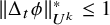 , which proves that
$\Delta _t \phi $
, which proves that
$\Delta _t \phi $
 is
$(1,0)$
is
$(1,0)$
 -structured of order
$k-1$
-structured of order
$k-1$
 , as required.
More complicated examples of higher-order characters involve nilpotent structures. In particular, nilsequences with so-called vertical frequency, called nilcharacters in [Reference Green, Tao and Ziegler35, Definition 6.1], and their generalizations introduced in the present paper, called nilspace characters, provide important examples of higher-order characters (see Section 4).
To illustrate Definition 2.29 further, let us consider in more detail its special case for
$k=1$
 . This tells us that f is an
$(R,\delta )$
. This tells us that f is an
$(R,\delta )$
 -character of order 1 if for every
$t\in \operatorname {\mathrm {Z}}$
-character of order 1 if for every
$t\in \operatorname {\mathrm {Z}}$
 we have that
$\Delta _t f$
we have that
$\Delta _t f$
 is
$(R,\delta )$
is
$(R,\delta )$
 -structured of order
$0$
-structured of order
$0$
 . By Lemma 2.26, this implies that there is a constant function
$g_t$
. By Lemma 2.26, this implies that there is a constant function
$g_t$
 such that
$\|g_t-\Delta _t f\|_2\leq \delta $
such that
$\|g_t-\Delta _t f\|_2\leq \delta $
 . If
$\delta $
. If
$\delta $
 is sufficiently small, then this in turn implies indeed, as it should, that such a function f is close in
$L^2$
is sufficiently small, then this in turn implies indeed, as it should, that such a function f is close in
$L^2$
 to a scalar multiple of a Fourier character.
Proposition 2.33. If
$f:\operatorname {\mathrm {Z}}\to \mathbb {C}$
 is an
$(R,\delta )$
is an
$(R,\delta )$
 -character of order 1 with
$\delta \in (0,\|f\|_2/20]$
-character of order 1 with
$\delta \in (0,\|f\|_2/20]$
 , then there exists
$\chi \in \widehat {\operatorname {\mathrm {Z}}}$
, then there exists
$\chi \in \widehat {\operatorname {\mathrm {Z}}}$
 such that
$\|f-\widehat {f}(\chi )\chi \|_2 \le 4\delta ^{1/2}\|f\|_2^{1/2}$
such that
$\|f-\widehat {f}(\chi )\chi \|_2 \le 4\delta ^{1/2}\|f\|_2^{1/2}$
 .
.
There are various ways to prove this by reducing to a simple instance of a so-called
$99\%$
 inverse theorem for the
$U^2$
inverse theorem for the
$U^2$
 -norm (for more on this topic, see [Reference Eisner and Tao16]). Let us give a short proof here.
Proof. By assumption, for every
$t\in \operatorname {\mathrm {Z}}$
 there is a constant
$g_t$
there is a constant
$g_t$
 such that
$\|\Delta _tf-g_t\|_2\leq \delta $
such that
$\|\Delta _tf-g_t\|_2\leq \delta $
 . Hence
$\big |\|\Delta _t f\|_{U^1}-|g_t|\big |\leq |\mathbb {E} ( \Delta _t f-g_t)|\leq \delta $
. Hence
$\big |\|\Delta _t f\|_{U^1}-|g_t|\big |\leq |\mathbb {E} ( \Delta _t f-g_t)|\leq \delta $
 . Then
$\mathbb {E}_t |g_t|\leq \|f\|_1^2+\delta \leq \|f\|_2^2+\delta $
. Then
$\mathbb {E}_t |g_t|\leq \|f\|_1^2+\delta \leq \|f\|_2^2+\delta $
 , and, writing
${h_t:=\Delta _t f-g_t}$
, and, writing
${h_t:=\Delta _t f-g_t}$
 , we have
$\mathbb {E}_t |g_t|^2 = \mathbb {E}_t\mathbb {E}_x |g_t|^2 \geq \mathbb {E}_t\mathbb {E}_x (|\Delta _t f(x)|^2-2|h_t| |\Delta _t f|)\geq \|f\|_2^4-2\delta \|f\|_2^2$
, we have
$\mathbb {E}_t |g_t|^2 = \mathbb {E}_t\mathbb {E}_x |g_t|^2 \geq \mathbb {E}_t\mathbb {E}_x (|\Delta _t f(x)|^2-2|h_t| |\Delta _t f|)\geq \|f\|_2^4-2\delta \|f\|_2^2$
 . Hence
$\|f\|_{U^2}^4=\mathbb {E}_t \|\Delta _t f\|_{U^1}^2 \geq \mathbb {E}_t |g_t|^2 -2\delta \mathbb {E}_t |g_t| +\delta ^2\geq \|f\|_2^4-4\delta \|f\|_2^2-\delta ^2$
. Hence
$\|f\|_{U^2}^4=\mathbb {E}_t \|\Delta _t f\|_{U^1}^2 \geq \mathbb {E}_t |g_t|^2 -2\delta \mathbb {E}_t |g_t| +\delta ^2\geq \|f\|_2^4-4\delta \|f\|_2^2-\delta ^2$
 . Completing squares and rearranging, we deduce that
$\|f\|_{U^2}^2\geq \|f\|_2^2-5\delta $
. Completing squares and rearranging, we deduce that
$\|f\|_{U^2}^2\geq \|f\|_2^2-5\delta $
 (which is an assumption for a
$99\%$
(which is an assumption for a
$99\%$
 -inverse-theorem). Let
$x=\|\widehat {f}\|_\infty $
-inverse-theorem). Let
$x=\|\widehat {f}\|_\infty $
 . Using that
$\|f\|_2\geq x \geq \|f\|_{U^2}^2/\|f\|_2$
. Using that
$\|f\|_2\geq x \geq \|f\|_{U^2}^2/\|f\|_2$
 , we have
$x (\|f\|_2-x)\leq \|f\|_2^2-\|f\|_{U^2}^2\leq 5\delta $
, we have
$x (\|f\|_2-x)\leq \|f\|_2^2-\|f\|_{U^2}^2\leq 5\delta $
 , so either
$x\leq \|f\|_2 \frac {1-\sqrt {1-20\delta /\|f\|_2}}{2}$
, so either
$x\leq \|f\|_2 \frac {1-\sqrt {1-20\delta /\|f\|_2}}{2}$
 , or
$x\geq \|f\|_2 \frac {1+\sqrt {1-20\delta /\|f\|_2}}{2}$
, or
$x\geq \|f\|_2 \frac {1+\sqrt {1-20\delta /\|f\|_2}}{2}$
 . The former case combined with
${x\geq \|f\|_{U^2}^2 / \|f\|_2}$
. The former case combined with
${x\geq \|f\|_{U^2}^2 / \|f\|_2}$
 implies
$\|f\|_{U^2}^2\leq 10\delta \|f\|_2$
implies
$\|f\|_{U^2}^2\leq 10\delta \|f\|_2$
 , and this combined with
$\|f\|_2^2\le \|f\|_{U^2}^2+5\delta $
, and this combined with
$\|f\|_2^2\le \|f\|_{U^2}^2+5\delta $
 implies
${\|f\|_2\leq 5(\delta +\sqrt {\delta ^2+\delta /5})\leq 4\sqrt {\delta }}$
implies
${\|f\|_2\leq 5(\delta +\sqrt {\delta ^2+\delta /5})\leq 4\sqrt {\delta }}$
 (using that
$\delta \leq 1/20$
(using that
$\delta \leq 1/20$
 ), so the conclusion holds with any
$\chi $
), so the conclusion holds with any
$\chi $
 . The latter case implies the conclusion with
$\chi $
. The latter case implies the conclusion with
$\chi $
 such that
$|\widehat {f}(\chi )|=\|\widehat {f}\|_\infty $
such that
$|\widehat {f}(\chi )|=\|\widehat {f}\|_\infty $
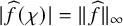 , as then
$\|f-\widehat {f}(\chi )\chi \|_2^2 =\|f\|_2^2-\|\widehat {f}\|_\infty ^2\leq 15\delta \|f\|_2$
, as then
$\|f-\widehat {f}(\chi )\chi \|_2^2 =\|f\|_2^2-\|\widehat {f}\|_\infty ^2\leq 15\delta \|f\|_2$
 .
.
This last result can be proved with better constants by a finer (but longer) argument using the Fourier coefficients of f. We omit this, as such an improvement is not needed in this paper.
It will be useful to introduce the following generalization of higher-order characters.
Definition 2.34 (Weak character of order k).
An
$(R,\delta _1,\delta _2)$
 -weak character of order k on a finite abelian group
$\operatorname {\mathrm {Z}}$
-weak character of order k on a finite abelian group
$\operatorname {\mathrm {Z}}$
 is a function
$f:\operatorname {\mathrm {Z}}\to \mathbb {C}$
is a function
$f:\operatorname {\mathrm {Z}}\to \mathbb {C}$
 with
$\|f\|_2\leq 1$
with
$\|f\|_2\leq 1$
 such that there is a set
$S\subset \operatorname {\mathrm {Z}}$
such that there is a set
$S\subset \operatorname {\mathrm {Z}}$
 with
$|S|\geq |\operatorname {\mathrm {Z}}|(1-\delta _2)$
with
$|S|\geq |\operatorname {\mathrm {Z}}|(1-\delta _2)$
 and such that for every
$t\in S$
and such that for every
$t\in S$
 the function
$\Delta _t f$
the function
$\Delta _t f$
 is
$(R,\delta _1)$
is
$(R,\delta _1)$
 -structured of order
$k-1$
-structured of order
$k-1$
 . We refer to R as the complexity parameter and to
$\delta _1,\delta _2$
. We refer to R as the complexity parameter and to
$\delta _1,\delta _2$
 as the precision parameters of f.
There is a fact that we must now establish, in order to connect properly the notions of higher-order structure and higher-order characters. Namely, we need to show that characters of order k are structured functions of order k. In fact, this holds more generally for weak characters of order k.
Lemma 2.35. Let g be an
$(R,\delta _1,\delta _2)$
 -weak-character of order k on a finite abelian group
$\operatorname {\mathrm {Z}}$
-weak-character of order k on a finite abelian group
$\operatorname {\mathrm {Z}}$
 . Then for every 1-bounded function
$f:\operatorname {\mathrm {Z}}\to \mathbb {C}$
. Then for every 1-bounded function
$f:\operatorname {\mathrm {Z}}\to \mathbb {C}$
 satisfying
$\|f\|_{U^{k+1}}\leq a\leq 1$
satisfying
$\|f\|_{U^{k+1}}\leq a\leq 1$
 , we have
$|\langle f,g\rangle |\leq (a^2 R+\delta _1+\delta _2^{1/2})^{1/2}$
, we have
$|\langle f,g\rangle |\leq (a^2 R+\delta _1+\delta _2^{1/2})^{1/2}$
 . In particular g is an
$(R',\delta ')$
. In particular g is an
$(R',\delta ')$
 -structured function of order k, for
$R'=O_a(1)$
-structured function of order k, for
$R'=O_a(1)$
 and
$\delta '=2(a^{1/2}(R^{1/4}+1)+\delta _1^{1/4}+\delta _2^{1/8})$
and
$\delta '=2(a^{1/2}(R^{1/4}+1)+\delta _1^{1/4}+\delta _2^{1/8})$
 .
.
Proof. By Definition 2.34, for a set
$S\subset \operatorname {\mathrm {Z}}$
 of cardinality at least
$(1-\delta _2)|\operatorname {\mathrm {Z}}|$
of cardinality at least
$(1-\delta _2)|\operatorname {\mathrm {Z}}|$
 , for every
$t\in S$
, for every
$t\in S$
 there is a function
$\mathcal {E}_t:\operatorname {\mathrm {Z}}\to \mathbb {C}$
there is a function
$\mathcal {E}_t:\operatorname {\mathrm {Z}}\to \mathbb {C}$
 with
$\|\mathcal {E}_t\|_2\leq \delta _1$
with
$\|\mathcal {E}_t\|_2\leq \delta _1$
 and a function
$h_t:\operatorname {\mathrm {Z}}\to \mathbb {C}$
and a function
$h_t:\operatorname {\mathrm {Z}}\to \mathbb {C}$
 with
$\|h_t\|_{U^k}^*\leq R$
with
$\|h_t\|_{U^k}^*\leq R$
 , such that
$\Delta _t g = h_t+\mathcal {E}_t$
, such that
$\Delta _t g = h_t+\mathcal {E}_t$
 . Then, as
$\|\Delta _t f\|_2\leq 1$
. Then, as
$\|\Delta _t f\|_2\leq 1$
 and
$(\mathbb {E}_t \|\Delta _t g\|_2^2)^{1/2}= \|g\|_2^2\leq 1$
and
$(\mathbb {E}_t \|\Delta _t g\|_2^2)^{1/2}= \|g\|_2^2\leq 1$
 , we have

By Hölder’s inequality, letting
$q=2^k/(2^k-1)$
 , we have that
$\mathbb {E}_t 1_S(t)\, \|\Delta _t f\|_{U^k} \, \|h_t\|_{U^k}^*$
, we have that
$\mathbb {E}_t 1_S(t)\, \|\Delta _t f\|_{U^k} \, \|h_t\|_{U^k}^*$
 is at most
$(\mathbb {E}_t \|\Delta _t f\|_{U^k}^{2^k})^{1/2^k} \, (\mathbb {E}_t 1_S(t)\, {\|h_t\|_{U^k}^*}^q)^{1/q}\, =\|f\|_{U^{k+1}}^2\, (\mathbb {E}_t 1_S(t)R^q)^{1/q}$
is at most
$(\mathbb {E}_t \|\Delta _t f\|_{U^k}^{2^k})^{1/2^k} \, (\mathbb {E}_t 1_S(t)\, {\|h_t\|_{U^k}^*}^q)^{1/q}\, =\|f\|_{U^{k+1}}^2\, (\mathbb {E}_t 1_S(t)R^q)^{1/q}$
 . Hence
$|\langle f,g\rangle |^2\leq a^2 R +\delta _1+\delta _2^{1/2}$
. Hence
$|\langle f,g\rangle |^2\leq a^2 R +\delta _1+\delta _2^{1/2}$
 , as claimed. By Proposition 2.27, it follows that g is
$(R',\delta ')$
, as claimed. By Proposition 2.27, it follows that g is
$(R',\delta ')$
 -structured of order k with
$R'=O_a(1)$
-structured of order k with
$R'=O_a(1)$
 and
$\delta '=2(a^{\frac {1}{2}}+b^{\frac {1}{2}})$
and
$\delta '=2(a^{\frac {1}{2}}+b^{\frac {1}{2}})$
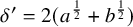 , where
$b=(a^2 R +\delta _1+\delta _2^{\frac {1}{2}})^{\frac {1}{2}}\leq aR^{\frac {1}{2}}+\delta _1^{\frac {1}{2}}+\delta _2^{\frac {1}{4}}$
, where
$b=(a^2 R +\delta _1+\delta _2^{\frac {1}{2}})^{\frac {1}{2}}\leq aR^{\frac {1}{2}}+\delta _1^{\frac {1}{2}}+\delta _2^{\frac {1}{4}}$
 .
.
Remark 2.36. It is now natural to wonder how special the characters of order k are among the structured functions of order k. We have seen in Proposition 2.33 that characters of order 1 are essentially scalar multiples of Fourier characters (up to small
$L^2$
 -errors), and these order-1 characters are indeed special among structured functions of order 1, we may even say that they are fundamental in the sense that every structured function of order 1 is a combination of a bounded number of characters of order 1 (up to a small
$L^2$
-errors), and these order-1 characters are indeed special among structured functions of order 1, we may even say that they are fundamental in the sense that every structured function of order 1 is a combination of a bounded number of characters of order 1 (up to a small
$L^2$
 -error), by Fourier analysis. This picture generalizes to higher orders; we shall discuss this in Section 4 using the concept of nilspace character. Specifically, we will show that every structured function of order k is, up to a small
$L^2$
-error), by Fourier analysis. This picture generalizes to higher orders; we shall discuss this in Section 4 using the concept of nilspace character. Specifically, we will show that every structured function of order k is, up to a small
$L^2$
 -error, a sum of a bounded number of k-step nilspace characters (this will follow from the regularity lemma Theorem 5.1). Moreover, focusing on the quadratic case, we will also show that 2-step nilspace characters are characters of order
$2$
-error, a sum of a bounded number of k-step nilspace characters (this will follow from the regularity lemma Theorem 5.1). Moreover, focusing on the quadratic case, we will also show that 2-step nilspace characters are characters of order
$2$
 as per Definition 2.29. We expect this latter fact to extend to general order k, but as explained in later sections, proving this is outside the scope of this paper.
As mentioned in the introduction, we aim to provide algorithms to obtain decompositions of functions into structured and quasirandom parts of order 2 (i.e., relative to the
$U^3$
 -norm). A key step in our approach consists in modifying
$\operatorname {\mathrm {Z}}$
-norm). A key step in our approach consists in modifying
$\operatorname {\mathrm {Z}}$
 -matrices by applying an operator to the
$\operatorname {\mathrm {Z}}$
-matrices by applying an operator to the
$\operatorname {\mathrm {Z}}$
 -diagonals which performs a Fourier regularization of these diagonals, that is, it isolates a suitable Fourier-structured part of these functions. We shall now introduce this operator and develop some of its main properties.
2.5 The Fourier denoising operator
$K_\varepsilon $

In this subsection, we define the main notion of Fourier regularization that we shall use to develop our spectral approach in quadratic Fourier analysis.
Informally speaking, the goal is to define a notion on finite abelian groups satisfying properties similar to those of the expectation operator corresponding to the first-order Fourier
$\sigma $
 -algebra
$\mathcal {F}_1$
-algebra
$\mathcal {F}_1$
 in the ultraproduct setting, or the Kronecker factor in ergodic theory (see Remark 2.28). In other words, we want a tool that decomposes a function on a finite abelian group into a structured and a quasirandom part of order 1 (i.e., relative to classical Fourier analysis), and which satisfies certain additional properties that are useful from algorithmic viewpoints. In the infinite setting of ultraproducts (see [Reference Szegedy58], or later [Reference Candela and Szegedy12]), the regularization has the form
$f=f_s+f_r$
in the ultraproduct setting, or the Kronecker factor in ergodic theory (see Remark 2.28). In other words, we want a tool that decomposes a function on a finite abelian group into a structured and a quasirandom part of order 1 (i.e., relative to classical Fourier analysis), and which satisfies certain additional properties that are useful from algorithmic viewpoints. In the infinite setting of ultraproducts (see [Reference Szegedy58], or later [Reference Candela and Szegedy12]), the regularization has the form
$f=f_s+f_r$
 where
$f_s=\mathbb {E}(f|\mathcal {F}_1)$
where
$f_s=\mathbb {E}(f|\mathcal {F}_1)$
 while
$f_r=f-f_s$
while
$f_r=f-f_s$
 . The function
$f_r$
. The function
$f_r$
 is also the projection of f to the orthogonal complement of
$L^2(\mathcal {F}_1)$
is also the projection of f to the orthogonal complement of
$L^2(\mathcal {F}_1)$
 . Thus, both operators
$f\mapsto f_s$
. Thus, both operators
$f\mapsto f_s$
 and
$f\mapsto f_r$
and
$f\mapsto f_r$
 are projections in the infinite setting, so both operators are contractions relative to the
$L^2$
are projections in the infinite setting, so both operators are contractions relative to the
$L^2$
 -norm. In particular, we have the continuity properties

In the finite setting, a first candidate for the desired tool could be the Fourier cut-off operator mentioned in Subsection 1.1, namely the operator which, for a fixed
$\varepsilon>0$
 , simply eliminates the Fourier coefficients of f that have modulus less than
$\varepsilon $
, simply eliminates the Fourier coefficients of f that have modulus less than
$\varepsilon $
 . Unfortunately, this operator is too blunt and does not have suitable features such as the above contraction property. However, there is a variant of this operator that does have such properties. Before we describe it, let us mention another very useful fact that holds in infinite settings: the translation invariance whereby we have
$(T^hf)_s=T^h(f_s)$
. Unfortunately, this operator is too blunt and does not have suitable features such as the above contraction property. However, there is a variant of this operator that does have such properties. Before we describe it, let us mention another very useful fact that holds in infinite settings: the translation invariance whereby we have
$(T^hf)_s=T^h(f_s)$
 and
$(T^hf)_r=T^h(f_r)$
and
$(T^hf)_r=T^h(f_r)$
 for every group element h. To guarantee this property, we consider operators of the following form.
Definition 2.37. Let
$r:\mathbb {R}_{\geq 0}\to \mathbb {R}_{\geq 0}$
 be an arbitrary function with
$r(0)=0$
be an arbitrary function with
$r(0)=0$
 . For
$z\in \mathbb {C}$
. For
$z\in \mathbb {C}$
 we define
$q_r(z):=z\, r(|z|)/|z|$
we define
$q_r(z):=z\, r(|z|)/|z|$
 for
$z\neq 0$
for
$z\neq 0$
 and
$q_r(0)=0$
and
$q_r(0)=0$
 . We then define an operator
$K_r$
. We then define an operator
$K_r$
 on
$\mathbb {C}^{\operatorname {\mathrm {Z}}}$
on
$\mathbb {C}^{\operatorname {\mathrm {Z}}}$
 as follows: for any function
$f\in \mathbb {C}^{\operatorname {\mathrm {Z}}}$
as follows: for any function
$f\in \mathbb {C}^{\operatorname {\mathrm {Z}}}$
 , letting
$f=\sum _{\chi \in \widehat {\operatorname {\mathrm {Z}}}} \widehat {f}(\chi ) \chi $
, letting
$f=\sum _{\chi \in \widehat {\operatorname {\mathrm {Z}}}} \widehat {f}(\chi ) \chi $
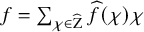 be its Fourier expansion, we define

Since translation only affects the phase of the Fourier coefficients, we have
$T^h K_r(f)=K_r(T_hf)$
 . It is also clear that
$\overline {K_r(f)}=K_r(\overline {f})$
. It is also clear that
$\overline {K_r(f)}=K_r(\overline {f})$
 . Hence,
$K_r$
. Hence,
$K_r$
 is invariant as per Definition 2.10.
We now want to identify a simple property of functions r which ensures that the associated operator
$K_r$
 has the desired continuity property.
Recall that a function
$g:\mathbb {C}\to \mathbb {C}$
 is said to be C-Lipschitz if for all x and y in the domain of g we have
$|g(x)-g(y)|\leq C |x-y|$
is said to be C-Lipschitz if for all x and y in the domain of g we have
$|g(x)-g(y)|\leq C |x-y|$
 . Similarly, given a map
$K:L^2(X)\to L^2(X)$
. Similarly, given a map
$K:L^2(X)\to L^2(X)$
 (for some topological space X with a Borel probability measure), we define the Lipschitz constant

When we need to specify the domain of K we write
$\|K\|_{\operatorname {\mathrm {Lip}}(L^2(X))}$
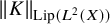 . The following lemma identifies a useful property of the kind alluded to above.
Lemma 2.38. Let
$r:\mathbb {R}_{\geq 0}\to \mathbb {R}_{\geq 0}$
 with
$r(0)=0$
with
$r(0)=0$
 be such that
$q_r$
be such that
$q_r$
 is C-Lipschitz for some constant C. Then for any finite abelian group
$\operatorname {\mathrm {Z}}$
is C-Lipschitz for some constant C. Then for any finite abelian group
$\operatorname {\mathrm {Z}}$
 we have
$\|K_r\|_{\operatorname {\mathrm {Lip}}(\mathbb {C}^{\operatorname {\mathrm {Z}}})}\leq C$
we have
$\|K_r\|_{\operatorname {\mathrm {Lip}}(\mathbb {C}^{\operatorname {\mathrm {Z}}})}\leq C$
 .
.
Proof. By Plancherel’s theorem we have
$\|K_r(f)-K_r(g)\|_2^2\!=\!\sum _{\chi \in \widehat {G}} |q_r(\widehat {f}(\chi ))-q_r(\widehat {g}(\chi ))|^2\!\leq \!\sum _{\chi } C^2 |\widehat {f}(\chi )-\widehat {g}(\chi )|^2 = C^2\|f-g\|_2^2$
 .
.
Now we focus on a specific function r and define the principal operator that we shall use.
Definition 2.39 (Fourier denoising operator).
For
$\varepsilon>0$
 , we denote by
$K_\varepsilon $
, we denote by
$K_\varepsilon $
 the operator defined by applying (2.5) with the specific function
$r=r_\varepsilon :\mathbb {R}_{\geq 0}\to \mathbb {R}_{\geq 0}$
the operator defined by applying (2.5) with the specific function
$r=r_\varepsilon :\mathbb {R}_{\geq 0}\to \mathbb {R}_{\geq 0}$
 ,
$x\mapsto \max (x-\varepsilon ,0)$
,
$x\mapsto \max (x-\varepsilon ,0)$
 .
.
Lemma 2.40. The function
$q_\varepsilon :=q_{r_\varepsilon }$
 is a
$1$
is a
$1$
 -Lipschitz function on
$\mathbb {C}$
-Lipschitz function on
$\mathbb {C}$
 , whence the operator
$K_\varepsilon $
, whence the operator
$K_\varepsilon $
 is
$1$
is
$1$
 -Lipschitz on
$\mathbb {C}^{\operatorname {\mathrm {Z}}}$
-Lipschitz on
$\mathbb {C}^{\operatorname {\mathrm {Z}}}$
 .
.
Proof. We prove the following inequality by a simple case distinction:

The first case is
$\min (|x|,|y|)\geq \varepsilon $
 . In this case, let
$u:=x/|x|$
. In this case, let
$u:=x/|x|$
 and
$v=y/|y|$
and
$v=y/|y|$
 . Then
$q_\varepsilon (x)=u(|x|-\varepsilon )$
. Then
$q_\varepsilon (x)=u(|x|-\varepsilon )$
 and
$q_\varepsilon (y)=u(|y|-\varepsilon )$
and
$q_\varepsilon (y)=u(|y|-\varepsilon )$
 . Note that
$\operatorname {\mathrm {Re}}(u\overline {v})\leq |u\overline {v}| \leq 1$
. Note that
$\operatorname {\mathrm {Re}}(u\overline {v})\leq |u\overline {v}| \leq 1$
 . Using that
$u,v$
. Using that
$u,v$
 have modulus 1, we have that
$|u(|x|-\varepsilon )-v(|y|-\varepsilon )|^2$
have modulus 1, we have that
$|u(|x|-\varepsilon )-v(|y|-\varepsilon )|^2$
 equals

The second case is
$\min (|x|,|y|)<\varepsilon \leq \max (|x|,|y|)$
 . In this case, suppose without loss of generality that
$|x|<\varepsilon , |y|\geq \varepsilon $
. In this case, suppose without loss of generality that
$|x|<\varepsilon , |y|\geq \varepsilon $
 , and then observe that
$q_\varepsilon (x)=0$
, and then observe that
$q_\varepsilon (x)=0$
 , so
$|q_\varepsilon (x)-q_\varepsilon (y)|=|y|-\varepsilon $
, so
$|q_\varepsilon (x)-q_\varepsilon (y)|=|y|-\varepsilon $
 . The triangle inequality then yields
$|x-y|\geq |y|-|x|\geq |y|-\varepsilon = |q_\varepsilon (x)-q_\varepsilon (y)|$
. The triangle inequality then yields
$|x-y|\geq |y|-|x|\geq |y|-\varepsilon = |q_\varepsilon (x)-q_\varepsilon (y)|$
 , as required.
The third case is
$\max (|x|,|y|)\leq \varepsilon $
 . Here (2.7) holds trivially, since
$q_\varepsilon (x)=q_\varepsilon (y)=0$
. Here (2.7) holds trivially, since
$q_\varepsilon (x)=q_\varepsilon (y)=0$
 .
.
Remark 2.41. Letting
$q^{\prime }_\varepsilon (z):=z-q_\varepsilon (z)$
 , a similar argument shows that
$q^{\prime }_\varepsilon $
, a similar argument shows that
$q^{\prime }_\varepsilon $
 is also a contraction on
$\mathbb {C}$
is also a contraction on
$\mathbb {C}$
 , that is, we have
$|x-y|\geq |q^{\prime }_\varepsilon (x)-q^{\prime }_\varepsilon (y)|$
, that is, we have
$|x-y|\geq |q^{\prime }_\varepsilon (x)-q^{\prime }_\varepsilon (y)|$
 for all
$x,y\in \mathbb {C}$
for all
$x,y\in \mathbb {C}$
 . This is less important for our applications, so we omit the proof. We do however record the following result, which will be used later in this paper.
Lemma 2.42. We have
$|q^{\prime }_\varepsilon (z)|=\min (|z|,\varepsilon )$
 for every
$z\in \mathbb {C}$
for every
$z\in \mathbb {C}$
 , and thus

Proof. We see that
$|q^{\prime }_\varepsilon (z)|=\min (|z|,\varepsilon )$
 by a simple case distinction. Indeed for
$|z|\leq \varepsilon $
by a simple case distinction. Indeed for
$|z|\leq \varepsilon $
 we have
$|q^{\prime }_\varepsilon (z)|=|z-q_\varepsilon (z)|=|z|=\min (|z|,\varepsilon )$
we have
$|q^{\prime }_\varepsilon (z)|=|z-q_\varepsilon (z)|=|z|=\min (|z|,\varepsilon )$
 , and for
$|z|>\varepsilon $
, and for
$|z|>\varepsilon $
 we have
$|q^{\prime }_\varepsilon (z)|=|z-q_\varepsilon (z)|=|z(1-\frac {|z|-\varepsilon }{|z|})|= \varepsilon =\min (|z|,\varepsilon )$
we have
$|q^{\prime }_\varepsilon (z)|=|z-q_\varepsilon (z)|=|z(1-\frac {|z|-\varepsilon }{|z|})|= \varepsilon =\min (|z|,\varepsilon )$
 .
.
To see that (2.8) holds, note first that
$|q^{\prime }_\varepsilon (x+y)|=\min (|x+y|,\varepsilon )\leq \min (|x|+|y|,\varepsilon )$
 , so it suffices to prove that

This can also be proved by a case distinction.
The first case is
$a+b\leq \varepsilon $
 . Then
$\min (a+b,\varepsilon )=a+b=\min (a,\varepsilon )+\min (b,\varepsilon )$
. Then
$\min (a+b,\varepsilon )=a+b=\min (a,\varepsilon )+\min (b,\varepsilon )$
 (where the last equality is since
$a\leq a+b\leq \varepsilon $
(where the last equality is since
$a\leq a+b\leq \varepsilon $
 so that
$a=\min (a,\varepsilon )$
so that
$a=\min (a,\varepsilon )$
 , and similarly
$b=\min (b,\varepsilon )$
, and similarly
$b=\min (b,\varepsilon )$
 ). So in this case we have equality.
The second case is
$a+b> \varepsilon $
 . Then the left side of (2.9) is
$\varepsilon $
. Then the left side of (2.9) is
$\varepsilon $
 . There is then a first sub-case in which both a and b are less than
$\varepsilon $
. There is then a first sub-case in which both a and b are less than
$\varepsilon $
 , in which case the right side of (2.9) is
$a+b$
, in which case the right side of (2.9) is
$a+b$
 , which by assumption in this second case is
$>\varepsilon $
, which by assumption in this second case is
$>\varepsilon $
 , so (2.9) holds in this sub-case. In the second sub-case at least one of
$a,b$
, so (2.9) holds in this sub-case. In the second sub-case at least one of
$a,b$
 is at least
$\varepsilon $
is at least
$\varepsilon $
 , say wlog it is a. Then the right side of (2.9) is
$\varepsilon +\min (b,\varepsilon )\geq \varepsilon $
, say wlog it is a. Then the right side of (2.9) is
$\varepsilon +\min (b,\varepsilon )\geq \varepsilon $
 , so (2.9) holds. This completes this second case.
We have thus proved that the operator
$K_\varepsilon $
 has the desired continuity property mentioned at the beginning of this section.
It remains to verify that, for functions
$f:\operatorname {\mathrm {Z}}\to \mathbb {C}$
 , the operator
$K_\varepsilon $
, the operator
$K_\varepsilon $
 yields a decomposition of f into structured and quasirandom parts, in which
$K_\varepsilon (f)$
yields a decomposition of f into structured and quasirandom parts, in which
$K_\varepsilon (f)$
 is a valid Fourier-structured part. Note that if
$\|f\|_2\leq 1$
is a valid Fourier-structured part. Note that if
$\|f\|_2\leq 1$
 , then letting
$K_\varepsilon '(f)=f-K_\varepsilon (f)$
, then letting
$K_\varepsilon '(f)=f-K_\varepsilon (f)$
 , we have the decomposition
$f=K_\varepsilon (f)+K_\varepsilon '(f)$
, we have the decomposition
$f=K_\varepsilon (f)+K_\varepsilon '(f)$
 where
$\|K^{\prime }_\varepsilon (f)\|_{U^2}\leq \varepsilon ^{1/2}$
where
$\|K^{\prime }_\varepsilon (f)\|_{U^2}\leq \varepsilon ^{1/2}$
 . We now prove that
$K_\varepsilon (f)$
. We now prove that
$K_\varepsilon (f)$
 is indeed Fourier structured.
Lemma 2.43. For every function
$f:\operatorname {\mathrm {Z}}\to \mathbb {C}$
 , the function
$K_\varepsilon (f)$
, the function
$K_\varepsilon (f)$
 is
$(\varepsilon ^{-2}\|f\|_2^2,0)$
is
$(\varepsilon ^{-2}\|f\|_2^2,0)$
 -Fourier structured. In particular we have

Proof. By Parseval’s identity we have
$|\{\chi \in \widehat {\operatorname {\mathrm {Z}}}:|\widehat {f}(\chi )|\ge \varepsilon \}|\le \|f\|_2^2/\varepsilon ^2$
 , so
$K_\varepsilon (f)$
, so
$K_\varepsilon (f)$
 is
$(\varepsilon ^{-2}\|f\|_2^2,0)$
is
$(\varepsilon ^{-2}\|f\|_2^2,0)$
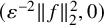 -Fourier structured. To obtain (2.10), we use the Cauchy-Schwarz inequality and the fact that
$\|K_\varepsilon (f)\|_2\le \|f\|_2$
-Fourier structured. To obtain (2.10), we use the Cauchy-Schwarz inequality and the fact that
$\|K_\varepsilon (f)\|_2\le \|f\|_2$
 .
.
Thus, if
$\|f\|_2\leq 1$
 then
$K_\varepsilon (f)$
then
$K_\varepsilon (f)$
 is
$(\varepsilon ^{-2},0)$
is
$(\varepsilon ^{-2},0)$
 -Fourier structured. This completes the verification that
$f=K_\varepsilon (f)+K^{\prime }_\varepsilon (f)$
-Fourier structured. This completes the verification that
$f=K_\varepsilon (f)+K^{\prime }_\varepsilon (f)$
 is a decomposition into Fourier-structured and quasirandom parts.
Remark 2.44. There are many possible choices of Fourier regularizing operators other than
$K_\varepsilon $
 . In general, we want such an operator to leave the large Fourier coefficients roughly unchanged, to reduce the small ones to values close to 0, and to be invariant. For our proofs in this paper, it turned out that
$K_\varepsilon $
. In general, we want such an operator to leave the large Fourier coefficients roughly unchanged, to reduce the small ones to values close to 0, and to be invariant. For our proofs in this paper, it turned out that
$K_\varepsilon $
 presented particularly convenient properties, such as Lemmas 2.40 and 2.42. Within the family of operators
$K_r$
presented particularly convenient properties, such as Lemmas 2.40 and 2.42. Within the family of operators
$K_r$
 defined in (2.5), some of these convenient properties of
$K_\varepsilon $
defined in (2.5), some of these convenient properties of
$K_\varepsilon $
 are available with other choices of r. For instance, it is not hard to show that if r is C-Lipschitz, then the operator
$K_r$
are available with other choices of r. For instance, it is not hard to show that if r is C-Lipschitz, then the operator
$K_r$
 is
$3C$
is
$3C$
 -Lipschitz. One can then choose functions
$q_r$
-Lipschitz. One can then choose functions
$q_r$
 that still reduce to 0 the small Fourier coefficients (like
$q_\varepsilon $
that still reduce to 0 the small Fourier coefficients (like
$q_\varepsilon $
 ) while leaving the large Fourier coefficients unchanged (unlike
$q_\varepsilon $
) while leaving the large Fourier coefficients unchanged (unlike
$q_\varepsilon $
 ). A specific example is
$r(x)=x$
). A specific example is
$r(x)=x$
 if
$x\geq \varepsilon $
if
$x\geq \varepsilon $
 ,
$r(x)=2x-\varepsilon $
,
$r(x)=2x-\varepsilon $
 for
$x\in [\varepsilon /2,\varepsilon ]$
for
$x\in [\varepsilon /2,\varepsilon ]$
 , and
$r(x)=0$
, and
$r(x)=0$
 otherwise. Looking into other possible choices of Fourier regularizing operators may be an interesting research direction, in particular regarding quantitative improvements of the resulting algorithms. In this direction, let us emphasize that the property of r being Lipschitz is quite convenient to avoid certain technical issues, as shown in the next example.
Example 2.45. Suppose that r is the blunt cut-off function
$r(x)=x\,\textbf {1}(x\geq \varepsilon )$
 for a fixed
$\varepsilon>0$
for a fixed
$\varepsilon>0$
 , and thus
$K_r$
, and thus
$K_r$
 is precisely the Fourier cut-off operator from Subsection 1.1. Let p be a prime number such that
$\varepsilon>1/\sqrt {p}$
is precisely the Fourier cut-off operator from Subsection 1.1. Let p be a prime number such that
$\varepsilon>1/\sqrt {p}$
 , and let
$\delta>\varepsilon -1/\sqrt {p}$
, and let
$\delta>\varepsilon -1/\sqrt {p}$
 . Then one can find a 1-bounded function
$f:\mathbb {Z}_p\to \mathbb {C}$
. Then one can find a 1-bounded function
$f:\mathbb {Z}_p\to \mathbb {C}$
 and a
$\delta $
and a
$\delta $
 -bounded function
$g:\mathbb {Z}_p\to \mathbb {C}$
-bounded function
$g:\mathbb {Z}_p\to \mathbb {C}$
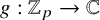 such that, while
$\|(f+g)-f\|_2=\delta $
such that, while
$\|(f+g)-f\|_2=\delta $
 , we have
$\|K_r(f+g)-K_r(f)\|_2\ge 1$
, we have
$\|K_r(f+g)-K_r(f)\|_2\ge 1$
 . Choosing carefully
$\varepsilon $
. Choosing carefully
$\varepsilon $
 and p, we can make
$\delta $
and p, we can make
$\delta $
 arbitrarily small, whence this choice of
$K_r$
arbitrarily small, whence this choice of
$K_r$
 fails to be a Lipschitz continuous operator in general, which is problematic for later calculations in this paper and also in specific applications. Let us give an explicit example of the latter. Let
$f(x):=\exp (2\pi i x^2/p)$
fails to be a Lipschitz continuous operator in general, which is problematic for later calculations in this paper and also in specific applications. Let us give an explicit example of the latter. Let
$f(x):=\exp (2\pi i x^2/p)$
 and
$g:=\delta f$
and
$g:=\delta f$
 . Then, by Gauss-sum estimates, we know that all Fourier coefficients of f have absolute value
$1/\sqrt {p}$
. Then, by Gauss-sum estimates, we know that all Fourier coefficients of f have absolute value
$1/\sqrt {p}$
 . Thus
$K_r(f)=0$
. Thus
$K_r(f)=0$
 , whereas
$K_r(f+g)=f+g$
, whereas
$K_r(f+g)=f+g$
 . Hence
$\|K_r(f+g)-K_r(f)\|_2 = \|f+g\|_2=1+\delta \ge 1$
. Hence
$\|K_r(f+g)-K_r(f)\|_2 = \|f+g\|_2=1+\delta \ge 1$
 . This devolves into a noncontinuous behavior of
$\mathcal {K}_r$
. This devolves into a noncontinuous behavior of
$\mathcal {K}_r$
 when we vary
$\varepsilon $
when we vary
$\varepsilon $
 . For instance, let
$h(x)=\exp (2\pi i x^3/p)$
. For instance, let
$h(x)=\exp (2\pi i x^3/p)$
 for a large prime p. By similar arguments as above, it is easy to see that if we consider
$\mathcal {K}_r(h\otimes \overline {h})$
for a large prime p. By similar arguments as above, it is easy to see that if we consider
$\mathcal {K}_r(h\otimes \overline {h})$
 for different
$\varepsilon $
for different
$\varepsilon $
 , we get the following behavior: if
$\varepsilon <1/\sqrt {p}$
, we get the following behavior: if
$\varepsilon <1/\sqrt {p}$
 then
$\mathcal {K}_r(h\otimes \overline {h})=h\otimes \overline {h}$
then
$\mathcal {K}_r(h\otimes \overline {h})=h\otimes \overline {h}$
 and thus we see only one nonzero eigenvalue, namely 1, with corresponding eigenvector h. On the other hand, when
$\varepsilon \ge 1/\sqrt {p}$
and thus we see only one nonzero eigenvalue, namely 1, with corresponding eigenvector h. On the other hand, when
$\varepsilon \ge 1/\sqrt {p}$
 , all diagonals
$\mathcal {D}_{\mathcal {K}_r(h\otimes \overline {h}),t}$
, all diagonals
$\mathcal {D}_{\mathcal {K}_r(h\otimes \overline {h}),t}$
 for
$t\in \operatorname {\mathrm {Z}}\setminus \{0\}$
for
$t\in \operatorname {\mathrm {Z}}\setminus \{0\}$
 are 0, and our operator becomes the linear operator that simply multiplies by
$1/p$
are 0, and our operator becomes the linear operator that simply multiplies by
$1/p$
 . Hence,
$\mathcal {K}_r$
. Hence,
$\mathcal {K}_r$
 exhibits a jump between two drastically different behaviors at
$\varepsilon =1/\sqrt {p}$
exhibits a jump between two drastically different behaviors at
$\varepsilon =1/\sqrt {p}$
 .
.
Remark 2.46. In higher orders
$k\geq 2$
 , an interesting choice of operator K to apply to the
$\operatorname {\mathrm {Z}}$
, an interesting choice of operator K to apply to the
$\operatorname {\mathrm {Z}}$
 -diagonals is the dual-function operator
$f\mapsto [f]_{U^k}$
-diagonals is the dual-function operator
$f\mapsto [f]_{U^k}$
 , where for
$f:\operatorname {\mathrm {Z}}\to \mathbb {C}$
, where for
$f:\operatorname {\mathrm {Z}}\to \mathbb {C}$
 we define the dual function
$[f]_k$
we define the dual function
$[f]_k$
 (also denoted by
$\mathcal {D}_k(f)$
(also denoted by
$\mathcal {D}_k(f)$
 ; see [Reference Tao and Vu66, Definition 11.13]) as follows:

We call the resulting
$\operatorname {\mathrm {Z}}$
 -matrix
$\mathcal {K}(f\otimes \overline {f})$
-matrix
$\mathcal {K}(f\otimes \overline {f})$
 the
$U^{k+1}$
the
$U^{k+1}$
 -dual operator, and denote it by
$[[f]]_{U^{k+1}}$
-dual operator, and denote it by
$[[f]]_{U^{k+1}}$
 . It turns out that
$[[f]]_{U^{k+1}}$
. It turns out that
$[[f]]_{U^{k+1}}$
 is a positive semi-definite operator, which has another definition very similar to the formula for the dual function (2.11) given by an average over cubes, but using an edge of the cube instead of a vertex. A useful property of dual functions is that
$[f]_{U^k}$
is a positive semi-definite operator, which has another definition very similar to the formula for the dual function (2.11) given by an average over cubes, but using an edge of the cube instead of a vertex. A useful property of dual functions is that
$[f]_{U^k}$
 is a structured function of order
$k-1$
is a structured function of order
$k-1$
 (in the sense of Definition 2.23) which satisfies
$\langle f,[f]_{U^k}\rangle =\|f\|_{U^k}^{2^k}$
(in the sense of Definition 2.23) which satisfies
$\langle f,[f]_{U^k}\rangle =\|f\|_{U^k}^{2^k}$
 , a correlation which indicates that
$[f]_{U^k}$
, a correlation which indicates that
$[f]_{U^k}$
 is nontrivially related to the structured part of f. Initial experiments with the eigenvectors of
$[[f]]_{U^{k+1}}$
is nontrivially related to the structured part of f. Initial experiments with the eigenvectors of
$[[f]]_{U^{k+1}}$
 show promise in describing the quadratic structure of f, but further investigation is required.
To close this section, let us introduce some additional tools that will enable us, among other things, to detail more precisely the observation made in Remark 2.8, namely the convenient interaction of products of
$\operatorname {\mathrm {Z}}$
 -matrices with the Fourier structure of their
$\operatorname {\mathrm {Z}}$
-matrices with the Fourier structure of their
$\operatorname {\mathrm {Z}}$
 -diagonals. To do so, we introduce the following matrix norm which quantifies this Fourier structure.
Definition 2.47. For any matrix
$M\in \mathbb {C}^{\operatorname {\mathrm {Z}}\times \operatorname {\mathrm {Z}}}$
 we define

Lemma 2.48. The function
$\|\cdot \|_{MA}$
 is a sub-multiplicative norm on the vector space
$\mathbb {C}^{\operatorname {\mathrm {Z}}\times \operatorname {\mathrm {Z}}}$
is a sub-multiplicative norm on the vector space
$\mathbb {C}^{\operatorname {\mathrm {Z}}\times \operatorname {\mathrm {Z}}}$
 with respect to matrix multiplication.
Proof. The fact that
$\|\cdot \|_{MA}$
 is a norm is easily checked. The sub-multiplicativity (namely that
$\|XY\|_{MA}\leq \|X\|_{MA}\|Y\|_{MA}$
is a norm is easily checked. The sub-multiplicativity (namely that
$\|XY\|_{MA}\leq \|X\|_{MA}\|Y\|_{MA}$
 for all
$X,Y\in \mathbb {C}^{\operatorname {\mathrm {Z}}\times \operatorname {\mathrm {Z}}}$
for all
$X,Y\in \mathbb {C}^{\operatorname {\mathrm {Z}}\times \operatorname {\mathrm {Z}}}$
 ) follows directly from Proposition 2.7.
This matrix norm immediately enables the control of the norm of polynomials evaluated on such matrices, which will be very useful to isolate certain eigenvalues later on. Let us record this.
Definition 2.49. Given any polynomial
$P(x)=\sum _{i=0}^n a_ix^i$
 with coefficients
$a_i\in \mathbb {C}$
with coefficients
$a_i\in \mathbb {C}$
 , let
$P^+$
, let
$P^+$
 denote the polynomial defined by

Remark 2.50. Note that for any polynomials
$P,Q$
 with coefficients in
$\mathbb {C}$
with coefficients in
$\mathbb {C}$
 , for any
$x\in \mathbb {R}_{\geq 0}$
, for any
$x\in \mathbb {R}_{\geq 0}$
 we have
$(PQ)^+(x)\le P^+(x)Q^+(x)$
we have
$(PQ)^+(x)\le P^+(x)Q^+(x)$
 . In particular, for any integer
$m\ge 1$
. In particular, for any integer
$m\ge 1$
 and
$x\in \mathbb {R}_{\geq 0}$
and
$x\in \mathbb {R}_{\geq 0}$
 , we have
$(P(x)^m)^+\le P^+(x)^m$
, we have
$(P(x)^m)^+\le P^+(x)^m$
 .
.
Lemma 2.48 has the following direct consequence.
Lemma 2.51. For any matrix
$M\in \mathbb {C}^{\operatorname {\mathrm {Z}}\times \operatorname {\mathrm {Z}}}$
 and polynomial
$P\in \mathbb {C}[x]$
and polynomial
$P\in \mathbb {C}[x]$
 , we have
$\|P(M)\|_{MA}\leq P^+(\|M\|_{MA})$
, we have
$\|P(M)\|_{MA}\leq P^+(\|M\|_{MA})$
 .
.
Proof. Letting
$P(x)=\sum _{i=0}^n a_ix^i$
 we have
$P(M)=\textstyle \sum _{i=0}^n a_iM^i$
we have
$P(M)=\textstyle \sum _{i=0}^n a_iM^i$
 , and by Lemma 2.48, we have

Let us record an important fact about weak quadratic characters, namely that these functions are precisely those which are approximately invariant under the operator
$\mathcal {K}_\varepsilon $
 .
.
Proposition 2.52. Let
$f:\operatorname {\mathrm {Z}}\to \mathbb {C}$
 be a 1-bounded function. Then the following holds:
-
(i) For any $\gamma ,\delta ,\varepsilon \in (0,1]$
, if
$\|\mathcal {K}_\varepsilon (f\otimes \overline {f})-f\otimes \overline {f}\|_2\leq \gamma $
, then f is a
$(\frac {4}{\varepsilon ^2\delta ^2},\,(\frac {2\gamma }{\delta })^{\frac {1}{2}},\,\delta )$
-weak quadratic character. -
(ii) For any $R>0$
and
$\delta _1,\delta _2\in [0,1]$
, if f is an
$(R,\delta _1,\delta _2)$
-weak quadratic character, then
$\|\mathcal {K}_\varepsilon (f\otimes \overline {f})-f\otimes \overline {f}\|_2\leq 6\varepsilon ^{1/4}R^{1/2}+ 4\delta _1+2\delta _2^{1/2} $
.


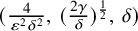



The proof will use the following basic property of
$K_\varepsilon $
 .
.
Lemma 2.53. Let
$R>0$
 ,
$\delta \in [0,1]$
,
$\delta \in [0,1]$
 , and
$g:\operatorname {\mathrm {Z}}\to \mathbb {C}$
, and
$g:\operatorname {\mathrm {Z}}\to \mathbb {C}$
 be
$(R,\delta )$
be
$(R,\delta )$
 -structured of order 1. Then
$\|K_\varepsilon (g)-g\|_2\leq 2\delta +4\varepsilon ^{1/4}R^{1/2}(1+\|g\|_2)^{1/4}$
-structured of order 1. Then
$\|K_\varepsilon (g)-g\|_2\leq 2\delta +4\varepsilon ^{1/4}R^{1/2}(1+\|g\|_2)^{1/4}$
 .
.
Proof. By Lemma 2.22, for any
$\alpha>0$
 there is a function
$h=\sum _{i\in [M]} c_i\chi _i$
there is a function
$h=\sum _{i\in [M]} c_i\chi _i$
 with
$M\leq \alpha ^{-6}R^4(1+\|g\|_2)^2$
with
$M\leq \alpha ^{-6}R^4(1+\|g\|_2)^2$
 and
$\|g-h\|_2\leq \alpha +\delta $
and
$\|g-h\|_2\leq \alpha +\delta $
 . Then, using Lemma 2.40, we have
$\|K_\varepsilon (g)-g\|_2\leq \|K_\varepsilon (g)-K_\varepsilon (h)\|_2+\|K_\varepsilon (h)- h\|_2+\|h-g\|_2\leq \|K_\varepsilon (h)- h\|_2+2\|h-g\|_2\leq \|K_\varepsilon (h)- h\|_2+2(\alpha +\delta )$
. Then, using Lemma 2.40, we have
$\|K_\varepsilon (g)-g\|_2\leq \|K_\varepsilon (g)-K_\varepsilon (h)\|_2+\|K_\varepsilon (h)- h\|_2+\|h-g\|_2\leq \|K_\varepsilon (h)- h\|_2+2\|h-g\|_2\leq \|K_\varepsilon (h)- h\|_2+2(\alpha +\delta )$
 . By (2.5) and Lemma 2.42, we have
$\|K_\varepsilon (h)- h\|_2 = (\sum _{i\in [M]}|q_\varepsilon '(c_i)|^2)^{1/2}\leq \varepsilon M^{1/2}$
. By (2.5) and Lemma 2.42, we have
$\|K_\varepsilon (h)- h\|_2 = (\sum _{i\in [M]}|q_\varepsilon '(c_i)|^2)^{1/2}\leq \varepsilon M^{1/2}$
 . Thus
$\|K_\varepsilon (g)-g\|_2\leq 2(\alpha +\delta )+\varepsilon \alpha ^{-3}R^2(1+\|g\|_2)$
. Thus
$\|K_\varepsilon (g)-g\|_2\leq 2(\alpha +\delta )+\varepsilon \alpha ^{-3}R^2(1+\|g\|_2)$
 , a quantity which we minimize by choosing
$\alpha =(3/2)^{-1/4}\varepsilon ^{1/4}R^{1/2}(1+\|g\|_2)^{1/4}$
, a quantity which we minimize by choosing
$\alpha =(3/2)^{-1/4}\varepsilon ^{1/4}R^{1/2}(1+\|g\|_2)^{1/4}$
 . The result follows.
Proof of Proposition 2.52.
Since
$\mathbb {E}_t\|K_\varepsilon (\Delta _t f)-\Delta _t f\|_2^2\le \gamma ^2$
 , it follows from Markov’s inequality that
$|\{t\in \operatorname {\mathrm {Z}}:\|K_\varepsilon (\Delta _t f)-\Delta _t f\|_2 < \frac {\gamma }{(\delta /2)^{1/2}}\}|\ge |\operatorname {\mathrm {Z}}|(1-\delta /2)$
, it follows from Markov’s inequality that
$|\{t\in \operatorname {\mathrm {Z}}:\|K_\varepsilon (\Delta _t f)-\Delta _t f\|_2 < \frac {\gamma }{(\delta /2)^{1/2}}\}|\ge |\operatorname {\mathrm {Z}}|(1-\delta /2)$
 . By Lemma 2.43, we have that
$K_\varepsilon (\Delta _t f)$
. By Lemma 2.43, we have that
$K_\varepsilon (\Delta _t f)$
 is
$(\varepsilon ^{-2}\|\Delta _tf\|_2^2,0)$
is
$(\varepsilon ^{-2}\|\Delta _tf\|_2^2,0)$
 -Fourier structured. Note that
$\mathbb {E}_t\|\Delta _tf\|_2^2=\|f\|_2^4$
-Fourier structured. Note that
$\mathbb {E}_t\|\Delta _tf\|_2^2=\|f\|_2^4$
 , so
$|\{t\in \operatorname {\mathrm {Z}}:\|\Delta _tf\|_2^2< \frac {\|f\|_2^4}{\delta /2}\}|\ge |\operatorname {\mathrm {Z}}|(1-\delta /2)$
, so
$|\{t\in \operatorname {\mathrm {Z}}:\|\Delta _tf\|_2^2< \frac {\|f\|_2^4}{\delta /2}\}|\ge |\operatorname {\mathrm {Z}}|(1-\delta /2)$
 . Hence, by the union bound, for at least
$(1-\delta )|\operatorname {\mathrm {Z}}|$
. Hence, by the union bound, for at least
$(1-\delta )|\operatorname {\mathrm {Z}}|$
 elements
$t\in \operatorname {\mathrm {Z}}$
elements
$t\in \operatorname {\mathrm {Z}}$
 , we have that
$\Delta _tf$
, we have that
$\Delta _tf$
 is
$(\frac {2\|f\|_2^4}{\varepsilon ^2\delta },\frac {2^{1/2}\gamma }{\delta ^{1/2}})$
is
$(\frac {2\|f\|_2^4}{\varepsilon ^2\delta },\frac {2^{1/2}\gamma }{\delta ^{1/2}})$
 -Fourier structured, hence
$(R',\frac {2^{1/2}\gamma }{\delta ^{1/2}})$
-Fourier structured, hence
$(R',\frac {2^{1/2}\gamma }{\delta ^{1/2}})$
 -structured of order 1 where, by Lemma 2.22 and what we know about t, we have
$R'=\frac {2^{3/4}\|f\|_2^3}{\varepsilon ^{3/2}\delta ^{3/4}}\|\Delta _t f\|_2\leq \frac {2^{5/4}\|f\|_2^5}{\varepsilon ^{3/2}\delta ^{5/4}}\leq \frac {4}{\varepsilon ^2\delta ^2}$
-structured of order 1 where, by Lemma 2.22 and what we know about t, we have
$R'=\frac {2^{3/4}\|f\|_2^3}{\varepsilon ^{3/2}\delta ^{3/4}}\|\Delta _t f\|_2\leq \frac {2^{5/4}\|f\|_2^5}{\varepsilon ^{3/2}\delta ^{5/4}}\leq \frac {4}{\varepsilon ^2\delta ^2}$
 . This proves
$(i)$
. This proves
$(i)$
 .
.
To prove
$(ii)$
 , let
$S\subset \operatorname {\mathrm {Z}}$
, let
$S\subset \operatorname {\mathrm {Z}}$
 with
$|S|\ge (1-\delta _2)|\operatorname {\mathrm {Z}}|$
with
$|S|\ge (1-\delta _2)|\operatorname {\mathrm {Z}}|$
 and such that for every
$t\in S$
and such that for every
$t\in S$
 we have that
$\Delta _tf$
we have that
$\Delta _tf$
 is
$(R,\delta _1)$
is
$(R,\delta _1)$
 -structured of order 1. Note that

By the triangle inequality and Lemma 2.40, we have
$\|K_\varepsilon (\Delta _t f)-\Delta _t f\|_2\le 2\|\Delta _t f\|_2$
 , so
$\mathbb {E}_t 1_{S^c}(t) \|K_\varepsilon (\Delta _t f)-\Delta _t f\|_2^2\le 4\mathbb {E}_t 1_{S^c}(t) \|\Delta _t f\|_2^2\leq 4\delta _2$
, so
$\mathbb {E}_t 1_{S^c}(t) \|K_\varepsilon (\Delta _t f)-\Delta _t f\|_2^2\le 4\mathbb {E}_t 1_{S^c}(t) \|\Delta _t f\|_2^2\leq 4\delta _2$
 (using that
$\|\Delta _t f\|_2\leq \|f\|_\infty \leq 1$
(using that
$\|\Delta _t f\|_2\leq \|f\|_\infty \leq 1$
 ). On the other hand, for every
$t\in S$
). On the other hand, for every
$t\in S$
 we have
$\Delta _tf=g_t+\mathcal {E}_t$
we have
$\Delta _tf=g_t+\mathcal {E}_t$
 where
$\|\mathcal {E}_t\|_2\le \delta _1$
where
$\|\mathcal {E}_t\|_2\le \delta _1$
 (in particular
$\|g_t\|_2\le 1+\delta _1$
(in particular
$\|g_t\|_2\le 1+\delta _1$
 ). Hence

By Lemma 2.40 we have
$\|K_\varepsilon (g_t+\mathcal {E}_t)-K_\varepsilon (g_t)\|_2\le \|\mathcal {E}_t\|_2\le \delta _1$
 , and by Lemma 2.53 we have
$\|K_\varepsilon (g_t)-g_t\|_2\le 2\delta _1+4\varepsilon ^{1/4}R^{1/2}(2+\delta _1)^{1/4}\le 2\delta _1+6\varepsilon ^{1/4}R^{1/2}$
, and by Lemma 2.53 we have
$\|K_\varepsilon (g_t)-g_t\|_2\le 2\delta _1+4\varepsilon ^{1/4}R^{1/2}(2+\delta _1)^{1/4}\le 2\delta _1+6\varepsilon ^{1/4}R^{1/2}$
 . We conclude that for
$t\in S$
. We conclude that for
$t\in S$
 we have
$\|K_\varepsilon (\Delta _t f)-\Delta _t f\|_2\le 4\delta _1+6\varepsilon ^{1/4}R^{1/2}$
we have
$\|K_\varepsilon (\Delta _t f)-\Delta _t f\|_2\le 4\delta _1+6\varepsilon ^{1/4}R^{1/2}$
 , so
$\mathbb {E}_t 1_S(t)\|K_\varepsilon (\Delta _t f)-\Delta _t f\|_2^2\le (4\delta _1+6\varepsilon ^{1/4}R^{1/2})^2$
, so
$\mathbb {E}_t 1_S(t)\|K_\varepsilon (\Delta _t f)-\Delta _t f\|_2^2\le (4\delta _1+6\varepsilon ^{1/4}R^{1/2})^2$
 .
.
Hence
$\|\mathcal {K}_\varepsilon (f\otimes \overline {f})-f\otimes \overline {f}\|_2\leq (4\delta _2 + [4\delta _1+6\varepsilon ^{1/4}R^{1/2}]^2)^{1/2}$
 and the result follows.
Remark 2.54. Note that, to prove
$(i)$
 , we did not need the assumption
$\|f\|_\infty \leq 1$
, we did not need the assumption
$\|f\|_\infty \leq 1$
 . Indeed, a bound
$\|f\|_2\leq 1$
. Indeed, a bound
$\|f\|_2\leq 1$
 was sufficient. Moreover, the proof of statement
$(ii)$
was sufficient. Moreover, the proof of statement
$(ii)$
 used the bound
$\|f\|_\infty \leq 1$
used the bound
$\|f\|_\infty \leq 1$
 only to control the term involving
$S^c$
only to control the term involving
$S^c$
 . Since for proper (i.e., nonweak) quadratic characters, there is no such term (as
$S^c$
. Since for proper (i.e., nonweak) quadratic characters, there is no such term (as
$S^c$
 is empty), it follows that for quadratic characters f, Proposition 2.52 holds in general (i.e., without assuming that f is 1-bounded). In particular, if f is an
$(R,\delta )$
is empty), it follows that for quadratic characters f, Proposition 2.52 holds in general (i.e., without assuming that f is 1-bounded). In particular, if f is an
$(R,\delta )$
 -quadratic character then
$\|\mathcal {K}_\varepsilon (f\otimes \overline {f})-f\otimes \overline {f}\|_2\leq 6\varepsilon ^{1/4}R^{1/2} +4\delta $
-quadratic character then
$\|\mathcal {K}_\varepsilon (f\otimes \overline {f})-f\otimes \overline {f}\|_2\leq 6\varepsilon ^{1/4}R^{1/2} +4\delta $
 .
.
Finally, we record the following fact, which is useful to control the behavior of weak quadratic characters under scalar multiplication.
Lemma 2.55. For any function
$f:\operatorname {\mathrm {Z}}\to \mathbb {C}$
 and
$c\in \mathbb {C}$
and
$c\in \mathbb {C}$
 , we have

In particular,

Proof. By (2.5) and Lemma 2.42, we have that
$\|\mathcal {K}_\varepsilon ((cf)\otimes (\overline {cf}))-(cf)\otimes (\overline {cf})\|_2^2$
 equals

Using that
$\min (\lambda a,\lambda b)=\lambda \min ( a, b)$
 for any
$a,b,\lambda \geq 0$
for any
$a,b,\lambda \geq 0$
 , we see that the last average above equals
$|c|^4 \, \mathbb {E}_t \sum _{\chi }\min \big (|\widehat {\Delta _t f}(\chi )|,\varepsilon /|c|^2\big )^2 = |c|^4\, \|\mathcal {K}_{\varepsilon /|c|^2}(f\otimes \overline {f})-f\otimes \overline {f}\|_2^2$
, we see that the last average above equals
$|c|^4 \, \mathbb {E}_t \sum _{\chi }\min \big (|\widehat {\Delta _t f}(\chi )|,\varepsilon /|c|^2\big )^2 = |c|^4\, \|\mathcal {K}_{\varepsilon /|c|^2}(f\otimes \overline {f})-f\otimes \overline {f}\|_2^2$
 , and (2.14) follows.
To see (2.15), note first that the argument above yields the equalities


and that (2.16) implies that
$\|\mathcal {K}_\varepsilon ((cf)\otimes (\overline {cf}))-(cf)\otimes (\overline {cf})\|_2$
 increases as
$|c|$
increases as
$|c|$
 increases, while (2.17) implies that
$\|\mathcal {K}_{\varepsilon /|c|^2}(f\otimes \overline {f})-f\otimes \overline {f}\|_2$
increases, while (2.17) implies that
$\|\mathcal {K}_{\varepsilon /|c|^2}(f\otimes \overline {f})-f\otimes \overline {f}\|_2$
 decreases as
$|c|$
decreases as
$|c|$
 increases.
Now
$\|\mathcal {K}_{\varepsilon /|c|^2}(f\otimes \overline {f})-f\otimes \overline {f}\|_2\leq 2\|f\otimes \overline {f}\|_2=2\|f\|_2^2$
 . Hence, if
$|c|^2\leq \varepsilon ^{1/2}$
. Hence, if
$|c|^2\leq \varepsilon ^{1/2}$
 , then, by the increasing property, the left side of (2.15) is at most
$2\varepsilon ^{1/2}\|f\|_2^2$
, then, by the increasing property, the left side of (2.15) is at most
$2\varepsilon ^{1/2}\|f\|_2^2$
 , while if
$|c|^2> \varepsilon ^{1/2}$
, while if
$|c|^2> \varepsilon ^{1/2}$
 , then by the decreasing property, the left side of (2.15) is at most
$|c|^2\,\|\mathcal {K}_{\varepsilon ^{1/2}}(f\otimes \overline {f})-f\otimes \overline {f}\|_2$
, then by the decreasing property, the left side of (2.15) is at most
$|c|^2\,\|\mathcal {K}_{\varepsilon ^{1/2}}(f\otimes \overline {f})-f\otimes \overline {f}\|_2$
 , and (2.15) follows.
3 Elementary motivation of the spectral approach in quadratic Fourier analysis
As discussed in the introduction, the spectral approach in quadratic Fourier analysis is based on the idea that, given a function
$f:\operatorname {\mathrm {Z}}\to \mathbb {C}$
 , the dominant eigenvectors of the Fourier-regularized matrix
$\mathcal {K}_\varepsilon (f\otimes \overline {f})$
, the dominant eigenvectors of the Fourier-regularized matrix
$\mathcal {K}_\varepsilon (f\otimes \overline {f})$
 are interesting quadratic Fourier components of f. In this section, we present some initial nontrivial results illustrating this idea more precisely.
The main result is that certain eigenvectors of the matrix
$\mathcal {K}_\varepsilon (f\otimes \overline {f})$
 , corresponding to large eigenvalues, are weak quadratic characters. We establish this formally in the first subsection below. In the second subsection, we gather further useful properties of the operator
$K_\varepsilon $
, corresponding to large eigenvalues, are weak quadratic characters. We establish this formally in the first subsection below. In the second subsection, we gather further useful properties of the operator
$K_\varepsilon $
 .
.
3.1 Spectrally isolated eigenvectors of
$\mathcal {K}_\varepsilon (f\otimes \overline {f})$
are (weak) quadratic characters

Definition 3.1. Let M be a self-adjoint linear operator on a finite-dimensional Hilbert space,Footnote 7 let
$\lambda $
 be an eigenvalue of M and let
$\theta>0$
be an eigenvalue of M and let
$\theta>0$
 . We say that
$\lambda $
. We say that
$\lambda $
 is
$\theta $
is
$\theta $
 -isolated if the multiplicity of
$\lambda $
-isolated if the multiplicity of
$\lambda $
 is
$1$
is
$1$
 and every other eigenvalue
$\lambda '$
and every other eigenvalue
$\lambda '$
 of M satisfies
$|\lambda -\lambda '|>\theta $
of M satisfies
$|\lambda -\lambda '|>\theta $
 .
.
The main result in this subsection, Proposition 3.4, tells us that eigenvectors of the matrix
$\mathcal {K}_\varepsilon (f\otimes \overline {f})$
 corresponding to isolated large eigenvalues are weak quadratic characters, with parameters depending on how structured the diagonals of the matrix are. To establish this result, we will use the interaction of the matrix norm
$\|\cdot \|_{MA}$
corresponding to isolated large eigenvalues are weak quadratic characters, with parameters depending on how structured the diagonals of the matrix are. To establish this result, we will use the interaction of the matrix norm
$\|\cdot \|_{MA}$
 (recall Definition 2.47) with polynomial matrix expressions, described in Lemma 2.51. To apply this effectively on isolated eigenvalues, we shall use the following polynomial approximations of indicator functions.
Definition 3.2. For any
$n\in \mathbb {N}$
 and
$\lambda \in \mathbb {R}\setminus \{0\}$
and
$\lambda \in \mathbb {R}\setminus \{0\}$
 , we define the polynomial

Note that
$p_n(\lambda ,\lambda )=1$
 . The idea is that if n is sufficiently large and x sufficiently separated from
$\lambda $
. The idea is that if n is sufficiently large and x sufficiently separated from
$\lambda $
 , then
$p_n(x,\lambda )$
, then
$p_n(x,\lambda )$
 is small. We make this precise as follows.
Lemma 3.3. For any
$\theta>0$
 and
$\lambda \in [-1,1]\setminus \{0\}$
and
$\lambda \in [-1,1]\setminus \{0\}$
 , if
$n\geq 4\theta ^{-2}\ln (\theta ^{-1}\lambda ^{-1})$
, if
$n\geq 4\theta ^{-2}\ln (\theta ^{-1}\lambda ^{-1})$
 , then
$|p_n(x,\lambda )|\leq \theta |x|$
, then
$|p_n(x,\lambda )|\leq \theta |x|$
 for every
$x\in [-1,1]$
for every
$x\in [-1,1]$
 satisfying
$|x-\lambda |\geq \theta .$
satisfying
$|x-\lambda |\geq \theta .$

Proof. The inequality holds for
$x=0$
 , as
$p_n(0,\lambda )=0$
, as
$p_n(0,\lambda )=0$
 , so we can assume that
$x\neq 0$
, so we can assume that
$x\neq 0$
 . Then

where the last inequality follows from the assumption on n.
Recall from (2.13) the definition of
$p_n^+$
 . Since
$p_n(x,\lambda )=\lambda ^{-1} x (- \frac {x^2}{4} +\lambda \frac {x}{2} +(1-\frac {\lambda ^2}{4}))^n$
. Since
$p_n(x,\lambda )=\lambda ^{-1} x (- \frac {x^2}{4} +\lambda \frac {x}{2} +(1-\frac {\lambda ^2}{4}))^n$
 , it follows that for
$0<|\lambda |\leq 1$
, it follows that for
$0<|\lambda |\leq 1$
 and
$x\geq 0$
and
$x\geq 0$
 we have

Recall also that we normalize eigenvectors v of a matrix to have
$\|v\|_2=1$
 . We can now present the main result of this subsection.
Proposition 3.4. Let
$M\in \mathbb {C}^{\operatorname {\mathrm {Z}}\times \operatorname {\mathrm {Z}}}$
 be a self-adjoint
$\operatorname {\mathrm {Z}}$
be a self-adjoint
$\operatorname {\mathrm {Z}}$
 -matrix with
$\|M\|_2\leq 1$
-matrix with
$\|M\|_2\leq 1$
 , and let
$\theta \in (0,1]$
, and let
$\theta \in (0,1]$
 . Suppose that
$\lambda \neq 0$
. Suppose that
$\lambda \neq 0$
 is a
$\theta $
is a
$\theta $
 -isolated eigenvalue of M, and let g be a corresponding eigenvector of M. Then, letting
$n:=\lceil 4\theta ^{-2}\ln (\theta ^{-1}\lambda ^{-1})\rceil $
-isolated eigenvalue of M, and let g be a corresponding eigenvector of M. Then, letting
$n:=\lceil 4\theta ^{-2}\ln (\theta ^{-1}\lambda ^{-1})\rceil $
 , we have that for at least
$(1-\theta ^{1/2})|\operatorname {\mathrm {Z}}|$
, we have that for at least
$(1-\theta ^{1/2})|\operatorname {\mathrm {Z}}|$
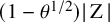 values of
$t\in \operatorname {\mathrm {Z}}$
values of
$t\in \operatorname {\mathrm {Z}}$
 , the function
$\Delta _t g$
, the function
$\Delta _t g$
 is
$(p_n^+(\|M\|_{MA},\lambda )^2\theta ^{-1},2\theta ^{1/2})$
is
$(p_n^+(\|M\|_{MA},\lambda )^2\theta ^{-1},2\theta ^{1/2})$
 -Fourier structured, so g is a weak quadratic character with parameters
$\big (2 p_n^+(\|M\|_{MA},\lambda )^{3/2}\theta ^{-5/4},3\theta ^{1/2},\theta \big )$
-Fourier structured, so g is a weak quadratic character with parameters
$\big (2 p_n^+(\|M\|_{MA},\lambda )^{3/2}\theta ^{-5/4},3\theta ^{1/2},\theta \big )$
 . In particular, if
$|\lambda |\geq \theta $
. In particular, if
$|\lambda |\geq \theta $
 , then g is a weak quadratic character with parameters

Proof. As M is self-adjoint, let
$\{g_i\}_{i=1}^{|\operatorname {\mathrm {Z}}|-1}$
 and
$\{\lambda _i\}_{i=1}^{|\operatorname {\mathrm {Z}}|-1}$
and
$\{\lambda _i\}_{i=1}^{|\operatorname {\mathrm {Z}}|-1}$
 be eigenvectors and corresponding eigenvalues of M in a way that
$\{g,g_1,\ldots ,g_{|\operatorname {\mathrm {Z}}|-1}\}$
be eigenvectors and corresponding eigenvalues of M in a way that
$\{g,g_1,\ldots ,g_{|\operatorname {\mathrm {Z}}|-1}\}$
 forms an orthonormal basis. Since
$\|M\|_2\leq 1$
forms an orthonormal basis. Since
$\|M\|_2\leq 1$
 , we have
$\lambda ^2+\sum _{i=1}^{|\operatorname {\mathrm {Z}}|-1}\lambda _i^2\leq 1$
, we have
$\lambda ^2+\sum _{i=1}^{|\operatorname {\mathrm {Z}}|-1}\lambda _i^2\leq 1$
 . In particular, all eigenvalues of M are of absolute value at most
$1$
. In particular, all eigenvalues of M are of absolute value at most
$1$
 . Let
$M':=p_n(M,\lambda )$
. Let
$M':=p_n(M,\lambda )$
 . We have (using
$p_n(\lambda ,\lambda )=1$
. We have (using
$p_n(\lambda ,\lambda )=1$
 ) that
$M'=g\otimes \overline {g}+\sum _{i=1}^{|\operatorname {\mathrm {Z}}|-1} p_n(\lambda _i,\lambda ) g_i\otimes \overline {g_i}$
) that
$M'=g\otimes \overline {g}+\sum _{i=1}^{|\operatorname {\mathrm {Z}}|-1} p_n(\lambda _i,\lambda ) g_i\otimes \overline {g_i}$
 .
.
By Lemma 3.3,
$|p_n(\lambda _i,\lambda )|\leq \theta |\lambda _i|$
 holds for
$1\leq i\leq {|\operatorname {\mathrm {Z}}|-1}$
holds for
$1\leq i\leq {|\operatorname {\mathrm {Z}}|-1}$
 , so
$\sum _{i=1}^{|\operatorname {\mathrm {Z}}|-1} p_n(\lambda _i,\lambda )^2\leq \theta ^2\sum _{i=1}^{|\operatorname {\mathrm {Z}}|-1}\lambda _i^2\leq \theta ^2$
, so
$\sum _{i=1}^{|\operatorname {\mathrm {Z}}|-1} p_n(\lambda _i,\lambda )^2\leq \theta ^2\sum _{i=1}^{|\operatorname {\mathrm {Z}}|-1}\lambda _i^2\leq \theta ^2$
 . Therefore
$\mathbb {E}_t\|\mathcal {D}_{M',t}-\Delta _t g\|_2^2=\|g\otimes \overline {g}-M'\|_2^2\leq \theta ^2$
. Therefore
$\mathbb {E}_t\|\mathcal {D}_{M',t}-\Delta _t g\|_2^2=\|g\otimes \overline {g}-M'\|_2^2\leq \theta ^2$
 . This means that for a subset
$S\in \operatorname {\mathrm {Z}}$
. This means that for a subset
$S\in \operatorname {\mathrm {Z}}$
 with
$|S|\geq (1-\theta /2)|\operatorname {\mathrm {Z}}|$
with
$|S|\geq (1-\theta /2)|\operatorname {\mathrm {Z}}|$
 we have that, if
$t\in S$
we have that, if
$t\in S$
 , then
$ \|\mathcal {D}_{M',t}-\Delta _t g\|_2\leq (2\theta )^{1/2}$
, then
$ \|\mathcal {D}_{M',t}-\Delta _t g\|_2\leq (2\theta )^{1/2}$
 .
.
As
$\mathbb {E}_t\|\Delta _t g\|_2^2=\|g\|_2^4\leq 1$
 , the set
$S':=\{t\in \operatorname {\mathrm {Z}}: \|\Delta _t g\|_2^2\leq \frac {2}{\theta }\}$
, the set
$S':=\{t\in \operatorname {\mathrm {Z}}: \|\Delta _t g\|_2^2\leq \frac {2}{\theta }\}$
 satisfies
$|S'|/|\operatorname {\mathrm {Z}}|\geq 1-\theta /2$
satisfies
$|S'|/|\operatorname {\mathrm {Z}}|\geq 1-\theta /2$
 .
.
By Lemma 2.51,
$\|M'\|_{MA}\leq p_n^+(\|M\|_{MA},\lambda )$
 . By Corollary 2.19, for every
$t\in S\cap S'$
. By Corollary 2.19, for every
$t\in S\cap S'$
 ,
$\mathcal {D}_{M',t}$
,
$\mathcal {D}_{M',t}$
 is
$(p_n^+(\|M\|_{MA},\lambda )^2\theta ^{-1},\theta )$
is
$(p_n^+(\|M\|_{MA},\lambda )^2\theta ^{-1},\theta )$
 -Fourier structured, so
$\Delta _t g$
-Fourier structured, so
$\Delta _t g$
 is
$(p_n^+(\|M\|_{MA},\lambda )^2\theta ^{-1},3\theta ^{1/2})$
is
$(p_n^+(\|M\|_{MA},\lambda )^2\theta ^{-1},3\theta ^{1/2})$
 -Fourier structured and
$\|\Delta _t g\|_2\leq (2/\theta )^{1/2}$
-Fourier structured and
$\|\Delta _t g\|_2\leq (2/\theta )^{1/2}$
 . The parameters for g involving
$\lambda $
. The parameters for g involving
$\lambda $
 follow by Lemma 2.22, and the final parameters in (3.2) follow from the latter and (3.1).
Proposition 3.4 is just one member of a family of similar results; we chose this one for purposes of illustration and motivation. In other variants one could want for instance the precision parameter of the character g to be independent of the isolation
$\theta $
 . Proving such variants can involve different choices of the polynomial
$p_n$
. Proving such variants can involve different choices of the polynomial
$p_n$
 . Proposition 3.4 implies the next theorem.
Theorem 3.5. Let
$\operatorname {\mathrm {Z}}$
 be a finite abelian group, let
$f:\operatorname {\mathrm {Z}}\to \mathbb {C}$
be a finite abelian group, let
$f:\operatorname {\mathrm {Z}}\to \mathbb {C}$
 be a 1-bounded function, and let
$\theta ,\varepsilon \in (0,1]$
be a 1-bounded function, and let
$\theta ,\varepsilon \in (0,1]$
 . Suppose that there exists a
$\theta $
. Suppose that there exists a
$\theta $
 -isolated eigenvalue
$\lambda $
-isolated eigenvalue
$\lambda $
 of
$\mathcal {K}_\varepsilon \big (f\otimes \overline {f}\big )$
of
$\mathcal {K}_\varepsilon \big (f\otimes \overline {f}\big )$
 with
$|\lambda |\geq \theta $
with
$|\lambda |\geq \theta $
 , and let g be a corresponding eigenvector with
$\|g\|_2= 1$
, and let g be a corresponding eigenvector with
$\|g\|_2= 1$
 . Then g is a weak quadratic character with parameters
$ \big (2\theta ^{-3}\varepsilon ^{-1}(1/(2\varepsilon )+1)^{2n},3\theta ^{1/2},\theta \big )$
. Then g is a weak quadratic character with parameters
$ \big (2\theta ^{-3}\varepsilon ^{-1}(1/(2\varepsilon )+1)^{2n},3\theta ^{1/2},\theta \big )$
 , where
$n=\lceil 8\theta ^{-2}\ln (\theta ^{-1})\rceil $
, where
$n=\lceil 8\theta ^{-2}\ln (\theta ^{-1})\rceil $
 .
.
Proof. Let M be the self-adjoint matrix
$\mathcal {K}_\varepsilon \big (f\otimes \overline {f}\big )$
 and
$M':=f\otimes \overline {f}$
and
$M':=f\otimes \overline {f}$
 . Note that
$\|\mathcal {D}_{M',t}\|_2\leq \|\mathcal {D}_{M',t}\|_\infty \leq 1$
. Note that
$\|\mathcal {D}_{M',t}\|_2\leq \|\mathcal {D}_{M',t}\|_\infty \leq 1$
 holds for every
$t\in \operatorname {\mathrm {Z}}$
holds for every
$t\in \operatorname {\mathrm {Z}}$
 , so
$\|\mathcal {D}_{M,t}\|_2\leq 1$
, so
$\|\mathcal {D}_{M,t}\|_2\leq 1$
 holds for every
$t\in \operatorname {\mathrm {Z}}$
holds for every
$t\in \operatorname {\mathrm {Z}}$
 by Lemma 2.40. By (2.10) we have
$\|\mathcal {D}_{M,t}\|_{A(\operatorname {\mathrm {Z}})}\leq \varepsilon ^{-1}$
by Lemma 2.40. By (2.10) we have
$\|\mathcal {D}_{M,t}\|_{A(\operatorname {\mathrm {Z}})}\leq \varepsilon ^{-1}$
 for every
$t\in \operatorname {\mathrm {Z}}$
for every
$t\in \operatorname {\mathrm {Z}}$
 . Note also that
$\|M\|_2=(\mathbb {E}_t\|\mathcal {D}_{M,t}\|_2^2)^{1/2}\leq 1$
. Note also that
$\|M\|_2=(\mathbb {E}_t\|\mathcal {D}_{M,t}\|_2^2)^{1/2}\leq 1$
 . The result now follows by applying Proposition 3.4.
There are various directions in which one can want to strengthen Theorem 3.5, and which provide good motivation for the upcoming sections of the paper.
One such direction seeks to ensure that the eigenvector g is not just a weak quadratic character, but rather a proper quadratic character. Another direction, which is important in connection with inverse theorems, is to add a nontrivial lower bound for the correlation between the original function f and the quadratic character g. In yet another direction, the goal is to obtain a correlating quadratic character g even when none of the largest eigenvalues is isolated.
In the upcoming sections we will make progress in these directions. To this end, we prepare in the next subsection by obtaining further useful properties of the operator
$K_\varepsilon $
 . Then, in Section 4, we will start using nilspace theory, and especially certain decompositions in terms of nilspace characters, which will be key ingredients for our results in the above directions. We will then be able to say more about the relations between weak quadratic characters and 2-step nilspace characters (in particular with Theorem 4.19; see also Question 4.21).
3.2 Further properties of the operator
$K_\varepsilon $

Here, we gather several inequalities involving the operator
$K_\varepsilon $
 from Definition 2.39.
Throughout this subsection we maintain the notation
$\operatorname {\mathrm {Z}}$
 for a finite abelian group. Recall also the distinction between
$K_\varepsilon $
for a finite abelian group. Recall also the distinction between
$K_\varepsilon $
 and
$\mathcal {K}_\varepsilon $
and
$\mathcal {K}_\varepsilon $
 from Remark 2.11.
The first two results capture continuity of
$\mathcal {K}_\varepsilon $
 relative to the
$L^2$
relative to the
$L^2$
 -norm.
Lemma 3.6. Let
$M,N\in \mathbb {C}^{\operatorname {\mathrm {Z}}\times \operatorname {\mathrm {Z}}}$
 and let
$\varepsilon \in (0,1]$
and let
$\varepsilon \in (0,1]$
 . Then

Proof. Computing the
$L^2$
 -norm via diagonals, note that the left side of (3.3) squared equals
$\mathbb {E}_t \|K_\varepsilon (\mathcal {D}_{M,t})-K_\varepsilon (\mathcal {D}_{N,t})\|_2^2$
-norm via diagonals, note that the left side of (3.3) squared equals
$\mathbb {E}_t \|K_\varepsilon (\mathcal {D}_{M,t})-K_\varepsilon (\mathcal {D}_{N,t})\|_2^2$
 . For every
$t\in \operatorname {\mathrm {Z}}$
. For every
$t\in \operatorname {\mathrm {Z}}$
 , by Lemma 2.40,
$\|K_\varepsilon (\mathcal {D}_{M,t})-K_\varepsilon (\mathcal {D}_{N,t})\|_2^2\leq \|\mathcal {D}_{M,t}-\mathcal {D}_{N,t}\|_2^2=\|\mathcal {D}_{M-N,t}\|_2^2$
, by Lemma 2.40,
$\|K_\varepsilon (\mathcal {D}_{M,t})-K_\varepsilon (\mathcal {D}_{N,t})\|_2^2\leq \|\mathcal {D}_{M,t}-\mathcal {D}_{N,t}\|_2^2=\|\mathcal {D}_{M-N,t}\|_2^2$
 . Since
$\mathbb {E}_t\|\mathcal {D}_{M-N,t}\|_2^2=\|M-N\|_2^2$
. Since
$\mathbb {E}_t\|\mathcal {D}_{M-N,t}\|_2^2=\|M-N\|_2^2$
 , the result follows.
Corollary 3.7. For any functions
$f,g:\operatorname {\mathrm {Z}}\to \mathbb {C}$
 and
$\varepsilon \in (0,1]$
and
$\varepsilon \in (0,1]$
 , we have

Proof. Using (3.3) we see that
$\|\mathcal {K}_\varepsilon (f\otimes \overline {f})-\mathcal {K}_\varepsilon (g\otimes \overline {g})\|_2$
 is at most

and this equals
$\|f-g\|_2\, (\|f\|_2+\|g\|_2)$
 as required.
The next results build up towards a continuity property of the map
$f\mapsto \mathcal {K}_\varepsilon (f\otimes \overline {f})$
 relative to the
$U^3$
relative to the
$U^3$
 -norm. This property will eventually be established in Corollary 3.13 below. We begin with the following simple lemma.
Lemma 3.8. For any function
$f:\operatorname {\mathrm {Z}}\to \mathbb {C}$
 and any
$\varepsilon \in (0,1]$
and any
$\varepsilon \in (0,1]$
 , we have
$\|K_\varepsilon (f)\|_2\leq \varepsilon ^{-1}\|f\|_{U^2}^2$
, we have
$\|K_\varepsilon (f)\|_2\leq \varepsilon ^{-1}\|f\|_{U^2}^2$
 .
.
Proof. Let
$g=K_\varepsilon (f)$
 and let
$S:=\operatorname {\mathrm {Supp}}(\widehat {g})=\{\chi \in \widehat {\operatorname {\mathrm {Z}}}: |\widehat {f}(\chi )|>\varepsilon \}$
and let
$S:=\operatorname {\mathrm {Supp}}(\widehat {g})=\{\chi \in \widehat {\operatorname {\mathrm {Z}}}: |\widehat {f}(\chi )|>\varepsilon \}$
 . By Markov’s inequality we then have
$|S|\varepsilon ^4\leq \|\widehat {f}\|_{\ell ^4}^4=\|f\|_{U^2}^4$
. By Markov’s inequality we then have
$|S|\varepsilon ^4\leq \|\widehat {f}\|_{\ell ^4}^4=\|f\|_{U^2}^4$
 . Furthermore, we have
$|\widehat {f}|\geq |\widehat {g}|$
. Furthermore, we have
$|\widehat {f}|\geq |\widehat {g}|$
 . By Parseval’s identity and the Cauchy-Schwarz inequality, we then have

A similar argument yields the following result.
Lemma 3.9. For any functions
$f,g:\operatorname {\mathrm {Z}}\to \mathbb {C}$
 and
$\varepsilon \in (0,1]$
and
$\varepsilon \in (0,1]$
 , we have

Proof. We have

Since
$q_\varepsilon $
 eliminates Fourier coefficients of modulus at most
$\varepsilon $
eliminates Fourier coefficients of modulus at most
$\varepsilon $
 , the last sum above gets nonzero contributions only from characters
$\chi $
, the last sum above gets nonzero contributions only from characters
$\chi $
 in the set
$S:=\{\chi :|\widehat {f}(\chi )|\geq \varepsilon \}\cup \{\chi :|\widehat {g}(\chi )|\geq \varepsilon \}$
in the set
$S:=\{\chi :|\widehat {f}(\chi )|\geq \varepsilon \}\cup \{\chi :|\widehat {g}(\chi )|\geq \varepsilon \}$
 . We have
$\varepsilon ^2\, |\{\chi :|\widehat {f}(\chi )|\geq \varepsilon \}|\leq \sum _\chi | \widehat {f}(\chi )|^2 = \|f\|_2^2$
. We have
$\varepsilon ^2\, |\{\chi :|\widehat {f}(\chi )|\geq \varepsilon \}|\leq \sum _\chi | \widehat {f}(\chi )|^2 = \|f\|_2^2$
 and similarly
$|\{\chi :|\widehat {g}(\chi )|\geq \varepsilon \}|\leq \varepsilon ^{-2} \|g\|_2^2$
and similarly
$|\{\chi :|\widehat {g}(\chi )|\geq \varepsilon \}|\leq \varepsilon ^{-2} \|g\|_2^2$
 . Hence
$ |S|\leq \varepsilon ^{-2}\, (\|f\|_2^2+\|g\|_2^2)$
. Hence
$ |S|\leq \varepsilon ^{-2}\, (\|f\|_2^2+\|g\|_2^2)$
 .
.
By Lemma 2.40 the function
$q_\varepsilon $
 is a contraction, whence (using Cauchy-Schwarz) we have

Since
$\|\widehat {f-g}\|_{\ell ^4}^2=\|f-g\|_{U^2}^2$
 , the result follows.
Applying Lemma 3.9 to diagonal functions of
$\operatorname {\mathrm {Z}}$
 -matrices (recall (2.1)), we shall obtain below a result (Lemma 3.12) enabling us to control
$L^2$
-matrices (recall (2.1)), we shall obtain below a result (Lemma 3.12) enabling us to control
$L^2$
 -norms of the form
$\|\mathcal {K}_\varepsilon (M)-\mathcal {K}_\varepsilon (N)\|_2$
-norms of the form
$\|\mathcal {K}_\varepsilon (M)-\mathcal {K}_\varepsilon (N)\|_2$
 , for
$\operatorname {\mathrm {Z}}$
, for
$\operatorname {\mathrm {Z}}$
 -matrices M and N, in terms of a norm which is the case
$k=2$
-matrices M and N, in terms of a norm which is the case
$k=2$
 of the following notion.
Definition 3.10. For any integer
$k\geq 2$
 , we define the following norm on
$\mathbb {C}^{\operatorname {\mathrm {Z}}\times \operatorname {\mathrm {Z}}}$
, we define the following norm on
$\mathbb {C}^{\operatorname {\mathrm {Z}}\times \operatorname {\mathrm {Z}}}$
 :
:

Lemma 3.11. For every
$k\geq 2$
 we have that
$\|\cdot \|_{DU^k}$
we have that
$\|\cdot \|_{DU^k}$
 is a norm on the vector space
$\mathbb {C}^{\operatorname {\mathrm {Z}}\times \operatorname {\mathrm {Z}}}$
is a norm on the vector space
$\mathbb {C}^{\operatorname {\mathrm {Z}}\times \operatorname {\mathrm {Z}}}$
 .
.
Proof. The only nontrivial norm axiom is the sub-additivity. This follows from the sub-additivity of the
$U^k$
 -norm and the
$L^{2^k}$
-norm and the
$L^{2^k}$
 -norm, indeed

We can now obtain the lemma announced above.
Lemma 3.12. Let
$M,N\in \mathbb {C}^{\operatorname {\mathrm {Z}}\times \operatorname {\mathrm {Z}}}$
 and
$\varepsilon \in (0,1]$
and
$\varepsilon \in (0,1]$
 . Then

Proof. The left side of (3.7) squared equals
$\mathbb {E}_t\|K_\varepsilon (\mathfrak {D}_{M,t})-K_\varepsilon (\mathfrak {D}_{N,t})\|_2^2$
 . Applying Lemma 3.9 for every
$t\in \operatorname {\mathrm {Z}}$
. Applying Lemma 3.9 for every
$t\in \operatorname {\mathrm {Z}}$
 , this is seen to be at most
$ \varepsilon ^{-1}\mathbb {E}_t\|\mathfrak {D}_{M,t}-\mathfrak {D}_{N,t}\|_{U^2}^2\,(\|\mathfrak {D}_{M,t})\|_2^2+\|\mathfrak {D}_{N,t}\|_2^2)^{1/2}$
, this is seen to be at most
$ \varepsilon ^{-1}\mathbb {E}_t\|\mathfrak {D}_{M,t}-\mathfrak {D}_{N,t}\|_{U^2}^2\,(\|\mathfrak {D}_{M,t})\|_2^2+\|\mathfrak {D}_{N,t}\|_2^2)^{1/2}$
 . Using that
$\mathfrak {D}_{M,t}-\mathfrak {D}_{N,t}=\mathfrak {D}_{M-N,t}$
. Using that
$\mathfrak {D}_{M,t}-\mathfrak {D}_{N,t}=\mathfrak {D}_{M-N,t}$
 and Cauchy-Schwarz, the last quantity is seen to be at most
$ \varepsilon ^{-1}(\mathbb {E}_t\|\mathfrak {D}_{M-N,t}\|_{U^2}^4)^{1/2}\,(\mathbb {E}_t\|\mathfrak {D}_{M,t})\|_2^2+\mathbb {E}_t\|\mathfrak {D}_{N,t}\|_2^2)^{1/2}$
and Cauchy-Schwarz, the last quantity is seen to be at most
$ \varepsilon ^{-1}(\mathbb {E}_t\|\mathfrak {D}_{M-N,t}\|_{U^2}^4)^{1/2}\,(\mathbb {E}_t\|\mathfrak {D}_{M,t})\|_2^2+\mathbb {E}_t\|\mathfrak {D}_{N,t}\|_2^2)^{1/2}$
 and (3.7) follows.
Similarly to how we deduced Corollary 3.7 from Lemma 3.6, we shall deduce the following from Lemma 3.12.
Corollary 3.13. Let
$\varepsilon \in (0,1]$
 and let
$f,g:\operatorname {\mathrm {Z}}\to \mathbb {C}$
and let
$f,g:\operatorname {\mathrm {Z}}\to \mathbb {C}$
 be functions. Then

To prove Corollary 3.13, we introduce the following special case of a Gowers
$U^k$
 -product.
Definition 3.14. For any integer
$k\geq 2$
 and any functions
$f,g:\operatorname {\mathrm {Z}}\to \mathbb {C}$
and any functions
$f,g:\operatorname {\mathrm {Z}}\to \mathbb {C}$
 , we denote by
$\langle f,g\rangle _{U^k}$
, we denote by
$\langle f,g\rangle _{U^k}$
 the special case of the Gowers
$U^k$
the special case of the Gowers
$U^k$
 -productFootnote 8
$\langle (f_v)_{v\in [\![ k]\!] }\rangle _{U^k}$
-productFootnote 8
$\langle (f_v)_{v\in [\![ k]\!] }\rangle _{U^k}$
 in which
$f_v=f$
in which
$f_v=f$
 for
$v(k)=0$
for
$v(k)=0$
 and
$f_v=g$
and
$f_v=g$
 for
$v(k)=1$
for
$v(k)=1$
 . Note that

In particular, we always have
$\langle f,g\rangle _{U^k}\geq 0$
 . Note also that from (3.9) it follows that

Proof of Corollary 3.13.
We have

To bound the first term on the right hand side, note that, by Lemma 3.12 and (3.10), we have

Similarly,
$\big \|\mathcal {K}_\varepsilon (f\otimes \overline {g})-\mathcal {K}_\varepsilon (g\otimes \overline {g})\big \|_2^2 \leq \varepsilon ^{-1}\;\langle f-g,g\rangle _{U^3}^{1/2}\;\|g\|_2\;(\|f\|_2^2+\|g\|_2^2)^{1/2}$
 . In particular, the product
$\big \|\mathcal {K}_\varepsilon (f\otimes \overline {f})-\mathcal {K}_\varepsilon (f\otimes \overline {g})\big \|_2 \big \|\mathcal {K}_\varepsilon (f\otimes \overline {g})-\mathcal {K}_\varepsilon (g\otimes \overline {g})\big \|_2 $
. In particular, the product
$\big \|\mathcal {K}_\varepsilon (f\otimes \overline {f})-\mathcal {K}_\varepsilon (f\otimes \overline {g})\big \|_2 \big \|\mathcal {K}_\varepsilon (f\otimes \overline {g})-\mathcal {K}_\varepsilon (g\otimes \overline {g})\big \|_2 $
 is at most

Hence
$ \big \|\mathcal {K}_\varepsilon (f\otimes \overline {f})-\mathcal {K}_\varepsilon (g\otimes \overline {g})\big \|_2^2\leq \varepsilon ^{-1}\, (\|f\|_2^2+\|g\|_2^2)^{\frac {1}{2}} (\langle f,f-g\rangle _{U^3}^{\frac {1}{4}}\|f\|_2^{\frac {1}{2}}+\langle f-g,g\rangle _{U^3}^{\frac {1}{4}}\|g\|_2^{\frac {1}{2}})^2$
 . By the Gowers-Cauchy-Schwarz inequality, we have
$\langle f,f-g\rangle _{U^3}^{1/4}\leq \|f\|_{U^3} \|f-g\|_{U^3}$
. By the Gowers-Cauchy-Schwarz inequality, we have
$\langle f,f-g\rangle _{U^3}^{1/4}\leq \|f\|_{U^3} \|f-g\|_{U^3}$
 and
$\langle f-g,g\rangle _{U^3}^{1/4}\leq \|g\|_{U^3} \|f-g\|_{U^3}$
and
$\langle f-g,g\rangle _{U^3}^{1/4}\leq \|g\|_{U^3} \|f-g\|_{U^3}$
 . Hence

By Hölder’s inequality with indices
$4$
 and
$4/3$
and
$4/3$
 applied to the last factor, the last line is at most
$\varepsilon ^{-1}\; \|f-g\|_{U^3}^2\; (\|f\|_2^2+\|g\|_2^2)^{\frac {1}{2}}\; (\|f\|_{U^3}^{\frac {4}{3}}+\|g\|_{U^3}^{\frac {4}{3}})^{\frac {3}{2}}\; (\|f\|_2^2+\|g\|_2^2)^{\frac {1}{2}}$
applied to the last factor, the last line is at most
$\varepsilon ^{-1}\; \|f-g\|_{U^3}^2\; (\|f\|_2^2+\|g\|_2^2)^{\frac {1}{2}}\; (\|f\|_{U^3}^{\frac {4}{3}}+\|g\|_{U^3}^{\frac {4}{3}})^{\frac {3}{2}}\; (\|f\|_2^2+\|g\|_2^2)^{\frac {1}{2}}$
 . The result follows.
The third and final type of bounds concerns functions and
$\operatorname {\mathrm {Z}}$
 -matrices that are stable under the Fourier denoising operator, particularly functions f such that
$\|K_\varepsilon (f)-f\|_2$
-matrices that are stable under the Fourier denoising operator, particularly functions f such that
$\|K_\varepsilon (f)-f\|_2$
 is small. We now prove various versions of the fact that the sum of stable functions (or
$\operatorname {\mathrm {Z}}$
is small. We now prove various versions of the fact that the sum of stable functions (or
$\operatorname {\mathrm {Z}}$
 -matrices) is also stable.
Lemma 3.15. For any two functions
$f,g:\operatorname {\mathrm {Z}}\to \mathbb {C}$
 and any
$\varepsilon>0$
and any
$\varepsilon>0$
 we have

Proof. By Parseval and the definitions of
$K_\varepsilon $
 ,
$q_\varepsilon $
,
$q_\varepsilon $
 , and
$q_\varepsilon '$
, and
$q_\varepsilon '$
 (recall Definition 2.39), we have

By Lemma 2.42, this is at most
$\big (\sum _{\chi \in \widehat {\operatorname {\mathrm {Z}}}} \big (\big |q^{\prime }_\varepsilon \big ( \widehat {f}(\chi )\big )\big | +\big |q^{\prime }_\varepsilon \big (\widehat {g}(\chi ) \big )\big |\big )^2\big )^{\frac {1}{2}}\leq \big (\sum _{\chi \in \widehat {\operatorname {\mathrm {Z}}}} \big |q^{\prime }_\varepsilon \big ( \widehat {f}(\chi )\big )\big |^2\big )^{\frac {1}{2}}\, + \big (\sum _{\chi \in \widehat {\operatorname {\mathrm {Z}}}} \big |q^{\prime }_\varepsilon \big ( \widehat {g}(\chi )\big )\big |^2\big )^{1/2} = \|K_\varepsilon (f)-f\|_2+\|K_\varepsilon (g)-g\|_2$
 .
.
Corollary 3.16. For any
$\operatorname {\mathrm {Z}}$
 -matrices
$M_1,M_2,\ldots ,M_n$
-matrices
$M_1,M_2,\ldots ,M_n$
 , and any
$\varepsilon \in (0,1]$
, and any
$\varepsilon \in (0,1]$
 , we have

Proof. First let us note that for any two such
$\operatorname {\mathrm {Z}}$
 -matrices M and N we have

Indeed, this follows from Lemma 3.15 applied to the diagonals (calculating the
$L^2$
 -norms via diagonals as in previous proofs above). Now (3.12) follows from (3.13) by a simple induction.
We now combine the above three types of bounds to give estimates that will be useful to handle various error terms that occur in applications of the regularity lemma proved in the next section.
Proposition 3.17. Let
$\varepsilon \in (0,1]$
 ,
$n\in \mathbb {N}$
,
$n\in \mathbb {N}$
 , and
$\alpha _i \ge 0$
, and
$\alpha _i \ge 0$
 for
$i\in [5]$
for
$i\in [5]$
 . Let
$f:\operatorname {\mathrm {Z}}\to \mathbb {C}$
. Let
$f:\operatorname {\mathrm {Z}}\to \mathbb {C}$
 be a function satisfying
$\|f\|_2\leq 1$
be a function satisfying
$\|f\|_2\leq 1$
 , and suppose that we have a decomposition
$f=\sum _{i=1}^n f_i+f_e+f_r$
, and suppose that we have a decomposition
$f=\sum _{i=1}^n f_i+f_e+f_r$
 where
where
-
(i) $\|f_e\|_2\leq \alpha _1\leq 1$
, -
(ii) $\|f_r\|_2\leq 1$
and
$\|f_r\|_{U^3}\leq \alpha _2$
, -
(iii) $\|f_i\|_2\leq \alpha _3$
for every
$i\in [n]$
, -
(iv) $\langle f_i,f_j\rangle _{U^3}\leq \alpha _4$
for all
$i\neq j$
in
$[n]$
, -
(v) $\|\mathcal {K}_\varepsilon (f_i\otimes \overline {f_i})-f_i\otimes \overline {f}_i\|_2\leq \alpha _5$
for every
$i\in [n]$
.


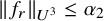





Then

Proof. Let
$F=\sum _{i=1}^n f_i$
 . We begin by eliminating
$f_e$
. We begin by eliminating
$f_e$
 using the first kind of continuity (relative to
$L^2$
using the first kind of continuity (relative to
$L^2$
 errors). We have
$f\otimes \overline {f} = (F+f_r)\otimes \overline {(F+f_r)}+(F+f_r)\otimes \overline {f_e}+f_e\otimes \overline {(F+f_r)} + f_e\otimes \overline {f_e}$
errors). We have
$f\otimes \overline {f} = (F+f_r)\otimes \overline {(F+f_r)}+(F+f_r)\otimes \overline {f_e}+f_e\otimes \overline {(F+f_r)} + f_e\otimes \overline {f_e}$
 .
.
By Lemma 3.6, we have that
$\|\mathcal {K}_\varepsilon (f\otimes \overline {f})-\mathcal {K}_\varepsilon ((F+f_r)\otimes \overline {(F+f_r)})\|_2$
 is at most

Next, we eliminate
$f_r$
 using the second kind of continuity (relative to
$U^3$
using the second kind of continuity (relative to
$U^3$
 errors). By the triangle inequality, we have that
$\|\mathcal {K}_\varepsilon (f\otimes \overline {f})-\mathcal {K}_\varepsilon (F\otimes \overline {F})\|_2$
errors). By the triangle inequality, we have that
$\|\mathcal {K}_\varepsilon (f\otimes \overline {f})-\mathcal {K}_\varepsilon (F\otimes \overline {F})\|_2$
 is at most

By Corollary 3.13 with
$f=F+f_r$
 and
$g=F$
and
$g=F$
 , and using
$\|F+f_r\|_2\leq 1+\alpha _1$
, and using
$\|F+f_r\|_2\leq 1+\alpha _1$
 ,
$\|F\|_2\leq 2+\alpha _1$
,
$\|F\|_2\leq 2+\alpha _1$
 , and
$\|\cdot \|_{U^3}\leq \|\cdot \|_{L^2}$
, and
$\|\cdot \|_{U^3}\leq \|\cdot \|_{L^2}$
 , we see that
$\|\mathcal {K}_\varepsilon ((F+f_r)\otimes \overline {(F+f_r)})-\mathcal {K}_\varepsilon (F\otimes \overline {F})\|_2$
, we see that
$\|\mathcal {K}_\varepsilon ((F+f_r)\otimes \overline {(F+f_r)})-\mathcal {K}_\varepsilon (F\otimes \overline {F})\|_2$
 is at most

Thus, so far we have proved that

Next, from the expansion
$F\otimes \overline {F}= \sum _{i\in [n]} f_i\otimes \overline {f_i}+\sum _{i\neq j\in [n]} f_i\otimes \overline {f_j}$
 , we eliminate the latter cross-terms. By Lemma 3.12, we have that
$\|\mathcal {K}_\varepsilon (F\otimes \overline {F})-\mathcal {K}_\varepsilon (\sum _{i\in [n]} f_i\otimes \overline {f_i})\|_2 $
, we eliminate the latter cross-terms. By Lemma 3.12, we have that
$\|\mathcal {K}_\varepsilon (F\otimes \overline {F})-\mathcal {K}_\varepsilon (\sum _{i\in [n]} f_i\otimes \overline {f_i})\|_2 $
 is at most

Combining this with (3.15) and the triangle inequality, we deduce that

Now, by Corollary 3.16 and property
$(iv)$
 , we have
$\|\sum _{i\in [n]} f_i\otimes \overline {f_i}-\mathcal {K}_\varepsilon (\sum _{i\in [n]} f_i\otimes \overline {f_i})\|_2\leq n\alpha _5$
, we have
$\|\sum _{i\in [n]} f_i\otimes \overline {f_i}-\mathcal {K}_\varepsilon (\sum _{i\in [n]} f_i\otimes \overline {f_i})\|_2\leq n\alpha _5$
 . Then, combining this with (3.16) via the triangle inequality, we deduce (3.14).
4 Nilspace characters
In this section, we begin to use nilspace theory to progress towards a central goal of this paper, namely proving the validity of our spectral algorithms in quadratic Fourier analysis (Theorem 1.1). To do so, in this section, we introduce and study what will be the main nilspace-theoretic notion of a higher-order Fourier analytic component of a function: the notion of a nilspace character. In particular, we shall establish in Theorem 4.19 a fact that will be important for us, namely that a 2-step nilspace character of bounded complexity on a finite abelian group
$\operatorname {\mathrm {Z}}$
 is a character of order 2 on
$\operatorname {\mathrm {Z}}$
is a character of order 2 on
$\operatorname {\mathrm {Z}}$
 (as per Definition 2.29), with a bounded complexity parameter depending on the precision parameter but not on the cardinality of
$\operatorname {\mathrm {Z}}$
(as per Definition 2.29), with a bounded complexity parameter depending on the precision parameter but not on the cardinality of
$\operatorname {\mathrm {Z}}$
 . To explain this in more detail, we need to recall certain basic notions from nilspace theory.
In addition to the original paper [Reference Camarena and Szegedy5], there are various subsequent sources treating nilspace theory in depth, including [Reference Candela6, Reference Candela7, Reference Gutman, Manners and Varjú37, Reference Gutman, Manners and Varjú38, Reference Gutman, Manners and Varjú39]. Therefore, rather than stating the full definitions here, let us mention the basic concepts of this theory and give references for their definitions. The basic concepts that we shall use include that of a nilspace [Reference Candela6, Definition 1.2.1], a compact nilspace [Reference Candela7, Definition 1.0.2] and compact finite-rank (cfr) nilspaces [Reference Candela7, Definition 1.0.2], as well as the morphisms of nilspaces [Reference Candela6, Definition 2.2.11]. We shall also use the structure groups and bundle structure of nilspaces [Reference Candela6, Definitions 3.2.17 and 3.2.18, and Theorem 3.2.19], as well as the existence of a unique probability Haar measure on each compact nilspace [Reference Candela7, Proposition 2.2.5]. It is worth recalling the notion of nilspace polynomial, see [Reference Candela and Szegedy12, Definition 1.3].
Definition 4.1. A k-step nilspace polynomial on a finite abelian group
$\operatorname {\mathrm {Z}}$
 is a function of the form
$F\operatorname {\mathrm {\circ }}\phi :\operatorname {\mathrm {Z}}\to \mathbb {C}$
is a function of the form
$F\operatorname {\mathrm {\circ }}\phi :\operatorname {\mathrm {Z}}\to \mathbb {C}$
 constructed as follows: there is a k-step cfr nilspace
$\operatorname {\mathrm {X}}$
constructed as follows: there is a k-step cfr nilspace
$\operatorname {\mathrm {X}}$
 such that the map
$\phi $
such that the map
$\phi $
 is a nilspace morphism from
$\operatorname {\mathrm {Z}}$
is a nilspace morphism from
$\operatorname {\mathrm {Z}}$
 (viewed as a 1-step nilspace) into
$\operatorname {\mathrm {X}}$
(viewed as a 1-step nilspace) into
$\operatorname {\mathrm {X}}$
 and
$F:\operatorname {\mathrm {X}}\to \mathbb {C}$
and
$F:\operatorname {\mathrm {X}}\to \mathbb {C}$
 is a 1-bounded continuous function. Usually, additional parameters are specified, such as a parameter bounding the complexity of the nilspace
$\operatorname {\mathrm {X}}$
is a 1-bounded continuous function. Usually, additional parameters are specified, such as a parameter bounding the complexity of the nilspace
$\operatorname {\mathrm {X}}$
 as well as the Lipschitz norm of F (see [Reference Candela and Szegedy12]), and in fact an adequate bound on some of these parameters is required for this notion of nilspace polynomial to be nontrivial; see Remark 4.6.
Nilspace characters are a special type of nilspace polynomials. To define nilspace characters, we first need to extend, to the setting of compact nilspaces, the notion (well-known in the setting of nilmanifolds) of a function having a vertical frequency (see [Reference Green, Tao and Ziegler35, Definition 6.1] and more recently [Reference Leng, Sah and Sawhney51, Definition 2.15]).
Definition 4.2 (Functions with vertical frequency on a compact nilspace).
Let
$\operatorname {\mathrm {X}}$
 be a k-step compact nilspace, let
$\operatorname {\mathrm {Z}}_k(\operatorname {\mathrm {X}})$
be a k-step compact nilspace, let
$\operatorname {\mathrm {Z}}_k(\operatorname {\mathrm {X}})$
 be the k-th structure group of
$\operatorname {\mathrm {X}}$
be the k-th structure group of
$\operatorname {\mathrm {X}}$
 (a compact abelian group), and let
$\chi $
(a compact abelian group), and let
$\chi $
 be a character in
$\widehat {\operatorname {\mathrm {Z}}_k(\operatorname {\mathrm {X}})}$
be a character in
$\widehat {\operatorname {\mathrm {Z}}_k(\operatorname {\mathrm {X}})}$
 . We say that a function
$F:\operatorname {\mathrm {X}}\to \mathbb {C}$
. We say that a function
$F:\operatorname {\mathrm {X}}\to \mathbb {C}$
 has vertical frequency
$\chi $
has vertical frequency
$\chi $
 if for every
$x\in \operatorname {\mathrm {X}}$
if for every
$x\in \operatorname {\mathrm {X}}$
 and every
$z\in \operatorname {\mathrm {Z}}_k(\operatorname {\mathrm {X}})$
and every
$z\in \operatorname {\mathrm {Z}}_k(\operatorname {\mathrm {X}})$
 we have
$F(x+z)=\chi (z)F(x)$
we have
$F(x+z)=\chi (z)F(x)$
 . Given a bounded Borel function
$F:\operatorname {\mathrm {X}}\to \mathbb {C}$
. Given a bounded Borel function
$F:\operatorname {\mathrm {X}}\to \mathbb {C}$
 and
$\chi \in \widehat {\operatorname {\mathrm {Z}}_k(\operatorname {\mathrm {X}})}$
and
$\chi \in \widehat {\operatorname {\mathrm {Z}}_k(\operatorname {\mathrm {X}})}$
 , we denote by
$F_\chi $
, we denote by
$F_\chi $
 the component of F with vertical frequency
$\chi $
the component of F with vertical frequency
$\chi $
 , defined as follows (where
$\mu $
, defined as follows (where
$\mu $
 is the probability Haar measure on
$\operatorname {\mathrm {Z}}_k(\operatorname {\mathrm {X}})$
is the probability Haar measure on
$\operatorname {\mathrm {Z}}_k(\operatorname {\mathrm {X}})$
 ):
):

It is easy to see that functions with vertical frequency
$\chi $
 form a closed subspace of the Hilbert space
$L^2(\operatorname {\mathrm {X}})$
form a closed subspace of the Hilbert space
$L^2(\operatorname {\mathrm {X}})$
 . We thus obtain the following notion (see [Reference Candela and Szegedy11, Definition 3.50]).
Definition 4.3. Let
$\operatorname {\mathrm {X}}$
 be a k-step compact nilspace, and let
$\chi $
be a k-step compact nilspace, and let
$\chi $
 be a character in
$\widehat {\operatorname {\mathrm {Z}}_k(\operatorname {\mathrm {X}})}$
be a character in
$\widehat {\operatorname {\mathrm {Z}}_k(\operatorname {\mathrm {X}})}$
 . We denote by
$W(\chi ,\operatorname {\mathrm {X}})$
. We denote by
$W(\chi ,\operatorname {\mathrm {X}})$
 the Hilbert space of functions in
$L^2(\operatorname {\mathrm {X}})$
the Hilbert space of functions in
$L^2(\operatorname {\mathrm {X}})$
 that have vertical frequency
$\chi $
that have vertical frequency
$\chi $
 .
.
Remark 4.4. Let
$\operatorname {\mathrm {X}}$
 be a k-step cfr nilspace, let
$\chi \in \widehat {\operatorname {\mathrm {Z}}_k(\operatorname {\mathrm {X}})}$
be a k-step cfr nilspace, let
$\chi \in \widehat {\operatorname {\mathrm {Z}}_k(\operatorname {\mathrm {X}})}$
 , and let
$p\in [1,\infty ]$
, and let
$p\in [1,\infty ]$
 . Then equation (4.1) defines a continuous linear operator
$(\cdot )_\chi :L^p(\operatorname {\mathrm {X}})\to L^p(\operatorname {\mathrm {X}})$
. Then equation (4.1) defines a continuous linear operator
$(\cdot )_\chi :L^p(\operatorname {\mathrm {X}})\to L^p(\operatorname {\mathrm {X}})$
 of norm 1. The space
$W^p(\chi ,\operatorname {\mathrm {X}}):=\{f\in L^p(\operatorname {\mathrm {X}}):f\text { has vertical frequency }\chi \}$
of norm 1. The space
$W^p(\chi ,\operatorname {\mathrm {X}}):=\{f\in L^p(\operatorname {\mathrm {X}}):f\text { has vertical frequency }\chi \}$
 is a closed subspace of
$L^p(\operatorname {\mathrm {X}})$
is a closed subspace of
$L^p(\operatorname {\mathrm {X}})$
 . Moreover, for
$p=2$
. Moreover, for
$p=2$
 , we have the decomposition
$L^2(\operatorname {\mathrm {X}})=\bigoplus _{\chi \in \widehat {\operatorname {\mathrm {Z}}_k(\operatorname {\mathrm {X}})}} W^2(\chi ,\operatorname {\mathrm {X}})$
, we have the decomposition
$L^2(\operatorname {\mathrm {X}})=\bigoplus _{\chi \in \widehat {\operatorname {\mathrm {Z}}_k(\operatorname {\mathrm {X}})}} W^2(\chi ,\operatorname {\mathrm {X}})$
 where the subspaces
$W^2(\chi ,\operatorname {\mathrm {X}})$
where the subspaces
$W^2(\chi ,\operatorname {\mathrm {X}})$
 are pairwise orthogonal. We will not need these results in this paper, as we will use mainly the components
$F_\chi $
are pairwise orthogonal. We will not need these results in this paper, as we will use mainly the components
$F_\chi $
 of much more specific functions F (Lipschitz continuous functions), so we omit the proofs.
We can now formulate the main concept in this section.
Definition 4.5 (Nilspace character).
A k-step nilspace character on a finite abelian group
$\operatorname {\mathrm {Z}}$
 is a 1-bounded function g of the following form: there is a k-step cfr nilspace
$\operatorname {\mathrm {X}}$
is a 1-bounded function g of the following form: there is a k-step cfr nilspace
$\operatorname {\mathrm {X}}$
 , a nilspace morphism
$\phi :\mathcal {D}_1(\operatorname {\mathrm {Z}})\to \operatorname {\mathrm {X}}$
, a nilspace morphism
$\phi :\mathcal {D}_1(\operatorname {\mathrm {Z}})\to \operatorname {\mathrm {X}}$
 , and a 1-bounded continuous function
$F:\operatorname {\mathrm {X}}\to \mathbb {C}$
, and a 1-bounded continuous function
$F:\operatorname {\mathrm {X}}\to \mathbb {C}$
 having vertical frequency
$\chi \in \widehat {\operatorname {\mathrm {Z}}_k(\operatorname {\mathrm {X}})}$
having vertical frequency
$\chi \in \widehat {\operatorname {\mathrm {Z}}_k(\operatorname {\mathrm {X}})}$
 , such that
$g=F\operatorname {\mathrm {\circ }}\phi $
, such that
$g=F\operatorname {\mathrm {\circ }}\phi $
 .
.
Various additional properties can be required for such a nilspace character
$g=F\operatorname {\mathrm {\circ }}\phi $
 (as for nilspace polynomials more generally): we can require F to have bounded Lipschitz constant C (we then say that g is a C-Lipschitz nilspace character); we can require the complexityFootnote 9 of the underlying nilspace to be at most m (we then say that g is a complexity-m nilspace character); we can also add an equidistribution requirement, namely that the morphism
$\phi $
(as for nilspace polynomials more generally): we can require F to have bounded Lipschitz constant C (we then say that g is a C-Lipschitz nilspace character); we can require the complexityFootnote 9 of the underlying nilspace to be at most m (we then say that g is a complexity-m nilspace character); we can also add an equidistribution requirement, namely that the morphism
$\phi $
 should be b-balancedFootnote 10 (we then say that g is a b-balanced nilspace character). Furthermore, one can require that the modulus of the character be equal to 1 everywhere. Note that with the latter requirement, when
$\operatorname {\mathrm {X}}$
should be b-balancedFootnote 10 (we then say that g is a b-balanced nilspace character). Furthermore, one can require that the modulus of the character be equal to 1 everywhere. Note that with the latter requirement, when
$\operatorname {\mathrm {X}}$
 is a nilmanifold, we recover the notion of a nilcharacter introduced by Green, Tao, and Ziegler in [Reference Green, Tao and Ziegler35, Definition 6.1]. Note also that, on the other hand, the modulus-1 requirement can often clash with the continuity requirement for F (see the discussion of topological obstructions in [Reference Green, Tao and Ziegler35, p. 1254]), in which case one can either weaken the continuity to piecewise continuity, or work with multidimensional generalizations (as in [Reference Green, Tao and Ziegler35]). Finally, note that the concept of nilspace character can be extended to compact abelian groups, by requiring that
$\phi $
is a nilmanifold, we recover the notion of a nilcharacter introduced by Green, Tao, and Ziegler in [Reference Green, Tao and Ziegler35, Definition 6.1]. Note also that, on the other hand, the modulus-1 requirement can often clash with the continuity requirement for F (see the discussion of topological obstructions in [Reference Green, Tao and Ziegler35, p. 1254]), in which case one can either weaken the continuity to piecewise continuity, or work with multidimensional generalizations (as in [Reference Green, Tao and Ziegler35]). Finally, note that the concept of nilspace character can be extended to compact abelian groups, by requiring that
$\phi $
 be a continuous morphism. As usual in this paper, we focus on finite abelian groups
$\operatorname {\mathrm {Z}}$
be a continuous morphism. As usual in this paper, we focus on finite abelian groups
$\operatorname {\mathrm {Z}}$
 .
.
Remark 4.6. In main results involving nilspace polynomials or characters, especially in inverse theorems or regularity results, some of the above-mentioned additional parameters actually must be adequately bounded in order for these results to be nontrivial. Indeed, concerning nilspace polynomials, note that if in Definition 4.1 we do not ensure a Lipschitz bound on F independent of
$|\operatorname {\mathrm {Z}}|$
 , then any 1-bounded function on
$\operatorname {\mathrm {Z}}$
, then any 1-bounded function on
$\operatorname {\mathrm {Z}}$
 could be a valid nilspace polynomial, as one could take
$\operatorname {\mathrm {X}}$
could be a valid nilspace polynomial, as one could take
$\operatorname {\mathrm {X}}$
 to be a copy of
$\operatorname {\mathrm {Z}}$
to be a copy of
$\operatorname {\mathrm {Z}}$
 embedded in some torus (equipped with its standard metric), take
$\varphi $
embedded in some torus (equipped with its standard metric), take
$\varphi $
 the identity map, and
$F = f$
the identity map, and
$F = f$
 . For nilspace characters, the role of Lipschitz bounds is more subtle, but it is still important in our results. For instance, such a Lipschitz bound is involved in our expression of 2-step nilspace characters as quadratic characters of bounded complexity (see Theorem 4.19 and Remark 4.20).
In the following subsections, we develop various properties of nilspace characters, especially to prove that they are adequate higher-order generalizations of classical Fourier characters.
4.1 Uniform approximation of Lipschitz functions by vertical Fourier sums
The structure theorem (or regularity lemma) from [Reference Candela and Szegedy12, Theorem 1.5] yields, as a key ingredient of the structured part in the resulting decomposition, a function on a compact nilspace that has a bounded Lipschitz norm. It will be very useful for later calculations to be able to approximate such a function by a sum of boundedly many functions with vertical frequency. That is the purpose of the main result in this subsection. To obtain this, we first gather some tools related to Lipschitz functions. We shall recall some basic definitions and notation following [Reference Cobzaş, Miculescu and Nicolae14, §8.4.2].
Given a metric space X, we say that a metric d on X is a compatible metric if d generates the given topology on X.
Definition 4.7. Let X be a compact metric space with a compatible metric d. For any continuous function
$f:X\to \mathbb {C}$
 , we write
$\|f\|_L$
, we write
$\|f\|_L$
 for the quantity
$\sup _{x\not =y}\frac {|f(x)-f(y)|}{d(x,y)}$
for the quantity
$\sup _{x\not =y}\frac {|f(x)-f(y)|}{d(x,y)}$
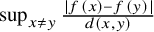 . We say that f is Lipschitz if
$\|f\|_L$
. We say that f is Lipschitz if
$\|f\|_L$
 is finite, and we say that f is C-Lipschitz if
$\|f\|_L\le C$
is finite, and we say that f is C-Lipschitz if
$\|f\|_L\le C$
 . We define
$\|f\|_{\text {sum}}:=\|f\|_L+\|f\|_\infty $
. We define
$\|f\|_{\text {sum}}:=\|f\|_L+\|f\|_\infty $
 .
.
Note that
$\|\cdot \|_{\text {sum}}$
 is a norm whereas
$\|\cdot \|_L$
is a norm whereas
$\|\cdot \|_L$
 is only a seminorm.
Given a k-step compact nilspace
$\operatorname {\mathrm {X}}$
 , we say a compatible metric d on
$\operatorname {\mathrm {X}}$
, we say a compatible metric d on
$\operatorname {\mathrm {X}}$
 is
$\operatorname {\mathrm {Z}}_k(\operatorname {\mathrm {X}})$
is
$\operatorname {\mathrm {Z}}_k(\operatorname {\mathrm {X}})$
 -invariant if
$d(x+z,y+z)=d(x,y)$
-invariant if
$d(x+z,y+z)=d(x,y)$
 for all
$x,y\in \operatorname {\mathrm {X}}$
for all
$x,y\in \operatorname {\mathrm {X}}$
 and
$z\in \operatorname {\mathrm {Z}}_k(\operatorname {\mathrm {X}})$
and
$z\in \operatorname {\mathrm {Z}}_k(\operatorname {\mathrm {X}})$
 .
.
Lemma 4.8. Let
$\operatorname {\mathrm {X}}$
 be a k-step compact nilspace and let d be a
$\operatorname {\mathrm {Z}}_k(\operatorname {\mathrm {X}})$
be a k-step compact nilspace and let d be a
$\operatorname {\mathrm {Z}}_k(\operatorname {\mathrm {X}})$
 -invariant compatible metric on
$\operatorname {\mathrm {X}}$
-invariant compatible metric on
$\operatorname {\mathrm {X}}$
 . Then, for every Lipschitz function
$F:\operatorname {\mathrm {X}}\to \mathbb {C}$
. Then, for every Lipschitz function
$F:\operatorname {\mathrm {X}}\to \mathbb {C}$
 (relative to d) and every
$\chi \in \widehat {\operatorname {\mathrm {Z}}_k(\operatorname {\mathrm {X}})}$
(relative to d) and every
$\chi \in \widehat {\operatorname {\mathrm {Z}}_k(\operatorname {\mathrm {X}})}$
 , the function
$F_\chi :\operatorname {\mathrm {X}}\to \mathbb {C}$
, the function
$F_\chi :\operatorname {\mathrm {X}}\to \mathbb {C}$
 ,
$x\mapsto \int _{\operatorname {\mathrm {Z}}_k(\operatorname {\mathrm {X}})}F(x+z)\overline {\chi (z)}\,\mathrm {d} z$
,
$x\mapsto \int _{\operatorname {\mathrm {Z}}_k(\operatorname {\mathrm {X}})}F(x+z)\overline {\chi (z)}\,\mathrm {d} z$
 satisfies
$\|F_\chi \|_L\leq \|F\|_L$
satisfies
$\|F_\chi \|_L\leq \|F\|_L$
 and
$\|F_\chi \|_\infty \leq \|F\|_\infty $
and
$\|F_\chi \|_\infty \leq \|F\|_\infty $
 .
.
Proof. For all
$x,y\in \operatorname {\mathrm {X}}$
 , using the
$\operatorname {\mathrm {Z}}_k(\operatorname {\mathrm {X}})$
, using the
$\operatorname {\mathrm {Z}}_k(\operatorname {\mathrm {X}})$
 -invariance we have

so
$\|F_\chi \|_L\leq \|F\|_L$
 . We also have
$|F_\chi (x)|\le \int _{\operatorname {\mathrm {Z}}_k(\operatorname {\mathrm {X}})} |F(x+z)|\,\mathrm {d} z \leq \|F\|_\infty $
. We also have
$|F_\chi (x)|\le \int _{\operatorname {\mathrm {Z}}_k(\operatorname {\mathrm {X}})} |F(x+z)|\,\mathrm {d} z \leq \|F\|_\infty $
 .
.
Remark 4.9. Note that for Lemma 4.8 to work, we needed the metric d on
$\operatorname {\mathrm {X}}$
 to be
$\operatorname {\mathrm {Z}}_k(\operatorname {\mathrm {X}})$
to be
$\operatorname {\mathrm {Z}}_k(\operatorname {\mathrm {X}})$
 -invariant. By [Reference Candela7, Lemma 2.1.11], one can equip every compact k-step nilspace with such a metric.Footnote 11
Remark 4.10. The Lipschitz constant of a function is not a topological property of the space, in the sense that given a compact metric space S and a continuous function
$F:S\to \mathbb {C}$
 , different compatible metrics can make F be Lipschitz or not. This holds even if we assume that the space is a k-step compact nilspace
$\operatorname {\mathrm {X}}$
, different compatible metrics can make F be Lipschitz or not. This holds even if we assume that the space is a k-step compact nilspace
$\operatorname {\mathrm {X}}$
 and all the considered metrics are
$\operatorname {\mathrm {Z}}_k(\operatorname {\mathrm {X}})$
and all the considered metrics are
$\operatorname {\mathrm {Z}}_k(\operatorname {\mathrm {X}})$
 -invariant. For instance, let
$\mathbb {T}=\mathbb {R}/\mathbb {Z}$
-invariant. For instance, let
$\mathbb {T}=\mathbb {R}/\mathbb {Z}$
 and let
$|x|_{\mathbb {T}}$
and let
$|x|_{\mathbb {T}}$
 be the usual distance from x to the nearest integer, under the usual identification of x with a real number in
$[0,1)$
be the usual distance from x to the nearest integer, under the usual identification of x with a real number in
$[0,1)$
 . Clearly
$d(x,y):=|x-y|_{\mathbb {T}}$
. Clearly
$d(x,y):=|x-y|_{\mathbb {T}}$
 is a
$\mathbb {T}$
is a
$\mathbb {T}$
 -invariant metric on
$\mathbb {T}$
-invariant metric on
$\mathbb {T}$
 . Moreover, so is
$d_\alpha (x,y):=|x-y|_{\mathbb {T}}^\alpha $
. Moreover, so is
$d_\alpha (x,y):=|x-y|_{\mathbb {T}}^\alpha $
 for any
$\alpha \in (0,1]$
for any
$\alpha \in (0,1]$
 . Let
$F:\mathbb {T}\to \mathbb {R}$
. Let
$F:\mathbb {T}\to \mathbb {R}$
 be the function defined by
$F(x)=\sqrt {x}$
be the function defined by
$F(x)=\sqrt {x}$
 for
$x\in [0,1/2)$
for
$x\in [0,1/2)$
 and
$F(x)=\sqrt {1-x}$
and
$F(x)=\sqrt {1-x}$
 otherwise. It can be checked that F is a 1-Lipschitz function relative to the metric
$d_{1/2}$
otherwise. It can be checked that F is a 1-Lipschitz function relative to the metric
$d_{1/2}$
 on
$\mathbb {T}$
on
$\mathbb {T}$
 , but it is not Lipschitz relative to d.
When working on cfr nilspaces, problematic metrics, such as in the above example, can be conveniently ruled out by focusing on metrics induced by the manifold structure of these spaces, that is, by Riemannian metrics. This generalizes a standard approach in the setting of nilmanifolds, for example, in [Reference Green, Tao and Ziegler35]. We gather some basic facts on Riemannian metrics in Appendix A (see in particular Definition A.11) and use these to get the following approximation result announced above. For simplicity, compact abelian Lie groups will always be assumed to be endowed with the flat metric, see Definition A.12.Footnote 12
Lemma 4.11. Let
$\operatorname {\mathrm {X}}$
 be a k-step cfr nilspace endowed with a Riemannian metric. Then there is a function
$\operatorname {\mathrm {Q}}_{\operatorname {\mathrm {X}}}:\mathbb {R}_{>0}\times \mathbb {R}_{\ge 0}\to \mathbb {N}$
be a k-step cfr nilspace endowed with a Riemannian metric. Then there is a function
$\operatorname {\mathrm {Q}}_{\operatorname {\mathrm {X}}}:\mathbb {R}_{>0}\times \mathbb {R}_{\ge 0}\to \mathbb {N}$
 such that the following holds. For any
$C,\delta>0$
such that the following holds. For any
$C,\delta>0$
 , there is a set
$S\subset \widehat {\operatorname {\mathrm {Z}}_k(\operatorname {\mathrm {X}})}$
, there is a set
$S\subset \widehat {\operatorname {\mathrm {Z}}_k(\operatorname {\mathrm {X}})}$
 with
$|S|\leq \operatorname {\mathrm {Q}}_{\operatorname {\mathrm {X}}}(\delta ,C)$
with
$|S|\leq \operatorname {\mathrm {Q}}_{\operatorname {\mathrm {X}}}(\delta ,C)$
 such that, for any C-Lipschitz function
$F:\operatorname {\mathrm {X}}\to \mathbb {C}$
such that, for any C-Lipschitz function
$F:\operatorname {\mathrm {X}}\to \mathbb {C}$
 (relative to the given metric), we have
$\|F-\sum _{\chi \in S} F_\chi \|_\infty \le \delta $
(relative to the given metric), we have
$\|F-\sum _{\chi \in S} F_\chi \|_\infty \le \delta $
 .
.
This includes, as a special case, a uniform approximation result for Lipschitz functions on nilmanifolds. Uniform approximation results by sums of functions with vertical frequency have been used in this setting previously (e.g., [Reference Green, Tao and Ziegler35, Lemma 6.4]). Note, however, that Lemma 4.11 yields an approximation by a partial Fourier series of F relative to the last structure group, which is more precise than an approximation in terms of some functions with vertical frequencies.
The proof of Lemma 4.11 will use the following special case for compact abelian Lie groups.
Lemma 4.12. Let G be a compact abelian Lie group. Then there exists
$\operatorname {\mathrm {Q}}_G:\mathbb {R}_{> 0}\times \mathbb {R}_{\ge 0}\to \mathbb {N}$
 such that the following holds. For any
$C,\delta>0$
such that the following holds. For any
$C,\delta>0$
 , there is a set
$S\subset \widehat {G}$
, there is a set
$S\subset \widehat {G}$
 with
$|S|\leq \operatorname {\mathrm {Q}}_G(\delta ,C)$
with
$|S|\leq \operatorname {\mathrm {Q}}_G(\delta ,C)$
 such that for any C-Lipschitz function
$f:G\to \mathbb {C}$
such that for any C-Lipschitz function
$f:G\to \mathbb {C}$
 we have
$\|f-\sum _{\chi \in S}\widehat {f}(\chi )\chi \|_\infty <\delta $
we have
$\|f-\sum _{\chi \in S}\widehat {f}(\chi )\chi \|_\infty <\delta $
 .
.
Proof. We know that
$G\cong \operatorname {\mathrm {Z}}\times \mathbb {T}^n$
 for some finite abelian group
$\operatorname {\mathrm {Z}}$
for some finite abelian group
$\operatorname {\mathrm {Z}}$
 and some integer
$n\geq 0$
and some integer
$n\geq 0$
 .
.
First, suppose that
$\operatorname {\mathrm {Z}}$
 is trivial, so that
$G\cong \mathbb {T}^n$
is trivial, so that
$G\cong \mathbb {T}^n$
 . Then, it follows from known results (due to Lebesgue for
$n=1$
. Then, it follows from known results (due to Lebesgue for
$n=1$
 , and to Zhizhiashvili for
$n>1$
, and to Zhizhiashvili for
$n>1$
 , see [Reference Lebesgue49, p. 201] and [Reference Golubov21, p. 642] respectively) that if f is C-Lipschitz on
$\mathbb {T}^n$
, see [Reference Lebesgue49, p. 201] and [Reference Golubov21, p. 642] respectively) that if f is C-Lipschitz on
$\mathbb {T}^n$
 then the Fourier sums
$S_M(f):=\sum _{r\in \mathbb {Z}^n:\|r\|_{\ell ^\infty }\leq M} \widehat {f}(\chi _r) \chi _r$
then the Fourier sums
$S_M(f):=\sum _{r\in \mathbb {Z}^n:\|r\|_{\ell ^\infty }\leq M} \widehat {f}(\chi _r) \chi _r$
 on
$\mathbb {T}^n$
on
$\mathbb {T}^n$
 satisfy
$\|S_M(f)-f\|_\infty \leq K_{C,n}\frac {\log ^n M}{M}$
satisfy
$\|S_M(f)-f\|_\infty \leq K_{C,n}\frac {\log ^n M}{M}$
 , where the constant
$K_{C,n}$
, where the constant
$K_{C,n}$
 depends only on C and n.Footnote 13 Hence the claim holds for M sufficiently large in terms of
$\delta $
depends only on C and n.Footnote 13 Hence the claim holds for M sufficiently large in terms of
$\delta $
 , C, and n.
Now if
$G=\operatorname {\mathrm {Z}}\times \mathbb {T}^n$
 for a general finite abelian group
$\operatorname {\mathrm {Z}}$
for a general finite abelian group
$\operatorname {\mathrm {Z}}$
 , then for every
$a\in \operatorname {\mathrm {Z}}$
, then for every
$a\in \operatorname {\mathrm {Z}}$
 and
$x\in \mathbb {T}^n$
and
$x\in \mathbb {T}^n$
 we have
$f(a,x)=\sum _{\xi \in \widehat {\operatorname {\mathrm {Z}}}} \big (\mathbb {E}_{z\in \operatorname {\mathrm {Z}}} f(z,x)\overline {\xi (z)}\big )\,\xi (a)$
we have
$f(a,x)=\sum _{\xi \in \widehat {\operatorname {\mathrm {Z}}}} \big (\mathbb {E}_{z\in \operatorname {\mathrm {Z}}} f(z,x)\overline {\xi (z)}\big )\,\xi (a)$
 . For every
$z\in \operatorname {\mathrm {Z}}$
. For every
$z\in \operatorname {\mathrm {Z}}$
 the function
$f(z,\cdot )$
the function
$f(z,\cdot )$
 is C-Lipschitz on
$\mathbb {T}^n$
is C-Lipschitz on
$\mathbb {T}^n$
 , so we can apply the previous paragraph with M such that
$\|S_M(f(z,\cdot ))-f(z,\cdot )\|_\infty \leq \delta /|\operatorname {\mathrm {Z}}|$
, so we can apply the previous paragraph with M such that
$\|S_M(f(z,\cdot ))-f(z,\cdot )\|_\infty \leq \delta /|\operatorname {\mathrm {Z}}|$
 . The result follows with
$S=\{(\xi ,\chi _r)\in \widehat {\operatorname {\mathrm {Z}}}\times \widehat {\mathbb {T}^n} = \widehat {G}: \|r\|_{\ell ^\infty }\leq M\}$
. The result follows with
$S=\{(\xi ,\chi _r)\in \widehat {\operatorname {\mathrm {Z}}}\times \widehat {\mathbb {T}^n} = \widehat {G}: \|r\|_{\ell ^\infty }\leq M\}$
 .
.
Proof of Lemma 4.11.
Let
$\operatorname {\mathrm {X}}\times \operatorname {\mathrm {Z}}_k(\operatorname {\mathrm {X}})\to \operatorname {\mathrm {X}}$
 ,
$(x,z)\mapsto x+z$
,
$(x,z)\mapsto x+z$
 be the addition map. On
$\operatorname {\mathrm {X}}\times \operatorname {\mathrm {Z}}_k(\operatorname {\mathrm {X}})$
be the addition map. On
$\operatorname {\mathrm {X}}\times \operatorname {\mathrm {Z}}_k(\operatorname {\mathrm {X}})$
 , we consider the usual Riemannian metric tensor which is the product of the Riemannian tensor of
$\operatorname {\mathrm {X}}$
, we consider the usual Riemannian metric tensor which is the product of the Riemannian tensor of
$\operatorname {\mathrm {X}}$
 with the usual Riemannian tensor on the compact abelian group
$\operatorname {\mathrm {Z}}_k(\operatorname {\mathrm {X}})$
with the usual Riemannian tensor on the compact abelian group
$\operatorname {\mathrm {Z}}_k(\operatorname {\mathrm {X}})$
 . Note that, in particular,
$(x,z)\mapsto x+z$
. Note that, in particular,
$(x,z)\mapsto x+z$
 is a morphism between k-step cfr nilspaces (regarding
$\operatorname {\mathrm {Z}}_k(\operatorname {\mathrm {X}})$
is a morphism between k-step cfr nilspaces (regarding
$\operatorname {\mathrm {Z}}_k(\operatorname {\mathrm {X}})$
 as the group nilspace
$\mathcal {D}_k(\operatorname {\mathrm {Z}}_k(\operatorname {\mathrm {X}}))$
as the group nilspace
$\mathcal {D}_k(\operatorname {\mathrm {Z}}_k(\operatorname {\mathrm {X}}))$
 ) and by Proposition A.13 we know that it is Lipschitz. Hence the map
$(x,z)\mapsto F(x+z)$
) and by Proposition A.13 we know that it is Lipschitz. Hence the map
$(x,z)\mapsto F(x+z)$
 (being the composition of two Lipschitz maps) is
$C'$
(being the composition of two Lipschitz maps) is
$C'$
 -Lipschitz with
$C'$
-Lipschitz with
$C'$
 depending only on
$\operatorname {\mathrm {X}}$
depending only on
$\operatorname {\mathrm {X}}$
 and C. We claim that, for any fixed
$x_0\in \operatorname {\mathrm {X}}$
and C. We claim that, for any fixed
$x_0\in \operatorname {\mathrm {X}}$
 , the map
$z\mapsto F(x_0+z)$
, the map
$z\mapsto F(x_0+z)$
 is also
$C'$
is also
$C'$
 -Lipschitz.
Indeed, we have
$|F(x_0+z)-F(x_0+z')|\le C'd_{\operatorname {\mathrm {X}}\times \operatorname {\mathrm {Z}}_k(\operatorname {\mathrm {X}})}((x_0,z),(x_0,z'))$
 . We claim that, for all
$z,z'\in \operatorname {\mathrm {Z}}_k(\operatorname {\mathrm {X}})$
. We claim that, for all
$z,z'\in \operatorname {\mathrm {Z}}_k(\operatorname {\mathrm {X}})$
 and
$x_0\in \operatorname {\mathrm {X}}$
and
$x_0\in \operatorname {\mathrm {X}}$
 , we have
$d_{\operatorname {\mathrm {Z}}_k(\operatorname {\mathrm {X}})}(z,z')=d_{\operatorname {\mathrm {X}}\times \operatorname {\mathrm {Z}}_k(\operatorname {\mathrm {X}})}((x_0,z),(x_0,z'))$
, we have
$d_{\operatorname {\mathrm {Z}}_k(\operatorname {\mathrm {X}})}(z,z')=d_{\operatorname {\mathrm {X}}\times \operatorname {\mathrm {Z}}_k(\operatorname {\mathrm {X}})}((x_0,z),(x_0,z'))$
 . Note that
$(x_0,z)$
. Note that
$(x_0,z)$
 and
$(x_0,z')$
and
$(x_0,z')$
 are in different connected components if and only if z and
$z'$
are in different connected components if and only if z and
$z'$
 are in different connected components. Hence, in this case we have
$d_{\operatorname {\mathrm {Z}}_k(\operatorname {\mathrm {X}})}(z,z')=1=d_{\operatorname {\mathrm {X}}\times \operatorname {\mathrm {Z}}_k(\operatorname {\mathrm {X}})}((x_0,z),(x_0,z'))$
are in different connected components. Hence, in this case we have
$d_{\operatorname {\mathrm {Z}}_k(\operatorname {\mathrm {X}})}(z,z')=1=d_{\operatorname {\mathrm {X}}\times \operatorname {\mathrm {Z}}_k(\operatorname {\mathrm {X}})}((x_0,z),(x_0,z'))$
 by definition. If z and
$z'$
by definition. If z and
$z'$
 lie in the same connected component, let
$\gamma :[0,1]\to \operatorname {\mathrm {X}}\times \operatorname {\mathrm {Z}}_k(\operatorname {\mathrm {X}})$
lie in the same connected component, let
$\gamma :[0,1]\to \operatorname {\mathrm {X}}\times \operatorname {\mathrm {Z}}_k(\operatorname {\mathrm {X}})$
 ,
$t\mapsto (x(t),z(t))$
,
$t\mapsto (x(t),z(t))$
 be a path connecting
$(x_0,z)$
be a path connecting
$(x_0,z)$
 with
$(x_0,z')$
with
$(x_0,z')$
 . Then
$L_\gamma =\int _0^1 \sqrt {g_{\operatorname {\mathrm {X}}\times \operatorname {\mathrm {Z}}_k(\operatorname {\mathrm {X}})}(\nabla \gamma ,\nabla \gamma )}$
. Then
$L_\gamma =\int _0^1 \sqrt {g_{\operatorname {\mathrm {X}}\times \operatorname {\mathrm {Z}}_k(\operatorname {\mathrm {X}})}(\nabla \gamma ,\nabla \gamma )}$
 where
$g_{\operatorname {\mathrm {X}}\times \operatorname {\mathrm {Z}}_k(\operatorname {\mathrm {X}})}$
where
$g_{\operatorname {\mathrm {X}}\times \operatorname {\mathrm {Z}}_k(\operatorname {\mathrm {X}})}$
 is the Riemannian metric tensor on
$\operatorname {\mathrm {X}}\times \operatorname {\mathrm {Z}}_k(\operatorname {\mathrm {X}})$
is the Riemannian metric tensor on
$\operatorname {\mathrm {X}}\times \operatorname {\mathrm {Z}}_k(\operatorname {\mathrm {X}})$
 . As
$g_{\operatorname {\mathrm {X}}\times \operatorname {\mathrm {Z}}_k(\operatorname {\mathrm {X}})}(\nabla \gamma ,\nabla \gamma ) = g_{\operatorname {\mathrm {X}}}(\nabla x(t),\nabla x(t))+g_{\operatorname {\mathrm {Z}}_k(\operatorname {\mathrm {X}})}(\nabla z(t),\nabla z(t))$
. As
$g_{\operatorname {\mathrm {X}}\times \operatorname {\mathrm {Z}}_k(\operatorname {\mathrm {X}})}(\nabla \gamma ,\nabla \gamma ) = g_{\operatorname {\mathrm {X}}}(\nabla x(t),\nabla x(t))+g_{\operatorname {\mathrm {Z}}_k(\operatorname {\mathrm {X}})}(\nabla z(t),\nabla z(t))$
 , if we let
$\gamma ':[0,1]\to \operatorname {\mathrm {Z}}_k(\operatorname {\mathrm {X}})$
, if we let
$\gamma ':[0,1]\to \operatorname {\mathrm {Z}}_k(\operatorname {\mathrm {X}})$
 ,
$t\mapsto z(t)$
,
$t\mapsto z(t)$
 , we have that
$L_\gamma \ge L_{\gamma '}$
, we have that
$L_\gamma \ge L_{\gamma '}$
 . Thus,
$d_{\operatorname {\mathrm {X}}\times \operatorname {\mathrm {Z}}_k(\operatorname {\mathrm {X}})}((x_0,z),(x_0,z'))\ge d_{\operatorname {\mathrm {Z}}_k(\operatorname {\mathrm {X}})}(z,z')$
. Thus,
$d_{\operatorname {\mathrm {X}}\times \operatorname {\mathrm {Z}}_k(\operatorname {\mathrm {X}})}((x_0,z),(x_0,z'))\ge d_{\operatorname {\mathrm {Z}}_k(\operatorname {\mathrm {X}})}(z,z')$
 . By a similar argument we obtain the reversed inequality, and the claim follows.
Therefore, since the map
$z\mapsto F(x_0+z)$
 is
$C'$
is
$C'$
 -Lipschitz, we can apply Lemma 4.12 to it and complete the proof (noting that the Lipschitz constant
$C'$
-Lipschitz, we can apply Lemma 4.12 to it and complete the proof (noting that the Lipschitz constant
$C'$
 does not depend on
$x_0\in \operatorname {\mathrm {X}}$
does not depend on
$x_0\in \operatorname {\mathrm {X}}$
 ).
).
Remark 4.13. Note that the proof of Lemma 4.12 shows that, in Lemma 4.11, letting
$\operatorname {\mathrm {Z}}$
 be a finite abelian group and
$n\geq 0$
be a finite abelian group and
$n\geq 0$
 be an integer such that
$\operatorname {\mathrm {Z}}_k(\operatorname {\mathrm {X}})\cong \operatorname {\mathrm {Z}}\times \mathbb {T}^n$
be an integer such that
$\operatorname {\mathrm {Z}}_k(\operatorname {\mathrm {X}})\cong \operatorname {\mathrm {Z}}\times \mathbb {T}^n$
 , we can add the information that the set S is of the concrete form
$S=\{(\xi ,\chi _r)\in \widehat {\operatorname {\mathrm {Z}}}\times \widehat {\mathbb {T}^n}: r\in \mathbb {Z}^n, \|r\|_{\ell ^\infty }\leq M\}$
, we can add the information that the set S is of the concrete form
$S=\{(\xi ,\chi _r)\in \widehat {\operatorname {\mathrm {Z}}}\times \widehat {\mathbb {T}^n}: r\in \mathbb {Z}^n, \|r\|_{\ell ^\infty }\leq M\}$
 for some sufficiently large integer M.
We close this section by discussing another advantage that functions with a uniform bound on their Lipschitz constant present for our later calculations, namely, that we can then have uniform control on the convergence of integrals. Before we go into this, let us recall a standard example showing that such uniform control fails without a uniform Lipschitz bound.
Example 4.14. Let
$I=[0,1]$
 with the usual topology and for each positive integer n consider the Dirac measure
$\delta _{1/n}$
with the usual topology and for each positive integer n consider the Dirac measure
$\delta _{1/n}$
 . These measures converge weakly to the Dirac measure
$\delta _0$
. These measures converge weakly to the Dirac measure
$\delta _0$
 , that is, for every continuous function
$f:I\to \mathbb {C}$
, that is, for every continuous function
$f:I\to \mathbb {C}$
 we have
$\int f\,\mathrm {d}\delta _{1/n}\to \int f\,\mathrm {d}\delta _0$
we have
$\int f\,\mathrm {d}\delta _{1/n}\to \int f\,\mathrm {d}\delta _0$
 as
$n\to \infty $
as
$n\to \infty $
 . However, this convergence is not uniform in f, as can be seen with the sequence of continuous functions
$f_n(x)=(1-nx)\mathbf {1}_{[0,1/n]}(x)$
. However, this convergence is not uniform in f, as can be seen with the sequence of continuous functions
$f_n(x)=(1-nx)\mathbf {1}_{[0,1/n]}(x)$
 ,
$n\in \mathbb {N}$
,
$n\in \mathbb {N}$
 , which satisfies
$\int f_n \,\mathrm {d}\delta _{1/n}-\int f_n \,\mathrm {d}\delta _0=-1$
, which satisfies
$\int f_n \,\mathrm {d}\delta _{1/n}-\int f_n \,\mathrm {d}\delta _0=-1$
 , and so
$\sup _{\|f\|_\infty \le 1} \left |\int f\,\mathrm {d}\delta _{1/n}-\int f\,\mathrm {d}\delta _0\right |\not \to 0 \text { as }n\to \infty $
, and so
$\sup _{\|f\|_\infty \le 1} \left |\int f\,\mathrm {d}\delta _{1/n}-\int f\,\mathrm {d}\delta _0\right |\not \to 0 \text { as }n\to \infty $
 .
.
Such examples could a priori be problematic for our proofs later, because the balance property (recalled below) is defined in terms of weak convergence of measures, and we then do not have uniform convergence of integrals. However, restricting our attention to Lipschitz functions with uniform Lipschitz constant will enable us to avoid such issues. A convenient way to implement such a uniform control is to use the Kantorovich-Rubinstein (or Wasserstein) norm.
Definition 4.15 (Kantorovich-Rubinstein norm).
Let X be a compact metric space, and let
$\mathcal {P}(X)$
 denote the set of Borel probability measures on X. The Kantorovich-Rubinstein norm on
$\mathcal {P}(X)$
denote the set of Borel probability measures on X. The Kantorovich-Rubinstein norm on
$\mathcal {P}(X)$
 is defined as follows:

The full definition of
$\|\mu \|_{KR}$
 is as a norm on the vector space of Borel measures with bounded variation (see [Reference Cobzaş, Miculescu and Nicolae14, Theorem 8.4.5]). A convenient fact about this norm is its direct relation with weak convergence of measures, as the following result indicates (this is a direct consequence of [Reference Cobzaş, Miculescu and Nicolae14, Theorem 8.4.13]).
Theorem 4.16. Let X be a compact metric space and let
$\mu ,\mu _1,\mu _2,\ldots $
 be measures in
$\mathcal {P}(X)$
be measures in
$\mathcal {P}(X)$
 . Then
$\mu _j\to \mu $
. Then
$\mu _j\to \mu $
 weakly if and only if
$\|\mu _j-\mu \|_{KR} \to 0$
weakly if and only if
$\|\mu _j-\mu \|_{KR} \to 0$
 .
.
We will use Theorem 4.16 to transform the balance property of the regularity lemma [Reference Candela and Szegedy12, Theorem 1.5] into a bound for the Kantorovich-Rubinstein norm. Let us recall the definition of balance (see [Reference Candela and Szegedy12, Definition 5.1]).
Definition 4.17. Let
$\operatorname {\mathrm {Y}}$
 be a k-step cfr nilspace. For each
$n\in \mathbb {N}$
be a k-step cfr nilspace. For each
$n\in \mathbb {N}$
 fix a metric
$d_n$
fix a metric
$d_n$
 on
$\mathcal {P}(\operatorname {\mathrm {C}}^n(\operatorname {\mathrm {Y}}))$
on
$\mathcal {P}(\operatorname {\mathrm {C}}^n(\operatorname {\mathrm {Y}}))$
 . Let
$\operatorname {\mathrm {X}}$
. Let
$\operatorname {\mathrm {X}}$
 be a k-step compact nilspace and
$\phi :\operatorname {\mathrm {X}}\to \operatorname {\mathrm {Y}}$
be a k-step compact nilspace and
$\phi :\operatorname {\mathrm {X}}\to \operatorname {\mathrm {Y}}$
 be a continuous morphism. For
$b>0$
be a continuous morphism. For
$b>0$
 , we say that
$\phi $
, we say that
$\phi $
 is b-balanced if for every
$n\le 1/b$
is b-balanced if for every
$n\le 1/b$
 we have
$d_n(\mu _{\operatorname {\mathrm {C}}^n(\operatorname {\mathrm {X}})}\operatorname {\mathrm {\circ }} (\phi ^{[\![ n]\!] })^{-1},\mu _{\operatorname {\mathrm {C}}^n(\operatorname {\mathrm {Y}})})\le b$
we have
$d_n(\mu _{\operatorname {\mathrm {C}}^n(\operatorname {\mathrm {X}})}\operatorname {\mathrm {\circ }} (\phi ^{[\![ n]\!] })^{-1},\mu _{\operatorname {\mathrm {C}}^n(\operatorname {\mathrm {Y}})})\le b$
 .
.
Corollary 4.18. Let
$\operatorname {\mathrm {Y}}$
 be a k-step cfr nilspace. For each
$n\in \mathbb {N}$
be a k-step cfr nilspace. For each
$n\in \mathbb {N}$
 fix a metric
$d_n$
fix a metric
$d_n$
 on
$\mathcal {P}(\operatorname {\mathrm {C}}^n(\operatorname {\mathrm {Y}}))$
on
$\mathcal {P}(\operatorname {\mathrm {C}}^n(\operatorname {\mathrm {Y}}))$
 and a metric
$d_n'$
and a metric
$d_n'$
 on
$\operatorname {\mathrm {C}}^n(\operatorname {\mathrm {Y}})$
on
$\operatorname {\mathrm {C}}^n(\operatorname {\mathrm {Y}})$
 . Then the following properties hold:
-
• For every $\delta>0$
there exists
$b=b(\delta )>0$
such that if
$\phi :\operatorname {\mathrm {X}}\to \operatorname {\mathrm {Y}}$
is a b-balanced morphism, then for all
$n\leq 1/\delta $
we have
$\|\mu _{\operatorname {\mathrm {C}}^n(\operatorname {\mathrm {X}})}\operatorname {\mathrm {\circ }} (\phi ^{[\![ n]\!] })^{-1}-\mu _{\operatorname {\mathrm {C}}^n(\operatorname {\mathrm {Y}})}\|_{KR}\le \delta $
. -
• For every $b>0$
there exists
$\delta =\delta (b)>0$
such that if for every
$n\leq 1/\delta $
we have
$\|\mu _{\operatorname {\mathrm {C}}^n(\operatorname {\mathrm {X}})}\operatorname {\mathrm {\circ }} (\phi ^{[\![ n]\!] })^{-1}-\mu _{\operatorname {\mathrm {C}}^n(\operatorname {\mathrm {Y}})}\|_{KR}\le \delta $
, then
$\phi $
is b-balanced.








Proof. For any fixed
$n\ge 0$
 , the space
$\mathcal {P}(\operatorname {\mathrm {C}}^n(\operatorname {\mathrm {Y}}))$
, the space
$\mathcal {P}(\operatorname {\mathrm {C}}^n(\operatorname {\mathrm {Y}}))$
 is endowed with the weak topology, which is metrizable. The balance property is using by definition one such possible metric
$d_n$
is endowed with the weak topology, which is metrizable. The balance property is using by definition one such possible metric
$d_n$
 , see [Reference Candela and Szegedy12, Definition 5.1]. By Theorem 4.16, the Kantorovich-Rubinstein norm also defines a metric for the weak topology on
$\mathcal {P}(\operatorname {\mathrm {C}}^n(\operatorname {\mathrm {Y}}))$
, see [Reference Candela and Szegedy12, Definition 5.1]. By Theorem 4.16, the Kantorovich-Rubinstein norm also defines a metric for the weak topology on
$\mathcal {P}(\operatorname {\mathrm {C}}^n(\operatorname {\mathrm {Y}}))$
 . The result follows, as by Theorem 4.16 convergence of a sequence
$\mu _i\in \mathcal {P}(\operatorname {\mathrm {C}}^n(\operatorname {\mathrm {Y}}))$
. The result follows, as by Theorem 4.16 convergence of a sequence
$\mu _i\in \mathcal {P}(\operatorname {\mathrm {C}}^n(\operatorname {\mathrm {Y}}))$
 relative to
$d_n$
relative to
$d_n$
 is equivalent to convergence relative to
$\|\cdot \|_{KR}$
is equivalent to convergence relative to
$\|\cdot \|_{KR}$
 .
.
4.2 2-step nilspace characters are quadratic characters
In this section we prove the following result.
Theorem 4.19. Let
$\operatorname {\mathrm {X}}$
 be a 2-step cfr nilspace and let
$\sigma \in (0,1/2)$
be a 2-step cfr nilspace and let
$\sigma \in (0,1/2)$
 . Let
$\operatorname {\mathrm {Z}}$
. Let
$\operatorname {\mathrm {Z}}$
 be a finite abelian group, let
$\phi :\operatorname {\mathrm {Z}}\to \operatorname {\mathrm {X}}$
be a finite abelian group, let
$\phi :\operatorname {\mathrm {Z}}\to \operatorname {\mathrm {X}}$
 be a morphism, and let
$F\operatorname {\mathrm {\circ }}\phi $
be a morphism, and let
$F\operatorname {\mathrm {\circ }}\phi $
 be a 2-step nilspace character on
$\operatorname {\mathrm {Z}}$
be a 2-step nilspace character on
$\operatorname {\mathrm {Z}}$
 with vertical frequency
$\chi $
with vertical frequency
$\chi $
 . Then, for every
$h\in \operatorname {\mathrm {Z}}$
. Then, for every
$h\in \operatorname {\mathrm {Z}}$
 , we have
$\Delta _h(F\operatorname {\mathrm {\circ }}\phi )=\sum _{\gamma \in S_h} \lambda _{h,\gamma }\gamma (z)+\mathcal {E}_h(z)$
, we have
$\Delta _h(F\operatorname {\mathrm {\circ }}\phi )=\sum _{\gamma \in S_h} \lambda _{h,\gamma }\gamma (z)+\mathcal {E}_h(z)$
 where
$S_h\subset \widehat {\operatorname {\mathrm {Z}}}$
where
$S_h\subset \widehat {\operatorname {\mathrm {Z}}}$
 satisfies
$|S_h|= O_{\operatorname {\mathrm {X}},\|F\|_{\text {sum}}}(\sigma ^{-O_{\operatorname {\mathrm {X}}}(1)})$
satisfies
$|S_h|= O_{\operatorname {\mathrm {X}},\|F\|_{\text {sum}}}(\sigma ^{-O_{\operatorname {\mathrm {X}}}(1)})$
 ,
$\mathcal {E}_h:\operatorname {\mathrm {Z}}\to \mathbb {C}$
,
$\mathcal {E}_h:\operatorname {\mathrm {Z}}\to \mathbb {C}$
 satisfies
$\|\mathcal {E}_h\|_\infty \le \sigma $
satisfies
$\|\mathcal {E}_h\|_\infty \le \sigma $
 , and for all
$h\in \operatorname {\mathrm {Z}}$
, and for all
$h\in \operatorname {\mathrm {Z}}$
 and
$\gamma \in S_h$
and
$\gamma \in S_h$
 we have
$|\lambda _{h,\gamma }|\le \|F\|_\infty ^2$
we have
$|\lambda _{h,\gamma }|\le \|F\|_\infty ^2$
 .
.
Remark 4.20. In particular, this establishes that any such 2-step nilspace character
$F\operatorname {\mathrm {\circ }}\phi $
 is a 1-bounded
$(R,\sigma )$
is a 1-bounded
$(R,\sigma )$
 -character of order 2 on
$\operatorname {\mathrm {Z}}$
-character of order 2 on
$\operatorname {\mathrm {Z}}$
 , in the sense of Definition 2.29, with precision parameter
$\sigma $
, in the sense of Definition 2.29, with precision parameter
$\sigma $
 and complexity parameter
$R=O_{\operatorname {\mathrm {X}},\|F\|_{\text {sum}}}(\sigma ^{-O_{\operatorname {\mathrm {X}}}(1)})$
and complexity parameter
$R=O_{\operatorname {\mathrm {X}},\|F\|_{\text {sum}}}(\sigma ^{-O_{\operatorname {\mathrm {X}}}(1)})$
 . Note the additional strength (compared with Definition 2.29) in that the error
$\mathcal {E}_h$
. Note the additional strength (compared with Definition 2.29) in that the error
$\mathcal {E}_h$
 here is small in
$\|\cdot \|_\infty $
here is small in
$\|\cdot \|_\infty $
 , not just in
$\|\cdot \|_2$
, not just in
$\|\cdot \|_2$
 .
.
Proof. Since
$\operatorname {\mathrm {X}}$
 is 2-step and of finite rank, the 1-step nilspace factor
$\operatorname {\mathrm {X}}_1$
is 2-step and of finite rank, the 1-step nilspace factor
$\operatorname {\mathrm {X}}_1$
 is isomorphic to a compact abelian Lie group, which is therefore of the form
$A\times \mathbb {T}^\ell $
is isomorphic to a compact abelian Lie group, which is therefore of the form
$A\times \mathbb {T}^\ell $
 for some finite abelian group A and some
$\ell \in \mathbb {Z}_{\ge 0}$
for some finite abelian group A and some
$\ell \in \mathbb {Z}_{\ge 0}$
 . In particular,
$\operatorname {\mathrm {X}}_1$
. In particular,
$\operatorname {\mathrm {X}}_1$
 has exactly
$|A|$
has exactly
$|A|$
 connected components.
Now observe that
$\pi _1\operatorname {\mathrm {\circ }}\phi $
 is a morphism between 1-step nilspaces (from
$\mathcal {D}_1(\operatorname {\mathrm {Z}})$
is a morphism between 1-step nilspaces (from
$\mathcal {D}_1(\operatorname {\mathrm {Z}})$
 to
$\operatorname {\mathrm {X}}_1$
to
$\operatorname {\mathrm {X}}_1$
 ), so it is an affine homomorphism of the corresponding abelian groups, and we therefore have
$\pi _1\operatorname {\mathrm {\circ }} \phi =\psi +\pi _1(\phi (0))$
), so it is an affine homomorphism of the corresponding abelian groups, and we therefore have
$\pi _1\operatorname {\mathrm {\circ }} \phi =\psi +\pi _1(\phi (0))$
 where
$\psi :\operatorname {\mathrm {Z}}\to A\times \mathbb {T}^\ell $
where
$\psi :\operatorname {\mathrm {Z}}\to A\times \mathbb {T}^\ell $
 is a continuous group homomorphism.
Let
$\operatorname {\mathrm {\Theta }}(\operatorname {\mathrm {X}}_1)^0$
 be the connected component of the identity of the translation group of
$\operatorname {\mathrm {X}}_1$
be the connected component of the identity of the translation group of
$\operatorname {\mathrm {X}}_1$
 . Note that this is isomorphic to the subgroup
$\{0\}\times \mathbb {T}^\ell $
. Note that this is isomorphic to the subgroup
$\{0\}\times \mathbb {T}^\ell $
 of
$A\times \mathbb {T}^\ell $
of
$A\times \mathbb {T}^\ell $
 (since
$\operatorname {\mathrm {\Theta }}(\operatorname {\mathrm {X}}_1)\cong A\times \mathbb {T}^\ell =\operatorname {\mathrm {Z}}_1(\operatorname {\mathrm {X}}_1)$
(since
$\operatorname {\mathrm {\Theta }}(\operatorname {\mathrm {X}}_1)\cong A\times \mathbb {T}^\ell =\operatorname {\mathrm {Z}}_1(\operatorname {\mathrm {X}}_1)$
 ). Thus, for every element
$(0,t)\in A\times \mathbb {T}^\ell $
). Thus, for every element
$(0,t)\in A\times \mathbb {T}^\ell $
 there is an element
$\beta ^{(1)}_t=\beta ^{(1)}_{(0,t)}\in \operatorname {\mathrm {\Theta }}(\operatorname {\mathrm {X}}_1)^0$
there is an element
$\beta ^{(1)}_t=\beta ^{(1)}_{(0,t)}\in \operatorname {\mathrm {\Theta }}(\operatorname {\mathrm {X}}_1)^0$
 such that, for every
$x\in \operatorname {\mathrm {X}}$
such that, for every
$x\in \operatorname {\mathrm {X}}$
 ,
$\beta ^{(1)}_t\pi _1(x) = \pi _1(x)+(0,t)$
,
$\beta ^{(1)}_t\pi _1(x) = \pi _1(x)+(0,t)$
 . Let
$h:\operatorname {\mathrm {\Theta }}(\operatorname {\mathrm {X}})\to \operatorname {\mathrm {\Theta }}(\operatorname {\mathrm {X}}_1)$
. Let
$h:\operatorname {\mathrm {\Theta }}(\operatorname {\mathrm {X}})\to \operatorname {\mathrm {\Theta }}(\operatorname {\mathrm {X}}_1)$
 be the continuous homomorphism defined as in [Reference Candela7, Lemma 2.9.3], that is, for
$\alpha \in \operatorname {\mathrm {\Theta }}(\operatorname {\mathrm {X}})$
be the continuous homomorphism defined as in [Reference Candela7, Lemma 2.9.3], that is, for
$\alpha \in \operatorname {\mathrm {\Theta }}(\operatorname {\mathrm {X}})$
 we let
$h(\alpha )$
we let
$h(\alpha )$
 be the unique map such that, for every
$x\in \operatorname {\mathrm {X}}$
be the unique map such that, for every
$x\in \operatorname {\mathrm {X}}$
 , we have
$h(\alpha )(\pi _1(x))=\pi _1(\alpha (x))$
, we have
$h(\alpha )(\pi _1(x))=\pi _1(\alpha (x))$
 . By [Reference Candela7, Theorem 2.9.10
$(ii)$
. By [Reference Candela7, Theorem 2.9.10
$(ii)$
 ], the restriction of h to
$\operatorname {\mathrm {\Theta }}(\operatorname {\mathrm {X}})^0$
], the restriction of h to
$\operatorname {\mathrm {\Theta }}(\operatorname {\mathrm {X}})^0$
 defines a surjective homomorphism between Lie groups
$h|_{\operatorname {\mathrm {\Theta }}(\operatorname {\mathrm {X}})^0}:\operatorname {\mathrm {\Theta }}(\operatorname {\mathrm {X}})^0\to \operatorname {\mathrm {\Theta }}(\operatorname {\mathrm {X}}_1)^0$
defines a surjective homomorphism between Lie groups
$h|_{\operatorname {\mathrm {\Theta }}(\operatorname {\mathrm {X}})^0}:\operatorname {\mathrm {\Theta }}(\operatorname {\mathrm {X}})^0\to \operatorname {\mathrm {\Theta }}(\operatorname {\mathrm {X}}_1)^0$
 . By the Open Mapping Theorem for topological groups,
$h|_{\operatorname {\mathrm {\Theta }}(\operatorname {\mathrm {X}})^0}$
. By the Open Mapping Theorem for topological groups,
$h|_{\operatorname {\mathrm {\Theta }}(\operatorname {\mathrm {X}})^0}$
 is an open map and in particular
$\operatorname {\mathrm {\Theta }}(\operatorname {\mathrm {X}}_1)^0\cong \operatorname {\mathrm {\Theta }}(\operatorname {\mathrm {X}})^0/\ker (h|_{\operatorname {\mathrm {\Theta }}(\operatorname {\mathrm {X}})^0})$
is an open map and in particular
$\operatorname {\mathrm {\Theta }}(\operatorname {\mathrm {X}}_1)^0\cong \operatorname {\mathrm {\Theta }}(\operatorname {\mathrm {X}})^0/\ker (h|_{\operatorname {\mathrm {\Theta }}(\operatorname {\mathrm {X}})^0})$
 . Hence, the map
$h|_{\operatorname {\mathrm {\Theta }}(\operatorname {\mathrm {X}})^0}$
. Hence, the map
$h|_{\operatorname {\mathrm {\Theta }}(\operatorname {\mathrm {X}})^0}$
 induces an open Hausdorff equivalence relation, see [Reference Bourbaki4, Chapter 1, §5, 2 and §8, 3]. By [Reference Bourbaki4, p. 107, Proposition 10] there exists a compact
$B\subset \operatorname {\mathrm {\Theta }}(\operatorname {\mathrm {X}})^0$
induces an open Hausdorff equivalence relation, see [Reference Bourbaki4, Chapter 1, §5, 2 and §8, 3]. By [Reference Bourbaki4, p. 107, Proposition 10] there exists a compact
$B\subset \operatorname {\mathrm {\Theta }}(\operatorname {\mathrm {X}})^0$
 such that
$h|_{\operatorname {\mathrm {\Theta }}(\operatorname {\mathrm {X}})^0}(B)=\operatorname {\mathrm {\Theta }}(\operatorname {\mathrm {X}}_1)^0$
such that
$h|_{\operatorname {\mathrm {\Theta }}(\operatorname {\mathrm {X}})^0}(B)=\operatorname {\mathrm {\Theta }}(\operatorname {\mathrm {X}}_1)^0$
 . Thus, for every
$t\in \mathbb {T}^\ell $
. Thus, for every
$t\in \mathbb {T}^\ell $
 , we let
$\beta _t\in B$
, we let
$\beta _t\in B$
 be such that
$h|_{\operatorname {\mathrm {\Theta }}(\operatorname {\mathrm {X}})^0}(\beta _t)=\beta _1^{(1)}$
be such that
$h|_{\operatorname {\mathrm {\Theta }}(\operatorname {\mathrm {X}})^0}(\beta _t)=\beta _1^{(1)}$
 .Footnote 14 Note that B can be chosen depending only on
$\operatorname {\mathrm {X}}$
.Footnote 14 Note that B can be chosen depending only on
$\operatorname {\mathrm {X}}$
 . Thus, in what follows, we assume that for each
$\operatorname {\mathrm {X}}$
. Thus, in what follows, we assume that for each
$\operatorname {\mathrm {X}}$
 , we make one such choice of a set B. Hence, if some quantity or object depends on B, we will simply say that it depends on
$\operatorname {\mathrm {X}}$
, we make one such choice of a set B. Hence, if some quantity or object depends on B, we will simply say that it depends on
$\operatorname {\mathrm {X}}$
 .
.
Now, for each
$a\in A$
 , consider the translation bundle corresponding to
$\beta ^{(1)}_a$
, consider the translation bundle corresponding to
$\beta ^{(1)}_a$
 , namely the following standard construction in nilspace theory (see [Reference Candela6, Definition 3.3.34]):

By [Reference Candela6, Lemma 3.3.35] we know that
$\operatorname {\mathrm {Y}}_a$
 is a 2-step compact nilspace that is a subnilspace of the arrow space
$\operatorname {\mathrm {X}}\Join _1 \operatorname {\mathrm {X}}$
is a 2-step compact nilspace that is a subnilspace of the arrow space
$\operatorname {\mathrm {X}}\Join _1 \operatorname {\mathrm {X}}$
 . Abusing the notation we will identify
$\operatorname {\mathrm {Y}}_{(a,0)}=\operatorname {\mathrm {Y}}_a$
. Abusing the notation we will identify
$\operatorname {\mathrm {Y}}_{(a,0)}=\operatorname {\mathrm {Y}}_a$
 .
.
By [Reference Candela6, Lemma 3.3.38], the 1-step canonical factor
$\pi _1(\operatorname {\mathrm {Y}}_a)$
 (denoted
$\mathcal {T}^*$
(denoted
$\mathcal {T}^*$
 in [Reference Candela6]) is, from the purely algebraic viewpoint, a degree-
$1$
in [Reference Candela6]) is, from the purely algebraic viewpoint, a degree-
$1$
 extension of
$\operatorname {\mathrm {X}}_1$
extension of
$\operatorname {\mathrm {X}}_1$
 by
$\operatorname {\mathrm {Z}}_2(\operatorname {\mathrm {X}})$
by
$\operatorname {\mathrm {Z}}_2(\operatorname {\mathrm {X}})$
 and, by the results from [Reference Candela7, Section 2.1], this extension is a continuous
$\operatorname {\mathrm {Z}}_2(\operatorname {\mathrm {X}})$
and, by the results from [Reference Candela7, Section 2.1], this extension is a continuous
$\operatorname {\mathrm {Z}}_2(\operatorname {\mathrm {X}})$
 -bundle over
$\operatorname {\mathrm {X}}_1$
-bundle over
$\operatorname {\mathrm {X}}_1$
 . In particular
$\operatorname {\mathrm {Y}}_1$
. In particular
$\operatorname {\mathrm {Y}}_1$
 is a compact 1-step nilspace, that is, an affine compact abelian group, which is an extension of the affine compact abelian group
$\operatorname {\mathrm {X}}_1$
is a compact 1-step nilspace, that is, an affine compact abelian group, which is an extension of the affine compact abelian group
$\operatorname {\mathrm {X}}_1$
 by
$\operatorname {\mathrm {Z}}_2(\operatorname {\mathrm {X}})$
by
$\operatorname {\mathrm {Z}}_2(\operatorname {\mathrm {X}})$
 .
.
Recall also that, by [Reference Candela6, Definition 3.3.34 and Proposition 3.3.36], the nilspace
$\operatorname {\mathrm {Y}}_a$
 is a continuous
$\operatorname {\mathrm {Z}}$
is a continuous
$\operatorname {\mathrm {Z}}$
 -bundle over
$\pi _1(\operatorname {\mathrm {Y}}_a)$
-bundle over
$\pi _1(\operatorname {\mathrm {Y}}_a)$
 , for the Polish group
$\operatorname {\mathrm {Z}}=\operatorname {\mathrm {Z}}_2(\operatorname {\mathrm {X}})^\Delta =\{(z,z):z\in \operatorname {\mathrm {Z}}_2(\operatorname {\mathrm {X}})\}\leq \operatorname {\mathrm {Z}}_2(\operatorname {\mathrm {X}})\times \operatorname {\mathrm {Z}}_2(\operatorname {\mathrm {X}})$
, for the Polish group
$\operatorname {\mathrm {Z}}=\operatorname {\mathrm {Z}}_2(\operatorname {\mathrm {X}})^\Delta =\{(z,z):z\in \operatorname {\mathrm {Z}}_2(\operatorname {\mathrm {X}})\}\leq \operatorname {\mathrm {Z}}_2(\operatorname {\mathrm {X}})\times \operatorname {\mathrm {Z}}_2(\operatorname {\mathrm {X}})$
 . In other words, the nilspace factor map
$\pi _1:\operatorname {\mathrm {Y}}_a\to \pi _1(\operatorname {\mathrm {Y}}_a)$
. In other words, the nilspace factor map
$\pi _1:\operatorname {\mathrm {Y}}_a\to \pi _1(\operatorname {\mathrm {Y}}_a)$
 is the map sending any
$(x_0,x_1)\in \operatorname {\mathrm {Y}}_a$
is the map sending any
$(x_0,x_1)\in \operatorname {\mathrm {Y}}_a$
 to its orbit under the
$\operatorname {\mathrm {Z}}$
to its orbit under the
$\operatorname {\mathrm {Z}}$
 -action, that is, the action of the diagonal subgroup
$\operatorname {\mathrm {Z}}_2(\operatorname {\mathrm {X}})^\Delta $
-action, that is, the action of the diagonal subgroup
$\operatorname {\mathrm {Z}}_2(\operatorname {\mathrm {X}})^\Delta $
 .
.
Let p denote the projection homomorphism
$(a,t)\mapsto (a,0)$
 on
$A\times \mathbb {T}^\ell $
on
$A\times \mathbb {T}^\ell $
 .
.
Our aim is to show that the multiplicative derivative
$\Delta _h(F\operatorname {\mathrm {\circ }}\phi ):z\mapsto \overline {F\operatorname {\mathrm {\circ }}\phi (z)} F(\phi (z+h))$
 factors through
$\operatorname {\mathrm {Y}}_{p(\psi (h))}$
factors through
$\operatorname {\mathrm {Y}}_{p(\psi (h))}$
 . To this end, we note the decomposition
$\Delta _h(F\operatorname {\mathrm {\circ }}\phi )(z) = V_h \operatorname {\mathrm {\circ }} \delta _h(z)$
. To this end, we note the decomposition
$\Delta _h(F\operatorname {\mathrm {\circ }}\phi )(z) = V_h \operatorname {\mathrm {\circ }} \delta _h(z)$
 , where

and

Let us check first that these maps are well-defined. The first thing to note is that
$p(\psi (h))-\psi (h)$
 is in
$\{0\}\times \mathbb {T}^\ell $
is in
$\{0\}\times \mathbb {T}^\ell $
 , so the lift
$\beta _{p(\psi (h))-\psi (h)}$
, so the lift
$\beta _{p(\psi (h))-\psi (h)}$
 indeed exists as defined above. Next, we need to prove that
$\delta _h(z)\in \operatorname {\mathrm {Y}}_{p(\psi (h))}$
indeed exists as defined above. Next, we need to prove that
$\delta _h(z)\in \operatorname {\mathrm {Y}}_{p(\psi (h))}$
 . That is, we need to check that

But the right hand side here equals by definition
$p(\psi (h))-\psi (h)+\pi _1(\phi (z+h)) = p(\psi (h))-\psi (h)+\pi _1(\phi (0))+\psi (z+h) = \pi _1(\phi (z))+p(\psi (h))$
 , as required.
We claim that
$\delta _h$
 is a nilspace morphism. To see this, note that, given an n-cube
$\operatorname {\mathrm {c}}$
is a nilspace morphism. To see this, note that, given an n-cube
$\operatorname {\mathrm {c}}$
 on
$\operatorname {\mathrm {Z}}$
on
$\operatorname {\mathrm {Z}}$
 , it suffices to check that
$(\phi \operatorname {\mathrm {\circ }}\operatorname {\mathrm {c}},\phi \operatorname {\mathrm {\circ }}(\operatorname {\mathrm {c}}+h))$
, it suffices to check that
$(\phi \operatorname {\mathrm {\circ }}\operatorname {\mathrm {c}},\phi \operatorname {\mathrm {\circ }}(\operatorname {\mathrm {c}}+h))$
 is an n-cube on
$\operatorname {\mathrm {X}}\Join _1 \operatorname {\mathrm {X}}$
is an n-cube on
$\operatorname {\mathrm {X}}\Join _1 \operatorname {\mathrm {X}}$
 , that is, that the 1-arrow
$\langle \phi \operatorname {\mathrm {\circ }}\operatorname {\mathrm {c}},\phi \operatorname {\mathrm {\circ }}(\operatorname {\mathrm {c}}+h)\rangle _1$
, that is, that the 1-arrow
$\langle \phi \operatorname {\mathrm {\circ }}\operatorname {\mathrm {c}},\phi \operatorname {\mathrm {\circ }}(\operatorname {\mathrm {c}}+h)\rangle _1$
 is in
$\operatorname {\mathrm {C}}^{n+1}(\operatorname {\mathrm {X}})$
is in
$\operatorname {\mathrm {C}}^{n+1}(\operatorname {\mathrm {X}})$
 . Indeed, if we show this then it will follow that
$\delta _h\operatorname {\mathrm {\circ }}\operatorname {\mathrm {c}}$
. Indeed, if we show this then it will follow that
$\delta _h\operatorname {\mathrm {\circ }}\operatorname {\mathrm {c}}$
 is also a cube, since the additional application of the translation
$\beta _{p(\psi (h))-\psi (h)}$
is also a cube, since the additional application of the translation
$\beta _{p(\psi (h))-\psi (h)}$
 in the second coordinate preserves cubes by definition of translations. But the 1-arrow
$\langle \phi \operatorname {\mathrm {\circ }}\operatorname {\mathrm {c}},\phi \operatorname {\mathrm {\circ }}(\operatorname {\mathrm {c}}+h)\rangle _1$
in the second coordinate preserves cubes by definition of translations. But the 1-arrow
$\langle \phi \operatorname {\mathrm {\circ }}\operatorname {\mathrm {c}},\phi \operatorname {\mathrm {\circ }}(\operatorname {\mathrm {c}}+h)\rangle _1$
 is clearly a cube because it is just
$\phi \operatorname {\mathrm {\circ }} \langle \operatorname {\mathrm {c}},\operatorname {\mathrm {c}}+h\rangle _1$
is clearly a cube because it is just
$\phi \operatorname {\mathrm {\circ }} \langle \operatorname {\mathrm {c}},\operatorname {\mathrm {c}}+h\rangle _1$
 , and this is indeed an
$(n+1)$
, and this is indeed an
$(n+1)$
 -cube on
$\operatorname {\mathrm {X}}$
-cube on
$\operatorname {\mathrm {X}}$
 since
$\langle \operatorname {\mathrm {c}},\operatorname {\mathrm {c}}+h\rangle _1$
since
$\langle \operatorname {\mathrm {c}},\operatorname {\mathrm {c}}+h\rangle _1$
 is an
$(n+1)$
is an
$(n+1)$
 -cube on
$\operatorname {\mathrm {Z}}$
-cube on
$\operatorname {\mathrm {Z}}$
 and
$\phi $
and
$\phi $
 is a morphism.
Now note that the space
$\operatorname {\mathrm {Y}}_{p(\psi (h))}$
 is among the finitely many spaces
$\operatorname {\mathrm {Y}}_a$
is among the finitely many spaces
$\operatorname {\mathrm {Y}}_a$
 ,
$a\in A$
,
$a\in A$
 . On the other hand, by Corollary A.15,
$V_h$
. On the other hand, by Corollary A.15,
$V_h$
 is a C-Lipschitz function with C bounded in terms of
$\|F\|_L$
is a C-Lipschitz function with C bounded in terms of
$\|F\|_L$
 ,
$\operatorname {\mathrm {X}}$
,
$\operatorname {\mathrm {X}}$
 , and
$\operatorname {\mathrm {Y}}_{p(\psi (h))}$
, and
$\operatorname {\mathrm {Y}}_{p(\psi (h))}$
 .Footnote 15 Hence, we can take this bound C to be uniform in h, since
$\operatorname {\mathrm {Y}}_{p(\psi (h))}$
.Footnote 15 Hence, we can take this bound C to be uniform in h, since
$\operatorname {\mathrm {Y}}_{p(\psi (h))}$
 can take at most
$|A|$
can take at most
$|A|$
 different values, and this number
$|A|$
different values, and this number
$|A|$
 depends only on
$\operatorname {\mathrm {X}}_1$
depends only on
$\operatorname {\mathrm {X}}_1$
 . Therefore
$\|V_h\|_L=O_{\operatorname {\mathrm {X}},\|F\|_{\text {sum}}}(1)$
. Therefore
$\|V_h\|_L=O_{\operatorname {\mathrm {X}},\|F\|_{\text {sum}}}(1)$
 . Moreover
$V_h$
. Moreover
$V_h$
 is invariant under the action of the structure group
$\operatorname {\mathrm {Z}}_2(\operatorname {\mathrm {X}})$
is invariant under the action of the structure group
$\operatorname {\mathrm {Z}}_2(\operatorname {\mathrm {X}})$
 acting diagonally on
$\operatorname {\mathrm {Y}}_{p(\psi (h))}$
acting diagonally on
$\operatorname {\mathrm {Y}}_{p(\psi (h))}$
 , so there exists
$W_h:\pi _1(\operatorname {\mathrm {Y}}_{p(\psi (h))})\to \mathbb {C}$
, so there exists
$W_h:\pi _1(\operatorname {\mathrm {Y}}_{p(\psi (h))})\to \mathbb {C}$
 such that
$W_h\operatorname {\mathrm {\circ }} \pi _{1} = V_h$
such that
$W_h\operatorname {\mathrm {\circ }} \pi _{1} = V_h$
 . Hence, by Lemma A.17 we have
$\|W_h\|_L = O_{\operatorname {\mathrm {X}},\|F\|_{\text {sum}}}(1)$
. Hence, by Lemma A.17 we have
$\|W_h\|_L = O_{\operatorname {\mathrm {X}},\|F\|_{\text {sum}}}(1)$
 as well.
Finally, by Proposition A.13 the metric on
$\pi _1(\operatorname {\mathrm {Y}}_{p(\psi (h))})$
 is Lipschitz equivalent to the usual metric on any compact abelian Lie group. Hence, by Lemma 4.12 we can approximate the function
$W_h$
is Lipschitz equivalent to the usual metric on any compact abelian Lie group. Hence, by Lemma 4.12 we can approximate the function
$W_h$
 in
$L^\infty $
in
$L^\infty $
 by a linear combination of boundedly many characters:

where
$\|\mathcal {E}_h\|_\infty \le \sigma $
 ,
$\lambda _{h,\gamma }=\widehat {W_h}(\gamma )$
,
$\lambda _{h,\gamma }=\widehat {W_h}(\gamma )$
 (so, in particular
$|\lambda _{h,\gamma }|\le \|F\|_\infty ^2$
(so, in particular
$|\lambda _{h,\gamma }|\le \|F\|_\infty ^2$
 ), and
$|S| = O_{\sigma ,\operatorname {\mathrm {X}},\|F\|_{\text {sum}}}(1)$
), and
$|S| = O_{\sigma ,\operatorname {\mathrm {X}},\|F\|_{\text {sum}}}(1)$
 . Moreover, from the proof of Lemma 4.12 we can give a more precise estimate of the size of S. Assume that the 1-step nilspace
$\operatorname {\mathrm {Y}}_{p(\psi (h))}\cong \mathcal {D}_1(A'\times \mathbb {T}^{\ell '})$
. Moreover, from the proof of Lemma 4.12 we can give a more precise estimate of the size of S. Assume that the 1-step nilspace
$\operatorname {\mathrm {Y}}_{p(\psi (h))}\cong \mathcal {D}_1(A'\times \mathbb {T}^{\ell '})$
 where
$A'$
where
$A'$
 and
$\ell '$
and
$\ell '$
 depend solely on
$\operatorname {\mathrm {X}}$
depend solely on
$\operatorname {\mathrm {X}}$
 (and
$p(\psi (h))$
(and
$p(\psi (h))$
 , but as this is a finite set depending only on
$\operatorname {\mathrm {X}}$
, but as this is a finite set depending only on
$\operatorname {\mathrm {X}}$
 we regard such a dependence as a dependence in
$\operatorname {\mathrm {X}}$
we regard such a dependence as a dependence in
$\operatorname {\mathrm {X}}$
 ). By Remark 4.13, note that letting
$S=\{(\widetilde {\chi },\chi _r)\in \widehat {A'}\times \widehat {\mathbb {T}^{\ell '}}:r\in \mathbb {Z}^{\ell '}, \|r\|_{\infty }\le M\}$
). By Remark 4.13, note that letting
$S=\{(\widetilde {\chi },\chi _r)\in \widehat {A'}\times \widehat {\mathbb {T}^{\ell '}}:r\in \mathbb {Z}^{\ell '}, \|r\|_{\infty }\le M\}$
 then for the given
$\sigma $
then for the given
$\sigma $
 we need to ensure that the upper bound
$O_{\operatorname {\mathrm {X}},\|F\|_{\text {sum}}}(\frac {\log ^{\ell '}M}{M})$
we need to ensure that the upper bound
$O_{\operatorname {\mathrm {X}},\|F\|_{\text {sum}}}(\frac {\log ^{\ell '}M}{M})$
 is at most
$\sigma $
is at most
$\sigma $
 . Since
$\frac {\log ^{\ell '}M}{M}\le \frac {O_{\ell '}(1)}{M^{1/2}}$
. Since
$\frac {\log ^{\ell '}M}{M}\le \frac {O_{\ell '}(1)}{M^{1/2}}$
 , it suffices to assume that
$M\ge \Omega _{\operatorname {\mathrm {X}},\|F\|_{\text {sum}}}(\sigma ^{-2})$
, it suffices to assume that
$M\ge \Omega _{\operatorname {\mathrm {X}},\|F\|_{\text {sum}}}(\sigma ^{-2})$
 . The estimate on the size of S follows by taking the
$\ell '$
. The estimate on the size of S follows by taking the
$\ell '$
 -th power of such a quantity and multiplying by
$|A'|$
-th power of such a quantity and multiplying by
$|A'|$
 .
.
Hence, we conclude that
$\overline {F\operatorname {\mathrm {\circ }}\phi (z)} \; T^h (F\operatorname {\mathrm {\circ }}\phi )(z) = \textstyle \sum _{\gamma \in S}\lambda _{h,\gamma } \gamma (\pi _1(\delta _h(z)))+\mathcal {E}_h(\pi _1(\delta _h(z)))$
 . Now note that each function
$ \gamma (\pi _1(\delta _h(z)))$
. Now note that each function
$ \gamma (\pi _1(\delta _h(z)))$
 is a Fourier character on
$\operatorname {\mathrm {Z}}$
is a Fourier character on
$\operatorname {\mathrm {Z}}$
 multiplied by a complex number of modulus 1, so the result follow by relabelling said character as
$\gamma $
multiplied by a complex number of modulus 1, so the result follow by relabelling said character as
$\gamma $
 .
.
Theorem 4.19 tells us that 2-step nilspace characters (Definition 4.5) are quadratic characters (Definition 2.29), and these are clearly weak quadratic characters (Definition 2.34). The converse direction is also interesting but not needed for this paper, so we do not pursue it here and instead we pose the following question.
Question 4.21. Is every weak quadratic character of bounded complexity close (in the
$L^2$
 -norm, for instance) to a 2-step nilspace character of bounded complexity?
4.3 Approximate orthogonality of balanced nilspace characters
In the structure theorem (or regularity lemma) for the
$U^{k+1}$
 -norm obtained in [Reference Candela and Szegedy12, Theorem 1.5], the structured part of the original function
$f:\operatorname {\mathrm {Z}}\to \mathbb {C}$
-norm obtained in [Reference Candela and Szegedy12, Theorem 1.5], the structured part of the original function
$f:\operatorname {\mathrm {Z}}\to \mathbb {C}$
 is of the form
$F\operatorname {\mathrm {\circ }} \phi $
is of the form
$F\operatorname {\mathrm {\circ }} \phi $
 for some highly balanced morphism
$\phi $
for some highly balanced morphism
$\phi $
 from
$\operatorname {\mathrm {Z}}$
from
$\operatorname {\mathrm {Z}}$
 into some k-step cfr nilspace
$\operatorname {\mathrm {X}}$
into some k-step cfr nilspace
$\operatorname {\mathrm {X}}$
 , and some Lipschitz function
$F:\operatorname {\mathrm {X}}\to \mathbb {C}$
, and some Lipschitz function
$F:\operatorname {\mathrm {X}}\to \mathbb {C}$
 . It is then natural to apply Lemma 4.11 to the function F and examine the properties of the resulting Fourier components
$F_\chi $
. It is then natural to apply Lemma 4.11 to the function F and examine the properties of the resulting Fourier components
$F_\chi $
 .
.
Recall the notation from Definition 3.14 for the special type of Gowers
$U^k$
 products (Definition 2.31) involving only two different functions. The first main result of this subsection establishes the following: the more balanced the morphism
$\phi $
products (Definition 2.31) involving only two different functions. The first main result of this subsection establishes the following: the more balanced the morphism
$\phi $
 is, the smaller the
$U^{k+1}$
is, the smaller the
$U^{k+1}$
 -products
$\langle F_\chi \operatorname {\mathrm {\circ }}\phi ,F_{\chi '}\operatorname {\mathrm {\circ }}\phi \rangle _{U^{k+1}}$
-products
$\langle F_\chi \operatorname {\mathrm {\circ }}\phi ,F_{\chi '}\operatorname {\mathrm {\circ }}\phi \rangle _{U^{k+1}}$
 will be for distinct characters
$\chi , \chi '$
will be for distinct characters
$\chi , \chi '$
 . This will be used in the proof of the validity of our algorithms.
Proposition 4.22. Let
$\delta ,C>0$
 , and let
$\operatorname {\mathrm {X}}$
, and let
$\operatorname {\mathrm {X}}$
 be a k-step compact nilspace endowed with a
$\operatorname {\mathrm {Z}}_k(\operatorname {\mathrm {X}})$
be a k-step compact nilspace endowed with a
$\operatorname {\mathrm {Z}}_k(\operatorname {\mathrm {X}})$
 -invariant metric. There exists
$b=b(\delta ,C,\operatorname {\mathrm {X}})>0$
-invariant metric. There exists
$b=b(\delta ,C,\operatorname {\mathrm {X}})>0$
 such that if
$\phi :\operatorname {\mathrm {Z}}\to \operatorname {\mathrm {X}}$
such that if
$\phi :\operatorname {\mathrm {Z}}\to \operatorname {\mathrm {X}}$
 is a b-balanced morphism, then for every 1-bounded C-Lipschitz function
$F:\operatorname {\mathrm {X}}\to \mathbb {C}$
is a b-balanced morphism, then for every 1-bounded C-Lipschitz function
$F:\operatorname {\mathrm {X}}\to \mathbb {C}$
 and every
$\chi \neq \chi '$
and every
$\chi \neq \chi '$
 in
$\widehat {\operatorname {\mathrm {Z}}_k(\operatorname {\mathrm {X}})}$
in
$\widehat {\operatorname {\mathrm {Z}}_k(\operatorname {\mathrm {X}})}$
 , we have
$\langle F_{\chi }\operatorname {\mathrm {\circ }}\phi , F_{\chi '}\operatorname {\mathrm {\circ }}\phi \rangle _{U^{k+1}}\leq \delta $
, we have
$\langle F_{\chi }\operatorname {\mathrm {\circ }}\phi , F_{\chi '}\operatorname {\mathrm {\circ }}\phi \rangle _{U^{k+1}}\leq \delta $
 .
.
Proof. Let
$\textbf {F}$
 denote the function on
$\operatorname {\mathrm {X}}^{[\![ k+1]\!] }$
denote the function on
$\operatorname {\mathrm {X}}^{[\![ k+1]\!] }$
 sending
$x=(x_v)_{v\in [\![ k+1]\!] }$
sending
$x=(x_v)_{v\in [\![ k+1]\!] }$
 to
$\prod _{v\in [\![ k+1]\!] }y_v\in \mathbb {C}$
to
$\prod _{v\in [\![ k+1]\!] }y_v\in \mathbb {C}$
 with
$y_v=F_{\chi }(x_v)$
with
$y_v=F_{\chi }(x_v)$
 if
$v_{k+1}=0$
if
$v_{k+1}=0$
 and
$y_v=F_{\chi '}(x_v)$
and
$y_v=F_{\chi '}(x_v)$
 otherwise. Note that

By Lemma 4.8, the functions
$F_\chi $
 and
$F_{\chi '}$
and
$F_{\chi '}$
 are both C-Lipschitz. For every
$n\in \mathbb {N}$
are both C-Lipschitz. For every
$n\in \mathbb {N}$
 we can endow
$\operatorname {\mathrm {X}}^{[\![ k+1]\!] }$
we can endow
$\operatorname {\mathrm {X}}^{[\![ k+1]\!] }$
 with the metric
$d_n'(\operatorname {\mathrm {c}},\operatorname {\mathrm {c}}'):=\sum _{v\in [\![ n]\!] }d_{\operatorname {\mathrm {X}}}(\operatorname {\mathrm {c}}(v),\operatorname {\mathrm {c}}'(v))$
with the metric
$d_n'(\operatorname {\mathrm {c}},\operatorname {\mathrm {c}}'):=\sum _{v\in [\![ n]\!] }d_{\operatorname {\mathrm {X}}}(\operatorname {\mathrm {c}}(v),\operatorname {\mathrm {c}}'(v))$
 (and
$\operatorname {\mathrm {C}}^n(\operatorname {\mathrm {X}})$
(and
$\operatorname {\mathrm {C}}^n(\operatorname {\mathrm {X}})$
 with the restriction of this metric) which ensures that
$\textbf {F}$
with the restriction of this metric) which ensures that
$\textbf {F}$
 has
$\|\textbf {F}\|_{\text {sum}} \le 1+C$
has
$\|\textbf {F}\|_{\text {sum}} \le 1+C$
 relative to that metric.Footnote 16
Let
$\eta>0$
 be a parameter to be fixed later. By Corollary 4.18 (applied with any fixed metrics
$d_n$
be a parameter to be fixed later. By Corollary 4.18 (applied with any fixed metrics
$d_n$
 on
$\mathcal {P}(\operatorname {\mathrm {C}}^n(\operatorname {\mathrm {X}}))$
on
$\mathcal {P}(\operatorname {\mathrm {C}}^n(\operatorname {\mathrm {X}}))$
 and the metrics
$d_n'$
and the metrics
$d_n'$
 on
$\operatorname {\mathrm {C}}^n(\operatorname {\mathrm {X}})$
on
$\operatorname {\mathrm {C}}^n(\operatorname {\mathrm {X}})$
 for
$n\in \mathbb {N}$
for
$n\in \mathbb {N}$
 that we have just defined), we know that there exists
$b=b(\eta ,\operatorname {\mathrm {X}})>0$
that we have just defined), we know that there exists
$b=b(\eta ,\operatorname {\mathrm {X}})>0$
 sufficiently small such that, if
$\phi :\operatorname {\mathrm {Z}}\to \operatorname {\mathrm {X}}$
sufficiently small such that, if
$\phi :\operatorname {\mathrm {Z}}\to \operatorname {\mathrm {X}}$
 is b-balanced, then
$\|\mu _{\operatorname {\mathrm {C}}^{k+1}(\operatorname {\mathrm {Z}})}\operatorname {\mathrm {\circ }} (\phi ^{[\![ {k+1}]\!] })^{-1}-\mu _{\operatorname {\mathrm {C}}^{k+1}(\operatorname {\mathrm {X}})}\|_{KR}\le \eta $
is b-balanced, then
$\|\mu _{\operatorname {\mathrm {C}}^{k+1}(\operatorname {\mathrm {Z}})}\operatorname {\mathrm {\circ }} (\phi ^{[\![ {k+1}]\!] })^{-1}-\mu _{\operatorname {\mathrm {C}}^{k+1}(\operatorname {\mathrm {X}})}\|_{KR}\le \eta $
 (here we assume that the metrics
$d,d_n,d_n'$
(here we assume that the metrics
$d,d_n,d_n'$
 are chosen a priori depending only on
$\operatorname {\mathrm {X}}$
are chosen a priori depending only on
$\operatorname {\mathrm {X}}$
 , hence we only record such a dependence). By definition of
$\|\cdot \|_{KR}$
, hence we only record such a dependence). By definition of
$\|\cdot \|_{KR}$
 , we then have

where
$\eta $
 is chosen to be
$\delta /(C+1)$
is chosen to be
$\delta /(C+1)$
 .
.
We now claim that
$\int _{\operatorname {\mathrm {C}}^{k+1}(\operatorname {\mathrm {X}})} \textbf {F}(\operatorname {\mathrm {c}})\,\mathrm {d}\mu _{\operatorname {\mathrm {C}}^{k+1}(\operatorname {\mathrm {X}})}(\operatorname {\mathrm {c}})=0$
 . Confirming this will complete the proof. Recall that the Haar measure on
$\operatorname {\mathrm {C}}^{k+1}(\operatorname {\mathrm {X}})$
. Confirming this will complete the proof. Recall that the Haar measure on
$\operatorname {\mathrm {C}}^{k+1}(\operatorname {\mathrm {X}})$
 is preserved by the action of the cube group
$G:=\operatorname {\mathrm {C}}^{k+1}(\mathcal {D}_k(\operatorname {\mathrm {Z}}_k(\operatorname {\mathrm {X}})))$
is preserved by the action of the cube group
$G:=\operatorname {\mathrm {C}}^{k+1}(\mathcal {D}_k(\operatorname {\mathrm {Z}}_k(\operatorname {\mathrm {X}})))$
 , by [Reference Candela7, Lemma 2.2.6]. Hence

But by definition of
$\textbf {F}$
 , for every
$\operatorname {\mathrm {c}}$
, for every
$\operatorname {\mathrm {c}}$
 we have

where
$\chi _v=\chi $
 if
$v_{k+1}=0$
if
$v_{k+1}=0$
 and
$\chi _v=\chi '$
and
$\chi _v=\chi '$
 otherwise. By [Reference Candela and Szegedy11, Lemma 3.52] the last integral above is 0 and the claim follows.
The second main result is that
$\phi $
 being highly balanced also ensures that distinct nilspace characters
$F_\chi \operatorname {\mathrm {\circ }}\phi $
being highly balanced also ensures that distinct nilspace characters
$F_\chi \operatorname {\mathrm {\circ }}\phi $
 and
$ F_{\chi '}\operatorname {\mathrm {\circ }}\phi $
and
$ F_{\chi '}\operatorname {\mathrm {\circ }}\phi $
 are quasiorthogonal in the following sense.
Definition 4.23. Given an inner-product space H and
$\delta>0$
 , we say that two elements
$f,g\in H$
, we say that two elements
$f,g\in H$
 are
$\delta $
are
$\delta $
 -quasiorthogonal if
$|\langle f,g\rangle |\leq \delta $
-quasiorthogonal if
$|\langle f,g\rangle |\leq \delta $
 .
.
Theorem 4.24. Let
$\delta ,C>0$
 and let
$\operatorname {\mathrm {X}}$
and let
$\operatorname {\mathrm {X}}$
 be a k-step compact nilspace endowed with a
$\operatorname {\mathrm {Z}}_k(\operatorname {\mathrm {X}})$
be a k-step compact nilspace endowed with a
$\operatorname {\mathrm {Z}}_k(\operatorname {\mathrm {X}})$
 -invariant metric. There exists
$b=b(\delta ,C,\operatorname {\mathrm {X}})>0$
-invariant metric. There exists
$b=b(\delta ,C,\operatorname {\mathrm {X}})>0$
 such that if
$\phi :\operatorname {\mathrm {Z}}\to \operatorname {\mathrm {X}}$
such that if
$\phi :\operatorname {\mathrm {Z}}\to \operatorname {\mathrm {X}}$
 is a b-balanced morphism, then for every 1-bounded C-Lipschitz function
$F:\operatorname {\mathrm {X}}\to \mathbb {C}$
is a b-balanced morphism, then for every 1-bounded C-Lipschitz function
$F:\operatorname {\mathrm {X}}\to \mathbb {C}$
 and
$\chi \neq \chi '$
and
$\chi \neq \chi '$
 in
$\widehat {\operatorname {\mathrm {Z}}_k(\operatorname {\mathrm {X}})}$
in
$\widehat {\operatorname {\mathrm {Z}}_k(\operatorname {\mathrm {X}})}$
 , the functions
$F_\chi \operatorname {\mathrm {\circ }}\phi $
, the functions
$F_\chi \operatorname {\mathrm {\circ }}\phi $
 ,
$F_{\chi '}\operatorname {\mathrm {\circ }}\phi $
,
$F_{\chi '}\operatorname {\mathrm {\circ }}\phi $
 are
$\delta $
are
$\delta $
 -quasiorthogonal.
Proof. Let
$\textbf {F}:\operatorname {\mathrm {X}}\to \mathbb {C}$
 be the function
$x\mapsto \overline {F_\chi (x)}F_{\chi '}(x)$
be the function
$x\mapsto \overline {F_\chi (x)}F_{\chi '}(x)$
 and note that
$\langle F_{\chi '},F_{\chi }\rangle = \mathbb {E}_{z\in \operatorname {\mathrm {Z}} } \textbf {F}\operatorname {\mathrm {\circ }} \phi (z)$
and note that
$\langle F_{\chi '},F_{\chi }\rangle = \mathbb {E}_{z\in \operatorname {\mathrm {Z}} } \textbf {F}\operatorname {\mathrm {\circ }} \phi (z)$
 . By Lemma 4.8, the functions
$F_\chi $
. By Lemma 4.8, the functions
$F_\chi $
 and
$F_{\chi '}$
and
$F_{\chi '}$
 are both C-Lipschitz and 1-bounded. Hence
$\|\textbf {F}\|_\infty \le 1$
are both C-Lipschitz and 1-bounded. Hence
$\|\textbf {F}\|_\infty \le 1$
 . For
$x,y\in \operatorname {\mathrm {X}}$
. For
$x,y\in \operatorname {\mathrm {X}}$
 ,
$|\overline {F_\chi (x)}F_{\chi '}(x)-\overline {F_\chi (y)}F_{\chi '}(y)|\le |\overline {F_\chi (x)}F_{\chi '}(x)-\overline {F_\chi (x)}F_{\chi '}(y)|+|\overline {F_\chi (x)}F_{\chi '}(y)-\overline {F_\chi (y)}F_{\chi '}(y)|\le 2\|F\|_\infty Cd_{\operatorname {\mathrm {X}}}(x,y)$
,
$|\overline {F_\chi (x)}F_{\chi '}(x)-\overline {F_\chi (y)}F_{\chi '}(y)|\le |\overline {F_\chi (x)}F_{\chi '}(x)-\overline {F_\chi (x)}F_{\chi '}(y)|+|\overline {F_\chi (x)}F_{\chi '}(y)-\overline {F_\chi (y)}F_{\chi '}(y)|\le 2\|F\|_\infty Cd_{\operatorname {\mathrm {X}}}(x,y)$
 , so
$\|\textbf {F}\|_{\text {sum}}\le 1+2C$
, so
$\|\textbf {F}\|_{\text {sum}}\le 1+2C$
 .
.
Let
$\eta>0$
 be a parameter to be fixed later. By Corollary 4.18, we know that there exists
$b=b(\eta ,\operatorname {\mathrm {X}})>0$
be a parameter to be fixed later. By Corollary 4.18, we know that there exists
$b=b(\eta ,\operatorname {\mathrm {X}})>0$
 sufficiently small such that, if
$\phi :\operatorname {\mathrm {Z}}\to \operatorname {\mathrm {X}}$
sufficiently small such that, if
$\phi :\operatorname {\mathrm {Z}}\to \operatorname {\mathrm {X}}$
 is b-balanced, then
$\|\mu _{\operatorname {\mathrm {Z}}}\operatorname {\mathrm {\circ }} \phi ^{-1}-\mu _{\operatorname {\mathrm {X}}}\|_{KR}\le \eta $
is b-balanced, then
$\|\mu _{\operatorname {\mathrm {Z}}}\operatorname {\mathrm {\circ }} \phi ^{-1}-\mu _{\operatorname {\mathrm {X}}}\|_{KR}\le \eta $
 . By definition of
$\|\cdot \|_{KR}$
. By definition of
$\|\cdot \|_{KR}$
 , we then have

where
$\eta $
 is chosen to be
$\delta /(2C+1)$
is chosen to be
$\delta /(2C+1)$
 .
.
We now claim that
$\int _{\operatorname {\mathrm {X}}} \textbf {F}(x)\,\mathrm {d}\mu _{\operatorname {\mathrm {X}}}(x)=0$
 . Confirming this will complete the proof. Since the Haar measure on
$\operatorname {\mathrm {X}}$
. Confirming this will complete the proof. Since the Haar measure on
$\operatorname {\mathrm {X}}$
 is preserved by the action of
$\operatorname {\mathrm {Z}}_k(\operatorname {\mathrm {X}})$
is preserved by the action of
$\operatorname {\mathrm {Z}}_k(\operatorname {\mathrm {X}})$
 (by [Reference Candela7, Lemma 2.2.6]), we have

By definition of
$\textbf {F}$
 , for every x, using that
$\chi \not =\chi '$
, for every x, using that
$\chi \not =\chi '$
 , we have

which concludes the proof.
We strongly believe that the two main results of this subsection are in fact consequences of a single stronger result, which would constitute in various ways a more natural form of approximate orthogonality. As this is not needed in this paper, we leave it as the following question.
Question 4.25. Can the smallness of
$\max _{\chi \not =\chi '}\{\langle F_\chi \operatorname {\mathrm {\circ }}\phi ,F_{\chi '}\operatorname {\mathrm {\circ }}\phi \rangle _{U^{k+1}}\} $
 in Proposition 4.22, and the smallness of
$\max _{\chi \not =\chi '}\{\langle F_\chi \operatorname {\mathrm {\circ }}\phi ,F_{\chi '}\operatorname {\mathrm {\circ }}\phi \rangle \}$
in Proposition 4.22, and the smallness of
$\max _{\chi \not =\chi '}\{\langle F_\chi \operatorname {\mathrm {\circ }}\phi ,F_{\chi '}\operatorname {\mathrm {\circ }}\phi \rangle \}$
 in Theorem 4.24, both be replaced with smallness of the larger quantity
$\max _{\chi \not =\chi '}\sup _{h\in \operatorname {\mathrm {Z}}}\|F_\chi \operatorname {\mathrm {\circ }}\phi \,\overline {T^hF_{\chi '}\operatorname {\mathrm {\circ }}\phi }\|_{U^k}$
in Theorem 4.24, both be replaced with smallness of the larger quantity
$\max _{\chi \not =\chi '}\sup _{h\in \operatorname {\mathrm {Z}}}\|F_\chi \operatorname {\mathrm {\circ }}\phi \,\overline {T^hF_{\chi '}\operatorname {\mathrm {\circ }}\phi }\|_{U^k}$
 ?
?
To motivate this question further, let us give some examples clarifying the relations between the three quantities in the question.
Example 4.26. Let us illustrate the aforementioned relations just in the case of the
$U^2$
 -norm.
First we give examples of functions
$f,g$
 showing that the product
$\langle f,g\rangle _{U^3} =\mathbb {E}_h \|f\overline {T^h g}\|_{U^2}^4$
showing that the product
$\langle f,g\rangle _{U^3} =\mathbb {E}_h \|f\overline {T^h g}\|_{U^2}^4$
 can be arbitrarily small while
$\sup _{h\in \operatorname {\mathrm {Z}}} \|f\overline {T^h g}\|_{U^2}$
can be arbitrarily small while
$\sup _{h\in \operatorname {\mathrm {Z}}} \|f\overline {T^h g}\|_{U^2}$
 is bounded away from 0. Let
$f(x)=e(x^3/p)$
is bounded away from 0. Let
$f(x)=e(x^3/p)$
 and
$g(x)=e((x^3+bx^2)/p)$
and
$g(x)=e((x^3+bx^2)/p)$
 for some
$b\neq 0$
for some
$b\neq 0$
 in
$\mathbb {Z}_p$
in
$\mathbb {Z}_p$
 , with
$p\ge 5$
, with
$p\ge 5$
 prime. Then
$\mathbb {E}_h \|f\overline {T^h g}\|_{U^2}^4=o(1)_{p\to \infty }$
prime. Then
$\mathbb {E}_h \|f\overline {T^h g}\|_{U^2}^4=o(1)_{p\to \infty }$
 , because
$\|f\overline {T^h g}\|_{U^2}=o(1)_{p\to \infty }$
, because
$\|f\overline {T^h g}\|_{U^2}=o(1)_{p\to \infty }$
 when
$3h+b\neq 0\mod p$
when
$3h+b\neq 0\mod p$
 . However, note that

so for
$h=-3^{-1}b\mod p$
 , the quadratic term above cancels and we obtain

which equals 1 since
$e(3^{-1}b^2 x)/p)$
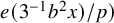 is a Fourier character.
Next let us give examples showing that
$\langle f,g\rangle _{U^3}$
 can be arbitrarily small while the usual inner product
$\langle f,g\rangle $
can be arbitrarily small while the usual inner product
$\langle f,g\rangle $
 is large (so that, in particular, the smallness of
$\langle f,g\rangle _{U^3}$
is large (so that, in particular, the smallness of
$\langle f,g\rangle _{U^3}$
 obtained in Proposition 4.22 does not imply the quasiorthogonality obtained in Theorem 4.24). Taking simply
$g=f=e(x^3/p)$
obtained in Proposition 4.22 does not imply the quasiorthogonality obtained in Theorem 4.24). Taking simply
$g=f=e(x^3/p)$
 , we have
$\langle f,g\rangle _{U^3}=\|f\|_{U^3}^8=o(1)_{p\to \infty }$
, we have
$\langle f,g\rangle _{U^3}=\|f\|_{U^3}^8=o(1)_{p\to \infty }$
 , yet
$\langle f,g\rangle = 1$
, yet
$\langle f,g\rangle = 1$
 .
.
4.4 k-step nilspace polynomials are structured functions of order k
For general theoretical reasons in the nilspace approach to higher-order Fourier analysis, and especially for our main proofs in Section 5, it is useful to establish that k-step nilspace polynomials of bounded complexity are structured functions of order k in the sense of Definition 2.23. We prove this with the following result, with the added strength that the
$L^2$
 -error in the latter definition is here reduced to an
$L^\infty $
-error in the latter definition is here reduced to an
$L^\infty $
 -error.
Theorem 4.27. Let
$m\in \mathbb {N}$
 and
$C\ge 0$
and
$C\ge 0$
 . Then for any
$\delta>0$
. Then for any
$\delta>0$
 there exists a constant
$N=N_{\delta ,m,C}\ge 0$
there exists a constant
$N=N_{\delta ,m,C}\ge 0$
 such that the following holds. Let
$\operatorname {\mathrm {X}}$
such that the following holds. Let
$\operatorname {\mathrm {X}}$
 be a k-step cfr nilspace of complexity at most m, let
$\operatorname {\mathrm {Z}}$
be a k-step cfr nilspace of complexity at most m, let
$\operatorname {\mathrm {Z}}$
 be a finite abelian group, let
$\phi :\operatorname {\mathrm {Z}}\to \operatorname {\mathrm {X}}$
be a finite abelian group, let
$\phi :\operatorname {\mathrm {Z}}\to \operatorname {\mathrm {X}}$
 be a nilspace morphism, and let
$F:\operatorname {\mathrm {X}}\to \mathbb {C}$
be a nilspace morphism, and let
$F:\operatorname {\mathrm {X}}\to \mathbb {C}$
 be a Lipschitz function with
$\|F\|_{\text {sum}}\le C$
be a Lipschitz function with
$\|F\|_{\text {sum}}\le C$
 . Then there is a function
$h:\operatorname {\mathrm {Z}}\to \mathbb {C}$
. Then there is a function
$h:\operatorname {\mathrm {Z}}\to \mathbb {C}$
 such that
$\|F\operatorname {\mathrm {\circ }}\phi -h\|_\infty \leq \delta $
such that
$\|F\operatorname {\mathrm {\circ }}\phi -h\|_\infty \leq \delta $
 and
$\|h\|_{U^{k+1}}^*\le N$
and
$\|h\|_{U^{k+1}}^*\le N$
 .
.
To prove this, we shall use a quantitative form of the Stone-Weierstrass theorem for functions
$F:\operatorname {\mathrm {X}}\to \mathbb {C}$
 such that the complexity of
$\operatorname {\mathrm {X}}$
such that the complexity of
$\operatorname {\mathrm {X}}$
 and
$\|F\|_{\text {sum}}$
and
$\|F\|_{\text {sum}}$
 are bounded (see Proposition 4.29). As an ingredient we use the following result on
$[0,1/2]^n$
are bounded (see Proposition 4.29). As an ingredient we use the following result on
$[0,1/2]^n$
 (equipped with the Euclidean metric).
Lemma 4.28. Let
$n\in \mathbb {N}$
 and
$C\ge 0$
and
$C\ge 0$
 . Then, for any
$\delta>0$
. Then, for any
$\delta>0$
 there exists
$N=N_{\delta ,n,C}\ge 0$
there exists
$N=N_{\delta ,n,C}\ge 0$
 such that the following holds. Let
$g:[0,1/2]^n\to \mathbb {C}$
such that the following holds. Let
$g:[0,1/2]^n\to \mathbb {C}$
 be a Lipschitz function such that
$\|g\|_{\text {sum}}\le C$
be a Lipschitz function such that
$\|g\|_{\text {sum}}\le C$
 . Then, for every
$i\in [N]$
. Then, for every
$i\in [N]$
 and
$j\in [n]$
and
$j\in [n]$
 , there exist a complex number
$\lambda _i=O_{C}(1)$
, there exist a complex number
$\lambda _i=O_{C}(1)$
 and a Lipschitz function
$h_{i,j}:[0,1/2]\to \mathbb {C}$
and a Lipschitz function
$h_{i,j}:[0,1/2]\to \mathbb {C}$
 with
$\|h_{i,j}\|_{\text {sum}}=O_{C}(1)$
with
$\|h_{i,j}\|_{\text {sum}}=O_{C}(1)$
 , and there exists
$\mathcal {E}:[0,1/2]^n\to \mathbb {C}$
, and there exists
$\mathcal {E}:[0,1/2]^n\to \mathbb {C}$
 with
$\|\mathcal {E}\|_\infty \le \delta $
with
$\|\mathcal {E}\|_\infty \le \delta $
 , such that
$g(x_1,\ldots ,x_n)=\sum _{i=1}^{N}\lambda _{i}\prod _{j=1}^n h_{i,j}(x_j)+\mathcal {E}(x_1,\ldots ,x_n)$
, such that
$g(x_1,\ldots ,x_n)=\sum _{i=1}^{N}\lambda _{i}\prod _{j=1}^n h_{i,j}(x_j)+\mathcal {E}(x_1,\ldots ,x_n)$
 .
.
Proof. We embed isometrically
$[0,1/2]^n$
 into
$\mathbb {T}^n$
into
$\mathbb {T}^n$
 by identifying
$\mathbb {T}^n\cong [0,1)^n$
by identifying
$\mathbb {T}^n\cong [0,1)^n$
 (using the Euclidean metric on
$[0,1/2]^n$
(using the Euclidean metric on
$[0,1/2]^n$
 and the flat metric on
$\mathbb {T}^n$
and the flat metric on
$\mathbb {T}^n$
 ). By the Tietze extension theorem, we extend g to a continuous function
$g':\mathbb {T}^n\to \mathbb {C}$
). By the Tietze extension theorem, we extend g to a continuous function
$g':\mathbb {T}^n\to \mathbb {C}$
 with
$\|g'\|_{\text {sum}}=O(C)$
with
$\|g'\|_{\text {sum}}=O(C)$
 . The partial Fourier series
$S_M(g'):=\sum _{r\in \mathbb {Z}^n:\|r\|_{\ell ^\infty }\leq M} \widehat {g'}(\chi _r) \chi _r$
. The partial Fourier series
$S_M(g'):=\sum _{r\in \mathbb {Z}^n:\|r\|_{\ell ^\infty }\leq M} \widehat {g'}(\chi _r) \chi _r$
 on
$\mathbb {T}^n$
on
$\mathbb {T}^n$
 satisfy
$\|S_M(g')-g'\|_\infty \leq K_{C,n}\frac {\log ^n M}{M}$
satisfy
$\|S_M(g')-g'\|_\infty \leq K_{C,n}\frac {\log ^n M}{M}$
 , where
$K_{C,n}$
, where
$K_{C,n}$
 depends only on C and n (see [Reference Lebesgue49, p. 201] for
$n=1$
depends only on C and n (see [Reference Lebesgue49, p. 201] for
$n=1$
 and [Reference Golubov21, p. 642] for
$n>1$
and [Reference Golubov21, p. 642] for
$n>1$
 ). Letting M be large enough so that
$K_{C,n}\frac {\log ^n M}{M}\le \delta $
). Letting M be large enough so that
$K_{C,n}\frac {\log ^n M}{M}\le \delta $
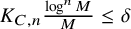 , we have
$\|S_M(g')-g'\|_\infty \leq \delta $
, we have
$\|S_M(g')-g'\|_\infty \leq \delta $
 . Note that each of the terms
$\widehat {g'}(\chi _r) \chi _r$
. Note that each of the terms
$\widehat {g'}(\chi _r) \chi _r$
 has the desired form. The result follows.
Proposition 4.29. Let
$\operatorname {\mathrm {X}}$
 be a k-step cfr nilspace and let
$C\ge 0$
be a k-step cfr nilspace and let
$C\ge 0$
 . Let
$K:\operatorname {\mathrm {Cor}}^{k+1}(\operatorname {\mathrm {X}})\to \operatorname {\mathrm {X}}$
. Let
$K:\operatorname {\mathrm {Cor}}^{k+1}(\operatorname {\mathrm {X}})\to \operatorname {\mathrm {X}}$
 be the corner-completion function (see [Reference Candela6, Lemma 2.1.12]). Then, for any
$\delta>0$
be the corner-completion function (see [Reference Candela6, Lemma 2.1.12]). Then, for any
$\delta>0$
 , there exists
$N=N_{\delta ,\operatorname {\mathrm {X}},C}\ge 0$
, there exists
$N=N_{\delta ,\operatorname {\mathrm {X}},C}\ge 0$
 such that the following holds. For any
$F:\operatorname {\mathrm {X}}\to \mathbb {C}$
such that the following holds. For any
$F:\operatorname {\mathrm {X}}\to \mathbb {C}$
 with
$\|F\|_{\text {sum}}\le C$
with
$\|F\|_{\text {sum}}\le C$
 there exist Lipschitz functions
$(h_{i,v}:\operatorname {\mathrm {X}}\to \mathbb {C})_{i\in [N],v\in [\![ k+1]\!] \backslash \{0^{k+1}\}}$
there exist Lipschitz functions
$(h_{i,v}:\operatorname {\mathrm {X}}\to \mathbb {C})_{i\in [N],v\in [\![ k+1]\!] \backslash \{0^{k+1}\}}$
 with
$\|h_{i,v}\|_{\text {sum}}=O_{\operatorname {\mathrm {X}},C}(1)$
with
$\|h_{i,v}\|_{\text {sum}}=O_{\operatorname {\mathrm {X}},C}(1)$
 such that
$\|F\operatorname {\mathrm {\circ }} K-\sum _{i\in [N]}\prod _{v\in [\![ k+1]\!] \backslash \{0^{k+1}\}}h_{i,v}(x_v)\|_\infty \le \delta $
such that
$\|F\operatorname {\mathrm {\circ }} K-\sum _{i\in [N]}\prod _{v\in [\![ k+1]\!] \backslash \{0^{k+1}\}}h_{i,v}(x_v)\|_\infty \le \delta $
 .
.
Proof. By Lemma A.9 and the fact that
$\operatorname {\mathrm {X}}$
 is compact, the function
$F\operatorname {\mathrm {\circ }} K$
is compact, the function
$F\operatorname {\mathrm {\circ }} K$
 is
$O_{C,\operatorname {\mathrm {X}}}(1)$
is
$O_{C,\operatorname {\mathrm {X}}}(1)$
 -Lipschitz. By the Tietze extension theorem, we can extend
$F\operatorname {\mathrm {\circ }} K$
-Lipschitz. By the Tietze extension theorem, we can extend
$F\operatorname {\mathrm {\circ }} K$
 to a continuous function on
$\operatorname {\mathrm {X}}^{[\![ k+1]\!] \backslash \{0^{k+1}\}}$
to a continuous function on
$\operatorname {\mathrm {X}}^{[\![ k+1]\!] \backslash \{0^{k+1}\}}$
 , which we denote by
$F'$
, which we denote by
$F'$
 , and for which we can assume that
$\|F'\|_{\text {sum}}=O_{C,\operatorname {\mathrm {X}}}(1)$
, and for which we can assume that
$\|F'\|_{\text {sum}}=O_{C,\operatorname {\mathrm {X}}}(1)$
 . As
$\operatorname {\mathrm {X}}$
. As
$\operatorname {\mathrm {X}}$
 is a compact manifold by Theorem A.2, we can find a finite
$C^\infty $
is a compact manifold by Theorem A.2, we can find a finite
$C^\infty $
 partition of unity
$(\rho _i)_{i\in \mathcal {I}}$
partition of unity
$(\rho _i)_{i\in \mathcal {I}}$
 such that, for all
$i\in \mathcal {I}$
such that, for all
$i\in \mathcal {I}$
 ,
$\operatorname {\mathrm {Supp}}(\rho _i)\subset U_i$
,
$\operatorname {\mathrm {Supp}}(\rho _i)\subset U_i$
 is compact and there exists a diffeomorphism
$\phi _i:U_i\to (0,1/2)^\ell $
is compact and there exists a diffeomorphism
$\phi _i:U_i\to (0,1/2)^\ell $
 (for some
$\ell =\ell _{\operatorname {\mathrm {X}}}$
(for some
$\ell =\ell _{\operatorname {\mathrm {X}}}$
 ). This then induces a partition of unity in
$\operatorname {\mathrm {X}}^{[\![ k+1]\!] \backslash \{0^{k+1}\}}$
). This then induces a partition of unity in
$\operatorname {\mathrm {X}}^{[\![ k+1]\!] \backslash \{0^{k+1}\}}$
 simply by considering products of different
$\rho _i$
simply by considering products of different
$\rho _i$
 , namely
$\{\prod _{v\in [\![ k+1]\!] \backslash \{0^{k+1}\}}\rho _{I_v}:I\in \mathcal {I}^{[\![ k+1]\!] \backslash \{0^{k+1}\}}\}$
, namely
$\{\prod _{v\in [\![ k+1]\!] \backslash \{0^{k+1}\}}\rho _{I_v}:I\in \mathcal {I}^{[\![ k+1]\!] \backslash \{0^{k+1}\}}\}$
 . For any
$I\in \mathcal {I}^{[\![ k+1]\!] \backslash \{0^{k+1}\}}$
. For any
$I\in \mathcal {I}^{[\![ k+1]\!] \backslash \{0^{k+1}\}}$
 , let
$\rho ^*_I$
, let
$\rho ^*_I$
 be the function mapping
$\operatorname {\mathrm {c}}^*\in \operatorname {\mathrm {X}}^{[\![ k+1]\!] \backslash \{0^{k+1}\}}$
be the function mapping
$\operatorname {\mathrm {c}}^*\in \operatorname {\mathrm {X}}^{[\![ k+1]\!] \backslash \{0^{k+1}\}}$
 to
$\prod _{v\in [\![ k+1]\!] \backslash \{0^{k+1}\}}\rho _{I_v}(\operatorname {\mathrm {c}}^*(x_v))$
to
$\prod _{v\in [\![ k+1]\!] \backslash \{0^{k+1}\}}\rho _{I_v}(\operatorname {\mathrm {c}}^*(x_v))$
 .
.
Hence
$F' = \sum _{I\in \mathcal {I}^{[\![ k+1]\!] \backslash \{0^{k+1}\}}} F'\rho _I$
 . Note that
$|\mathcal {I}^{[\![ k+1]\!] \backslash \{0^{k+1}\}}|=O_{\operatorname {\mathrm {X}}}(1)$
. Note that
$|\mathcal {I}^{[\![ k+1]\!] \backslash \{0^{k+1}\}}|=O_{\operatorname {\mathrm {X}}}(1)$
 so if we prove the desired decomposition for each function
$F'\rho _I$
so if we prove the desired decomposition for each function
$F'\rho _I$
 then the result will follow. Note also that by construction
$\|F'\rho _I\|_{\text {sum}}=O_{\operatorname {\mathrm {X}},C}(1)$
then the result will follow. Note also that by construction
$\|F'\rho _I\|_{\text {sum}}=O_{\operatorname {\mathrm {X}},C}(1)$
 . For
$I\in \mathcal {I}^{[\![ k+1]\!] \backslash \{0^{k+1}\}}$
. For
$I\in \mathcal {I}^{[\![ k+1]\!] \backslash \{0^{k+1}\}}$
 , let
$\phi _I$
, let
$\phi _I$
 denote the map
$\prod _{v\in [\![ k+1]\!] \backslash \{0^{k+1}\}}\phi _{I_v}:\prod _{v\in [\![ k+1]\!] \backslash \{0^{k+1}\}}U_{I_v}\to (0,1/2)^{\ell (2^{k+1}-1)}$
denote the map
$\prod _{v\in [\![ k+1]\!] \backslash \{0^{k+1}\}}\phi _{I_v}:\prod _{v\in [\![ k+1]\!] \backslash \{0^{k+1}\}}U_{I_v}\to (0,1/2)^{\ell (2^{k+1}-1)}$
 . Then
$F'\rho _I = (F'\rho _I)\operatorname {\mathrm {\circ }} \phi _I^{-1}\operatorname {\mathrm {\circ }}\phi _I$
. Then
$F'\rho _I = (F'\rho _I)\operatorname {\mathrm {\circ }} \phi _I^{-1}\operatorname {\mathrm {\circ }}\phi _I$
 . Note that
$\|\phi _I\|_{\text {Lip}}$
. Note that
$\|\phi _I\|_{\text {Lip}}$
 and
$\|\phi _I^{-1}\|_{\text {Lip}}$
and
$\|\phi _I^{-1}\|_{\text {Lip}}$
 are both
$O_{\operatorname {\mathrm {X}}}(1)$
are both
$O_{\operatorname {\mathrm {X}}}(1)$
 , which implies that
$\|(F'\rho _I)\operatorname {\mathrm {\circ }} \phi _I^{-1}\|_{\text {sum}}=O_{C,\operatorname {\mathrm {X}}}(1)$
, which implies that
$\|(F'\rho _I)\operatorname {\mathrm {\circ }} \phi _I^{-1}\|_{\text {sum}}=O_{C,\operatorname {\mathrm {X}}}(1)$
 . Thus, we can apply Lemma 4.28 to
$(F'\rho _I)\operatorname {\mathrm {\circ }} \phi _I^{-1}$
. Thus, we can apply Lemma 4.28 to
$(F'\rho _I)\operatorname {\mathrm {\circ }} \phi _I^{-1}$
 with
$\delta _I=\delta /|\mathcal {I}^{[\![ k+1]\!] \backslash \{0^{k+1}\}}|$
with
$\delta _I=\delta /|\mathcal {I}^{[\![ k+1]\!] \backslash \{0^{k+1}\}}|$
 . Hence
$ \big \|(F'\rho _I)\operatorname {\mathrm {\circ }} \phi _I^{-1}-\textstyle \sum _{i\in [N]}\textstyle \prod _{v\in [\![ k+1]\!] \backslash \{0^{k+1}\}}h_{i,v}^{I}\big \|_\infty \le \delta _I$
. Hence
$ \big \|(F'\rho _I)\operatorname {\mathrm {\circ }} \phi _I^{-1}-\textstyle \sum _{i\in [N]}\textstyle \prod _{v\in [\![ k+1]\!] \backslash \{0^{k+1}\}}h_{i,v}^{I}\big \|_\infty \le \delta _I$
 , where
$h_{i,v}^{I}:(0,1/2)^\ell \to \mathbb {C}$
, where
$h_{i,v}^{I}:(0,1/2)^\ell \to \mathbb {C}$
 .Footnote 17 The desired decomposition follows simply by considering
$\prod _{v\in [\![ k+1]\!] \backslash \{0^{k+1}\}}h_{i,v}^{I}\operatorname {\mathrm {\circ }}\phi _I$
.Footnote 17 The desired decomposition follows simply by considering
$\prod _{v\in [\![ k+1]\!] \backslash \{0^{k+1}\}}h_{i,v}^{I}\operatorname {\mathrm {\circ }}\phi _I$
 for
$i\in [N]$
for
$i\in [N]$
 and
$I\in \mathcal {I}^{[\![ k+1]\!] \backslash \{0^{k+1}\}}$
and
$I\in \mathcal {I}^{[\![ k+1]\!] \backslash \{0^{k+1}\}}$
 .
.
Proof of Theorem 4.27.
Let
$K_{k+1}:=\{0,1\}^{k+1}\setminus \{0^{k+1}\}$
 . For every
$x,t_1,\ldots ,t_{k+1}\in \operatorname {\mathrm {Z}}$
. For every
$x,t_1,\ldots ,t_{k+1}\in \operatorname {\mathrm {Z}}$
 we have

where
$K:\operatorname {\mathrm {Cor}}^{k+1}(\operatorname {\mathrm {X}})\to \operatorname {\mathrm {X}}$
 is the continuous corner completion function.
By Proposition 4.29 applied to F and K there exists
$N=N_{\delta ,m,C}\ge 0$
 (recall that
$\operatorname {\mathrm {X}}$
(recall that
$\operatorname {\mathrm {X}}$
 has complexity at most m) and functions
$(h_{i,v}:\operatorname {\mathrm {X}}\to \mathbb {C})_{i\in [N],v\in K_{k+1}}$
has complexity at most m) and functions
$(h_{i,v}:\operatorname {\mathrm {X}}\to \mathbb {C})_{i\in [N],v\in K_{k+1}}$
 with
$\|h_{i,v}\|_{\text {sum}}=O_{m,C}(1)$
with
$\|h_{i,v}\|_{\text {sum}}=O_{m,C}(1)$
 such that
$\|F\operatorname {\mathrm {\circ }} K-\sum _{i\in [N]}\prod _{v\in K_{k+1}}h_{i,v}(x_v)\|_\infty \le \delta $
such that
$\|F\operatorname {\mathrm {\circ }} K-\sum _{i\in [N]}\prod _{v\in K_{k+1}}h_{i,v}(x_v)\|_\infty \le \delta $
 .
.
Let
$h:\operatorname {\mathrm {Z}}\to \mathbb {C}$
 ,
$x\mapsto \mathbb {E}_{t_1,\ldots ,t_{k+1}\in \operatorname {\mathrm {Z}}} \sum _{i\in [N]}\prod _{v\in K_{k+1}}h_{i,v}(\phi (x+v\cdot t))$
,
$x\mapsto \mathbb {E}_{t_1,\ldots ,t_{k+1}\in \operatorname {\mathrm {Z}}} \sum _{i\in [N]}\prod _{v\in K_{k+1}}h_{i,v}(\phi (x+v\cdot t))$
 , where
$t=(t_1,\ldots ,t_{k+1})$
, where
$t=(t_1,\ldots ,t_{k+1})$
 . We have for every
$x\in \operatorname {\mathrm {Z}}$
. We have for every
$x\in \operatorname {\mathrm {Z}}$
 ,
,

To bound
$\|h\|_{U^{k+1}}^*$
 , let
$g:\operatorname {\mathrm {Z}}\to \mathbb {C}$
, let
$g:\operatorname {\mathrm {Z}}\to \mathbb {C}$
 with
$\|g\|_{U^{k+1}}\leq 1$
with
$\|g\|_{U^{k+1}}\leq 1$
 , and note that
$\mathbb {E}_x h(x) \overline {g(x)}$
, and note that
$\mathbb {E}_x h(x) \overline {g(x)}$
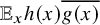 equals

where we used the Gowers-Cauchy-Schwarz inequality. Hence
$\|h\|_{U^{k+1}}^*=O_{\delta ,m,C}(1)$
 .
.
5 Refined regularity in terms of nilspace characters
5.1 The refined regularity lemma
Recall that a complexity notion for compact nilspaces is a bijection between the countable set of isomorphism classes of cfr nilspaces and the natural numbers (see [Reference Candela and Szegedy12, Definition 1.2]). Throughout this section, we assume that we have fixed an arbitrary complexity notion, denoting the resulting list of nilspaces by
$\{\operatorname {\mathrm {Y}}_1,\operatorname {\mathrm {Y}}_2,\ldots \}$
 . For each
$\operatorname {\mathrm {Y}}_i$
. For each
$\operatorname {\mathrm {Y}}_i$
 in this fixed complexity notion, let
$\operatorname {\mathrm {Q}}_{\operatorname {\mathrm {Y}}_i}(\eta ,C)$
in this fixed complexity notion, let
$\operatorname {\mathrm {Q}}_{\operatorname {\mathrm {Y}}_i}(\eta ,C)$
 be the function given by Lemma 4.11. For each
$m\in \mathbb {N}$
be the function given by Lemma 4.11. For each
$m\in \mathbb {N}$
 and
$\eta>0$
and
$\eta>0$
 , we then define

We can now prove the following regularity theorem, refining [Reference Candela and Szegedy12, Theorem 1.5] for finite abelian groups. (The proof could be extended to compact abelian groups as enabled by [Reference Candela and Szegedy12, Theorem 1.5], but we do not need this.)
Theorem 5.1 (Regularity).
Let
$k\in \mathbb {N}$
 and let
$\mathcal {D}:\mathbb {R}_{>0}\times \mathbb {N}\to \mathbb {R}_{>0}$
and let
$\mathcal {D}:\mathbb {R}_{>0}\times \mathbb {N}\to \mathbb {R}_{>0}$
 be an arbitrary function. For every
$\eta>0$
be an arbitrary function. For every
$\eta>0$
 there exists
$N=N(\eta ,\mathcal {D})>0$
there exists
$N=N(\eta ,\mathcal {D})>0$
 such that the following holds. For every finite abelian group
$\operatorname {\mathrm {Z}}$
such that the following holds. For every finite abelian group
$\operatorname {\mathrm {Z}}$
 and every 1-bounded function
$f:\operatorname {\mathrm {Z}}\to \mathbb {C}$
and every 1-bounded function
$f:\operatorname {\mathrm {Z}}\to \mathbb {C}$
 , for some
$m\in [1,N]$
, for some
$m\in [1,N]$
 there exists a k-step cfr nilspace
$\operatorname {\mathrm {Y}}$
there exists a k-step cfr nilspace
$\operatorname {\mathrm {Y}}$
 of complexity at most m, a
$\mathcal {D}(\eta ,m)$
of complexity at most m, a
$\mathcal {D}(\eta ,m)$
 -balanced morphism
$\phi :\operatorname {\mathrm {Z}}\to \operatorname {\mathrm {Y}}$
-balanced morphism
$\phi :\operatorname {\mathrm {Z}}\to \operatorname {\mathrm {Y}}$
 , and a 1-bounded m-Lipschitz function
$F:\operatorname {\mathrm {Y}}\to \mathbb {C}$
, and a 1-bounded m-Lipschitz function
$F:\operatorname {\mathrm {Y}}\to \mathbb {C}$
 , such that

where
$f_s=F\operatorname {\mathrm {\circ }}\phi $
 ,
$\|f_e\|_1\le \eta $
,
$\|f_e\|_1\le \eta $
 ,
$\|f_r\|_\infty \le 1$
,
$\|f_r\|_\infty \le 1$
 , and
$\max (\|f_r\|_{U^{k+1}},|\langle f_r,f_s\rangle |,|\langle f_r,f_e \rangle |)\le \mathcal {D}(\eta ,m)$
, and
$\max (\|f_r\|_{U^{k+1}},|\langle f_r,f_s\rangle |,|\langle f_r,f_e \rangle |)\le \mathcal {D}(\eta ,m)$
 .
.
Moreover, there is a set
$S\subset \widehat {\operatorname {\mathrm {Z}}_k(\operatorname {\mathrm {Y}})} $
 with
$|S|\leq \operatorname {\mathrm {Q}}(\eta ,m)$
with
$|S|\leq \operatorname {\mathrm {Q}}(\eta ,m)$
 , such that, letting
$g_\chi :=F_\chi \operatorname {\mathrm {\circ }}\phi $
, such that, letting
$g_\chi :=F_\chi \operatorname {\mathrm {\circ }}\phi $
 for each
$\chi \in S$
for each
$\chi \in S$
 , we have

where
$\|g_e\|_\infty \le \eta $
 , and for all
$\chi \neq \chi '$
, and for all
$\chi \neq \chi '$
 in S, we have
$\max \big (|\langle g_{\chi },g_{\chi '}\rangle |,\, \langle g_{\chi },g_{\chi '}\rangle _{U^{k+1}}\big )\le \mathcal {D}(\eta ,m)$
in S, we have
$\max \big (|\langle g_{\chi },g_{\chi '}\rangle |,\, \langle g_{\chi },g_{\chi '}\rangle _{U^{k+1}}\big )\le \mathcal {D}(\eta ,m)$
 .
.
Proof. Having fixed
$\mathcal {D}$
 and
$\eta $
and
$\eta $
 , we apply [Reference Candela and Szegedy12, Theorem 1.5] with a function
$\mathcal {D}'$
, we apply [Reference Candela and Szegedy12, Theorem 1.5] with a function
$\mathcal {D}'$
 for which we shall specify constraints throughout the proof. Firstly we require that
$\mathcal {D}'(\eta ,m) \le \mathcal {D}(\eta ,m)$
for which we shall specify constraints throughout the proof. Firstly we require that
$\mathcal {D}'(\eta ,m) \le \mathcal {D}(\eta ,m)$
 . For this function
$\mathcal {D}'$
. For this function
$\mathcal {D}'$
 (to be fully specified later), let
$f=f_s+f_e+f_r$
(to be fully specified later), let
$f=f_s+f_e+f_r$
 be the decomposition provided by [Reference Candela and Szegedy12, Theorem 1.5]. It then remains to decompose
$f_s = F\operatorname {\mathrm {\circ }} \phi $
be the decomposition provided by [Reference Candela and Szegedy12, Theorem 1.5]. It then remains to decompose
$f_s = F\operatorname {\mathrm {\circ }} \phi $
 further as claimed in (5.3). By [Reference Candela and Szegedy12, Theorem 1.5] we know that
$F:\operatorname {\mathrm {Y}}\to \mathbb {C}$
further as claimed in (5.3). By [Reference Candela and Szegedy12, Theorem 1.5] we know that
$F:\operatorname {\mathrm {Y}}\to \mathbb {C}$
 is m-Lipschitz, 1-bounded, and the complexity of
$\operatorname {\mathrm {Y}}$
is m-Lipschitz, 1-bounded, and the complexity of
$\operatorname {\mathrm {Y}}$
 is at most m. Also, the morphism
$\phi :\operatorname {\mathrm {Z}}\to \operatorname {\mathrm {Y}}$
is at most m. Also, the morphism
$\phi :\operatorname {\mathrm {Z}}\to \operatorname {\mathrm {Y}}$
 is
$\mathcal {D}'(\eta ,m)$
is
$\mathcal {D}'(\eta ,m)$
 -balanced.
As
$\operatorname {\mathrm {Y}}$
 has complexity at most m, Lemma 4.11 applied with
$\delta =\eta $
has complexity at most m, Lemma 4.11 applied with
$\delta =\eta $
 yields a set
$S\subset \widehat {\operatorname {\mathrm {Z}}_k(\operatorname {\mathrm {Y}})}$
yields a set
$S\subset \widehat {\operatorname {\mathrm {Z}}_k(\operatorname {\mathrm {Y}})}$
 with
$|S|\leq \operatorname {\mathrm {Q}}(\eta ,m)$
with
$|S|\leq \operatorname {\mathrm {Q}}(\eta ,m)$
 such that
$F = \sum _{\chi \in S}F_\chi + F_e$
such that
$F = \sum _{\chi \in S}F_\chi + F_e$
 where
$\|F_e\|_\infty \le \eta $
where
$\|F_e\|_\infty \le \eta $
 . Letting
$g_e=F_e\operatorname {\mathrm {\circ }}\phi $
. Letting
$g_e=F_e\operatorname {\mathrm {\circ }}\phi $
 , we obtain (5.3). By Lemma 4.8, we have
$\|F_\chi \|_L\le \|F\|_L$
, we obtain (5.3). By Lemma 4.8, we have
$\|F_\chi \|_L\le \|F\|_L$
 and
$\|F_\chi \|_\infty \le \|F\|_\infty $
and
$\|F_\chi \|_\infty \le \|F\|_\infty $
 , so
$\|F_\chi \|_{\textrm {sum}}\leq m+1$
, so
$\|F_\chi \|_{\textrm {sum}}\leq m+1$
 .
.
Finally, we apply Proposition 4.22 and Theorem 4.24 with
$\delta =\mathcal {D}(\eta ,m)$
 , thus obtaining that there exists
$b=b(\mathcal {D}(\eta ,m),m,\operatorname {\mathrm {Y}})>0$
, thus obtaining that there exists
$b=b(\mathcal {D}(\eta ,m),m,\operatorname {\mathrm {Y}})>0$
 such that if
$\phi $
such that if
$\phi $
 is b-balanced, then the conclusions of Proposition 4.22 and Theorem 4.24 hold, giving us the claimed smallness of
$U^{k+1}$
is b-balanced, then the conclusions of Proposition 4.22 and Theorem 4.24 hold, giving us the claimed smallness of
$U^{k+1}$
 -products and quasiorthogonality, namely
$\max \big (|\langle g_{\chi },g_{\chi '}\rangle |,\, \langle g_{\chi },g_{\chi '}\rangle _{U^{k+1}}\big )\le \mathcal {D}(\eta ,m)$
-products and quasiorthogonality, namely
$\max \big (|\langle g_{\chi },g_{\chi '}\rangle |,\, \langle g_{\chi },g_{\chi '}\rangle _{U^{k+1}}\big )\le \mathcal {D}(\eta ,m)$
 for all
$\chi \neq \chi '$
for all
$\chi \neq \chi '$
 in S. Since
$\operatorname {\mathrm {Y}}$
in S. Since
$\operatorname {\mathrm {Y}}$
 has complexity at most m, this function
$b(\mathcal {D}(\eta ,m),m,\operatorname {\mathrm {Y}})$
has complexity at most m, this function
$b(\mathcal {D}(\eta ,m),m,\operatorname {\mathrm {Y}})$
 can be bounded by a function
$b'(\mathcal {D}(\eta ,m),m)$
can be bounded by a function
$b'(\mathcal {D}(\eta ,m),m)$
 . We require that
$\mathcal {D}'(\eta ,m)<b'(\mathcal {D}(\eta ,m),m)$
. We require that
$\mathcal {D}'(\eta ,m)<b'(\mathcal {D}(\eta ,m),m)$
 .
.
5.2 Correlation, approximate diagonalization of the
$U^k$
norm, and regularization

This subsection presents three main consequences of the refined regularity theorem that follow by elementary arguments once we have Theorem 5.1.
We begin with a simple refinement of the inverse theorem [Reference Candela and Szegedy12, Theorem 5.2] (in the case of finite abelian groups), which shows that a 1-bounded function
$f:\operatorname {\mathrm {Z}}\to \mathbb {C}$
 with large
$U^{k+1}$
with large
$U^{k+1}$
 -norm correlates nontrivially not just with the structured part
$f_s$
-norm correlates nontrivially not just with the structured part
$f_s$
 (which is a nilspace polynomial in the sense of [Reference Candela and Szegedy12]) but rather with one of the nilspace characters in the decomposition of
$f_s$
(which is a nilspace polynomial in the sense of [Reference Candela and Szegedy12]) but rather with one of the nilspace characters in the decomposition of
$f_s$
 .
.
Theorem 5.2 (Inverse theorem with nilspace characters).
Under the assumptions and notation of Theorem 5.1, suppose in addition that
$\|f\|_{U^{k+1}}\geq \delta>0$
 . Then

Proof. Following the proof of [Reference Candela and Szegedy12, Theorem 5.2], we have that if
$\eta $
 and
$\mathcal {D}(\eta ,m)$
and
$\mathcal {D}(\eta ,m)$
 are sufficiently small in terms of
$\delta $
are sufficiently small in terms of
$\delta $
 , then
$|\langle f,f_s\rangle |\ge \delta ^{2^{k+1}}/2$
, then
$|\langle f,f_s\rangle |\ge \delta ^{2^{k+1}}/2$
 . Substituting here
$f_s=\sum _{\chi \in S}g_\chi +g_e$
. Substituting here
$f_s=\sum _{\chi \in S}g_\chi +g_e$
 , and noting that we can also take
$\eta $
, and noting that we can also take
$\eta $
 to be at most
$\delta ^{2^{k+1}}/4$
to be at most
$\delta ^{2^{k+1}}/4$
 , we see that there exists
$\chi \in S$
, we see that there exists
$\chi \in S$
 such that
$|\langle f,g_\chi \rangle |\ge \delta ^{2^{k+1}}/(4|S|)$
such that
$|\langle f,g_\chi \rangle |\ge \delta ^{2^{k+1}}/(4|S|)$
 where
$|S|=O_\delta (1)$
where
$|S|=O_\delta (1)$
 .
.
We can now prove a new, more detailed correlation estimate, which gives information not just on the maximal correlation but also on the correlation of f with each nilspace character in (5.3) having nonnegligible
$L^2$
 -norm. The information in question is that every such inner product is close to the squared
$L^2$
-norm. The information in question is that every such inner product is close to the squared
$L^2$
 -norm of the nilspace character.
Lemma 5.3. Under the assumptions and notation of Theorem 5.1, for each
$\chi \in S$
 we have

Proof. We have
$\langle f,g_\chi \rangle =\sum _{\chi '\in S} \langle g_{\chi '} ,g_\chi \rangle +\langle g_e +f_e,g_\chi \rangle +\langle f_r,g_\chi \rangle $
 . Hence

Using the quasiorthogonality, the sum over
$S\setminus \{\chi \}$
 here is at most
$|S|\mathcal {D}(\eta ,m)$
here is at most
$|S|\mathcal {D}(\eta ,m)$
 .
.
Next, using that
$\|g_\chi \|_\infty \leq 1$
 , we have
$|\langle g_e+f_e,g_\chi \rangle |\leq \|g_e\|_\infty +\|f_e\|_1\leq 2\eta $
, we have
$|\langle g_e+f_e,g_\chi \rangle |\leq \|g_e\|_\infty +\|f_e\|_1\leq 2\eta $
 .
.
Finally, we bound
$|\langle f_r,g_\chi \rangle |$
 . We have
$g_\chi =F_\chi \operatorname {\mathrm {\circ }}\phi $
. We have
$g_\chi =F_\chi \operatorname {\mathrm {\circ }}\phi $
 where, as explained in the proof of Theorem 5.1, we have
$\|F_\chi \|_{\textrm {sum}}\leq m+1$
where, as explained in the proof of Theorem 5.1, we have
$\|F_\chi \|_{\textrm {sum}}\leq m+1$
 . By Theorem 4.27 with
$\delta =\eta $
. By Theorem 4.27 with
$\delta =\eta $
 , there is
$h':\operatorname {\mathrm {Z}}\to \mathbb {C}$
, there is
$h':\operatorname {\mathrm {Z}}\to \mathbb {C}$
 with
$\|h'\|_{U^{k+1}}^*=O_{\eta ,m}(1)$
with
$\|h'\|_{U^{k+1}}^*=O_{\eta ,m}(1)$
 such that
$\| g_\chi -h'\|_\infty \leq \eta $
such that
$\| g_\chi -h'\|_\infty \leq \eta $
 . Hence
$g_\chi $
. Hence
$g_\chi $
 is an
$(R,\eta )$
is an
$(R,\eta )$
 -structured function of order k with
$R=O_{\eta ,m}(1)$
-structured function of order k with
$R=O_{\eta ,m}(1)$
 . Since
$f_r$
. Since
$f_r$
 is 1-bounded and
$\|f_r\|_{U^{k+1}}\leq \mathcal {D}(\eta ,m)$
is 1-bounded and
$\|f_r\|_{U^{k+1}}\leq \mathcal {D}(\eta ,m)$
 , by Proposition 2.27 with
$h=f_r$
, by Proposition 2.27 with
$h=f_r$
 , we have
$|\langle f_r,g_\chi \rangle |\leq \mathcal {D}(\eta ,m) O_{\eta ,m}(1)+\eta $
, we have
$|\langle f_r,g_\chi \rangle |\leq \mathcal {D}(\eta ,m) O_{\eta ,m}(1)+\eta $
 . The result follows.
The next main result in this subsection is an approximate diagonalization of the
$U^{k+1}$
 -norm. To motivate this, recall the well-known formula for the
$U^2$
-norm. To motivate this, recall the well-known formula for the
$U^2$
 -norm in terms of Fourier coefficients:

This formula can be viewed as a diagonalization of the
$U^2$
 -norm in the sense that when we write
$\|f\|_{U^2}^4$
-norm in the sense that when we write
$\|f\|_{U^2}^4$
 as
$\langle f,f,f,f\rangle _{U^2}$
as
$\langle f,f,f,f\rangle _{U^2}$
 , substitute here f by its Fourier expansion
$f=\sum _{\chi \in \widehat {\operatorname {\mathrm {Z}}}} \widehat {f}(\chi )\chi $
, substitute here f by its Fourier expansion
$f=\sum _{\chi \in \widehat {\operatorname {\mathrm {Z}}}} \widehat {f}(\chi )\chi $
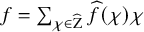 , and expand the
$U^2$
, and expand the
$U^2$
 -product, the orthonormality of characters yields cancellation of all nondiagonal terms in the expansion, resulting in the right side of (5.6). Note that this right side can be rewritten as
$\sum _{\chi \in \widehat {\operatorname {\mathrm {Z}}}} \|\widehat {f}(\chi )\chi \|_{U^2}^4$
-product, the orthonormality of characters yields cancellation of all nondiagonal terms in the expansion, resulting in the right side of (5.6). Note that this right side can be rewritten as
$\sum _{\chi \in \widehat {\operatorname {\mathrm {Z}}}} \|\widehat {f}(\chi )\chi \|_{U^2}^4$
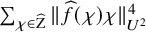 .
.
As a consequence of Theorem 5.1, we can obtain the following generalization of (5.6). This type of result will help in the final proof of this section, but it is also of independent interest. Indeed, formulas of this type, which can be viewed as approximate “Pythagorean theorems” for the Gowers norms, have been sought as a desirable feature of higher-order Fourier analysis; see for instance a special case of such a result for the
$U^3$
 -norm in [Reference Gowers and Wolf29, Theorem 4.1].
Theorem 5.4 (Approximate diagonalization of
$\|\cdot \|_{U^{k+1}}$
).

Let
$k\in \mathbb {N}$
 , let
$\mathcal {D}:\mathbb {R}_{>0}\times \mathbb {N}\to \mathbb {R}_{>0}$
, let
$\mathcal {D}:\mathbb {R}_{>0}\times \mathbb {N}\to \mathbb {R}_{>0}$
 be an arbitrary function, and let
$\eta>0$
be an arbitrary function, and let
$\eta>0$
 . Let
$\operatorname {\mathrm {Z}}$
. Let
$\operatorname {\mathrm {Z}}$
 be a finite abelian group and let
$f:\operatorname {\mathrm {Z}}\to \mathbb {C}$
be a finite abelian group and let
$f:\operatorname {\mathrm {Z}}\to \mathbb {C}$
 be a 1-bounded function. Let
$f=\sum _{\chi \in S} g_\chi + g_e+f_e+f_r$
be a 1-bounded function. Let
$f=\sum _{\chi \in S} g_\chi + g_e+f_e+f_r$
 and
$m\leq N(\eta ,\mathcal {D})$
and
$m\leq N(\eta ,\mathcal {D})$
 be the decomposition and complexity bound given by Theorem 5.1. Then

where
$|\mathcal {E}|\leq 2^{2^{k+1}}\big ( 4\eta ^{\frac {k+2}{2^{k+1}}}+\mathcal {D}(\eta ,m)\big )+(|S|^{2^{k+1}}-1)\mathcal {D}(\eta ,m)^{1/2^k}$
 .
.
We extract the final part of the proof of this theorem as the following separate lemma, which will be used in other results below. This lemma gives more properly an approximate “Pythagorean formula” for Gowers norms (as it holds not just for the nilspace characters in Theorem 5.4, but for any system of 1-bounded functions with pairwise small Gowers inner-products).
Lemma 5.5 (Approximate Pythagorean formula for
$\|\cdot \|_{U^s}$
).

Let
$s\geq 2$
 be an integer, let G be a compact abelian group, let B be a finite set, and let
$(g_i)_{i\in B}$
be an integer, let G be a compact abelian group, let B be a finite set, and let
$(g_i)_{i\in B}$
 be a collection of 1-bounded Borel functions on G such that for any
$i\neq j$
be a collection of 1-bounded Borel functions on G such that for any
$i\neq j$
 in B we have
$\langle g_i,g_j\rangle _{U^{s}}\leq \delta $
in B we have
$\langle g_i,g_j\rangle _{U^{s}}\leq \delta $
 . Then

Proof. We expand
$\|\sum _{i\in B} g_i\|_{U^{s}}^{2^{s}}$
 into
$|B|^{2^{s}}$
into
$|B|^{2^{s}}$
 Gowers
$U^{s}$
Gowers
$U^{s}$
 -products, obtaining

In the right side here, the summands for which the corresponding vector
$(i_v)_{v\in [\![ {s}]\!] }$
 is constant add up to
$\sum _{i\in B} \|g_i\|_{U^{s}}^{2^{s}}$
is constant add up to
$\sum _{i\in B} \|g_i\|_{U^{s}}^{2^{s}}$
 . The main task is thus to show that every other term is small. Every such term is a product
$ \langle (g_{i_v})_{v\in [\![ {s}]\!] }\rangle _{U^{s}}$
. The main task is thus to show that every other term is small. Every such term is a product
$ \langle (g_{i_v})_{v\in [\![ {s}]\!] }\rangle _{U^{s}}$
 such that for some pair of vertices
$v,w\in [\![ {s}]\!] $
such that for some pair of vertices
$v,w\in [\![ {s}]\!] $
 we have
$i_v\neq i_w$
we have
$i_v\neq i_w$
 . We claim that we can then assume additionally that these vertices
$v,w$
. We claim that we can then assume additionally that these vertices
$v,w$
 are adjacent in the discrete cube
$[\![ {s}]\!] $
are adjacent in the discrete cube
$[\![ {s}]\!] $
 (i.e., only one of their coordinates differs); this follows from the fact that starting from any vertex of
$[\![ {s}]\!] $
(i.e., only one of their coordinates differs); this follows from the fact that starting from any vertex of
$[\![ {s}]\!] $
 there is a Hamiltonian path in the graph of 1-faces (or “edges”) of the discrete cube
$[\![ {s}]\!] $
there is a Hamiltonian path in the graph of 1-faces (or “edges”) of the discrete cube
$[\![ {s}]\!] $
 , so if our claim was false then starting from any vertex and following such a path, we would deduce that
$(i_v)_{v\in [\![ {s}]\!] }$
, so if our claim was false then starting from any vertex and following such a path, we would deduce that
$(i_v)_{v\in [\![ {s}]\!] }$
 is constant, a contradiction. Assuming thus that
$v,w$
is constant, a contradiction. Assuming thus that
$v,w$
 are adjacent with
$i_v\neq i_w$
are adjacent with
$i_v\neq i_w$
 , now note that by
${s}-1$
, now note that by
${s}-1$
 applications of the Cauchy-Schwarz inequality, similar to the applications involved in the proof of the
$U^{s}$
applications of the Cauchy-Schwarz inequality, similar to the applications involved in the proof of the
$U^{s}$
 -Gowers-Cauchy-Schwarz inequality (see [Reference Tao and Vu66]), and using that
$\|g_i\|_{U^{s}}\leq 1$
-Gowers-Cauchy-Schwarz inequality (see [Reference Tao and Vu66]), and using that
$\|g_i\|_{U^{s}}\leq 1$
 for every
$i\in B$
for every
$i\in B$
 , we obtain that the
$U^{s}$
, we obtain that the
$U^{s}$
 -product in question is at most
$\langle g_{i_v},g_{i_w}\rangle _{U^{s}}^{1/2^{{s}-1}}\leq \delta ^{1/2^{{s}-1}}$
-product in question is at most
$\langle g_{i_v},g_{i_w}\rangle _{U^{s}}^{1/2^{{s}-1}}\leq \delta ^{1/2^{{s}-1}}$
 . The result follows.
We shall also use the following upper bound for the Gowers norms.
Lemma 5.6. Let
$s\geq 2$
 be an integer, let G be a compact abelian group, and let
$f:G\to \mathbb {C}$
be an integer, let G be a compact abelian group, and let
$f:G\to \mathbb {C}$
 be a bounded Borel function. Then

Proof. To see that
$\|f\|_{U^{s}}^{2^{s}}\leq \|f\|_2^{2{s}+2}\|f\|_{L^\infty }^{2^{s}-2{s}-2}$
 , note that the graph of 1-faces on the discrete cube
$[\![ {s}]\!] $
, note that the graph of 1-faces on the discrete cube
$[\![ {s}]\!] $
 contains two disjoint stars
$S_1,S_2$
contains two disjoint stars
$S_1,S_2$
 of order
${s}+1$
of order
${s}+1$
 , namely the star with center
$0^{s}$
, namely the star with center
$0^{s}$
 and the star with center
$1^{s}$
and the star with center
$1^{s}$
 (note that for
${s}=3$
(note that for
${s}=3$
 these stars partition
$[\![ {s}]\!] $
these stars partition
$[\![ {s}]\!] $
 , and for
${s}>3$
, and for
${s}>3$
 their union leaves
$2^{s}-2{s}-2$
their union leaves
$2^{s}-2{s}-2$
 vertices in the complement). Using the Cauchy-Schwarz inequality, we then have

The variables in each star
$S_i$
 can be changed into
${s}+1$
can be changed into
${s}+1$
 independent variables
$x_1,\ldots ,x_{{s}+1}\in G$
independent variables
$x_1,\ldots ,x_{{s}+1}\in G$
 , and it follows that the last two integrals both equal
$\|f\|_2^{2s+2}$
, and it follows that the last two integrals both equal
$\|f\|_2^{2s+2}$
 .
.
The proof of the other inequality
$\|f\|_{U^{s}}^{2^{s}}\leq \|f\|_1^{{s}+1}\|f\|_{L^\infty }^{2^{s}-{s}-1}$
 is similar.
Proof of Theorem 5.4.
Letting
$f_c=\sum _{\chi \in S} F_\chi \operatorname {\mathrm {\circ }}\phi $
 , we have that
$\big |\|f\|_{U^{k+1}}-\|f_c\|_{U^{k+1}}\big |$
, we have that
$\big |\|f\|_{U^{k+1}}-\|f_c\|_{U^{k+1}}\big |$
 is at most

where we used that
$\|f_e\|_\infty \le 3$
 and thus
$\|f_e\|_{U^{k+1}}^{2^{k+1}}\le 3^{2^{k+1}-(k+2)}\|f_e\|_1^{k+2}$
and thus
$\|f_e\|_{U^{k+1}}^{2^{k+1}}\le 3^{2^{k+1}-(k+2)}\|f_e\|_1^{k+2}$
 (by Lemma 5.6). Hence, using
$\|f\|_{U^{k+1}}\leq \|f\|_{L^\infty }\leq 1$
(by Lemma 5.6). Hence, using
$\|f\|_{U^{k+1}}\leq \|f\|_{L^\infty }\leq 1$
 and
$\|f_c\|_{U^{k+1}}\leq \|f_c\|_{L^\infty }\leq 1+\eta $
and
$\|f_c\|_{U^{k+1}}\leq \|f_c\|_{L^\infty }\leq 1+\eta $
 , we obtain that
$|\|f\|_{U^{k+1}}^{2^{k+1}}-\|f_c\|_{U^{k+1}}^{2^{k+1}}|\leq \big |\|f\|_{U^{k+1}}-\|f_c\|_{U^{k+1}}\big |\;\big |\|f\|_{U^{k+1}}^{2^{k+1}-1}+\|f\|_{U^{k+1}}^{2^{k+1}-2}\|f_c\|_{U^{k+1}}+\cdots +\|f_c\|_{U^{k+1}}^{2^{k+1}-1})\leq (\eta +3^{1-\frac {k+2}{2^{k+1}}}\eta ^{\frac {k+2}{2^{k+1}}}+\mathcal {D}(\eta ,m)) \;\big (1+(1+\eta )+(1+\eta )^2+\cdots +(1+\eta )^{2^{k+1}-1})$
, we obtain that
$|\|f\|_{U^{k+1}}^{2^{k+1}}-\|f_c\|_{U^{k+1}}^{2^{k+1}}|\leq \big |\|f\|_{U^{k+1}}-\|f_c\|_{U^{k+1}}\big |\;\big |\|f\|_{U^{k+1}}^{2^{k+1}-1}+\|f\|_{U^{k+1}}^{2^{k+1}-2}\|f_c\|_{U^{k+1}}+\cdots +\|f_c\|_{U^{k+1}}^{2^{k+1}-1})\leq (\eta +3^{1-\frac {k+2}{2^{k+1}}}\eta ^{\frac {k+2}{2^{k+1}}}+\mathcal {D}(\eta ,m)) \;\big (1+(1+\eta )+(1+\eta )^2+\cdots +(1+\eta )^{2^{k+1}-1})$
 , which is at most
$2^{2^{k+1}}(\eta +3^{1-\frac {k+2}{2^{k+1}}}\eta ^{\frac {k+2}{2^{k+1}}}+\mathcal {D}(\eta ,m))$
, which is at most
$2^{2^{k+1}}(\eta +3^{1-\frac {k+2}{2^{k+1}}}\eta ^{\frac {k+2}{2^{k+1}}}+\mathcal {D}(\eta ,m))$
 .
.
Hence
$\big |\|f\|_{U^{k+1}}^{2^{k+1}}-\|f_c\|_{U^{k+1}}^{2^{k+1}}\big |\leq 2^{2^{k+1}}( 4\eta ^{\frac {k+2}{2^{k+1}}}+\mathcal {D}(\eta ,m))$
 . Combining this with Lemma 5.5 applied to
$f_c$
. Combining this with Lemma 5.5 applied to
$f_c$
 , the result follows.
In a similar spirit, we can also prove the following approximate Parseval identity, to be used in the proof of Proposition 5.8 below. Higher-order analogues of Parseval’s identity have also been sought as desirable features of higher-order Fourier analysis (see [Reference Gowers25, Section 16]).
Theorem 5.7 (Approximate higher-order Parseval identity).
Let
$k\in \mathbb {N}$
 , let
$\mathcal {D}:\mathbb {R}_{>0}\times \mathbb {N}\to \mathbb {R}_{>0}$
, let
$\mathcal {D}:\mathbb {R}_{>0}\times \mathbb {N}\to \mathbb {R}_{>0}$
 be an arbitrary function, and let
$\eta>0$
be an arbitrary function, and let
$\eta>0$
 . Let
$\operatorname {\mathrm {Z}}$
. Let
$\operatorname {\mathrm {Z}}$
 be a finite abelian group, and let
$f:\operatorname {\mathrm {Z}}\to \mathbb {C}$
be a finite abelian group, and let
$f:\operatorname {\mathrm {Z}}\to \mathbb {C}$
 be a 1-bounded function. Let
$f=\sum _{\chi \in S} g_\chi + g_e+f_e+f_r$
be a 1-bounded function. Let
$f=\sum _{\chi \in S} g_\chi + g_e+f_e+f_r$
 and
$m\leq N(\eta ,\mathcal {D})$
and
$m\leq N(\eta ,\mathcal {D})$
 be the decomposition and complexity bound given by Theorem 5.1. Then

Proof. Letting again
$f_c=\sum _{\chi \in S} g_\chi $
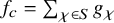 , and recalling that
$f_s=f_c+g_e$
, and recalling that
$f_s=f_c+g_e$
 , we have, using the estimates given in Theorem 5.1, that

As
$\|f_s\|_\infty \leq 1$
 and
$\|g_e\|_\infty \leq \eta $
and
$\|g_e\|_\infty \leq \eta $
 , we have
$|\|f_s\|_2^2-\|f_c\|_2^2|\leq 2|\langle f_c,g_e\rangle |+\|g_e\|_2^2\leq 2\eta +\eta ^2\le 3\eta $
, we have
$|\|f_s\|_2^2-\|f_c\|_2^2|\leq 2|\langle f_c,g_e\rangle |+\|g_e\|_2^2\leq 2\eta +\eta ^2\le 3\eta $
 , and so
$|\|f\|_2^2-\|f_c\|_2^2| \leq |\|f\|_2^2-\|f_s\|_2^2| +|\|f_s\|_2^2-\|f_c\|_2^2| \leq 4\mathcal {D}(\eta ,m)+8\eta +\|f_r\|_2^2$
, and so
$|\|f\|_2^2-\|f_c\|_2^2| \leq |\|f\|_2^2-\|f_s\|_2^2| +|\|f_s\|_2^2-\|f_c\|_2^2| \leq 4\mathcal {D}(\eta ,m)+8\eta +\|f_r\|_2^2$
 . We finish by using that
$|\|f_c\|_2^2-\sum _{\chi \in S} \|g_\chi \|_2^2|\leq |S|^2\max _{\chi \neq \chi '\in S}|\langle g_\chi ,g_{\chi '}\rangle | \leq |S|^2\mathcal {D}(\eta ,m)$
. We finish by using that
$|\|f_c\|_2^2-\sum _{\chi \in S} \|g_\chi \|_2^2|\leq |S|^2\max _{\chi \neq \chi '\in S}|\langle g_\chi ,g_{\chi '}\rangle | \leq |S|^2\mathcal {D}(\eta ,m)$
 .
.
The final result of this subsection is a key ingredient for the proof of our main result Theorem 1.1, to be completed in the last section (see Theorem 7.12).
Proposition 5.8. Let
$k\in \mathbb {N}$
 , let
$\mathcal {D}:\mathbb {R}_{>0}\times \mathbb {N}\to \mathbb {R}_{>0}$
, let
$\mathcal {D}:\mathbb {R}_{>0}\times \mathbb {N}\to \mathbb {R}_{>0}$
 be an arbitrary function, and let
$\eta>0$
be an arbitrary function, and let
$\eta>0$
 . Let
$\operatorname {\mathrm {Z}}$
. Let
$\operatorname {\mathrm {Z}}$
 be a finite abelian group, and let
$f:\operatorname {\mathrm {Z}}\to \mathbb {C}$
be a finite abelian group, and let
$f:\operatorname {\mathrm {Z}}\to \mathbb {C}$
 be a 1-bounded function. Let

be the decomposition given by Theorem 5.1, with associated complexity bound
$m\leq N(\eta ,\mathcal {D})$
 . For any
$\rho>0$
. For any
$\rho>0$
 , let
$S_\rho :=\{\chi \in S :\|g_\chi \|_2^2\geq \rho \}$
, let
$S_\rho :=\{\chi \in S :\|g_\chi \|_2^2\geq \rho \}$
 . Then
$|S_\rho |\leq \rho ^{-1} (1+c_0)$
. Then
$|S_\rho |\leq \rho ^{-1} (1+c_0)$
 and
and

where
$c_0=(|S|^2+4)\mathcal {D}(\eta ,m)+8\eta $
 . Moreover, for any
$\sigma>0$
. Moreover, for any
$\sigma>0$
 , there exists
$h:\operatorname {\mathrm {Z}}\to \mathbb {C}$
, there exists
$h:\operatorname {\mathrm {Z}}\to \mathbb {C}$
 with
$\|h\|_{U^{k+1}}^*=O_{\sigma ,\rho ,\eta ,m}(1)$
with
$\|h\|_{U^{k+1}}^*=O_{\sigma ,\rho ,\eta ,m}(1)$
 and
$\|h-\sum _{\chi \in S_\rho }g_\chi \|_\infty \leq \sigma $
and
$\|h-\sum _{\chi \in S_\rho }g_\chi \|_\infty \leq \sigma $
 .
.
The last sentence of Proposition 5.8 tells us that
$\sum _{\chi \in S_\rho }g_\chi $
 is a valid k-th order structured part of f, since it is an
$(R,\delta )$
is a valid k-th order structured part of f, since it is an
$(R,\delta )$
 -structured function of order k, with the additional strength that the error is small uniformly (not just in
$L^2$
-structured function of order k, with the additional strength that the error is small uniformly (not just in
$L^2$
 as in Definition 2.23).
Proof. By (5.10), and using that
$\|f_r\|_2\geq 0$
 , we have
$\sum _{\chi \in S}\|g_\chi \|_2^2\leq \|f\|_2^2+c_0\leq 1+c_0$
, we have
$\sum _{\chi \in S}\|g_\chi \|_2^2\leq \|f\|_2^2+c_0\leq 1+c_0$
 where
$c_0=(|S|^2+4)\mathcal {D}(\eta ,m)+8\eta $
where
$c_0=(|S|^2+4)\mathcal {D}(\eta ,m)+8\eta $
 , so
$|S_\rho |\leq \rho ^{-1}(1+c_0)$
, so
$|S_\rho |\leq \rho ^{-1}(1+c_0)$
 . Using that
$\|g_e\|_\infty \leq \eta $
. Using that
$\|g_e\|_\infty \leq \eta $
 ,
$\|f_e\|_\infty \leq 3$
,
$\|f_e\|_\infty \leq 3$
 ,
$\|f_e\|_1\leq \eta $
,
$\|f_e\|_1\leq \eta $
 , and (5.9) applied with
$s=k+1$
, and (5.9) applied with
$s=k+1$
 , we have

Hence
$\|f-\sum _{\chi \in S_\rho }g_\chi \|_{U^{k+1}}\leq \|\sum _{\chi \in S\setminus S_\rho }g_\chi \|_{U^{k+1}} + c_1$
 . By (5.8) applied with
$B=S\backslash S_\rho $
. By (5.8) applied with
$B=S\backslash S_\rho $
 , we have
$\|\sum _{\chi \in S\setminus S_\rho }g_\chi \|_{U^{k+1}}^{2^{k+1}}\leq \sum _{\chi \in S\setminus S_\rho } \|g_\chi \|_{U^{k+1}}^{2^{k+1}} + (|S\setminus S_\rho |^{2^{k+1}}-1)\mathcal {D}(\eta ,m)^{1/2^k}$
, we have
$\|\sum _{\chi \in S\setminus S_\rho }g_\chi \|_{U^{k+1}}^{2^{k+1}}\leq \sum _{\chi \in S\setminus S_\rho } \|g_\chi \|_{U^{k+1}}^{2^{k+1}} + (|S\setminus S_\rho |^{2^{k+1}}-1)\mathcal {D}(\eta ,m)^{1/2^k}$
 . Moreover, by (5.9) and the fact that each
$g_\chi $
. Moreover, by (5.9) and the fact that each
$g_\chi $
 is 1-bounded, we have

Putting all this together, we conclude that

where in the last inequality we used that
$\|\cdot \|_{\ell ^{2^{k+1}}}\leq \|\cdot \|_{\ell ^1}$
 .
.
To prove the last claim, we apply Theorem 4.27. Recall that for each
$\chi \in S_\rho $
 we have
$g_\chi =F_\chi \operatorname {\mathrm {\circ }}\phi $
we have
$g_\chi =F_\chi \operatorname {\mathrm {\circ }}\phi $
 with
$\|F_\chi \|_{\textrm {sum}}\leq m+1$
with
$\|F_\chi \|_{\textrm {sum}}\leq m+1$
 . Thus
$\sum _{\chi \in S_\rho }g_\chi =F_\rho \operatorname {\mathrm {\circ }}\phi $
. Thus
$\sum _{\chi \in S_\rho }g_\chi =F_\rho \operatorname {\mathrm {\circ }}\phi $
 where
$F_\rho :=\sum _{\chi \in S_\rho } F_\chi :\operatorname {\mathrm {X}}\to \mathbb {C}$
where
$F_\rho :=\sum _{\chi \in S_\rho } F_\chi :\operatorname {\mathrm {X}}\to \mathbb {C}$
 satisfies
$\|F_\rho \|_{\textrm {sum}}\leq |S_\rho | (m+1)$
satisfies
$\|F_\rho \|_{\textrm {sum}}\leq |S_\rho | (m+1)$
 . It then follows from Theorem 4.27, applied with
$\delta =\sigma $
. It then follows from Theorem 4.27, applied with
$\delta =\sigma $
 , that there is a function
$h:\operatorname {\mathrm {Z}}\to \mathbb {C}$
, that there is a function
$h:\operatorname {\mathrm {Z}}\to \mathbb {C}$
 with
$\|F_\rho \operatorname {\mathrm {\circ }}\phi -h\|_\infty \leq \sigma $
with
$\|F_\rho \operatorname {\mathrm {\circ }}\phi -h\|_\infty \leq \sigma $
 and
$\|h\|_{U^{k+1}}^*=O_{\sigma ,\rho ,\eta ,m}(1)$
and
$\|h\|_{U^{k+1}}^*=O_{\sigma ,\rho ,\eta ,m}(1)$
 .
.
6 A structure theorem for
$\mathcal {K}_\varepsilon (f\otimes \overline {f})$
using 2-step nilspace characters

In this section, we restrict the general k-th order treatment of Section 5 and focus on the quadratic case (second order) to obtain a key ingredient for our algorithmic applications: Theorem 6.1 below. The idea is to apply the Fourier denoising operator
$K_{\varepsilon }$
 (recall Definition 2.39) to the decomposition resulting from our upgraded regularity lemma (Theorem 5.1) in the case
$k=2$
(recall Definition 2.39) to the decomposition resulting from our upgraded regularity lemma (Theorem 5.1) in the case
$k=2$
 . The resulting structure theorem for
$\mathcal {K}_\varepsilon \big (f\otimes \overline {f}\big )$
. The resulting structure theorem for
$\mathcal {K}_\varepsilon \big (f\otimes \overline {f}\big )$
 decomposes this matrix into a sum of a bounded number of rank-1 matrices corresponding to nonnegligible 2-step nilspace characters.
Theorem 6.1. For any function
$\mathcal {D}:\mathbb {R}_{>0}\times \mathbb {N}\to \mathbb {R}_{>0}$
 and any
$\eta \in (0,1)$
and any
$\eta \in (0,1)$
 , there exists
$M=M(\eta ,\mathcal {D})>0$
, there exists
$M=M(\eta ,\mathcal {D})>0$
 such that the following holds. Let
$\operatorname {\mathrm {Z}}$
such that the following holds. Let
$\operatorname {\mathrm {Z}}$
 be a finite abelian group, and let
$f:\operatorname {\mathrm {Z}}\to \mathbb {C}$
be a finite abelian group, and let
$f:\operatorname {\mathrm {Z}}\to \mathbb {C}$
 be a 1-bounded function. Then, for some
$m\leq M$
be a 1-bounded function. Then, for some
$m\leq M$
 , there is a 2-step cfr nilspace
$\operatorname {\mathrm {X}}$
, there is a 2-step cfr nilspace
$\operatorname {\mathrm {X}}$
 of complexity at most m, a
$\mathcal {D}(\eta ,m)$
of complexity at most m, a
$\mathcal {D}(\eta ,m)$
 -balanced morphism
$\phi :\operatorname {\mathrm {Z}}\to \operatorname {\mathrm {X}}$
-balanced morphism
$\phi :\operatorname {\mathrm {Z}}\to \operatorname {\mathrm {X}}$
 , a 1-bounded m-Lipschitz function
$F:\operatorname {\mathrm {X}}\to \mathbb {C}$
, a 1-bounded m-Lipschitz function
$F:\operatorname {\mathrm {X}}\to \mathbb {C}$
 , and a set
$S\subset \widehat {\operatorname {\mathrm {Z}}_k(\operatorname {\mathrm {X}})}$
, and a set
$S\subset \widehat {\operatorname {\mathrm {Z}}_k(\operatorname {\mathrm {X}})}$
 with
$|S|\leq \operatorname {\mathrm {Q}}(\eta ,m)$
with
$|S|\leq \operatorname {\mathrm {Q}}(\eta ,m)$
 , such that for every
$\varepsilon>0$
, such that for every
$\varepsilon>0$
 we have

where for every
$\chi \in S$
 we have
$g_\chi :=F_\chi \operatorname {\mathrm {\circ }}\phi $
we have
$g_\chi :=F_\chi \operatorname {\mathrm {\circ }}\phi $
 with
$\|g_\chi \|_2\geq \eta ^2/\operatorname {\mathrm {Q}}(\eta ,m)$
with
$\|g_\chi \|_2\geq \eta ^2/\operatorname {\mathrm {Q}}(\eta ,m)$
 , and
$E\in \mathbb {C}^{\operatorname {\mathrm {Z}}\times \operatorname {\mathrm {Z}}}$
, and
$E\in \mathbb {C}^{\operatorname {\mathrm {Z}}\times \operatorname {\mathrm {Z}}}$
 satisfies
$\|E\|_2\leq 21\sqrt {\eta }+20\mathcal {D}(\eta ,m)\varepsilon ^{-1/2} \operatorname {\mathrm {Q}}(\eta ,m)^{5/2}+O_{m,\eta }(\varepsilon ^{1/4})$
satisfies
$\|E\|_2\leq 21\sqrt {\eta }+20\mathcal {D}(\eta ,m)\varepsilon ^{-1/2} \operatorname {\mathrm {Q}}(\eta ,m)^{5/2}+O_{m,\eta }(\varepsilon ^{1/4})$
 .
.
Remark 6.2. Note that we can ensure that
$\|E\|_2\leq 23\sqrt {\eta }$
 by letting
$\varepsilon =\varepsilon _{\eta ,m}>0$
by letting
$\varepsilon =\varepsilon _{\eta ,m}>0$
 be such that
$O_{m,\eta }(\varepsilon ^{1/4})\le \sqrt {\eta }$
be such that
$O_{m,\eta }(\varepsilon ^{1/4})\le \sqrt {\eta }$
 and then setting
$\mathcal {D}(\eta ,m)$
and then setting
$\mathcal {D}(\eta ,m)$
 so that
$20\mathcal {D}(\eta ,m)\varepsilon ^{-1/2} \operatorname {\mathrm {Q}}(\eta ,m)^{5/2}\le \sqrt {\eta }$
so that
$20\mathcal {D}(\eta ,m)\varepsilon ^{-1/2} \operatorname {\mathrm {Q}}(\eta ,m)^{5/2}\le \sqrt {\eta }$
 .
.
Proof. We apply Theorem 5.1 with
$\eta $
 and
$\mathcal {D}$
and
$\mathcal {D}$
 . This yields that for some
$M=M(\eta ,\mathcal {D})>0$
. This yields that for some
$M=M(\eta ,\mathcal {D})>0$
 , there exists
$m\le M$
, there exists
$m\le M$
 such that we have the decomposition
$f=\sum _{\chi \in S}g_\chi +g_e+f_e+f_r$
such that we have the decomposition
$f=\sum _{\chi \in S}g_\chi +g_e+f_e+f_r$
 , with the properties specified in Theorem 5.1. Relabeling this set S (resulting from Theorem 5.1) as
$S'$
, with the properties specified in Theorem 5.1. Relabeling this set S (resulting from Theorem 5.1) as
$S'$
 , we now restrict the last sum to the following subset of
$S'$
, we now restrict the last sum to the following subset of
$S'$
 , to ensure that each
$\|g_\chi \|_2$
, to ensure that each
$\|g_\chi \|_2$
 is large:

Note that
$\|\sum _{\chi \in S'\setminus S} g_\chi \|_2\leq |S'\setminus S| \frac {\eta ^2}{|S'|}\leq \eta ^2$
 . Therefore, letting
$f_2:=\sum _{\chi \in S'\setminus S} g_\chi +g_e+f_e$
. Therefore, letting
$f_2:=\sum _{\chi \in S'\setminus S} g_\chi +g_e+f_e$
 , we have
$f=\sum _{\chi \in S}g_\chi +f_2+f_r$
, we have
$f=\sum _{\chi \in S}g_\chi +f_2+f_r$
 , where
$\|f_2\|_2\leq \eta ^2 +\eta +\sqrt {3\eta }\leq 4\sqrt {\eta }$
, where
$\|f_2\|_2\leq \eta ^2 +\eta +\sqrt {3\eta }\leq 4\sqrt {\eta }$
 (where we used that
$\eta \in (0,1)$
(where we used that
$\eta \in (0,1)$
 ) and
$\|f_r\|_{U^3}\leq \mathcal {D}(\eta ,m)$
) and
$\|f_r\|_{U^3}\leq \mathcal {D}(\eta ,m)$
 . Note that since
$|S'|\le \operatorname {\mathrm {Q}}(\eta ,m)$
. Note that since
$|S'|\le \operatorname {\mathrm {Q}}(\eta ,m)$
 , for every
$\chi \in S$
, for every
$\chi \in S$
 we have
$\|g_\chi \|_2\ge \eta ^2/\operatorname {\mathrm {Q}}(\eta ,m)$
we have
$\|g_\chi \|_2\ge \eta ^2/\operatorname {\mathrm {Q}}(\eta ,m)$
 .
.
Now the result will follow from Proposition 3.17 by setting the parameters
$\alpha _i$
 in that proposition according to the above data. More precisely, in our present application of Proposition 3.17, we have that condition
$(i)$
in that proposition according to the above data. More precisely, in our present application of Proposition 3.17, we have that condition
$(i)$
 in that proposition holds with
$\alpha _1=4\sqrt {\eta }$
in that proposition holds with
$\alpha _1=4\sqrt {\eta }$
 , condition
$(ii)$
, condition
$(ii)$
 holds with
$\alpha _2=\mathcal {D}(\eta ,m)$
holds with
$\alpha _2=\mathcal {D}(\eta ,m)$
 , condition
$(iii)$
, condition
$(iii)$
 holds with
$\alpha _3=1$
holds with
$\alpha _3=1$
 and
$n=|S|$
and
$n=|S|$
 (letting the
$f_i$
(letting the
$f_i$
 in that proposition be the nilspace characters
$g_\chi $
in that proposition be the nilspace characters
$g_\chi $
 ). Furthermore, condition
$(iv)$
). Furthermore, condition
$(iv)$
 holds with
$\alpha _4=\mathcal {D}(\eta ,m)$
holds with
$\alpha _4=\mathcal {D}(\eta ,m)$
 (by the last sentence of Theorem 5.1). Finally, by Theorem 4.19 we have that each
$g_\chi $
(by the last sentence of Theorem 5.1). Finally, by Theorem 4.19 we have that each
$g_\chi $
 is a quadratic character on
$\operatorname {\mathrm {Z}}$
is a quadratic character on
$\operatorname {\mathrm {Z}}$
 with parameters
$(R,\sigma )$
with parameters
$(R,\sigma )$
 where
$R=O_{m}(\sigma ^{-O_{m}(1)})$
where
$R=O_{m}(\sigma ^{-O_{m}(1)})$
 , so by Proposition 2.52, we have
$\|\mathcal {K}_\varepsilon (g_\chi \otimes \overline {g_\chi })-g_\chi \otimes \overline {g_\chi }\|_2\leq 4\sigma + O_{m}(\varepsilon ^{1/4}\sigma ^{-O_{m}(1)})$
, so by Proposition 2.52, we have
$\|\mathcal {K}_\varepsilon (g_\chi \otimes \overline {g_\chi })-g_\chi \otimes \overline {g_\chi }\|_2\leq 4\sigma + O_{m}(\varepsilon ^{1/4}\sigma ^{-O_{m}(1)})$
 . Setting
$\sigma =\eta /(4 \operatorname {\mathrm {Q}}(\eta ,m))$
. Setting
$\sigma =\eta /(4 \operatorname {\mathrm {Q}}(\eta ,m))$
 , we have that condition
$(v)$
, we have that condition
$(v)$
 in Proposition 3.17 holds with
$\alpha _5=\eta /\operatorname {\mathrm {Q}}(\eta ,m)+O_{m,\eta }(\varepsilon ^{1/4})$
in Proposition 3.17 holds with
$\alpha _5=\eta /\operatorname {\mathrm {Q}}(\eta ,m)+O_{m,\eta }(\varepsilon ^{1/4})$
 .
.
Substituting these quantities into the bound
$5\alpha _1+ 16 \varepsilon ^{-1/2}\alpha _2+\varepsilon ^{-1/2} n^2(n^{1/2}\alpha _3+3)\alpha _4 + n\alpha _5$
 from Proposition 3.17, and using that
$|S|\leq \operatorname {\mathrm {Q}}(\eta ,m)$
from Proposition 3.17, and using that
$|S|\leq \operatorname {\mathrm {Q}}(\eta ,m)$
 , the result follows.
7 Algorithmic consequences of the structure theorem for
$\mathcal {K}_\varepsilon (f\otimes \overline {f})$

In this section we use the notions of pseudoeigenvalues and pseudoeigenvectors, well-known in matrix analysis (see [Reference Trefethen and Embree69, p. 16]). However, we adapt these notions to
$\operatorname {\mathrm {Z}}$
 -matrices as follows, coherently with the normalization used in this paper (recall Definition 2.3). We shall use these notions only in this normalized form throughout this section.
Definition 7.1. Let
$\operatorname {\mathrm {Z}}$
 be a finite abelian group, let
$M\in \mathbb {C}^{\operatorname {\mathrm {Z}}\times \operatorname {\mathrm {Z}}}$
be a finite abelian group, let
$M\in \mathbb {C}^{\operatorname {\mathrm {Z}}\times \operatorname {\mathrm {Z}}}$
 be a
$\operatorname {\mathrm {Z}}$
be a
$\operatorname {\mathrm {Z}}$
 -matrix, and let
$\beta>0$
-matrix, and let
$\beta>0$
 . A
$\beta $
. A
$\beta $
 -pseudoeigenvalue of M is a number
$\lambda \in \mathbb {C}$
-pseudoeigenvalue of M is a number
$\lambda \in \mathbb {C}$
 such that for some
$v\in \mathbb {C}^{\operatorname {\mathrm {Z}}}$
such that for some
$v\in \mathbb {C}^{\operatorname {\mathrm {Z}}}$
 with
$\|v\|_2=1$
with
$\|v\|_2=1$
 we have
$\|Mv-\lambda v\|_2< \beta $
we have
$\|Mv-\lambda v\|_2< \beta $
 . We then say that v is a
$\beta $
. We then say that v is a
$\beta $
 -pseudoeigenvector corresponding to
$\lambda $
-pseudoeigenvector corresponding to
$\lambda $
 , or
$(\lambda ,\beta )$
, or
$(\lambda ,\beta )$
 -pseudoeigenvector. The set of
$\beta $
-pseudoeigenvector. The set of
$\beta $
 -pseudoeigenvalues of M is denoted by
$\sigma _\beta (M)$
-pseudoeigenvalues of M is denoted by
$\sigma _\beta (M)$
 .
.
Given a self-adjoint
$\operatorname {\mathrm {Z}}$
 -matrix
$M\in \mathbb {C}^{\operatorname {\mathrm {Z}}\times \operatorname {\mathrm {Z}}}$
-matrix
$M\in \mathbb {C}^{\operatorname {\mathrm {Z}}\times \operatorname {\mathrm {Z}}}$
 , we denote by
$\mathrm{Spec}(M)$
, we denote by
$\mathrm{Spec}(M)$
 the spectrum of M, that is, the multiset of (real) eigenvalues of M, where the multiplicity of each eigenvalue equals the dimension of its eigenspace. For any
$\rho>0$
the spectrum of M, that is, the multiset of (real) eigenvalues of M, where the multiplicity of each eigenvalue equals the dimension of its eigenspace. For any
$\rho>0$
 we define the multiset

By Theorem 6.1, we know that the self-adjoint matrix
$\mathcal {K}_\varepsilon (f\otimes \overline {f})$
 is (up to a small
$L^2$
is (up to a small
$L^2$
 -error) a sum of rank-1 matrices
$g_\chi \otimes \overline {g_\chi }$
-error) a sum of rank-1 matrices
$g_\chi \otimes \overline {g_\chi }$
 where the
$g_\chi $
where the
$g_\chi $
 are quasiorthogonal nilspace characters with nonnegligible
$L^2$
are quasiorthogonal nilspace characters with nonnegligible
$L^2$
 -norm. Then every
$g_\chi $
-norm. Then every
$g_\chi $
 yields a pseudoeigenvector of
$\mathcal {K}_\varepsilon (f\otimes \overline {f})$
yields a pseudoeigenvector of
$\mathcal {K}_\varepsilon (f\otimes \overline {f})$
 , as follows.
Lemma 7.2. Under the assumptions of Theorem 6.1, let
$\mathcal {K}_\varepsilon (f\otimes \overline {f})= \sum _{\chi \in S} g_\chi \otimes \overline {g_\chi } + E$
 be the decomposition, obtained in (6.1), for the 1-bounded function
$f:\operatorname {\mathrm {Z}}\to \mathbb {C}$
be the decomposition, obtained in (6.1), for the 1-bounded function
$f:\operatorname {\mathrm {Z}}\to \mathbb {C}$
 . Then for any
$\chi \in S$
. Then for any
$\chi \in S$
 , the function
$u_\chi :=g_\chi /\|g_\chi \|_2$
, the function
$u_\chi :=g_\chi /\|g_\chi \|_2$
 is a
$\beta $
is a
$\beta $
 -pseudoeigenvector of
$\mathcal {K}_\varepsilon (f\otimes \overline {f})$
-pseudoeigenvector of
$\mathcal {K}_\varepsilon (f\otimes \overline {f})$
 with pseudoeigenvalue
$\lambda _\chi :=\|g_\chi \|_2^2$
with pseudoeigenvalue
$\lambda _\chi :=\|g_\chi \|_2^2$
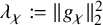 , where
$\beta =21\sqrt {\eta }+\mathcal {D}(\eta ,m)(20\varepsilon ^{-1/2} \operatorname {\mathrm {Q}}(\eta ,m)^{5/2}+\operatorname {\mathrm {Q}}(\eta ,m)^2/\eta ^2)+O_{m,\eta }(\varepsilon ^{1/4})$
, where
$\beta =21\sqrt {\eta }+\mathcal {D}(\eta ,m)(20\varepsilon ^{-1/2} \operatorname {\mathrm {Q}}(\eta ,m)^{5/2}+\operatorname {\mathrm {Q}}(\eta ,m)^2/\eta ^2)+O_{m,\eta }(\varepsilon ^{1/4})$
 .
.
Remark 7.3. Note that, choosing
$\varepsilon>0$
 sufficiently small so that the term
$O_{m,\eta }(\varepsilon ^{1/4})$
sufficiently small so that the term
$O_{m,\eta }(\varepsilon ^{1/4})$
 is at most
$\eta ^{1/2}$
is at most
$\eta ^{1/2}$
 , we can then prescribe the function
$\mathcal {D}$
, we can then prescribe the function
$\mathcal {D}$
 to be sufficiently fast-decreasing so that
$\beta =O(\eta ^{1/2})$
to be sufficiently fast-decreasing so that
$\beta =O(\eta ^{1/2})$
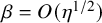 .
.
Proof. Recall from Theorem 6.1 that
$\|g_\chi \|_2\geq \eta ^2/\operatorname {\mathrm {Q}}(\eta ,m)$
 for each
$\chi \in S$
for each
$\chi \in S$
 . Letting
$M=\mathcal {K}_\varepsilon (f\otimes \overline {f})$
. Letting
$M=\mathcal {K}_\varepsilon (f\otimes \overline {f})$
 , we have
$M u_\chi = \lambda _\chi u_\chi + \sum _{\chi '\in S\setminus \{\chi \}} \lambda _{\chi '} u_{\chi '} \langle u_{\chi '},u_\chi \rangle + E u_\chi $
, we have
$M u_\chi = \lambda _\chi u_\chi + \sum _{\chi '\in S\setminus \{\chi \}} \lambda _{\chi '} u_{\chi '} \langle u_{\chi '},u_\chi \rangle + E u_\chi $
 . Hence

Using that
$|\langle g_{\chi '},g_\chi \rangle |\leq \mathcal {D}(\eta ,m)$
 (by Theorem 5.1), we conclude that
$ \|M u_\chi - \lambda _\chi u_\chi \|_2\leq |S| \frac {\operatorname {\mathrm {Q}}(\eta ,m)}{\eta ^2} \mathcal {D}(\eta ,m)+ \| E\|_2$
(by Theorem 5.1), we conclude that
$ \|M u_\chi - \lambda _\chi u_\chi \|_2\leq |S| \frac {\operatorname {\mathrm {Q}}(\eta ,m)}{\eta ^2} \mathcal {D}(\eta ,m)+ \| E\|_2$
 , and the result follows.
We now face the question of how to recover, algorithmically, the pseudo-eigenvectors (normalized nilspace characters)
$u_\chi $
 from the eigenvalues and eigenvectors of
$\mathcal {K}_\varepsilon (f\otimes \overline {f})$
from the eigenvalues and eigenvectors of
$\mathcal {K}_\varepsilon (f\otimes \overline {f})$
 .
.
Firstly, in Subsection 7.1 we obtain a decomposition of f into a quadratically structured part
$\sum _{\chi \in S_\rho } g_\chi $
 and a
$U^3$
and a
$U^3$
 -noise part, using the leading eigenvalues and eigenvectors of
$\mathcal {K}_\varepsilon (f\otimes \overline {f})$
-noise part, using the leading eigenvalues and eigenvectors of
$\mathcal {K}_\varepsilon (f\otimes \overline {f})$
 (see Theorem 7.12). This will enable us to obtain such a decomposition algorithmically.
Secondly, in Subsection 7.2 we focus on this structured part
$\sum _{\chi \in S_\rho } g_\chi $
 to describe how one can recover the individual nilspace characters
$g_\chi $
to describe how one can recover the individual nilspace characters
$g_\chi $
 using dominant eigenvalues of
$\mathcal {K}_\varepsilon (f\otimes \overline {f})$
using dominant eigenvalues of
$\mathcal {K}_\varepsilon (f\otimes \overline {f})$
 .
.
Before we get started on the first task, let us record the following simple result, that will enable us to express the pseudoeigenvectors
$u_\chi $
 in terms of the eigenvectors of
$\mathcal {K}_\varepsilon (f\otimes \overline {f})$
in terms of the eigenvectors of
$\mathcal {K}_\varepsilon (f\otimes \overline {f})$
 .
.
Lemma 7.4. Let
$\operatorname {\mathrm {Z}}$
 be a finite abelian group and let
$M\in \mathbb {C}^{\operatorname {\mathrm {Z}}\times \operatorname {\mathrm {Z}}}$
be a finite abelian group and let
$M\in \mathbb {C}^{\operatorname {\mathrm {Z}}\times \operatorname {\mathrm {Z}}}$
 be a self-adjoint
$\operatorname {\mathrm {Z}}$
be a self-adjoint
$\operatorname {\mathrm {Z}}$
 -matrix, with real eigenvalues
$\lambda _i$
-matrix, with real eigenvalues
$\lambda _i$
 for
$i\in [|\operatorname {\mathrm {Z}}|]$
for
$i\in [|\operatorname {\mathrm {Z}}|]$
 . Let
$\lambda $
. Let
$\lambda $
 be a
$\beta $
be a
$\beta $
 -pseudoeigenvalue of M and let u be a corresponding
$(\lambda ,\beta )$
-pseudoeigenvalue of M and let u be a corresponding
$(\lambda ,\beta )$
 -pseudoeigenvector. Let
$\{v_i:i\in [|\operatorname {\mathrm {Z}}|]\}$
-pseudoeigenvector. Let
$\{v_i:i\in [|\operatorname {\mathrm {Z}}|]\}$
 be an orthonormal basis of eigenvectors of M, let
$u=\sum _{i\in [|\operatorname {\mathrm {Z}}|]}\mu _i v_i$
be an orthonormal basis of eigenvectors of M, let
$u=\sum _{i\in [|\operatorname {\mathrm {Z}}|]}\mu _i v_i$
 be the expansion of u in this basis, and consider the eigenvalue cluster
$C_\delta (\lambda ):=\{i\in [|\operatorname {\mathrm {Z}}|]:|\lambda _i-\lambda |\leq \delta \}$
be the expansion of u in this basis, and consider the eigenvalue cluster
$C_\delta (\lambda ):=\{i\in [|\operatorname {\mathrm {Z}}|]:|\lambda _i-\lambda |\leq \delta \}$
 . Then

Proof. Suppose that the eigenvalues
$\lambda _i$
 of M satisfy
$\lambda _i\geq \lambda _j$
of M satisfy
$\lambda _i\geq \lambda _j$
 if
$i<j$
if
$i<j$
 . By assumption we have
$Mu-\lambda u=\sum _{i=1}^{|\operatorname {\mathrm {Z}}|} \mu _i(\lambda _i-\lambda )v_i$
. By assumption we have
$Mu-\lambda u=\sum _{i=1}^{|\operatorname {\mathrm {Z}}|} \mu _i(\lambda _i-\lambda )v_i$
 , so
$\|Mu-\lambda u\|_2^2=\sum _{i=1}^{|\operatorname {\mathrm {Z}}|}\mu _i^2(\lambda _i-\lambda )^2$
, so
$\|Mu-\lambda u\|_2^2=\sum _{i=1}^{|\operatorname {\mathrm {Z}}|}\mu _i^2(\lambda _i-\lambda )^2$
 . Since u is a
$\beta $
. Since u is a
$\beta $
 -pseudoeigenvector of M, the left side of the last equation is at most
$\beta ^2$
-pseudoeigenvector of M, the left side of the last equation is at most
$\beta ^2$
 , so
$\sum _{i=1}^{|\operatorname {\mathrm {Z}}|}\mu _i^2(\lambda _i-\lambda )^2\leq \beta ^2$
, so
$\sum _{i=1}^{|\operatorname {\mathrm {Z}}|}\mu _i^2(\lambda _i-\lambda )^2\leq \beta ^2$
 . Let
$I_\delta (\lambda ):=\{i\in [|\operatorname {\mathrm {Z}}|]:|\lambda _i-\lambda |>\delta \}$
. Let
$I_\delta (\lambda ):=\{i\in [|\operatorname {\mathrm {Z}}|]:|\lambda _i-\lambda |>\delta \}$
 be the complement of
$C_\delta (\lambda )$
be the complement of
$C_\delta (\lambda )$
 . Then
$\delta ^2 \sum _{i\in I_\delta }\mu _i^2\leq \sum _{i=1}^{|\operatorname {\mathrm {Z}}|}\mu _i^2(\lambda _i-\lambda )^2\leq \beta ^2$
. Then
$\delta ^2 \sum _{i\in I_\delta }\mu _i^2\leq \sum _{i=1}^{|\operatorname {\mathrm {Z}}|}\mu _i^2(\lambda _i-\lambda )^2\leq \beta ^2$
 , whence
$\big \|u-\sum _{i\in C_\delta (\lambda )} \mu _i v_i\big \|_2^2=\sum _{i\in I_\delta }\mu _i^2\leq \beta ^2/\delta ^2$
, whence
$\big \|u-\sum _{i\in C_\delta (\lambda )} \mu _i v_i\big \|_2^2=\sum _{i\in I_\delta }\mu _i^2\leq \beta ^2/\delta ^2$
 .
.
7.1 Obtaining a quadratically structured part of f from the spectrum of
$\mathcal {K}_\varepsilon (f\otimes \overline {f})$

The case
$k=2$
 of Proposition 5.8 establishes the sum of 2-step nilspace characters
$\sum _{\chi \in S_\rho } g_\chi $
of Proposition 5.8 establishes the sum of 2-step nilspace characters
$\sum _{\chi \in S_\rho } g_\chi $
 as a valid quadratic (or second-order) structured part of f. The main result in this subsection, Theorem 7.12, tells us that this structured part can be recovered, up to a small error, as the projection of the function f to the linear span of the eigenvectors of
$\mathcal {K}_\varepsilon (f\otimes \overline {f})$
as a valid quadratic (or second-order) structured part of f. The main result in this subsection, Theorem 7.12, tells us that this structured part can be recovered, up to a small error, as the projection of the function f to the linear span of the eigenvectors of
$\mathcal {K}_\varepsilon (f\otimes \overline {f})$
 with large eigenvalues. This will prove Theorem 1.1, and thus the validity of our spectral algorithm to obtain the order-2 structured part of a bounded function (i.e., Algorithm 1).
To prove this result, we shall need to compare two orthogonal projections. On the one hand, the projection of f to the space spanned by its dominant 2-step nilspace characters
$g_\chi $
 (provided by Proposition 5.8). On the other hand, the projection of f to the linear span of the leading eigenvectors of
$\mathcal {K}_\varepsilon (f\otimes \overline {f})$
(provided by Proposition 5.8). On the other hand, the projection of f to the linear span of the leading eigenvectors of
$\mathcal {K}_\varepsilon (f\otimes \overline {f})$
 . We are thus naturally led to standard tools in the theory of orthogonal projections in Hilbert space, which we now gather before proving the main result.
The first such tool is the following metric on the set of orthogonal projections.
Definition 7.5. Let W be a real or complex Hilbert space with inner product
$\langle \cdot ,\cdot \rangle $
 and norm
$\|v\|_W:=\langle v,v\rangle ^{1/2}$
and norm
$\|v\|_W:=\langle v,v\rangle ^{1/2}$
 . For any two orthogonal projections
$P,Q$
. For any two orthogonal projections
$P,Q$
 on W, we denote by
$d(P,Q)$
on W, we denote by
$d(P,Q)$
 the operator norm of
$P-Q$
the operator norm of
$P-Q$
 , i.e.

We shall apply this in the Hilbert space
$\mathbb {C}^{\operatorname {\mathrm {Z}}}$
 for a finite abelian group
$\operatorname {\mathrm {Z}}$
for a finite abelian group
$\operatorname {\mathrm {Z}}$
 , equipped with the inner product and
$L^2$
, equipped with the inner product and
$L^2$
 -norm with the normalization used throughout this paper. Recall that any such orthogonal projection P is uniquely associated with the vector subspace that is its image, which we shall denote by
$U_P$
-norm with the normalization used throughout this paper. Recall that any such orthogonal projection P is uniquely associated with the vector subspace that is its image, which we shall denote by
$U_P$
 . Thus, the above metric gives a notion of distance between linear subspaces of W, which is well-known in the theory of Grassmannians (see, for instance, [Reference Morris55, (3)] or the book [Reference Akhiezer and Glazman2]). Recall the following basic fact (see [Reference Akhiezer and Glazman2, §39], where the metric is called the aperture of the subspaces
$U_P$
. Thus, the above metric gives a notion of distance between linear subspaces of W, which is well-known in the theory of Grassmannians (see, for instance, [Reference Morris55, (3)] or the book [Reference Akhiezer and Glazman2]). Recall the following basic fact (see [Reference Akhiezer and Glazman2, §39], where the metric is called the aperture of the subspaces
$U_P$
 ,
$U_Q$
,
$U_Q$
 ).
).
Lemma 7.6. For any pair of orthogonal projections
$P,Q$
 on a Hilbert space W, we have
$d(P,Q)\leq 1$
on a Hilbert space W, we have
$d(P,Q)\leq 1$
 , and if
$d(P,Q)< 1$
, and if
$d(P,Q)< 1$
 then the dimensions of the subspaces
$U_P$
then the dimensions of the subspaces
$U_P$
 ,
$U_Q$
,
$U_Q$
 are equal.
Proof. To see that
$\|P-Q\|\leq 1$
 , let us recall here a short standard argument: note that
$P-Q=P(1-Q)-(1-P)Q$
, let us recall here a short standard argument: note that
$P-Q=P(1-Q)-(1-P)Q$
 , so that for every v we have
$Pv-Qv=P(1-Q)v-(1-P)Qv$
, so that for every v we have
$Pv-Qv=P(1-Q)v-(1-P)Qv$
 , and since
$P(1-Q)v$
, and since
$P(1-Q)v$
 and
$(1-P)Qv$
and
$(1-P)Qv$
 are clearly orthogonal, it follows that
$\|(P-Q)v\|_W^2=\|P(1-Q)v\|_W^2+\|(1-P)Qv\|_W^2\leq \|(1-Q)v\|_W^2+\|Qv\|_W^2=\|v\|_W^2$
are clearly orthogonal, it follows that
$\|(P-Q)v\|_W^2=\|P(1-Q)v\|_W^2+\|(1-P)Qv\|_W^2\leq \|(1-Q)v\|_W^2+\|Qv\|_W^2=\|v\|_W^2$
 , as required.
The second claim in the proof is the main theorem in [Reference Akhiezer and Glazman2, §39].
The following alternative expression for
$d(P,Q)$
 will be useful (see [Reference Akhiezer and Glazman2, p. 111, equation (2)]):

where
$\textrm {dist}(v,U_Q):=\|v-Q(v)\|_W$
 . We shall also use the following estimate.
Lemma 7.7. Let
$P,Q$
 be orthogonal projections on a Hilbert space W. Let
$b_1,b_2,\dots ,b_\ell $
be orthogonal projections on a Hilbert space W. Let
$b_1,b_2,\dots ,b_\ell $
 be an orthonormal basis of
$U_P$
be an orthonormal basis of
$U_P$
 (the image of P). Then

Proof. Let
$v=\sum _{i=1}^\ell \lambda _i b_i$
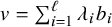 with
$\|v\|_W\leq 1$
with
$\|v\|_W\leq 1$
 . By the Cauchy-Schwarz inequality, we have that
$\|v-Q(v)\|_W$
. By the Cauchy-Schwarz inequality, we have that
$\|v-Q(v)\|_W$
 is at most
$\sum _{i=1}^\ell |\lambda _i|\|b_i-Q(b_i)\|_W\leq \big (\sum _{i=1}^\ell |\lambda _i|\big )\max _{1\leq i\leq \ell }\|b_i-Q(b_i)\|_W \leq \ell ^{1/2}\max _{1\leq i\leq \ell }\|b_i-Q(b_i)\|_W$
is at most
$\sum _{i=1}^\ell |\lambda _i|\|b_i-Q(b_i)\|_W\leq \big (\sum _{i=1}^\ell |\lambda _i|\big )\max _{1\leq i\leq \ell }\|b_i-Q(b_i)\|_W \leq \ell ^{1/2}\max _{1\leq i\leq \ell }\|b_i-Q(b_i)\|_W$
 (where we used that
$\|v\|_W^2=\sum _{i=1}^\ell |\lambda _i|^2$
(where we used that
$\|v\|_W^2=\sum _{i=1}^\ell |\lambda _i|^2$
 ).
).
Definition 7.8 (Projection to the span of spectrally dominant eigenvectors).
Let T be a self-adjoint linear operator on a Hilbert space W, and let
$\rho>0$
 . We denote by
$\text {Eigen}_\rho (T)$
. We denote by
$\text {Eigen}_\rho (T)$
 the subspace of W spanned by eigenvectors with corresponding eigenvalues in
$\mathrm{Spec}_\rho (T)$
the subspace of W spanned by eigenvectors with corresponding eigenvalues in
$\mathrm{Spec}_\rho (T)$
 . We denote by
$\mathcal {P}_{T,\rho }$
. We denote by
$\mathcal {P}_{T,\rho }$
 the orthogonal projection to
$\text {Eigen}_\rho (T)$
the orthogonal projection to
$\text {Eigen}_\rho (T)$
 in W.
in W.
Another ingredient is the following refinement of the Gram-Schmidt process.
Lemma 7.9 (Quantitative Gram-Schmidt process).
Let W be a Hilbert space. For each positive integer
$s\geq 2$
 there is a constant
$C_s>0$
there is a constant
$C_s>0$
 such that the following holds. Let
$u_1,\ldots ,u_s\in W$
such that the following holds. Let
$u_1,\ldots ,u_s\in W$
 such that
$\|u_i\|_W=1$
such that
$\|u_i\|_W=1$
 and such that for some
$\tau \in (0,1)$
and such that for some
$\tau \in (0,1)$
 we have
$|\langle u_i,u_j\rangle |\leq \tau /C_s$
we have
$|\langle u_i,u_j\rangle |\leq \tau /C_s$
 for all pairs
$i\neq j$
for all pairs
$i\neq j$
 . Then there exist orthonormal vectors
$w_1,\ldots ,w_s\in W$
. Then there exist orthonormal vectors
$w_1,\ldots ,w_s\in W$
 such that for every
$i\in [s]$
such that for every
$i\in [s]$
 we have
$\|u_i-w_i\|_2\leq C_s\tau $
we have
$\|u_i-w_i\|_2\leq C_s\tau $
 and such that, for any
$i\in [s]$
and such that, for any
$i\in [s]$
 ,
$\operatorname {\mathrm {Span}}(w_1,\ldots ,w_i)=\operatorname {\mathrm {Span}}(u_1,\ldots ,u_i)$
,
$\operatorname {\mathrm {Span}}(w_1,\ldots ,w_i)=\operatorname {\mathrm {Span}}(u_1,\ldots ,u_i)$
 .
.
Estimates for
$C_s$
 can be obtained from the proof, for example,
$C_2=1$
can be obtained from the proof, for example,
$C_2=1$
 and
$C_s=13\cdot 5^{s-3}-1$
and
$C_s=13\cdot 5^{s-3}-1$
 for
$s\ge 3$
for
$s\ge 3$
 .
.
Proof. We apply the Gram-Schmidt orthonormalization to the set
$\{u_1,\ldots ,u_s\}$
 , and keep track of the changes performed by this process, to ensure the
$L^2$
, and keep track of the changes performed by this process, to ensure the
$L^2$
 -smallness of these changes.
Following the formulas used in the process (see for instance [Reference Horn and Johnson41, §0.6.4]), we have
$w_1=u_1$
 , then
$w_2'=u_2-\langle u_2,w_1\rangle w_1$
, then
$w_2'=u_2-\langle u_2,w_1\rangle w_1$
 and
$w_2:=w_2'/\|w_2'\|_W$
and
$w_2:=w_2'/\|w_2'\|_W$
 . Hence
$\|u_2-w_2'\|_W=|\langle u_2,w_1\rangle |\leq \tau $
. Hence
$\|u_2-w_2'\|_W=|\langle u_2,w_1\rangle |\leq \tau $
 . We can therefore let
$C_2=1$
. We can therefore let
$C_2=1$
 .
.
Now, for general
$s>2$
 , the formulae are
$w_s' = u_s - \sum _{j=1}^{s-1}\langle u_s,w_j\rangle w_j$
, the formulae are
$w_s' = u_s - \sum _{j=1}^{s-1}\langle u_s,w_j\rangle w_j$
 and
$w_s =w_s'/\|w_s'\|_W$
and
$w_s =w_s'/\|w_s'\|_W$
 . For
$j\in [s-1]$
. For
$j\in [s-1]$
 , we have
$|\langle u_s,w_j\rangle |\leq |\langle u_s,u_j\rangle |+\|u_j-w_j\|_W$
, we have
$|\langle u_s,w_j\rangle |\leq |\langle u_s,u_j\rangle |+\|u_j-w_j\|_W$
 by the triangle and Cauchy-Schwarz inequalities, and the fact that
$u_j$
by the triangle and Cauchy-Schwarz inequalities, and the fact that
$u_j$
 is a unit vector. Hence by induction we can assume that for every
$j\in [s-1]$
is a unit vector. Hence by induction we can assume that for every
$j\in [s-1]$
 we have
$|\langle u_s,w_j\rangle |\leq (1+ C_j)\tau $
we have
$|\langle u_s,w_j\rangle |\leq (1+ C_j)\tau $
 . It follows that
$\|u_s-w_s'\|_W\leq \sum _{j\in [s-1]} |\langle u_s,w_j\rangle |\leq \tau \sum _{j\in [s-1]} (1+ C_j)=\tau \big (s+\sum _{j=3}^{s-1}C_j\big )$
. It follows that
$\|u_s-w_s'\|_W\leq \sum _{j\in [s-1]} |\langle u_s,w_j\rangle |\leq \tau \sum _{j\in [s-1]} (1+ C_j)=\tau \big (s+\sum _{j=3}^{s-1}C_j\big )$
 . This in turn implies, by the triangle inequality, that
$|1-\|w_s'\|_W|\leq \big (s+\sum _{j=3}^{s-1}C_j\big )\tau $
. This in turn implies, by the triangle inequality, that
$|1-\|w_s'\|_W|\leq \big (s+\sum _{j=3}^{s-1}C_j\big )\tau $
 . Therefore, letting
$w_s:=w_s' /\|w_s'\|_W$
. Therefore, letting
$w_s:=w_s' /\|w_s'\|_W$
 , we have
$\|u_s-w_s\|_W$
, we have
$\|u_s-w_s\|_W$
 equals

If
$\tau \leq 1/\big (2 (s+\sum _{j=3}^{s-1}C_j)\big )$
 , then
$\|u_s-w_s\|_W\leq 4(s+\sum _{j=3}^{s-1}C_j) \tau $
, then
$\|u_s-w_s\|_W\leq 4(s+\sum _{j=3}^{s-1}C_j) \tau $
 . Letting
$C_s:=4(s+\sum _{j=3}^{s-1}C_j)$
. Letting
$C_s:=4(s+\sum _{j=3}^{s-1}C_j)$
 , we have that if
$\tau \leq 1/C_s$
, we have that if
$\tau \leq 1/C_s$
 then
$\|u_s-w_s\|_W\leq C_s\tau $
then
$\|u_s-w_s\|_W\leq C_s\tau $
 . This completes the induction.
We also use the following version of the Hoffman-Wielandt theorem [Reference Horn and Johnson41, Corollary 6.3.8].
Theorem 7.10. Let
$\operatorname {\mathrm {Z}}$
 be a finite abelian group and let
$A, B\in \mathbb {C}^{\operatorname {\mathrm {Z}}\times \operatorname {\mathrm {Z}}}$
be a finite abelian group and let
$A, B\in \mathbb {C}^{\operatorname {\mathrm {Z}}\times \operatorname {\mathrm {Z}}}$
 be self-adjoint
$\operatorname {\mathrm {Z}}$
be self-adjoint
$\operatorname {\mathrm {Z}}$
 -matrices. Let
$\lambda _1\geq \cdots \geq \lambda _n$
-matrices. Let
$\lambda _1\geq \cdots \geq \lambda _n$
 be the eigenvalues of A arranged in nonincreasing order, and similarly let
$\lambda _1'\geq \cdots \geq \lambda _n'$
be the eigenvalues of A arranged in nonincreasing order, and similarly let
$\lambda _1'\geq \cdots \geq \lambda _n'$
 be the eigenvalues of B arranged in nonincreasing order. Then

Note that in the standard matrix-analysis setup (such as in [Reference Horn and Johnson41]), the norm on the right side in (7.6) is the Frobenius norm (involving summation over all entries, rather than normalized summation as here), and the eigenvalues are also defined relative to summation. In (7.6), we give the equivalent normalized version of the Hoffman-Wielandt inequality, where we divide the original inequality by
$n^2=|\operatorname {\mathrm {Z}}|^2$
 . On the right side, this division goes into having the normalized
$L^2$
. On the right side, this division goes into having the normalized
$L^2$
 -norm, that is, the Hilbert-Schmidt norm, while on the left, the division is compensated by the fact that our eigenvalues are
$1/n$
-norm, that is, the Hilbert-Schmidt norm, while on the left, the division is compensated by the fact that our eigenvalues are
$1/n$
 times the usually defined eigenvalues (recall Definition 2.3).
The following result enables us, given proximal self-adjoint
$\operatorname {\mathrm {Z}}$
 -matrices, to find proximal orthogonal projections onto dominant eigenspaces of these
$\operatorname {\mathrm {Z}}$
-matrices, to find proximal orthogonal projections onto dominant eigenspaces of these
$\operatorname {\mathrm {Z}}$
 -matrices.
Theorem 7.11. Let
$\rho _1,\rho _2\in (0,1)$
 . Let
$T_1,T_2$
. Let
$T_1,T_2$
 be self-adjoint
$\operatorname {\mathrm {Z}}$
be self-adjoint
$\operatorname {\mathrm {Z}}$
 -matrices such that
$\|T_2\|_2\leq 1$
-matrices such that
$\|T_2\|_2\leq 1$
 and
$\|T_1-T_2\|_2\leq \frac {\rho _2\rho _1^4}{120}$
and
$\|T_1-T_2\|_2\leq \frac {\rho _2\rho _1^4}{120}$
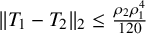 . Then there is
$\rho \in [\rho _1/2,\rho _1]$
. Then there is
$\rho \in [\rho _1/2,\rho _1]$
 such that
$d(\mathcal {P}_{T_1,\rho },\mathcal {P}_{T_2,\rho })\leq \rho _2$
such that
$d(\mathcal {P}_{T_1,\rho },\mathcal {P}_{T_2,\rho })\leq \rho _2$
 , whence in particular
$|\mathrm{Spec}_\rho (T_1)| = |\mathrm{Spec}_\rho (T_2)|$
, whence in particular
$|\mathrm{Spec}_\rho (T_1)| = |\mathrm{Spec}_\rho (T_2)|$
 . Moreover
$T_2$
. Moreover
$T_2$
 has no eigenvalue in
$[\rho -\frac {\rho _1^3}{30},\rho +\frac {\rho _1^3}{30})$
has no eigenvalue in
$[\rho -\frac {\rho _1^3}{30},\rho +\frac {\rho _1^3}{30})$
 .
.
Proof. Let
$\delta =\|T_1-T_2\|_2$
 . Let
$S=\{\lambda _1\geq \ldots \geq \lambda _t\}=\mathrm{Spec}_\rho (T_2)\cap [\rho _1/2,\rho _1]$
. Let
$S=\{\lambda _1\geq \ldots \geq \lambda _t\}=\mathrm{Spec}_\rho (T_2)\cap [\rho _1/2,\rho _1]$
 be the (multi)set of eigenvalues of
$T_2$
be the (multi)set of eigenvalues of
$T_2$
 which also lie in
$[\rho _1/2,\rho _1]$
which also lie in
$[\rho _1/2,\rho _1]$
 . The assumption
$\|T_2\|_2\leq 1$
. The assumption
$\|T_2\|_2\leq 1$
 , together with the fact that (by our general choice of normalizations) the norm
$\|T_2\|_2$
, together with the fact that (by our general choice of normalizations) the norm
$\|T_2\|_2$
 is the sum of squares of the eigenvalues of
$T_2$
is the sum of squares of the eigenvalues of
$T_2$
 , implies that
$\sum _{i\in [t]}\lambda _i^2\leq \|T_2\|_2^2\leq 1$
, implies that
$\sum _{i\in [t]}\lambda _i^2\leq \|T_2\|_2^2\leq 1$
 , so
$t\leq 4/\rho _1^2$
, so
$t\leq 4/\rho _1^2$
 . Note that there exists
$\rho '\in [\rho _1/2+\frac {\rho _1^3}{10},\rho _1]$
. Note that there exists
$\rho '\in [\rho _1/2+\frac {\rho _1^3}{10},\rho _1]$
 such that
$S\cap [\rho '-\frac {\rho _1^3}{10},\rho ')=\emptyset $
such that
$S\cap [\rho '-\frac {\rho _1^3}{10},\rho ')=\emptyset $
 . Indeed, otherwise, letting
$S'=S\cup \{\rho _1/2,\rho _1\}$
. Indeed, otherwise, letting
$S'=S\cup \{\rho _1/2,\rho _1\}$
 , we would have that any two consecutive elements of
$S'$
, we would have that any two consecutive elements of
$S'$
 differ by at most
$\frac {\rho _1^3}{10}$
differ by at most
$\frac {\rho _1^3}{10}$
 , implying that we could partition
$[\rho _1/2,\rho _1]$
, implying that we could partition
$[\rho _1/2,\rho _1]$
 into
$t+1$
into
$t+1$
 consecutive intervals of length at most
$\frac {\rho _1^3}{10}$
consecutive intervals of length at most
$\frac {\rho _1^3}{10}$
 , which yields the contradiction that
$\frac {\rho _1^3}{10}(t+1)\le \frac {\rho _1^3}{10}(\frac {4}{\rho _1^2}+1)<\frac {\rho _1}{2}$
, which yields the contradiction that
$\frac {\rho _1^3}{10}(t+1)\le \frac {\rho _1^3}{10}(\frac {4}{\rho _1^2}+1)<\frac {\rho _1}{2}$
 .
.
We claim that
$(\mathrm{Spec}(T_1)\cup \mathrm{Spec}(T_2))\cap [\rho '-2\frac {\rho _1^3}{30},\rho '-\frac {\rho _1^3}{30}) =\emptyset $
 . Indeed, Theorem 7.10 implies that each eigenvalue of
$T_1$
. Indeed, Theorem 7.10 implies that each eigenvalue of
$T_1$
 is at distance at most
$\delta $
is at distance at most
$\delta $
 from an eigenvalue of
$T_2$
from an eigenvalue of
$T_2$
 . As the interval
$[\rho '-\frac {\rho _1^3}{10},\rho ')$
. As the interval
$[\rho '-\frac {\rho _1^3}{10},\rho ')$
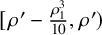 contains no eigenvalue of
$T_2$
contains no eigenvalue of
$T_2$
 , the interval
$[\rho '-\frac {\rho _1^3}{10}+\delta ,\rho '-\delta )$
, the interval
$[\rho '-\frac {\rho _1^3}{10}+\delta ,\rho '-\delta )$
 cannot contain eigenvalues of
$T_1$
cannot contain eigenvalues of
$T_1$
 , and since
$\delta =\|T_1-T_2\|_2\le \frac {\rho _2\rho _1^4}{120}\le \frac {\rho _1^3}{30}$
, and since
$\delta =\|T_1-T_2\|_2\le \frac {\rho _2\rho _1^4}{120}\le \frac {\rho _1^3}{30}$
 , the claim follows. Let
$\rho :=\rho '-\frac {\rho _1^3}{30}$
, the claim follows. Let
$\rho :=\rho '-\frac {\rho _1^3}{30}$
 ,
$P_1:=\mathcal {P}_{T_1,\rho }$
,
$P_1:=\mathcal {P}_{T_1,\rho }$
 , and
$P_2:=\mathcal {P}_{T_2,\rho }$
, and
$P_2:=\mathcal {P}_{T_2,\rho }$
 .
.
Let v be an eigenvector of
$T_1$
 with
$\|v\|_2=1$
with
$\|v\|_2=1$
 and eigenvalue
$\kappa $
and eigenvalue
$\kappa $
 in
$\mathrm{Spec}_\rho (T_1)$
in
$\mathrm{Spec}_\rho (T_1)$
 . We have
$\|T_2v-\kappa v\|_2=\|T_1v+(T_2-T_1)v-\kappa v\|_2=\|(T_2-T_1)v\|_2\leq \delta $
. We have
$\|T_2v-\kappa v\|_2=\|T_1v+(T_2-T_1)v-\kappa v\|_2=\|(T_2-T_1)v\|_2\leq \delta $
 .
.
By Lemma 7.4, there exists
$w\in \text {Eigen}_{\rho }(T_2)$
 such that
$\|v-w\|_2\leq \delta 30\rho _1^{-3}$
such that
$\|v-w\|_2\leq \delta 30\rho _1^{-3}$
 (more precisely, w is the combination of eigenvectors corresponding to the relevant eigenvalue cluster, as given by Lemma 7.4, noting in addition that, by our choice of
$\rho $
(more precisely, w is the combination of eigenvectors corresponding to the relevant eigenvalue cluster, as given by Lemma 7.4, noting in addition that, by our choice of
$\rho $
 , there is no such eigenvalue less than
$\rho $
, there is no such eigenvalue less than
$\rho $
 in this cluster). It follows that
$\|v-P_2(v)\|_2\leq \|v-w\|_2\leq 30 \delta \rho _1^{-3}$
in this cluster). It follows that
$\|v-P_2(v)\|_2\leq \|v-w\|_2\leq 30 \delta \rho _1^{-3}$
 . The image of
$P_1$
. The image of
$P_1$
 is
$\text {Eigen}_{\rho }(T_1)$
is
$\text {Eigen}_{\rho }(T_1)$
 , which has dimension
$|\mathrm{Spec}_{\rho }(T_1)|\leq {\rho }^{-2} \sum _{\lambda \in \mathrm{Spec}(T_1)} \lambda ^2= {\rho }^{-2} \|T_1\|_2^2\leq (1+\delta )^2/{\rho }^2\le 16/\rho _1^2$
, which has dimension
$|\mathrm{Spec}_{\rho }(T_1)|\leq {\rho }^{-2} \sum _{\lambda \in \mathrm{Spec}(T_1)} \lambda ^2= {\rho }^{-2} \|T_1\|_2^2\leq (1+\delta )^2/{\rho }^2\le 16/\rho _1^2$
 . Hence, by Lemma 7.7 applied with
$P=P_1, Q=P_2$
. Hence, by Lemma 7.7 applied with
$P=P_1, Q=P_2$
 , we have
$\sup _{v\in U_{P_1}:\|v\|\leq 1} \text {dist}(v,U_{P_2}) \leq 120 \delta \rho _1^{-4}$
, we have
$\sup _{v\in U_{P_1}:\|v\|\leq 1} \text {dist}(v,U_{P_2}) \leq 120 \delta \rho _1^{-4}$
 . Similarly, we obtain
$\sup _{v\in U_{P_2}:\|v\|\leq 1} \text {dist}(v,U_{P_1})\leq 120 \delta \rho _1^{-4}$
. Similarly, we obtain
$\sup _{v\in U_{P_2}:\|v\|\leq 1} \text {dist}(v,U_{P_1})\leq 120 \delta \rho _1^{-4}$
 . Hence, by (7.4), we have
$d(P_1,P_2)\leq 120 \delta \rho _1^{-4}$
. Hence, by (7.4), we have
$d(P_1,P_2)\leq 120 \delta \rho _1^{-4}$
 , so if
$\delta \leq \rho _2\rho _1^4/120$
, so if
$\delta \leq \rho _2\rho _1^4/120$
 , then
$d(P_1,P_2)\leq \rho _2$
, then
$d(P_1,P_2)\leq \rho _2$
 . As
$\rho _2<1$
. As
$\rho _2<1$
 , by the last sentence of Lemma7.6 we have
$|\mathrm{Spec}_{\rho }(T_1)| = |\mathrm{Spec}_{\rho }(T_2)|$
, by the last sentence of Lemma7.6 we have
$|\mathrm{Spec}_{\rho }(T_1)| = |\mathrm{Spec}_{\rho }(T_2)|$
 .
.
We can now prove the main result of this subsection.
Theorem 7.12. Let
$\mathcal {H}:\mathbb {R}_{>0}\to \mathbb {R}_{>0}$
 and
$\mathcal {B}:\mathbb {R}_{>0}\times \mathbb {N}\to \mathbb {R}_{>0}$
and
$\mathcal {B}:\mathbb {R}_{>0}\times \mathbb {N}\to \mathbb {R}_{>0}$
 be arbitrary functions, and let
$\rho _0\in (0,1)$
be arbitrary functions, and let
$\rho _0\in (0,1)$
 . Then there exists
$M=M(\rho _0,\mathcal {B}, \mathcal {H})>0$
. Then there exists
$M=M(\rho _0,\mathcal {B}, \mathcal {H})>0$
 and
$\varepsilon _0=\varepsilon _0(\rho _0,\mathcal {B}, \mathcal {H})>0$
and
$\varepsilon _0=\varepsilon _0(\rho _0,\mathcal {B}, \mathcal {H})>0$
 such that the following holds. For any finite abelian group
$\operatorname {\mathrm {Z}}$
such that the following holds. For any finite abelian group
$\operatorname {\mathrm {Z}}$
 and any
$1$
and any
$1$
 -bounded function
$f:\operatorname {\mathrm {Z}}\to \mathbb {C}$
-bounded function
$f:\operatorname {\mathrm {Z}}\to \mathbb {C}$
 , there exists
$m\le M$
, there exists
$m\le M$
 ,
$\varepsilon =\varepsilon _{\mathcal {H},\rho _0,m}\in [\varepsilon _0,1]$
,
$\varepsilon =\varepsilon _{\mathcal {H},\rho _0,m}\in [\varepsilon _0,1]$
 , and
$\rho =\rho _{\rho _0,f}\in [\rho _0/2,\rho _0]$
, and
$\rho =\rho _{\rho _0,f}\in [\rho _0/2,\rho _0]$
 satisfying the following.
Letting
$P_{\rho }$
 denote the orthogonal projection to
$\text {Eigen}_\rho \big (\mathcal {K}_\varepsilon (f\otimes \overline {f})\big )$
denote the orthogonal projection to
$\text {Eigen}_\rho \big (\mathcal {K}_\varepsilon (f\otimes \overline {f})\big )$
 in
$\mathbb {C}^{\operatorname {\mathrm {Z}}}$
in
$\mathbb {C}^{\operatorname {\mathrm {Z}}}$
 , we have

Moreover, there is a
$2$
 -step cfr nilspace
$\operatorname {\mathrm {X}}$
-step cfr nilspace
$\operatorname {\mathrm {X}}$
 of complexity
$\leq m$
of complexity
$\leq m$
 , a
$\mathcal {B}(\rho _0,m)$
, a
$\mathcal {B}(\rho _0,m)$
 -balanced morphism
$\phi :\operatorname {\mathrm {Z}}\to \operatorname {\mathrm {X}}$
-balanced morphism
$\phi :\operatorname {\mathrm {Z}}\to \operatorname {\mathrm {X}}$
 , a 1-bounded m-Lipschitz function
$F:\operatorname {\mathrm {X}}\to \mathbb {C}$
, a 1-bounded m-Lipschitz function
$F:\operatorname {\mathrm {X}}\to \mathbb {C}$
 , and a set
$S_{\rho }=S_{\rho ,m,f}\subset \widehat {\operatorname {\mathrm {Z}}_k(\operatorname {\mathrm {X}})}$
, and a set
$S_{\rho }=S_{\rho ,m,f}\subset \widehat {\operatorname {\mathrm {Z}}_k(\operatorname {\mathrm {X}})}$
 with
$|S_{\rho }|=|\mathrm{Spec}_\rho \big (\mathcal {K}_\varepsilon (f\otimes \overline {f})\big )|\le 10/\rho $
with
$|S_{\rho }|=|\mathrm{Spec}_\rho \big (\mathcal {K}_\varepsilon (f\otimes \overline {f})\big )|\le 10/\rho $
 , such that for every
$\chi \in S_{\rho }$
, such that for every
$\chi \in S_{\rho }$
 , letting
$g_\chi =F_\chi \operatorname {\mathrm {\circ }}\phi $
, letting
$g_\chi =F_\chi \operatorname {\mathrm {\circ }}\phi $
 , we have
$\|g_\chi \|_2^2\geq \rho $
, we have
$\|g_\chi \|_2^2\geq \rho $
 and
and

and there exists
$h:\operatorname {\mathrm {Z}}\to \mathbb {C}$
 such that
$\|h-\sum _{\chi \in S_{\rho }}g_\chi \|_{\infty }\le \mathcal {H}(\rho _0)$
such that
$\|h-\sum _{\chi \in S_{\rho }}g_\chi \|_{\infty }\le \mathcal {H}(\rho _0)$
 and
$\|h\|_{U^3}^* = O_{\rho _0,\mathcal {B},\mathcal {H}}(1)$
and
$\|h\|_{U^3}^* = O_{\rho _0,\mathcal {B},\mathcal {H}}(1)$
 .
.
Remark 7.13. This result can be viewed as a spectral structure-randomness decomposition of order 2. In particular, note that by (7.8) and the properties of h, we have that
$P_\rho (f)$
 is a structured function of order 2 in the sense of Definition 2.23, with parameters
$\big (O_{\rho _0,\mathcal {B},\mathcal {H}}(1),2\mathcal {H}(\rho _0)\big )$
is a structured function of order 2 in the sense of Definition 2.23, with parameters
$\big (O_{\rho _0,\mathcal {B},\mathcal {H}}(1),2\mathcal {H}(\rho _0)\big )$
 .
.
Remark 7.14. It will follow from the proof that
$\rho $
 can be chosen so that there are no eigenvalues of
$\mathcal {K}_\varepsilon (f\otimes \overline {f})$
can be chosen so that there are no eigenvalues of
$\mathcal {K}_\varepsilon (f\otimes \overline {f})$
 in the interval
$[\rho -\rho _0^3/30,\rho +\rho _0^3/30)$
in the interval
$[\rho -\rho _0^3/30,\rho +\rho _0^3/30)$
 .
.
Proof. Let
$C_s$
 be the constant defined in Lemma 7.9. Let

and let
$\eta =\rho _0^{8}\Upsilon (\rho _0)^2/(9\cdot 10^6)\in [0,1]$
 . Let
$\mathcal {D}:\mathbb {R}_{>0}\times \mathbb {N}\to \mathbb {R}_{>0}$
. Let
$\mathcal {D}:\mathbb {R}_{>0}\times \mathbb {N}\to \mathbb {R}_{>0}$
 and
$\varepsilon>0$
and
$\varepsilon>0$
 be chosen so that the following conditions hold:
-
(i) The number $\tau :=C_{\operatorname {\mathrm {Q}}(\eta ,m)}\operatorname {\mathrm {Q}}(\eta ,m)^2\eta ^{-4}\mathcal {D}(\eta ,m)$
is at most 1, -
(ii) $2\operatorname {\mathrm {Q}}(\eta ,m)C_{\operatorname {\mathrm {Q}}(\eta ,m)}\tau \le \sqrt {\eta }$
, -
(iii) $(\operatorname {\mathrm {Q}}(\eta ,m)^2+4)\mathcal {D}(\eta ,m)\le \eta $
, -
(iv) $\varepsilon =\varepsilon _{m,\eta }>0$
is chosen following Remark 6.2 (which also imposes another condition on
$\mathcal {D}$
being small enough), so that
$\|E\|_2\leq 23\sqrt {\eta }$
. -
(v) $\mathcal {D}(\eta ,m)(\operatorname {\mathrm {Q}}(\eta ,m)+O_{\eta ,m}(1))\le \eta ^{1/2}$
, where the implicit constant is defined as per Lemma 5.3, -
(vi) $2\operatorname {\mathrm {Q}}(\eta ,m)\mathcal {D}(\eta ,m)^{1/4^3}\le \eta ^{1/2}$
, and -
(vii) $\mathcal {D}(\eta ,m)\le \mathcal {B}(\rho _0,m)$
.








We apply Theorem 6.1 to f with parameters
$\eta $
 and
$\mathcal {D}$
and
$\mathcal {D}$
 . Thus, we obtain the decomposition
$\mathcal {K}_\varepsilon (f\otimes \overline {f})=\sum _{\chi \in S} g_\chi \otimes \overline {g_\chi } + E$
. Thus, we obtain the decomposition
$\mathcal {K}_\varepsilon (f\otimes \overline {f})=\sum _{\chi \in S} g_\chi \otimes \overline {g_\chi } + E$
 . Note that letting
$\varepsilon _0:=\min _{m\le M}(\varepsilon _{\eta ,m})$
. Note that letting
$\varepsilon _0:=\min _{m\le M}(\varepsilon _{\eta ,m})$
 we have that indeed
$\varepsilon \ge \varepsilon _0>0$
we have that indeed
$\varepsilon \ge \varepsilon _0>0$
 and
$\varepsilon _0=\varepsilon _0(\rho _0,\mathcal {B})$
and
$\varepsilon _0=\varepsilon _0(\rho _0,\mathcal {B})$
 .
.
Next, note that by our choices above, the unit vectors
$u_\chi :=g_\chi /\|g_\chi \|_2$
 satisfy, for any
$\chi \neq \chi '$
satisfy, for any
$\chi \neq \chi '$
 ,
,

with
$s=|S|$
 and
$\tau $
and
$\tau $
 defined in (i) (in particular
$\tau \le 1$
defined in (i) (in particular
$\tau \le 1$
 ).
).

Thus, we obtain the orthonormal vectors
$w_\chi $
 . We then define
$g_\chi ':=\|g_\chi \|_2 w_\chi $
. We then define
$g_\chi ':=\|g_\chi \|_2 w_\chi $
 for each
$\chi \in S$
for each
$\chi \in S$
 . We thus have the orthogonal set
$\{g_\chi ':\chi \in S\}$
. We thus have the orthogonal set
$\{g_\chi ':\chi \in S\}$
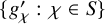 which satisfies

Now we consider the following
$\operatorname {\mathrm {Z}}$
 -matrices:

Note that by Lemma 3.6 with
$M=\mathcal {K}_\varepsilon (f\otimes \overline {f})$
 and
$N=0$
and
$N=0$
 , we have
$\|T_2\|_2\leq 1$
, we have
$\|T_2\|_2\leq 1$
 . We also have
$\|g^{\prime }_\chi \otimes \overline {g^{\prime }_\chi }-g_\chi \otimes \overline {g_\chi }\|_2\leq \|g^{\prime }_\chi -g_\chi \|_2(\|g^{\prime }_\chi \|_2+\|g_\chi \|_2)\leq 2 C_s\tau $
. We also have
$\|g^{\prime }_\chi \otimes \overline {g^{\prime }_\chi }-g_\chi \otimes \overline {g_\chi }\|_2\leq \|g^{\prime }_\chi -g_\chi \|_2(\|g^{\prime }_\chi \|_2+\|g_\chi \|_2)\leq 2 C_s\tau $
 . Hence
$\|T_1-T_2\|_2\leq |S|2 C_s\tau +\|E\|_2$
. Hence
$\|T_1-T_2\|_2\leq |S|2 C_s\tau +\|E\|_2$
 , and by (ii) and (iv), we have
$\|T_1-T_2\|_2\leq 24\sqrt {\eta }$
, and by (ii) and (iv), we have
$\|T_1-T_2\|_2\leq 24\sqrt {\eta }$
 .
.
We want to apply Theorem 7.11 to
$T_1$
 and
$T_2$
and
$T_2$
 with
$\rho _1=\rho _0$
with
$\rho _1=\rho _0$
 , and
$\rho _2=\Upsilon (\rho _0)$
, and
$\rho _2=\Upsilon (\rho _0)$
 . Hence, we want to ensure that
$\|T_1-T_2\|_2\leq 24\sqrt {\eta }\le \rho _0^4\Upsilon (\rho _0)/120$
. Hence, we want to ensure that
$\|T_1-T_2\|_2\leq 24\sqrt {\eta }\le \rho _0^4\Upsilon (\rho _0)/120$
 . But note that this holds by our choice of
$\eta $
. But note that this holds by our choice of
$\eta $
 . Hence, there exists
$\rho \in [\rho _0/2,\rho _0]$
. Hence, there exists
$\rho \in [\rho _0/2,\rho _0]$
 such that
$d(\mathcal {P}_{T_1,\rho },\mathcal {P}_{T_2,\rho })\leq \Upsilon (\rho _0)$
such that
$d(\mathcal {P}_{T_1,\rho },\mathcal {P}_{T_2,\rho })\leq \Upsilon (\rho _0)$
 . By definition of the metric d (recall (7.3)) and the fact that
$\|f\|_2\leq 1$
. By definition of the metric d (recall (7.3)) and the fact that
$\|f\|_2\leq 1$
 , this implies that
$\|\mathcal {P}_{T_2,\rho }(f)-\mathcal {P}_{T_1,\rho }(f)\|_2\leq \Upsilon (\rho _0)$
, this implies that
$\|\mathcal {P}_{T_2,\rho }(f)-\mathcal {P}_{T_1,\rho }(f)\|_2\leq \Upsilon (\rho _0)$
 .
.
Note that
$\mathcal {P}_{T_2,\rho }(f)$
 is the desired projection
$P_{\rho }(f)$
is the desired projection
$P_{\rho }(f)$
 . Let
$S_{\rho }:=\{\chi \in S:\|g_\chi \|_2^2\geq \rho \}$
. Let
$S_{\rho }:=\{\chi \in S:\|g_\chi \|_2^2\geq \rho \}$
 . Note that by (7.12) and Theorem 7.11 we know that
$|S_\rho |=|\{\chi \in S:\|g_\chi '\|_2^2\ge \rho \}|=|\mathrm{Spec}_\rho (T_2)|$
. Note that by (7.12) and Theorem 7.11 we know that
$|S_\rho |=|\{\chi \in S:\|g_\chi '\|_2^2\ge \rho \}|=|\mathrm{Spec}_\rho (T_2)|$
 and that
$\rho \in [\rho _0/2,\rho _0]$
and that
$\rho \in [\rho _0/2,\rho _0]$
 can be chosen explicitly depending on
$T_2$
can be chosen explicitly depending on
$T_2$
 . Note also that by Proposition 5.8 and (iii) we have
$|S_\rho |\le 10/\rho $
. Note also that by Proposition 5.8 and (iii) we have
$|S_\rho |\le 10/\rho $
 .
.
We claim that
$\mathcal {P}_{T_1,{\rho }}(f)$
 is close in
$L^2$
is close in
$L^2$
 to
$\sum _{\chi \in S_{\rho }} g_\chi $
to
$\sum _{\chi \in S_{\rho }} g_\chi $
 . Indeed, the vectors
$w_\chi =\frac {g_\chi '}{\|g_\chi '\|_2}$
. Indeed, the vectors
$w_\chi =\frac {g_\chi '}{\|g_\chi '\|_2}$
 form an orthonormal set of eigenvectors of
$T_1$
form an orthonormal set of eigenvectors of
$T_1$
 , with corresponding eigenvalues
$\|g_\chi '\|_2^2$
, with corresponding eigenvalues
$\|g_\chi '\|_2^2$
 . This together with
$\|g^{\prime }_\chi \|_2=\|g_\chi \|_2$
. This together with
$\|g^{\prime }_\chi \|_2=\|g_\chi \|_2$
 implies the following expression for the projection:

By (7.12) we have
$\|g_\chi -g_\chi '\|_2\leq C_s\tau $
 , so
$\|\langle f,g_\chi '\rangle g_\chi '-\langle f,g_\chi \rangle g_\chi \|_2\leq 2 C_s\tau $
, so
$\|\langle f,g_\chi '\rangle g_\chi '-\langle f,g_\chi \rangle g_\chi \|_2\leq 2 C_s\tau $
 , and so

where we used that
$|S_{\rho }|\le |S|$
 , that
$2|S|C_s\tau \le \sqrt {\eta }$
, that
$2|S|C_s\tau \le \sqrt {\eta }$
 (by (ii)), and that
$\rho \geq \rho _0/2$
(by (ii)), and that
$\rho \geq \rho _0/2$
 .
.
Finally, by (5.5), for every
$\chi \in S_{{\rho }}$
 we have

Recalling the definition of
$\eta $
 and using (v), we have
$|\langle f,\frac {g_\chi }{\|g_\chi \|_2}\rangle -\|g_\chi \|_2|\leq \rho _0^{7/2}\Upsilon (\rho _0)/530$
and using (v), we have
$|\langle f,\frac {g_\chi }{\|g_\chi \|_2}\rangle -\|g_\chi \|_2|\leq \rho _0^{7/2}\Upsilon (\rho _0)/530$
 . Hence, using
$|S_{{\rho }}|\le 10/{\rho }$
. Hence, using
$|S_{{\rho }}|\le 10/{\rho }$
 and
$\rho \geq \rho _0/2$
and
$\rho \geq \rho _0/2$
 , we conclude that

Hence
$\|\mathcal {P}_{T_1,{{\rho }}}(f)-\sum _{\chi \in S_{{\rho }}} g_\chi \|_2\le \rho _0^{5/2}\Upsilon (\rho _0)/26$
 , which proves our claim.
Using this last estimate we can prove (7.8), indeed
$\|P_{{\rho }}(f)-\sum _{\chi \in S_{{\rho }}} g_\chi \|_2$
 is at most

Now, using the above estimates, the fact that the
$L^2$
 -norm dominates the
$U^3$
-norm dominates the
$U^3$
 -norm, and the bound (5.11), we conclude that

Now using that
$1+c_0\leq 1+ (|S|^2+4)\mathcal {D}(\eta ,m)+8\eta \le 1+9\eta \le 10$
 (by (iii)), and that
$2|S|\mathcal {D}(\eta ,m)^{1/4^3}\leq \eta ^{1/2}$
(by (iii)), and that
$2|S|\mathcal {D}(\eta ,m)^{1/4^3}\leq \eta ^{1/2}$
 by (vi), we deduce that the last line above is at most
$10^{1/8}\rho ^{3/8}+5\eta ^{1/2}+\Upsilon (\rho _0)\left (\rho _0^{5/2}/26+1 \right )\leq 10^{1/8}\rho ^{3/8}+\Upsilon (\rho _0)\left ( \rho _0^4/600+\rho _0^{5/2}/26+1 \right )$
by (vi), we deduce that the last line above is at most
$10^{1/8}\rho ^{3/8}+5\eta ^{1/2}+\Upsilon (\rho _0)\left (\rho _0^{5/2}/26+1 \right )\leq 10^{1/8}\rho ^{3/8}+\Upsilon (\rho _0)\left ( \rho _0^4/600+\rho _0^{5/2}/26+1 \right )$
 , and this is at most
$ 2\rho ^{3/8}$
, and this is at most
$ 2\rho ^{3/8}$
 by our choice of
$\Upsilon $
by our choice of
$\Upsilon $
 .
.
To prove the final statement of the theorem, we apply Proposition 5.8 for
$\sigma :=\mathcal {H}(\rho _0)$
 . Thus, we obtain some
$h:\operatorname {\mathrm {Z}}\to \mathbb {C}$
. Thus, we obtain some
$h:\operatorname {\mathrm {Z}}\to \mathbb {C}$
 such that
$\|h-\sum _{\chi \in S_{\rho }}g_\chi \|_{\infty }\le \mathcal {H}(\rho _0)$
such that
$\|h-\sum _{\chi \in S_{\rho }}g_\chi \|_{\infty }\le \mathcal {H}(\rho _0)$
 and
$\|h\|_{U^3}^* = O_{\rho _0,\mathcal {B},\mathcal {H}}(1)$
and
$\|h\|_{U^3}^* = O_{\rho _0,\mathcal {B},\mathcal {H}}(1)$
 .
.
We can now complete the proof of the validity of our spectral
$U^3$
 -regularization algorithm.


7.2 Obtaining dominant nilspace characters of f from the spectrum of
$\mathcal {K}_\varepsilon (f\otimes \overline {f})$

Now that we have a method for recovering algorithmically the structured part
$\sum _{\chi \in S_\rho }g_\chi $
 using the eigenvectors of
$\mathcal {K}_\varepsilon (f\otimes \overline {f})$
using the eigenvectors of
$\mathcal {K}_\varepsilon (f\otimes \overline {f})$
 , it is natural to try to go further and recover as much as possible the individual nilspace characters
$g_\chi $
, it is natural to try to go further and recover as much as possible the individual nilspace characters
$g_\chi $
 ,
$\chi \in S_\rho $
,
$\chi \in S_\rho $
 . Lemma 7.4 guarantees that every such function
$g_\chi $
. Lemma 7.4 guarantees that every such function
$g_\chi $
 is (up to an error with small
$L^2$
is (up to an error with small
$L^2$
 -norm) a linear combination of eigenvectors of
$\mathcal {K}_\varepsilon (f\otimes \overline {f})$
-norm) a linear combination of eigenvectors of
$\mathcal {K}_\varepsilon (f\otimes \overline {f})$
 that have corresponding eigenvalues close to the number
$\|g_\chi \|_2^2$
that have corresponding eigenvalues close to the number
$\|g_\chi \|_2^2$
 . The main problem that we may face is that there could be a cluster of many such eigenvalues, with corresponding eigenvectors thus spanning a multidimensional space, in which case we would have to find how to recover
$g_\chi $
. The main problem that we may face is that there could be a cluster of many such eigenvalues, with corresponding eigenvectors thus spanning a multidimensional space, in which case we would have to find how to recover
$g_\chi $
 algorithmically inside this space.
A simple observation is that if the dominant eigenvalues of
$\mathcal {K}_\varepsilon (f\otimes \overline {f})$
 are sufficiently isolated, then the above clustering cannot happen and we are therefore able to recover
$g_\chi $
are sufficiently isolated, then the above clustering cannot happen and we are therefore able to recover
$g_\chi $
 as a scalar multiple of precisely one of the eigenvectors (up to a small
$L^2$
as a scalar multiple of precisely one of the eigenvectors (up to a small
$L^2$
 -error). In fact, this holds more generally in a sense that will be very useful for us. Namely, for any unit vector h in the linear span of the leading eigenvectors of
$\mathcal {K}_\varepsilon (f\otimes \overline {f})$
-error). In fact, this holds more generally in a sense that will be very useful for us. Namely, for any unit vector h in the linear span of the leading eigenvectors of
$\mathcal {K}_\varepsilon (f\otimes \overline {f})$
 , if the leading eigenvalues of the new matrix
$\mathcal {K}_\varepsilon (h\otimes \overline {h})$
, if the leading eigenvalues of the new matrix
$\mathcal {K}_\varepsilon (h\otimes \overline {h})$
 are well-separated, then there is a bijection from the set of leading eigenvectors of the latter matrix to the set of leading nilspace character
$g_\chi $
are well-separated, then there is a bijection from the set of leading eigenvectors of the latter matrix to the set of leading nilspace character
$g_\chi $
 of f, such that
$g_\chi $
of f, such that
$g_\chi $
 is close in
$L^2$
is close in
$L^2$
 to a scalar multiple of its corresponding eigenvector under this bijection. This is formalized in the following main theorem of this subsection.
We say that a multiset X of complex numbers is
$\delta $
 -separated if
$|x-y|>\delta $
-separated if
$|x-y|>\delta $
 for every
$x\neq y$
for every
$x\neq y$
 in X. Note that, in particular, this implies that every element of X has multiplicity 1.
Theorem 7.15. For any
$q>0$
 and
$r>q+1$
and
$r>q+1$
 , there exists
$B_{q,r}\in (0,1)$
, there exists
$B_{q,r}\in (0,1)$
 such that the following holds. Let
$\mathcal {B}$
such that the following holds. Let
$\mathcal {B}$
 be a function
$\mathbb {R}_{>0}\times \mathbb {N}\to \mathbb {R}_{>0}$
be a function
$\mathbb {R}_{>0}\times \mathbb {N}\to \mathbb {R}_{>0}$
 , let
$\mathcal {H}:\mathbb {R}_{>0}\to \mathbb {R}_{>0}$
, let
$\mathcal {H}:\mathbb {R}_{>0}\to \mathbb {R}_{>0}$
 ,
$x\mapsto (x/2)^r$
,
$x\mapsto (x/2)^r$
 , and let
$\rho _0\in (0,B_{q,r}]$
, and let
$\rho _0\in (0,B_{q,r}]$
 . Let
$M(\rho _0,\mathcal {B},\mathcal {H}),\varepsilon _0(\rho _0,\mathcal {B},\mathcal {H})$
. Let
$M(\rho _0,\mathcal {B},\mathcal {H}),\varepsilon _0(\rho _0,\mathcal {B},\mathcal {H})$
 be the resulting numbers given by Theorem 7.12. Let
$\operatorname {\mathrm {Z}}$
be the resulting numbers given by Theorem 7.12. Let
$\operatorname {\mathrm {Z}}$
 be a finite abelian group, let
$f:\operatorname {\mathrm {Z}}\to \mathbb {C}$
be a finite abelian group, let
$f:\operatorname {\mathrm {Z}}\to \mathbb {C}$
 be 1-bounded, and, for an appropriate
$\rho \in [\rho _0/2,\rho _0]$
be 1-bounded, and, for an appropriate
$\rho \in [\rho _0/2,\rho _0]$
 , let
$f=\sum _{\chi \in S_\rho }g_\chi +f_r+f_e$
, let
$f=\sum _{\chi \in S_\rho }g_\chi +f_r+f_e$
 be the corresponding decomposition given by Theorem 7.12, where
$\|f_r\|_{U^3}\le 2\rho ^{3/8}$
be the corresponding decomposition given by Theorem 7.12, where
$\|f_r\|_{U^3}\le 2\rho ^{3/8}$
 and
$\|f_e\|_2\le (\rho _0/2)^r$
and
$\|f_e\|_2\le (\rho _0/2)^r$
 . Let h be a function in
$\text {Eigen}_\rho \big (\mathcal {K}_\varepsilon (f\otimes \overline {f})\big )\subset \mathbb {C}^{\operatorname {\mathrm {Z}}}$
. Let h be a function in
$\text {Eigen}_\rho \big (\mathcal {K}_\varepsilon (f\otimes \overline {f})\big )\subset \mathbb {C}^{\operatorname {\mathrm {Z}}}$
 , with
$\|h\|_2\leq 1$
, with
$\|h\|_2\leq 1$
 , such that
$A:=\mathcal {K}_\varepsilon (h\otimes \overline {h})$
, such that
$A:=\mathcal {K}_\varepsilon (h\otimes \overline {h})$
 has spectrum
$\mathrm{Spec}_{\rho ^q}(A)$
has spectrum
$\mathrm{Spec}_{\rho ^q}(A)$
 being
$\delta $
being
$\delta $
 -separated for some
$\delta>\rho ^{q}$
-separated for some
$\delta>\rho ^{q}$
 , and
$|\mathrm{Spec}_{\rho ^q}(A)|=|S_\rho |$
, and
$|\mathrm{Spec}_{\rho ^q}(A)|=|S_\rho |$
 . Then there is a bijection
$J:\mathrm{Spec}_{\rho ^q}(A)\to S_\rho $
. Then there is a bijection
$J:\mathrm{Spec}_{\rho ^q}(A)\to S_\rho $
 such that, for every
$\lambda \in \mathrm{Spec}_{\rho ^q}(A)$
such that, for every
$\lambda \in \mathrm{Spec}_{\rho ^q}(A)$
 , letting
$\chi =J(\lambda )$
, letting
$\chi =J(\lambda )$
 and v be an eigenvector of A (with
$\|v\|_2=1$
and v be an eigenvector of A (with
$\|v\|_2=1$
 ) corresponding to
$\lambda $
) corresponding to
$\lambda $
 , we have
$\|\langle f,v\rangle v-g_\chi \|_2\le 28\rho ^{r-q}$
, we have
$\|\langle f,v\rangle v-g_\chi \|_2\le 28\rho ^{r-q}$
 and
$|\langle f,v\rangle |\ge \sqrt {\rho /2}$
and
$|\langle f,v\rangle |\ge \sqrt {\rho /2}$
 .
.
We can let
$B_{q,r}:=\min \big (1, (1/14)^{1/(r-1)}, (1/14)^{1/(r-q)}, (1/56)^{1/(r-q)},(1/452)^{1/(r-q-1)} \big )$
 . Let us also mention that the specific choice of function
$(x/2)^r$
. Let us also mention that the specific choice of function
$(x/2)^r$
 in the theorem is sufficient for our purposes in what follows, but that the result could be extended to a more general function
$\mathcal {H}$
in the theorem is sufficient for our purposes in what follows, but that the result could be extended to a more general function
$\mathcal {H}$
 .
.
Remark 7.16. The structured part
$P_\rho (f)$
 of f obtained in Theorem 7.12 has
$L^2$
of f obtained in Theorem 7.12 has
$L^2$
 -norm at most 1 (being an orthogonal projection of the 1-bounded function f), and it can then be seen that, setting
$h=P_\rho (f)$
-norm at most 1 (being an orthogonal projection of the 1-bounded function f), and it can then be seen that, setting
$h=P_\rho (f)$
 , the spectra
$\mathrm{Spec}_\rho (\mathcal {K}_\varepsilon (h\otimes \overline {h}))$
, the spectra
$\mathrm{Spec}_\rho (\mathcal {K}_\varepsilon (h\otimes \overline {h}))$
 and
$\mathrm{Spec}_\rho (\mathcal {K}_\varepsilon (f\otimes \overline {f}))$
and
$\mathrm{Spec}_\rho (\mathcal {K}_\varepsilon (f\otimes \overline {f}))$
 are roughly equal (this is proved in Lemma 7.18 below). Therefore, using this choice of h, Theorem 7.15 implies that, if
$\mathrm{Spec}_\rho \big (\mathcal {K}_\varepsilon (f\otimes \overline {f})\big )$
are roughly equal (this is proved in Lemma 7.18 below). Therefore, using this choice of h, Theorem 7.15 implies that, if
$\mathrm{Spec}_\rho \big (\mathcal {K}_\varepsilon (f\otimes \overline {f})\big )$
 is sufficiently separated, then every nilspace character
$g_\chi $
is sufficiently separated, then every nilspace character
$g_\chi $
 in the decomposition of f with
$\chi \in S_\rho $
in the decomposition of f with
$\chi \in S_\rho $
 can be recovered directly (up to a small
$L^2$
can be recovered directly (up to a small
$L^2$
 -error) as an eigenvector in
$\text {Eigen}_\rho \big (\mathcal {K}_\varepsilon (h\otimes \overline {h})\big )$
-error) as an eigenvector in
$\text {Eigen}_\rho \big (\mathcal {K}_\varepsilon (h\otimes \overline {h})\big )$
 . The purpose of the greater generality of Theorem 7.15 (enabling us to consider more general functions h in the unit ball of
$\text {Eigen}_\rho \big (\mathcal {K}_\varepsilon (f\otimes \overline {f})\big )$
. The purpose of the greater generality of Theorem 7.15 (enabling us to consider more general functions h in the unit ball of
$\text {Eigen}_\rho \big (\mathcal {K}_\varepsilon (f\otimes \overline {f})\big )$
 ) is to give us more options for recovering the individual quadratic characters of f, even when the eigenvalues of
$\mathcal {K}_\varepsilon (f\otimes \overline {f})$
) is to give us more options for recovering the individual quadratic characters of f, even when the eigenvalues of
$\mathcal {K}_\varepsilon (f\otimes \overline {f})$
 are not sufficiently separated (a situation that can occur even in the classical Fourier-analytic setting, as we mentioned in Remark 2.13). Indeed, the subspace
$\text {Eigen}_\rho \big (\mathcal {K}_\varepsilon (f\otimes \overline {f})\big )$
are not sufficiently separated (a situation that can occur even in the classical Fourier-analytic setting, as we mentioned in Remark 2.13). Indeed, the subspace
$\text {Eigen}_\rho \big (\mathcal {K}_\varepsilon (f\otimes \overline {f})\big )$
 has a dimension much smaller than
$|\operatorname {\mathrm {Z}}|$
has a dimension much smaller than
$|\operatorname {\mathrm {Z}}|$
 , and the theorem tells us that it suffices to find a vector (or function) h in this subspace such that the dominant eigenvalues of
$\mathcal {K}_\varepsilon (h\otimes \overline {h})$
, and the theorem tells us that it suffices to find a vector (or function) h in this subspace such that the dominant eigenvalues of
$\mathcal {K}_\varepsilon (h\otimes \overline {h})$
 are sufficiently separated. In the last part of this subsection, we will see that it is useful to consider a random vector h in the unit ball of this subspace, because we can then guarantee that, with high probability, the spectrum
$\mathrm{Spec}_{\rho ^q}\big (\mathcal {K}_\varepsilon (h\otimes \overline {h})\big )$
are sufficiently separated. In the last part of this subsection, we will see that it is useful to consider a random vector h in the unit ball of this subspace, because we can then guarantee that, with high probability, the spectrum
$\mathrm{Spec}_{\rho ^q}\big (\mathcal {K}_\varepsilon (h\otimes \overline {h})\big )$
 for such a random h is adequately separated.
The proof of Theorem 7.15 relies on the following result. This tells us essentially that if h is any unit vector that is close to a linear combination of a few quasiorthogonal quadratic characters of unit norm, then the leading eigenvalues of
$\mathcal {K}_\varepsilon (h\otimes \overline {h})$
 are close to the squared moduli of the coefficients in the linear combination.
Proposition 7.17. Let
$\varepsilon \in (0,1]$
 , let
$\operatorname {\mathrm {Z}}$
, let
$\operatorname {\mathrm {Z}}$
 be a finite abelian group, let D be a finite set, and let
$g_\chi $
be a finite abelian group, let D be a finite set, and let
$g_\chi $
 ,
$\chi \in D$
,
$\chi \in D$
 be functions in
$\mathbb {C}^{\operatorname {\mathrm {Z}}}$
be functions in
$\mathbb {C}^{\operatorname {\mathrm {Z}}}$
 satisfying
$\|g_\chi \|_2\in [\tau _1,1]$
satisfying
$\|g_\chi \|_2\in [\tau _1,1]$
 ,
$\|\mathcal {K}_{\varepsilon ^{1/2}}(g_\chi \otimes \overline {g_\chi })-g_\chi \otimes \overline {g_\chi }\|_2\leq \tau _2$
,
$\|\mathcal {K}_{\varepsilon ^{1/2}}(g_\chi \otimes \overline {g_\chi })-g_\chi \otimes \overline {g_\chi }\|_2\leq \tau _2$
 , and
$\max (|\langle g_\chi ,g_{\chi '}\rangle |,\langle g_\chi ,g_{\chi '}\rangle _{U^3})\leq \tau _3\leq \tau _1^2/|D|$
, and
$\max (|\langle g_\chi ,g_{\chi '}\rangle |,\langle g_\chi ,g_{\chi '}\rangle _{U^3})\leq \tau _3\leq \tau _1^2/|D|$
 for every
$\chi '\in D\setminus \{\chi \}$
for every
$\chi '\in D\setminus \{\chi \}$
 . Let
$u_\chi =g_\chi /\|g_\chi \|_2$
. Let
$u_\chi =g_\chi /\|g_\chi \|_2$
 for each
$\chi \in D$
for each
$\chi \in D$
 , and suppose that
$h\in \mathbb {C}^{\operatorname {\mathrm {Z}}}$
, and suppose that
$h\in \mathbb {C}^{\operatorname {\mathrm {Z}}}$
 is a function with
$\|h\|_2\leq 1$
is a function with
$\|h\|_2\leq 1$
 such that, for some function
$h'=\sum _{\chi \in D} c_\chi u_\chi $
such that, for some function
$h'=\sum _{\chi \in D} c_\chi u_\chi $
 with
$|c_\chi |\leq 1$
with
$|c_\chi |\leq 1$
 , we have
$\|h-h'\|_2\leq \tau _4$
, we have
$\|h-h'\|_2\leq \tau _4$
 . Then

where
$\|E\|_2 \le 5\tau _4 + \varepsilon ^{-1/2}|D|^2(|D|^{1/2}+3)\tau _3+|D|\max \big (\tau _2/\tau _1^2,2\varepsilon ^{1/2})$
 . In particular, letting
$\lambda _1\geq \lambda _2 \geq \cdots \geq \lambda _{|\operatorname {\mathrm {Z}}|}$
. In particular, letting
$\lambda _1\geq \lambda _2 \geq \cdots \geq \lambda _{|\operatorname {\mathrm {Z}}|}$
 be the eigenvalues of the matrix
$\mathcal {K}_\varepsilon (h\otimes \overline {h})$
be the eigenvalues of the matrix
$\mathcal {K}_\varepsilon (h\otimes \overline {h})$
 , and
$\chi _1,\chi _2,\ldots ,\chi _{|D|}$
, and
$\chi _1,\chi _2,\ldots ,\chi _{|D|}$
 be an ordering such that
$c_{\chi _i}\geq c_{\chi _{i+1}}$
be an ordering such that
$c_{\chi _i}\geq c_{\chi _{i+1}}$
 for all i, and setting
$c_{\chi _i}=0$
for all i, and setting
$c_{\chi _i}=0$
 for
$i>|D|$
for
$i>|D|$
 , we have

To prove Proposition 7.17, we will combine the refined Gram-Schmidt process (Lemma 7.9) with Theorem 7.10.
Proof of Proposition 7.17.
We first apply Proposition 3.17 with the following elements and parameters
$\alpha _i$
 : we take
$f=h=\sum _{\chi \in D} c_\chi u_\chi +f_e$
: we take
$f=h=\sum _{\chi \in D} c_\chi u_\chi +f_e$
 , where
$f_e:=h-h'$
, where
$f_e:=h-h'$
 (so
$\alpha _1=\tau _4$
(so
$\alpha _1=\tau _4$
 ),
$f_r=0$
),
$f_r=0$
 (so
$\alpha _2=0$
(so
$\alpha _2=0$
 ), the
$f_i$
), the
$f_i$
 are the functions
$c_\chi u_\chi $
are the functions
$c_\chi u_\chi $
 , so
$\alpha _3=1$
, so
$\alpha _3=1$
 and
$\alpha _4=\tau _3$
and
$\alpha _4=\tau _3$
 . Finally, we have
$\|\mathcal {K}_{\varepsilon }\big ( (c_\chi u_\chi ) \otimes \overline {(c_\chi u_\chi )})- (c_\chi u_\chi ) \otimes \overline {(c_\chi u_\chi )} \|_2\leq \alpha _5$
. Finally, we have
$\|\mathcal {K}_{\varepsilon }\big ( (c_\chi u_\chi ) \otimes \overline {(c_\chi u_\chi )})- (c_\chi u_\chi ) \otimes \overline {(c_\chi u_\chi )} \|_2\leq \alpha _5$
 where we shall now estimate
$\alpha _5$
where we shall now estimate
$\alpha _5$
 using Lemma 2.55. Indeed, since
$\|\mathcal {K}_{\varepsilon ^{1/2}}(g_\chi \otimes \overline {g_\chi })-g_\chi \otimes \overline {g_\chi }\|_2\leq \tau _2$
using Lemma 2.55. Indeed, since
$\|\mathcal {K}_{\varepsilon ^{1/2}}(g_\chi \otimes \overline {g_\chi })-g_\chi \otimes \overline {g_\chi }\|_2\leq \tau _2$
 , we deduce by Lemma 2.55 applied with
$c=c_\chi /\|g_\chi \|_2$
, we deduce by Lemma 2.55 applied with
$c=c_\chi /\|g_\chi \|_2$
 (and using that
$\|g_\chi \|_2\le 1$
(and using that
$\|g_\chi \|_2\le 1$
 ) that

so we can let
$\alpha _5=\max \big (\tau _2/\tau _1^2,2\varepsilon ^{1/2})$
 .
.
Thus we obtain

where
$\|E\|_2\leq 5\tau _4 + \varepsilon ^{-1/2}|D|^2(|D|^{1/2}+3)\tau _3+|D|\max \big (\tau _2/\tau _1^2,2\varepsilon ^{1/2})$
 .
.
Now, we apply Theorem 7.10 to deduce that, letting
$\lambda _i'$
 be the eigenvalues of the self-adjoint matrix
$M_u:=\sum _{\chi \in D} |c_\chi |^2 u_\chi \otimes \overline {u_\chi }$
be the eigenvalues of the self-adjoint matrix
$M_u:=\sum _{\chi \in D} |c_\chi |^2 u_\chi \otimes \overline {u_\chi }$
 in descending order, and letting
$n=|\operatorname {\mathrm {Z}}|$
in descending order, and letting
$n=|\operatorname {\mathrm {Z}}|$
 , we have

We can thus focus on approximating the eigenvalues
$\lambda _i'$
 . For this we apply Lemma 7.9 to the quasi-orthogonal set
$\{u_\chi :\chi \in D\}$
. For this we apply Lemma 7.9 to the quasi-orthogonal set
$\{u_\chi :\chi \in D\}$
 with
$\tau =C_{|D|}\tau _3/\tau _1^2\leq 1$
with
$\tau =C_{|D|}\tau _3/\tau _1^2\leq 1$
 (note that, for
$\chi \not =\chi '$
(note that, for
$\chi \not =\chi '$
 ,
$|\langle u_\chi ,u_{\chi '}\rangle | = |\langle \frac {g_\chi }{\|g_\chi \|_2},\frac {g_{\chi '}}{\|g_{\chi '}\|_2}\rangle |\le \tau _3/\tau _1^2$
,
$|\langle u_\chi ,u_{\chi '}\rangle | = |\langle \frac {g_\chi }{\|g_\chi \|_2},\frac {g_{\chi '}}{\|g_{\chi '}\|_2}\rangle |\le \tau _3/\tau _1^2$
 ), obtaining an orthonormal set
$\{w_\chi :\chi \in D\}$
), obtaining an orthonormal set
$\{w_\chi :\chi \in D\}$
 with
$\|u_\chi -w_\chi \|_2\leq C_{|D|}^2\tau _3/\tau _1^2$
with
$\|u_\chi -w_\chi \|_2\leq C_{|D|}^2\tau _3/\tau _1^2$
 for all
$\chi $
for all
$\chi $
 .
.
It follows that the matrices
$M_u$
 and
$M_w:=\sum _{\chi \in D} |c_\chi |^2 w_\chi \otimes \overline {w_\chi }$
and
$M_w:=\sum _{\chi \in D} |c_\chi |^2 w_\chi \otimes \overline {w_\chi }$
 satisfy

Moreover, the eigenvalues of the matrix
$M_w$
 are clearly determined: since the
$w_\chi $
are clearly determined: since the
$w_\chi $
 are orthonormal, it follows that for each
$\chi \in D$
are orthonormal, it follows that for each
$\chi \in D$
 we have
$M_w w_\chi = |c_\chi |^2 w_\chi $
we have
$M_w w_\chi = |c_\chi |^2 w_\chi $
 , so each
$w_\chi $
, so each
$w_\chi $
 is an eigenvector with eigenvalue
$|c_\chi |^2$
is an eigenvector with eigenvalue
$|c_\chi |^2$
 . Applying again Theorem 7.10 to
$M_u$
. Applying again Theorem 7.10 to
$M_u$
 ,
$M_w$
,
$M_w$
 , we deduce that
$\big (\sum _{i=1}^{|R|} |\lambda _i'-|c_{\chi _i}|^2|^2\big )^{1/2} \leq 2|D|C_{|D|}^2\tau _3/\tau _1^2$
, we deduce that
$\big (\sum _{i=1}^{|R|} |\lambda _i'-|c_{\chi _i}|^2|^2\big )^{1/2} \leq 2|D|C_{|D|}^2\tau _3/\tau _1^2$
 . Hence for each i we have
$|\lambda _i - |c_{\chi _i}|^2|\leq 2|D|C_{|D|}^2\tau _3/\tau _1^2 + \|E\|_2$
. Hence for each i we have
$|\lambda _i - |c_{\chi _i}|^2|\leq 2|D|C_{|D|}^2\tau _3/\tau _1^2 + \|E\|_2$
 and the result follows.
We can now prove the main result of this section.
Proof of Theorem 7.15.
Recall that our assumptions include an application of Theorem 7.12. In particular, we have applied Theorem 6.1 with some particular choices of
$\eta $
 and
$\mathcal {D}$
and
$\mathcal {D}$
 . For simplicity, instead of applying again Theorem 6.1 with a new list of constants, we are going to assume that we have repeated the argument of Theorem 7.12 with two additional constraints specified below, (viii) and (ix), on
$\varepsilon $
. For simplicity, instead of applying again Theorem 6.1 with a new list of constants, we are going to assume that we have repeated the argument of Theorem 7.12 with two additional constraints specified below, (viii) and (ix), on
$\varepsilon $
 and
$\mathcal {D}$
and
$\mathcal {D}$
 . Recall also that
$\mathcal {H}(\rho _0)=(\rho _0/2)^r$
. Recall also that
$\mathcal {H}(\rho _0)=(\rho _0/2)^r$
 , so in particular
$\Upsilon (\rho _0)\leq (\rho _0/2)^r\leq \rho ^r$
, so in particular
$\Upsilon (\rho _0)\leq (\rho _0/2)^r\leq \rho ^r$
 , and thus
$\eta =\rho _0^8\Upsilon (\rho _0)/(9\cdot 10^6)\leq \rho ^{8+2r}/5^6$
, and thus
$\eta =\rho _0^8\Upsilon (\rho _0)/(9\cdot 10^6)\leq \rho ^{8+2r}/5^6$
 .
.
Let
$T_1$
 and
$T_2$
and
$T_2$
 be defined as in (7.13):

Then, arguing as in the proof of Theorem 7.12, we have
$d(\mathcal {P}_{T_1,\rho },\mathcal {P}_{T_2,\rho })\leq \Upsilon (\rho _0)\leq \rho ^r$
 . Since
$\|h\|_2\leq 1$
. Since
$\|h\|_2\leq 1$
 and
$h=\mathcal {P}_{T_2,\rho }(h)$
and
$h=\mathcal {P}_{T_2,\rho }(h)$
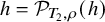 , it follows that
$\|\mathcal {P}_{T_1,\rho }(h)-h\|_2\leq \rho ^r$
, it follows that
$\|\mathcal {P}_{T_1,\rho }(h)-h\|_2\leq \rho ^r$
 . Moreover
$\mathcal {P}_{T_1,\rho }(h)=\sum _{\chi \in S_\rho } \langle h,w_\chi \rangle w_\chi $
. Moreover
$\mathcal {P}_{T_1,\rho }(h)=\sum _{\chi \in S_\rho } \langle h,w_\chi \rangle w_\chi $
 , where
$w_\chi =g_\chi '/\|g_\chi '\|_2$
, where
$w_\chi =g_\chi '/\|g_\chi '\|_2$
 (indeed the orthonormality of the
$w_\chi $
(indeed the orthonormality of the
$w_\chi $
 implies that the eigenvalues of
$T_1$
implies that the eigenvalues of
$T_1$
 are precisely the numbers
$\|g^{\prime }_\chi \|_2^2=\|g_\chi \|_2^2$
are precisely the numbers
$\|g^{\prime }_\chi \|_2^2=\|g_\chi \|_2^2$
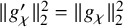 ,
$\chi \in S$
,
$\chi \in S$
 , so
$\text {Eigen}_\rho (T_1)$
, so
$\text {Eigen}_\rho (T_1)$
 is the linear span of
$\{w_\chi :\chi \in S_\rho \}$
is the linear span of
$\{w_\chi :\chi \in S_\rho \}$
 ). By Lemma 7.9, we have
$\|u_\chi -w_\chi \|_2\leq C_s\tau $
). By Lemma 7.9, we have
$\|u_\chi -w_\chi \|_2\leq C_s\tau $
 where
$\tau $
where
$\tau $
 is defined as per (i) for
$\chi \in S_\rho $
is defined as per (i) for
$\chi \in S_\rho $
 (where
$s=|S|$
(where
$s=|S|$
 ). Combining this with condition (ii) from the proof of Theorem 7.12, and with the fact that
$S_\rho \subset S$
). Combining this with condition (ii) from the proof of Theorem 7.12, and with the fact that
$S_\rho \subset S$
 , we conclude that
$\big \|\mathcal {P}_{T_1,\rho }(h)-\sum _{\chi \in S_\rho } \langle h,w_\chi \rangle u_\chi \big \|_2\leq C_s\tau \,|S_\rho | \le \operatorname {\mathrm {Q}}(\eta ,m)C_s\tau \le \eta ^{1/2}/2\le \rho ^{4+r}/250$
, we conclude that
$\big \|\mathcal {P}_{T_1,\rho }(h)-\sum _{\chi \in S_\rho } \langle h,w_\chi \rangle u_\chi \big \|_2\leq C_s\tau \,|S_\rho | \le \operatorname {\mathrm {Q}}(\eta ,m)C_s\tau \le \eta ^{1/2}/2\le \rho ^{4+r}/250$
 . Thus, letting
$c_\chi =\langle h,w_\chi \rangle $
. Thus, letting
$c_\chi =\langle h,w_\chi \rangle $
 , we have

We now want to apply Proposition 7.17 to h, with
$D=S_\rho $
 and
$h'=\sum _{\chi \in S_\rho }c_\chi u_\chi $
and
$h'=\sum _{\chi \in S_\rho }c_\chi u_\chi $
 . By definition of
$S_\rho $
. By definition of
$S_\rho $
 (recall Proposition 5.8), we can let
$\tau _1=(\rho _0/2)^{1/2}$
(recall Proposition 5.8), we can let
$\tau _1=(\rho _0/2)^{1/2}$
 . To estimate
$\tau _2$
. To estimate
$\tau _2$
 , we need to bound
$\|\mathcal {K}_{\varepsilon ^{1/2}}(g_\chi \otimes \overline {g_\chi })-(g_\chi \otimes \overline {g_\chi })\|_2 $
, we need to bound
$\|\mathcal {K}_{\varepsilon ^{1/2}}(g_\chi \otimes \overline {g_\chi })-(g_\chi \otimes \overline {g_\chi })\|_2 $
 . Note that
$g_\chi =F_\chi \operatorname {\mathrm {\circ }}\phi $
. Note that
$g_\chi =F_\chi \operatorname {\mathrm {\circ }}\phi $
 where
$F_\chi :\operatorname {\mathrm {X}}\to \mathbb {C}$
where
$F_\chi :\operatorname {\mathrm {X}}\to \mathbb {C}$
 is a Lipschitz function with
$\|F_\chi \|_{\text {sum}}\le 1+m$
is a Lipschitz function with
$\|F_\chi \|_{\text {sum}}\le 1+m$
 . By Theorem 4.19, for any
$\sigma \in (0,1/2)$
. By Theorem 4.19, for any
$\sigma \in (0,1/2)$
 we have that
$g_\chi $
we have that
$g_\chi $
 is a quadratic character with parameters
$(O_{m}(\sigma ^{-O_m(1)}),\sigma )$
is a quadratic character with parameters
$(O_{m}(\sigma ^{-O_m(1)}),\sigma )$
 . By Proposition 2.52, we have
$\|\mathcal {K}_{\varepsilon ^{1/2}}\big ( (g_\chi ) \otimes \overline {(g_\chi )})- (g_\chi ) \otimes \overline {(g_\chi )}\|_2\leq 4\sigma + O_{m}(\varepsilon ^{1/8}\sigma ^{-O_{m}(1)})$
. By Proposition 2.52, we have
$\|\mathcal {K}_{\varepsilon ^{1/2}}\big ( (g_\chi ) \otimes \overline {(g_\chi )})- (g_\chi ) \otimes \overline {(g_\chi )}\|_2\leq 4\sigma + O_{m}(\varepsilon ^{1/8}\sigma ^{-O_{m}(1)})$
 . Setting
$\sigma =\eta /4$
. Setting
$\sigma =\eta /4$
 , we have
$\|\mathcal {K}_{\varepsilon ^{1/2}}\big ( (g_\chi ) \otimes \overline {(g_\chi )})- (g_\chi ) \otimes \overline {(g_\chi )}\|_2\leq \eta +O_{m,\eta }(\varepsilon ^{1/8})=:\tau _2$
, we have
$\|\mathcal {K}_{\varepsilon ^{1/2}}\big ( (g_\chi ) \otimes \overline {(g_\chi )})- (g_\chi ) \otimes \overline {(g_\chi )}\|_2\leq \eta +O_{m,\eta }(\varepsilon ^{1/8})=:\tau _2$
 . Finally, recall that by Theorem 5.1 we can let
$\tau _3=\mathcal {D}(\eta ,m)$
. Finally, recall that by Theorem 5.1 we can let
$\tau _3=\mathcal {D}(\eta ,m)$
 , and since
$|S_\rho |\le |S|\le \operatorname {\mathrm {Q}}(\eta ,m)$
, and since
$|S_\rho |\le |S|\le \operatorname {\mathrm {Q}}(\eta ,m)$
 , we have that
$\tau _3 |D|\le \tau _3 \operatorname {\mathrm {Q}}(\eta ,m) \le \mathcal {D}(\eta ,m)\operatorname {\mathrm {Q}}(\eta ,m) $
, we have that
$\tau _3 |D|\le \tau _3 \operatorname {\mathrm {Q}}(\eta ,m) \le \mathcal {D}(\eta ,m)\operatorname {\mathrm {Q}}(\eta ,m) $
 , which is at most
$\tau _1^2=\rho _0/2$
, which is at most
$\tau _1^2=\rho _0/2$
 by assumption (i) from the proof of Theorem 7.12 and the above bound on
$\eta $
by assumption (i) from the proof of Theorem 7.12 and the above bound on
$\eta $
 . Finally, by (7.17) we can let
$\tau _4=2\rho ^r$
. Finally, by (7.17) we can let
$\tau _4=2\rho ^r$
 . Applying now Proposition 7.17 with these parameters
$\tau _i$
. Applying now Proposition 7.17 with these parameters
$\tau _i$
 , we obtain (7.14) with

where for this last inequality we used that
$2 |D|\eta \leq (20/\rho ) \eta \leq \rho ^r$
 .
.
To simplify the upper bound in (7.18) further, we impose additional constraints on both
$\varepsilon =\varepsilon _{\eta ,m}$
 and
$\mathcal {D}$
and
$\mathcal {D}$
 . These assumptions are to be thought of as added to the list at the beginning of the proof Theorem 7.12, as the following eighth condition:
-
(viii) We let $\varepsilon =\varepsilon _{\eta ,m}>0$
be such that the term
$O_{m,\eta }(\varepsilon ^{1/8})$
in (7.18) is at most
$(\rho _0/2)^r$
. Furthermore, we then let
$\mathcal {D}$
be such that the term
$O_{m,\eta }(\varepsilon ^{-1/2}\mathcal {D}(\eta ,m))$
in (7.18) is at most
$ (\rho _0/2)^r$
.


Hence
$\|E\|_2\le 13\rho ^r$
 . Let
$\{\lambda _1\ge \lambda _2\ge \cdots \}$
. Let
$\{\lambda _1\ge \lambda _2\ge \cdots \}$
 be the eigenvalues of
$\mathcal {K}_\varepsilon (h\otimes \overline {h})$
be the eigenvalues of
$\mathcal {K}_\varepsilon (h\otimes \overline {h})$
 ordered decreasingly, let the elements of
$S_\rho $
ordered decreasingly, let the elements of
$S_\rho $
 be ordered
$\chi _1,\chi _2,\ldots $
be ordered
$\chi _1,\chi _2,\ldots $
 so that
$|c_{\chi _1}|^2\ge |c_{\chi _2}|^2\ge \cdots $
so that
$|c_{\chi _1}|^2\ge |c_{\chi _2}|^2\ge \cdots $
 , and also let
$c_{\chi _i}:=0$
, and also let
$c_{\chi _i}:=0$
 for
$|S_\rho |<i\le |\operatorname {\mathrm {Z}}|$
for
$|S_\rho |<i\le |\operatorname {\mathrm {Z}}|$
 . We then have (7.15), and thus, for all
$i\in [|\operatorname {\mathrm {Z}}|]$
. We then have (7.15), and thus, for all
$i\in [|\operatorname {\mathrm {Z}}|]$
 , it follows that
$||c_{\chi _i}|^2-\lambda _i|\leq \gamma :=2|S_\rho | C_{|S_\rho |}^2\tau _3/\tau _1^2+\|E\|_2$
, it follows that
$||c_{\chi _i}|^2-\lambda _i|\leq \gamma :=2|S_\rho | C_{|S_\rho |}^2\tau _3/\tau _1^2+\|E\|_2$
 . Similarly, we would like to have a simpler bound for this quantity, so we assume the following additional condition:
-
(ix) The function $\mathcal {D}$
is chosen so that
$2\operatorname {\mathrm {Q}}(\eta ,m)C_{\operatorname {\mathrm {Q}}(\eta ,m)}^2\mathcal {D}(\eta ,m) (\rho _0/2)^{-1}\le (\rho _0/2)^r$
.


Thus we obtain that

Our aim now is to apply Lemma 7.4 to
$A:=\mathcal {K}_\varepsilon (h\otimes \overline {h})$
 . Let
$\{v_i:i\in |\operatorname {\mathrm {Z}}|\}$
. Let
$\{v_i:i\in |\operatorname {\mathrm {Z}}|\}$
 be an orthonormal basis of eigenvectors of A, where
$v_i$
be an orthonormal basis of eigenvectors of A, where
$v_i$
 has corresponding eigenvalue
$\lambda _i$
has corresponding eigenvalue
$\lambda _i$
 .
.
We claim that each
$u_\chi $
 with
$\chi \in S_\rho $
with
$\chi \in S_\rho $
 is a
$\beta $
is a
$\beta $
 -pseudoeigenvector of A with pseudoeigenvalue
$|c_\chi |^2$
-pseudoeigenvector of A with pseudoeigenvalue
$|c_\chi |^2$
 , for
$\beta =14\rho ^r$
, for
$\beta =14\rho ^r$
 . Indeed (7.14) implies
$\mathcal {K}_\varepsilon (h\otimes \overline {h})u_\chi = \sum _{\chi '\in S_\rho } |c_{\chi '}|^2 u_{\chi '}\langle u_\chi ,u_{\chi '}\rangle + Eu_\chi $
. Indeed (7.14) implies
$\mathcal {K}_\varepsilon (h\otimes \overline {h})u_\chi = \sum _{\chi '\in S_\rho } |c_{\chi '}|^2 u_{\chi '}\langle u_\chi ,u_{\chi '}\rangle + Eu_\chi $
 , so
, so

the second inequality holding by (7.10) and the third by (ii), using
$\eta \le \rho ^r$
 and our bound on
$\|E\|_2$
and our bound on
$\|E\|_2$
 .
.
Fix any
$\lambda \in \mathrm{Spec}_{\rho ^q}(A)$
 and let v be a corresponding unit eigenvector. Since
$\mathrm{Spec}_{\rho ^q}(A)$
and let v be a corresponding unit eigenvector. Since
$\mathrm{Spec}_{\rho ^q}(A)$
 is
$\delta $
is
$\delta $
 -separated and
$\lambda \ge \rho ^q>14\rho ^r$
-separated and
$\lambda \ge \rho ^q>14\rho ^r$
 , we have
$||c_\chi |^2-\lambda |\le 14\rho ^r$
, we have
$||c_\chi |^2-\lambda |\le 14\rho ^r$
 for some
$\chi \in S_\rho $
for some
$\chi \in S_\rho $
 . Let
$C_{\rho ^{q}/2}(|c_\chi |^2):=\{i\in [|\operatorname {\mathrm {Z}}|]:|\lambda _i-|c_\chi |^2|\le \rho ^{q}/2\}$
. Let
$C_{\rho ^{q}/2}(|c_\chi |^2):=\{i\in [|\operatorname {\mathrm {Z}}|]:|\lambda _i-|c_\chi |^2|\le \rho ^{q}/2\}$
 . We claim that
$C_{\rho ^{q}/2}(|c_\chi |^2) = \{\lambda \}$
. We claim that
$C_{\rho ^{q}/2}(|c_\chi |^2) = \{\lambda \}$
 . First, note that if
$i>|S_\rho |$
. First, note that if
$i>|S_\rho |$
 , the second part of (7.19) tells us that
$\lambda _i\le 14\rho ^r$
, the second part of (7.19) tells us that
$\lambda _i\le 14\rho ^r$
 . Since
$\rho ^q-\rho ^q/2-14\rho ^r>14\rho ^r$
. Since
$\rho ^q-\rho ^q/2-14\rho ^r>14\rho ^r$
 , it follows that for
$i>|S_\rho |$
, it follows that for
$i>|S_\rho |$
 we have
$|\lambda _i-|c_\chi |^2|>\rho ^q/2$
we have
$|\lambda _i-|c_\chi |^2|>\rho ^q/2$
 . Now if
$i\le |S_\rho |$
. Now if
$i\le |S_\rho |$
 , then, since by assumption
$|\mathrm{Spec}_{\rho ^q}(A)|=|S_\rho |$
, then, since by assumption
$|\mathrm{Spec}_{\rho ^q}(A)|=|S_\rho |$
 , it follows that
$\lambda _i\ge \rho ^q$
, it follows that
$\lambda _i\ge \rho ^q$
 for all
$i\le |S_\rho |$
for all
$i\le |S_\rho |$
 . Let
$\lambda _i\not =\lambda $
. Let
$\lambda _i\not =\lambda $
 for
$i\ge |S_\rho |$
for
$i\ge |S_\rho |$
 . We want to prove that
$|\lambda _i-|c_\chi |^2|>\rho ^q$
. We want to prove that
$|\lambda _i-|c_\chi |^2|>\rho ^q$
 . As
$\mathrm{Spec}_{\rho ^q}(A)$
. As
$\mathrm{Spec}_{\rho ^q}(A)$
 is
$\delta $
is
$\delta $
 -separated, we have
$|\lambda -\lambda _i|\ge \delta \ge \rho ^q$
-separated, we have
$|\lambda -\lambda _i|\ge \delta \ge \rho ^q$
 . Thus,
$|\lambda _i-|c_\chi |^2|\ge |\lambda _i-\lambda |-|\lambda -|c_\chi |^2|\ge \rho ^q-14\rho ^r>\rho ^q/2$
. Thus,
$|\lambda _i-|c_\chi |^2|\ge |\lambda _i-\lambda |-|\lambda -|c_\chi |^2|\ge \rho ^q-14\rho ^r>\rho ^q/2$
 . Therefore, we can define a map
$J:\mathrm{Spec}_{\rho ^q}(A)\to S_\rho $
. Therefore, we can define a map
$J:\mathrm{Spec}_{\rho ^q}(A)\to S_\rho $
 that associates
$\lambda $
that associates
$\lambda $
 with the unique
$\chi \in S_\rho $
with the unique
$\chi \in S_\rho $
 such that
$|\lambda -|c_\chi |^2|\le \rho ^q/2$
such that
$|\lambda -|c_\chi |^2|\le \rho ^q/2$
 . As
$|\mathrm{Spec}_{\rho ^q}(A)|=|S_\rho |$
. As
$|\mathrm{Spec}_{\rho ^q}(A)|=|S_\rho |$
 , J is a bijection. By Lemma 7.4, we have
$\|u_\chi -\langle u_\chi ,v\rangle v\|_2\le 28\rho ^{r- q}$
, J is a bijection. By Lemma 7.4, we have
$\|u_\chi -\langle u_\chi ,v\rangle v\|_2\le 28\rho ^{r- q}$
 .
.
In particular
$|1-|\langle u_\chi ,v\rangle |\;|\le 28\rho ^{r- q}\le 1/2$
 . Hence
$\|u_\chi /\langle u_\chi ,v\rangle -v\|_2\le \frac {1}{\langle u_\chi ,v\rangle }\beta /\delta \le 56\rho ^{r- q}$
. Hence
$\|u_\chi /\langle u_\chi ,v\rangle -v\|_2\le \frac {1}{\langle u_\chi ,v\rangle }\beta /\delta \le 56\rho ^{r- q}$
 . Note that
$\big |\frac {1}{\langle u_\chi ,v\rangle }-\frac {\overline {\langle u_\chi ,v\rangle }}{|\langle u_\chi ,v\rangle |}\big | = \big |\frac {1}{|\langle u_\chi ,v\rangle |}-1\big |=\big |\frac {|\langle u_\chi ,v\rangle |-1}{\langle u_\chi ,v\rangle }\big |\le 56\rho ^{r- q}$
. Note that
$\big |\frac {1}{\langle u_\chi ,v\rangle }-\frac {\overline {\langle u_\chi ,v\rangle }}{|\langle u_\chi ,v\rangle |}\big | = \big |\frac {1}{|\langle u_\chi ,v\rangle |}-1\big |=\big |\frac {|\langle u_\chi ,v\rangle |-1}{\langle u_\chi ,v\rangle }\big |\le 56\rho ^{r- q}$
 and thus, letting
$z:=\frac {\overline {\langle u_\chi ,v\rangle }}{|\langle u_\chi ,v\rangle |}$
and thus, letting
$z:=\frac {\overline {\langle u_\chi ,v\rangle }}{|\langle u_\chi ,v\rangle |}$
 we have that
$\left \|v-\frac {zg_\chi }{\|g_\chi \|_2}\right \|_2\le 112\rho ^{r- q}$
we have that
$\left \|v-\frac {zg_\chi }{\|g_\chi \|_2}\right \|_2\le 112\rho ^{r- q}$
 .
.
With this, we can now recover the component
$g_\chi $
 of f. Indeed, note that

Thus
$\|g_\chi -\langle f,v\rangle v\|_2\le \|g_\chi -\langle f,\frac {zg_\chi }{\|g_\chi \|_2}\rangle \frac {zg_\chi }{\|g_\chi \|_2}\|_2+224\rho ^{r- q}$
 . Moreover
$\|g_\chi -\langle f,\frac {zg_\chi }{\|g_\chi \|_2}\rangle \frac {zg_\chi }{\|g_\chi \|_2}\|_2 = \frac {1}{\|g_\chi \|_2}|\|g_\chi \|_2^2-\langle f,g_\chi \rangle g_\chi |$
. Moreover
$\|g_\chi -\langle f,\frac {zg_\chi }{\|g_\chi \|_2}\rangle \frac {zg_\chi }{\|g_\chi \|_2}\|_2 = \frac {1}{\|g_\chi \|_2}|\|g_\chi \|_2^2-\langle f,g_\chi \rangle g_\chi |$
 . As
$\chi \in S_\rho $
. As
$\chi \in S_\rho $
 , we have
$\|g_\chi \|_2\ge \sqrt {\rho }$
, we have
$\|g_\chi \|_2\ge \sqrt {\rho }$
 , and by Lemma 5.3 combined with (v) and
$4\sqrt {\eta }/\sqrt {\rho }\le \rho ^r$
, and by Lemma 5.3 combined with (v) and
$4\sqrt {\eta }/\sqrt {\rho }\le \rho ^r$
 , we have that
$\|g_\chi -\langle f,v\rangle v\|_2\le \rho ^r+224\rho ^{r- q}\le 225\rho ^{r-q}$
, we have that
$\|g_\chi -\langle f,v\rangle v\|_2\le \rho ^r+224\rho ^{r- q}\le 225\rho ^{r-q}$
 .
.
Finally, to see that v indeed correlates with f, note that by Lemma 5.3 combined with (v), we have
$|\langle f,g_\chi \rangle -\|g_\chi \|_2^2|\le \rho ^r$
 (similarly as before). Hence
$|\langle f, \langle f,v\rangle v\rangle |\ge |\langle f,g_\chi \rangle |-\|g_\chi -\langle f,v\rangle v\|_2\ge \rho -226\rho ^{r-q}\ge \rho /2$
(similarly as before). Hence
$|\langle f, \langle f,v\rangle v\rangle |\ge |\langle f,g_\chi \rangle |-\|g_\chi -\langle f,v\rangle v\|_2\ge \rho -226\rho ^{r-q}\ge \rho /2$
 where we used that
$\|g_\chi \|_2^2\ge \rho $
where we used that
$\|g_\chi \|_2^2\ge \rho $
 . Therefore
$|\langle f,v\rangle |\ge \sqrt {\rho /2}$
. Therefore
$|\langle f,v\rangle |\ge \sqrt {\rho /2}$
 .
.
The second consequence of Proposition 7.17 is the following confirmation of the fact mentioned at the beginning of Remark 7.16.
Lemma 7.18. Under the same assumptions as Theorems 7.12 and 7.15, assume further that
$r>3$
 and
$\rho <(1/450)^{1/(r-3)}$
and
$\rho <(1/450)^{1/(r-3)}$
 . Let
$h=P_\rho (f)$
. Let
$h=P_\rho (f)$
 . Then there is a bijection
$B:\mathrm{Spec}_{\rho }(\mathcal {K}_\varepsilon (h\otimes \overline {h}))\to \mathrm{Spec}_\rho (\mathcal {K}_\varepsilon (f\otimes \overline {f}))$
. Then there is a bijection
$B:\mathrm{Spec}_{\rho }(\mathcal {K}_\varepsilon (h\otimes \overline {h}))\to \mathrm{Spec}_\rho (\mathcal {K}_\varepsilon (f\otimes \overline {f}))$
 which preserves multiplicity of eigenvalues and satisfies
$|B(\lambda )-\lambda |\leq 15\rho ^r$
which preserves multiplicity of eigenvalues and satisfies
$|B(\lambda )-\lambda |\leq 15\rho ^r$
 .
.
Proof. Recall from (7.13) the definition of the
$\operatorname {\mathrm {Z}}$
 -matrices
$T_1$
-matrices
$T_1$
 and
$T_2$
and
$T_2$
 and recall that
$\|T_1-T_2\|_2\le 24\sqrt {\eta }$
and recall that
$\|T_1-T_2\|_2\le 24\sqrt {\eta }$
 . By definition, the
$|\operatorname {\mathrm {Z}}|$
. By definition, the
$|\operatorname {\mathrm {Z}}|$
 eigenvalues of
$T_1$
eigenvalues of
$T_1$
 are precisely
$\|g_{\chi _1}\|_2^2\ge \|g_{\chi _2}\|_2^2\ge \cdots $
are precisely
$\|g_{\chi _1}\|_2^2\ge \|g_{\chi _2}\|_2^2\ge \cdots $
 (where we complete the list with zeroes if necessary), and the
$|\operatorname {\mathrm {Z}}|$
(where we complete the list with zeroes if necessary), and the
$|\operatorname {\mathrm {Z}}|$
 eigenvalues of
$T_2$
eigenvalues of
$T_2$
 are
$\lambda _1\ge \lambda _2\ge \cdots $
are
$\lambda _1\ge \lambda _2\ge \cdots $
 . By Theorem 7.10 we have
$\sum _{i=1}^{|S_\rho |} |\|g_{\chi _i}\|_2^2-\lambda _i|^2\leq \sum _{i=1}^{|\operatorname {\mathrm {Z}}|} |\|g_{\chi _i}\|_2^2-\lambda _i|^2\le 24^2 \eta \le \rho ^{2r}$
. By Theorem 7.10 we have
$\sum _{i=1}^{|S_\rho |} |\|g_{\chi _i}\|_2^2-\lambda _i|^2\leq \sum _{i=1}^{|\operatorname {\mathrm {Z}}|} |\|g_{\chi _i}\|_2^2-\lambda _i|^2\le 24^2 \eta \le \rho ^{2r}$
 .
.
Now we apply Proposition 7.17 with
$h=P_\rho (f)$
 and
$h'=\sum _{\chi \in S_\rho }g_\chi $
and
$h'=\sum _{\chi \in S_\rho }g_\chi $
 , using that
$\|P_\rho (f)\|_2\leq 1$
, using that
$\|P_\rho (f)\|_2\leq 1$
 and that, by (7.8), we have
$\|h-h'\|_2=\rho ^r$
and that, by (7.8), we have
$\|h-h'\|_2=\rho ^r$
 . Let
$A:=\mathcal {K}_\varepsilon (h\otimes \overline {h})$
. Let
$A:=\mathcal {K}_\varepsilon (h\otimes \overline {h})$
 and let
$\mathrm{Spec}(A)=\{\mu _1\ge \mu _2\ge \cdots \}$
and let
$\mathrm{Spec}(A)=\{\mu _1\ge \mu _2\ge \cdots \}$
 . Reusing the bound (7.19) from Theorem 7.15 we have
$\big (\sum _{i=1}^{|\operatorname {\mathrm {Z}}|} ||c_{\chi _i}|^2-\mu _i|^2\big )^{1/2}\le 14\rho ^r$
. Reusing the bound (7.19) from Theorem 7.15 we have
$\big (\sum _{i=1}^{|\operatorname {\mathrm {Z}}|} ||c_{\chi _i}|^2-\mu _i|^2\big )^{1/2}\le 14\rho ^r$
 where crucially here
$c_\chi =\|g_\chi \|_2$
where crucially here
$c_\chi =\|g_\chi \|_2$
 if
$\chi \in S_\rho $
if
$\chi \in S_\rho $
 and
$c_\chi =0$
and
$c_\chi =0$
 otherwise. In particular,
$\big (\sum _{i=1}^{|S_\rho |} |\|g_{\chi _i}\|_2^2-\mu _i|^2\big )^{1/2}\le 14\rho ^r$
otherwise. In particular,
$\big (\sum _{i=1}^{|S_\rho |} |\|g_{\chi _i}\|_2^2-\mu _i|^2\big )^{1/2}\le 14\rho ^r$
 . By the triangle inequality, we deduce that
$\big (\sum _{i=1}^{|S_\rho |} |\mu _i-\lambda _i|^2\big )^{1/2}\le 15\rho ^r$
. By the triangle inequality, we deduce that
$\big (\sum _{i=1}^{|S_\rho |} |\mu _i-\lambda _i|^2\big )^{1/2}\le 15\rho ^r$
 .
.
To conclude that this gives the desired bijection, we want to ensure that all the
$\mu _i$
 are larger than
$\rho $
are larger than
$\rho $
 . By Remark 7.14, we have
$\lambda _{|S_\rho |}\ge \rho +\rho _0^3/30$
. By Remark 7.14, we have
$\lambda _{|S_\rho |}\ge \rho +\rho _0^3/30$
 . By our assumption on r and
$\rho $
. By our assumption on r and
$\rho $
 , we know that
$\rho _0^3/30\ge \rho ^3/30>15\rho ^r$
, we know that
$\rho _0^3/30\ge \rho ^3/30>15\rho ^r$
 . Therefore
$\mu _{|S_\rho |}\ge \rho $
. Therefore
$\mu _{|S_\rho |}\ge \rho $
 and the result follows.
Remark 7.19. It follows from Lemma 7.2 combined with Lemma 7.4 that if an eigenvalue of
$\mathcal {K}_\varepsilon (f\otimes \overline {f})$
 is large and sufficiently separated from the rest, then the projection of f to the corresponding eigenspace is very close to one of the nilspace characters
$g_\chi $
is large and sufficiently separated from the rest, then the projection of f to the corresponding eigenspace is very close to one of the nilspace characters
$g_\chi $
 . Moreover, Theorem 7.15 could be generalized to be applicable in clusters of eigenvalues. That is, if C is a submultiset of
$\mathrm{Spec}_{\rho }\big (\mathcal {K}_\varepsilon (f\otimes \overline {f})\big )$
. Moreover, Theorem 7.15 could be generalized to be applicable in clusters of eigenvalues. That is, if C is a submultiset of
$\mathrm{Spec}_{\rho }\big (\mathcal {K}_\varepsilon (f\otimes \overline {f})\big )$
 such that C is included in a ball of small radius separated from the rest of the eigenvalues, then the mentioned generalization of Theorem 7.15 would involve a vector h chosen in the eigenspace corresponding to C, instead of the whole space
$\text {Eigen}_\rho \big (\mathcal {K}_\varepsilon (f\otimes \overline {f})\big )$
such that C is included in a ball of small radius separated from the rest of the eigenvalues, then the mentioned generalization of Theorem 7.15 would involve a vector h chosen in the eigenspace corresponding to C, instead of the whole space
$\text {Eigen}_\rho \big (\mathcal {K}_\varepsilon (f\otimes \overline {f})\big )$
 . Another possible extension of Theorem 7.15 involves not assuming that
$|\mathrm{Spec}_{\rho ^q}(A)|=|S_\rho |$
. Another possible extension of Theorem 7.15 involves not assuming that
$|\mathrm{Spec}_{\rho ^q}(A)|=|S_\rho |$
 . In this case, we could prove an analogous result but where the map
$J:\mathrm{Spec}_{\rho ^q}(A)\to S_\rho $
. In this case, we could prove an analogous result but where the map
$J:\mathrm{Spec}_{\rho ^q}(A)\to S_\rho $
 is only an injection. As we shall not use these extensions in the paper, we omit their proofs.
Finally, note that it follows from (7.19) that, for any
$h\in \text {Eigen}_\rho \big (\mathcal {K}_\varepsilon (f\otimes \overline {f})\big )$
 with
$\|h\|_2\le 1$
with
$\|h\|_2\le 1$
 , we have
$|\mathrm{Spec}_{\rho ^q}\big (\mathcal {K}_\varepsilon (h\otimes \overline {h})\big )|\leq |S_\rho |$
, we have
$|\mathrm{Spec}_{\rho ^q}\big (\mathcal {K}_\varepsilon (h\otimes \overline {h})\big )|\leq |S_\rho |$
 . Indeed, choosing h in
$\text {Eigen}_\rho \big (\mathcal {K}_\varepsilon (f\otimes \overline {f})\big )$
. Indeed, choosing h in
$\text {Eigen}_\rho \big (\mathcal {K}_\varepsilon (f\otimes \overline {f})\big )$
 generates a gap in the set of the eigenvalues of
$\mathcal {K}_\varepsilon (h\otimes \overline {h})$
generates a gap in the set of the eigenvalues of
$\mathcal {K}_\varepsilon (h\otimes \overline {h})$
 , that is, there are at most
$|S_\rho |$
, that is, there are at most
$|S_\rho |$
 such eigenvalues which can be larger than
$14\rho ^r$
such eigenvalues which can be larger than
$14\rho ^r$
 and all the others must be small. In particular, we can combine this fact with Lemma 7.18 to deduce that for
$h=P_\rho (f)$
and all the others must be small. In particular, we can combine this fact with Lemma 7.18 to deduce that for
$h=P_\rho (f)$
 , we have
$\mathrm{Spec}_{\rho ^q}\big (\mathcal {K}_\varepsilon (h\otimes \overline {h})\big )=\mathrm{Spec}_{\rho }\big (\mathcal {K}_\varepsilon (h\otimes \overline {h})\big )$
, we have
$\mathrm{Spec}_{\rho ^q}\big (\mathcal {K}_\varepsilon (h\otimes \overline {h})\big )=\mathrm{Spec}_{\rho }\big (\mathcal {K}_\varepsilon (h\otimes \overline {h})\big )$
 .
.
Proof of Theorem 1.6.
This follows from Theorem 7.15 applied with
$q=7$
 and
$r=11$
and
$r=11$
 . Indeed, this application gives us that each unit eigenvector v has a corresponding 2-step nilspace character
$g_\chi $
. Indeed, this application gives us that each unit eigenvector v has a corresponding 2-step nilspace character
$g_\chi $
 such that
$\|v-g_\chi /\langle f,v\rangle \|_2\leq 56 \rho ^{7/2}$
such that
$\|v-g_\chi /\langle f,v\rangle \|_2\leq 56 \rho ^{7/2}$
 . The claimed quadratic character is then
$g:=g_\chi /\langle f,v\rangle $
. The claimed quadratic character is then
$g:=g_\chi /\langle f,v\rangle $
 . To obtain the complexity and precision bounds for g, note that, by Remark 4.20, the function
$g_\chi $
. To obtain the complexity and precision bounds for g, note that, by Remark 4.20, the function
$g_\chi $
 is an
$(R,\sigma )$
is an
$(R,\sigma )$
 -character of order 2 with
$R=O_{\operatorname {\mathrm {X}},\|F\|_{\text {sum}}}(\sigma ^{-O_{\operatorname {\mathrm {X}}}(1)})$
-character of order 2 with
$R=O_{\operatorname {\mathrm {X}},\|F\|_{\text {sum}}}(\sigma ^{-O_{\operatorname {\mathrm {X}}}(1)})$
 . Letting
$\sigma =c\rho ^2$
. Letting
$\sigma =c\rho ^2$
 for a small enough constant
$c>0$
for a small enough constant
$c>0$
 , we have that g is a
$(O_\rho (1),\rho )$
, we have that g is a
$(O_\rho (1),\rho )$
 -quadratic character and
$|\langle f,g\rangle |\ge |\langle f,v\rangle |-\|v-g\|_2\ge \sqrt {\rho /2}-56\rho ^{7/2}\ge \sqrt {\rho /4}$
-quadratic character and
$|\langle f,g\rangle |\ge |\langle f,v\rangle |-\|v-g\|_2\ge \sqrt {\rho /2}-56\rho ^{7/2}\ge \sqrt {\rho /4}$
 .
.
7.2.1 Handling clustered eigenvalues
Suppose that we are working under the assumptions of Theorem 7.15, and for the given 1-bounded function
$f:\operatorname {\mathrm {Z}}\to \mathbb {C}$
 we want to recover the individual
$g_\chi $
we want to recover the individual
$g_\chi $
 ,
$\chi \in S_\rho $
,
$\chi \in S_\rho $
 in the decomposition of f involved in that theorem. As explained earlier (in particular, combining Remark 7.16 and Lemma 7.18), if the large spectrum of
$\mathcal {K}_\varepsilon (f\otimes \overline {f})$
in the decomposition of f involved in that theorem. As explained earlier (in particular, combining Remark 7.16 and Lemma 7.18), if the large spectrum of
$\mathcal {K}_\varepsilon (f\otimes \overline {f})$
 is sufficiently separated, then the desired recovery is straightforward using this spectrum, by Theorem 7.15. Hence, the last difficulty that we face for this recovery is the possibility that, for
$h=P_\rho (f)$
is sufficiently separated, then the desired recovery is straightforward using this spectrum, by Theorem 7.15. Hence, the last difficulty that we face for this recovery is the possibility that, for
$h=P_\rho (f)$
 , the separation assumptions for the spectrum in Theorem 7.15 do not hold. Our goal now is to show that, in fact, if we select another function h randomly in
$\text {Eigen}_\rho \big (\mathcal {K}_\varepsilon (f\otimes \overline {f})\big )$
, the separation assumptions for the spectrum in Theorem 7.15 do not hold. Our goal now is to show that, in fact, if we select another function h randomly in
$\text {Eigen}_\rho \big (\mathcal {K}_\varepsilon (f\otimes \overline {f})\big )$
 according to a simple normal distribution (specified below), then with high probability the resulting spectrum
$\mathrm{Spec}_{\rho ^q}\big (\mathcal {K}_\varepsilon (h\otimes \overline {h})\big )$
according to a simple normal distribution (specified below), then with high probability the resulting spectrum
$\mathrm{Spec}_{\rho ^q}\big (\mathcal {K}_\varepsilon (h\otimes \overline {h})\big )$
 will satisfy the conditions for Theorem 7.15 to be applicable, and thus enable the recovery of the
$g_\chi $
will satisfy the conditions for Theorem 7.15 to be applicable, and thus enable the recovery of the
$g_\chi $
 .
.
Let us now detail the probabilistic argument. Let
$\gamma \in [0,1]$
 be some fixed parameter to be determined later. Let
$A_1,B_1,A_2,B_2,\ldots ,A_t,B_t$
be some fixed parameter to be determined later. Let
$A_1,B_1,A_2,B_2,\ldots ,A_t,B_t$
 be i.i.d. real normal random variables with mean
$0$
be i.i.d. real normal random variables with mean
$0$
 and variance
$\gamma /(2{t})$
and variance
$\gamma /(2{t})$
 . Then, for every
$j\in [t]$
. Then, for every
$j\in [t]$
 , let
$X_j$
, let
$X_j$
 be the complex random variable
$A_j+iB_j$
be the complex random variable
$A_j+iB_j$
 , and let

be the resulting complex Gaussian random vector in
$\mathbb {C}^{t}$
 (for background on such vectors see, e.g., [Reference Goodman20]). Note that
$\mathbb {E}\|X\|_{\ell ^2}=\mathbb {E}(|X_1|^2+\cdots +|X_{t}|^2)=\mathbb {E}(A_1^2+B_1^2+\cdots +A_{t}^2+B_{t}^2)=\gamma $
(for background on such vectors see, e.g., [Reference Goodman20]). Note that
$\mathbb {E}\|X\|_{\ell ^2}=\mathbb {E}(|X_1|^2+\cdots +|X_{t}|^2)=\mathbb {E}(A_1^2+B_1^2+\cdots +A_{t}^2+B_{t}^2)=\gamma $
 .
.
Letting
$v_1,\ldots ,v_{t}$
 be an orthonormal basis of complex eigenvectors for
$\text {Eigen}_\rho \big (\mathcal {K}_\varepsilon (f\otimes \overline {f})\big )$
be an orthonormal basis of complex eigenvectors for
$\text {Eigen}_\rho \big (\mathcal {K}_\varepsilon (f\otimes \overline {f})\big )$
 , we then define the random vector

Note that
$\mathbb {E}\|h\|_2^2=\gamma $
 . We want to prove that, with high probability, the large spectrum of
$\mathcal {K}_\varepsilon (h\otimes \overline {h})$
. We want to prove that, with high probability, the large spectrum of
$\mathcal {K}_\varepsilon (h\otimes \overline {h})$
 satisfies the properties required in Theorem 7.15. To do so, we plan to use Proposition 7.17, which requires us to prove that h is sufficiently close to a vector of the form
$\sum _{\chi \in S_\rho }c_\chi u_\chi $
satisfies the properties required in Theorem 7.15. To do so, we plan to use Proposition 7.17, which requires us to prove that h is sufficiently close to a vector of the form
$\sum _{\chi \in S_\rho }c_\chi u_\chi $
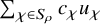 such that the set
$\{|c_\chi |^2\}_{\chi \in S_\rho }$
such that the set
$\{|c_\chi |^2\}_{\chi \in S_\rho }$
 is sufficiently separated. Hence, we would like to express h in terms of the
$u_{\chi _i}$
is sufficiently separated. Hence, we would like to express h in terms of the
$u_{\chi _i}$
 rather than the
$v_j$
rather than the
$v_j$
 (note that here we are using that
${t}=|S_\rho |=|\mathrm{Spec}_\rho (f\otimes \overline {f})|$
(note that here we are using that
${t}=|S_\rho |=|\mathrm{Spec}_\rho (f\otimes \overline {f})|$
 ). However, the subspace of
$\mathbb {C}^{\operatorname {\mathrm {Z}}}$
). However, the subspace of
$\mathbb {C}^{\operatorname {\mathrm {Z}}}$
 generated by
$\{u_{\chi _i}\}_{i\in [{t}]}$
generated by
$\{u_{\chi _i}\}_{i\in [{t}]}$
 may not be the same as the one generated by the
$\{v_j\}_{j\in [{t}]}$
may not be the same as the one generated by the
$\{v_j\}_{j\in [{t}]}$
 . Fortunately, these two subspaces are close to each other, as we detail in the proof of Theorem 7.24 below. Let P denote the orthogonal projection in
$\mathbb {C}^{\operatorname {\mathrm {Z}}}$
. Fortunately, these two subspaces are close to each other, as we detail in the proof of Theorem 7.24 below. Let P denote the orthogonal projection in
$\mathbb {C}^{\operatorname {\mathrm {Z}}}$
 onto the subspace spanned by
$\{u_\chi :\chi \in S_\rho \}$
onto the subspace spanned by
$\{u_\chi :\chi \in S_\rho \}$
 . Let
$W\in \mathbb {C}^{{t}\times {t}}$
. Let
$W\in \mathbb {C}^{{t}\times {t}}$
 be the matrix defined by

As we shall establish in the proof of Theorem 7.24, we then have

Remark 7.20. Note that the matrix W here is not a
$\operatorname {\mathrm {Z}}$
 -matrix and we do not use the normalization for it as we do for
$\operatorname {\mathrm {Z}}$
-matrix and we do not use the normalization for it as we do for
$\operatorname {\mathrm {Z}}$
 -matrices (recall Definition 2.3). In particular, given a vector
$x\in \mathbb {C}^t$
-matrices (recall Definition 2.3). In particular, given a vector
$x\in \mathbb {C}^t$
 , we use the standard definition
$(Wx)_i=\sum _{j\in [t]} W_{i,j}x_j$
, we use the standard definition
$(Wx)_i=\sum _{j\in [t]} W_{i,j}x_j$
 . Recall that
$\|x\|_{\ell ^2}^2$
. Recall that
$\|x\|_{\ell ^2}^2$
 denotes the Euclidean norm of
$x\in \mathbb {C}^t$
denotes the Euclidean norm of
$x\in \mathbb {C}^t$
 , that is
$\|x\|_{\ell ^2}^2=\sum _{i\in [t]}|x_i|^2$
, that is
$\|x\|_{\ell ^2}^2=\sum _{i\in [t]}|x_i|^2$
 . In particular, by (7.21) we have
$\|h\|_2=\|X\|_{\ell ^2}$
. In particular, by (7.21) we have
$\|h\|_2=\|X\|_{\ell ^2}$
 .
.
Now, by definition of the matrix W above, and (7.23), for any vector
$x\in \mathbb {C}^t$
 we have

where all sums and averages here are for i and j in
$[{t}]$
 . This will imply that the matrix W is nearly unitary. To justify this we will use the following independent result.
Lemma 7.21. Let
$N\in \mathbb {N}$
 , let
${t}\in [N]$
, let
${t}\in [N]$
 , let
$\kappa \in (0,1]$
, let
$\kappa \in (0,1]$
 , and
$\tau \in (0, 1/(2{t}))$
, and
$\tau \in (0, 1/(2{t}))$
 . Let
$\{v_i\}_{i\in [{t}]}\subset \mathbb {C}^N$
. Let
$\{v_i\}_{i\in [{t}]}\subset \mathbb {C}^N$
 be an orthonormal set of vectors, let
$\{u_i\}_{i\in [{t}]}\subset \mathbb {C}^N$
be an orthonormal set of vectors, let
$\{u_i\}_{i\in [{t}]}\subset \mathbb {C}^N$
 be a set of unit vectors such that for every
$i\not =j$
be a set of unit vectors such that for every
$i\not =j$
 we have
$|\langle u_i,u_j\rangle |\le \tau $
we have
$|\langle u_i,u_j\rangle |\le \tau $
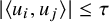 , and let
$\{d_i\}_{i\in [{t}]}\subset \mathbb {C}^N$
, and let
$\{d_i\}_{i\in [{t}]}\subset \mathbb {C}^N$
 be such that for every
$i\in [{t}]$
be such that for every
$i\in [{t}]$
 we have
$\|d_i\|_2\le \kappa $
we have
$\|d_i\|_2\le \kappa $
 . Let W be a matrix in
$\mathbb {C}^{{t}\times {t}}$
. Let W be a matrix in
$\mathbb {C}^{{t}\times {t}}$
 such that for every
$j\in [{t}]$
such that for every
$j\in [{t}]$
 we have
$v_j = \textstyle \sum _{i\in [{t}]} W_{i,j} u_i+d_j$
we have
$v_j = \textstyle \sum _{i\in [{t}]} W_{i,j} u_i+d_j$
 . Then, for every
$x\in \mathbb {C}^{t}$
. Then, for every
$x\in \mathbb {C}^{t}$
 we have

Proof. By the analogue of (7.24) for
$v_i,u_i$
 , we have

We now expand both sides.
The right side of (7.26) equals
$\langle \sum _j x_j (v_j-d_j), \sum _{j'} x_{j'} (v_{j'}-d_{j'})\rangle = \sum _{j,j'} x_j\overline {x_{j'}} (\langle v_j,v_{j'}\rangle -\langle v_j,d_{j'}\rangle -\langle d_j,v_{j'}\rangle +\langle d_j,d_{j'}\rangle )$
 . As the
$v_i$
. As the
$v_i$
 are orthonormal, we have
$\sum _{j,j'} x_j\overline {x_{j'}} \langle v_j,v_{j'}\rangle =\|x\|_{\ell ^2}^2$
are orthonormal, we have
$\sum _{j,j'} x_j\overline {x_{j'}} \langle v_j,v_{j'}\rangle =\|x\|_{\ell ^2}^2$
 . By Cauchy-Schwarz, and recalling that
$\kappa \le 1$
. By Cauchy-Schwarz, and recalling that
$\kappa \le 1$
 , we have
$\big |\|\sum _j x_j (v_j-d_j)\|_2^2-\|x\|_{\ell ^2}^2\big |\le \sum _{j,j'}|x_jx_{j'}|3\kappa =3\kappa \big (\sum _j|x_j|\big )^2\le 3\kappa {t}\|x\|_{\ell ^2}^2$
, we have
$\big |\|\sum _j x_j (v_j-d_j)\|_2^2-\|x\|_{\ell ^2}^2\big |\le \sum _{j,j'}|x_jx_{j'}|3\kappa =3\kappa \big (\sum _j|x_j|\big )^2\le 3\kappa {t}\|x\|_{\ell ^2}^2$
 .
.
The left-hand side of (7.26) is
$\|\sum _i (Wx)_i u_i\|_2^2 = \sum _{i,i'} (Wx)_i\overline {(Wx)_{i'}} \langle u_i,u_{i'}\rangle $
 , which equals
$\|Wx\|_{\ell ^2}^2 + \sum _{i\neq i'} (Wx)_i\overline {(Wx)_{i'}}\langle u_i,u_{i'}\rangle $
, which equals
$\|Wx\|_{\ell ^2}^2 + \sum _{i\neq i'} (Wx)_i\overline {(Wx)_{i'}}\langle u_i,u_{i'}\rangle $
 . Hence
$\big | \|Wx\|_{\ell ^2}^2 -\|\sum _i (Wx)_i u_i\|_2^2\big |\leq \tau (\sum _i |(Wx)_i|)^2$
. Hence
$\big | \|Wx\|_{\ell ^2}^2 -\|\sum _i (Wx)_i u_i\|_2^2\big |\leq \tau (\sum _i |(Wx)_i|)^2$
 , which is at most
$\tau t \sum _i |(Wx)_i|^2 \leq \tau {t} \|W\|_{\ell ^2}^2\|x\|_{\ell ^2}^2$
, which is at most
$\tau t \sum _i |(Wx)_i|^2 \leq \tau {t} \|W\|_{\ell ^2}^2\|x\|_{\ell ^2}^2$
 .
.
Finally, let us prove that
$\|W\|_{\ell ^2}^2\leq 12{t}$
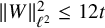 . Note that for every
$j\in [{t}]$
. Note that for every
$j\in [{t}]$
 we have

As
$\|\sum _{i} W_{i,j} u_i\|_2\le \|v_j\|_2+\|d_j\|_2\le 1+\kappa \le 2$
 , by Cauchy-Schwarz we have
$\big |\langle \sum _{i} W_{i,j} u_i,d_j\rangle +\langle d_j,\sum _{i} W_{i,j} u_i\rangle +\langle d_j,d_j\rangle \big |\le 4\kappa +\kappa ^2\le 5\kappa $
, by Cauchy-Schwarz we have
$\big |\langle \sum _{i} W_{i,j} u_i,d_j\rangle +\langle d_j,\sum _{i} W_{i,j} u_i\rangle +\langle d_j,d_j\rangle \big |\le 4\kappa +\kappa ^2\le 5\kappa $
 . To control the other term, note that

so
$| 1- \sum _i |W_{i,j}|^2|\leq 5\kappa +\tau (\sum _{i} |W_{i,j}|)^2 \leq 5\kappa + \tau t\sum _i |W_{i,j}|^2$
 . We conclude that for every
$j\in [t]$
. We conclude that for every
$j\in [t]$
 we have
$(1-\tau t)\sum _i |W_{i,j}|^2\leq 1+5\kappa $
we have
$(1-\tau t)\sum _i |W_{i,j}|^2\leq 1+5\kappa $
 . Summing this over j, we deduce
$(1-\tau t)\|W\|_{\ell ^2}^2\leq (1+5\kappa )t$
. Summing this over j, we deduce
$(1-\tau t)\|W\|_{\ell ^2}^2\leq (1+5\kappa )t$
 , whence
$\|W\|_{\ell ^2}^2\leq \frac {{t}}{1-\tau t}(1+5\kappa )\le 12{t}$
, whence
$\|W\|_{\ell ^2}^2\leq \frac {{t}}{1-\tau t}(1+5\kappa )\le 12{t}$
 , as claimed.
Combining the bounds above, we deduce
$\big |\|x\|_{\ell ^2}^2-\|Wx\|_{\ell ^2}^2\big |\le \big |\|\sum _j x_j (v_j-d_j)\|_2^2-\|x\|_{\ell ^2}^2\big |+\big | \|Wx\|_{\ell ^2}^2 -\|\sum _i (Wx)_i u_i\|_2^2\big |\le 3\kappa t\|x\|_{\ell ^2}^2+12\tau t^2\|x\|^2_{\ell ^2}$
 and (7.25) follows.
Recall from (7.20) the definition of the complex Gaussian vector
$X=(X_1,\ldots ,X_t)$
 , and from (7.21) the random function h. Our aim is to apply Theorem 7.15 to this h. To do so, we need to ensure that the leading eigenvalues of
$\mathcal {K}_\varepsilon (h\otimes \overline {h})$
, and from (7.21) the random function h. Our aim is to apply Theorem 7.15 to this h. To do so, we need to ensure that the leading eigenvalues of
$\mathcal {K}_\varepsilon (h\otimes \overline {h})$
 are sufficiently separated, and for this we need more information on these eigenvalues. Now Proposition 7.17 tells us that if we can write
$h=\sum _{\chi \in D} c_\chi u_\chi +\mathcal {E}$
are sufficiently separated, and for this we need more information on these eigenvalues. Now Proposition 7.17 tells us that if we can write
$h=\sum _{\chi \in D} c_\chi u_\chi +\mathcal {E}$
 where
$\|\mathcal {E}\|_2$
where
$\|\mathcal {E}\|_2$
 is small, then the eigenvalues of
$\mathcal {K}_\varepsilon (h\otimes \overline {h})$
is small, then the eigenvalues of
$\mathcal {K}_\varepsilon (h\otimes \overline {h})$
 will be approximately the numbers
$|c_\chi |^2$
will be approximately the numbers
$|c_\chi |^2$
 . But we can write h this way, indeed we have
$h=\sum _jX_jv_j=\sum _i(WX)_iu_{\chi _i}+(h-P(h))$
. But we can write h this way, indeed we have
$h=\sum _jX_jv_j=\sum _i(WX)_iu_{\chi _i}+(h-P(h))$
 where
$\|h-P(h)\|_2$
where
$\|h-P(h)\|_2$
 will be shown to be small in the proof of Theorem 7.24 (as mentioned already in (7.23)). Hence the coefficients
$c_{\chi _i}$
will be shown to be small in the proof of Theorem 7.24 (as mentioned already in (7.23)). Hence the coefficients
$c_{\chi _i}$
 that we thus obtain are the coordinates of the image of X under the matrix W. Let
$Y=(Y_1,\ldots ,Y_s):=WX$
that we thus obtain are the coordinates of the image of X under the matrix W. Let
$Y=(Y_1,\ldots ,Y_s):=WX$
 be this image, so that the aforementioned eigenvalues are approximately the numbers
$|Y_i|^2$
be this image, so that the aforementioned eigenvalues are approximately the numbers
$|Y_i|^2$
 . Now, if W were unitary, then, by standard results, the vector Y would also be complex Gaussian with the same distributionFootnote 18 as X, and this would imply (as we will show below in Lemma 7.23) that with high probability the eigenvalue separation that we need does indeed hold. However, Lemma 7.21 only gives that W is nearly unitary. Fortunately, any such matrix can be efficiently approximated by a unitary matrix, as the next result shows.
Lemma 7.22. Let
${t}\ge 2$
 ,
$\delta \le 1/(24{t})$
,
$\delta \le 1/(24{t})$
 , and let W be a matrix in
$\mathbb {C}^{{t}\times {t}}$
, and let W be a matrix in
$\mathbb {C}^{{t}\times {t}}$
 satisfying

Then there is a unitary matrix
$M\in \mathbb {C}^{{t}\times {t}}$
 such that
$W=M+E$
such that
$W=M+E$
 where
$\|E\|_{\infty } \leq 30 \delta {t}^{1/2}$
where
$\|E\|_{\infty } \leq 30 \delta {t}^{1/2}$
 .
.
Here for a matrix
$E\in \mathbb {C}^{{t}\times {t}}$
 recall that
$\|E\|_{\infty }:=\max _{i,j}|E_{i,j}| $
recall that
$\|E\|_{\infty }:=\max _{i,j}|E_{i,j}| $
 .
.
Proof. Let
$\mathcal {I}_{t}$
 denote the identity
${t}\times {t}$
denote the identity
${t}\times {t}$
 matrix. Firstly we claim that (7.27) implies

This can be proved by following a standard argument proving that
$x\mapsto Ax$
 is a Euclidean isometry only if the matrix A is unitary (e.g., the proof of
$(g)\Rightarrow (a)$
is a Euclidean isometry only if the matrix A is unitary (e.g., the proof of
$(g)\Rightarrow (a)$
 in [Reference Horn and Johnson41, Theorem 2.1.4]). More precisely, let
$x=z+w$
in [Reference Horn and Johnson41, Theorem 2.1.4]). More precisely, let
$x=z+w$
 for any
$z,w$
for any
$z,w$
 , let
$y=Wx$
, let
$y=Wx$
 , let
$A=W^*W$
, let
$A=W^*W$
 , and note thatFootnote 19

By assumption we have
$|x^*x-y^*y|\leq \delta x^*x$
 ,
$|z^*z-z^*Az|\leq \delta z^*z$
,
$|z^*z-z^*Az|\leq \delta z^*z$
 , and
$|w^*w-w^*Aw|\leq \delta w^*w$
, and
$|w^*w-w^*Aw|\leq \delta w^*w$
 . Using this, we deduce that for every
$w,z$
. Using this, we deduce that for every
$w,z$
 we have

Now, applying (7.29) with
$z=e_i$
 and
$w=e_j$
and
$w=e_j$
 , we deduce that
$|\operatorname {\mathrm {Re}}(A_{i,j})-\textbf {1}(i=j)|\leq 3\delta $
, we deduce that
$|\operatorname {\mathrm {Re}}(A_{i,j})-\textbf {1}(i=j)|\leq 3\delta $
 . Moreover, applying (7.29) with
$z=e_i$
. Moreover, applying (7.29) with
$z=e_i$
 and
$w=i e_j$
and
$w=i e_j$
 , we deduce that
$|\operatorname {\mathrm {Re}}(i A_{i,j})|=|\operatorname {\mathrm {Im}}(A_{i,j})|\leq 3\delta $
, we deduce that
$|\operatorname {\mathrm {Re}}(i A_{i,j})|=|\operatorname {\mathrm {Im}}(A_{i,j})|\leq 3\delta $
 . The last two inequalities imply (7.28). We can now apply [Reference Aaronson1, Lemma 7.2] using that
$\delta <1/(24{t})$
. The last two inequalities imply (7.28). We can now apply [Reference Aaronson1, Lemma 7.2] using that
$\delta <1/(24{t})$
 , thus obtaining a unitary matrix M such that
$\|W-M\|_{\infty } \leq 30 \delta {t}^{1/2}$
, thus obtaining a unitary matrix M such that
$\|W-M\|_{\infty } \leq 30 \delta {t}^{1/2}$
 , as claimed.
Recall that
$Y=WX$
 for X defined in (7.20). Our goal now is to prove that with high probability the coordinates
$|Y_i|^2$
for X defined in (7.20). Our goal now is to prove that with high probability the coordinates
$|Y_i|^2$
 are sufficiently separated and large. To this end, the decomposition
$W=M+E$
are sufficiently separated and large. To this end, the decomposition
$W=M+E$
 provided by Lemma 7.22 is useful, because we then have
$Y=MX+EX$
provided by Lemma 7.22 is useful, because we then have
$Y=MX+EX$
 , where
$MX$
, where
$MX$
 has the same distribution as X thanks to the fact that M is unitary, and
$EX$
has the same distribution as X thanks to the fact that M is unitary, and
$EX$
 is small. Thus, we have reduced our task to proving the following result, which we will apply to
$V=MX$
is small. Thus, we have reduced our task to proving the following result, which we will apply to
$V=MX$
 .
.
Lemma 7.23. There exists an absolute constant
$C>0$
 such that the following holds. Let
${t}\in \mathbb {N}$
such that the following holds. Let
${t}\in \mathbb {N}$
 and
$\delta ,\sigma ,\gamma>0$
and
$\delta ,\sigma ,\gamma>0$
 . Let
$A_1,B_1,\ldots ,A_{t},B_{t}$
. Let
$A_1,B_1,\ldots ,A_{t},B_{t}$
 be i.i.d. real normal variables with mean 0 and variance
$\gamma /(2{t})$
be i.i.d. real normal variables with mean 0 and variance
$\gamma /(2{t})$
 , and let V be the complex Gaussian vector in
$\mathbb {C}^{t}$
, and let V be the complex Gaussian vector in
$\mathbb {C}^{t}$
 with j-th coordinate
$V_j:=A_j+iB_j$
with j-th coordinate
$V_j:=A_j+iB_j$
 ,
$j\in [t]$
,
$j\in [t]$
 . Let
$Q(\delta ,\gamma ,\sigma ,{t})$
. Let
$Q(\delta ,\gamma ,\sigma ,{t})$
 denote the following event: we have
$\|V\|_{\ell ^2}\leq 1$
denote the following event: we have
$\|V\|_{\ell ^2}\leq 1$
 and for every pair
$j\neq k$
and for every pair
$j\neq k$
 in
$[{t}]$
in
$[{t}]$
 we have
$||V_j|^2-|V_k|^2|> 2\delta $
we have
$||V_j|^2-|V_k|^2|> 2\delta $
 and
$|V_j|^2>\sigma $
and
$|V_j|^2>\sigma $
 . Then

Proof. Firstly we obtain a small upper bound on the probability that for some pair
$j\neq k$
 we have
$||V_j|^2-|V_k|^2|\leq 2\delta $
we have
$||V_j|^2-|V_k|^2|\leq 2\delta $
 . By the union bound, this probability is at most
$\binom {s}{2}$
. By the union bound, this probability is at most
$\binom {s}{2}$
 times the probability, for any fixed pair
$j,k$
times the probability, for any fixed pair
$j,k$
 , that
$||V_j|^2-|V_k|^2|\leq 2\delta $
, that
$||V_j|^2-|V_k|^2|\leq 2\delta $
 . Without loss of generality we fix
$j=1$
. Without loss of generality we fix
$j=1$
 ,
$k=2$
,
$k=2$
 .
.
Since
$\big ||V_1|^2-|V_2|^2\big |=|A_1^2-A_2^2+B_1^2-B_2^2|$
 , we want a small upper bound for the probability of the event
$E: |A_1^2-A_2^2+B_1^2-B_2^2|\leq 2\delta $
, we want a small upper bound for the probability of the event
$E: |A_1^2-A_2^2+B_1^2-B_2^2|\leq 2\delta $
 . Let
$A=A_1^2-A_2^2$
. Let
$A=A_1^2-A_2^2$
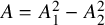 and
$B=B_1^2-B_2^2$
and
$B=B_1^2-B_2^2$
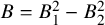 , and denote by
$f_A$
, and denote by
$f_A$
 ,
$f_B$
,
$f_B$
 the probability density functions of
$A,B$
the probability density functions of
$A,B$
 respectively. Since the probability density function
$f_{A+B}$
respectively. Since the probability density function
$f_{A+B}$
 is the convolution
$f_A*f_B$
is the convolution
$f_A*f_B$
 , we have

where the last equality follows from the Fubini–Tonelli theorem [Reference Cohn15, Proposition 5.2.1] and the change of variables
$y=z-x$
 .
.
Note that
$B=(B_1-B_2)(B_1+B_2)$
 and that each of
$B_1-B_2$
and that each of
$B_1-B_2$
 ,
$B_1+B_2$
,
$B_1+B_2$
 is a normal variable with mean 0. Hence B follows a product distribution, with
$f_B(y)$
is a normal variable with mean 0. Hence B follows a product distribution, with
$f_B(y)$
 being the value at
$|y|$
being the value at
$|y|$
 of a modified Bessel function of the second kind. From this we just use the consequence that, for every x we have
$\int _{[-2\delta ,2\delta ]-x}f_B(y) \,\mathrm {d} y\leq \int _{[-2\delta ,2\delta ]}f_B(y) \,\mathrm {d} y = \mathbb {P}(|B_1^2-B_2^2|\leq 2\delta )$
of a modified Bessel function of the second kind. From this we just use the consequence that, for every x we have
$\int _{[-2\delta ,2\delta ]-x}f_B(y) \,\mathrm {d} y\leq \int _{[-2\delta ,2\delta ]}f_B(y) \,\mathrm {d} y = \mathbb {P}(|B_1^2-B_2^2|\leq 2\delta )$
 . As
$|B_1^2-B_2^2|=|B_1-B_2|\, |B_1+B_2|$
. As
$|B_1^2-B_2^2|=|B_1-B_2|\, |B_1+B_2|$
 , this product being at most
$2\delta $
, this product being at most
$2\delta $
 implies that either
$|B_1-B_2|\leq (2\delta )^{1/2}$
implies that either
$|B_1-B_2|\leq (2\delta )^{1/2}$
 or
$|B_1+B_2|\leq (2\delta )^{1/2}$
or
$|B_1+B_2|\leq (2\delta )^{1/2}$
 . Let us bound
$\mathbb {P}(|B_1-B_2|\leq (2\delta )^{1/2})$
. Let us bound
$\mathbb {P}(|B_1-B_2|\leq (2\delta )^{1/2})$
 (the other event will be treated similarly). Since
$B_1-B_2$
(the other event will be treated similarly). Since
$B_1-B_2$
 is a normal random variable with mean 0 and variance
$\gamma /s$
is a normal random variable with mean 0 and variance
$\gamma /s$
 , the variable
$Z:=(B_1-B_2)\sqrt {s/\gamma }$
, the variable
$Z:=(B_1-B_2)\sqrt {s/\gamma }$
 is standard normal, whence
$\mathbb {P}(|B_1-B_2|\leq \sqrt {2\delta })=\mathbb {P}(|Z|\leq \sqrt {2\delta t/\gamma })=\text {erf}(\sqrt {\delta t/\gamma })$
is standard normal, whence
$\mathbb {P}(|B_1-B_2|\leq \sqrt {2\delta })=\mathbb {P}(|Z|\leq \sqrt {2\delta t/\gamma })=\text {erf}(\sqrt {\delta t/\gamma })$
 . By standard estimates for the error function erf, we have
$\text {erf}(\sqrt {\delta t/\gamma })\leq \big (1-e^{-4\delta t/(\gamma \pi )}\big )^{1/2}$
. By standard estimates for the error function erf, we have
$\text {erf}(\sqrt {\delta t/\gamma })\leq \big (1-e^{-4\delta t/(\gamma \pi )}\big )^{1/2}$
 . The same upper bound applies to
$\mathbb {P}(|B_1+B_2|\leq \sqrt {2\delta })$
. The same upper bound applies to
$\mathbb {P}(|B_1+B_2|\leq \sqrt {2\delta })$
 .
.
We conclude that the probability that some pair
$V_j,V_k$
 satisfies
$\big | |V_j|^2-|V_k|^2\big |\leq 2\delta $
satisfies
$\big | |V_j|^2-|V_k|^2\big |\leq 2\delta $
 is at most

Next, note that for every
$j\in [{t}]$
 we have
$\mathbb {P}(|V_j|^2\leq \sigma )=\mathbb {P}(A_j^2+B_j^2\in [0,\sigma ])$
we have
$\mathbb {P}(|V_j|^2\leq \sigma )=\mathbb {P}(A_j^2+B_j^2\in [0,\sigma ])$
 . Since
$A_j\sqrt {2{t}/\gamma },B_j\sqrt {2{t}/\gamma }$
. Since
$A_j\sqrt {2{t}/\gamma },B_j\sqrt {2{t}/\gamma }$
 are both standard normal, the variable
$2{t}(A_j^2+B_j^2)/\gamma $
are both standard normal, the variable
$2{t}(A_j^2+B_j^2)/\gamma $
 follows a
$\chi ^2$
follows a
$\chi ^2$
 -distribution with 2 degrees of freedom, so by standard results the cumulative distribution function of this variable is
$\mathbb {P}(2{t}(A_j^2+B_j^2)/\gamma \leq x)=1-e^{-x/2}$
-distribution with 2 degrees of freedom, so by standard results the cumulative distribution function of this variable is
$\mathbb {P}(2{t}(A_j^2+B_j^2)/\gamma \leq x)=1-e^{-x/2}$
 . Therefore we have
$\mathbb {P}(|V_j|^2\leq \sigma )=\mathbb {P}(2{t}(A_j^2+B_j^2)/\gamma \leq 2{t}\sigma /\gamma )=1-e^{-{t}\sigma /\gamma }$
. Therefore we have
$\mathbb {P}(|V_j|^2\leq \sigma )=\mathbb {P}(2{t}(A_j^2+B_j^2)/\gamma \leq 2{t}\sigma /\gamma )=1-e^{-{t}\sigma /\gamma }$
 , so
$\mathbb {P}(\exists \, j\in [{t}]\textrm { s.t. }|V_j^2|\leq \sigma )\leq {t}(1-e^{-{t}\sigma /\gamma })$
, so
$\mathbb {P}(\exists \, j\in [{t}]\textrm { s.t. }|V_j^2|\leq \sigma )\leq {t}(1-e^{-{t}\sigma /\gamma })$
 .
.
Finally, we need to bound the probability that
$\|V\|_{\ell ^2}>1$
 . By [Reference Vershynin72, Theorem 3.1.1] we have that
$\big \| \|X/\sqrt {\gamma /2{t}}\|_{\ell ^2}-\sqrt {2{t}}\big \|_{\psi _2}\le C$
. By [Reference Vershynin72, Theorem 3.1.1] we have that
$\big \| \|X/\sqrt {\gamma /2{t}}\|_{\ell ^2}-\sqrt {2{t}}\big \|_{\psi _2}\le C$
 for some absolute constant C (see [Reference Vershynin72, Definition 2.5.6] for the definition of the sub-Gaussian norm
$\|\cdot \|_{\psi _2}$
for some absolute constant C (see [Reference Vershynin72, Definition 2.5.6] for the definition of the sub-Gaussian norm
$\|\cdot \|_{\psi _2}$
 ). Hence,
$\big \| \|X\|_{\ell ^2}-\sqrt {\gamma }\big \|_{\psi _2}\le C\sqrt {\gamma /2{t}}$
). Hence,
$\big \| \|X\|_{\ell ^2}-\sqrt {\gamma }\big \|_{\psi _2}\le C\sqrt {\gamma /2{t}}$
 . By [Reference Vershynin72, Proposition 2.5.2] there exists another absolute constant
$C'>0$
. By [Reference Vershynin72, Proposition 2.5.2] there exists another absolute constant
$C'>0$
 such that for all
$x\ge 0$
such that for all
$x\ge 0$
 ,
$\mathbb {P}\big (|\|X\|_{\ell ^2}-\sqrt {\gamma }|\ge x\big )\le 2e^{-C'x^2{t}/\gamma }$
,
$\mathbb {P}\big (|\|X\|_{\ell ^2}-\sqrt {\gamma }|\ge x\big )\le 2e^{-C'x^2{t}/\gamma }$
 . Letting
$x:=1-\sqrt {\gamma }$
. Letting
$x:=1-\sqrt {\gamma }$
 we conclude that
$\mathbb {P}\big (\|X\|_{\ell ^2}\ge 1\big )\le 2e^{-C'(1-\sqrt {\gamma })^2{t}/\gamma }$
we conclude that
$\mathbb {P}\big (\|X\|_{\ell ^2}\ge 1\big )\le 2e^{-C'(1-\sqrt {\gamma })^2{t}/\gamma }$
 .
.
Now we have all the necessary ingredients to prove the following result.
Theorem 7.24. For any
$q>6$
 and
$r>q+3$
and
$r>q+3$
 , there exists
$C_{q,r}>0$
, there exists
$C_{q,r}>0$
 such that the following holds.Footnote 20 Let
$\rho _0\in (0,C_{q,r}]$
such that the following holds.Footnote 20 Let
$\rho _0\in (0,C_{q,r}]$
 . Under the assumptions of Theorems 7.12 and 7.15, recall that, for a 1-bounded function
$f:\operatorname {\mathrm {Z}}\to \mathbb {C}$
. Under the assumptions of Theorems 7.12 and 7.15, recall that, for a 1-bounded function
$f:\operatorname {\mathrm {Z}}\to \mathbb {C}$
 there exists
$\rho \in [\rho _0/2,\rho _0]$
there exists
$\rho \in [\rho _0/2,\rho _0]$
 such that we have a decomposition
$f=\sum _{\chi \in S_\rho }g_\chi +f_r+f_e$
such that we have a decomposition
$f=\sum _{\chi \in S_\rho }g_\chi +f_r+f_e$
 where
$\|f_r\|_{U^3}\le 2\rho ^{3/8}$
where
$\|f_r\|_{U^3}\le 2\rho ^{3/8}$
 and
$\|f_e\|_2\le (\rho _0/2)^r$
and
$\|f_e\|_2\le (\rho _0/2)^r$
 . Let
$t:=|S_\rho |$
. Let
$t:=|S_\rho |$
 and, for
$i\in [t]$
and, for
$i\in [t]$
 , let
$A_i,B_i$
, let
$A_i,B_i$
 be independent normal random variables with mean 0 and variance
$\rho /(2t)$
be independent normal random variables with mean 0 and variance
$\rho /(2t)$
 . Let X be the complex random vector
$X:=(A_1+iB_1,\ldots ,A_t+iB_t)$
. Let X be the complex random vector
$X:=(A_1+iB_1,\ldots ,A_t+iB_t)$
 . Let
$\{v_j:j\in [t]\}$
. Let
$\{v_j:j\in [t]\}$
 be an orthonormal basis of
$\text {Eigen}_\rho \big (\mathcal {K}_\varepsilon (f\otimes \overline {f})\big )$
be an orthonormal basis of
$\text {Eigen}_\rho \big (\mathcal {K}_\varepsilon (f\otimes \overline {f})\big )$
 and let h be the random function
$\sum _{j\in [t]} X_jv_j$
and let h be the random function
$\sum _{j\in [t]} X_jv_j$
 . Then, with probability
$1-o_{\rho \to 0}(1)$
. Then, with probability
$1-o_{\rho \to 0}(1)$
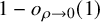 , we have that
$\|h\|_2\le 1$
, we have that
$\|h\|_2\le 1$
 , that
$\mathrm{Spec}_{\rho ^q}(\mathcal {K}_\varepsilon (h\otimes \overline {h})\big )$
, that
$\mathrm{Spec}_{\rho ^q}(\mathcal {K}_\varepsilon (h\otimes \overline {h})\big )$
 is
$\rho ^q$
is
$\rho ^q$
 -separated, and that
$|\mathrm{Spec}_{\rho ^q}(\mathcal {K}_\varepsilon (h\otimes \overline {h})\big )|=|S_\rho |$
-separated, and that
$|\mathrm{Spec}_{\rho ^q}(\mathcal {K}_\varepsilon (h\otimes \overline {h})\big )|=|S_\rho |$
 .
.
Proof. Recall that
${t}:=|S_\rho |$
 is equal to
$|\mathrm{Spec}_\rho \big (\mathcal {K}_\varepsilon (f\otimes \overline {f})\big )|$
is equal to
$|\mathrm{Spec}_\rho \big (\mathcal {K}_\varepsilon (f\otimes \overline {f})\big )|$
 . We first prove the following claim:

To prove this, let
$w=\sum _{i}x_iv_i$
 and note that
$\|w\|_2=\|x\|_{\ell ^2}$
and note that
$\|w\|_2=\|x\|_{\ell ^2}$
 . Let
$T_1$
. Let
$T_1$
 and
$T_2$
and
$T_2$
 be as defined in (7.13). By (7.11), we know that
$\mathcal {P}_{T_1,\rho }$
be as defined in (7.13). By (7.11), we know that
$\mathcal {P}_{T_1,\rho }$
 is precisely the projection to the space spanned by the
$u_\chi $
is precisely the projection to the space spanned by the
$u_\chi $
 for
$\chi \in S_\rho $
for
$\chi \in S_\rho $
 . By our choice of parameters in Theorems 7.12 and 7.15, we have that
$\|\mathcal {P}_{T_1,\rho }-\mathcal {P}_{T_2,\rho }\|\le \rho ^r$
. By our choice of parameters in Theorems 7.12 and 7.15, we have that
$\|\mathcal {P}_{T_1,\rho }-\mathcal {P}_{T_2,\rho }\|\le \rho ^r$
 . As
$w\in \text {Eigen}_\rho \big (\mathcal {K}_\varepsilon (f\otimes \overline {f})\big )$
. As
$w\in \text {Eigen}_\rho \big (\mathcal {K}_\varepsilon (f\otimes \overline {f})\big )$
 , we have
$\mathcal {P}_{T_2,\rho }(w)=w$
, we have
$\mathcal {P}_{T_2,\rho }(w)=w$
 , whence
$\|\mathcal {P}_{T_1,\rho }(w)-w\|_2=\|\mathcal {P}_{T_1,\rho }(w)-\mathcal {P}_{T_2,\rho }(w)\|_2\le \rho ^r\|w\|_2=\rho ^r\|x\|_{\ell ^2}$
, whence
$\|\mathcal {P}_{T_1,\rho }(w)-w\|_2=\|\mathcal {P}_{T_1,\rho }(w)-\mathcal {P}_{T_2,\rho }(w)\|_2\le \rho ^r\|w\|_2=\rho ^r\|x\|_{\ell ^2}$
 . Let
$W\in \mathbb {C}^{{t}\times {t}}$
. Let
$W\in \mathbb {C}^{{t}\times {t}}$
 be the matrix defined in (7.22), thus for every
$j\in [{t}]$
be the matrix defined in (7.22), thus for every
$j\in [{t}]$
 we have
$\mathcal {P}_{T_1,\rho }(v_j) = \sum _{i\in [t]} W_{i,j} u_{\chi _i}$
we have
$\mathcal {P}_{T_1,\rho }(v_j) = \sum _{i\in [t]} W_{i,j} u_{\chi _i}$
 . Then, for every
$j\in [t]$
. Then, for every
$j\in [t]$
 , we have
$v_j = \sum _{i\in [t]} W_{i,j} u_{\chi _i}+d_j$
, we have
$v_j = \sum _{i\in [t]} W_{i,j} u_{\chi _i}+d_j$
 where
$\|d_j\|_2\le \rho ^r$
where
$\|d_j\|_2\le \rho ^r$
 (as we announced in (7.23)). Now we want to apply Lemma 7.21 to
$\{v_i\}_{i\in [t]}$
(as we announced in (7.23)). Now we want to apply Lemma 7.21 to
$\{v_i\}_{i\in [t]}$
 and
$\{u_\chi \}_{\chi \in S_\rho }$
and
$\{u_\chi \}_{\chi \in S_\rho }$
 with
$\kappa :=\rho ^r$
with
$\kappa :=\rho ^r$
 ,
$\tau :=\rho ^{4+r}$
,
$\tau :=\rho ^{4+r}$
 , and
$t=|S_\rho |$
, and
$t=|S_\rho |$
 . Since
$|S_\rho |\le |S|\le \operatorname {\mathrm {Q}}(\eta ,m)$
. Since
$|S_\rho |\le |S|\le \operatorname {\mathrm {Q}}(\eta ,m)$
 , using condition (ii) from Theorem 7.12, we have that
$\tau \le 1/(2t)$
, using condition (ii) from Theorem 7.12, we have that
$\tau \le 1/(2t)$
 . Hence, Lemma 7.21 combined with the bound
$t\le 10/\rho $
. Hence, Lemma 7.21 combined with the bound
$t\le 10/\rho $
 (given by Theorem 7.12) tells us that
$\big | \|Wx\|_{\ell ^2}^2 - \|x\|_{\ell ^2}^2 \big | \leq 1230\rho ^{r-1}\|x\|_{\ell ^2}^2$
(given by Theorem 7.12) tells us that
$\big | \|Wx\|_{\ell ^2}^2 - \|x\|_{\ell ^2}^2 \big | \leq 1230\rho ^{r-1}\|x\|_{\ell ^2}^2$
 . Next, by Lemma 7.22 (note that we can apply this because by assumption on
$\rho _0$
. Next, by Lemma 7.22 (note that we can apply this because by assumption on
$\rho _0$
 it follows that
$24t\delta \le 1$
it follows that
$24t\delta \le 1$
 ) we have that
$W=M+E$
) we have that
$W=M+E$
 where M is unitary and
$\|E\|_\infty \le 30\delta t^{1/2}$
where M is unitary and
$\|E\|_\infty \le 30\delta t^{1/2}$
 where
$\delta =1230\rho ^{r-1}$
where
$\delta =1230\rho ^{r-1}$
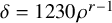 . In particular, note that

Thus
$\|\sum _i (Ex)_iu_{\chi _i}\|_2\le t\|Ex\|_\infty \le 30\delta t^2\|x\|_{\ell ^2}$
 . Letting
$d:=(\mathcal {P}_{T_1,\rho }(w)-\mathcal {P}_{T_2,\rho }(w))+\sum _i (Ex)_iu_{\chi _i}$
. Letting
$d:=(\mathcal {P}_{T_1,\rho }(w)-\mathcal {P}_{T_2,\rho }(w))+\sum _i (Ex)_iu_{\chi _i}$
 the claim (7.32) follows.
Now let h be the random function
$\sum _{i\in [{t}]} X_iv_i$
 in the theorem. By (7.32), we have that
$h = \sum _i (MX)_i u_{\chi _i}+d$
in the theorem. By (7.32), we have that
$h = \sum _i (MX)_i u_{\chi _i}+d$
 . Let V denote the vector
$MX$
. Let V denote the vector
$MX$
 . We apply now Lemma 7.23 to V with parameters
${t}=|S_\rho |\le 10/\rho $
. We apply now Lemma 7.23 to V with parameters
${t}=|S_\rho |\le 10/\rho $
 ,
$\delta :=\rho ^q$
,
$\delta :=\rho ^q$
 ,
$\sigma :=2\rho ^q$
,
$\sigma :=2\rho ^q$
 ,
$\gamma :=\rho $
,
$\gamma :=\rho $
 . Let us check that under these conditions, the right side of (7.30) is
$1-o_{\rho \to 0}(1)$
. Let us check that under these conditions, the right side of (7.30) is
$1-o_{\rho \to 0}(1)$
 . The first term is
${t}^2\big (1-e^{-4\delta {t}/(\gamma \pi )}\big )^{1/2}\le O\big (\tfrac {1}{\rho ^4}(1-e^{-40\rho ^q/(\pi \rho ^2)} \big )^{1/2}$
. The first term is
${t}^2\big (1-e^{-4\delta {t}/(\gamma \pi )}\big )^{1/2}\le O\big (\tfrac {1}{\rho ^4}(1-e^{-40\rho ^q/(\pi \rho ^2)} \big )^{1/2}$
 . By L’Hôpital’s rule it is easily checked that this quantity tends to 0 as
$\rho \to 0$
. By L’Hôpital’s rule it is easily checked that this quantity tends to 0 as
$\rho \to 0$
 if
$q>6$
if
$q>6$
 . The second term is
$t\big (1-e^{-t\sigma /\gamma }\big )=O\big (\tfrac {1}{\rho }(1-e^{-20\rho ^q/\rho ^2})\big )$
. The second term is
$t\big (1-e^{-t\sigma /\gamma }\big )=O\big (\tfrac {1}{\rho }(1-e^{-20\rho ^q/\rho ^2})\big )$
 , which tends to 0 as
$\rho \to 0$
, which tends to 0 as
$\rho \to 0$
 if
$q>3$
if
$q>3$
 (also by L’Hôpital’s rule). The third and final term is
$2e^{-C(1-\sqrt {\gamma })^2{t}/\gamma }$
(also by L’Hôpital’s rule). The third and final term is
$2e^{-C(1-\sqrt {\gamma })^2{t}/\gamma }$
 . Note that we can assume that
$t\ge 1$
. Note that we can assume that
$t\ge 1$
 , as otherwise the result is trivial, and we can also assume that
$\sqrt {\gamma }=\sqrt {\rho }\le 1/2$
, as otherwise the result is trivial, and we can also assume that
$\sqrt {\gamma }=\sqrt {\rho }\le 1/2$
 . Thus
$2e^{-C(1-\sqrt {\gamma })^2{t}/\gamma }\le O\big ( e^{-C/(4\rho )} \big )\to 0$
. Thus
$2e^{-C(1-\sqrt {\gamma })^2{t}/\gamma }\le O\big ( e^{-C/(4\rho )} \big )\to 0$
 as
$\rho \to 0$
as
$\rho \to 0$
 .
.
In particular, as
$\|V\|_{\ell ^2}\le 1$
 and M is unitary, we have
$\|X\|_{\ell ^2}\le 1$
and M is unitary, we have
$\|X\|_{\ell ^2}\le 1$
 , and
$h = \sum _i V_iu_{\chi _i}+d$
, and
$h = \sum _i V_iu_{\chi _i}+d$
 where
$\|d\|_2\le 4\cdot 10^6 \rho ^{r-3}$
where
$\|d\|_2\le 4\cdot 10^6 \rho ^{r-3}$
 .
.
Finally, we apply Proposition 7.17 to h. Note that the constants
$\tau _1,\tau _2$
 , and
$\tau _3$
, and
$\tau _3$
 are bounded as in the proof of Theorem 7.15, and we have just proved that we can let
$\tau _4=4\cdot 10^6 \rho ^{r-3}$
are bounded as in the proof of Theorem 7.15, and we have just proved that we can let
$\tau _4=4\cdot 10^6 \rho ^{r-3}$
 . Hence, we have (7.14) with
$\|E\|_2\le 3\rho ^r+20\cdot 10^6 \rho ^{r-3}\le 3\cdot 10^7\rho ^{r-3}$
. Hence, we have (7.14) with
$\|E\|_2\le 3\rho ^r+20\cdot 10^6 \rho ^{r-3}\le 3\cdot 10^7\rho ^{r-3}$
 . Let
$\lambda _i$
. Let
$\lambda _i$
 be the eigenvalues of
$\mathcal {K}_\varepsilon (h\otimes \overline {h})$
be the eigenvalues of
$\mathcal {K}_\varepsilon (h\otimes \overline {h})$
 in descending order. Assume also that
$|V_1|^2\ge |V_2|^2\ge \cdots $
in descending order. Assume also that
$|V_1|^2\ge |V_2|^2\ge \cdots $
 (by relabeling if necessary). Then, by (7.15) combined with (ix), we have
$\big (\textstyle \sum _{i=1}^{t} \big |\, |V_i|^2-\lambda _i\big |^2\big )^{\frac {1}{2}}\leq 4\cdot 10^7\rho ^{r-3}$
(by relabeling if necessary). Then, by (7.15) combined with (ix), we have
$\big (\textstyle \sum _{i=1}^{t} \big |\, |V_i|^2-\lambda _i\big |^2\big )^{\frac {1}{2}}\leq 4\cdot 10^7\rho ^{r-3}$
 . In particular, note that, for all
$i,j\in [t]$
. In particular, note that, for all
$i,j\in [t]$
 with
$i\not =j$
with
$i\not =j$
 we have
$\big ||V_i|^2-|V_j|^2\big |\ge 2\rho ^q$
we have
$\big ||V_i|^2-|V_j|^2\big |\ge 2\rho ^q$
 . As
$4\cdot 10^7\rho ^{r-3}\le \rho ^q/2$
. As
$4\cdot 10^7\rho ^{r-3}\le \rho ^q/2$
 , we have
$|\lambda _i-\lambda _j|\ge \rho ^q$
, we have
$|\lambda _i-\lambda _j|\ge \rho ^q$
 for all
$i,j\in [t]$
for all
$i,j\in [t]$
 ,
$i\not =j$
,
$i\not =j$
 . Similarly, since for all
$i\in [t]$
. Similarly, since for all
$i\in [t]$
 we have
$|V_i|^2\ge 2\rho ^q$
we have
$|V_i|^2\ge 2\rho ^q$
 , it follows that
$\lambda _i\ge \rho ^q$
, it follows that
$\lambda _i\ge \rho ^q$
 for all
$i\in [t]$
for all
$i\in [t]$
 . By (7.15), we have
$\lambda _i\le 4\cdot 10^7\rho ^{r-3}<\rho ^q$
. By (7.15), we have
$\lambda _i\le 4\cdot 10^7\rho ^{r-3}<\rho ^q$
 for all
$i>t$
for all
$i>t$
 , and the result follows.
Remark 7.25 (Uniform spherical distribution).
In Theorem 7.24 we chose the random vector
$X\in \mathbb {C}^t$
 to follow a multivariate (complex) normal distribution and we showed that, with high probability, the function
$h=\sum _i X_iv_i$
to follow a multivariate (complex) normal distribution and we showed that, with high probability, the function
$h=\sum _i X_iv_i$
 satisfies the desired properties. However, note that if instead we let
$X':=X/\|X\|_{\ell ^2}$
satisfies the desired properties. However, note that if instead we let
$X':=X/\|X\|_{\ell ^2}$
 , then
$X'$
, then
$X'$
 follows a uniform distribution in the unit sphere of
$\mathbb {C}^t$
follows a uniform distribution in the unit sphere of
$\mathbb {C}^t$
 (e.g., by [Reference Vershynin72, Exercise 3.3.7]). Moreover, if we let
$h':=\sum _i X_i'v_i$
(e.g., by [Reference Vershynin72, Exercise 3.3.7]). Moreover, if we let
$h':=\sum _i X_i'v_i$
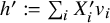 and the event
$Q(\rho ^q,\rho ,2\rho ^q,t)$
and the event
$Q(\rho ^q,\rho ,2\rho ^q,t)$
 from Lemma 7.23 holds for X, then we also have that
$\|h'\|_2\le 1$
from Lemma 7.23 holds for X, then we also have that
$\|h'\|_2\le 1$
 ,
$\mathrm{Spec}_{\rho ^q}(\mathcal {K}_\varepsilon (h'\otimes \overline {h'})\big )$
,
$\mathrm{Spec}_{\rho ^q}(\mathcal {K}_\varepsilon (h'\otimes \overline {h'})\big )$
 is
$\rho ^q$
is
$\rho ^q$
 -separated, and
$|\mathrm{Spec}_{\rho ^q}(\mathcal {K}_\varepsilon (h'\otimes \overline {h'})\big )|=|S_\rho |$
-separated, and
$|\mathrm{Spec}_{\rho ^q}(\mathcal {K}_\varepsilon (h'\otimes \overline {h'})\big )|=|S_\rho |$
 . To see this, let
$V':=MX'$
. To see this, let
$V':=MX'$
 and note that
$V'=V/\|X\|_{\ell ^2}$
and note that
$V'=V/\|X\|_{\ell ^2}$
 where
$V=MX$
where
$V=MX$
 (as in the proof of Theorem 7.24). Thus, if
$h'=\sum _iV^{\prime }_iu_{\chi _i}+d'$
(as in the proof of Theorem 7.24). Thus, if
$h'=\sum _iV^{\prime }_iu_{\chi _i}+d'$
 we have that
$h'$
we have that
$h'$
 satisfies the same conditions as h, that is, we have
$\|d'\|_2\le 4\cdot 10^6 \rho ^{r-3}$
satisfies the same conditions as h, that is, we have
$\|d'\|_2\le 4\cdot 10^6 \rho ^{r-3}$
 (by (7.32)), for all
$i\in [t]$
(by (7.32)), for all
$i\in [t]$
 we have
$|V^{\prime }_i|^2=\tfrac {|V_i|^2}{\|X\|_{\ell ^2}^2}\ge 2\rho ^q$
we have
$|V^{\prime }_i|^2=\tfrac {|V_i|^2}{\|X\|_{\ell ^2}^2}\ge 2\rho ^q$
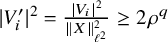 , and for all
$i\not =j$
, and for all
$i\not =j$
 we have
$\big ||V^{\prime }_i|^2-|V^{\prime }_j|^2\big |=\tfrac {||V_i|^2-|V_j|^2|}{\|X\|_{\ell ^2}^2}\ge \rho ^q$
we have
$\big ||V^{\prime }_i|^2-|V^{\prime }_j|^2\big |=\tfrac {||V_i|^2-|V_j|^2|}{\|X\|_{\ell ^2}^2}\ge \rho ^q$
 . Therefore, the function
$h'$
. Therefore, the function
$h'$
 also satisfies the conclusion of Theorem 7.24 and we could have directly chosen X to be uniformly distributed in the unit sphere.
A Metrics on cfr nilspaces derived from the manifold structure
Every k-step cfr nilspace
$\operatorname {\mathrm {X}}$
 is a metric space [Reference Candela7, Remark 2.1.3
$(ii)$
is a metric space [Reference Candela7, Remark 2.1.3
$(ii)$
 ]. However, there can be different metrics on
$\operatorname {\mathrm {X}}$
]. However, there can be different metrics on
$\operatorname {\mathrm {X}}$
 that generate the same original topology, and some of these metrics are better than others for our purposes in this paper. In particular, we need to work with a family of metrics on k-step cfr nilspaces
$\operatorname {\mathrm {X}}$
that generate the same original topology, and some of these metrics are better than others for our purposes in this paper. In particular, we need to work with a family of metrics on k-step cfr nilspaces
$\operatorname {\mathrm {X}}$
 which ensure sufficient control on Lipschitz constants of various functions on
$\operatorname {\mathrm {X}}$
which ensure sufficient control on Lipschitz constants of various functions on
$\operatorname {\mathrm {X}}$
 (including complex-valued functions but also nilspace translations on
$\operatorname {\mathrm {X}}$
(including complex-valued functions but also nilspace translations on
$\operatorname {\mathrm {X}}$
 ), and also on Lipschitz constants of compositions of such functions with morphisms between different nilspaces. Such properties are used for instance in the proof of Theorem 4.19.
Below we describe metrics with such properties, eventually obtaining as main results Proposition A.13, Corollary A.15 and Lemma A.17, giving the desired control on Lipschitz constants.
Let us first give an example showing some metrics that we want to avoid in this respect.
Example A.1. Consider the circle
$\mathbb {T}=\mathbb {R}/\mathbb {Z}$
 , which can be regarded as a
$1$
, which can be regarded as a
$1$
 -step cfr nilspace. If for
$x\in \mathbb {R}$
-step cfr nilspace. If for
$x\in \mathbb {R}$
 we let
$|x|_{\mathbb {T}}:=\min _{n\in \mathbb {Z}}\{|x-n|\}$
we let
$|x|_{\mathbb {T}}:=\min _{n\in \mathbb {Z}}\{|x-n|\}$
 , then we obtain the well-known metric
$d(x+\mathbb {Z},y+\mathbb {Z}):=|x-y|_{\mathbb {T}}$
, then we obtain the well-known metric
$d(x+\mathbb {Z},y+\mathbb {Z}):=|x-y|_{\mathbb {T}}$
 that generates the usual topology on
$\mathbb {T}$
that generates the usual topology on
$\mathbb {T}$
 . There are other metrics, like
$d_\alpha (x+\mathbb {Z},y+\mathbb {Z}):=|x-y|_{\mathbb {T}}^\alpha $
. There are other metrics, like
$d_\alpha (x+\mathbb {Z},y+\mathbb {Z}):=|x-y|_{\mathbb {T}}^\alpha $
 for
$\alpha \in (0,1)$
for
$\alpha \in (0,1)$
 , that generate the same topology. The problem with these metrics is that, for example, the identity map
$(\mathbb {T},d)\to (\mathbb {T},d_\alpha )$
, that generate the same topology. The problem with these metrics is that, for example, the identity map
$(\mathbb {T},d)\to (\mathbb {T},d_\alpha )$
 is not Lipschitz. Hence, if we let
$\operatorname {\mathrm {X}}=\mathcal {D}_1(\mathbb {Z}_2\times \mathbb {T})$
is not Lipschitz. Hence, if we let
$\operatorname {\mathrm {X}}=\mathcal {D}_1(\mathbb {Z}_2\times \mathbb {T})$
 we can define a (somewhat artificial, yet valid) metric
$d':\operatorname {\mathrm {X}}\times \operatorname {\mathrm {X}}\to \mathbb {R}_{\ge 0}$
we can define a (somewhat artificial, yet valid) metric
$d':\operatorname {\mathrm {X}}\times \operatorname {\mathrm {X}}\to \mathbb {R}_{\ge 0}$
 by setting
$d'((a_0,a_1),(b_0,b_1))$
by setting
$d'((a_0,a_1),(b_0,b_1))$
 to have value
$1$
to have value
$1$
 if
$a_0\not =b_0$
if
$a_0\not =b_0$
 , value
$d(a_1,b_1)$
, value
$d(a_1,b_1)$
 if
$a_0=b_0=0$
if
$a_0=b_0=0$
 , and value
$d_{1/2}(a_1,b_1)$
, and value
$d_{1/2}(a_1,b_1)$
 if
$a_0=b_0=1$
if
$a_0=b_0=1$
 . Then, by the previous observation, it is easy to see that the nilspace translation
$\alpha \in \operatorname {\mathrm {\Theta }}(\operatorname {\mathrm {X}})$
. Then, by the previous observation, it is easy to see that the nilspace translation
$\alpha \in \operatorname {\mathrm {\Theta }}(\operatorname {\mathrm {X}})$
 defined by
$\alpha (a_0,a_1):=(a_0+1,a_1)$
defined by
$\alpha (a_0,a_1):=(a_0+1,a_1)$
 is not Lipschitz.
There is a very convenient family of metrics on cfr nilspaces which avoids issues such as those in the above example. This family is naturally suggested by what is already usual practice when working in the more classical setting of compact nilmanifolds (which are particular cases of cfr nilspaces). Indeed, on nilmanifolds we can use Riemannian metrics, that is, metrics induced by Riemannian metric tensors defined on the nilmanifolds. It turns out that we can use a similar construction on cfr nilspaces more generally, because we can endow these spaces with a differentiable structure that makes them smooth (i.e.,
$C^\infty $
 ) manifolds. In fact, this smooth structure is available, without much added difficulty, on the more general class of (not necessarily compact) Lie-fibered nilspaces, that is, topological nilspaces whose structure groups are Lie groups (for the precise definition see [Reference Candela, Gonzalez-Sanchez and Szegedy10, Definition 2.19]).
Theorem A.2. Let
$\operatorname {\mathrm {X}}$
 be a k-step Lie-fibered (resp. cfr) nilspace. Then
$\operatorname {\mathrm {X}}$
be a k-step Lie-fibered (resp. cfr) nilspace. Then
$\operatorname {\mathrm {X}}$
 can be endowed with a
$C^\infty $
can be endowed with a
$C^\infty $
 manifold (resp. compact manifold) structure such that every cube set
$\operatorname {\mathrm {C}}^n(\operatorname {\mathrm {X}})$
manifold (resp. compact manifold) structure such that every cube set
$\operatorname {\mathrm {C}}^n(\operatorname {\mathrm {X}})$
 (
$n\in \mathbb {N}$
(
$n\in \mathbb {N}$
 ) is also a
$C^\infty $
) is also a
$C^\infty $
 manifold.
Proof. Our main tool here is a structure theorem for nilspaces, namely [Reference Candela, Gonzalez-Sanchez and Szegedy10, Theorem 1.8], which tells us that any k-step cfr nilspace is isomorphic to a quotient space
$F/H$
 where F is a k-step free nilspace (see [Reference Candela, Gonzalez-Sanchez and Szegedy10, Definition 1.2]) and
$H\subset \operatorname {\mathrm {\Theta }}(F)$
where F is a k-step free nilspace (see [Reference Candela, Gonzalez-Sanchez and Szegedy10, Definition 1.2]) and
$H\subset \operatorname {\mathrm {\Theta }}(F)$
 is a k-th order lattice action (see [Reference Candela, Gonzalez-Sanchez and Szegedy10, Definition 1.7]). Note that this theorem is stated for cfr nilspaces, but it can be checked that its proof works exactly the same for Lie-fibered nilspaces, see [Reference Candela, Gonzalez-Sanchez and Szegedy10, §6] (where, of course, we have to drop the fiber-cocompact property).
The advantage of seeing
$\operatorname {\mathrm {X}}$
 as
$F/H$
as
$F/H$
 is that F has now a natural
$C^\infty $
is that F has now a natural
$C^\infty $
 structure which induces a uniquely defined
$C^\infty $
structure which induces a uniquely defined
$C^\infty $
 structure on the quotient
$F/H$
structure on the quotient
$F/H$
 (by definition
$F=\prod _{i=1}^k \mathcal {D}_i(\mathbb {Z}^{a_i}\times \mathbb {R}^{b_i})$
(by definition
$F=\prod _{i=1}^k \mathcal {D}_i(\mathbb {Z}^{a_i}\times \mathbb {R}^{b_i})$
 ). Let
$\pi _H:F\to F/H$
). Let
$\pi _H:F\to F/H$
 be the quotient morphism. By [Reference Srinivasacharyulu57, p. 51, 5.9.5] it suffices to prove that the set
$R:=\{(x,gx)\in F^2:x\in F, g\in H\}$
be the quotient morphism. By [Reference Srinivasacharyulu57, p. 51, 5.9.5] it suffices to prove that the set
$R:=\{(x,gx)\in F^2:x\in F, g\in H\}$
 is an embedded closed submanifold of
$F^2$
is an embedded closed submanifold of
$F^2$
 and the projection
$p_1:R\to F$
and the projection
$p_1:R\to F$
 ,
$(x,gx)\mapsto x$
,
$(x,gx)\mapsto x$
 is a submersion. Note that the fact that R is closed follows from [Reference Candela, Gonzalez-Sanchez and Szegedy10, Lemma 5.25]. To prove that R is an embedded submanifold, we are going to prove the following claim:

We prove this by induction on the step k.
For
$k=0$
 the claim is trivially true (
$0$
the claim is trivially true (
$0$
 -step nilspaces are 1-point spaces).
Now assume that (A.1) holds for step at most
$k-1$
 . Let
$\eta _{k-1}:\operatorname {\mathrm {\Theta }}(F)\to \operatorname {\mathrm {\Theta }}(F_{k-1})$
. Let
$\eta _{k-1}:\operatorname {\mathrm {\Theta }}(F)\to \operatorname {\mathrm {\Theta }}(F_{k-1})$
 be the homomorphism that forgets the action on the k-th order component (see [Reference Candela, Gonzalez-Sanchez and Szegedy10, paragraph before Definition 1.5]). Let
$U^{k-1}\subset F_{k-1}^2$
be the homomorphism that forgets the action on the k-th order component (see [Reference Candela, Gonzalez-Sanchez and Szegedy10, paragraph before Definition 1.5]). Let
$U^{k-1}\subset F_{k-1}^2$
 be a neighborhood of
$(\pi _{k-1}(x_0),\eta _{k-1}(g_0)(\pi _{k-1}(x_0)))$
be a neighborhood of
$(\pi _{k-1}(x_0),\eta _{k-1}(g_0)(\pi _{k-1}(x_0)))$
 satisfying the claim. If
$(x,gx)\in R\cap ( \pi _{k-1}^2)^{-1}(U^{k-1})$
satisfying the claim. If
$(x,gx)\in R\cap ( \pi _{k-1}^2)^{-1}(U^{k-1})$
 , we have

In particular, by the fiber-transitive property (see [Reference Candela, Gonzalez-Sanchez and Szegedy10, Definition 1.4]), there exists
$\gamma \in H_{k}$
 such that
$gx=g_0x+\gamma $
such that
$gx=g_0x+\gamma $
 . Fix an arbitrary translation-invariant distance in F (e.g., the usual Euclidean distance) and let
$\delta>0$
. Fix an arbitrary translation-invariant distance in F (e.g., the usual Euclidean distance) and let
$\delta>0$
 be a constant to be fixed later. For any
$r\ge 0$
be a constant to be fixed later. For any
$r\ge 0$
 let
$B_r(x_0):=\{y\in F:d(y,x_0)<r\}$
let
$B_r(x_0):=\{y\in F:d(y,x_0)<r\}$
 . As
$H_k$
. As
$H_k$
 is a discrete lattice in the k-th structure group of F, there exists
$\epsilon>0$
is a discrete lattice in the k-th structure group of F, there exists
$\epsilon>0$
 such that if
$\gamma '\in B_\epsilon (\underline {0})\cap H_k$
such that if
$\gamma '\in B_\epsilon (\underline {0})\cap H_k$
 then
$\gamma '=0$
then
$\gamma '=0$
 (where
$\underline {0}\in F$
(where
$\underline {0}\in F$
 is the constant
$0$
is the constant
$0$
 in all coordinates). As
$g_0$
in all coordinates). As
$g_0$
 is continuous, if
$\delta $
is continuous, if
$\delta $
 is sufficiently small and
$x\in B_\delta (x_0)$
is sufficiently small and
$x\in B_\delta (x_0)$
 then
$d(g_0x,gx)<\epsilon /3$
then
$d(g_0x,gx)<\epsilon /3$
 . Now in
$F^2$
. Now in
$F^2$
 the set
$U:=B_\delta (x_0)\times B_{\epsilon /3}(g_0x_0) \cap (\pi _{k-1}^2)^{-1}(U^{k-1})$
the set
$U:=B_\delta (x_0)\times B_{\epsilon /3}(g_0x_0) \cap (\pi _{k-1}^2)^{-1}(U^{k-1})$
 is an open neighborhood of
$(x_0,g_0x_0)$
is an open neighborhood of
$(x_0,g_0x_0)$
 . Note that if
$(x,gx)\in R\cap U$
. Note that if
$(x,gx)\in R\cap U$
 then there exists
$\gamma \in H_k$
then there exists
$\gamma \in H_k$
 such that
$(x,gx)=(x,g_0x+\gamma )$
such that
$(x,gx)=(x,g_0x+\gamma )$
 . As
$d(x,x_0)<\delta $
. As
$d(x,x_0)<\delta $
 we have that
$d(g_0x,g_0x_0)<\epsilon /3$
we have that
$d(g_0x,g_0x_0)<\epsilon /3$
 . Also, by definition
$d(g_0x_0,g_0x+\gamma )<\epsilon /3$
. Also, by definition
$d(g_0x_0,g_0x+\gamma )<\epsilon /3$
 . Hence
$d(\gamma ,\underline {0})<2\epsilon /3$
. Hence
$d(\gamma ,\underline {0})<2\epsilon /3$
 and we have shown that in this case
$\gamma =0$
and we have shown that in this case
$\gamma =0$
 . The claim (A.1) follows.
Using (A.1), we can prove that
$R\subset F^2$
 is an embedded submanifold. For any
$(x_0,g_0x_0)\in R$
is an embedded submanifold. For any
$(x_0,g_0x_0)\in R$
 on the neighborhood U given by (A.1), we define the chart
$\varphi :(x,y)\in U\mapsto (x,y-g_0x)\in F^2$
on the neighborhood U given by (A.1), we define the chart
$\varphi :(x,y)\in U\mapsto (x,y-g_0x)\in F^2$
 . As
$g_0$
. As
$g_0$
 has an expression in terms of polynomials, it is clear that this map is a diffeomorphism. Moreover, by construction of U, the elements of
$R\cap U$
has an expression in terms of polynomials, it is clear that this map is a diffeomorphism. Moreover, by construction of U, the elements of
$R\cap U$
 are exactly those whose images under
$\varphi $
are exactly those whose images under
$\varphi $
 have
$0\in F$
have
$0\in F$
 in the second coordinate. Hence R is a closed embedded submanifold of
$F^2$
in the second coordinate. Hence R is a closed embedded submanifold of
$F^2$
 .
.
The fact that
$p_1:R\to F$
 is a submersion follows easily using the charts
$\varphi $
is a submersion follows easily using the charts
$\varphi $
 described above. In fact, it can be checked that the differential is the identity at every point.
A similar argument shows that the sets
$\operatorname {\mathrm {C}}^n(\operatorname {\mathrm {X}})$
 are manifolds as well. The key observation is that the fiber-transitive property implies that if
$\operatorname {\mathrm {c}}\in \operatorname {\mathrm {C}}^n(F)$
are manifolds as well. The key observation is that the fiber-transitive property implies that if
$\operatorname {\mathrm {c}}\in \operatorname {\mathrm {C}}^n(F)$
 and
$d\in \operatorname {\mathrm {C}}^n(H_\bullet )$
and
$d\in \operatorname {\mathrm {C}}^n(H_\bullet )$
 is such that
$\pi _{k-1}^{[\![ n]\!] }\operatorname {\mathrm {\circ }} d\operatorname {\mathrm {\circ }} \operatorname {\mathrm {c}}= \pi _{k-1}^{[\![ n]\!] }\operatorname {\mathrm {\circ }} \operatorname {\mathrm {c}}$
is such that
$\pi _{k-1}^{[\![ n]\!] }\operatorname {\mathrm {\circ }} d\operatorname {\mathrm {\circ }} \operatorname {\mathrm {c}}= \pi _{k-1}^{[\![ n]\!] }\operatorname {\mathrm {\circ }} \operatorname {\mathrm {c}}$
 , then there exists
$d'\in \operatorname {\mathrm {C}}^n(\mathcal {D}_k(H_k))$
, then there exists
$d'\in \operatorname {\mathrm {C}}^n(\mathcal {D}_k(H_k))$
 such that
$d\operatorname {\mathrm {\circ }}\operatorname {\mathrm {c}}=\operatorname {\mathrm {c}}+d'$
such that
$d\operatorname {\mathrm {\circ }}\operatorname {\mathrm {c}}=\operatorname {\mathrm {c}}+d'$
 and
$\operatorname {\mathrm {C}}^n(\mathcal {D}_k(H_k))$
and
$\operatorname {\mathrm {C}}^n(\mathcal {D}_k(H_k))$
 is discrete.
Remark A.3. It also follows from [Reference Srinivasacharyulu57, p. 51, 5.9.5] that the quotient map
$\pi _H:F\to F/H$
 is a submersion.
Corollary A.4. Let
$\operatorname {\mathrm {X}}$
 be a Lie-fibered nilspace,
$n\ge 0$
be a Lie-fibered nilspace,
$n\ge 0$
 , and
$S\subset [\![ n]\!] $
, and
$S\subset [\![ n]\!] $
 be a subset with the extension property (see [Reference Candela6, Definition 3.1.3]). Then
$\hom (S,\operatorname {\mathrm {X}})$
be a subset with the extension property (see [Reference Candela6, Definition 3.1.3]). Then
$\hom (S,\operatorname {\mathrm {X}})$
 is a
$C^\infty $
is a
$C^\infty $
 manifold.
Proof. The proof is essentially the same as the one given above for the cube sets
$\operatorname {\mathrm {C}}^n(\operatorname {\mathrm {X}})$
 , as for a fiber-transitive action we have that if
$\operatorname {\mathrm {c}}\in \hom (S,F)$
, as for a fiber-transitive action we have that if
$\operatorname {\mathrm {c}}\in \hom (S,F)$
 and
$d\in \hom (S,H_\bullet )$
and
$d\in \hom (S,H_\bullet )$
 is such that
$\pi _{k-1}^{S}\operatorname {\mathrm {\circ }} d\operatorname {\mathrm {\circ }} \operatorname {\mathrm {c}}= \pi _{k-1}^{S}\operatorname {\mathrm {\circ }} \operatorname {\mathrm {c}}$
is such that
$\pi _{k-1}^{S}\operatorname {\mathrm {\circ }} d\operatorname {\mathrm {\circ }} \operatorname {\mathrm {c}}= \pi _{k-1}^{S}\operatorname {\mathrm {\circ }} \operatorname {\mathrm {c}}$
 then there exists
$d'\in \hom (S,\mathcal {D}_k(H_k))$
then there exists
$d'\in \hom (S,\mathcal {D}_k(H_k))$
 such that
$d\operatorname {\mathrm {\circ }}\operatorname {\mathrm {c}}=\operatorname {\mathrm {c}}+d'$
such that
$d\operatorname {\mathrm {\circ }}\operatorname {\mathrm {c}}=\operatorname {\mathrm {c}}+d'$
 and
$\hom (S,\mathcal {D}_k(H_k))$
and
$\hom (S,\mathcal {D}_k(H_k))$
 is discrete.
Equipping k-step nilspaces with this
$C^\infty $
 manifold structure, we also obtain that the canonical factor maps are
$C^\infty $
manifold structure, we also obtain that the canonical factor maps are
$C^\infty $
 .
.
Proposition A.5. Let
$\operatorname {\mathrm {X}}$
 be a k-step Lie-fibered nilspace. Then the action of the last structure group
$\operatorname {\mathrm {Z}}_k(\operatorname {\mathrm {X}})$
be a k-step Lie-fibered nilspace. Then the action of the last structure group
$\operatorname {\mathrm {Z}}_k(\operatorname {\mathrm {X}})$
 on
$\operatorname {\mathrm {X}}$
on
$\operatorname {\mathrm {X}}$
 is differentiable. Moreover, this makes
$\operatorname {\mathrm {X}}$
is differentiable. Moreover, this makes
$\operatorname {\mathrm {X}}$
 a fiber-bundle over
$\operatorname {\mathrm {X}}_{k-1}$
a fiber-bundle over
$\operatorname {\mathrm {X}}_{k-1}$
 in the category of
$C^\infty $
in the category of
$C^\infty $
 manifolds.
Proof. Note that if
$\operatorname {\mathrm {X}}\cong F/H$
 for a fiber-transitive group H, we can describe the action of the last structure group as
$F/H\times \mathcal {D}_k(F)/H_k \to F/H$
for a fiber-transitive group H, we can describe the action of the last structure group as
$F/H\times \mathcal {D}_k(F)/H_k \to F/H$
 ,
$(\pi _H(x),z\mod H_k)\mapsto (\pi _H(x+z))$
,
$(\pi _H(x),z\mod H_k)\mapsto (\pi _H(x+z))$
 . By [Reference Lee50, Theorem 4.29] to prove that this map is
$C^\infty $
. By [Reference Lee50, Theorem 4.29] to prove that this map is
$C^\infty $
 it suffices to check that the action
$F\times \mathcal {D}_k(F)\to F$
it suffices to check that the action
$F\times \mathcal {D}_k(F)\to F$
 is
$C^\infty $
is
$C^\infty $
 , which is trivial as this is just addition on the k-th factor of F. As the action is proper (note that the map
$F/H\times \mathcal {D}_k(F)\to F/H\times F/H$
, which is trivial as this is just addition on the k-th factor of F. As the action is proper (note that the map
$F/H\times \mathcal {D}_k(F)\to F/H\times F/H$
 is a homeomorphism onto its image) we have that by standard results (e.g., [Reference Lee50, Exercise 21-6]),
$\operatorname {\mathrm {X}}\cong F/H$
is a homeomorphism onto its image) we have that by standard results (e.g., [Reference Lee50, Exercise 21-6]),
$\operatorname {\mathrm {X}}\cong F/H$
 is a fiber-bundle over
$\operatorname {\mathrm {X}}_{k-1}$
is a fiber-bundle over
$\operatorname {\mathrm {X}}_{k-1}$
 .
.
Moreover, morphisms are automatically
$C^\infty $
 maps.
maps.
Theorem A.6 (Automatic differentiability of morphisms).
Let
$\operatorname {\mathrm {X}}$
 and
$\operatorname {\mathrm {Y}}$
and
$\operatorname {\mathrm {Y}}$
 be k-step Lie-fibered nilspaces and let
$\varphi :\operatorname {\mathrm {X}}\to \operatorname {\mathrm {Y}}$
be k-step Lie-fibered nilspaces and let
$\varphi :\operatorname {\mathrm {X}}\to \operatorname {\mathrm {Y}}$
 be a continuous morphism. Then
$\varphi $
be a continuous morphism. Then
$\varphi $
 is
$C^\infty $
is
$C^\infty $
 . Moreover, if
$\varphi $
. Moreover, if
$\varphi $
 is a fibration then it is a submersion.
To prove Theorem A.6 we shall use the following result.
Proposition A.7 (Free nilspaces are projective in the category of Lie-fibered nilspaces).
Let
$\operatorname {\mathrm {X}},\operatorname {\mathrm {Y}}$
 be k-step Lie-fibered nilspaces, and let F be a free nilspace. Suppose that we have a morphism
$\phi :F\to \operatorname {\mathrm {X}}$
be k-step Lie-fibered nilspaces, and let F be a free nilspace. Suppose that we have a morphism
$\phi :F\to \operatorname {\mathrm {X}}$
 and a fibration
$\varphi :\operatorname {\mathrm {Y}}\to \operatorname {\mathrm {X}}$
and a fibration
$\varphi :\operatorname {\mathrm {Y}}\to \operatorname {\mathrm {X}}$
 . Then there exists a morphism
$\psi :F\to \operatorname {\mathrm {Y}}$
. Then there exists a morphism
$\psi :F\to \operatorname {\mathrm {Y}}$
 such that
$\phi =\varphi \operatorname {\mathrm {\circ }}\psi $
such that
$\phi =\varphi \operatorname {\mathrm {\circ }}\psi $
 .
.
Proof. By [Reference Candela, Gonzalez-Sanchez and Szegedy10, Theorem 4.4] there exists a free nilspace
$F'$
 and a fibration
$\varphi :F'\to \operatorname {\mathrm {Y}}$
and a fibration
$\varphi :F'\to \operatorname {\mathrm {Y}}$
 . Thus, without loss of generality we can assume that
$\operatorname {\mathrm {Y}}$
. Thus, without loss of generality we can assume that
$\operatorname {\mathrm {Y}}$
 is also a free nilspace.
Consider now the fiber product
$F\times _{\operatorname {\mathrm {X}}} \operatorname {\mathrm {Y}}:=\{(f,y)\in F\times \operatorname {\mathrm {Y}}:\phi (f)=\varphi (y)\}$
 with cube sets
$\operatorname {\mathrm {C}}^n(F\times _{\operatorname {\mathrm {X}}} \operatorname {\mathrm {Y}}):=\{(\operatorname {\mathrm {c}},\operatorname {\mathrm {c}}')\in \operatorname {\mathrm {C}}^n(F)\times \operatorname {\mathrm {C}}^n(\operatorname {\mathrm {Y}}):\phi \operatorname {\mathrm {\circ }}\operatorname {\mathrm {c}}=\varphi \operatorname {\mathrm {\circ }}\operatorname {\mathrm {c}}'\}$
with cube sets
$\operatorname {\mathrm {C}}^n(F\times _{\operatorname {\mathrm {X}}} \operatorname {\mathrm {Y}}):=\{(\operatorname {\mathrm {c}},\operatorname {\mathrm {c}}')\in \operatorname {\mathrm {C}}^n(F)\times \operatorname {\mathrm {C}}^n(\operatorname {\mathrm {Y}}):\phi \operatorname {\mathrm {\circ }}\operatorname {\mathrm {c}}=\varphi \operatorname {\mathrm {\circ }}\operatorname {\mathrm {c}}'\}$
 . This construction has appeared many times in nilspace theory, see [Reference Candela, Gonzalez-Sanchez and Szegedy8, Lemma 4.2] and [Reference Candela, Gonzalez-Sanchez and Szegedy10, Lemma 2.18]. We leave as an exercise for the reader to check that, even though in such results both
$\phi $
. This construction has appeared many times in nilspace theory, see [Reference Candela, Gonzalez-Sanchez and Szegedy8, Lemma 4.2] and [Reference Candela, Gonzalez-Sanchez and Szegedy10, Lemma 2.18]. We leave as an exercise for the reader to check that, even though in such results both
$\phi $
 and
$\varphi $
and
$\varphi $
 are required to be fibrations, it suffices that one of them (in this case
$\varphi $
are required to be fibrations, it suffices that one of them (in this case
$\varphi $
 ) is a fibration for all the arguments to work. Using these results we have the following commutative diagram:

where it is not difficult to prove that
$p_1:F\times _{\operatorname {\mathrm {X}}} \operatorname {\mathrm {Y}}\to F$
 is a fibration.
Next, we claim that
$F\times _{\operatorname {\mathrm {X}}} \operatorname {\mathrm {Y}}$
 is a free nilspace. We already know by [Reference Candela, Gonzalez-Sanchez and Szegedy8, Lemma 4.2] and [Reference Candela, Gonzalez-Sanchez and Szegedy10, Lemma 2.18] that it is a lch k-step nilspace, so we just need to check that the structure groups are Lie groups. We prove this just for the k-th structure group, as the claim for the other structure groups follows similarly. By [Reference Candela, Gonzalez-Sanchez and Szegedy9, Proposition A.20] the k-structure group of
$F\times _{\operatorname {\mathrm {X}}} \operatorname {\mathrm {Y}}$
is a free nilspace. We already know by [Reference Candela, Gonzalez-Sanchez and Szegedy8, Lemma 4.2] and [Reference Candela, Gonzalez-Sanchez and Szegedy10, Lemma 2.18] that it is a lch k-step nilspace, so we just need to check that the structure groups are Lie groups. We prove this just for the k-th structure group, as the claim for the other structure groups follows similarly. By [Reference Candela, Gonzalez-Sanchez and Szegedy9, Proposition A.20] the k-structure group of
$F\times _{\operatorname {\mathrm {X}}} \operatorname {\mathrm {Y}}$
 , that is,
$\operatorname {\mathrm {Z}}_k(F\times _{\operatorname {\mathrm {X}}} \operatorname {\mathrm {Y}})$
, that is,
$\operatorname {\mathrm {Z}}_k(F\times _{\operatorname {\mathrm {X}}} \operatorname {\mathrm {Y}})$
 , is isomorphic to
$\{(z_1,z_2)\in \operatorname {\mathrm {Z}}_k(F)\times \operatorname {\mathrm {Z}}_k(\operatorname {\mathrm {Y}}):\gamma _k(z_1)=\gamma _k'(z_2)\}$
, is isomorphic to
$\{(z_1,z_2)\in \operatorname {\mathrm {Z}}_k(F)\times \operatorname {\mathrm {Z}}_k(\operatorname {\mathrm {Y}}):\gamma _k(z_1)=\gamma _k'(z_2)\}$
 where
$\gamma _k$
where
$\gamma _k$
 and
$\gamma _k'$
and
$\gamma _k'$
 are the k-th structure morphisms of
$\phi $
are the k-th structure morphisms of
$\phi $
 and
$\varphi $
and
$\varphi $
 respectively. Note that we have the following short exact sequence
$0\to \ker (\varphi )\to \operatorname {\mathrm {Z}}_k(F\times _{\operatorname {\mathrm {X}}} \operatorname {\mathrm {Y}})\to \operatorname {\mathrm {Z}}_k(F)\to 0$
respectively. Note that we have the following short exact sequence
$0\to \ker (\varphi )\to \operatorname {\mathrm {Z}}_k(F\times _{\operatorname {\mathrm {X}}} \operatorname {\mathrm {Y}})\to \operatorname {\mathrm {Z}}_k(F)\to 0$
 . As both
$\ker (\varphi )$
. As both
$\ker (\varphi )$
 and
$\operatorname {\mathrm {Z}}_k(F)$
and
$\operatorname {\mathrm {Z}}_k(F)$
 are Lie groups, so is
$\operatorname {\mathrm {Z}}_k(F\times _{\operatorname {\mathrm {X}}} \operatorname {\mathrm {Y}})$
are Lie groups, so is
$\operatorname {\mathrm {Z}}_k(F\times _{\operatorname {\mathrm {X}}} \operatorname {\mathrm {Y}})$
 . Moreover, as F is a free nilspace, we have
$\operatorname {\mathrm {Z}}_k(F)\cong \mathbb {R}^a\times \mathbb {Z}^b$
. Moreover, as F is a free nilspace, we have
$\operatorname {\mathrm {Z}}_k(F)\cong \mathbb {R}^a\times \mathbb {Z}^b$
 for some
$a,b\in \mathbb {Z}_{\ge 0}$
for some
$a,b\in \mathbb {Z}_{\ge 0}$
 , and since this group is projective in the category of abelian Lie groups, we have
$\operatorname {\mathrm {Z}}_k(F\times _{\operatorname {\mathrm {X}}} \operatorname {\mathrm {Y}})\cong \operatorname {\mathrm {Z}}_k(F)\times \ker (\varphi )$
, and since this group is projective in the category of abelian Lie groups, we have
$\operatorname {\mathrm {Z}}_k(F\times _{\operatorname {\mathrm {X}}} \operatorname {\mathrm {Y}})\cong \operatorname {\mathrm {Z}}_k(F)\times \ker (\varphi )$
 . Moreover, as
$\ker (\varphi )$
. Moreover, as
$\ker (\varphi )$
 is a closed subgroup of
$\operatorname {\mathrm {Z}}_k(\operatorname {\mathrm {Y}})\cong \mathbb {R}^{a'}\times \mathbb {Z}^{b'}$
is a closed subgroup of
$\operatorname {\mathrm {Z}}_k(\operatorname {\mathrm {Y}})\cong \mathbb {R}^{a'}\times \mathbb {Z}^{b'}$
 for some
$a',b'\in \mathbb {Z}_{\ge 0}$
for some
$a',b'\in \mathbb {Z}_{\ge 0}$
 , we have that
$\ker (\varphi )$
, we have that
$\ker (\varphi )$
 is also itself a product of the form
$\mathbb {R}^{a"}\times \mathbb {Z}^{b"}$
is also itself a product of the form
$\mathbb {R}^{a"}\times \mathbb {Z}^{b"}$
 for some
$a",b"\in \mathbb {Z}_{\ge 0}$
for some
$a",b"\in \mathbb {Z}_{\ge 0}$
 . Hence
$\operatorname {\mathrm {Z}}_k(F\times _{\operatorname {\mathrm {X}}}\operatorname {\mathrm {Y}})$
. Hence
$\operatorname {\mathrm {Z}}_k(F\times _{\operatorname {\mathrm {X}}}\operatorname {\mathrm {Y}})$
 is of the desired form.
To conclude, we apply [Reference Candela, Gonzalez-Sanchez and Szegedy10, Lemma 8.9] to the fibration
$p_1:F\times _{\operatorname {\mathrm {X}}}\operatorname {\mathrm {Y}}\to F$
 . Hence, there exists a cross-section
$s:F\to F\times _{\operatorname {\mathrm {X}}}\operatorname {\mathrm {Y}}$
. Hence, there exists a cross-section
$s:F\to F\times _{\operatorname {\mathrm {X}}}\operatorname {\mathrm {Y}}$
 (note that such lemma gives a free nilspace
$F'$
(note that such lemma gives a free nilspace
$F'$
 and a nilspace isomorphism
$\tau :F\times F'\to F\times _{\operatorname {\mathrm {X}}}\operatorname {\mathrm {Y}}$
and a nilspace isomorphism
$\tau :F\times F'\to F\times _{\operatorname {\mathrm {X}}}\operatorname {\mathrm {Y}}$
 and thus we may let s be
$\tau $
and thus we may let s be
$\tau $
 composed with the obvious inclusion of F into
$F\times F'$
composed with the obvious inclusion of F into
$F\times F'$
 ) with
$p_1\operatorname {\mathrm {\circ }} s=\mathrm {id}_{F}$
) with
$p_1\operatorname {\mathrm {\circ }} s=\mathrm {id}_{F}$
 , which is a morphism. Thus, we may take
$\psi =p_2\operatorname {\mathrm {\circ }} s$
, which is a morphism. Thus, we may take
$\psi =p_2\operatorname {\mathrm {\circ }} s$
 and the result follows.
Proof of Theorem A.6.
Let
$\operatorname {\mathrm {X}}$
 and
$\operatorname {\mathrm {Y}}$
and
$\operatorname {\mathrm {Y}}$
 be Lie-fibered k-step nilspaces, and let
$\varphi :\operatorname {\mathrm {X}}\to \operatorname {\mathrm {Y}}$
be Lie-fibered k-step nilspaces, and let
$\varphi :\operatorname {\mathrm {X}}\to \operatorname {\mathrm {Y}}$
 be a morphism. By [Reference Candela, Gonzalez-Sanchez and Szegedy10, Lemma 4.4] there exist free nilspaces
$F,F'$
be a morphism. By [Reference Candela, Gonzalez-Sanchez and Szegedy10, Lemma 4.4] there exist free nilspaces
$F,F'$
 and fibrations
$\phi :F\to \operatorname {\mathrm {X}}$
and fibrations
$\phi :F\to \operatorname {\mathrm {X}}$
 and
$\phi ':F'\to \operatorname {\mathrm {Y}}$
and
$\phi ':F'\to \operatorname {\mathrm {Y}}$
 . We now apply Proposition A.7 to
$\varphi \operatorname {\mathrm {\circ }}\phi $
. We now apply Proposition A.7 to
$\varphi \operatorname {\mathrm {\circ }}\phi $
 and
$\phi '$
and
$\phi '$
 , obtaining a morphism
$\psi :F\to F'$
, obtaining a morphism
$\psi :F\to F'$
 which makes the following diagram commutative:

By [Reference Candela, Gonzalez-Sanchez and Szegedy10, §3.1] morphisms between k-step free nilspaces are basically polynomials of degree at most k, so they are
$C^\infty $
 maps. By [Reference Lee50, Theorem 4.29] it then follows that
$\varphi $
maps. By [Reference Lee50, Theorem 4.29] it then follows that
$\varphi $
 is also
$C^\infty $
is also
$C^\infty $
 .
.
Now if
$\varphi $
 is a fibration, then firstly, similarly as in the proof of Proposition A.7, we can construct the fiber-product of
$F\times _{\operatorname {\mathrm {Y}}}F'$
is a fibration, then firstly, similarly as in the proof of Proposition A.7, we can construct the fiber-product of
$F\times _{\operatorname {\mathrm {Y}}}F'$
 . Then, the fact that
$\varphi $
. Then, the fact that
$\varphi $
 is a fibration implies that
$p_1:F\times _{\operatorname {\mathrm {Y}}}F'\to F$
is a fibration implies that
$p_1:F\times _{\operatorname {\mathrm {Y}}}F'\to F$
 and
$p_2:F\times _{\operatorname {\mathrm {Y}}}F'\to F'$
and
$p_2:F\times _{\operatorname {\mathrm {Y}}}F'\to F'$
 are also fibrations. By [Reference Candela, Gonzalez-Sanchez and Szegedy10, Lemma 8.9], such maps are basically projections, that is,
$F\times _{\operatorname {\mathrm {Y}}}F'\cong F\times N$
are also fibrations. By [Reference Candela, Gonzalez-Sanchez and Szegedy10, Lemma 8.9], such maps are basically projections, that is,
$F\times _{\operatorname {\mathrm {Y}}}F'\cong F\times N$
 and
$F\times _{\operatorname {\mathrm {Y}}}F'\cong F'\times N'$
and
$F\times _{\operatorname {\mathrm {Y}}}F'\cong F'\times N'$
 for some free nilspaces
$N,N'$
for some free nilspaces
$N,N'$
 . In particular,
$p_1,p_2$
. In particular,
$p_1,p_2$
 are submersions. Hence
$\varphi \operatorname {\mathrm {\circ }}\phi \operatorname {\mathrm {\circ }} p_1 = \phi '\operatorname {\mathrm {\circ }} p_2$
are submersions. Hence
$\varphi \operatorname {\mathrm {\circ }}\phi \operatorname {\mathrm {\circ }} p_1 = \phi '\operatorname {\mathrm {\circ }} p_2$
 where both
$\phi '\operatorname {\mathrm {\circ }} p_2$
where both
$\phi '\operatorname {\mathrm {\circ }} p_2$
 and
$\phi \operatorname {\mathrm {\circ }} p_1$
and
$\phi \operatorname {\mathrm {\circ }} p_1$
 are submersions. Hence, as
$\phi \operatorname {\mathrm {\circ }} p_1$
are submersions. Hence, as
$\phi \operatorname {\mathrm {\circ }} p_1$
 is also surjective,
$\varphi $
is also surjective,
$\varphi $
 is also a submersion.
Corollary A.8. Let
$\operatorname {\mathrm {X}}$
 be a k-step cfr nilspace. Then the action of the translation group
$\operatorname {\mathrm {X}}$
be a k-step cfr nilspace. Then the action of the translation group
$\operatorname {\mathrm {X}}$
 , that is,
$\operatorname {\mathrm {X}}\times \operatorname {\mathrm {\Theta }}(\operatorname {\mathrm {X}})\to \operatorname {\mathrm {X}}$
, that is,
$\operatorname {\mathrm {X}}\times \operatorname {\mathrm {\Theta }}(\operatorname {\mathrm {X}})\to \operatorname {\mathrm {X}}$
 ,
$(x,\alpha )\mapsto \alpha (x)$
,
$(x,\alpha )\mapsto \alpha (x)$
 , is
$C^\infty $
, is
$C^\infty $
 .
.
Proof. Recall that, by [Reference Candela7, Theorem 2.9.10], the translation group
$\operatorname {\mathrm {\Theta }}(\operatorname {\mathrm {X}})$
 is a k-step nilpotent filtered Lie group, so in particular it is a k-step Lie-fibered nilspace. Then the map
$\operatorname {\mathrm {X}}\times \operatorname {\mathrm {\Theta }}(\operatorname {\mathrm {X}})\to \operatorname {\mathrm {X}}$
is a k-step nilpotent filtered Lie group, so in particular it is a k-step Lie-fibered nilspace. Then the map
$\operatorname {\mathrm {X}}\times \operatorname {\mathrm {\Theta }}(\operatorname {\mathrm {X}})\to \operatorname {\mathrm {X}}$
 ,
$(x,\alpha )\mapsto \alpha (x)$
,
$(x,\alpha )\mapsto \alpha (x)$
 is a continuous morphism, so the result follows by Theorem A.6.
We can now also prove the following result, used for instance in the proof of Proposition 4.29.
Lemma A.9. Let
$\operatorname {\mathrm {X}}$
 be a k-step Lie-fibered nilspace. Then the corner completion map
$K:\operatorname {\mathrm {Cor}}^{k+1}(\operatorname {\mathrm {X}})\to \operatorname {\mathrm {X}}$
be a k-step Lie-fibered nilspace. Then the corner completion map
$K:\operatorname {\mathrm {Cor}}^{k+1}(\operatorname {\mathrm {X}})\to \operatorname {\mathrm {X}}$
 is
$C^\infty $
is
$C^\infty $
 .
.
Proof. By [Reference Candela, Gonzalez-Sanchez and Szegedy10, Theorem 1.8], there is a fibration
$\varphi :F\to \operatorname {\mathrm {X}}$
 where F is a k-step free nilspace and
$\operatorname {\mathrm {X}}\cong F/H$
where F is a k-step free nilspace and
$\operatorname {\mathrm {X}}\cong F/H$
 for some fiber-transitive fiber-discrete group H. By Corollary A.4, we have that
$\operatorname {\mathrm {Cor}}^{k+1}(\operatorname {\mathrm {X}})$
for some fiber-transitive fiber-discrete group H. By Corollary A.4, we have that
$\operatorname {\mathrm {Cor}}^{k+1}(\operatorname {\mathrm {X}})$
 is a
$C^\infty $
is a
$C^\infty $
 manifold and we have the following commutative diagram:

Here
$K'$
 is the completion function of F. Note that
$\varphi $
is the completion function of F. Note that
$\varphi $
 and
$\varphi ^{[\![ k+1]\!] \backslash \{0^{k+1}\}}$
and
$\varphi ^{[\![ k+1]\!] \backslash \{0^{k+1}\}}$
 are submersions by Remark A.3, and
$K'$
are submersions by Remark A.3, and
$K'$
 is
$C^{\infty }$
is
$C^{\infty }$
 (this last claim can be checked by hand, as
$K'$
(this last claim can be checked by hand, as
$K'$
 has an explicit polynomial expression). Hence K is also a
$C^\infty $
has an explicit polynomial expression). Hence K is also a
$C^\infty $
 map.
map.
We can now define the desired metrics that we shall work with.
Lemma A.10. Let
$\operatorname {\mathrm {X}}$
 be a k-step cfr nilspace endowed with the
$C^\infty $
be a k-step cfr nilspace endowed with the
$C^\infty $
 structure given by Theorem A.2. Then there exists a Riemannian metric tensor on
$\operatorname {\mathrm {X}}$
structure given by Theorem A.2. Then there exists a Riemannian metric tensor on
$\operatorname {\mathrm {X}}$
 which is
$\operatorname {\mathrm {Z}}_k(\operatorname {\mathrm {X}})$
which is
$\operatorname {\mathrm {Z}}_k(\operatorname {\mathrm {X}})$
 -invariant.
Proof. Any smooth manifold admits a Riemannian metric tensor (see [Reference Lee50, Proposition 13.3]). If g is such a tensor, it is easy to see that
$\int _{\operatorname {\mathrm {Z}}_k(\operatorname {\mathrm {X}})}g(\cdot +z,\cdot +z)\,\mathrm {d}_{\operatorname {\mathrm {Z}}_k(\operatorname {\mathrm {X}})}(z)$
 is also a Riemannian metric tensor which is
${\operatorname {\mathrm {Z}}_k(\operatorname {\mathrm {X}})}$
is also a Riemannian metric tensor which is
${\operatorname {\mathrm {Z}}_k(\operatorname {\mathrm {X}})}$
 -invariant.
Note that there may be many such Riemannian tensors, as the previous result does not guarantee uniqueness. However, this will not be a problem in what follows.
Recall that in a connected Riemannian manifold, the geodesic distance is defined as the length of the shortest path between two points, and this distance agrees with the topology of the manifold, see [Reference Lee50, Proposition 8.19]. This is the distance function that we shall use. Let us record it as follows.
Definition A.11 (Riemannian metric on a cfr k-step nilspace).
Let
$\operatorname {\mathrm {X}}$
 be a cfr k-step nilspace endowed with a Riemannian metric tensor g. We define the distance
$d(x,y)$
be a cfr k-step nilspace endowed with a Riemannian metric tensor g. We define the distance
$d(x,y)$
 for
$x,y\in \operatorname {\mathrm {X}}$
for
$x,y\in \operatorname {\mathrm {X}}$
 to be
$1$
to be
$1$
 if x and y are in different connected components, and
$d(x,y)=\inf _{\gamma _{x,y}}\int \sqrt {g(\nabla \gamma ,\nabla \gamma )}$
if x and y are in different connected components, and
$d(x,y)=\inf _{\gamma _{x,y}}\int \sqrt {g(\nabla \gamma ,\nabla \gamma )}$
 otherwise, where the infimum is on the
$C^\infty $
otherwise, where the infimum is on the
$C^\infty $
 maps
$\gamma :[0,1]\to \operatorname {\mathrm {X}}$
maps
$\gamma :[0,1]\to \operatorname {\mathrm {X}}$
 with
$\gamma (0)=x$
with
$\gamma (0)=x$
 and
$\gamma (1)=y$
and
$\gamma (1)=y$
 .
.
A particular case is that of 1-step cfr nilspaces. These are in fact compact abelian Lie groups. For those, we will always use a metric defined as follows.
Definition A.12 (Riemannain metric on compact abelian Lie groups).
Let G be a compact abelian Lie group, thus
$G\cong \operatorname {\mathrm {Z}}\times \mathbb {T}^n$
 where
$\operatorname {\mathrm {Z}}$
where
$\operatorname {\mathrm {Z}}$
 is a finite abelian group and
$n\in \mathbb {Z}_{\geq 0}$
is a finite abelian group and
$n\in \mathbb {Z}_{\geq 0}$
 . We define a Riemannian metric tensor on G by giving a Riemannian metric tensor on each of its connected components: on
$\{a\}\times \mathbb {T}^n$
. We define a Riemannian metric tensor on G by giving a Riemannian metric tensor on each of its connected components: on
$\{a\}\times \mathbb {T}^n$
 for
$a\in \operatorname {\mathrm {Z}}$
for
$a\in \operatorname {\mathrm {Z}}$
 , we define a Riemannian metric tensor as the n-fold product of the usual metric tensor on
$\mathbb {T}$
, we define a Riemannian metric tensor as the n-fold product of the usual metric tensor on
$\mathbb {T}$
 obtained as the induced Riemannian metric when
$\mathbb {T}$
obtained as the induced Riemannian metric when
$\mathbb {T}$
 is embedded in
$\mathbb {R}^2$
is embedded in
$\mathbb {R}^2$
 the usual way, see [Reference do Carmo13, Chapter 1, Example 2.7]. On G, we define the distance
$d_G(x,y)=1$
the usual way, see [Reference do Carmo13, Chapter 1, Example 2.7]. On G, we define the distance
$d_G(x,y)=1$
 if
$x,y\in G$
if
$x,y\in G$
 are in different connected components, and as the usual Riemannian distance otherwise (see Definition A.11). We call this metric on G the usual or flat metric on G.
We can now reap the benefits of using this Riemannian distance, by proving the main results concerning Lipschitz properties, announced at the beginning of the appendix.
We start with the following.
Proposition A.13. Let
$\operatorname {\mathrm {X}},\operatorname {\mathrm {Y}}$
 be k-step cfr nilspaces, and let
$\varphi :\operatorname {\mathrm {X}}\to \operatorname {\mathrm {Y}}$
be k-step cfr nilspaces, and let
$\varphi :\operatorname {\mathrm {X}}\to \operatorname {\mathrm {Y}}$
 be a (continuous) morphism. Then, relative to any two Riemannian metrics on
$\operatorname {\mathrm {X}}$
be a (continuous) morphism. Then, relative to any two Riemannian metrics on
$\operatorname {\mathrm {X}}$
 and
$\operatorname {\mathrm {Y}}$
and
$\operatorname {\mathrm {Y}}$
 , the map
$\varphi $
, the map
$\varphi $
 is Lipschitz.
Proof. Let
$g_{\operatorname {\mathrm {X}}}$
 and
$g_{\operatorname {\mathrm {Y}}}$
and
$g_{\operatorname {\mathrm {Y}}}$
 be the metric tensors of
$\operatorname {\mathrm {X}}$
be the metric tensors of
$\operatorname {\mathrm {X}}$
 and
$\operatorname {\mathrm {Y}}$
and
$\operatorname {\mathrm {Y}}$
 respectively. Consider the unit tangent bundle
$\operatorname {\mathrm {UT}}(\operatorname {\mathrm {X}})$
respectively. Consider the unit tangent bundle
$\operatorname {\mathrm {UT}}(\operatorname {\mathrm {X}})$
 on
$\operatorname {\mathrm {X}}$
on
$\operatorname {\mathrm {X}}$
 and the map
$D:\operatorname {\mathrm {UT}}(\operatorname {\mathrm {X}})\to \mathbb {R}_{\ge 0}$
and the map
$D:\operatorname {\mathrm {UT}}(\operatorname {\mathrm {X}})\to \mathbb {R}_{\ge 0}$
 defined as

This map is always well-defined as the denominator is constantly 1. Moreover, it is a continuous map and
$\operatorname {\mathrm {UT}}(\operatorname {\mathrm {X}})$
 is compact. Thus, it attains a maximum M. Hence
$g_{\operatorname {\mathrm {Y}}}(\nabla \varphi (W),\nabla \varphi (W))\le Mg_{\operatorname {\mathrm {X}}}(W,W)$
is compact. Thus, it attains a maximum M. Hence
$g_{\operatorname {\mathrm {Y}}}(\nabla \varphi (W),\nabla \varphi (W))\le Mg_{\operatorname {\mathrm {X}}}(W,W)$
 for any tangent vector W.
Then, given any two points
$x,y\in \operatorname {\mathrm {X}}$
 , if they are in different connected components then we always have
$d_{\operatorname {\mathrm {Y}}}(\varphi (x),\varphi (y))\le Ld_{\operatorname {\mathrm {X}}}(x,y)$
, if they are in different connected components then we always have
$d_{\operatorname {\mathrm {Y}}}(\varphi (x),\varphi (y))\le Ld_{\operatorname {\mathrm {X}}}(x,y)$
 for any constant
$L\ge \operatorname {\mathrm {diam}}(\operatorname {\mathrm {Y}})$
for any constant
$L\ge \operatorname {\mathrm {diam}}(\operatorname {\mathrm {Y}})$
 so there is nothing to prove. On the other hand, if they are in the same connected component, let
$\gamma :[0,1]\to \operatorname {\mathrm {X}}$
so there is nothing to prove. On the other hand, if they are in the same connected component, let
$\gamma :[0,1]\to \operatorname {\mathrm {X}}$
 be such that
$\gamma (0)=x$
be such that
$\gamma (0)=x$
 ,
$\gamma (1)=y$
,
$\gamma (1)=y$
 , and
$d(x,y)=\int \sqrt {g_{\operatorname {\mathrm {X}}}(\nabla \gamma ,\nabla \gamma )}$
, and
$d(x,y)=\int \sqrt {g_{\operatorname {\mathrm {X}}}(\nabla \gamma ,\nabla \gamma )}$
 . Then
$d(\varphi (x),\varphi (y)) \le \int \sqrt {g_{\operatorname {\mathrm {Y}}}(\nabla \varphi \operatorname {\mathrm {\circ }}\nabla \gamma ,\nabla \varphi \operatorname {\mathrm {\circ }}\nabla \gamma )}\le M\int \sqrt {g_{\operatorname {\mathrm {X}}}(\nabla \gamma ,\nabla \gamma )} = Md(x,y)$
. Then
$d(\varphi (x),\varphi (y)) \le \int \sqrt {g_{\operatorname {\mathrm {Y}}}(\nabla \varphi \operatorname {\mathrm {\circ }}\nabla \gamma ,\nabla \varphi \operatorname {\mathrm {\circ }}\nabla \gamma )}\le M\int \sqrt {g_{\operatorname {\mathrm {X}}}(\nabla \gamma ,\nabla \gamma )} = Md(x,y)$
 .Hence, the morphism
$\varphi $
.Hence, the morphism
$\varphi $
 is
$\max (\operatorname {\mathrm {diam}}(\operatorname {\mathrm {Y}}),M)$
is
$\max (\operatorname {\mathrm {diam}}(\operatorname {\mathrm {Y}}),M)$
 -Lipschitz.
Remark A.14. It is important to note that the Lipschitz constant depends on the metrics chosen. But once we fix such metrics, all continuous morphisms are Lipschitz maps. We will endow every k-step cfr nilspace with one such Riemannian metric tensor and a corresponding metric.
The idea of the previous result can be extended slightly, to show that if we have a compact family of translations acting on a nilspace, then their Lipschitz constants are bounded uniformly.
Corollary A.15. Let
$\operatorname {\mathrm {X}}$
 be a cfr k-step nilspace where we have fixed some Riemannian metric
$g_{\operatorname {\mathrm {X}}}$
be a cfr k-step nilspace where we have fixed some Riemannian metric
$g_{\operatorname {\mathrm {X}}}$
 . Let
$C\subset \operatorname {\mathrm {\Theta }}(\operatorname {\mathrm {X}})$
. Let
$C\subset \operatorname {\mathrm {\Theta }}(\operatorname {\mathrm {X}})$
 be compact. Then
$\sup _{\alpha \in C}\|\alpha \|_L<\infty $
be compact. Then
$\sup _{\alpha \in C}\|\alpha \|_L<\infty $
 .
.
Proof. The idea of the proof is the same as before. The only difference is to consider the map
$\operatorname {\mathrm {UT}}(\operatorname {\mathrm {X}})\times C\to \mathbb {R}$
 defined as
$(x,W_x,\alpha )\mapsto \frac {g_{\operatorname {\mathrm {X}}}(\nabla \alpha (W_x),\nabla \alpha (W_x))}{g_{\operatorname {\mathrm {X}}}(W_x,W_x)}$
defined as
$(x,W_x,\alpha )\mapsto \frac {g_{\operatorname {\mathrm {X}}}(\nabla \alpha (W_x),\nabla \alpha (W_x))}{g_{\operatorname {\mathrm {X}}}(W_x,W_x)}$
 , which is continuous by Corollary A.8 (in fact,
$C^\infty $
, which is continuous by Corollary A.8 (in fact,
$C^\infty $
 ). In particular, it attains a maximum and thus, repeating the same argument from the proof of Proposition A.13, the result follows.
We need the next technical result that follows from the fact that
$\pi _{k-1}:\operatorname {\mathrm {X}}\to \operatorname {\mathrm {X}}_{k-1}$
 is a submersion by Theorem A.6 (we omit its proof).
Lemma A.16. Let
$\operatorname {\mathrm {X}}$
 be a cfr k-step nilspace and assume that we have fixed Riemannian metrics on
$\operatorname {\mathrm {X}}$
be a cfr k-step nilspace and assume that we have fixed Riemannian metrics on
$\operatorname {\mathrm {X}}$
 and
$\operatorname {\mathrm {X}}_{k-1}$
and
$\operatorname {\mathrm {X}}_{k-1}$
 . Then for every point
$\pi _{k-1}(x)\in \operatorname {\mathrm {X}}_{k-1}$
. Then for every point
$\pi _{k-1}(x)\in \operatorname {\mathrm {X}}_{k-1}$
 there exists a neighborhood
$U_x\subset \operatorname {\mathrm {X}}_{k-1}$
there exists a neighborhood
$U_x\subset \operatorname {\mathrm {X}}_{k-1}$
 and a Lipschitz cross-section
$s_x:U_x\to \operatorname {\mathrm {X}}$
and a Lipschitz cross-section
$s_x:U_x\to \operatorname {\mathrm {X}}$
 . In particular, by compactness, there exists a finite set
$\{\pi _{k-1}(x_1),\ldots ,\pi _{k-1}(x_s)\}\subset \operatorname {\mathrm {X}}_{k-1}$
. In particular, by compactness, there exists a finite set
$\{\pi _{k-1}(x_1),\ldots ,\pi _{k-1}(x_s)\}\subset \operatorname {\mathrm {X}}_{k-1}$
 such that
$\operatorname {\mathrm {X}}_{k-1}=\bigcup _{i=1}^s U_{x_i}$
such that
$\operatorname {\mathrm {X}}_{k-1}=\bigcup _{i=1}^s U_{x_i}$
 .
.
Lemma A.17. Let
$\operatorname {\mathrm {Y}}$
 be a k-step cfr nilspace and assume that we have fixed Riemannian metrics on
$\operatorname {\mathrm {Y}}$
be a k-step cfr nilspace and assume that we have fixed Riemannian metrics on
$\operatorname {\mathrm {Y}}$
 and
$\operatorname {\mathrm {Y}}_{k-1}$
and
$\operatorname {\mathrm {Y}}_{k-1}$
 . Let
$F:\operatorname {\mathrm {Y}}\to \mathbb {C}$
. Let
$F:\operatorname {\mathrm {Y}}\to \mathbb {C}$
 be Lipschitz with respect to the metric on
$\operatorname {\mathrm {Y}}$
be Lipschitz with respect to the metric on
$\operatorname {\mathrm {Y}}$
 and suppose that
$F=F'\operatorname {\mathrm {\circ }}\pi _{k-1}$
and suppose that
$F=F'\operatorname {\mathrm {\circ }}\pi _{k-1}$
 for some function
$F':\operatorname {\mathrm {Y}}_1\to \mathbb {C}$
for some function
$F':\operatorname {\mathrm {Y}}_1\to \mathbb {C}$
 . Then
$F':\operatorname {\mathrm {Y}}_{k-1}\to \mathbb {C}$
. Then
$F':\operatorname {\mathrm {Y}}_{k-1}\to \mathbb {C}$
 is also Lipschitz, with
$\|F'\|_{\max }$
is also Lipschitz, with
$\|F'\|_{\max }$
 bounded in terms of
$\|F\|_{\max }$
bounded in terms of
$\|F\|_{\max }$
 and the chosen metrics.
Proof. Consider a covering of
$\operatorname {\mathrm {X}}_{k-1}$
 by open sets such as the one given in Lemma A.16. By the Lebesgue number lemma there exists
$\delta>0$
by open sets such as the one given in Lemma A.16. By the Lebesgue number lemma there exists
$\delta>0$
 such that for any
$\pi _{k-1}(x),\pi _{k-1}(y)\in \operatorname {\mathrm {X}}_{k-1}$
such that for any
$\pi _{k-1}(x),\pi _{k-1}(y)\in \operatorname {\mathrm {X}}_{k-1}$
 if
$d(\pi _{k-1}(x),\pi _{k-1}(y))<\delta $
if
$d(\pi _{k-1}(x),\pi _{k-1}(y))<\delta $
 then
$\pi _{k-1}(x),\pi _{k-1}(y)\in U_{x_i}$
then
$\pi _{k-1}(x),\pi _{k-1}(y)\in U_{x_i}$
 for some
$i\in [s]$
for some
$i\in [s]$
 .
.
Let
$\pi _{k-1}(x),\pi _{k-1}(y)$
 be any two points in
$\operatorname {\mathrm {X}}_{k-1}$
be any two points in
$\operatorname {\mathrm {X}}_{k-1}$
 . If
$d(\pi _{k-1}(x),\pi _{k-1}(y))\ge \delta $
. If
$d(\pi _{k-1}(x),\pi _{k-1}(y))\ge \delta $
 then clearly
$|F'(\pi _{k-1}(x))-F'(\pi _{k-1}(y))|\le 2\|F\|_\infty \le \frac {2\|F\|_\infty }{\delta }d(\pi _{k-1}(x),\pi _{k-1}(y))$
then clearly
$|F'(\pi _{k-1}(x))-F'(\pi _{k-1}(y))|\le 2\|F\|_\infty \le \frac {2\|F\|_\infty }{\delta }d(\pi _{k-1}(x),\pi _{k-1}(y))$
 . On the other hand, if
$d(\pi _{k-1}(x),\pi _{k-1}(y))<\delta $
. On the other hand, if
$d(\pi _{k-1}(x),\pi _{k-1}(y))<\delta $
 then we have
$|F'(\pi _{k-1}(x))-F'(\pi _{k-1}(y))| = |F(s_i(\pi _{k-1}(x)))-F(s_i(\pi _{k-1}(x)))|\le \|F\|_Ld(s_i(\pi _{k-1}(x)),s_i(\pi _{k-1}(x)))\le \|F\|_L\|s_i\|_Ld(\pi _{k-1}(x),\pi _{k-1}(y))$
then we have
$|F'(\pi _{k-1}(x))-F'(\pi _{k-1}(y))| = |F(s_i(\pi _{k-1}(x)))-F(s_i(\pi _{k-1}(x)))|\le \|F\|_Ld(s_i(\pi _{k-1}(x)),s_i(\pi _{k-1}(x)))\le \|F\|_L\|s_i\|_Ld(\pi _{k-1}(x),\pi _{k-1}(y))$
 . Thus, we have
$\|F\|_L\le \max \left (\frac {2\|F\|_\infty }{\delta },\max _{i\in [s]}\|F\|_L\|s_i\|_L\right )$
. Thus, we have
$\|F\|_L\le \max \left (\frac {2\|F\|_\infty }{\delta },\max _{i\in [s]}\|F\|_L\|s_i\|_L\right )$
 .
.
Acknowledgments
The authors thank R. Giménez Conejero and Alex Hof for valuable discussions regarding the appendix of this paper. We also thank the anonymous referee for valuable comments that improved the paper. For a majority of the authors’ work on this article, the second-named author was affiliated with HUN-REN Alfréd Rényi Institute of Mathematics, and for the final part of the work he was affiliated with Université Paris Cité, Sorbonne Université, CNRS, IMJ-PRG.
Competing interests
The authors have no competing interests to declare.
Financial support
All authors received funding from projects PID2020-113350GB-I00 and PID2024-156180NB-I00 funded by Spain’s MICIU/AEI and the EU. The second-named author received funding from project Momentum (Lendület) 30003 of the Hungarian Government and from HORIZON-MSCA-2024-PF-01, AlgHOF 101202161, funded by the European Union.Footnote 21 The second and third-named authors were also supported partially by the NKFIH “Élvonal” KKP 133921 grant and partially by the Hungarian Ministry of Innovation and Technology NRDI Office within the framework of the Artificial Intelligence National Laboratory Program (MILAB, RRF-2.3.1- 21-2022-00004).

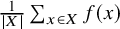

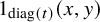












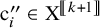





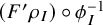




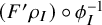





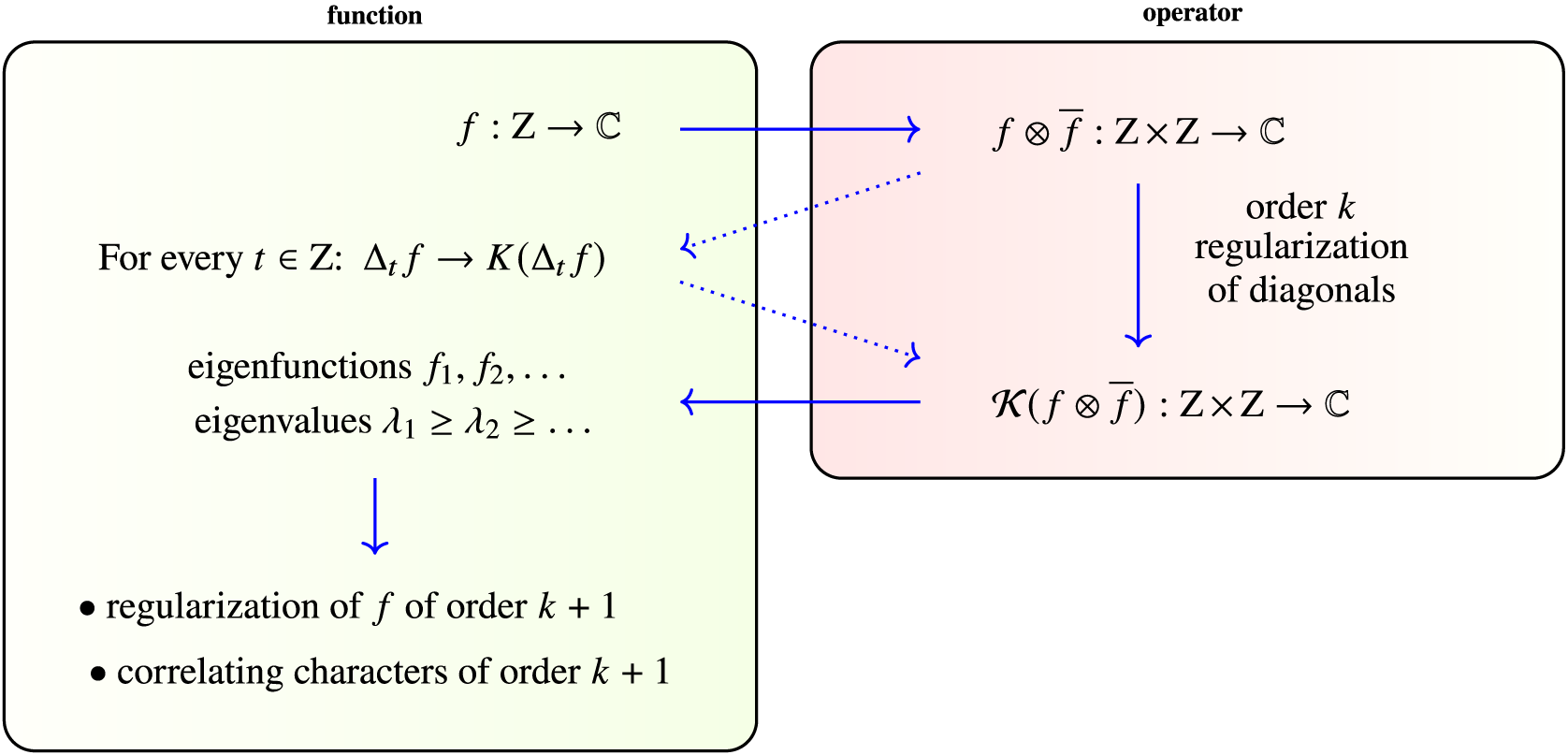
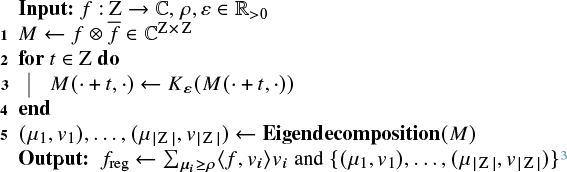
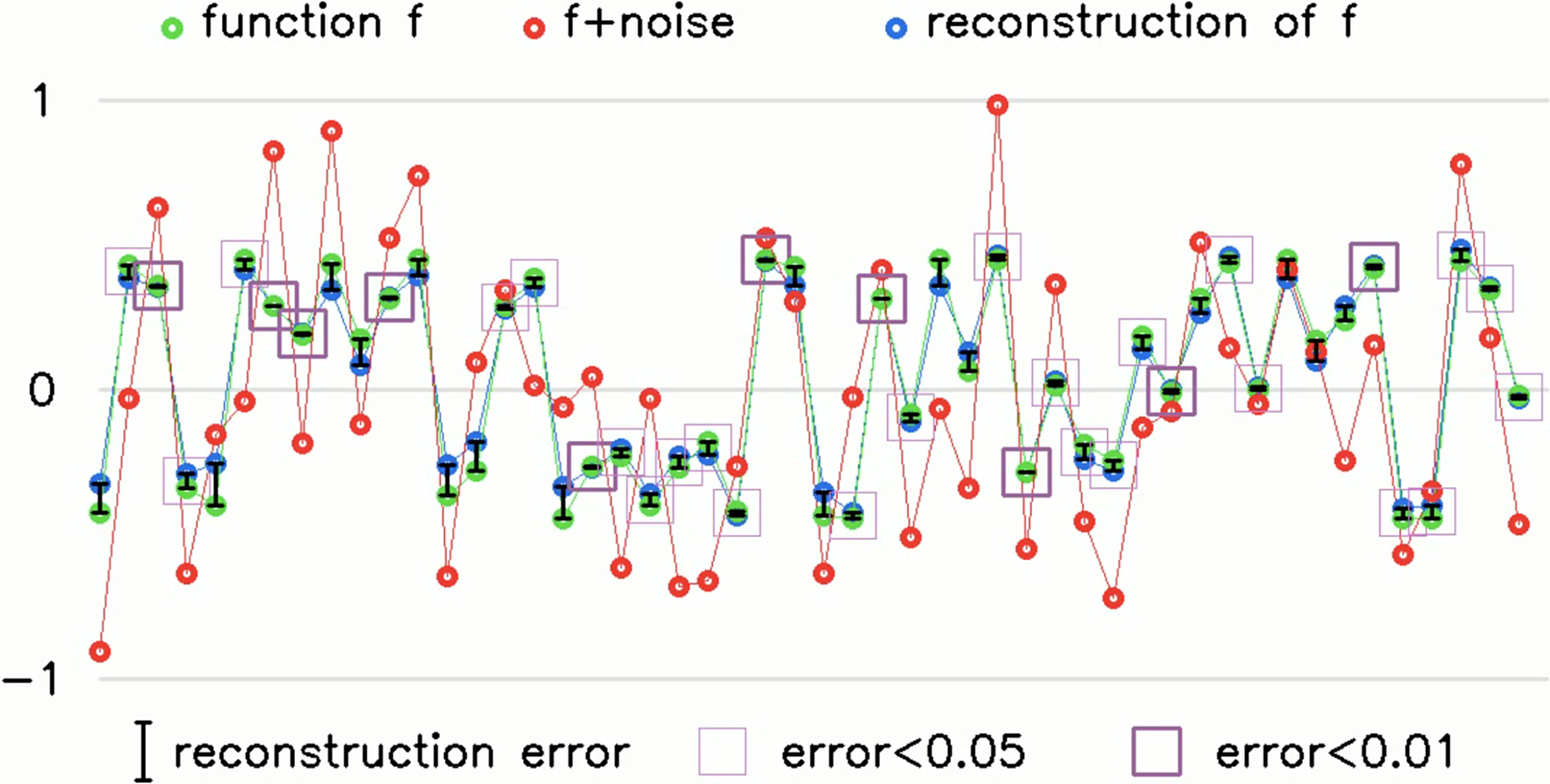


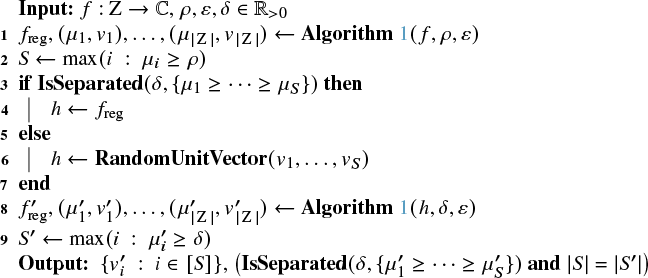
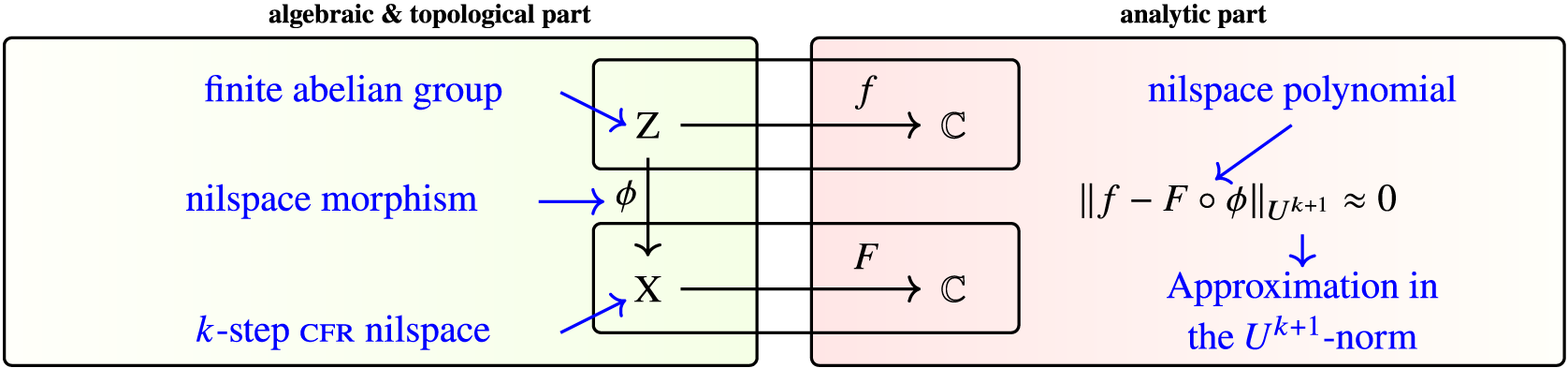

 Open access

