


I. Introduction
Facing declining consumption of fresh apples, apple products such as cider have become increasingly important for apple producers. To promote Norwegian consumption, high-quality apple cider from the Hardanger region received geographical indication protection in 2009. Hardanger is a traditional apple growing region on the west coast of Norway. The protection was granted through a national certification program, which was initiated by the Ministry of Agriculture and Food. The program ensures legal protection for food products associated with specific regions or traditional specialties (Stiftelsen norsk mat, 2024). To further promote hard cider consumption, farms were allowed to sell fruit wines with an alcohol content of up to 22% directly from their premises in 2016 (Regjeringen.no, 2022). As a result, cider tourism and other activities related to cider production have increased (Taste Hardanger, 2024).
The focus on quality and promotion has resulted in increased sales of hard apple cider. The sales in the national retail monopoly (Vinmonopolet) have increased from NOK 3.9 million in 2011 to 64 million in 2021 with rapid increases after 2017. The total sales in Vinmonopolet, the HORECA segment, and at farms were about 100 million the same year. Currently 349 hard ciders with an alcohol content between 4.8% and 18% are sold in Vinmonopolet. Of these ciders, 231 are domestically produced and 80% in the Hardanger region (Vinmonopolet, 2024). The Norwegian hard ciders also have a higher unit value than imported hard ciders. The preference for locally produced cider is in line with previous results for the United States (Farris et al., Reference Farris, Malone, Robison and Rothwell2019; Jensen et al., Reference Jensen, DeLong, Gill and Hughes2021; Staples et al., Reference Staples, Howard, Conner, Sirrine, Ostrom and Miller2023). Even though the growth in sales of hard ciders has been remarkable, it is still a niche product with a market share of about 1% of the total sales of wine.
We have two objectives in this paper. First, we investigate the effects of personality, motives, and socioeconomic variables on the consumption of hard ciders defined as ciders with an alcohol content above 4.75%. Gustavsen and Rickertsen (Reference Gustavsen and Rickertsen2018, Reference Gustavsen and Rickertsen2019, Reference Gustavsen and Rickertsen2020) investigated the associations between motivation, personality traits, and socioeconomic variables and sales and frequencies of consumption of wine and beer. We use the personality traits, and socioeconomic variables used in Gustavsen and Rickertsen (Reference Gustavsen and Rickertsen2020) to investigate the effects on the frequency of cider consumption. However, a more recent data set is used. Effects of demographic variables on hard cider consumption have previously been investigated (e.g., Tozer et al., Reference Tozer, Galinato, Ross, Miles and McCluskey2015; Yenerall et al., Reference Yenerall, Jensen, Hughes, Trejo-Pech and DeLong2022). One general result is that younger people have a stronger preference for cider than older people. Second, results in Neill et al. (Reference Neill, Lahne, Calvert and Hamilton2024) indicate that hard cider is perceived as a complement to red and white wine, and we compare the associations found for hard cider with the corresponding associations found for red, white, and sparkling wines.
II. Data and methods
Data from the Norwegian Monitor Survey (NMS) from the 2023 round was used. This is a nationally representative survey of adults aged between 15 and 95 years. The NMS is Norway’s most comprehensive consumer and opinion survey, and it covers a broad range of topics including demographics and socioeconomic information, political preferences, viewpoints on moral and ethical issues, and self-perceived happiness, health, and food and drinking habits including the frequencies of hard cider consumption (Ipsos-MMI, 2024). In the survey, 3,373 respondents from 18 to 91 years of age participated.
To analyze individual frequencies of cider consumption, we used the methods and variables used in Gustavsen and Rickertsen (Reference Gustavsen and Rickertsen2020); however, the motivation indexes for wine and food interest are replaced by two dummy variables because of different questions in the 2019 and 2023 survey rounds.
Table 1 shows the frequency and percentages of wine consumption from the NM survey in 2023. The frequencies are based on the question: “How often do you drink the following alcoholic drinks: (i) cider, (ii) sparkling wine, (iii) white wine, and (iv) red wine.” Almost 14% drank cider once a month or more, about 20% drank cider 3–11 times a year, and 40% never drank cider. There are more frequent consumers of wine. About 20%, 35%, and 45% drank sparkling, white, and red wine, respectively, once a month or more.
Frequencies and percentages of hard cider and wine consumption

Note: Based on 3,373 respondents. The lower number of respondents reported in the last column is due to respondents who did not answer the question.
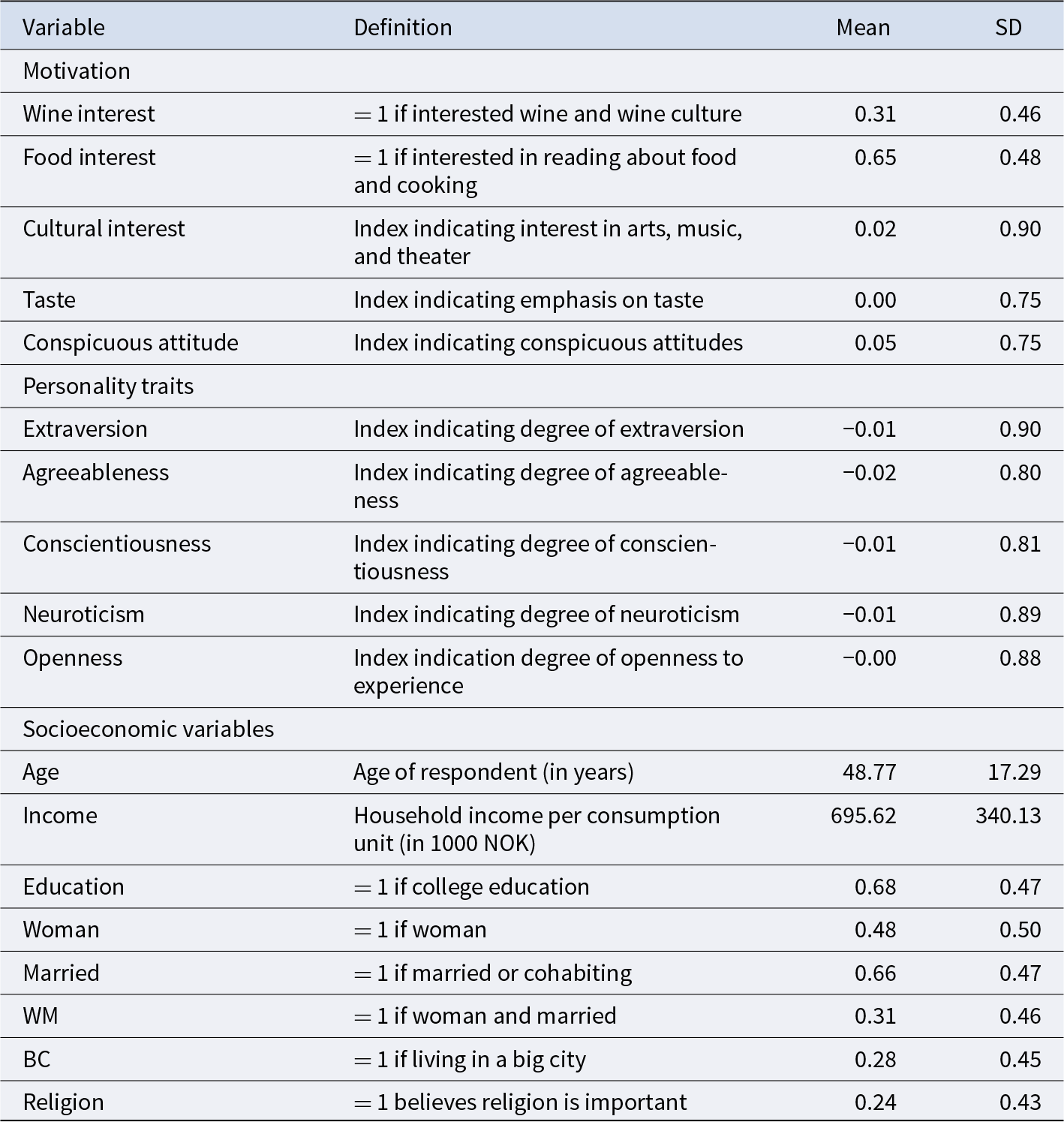
The descriptive statistics and variable definitions are presented in Table 2. Motivation was measured by three indexes for cultural interest, taste, and conspicuous attitudes and two dummy variables for wine and food interest. The index for conspicuous attitude included questions related to high emphasis of looking good, wear expensive clothes, and obtain consumer goods that make impressions on other people. The index for cultural interest was based on questions related to interest in art exhibitions, theater, music, and literature. The index for taste was based questions related to trade-off between taste and health and the appearance of food, and preference for short term expenditure like eating away-from-home (Gustavsen and Rickertsen, Reference Gustavsen and Rickertsen2020). Personality traits were measured by the OCEAN traits: openness to experience, conscientiousness, extraversion, agreeableness, and neuroticism (Gustavsen and Rickertsen, Reference Gustavsen and Rickertsen2019, Reference Gustavsen and Rickertsen2020). The socioeconomic variables used in Gustavsen and Rickertsen (Reference Gustavsen and Rickertsen2020) were also included.
Variable definitions and descriptive statistics
As in Gustavsen and Rickertsen (Reference Gustavsen and Rickertsen2019, Reference Gustavsen and Rickertsen2020), latent variables for the five personality traits and the three motivation indexes were constructed using the graded response model of Samejima (Reference Samejima1969), and the individual frequencies of cider consumption were simulated using the beta distributions for nominal interval variables. To estimate the relationships between consumption frequencies and covariates, the beta regression setup in Ferrari and Cribari-Neto (Reference Ferrari and Cribari-Neto2004) was used. To take account of respondents who never drank cider, odds ratios were included in the model (Stasinopoulos et al., Reference Stasinopoulos, Enea, Rigby and Hossain2017). To avoid estimation problems and obtain comparable coefficients, the continuous variables were standardized before estimation.
About one-third of the respondents were interested in wine and wine culture, and two-thirds were interested in reading about food and cooking. The mean age of the respondents was 49 years, about two-thirds had some college education, about two-thirds were married or cohabited. About a quarter was living in one of the four biggest cities in Norway, and about a quarter found religion to be important.
III. Estimation results
The estimation results are shown in Table 3. The second column (O 0) gives the coefficient estimate for the odds of not drinking cider (the censored part of the model), and the next column (SEO 0) shows the associated standard errors. The fourth column (BE(0,1)) shows the estimated coefficients for the frequency of drinking cider conditional on a positive consumption (the beta regression part of the model), and the next column (SEBE (0,1)) gives the associated standard errors. Significant coefficients at the 5% level are printed in bold type.
Parameter estimates and consumption frequencies for hard cider consumption
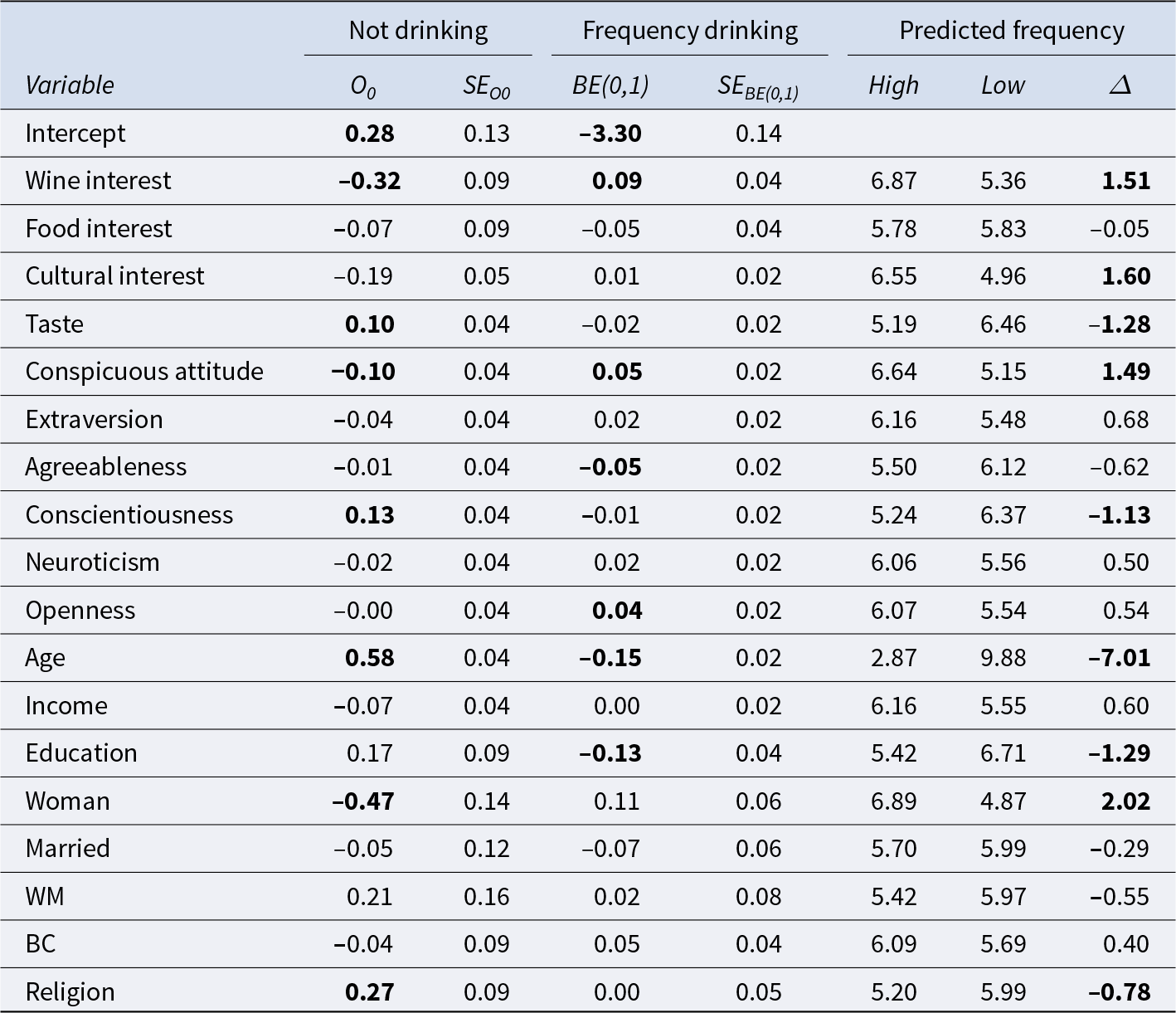
Notes: The estimation results are based on 3,227 respondents. Some respondents (146) did not answer all the questions and were not included in the estimated model. Bold print indicates significance at the 5% level. The effects of the variables on the consumption frequencies were simulated using 500 bootstraps. For the continuous variables, the column High reports the effect on consumption frequency of being among the 10% of respondents with the highest value of the variable, the column Low reports the effect of being among the 10% of respondents with the lowest value of the variable, and the column Δ reports the difference between the High and Low columns. For the dummy variables, the High column reports the effect of the dummy variable taking the value of 1 and the Low column the effect of taking the value of 0.
Wine interest, high scores on conspicuous attitudes, and being female significantly reduce the probability of not drinking hard cider. Correspondingly, increasing age and finding religion to be important increase the probability of not drinking cider. Scoring high on conscientiousness and taste also increase the probability. A probable explanation for the taste effect is that many cider types are on the sweet side. Conditional on drinking cider, wine interest, scoring high on conspicuous attitude, and being open to experiences increase the consumption frequency. Older respondents, respondents scoring high on agreeableness, and somewhat surprising, higher educated respondents have a lower consumption frequency.
Apart from sign, size, and significance, the estimated coefficients have no interpretation. To get a better understanding of the magnitude of the effects, we did a simulation. The effects of the variables on the consumption frequencies were simulated using 500 bootstraps. For the continuous variables, the column High reports the effect on consumption frequency of being among the 10% of respondents with the highest value of the variable, the column Low reports the effect of being among the 10% of respondents with the lowest value of the variable, and the column Δ reports the difference between the High and Low columns. The significant differences are printed in bold type. For the dummy variables, the High column reports the effect of the dummy variable taking the value of 1 and the Low column the effect of taking the value 0. The three rightmost columns of Table 3 show the predicted consumption frequency keeping other covariates at their mean values.
Respondents with a high wine interest are predicted to drink hard cider 6.87 times per year while low interest respondents are predicted to drink it 5.35 times, i.e., high scoring respondents are expected to drink cider 1.5 times more per year or almost 30% more frequently. Other variables significantly increasing the predicted frequency are cultural interest, having a high score on conspicuous attitude, and being female. The difference in predicted frequency between female and male respondents is about two or about 40%. Scoring high on the taste index, being a conscientious respondent, being older, higher educated, or believing religion is important reduce the predicted frequencies. The effect of age is very large. The 10% oldest respondents were drinking hard cider 2.87 times per year while the 10% youngest were drinking it 9.88 times per year.
IV. Comparison of hard cider and wine
It is of interest to compare the effect found for hard cider with corresponding effects for different types of wine. To illustrate these effects, we focused on the motivation variables and compared the results presented in the last column of Table 3 with corresponding results found by estimating the model using the 2023 data set for sparkling, white, and red wine. Table 4 shows the expected difference in consumption frequencies for respondents in the high and low group for each variable.
Importance of motives for consumption frequencies of hard cider and wine

Notes: The estimation results are based on 500 bootstraps and 3,227 respondents. Some respondents (146) did not answer all the questions and were not included in the simulation. Bold print indicates significant difference at the 5% level. The columns report the difference between respondents having high and low scores (as defined in the note to Table 3) on each variable.
Cultural and wine interest are the main motives for cider and all types of wine. Wine interest is the main factor for the categories, but cultural interest has a slightly larger effect for hard cider. Conspicuous attitude also significantly affects the predicted frequencies. Food interest and taste have no effects for wine.
The absolute effects on consumption frequencies are much larger for the beverages that are frequently consumed. As seen in Table 1, the consumption frequencies are much higher for red, white, and sparkling wines than for cider. The effect of wine interest on the difference in the consumption frequency between the high and low group is about 1.5 for hard cider. For sparkling, white, and red wines the corresponding differences are 6.5, 17.5, and 27.6.
Despite the changed definition of the variables for wine and food interest, the effects of the motivation variables are broadly in line with the results in Gustavsen and Rickertsen (Reference Gustavsen and Rickertsen2020) who used data from 2019. The signs, the significance, and the magnitudes are similar for cultural and wine interest. However, food interest had a significant impact on the consumption frequency for white and red wine in 2019. Finally, conspicuous attitude had no effect for red wine, in 2019.
V. Conclusions
The sales of hard cider and, in particular, domestic cider has increased rapidly over the last 20 year. Sales of Norwegian hard cider from Vinmonopolet have increased from about 3,000 to 279,000 L over the 2006–2022 period, while sales of imported hard cider have increased from about 2,000–65,000 L. This remarkable growth has resulted in increased consumption frequencies that are associated with many different variables. However, the hard cider consumption is still small as compared with wine.
Younger respondents have substantially higher probability of consuming hard cider than older, and the predicted consumption frequency is higher. This may be explained by many rather sweet cider types, which may appeal to younger consumers. The age effect is in line with Yenerall et al. (Reference Yenerall, Jensen, Hughes, Trejo-Pech and DeLong2022), who found that the Millennial generation and Generation X were more likely to consume and spend more on hard cider than older generations in the U.S. state of Tennessee in 2019.
Our findings regarding motivations to consume hard cider resemble the results for sparkling, white, and red wines found in Gustavsen and Rickertsen (Reference Gustavsen and Rickertsen2020). Cultural interest and wine interest are the most important motivational factors for all categories.
Acknowledgements
Paper presented at the 16th Annual Conference of AAWE, July 1–5, 2024, Lausanne, Switzerland. We thank conference participants, two anonymous referees, and the editor for useful comments.
Funding statement
This research is a part of the project: “Sustainable Eaters” funded by the BIONÆR program of the Research Council of Norway (Project Number 320800).


 Open access

