

Introduction
European countries are experiencing a shift towards an older population (Hasselhorn and Apt, Reference Hasselhorn and Apt2015). This means that welfare systems will need to function with fewer workers supporting more people of retirement age (Giannakouris, Reference Giannakouris2010), which has led policy makers to try to keep older people in the labour force longer (Hasselhorn and Apt, Reference Hasselhorn and Apt2015).
Different groups of workers may not have the same opportunities to stay in the labour force into older age. It has been found, for example, that women and those with lower education are less likely to work beyond the age of 60 (McAllister et al., Reference McAllister, Bodin, Brønnum-Hansen, Harber-Aschan, Barr, Bentley, Liao, Koitzsch Jensen, Andersen, Chen, Thielen, Mustard, Diderichsen, Whitehead and Burström2020). Additionally, manual workers tend to exit the labour market much earlier than non-manual workers (Kadefors et al., Reference Kadefors, Nilsson, Rylander, Östergren and Albin2018, Reference Kadefors, Nilsson, Östergren, Rylander and Albin2019). There is also evidence that poor health is a major reason for individuals being unable to work to the expected retirement age or beyond (van Rijn et al., Reference van Rijn, Robroek, Brouwer and Burdorf2014; Jonsson et al., Reference Jonsson, Dellve and Halleröd2019). Thus, the possibilities to work into older age differ greatly between groups.
The reasons for exiting the labour market also vary among different groups of people. Manual workers are more likely to do so through disability pension (Laaksonen et al., Reference Laaksonen, Rantala, Järnefelt and Kannisto2017; Riekhoff and Järnefelt, Reference Riekhoff and Järnefelt2018), unemployment or economic inactivity (Schuring et al., Reference Schuring, Schram, Robroek and Burdorf2019). That is, they are forced to leave the labour market due to health or labour market reasons (‘push factors’). On the other hand, people in higher-qualified jobs may be able to work longer due to better health, more flexibility in their work and stronger attachment to their occupations (Carr et al., Reference Carr, Fleischmann, Goldberg, Kuh, Murray, Stafford, Stansfeld, Vahtera, Xue, Zaninotto, Zins and Head2018). When those with higher education do retire, it is more likely due to having the financial means to retire and other personal and family factors (‘pull factors’) (Andersen et al., Reference Andersen, Jensen and Sundstrup2019). Thus, there appears to be important differences in the voluntariness of labour market exit among different socioeconomic groups.
An overview of retirement policies in Europe explained that policies which base individual benefits on individual contributions to a greater extent are likely to impact groups such as women and low-wage workers more severely (Hinrichs, Reference Hinrichs2021). That is, policies that give greater incentives for those who are able to work longer may lead to greater disparities in economic resources and health, particularly disadvantaging those with lower socioeconomic positions. This can lead to an increase in social inequalities, which can be understood in a broad sense, including income, standard of living, and health (Pandey and Nathwani, Reference Pandey and Nathwani1996).
Education is a fundamental aspect of socioeconomic position. Comparing those with different levels of education is an important way of understanding potential inequalities as they relate to policies aimed at extending working life. A growing gap in income among those with different levels of education could eventually lead to unjust differences in health (Whitehead and Dahlgren, Reference Whitehead and Dahlgren2006). It is therefore important to consider how retirement and social insurance policies may differentially affect older workers with different levels of education.
Sweden serves as an interesting example of policy changes as they relate to extending working life. A major change was made to its social insurance system in 2008, which made the criteria to qualify for a disability pension much stricter (Ministry of Health and Social Affairs, 2008; Nilsson et al., Reference Nilsson, Östergren, Kadefors and Albin2016; Kadefors et al., Reference Kadefors, Nilsson, Östergren, Rylander and Albin2019). Some examples of the stricter criteria include that individuals can only qualify for a disability pension if they are deemed unable to ever work full-time again, i.e. only in situations where there is no rehabilitation which could improve work ability. Additionally, only work ability can be considered without accounting for other external circumstances such as age, residence or education (Ministry of Health and Social Affairs, 2008). Between 2006 and 2011, new cases of disability pension decreased by 70 per cent (Kadefors et al., Reference Kadefors, Nilsson, Östergren, Rylander and Albin2019). Around the same time, reforms to the pension system were also introduced which increased financial incentives to work longer before retiring (Laun and Palme, Reference Laun and Palme2018). Unique to many European countries, Sweden does not have a statutory retirement age (König and Sjögren Lindqvist, Reference König, Sjögren Lindqvist, Hofäcker, Hess and König2016), but the societal norm for retirement has consistently been found to be 65 years old (Hasselhorn and Apt, Reference Hasselhorn and Apt2015; Johansson et al., Reference Johansson, Laun, Palme and Stenscota2018). The two most common ways of exiting the labour market before this age are through disability pension and early old-age pension.
Disability pension is for people of working age who have been deemed as never being able to work full-time due to illness or disability, and is thus considered more permanent compared to sickness absence (Försäkringskassan, 2023). Early old-age pension is another alternative for exiting the labour market prematurely. The pension system in Sweden has four tiers: public pension, guaranteed pension, occupational pension and private pension (Baumann et al., Reference Baumann, Eyjólfsdóttir, Fritzell, Lennartsson, Darin-Mattsson, Kåreholt, Andel, Dratva and Agahi2022), but the public pension covers most individuals in Sweden and is the most common form of pension. Since the late 1990s, it can be drawn from the age of 61. In 2020 this was raised to 62, is currently 63 and continues to be gradually raised (Inspektionen för Socialförsäkringen, 2021). Since it is based on lifetime earnings from employment, financial incentives favour those who work longer (Firm and Johannisson, Reference Firm and Johannisson2018; Kadefors et al., Reference Kadefors, Nilsson, Östergren, Rylander and Albin2019). A recent report describes the Swedish pension system in depth from an international perspective (Inspektionen för Socialförsäkringen, 2021).
While policy changes related to pensions, including disability pension, have helped to keep people in the labour force longer in Sweden (Laun and Palme, Reference Laun and Palme2018), they may also have led to greater inequalities. Those who are unable to work until the age of 65 will face negative financial consequences for their remaining lifetime. Sweden has seen growing socioeconomic inequalities in terms of life expectancy, as these gains have mainly been among those with higher socioeconomic position (Fors et al., Reference Fors, Wastesson and Morin2021). There are even indicators that mortality rates have increased among lower-educated women (Long et al., Reference Long, Mackenbach, Klokgieters, Kalédiené, Deboosere, Martikainen, Heggebø, Leinsalu, Bopp, Brønnum-Hansen, Costa, Eikemo and Nusselder2023). There is likely a similar trend where gains in labour market participation may have disproportionately affected those in higher socioeconomic positions.
Workers who no longer qualify for a disability pension under the new, more restrictive system, despite reduced work ability, may have to use alternative strategies to exit the labour market such as drawing an old-age pension as early as possible. People could do this while also continuing to work to compensate for a reduced income due to reduced work ability. As receipt of a disability pension is more common among workers with a lower level of education, this group could bear the greatest financial consequences of the policy changes. There may also be important differences between men and women, as receipt of a disability pension has historically been more common among women, and retirement pathways may be different due to lower lifetime income among women (Kadefors et al., Reference Kadefors, Nilsson, Östergren, Rylander and Albin2019).
Previous literature
There is literature investigating socioeconomic differences in labour market exit, but only a few studies have made comparisons before and after policy reforms. Several studies from different European contexts have concluded that restrictions in disability and retirement pension policy disproportionally affect those with lower education or occupational class (Carr et al., Reference Carr, Fleischmann, Goldberg, Kuh, Murray, Stafford, Stansfeld, Vahtera, Xue, Zaninotto, Zins and Head2018; Leinonen et al., Reference Leinonen, Martikainen and Myrskylä2018; Mathisen et al., Reference Mathisen, Jensen, Bjorner, Brønnum-Hansen, Christensen, Thielen, Gadeberg and Andersen2021). Three previous register-based studies in Sweden have made comparisons between cohorts before and after the major social insurance reforms regarding the relationship between occupation or occupational class and workforce participation or length of working life (Nilsson et al., Reference Nilsson, Östergren, Kadefors and Albin2016; Kadefors et al., Reference Kadefors, Nilsson, Rylander, Östergren and Albin2018, Reference Kadefors, Nilsson, Östergren, Rylander and Albin2019). It was found that labour force participation had increased, but mostly among women and those in lower-qualified occupations (Nilsson et al., Reference Nilsson, Östergren, Kadefors and Albin2016), that white-collar workers worked significantly longer than blue-collar workers (Kadefors et al., Reference Kadefors, Nilsson, Rylander, Östergren and Albin2018) and that early old-age pensions had become more common among blue-collar workers (Kadefors et al., Reference Kadefors, Nilsson, Östergren, Rylander and Albin2019).
The previous Swedish studies focused on occupation or occupational class as a measure of socioeconomic differences. Education as a measure of socioeconomic differences may provide additional information because it is an individual resource not only linked to other determinants of health like job quality and income, but also to sustained employability and the possibilities of shifting work tasks or even career in older age. Furthermore, educational differences in health and resources have been found to accumulate throughout the lifecourse and to be particularly important in older age (König et al., Reference König, Lindwall and Johansson2019). Previous studies have not looked at the possible role of other factors of importance for labour market trajectories such as unemployment (poor employability) and sickness absence (poor health), in late working life. These factors may be important in explaining changes in educational differences after the policy changes, as those who do not qualify for disability pension in the new system may have poorer employability and work ability.
Because it is increasingly common for people to combine work and retirement, it is important to account carefully for whether or not individuals continue working when they draw their early old-age pension. One previous study in Sweden has investigated educational differences in labour market exit pathways including combinations of early pension and employment while also accounting for unemployment and sickness absence (Thern et al., Reference Thern, Falkstedt, Almroth, Kjellberg, Landberg, Bodin, Melin and Hemmingsson2022). This study, however, did not make comparisons between cohorts before and after policy reforms and only included men.
Aim and hypotheses
The aim of this study, based on population registers, is to investigate how differences in early labour market exit pathways among older men and women with different levels of education changed after major restrictive social insurance and retirement policy reforms in Sweden, and to account for the explanatory role of unemployment and sickness absence.
The following hypotheses are investigated:
• Hypothesis 1: The proportion of those on disability pension will shrink, especially among the higher educated who tend to have better health and less health-damaging jobs, leading to greater educational differences.
• Hypothesis 2: The proportion of those drawing an early old-age pension will grow among the lower educated who have poorer health and restricted possibilities to qualify for a disability pension, also leading to greater inequalities. There may be variation in this pattern based on whether individuals continue to earn income or not.
• Hypothesis 3: Educational differences in those who are not earning income will be similar between the two cohorts because of the simultaneous decrease in disability pension and increase in early old-age pension.
In addition to these hypotheses, we investigate differences between men and women, and differences in the explanatory role of unemployment and sickness absence (poor health and work ability) between the two cohorts.
Methods
Study population and design
Two cohorts were created based on the Swedish Work, Illness, and labour market Participation (SWIP) cohort, which includes all individuals aged 16–64 who were registered as living in Sweden in 2005. This population-based cohort consists of record linkages between the major Swedish medical and administrative registers such as the Total Population register (Ludvigsson et al., Reference Ludvigsson, Almqvist, Bonamy, Ljung, Michaelsson, Neovius, Stephansson and Ye2016), the Longitudinal Integrated Database for Health Insurance and Labour Market Studies (LISA) register (Ludvigsson et al., Reference Ludvigsson, Svedberg, Olen, Bruze and Neovius2019) and the Social Insurance Micro Data for Analysis of the Social Insurance System (MIDAS) register. The SWIP cohort has been described in greater detail in previous publications (Almroth et al., Reference Almroth, Hemmingsson, Sörberg Wallin, Kjellberg, Burström and Falkstedt2021; Falkstedt et al., Reference Falkstedt, Hemmingsson, Albin, Bodin, Ahlbom, Selander, Gustavsson, Andersson, Almroth and Kjellberg2021).
The present study is based on two sub-cohorts consisting of individuals who were in their early sixties before and after the major social insurance reforms mentioned above (Ministry of Health and Social Affairs, 2008). This age group was chosen because 61 is the age where individuals could first draw their public pension, and thus a relevant age to study labour market exit before and after reforms. Cohort 1 includes all registered individuals in Sweden who were either 60 or 61 years old in 2005 (born in 1944 and 1945), while Cohort 2 includes all registered individuals in Sweden who were aged 60 or 61 in 2012 (born in 1951 or 1952). Cohort 1 has the baseline year in 2005 and is followed up until the end of 2008. For Cohort 2, baseline is in 2012, and the follow-up is until the end of 2015. One of the largest differences between the two cohorts is the implementation of disability pension policies. Cohort 1 is a larger birth cohort and tertiary education increased between Cohorts 1 and 2. The two cohorts, however, do not differ substantially in terms of other major labour market trends. Sweden, for example, recovered quickly after the 2008 economic recession compared to other European countries and increases in unemployment were mostly among younger age groups compared to those included in the present study (Anxo and Ericson, Reference Anxo and Ericson2015; Organisation for Economic Co-operation and Development, 2016).
Those who had received a disability pension prior to the start of follow-up for both cohorts were excluded from the analysis (N = 65,871 for Cohort 1; N = 46,678 for Cohort 2), as were those who had drawn their old-age pension early during the baseline year (N = 8,431 for Cohort 1; N = 8,078 for Cohort 2). This was done because those already receiving a disability pension or early old-age pension prior to baseline would not have the possibility to become incident cases. After exclusions, Cohort 1 included 186,145 individuals (46% women) and Cohort 2 included 176,216 individuals (47% women). The larger representation of men in both cohorts was due to more women being previous disability pension cases.
Measures
Education
Highest attained education is estimated from the LISA register during the baseline year for each cohort. This variable was categorised as primary (≤9 years), secondary (10–12 years) and tertiary education (≥13 years).
Labour market exit outcomes
Four labour market exit pathways were defined for the purpose of this study:
(1) Disability pension is identified in the MIDAS register and was defined as receiving any first-time full- or part-time disability pension during the follow-up period.
(2) Early old-age pension with income was defined through the LISA register which reports yearly information on income and pension payments. Those who began taking their pension before turning age 65 and who continued to earn an income from employment above one price basic amount (PBA) (SCB Statistikmyndighet, 2023) during the following calendar year were considered as early old-age pensioners with income. The PBA is calculated by Statistics Sweden every year to determine insurance and retirement levels. The PBA ranged from 39,700 to 44,500 Swedish crowns during the observation period of the present study. This is equivalent to earning around US$5,000–6,000 during an entire year when accounting for yearly exchange rates. The PBA was chosen as the threshold in order to reflect a very low level of income, as setting the threshold at zero would misclassify those who may have earned a very small amount outside a normal working situation. The income from the year following the onset of early old-age pension benefits was used because information on pension payments and income is only reported yearly in the LISA register. This means that if an individual had income from pension and employment from the same calendar year, it would not be clear whether they were drawing a pension and working during the entire year or whether they stopped working and started drawing their pension part way through the year. Because this outcome corresponds to a two-year period, the year after follow-up for both cohorts was used to quantify this outcome. For example, if someone in Cohort 2 started drawing their pension in 2015 and continued earning income above one PBA in 2016, they would be counted as having early old-age pension with income and follow-up time would stop in 2015. This method of classifying combinations of pension and income from work has been used in a previous study (Thern et al., Reference Thern, Falkstedt, Almroth, Kjellberg, Landberg, Bodin, Melin and Hemmingsson2022). Similar methods of classifying retirement based on these income thresholds have also been found to be highly correlated with self-reported retirement age (Eyjólfsdóttir et al., Reference Eyjólfsdóttir, Baumann, Agahi and Lennartsson2021).
(3) Early old-age pension without income was defined similarly to the outcome described above but included those who began taking their pension before turning 65 and who earned income below one PBA during the following year. This outcome also corresponds to a two-year period as described above.
(4) No income includes all individuals who earned less than one PBA for two years in a row during the follow-up period. Income information is reported yearly in the LISA register and refers to tax-reported income from work. Individuals categorised as having no income could be receiving benefits from a variety of other sources including a disability pension and old-age pension. Thus, this outcome gives an overview of those outside the paid labour force. Because this outcome corresponds to a two-year period, the year after the follow-up period was used to quantify this outcome as described above. For analyses with this outcome, we additionally excluded those with income below one PBA during the two years before baseline (N = 17,752 for Cohort 1; N = 14,222 for Cohort 2).
Other demographic and labour market variables
Information on sex and age was obtained from the Total Population Register. Unemployment and sickness absence days during the 5 years prior to baseline were obtained from the LISA register and categorised as 0, 1–365 and more than 365 days, respectively. Unemployment and sickness absence are used as potential explanatory variables because they represent marginalised labour market states which could differ among educational groups and be related to the likelihood of the above-mentioned labour market exit outcomes (Thern et al., Reference Thern, Falkstedt, Almroth, Kjellberg, Landberg, Bodin, Melin and Hemmingsson2022). Accounting for these variables could contribute to a better understanding of the mechanisms involved in educational differences in labour market exit in the two cohorts.
Statistical analysis
The distribution of age, unemployment days, sickness absence days and education level were first explored according to cohort and sex. Proportions of each labour market exit outcome among each level of education were calculated for men and women in Cohorts 1 and 2 separately. The four labour market exit outcomes were analysed as time-to-event data during the follow-up period using Cox proportional hazards regression (survival analysis) models. Models only adjusted for age were built to estimate the relationship between attained educational level and the four labour market exit outcomes separately for each cohort and by sex. In order to test formally for changes in the relationship between education and the four labour market exit outcomes between the two cohorts, we pooled the data and included interaction terms between education and cohort, as has been done in a previous study examining changes in birth cohorts (Martikainen et al., Reference Martikainen, Elo, Tarkiainen, Mikkonen, Myrskylä and Moustgaard2020).
In a second model, unemployment and sickness absence days were also added in order to estimate the explanatory role that these labour market factors played. This was quantified by calculating the percentage reduction in excess risk after adding unemployment and sickness absence to the models. That is, (HRcrude − HRadjusted)/(HRcrude − 1) (where HR is the hazard ratio), as has been used in several previous publications (Lundin et al., Reference Lundin, Lundberg, Hallsten, Ottosson and Hemmingsson2010; Thern et al., Reference Thern, Falkstedt, Almroth, Kjellberg, Landberg, Bodin, Melin and Hemmingsson2022). As a supplementary analysis, we also explored models adjusting for only age and unemployment and only age and sickness absence, respectively.
Follow-up time is counted from 1 January 2006, for Cohort 1, and 1 January 2013, for Cohort 2. Individuals were censored when they migrated from Sweden, turned 65 years old, died or reached the end of the follow-up period which was 31 December 2008, for Cohort 1, and 31 December 2015, for Cohort 2. Because the outcomes defined in the LISA register are only reported yearly, the 1 January in the year when the event occurred is used to estimate the time of the event.
We conducted several sensitivity analyses to test the robustness of our results. First, we repeated the early old-age pension analyses using two PBAs instead of one. Second, we explored an alternative categorisation for sickness absence during the five years prior to baseline which included 0, 1–89, 90–179, 180–364 and ≥365 days. These results did not differ in any significant way from the ones we present in this article. Finally, we conducted all analyses using five categories for education level based on years of education ≤9, 10–11, 12, 13–14 and ≥15). Results showed some variation, but the conclusions remained the same.
Analyses were done using SAS Enterprise Guide 8.3.
Results
The age distribution among men and women was similar in both cohorts (Table 1). The pattern of unemployment was also similar in Cohorts 1 and 2 and was similar between men and women within both cohorts. Sickness absence was less common in Cohort 2 compared to Cohort 1 and was more common among women in both cohorts. Tertiary education was more common in Cohort 2, especially for women.
Baseline characteristics for Cohorts 1 and 2
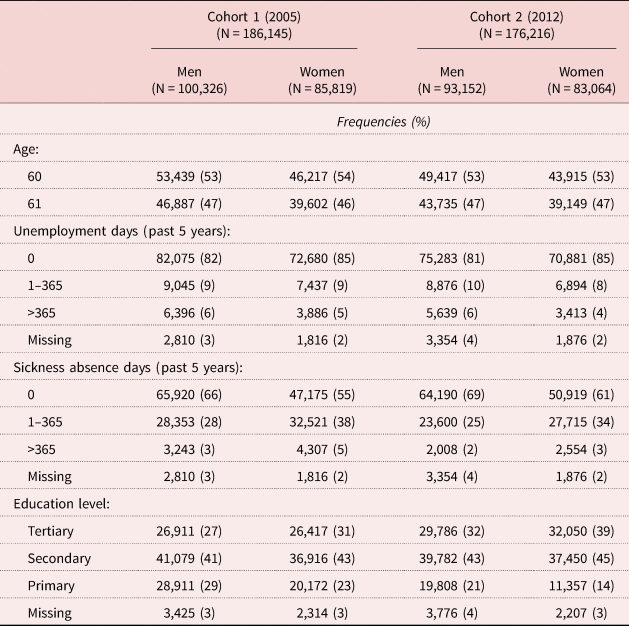
Note: Percentages may not always add up to 100 due to rounding.
During the follow-up period, 13,154 individuals (7%) in Cohort 1 and 3,655 individuals (2%) in Cohort 2 became new disability pension cases, while 18,739 individuals (10%) in Cohort 1 and 22,277 individuals (13%) in Cohort 2 became early old-age pensioners while still earning income. Early old-age pension without income occurred among 23,173 individuals (13%) in Cohort 1 and 28,543 individuals (17%) in Cohort 2. Finally, there were 36,614 individuals (22%) with income below one PBA for two years in a row in Cohort 1 and 29,720 individuals (19%) in Cohort 2.
The proportion of new disability pension cases among men and women largely decreased in all educational groups in Cohort 2 compared with Cohort 1 (Tables 2 and 3). Relative comparisons showed that the lower educated compared to the highest educated were more likely to receive disability pension. All associations tended to be stronger in Cohort 2, especially for women. For example, the hazard ratio (HR) for men with primary education compared to tertiary education was 1.97 in Cohort 1 and 2.20 in Cohort 2, while for women it was 1.18 in Cohort 1 and 2.21 in Cohort 2.
Hazard ratios (HR) and 95 per cent confidence intervals (95% CI) for exit routes according to attained education among men: models adjusted for age only
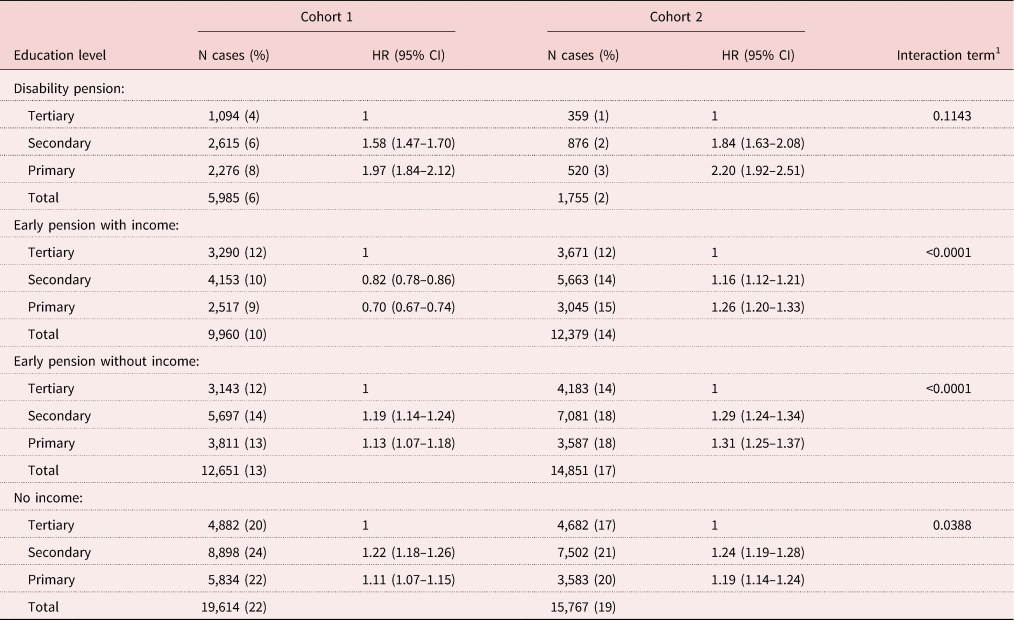
Notes: 1. p-Value corresponding to Wald test for interaction term. Models are adjusted for age.
Hazard ratios (HR) and 95 per cent confidence intervals (95% CI) for exit routes according to attained education among women: adjusted for age only
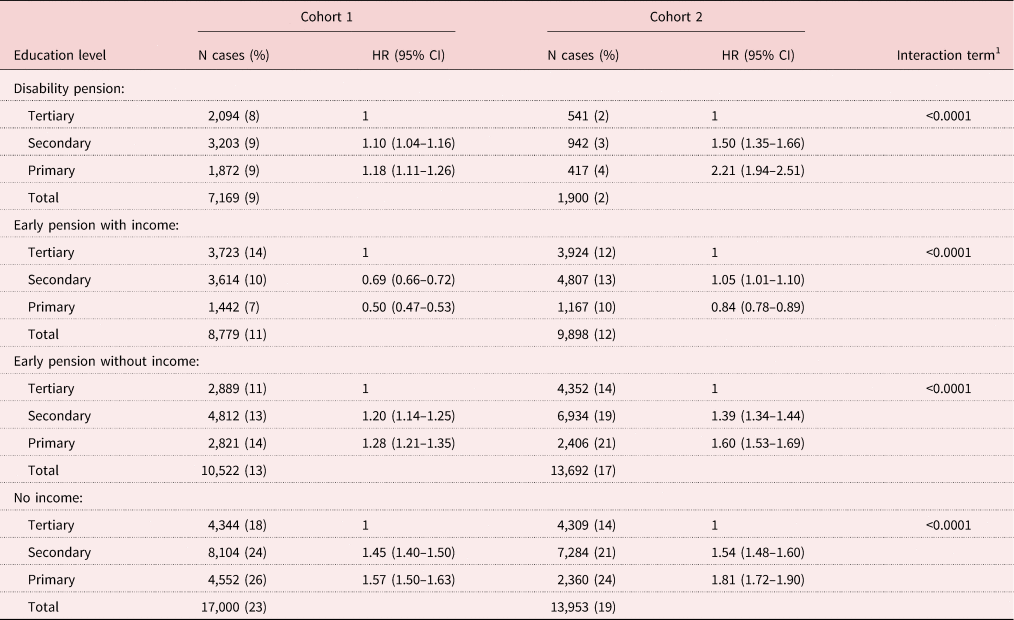
Notes: 1. p-Value corresponding to Wald test for interaction term. Models are adjusted for age.
The proportion of those taking an early old-age pension with income was higher among those with primary and secondary education in Cohort 2 compared to Cohort 1 but was similar among men with tertiary education and lower among women with tertiary education (Tables 2 and 3). Further, having a lower level of education was associated with a decreased likelihood of taking an early pension with income in Cohort 1 (HR = 0.70 for primary- compared to tertiary-educated men; HR = 0.50 for women). However, a lower level of education was associated with an increased likelihood of this outcome in Cohort 2, except among women with primary education (HR = 1.31 for primary- compared to tertiary-educated men; HR = 1.05 for secondary- compared to tertiary-educated women).
Taking an early pension without income became more common in all education groups in Cohort 2 compared to Cohort 1. Having a lower level of education was associated with an increased rate of taking an early pension without income from work, and these associations were stronger in Cohort 2. For example, for primary compared to tertiary-educated men in Cohort 1, the HR was 1.13 in Cohort 1 and 1.31 in Cohort 2 and for women in was 1.28 in Cohort 1 and 1.60 in Cohort 2.
The proportion of individuals without income decreased in Cohort 2 compared to Cohort 1, but this decrease was smallest among those with a primary education (Tables 2 and 3). The HR values show that compared to those with a tertiary education, having a primary or secondary education was associated with an increased likelihood of not earning income for both men and women. These associations were stronger in Cohort 2 and were higher among women. For primary-educated men the HR was 1.11 in Cohort 1 and 1.19 in Cohort 2, and for women it was 1.57 in Cohort 1 and 1.81 in Cohort 2.
Interaction terms between education and cohort were significant according to all outcomes, except for the disability pension outcome among men.
In models adjusting for unemployment and sickness absence prior to baseline, associations were attenuated to some extent among men (Table 4) and women (Table 5). For both men and women, associations between education and disability pension were greatly attenuated when adjusting for sickness absence and unemployment, except for the primary-educated women in Cohort 1. However, in models adjusting for these factors separately, associations were most attenuated by sickness absence (supplementary analysis available upon request). For early pension with income, associations were nearly identical when adjusting for unemployment and sickness absence (Tables 4 and 5). For early old-age pension without income, unemployment and sickness absence explained more of the association in Cohort 1 than for Cohort 2. Finally, associations between education level and not earning income were explained to some extent by previous unemployment and sickness absence, particularly for men.
Hazard ratios (HR) and 95 per cent confidence intervals (95% CI) for exit routes according to attained education among men: adjusted models

Notes: Model 1 is adjusted for age. Model 2 is adjusted for age, sickness absence and unemployment. 1. Percentage change in association when adding covariates to Model 2; calculated by (HRcrude − HRadjusted)/(HRcrude − 1).
Hazard ratios (HR) and 95 per cent confidence intervals (95% CI) for exit routes according to attained education among women: adjusted models
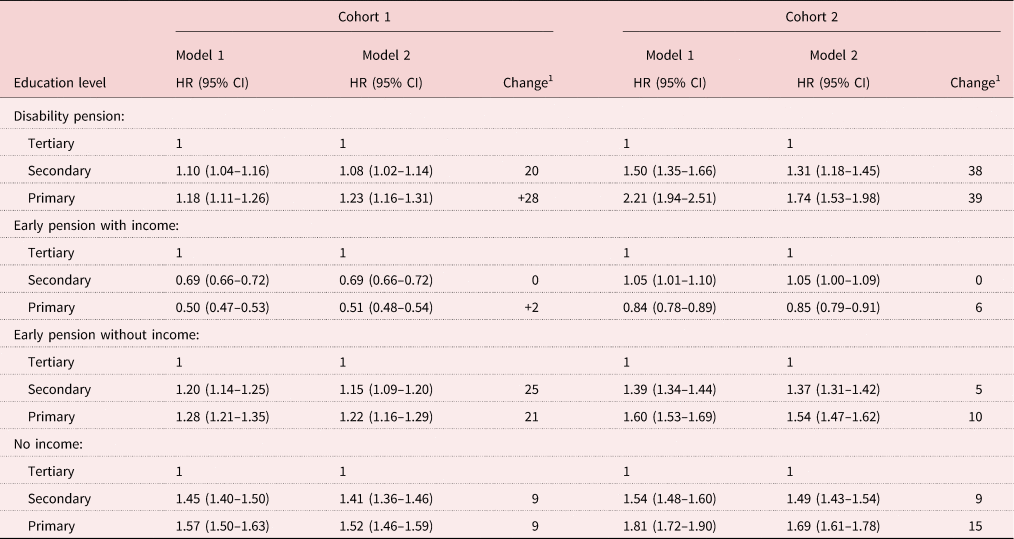
Notes: Model 1 is adjusted for age. Model 2 is adjusted for age, sickness absence and unemployment. 1. Percentage change in association when adding covariates to Model 2; calculated by (HRcrude − HRadjusted)/(HRcrude − 1).
Discussion
Summary of results
In this population-based study of two cohorts aged in their early sixties before and after major social insurance and retirement policy reforms in Sweden, we found that differences in the probability of early exits between lower- and higher-educated individuals were larger in Cohort 2 compared to Cohort 1 concerning all exit pathways. Significant interaction terms between education and cohort support these differences before and after the reforms except concerning men and disability pension. Previous sickness absence and unemployment played varying explanatory roles for these differences among the different exit outcomes and their explanatory roles were not clearly increased after the reforms. The changes in educational differences in early exit between cohorts showed similar patterns between men and women, though inequalities tended to grow even more among women.
Comparison with previous studies
Hypotheses 1 and 2 were supported in that inequalities in disability pension and early old-age pension increased, and that there were some differences in early old-age pension depending on whether the person continued to earn income or not. The finding that disability pension cases tended to decrease while early old-age pension cases tended to increase, and that this disproportionally affected the lower educated is in line with previous studies in Sweden looking at occupational differences (Nilsson et al., Reference Nilsson, Östergren, Kadefors and Albin2016; Kadefors et al., Reference Kadefors, Nilsson, Rylander, Östergren and Albin2018, Reference Kadefors, Nilsson, Östergren, Rylander and Albin2019).
Also, like previous studies (Laun and Palme, Reference Laun and Palme2018), we observed that those outside the labour market tended to decrease from the period after compared to before the reforms. We found, however, that educational differences in the likelihood of being without income tended to increase in the later period compared to the earlier period, especially for women. Thus, our Hypothesis 3 of no change was not supported.
Studies in other countries have also pointed to growing inequalities in labour market exit. A Danish study investigating the effects of a similar disability pension reform found that blue-collar workers were disproportionately affected (Mathisen et al., Reference Mathisen, Jensen, Bjorner, Brønnum-Hansen, Christensen, Thielen, Gadeberg and Andersen2021). A Finnish study also pointed to growing inequalities between occupational classes in terms of labour market exit (Leinonen et al., Reference Leinonen, Martikainen and Myrskylä2018). The present study contributes to what was previously known by investigating educational differences in several exit pathways before and after major policy reforms in Sweden and by investigating the explanatory role of long-term sickness absence and unemployment.
In the present study, previous sickness absence and unemployment explained varying degrees of the associations between educational level and the different exit pathways. Educational differences in receipt of a disability pension seemed to be partly explained by sickness absence and unemployment, which is unsurprising given that individuals almost always need to be on sickness absence before qualifying for a disability pension. Unemployment and sickness absence explained very little of the educational differences among those in receipt of an early old-age pension with income but had a greater explanatory role with regard to early old-age pension without income in Cohort 1. These findings are in line with a previous study which found that sickness absence and unemployment had very little influence on associations between education and receipt of an early old-age pension among men born between 1949 and 1951 (Thern et al., Reference Thern, Falkstedt, Almroth, Kjellberg, Landberg, Bodin, Melin and Hemmingsson2022).
Patterns were overall similar between men and women across outcomes, though there tended to be greater increases in inequalities for women, especially regarding disability pensions. This finding is in line with previous studies which have found that more women than men were affected by changes in disability pension policy (Kadefors et al., Reference Kadefors, Nilsson, Östergren, Rylander and Albin2019), and that differences in working years lost when comparing higher- and lower-educated workers were greater among women than men (Robroek et al., Reference Robroek, Nieboer, Jarvholm and Burdorf2020).
Interpretation of results
Our finding that educational differences in the incidence of disability pension were stronger in Cohort 2 could have multiple explanations. It could partly be due to the large decreases among the higher educated and, accordingly, the disability pension policy reforms may have been successful in decreasing use of disability pension among those who may have less need for it. However, there were also large reductions of new disability pension cases among the lowest educated, who are more likely to have adverse working conditions and the greatest need for disability pension. That this also corresponded to clearly increased differences in incident early old-age pension may point to the conclusion that lower-educated individuals are taking on the financial burden of early retirement due to the restrictions of the disability pension system and, thus, that inequalities are increasing.
Interestingly, early old-age pension with income was relatively less common among the lower educated compared to the higher educated in Cohort 1 while the opposite was true in Cohort 2, especially for men. One possible explanation is that the restriction on access to disability pensions has caused lower-educated individuals with difficulty to work full-time to draw their old-age pension early in order to subsidise the income that they were able to earn from employment. However, others may draw their pension at the same time as earning an income from employment in order to maximise their total income in the present. This practice may have been adopted among the lower educated later in time than among the higher educated.
Voluntary and involuntary or health-related and non-health-related exit have been central concepts in previous international studies of labour market exit (Reeuwijk et al., Reference Reeuwijk, van Klaveren, van Rijn, Burdorf and Robroek2017; Carr et al., Reference Carr, Fleischmann, Goldberg, Kuh, Murray, Stafford, Stansfeld, Vahtera, Xue, Zaninotto, Zins and Head2018; Jensen et al., Reference Jensen, Brønnum-Hansen, Andersen, Thielen, McAllister, Burström, Barr, Whitehead and Diderichsen2019; Mäcken et al., Reference Mäcken, Präg, Hess and Ellwardt2021). These studies have found that lower education is especially related to involuntary and health-related exit (Carr et al., Reference Carr, Fleischmann, Goldberg, Kuh, Murray, Stafford, Stansfeld, Vahtera, Xue, Zaninotto, Zins and Head2018; Mäcken et al., Reference Mäcken, Präg, Hess and Ellwardt2021), often referred to as push factors. In the present study, we do not know the reasons for drawing an early old-age pension. Disability pension usage is health related and thought to be caused by involuntary push factors related to health. Early old-age pension usage, however, whether still earning income or not, could represent many different potential situations, including push factors related to reduced work ability, pull factors such as a financial situation that makes early retirement possible, or factors such as wanting to spend more time with friends and family. However, a previous Danish study found that the relationship between low occupational class and early retirement was largely mediated by poor health (Qvist, Reference Qvist2021), indicating that ill health is important even when considering usage of early old-age pensions.
Strengths and limitations
This population-based study includes the entire registered Swedish population, which made it possible to focus on only those who were 60 and 61 years old. We were therefore able to create two comparable cohorts of men and women representing either side of the major social insurance and pension policy reforms. We also had the opportunity to consider multiple exit pathways including both those who drew their early old-age pension while still earning income and those who drew it without earning income. Focusing on educational differences made it possible to understand more nuanced socioeconomic differences, which complements previous studies on large occupational groups. By not restricting the population to only those in active labour, issues of the healthy worker effect may have been slightly reduced. We excluded those already on a disability pension and early old-age pension at the start of follow-up but included those with weak or marginalised labour market positions, such as those who were on sick leave, unemployed or earning low income for all analyses except for the analyses of those not earning income.
On the other hand, the use of register data prevented us from investigating the motivation behind different exit pathways and whether it was related to factors such as health or work ability. Those who drew an early old-age pension either with or without still earning income are a very heterogeneous group, which makes it difficult to draw conclusions about potentially health-related early retirement. Additionally, we used previous unemployment and sickness absence as a proxy for a more comprehensive measure of poor employability and work ability. We also did not have the possibility to investigate the role of home life and care responsibilities which may be important in labour market exit decisions. However, previous investigations of retirement motivation in Sweden indicated that care responsibilities were a very rarely mentioned reason for retirement (König and Sjögren Lindqvist, Reference König, Sjögren Lindqvist, Hofäcker, Hess and König2016). Although we compared two cohorts of individuals before and after major reforms, we cannot rule out other possible differences between these two cohorts which could confound some of the observed changes. Some examples could be social attitudes and public awareness of different labour market exit pathways. Finally, we focused on the periods before and after major policy reforms, avoiding overlaps in follow-up time and focusing on the age group with the possibility of taking early old-age pension during follow-up. However, this means that our study only covers the period up until 2016. We did not have new enough data to consider a third, more recent, cohort with equivalent follow-up time, and future studies could investigate whether increases in inequalities have continued.
Conclusions
Educational inequalities in labour market exit have tended to increase after major reforms to the social insurance and pension systems in Sweden. The fact that decreases in usage of disability pensions have corresponded with increases in usage of early old-age pensions, especially among the lower educated, indicates that individuals may be using early retirement when they are unable to qualify for a disability pension. This puts the financial burden on the individual, who faces economic repercussions for their remaining lifetime for taking an earlier pension. Given that these changes were seen in a relatively short time, it is not unlikely that educational inequalities will continue to grow, especially as policies attempt to extend the working age even longer. This is especially problematic given the increasing socioeconomic divide in health as reflected in life expectancy and indicates that such disparities should be investigated before making changes to welfare systems. These findings are relevant beyond the Swedish context, as most other European countries have implemented similar policies aimed at extending working life.
Author contributions
DF, TH, M Albin, JS, PG, TB and KK formulated the research question and design for a broader research project. M Almroth, DF, TH and KK more specifically conceptualised the study aim, design and methods with input from M Albin. M Almroth conducted the statistical analysis and drafted the manuscript. KB, ET and K-YP contributed to analytical and written aspects of the manuscript. All other authors provided comments on the manuscript throughout the process. All authors approved the final version of the manuscript.
Financial support
This work was supported by the Swedish Research Council for Health, Working Life, and Welfare Forte (grant number 2017/1224-31).
Competing interests
The authors declare no competing interests.
Ethical standards
Ethical approval was obtained from the Regional Ethics Review Board in Stockholm (reference numbers 2017/1224-31 and 2018/1675-32).


 Open access

