




1. Introduction
Nakajima quiver varieties [Reference NakajimaNak94, Reference NakajimaNak98] provide a rich source of examples illustrating many beautiful phenomena in algebraic geometry and geometric representation theory. To recall the construction, consider a finite graph with vertex set I, and vectors $\mathbf{v}, \mathbf{w}\in \mathbb{N}^{I}$
. This combinatorial data determines a Hamiltonian action of the group
$\mathbf{v}, \mathbf{w}\in \mathbb{N}^{I}$
. This combinatorial data determines a Hamiltonian action of the group $G:= \prod_{i\in I} \operatorname{GL}(v_i)$
on a symplectic vector space
$G:= \prod_{i\in I} \operatorname{GL}(v_i)$
on a symplectic vector space $\mathbf{M}(\mathbf{v}, \mathbf{w})$
, giving rise to a moment map
$\mathbf{M}(\mathbf{v}, \mathbf{w})$
, giving rise to a moment map $\mu\colon \mathbf{M}(\mathbf{v}, \mathbf{w})\to \mathfrak{g}^*$
. For any character
$\mu\colon \mathbf{M}(\mathbf{v}, \mathbf{w})\to \mathfrak{g}^*$
. For any character $\theta \in G^\vee$
, the Nakajima quiver variety is defined to be the geometric invariant theory (GIT) quotient
$\theta \in G^\vee$
, the Nakajima quiver variety is defined to be the geometric invariant theory (GIT) quotient
 \begin{equation}\mathfrak{M}_\theta(\mathbf{v},\mathbf{w}):= \mu^{-1}(0){{/\!\!/\!}}_\theta \, G.\end{equation}
Under suitable conditions on $\mathbf{v}, \mathbf{w}$
, and for any sufficiently general
$\mathbf{v}, \mathbf{w}$
, and for any sufficiently general $\theta$
(see § 1.2), the structure morphism
$\theta$
(see § 1.2), the structure morphism $\mathfrak{M}_\theta(\mathbf{v},\mathbf{w})\to \mathfrak{M}_0(\mathbf{v},\mathbf{w})$
is a crepant resolution of singularities. It follows from the work of Birkar, Cascini, Hacon and McKernan [Reference Birkar, Cascini, Hacon and McKernanBCH+10, Corollary 1.3.2] that
$\mathfrak{M}_\theta(\mathbf{v},\mathbf{w})\to \mathfrak{M}_0(\mathbf{v},\mathbf{w})$
is a crepant resolution of singularities. It follows from the work of Birkar, Cascini, Hacon and McKernan [Reference Birkar, Cascini, Hacon and McKernanBCH+10, Corollary 1.3.2] that $\mathfrak{M}_\theta(\mathbf{v},\mathbf{w})$
is a relative Mori dream space (see Namikawa [Reference NamikawaNam15] or Bellamy et al. [Reference Bellamy, Craw, Rayan, Schedler and WeissBCR+24, Lemma 5.3]). Put simply, the birational geometry of
$\mathfrak{M}_\theta(\mathbf{v},\mathbf{w})$
is a relative Mori dream space (see Namikawa [Reference NamikawaNam15] or Bellamy et al. [Reference Bellamy, Craw, Rayan, Schedler and WeissBCR+24, Lemma 5.3]). Put simply, the birational geometry of $\mathfrak{M}_\theta(\mathbf{v},\mathbf{w})$
is especially well behaved. It is therefore natural to ask for a concrete description of the relative movable cone and the set of all projective crepant resolutions of
$\mathfrak{M}_\theta(\mathbf{v},\mathbf{w})$
is especially well behaved. It is therefore natural to ask for a concrete description of the relative movable cone and the set of all projective crepant resolutions of $\mathfrak{M}_0(\mathbf{v},\mathbf{w})$
.
$\mathfrak{M}_0(\mathbf{v},\mathbf{w})$
.
Here, we answer these questions in full by proving directly that quiver varieties are relative Mori dream spaces, and we establish that every projective crepant resolution of $\mathfrak{M}_0(\mathbf{v},\mathbf{w})$
is itself a quiver variety. In doing so, we provide a vast generalisation of the results of [Reference Bellamy and CrawBC20], bypassing the étale-local description of quiver varieties required there. Our proof does not use results from [Reference Birkar, Cascini, Hacon and McKernanBCH+10], nor does it apply the relative version of the sufficient condition to be a Mori dream space given by Hu and Keel [Reference Hu and KeelHK00, Theorem 2.3], because that condition does not apply even to the simplest quiver variety, namely, the minimal resolution of the
$\mathfrak{M}_0(\mathbf{v},\mathbf{w})$
is itself a quiver variety. In doing so, we provide a vast generalisation of the results of [Reference Bellamy and CrawBC20], bypassing the étale-local description of quiver varieties required there. Our proof does not use results from [Reference Birkar, Cascini, Hacon and McKernanBCH+10], nor does it apply the relative version of the sufficient condition to be a Mori dream space given by Hu and Keel [Reference Hu and KeelHK00, Theorem 2.3], because that condition does not apply even to the simplest quiver variety, namely, the minimal resolution of the $A_1$
surface singularity.
$A_1$
surface singularity.
1.1 The main result for GIT quotients
In fact, our approach is much more general, and applies to a broad class of quotients that arises across algebraic geometry. Consider the action of a reductive group G on an affine variety V. We do not assume that V is normal. The vector space $G^\vee_{{\mathbb{Q}}}=G^\vee \otimes_{{\mathbb{Z}}} {{\mathbb{Q}}}$
of rational characters decomposes into a polyhedral wall-and-chamber structure called the GIT fan. The set of generic stability parameters
$G^\vee_{{\mathbb{Q}}}=G^\vee \otimes_{{\mathbb{Z}}} {{\mathbb{Q}}}$
of rational characters decomposes into a polyhedral wall-and-chamber structure called the GIT fan. The set of generic stability parameters $\theta$
in
$\theta$
in $G^\vee_{{\mathbb{Q}}}$
decomposes as the union of finitely many GIT chambers, each of which is the interior of a top-dimensional cone in the GIT fan. Our main result introduces a new sufficient condition guaranteeing that, for any chamber C and any
$G^\vee_{{\mathbb{Q}}}$
decomposes as the union of finitely many GIT chambers, each of which is the interior of a top-dimensional cone in the GIT fan. Our main result introduces a new sufficient condition guaranteeing that, for any chamber C and any $\theta\in C$
, the GIT quotient
$\theta\in C$
, the GIT quotient $X_{\theta{}}:=V{{/\!\!/\!}}_\theta \, G$
is a relative Mori dream space over the affine quotient
$X_{\theta{}}:=V{{/\!\!/\!}}_\theta \, G$
is a relative Mori dream space over the affine quotient $Y:= V{{/\!\!/\!}}_0 \, G$
; in fact, we describe a region of the GIT fan that captures completely the birational geometry of
$Y:= V{{/\!\!/\!}}_0 \, G$
; in fact, we describe a region of the GIT fan that captures completely the birational geometry of $X_{\theta{}}$
over Y.
$X_{\theta{}}$
over Y.
Before stating our main result for GIT quotients, we describe our sufficient condition in general terms (see Condition 3.3 for details). Recall that each character $\zeta\in G^\vee$
determines a G-linearisation of the trivial bundle on V that descends to a line bundle
$\zeta\in G^\vee$
determines a G-linearisation of the trivial bundle on V that descends to a line bundle $L_\zeta$
on
$L_\zeta$
on $X_{\theta{}}$
for generic
$X_{\theta{}}$
for generic $\theta\in G^\vee_{{{\mathbb{Q}}}}$
. Let C be the chamber containing
$\theta\in G^\vee_{{{\mathbb{Q}}}}$
. Let C be the chamber containing $\theta$
. The linearisation map for C is the map of rational vector spaces
$\theta$
. The linearisation map for C is the map of rational vector spaces
 \[ L_C\colon G^\vee_{{\mathbb{Q}}}\longrightarrow \operatorname{Pic}(X_{\theta{}}/Y)\otimes_{{\mathbb{Z}}} {{\mathbb{Q}}} \]
defined by $L_C(\zeta) = L_\zeta$
. One of the sufficient conditions from [Reference Hu and KeelHK00, Lemma 2.2(4)] requires that
$L_C(\zeta) = L_\zeta$
. One of the sufficient conditions from [Reference Hu and KeelHK00, Lemma 2.2(4)] requires that $L_C$
is an isomorphism, and we impose this as part of the first criterion in our sufficient condition.
$L_C$
is an isomorphism, and we impose this as part of the first criterion in our sufficient condition.
The novel aspect in our Condition 3.3 is that the second and third criteria are phrased in terms of wall-crossing. For each GIT chamber C, we define a closed cone $R_C$
in
$R_C$
in $G^\vee_{{\mathbb{Q}}}$
to be the union of the closures of a collection of chambers (see Definition 3.1), and our second and third criteria guarantee that (i) variation of GIT quotient across each wall in the interior of
$G^\vee_{{\mathbb{Q}}}$
to be the union of the closures of a collection of chambers (see Definition 3.1), and our second and third criteria guarantee that (i) variation of GIT quotient across each wall in the interior of $R_C$
induces a flip
$R_C$
induces a flip $V{{/\!\!/\!}}_{\theta_-} G\dashrightarrow V{{/\!\!/\!}}_{\theta_+}G$
; and (ii) the morphisms induced by variation of GIT quotient into each boundary wall from the interior of
$V{{/\!\!/\!}}_{\theta_-} G\dashrightarrow V{{/\!\!/\!}}_{\theta_+}G$
; and (ii) the morphisms induced by variation of GIT quotient into each boundary wall from the interior of $R_C$
contract a divisor. We provide examples to show that even when the linearisation map
$R_C$
contract a divisor. We provide examples to show that even when the linearisation map $L_C$
is an isomorphism, it can happen that an interior GIT wall of
$L_C$
is an isomorphism, it can happen that an interior GIT wall of $R_C$
does not induce a flip (see Example 3.6), and moreover, that even when
$R_C$
does not induce a flip (see Example 3.6), and moreover, that even when $L_C$
is an isomorphism and all interior walls induce flips, it can happen that a boundary wall induces a morphism that does not contract a divisor (see Example 3.8). Thus, all three criteria from Condition 3.3 must be imposed to obtain the geometric behaviour that we seek.
$L_C$
is an isomorphism and all interior walls induce flips, it can happen that a boundary wall induces a morphism that does not contract a divisor (see Example 3.8). Thus, all three criteria from Condition 3.3 must be imposed to obtain the geometric behaviour that we seek.
The importance of our sufficient condition is illustrated by our main result for GIT quotients that can be stated as follows (see Theorem 3.12 and Corollaries 3.15 and 3.16).
Theorem 1.1. For the action of a reductive group G on an affine variety V, suppose that a GIT chamber C in $G^\vee_{{\mathbb{Q}}}$
satisfies Condition 3.3. For
$G^\vee_{{\mathbb{Q}}}$
satisfies Condition 3.3. For $\theta\in C$
, write
$\theta\in C$
, write $X_{\theta{}}:=V{{/\!\!/\!}}_\theta \, G$
.
$X_{\theta{}}:=V{{/\!\!/\!}}_\theta \, G$
.
-
(i) The linearisation map is an isomorphism that identifies the GIT wall-and-chamber structure in $R_C$
with the decomposition of the movable cone
$\operatorname{Mov}(X_{\theta{}}/Y)$
into Mori chambers.
$R_C$
with the decomposition of the movable cone
$\operatorname{Mov}(X_{\theta{}}/Y)$
into Mori chambers. -
(ii) For generic
$\zeta \in R_C$
, the GIT quotient
$X_\zeta := V{{/\!\!/\!}}_\zeta G$
is the birational model of
$X_{\theta{}}$
determined by the line bundle
$L_C(\zeta)$
. -
(iii) The GIT quotient
$X_{\theta{}}$
is a Mori dream space over Y.


In particular, the ${{\mathbb{Q}}}$
-factorial small birational models of
${{\mathbb{Q}}}$
-factorial small birational models of $X_{\theta{}}$
are the birational models
$X_{\theta{}}$
are the birational models $V{{/\!\!/\!}}_\zeta \, G$
determined by the line bundles
$V{{/\!\!/\!}}_\zeta \, G$
determined by the line bundles $L_C(\zeta)$
for generic
$L_C(\zeta)$
for generic $\zeta \in R_C$
.
$\zeta \in R_C$
.
Remark 1.2. As a consequence of the proof of the theorem, we see that the line bundles yielding birational models which are small, in the sense that they coincide with $X_{\theta{}}$
outside codimension two, are precisely the
$X_{\theta{}}$
outside codimension two, are precisely the $L_C(\zeta)$
for
$L_C(\zeta)$
for $\zeta$
in the interior of
$\zeta$
in the interior of $R_C$
. The corresponding model is the normalisation
$R_C$
. The corresponding model is the normalisation $\widetilde{X}_\zeta$
of the GIT quotient
$\widetilde{X}_\zeta$
of the GIT quotient $X_\zeta$
.
$X_\zeta$
.
Thus, when Condition 3.3 applies, Theorem 1.1 shows that the birational geometry of $X_{\theta{}}$
over Y is determined completely by variation of GIT quotient within the cone
$X_{\theta{}}$
over Y is determined completely by variation of GIT quotient within the cone $R_C$
. In fact, Theorem 1.1
$R_C$
. In fact, Theorem 1.1 ${(\mathrm{iii})}$
implies that Condition 3.3 is a new sufficient condition for a GIT problem to define a relative Mori dream space. Our approach does not use in any way the deep geometric results in the minimal model programme from [Reference Birkar, Cascini, Hacon and McKernanBCH+10], relying instead on GIT arguments.
${(\mathrm{iii})}$
implies that Condition 3.3 is a new sufficient condition for a GIT problem to define a relative Mori dream space. Our approach does not use in any way the deep geometric results in the minimal model programme from [Reference Birkar, Cascini, Hacon and McKernanBCH+10], relying instead on GIT arguments.
The work of Hu and Keel [Reference Hu and KeelHK00] shows that for any Mori dream space X, Theorem 1.1 applies for the action of an algebraic torus on $\operatorname{Spec} \operatorname{Cox}(X)$
; more generally, [Reference Arzhantsev, Derenthal, Hausen and LafaceADH+05, Theorem 4.3.3.1] reconstructs a larger class of varieties from a quasi-torus action on
$\operatorname{Spec} \operatorname{Cox}(X)$
; more generally, [Reference Arzhantsev, Derenthal, Hausen and LafaceADH+05, Theorem 4.3.3.1] reconstructs a larger class of varieties from a quasi-torus action on $\operatorname{Spec} \operatorname{Cox}(X)$
. However, we are particularly interested in examples where the reductive group G need not be a (quasi-)torus, and where the affine variety V is not the spectrum of
$\operatorname{Spec} \operatorname{Cox}(X)$
. However, we are particularly interested in examples where the reductive group G need not be a (quasi-)torus, and where the affine variety V is not the spectrum of $\operatorname{Cox}(X)$
. In short, the Cox ring does not have a monopoly on finitely generated
$\operatorname{Cox}(X)$
. In short, the Cox ring does not have a monopoly on finitely generated ${{\Bbbk}}$
-algebras that encode perfectly the birational geometry of a Mori dream space.
${{\Bbbk}}$
-algebras that encode perfectly the birational geometry of a Mori dream space.
1.2 Application to quiver varieties
While our Condition 3.3 is strong enough to establish Theorem 1.1, it is also weak enough to apply in a number of interesting situations. The case of primary interest to us is the group action that defines a quiver variety.
As above, for any graph with vertex set I, choose dimension vectors $\mathbf{v}, \mathbf{w}\in \mathbb{N}^{I}$
with
$\mathbf{v}, \mathbf{w}\in \mathbb{N}^{I}$
with $\mathbf{w}\neq 0$
and
$\mathbf{w}\neq 0$
and $v_i \neq 0$
for all
$v_i \neq 0$
for all $i\in I$
. For any
$i\in I$
. For any $\theta\in G^\vee$
, the quiver variety
$\theta\in G^\vee$
, the quiver variety $\mathfrak{M}_\theta(\mathbf{v},\mathbf{w})$
is the GIT quotient from (1.1). We assume throughout that there exists a simple representation of the doubled quiver in
$\mathfrak{M}_\theta(\mathbf{v},\mathbf{w})$
is the GIT quotient from (1.1). We assume throughout that there exists a simple representation of the doubled quiver in $\mu^{-1}(0)$
, or equivalently, the vector
$\mu^{-1}(0)$
, or equivalently, the vector $\alpha:=(1,\mathbf{v})\in \mathbb{N}\times \mathbb{N}^{I}$
satisfies Crawley-Boevey’s condition
$\alpha:=(1,\mathbf{v})\in \mathbb{N}\times \mathbb{N}^{I}$
satisfies Crawley-Boevey’s condition $\alpha\in \Sigma_0$
(see Definition 4.4). It follows that the zero fibre of the moment map
$\alpha\in \Sigma_0$
(see Definition 4.4). It follows that the zero fibre of the moment map $V:= \mu^{-1}(0)$
is an affine variety [Reference Crawley-BoeveyCB01, Theorem 1.2], and moreover, if
$V:= \mu^{-1}(0)$
is an affine variety [Reference Crawley-BoeveyCB01, Theorem 1.2], and moreover, if $\theta$
is generic, then the projective morphism
$\theta$
is generic, then the projective morphism $\mathfrak{M}_\theta(\mathbf{v},\mathbf{w})\rightarrow \mathfrak{M}_0(\mathbf{v},\mathbf{w})$
to the affine GIT quotient is a crepant resolution of singularities.
$\mathfrak{M}_\theta(\mathbf{v},\mathbf{w})\rightarrow \mathfrak{M}_0(\mathbf{v},\mathbf{w})$
to the affine GIT quotient is a crepant resolution of singularities.
For any GIT chamber C and for $\theta\in C$
, the quiver variety
$\theta\in C$
, the quiver variety $\mathfrak{M}_\theta(\mathbf{v},\mathbf{w})$
is non-singular and hence the linearisation map
$\mathfrak{M}_\theta(\mathbf{v},\mathbf{w})$
is non-singular and hence the linearisation map $L_C$
is surjective by the work of McGerty and Nevins [Reference McGerty and NevinsMN18, Theorem 1.2]. The assumption
$L_C$
is surjective by the work of McGerty and Nevins [Reference McGerty and NevinsMN18, Theorem 1.2]. The assumption $\alpha\in \Sigma_0$
implies that
$\alpha\in \Sigma_0$
implies that $\mathfrak{M}_{\theta_0}(\mathbf{v},\mathbf{w})$
is singular for any non-generic
$\mathfrak{M}_{\theta_0}(\mathbf{v},\mathbf{w})$
is singular for any non-generic $\theta_0\in G^\vee_{{\mathbb{Q}}}$
, so the morphism
$\theta_0\in G^\vee_{{\mathbb{Q}}}$
, so the morphism
 \begin{equation} \tau\colon \mathfrak{M}_\theta(\mathbf{v},\mathbf{w})\longrightarrow \mathfrak{M}_{\theta_0}(\mathbf{v},\mathbf{w}) \end{equation}
obtained by varying $\theta$
into the boundary of the chamber C necessarily contracts at least one curve. This allows us to prove that
$\theta$
into the boundary of the chamber C necessarily contracts at least one curve. This allows us to prove that $L_C$
is actually an isomorphism; we provide examples to show that
$L_C$
is actually an isomorphism; we provide examples to show that $L_C$
need not be injective when
$L_C$
need not be injective when $\alpha\not\in \Sigma_0$
(see Remark 4.3). The second and third criteria in our Condition 3.3 are phrased in terms of wall-crossing for quiver varieties, and for these, we control the dimension of the unstable locus of the morphism
$\alpha\not\in \Sigma_0$
(see Remark 4.3). The second and third criteria in our Condition 3.3 are phrased in terms of wall-crossing for quiver varieties, and for these, we control the dimension of the unstable locus of the morphism $\tau$
from (1.2) by analysing the singular locus of
$\tau$
from (1.2) by analysing the singular locus of $\mathfrak{M}_{\theta_0}(\mathbf{v},\mathbf{w})$
for non-generic
$\mathfrak{M}_{\theta_0}(\mathbf{v},\mathbf{w})$
for non-generic $\theta_0\in G^\vee_{{\mathbb{Q}}}$
. We distinguish flipping and divisorial contractions using the fact that
$\theta_0\in G^\vee_{{\mathbb{Q}}}$
. We distinguish flipping and divisorial contractions using the fact that $\tau$
is semi-small, a result due to Kaledin [Reference KaledinKal06].
$\tau$
is semi-small, a result due to Kaledin [Reference KaledinKal06].
This leads to our main result for quiver varieties (see Theorem 4.6 and Proposition 4.12). Note that all Nakajima quiver varieties are normal thanks to [Reference Crawley-BoeveyCB03] (see also [Reference Bellamy and SchedlerBS21] for the non-affine case).
Theorem 1.3. Under the above assumptions, the following assertions hold.
-
(i) Every GIT chamber C satisfies Condition 3.3, so Theorem 1.1 holds for the quiver variety
$X_{\theta{}}:=\mathfrak{M}_\theta(\mathbf{v},\mathbf{w})$
with
$\theta\in C$
. -
(ii) For any chamber C, the GIT region
$R_C$
is a simplicial cone that provides a fundamental domain for the action of the Namikawa–Weyl group on
$G^\vee_{{{\mathbb{Q}}}}$
.



Thus, projective crepant resolutions $\mathfrak{M}_\theta(\mathbf{v}, \mathbf{w})\to \mathfrak{M}_0(\mathbf{v},\mathbf{w})$
, taken up to isomorphism over
$\mathfrak{M}_\theta(\mathbf{v}, \mathbf{w})\to \mathfrak{M}_0(\mathbf{v},\mathbf{w})$
, taken up to isomorphism over $\mathfrak{M}_0(\mathbf{v},\mathbf{w})$
, are in bijection with GIT chambers in
$\mathfrak{M}_0(\mathbf{v},\mathbf{w})$
, are in bijection with GIT chambers in $G^\vee_{{{\mathbb{Q}}}}$
modulo the action of the Namikawa–Weyl group.
$G^\vee_{{{\mathbb{Q}}}}$
modulo the action of the Namikawa–Weyl group.
This theorem provides a broad generalisation of the geometric interpretation by Kronheimer [Reference KronheimerKro89] of the McKay correspondence, in which, for any finite subgroup $\Gamma\subset \operatorname{SL}(2,{{\Bbbk}})$
, the minimal resolution of the Kleinian singularity
$\Gamma\subset \operatorname{SL}(2,{{\Bbbk}})$
, the minimal resolution of the Kleinian singularity $\mathfrak{M}_0(\mathbf{v},\mathbf{w})\cong \mathbb{A}^2/\Gamma$
is constructed by variation of GIT (or hyperkähler) quotient as a quiver variety
$\mathfrak{M}_0(\mathbf{v},\mathbf{w})\cong \mathbb{A}^2/\Gamma$
is constructed by variation of GIT (or hyperkähler) quotient as a quiver variety $\mathfrak{M}_\theta(\mathbf{v},\mathbf{w})$
for generic
$\mathfrak{M}_\theta(\mathbf{v},\mathbf{w})$
for generic $\theta$
, and moreover, any Weyl chamber of the simply-laced Dynkin types A, D and E (ADE) can be identified with the ample cone of the minimal resolution.
$\theta$
, and moreover, any Weyl chamber of the simply-laced Dynkin types A, D and E (ADE) can be identified with the ample cone of the minimal resolution.
Theorem 1.3 provides a direct, geometric proof of the fact that every quiver variety $\mathfrak{M}_\theta(\mathbf{v},\mathbf{w})$
is a relative Mori dream space over
$\mathfrak{M}_\theta(\mathbf{v},\mathbf{w})$
is a relative Mori dream space over $\mathfrak{M}_0(\mathbf{v},\mathbf{w})$
. In fact, we go further for quiver varieties by describing explicitly the hyperplane arrangement that determines the GIT chamber decomposition appearing in Theorem 1.3 (see Theorem 4.18).
$\mathfrak{M}_0(\mathbf{v},\mathbf{w})$
. In fact, we go further for quiver varieties by describing explicitly the hyperplane arrangement that determines the GIT chamber decomposition appearing in Theorem 1.3 (see Theorem 4.18).
Corollary 1.4. Under the above assumptions, every projective crepant resolution of the affine quotient $\mathfrak{M}_0(\mathbf{v},\mathbf{w})$
is itself a quiver variety
$\mathfrak{M}_0(\mathbf{v},\mathbf{w})$
is itself a quiver variety $\mathfrak{M}_\theta(\mathbf{v},\mathbf{w})$
for some generic
$\mathfrak{M}_\theta(\mathbf{v},\mathbf{w})$
for some generic $\theta\in G^\vee$
.
$\theta\in G^\vee$
.
This result implies that every relative minimal model of a quiver variety is itself a quiver variety. This generalises and unifies the results from Yamagishi [Reference YamagishiYam15, § 5], and a pair of results of the authors ([Reference Bellamy and CrawBC20, Theorem 1.2], [Reference Bellamy, Craw, Rayan, Schedler and WeissBCR+24, Theorem 1.2]); see Remark 4.9 for more details about the former.
1.3 Hypertoric varieties
Our methods apply equally well to non-singular hypertoric (originally called toric hyperkähler) varieties. Here, a hypertoric variety is a variety obtained as a Hamiltonian reduction of a vector space by an algebraic torus, by which we mean a GIT quotient of the zero fibre of the moment map by the torus. In this case, the verification of our Condition 3.3 for the standard GIT construction of a non-singular hypertoric variety X was largely carried out by Konno [Reference KonnoKon03, Theorem 6.3], though we also use the tilting bundle on X constructed by Špenko and Van den Bergh [Reference Špenko and Van den BerghŠVdB21] (see also [Reference McBreen and WebesterMW24]) to deduce that the linearisation map is surjective. Our main result for non-singular hypertoric varieties, given in Theorem 5.1, establishes the following result.
Theorem 1.5. Condition 3.3 holds for non-singular hypertoric varieties.
In this context, Theorem 1.1 implies in particular that every projective crepant resolution of a hypertoric variety is itself a hypertoric variety.
1.4 Application to threefold quotient singularities
The holomorphic symplectic nature of Nakajima quiver varieties and hypertoric varieties plays a role in our proofs of Theorems 1.3 and 1.5. However, to emphasise that this is not an essential feature when applying Theorem 1.1, we also study a class of examples in odd dimensions.
Consider any threefold quotient singularity of the form $\mathbb{A}^3/\Gamma$
, where
$\mathbb{A}^3/\Gamma$
, where $\Gamma\subset \operatorname{SL}(3,{{\Bbbk}})$
is a finite subgroup for which every non-trivial conjugacy class is junior in the sense of Ito and Reid [Reference Ito and ReidIR96] and
$\Gamma\subset \operatorname{SL}(3,{{\Bbbk}})$
is a finite subgroup for which every non-trivial conjugacy class is junior in the sense of Ito and Reid [Reference Ito and ReidIR96] and ${{\Bbbk}}$
is an algebraically closed field of characteristic zero. This condition is equivalent to requiring that any projective crepant resolution
${{\Bbbk}}$
is an algebraically closed field of characteristic zero. This condition is equivalent to requiring that any projective crepant resolution $f\colon X\to Y:=\mathbb{A}^3/\Gamma$
has all fibres of dimension at most one. One such resolution is provided by
$f\colon X\to Y:=\mathbb{A}^3/\Gamma$
has all fibres of dimension at most one. One such resolution is provided by $X:= \Gamma\text{-Hilb}(\mathbb{A}^3)$
, the fine moduli space of
$X:= \Gamma\text{-Hilb}(\mathbb{A}^3)$
, the fine moduli space of $\Gamma$
-clusters in
$\Gamma$
-clusters in $\mathbb{A}^3$
, as in [Reference Bridgeland, King and ReidBKR01], for which there is a natural GIT quotient construction
$\mathbb{A}^3$
, as in [Reference Bridgeland, King and ReidBKR01], for which there is a natural GIT quotient construction $X\cong X_{\theta{}} = V{{/\!\!/\!}}_\theta \, G$
for some generic
$X\cong X_{\theta{}} = V{{/\!\!/\!}}_\theta \, G$
for some generic $\theta$
. The fact that X contains no proper surfaces allows us to show that Condition 3.3 holds in this setting, so the conclusions of Theorem 1.1 hold for the given GIT quotient description of
$\theta$
. The fact that X contains no proper surfaces allows us to show that Condition 3.3 holds in this setting, so the conclusions of Theorem 1.1 hold for the given GIT quotient description of $X_{\theta{}}$
(see Theorem 6.9). Thus, we obtain the following theorem.
$X_{\theta{}}$
(see Theorem 6.9). Thus, we obtain the following theorem.
Theorem 1.6. Let $\Gamma\subset \operatorname{SL}(3,{{\Bbbk}})$
be a finite subgroup such that every non-trivial conjugacy class of
$\Gamma\subset \operatorname{SL}(3,{{\Bbbk}})$
be a finite subgroup such that every non-trivial conjugacy class of $\Gamma$
is junior. Then every projective crepant resolution of
$\Gamma$
is junior. Then every projective crepant resolution of $\mathbb{A}^3/\Gamma$
is a fine moduli space
$\mathbb{A}^3/\Gamma$
is a fine moduli space $\mathcal{M}_\theta$
of
$\mathcal{M}_\theta$
of $\theta$
-stable
$\theta$
-stable $\Gamma$
-constellations for some generic
$\Gamma$
-constellations for some generic $\theta\in \Theta$
.
$\theta\in \Theta$
.
Our direct and simple geometric proof of this result bypasses the algebraic approach via mutation from Nolla de Celis and Sekiya [Reference Nolla de Celis and SekiyaNdCS17, Corollaries 1.3 and 1.5] that was pioneered by Wemyss and later generalised in his beautiful paper [Reference WemyssWem18, Theorem 6.2]. Our Theorem 1.1 ${(\mathrm{i})}$
also provides a direct GIT description of the relative movable cone
${(\mathrm{i})}$
also provides a direct GIT description of the relative movable cone $\operatorname{Mov}(X/Y)$
in this setting.
$\operatorname{Mov}(X/Y)$
in this setting.
Very recently, Yamagishi [Reference YamagishiYam25, Theorem 1.1] announced that the conclusion of Theorem 1.6 holds for any finite subgroup $\Gamma$
of
$\Gamma$
of $\operatorname{SL}(3,{{\Bbbk}})$
. While the scope of our Theorem 1.6 is much more limited, our approach is elementary: we show that there are no GIT walls of ‘type
$\operatorname{SL}(3,{{\Bbbk}})$
. While the scope of our Theorem 1.6 is much more limited, our approach is elementary: we show that there are no GIT walls of ‘type $\operatorname{0}$
’, and also, we do not require the deep results from [Reference Birkar, Cascini, Hacon and McKernanBCH+10]. Put simply, those
$\operatorname{0}$
’, and also, we do not require the deep results from [Reference Birkar, Cascini, Hacon and McKernanBCH+10]. Put simply, those $\Gamma$
for which every non-trivial conjugacy class is junior provide an especially simple family of examples that is amenable to our geometric approach.
$\Gamma$
for which every non-trivial conjugacy class is junior provide an especially simple family of examples that is amenable to our geometric approach.
1.5 Optimality of Condition 3.3
In the course of proving that our three main classes of examples satisfy Condition 3.3, we find that Condition 3.3(1) implies the other two conditions in those cases. However, Examples 3.6 and 3.8 show that this is not true in general, and indeed, for those two examples the conclusions of Theorem 1.1 do not hold.
The cases of Nakajima quiver varieties and hypertoric varieties are both Hamiltonian reductions associated to a representation of a reductive group. In this situation, the conclusion of Theorem 1.1 was anticipated (without proof) in [Reference Braden, Proudfoot and WebsterBPW16, Remark 2.21], assuming only Condition 3.3.(1). This omission would be explained if, in this setting, the first part of Condition 3.3 implies the others.
Conjecture 1.7. Let W be a linear representation of a complex reductive algebraic group G and let $\mu\colon T^*W \to \mathfrak{g} := \operatorname{Lie} G$
be the associated moment map. Let
$\mu\colon T^*W \to \mathfrak{g} := \operatorname{Lie} G$
be the associated moment map. Let $V := \mu^{-1}(0)$
. If, for some generic
$V := \mu^{-1}(0)$
. If, for some generic $\theta \in G^\vee_{{{\mathbb{Q}}}}$
, the variation of GIT (VGIT) morphism
$\theta \in G^\vee_{{{\mathbb{Q}}}}$
, the variation of GIT (VGIT) morphism $X_\theta \to X_0$
is a crepant resolution, and the associated linearisation map
$X_\theta \to X_0$
is a crepant resolution, and the associated linearisation map $L_C$
is an isomorphism, then Condition 3.3 holds.
$L_C$
is an isomorphism, then Condition 3.3 holds.
A proof of this conjecture would establish that Hamiltonian reductions bypass the more subtle and surprising VGIT phenomena exhibited by Examples 3.6 and 3.8. More precisely, we anticipate that parts (2) and (3) of Corollary 3.25 hold in the case of the Hamiltonian reductions appearing in Conjecture 1.7.
Notation. Let ${{\Bbbk}}$
be an algebraically closed field of characteristic zero. Throughout the paper, a variety is an integral separated scheme of finite type over
${{\Bbbk}}$
be an algebraically closed field of characteristic zero. Throughout the paper, a variety is an integral separated scheme of finite type over ${{\Bbbk}}$
.
${{\Bbbk}}$
.
2. Background
2.1 Birational geometry
Consider a projective morphism $f\colon X\to Y$
of normal varieties over
$f\colon X\to Y$
of normal varieties over ${{\Bbbk}}$
, where Y is affine. The relative Picard group is
${{\Bbbk}}$
, where Y is affine. The relative Picard group is $\operatorname{Pic}(X/Y):=\operatorname{Pic}(X)/f^*\operatorname{Pic}(Y)$
, and we set
$\operatorname{Pic}(X/Y):=\operatorname{Pic}(X)/f^*\operatorname{Pic}(Y)$
, and we set $\operatorname{Pic}(X/Y)_{{{\mathbb{Q}}}}:=\operatorname{Pic}(X/Y)\otimes_{{{\mathbb{Z}}}} {{\mathbb{Q}}}$
. A line bundle
$\operatorname{Pic}(X/Y)_{{{\mathbb{Q}}}}:=\operatorname{Pic}(X/Y)\otimes_{{{\mathbb{Z}}}} {{\mathbb{Q}}}$
. A line bundle $L\in \operatorname{Pic}(X/Y)_{{{\mathbb{Q}}}}$
is nef (over Y) if
$L\in \operatorname{Pic}(X/Y)_{{{\mathbb{Q}}}}$
is nef (over Y) if $\deg L\vert_\ell\geq 0$
for every proper curve
$\deg L\vert_\ell\geq 0$
for every proper curve $\ell$
in X, and it is semi-ample (over Y) if
$\ell$
in X, and it is semi-ample (over Y) if $L^{m}$
is basepoint-free for some
$L^{m}$
is basepoint-free for some $m\geq 1$
. The stable base locus of L is defined to be the intersection of the base loci of the linear series
$m\geq 1$
. The stable base locus of L is defined to be the intersection of the base loci of the linear series $\vert L^{m}\vert$
for all
$\vert L^{m}\vert$
for all $m\geq 1$
, and we say that L is movable if its stable base locus is of codimension at least two in X. Every semi-ample line bundle is nef, but the converse is not true in general.
$m\geq 1$
, and we say that L is movable if its stable base locus is of codimension at least two in X. Every semi-ample line bundle is nef, but the converse is not true in general.
The nef cone of X over Y is the closed convex cone $\operatorname{Nef}(X/Y)$
in
$\operatorname{Nef}(X/Y)$
in $\operatorname{Pic}(X/Y)_{{{\mathbb{Q}}}}$
generated by line bundles on X that are nef over Y. The relative version of Kleiman’s ampleness criterion [Reference KleimanKle66, IV, § 4] implies that the relative ample cone
$\operatorname{Pic}(X/Y)_{{{\mathbb{Q}}}}$
generated by line bundles on X that are nef over Y. The relative version of Kleiman’s ampleness criterion [Reference KleimanKle66, IV, § 4] implies that the relative ample cone $\operatorname{Amp}(X/Y)$
is the interior of
$\operatorname{Amp}(X/Y)$
is the interior of $\operatorname{Nef}(X/Y)$
. The movable cone
$\operatorname{Nef}(X/Y)$
. The movable cone $\operatorname{Mov}(X/Y)$
is the closed convex cone in
$\operatorname{Mov}(X/Y)$
is the closed convex cone in $\operatorname{Pic}(X/Y)_{{{\mathbb{Q}}}}$
obtained as the closure of the cone generated by all movable divisor classes. Note that the nef cone is contained in the movable cone.
$\operatorname{Pic}(X/Y)_{{{\mathbb{Q}}}}$
obtained as the closure of the cone generated by all movable divisor classes. Note that the nef cone is contained in the movable cone.
Let $\tau\colon X\to X_0$
be a projective, surjective morphism over Y satisfying
$\tau\colon X\to X_0$
be a projective, surjective morphism over Y satisfying $\tau_*(\mathcal{O}_X)=\mathcal{O}_{X_0}$
, so
$\tau_*(\mathcal{O}_X)=\mathcal{O}_{X_0}$
, so $\tau$
has connected fibres. We say that
$\tau$
has connected fibres. We say that $\tau$
is of fibre type if
$\tau$
is of fibre type if $\dim X_0\lt\dim X$
. Otherwise,
$\dim X_0\lt\dim X$
. Otherwise, $\tau$
is birational, and there are two cases: either the exceptional locus of
$\tau$
is birational, and there are two cases: either the exceptional locus of $\tau$
, denoted by
$\tau$
, denoted by $\operatorname{Exc}(\tau)$
, contains a divisor, in which case
$\operatorname{Exc}(\tau)$
, contains a divisor, in which case $\tau$
is a divisorial contraction; or it does not, in which case
$\tau$
is a divisorial contraction; or it does not, in which case $\tau$
is a small contraction. In the latter case, let L be a line bundle on X such that
$\tau$
is a small contraction. In the latter case, let L be a line bundle on X such that $L^{-1}$
is
$L^{-1}$
is $\tau$
-ample. The flip of
$\tau$
-ample. The flip of $\tau$
with respect to L is a commutative diagram
$\tau$
with respect to L is a commutative diagram

where $\tau^\prime$
is a small contraction,
$\tau^\prime$
is a small contraction, $\psi$
is an isomorphism in codimension one, and the strict transform of L along
$\psi$
is an isomorphism in codimension one, and the strict transform of L along $\psi$
is
$\psi$
is $\tau^\prime$
-ample. If, in addition, the canonical class
$\tau^\prime$
-ample. If, in addition, the canonical class $K_X$
satisfies
$K_X$
satisfies $K_X\cdot \ell=0$
for each curve
$K_X\cdot \ell=0$
for each curve $\ell$
contracted by
$\ell$
contracted by $\tau$
, then (2.1) is the flop of the curve class
$\tau$
, then (2.1) is the flop of the curve class $\ell$
[Reference Kollár and MoriKM98, Definition 6.10].
$\ell$
[Reference Kollár and MoriKM98, Definition 6.10].
Let $L\in \operatorname{Pic}(X/Y)_{{{\mathbb{Q}}}}$
be such that the section ring
$L\in \operatorname{Pic}(X/Y)_{{{\mathbb{Q}}}}$
be such that the section ring
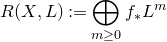 \[ R(X,L):=\bigoplus_{m\geq 0} f_* L^{m} \]
is a finitely generated $\mathcal{O}_Y$
-algebra. Then
$\mathcal{O}_Y$
-algebra. Then $X(L):= \operatorname{Proj}_Y R(X,L)$
fits into a commutative diagram
$X(L):= \operatorname{Proj}_Y R(X,L)$
fits into a commutative diagram

where $\psi_L$
is regular on the complement of the stable base locus of L in X. We do not assume in general that f is birational, nor do we assume that L is big, that is,
$\psi_L$
is regular on the complement of the stable base locus of L in X. We do not assume in general that f is birational, nor do we assume that L is big, that is, $\psi_L$
need not be birational either. However, if L is movable, then the rational map
$\psi_L$
need not be birational either. However, if L is movable, then the rational map $\psi_L$
is an isomorphism in codimension one. If L is movable and X(L) is
$\psi_L$
is an isomorphism in codimension one. If L is movable and X(L) is ${{\mathbb{Q}}}$
-factorial, then we call X(L) a
${{\mathbb{Q}}}$
-factorial, then we call X(L) a ${{\mathbb{Q}}}$
-factorial small birational model of X over Y. When X and X(L) are
${{\mathbb{Q}}}$
-factorial small birational model of X over Y. When X and X(L) are ${{\mathbb{Q}}}$
-factorial, we identify
${{\mathbb{Q}}}$
-factorial, we identify $\operatorname{Pic}(X(L)/Y)_{{{\mathbb{Q}}}}$
with
$\operatorname{Pic}(X(L)/Y)_{{{\mathbb{Q}}}}$
with $\operatorname{Pic}(X/Y)_{{{\mathbb{Q}}}}$
by taking strict transform along the birational map
$\operatorname{Pic}(X/Y)_{{{\mathbb{Q}}}}$
by taking strict transform along the birational map $\psi_L$
; this in turn identifies
$\psi_L$
; this in turn identifies $\operatorname{Mov}(X(L)/Y)$
with
$\operatorname{Mov}(X(L)/Y)$
with $\operatorname{Mov}(X/Y)$
. Let
$\operatorname{Mov}(X/Y)$
. Let $\psi_L^*\operatorname{Amp}(X(L)/Y)$
and
$\psi_L^*\operatorname{Amp}(X(L)/Y)$
and $\psi_L^*\operatorname{Nef}(X(L)/Y)$
denote the cones in
$\psi_L^*\operatorname{Nef}(X(L)/Y)$
denote the cones in $\operatorname{Pic}(X/Y)_{{\mathbb{Q}}}$
obtained by taking the strict transform along
$\operatorname{Pic}(X/Y)_{{\mathbb{Q}}}$
obtained by taking the strict transform along $\psi_L$
of all classes on X(L) that are relatively ample and nef, respectively.
$\psi_L$
of all classes on X(L) that are relatively ample and nef, respectively.
Given $L, L^\prime\in \operatorname{Pic}(X/Y)_{{{\mathbb{Q}}}}$
with finitely generated section rings, we say that L is Mori equivalent to
$L, L^\prime\in \operatorname{Pic}(X/Y)_{{{\mathbb{Q}}}}$
with finitely generated section rings, we say that L is Mori equivalent to $L^\prime$
if there is an isomorphism
$L^\prime$
if there is an isomorphism $\varphi\colon X(L)\to X(L^\prime)$
such that the rational maps
$\varphi\colon X(L)\to X(L^\prime)$
such that the rational maps $\psi_L, \psi_{L^\prime}$
satisfy
$\psi_L, \psi_{L^\prime}$
satisfy $\varphi\circ \psi_L = \psi_{L^\prime}$
. A Mori chamber is a Mori equivalence class whose interior is open in
$\varphi\circ \psi_L = \psi_{L^\prime}$
. A Mori chamber is a Mori equivalence class whose interior is open in $\operatorname{Pic}(X/Y)_{{{\mathbb{Q}}}}$
. These chambers are typically studied under the additional assumption that
$\operatorname{Pic}(X/Y)_{{{\mathbb{Q}}}}$
. These chambers are typically studied under the additional assumption that $\operatorname{Pic}(X/Y)_{{\mathbb{Q}}}$
is isomorphic to the Néron–Severi space
$\operatorname{Pic}(X/Y)_{{\mathbb{Q}}}$
is isomorphic to the Néron–Severi space $N^1(X/Y):=\operatorname{Pic}(X/Y)_\mathbb{Q}/\!\equiv$
of numerical equivalence classes, where
$N^1(X/Y):=\operatorname{Pic}(X/Y)_\mathbb{Q}/\!\equiv$
of numerical equivalence classes, where $L\equiv L^\prime$
if and only if
$L\equiv L^\prime$
if and only if $\deg(L\vert_\ell) = \deg(L^{\prime}\vert_\ell)$
for every proper curve
$\deg(L\vert_\ell) = \deg(L^{\prime}\vert_\ell)$
for every proper curve $\ell$
in X.
$\ell$
in X.
To see how the isomorphism $\operatorname{Pic}(X/Y)_{{\mathbb{Q}}}\cong N^1(X/Y)$
arises in the case of interest to us, recall first the following fundamental and well-known result.
$\operatorname{Pic}(X/Y)_{{\mathbb{Q}}}\cong N^1(X/Y)$
arises in the case of interest to us, recall first the following fundamental and well-known result.
Proposition 2.1. If $L\in \operatorname{Pic}(X/Y)$
is semi-ample over Y, then it is nef over Y. Moreover, the section ring R(X,L) is a finitely generated
$L\in \operatorname{Pic}(X/Y)$
is semi-ample over Y, then it is nef over Y. Moreover, the section ring R(X,L) is a finitely generated $\mathcal{O}_Y$
-algebra, and the morphism from X to
$\mathcal{O}_Y$
-algebra, and the morphism from X to $\operatorname{Proj}_Y R(X,L)$
determined by any power of L contracts a proper curve
$\operatorname{Proj}_Y R(X,L)$
determined by any power of L contracts a proper curve $\ell$
in X if and only if
$\ell$
in X if and only if $L\cdot \ell = 0$
.
$L\cdot \ell = 0$
.
Proof. Suppose that $L^m\in \operatorname{Pic}(X/Y)$
is a basepoint-free line bundle over Y. The induced morphism
$L^m\in \operatorname{Pic}(X/Y)$
is a basepoint-free line bundle over Y. The induced morphism $h\colon X\to \vert L^m\vert\cong \mathbb{P}_Y^N$
satisfies
$h\colon X\to \vert L^m\vert\cong \mathbb{P}_Y^N$
satisfies $h^*(\mathcal{O}(1))\cong L^m$
. For a proper curve
$h^*(\mathcal{O}(1))\cong L^m$
. For a proper curve $\ell $
in X, we have
$\ell $
in X, we have
 \[ L\cdot \ell:= \frac{1}{m} \deg\big(h^*(\mathcal{O}(1))\vert_\ell\big) = \frac{1}{m}\deg\big(\mathcal{O}(1)\vert_{h_*[\ell]}\big) \]
where $h_*[\ell]$
is the pushforward of the curve class of
$h_*[\ell]$
is the pushforward of the curve class of $\ell$
. Thus, L is nef over Y, and
$\ell$
. Thus, L is nef over Y, and $\ell$
is contracted by h if and only if
$\ell$
is contracted by h if and only if $L\cdot \ell=0$
. Finite generation of R(X,L) is the relative version of a theorem of Zariski (see [Reference OhtaOht22, Lemma 6.11]), and the image of h is
$L\cdot \ell=0$
. Finite generation of R(X,L) is the relative version of a theorem of Zariski (see [Reference OhtaOht22, Lemma 6.11]), and the image of h is $\operatorname{Proj}_Y R(X,L)$
.
$\operatorname{Proj}_Y R(X,L)$
.
Corollary 2.2. If each $L\in \operatorname{Pic}(X/Y)$
that is nef over Y is actually semi-ample over Y, then there is an isomorphism
$L\in \operatorname{Pic}(X/Y)$
that is nef over Y is actually semi-ample over Y, then there is an isomorphism $\operatorname{Pic}(X/Y)_{{\mathbb{Q}}} \cong N^1(X/Y)$
.
$\operatorname{Pic}(X/Y)_{{\mathbb{Q}}} \cong N^1(X/Y)$
.
Proof. The quotient map $\operatorname{Pic}(X/Y)_{{\mathbb{Q}}} \to N^1(X/Y)$
is injective (see [Reference OhtaOht22, Proposition 3.2]).
$\operatorname{Pic}(X/Y)_{{\mathbb{Q}}} \to N^1(X/Y)$
is injective (see [Reference OhtaOht22, Proposition 3.2]).
2.2 GIT quotients and the linearisation map
Let G be a reductive algebraic group acting on an affine variety V with coordinate ring ${{\Bbbk}}[V]$
. Let
${{\Bbbk}}[V]$
. Let $G^\vee$
denote the character group of G. For
$G^\vee$
denote the character group of G. For $\theta\in G^\vee$
, we say that
$\theta\in G^\vee$
, we say that $f\in {{\Bbbk}}[V]$
is
$f\in {{\Bbbk}}[V]$
is $\theta$
-semi-invariant if
$\theta$
-semi-invariant if $f(g.v) = \theta(g)f(v)$
for all
$f(g.v) = \theta(g)f(v)$
for all $v\in V$
and
$v\in V$
and $g\in G$
, and we write
$g\in G$
, and we write ${{\Bbbk}}[V]_\theta$
for the space of
${{\Bbbk}}[V]_\theta$
for the space of $\theta$
-semi-invariant functions. A point
$\theta$
-semi-invariant functions. A point $v\in V$
is
$v\in V$
is $\theta$
-semi-stable if there exist
$\theta$
-semi-stable if there exist $j\gt0$
and
$j\gt0$
and $f\in {{\Bbbk}}[V]_{j\theta}$
such that
$f\in {{\Bbbk}}[V]_{j\theta}$
such that $f(v)\neq 0$
. The
$f(v)\neq 0$
. The $\theta$
-semi-stable locus
$\theta$
-semi-stable locus $V^\theta\subseteq V$
is the G-invariant, open subset of
$V^\theta\subseteq V$
is the G-invariant, open subset of $\theta$
-semi-stable points. A point
$\theta$
-semi-stable points. A point $v\in V^\theta$
is
$v\in V^\theta$
is $\theta$
-stable if the stabiliser
$\theta$
-stable if the stabiliser $G_v$
is finite and the orbit
$G_v$
is finite and the orbit $G\cdot v$
is closed in
$G\cdot v$
is closed in $V^\theta$
. A character
$V^\theta$
. A character $\theta\in G^\vee$
is effective if
$\theta\in G^\vee$
is effective if $V^\theta$
is non-empty, and an effective character
$V^\theta$
is non-empty, and an effective character $\theta$
is generic if every
$\theta$
is generic if every $\theta$
-semi-stable point of V is
$\theta$
-semi-stable point of V is $\theta$
-stable. The
$\theta$
-stable. The $\theta$
-semi-stable locus is unchanged if we replace
$\theta$
-semi-stable locus is unchanged if we replace $\theta$
by a positive multiple, so the definitions extend to any fractional character
$\theta$
by a positive multiple, so the definitions extend to any fractional character $\theta\in G^\vee_{{{\mathbb{Q}}}}:= G^\vee\otimes_{{{\mathbb{Z}}}} {{\mathbb{Q}}}$
.
$\theta\in G^\vee_{{{\mathbb{Q}}}}:= G^\vee\otimes_{{{\mathbb{Z}}}} {{\mathbb{Q}}}$
.
For any effective $\theta\in G^\vee_{{{\mathbb{Q}}}}$
, the GIT quotient
$\theta\in G^\vee_{{{\mathbb{Q}}}}$
, the GIT quotient
 \[X_{\theta{}}:= V{{/\!\!/\!}}_\theta \, G:= \operatorname{Proj} \bigg(\bigoplus_{j\geq 0} {{\Bbbk}}[V]_{j\theta}\bigg) \]
is the categorical quotient of the $\theta$
-semi-stable locus
$\theta$
-semi-stable locus $V^\theta$
by the action of G. Note that
$V^\theta$
by the action of G. Note that $X_{\theta{}}$
is projective over the affine quotient
$X_{\theta{}}$
is projective over the affine quotient
 \[Y:= V{{/\!\!/\!}}_0 \, G = \operatorname{Spec} {{\Bbbk}}[V]^G. \]
If $\theta$
is generic, then
$\theta$
is generic, then $X_{\theta{}}$
is the geometric quotient of
$X_{\theta{}}$
is the geometric quotient of $V^\theta$
by G.
$V^\theta$
by G.
The set of effective fractional characters is a closed, convex cone in $G^\vee_{{{\mathbb{Q}}}}$
that admits a wall-and-chamber structure as follows. Fractional characters
$G^\vee_{{{\mathbb{Q}}}}$
that admits a wall-and-chamber structure as follows. Fractional characters $\theta, \theta'\in G^\vee_{{{\mathbb{Q}}}}$
are GIT-equivalent if
$\theta, \theta'\in G^\vee_{{{\mathbb{Q}}}}$
are GIT-equivalent if $V^{\theta}=V^{\theta'}$
. The GIT-equivalence classes form the relative interiors of a finite collection of rational polyhedral cones in
$V^{\theta}=V^{\theta'}$
. The GIT-equivalence classes form the relative interiors of a finite collection of rational polyhedral cones in $G^\vee_{{{\mathbb{Q}}}}$
, and the collection of all such cones, called GIT cones, forms a fan, called the GIT fan, whose support is the convex cone of effective fractional characters in
$G^\vee_{{{\mathbb{Q}}}}$
, and the collection of all such cones, called GIT cones, forms a fan, called the GIT fan, whose support is the convex cone of effective fractional characters in $G^\vee_{{{\mathbb{Q}}}}$
. The set of generic stability parameters
$G^\vee_{{{\mathbb{Q}}}}$
. The set of generic stability parameters $\theta$
in
$\theta$
in $G^\vee_{{\mathbb{Q}}}$
decomposes as the union of (GIT) chambers, each of which is the interior of a top-dimensional cone in the GIT fan. As shown by Ressayre [Reference RessayreRes98], it can happen that the interior of a top-dimensional GIT cone is not a chamber. However, in this paper we work only with stability parameters
$G^\vee_{{\mathbb{Q}}}$
decomposes as the union of (GIT) chambers, each of which is the interior of a top-dimensional cone in the GIT fan. As shown by Ressayre [Reference RessayreRes98], it can happen that the interior of a top-dimensional GIT cone is not a chamber. However, in this paper we work only with stability parameters $\theta$
lying in the closure of the union of all GIT chambers, and we reserve the phrase GIT wall for any codimension-one face of the closure
$\theta$
lying in the closure of the union of all GIT chambers, and we reserve the phrase GIT wall for any codimension-one face of the closure $\overline{C}$
of some GIT chamber C. The characterisation of the GIT fan via GIT-equivalence was established by Ressayre [Reference RessayreRes00] (see Halic [Reference HalicHal04] for affine V), building on the earlier work of Dolgachev and Hu [Reference Dolgachev and HuDH98], and Thaddeus [Reference ThaddeusTha96]. Those papers assume that V is normal, but in fact, GIT-equivalence is unaffected by passing to the normalisation of V; explicitly, if
$\overline{C}$
of some GIT chamber C. The characterisation of the GIT fan via GIT-equivalence was established by Ressayre [Reference RessayreRes00] (see Halic [Reference HalicHal04] for affine V), building on the earlier work of Dolgachev and Hu [Reference Dolgachev and HuDH98], and Thaddeus [Reference ThaddeusTha96]. Those papers assume that V is normal, but in fact, GIT-equivalence is unaffected by passing to the normalisation of V; explicitly, if $\nu\colon \widetilde{V}\to V$
is the normalisation, then
$\nu\colon \widetilde{V}\to V$
is the normalisation, then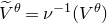 ${\widetilde{V}}^\theta = \nu^{-1}(V^\theta)$
for any
${\widetilde{V}}^\theta = \nu^{-1}(V^\theta)$
for any $\theta\in G^\vee_{{{\mathbb{Q}}}}$
.
$\theta\in G^\vee_{{{\mathbb{Q}}}}$
.
Let C be a GIT chamber and fix $\theta\in C$
, so
$\theta\in C$
, so $\theta$
is generic. For
$\theta$
is generic. For $\chi\in G^\vee$
, consider the G-equivariant line bundle
$\chi\in G^\vee$
, consider the G-equivariant line bundle $\chi\otimes \mathcal{O}_{V^\theta}$
on the
$\chi\otimes \mathcal{O}_{V^\theta}$
on the $\theta$
-stable locus in V given by equipping the trivial line bundle with the action of G on each fibre given by
$\theta$
-stable locus in V given by equipping the trivial line bundle with the action of G on each fibre given by $\chi$
; explicitly, the action of G on
$\chi$
; explicitly, the action of G on $V^\theta$
lifts to the action on
$V^\theta$
lifts to the action on $V^\theta\times \mathbb{A}^1$
such that the dual action on functions is
$V^\theta\times \mathbb{A}^1$
such that the dual action on functions is $g\cdot (f,t) = (g\cdot f, \chi^{-1}(g) t)$
. It follows that the space of sections is isomorphic to the space
$g\cdot (f,t) = (g\cdot f, \chi^{-1}(g) t)$
. It follows that the space of sections is isomorphic to the space ${{\Bbbk}}[V^\theta]_\chi$
of
${{\Bbbk}}[V^\theta]_\chi$
of $\chi$
-semi-invariant functions on
$\chi$
-semi-invariant functions on $V^\theta$
. By descent [Reference NevinsNev08],
$V^\theta$
. By descent [Reference NevinsNev08], $\chi\otimes \mathcal{O}_{V^\theta}$
descends to a line bundle on
$\chi\otimes \mathcal{O}_{V^\theta}$
descends to a line bundle on $X_{\theta{}}$
if the stabiliser of each
$X_{\theta{}}$
if the stabiliser of each $x \in V^{\theta}$
is in the kernel of
$x \in V^{\theta}$
is in the kernel of $\chi$
. Since all stabilisers are finite, and there are only finitely many conjugacy classes of such stabilisers by [Reference LunaLun73, Corollaire 3], there is some multiple
$\chi$
. Since all stabilisers are finite, and there are only finitely many conjugacy classes of such stabilisers by [Reference LunaLun73, Corollaire 3], there is some multiple $j \chi\in G^\vee$
of
$j \chi\in G^\vee$
of $\chi$
that descends to a line bundle on X that we denote
$\chi$
that descends to a line bundle on X that we denote $L_{j\chi}$
. We define
$L_{j\chi}$
. We define $L_{\chi}:= ({1}/{j})L_{j \chi}\in \operatorname{Pic}(X_{\theta{}}/Y)_{{{\mathbb{Q}}}}$
.
$L_{\chi}:= ({1}/{j})L_{j \chi}\in \operatorname{Pic}(X_{\theta{}}/Y)_{{{\mathbb{Q}}}}$
.
Definition 2.3. Let C be a GIT chamber. For $\theta\in C$
and
$\theta\in C$
and $X_{\theta{}}=V{{/\!\!/\!}}_\theta \, G$
, the linearisation map for C is the
$X_{\theta{}}=V{{/\!\!/\!}}_\theta \, G$
, the linearisation map for C is the $\mathbb{Q}$
-linear map
$\mathbb{Q}$
-linear map
 \begin{equation} L_C\colon G^\vee_{\mathbb{Q}} \longrightarrow \operatorname{Pic}(X_{\theta{}}/Y)_{{{\mathbb{Q}}}} \end{equation}
determined by setting $L_C(\chi):= L_\chi$
for all
$L_C(\chi):= L_\chi$
for all $\chi\in G^\vee$
.
$\chi\in G^\vee$
.
2.3 Variation of GIT quotient
Let C be a GIT chamber and let $\theta\in C$
. In addition, let
$\theta\in C$
. In addition, let $\theta_0$
be a general point in any face of the closure
$\theta_0$
be a general point in any face of the closure $\overline{C}$
. The G-equivariant inclusion of the
$\overline{C}$
. The G-equivariant inclusion of the $\theta$
-stable locus into the
$\theta$
-stable locus into the $\theta_0$
-semi-stable locus of V fits into a commutative diagram of varieties
$\theta_0$
-semi-stable locus of V fits into a commutative diagram of varieties

where $\pi_0$
is a good categorical quotient,
$\pi_0$
is a good categorical quotient, $\pi$
is a geometric quotient and
$\pi$
is a geometric quotient and $\tau$
is a projective morphism; the morphism
$\tau$
is a projective morphism; the morphism $\tau$
is said to be induced by variation of GIT quotient. The G-equivariant line bundle
$\tau$
is said to be induced by variation of GIT quotient. The G-equivariant line bundle $\theta_0\otimes \mathcal{O}$
on
$\theta_0\otimes \mathcal{O}$
on $V^{\theta_0}$
descends to the polarising ample bundle
$V^{\theta_0}$
descends to the polarising ample bundle $\mathcal{O}(1)$
on
$\mathcal{O}(1)$
on $X_{\theta{_0}}$
, and its restriction to
$X_{\theta{_0}}$
, and its restriction to $V^\theta$
descends to the line bundle
$V^\theta$
descends to the line bundle $L_C(\theta_0)$
on
$L_C(\theta_0)$
on $X_{\theta{}}$
. Commutativity of diagram (2.4) gives
$X_{\theta{}}$
. Commutativity of diagram (2.4) gives
 \begin{equation} L_C(\theta_0) = \tau^*\big(\mathcal{O}(1)\big). \end{equation}
Let $C_-$
and
$C_-$
and $C_+$
be adjacent GIT chambers separated by a wall. Let
$C_+$
be adjacent GIT chambers separated by a wall. Let $\theta_-\in C_-$
,
$\theta_-\in C_-$
, $\theta_+\in C_+$
and let
$\theta_+\in C_+$
and let $\theta_0$
be a general point in the wall
$\theta_0$
be a general point in the wall $\overline{C_-}\cap \overline{C_+}$
. The morphisms
$\overline{C_-}\cap \overline{C_+}$
. The morphisms $\tau_-\colon X_{\theta{_-}}\rightarrow X_{\theta{_0}}$
and
$\tau_-\colon X_{\theta{_-}}\rightarrow X_{\theta{_0}}$
and $\tau_+\colon X_{\theta{_+}}\rightarrow X_{\theta{_0}}$
obtained by VGIT as in (2.4) fit into a commutative diagram
$\tau_+\colon X_{\theta{_+}}\rightarrow X_{\theta{_0}}$
obtained by VGIT as in (2.4) fit into a commutative diagram

of varieties over $Y=V{{/\!\!/\!}}_0 \, G$
. Let us assume that
$Y=V{{/\!\!/\!}}_0 \, G$
. Let us assume that $X_{\theta{_\pm}}$
are normal.
$X_{\theta{_\pm}}$
are normal.
Lemma 2.4.
-
(i) The
$\theta_0$
-stable locus in V is the intersection
$V^{\theta_0\mathrm{\hbox{-}st}}:=V^{\theta_+}\cap V^{\theta_-}$
. -
(ii) Each map in diagram (2.6) is an isomorphism over the subset
$V^{\theta_0\mathrm{\hbox{-}st}}/G\subseteq X_{\theta{_0}}$
. -
(iii) The subset
$\tau_-^{-1}\big(\pi_0(V^{\theta_0}\setminus V^{\theta_0\mathrm{\hbox{-}st}})\big)$
is Zariski-closed in
$X_{\theta{_-}}$
(the same with
$+$
replacing
$-$
).






Proof. Part ${{(\mathrm{i})}}$
follows by combining two results from Thaddeus [Reference ThaddeusTha96, Proposition 1.3, Lemma 3.2]; alternatively, the proof by Dolgachev and Hu [Reference Dolgachev and HuDH98, Proposition 3.4.7, Lemma 4.1.5] can be applied under our assumptions on V. Part (ii) follows from the description of the open set
${{(\mathrm{i})}}$
follows by combining two results from Thaddeus [Reference ThaddeusTha96, Proposition 1.3, Lemma 3.2]; alternatively, the proof by Dolgachev and Hu [Reference Dolgachev and HuDH98, Proposition 3.4.7, Lemma 4.1.5] can be applied under our assumptions on V. Part (ii) follows from the description of the open set $V^{\theta_0\mathrm{\hbox{-}st}}$
given in part (i). For part (iii), the semi-stable locus for any character of G is open and G-invariant in V, so
$V^{\theta_0\mathrm{\hbox{-}st}}$
given in part (i). For part (iii), the semi-stable locus for any character of G is open and G-invariant in V, so $V^{\theta_0}\setminus V^{\theta_-}$
is a closed and G-invariant subset of
$V^{\theta_0}\setminus V^{\theta_-}$
is a closed and G-invariant subset of $V^{\theta_0}$
. The image
$V^{\theta_0}$
. The image $\pi_0(V^{\theta_0}\setminus V^{\theta_-})$
is closed because
$\pi_0(V^{\theta_0}\setminus V^{\theta_-})$
is closed because $\pi_0$
is a good quotient, so the statement follows from continuity of
$\pi_0$
is a good quotient, so the statement follows from continuity of $\tau_-$
in the Zariski topology.
$\tau_-$
in the Zariski topology.
Definition 2.5. The unstable locus for $\tau_-$
is the subset in
$\tau_-$
is the subset in $X_{\theta_-}$
parametrising strictly
$X_{\theta_-}$
parametrising strictly $\theta_0$
-semi-stable points,
$\theta_0$
-semi-stable points, $\operatorname{Uns}(\tau_-):=\tau_-^{-1}\big(\pi_0(V^{\theta_0}\setminus V^{\theta_0\mathrm{\hbox{-}st}})\big)$
. The locus
$\operatorname{Uns}(\tau_-):=\tau_-^{-1}\big(\pi_0(V^{\theta_0}\setminus V^{\theta_0\mathrm{\hbox{-}st}})\big)$
. The locus $\operatorname{Uns}(\tau_+)$
is the same with
$\operatorname{Uns}(\tau_+)$
is the same with $+$
replacing
$+$
replacing $-$
.
$-$
.
Remark 2.6.
-
(1) Lemma 2.4 implies that the exceptional locus of
$\tau_-$
(i.e., the locus where it is not an isomorphism), denoted by
$\operatorname{Exc}(\tau_-)$
, is a subset of the unstable locus
$\operatorname{Uns}(\tau_-)$
. This inclusion may be strict. The locus
$\operatorname{Exc}(\tau_+)$
is the same with
$+$
replacing
$-$
. -
(2) The unstable locus is closed by Lemma 2.4(iii). We give it the reduced scheme structure.


The next result generalises a result of Thaddeus [Reference ThaddeusTha96, Theorem 3.3], though the necessary assumption on the dimension of the unstable locus is missing from that statement. For this, we take the Stein factorisations of the morphisms $\tau_\pm$
from diagram (2.6) to obtain a commutative diagram
$\tau_\pm$
from diagram (2.6) to obtain a commutative diagram

where the morphisms $\widetilde{\tau}_\pm$
have connected fibres. Note that the target
$\widetilde{\tau}_\pm$
have connected fibres. Note that the target $\widetilde{X}_{\theta_0}$
is just the normalisation of
$\widetilde{X}_{\theta_0}$
is just the normalisation of $X_{\theta_0}$
since
$X_{\theta_0}$
since $\tau_{\pm}$
are birational by Lemma 2.4(i) and
$\tau_{\pm}$
are birational by Lemma 2.4(i) and $X_{\theta{_\pm}}$
are normal. In other words,
$X_{\theta{_\pm}}$
are normal. In other words, $\widetilde{\tau}_{\pm}$
are the functorial maps induced by normalisation.
$\widetilde{\tau}_{\pm}$
are the functorial maps induced by normalisation.
Proposition 2.7. Assume that $X_{\theta{_+}}$
and
$X_{\theta{_+}}$
and $X_{\theta{_-}}$
are normal, that
$X_{\theta{_-}}$
are normal, that $\operatorname{Uns}(\tau_+)\subseteq X_{\theta{_+}}$
and
$\operatorname{Uns}(\tau_+)\subseteq X_{\theta{_+}}$
and $\operatorname{Uns}(\tau_-)\subseteq X_{\theta{_-}}$
have codimension at least two, and that
$\operatorname{Uns}(\tau_-)\subseteq X_{\theta{_-}}$
have codimension at least two, and that $\tau_+$
and
$\tau_+$
and $\tau_-$
contract at least one curve. Then (2.7) is a flip with respect to the line bundle
$\tau_-$
contract at least one curve. Then (2.7) is a flip with respect to the line bundle $L_{C_-}(\theta_+)$
on
$L_{C_-}(\theta_+)$
on $X_{\theta{_-}}$
, and
$X_{\theta{_-}}$
, and
 \begin{equation} L_{C_-}(\eta) \cong \psi^*\big(L_{C_+}(\eta)\big) \,\text{for all }\eta\in G^\vee_{\mathbb{Q}}. \end{equation}
If, in addition, $X_{\theta{_-}}$
is
$X_{\theta{_-}}$
is ${{\mathbb{Q}}}$
-factorial and
${{\mathbb{Q}}}$
-factorial and $L_{C_-}$
is surjective, then
$L_{C_-}$
is surjective, then $X_{\theta{_+}}$
is
$X_{\theta{_+}}$
is ${{\mathbb{Q}}}$
-factorial.
${{\mathbb{Q}}}$
-factorial.
Proof. The exceptional loci $\operatorname{Exc}(\tau_+)$
and
$\operatorname{Exc}(\tau_+)$
and $\operatorname{Exc}(\tau_-)$
are contained in the unstable loci
$\operatorname{Exc}(\tau_-)$
are contained in the unstable loci $\operatorname{Uns}(\tau_+)$
and
$\operatorname{Uns}(\tau_+)$
and $\operatorname{Uns}(\tau_-)$
respectively by Remark 2.6(1), so our codimension assumption shows that
$\operatorname{Uns}(\tau_-)$
respectively by Remark 2.6(1), so our codimension assumption shows that $\psi$
is an isomorphism in codimension one. Pushforward along
$\psi$
is an isomorphism in codimension one. Pushforward along $\psi$
therefore identifies the class groups of
$\psi$
therefore identifies the class groups of $X_{\theta_\pm}$
.
$X_{\theta_\pm}$
.
Combining Lemma 2.4(ii) with our assumption on the unstable locus implies that the complement of $V^{\theta_0\mathrm{\hbox{-}st}}/G$
is of codimension at least two in both
$V^{\theta_0\mathrm{\hbox{-}st}}/G$
is of codimension at least two in both $X_{\theta{_+}}$
and
$X_{\theta{_+}}$
and $X_{\theta{_-}}$
. Since
$X_{\theta{_-}}$
. Since $X_{\theta{_+}}$
and
$X_{\theta{_+}}$
and $X_{\theta{_-}}$
are normal, line bundles on both
$X_{\theta{_-}}$
are normal, line bundles on both $X_{\theta{_+}}$
and
$X_{\theta{_+}}$
and $X_{\theta{_-}}$
are uniquely determined, up to isomorphism, by their restriction to
$X_{\theta{_-}}$
are uniquely determined, up to isomorphism, by their restriction to $V^{\theta_0\mathrm{\hbox{-}st}}/G$
. By restricting all three maps from (2.6) to the isomorphisms over this locus, we see that both
$V^{\theta_0\mathrm{\hbox{-}st}}/G$
. By restricting all three maps from (2.6) to the isomorphisms over this locus, we see that both $L_{C_+}(\eta)$
on
$L_{C_+}(\eta)$
on $X_{\theta{_+}}$
and
$X_{\theta{_+}}$
and $L_{C_-}(\eta)$
on
$L_{C_-}(\eta)$
on $X_{\theta{_-}}$
are obtained by descent from
$X_{\theta{_-}}$
are obtained by descent from $\eta\otimes \mathcal{O}$
on
$\eta\otimes \mathcal{O}$
on $V^{\theta_0\mathrm{\hbox{-}st}}$
. Therefore, isomorphism (2.8) holds. In particular, the strict transform of
$V^{\theta_0\mathrm{\hbox{-}st}}$
. Therefore, isomorphism (2.8) holds. In particular, the strict transform of $L_{C_-}(\theta_+)$
along
$L_{C_-}(\theta_+)$
along $\psi$
is the line bundle
$\psi$
is the line bundle $L_{C_+}(\theta_+)$
on
$L_{C_+}(\theta_+)$
on $X_{\theta{_+}}$
.
$X_{\theta{_+}}$
.
The polarising ample bundle $L_{C_+}(\theta_+)$
on
$L_{C_+}(\theta_+)$
on $X_{\theta{_+}}$
is
$X_{\theta{_+}}$
is $\widetilde{\tau}_+$
-ample, so to prove that (2.7) is a flip, we need only show that
$\widetilde{\tau}_+$
-ample, so to prove that (2.7) is a flip, we need only show that $L_{C_-}(\theta_+)^{-1}$
is
$L_{C_-}(\theta_+)^{-1}$
is $\widetilde{\tau}_-$
-ample. For this, the ample bundle
$\widetilde{\tau}_-$
-ample. For this, the ample bundle $L_0:=\mathcal{O}(1)$
on
$L_0:=\mathcal{O}(1)$
on $\widetilde{X}_{\theta_0}$
satisfies
$\widetilde{X}_{\theta_0}$
satisfies $L_{C_-}(\theta_0) = (\widetilde{\tau}_-)^*(L_0)$
by (2.5). By choosing alternative characters
$L_{C_-}(\theta_0) = (\widetilde{\tau}_-)^*(L_0)$
by (2.5). By choosing alternative characters $\theta_+\in C_+$
and
$\theta_+\in C_+$
and $\theta_-\in C_-$
if necessary, we may assume that
$\theta_-\in C_-$
if necessary, we may assume that $\theta_0 = {1}/{2}(\theta_++\theta_-)$
, in which case
$\theta_0 = {1}/{2}(\theta_++\theta_-)$
, in which case
 \[L_{C_-}(\theta_+)\otimes L_{C_-}(\theta_-) = L_{C_-}(\theta_+ + \theta_-) = L_{C_-}(2\theta_0) = (\widetilde{\tau}_-)^*(L_0)^{2}. \]
The set of curve classes contracted by $\widetilde{\tau}_-$
is non-empty by assumption. The line bundles
$\widetilde{\tau}_-$
is non-empty by assumption. The line bundles $L_{C_-}(\theta_-)$
and
$L_{C_-}(\theta_-)$
and $\widetilde{\tau}_-^*(L_0)$
have positive and zero degree respectively on all such curves. It follows that
$\widetilde{\tau}_-^*(L_0)$
have positive and zero degree respectively on all such curves. It follows that
 \[L_{C_-}(\theta_+)^{-1} = L_{C_-}(\theta_-)\otimes \tau_-^*(L_0)^{-2} \]
has positive degree on all such curves, so it is $\widetilde{\tau}_-$
-ample as required.
$\widetilde{\tau}_-$
-ample as required.
For the final statement, let $D_+$
be a Weil divisor on
$D_+$
be a Weil divisor on $X_{\theta{_+}}$
. Then
$X_{\theta{_+}}$
. Then $(\psi^{-1})_*D_+$
is a Weil divisor on
$(\psi^{-1})_*D_+$
is a Weil divisor on $X_{\theta{_-}}$
, and since
$X_{\theta{_-}}$
, and since $X_{\theta{_-}}$
is
$X_{\theta{_-}}$
is ${{\mathbb{Q}}}$
-factorial, the divisor
${{\mathbb{Q}}}$
-factorial, the divisor $m(\psi^{-1})_*D_+$
is Cartier for some
$m(\psi^{-1})_*D_+$
is Cartier for some $m\gt0$
. Since
$m\gt0$
. Since $L_{C_-}$
is surjective, there exists
$L_{C_-}$
is surjective, there exists $\eta\in G^\vee_{{\mathbb{Q}}}$
such that
$\eta\in G^\vee_{{\mathbb{Q}}}$
such that $L_{C_-}(\eta) \cong \mathcal{O}_{X_{\theta{_-}}}(m(\psi^{-1})_*D_+)$
. Now (2.8) gives
$L_{C_-}(\eta) \cong \mathcal{O}_{X_{\theta{_-}}}(m(\psi^{-1})_*D_+)$
. Now (2.8) gives
 \[ \mathcal{O}_{X_{\theta{_+}}}(mD_+) \cong (\psi^{-1})^*\mathcal{O}_{X_{\theta{_-}}}(m(\psi^{-1})_*D_+) \cong (\psi^{-1})^* L_{C_-}(\eta) \cong L_{C_+}(\eta) \]
which lies in $\operatorname{Pic}(X_{\theta{_+}}/Y)$
, so
$\operatorname{Pic}(X_{\theta{_+}}/Y)$
, so $mD_+$
is Cartier.
$mD_+$
is Cartier.
3. Reconstructing relative Mori dream spaces by GIT
3.1 GIT regions
As before, let G denote a reductive algebraic group acting on an affine variety V. For $\theta\in G^\vee_{\mathbb{Q}}$
, write
$\theta\in G^\vee_{\mathbb{Q}}$
, write $X_{\theta{}}:=V{{/\!\!/\!}}_\theta \, G$
, and let
$X_{\theta{}}:=V{{/\!\!/\!}}_\theta \, G$
, and let $f\colon X_{\theta{}}\to Y:= X_0$
denote the projective morphism obtained by VGIT.
$f\colon X_{\theta{}}\to Y:= X_0$
denote the projective morphism obtained by VGIT.
To formulate our key condition, let $C_-$
and
$C_-$
and $C_+$
be GIT chambers separated by a wall
$C_+$
be GIT chambers separated by a wall $\overline{C_-}\cap \overline{C_+}$
. We delete this separating wall if and only if the morphisms
$\overline{C_-}\cap \overline{C_+}$
. We delete this separating wall if and only if the morphisms $\tau_-$
and
$\tau_-$
and $\tau_+$
from diagram (2.6) are both small. The result is an a priori coarser wall-and-chamber decomposition of the GIT fan.
$\tau_+$
from diagram (2.6) are both small. The result is an a priori coarser wall-and-chamber decomposition of the GIT fan.
Definition 3.1. A GIT region in $G^\vee_{{\mathbb{Q}}}$
is any top-dimensional cone of the coarse fan defined above. By construction, every GIT region that contains a chamber is the union of the closures of a collection of GIT chambers. For any chamber C, let
$G^\vee_{{\mathbb{Q}}}$
is any top-dimensional cone of the coarse fan defined above. By construction, every GIT region that contains a chamber is the union of the closures of a collection of GIT chambers. For any chamber C, let $R_C$
denote the unique GIT region containing C.
$R_C$
denote the unique GIT region containing C.
Example 3.2. The Cox construction of the first Hirzebruch surface $\mathbb{F}_1:=\mathbb{P}_{\mathbb{P}^1}(\mathcal{O}\oplus \mathcal{O}(1))$
passes via the action of the torus
$\mathbb{F}_1:=\mathbb{P}_{\mathbb{P}^1}(\mathcal{O}\oplus \mathcal{O}(1))$
passes via the action of the torus $G=({{\Bbbk}}^\times)^2$
on
$G=({{\Bbbk}}^\times)^2$
on $\mathbb{A}^4$
with weights
$\mathbb{A}^4$
with weights $\left[\begin{smallmatrix}1 & -1 & 1 & 0 \\0 & 1 & 0 & 1\end{smallmatrix}\right]$
. There are two GIT chambers
$\left[\begin{smallmatrix}1 & -1 & 1 & 0 \\0 & 1 & 0 & 1\end{smallmatrix}\right]$
. There are two GIT chambers $C_-:= \operatorname{Amp}(\mathbb{F}_1)= \left\{\alpha \left[\begin{smallmatrix}1\\0\end{smallmatrix}\right]+\beta \left[\begin{smallmatrix}0\\1\end{smallmatrix}\right]\,\middle|\, \alpha,\beta>0\right\}\,\text{and}\,C_+:=\left\{\alpha \left[\begin{smallmatrix}-1\\1\end{smallmatrix}\right]+\beta \left[\begin{smallmatrix}0\\1\end{smallmatrix}\right]\,\middle|\, \alpha,\beta>0\right\}.$
For $\theta_-\in C_-$
and
$\theta_-\in C_-$
and $\theta_+\in C_+$
, we have
$\theta_+\in C_+$
, we have $X_{\theta{_-}}\cong \mathbb{F}_1$
and
$X_{\theta{_-}}\cong \mathbb{F}_1$
and $X_{\theta{_+}}\cong \mathbb{P}^2$
. The VGIT morphism
$X_{\theta{_+}}\cong \mathbb{P}^2$
. The VGIT morphism $\tau_-\colon \mathbb{F}_1\to \mathbb{P}^2$
contracts the
$\tau_-\colon \mathbb{F}_1\to \mathbb{P}^2$
contracts the $(-1)$
-curve, whereas
$(-1)$
-curve, whereas $\tau_+$
is an isomorphism. Thus,
$\tau_+$
is an isomorphism. Thus, $R_{C_-} = \overline{C_-}$
and
$R_{C_-} = \overline{C_-}$
and $R_{C_+} = \overline{C_+}$
.
$R_{C_+} = \overline{C_+}$
.
The linearisation map $L_{C_-}$
in Example 3.2 is an isomorphism that identifies
$L_{C_-}$
in Example 3.2 is an isomorphism that identifies $R_{C_-}$
with the movable (in fact, the nef) cone of
$R_{C_-}$
with the movable (in fact, the nef) cone of $X_{\theta{_-}}$
for
$X_{\theta{_-}}$
for $\theta_-\in C_-$
. Example 3.8 below illustrates that even when
$\theta_-\in C_-$
. Example 3.8 below illustrates that even when $L_{C_-}$
is an isomorphism, it need not identify
$L_{C_-}$
is an isomorphism, it need not identify $R_{C_-}$
with
$R_{C_-}$
with $\operatorname{Mov}(X_{\theta{_-}})$
for
$\operatorname{Mov}(X_{\theta{_-}})$
for $\theta\in C_-$
.
$\theta\in C_-$
.
3.2 The new GIT condition and two key examples
Define a GIT wall to be a flipping wall if it satisfies the assumptions of Proposition 2.7, that is, the wall separates two GIT chambers $C_\pm$
such that, in the notation of diagram (2.6), both
$C_\pm$
such that, in the notation of diagram (2.6), both $X_{\theta{_-}}$
and
$X_{\theta{_-}}$
and $X_{\theta{_+}}$
are normal, the unstable loci
$X_{\theta{_+}}$
are normal, the unstable loci $\operatorname{Uns}(\tau_+)\subseteq X_{\theta{_+}}$
and
$\operatorname{Uns}(\tau_+)\subseteq X_{\theta{_+}}$
and $\operatorname{Uns}(\tau_-)\subseteq X_{\theta{_-}}$
have codimension at least two, and the morphisms
$\operatorname{Uns}(\tau_-)\subseteq X_{\theta{_-}}$
have codimension at least two, and the morphisms $\tau_+$
and
$\tau_+$
and $\tau_-$
both contract at least one curve. For any wall in the boundary of
$\tau_-$
both contract at least one curve. For any wall in the boundary of $R_C$
, let
$R_C$
, let $C_-$
denote the unique chamber in
$C_-$
denote the unique chamber in $R_C$
that contains the wall in its closure. Let
$R_C$
that contains the wall in its closure. Let $\theta_-\in C_-$
and let
$\theta_-\in C_-$
and let $\theta_0$
be general in the wall. We say that the wall, when approached from the chamber
$\theta_0$
be general in the wall. We say that the wall, when approached from the chamber $C_-$
in
$C_-$
in $R_C$
, is small, divisorial or of fibre type if the induced morphism
$R_C$
, is small, divisorial or of fibre type if the induced morphism $\tau_-\colon X_{\theta{_-}} \to X_{\theta{_0}}$
is of the same type.
$\tau_-\colon X_{\theta{_-}} \to X_{\theta{_0}}$
is of the same type.
Condition 3.3. There exists a GIT chamber C such that:
-
(1) for
$\theta\in C$
, the GIT quotient
$X:=X_{\theta{}}$
is a
${{\mathbb{Q}}}$
-factorial normal variety and the linearisation map is an isomorphism of rational vector spaces;
\[ L_{C} \colon G^{\vee}_{{\mathbb{Q}}}\longrightarrow \operatorname{Pic}(X/Y)_\mathbb{Q} \]
-
(2) each wall in the interior of the GIT region
$R_C$
containing C is a flipping wall; and -
(3) each boundary wall of
$R_C$
is either divisorial or of fibre type.


Remark 3.4. Condition 3.3 is required for the statement and proof of Theorem 3.12. We present several examples to shed light on the three different parts of this assumption as follows.
-
– Condition 3.3 holds for the chamber
$C_-$
in Example 3.2, while Condition 3.3(1) fails for
$C_+$
. Many similar examples are described in Example 3.5 below. -
– If Condition 3.3(1) holds, it can happen that (2) fails to hold; see Example 3.6 below.
-
– If Condition 3.3(1) and (2) both hold, it can happen that (3) fails to hold; see Example 3.8 below.


Note, in addition, that Condition 3.3(2) implies that $X_{\theta{}}$
is normal for every generic
$X_{\theta{}}$
is normal for every generic $\theta\in R_C$
.
$\theta\in R_C$
.
Example 3.5 (Mori dream spaces via the Cox ring). Generalising Example 3.2, let X be any Mori dream space in the sense of Hu and Keel [Reference Hu and KeelHK00]. That is, X is a ${{\mathbb{Q}}}$
-factorial normal projective variety with
${{\mathbb{Q}}}$
-factorial normal projective variety with $\operatorname{Pic}(X)_{{\mathbb{Q}}}\cong N^1(X)$
, such that the Cox ring of X, denoted by
$\operatorname{Pic}(X)_{{\mathbb{Q}}}\cong N^1(X)$
, such that the Cox ring of X, denoted by $\operatorname{Cox}(X)$
, is a finitely generated
$\operatorname{Cox}(X)$
, is a finitely generated ${{\Bbbk}}$
-algebra. For simplicity, assume that
${{\Bbbk}}$
-algebra. For simplicity, assume that $\operatorname{Pic}(X)$
is free. The
$\operatorname{Pic}(X)$
is free. The $\operatorname{Pic}(X)$
-grading of
$\operatorname{Pic}(X)$
-grading of $\operatorname{Cox}(X)$
defines an action of the algebraic torus
$\operatorname{Cox}(X)$
defines an action of the algebraic torus $G:= \operatorname{Hom}(\operatorname{Pic}(X),{{\Bbbk}}^\times)$
on the affine variety
$G:= \operatorname{Hom}(\operatorname{Pic}(X),{{\Bbbk}}^\times)$
on the affine variety $V:= \operatorname{Spec} \operatorname{Cox}(X)$
.
$V:= \operatorname{Spec} \operatorname{Cox}(X)$
.
-
(i) For the chamber
$C=\operatorname{Amp}(X)$
, the linearisation map
$L_C \colon G^\vee_{{\mathbb{Q}}}\to \operatorname{Pic}(X)_{{\mathbb{Q}}}$
is an isomorphism by [Reference Hu and KeelHK00, Proof of Proposition 2.11], so Condition 3.3(1) holds, while [Reference Hu and KeelHK00, Proposition 1.11] shows that conditions (2) and (3) also hold. -
(ii) For any chamber
$C^\prime$
that does not lie in
$\operatorname{Mov}(X)$
, the kernel of
$L_{C^\prime}$
has dimension at least one because the rank of
$\operatorname{Pic}(X_{\theta{^\prime}})_{{\mathbb{Q}}}$
for
$\theta^\prime\in C^\prime$
drops by one as we cross each boundary wall of the movable cone. In particular, Condition 3.3 fails for
$C^\prime$
.




Analogous statements hold for the action induced by the $\operatorname{Pic}(X/Y)$
-grading on the Cox ring for any relative Mori dream space
$\operatorname{Pic}(X/Y)$
-grading on the Cox ring for any relative Mori dream space $X\to Y$
; this requires a choice of line bundles on X that provide a basis for
$X\to Y$
; this requires a choice of line bundles on X that provide a basis for $\operatorname{Pic}(X/Y)_{{{\mathbb{Q}}}}$
(see Grab [Reference GrabGra19] or Ohta [Reference OhtaOht22] for details).
$\operatorname{Pic}(X/Y)_{{{\mathbb{Q}}}}$
(see Grab [Reference GrabGra19] or Ohta [Reference OhtaOht22] for details).
Example 3.6 (A local del Pezzo by quiver GIT). Let Z be the two-point blow-up of $\mathbb{P}^2$
. The total space
$\mathbb{P}^2$
. The total space $X:= \text{tot}(\omega_Z)$
of the canonical bundle on Z is smooth with trivial canonical class, the anticanonical ring
$X:= \text{tot}(\omega_Z)$
of the canonical bundle on Z is smooth with trivial canonical class, the anticanonical ring $R:= \bigoplus_{k\geq 0} H^0(Z,\omega_Z^{-\otimes k})$
is Gorenstein [Reference Goto and WatanabeGW78, Example 5.1.13], and the morphism
$R:= \bigoplus_{k\geq 0} H^0(Z,\omega_Z^{-\otimes k})$
is Gorenstein [Reference Goto and WatanabeGW78, Example 5.1.13], and the morphism
 \[f\colon X=\text{tot}(\omega_Z) \longrightarrow Y:= \operatorname{Spec} R \]
that contracts the zero section is a projective crepant resolution. In fact, f is a morphism of toric varieties: for the lattice $M={{\mathbb{Z}}}^3$
, we have that
$M={{\mathbb{Z}}}^3$
, we have that $R\cong {{\mathbb{C}}}[\sigma^\vee\cap M]$
, where
$R\cong {{\mathbb{C}}}[\sigma^\vee\cap M]$
, where $\sigma\subseteq N\otimes_{{{\mathbb{Z}}}} {{\mathbb{Q}}}$
is the strongly convex rational polyhedral cone obtained as the cone over the pentagon in Figure 1(a); the basic triangulation of the pentagon that determines the fan
$\sigma\subseteq N\otimes_{{{\mathbb{Z}}}} {{\mathbb{Q}}}$
is the strongly convex rational polyhedral cone obtained as the cone over the pentagon in Figure 1(a); the basic triangulation of the pentagon that determines the fan $\Sigma$
of X is also shown in Figure 1(a). The cones
$\Sigma$
of X is also shown in Figure 1(a). The cones $\ell_1, \ell_2, \ell_3\in \Sigma$
each determine a
$\ell_1, \ell_2, \ell_3\in \Sigma$
each determine a $(-1,-1)$
-curve in X, and for
$(-1,-1)$
-curve in X, and for $1\leq i\leq 3$
, flopping the curve defined by
$1\leq i\leq 3$
, flopping the curve defined by $\ell_i$
produces a projective crepant resolution
$\ell_i$
produces a projective crepant resolution $X_i\to Y$
. A curve in each of
$X_i\to Y$
. A curve in each of $X_1$
and
$X_1$
and $X_3$
can be flopped to produce the projective crepant resolution
$X_3$
can be flopped to produce the projective crepant resolution $X_4\to Y$
as shown in Figure 1(b).
$X_4\to Y$
as shown in Figure 1(b).
(a) Slice of the fan defining X. (b) Flops linking crepant resolutions.

The morphism $f\colon X\to Y$
is a relative Mori dream space, but our interest here lies with a GIT quotient construction that differs from the construction via the Cox ring of X as in Example 3.5. For this, list the torus-invariant prime Weil divisors
$f\colon X\to Y$
is a relative Mori dream space, but our interest here lies with a GIT quotient construction that differs from the construction via the Cox ring of X as in Example 3.5. For this, list the torus-invariant prime Weil divisors $D_1, \dots,D_5$
on Y, one for each lattice point
$D_1, \dots,D_5$
on Y, one for each lattice point $v_1, \dots, v_5$
on the boundary of the pentagon as above. Define four reflexive sheaves of rank one on Y, namely
$v_1, \dots, v_5$
on the boundary of the pentagon as above. Define four reflexive sheaves of rank one on Y, namely $E_0:= \mathcal{O}_Y$
,
$E_0:= \mathcal{O}_Y$
, $E_1:=\mathcal{O}_Y(D_1)$
,
$E_1:=\mathcal{O}_Y(D_1)$
, $E_2:=\mathcal{O}_Y(D_3)$
and
$E_2:=\mathcal{O}_Y(D_3)$
and $E_3:= \mathcal{O}_Y(D_1+D_5)$
, and set
$E_3:= \mathcal{O}_Y(D_1+D_5)$
, and set $\mathscr{E}:=\{E_0, E_1, E_2, E_3\}$
. Following [Reference Craw and Quintero VélezCQV12, Definition 2.2], the quiver of sections of
$\mathscr{E}:=\{E_0, E_1, E_2, E_3\}$
. Following [Reference Craw and Quintero VélezCQV12, Definition 2.2], the quiver of sections of $\mathscr{E}$
, denoted by Q, is shown in Figure 2(a): the vertex set corresponds to the collection
$\mathscr{E}$
, denoted by Q, is shown in Figure 2(a): the vertex set corresponds to the collection $\mathscr{E}$
; and each arrow is labelled by a Weil divisor where, for example, the label 12 is shorthand for the divisor
$\mathscr{E}$
; and each arrow is labelled by a Weil divisor where, for example, the label 12 is shorthand for the divisor $D_1+D_2$
. The algebra
$D_1+D_2$
. The algebra $\operatorname{End}_{R}(\bigoplus_{0\leq i\leq 3}E_i)$
can be presented as the quotient of the path algebra of Q by a two-sided ideal of relations determined by the labelling of arrows by divisors [Reference Craw and Quintero VélezCQV12, Lemma 2.5].
$\operatorname{End}_{R}(\bigoplus_{0\leq i\leq 3}E_i)$
can be presented as the quotient of the path algebra of Q by a two-sided ideal of relations determined by the labelling of arrows by divisors [Reference Craw and Quintero VélezCQV12, Lemma 2.5].
(a) Quiver of sections Q on Y. (b) Graph indicating chambers that lie adjacent.

To reconstruct the morphism f by quiver GIT, let $\mathbb{N}(Q)$
denote the semigroup generated by the columns of the matrix
$\mathbb{N}(Q)$
denote the semigroup generated by the columns of the matrix
 \[ \left[\begin{smallmatrix} -1 & -1 & 0 & 0 & 0 & 0 & 1 & 1 & 1 & 1 \\ 1 & 0 & -1 & -1 & 0 & 0 & 0 & 0 & 0 & 0 \\ 0 & 1 & 0 & 0 & -1 & -1 & 0 & 0 & 0 & 0 \\ 0 & 0 & 1 & 1 & 1 & 1 & -1 & -1 & -1 & -1 \\ 1 & 0 & 0 & 0 & 0 & 1 & 1 & 0 & 0 & 1 \\ 0 & 0 & 0 & 1 & 0 & 1 & 2 & 0 & 1 & 1 \\ 0 & 1 & 0 & 1 & 0 & 0 & 1 & 0 & 1 & 0 \\ 0 & 0 & 0 & 0 & 1 & 0 & 0 & 1 & 1 & 0 \\ 0 & 0 & 1 & 0 & 0 & 0 & 0 & 1 & 0 & 1 \end{smallmatrix}\right]\!; \]
each column corresponds to an arrow, where the top four entries record the head and tail, while the bottom five entries record the labelling divisor. Consider the toric variety $V:= \operatorname{Spec} {{\Bbbk}}[ \mathbb{N}(Q)]$
defined by the semigroup algebra of
$V:= \operatorname{Spec} {{\Bbbk}}[ \mathbb{N}(Q)]$
defined by the semigroup algebra of $\mathbb{N}(Q)$
. The algebraic torus
$\mathbb{N}(Q)$
. The algebraic torus $G:=\operatorname{Spec} {{\Bbbk}}[\operatorname{Wt}(Q)]$
with character lattice
$G:=\operatorname{Spec} {{\Bbbk}}[\operatorname{Wt}(Q)]$
with character lattice $\operatorname{Wt}(Q):=\{\theta\in {{\mathbb{Z}}}^4 \mid \sum_i \theta_i=0\}$
acts on V, where the weights of the action are recorded in the top four rows of the matrix. Following [Reference Craw and Quintero VélezCQV12, Proposition 2.14], the affine quotient satisfies
$\operatorname{Wt}(Q):=\{\theta\in {{\mathbb{Z}}}^4 \mid \sum_i \theta_i=0\}$
acts on V, where the weights of the action are recorded in the top four rows of the matrix. Following [Reference Craw and Quintero VélezCQV12, Proposition 2.14], the affine quotient satisfies $V{{/\!\!/\!}}_0 T \cong Y$
, while for each
$V{{/\!\!/\!}}_0 T \cong Y$
, while for each $\theta\in \operatorname{Wt}(Q)$
, variation of GIT gives a projective, birational, toric morphism
$\theta\in \operatorname{Wt}(Q)$
, variation of GIT gives a projective, birational, toric morphism $f_\theta\colon X_{\theta{}}:= V{{/\!\!/\!}}_\theta G\to Y$
. The GIT chamber
$f_\theta\colon X_{\theta{}}:= V{{/\!\!/\!}}_\theta G\to Y$
. The GIT chamber
 \[ C:=\big\{ \theta\in G^\vee_{{\mathbb{Q}}} \mid \theta_1 \lt0;\; \theta_2\lt0,\; \theta_1+\theta_2+\theta_3\gt 0\big\} \]
gives $X\cong X_{\theta{}}$
and
$X\cong X_{\theta{}}$
and $f=f_\theta$
for
$f=f_\theta$
for $\theta\in C$
. The linearisation map
$\theta\in C$
. The linearisation map $L_{C}$
is an isomorphism that identifies C with the ample cone of X, so Criterion 3.3(1) is satisfied.
$L_{C}$
is an isomorphism that identifies C with the ample cone of X, so Criterion 3.3(1) is satisfied.
The defining inequalities of the chambers $C_1, C_2, C_3$
that lie adjacent to C are shown in Table 1, together with the unique chamber
$C_1, C_2, C_3$
that lie adjacent to C are shown in Table 1, together with the unique chamber $C_4$
that lies adjacent to both
$C_4$
that lies adjacent to both $C_1$
and
$C_1$
and $C_3$
as in Figure 2(b).
$C_3$
as in Figure 2(b).
Defining inequalities for the GIT chambers in Example 3.6.

Crossing the wall from C to $C_1$
induces the flop
$C_1$
induces the flop $X\dashrightarrow X_1$
, and symmetrically, crossing from C to
$X\dashrightarrow X_1$
, and symmetrically, crossing from C to $C_3$
induces the flop
$C_3$
induces the flop $X\dashrightarrow X_3$
. In addition, for
$X\dashrightarrow X_3$
. In addition, for $i\in \{1,3\}$
, one can cross a wall from
$i\in \{1,3\}$
, one can cross a wall from $C_i$
to
$C_i$
to $C_4$
to induce the flop
$C_4$
to induce the flop $X_i\dashrightarrow X_4$
. However, crossing the wall separating
$X_i\dashrightarrow X_4$
. However, crossing the wall separating $C_-:=C$
from
$C_-:=C$
from $C_+:= C_2$
does not induce the flop
$C_+:= C_2$
does not induce the flop $X\dashrightarrow X_2$
as one might expect after comparing Figures 1(a) and 2(b). Rather, the morphism
$X\dashrightarrow X_2$
as one might expect after comparing Figures 1(a) and 2(b). Rather, the morphism $\tau_-$
from diagram (2.6) contracts the curve in X determined by
$\tau_-$
from diagram (2.6) contracts the curve in X determined by $\ell_2$
, whereas
$\ell_2$
, whereas $\tau_+$
is an isomorphism. In particular,
$\tau_+$
is an isomorphism. In particular, $V{{/\!\!/\!}}_{\theta_2}G$
for
$V{{/\!\!/\!}}_{\theta_2}G$
for $\theta_2\in C_2$
is not
$\theta_2\in C_2$
is not ${{\mathbb{Q}}}$
-factorial, and
${{\mathbb{Q}}}$
-factorial, and $X_2\not\cong V{{/\!\!/\!}}_{\theta_2}G$
. Therefore, the wall separating C from
$X_2\not\cong V{{/\!\!/\!}}_{\theta_2}G$
. Therefore, the wall separating C from $C_2$
is not a flipping wall despite being an internal wall of
$C_2$
is not a flipping wall despite being an internal wall of $R_C$
, so Condition 3.3(2) fails even though Condition 3.3(1) holds.
$R_C$
, so Condition 3.3(2) fails even though Condition 3.3(1) holds.
Remark 3.7. Example 3.6 is obtained by modifying that from Ishii and Ueda [Reference Ishii and UedaIU16, Example 12.6], where, for the additional reflexive sheaf $E_4:=\mathcal{O}_Y(2D_1+2D_5)$
, a collection of GIT quotients associated to a quiver with relations defining the algebra
$E_4:=\mathcal{O}_Y(2D_1+2D_5)$
, a collection of GIT quotients associated to a quiver with relations defining the algebra $\operatorname{End}_{R}(\bigoplus_{0\leq i\leq 4}E_i)$
are studied. The linearisation map is not injective for any chamber in that case. In Example 3.6, we omitted the summand
$\operatorname{End}_{R}(\bigoplus_{0\leq i\leq 4}E_i)$
are studied. The linearisation map is not injective for any chamber in that case. In Example 3.6, we omitted the summand $E_4$
which reduces the dimension of the space of stability conditions by one, making
$E_4$
which reduces the dimension of the space of stability conditions by one, making $L_{C}$
an isomorphism.
$L_{C}$
an isomorphism.
Example 3.8. Consider the action of the algebraic torus $({{\Bbbk}}^\times)^2$
on
$({{\Bbbk}}^\times)^2$
on $\mathbb{A}^5$
with weights
$\mathbb{A}^5$
with weights $\left[\begin{smallmatrix}0 & 0 & 1 & 1 & 1 \\1 & 1 & 0 & -1 & -1\end{smallmatrix}\right]$
. For the character
$\left[\begin{smallmatrix}0 & 0 & 1 & 1 & 1 \\1 & 1 & 0 & -1 & -1\end{smallmatrix}\right]$
. For the character $L_- := \left[\begin{smallmatrix}1\\1\end{smallmatrix}\right]$
, the Cox construction gives
$L_- := \left[\begin{smallmatrix}1\\1\end{smallmatrix}\right]$
, the Cox construction gives $X_-=\mathbb{A}^5{{/\!\!/\!}}_{L_-} ({{\Bbbk}}^\times)^2$
, where we identify the character lattice of
$X_-=\mathbb{A}^5{{/\!\!/\!}}_{L_-} ({{\Bbbk}}^\times)^2$
, where we identify the character lattice of $({{\Bbbk}}^\times)^2$
with
$({{\Bbbk}}^\times)^2$
with $\operatorname{Pic}(X_-)$
. For
$\operatorname{Pic}(X_-)$
. For $L_+ := \left[\begin{smallmatrix}2\\-1\end{smallmatrix}\right]$
, variation of GIT quotient determines a flop
$L_+ := \left[\begin{smallmatrix}2\\-1\end{smallmatrix}\right]$
, variation of GIT quotient determines a flop $\psi\colon X_-\dashrightarrow X_+:=\mathbb{A}^5{{/\!\!/\!}}_{L_+} ({{\Bbbk}}^\times)^2$
of smooth projective toric threefolds. The ample cones of
$\psi\colon X_-\dashrightarrow X_+:=\mathbb{A}^5{{/\!\!/\!}}_{L_+} ({{\Bbbk}}^\times)^2$
of smooth projective toric threefolds. The ample cones of $X_-$
and
$X_-$
and $X_+$
satisfy
$X_+$
satisfy
 \[\operatorname{Amp}(X_-)=\left\{\alpha \left[\begin{smallmatrix}1\\0\end{smallmatrix}\right]+\beta \left[\begin{smallmatrix}0\\1\end{smallmatrix}\right]\;\middle|\;\alpha,\beta>0\right\}\,\text{and}\,\psi^*\operatorname{Amp}(X_+)=\left\{\alpha \left[\begin{smallmatrix}1\\0\end{smallmatrix}\right]+\beta \left[\begin{smallmatrix}1\\-1\end{smallmatrix}\right]\;\middle|\;\alpha,\beta>0\right\}.\]
Our interest lies in an alternative GIT construction introduced in [Reference Craw and SmithCS08]. For this, consider the globally generated line bundles
 , and set $\mathcal{L}:=\{L_0, L_1, L_2\}$
. Let
$\mathcal{L}:=\{L_0, L_1, L_2\}$
. Let $\mathbb{N}(\mathcal{L})$
denote the semigroup generated by the columns of the matrix
$\mathbb{N}(\mathcal{L})$
denote the semigroup generated by the columns of the matrix
 \[ \left[\begin{smallmatrix} -1 & -1 & -1 & 0 & 0 & 0 & 0 & 0 & 0 & 0 & 0 \\ 1 & 0 & 0 & 1 & 1 & 1 & 1 & 1 & 1 & 1 & 1 \\ 0 & 1 & 1 & -1 & -1 & -1 & -1 & -1 & -1 & -1 & -1 \\ 0 & 0 & 1 & 1 & 1 & 1 & 0 & 0 & 0 & 0 & 0 \\ 0 & 1 & 0 & 0 & 0 & 0 & 1 & 1 & 1 & 0 & 0 \\ 2 & 0 & 0 & 0 & 0 & 0 & 0 & 0 & 0 & 1 & 1 \\ 0 & 0 & 0 & 2 & 1 & 0 & 2 & 1 & 0 & 1 & 0 \\ 0 & 0 & 0 & 0 & 1 & 2 & 0 & 1 & 2 & 0 & 1 \end{smallmatrix}\right]\!, \]
where, for $0\leq i,j\leq 2$
, each column with
$0\leq i,j\leq 2$
, each column with $-1$
in row i and
$-1$
in row i and $+1$
in row j corresponds to a given torus-invariant divisor defining a section of
$+1$
in row j corresponds to a given torus-invariant divisor defining a section of $L_j\otimes L_i^{-1}$
; see [Reference Craw and SmithCS08, § 3]. The semigroup algebra of
$L_j\otimes L_i^{-1}$
; see [Reference Craw and SmithCS08, § 3]. The semigroup algebra of $\mathbb{N}(\mathcal{L})$
defines the toric variety
$\mathbb{N}(\mathcal{L})$
defines the toric variety $V:= \operatorname{Spec} {{\Bbbk}}[ \mathbb{N}(\mathcal{L})]$
, and the top three rows of the above matrix encode the weights of an action on V by the algebraic torus G of rank two whose character lattice is
$V:= \operatorname{Spec} {{\Bbbk}}[ \mathbb{N}(\mathcal{L})]$
, and the top three rows of the above matrix encode the weights of an action on V by the algebraic torus G of rank two whose character lattice is $G^\vee=\{(\theta_i)\in {{\mathbb{Z}}}^3 \mid \theta_0+\theta_1+\theta_2=0\}$
. There are two GIT chambers,
$G^\vee=\{(\theta_i)\in {{\mathbb{Z}}}^3 \mid \theta_0+\theta_1+\theta_2=0\}$
. There are two GIT chambers,
 \[ C_-:=\{\theta\in G^\vee_{\mathbb{Q}} \mid \theta_1\gt0, \theta_2\gt0\} \,\text{and}\, C_+:= \{\theta\in G^\vee_{\mathbb{Q}} \mid \theta_1+\theta_2\gt0, \theta_2\lt0\}. \]
Observe that the GIT quotient $X_\eta$
is non-empty if and only if
$X_\eta$
is non-empty if and only if $\eta\in \overline{C_-}\cup \overline{C_+}$
.
$\eta\in \overline{C_-}\cup \overline{C_+}$
.
We claim that the GIT regions satisfy $R_{C_-}= \overline{C_-}\cup \overline{C_+}=R_{C_+}$
. To see this, fix
$R_{C_-}= \overline{C_-}\cup \overline{C_+}=R_{C_+}$
. To see this, fix $\theta_-:=(-2,1,1)\in C_-$
and
$\theta_-:=(-2,1,1)\in C_-$
and $\theta_+:=(-1,2,-1)\in C_+$
. Applying [Reference Craw and SmithCS08, Corollary 4.10, Theorem 4.15] shows that
$\theta_+:=(-1,2,-1)\in C_+$
. Applying [Reference Craw and SmithCS08, Corollary 4.10, Theorem 4.15] shows that $X_-\cong X_{\theta{_-}}$
, and moreover, that
$X_-\cong X_{\theta{_-}}$
, and moreover, that $L_{C_-}$
identifies
$L_{C_-}$
identifies $G^\vee$
with the index 2 sublattice of
$G^\vee$
with the index 2 sublattice of $\operatorname{Pic}(X_-)$
spanned by
$\operatorname{Pic}(X_-)$
spanned by $L_1$
and
$L_1$
and $L_2$
. It follows that
$L_2$
. It follows that $L_{C_-}$
is an isomorphism of rational vector spaces that identifies
$L_{C_-}$
is an isomorphism of rational vector spaces that identifies $C_-$
with
$C_-$
with $\operatorname{Amp}(X_-)$
. More generally, for
$\operatorname{Amp}(X_-)$
. More generally, for $\eta\in \overline{C_-}\cup \overline{C_+}$
, the columns of the matrix are chosen to ensure that the
$\eta\in \overline{C_-}\cup \overline{C_+}$
, the columns of the matrix are chosen to ensure that the $\eta$
-graded piece
$\eta$
-graded piece ${{\Bbbk}}[V]_\eta$
of the coordinate ring of V is isomorphic to the vector space
${{\Bbbk}}[V]_\eta$
of the coordinate ring of V is isomorphic to the vector space $H^0(X_-,L_{C_-}(\eta))$
, so
$H^0(X_-,L_{C_-}(\eta))$
, so $X_\eta$
is isomorphic to
$X_\eta$
is isomorphic to $\operatorname{Proj}$
of the section ring of
$\operatorname{Proj}$
of the section ring of $L_{C_-}(\eta)$
. In particular,
$L_{C_-}(\eta)$
. In particular, $X_{\theta{_+}}\cong X_+$
and the rational map
$X_{\theta{_+}}\cong X_+$
and the rational map $X_{\theta{_-}}\dashrightarrow X_{\theta{_+}}$
induced by crossing the wall separating
$X_{\theta{_-}}\dashrightarrow X_{\theta{_+}}$
induced by crossing the wall separating $C_-$
and
$C_-$
and $C_+$
is the flop
$C_+$
is the flop $\psi\colon X_-\dashrightarrow X_+$
. Thus, both VGIT morphisms
$\psi\colon X_-\dashrightarrow X_+$
. Thus, both VGIT morphisms $\tau_\pm$
are small, so the claim follows.
$\tau_\pm$
are small, so the claim follows.
Note, however, that while $L_{C_-}$
is an isomorphism, it fails to identify
$L_{C_-}$
is an isomorphism, it fails to identify $C_+$
with
$C_+$
with $\operatorname{Amp}(X_+)$
, so
$\operatorname{Amp}(X_+)$
, so $L_{C_-}$
does not identify
$L_{C_-}$
does not identify $R_{C_-}$
with
$R_{C_-}$
with $\operatorname{Mov}(X_{\theta{_-}})$
. In fact, the cone
$\operatorname{Mov}(X_{\theta{_-}})$
. In fact, the cone $C_+$
is generated by the vectors
$C_+$
is generated by the vectors $(-1,1,0)$
and
$(-1,1,0)$
and $(0,1,-1)$
, so the cone
$(0,1,-1)$
, so the cone $L_{C_-}(C_+)$
is generated by
$L_{C_-}(C_+)$
is generated by $L_{C_-}((-1,1,0))= L_0^{-1}\otimes L_1\cong L_1= \begin{bmatrix}2\\0\end{bmatrix}$
and
$L_{C_-}((-1,1,0))= L_0^{-1}\otimes L_1\cong L_1= \begin{bmatrix}2\\0\end{bmatrix}$
and $L_{C_-}((0,1,-1)) = L_1 \otimes L_2^{-1}= \begin{bmatrix}2\\-1\end{bmatrix}$
, giving
$L_{C_-}((0,1,-1)) = L_1 \otimes L_2^{-1}= \begin{bmatrix}2\\-1\end{bmatrix}$
, giving $L_{C_-}(C_+)=\left\{\alpha \left[\begin{smallmatrix}2\\0\end{smallmatrix}\right]+\beta \left[\begin{smallmatrix}2\\-1\end{smallmatrix}\right]\;\middle|\; \alpha,\beta>0\right\}.$
It follows that $L_{C_-}$
identifies the character
$L_{C_-}$
identifies the character $\eta=(0,1,-1)$
in the boundary of
$\eta=(0,1,-1)$
in the boundary of $R_{C_-}$
with the ample bundle
$R_{C_-}$
with the ample bundle $\begin{bmatrix}2\\-1\end{bmatrix}$
on
$\begin{bmatrix}2\\-1\end{bmatrix}$
on $X_+$
, so the induced VGIT morphism
$X_+$
, so the induced VGIT morphism $X_{\theta{_+}}\to X_{\eta}$
is an isomorphism rather than a divisorial or fibre-type contraction.
$X_{\theta{_+}}\to X_{\eta}$
is an isomorphism rather than a divisorial or fibre-type contraction.
3.3 The main result
We now establish the main geometric consequences of Condition 3.3. For C a GIT chamber, $\theta \in C$
, and
$\theta \in C$
, and $\eta \in \overline{C}$
, let
$\eta \in \overline{C}$
, let $X_\theta \to \widetilde{X}_\eta$
be the Stein factorisation of the VGIT morphism
$X_\theta \to \widetilde{X}_\eta$
be the Stein factorisation of the VGIT morphism $X_\theta \to X_\eta$
.
$X_\theta \to X_\eta$
.
Lemma 3.9. Let C be a chamber satisfying Condition 3.3, and set $X=X_{\theta{}}$
for
$X=X_{\theta{}}$
for $\theta\in C$
. Then:
$\theta\in C$
. Then:
-
(i) the isomorphism
$L_{C}$
identifies C and
$\overline{C}$
with
$\operatorname{Amp}(X/Y)$
and
$\operatorname{Nef}(X/Y)$
, respectively; -
(ii) each
$L\in \operatorname{Pic}(X/Y)$
that is nef over Y is also semi-ample over Y; -
(iii) for
$\eta\in \overline{C}$
, the section ring
$R(X,L_C(\eta))$
is a finitely generated
$\mathcal{O}_Y$
-algebra, and moreover,
$\widetilde{X}_\eta$
is isomorphic to
$\operatorname{Proj} R(X,L_C(\eta))$
; and -
(iv)
$\operatorname{Pic}(X/Y)_{{\mathbb{Q}}}\cong N^1(X/Y)$
.







Proof. For part (i), the line bundle $L_{C}(\theta)$
is ample, so the isomorphism
$L_{C}(\theta)$
is ample, so the isomorphism $L_{C}$
from Condition 3.3(1) identifies C with the interior of a top-dimensional polyhedral cone in
$L_{C}$
from Condition 3.3(1) identifies C with the interior of a top-dimensional polyhedral cone in $\operatorname{Nef}(X/Y)$
. Let
$\operatorname{Nef}(X/Y)$
. Let $\theta_0$
be general in a wall of
$\theta_0$
be general in a wall of $\overline{C}$
. If this wall passes through the interior of
$\overline{C}$
. If this wall passes through the interior of $R_C$
, then the morphism
$R_C$
, then the morphism $\tau\colon X\to X_{\theta{_0}}$
induced by VGIT contracts at least one curve by Condition 3.3(2). Otherwise, it is a boundary wall of
$\tau\colon X\to X_{\theta{_0}}$
induced by VGIT contracts at least one curve by Condition 3.3(2). Otherwise, it is a boundary wall of $R_C$
, in which case
$R_C$
, in which case $\tau\colon X\to X_{\theta{_0}}$
is of fibre type or it is a divisorial contraction. Thus,
$\tau\colon X\to X_{\theta{_0}}$
is of fibre type or it is a divisorial contraction. Thus, $L_{C}$
sends the boundary of
$L_{C}$
sends the boundary of $\overline{C}$
into the boundary of
$\overline{C}$
into the boundary of $\operatorname{Nef}(X/Y)$
, so in fact
$\operatorname{Nef}(X/Y)$
, so in fact $L_{C}$
identifies C with
$L_{C}$
identifies C with $\operatorname{Amp}(X/Y)$
and
$\operatorname{Amp}(X/Y)$
and $\overline{C}$
with
$\overline{C}$
with $\operatorname{Nef}(X/Y)$
.
$\operatorname{Nef}(X/Y)$
.
For part (ii), any class in the interior of $\operatorname{Nef}(X/Y)$
is ample and hence semi-ample. For L in the boundary of
$\operatorname{Nef}(X/Y)$
is ample and hence semi-ample. For L in the boundary of $\operatorname{Nef}(X/Y)$
, it follows that
$\operatorname{Nef}(X/Y)$
, it follows that $\eta:=L_{C}^{-1}(L)$
lies in the boundary of C. After multiplying by some
$\eta:=L_{C}^{-1}(L)$
lies in the boundary of C. After multiplying by some $m\gt0$
if necessary, (2.5) shows that
$m\gt0$
if necessary, (2.5) shows that $L_C(m\eta) = \tau^*(\mathcal{O}(1))$
for the morphism
$L_C(m\eta) = \tau^*(\mathcal{O}(1))$
for the morphism $\tau\colon X\to X_{m\eta}$
over Y induced by VGIT. Thus,
$\tau\colon X\to X_{m\eta}$
over Y induced by VGIT. Thus, $L^m=\tau^*\big(\mathcal{O}(1)\big)$
is basepoint-free, so L is semi-ample over Y.
$L^m=\tau^*\big(\mathcal{O}(1)\big)$
is basepoint-free, so L is semi-ample over Y.
For part (iii), let $\eta\in \overline{C}$
. Parts (i) and (ii) imply that
$\eta\in \overline{C}$
. Parts (i) and (ii) imply that $L_C(\eta)$
is semi-ample, so the section ring
$L_C(\eta)$
is semi-ample, so the section ring $R(X,L_C(\eta))$
is finitely generated by a theorem of Zariski [Reference LazarsfeldLaz04, Example 2.1.30], and hence the model
$R(X,L_C(\eta))$
is finitely generated by a theorem of Zariski [Reference LazarsfeldLaz04, Example 2.1.30], and hence the model $X(L_C(\eta))$
is well defined. Since
$X(L_C(\eta))$
is well defined. Since $\eta$
lies in a face of
$\eta$
lies in a face of $\overline{C}$
, the VGIT morphism
$\overline{C}$
, the VGIT morphism $\tau\colon X\to X_\eta$
satisfies
$\tau\colon X\to X_\eta$
satisfies $L_C(\eta)\cong\tau^*(\mathcal{O}_{X_\eta}(1))$
by (2.4). The Stein factorisation
$L_C(\eta)\cong\tau^*(\mathcal{O}_{X_\eta}(1))$
by (2.4). The Stein factorisation $\widetilde{\tau}\colon X_\theta \to \widetilde{X}_\eta$
then gives
$\widetilde{\tau}\colon X_\theta \to \widetilde{X}_\eta$
then gives $L_C(\eta)\cong\widetilde{\tau}^*(\mathcal{O}(1))$
, where
$L_C(\eta)\cong\widetilde{\tau}^*(\mathcal{O}(1))$
, where $\mathcal{O}(1)$
is ample on
$\mathcal{O}(1)$
is ample on $\widetilde{X}_\eta$
. Since
$\widetilde{X}_\eta$
. Since $\widetilde{\tau}_*(\mathcal{O}_X)\cong \mathcal{O}_{\widetilde{X}}$
, we have for each
$\widetilde{\tau}_*(\mathcal{O}_X)\cong \mathcal{O}_{\widetilde{X}}$
, we have for each $m\geq 0$
that
$m\geq 0$
that
 \begin{equation} f_*L_C(\eta)^m \cong (f_\eta)_*\big(\widetilde{\tau}_*(\widetilde{\tau}^*(\mathcal{O}(m))\big) \cong (f_\eta)_*\big(\mathcal{O}(m)\otimes \widetilde{\tau}_*(\mathcal{O}_X)\big) \cong (f_\eta)_* \mathcal{O}(m) \end{equation}
on Y, where $f_\eta\colon \widetilde{X}_\eta\to Y$
satisfies
$f_\eta\colon \widetilde{X}_\eta\to Y$
satisfies $f=f_\eta\circ \tau$
. Therefore, the section rings of
$f=f_\eta\circ \tau$
. Therefore, the section rings of $L_C(\eta)$
on X and
$L_C(\eta)$
on X and $\mathcal{O}(1)$
on
$\mathcal{O}(1)$
on $\widetilde{X}_\eta$
are isomorphic, so
$\widetilde{X}_\eta$
are isomorphic, so $\widetilde{X}_\eta\cong \operatorname{Proj} R(X,L_C(\eta))$
as required.
$\widetilde{X}_\eta\cong \operatorname{Proj} R(X,L_C(\eta))$
as required.
Part (iv) follows by combining part (ii) with Corollary 2.2.
Lemma 3.10. If one GIT chamber C satisfies Condition 3.3, then every GIT chamber $C'\subset R_C$
satisfies Condition 3.3. In particular, the statement of Lemma 3.9 holds for each chamber in
$C'\subset R_C$
satisfies Condition 3.3. In particular, the statement of Lemma 3.9 holds for each chamber in $R_C$
.
$R_C$
.
Proof. Conditions 3.3(2) and (3) are independent of the choice of chamber $C'\subset R_C$
, so it suffices to prove Condition 3.3(1) holds for C’. There are only finitely many GIT chambers [Reference ThaddeusTha96, Theorem 2.4], so we proceed by induction. We know Condition 3.3(1) holds for C. For the induction step, let
$C'\subset R_C$
, so it suffices to prove Condition 3.3(1) holds for C’. There are only finitely many GIT chambers [Reference ThaddeusTha96, Theorem 2.4], so we proceed by induction. We know Condition 3.3(1) holds for C. For the induction step, let $C_+$
and
$C_+$
and $C_-$
be adjacent chambers in
$C_-$
be adjacent chambers in $R_C$
separated by a GIT wall, where Condition 3.3(1) holds for
$R_C$
separated by a GIT wall, where Condition 3.3(1) holds for $C_-$
. Let
$C_-$
. Let $\theta_+\in C_+$
and
$\theta_+\in C_+$
and $\theta_-\in C_-$
. Since the wall separating
$\theta_-\in C_-$
. Since the wall separating $C_+$
and
$C_+$
and $C_-$
lies in the interior of
$C_-$
lies in the interior of $R_C$
, Condition 3.3(2) gives that
$R_C$
, Condition 3.3(2) gives that $X_{\theta_+}$
is normal, and Proposition 2.7 implies that the birational map
$X_{\theta_+}$
is normal, and Proposition 2.7 implies that the birational map $\psi \colon X_{\theta{_-}}\dashrightarrow X_{\theta{_+}}$
from diagram (2.4) is an isomorphism in codimension one such that
$\psi \colon X_{\theta{_-}}\dashrightarrow X_{\theta{_+}}$
from diagram (2.4) is an isomorphism in codimension one such that
 \begin{equation} L_{C_-}(\eta) \cong\psi^*L_{C_+}(\eta)\,\text{ for all }\eta\in G^\vee_{\mathbb{Q}}. \end{equation}
Since $X_{\theta_-}$
is
$X_{\theta_-}$
is ${{\mathbb{Q}}}$
-factorial and
${{\mathbb{Q}}}$
-factorial and $L_{C_-}$
is surjective,
$L_{C_-}$
is surjective, $X_{\theta_+}$
is
$X_{\theta_+}$
is ${{\mathbb{Q}}}$
-factorial by Proposition 2.7. Pushforward along
${{\mathbb{Q}}}$
-factorial by Proposition 2.7. Pushforward along $\psi$
identifies the class groups of
$\psi$
identifies the class groups of $X_{\theta_\pm}$
, and hence
$X_{\theta_\pm}$
, and hence ${{\mathbb{Q}}}$
-factoriality implies that
${{\mathbb{Q}}}$
-factoriality implies that $\psi^*$
identifies the rational Picard groups
$\psi^*$
identifies the rational Picard groups $\operatorname{Pic}(X/Y)_{{\mathbb{Q}}}\cong \operatorname{Pic}(X_{\theta{_-}}/Y)_{{\mathbb{Q}}}\cong \operatorname{Pic}(X_{\theta{_+}}/Y)_{{\mathbb{Q}}}$
. Since
$\operatorname{Pic}(X/Y)_{{\mathbb{Q}}}\cong \operatorname{Pic}(X_{\theta{_-}}/Y)_{{\mathbb{Q}}}\cong \operatorname{Pic}(X_{\theta{_+}}/Y)_{{\mathbb{Q}}}$
. Since $L_{C_-}$
is an isomorphism, so is
$L_{C_-}$
is an isomorphism, so is $L_{C_+}$
by (3.2). This shows that Condition 3.3(1) holds for
$L_{C_+}$
by (3.2). This shows that Condition 3.3(1) holds for $C_+$
, so it holds for each chamber in
$C_+$
, so it holds for each chamber in $R_C$
by induction. This completes the proof of the first statement, while the second statement follows by applying the proof of Lemma 3.9 verbatim to each chamber C’ in
$R_C$
by induction. This completes the proof of the first statement, while the second statement follows by applying the proof of Lemma 3.9 verbatim to each chamber C’ in $R_C$
.
$R_C$
.
Remark 3.11. The proof of Lemma 3.10 shows that for each chamber $C'\subset R_C$
and any
$C'\subset R_C$
and any $\theta'\in C'$
, the linearisation map
$\theta'\in C'$
, the linearisation map $L_{C'}$
is equal to
$L_{C'}$
is equal to $L_C$
, up to the identification
$L_C$
, up to the identification $\operatorname{Pic}(X/Y)_{{{\mathbb{Q}}}}\cong \operatorname{Pic}(X_{\theta{^\prime}}/Y)_{{{\mathbb{Q}}}}$
.
$\operatorname{Pic}(X/Y)_{{{\mathbb{Q}}}}\cong \operatorname{Pic}(X_{\theta{^\prime}}/Y)_{{{\mathbb{Q}}}}$
.
By taking the composition of the linearisation map $L_{C}$
with the isomorphism from Lemma 3.9(iv), we may identify the target of
$L_{C}$
with the isomorphism from Lemma 3.9(iv), we may identify the target of $L_{C}$
with
$L_{C}$
with $N^1(X/Y)$
whenever Condition 3.3 holds.
$N^1(X/Y)$
whenever Condition 3.3 holds.
Theorem 3.12. Suppose that Condition 3.3 holds. Then:
-
(i) the linearisation map
$L_{C}\colon G^{\vee}_{\mathbb{Q}} \rightarrow N^1(X/Y)$
is an isomorphism that identifies the GIT decomposition of the region
$R_C$
with the Mori chamber decomposition of
$\operatorname{Mov}(X/Y)$
; and -
(ii) for any
$\eta\in R_C$
, the section ring
$R(X,L_C(\eta))$
is a finitely generated
$\mathcal{O}_Y$
-algebra, and the model
$\operatorname{Proj} R(X,L_C(\eta))$
is the variety
$\widetilde{X}_\zeta$
appearing in the Stein factorisation of
$X_{\theta'} \to X_\zeta$
for
$\theta'$
in a GIT chamber C’ whose boundary contains
$\zeta$
.






In particular, every small birational model of X over Y can be obtained as a GIT quotient of the form $\widetilde{X}_\eta$
for some
$\widetilde{X}_\eta$
for some $\eta$
in the interior of
$\eta$
in the interior of $R_C$
.
$R_C$
.
Remark 3.13. Theorem 3.12 establishes that the region $R_C$
from Condition 3.3 is the convex polyhedral cone
$R_C$
from Condition 3.3 is the convex polyhedral cone $L_{C}^{-1}\big(\operatorname{Mov}(X/Y)\big)$
.
$L_{C}^{-1}\big(\operatorname{Mov}(X/Y)\big)$
.
Conversely, for a given GIT set-up, suppose that there is a chamber C with $X=X_{\theta{}}$
for
$X=X_{\theta{}}$
for $\theta\in C$
, such that
$\theta\in C$
, such that $L_C$
is an isomorphism of fans between
$L_C$
is an isomorphism of fans between $R_C$
and
$R_C$
and $\operatorname{Mov}(X/Y)$
. If, in addition, each VGIT morphism for an interior wall of
$\operatorname{Mov}(X/Y)$
. If, in addition, each VGIT morphism for an interior wall of $R_C$
has unstable locus of codimension at least two, then all parts of Condition 3.3 are satisfied.
$R_C$
has unstable locus of codimension at least two, then all parts of Condition 3.3 are satisfied.
Proof. Suppose first that $R_C$
contains a unique GIT chamber (i.e.,
$R_C$
contains a unique GIT chamber (i.e., $\overline{C}=R_C$
). For every wall of C and any
$\overline{C}=R_C$
). For every wall of C and any $\theta_0$
that is general in the wall, Condition 3.3(3) implies that the Stein factorisation of the induced VGIT morphism
$\theta_0$
that is general in the wall, Condition 3.3(3) implies that the Stein factorisation of the induced VGIT morphism $\tau\colon X\to X_{\theta{_0}}$
is of fibre type or it is a divisorial contraction, so
$\tau\colon X\to X_{\theta{_0}}$
is of fibre type or it is a divisorial contraction, so $\operatorname{Nef}(X/Y)=\operatorname{Mov}(X/Y)$
. The identification of
$\operatorname{Nef}(X/Y)=\operatorname{Mov}(X/Y)$
. The identification of $\overline{C}$
with
$\overline{C}$
with $\operatorname{Nef}(X/Y)$
and the isomorphism from
$\operatorname{Nef}(X/Y)$
and the isomorphism from $\widetilde{X}_\eta$
to
$\widetilde{X}_\eta$
to $\operatorname{Proj} R(X,L_C(\eta))$
for all relevant
$\operatorname{Proj} R(X,L_C(\eta))$
for all relevant $\eta\in \overline{C}$
were established in Lemma 3.9. This proves (i) and (ii) when
$\eta\in \overline{C}$
were established in Lemma 3.9. This proves (i) and (ii) when $\overline{C}=R_C$
.
$\overline{C}=R_C$
.
For the general case, we noted in Remark 3.11 that the linearisation maps $L_{C'}$
for all
$L_{C'}$
for all $C'\subset R_C$
are compatible with taking the strict transform along the appropriate birational map
$C'\subset R_C$
are compatible with taking the strict transform along the appropriate birational map $\psi_{C'}$
. Thus, for the chamber C from Condition 3.3 and for any other chamber
$\psi_{C'}$
. Thus, for the chamber C from Condition 3.3 and for any other chamber $C'\subset R_C$
with
$C'\subset R_C$
with $\theta'\in C'$
, we obtain
$\theta'\in C'$
, we obtain $L_C\big(\overline{C^\prime}\big) = \psi_{C'}^*L_{C^\prime}\big(\overline{C^\prime}\big) = \psi_{C'}^*\big(\operatorname{Nef}(X_{\theta{^\prime}}/Y)\big)$
by (3.2) and Lemma 3.10. Applying
$L_C\big(\overline{C^\prime}\big) = \psi_{C'}^*L_{C^\prime}\big(\overline{C^\prime}\big) = \psi_{C'}^*\big(\operatorname{Nef}(X_{\theta{^\prime}}/Y)\big)$
by (3.2) and Lemma 3.10. Applying $L_C$
to the obvious decomposition
$L_C$
to the obvious decomposition $R_C = \bigcup_{C^\prime\subset R_C} \overline{C^\prime}$
gives
$R_C = \bigcup_{C^\prime\subset R_C} \overline{C^\prime}$
gives
 \begin{equation} L_C(R_C) = \bigcup_{C^\prime\subset R_C} \psi_{C'}^* \big(\operatorname{Nef}(X_{\theta{^\prime}}/Y)\big). \end{equation}
Any wall in the boundary of $L_C(R_C)$
therefore lies in the boundary of
$L_C(R_C)$
therefore lies in the boundary of $\operatorname{Nef}(X_{\theta{^\prime}}/Y)$
for some
$\operatorname{Nef}(X_{\theta{^\prime}}/Y)$
for some $C'\subset R_C$
and
$C'\subset R_C$
and $\theta'\in C'$
. Condition 3.3(3) ensures that if
$\theta'\in C'$
. Condition 3.3(3) ensures that if $\theta_0$
is general in the corresponding boundary wall of
$\theta_0$
is general in the corresponding boundary wall of $R_C$
, then the Stein factorisation of the induced VGIT morphism
$R_C$
, then the Stein factorisation of the induced VGIT morphism $\tau\colon X_{\theta{^\prime}}\to X_{\theta{_0}}$
is either of fibre type or it is a divisorial contraction, so
$\tau\colon X_{\theta{^\prime}}\to X_{\theta{_0}}$
is either of fibre type or it is a divisorial contraction, so $L_C$
sends the boundary of
$L_C$
sends the boundary of $R_C$
into the boundary of
$R_C$
into the boundary of $\operatorname{Mov}(X/Y)$
. It follows from (3.3) that
$\operatorname{Mov}(X/Y)$
. It follows from (3.3) that $L_C$
maps GIT chambers in
$L_C$
maps GIT chambers in $R_C$
to the open ample cones in
$R_C$
to the open ample cones in $\operatorname{Mov}(X/Y)$
of small birational models of X over Y. More generally, it maps GIT cones in
$\operatorname{Mov}(X/Y)$
of small birational models of X over Y. More generally, it maps GIT cones in $R_C$
to cones of the Mori decomposition of
$R_C$
to cones of the Mori decomposition of $\operatorname{Mov}(X/Y)$
. This proves (i).
$\operatorname{Mov}(X/Y)$
. This proves (i).
For (ii), let $\eta\in R_C$
and let
$\eta\in R_C$
and let $C^\prime\subset R_C$
denote any chamber such that
$C^\prime\subset R_C$
denote any chamber such that $\eta\in \overline{C'}$
. Lemma 3.10 implies that the codomain of the Stein factorisation of
$\eta\in \overline{C'}$
. Lemma 3.10 implies that the codomain of the Stein factorisation of $X_{\theta'}\to X_\eta$
for
$X_{\theta'}\to X_\eta$
for $\theta'\in C'$
satisfies
$\theta'\in C'$
satisfies $\widetilde{X}_\eta\cong X(L_{C'}(\eta))$
. Since both C and
$\widetilde{X}_\eta\cong X(L_{C'}(\eta))$
. Since both C and $C^\prime$
are contained in
$C^\prime$
are contained in $R_C$
, the linearisation maps
$R_C$
, the linearisation maps $L_{C'}$
and
$L_{C'}$
and $L_C$
are compatible with taking the strict transform along the appropriate birational map, giving
$L_C$
are compatible with taking the strict transform along the appropriate birational map, giving $\widetilde{X}_\eta \cong X(L_{C'}(\eta))\cong X(L_{C}(\eta))$
.
$\widetilde{X}_\eta \cong X(L_{C'}(\eta))\cong X(L_{C}(\eta))$
.
For the final statement, X is ${{\mathbb{Q}}}$
-factorial and hence so is
${{\mathbb{Q}}}$
-factorial and hence so is $X_{\eta}$
for every generic
$X_{\eta}$
for every generic $\eta\in R_C$
by Lemma 3.10. Let X’ be a small birational model of X over Y. Then there is a line bundle L’ in the interior of
$\eta\in R_C$
by Lemma 3.10. Let X’ be a small birational model of X over Y. Then there is a line bundle L’ in the interior of $\operatorname{Mov}(X/Y)$
satisfying
$\operatorname{Mov}(X/Y)$
satisfying $X(L')\cong X'$
. The character
$X(L')\cong X'$
. The character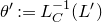 $\theta':=L_C^{-1}(L')$
lies in the interior of
$\theta':=L_C^{-1}(L')$
lies in the interior of $R_C$
and satisfies
$R_C$
and satisfies $\widetilde{X}_{\theta'}\cong X'$
as required.
$\widetilde{X}_{\theta'}\cong X'$
as required.
Example 3.14. In Theorem 3.12, if X were not ${{\mathbb{Q}}}$
-factorial, then it does not necessarily follow that every
${{\mathbb{Q}}}$
-factorial, then it does not necessarily follow that every ${{\mathbb{Q}}}$
-factorial small birational model of X can be obtained by variation of GIT quotient. For example, if G is trivial and V is the locus of square-zero
${{\mathbb{Q}}}$
-factorial small birational model of X can be obtained by variation of GIT quotient. For example, if G is trivial and V is the locus of square-zero $n \times n$
matrices, then
$n \times n$
matrices, then $X=Y=V$
. Condition 3.3 applies because
$X=Y=V$
. Condition 3.3 applies because $\operatorname{Pic}(X)$
is trivial and hence
$\operatorname{Pic}(X)$
is trivial and hence $G^\vee_{{{\mathbb{Q}}}}\cong N^1(X/Y)=\{0\}$
, so Theorem 3.12 applies. However, X admits a projective crepant resolution
$G^\vee_{{{\mathbb{Q}}}}\cong N^1(X/Y)=\{0\}$
, so Theorem 3.12 applies. However, X admits a projective crepant resolution $T^* \mathbb{P}^{n-1}$
which is a
$T^* \mathbb{P}^{n-1}$
which is a ${{\mathbb{Q}}}$
-factorial small birational model that is not obtained by varying the trivial quotient. In this case, this resolution is a quiver variety and can be obtained by varying a different GIT quotient; see Corollary 4.7.
${{\mathbb{Q}}}$
-factorial small birational model that is not obtained by varying the trivial quotient. In this case, this resolution is a quiver variety and can be obtained by varying a different GIT quotient; see Corollary 4.7.
This result allows us to draw conclusions about the GIT quotients directly from known results in birational geometry as follows.
Corollary 3.15. Suppose that Condition 3.3 holds, and let $\theta,\theta'\in R_C$
. Then:
$\theta,\theta'\in R_C$
. Then:
-
(i)
$X_{\theta{}}$
is isomorphic to
$X_{\theta{'}}$
over Y if and only if
$\theta, \theta'$
lie in the same GIT cone; -
(ii) if
$\theta$
is generic and
$\theta'$
in the interior of
$R_C$
, then the normalisation
$\widetilde{X}_{\theta'}$
of
$X_{\theta{'}}$
is the (not necessarily
$\mathbb{Q}$
-factorial) small birational model of
$X_{\theta{}}$
over Y given by the line bundle
$L_C(\theta')$
; -
(iii) for any
$\theta$
in the interior of
$R_C$
, the variety
$X_{\theta{}}$
is
${{\mathbb{Q}}}$
-factorial if and only if
$\theta$
is generic; -
(iv) the dimension of
$N^1(\widetilde{X}_{\eta}/Y)$
equals the dimension of the minimal GIT cone containing
$\eta$
, where for any GIT chamber C’ with
$\eta\in \overline{C'}$
and
$\theta'\in C'$
, we write
$X_{\theta'}\to \widetilde{X}_{\eta}$
for the Stein factorisation of the VGIT morphism
$X_{\theta'}\to X_{\eta}$
.


Proof. For (i), the models X(L) and X(L’) associated to $L, L'\in \operatorname{Pic}(X/Y)$
are isomorphic over Y if and only if L, L’ lie in the same face of the decomposition of
$L, L'\in \operatorname{Pic}(X/Y)$
are isomorphic over Y if and only if L, L’ lie in the same face of the decomposition of $\operatorname{Mov}(X/Y)$
from (3.3). Thus, (i) follows from Theorem 3.12.
$\operatorname{Mov}(X/Y)$
from (3.3). Thus, (i) follows from Theorem 3.12.
For (ii), the interior of $R_C$
is identified with the interior of
$R_C$
is identified with the interior of $\operatorname{Mov}(X/Y)$
, so the GIT quotients
$\operatorname{Mov}(X/Y)$
, so the GIT quotients $X_{\theta{'}}$
and
$X_{\theta{'}}$
and $X_{\theta{}}$
are isomorphic in codimension one over Y. Moreover, if
$X_{\theta{}}$
are isomorphic in codimension one over Y. Moreover, if $C' \subseteq R_C$
is a GIT chamber with
$C' \subseteq R_C$
is a GIT chamber with $\theta' \in \overline{C'}$
, then the codomain of the Stein factorisation
$\theta' \in \overline{C'}$
, then the codomain of the Stein factorisation $X_{\theta{''}} \to \widetilde{X}_{\theta'}$
of the VGIT morphism for
$X_{\theta{''}} \to \widetilde{X}_{\theta'}$
of the VGIT morphism for $\theta'' \in C'$
is just the normalisation of
$\theta'' \in C'$
is just the normalisation of $X_{\theta{'}}$
, as noted after (2.7). The result then follows from Theorem 3.12(ii).
$X_{\theta{'}}$
, as noted after (2.7). The result then follows from Theorem 3.12(ii).
For (iii), one direction was noted in Lemma 3.10 while for the other, it is well known that the base of a flip is not ${{\mathbb{Q}}}$
-factorial. Indeed, if
${{\mathbb{Q}}}$
-factorial. Indeed, if $X_{\theta{_0}}$
were
$X_{\theta{_0}}$
were ${{\mathbb{Q}}}$
-factorial, then, in the notation of Proposition 2.7, any Cartier divisor D satisfying
${{\mathbb{Q}}}$
-factorial, then, in the notation of Proposition 2.7, any Cartier divisor D satisfying $\mathcal{O}_{X_{\theta{_-}}}(D)=L_{C_-}(\theta_+)$
would define a Weil divisor
$\mathcal{O}_{X_{\theta{_-}}}(D)=L_{C_-}(\theta_+)$
would define a Weil divisor $(\tau_-)_*(D)$
on
$(\tau_-)_*(D)$
on $X_{\theta{_0}}$
, making mD and
$X_{\theta{_0}}$
, making mD and $(\tau_-)^*(\tau_-)_*(mD)$
linearly equivalent for some
$(\tau_-)^*(\tau_-)_*(mD)$
linearly equivalent for some $m\gt0$
. However, the intersection numbers of these divisors with respect to a curve contracted by
$m\gt0$
. However, the intersection numbers of these divisors with respect to a curve contracted by $\tau_-$
are negative and zero, respectively.
$\tau_-$
are negative and zero, respectively.
For (iv), let F be the minimal GIT cone containing $\eta$
, let
$\eta$
, let $C'\subset R_C$
be a chamber containing F in its closure, and let
$C'\subset R_C$
be a chamber containing F in its closure, and let $\theta'\in C'$
. Lemma 3.10 implies that
$\theta'\in C'$
. Lemma 3.10 implies that $L_{C}$
identifies F with the minimal face of
$L_{C}$
identifies F with the minimal face of $\operatorname{Nef}(X_{\theta{^\prime}}/Y)$
containing
$\operatorname{Nef}(X_{\theta{^\prime}}/Y)$
containing $L_C(\theta)$
. By (2.3), every line bundle in the interior of this face is the pullback of an ample bundle via the Stein factorisation
$L_C(\theta)$
. By (2.3), every line bundle in the interior of this face is the pullback of an ample bundle via the Stein factorisation $\widetilde{\tau}\colon X_{\theta'}\to \widetilde{X}_\eta$
of the VGIT morphism
$\widetilde{\tau}\colon X_{\theta'}\to \widetilde{X}_\eta$
of the VGIT morphism $\tau\colon X_{\theta{^\prime}}\to X_\eta$
, so
$\tau\colon X_{\theta{^\prime}}\to X_\eta$
, so $\dim L_C(F) \leq \dim (\widetilde{\tau})^*N^1(\widetilde{X}_{\eta}/Y)$
. On the other hand,
$\dim L_C(F) \leq \dim (\widetilde{\tau})^*N^1(\widetilde{X}_{\eta}/Y)$
. On the other hand, $L_C(F)$
is dual via the intersection pairing to the face
$L_C(F)$
is dual via the intersection pairing to the face $\sigma$
of the Mori cone of curves generated by the numerical classes of curves contracted by
$\sigma$
of the Mori cone of curves generated by the numerical classes of curves contracted by $\widetilde{\tau}$
, so
$\widetilde{\tau}$
, so $\dim L_C(F) = \dim (\sigma^\perp)$
for
$\dim L_C(F) = \dim (\sigma^\perp)$
for $\sigma^\perp =\{L\in N^1(\widetilde{X}_{\theta'}/Y) \mid \deg L\vert_\ell =0 \;\forall \; \ell\in \sigma\}$
. The pullback via
$\sigma^\perp =\{L\in N^1(\widetilde{X}_{\theta'}/Y) \mid \deg L\vert_\ell =0 \;\forall \; \ell\in \sigma\}$
. The pullback via $\widetilde{\tau}$
of any class in
$\widetilde{\tau}$
of any class in $N^1(\widetilde{X}_\eta/Y)$
has degree zero on each generator of
$N^1(\widetilde{X}_\eta/Y)$
has degree zero on each generator of $\sigma$
, so
$\sigma$
, so $(\widetilde{\tau})^*N^1(\widetilde{X}_\eta/Y)\subseteq \sigma^\perp$
and hence
$(\widetilde{\tau})^*N^1(\widetilde{X}_\eta/Y)\subseteq \sigma^\perp$
and hence $\dim (\widetilde{\tau})^*N^1(\widetilde{X}_\eta/Y)\leq \dim (\sigma^\perp) = \dim L_C(F)$
. The map
$\dim (\widetilde{\tau})^*N^1(\widetilde{X}_\eta/Y)\leq \dim (\sigma^\perp) = \dim L_C(F)$
. The map $\tau^*$
is injective, so
$\tau^*$
is injective, so $\dim F = \dim L_C(F) = \dim N^1(\widetilde{X}_\eta/Y)$
as required.
$\dim F = \dim L_C(F) = \dim N^1(\widetilde{X}_\eta/Y)$
as required.
3.4 Relative Mori dream spaces
Example 3.5 illustrates that the GIT construction of any Mori dream space via its Cox ring gives rise to a GIT chamber that satisfies our Condition 3.3. The next result provides a partial converse, but we emphasise that even for a Mori dream space, we are typically interested in applying our Condition 3.3 for new GIT descriptions that do not involve the Cox ring directly.
Corollary 3.16. Suppose that Condition 3.3 holds. Then the GIT quotient $X=X_{\theta{}}$
is a Mori dream space over Y, that is:
$X=X_{\theta{}}$
is a Mori dream space over Y, that is:
-
(i) X is normal and
${{\mathbb{Q}}}$
-factorial; -
(ii)
$\operatorname{Pic}(X/Y)_{{\mathbb{Q}}}\cong N^1(X/Y);$
-
(iii) the relative nef cone
$\operatorname{Nef}(X/Y)$
is generated by finitely many semi-ample line bundles; and -
(iv) there exist
$k\geq 0$
and
${{\mathbb{Q}}}$
-factorial varieties
$X=X_0, X_1, \dots, X_k$
, each projective over Y, as well as birational maps
$\psi_i\colon X\dashrightarrow X_i$
over Y for
$0\leq i\leq k$
that are isomorphisms in codimension one, such that (3.4)where each cone in this description is generated by finitely many semi-ample line bundles.
\begin{equation} \operatorname{Mov}(X/Y) = \bigcup_{0\leq i\leq k} \psi_i^*\;\operatorname{Nef}(X_i/Y),\end{equation}








Proof. Let $C^\prime\subset R_C$
be the chamber with
$C^\prime\subset R_C$
be the chamber with $\theta\in C^\prime$
. Part (i) holds by assumption, while part (ii) is Lemma 3.9(iv). For part (iii), the closure
$\theta\in C^\prime$
. Part (i) holds by assumption, while part (ii) is Lemma 3.9(iv). For part (iii), the closure $\overline{C'}$
is a polyhedral cone [Reference ThaddeusTha96, Theorems 2.3–2.4], and hence so is
$\overline{C'}$
is a polyhedral cone [Reference ThaddeusTha96, Theorems 2.3–2.4], and hence so is $\operatorname{Nef}(X/Y)$
by Lemma 3.10. All cone generators for
$\operatorname{Nef}(X/Y)$
by Lemma 3.10. All cone generators for $\operatorname{Nef}(X/Y)$
are semi-ample over Y by Lemma 3.10. Part (iv) follows from the decomposition (3.3) and the equality of cones
$\operatorname{Nef}(X/Y)$
are semi-ample over Y by Lemma 3.10. Part (iv) follows from the decomposition (3.3) and the equality of cones $L_C(R_C)=\operatorname{Mov}(X/Y)$
from Theorem 3.12.
$L_C(R_C)=\operatorname{Mov}(X/Y)$
from Theorem 3.12.
Remark 3.17.
-
(1) The birational maps that feature in Corollary 3.16 are all constructed by variation of GIT quotient, so we need not appeal to the existence of flips from [Reference Birkar, Cascini, Hacon and McKernanBCH+10].
-
(2) It is instructive to compare Condition 3.3 with the criteria for a GIT quotient to be a Mori dream space given by Hu and Keel [Reference Hu and KeelHK00, Lemma 2.2] (see also Ohta [Reference OhtaOht22, Theorem 6.7]). While our Condition 3.3(1) is equivalent to their third and fourth criteria, our criteria (2) and (3) differ considerably from their first and second criteria. We show in Theorem 4.6 that quiver varieties satisfy our Condition 3.3, so they are Mori dream spaces by Corollary 3.16. However, the next example shows that even the simplest quiver varieties can fail to satisfy the Hu–Keel criteria.
Example 3.18. The minimal resolution of the $A_1$
singularity
$A_1$
singularity $Y=\mathbb{V}(uv-w^2)\subset \mathbb{A}^3$
is obtained by variation of GIT quotient for quiver varieties associated to the graph with one node, and vectors
$Y=\mathbb{V}(uv-w^2)\subset \mathbb{A}^3$
is obtained by variation of GIT quotient for quiver varieties associated to the graph with one node, and vectors $\mathbf{v}=1$
,
$\mathbf{v}=1$
, $\mathbf{w} = 2$
. The quiver Q is the McKay quiver for the cyclic group of order two in
$\mathbf{w} = 2$
. The quiver Q is the McKay quiver for the cyclic group of order two in $\operatorname{SL}(2,{{\Bbbk}})$
, and dimension vector
$\operatorname{SL}(2,{{\Bbbk}})$
, and dimension vector $\alpha=(1,1)$
. In this case,
$\alpha=(1,1)$
. In this case, $V = \mathbb{V}(ad-bc)\subset \mathbb{A}^4$
admits an action by
$V = \mathbb{V}(ad-bc)\subset \mathbb{A}^4$
admits an action by $G=({{\Bbbk}}^\times)^2/{{\Bbbk}}^\times$
, and for
$G=({{\Bbbk}}^\times)^2/{{\Bbbk}}^\times$
, and for $\theta = (-1,1)\in G^\vee$
the
$\theta = (-1,1)\in G^\vee$
the $\theta$
-unstable locus is the intersection of V with
$\theta$
-unstable locus is the intersection of V with $\mathbb{V}(a,b)$
. This locus is of codimension one in V, so
$\mathbb{V}(a,b)$
. This locus is of codimension one in V, so $X=V{{/\!\!/\!}}_\theta \, G$
fails to satisfy the Hu–Keel criterion [Reference Hu and KeelHK00, Lemma 2.2(1)]. However, this example satisfies Condition 3.3 (see Theorem 4.6), so it is a Mori dream space over Y by Corollary 3.16.
$X=V{{/\!\!/\!}}_\theta \, G$
fails to satisfy the Hu–Keel criterion [Reference Hu and KeelHK00, Lemma 2.2(1)]. However, this example satisfies Condition 3.3 (see Theorem 4.6), so it is a Mori dream space over Y by Corollary 3.16.
Remark 3.19. If Condition 3.3 holds, then combining Corollary 3.16 with the statement of Hu and Keel [Reference Hu and KeelHK00, Proposition 2.9] (see also Ohta [Reference OhtaOht22, Proposition 6.9]) implies that the Cox ring of the variety $X_{\theta{}}$
is a finitely generated
$X_{\theta{}}$
is a finitely generated ${{\Bbbk}}$
-algebra for
${{\Bbbk}}$
-algebra for $\theta\in C$
. Our Theorem 3.12 allows for an alternative description of the Cox ring of
$\theta\in C$
. Our Theorem 3.12 allows for an alternative description of the Cox ring of $X_{\theta}$
(see [Reference Bellamy, Craw and SchedlerBCS24]).
$X_{\theta}$
(see [Reference Bellamy, Craw and SchedlerBCS24]).
3.5 Strong convexity and injectivity
In practice, injectivity of $L_C$
can often follow from the following simple criterion.
$L_C$
can often follow from the following simple criterion.
A cone is called strongly convex if the origin is a face. Given a fan, the origin is a cone if and only if all cones are strongly convex.
Given a chamber C, let $K_C$
be the intersection of all supporting hyperplanes of the walls of C. The following lemma is standard.
$K_C$
be the intersection of all supporting hyperplanes of the walls of C. The following lemma is standard.
Lemma 3.20. The chamber C is a product of $K_C$
and a strongly convex cone. In particular,
$K_C$
and a strongly convex cone. In particular, $K_C$
is the largest linear subspace of C, the intersection of all faces of C, and the only face which is a linear subspace.
$K_C$
is the largest linear subspace of C, the intersection of all faces of C, and the only face which is a linear subspace.
Proof. Since all faces of C are defined by intersections of half-spaces supported on the hyperplanes defining $K_C$
, we see that
$K_C$
, we see that $K_C$
is contained in all faces. This also shows that it is the largest linear subspace of C and the intersection of all faces. For the first statement,
$K_C$
is contained in all faces. This also shows that it is the largest linear subspace of C and the intersection of all faces. For the first statement, $C/K_C$
is a strongly convex cone, and by taking a splitting of the ambient vector space,
$C/K_C$
is a strongly convex cone, and by taking a splitting of the ambient vector space, $C \cong C/K_C \times K_C$
.
$C \cong C/K_C \times K_C$
.
In particular, $K_C$
does not depend on the choice of chamber, and it is zero if and only if all cones are strongly convex. Let us simply call it K from now on.
$K_C$
does not depend on the choice of chamber, and it is zero if and only if all cones are strongly convex. Let us simply call it K from now on.
Lemma 3.21. Suppose that V has a G-fixed point. Then each GIT cone is strongly convex.
Proof. By definition, if $\theta$
is a non-trivial effective character, then any G-fixed point is
$\theta$
is a non-trivial effective character, then any G-fixed point is $\theta$
-unstable. So
$\theta$
-unstable. So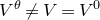 $V^{\theta}\neq V=V^0$
, and hence
$V^{\theta}\neq V=V^0$
, and hence $\{0\}$
is a GIT cone.
$\{0\}$
is a GIT cone.
In particular, if V is conical and the G action is equivariant, then the origin is a G-fixed point.
Proposition 3.22. Suppose that C is a GIT chamber such that the VGIT morphism $\tau$
from (2.4) obtained by choosing general
$\tau$
from (2.4) obtained by choosing general $\theta_0$
in any wall of
$\theta_0$
in any wall of $\overline{C}$
contracts at least one curve. Then
$\overline{C}$
contracts at least one curve. Then $\ker(L_{C}) \subseteq K$
.
$\ker(L_{C}) \subseteq K$
.
Proof. We adapt the proof of [Reference Bellamy and CrawBC20, Proposition 6.1]. Suppose on the contrary that there is a vector $\eta \in \ker(L_{C})$
not contained in K. Then
$\eta \in \ker(L_{C})$
not contained in K. Then $\eta$
is not contained in every supporting hyperplane of
$\eta$
is not contained in every supporting hyperplane of $\overline{C}$
. We may translate any
$\overline{C}$
. We may translate any $\theta \in C$
by a rational multiple of
$\theta \in C$
by a rational multiple of $\eta$
to hit a wall of
$\eta$
to hit a wall of $\overline{C}$
, say at
$\overline{C}$
, say at $\theta_0$
. Since
$\theta_0$
. Since $\eta \in \ker(L_{C})$
, the line bundle
$\eta \in \ker(L_{C})$
, the line bundle $L_C(\theta) = L_C(\theta_0)$
is ample, so some multiple is very ample. However, this is a contradiction because the VGIT morphism
$L_C(\theta) = L_C(\theta_0)$
is ample, so some multiple is very ample. However, this is a contradiction because the VGIT morphism $\tau\colon X_{\theta{}}\to X_{\theta{_0}}$
contracts a curve.
$\tau\colon X_{\theta{}}\to X_{\theta{_0}}$
contracts a curve.
Corollary 3.23. Suppose that $\overline{C}$
is strongly convex. If, for every wall of
$\overline{C}$
is strongly convex. If, for every wall of $\overline{C}$
, the VGIT morphism
$\overline{C}$
, the VGIT morphism $\tau$
from (2.4) obtained by choosing
$\tau$
from (2.4) obtained by choosing $\theta_0$
to be general in the wall contracts at least one curve, then
$\theta_0$
to be general in the wall contracts at least one curve, then $L_C$
is injective.
$L_C$
is injective.
Remark 3.24. In the situation of diagram (2.6), suppose $\tau_\pm$
are both small contractions. If the image under both
$\tau_\pm$
are both small contractions. If the image under both $\tau_\pm$
of the unstable locus
$\tau_\pm$
of the unstable locus $\operatorname{Uns}(\tau_\pm)$
is singular, and the singular locus of
$\operatorname{Uns}(\tau_\pm)$
is singular, and the singular locus of $X_{\theta_0}$
has codimension at least two, then each of
$X_{\theta_0}$
has codimension at least two, then each of $\operatorname{Uns}(\tau_\pm)$
has codimension at least two in
$\operatorname{Uns}(\tau_\pm)$
has codimension at least two in $X_{\theta{_\pm}}$
. This can be a convenient condition to check in practice.
$X_{\theta{_\pm}}$
. This can be a convenient condition to check in practice.
Putting these together, we conclude that the following useful criterion for Condition 3.3 holds.
Corollary 3.25. Suppose that there exists a GIT chamber C such that:
-
(1) the closed cone
$\overline{C}$
is strongly convex, the map
$L_C$
is surjective, and for
$\theta\in C$
the GIT quotient
$X:=X_{\theta{}}$
is a
${{\mathbb{Q}}}$
-factorial, normal variety; -
(2) for any GIT chambers
$C_\pm$
in
$R_C$
sharing a wall, the VGIT morphisms
$\tau_{\pm}$
from (2.6) both contract a curve and they each map their unstable locus to the singular locus of
$X_{\theta{_0}}$
which is of codimension at least two; and -
(3) each boundary wall of
$R_C$
is either divisorial or of fibre type.


Then Condition 3.3 is satisfied.
3.6 Minimal models of Gorenstein singularities
In this section we assume, in addition, that Y has Gorenstein singularities and that $f\colon X \to Y$
is a projective crepant resolution, or more generally, a projective
$f\colon X \to Y$
is a projective crepant resolution, or more generally, a projective ${{\mathbb{Q}}}$
-factorial terminalisation, that is, a projective crepant birational morphism from a variety with
${{\mathbb{Q}}}$
-factorial terminalisation, that is, a projective crepant birational morphism from a variety with ${{\mathbb{Q}}}$
-factorial terminal singularities.
${{\mathbb{Q}}}$
-factorial terminal singularities.
Suppose that there exists another projective ${{\mathbb{Q}}}$
-factorial terminalisation
${{\mathbb{Q}}}$
-factorial terminalisation $f'\colon X'\to Y$
. Then X and X’ are birational minimal models over Y, so by [Reference Kollár and MoriKM98, Theorem 3.52] there is a movable line bundle L on X such that
$f'\colon X'\to Y$
. Then X and X’ are birational minimal models over Y, so by [Reference Kollár and MoriKM98, Theorem 3.52] there is a movable line bundle L on X such that $X'\cong X(L)$
, and the morphism
$X'\cong X(L)$
, and the morphism $f'=f_{L}$
fits into a commutative diagram (2.2). In particular, if there is a GIT construction such that
$f'=f_{L}$
fits into a commutative diagram (2.2). In particular, if there is a GIT construction such that $X\cong X_{\theta{}}$
for
$X\cong X_{\theta{}}$
for $\theta\in C$
as in Condition 3.3, then Theorem 3.12 implies that there is a chamber
$\theta\in C$
as in Condition 3.3, then Theorem 3.12 implies that there is a chamber $C^\prime$
in the GIT region
$C^\prime$
in the GIT region $R_C$
such that
$R_C$
such that $X^\prime \cong X_{\theta{^\prime}}$
for
$X^\prime \cong X_{\theta{^\prime}}$
for $\theta^\prime\in C^\prime$
. More generally, we have the following corollary.
$\theta^\prime\in C^\prime$
. More generally, we have the following corollary.
Corollary 3.26. Suppose that Condition 3.3 holds and that $f_\theta\colon X_{\theta{}}\to Y$
is a projective
$f_\theta\colon X_{\theta{}}\to Y$
is a projective ${{\mathbb{Q}}}$
-factorial terminalisation for
${{\mathbb{Q}}}$
-factorial terminalisation for $\theta\in C$
.
$\theta\in C$
.
-
(i) If a projective, crepant morphism
$g \colon Z \to Y$
is dominated by a projective
${{\mathbb{Q}}}$
-factorial terminalisation
$f'\colon X'\to Y$
, then there exist a chamber
$C^\prime$
in
$R_C$
and
$\eta\in \overline{C'}$
such that
$Z\cong X_{\eta}$
and
$g=f_\eta$
. Moreover, Z has terminal singularities if and only if
$\eta$
lies in the interior of
$R_C$
. -
(ii) Conversely, for all
$\eta\in R_C$
, the morphism
$f_\eta\colon X_\eta\to Y$
is projective and crepant.


Proof. For (i), the choice of $C^\prime\subseteq R_C$
is described in the paragraph preceding Corollary 3.26. Since
$C^\prime\subseteq R_C$
is described in the paragraph preceding Corollary 3.26. Since $f^\prime$
factors via g, the morphism
$f^\prime$
factors via g, the morphism $h\colon X'\to Z$
satisfying
$h\colon X'\to Z$
satisfying $f^\prime = g\circ h$
is obtained from a basepoint-free line bundle
$f^\prime = g\circ h$
is obtained from a basepoint-free line bundle $L\in \operatorname{Nef}(X'/Y)$
. The first statement follows from Theorem 3.12 by setting
$L\in \operatorname{Nef}(X'/Y)$
. The first statement follows from Theorem 3.12 by setting $\eta:=L_{C}^{-1}(L)$
. For the second statement, Z fails to be terminal if and only if the crepant morphism
$\eta:=L_{C}^{-1}(L)$
. For the second statement, Z fails to be terminal if and only if the crepant morphism $h\colon X\to Z\cong X_\eta$
contracts a divisor. This holds if and only if
$h\colon X\to Z\cong X_\eta$
contracts a divisor. This holds if and only if $\eta$
lies in the boundary of
$\eta$
lies in the boundary of $\operatorname{Mov}(X'/Y)$
, which is identified with
$\operatorname{Mov}(X'/Y)$
, which is identified with $\operatorname{Mov}(X/Y)$
by pullback along the birational map
$\operatorname{Mov}(X/Y)$
by pullback along the birational map $\psi$
from (2.1).
$\psi$
from (2.1).
For (ii), each $\eta\in R_C$
lies in the closure of some chamber
$\eta\in R_C$
lies in the closure of some chamber $C^\prime\subseteq R_C$
, so for
$C^\prime\subseteq R_C$
, so for $\theta^\prime\in C^\prime$
the morphism
$\theta^\prime\in C^\prime$
the morphism $f_{\theta^\prime}\colon X_{\theta{^\prime}}\to Y$
factors via
$f_{\theta^\prime}\colon X_{\theta{^\prime}}\to Y$
factors via $f_\eta\colon X_\eta\to Y$
. Since
$f_\eta\colon X_\eta\to Y$
. Since $f_{\theta^\prime}$
is crepant, so too is
$f_{\theta^\prime}$
is crepant, so too is $f_\eta$
.
$f_\eta$
.
Remark 3.27. The hypothesis from Corollary 3.26(i), namely that a projective, crepant morphism $g\colon Z\to Y$
is dominated by a projective,
$g\colon Z\to Y$
is dominated by a projective, $\mathbb{Q}$
-factorial terminalisation
$\mathbb{Q}$
-factorial terminalisation $f^\prime\colon X^\prime\to Y$
, is superfluous in light of results from [Reference Birkar, Cascini, Hacon and McKernanBCH+10]. However, we choose to leave this as an explicit assumption here to underline the fact that the results in the current paper do not rely on [Reference Birkar, Cascini, Hacon and McKernanBCH+10] in any way.
$f^\prime\colon X^\prime\to Y$
, is superfluous in light of results from [Reference Birkar, Cascini, Hacon and McKernanBCH+10]. However, we choose to leave this as an explicit assumption here to underline the fact that the results in the current paper do not rely on [Reference Birkar, Cascini, Hacon and McKernanBCH+10] in any way.
3.7 Weakening the hypotheses
We conclude this section by noting that our results hold in a slightly more general context.
Rather than assume that $L_C$
is an isomorphism in Condition 3.3(1), suppose instead that there exists an affine subspace
$L_C$
is an isomorphism in Condition 3.3(1), suppose instead that there exists an affine subspace $\Lambda \subseteq G^\vee_{{\mathbb{Q}}}$
that is not contained in the linear span of any GIT wall, such that the restriction of
$\Lambda \subseteq G^\vee_{{\mathbb{Q}}}$
that is not contained in the linear span of any GIT wall, such that the restriction of $L_C$
to
$L_C$
to $\Lambda$
is an affine isomorphism
$\Lambda$
is an affine isomorphism $\Lambda\cong \operatorname{Pic}(X/Y)_{{{\mathbb{Q}}}}$
. If one replaces the study of chambers C in
$\Lambda\cong \operatorname{Pic}(X/Y)_{{{\mathbb{Q}}}}$
. If one replaces the study of chambers C in $G^\vee_{{\mathbb{Q}}}$
by the open cones
$G^\vee_{{\mathbb{Q}}}$
by the open cones $C\cap \Lambda$
in
$C\cap \Lambda$
in $\Lambda$
, and the closed GIT region
$\Lambda$
, and the closed GIT region $R_C$
by
$R_C$
by $R_C\cap \Lambda$
, then the proof of Theorem 3.12 applies verbatim if one assumes the analogue of Condition 3.3 in this context.
$R_C\cap \Lambda$
, then the proof of Theorem 3.12 applies verbatim if one assumes the analogue of Condition 3.3 in this context.
Example 3.28. If $X_{\theta{}}$
denotes the quiver variety for a framed extended Dynkin quiver of dimension vector
$X_{\theta{}}$
denotes the quiver variety for a framed extended Dynkin quiver of dimension vector $(1,\delta)$
where
$(1,\delta)$
where $\delta$
denotes the minimal imaginary root for an affine root system of type ADE as in [Reference Bellamy and CrawBC20, Proposition 7.11(i)], then any affine hyperplane
$\delta$
denotes the minimal imaginary root for an affine root system of type ADE as in [Reference Bellamy and CrawBC20, Proposition 7.11(i)], then any affine hyperplane $\Lambda$
orthogonal to the kernel of
$\Lambda$
orthogonal to the kernel of $L_C$
will do.
$L_C$
will do.
One might hope to weaken Condition 3.3(1) further to require only surjectivity of $L_C$
. However, as Corollary 3.23 shows, if
$L_C$
. However, as Corollary 3.23 shows, if $L_C$
is not injective, then there are two cases to consider. Firstly, if
$L_C$
is not injective, then there are two cases to consider. Firstly, if $\overline{C}$
is not strongly convex, then it is natural to study a transverse slice
$\overline{C}$
is not strongly convex, then it is natural to study a transverse slice $\Lambda$
to the maximal linear subspace in
$\Lambda$
to the maximal linear subspace in $\overline{C}$
, as described above. The second case is where C has a wall for which the VGIT morphism does not contract a curve. In this latter case, one might hope to restrict attention to an affine subspace that intersects none of these walls (such walls are called ‘fake’ or ‘type
$\overline{C}$
, as described above. The second case is where C has a wall for which the VGIT morphism does not contract a curve. In this latter case, one might hope to restrict attention to an affine subspace that intersects none of these walls (such walls are called ‘fake’ or ‘type $\operatorname{0}$
’ in the literature); this is precisely the situation described in Example 3.28 above.
$\operatorname{0}$
’ in the literature); this is precisely the situation described in Example 3.28 above.
4. Nakajima quiver varieties
In this section we establish our main result for Nakajima quiver varieties (see Theorem 4.6).
4.1 Quiver varieties
Choose an arbitrary finite graph with vertices $0,\dots,r$
and let H be the set of pairs consisting of an edge, together with an orientation on it. Let
$0,\dots,r$
and let H be the set of pairs consisting of an edge, together with an orientation on it. Let $\operatorname{tl}(a)$
and
$\operatorname{tl}(a)$
and $\operatorname{hd}(a)$
denote the tail and head respectively of the oriented edge
$\operatorname{hd}(a)$
denote the tail and head respectively of the oriented edge $a \in H$
. Let
$a \in H$
. Let $a^*$
denote the same edge, but with opposite orientation. We fix an orientation of the graph, that is, a subset
$a^*$
denote the same edge, but with opposite orientation. We fix an orientation of the graph, that is, a subset $\Omega \subset H$
such that
$\Omega \subset H$
such that $\Omega \cup \Omega^* = H$
and
$\Omega \cup \Omega^* = H$
and $\Omega \cap \Omega^* = \emptyset$
. Then
$\Omega \cap \Omega^* = \emptyset$
. Then $\epsilon : H \rightarrow \{ \pm 1 \}$
is defined to take value 1 on
$\epsilon : H \rightarrow \{ \pm 1 \}$
is defined to take value 1 on $\Omega$
and
$\Omega$
and $-1$
on
$-1$
on $\Omega^*$
.
$\Omega^*$
.
Fix collections $V_0, \dots, V_r$
and
$V_0, \dots, V_r$
and $W_0, \dots, W_r$
of finite-dimensional vector spaces over
$W_0, \dots, W_r$
of finite-dimensional vector spaces over ${{\Bbbk}}$
and set
${{\Bbbk}}$
and set
 $$\mathbf{v} = (\dim V_0, \dots, \dim V_r), \, \mathbf{w} = (\dim W_0, \dots, \dim W_r).$$
The group $G(\mathbf{v}) := \prod_{k = 0}^r \operatorname{GL}(V_k)$
acts naturally on the space
$G(\mathbf{v}) := \prod_{k = 0}^r \operatorname{GL}(V_k)$
acts naturally on the space
 $$\mathbf{M}(\mathbf{v},\mathbf{w}) := \bigg(\bigoplus_{a \in H} \operatorname{Hom}_{{{\Bbbk}}}(V_{\operatorname{tl}(a)}, V_{\operatorname{hd}(a)})\bigg) \oplus \bigg(\bigoplus_{k = 0}^r \big(\operatorname{Hom}_{{{\Bbbk}}}(V_k,W_k) \oplus \operatorname{Hom}_{{{\Bbbk}}}(W_k,V_k)\big)\bigg).$$
This action of $G(\mathbf{v})$
is Hamiltonian for the natural symplectic structure on
$G(\mathbf{v})$
is Hamiltonian for the natural symplectic structure on $\mathbf{M}(\mathbf{v},\mathbf{w})$
and, after identifying the dual of
$\mathbf{M}(\mathbf{v},\mathbf{w})$
and, after identifying the dual of $\mathfrak{g}(\mathbf{v}) := \operatorname{Lie} G(\mathbf{v})$
with
$\mathfrak{g}(\mathbf{v}) := \operatorname{Lie} G(\mathbf{v})$
with $\mathfrak{g}(\mathbf{v})$
via the trace pairing, the corresponding moment map
$\mathfrak{g}(\mathbf{v})$
via the trace pairing, the corresponding moment map ${{\mu}} \colon \mathbf{M}(\mathbf{v},\mathbf{w}) \rightarrow \mathfrak{g}(\mathbf{v})$
satisfies
${{\mu}} \colon \mathbf{M}(\mathbf{v},\mathbf{w}) \rightarrow \mathfrak{g}(\mathbf{v})$
satisfies
 $${\mathbf{\mu}}(B,i,j) = \bigg( \sum_{\operatorname{hd}(a) = k} \epsilon(a) B_a B_{a^*} + i_k j_k \bigg)_{k = 0}^r$$
where $i_k \in \operatorname{Hom}_{{{\Bbbk}}}(W_k,V_k), j_k \in \operatorname{Hom}_{{{\Bbbk}}}(V_k,W_k)$
and
$i_k \in \operatorname{Hom}_{{{\Bbbk}}}(W_k,V_k), j_k \in \operatorname{Hom}_{{{\Bbbk}}}(V_k,W_k)$
and $B_a \in \operatorname{Hom}_{{{\Bbbk}}}(V_{\operatorname{tl}(a)},V_{\operatorname{hd}(a)})$
. Though one can talk about arbitrary stability conditions in this context, as was done in [Reference NakajimaNak09], it is easier in our case to apply the trick of Crawley-Boevey [Reference Crawley-BoeveyCB01] and reduce to the case where each
$B_a \in \operatorname{Hom}_{{{\Bbbk}}}(V_{\operatorname{tl}(a)},V_{\operatorname{hd}(a)})$
. Though one can talk about arbitrary stability conditions in this context, as was done in [Reference NakajimaNak09], it is easier in our case to apply the trick of Crawley-Boevey [Reference Crawley-BoeveyCB01] and reduce to the case where each $W_k = 0$
by introducing a framing vertex.
$W_k = 0$
by introducing a framing vertex.
The set H associated to the graph can be thought of as the arrow set of a quiver. We frame this quiver by adding an additional vertex $\infty$
, as well as
$\infty$
, as well as $\mathbf{w}_i$
arrows from vertex
$\mathbf{w}_i$
arrows from vertex $\infty$
to vertex i and another
$\infty$
to vertex i and another $\mathbf{w}_i$
arrows from vertex i to vertex
$\mathbf{w}_i$
arrows from vertex i to vertex $\infty$
. This framed (doubled) quiver is denoted by
$\infty$
. This framed (doubled) quiver is denoted by $Q = (Q_0,Q_1)$
, where
$Q = (Q_0,Q_1)$
, where $Q_0 = \{ \infty, 0, \dots, r \}$
. Each dimension vector
$Q_0 = \{ \infty, 0, \dots, r \}$
. Each dimension vector $\mathbf{v} = (\dim V_0, \dots, \dim V_r)$
for the original graph determines a dimension vector
$\mathbf{v} = (\dim V_0, \dots, \dim V_r)$
for the original graph determines a dimension vector $\alpha:= (1,\mathbf{v}) = (1,\dim V_0, \dots, \dim V_r)$
for Q. We may identify
$\alpha:= (1,\mathbf{v}) = (1,\dim V_0, \dots, \dim V_r)$
for Q. We may identify $\mathbf{M}(\mathbf{v},\mathbf{w})$
with the space
$\mathbf{M}(\mathbf{v},\mathbf{w})$
with the space
 \[\operatorname{Rep}(Q,\alpha):= \bigoplus_{a\in Q_1} \operatorname{Hom}_{{{\Bbbk}}}({{\Bbbk}}^{\alpha_{\operatorname{tl}(a)}},{{\Bbbk}}^{\alpha_{\operatorname{hd}(a)}}) \]
of representations of Q of dimension vector $\alpha$
in such a way that the
$\alpha$
in such a way that the $G(\mathbf{v})$
-action on
$G(\mathbf{v})$
-action on $\mathbf{M}(\mathbf{v},\mathbf{w})$
corresponds to the action of the group
$\mathbf{M}(\mathbf{v},\mathbf{w})$
corresponds to the action of the group $G(\alpha):=\big(\prod_{i\in Q_0} \operatorname{GL}(\alpha_i)\big)/{{\Bbbk}}^\times$
on
$G(\alpha):=\big(\prod_{i\in Q_0} \operatorname{GL}(\alpha_i)\big)/{{\Bbbk}}^\times$
on $\operatorname{Rep}(Q,\alpha)$
by conjugation and, moreover, the above map
$\operatorname{Rep}(Q,\alpha)$
by conjugation and, moreover, the above map ${\mathbf{\mu}}$
corresponds to the moment map
${\mathbf{\mu}}$
corresponds to the moment map $\mu$
induced by this
$\mu$
induced by this $G(\alpha)$
-action on
$G(\alpha)$
-action on $\operatorname{Rep}(Q,\alpha)$
.
$\operatorname{Rep}(Q,\alpha)$
.
From now on, we assume that $\mathbf{v}$
satisfies
$\mathbf{v}$
satisfies $v_i\neq 0$
for all
$v_i\neq 0$
for all $0\leq i\leq r$
, and
$0\leq i\leq r$
, and $\mathbf{w} \neq 0$
. This is equivalent to choosing a dimension vector
$\mathbf{w} \neq 0$
. This is equivalent to choosing a dimension vector $\alpha$
for Q with component
$\alpha$
for Q with component $\alpha_{\infty} = 1$
and
$\alpha_{\infty} = 1$
and $\alpha_i \neq 0$
for all i (and Q must have at least one arrow from some vertex i to vertex
$\alpha_i \neq 0$
for all i (and Q must have at least one arrow from some vertex i to vertex $\infty$
). Then the rational vector space
$\infty$
). Then the rational vector space
 \[\Theta := \big\{\theta \in \operatorname{Hom}(\mathbb{Z}^{Q_0},\mathbb{Q}) \mid \theta(\alpha)=0\big\} \]
satisfies $G(\alpha)^{\vee} \otimes_{\mathbb{Z}} \mathbb{Q} = \Theta$
, where
$G(\alpha)^{\vee} \otimes_{\mathbb{Z}} \mathbb{Q} = \Theta$
, where $\chi_\theta(g) = \prod_{i \in Q_0} \det(g_i)^{\theta_i}$
for
$\chi_\theta(g) = \prod_{i \in Q_0} \det(g_i)^{\theta_i}$
for $g\in G(\alpha)$
. For
$g\in G(\alpha)$
. For $\theta\in \Theta$
, after replacing
$\theta\in \Theta$
, after replacing $\theta$
by a positive multiple if necessary, the (Nakajima) quiver variety associated to
$\theta$
by a positive multiple if necessary, the (Nakajima) quiver variety associated to $\theta$
is the categorical quotient
$\theta$
is the categorical quotient
 \[ \mathfrak{M}_\theta(\mathbf{v},\mathbf{w}) := \mu^{-1}(0){{/\!\!/\!}}_{\chi_\theta} G(\alpha)= \mu^{-1}(0)^{\theta}/\!\!/G(\alpha) = \operatorname{Proj}\bigoplus_{k\geq 0} {{\Bbbk}}[\mu^{-1}(0)]^{\chi_{k\theta}}, \]
where $\mu^{-1}(0)^{\theta}$
denotes the locus of
$\mu^{-1}(0)^{\theta}$
denotes the locus of $\chi_\theta$
-semi-stable points in
$\chi_\theta$
-semi-stable points in $\mu^{-1}(0)$
and
$\mu^{-1}(0)$
and ${{\Bbbk}}[\mu^{-1}(0)]^{\chi_{k\theta}}$
is the
${{\Bbbk}}[\mu^{-1}(0)]^{\chi_{k\theta}}$
is the $\chi_{k\theta}$
-semi-invariant slice of the coordinate ring of the locus
$\chi_{k\theta}$
-semi-invariant slice of the coordinate ring of the locus $\mu^{-1}(0)$
. Note that
$\mu^{-1}(0)$
. Note that ${{\Bbbk}}^\times$
acts on
${{\Bbbk}}^\times$
acts on $\mathbf{M}(\mathbf{v},\mathbf{w})$
by scaling, and this action descends to an action on
$\mathbf{M}(\mathbf{v},\mathbf{w})$
by scaling, and this action descends to an action on $\mathfrak{M}_\theta(\mathbf{v},\mathbf{w})$
.
$\mathfrak{M}_\theta(\mathbf{v},\mathbf{w})$
.
For a more algebraic description of $\mathfrak{M}_\theta(\mathbf{v},\mathbf{w})$
, extend
$\mathfrak{M}_\theta(\mathbf{v},\mathbf{w})$
, extend $\epsilon$
to Q by setting
$\epsilon$
to Q by setting $\epsilon(a) = 1$
if
$\epsilon(a) = 1$
if $a \colon \infty \rightarrow i$
and
$a \colon \infty \rightarrow i$
and $\epsilon(a) = -1$
if
$\epsilon(a) = -1$
if $a \colon i \rightarrow \infty$
. The preprojective algebra
$a \colon i \rightarrow \infty$
. The preprojective algebra $\Pi$
is the quotient of the path algebra
$\Pi$
is the quotient of the path algebra ${{\Bbbk}} Q$
by the relation
${{\Bbbk}} Q$
by the relation
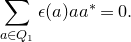 \begin{equation} \sum_{a \in Q_1} \epsilon(a) aa^* = 0.\end{equation}
Given $\theta\in \Theta$
, we say that a
$\theta\in \Theta$
, we say that a $\Pi$
-module M of dimension vector
$\Pi$
-module M of dimension vector $\alpha$
is
$\alpha$
is $\theta$
-semi-stable if
$\theta$
-semi-stable if $\theta(N)\geq 0$
for all submodules
$\theta(N)\geq 0$
for all submodules $N\subseteq M$
, and it is
$N\subseteq M$
, and it is $\theta$
-stable if
$\theta$
-stable if $\theta(N)\gt0$
for all proper non-zero submodules. Two
$\theta(N)\gt0$
for all proper non-zero submodules. Two $\theta$
-semi-stable
$\theta$
-semi-stable $\Pi$
-modules are S-equivalent if their composition series agree in the abelian category of
$\Pi$
-modules are S-equivalent if their composition series agree in the abelian category of $\theta$
-semi-stable
$\theta$
-semi-stable $\Pi$
-modules. A finite-dimensional
$\Pi$
-modules. A finite-dimensional $\Pi$
-module is said to be
$\Pi$
-module is said to be $\theta$
-polystable if it is a direct sum of
$\theta$
-polystable if it is a direct sum of $\theta$
-stable
$\theta$
-stable $\Pi$
-modules. King [Reference KingKin94] proved that a
$\Pi$
-modules. King [Reference KingKin94] proved that a $\Pi$
-module M of dimension vector
$\Pi$
-module M of dimension vector $\alpha$
is
$\alpha$
is $\theta$
-semi-stable (respectively,
$\theta$
-semi-stable (respectively, $\theta$
-stable) if and only if the corresponding point of
$\theta$
-stable) if and only if the corresponding point of $\mu^{-1}(0)$
is
$\mu^{-1}(0)$
is $\chi_\theta$
-semi-stable (respectively,
$\chi_\theta$
-semi-stable (respectively, $\chi_\theta$
-stable) in the sense of GIT. In fact [Reference KingKin94, Propositions 3.2, 5.2] establishes that the quiver variety
$\chi_\theta$
-stable) in the sense of GIT. In fact [Reference KingKin94, Propositions 3.2, 5.2] establishes that the quiver variety $\mathfrak{M}_\theta(\mathbf{v},\mathbf{w})$
is the coarse moduli space of S-equivalence classes of
$\mathfrak{M}_\theta(\mathbf{v},\mathbf{w})$
is the coarse moduli space of S-equivalence classes of $\theta$
-semi-stable
$\theta$
-semi-stable $\Pi$
-modules of dimension vector
$\Pi$
-modules of dimension vector $\alpha$
, where the closed points of
$\alpha$
, where the closed points of $\mathfrak{M}_\theta(\mathbf{v},\mathbf{w})$
are in bijection with the
$\mathfrak{M}_\theta(\mathbf{v},\mathbf{w})$
are in bijection with the $\theta$
-polystable representations of
$\theta$
-polystable representations of $\Pi$
of dimension
$\Pi$
of dimension $\alpha$
. We write
$\alpha$
. We write $\mathfrak{M}_\theta(\mathbf{v},\mathbf{w})^s$
for the (possibly empty) open subset of
$\mathfrak{M}_\theta(\mathbf{v},\mathbf{w})^s$
for the (possibly empty) open subset of $\mathfrak{M}_\theta(\mathbf{v},\mathbf{w})$
parametrising
$\mathfrak{M}_\theta(\mathbf{v},\mathbf{w})$
parametrising $\theta$
-stable representations.
$\theta$
-stable representations.
4.2 Kirwan surjectivity
Recall that $\mathbf{w}\neq 0$
and
$\mathbf{w}\neq 0$
and $v_i \neq 0$
for all i, with
$v_i \neq 0$
for all i, with $\alpha:= (1,\mathbf{v})\in \mathbb{N}^{Q_0}$
. In this case, there exist
$\alpha:= (1,\mathbf{v})\in \mathbb{N}^{Q_0}$
. In this case, there exist $\theta$
that are non-degenerate in the sense of [Reference McGerty and NevinsMN18, Definition 3.1], but
$\theta$
that are non-degenerate in the sense of [Reference McGerty and NevinsMN18, Definition 3.1], but $\mu^{-1}(0)^{\theta}$
can be empty. Let us first recall the condition on
$\mu^{-1}(0)^{\theta}$
can be empty. Let us first recall the condition on $\alpha$
which excludes this.
$\alpha$
which excludes this.
Associated to the quiver Q is a root system R with positive roots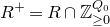 $R^+ = R \cap {{\mathbb{Z}}}_{\ge 0}^{Q_0}$
. We set
$R^+ = R \cap {{\mathbb{Z}}}_{\ge 0}^{Q_0}$
. We set $R^+_{\theta} = \{ \gamma \in R^+ \, | \, \theta(\gamma) = 0 \}$
.
$R^+_{\theta} = \{ \gamma \in R^+ \, | \, \theta(\gamma) = 0 \}$
.
Lemma 4.1. The following conditions are equivalent:
-
(i)
$\alpha \in R^+$
; -
(ii) each
$\theta\in \Theta$
is effective, that is,
$\mu^{-1}(0)^{\theta} \neq \emptyset$
; -
(iii)
$G(\alpha)$
acts freely on
$\mu^{-1}(0)^{\theta}$
for
$\theta$
in some dense open subset of
$\Theta$
.


Moreover, when these conditions hold, the GIT chambers are precisely the interiors of the top-dimensional cones of the GIT fan.
Proof. The space $\mu^{-1}(0)^{\theta}$
is non-empty if and only if the quiver variety
$\mu^{-1}(0)^{\theta}$
is non-empty if and only if the quiver variety $\mathfrak{M}_{\theta}(\mathbf{v},\mathbf{w})$
is non-empty if and only if
$\mathfrak{M}_{\theta}(\mathbf{v},\mathbf{w})$
is non-empty if and only if $\alpha \in \mathbb{N} R^+_{\theta}$
. Since
$\alpha \in \mathbb{N} R^+_{\theta}$
. Since $\alpha_{\infty} = 1$
, we have
$\alpha_{\infty} = 1$
, we have $\alpha \in \mathbb{N} R^+_{\theta}$
for all
$\alpha \in \mathbb{N} R^+_{\theta}$
for all $\theta \in \Theta$
if and only if
$\theta \in \Theta$
if and only if $\alpha \in R^+$
. This shows
$\alpha \in R^+$
. This shows $(i) \iff {{(\mathrm{ii})}}$
. For a general
$(i) \iff {{(\mathrm{ii})}}$
. For a general $\theta \in \Theta$
, the condition
$\theta \in \Theta$
, the condition $\alpha$
indivisible implies that every
$\alpha$
indivisible implies that every $\theta$
-semi-stable representation is
$\theta$
-semi-stable representation is $\theta$
-stable; in other words, a general
$\theta$
-stable; in other words, a general $\theta$
is generic. Therefore,
$\theta$
is generic. Therefore, $G(\alpha)$
will act freely if
$G(\alpha)$
will act freely if $\mu^{-1}(0)^{\theta} \neq \emptyset$
, so (ii) implies (iii). Conversely, if
$\mu^{-1}(0)^{\theta} \neq \emptyset$
, so (ii) implies (iii). Conversely, if $G(\alpha)$
acts freely on
$G(\alpha)$
acts freely on $\mu^{-1}(0)^{\theta}$
then the latter must be non-empty by definition. But
$\mu^{-1}(0)^{\theta}$
then the latter must be non-empty by definition. But $\mu^{-1}(0)^{\theta} \subset \mu^{-1}(0)^{\theta_0}$
for
$\mu^{-1}(0)^{\theta} \subset \mu^{-1}(0)^{\theta_0}$
for $\theta \in C$
and
$\theta \in C$
and $\theta_0 \in \overline{C}$
, so (iii) implies
$\theta_0 \in \overline{C}$
, so (iii) implies ${{(\mathrm{ii})}}$
.
${{(\mathrm{ii})}}$
.
In the preceding paragraph, we noted that each general $\theta \in \Theta$
is generic. This is precisely the final statement.
$\theta \in \Theta$
is generic. This is precisely the final statement.
By [Reference Bellamy and SchedlerBS21, Theorem 1.15], the smooth locus of $\mathfrak{M}_{\theta}(\mathbf{v},\mathbf{w})$
equals the canonically polystable locus, which is the locus where the decomposition of polystable representations into a sum of stable ones is of generic type. In particular, if the stable locus is non-empty, then the smooth locus equals the stable locus
$\mathfrak{M}_{\theta}(\mathbf{v},\mathbf{w})$
equals the canonically polystable locus, which is the locus where the decomposition of polystable representations into a sum of stable ones is of generic type. In particular, if the stable locus is non-empty, then the smooth locus equals the stable locus $\mathfrak{M}_\theta(\mathbf{v},\mathbf{w})^s$
.
$\mathfrak{M}_\theta(\mathbf{v},\mathbf{w})^s$
.
For $\theta \ge \theta_0$
, the morphism
$\theta \ge \theta_0$
, the morphism $f_{\theta} \colon \mathfrak{M}_{\theta}(\mathbf{v},\mathbf{w}) \to \mathfrak{M}_{\theta_0}(\mathbf{v},\mathbf{w})$
need not be surjective. However, it is birational onto its image [Reference Bellamy and CrawBC20, Theorem A.1]. Hence, it is not of fibre type. If the stable locus with respect to
$f_{\theta} \colon \mathfrak{M}_{\theta}(\mathbf{v},\mathbf{w}) \to \mathfrak{M}_{\theta_0}(\mathbf{v},\mathbf{w})$
need not be surjective. However, it is birational onto its image [Reference Bellamy and CrawBC20, Theorem A.1]. Hence, it is not of fibre type. If the stable locus with respect to $\theta_0$
is empty then it can happen that
$\theta_0$
is empty then it can happen that $f_{\theta}$
is an isomorphism onto (the normalisation of) its image, showing that ‘fake’ walls (also known as walls of ‘type
$f_{\theta}$
is an isomorphism onto (the normalisation of) its image, showing that ‘fake’ walls (also known as walls of ‘type $\operatorname{0}$
’; see § 6.3) exist.
$\operatorname{0}$
’; see § 6.3) exist.
As a consequence of Kirwan surjectivity, established in [Reference McGerty and NevinsMN18], we note the following theorem.
Theorem 4.2 (McGerty and Nevins). Assume that $\mathbf{w} \neq 0$
and the equivalent conditions of Lemma 4.1 hold. For any chamber C and for
$\mathbf{w} \neq 0$
and the equivalent conditions of Lemma 4.1 hold. For any chamber C and for $\theta\in C$
, the restriction of the linearisation map defines a surjective map of lattices
$\theta\in C$
, the restriction of the linearisation map defines a surjective map of lattices $\ell_C \colon G^{\vee} \to \operatorname{Pic}\big(\mathfrak{M}_{\theta}(\mathbf{v}, \mathbf{w})/\mathfrak{M}_{0}(\mathbf{v}, \mathbf{w})\big) \cong \operatorname{Pic}\big(\mathfrak{M}_\theta(\mathbf{v},\mathbf{w})\big)$
.
$\ell_C \colon G^{\vee} \to \operatorname{Pic}\big(\mathfrak{M}_{\theta}(\mathbf{v}, \mathbf{w})/\mathfrak{M}_{0}(\mathbf{v}, \mathbf{w})\big) \cong \operatorname{Pic}\big(\mathfrak{M}_\theta(\mathbf{v},\mathbf{w})\big)$
.
Proof. Note that $\mathfrak{M}_{0}(\mathbf{v}, \mathbf{w})$
is an affine cone, so
$\mathfrak{M}_{0}(\mathbf{v}, \mathbf{w})$
is an affine cone, so $\operatorname{Pic}(\mathfrak{M}_{0}(\mathbf{v}, \mathbf{w})) = 0$
and hence the relative Picard group
$\operatorname{Pic}(\mathfrak{M}_{0}(\mathbf{v}, \mathbf{w})) = 0$
and hence the relative Picard group $\operatorname{Pic}(\mathfrak{M}_{\theta}(\mathbf{v}, \mathbf{w})/\mathfrak{M}_{0}(\mathbf{v}, \mathbf{w}))$
equals
$\operatorname{Pic}(\mathfrak{M}_{\theta}(\mathbf{v}, \mathbf{w})/\mathfrak{M}_{0}(\mathbf{v}, \mathbf{w}))$
equals $\operatorname{Pic}(\mathfrak{M}_{\theta}(\mathbf{v}, \mathbf{w}))$
. There is the following commutative diagram.
$\operatorname{Pic}(\mathfrak{M}_{\theta}(\mathbf{v}, \mathbf{w}))$
. There is the following commutative diagram.

The main result of [Reference McGerty and NevinsMN18] says that the map $G^{\vee} \to H^2(\mathfrak{M}_{\theta}(\mathbf{v}, \mathbf{w}),\mathbb{Z})$
is surjective. Since
$G^{\vee} \to H^2(\mathfrak{M}_{\theta}(\mathbf{v}, \mathbf{w}),\mathbb{Z})$
is surjective. Since $\mathfrak{M}_{\theta}(\mathbf{v}, \mathbf{w})$
is smooth, [Reference NakajimaNak01, Theorem 7.3.5] says that the cycle map
$\mathfrak{M}_{\theta}(\mathbf{v}, \mathbf{w})$
is smooth, [Reference NakajimaNak01, Theorem 7.3.5] says that the cycle map $\operatorname{Pic}(\mathfrak{M}_{\theta}(\mathbf{v},\mathbf{w})) \to H^2(\mathfrak{M}_{\theta}(\mathbf{v}, \mathbf{w}),\mathbb{Z})$
is an isomorphism. We note that the paper [Reference NakajimaNak01] assumed that the quiver Q has no loops. However, the proof of [Reference NakajimaNak01, Theorem 7.3.5] does not require this restriction.
$\operatorname{Pic}(\mathfrak{M}_{\theta}(\mathbf{v},\mathbf{w})) \to H^2(\mathfrak{M}_{\theta}(\mathbf{v}, \mathbf{w}),\mathbb{Z})$
is an isomorphism. We note that the paper [Reference NakajimaNak01] assumed that the quiver Q has no loops. However, the proof of [Reference NakajimaNak01, Theorem 7.3.5] does not require this restriction.
The map $L_C$
is obtained from
$L_C$
is obtained from $\ell_C$
by tensoring by
$\ell_C$
by tensoring by $\mathbb{Q}$
, so is also surjective under the hypotheses of the theorem.
$\mathbb{Q}$
, so is also surjective under the hypotheses of the theorem.
Remark 4.3. The map $\ell_C$
will have a non-trivial kernel in general. A simple example is given by taking a framed affine Dynkin quiver and
$\ell_C$
will have a non-trivial kernel in general. A simple example is given by taking a framed affine Dynkin quiver and $\alpha = e_{\infty} + \delta$
; see [Reference Bellamy and CrawBC20, Proposition 7.11]. In fact, one can choose suitable
$\alpha = e_{\infty} + \delta$
; see [Reference Bellamy and CrawBC20, Proposition 7.11]. In fact, one can choose suitable $(Q,\mathbf{v}, \mathbf{w})$
and generic
$(Q,\mathbf{v}, \mathbf{w})$
and generic $\theta$
such that the quiver variety
$\theta$
such that the quiver variety $\mathfrak{M}_{\theta}(\mathbf{v}, \mathbf{w})$
is a minimal resolution of the corresponding Kleinian singularity and
$\mathfrak{M}_{\theta}(\mathbf{v}, \mathbf{w})$
is a minimal resolution of the corresponding Kleinian singularity and $\ell_C$
has kernel of arbitrarily large dimension.
$\ell_C$
has kernel of arbitrarily large dimension.
4.3 Applying the main result
Let $\langle - , -\rangle$
denote the Ringel form on
$\langle - , -\rangle$
denote the Ringel form on $\mathbb{Z}^{Q_0}$
and
$\mathbb{Z}^{Q_0}$
and $( - , - )$
its symmetrisation. For any
$( - , - )$
its symmetrisation. For any $\gamma\in R$
, define
$\gamma\in R$
, define $p(\gamma) := 1 - {1}/{2}(\gamma,\gamma)$
.
$p(\gamma) := 1 - {1}/{2}(\gamma,\gamma)$
.
Definition 4.4. Define $\Sigma_{\theta}$
to be the set of
$\Sigma_{\theta}$
to be the set of $\gamma \in R^+_{\theta}$
such that
$\gamma \in R^+_{\theta}$
such that
 \[p(\gamma) \gt p\big(\beta^{(1)}\big) + \cdots + p\big(\beta^{(k)}\big) \]
for every proper decomposition $\gamma = \beta^{(1)} + \cdots + \beta^{(k)}$
with
$\gamma = \beta^{(1)} + \cdots + \beta^{(k)}$
with $\beta^{(i)} \in R^+_{\theta}$
.
$\beta^{(i)} \in R^+_{\theta}$
.
Crawley-Boevey [Reference Crawley-BoeveyCB01, Theorem 1.2] showed that $\alpha \in \Sigma_{0}$
if and only if there exists a simple (= 0-stable)
$\alpha \in \Sigma_{0}$
if and only if there exists a simple (= 0-stable) $\Pi$
-module of dimension vector
$\Pi$
-module of dimension vector $\alpha$
. More generally, it is shown in [Reference Bellamy and SchedlerBS21, Theorem 1.3] that there exists a
$\alpha$
. More generally, it is shown in [Reference Bellamy and SchedlerBS21, Theorem 1.3] that there exists a $\theta$
-stable
$\theta$
-stable $\Pi$
-module of dimension
$\Pi$
-module of dimension $\alpha$
if and only if
$\alpha$
if and only if $\alpha \in \Sigma_{\theta}$
. Since
$\alpha \in \Sigma_{\theta}$
. Since $\alpha=(1,\mathbf{v})$
is indivisible, every
$\alpha=(1,\mathbf{v})$
is indivisible, every $\theta$
-semi-stable representation will be
$\theta$
-semi-stable representation will be $\theta$
-stable if
$\theta$
-stable if $\theta(\beta) \neq 0$
for all roots
$\theta(\beta) \neq 0$
for all roots $\beta \lt \alpha$
. That is, the GIT walls are contained in the union of hyperplanes
$\beta \lt \alpha$
. That is, the GIT walls are contained in the union of hyperplanes $\beta^\perp$
. For a precise description of the GIT walls, see § 4.5 below.
$\beta^\perp$
. For a precise description of the GIT walls, see § 4.5 below.
Lemma 4.5. Assume $\alpha\in \Sigma_0$
. For any chamber C, let
$\alpha\in \Sigma_0$
. For any chamber C, let $\theta\in C$
and choose
$\theta\in C$
and choose $\theta_0\in \overline{C}\setminus C$
. Then the surjective, birational VGIT morphism
$\theta_0\in \overline{C}\setminus C$
. Then the surjective, birational VGIT morphism $\tau \colon \mathfrak{M}_{\theta}(\mathbf{v},\mathbf{w}) \to \mathfrak{M}_{\theta_0}(\mathbf{v},\mathbf{w})$
contracts at least one curve.
$\tau \colon \mathfrak{M}_{\theta}(\mathbf{v},\mathbf{w}) \to \mathfrak{M}_{\theta_0}(\mathbf{v},\mathbf{w})$
contracts at least one curve.
Proof. Since $\alpha \in \Sigma_0$
, the simple locus (
$\alpha \in \Sigma_0$
, the simple locus ( $=$
0-stable locus) of
$=$
0-stable locus) of $\mathfrak{M}_0(\mathbf{v},\mathbf{w})$
is non-empty, hence open and dense. Therefore, the simple locus of
$\mathfrak{M}_0(\mathbf{v},\mathbf{w})$
is non-empty, hence open and dense. Therefore, the simple locus of $\mathfrak{M}_{\zeta}(\mathbf{v},\mathbf{w})$
is non-empty for all
$\mathfrak{M}_{\zeta}(\mathbf{v},\mathbf{w})$
is non-empty for all $\zeta\in \Theta$
. Since this locus is contained in the
$\zeta\in \Theta$
. Since this locus is contained in the $\zeta$
-stable locus, the latter is also always non-empty. Now [Reference Bellamy and SchedlerBS21, Theorem 1.15] implies that the singular locus is precisely the strictly
$\zeta$
-stable locus, the latter is also always non-empty. Now [Reference Bellamy and SchedlerBS21, Theorem 1.15] implies that the singular locus is precisely the strictly $\theta_0$
-polystable locus.
$\theta_0$
-polystable locus.
The morphism $\tau \colon \mathfrak{M}_{\theta}(\mathbf{v},\mathbf{w}) \to \mathfrak{M}_{\theta_0}(\mathbf{v},\mathbf{w})$
is a surjective birational morphism because
$\tau \colon \mathfrak{M}_{\theta}(\mathbf{v},\mathbf{w}) \to \mathfrak{M}_{\theta_0}(\mathbf{v},\mathbf{w})$
is a surjective birational morphism because $\alpha \in \Sigma_0$
. Moreover, since
$\alpha \in \Sigma_0$
. Moreover, since $\theta_0 \in \overline{C} \smallsetminus C$
, there is a
$\theta_0 \in \overline{C} \smallsetminus C$
, there is a $\theta$
-stable
$\theta$
-stable $\Pi$
-module M of dimension
$\Pi$
-module M of dimension $\alpha$
that is not
$\alpha$
that is not $\theta_0$
-stable. Therefore, the image under
$\theta_0$
-stable. Therefore, the image under $\tau$
of the corresponding point
$\tau$
of the corresponding point $[M]\in \mathfrak{M}_\theta(\mathbf{v},\mathbf{w})$
is strictly
$[M]\in \mathfrak{M}_\theta(\mathbf{v},\mathbf{w})$
is strictly $\theta_0$
-polystable. The previous paragraph implies that
$\theta_0$
-polystable. The previous paragraph implies that $\tau[M]$
lies in the singular locus of
$\tau[M]$
lies in the singular locus of $\mathfrak{M}_{\theta_0}(\mathbf{v}, \mathbf{w})$
, so
$\mathfrak{M}_{\theta_0}(\mathbf{v}, \mathbf{w})$
, so $\tau$
contracts at least one curve by Zariski’s Main Theorem [Reference HartshorneHar77, III, Corollary 11.4].
$\tau$
contracts at least one curve by Zariski’s Main Theorem [Reference HartshorneHar77, III, Corollary 11.4].
Theorem 4.6. Let $\alpha\in \Sigma_0$
. Then every GIT chamber C satisfies Condition 3.3.
$\alpha\in \Sigma_0$
. Then every GIT chamber C satisfies Condition 3.3.
Proof. Since $\alpha \in R^+$
, Lemma 4.1 implies that
$\alpha \in R^+$
, Lemma 4.1 implies that $G(\alpha)$
acts freely on
$G(\alpha)$
acts freely on $\mu^{-1}(0)^{\theta}$
for
$\mu^{-1}(0)^{\theta}$
for $\theta \in C$
, so the quotient
$\theta \in C$
, so the quotient $\mathfrak{M}_{\theta}(\mathbf{v},\mathbf{w})$
is non-singular (see, for example, [Reference Crawley-BoeveyCB99, Lemma 10.3]) and Theorem 4.2 says that
$\mathfrak{M}_{\theta}(\mathbf{v},\mathbf{w})$
is non-singular (see, for example, [Reference Crawley-BoeveyCB99, Lemma 10.3]) and Theorem 4.2 says that $L_C$
is surjective. The origin in
$L_C$
is surjective. The origin in $\mu^{-1}(0)$
is a
$\mu^{-1}(0)$
is a $G(\alpha)$
-fixed point, so Lemma 3.21 says that
$G(\alpha)$
-fixed point, so Lemma 3.21 says that $\overline{C}$
is strongly convex. For
$\overline{C}$
is strongly convex. For $\theta\in C$
and any
$\theta\in C$
and any $\theta_0\in \overline{C}\setminus C$
general in a wall, the morphism
$\theta_0\in \overline{C}\setminus C$
general in a wall, the morphism $\tau \colon \mathfrak{M}_{\theta}(\mathbf{v},\mathbf{w}) \to \mathfrak{M}_{\theta_0}(\mathbf{v},\mathbf{w})$
contracts at least one curve by Lemma 4.5. Therefore,
$\tau \colon \mathfrak{M}_{\theta}(\mathbf{v},\mathbf{w}) \to \mathfrak{M}_{\theta_0}(\mathbf{v},\mathbf{w})$
contracts at least one curve by Lemma 4.5. Therefore, $L_C$
is injective by Corollary 3.23, so Condition 3.3(1) holds. In addition, the unstable locus in
$L_C$
is injective by Corollary 3.23, so Condition 3.3(1) holds. In addition, the unstable locus in $\mathfrak{M}_{\theta}(\mathbf{v},\mathbf{w})$
is precisely the preimage under
$\mathfrak{M}_{\theta}(\mathbf{v},\mathbf{w})$
is precisely the preimage under $\tau$
of the singular locus of
$\tau$
of the singular locus of $\mathfrak{M}_{\theta_0}(\mathbf{v},\mathbf{w})$
; that is, the unstable locus is the exceptional locus of
$\mathfrak{M}_{\theta_0}(\mathbf{v},\mathbf{w})$
; that is, the unstable locus is the exceptional locus of $\tau$
, thanks to [Reference Bellamy and SchedlerBS21, Theorem 1.15] and the fact that the
$\tau$
, thanks to [Reference Bellamy and SchedlerBS21, Theorem 1.15] and the fact that the $\theta_0$
-stable locus is non-empty (hence
$\theta_0$
-stable locus is non-empty (hence $\theta_0$
-stable is equivalent to canonically
$\theta_0$
-stable is equivalent to canonically $\theta_0$
-polystable as in op. cit.). Since the smooth variety
$\theta_0$
-polystable as in op. cit.). Since the smooth variety $\mathfrak{M}_{\theta}(\mathbf{v},\mathbf{w})$
is a symplectic quotient, it is symplectic (see [Reference Crawley-BoeveyCB03, § 8]; note that the symplectic condition actually does not require smoothness, see [Reference Bellamy and SchedlerBS21, Theorem 1.2]). As we have already established that
$\mathfrak{M}_{\theta}(\mathbf{v},\mathbf{w})$
is a symplectic quotient, it is symplectic (see [Reference Crawley-BoeveyCB03, § 8]; note that the symplectic condition actually does not require smoothness, see [Reference Bellamy and SchedlerBS21, Theorem 1.2]). As we have already established that $\tau$
is projective and birational, it is a symplectic resolution of singularities (with normal base, thanks to [Reference Crawley-BoeveyCB03], although we do not require this for the argument). Therefore, it is semi-small [Reference KaledinKal06], so
$\tau$
is projective and birational, it is a symplectic resolution of singularities (with normal base, thanks to [Reference Crawley-BoeveyCB03], although we do not require this for the argument). Therefore, it is semi-small [Reference KaledinKal06], so
 \begin{equation} \operatorname{codim}_{\mathfrak{M}_{\theta}(\mathbf{v},\mathbf{w})} \, \operatorname{Uns}(\tau) \ge \tfrac{1}{2} \operatorname{codim}_{\mathfrak{M}_{\theta_0}(\mathbf{v},\mathbf{w})} \, \operatorname{Sing}\big(\mathfrak{M}_{\theta_0}(\mathbf{v},\mathbf{w})\big).\end{equation}
Note that this inequality also follows explicitly for quiver varieties using, for example, [Reference Bellamy and SchedlerBS21, Corollary 6.4].
Since the singular locus of $\mathfrak{M}_{\theta_0}(\mathbf{v},\mathbf{w})$
is a union of symplectic leaves, its codimension is even. There are two cases.
$\mathfrak{M}_{\theta_0}(\mathbf{v},\mathbf{w})$
is a union of symplectic leaves, its codimension is even. There are two cases.
-
(1) If this codimension is at least four then the codimension of the unstable locus is at least two. This depends only on
$\theta_0$
in the GIT wall rather than on the chamber whose closure contains the wall, so this analysis applies equally to both morphisms
$\tau_+$
and
$\tau_-$
in diagram (2.6). Therefore, the GIT wall is a flipping wall. -
(2) Otherwise, the codimension of the singular locus of
$\mathfrak{M}_{\theta_0}(\mathbf{v},\mathbf{w})$
is two. Locally, the singularities of
$\mathfrak{M}_{\theta_0}(\mathbf{v},\mathbf{w})$
transverse to a codimension-two leaf are Kleinian, which implies that the inequality in (4.2) is an equality. In other words,
$\tau$
is divisorial.


It remains to note that the GIT region $R_C$
is defined in such a way that the walls in the interior of
$R_C$
is defined in such a way that the walls in the interior of $R_C$
cannot induce a divisorial contraction, so they are flipping by the above; boundary walls are not flipping, so they are divisorial by the above. Thus, Conditions 3.3(2) and (3) hold.
$R_C$
cannot induce a divisorial contraction, so they are flipping by the above; boundary walls are not flipping, so they are divisorial by the above. Thus, Conditions 3.3(2) and (3) hold.
Our main result (Theorem 3.12) therefore holds under the assumptions of Theorem 4.6, so we obtain Theorem 1.3. In fact, Corollary 3.26 implies the following stronger result.
Corollary 4.7. Let $\alpha\in \Sigma_0$
, and let
$\alpha\in \Sigma_0$
, and let $C\subset \Theta$
be a chamber with GIT region
$C\subset \Theta$
be a chamber with GIT region $R_C$
.
$R_C$
.
-
(i) Projective partial crepant resolutions of
$\mathfrak{M}_0(\mathbf{v},\mathbf{w})$
, taken up to isomorphism over
$\mathfrak{M}_0(\mathbf{v},\mathbf{w})$
, are in bijection with the GIT cones in
$R_C$
. -
(ii) Under this bijection, the crepant resolutions of
$\mathfrak{M}_0(\mathbf{v},\mathbf{w})$
correspond to the GIT chambers.


In particular, every projective partial crepant resolution of the affine quiver variety $\mathfrak{M}_0(\mathbf{v},\mathbf{w})$
is of the form
$\mathfrak{M}_0(\mathbf{v},\mathbf{w})$
is of the form $f_\theta\colon \mathfrak{M}_{\theta}(\mathbf{v},\mathbf{w}) \to \mathfrak{M}_0(\mathbf{v},\mathbf{w})$
, for some
$f_\theta\colon \mathfrak{M}_{\theta}(\mathbf{v},\mathbf{w}) \to \mathfrak{M}_0(\mathbf{v},\mathbf{w})$
, for some $\theta \in R_C$
. We also deduce from Corollary 3.16 the following result, independent of [Reference Birkar, Cascini, Hacon and McKernanBCH+10, Reference NamikawaNam15].
$\theta \in R_C$
. We also deduce from Corollary 3.16 the following result, independent of [Reference Birkar, Cascini, Hacon and McKernanBCH+10, Reference NamikawaNam15].
Corollary 4.8. Let $\alpha\in \Sigma_0$
. For any generic
$\alpha\in \Sigma_0$
. For any generic $\theta\in \Theta$
, the quiver variety
$\theta\in \Theta$
, the quiver variety $\mathfrak{M}_{\theta}(\mathbf{v},\mathbf{w})$
is a Mori dream space over
$\mathfrak{M}_{\theta}(\mathbf{v},\mathbf{w})$
is a Mori dream space over $\mathfrak{M}_0(\mathbf{v},\mathbf{w})$
.
$\mathfrak{M}_0(\mathbf{v},\mathbf{w})$
.
Remark 4.9. Actually, the assumption $\alpha \in \Sigma_0$
is stronger than what we need. It is enough for the proof above that: (a) for generic
$\alpha \in \Sigma_0$
is stronger than what we need. It is enough for the proof above that: (a) for generic $\theta$
,
$\theta$
, $\mathfrak{M}_{\theta}(\mathbf{v},\mathbf{w}) \to \mathfrak{M}_0(\mathbf{v},\mathbf{w})$
is a resolution of singularities; (b)
$\mathfrak{M}_{\theta}(\mathbf{v},\mathbf{w}) \to \mathfrak{M}_0(\mathbf{v},\mathbf{w})$
is a resolution of singularities; (b) $\mathfrak{M}_{\theta_0}(\mathbf{v},\mathbf{w})$
is singular for non-generic
$\mathfrak{M}_{\theta_0}(\mathbf{v},\mathbf{w})$
is singular for non-generic $\theta_0$
; and (c) for
$\theta_0$
; and (c) for $\theta_0$
in the interior of
$\theta_0$
in the interior of $R_C$
, the
$R_C$
, the $\theta_0$
-stable locus in V is non-empty. These conditions are all satisfied in the setting of [Reference Bellamy and CrawBC20] for
$\theta_0$
-stable locus in V is non-empty. These conditions are all satisfied in the setting of [Reference Bellamy and CrawBC20] for $n \gt 1$
, so Condition 3.3 applies in that situation, recovering their main result. More generally, by [Reference Schedler and TirelliST22, Theorem 6.23, Remark 6.24], (a) is satisfied if and only if
$n \gt 1$
, so Condition 3.3 applies in that situation, recovering their main result. More generally, by [Reference Schedler and TirelliST22, Theorem 6.23, Remark 6.24], (a) is satisfied if and only if $\alpha$
is a ‘flat root’, meaning that, for
$\alpha$
is a ‘flat root’, meaning that, for $\theta=0$
, Definition 4.4 holds except with a non-strict inequality instead of a strict one. Under this assumption, condition (b) holds if and only if, whenever the proper decomposition in Definition 4.4 (for
$\theta=0$
, Definition 4.4 holds except with a non-strict inequality instead of a strict one. Under this assumption, condition (b) holds if and only if, whenever the proper decomposition in Definition 4.4 (for $\theta_0$
) is into only two roots
$\theta_0$
) is into only two roots $\alpha= \beta^{(1)} + \beta^{(2)}$
, either the inequality is strict, or for some other decomposition of
$\alpha= \beta^{(1)} + \beta^{(2)}$
, either the inequality is strict, or for some other decomposition of $\alpha$
into positive roots lying in the
$\alpha$
into positive roots lying in the $\mathbb{Q}$
-linear span of
$\mathbb{Q}$
-linear span of $\beta^{(1)}$
and
$\beta^{(1)}$
and $\beta^{(2)}$
, the inequality is strict. Finally, assuming this, condition (c) holds if and only if, for each decomposition into two roots
$\beta^{(2)}$
, the inequality is strict. Finally, assuming this, condition (c) holds if and only if, for each decomposition into two roots $\alpha=\beta^{(1)}+\beta^{(2)}$
, either (i) one has a strict inequality
$\alpha=\beta^{(1)}+\beta^{(2)}$
, either (i) one has a strict inequality $p(\alpha)\gt p(\gamma^{(1)})+\cdots+p(\gamma^{(m)})$
for every decomposition into roots
$p(\alpha)\gt p(\gamma^{(1)})+\cdots+p(\gamma^{(m)})$
for every decomposition into roots $\gamma^{(i)}$
in the
$\gamma^{(i)}$
in the $\mathbb{Q}$
-linear span of
$\mathbb{Q}$
-linear span of $\beta^{(1)}$
and
$\beta^{(1)}$
and $\beta^{(2)}$
, or (ii) for at least one such decomposition,
$\beta^{(2)}$
, or (ii) for at least one such decomposition, $p(\alpha)=1+p(\gamma^{(1)})+\cdots+p(\gamma^{(m)})$
. Geometrically, these conditions say that, for generic
$p(\alpha)=1+p(\gamma^{(1)})+\cdots+p(\gamma^{(m)})$
. Geometrically, these conditions say that, for generic $\theta_0$
in the corresponding wall, either (i)
$\theta_0$
in the corresponding wall, either (i) $\alpha \in \Sigma_{\theta_0}$
, or else (ii) the quiver variety
$\alpha \in \Sigma_{\theta_0}$
, or else (ii) the quiver variety $\mathfrak{M}_\theta(\mathbf{v},\mathbf{w})$
has singular locus of codimension two.
$\mathfrak{M}_\theta(\mathbf{v},\mathbf{w})$
has singular locus of codimension two.
Remark 4.10. One can consider quiver varieties associated to deformed preprojective algebras (at deformation parameter $\lambda$
). The assumption
$\lambda$
). The assumption $\lambda = 0$
is only required to deduce the surjectivity of
$\lambda = 0$
is only required to deduce the surjectivity of $L_C$
from [Reference McGerty and NevinsMN18]. This is also the only place where we require
$L_C$
from [Reference McGerty and NevinsMN18]. This is also the only place where we require $\alpha_{\infty} = 1$
(or
$\alpha_{\infty} = 1$
(or $\mathbf{w} \neq 0$
). In forthcoming work, we will show that we can drop this condition, so that, for
$\mathbf{w} \neq 0$
). In forthcoming work, we will show that we can drop this condition, so that, for $\lambda=0$
,
$\lambda=0$
, $L_C$
is an isomorphism over
$L_C$
is an isomorphism over $\mathbb{Q}$
for any
$\mathbb{Q}$
for any $\alpha \in \Sigma_0$
except when
$\alpha \in \Sigma_0$
except when $\alpha=2\beta$
for
$\alpha=2\beta$
for $(\beta,\beta)=-2$
(the O’Grady type singularity, for which
$(\beta,\beta)=-2$
(the O’Grady type singularity, for which $\mathfrak{M}_\theta(\mathbf{v},\mathbf{w})$
is not terminal for generic
$\mathfrak{M}_\theta(\mathbf{v},\mathbf{w})$
is not terminal for generic $\theta$
and is resolved by blowing up the reduced singular locus).
$\theta$
and is resolved by blowing up the reduced singular locus).
4.4 The Namikawa–Weyl group
We now prove a general result about polyhedral cones and automorphisms of real vector spaces for which we could not find a suitable reference.
Lemma 4.11. Let $C, C' \subset \mathbb{R}^n$
be the interiors of rational polyhedral cones such that
$C, C' \subset \mathbb{R}^n$
be the interiors of rational polyhedral cones such that $W:= \overline{C} \cap \overline{C'}$
is a common codimension-one face. Let
$W:= \overline{C} \cap \overline{C'}$
is a common codimension-one face. Let $\gamma$
be an integral automorphism of
$\gamma$
be an integral automorphism of $\mathbb{R}^n$
with
$\mathbb{R}^n$
with $\gamma(C) = C'$
fixing W pointwise. Then
$\gamma(C) = C'$
fixing W pointwise. Then $\gamma^2 = 1$
and
$\gamma^2 = 1$
and $\operatorname{Fix}(\gamma)$
is the hyperplane spanned by W. If
$\operatorname{Fix}(\gamma)$
is the hyperplane spanned by W. If $\overline{C}$
is strongly convex, then such an automorphism is unique.
$\overline{C}$
is strongly convex, then such an automorphism is unique.
Proof. If $H \subset \mathbb{R}^n$
is the hyperplane spanned by the vectors in W then
$H \subset \mathbb{R}^n$
is the hyperplane spanned by the vectors in W then $\gamma$
is the identity on H. Write
$\gamma$
is the identity on H. Write $H = \beta^{\perp}$
for some primitive vector
$H = \beta^{\perp}$
for some primitive vector $\beta \in \mathbb{Z}^n$
. Then
$\beta \in \mathbb{Z}^n$
. Then $\gamma(\beta) = -\beta + v$
for some
$\gamma(\beta) = -\beta + v$
for some $v \in H$
, as
$v \in H$
, as $\gamma$
is an integral automorphism sending C to C’. As a result,
$\gamma$
is an integral automorphism sending C to C’. As a result, $\det(\gamma)=-1$
, and
$\det(\gamma)=-1$
, and $\gamma$
must have an eigenvector
$\gamma$
must have an eigenvector $\beta'$
of eigenvalue
$\beta'$
of eigenvalue $-1$
. This proves the first assertion.
$-1$
. This proves the first assertion.
For the second assertion, suppose that $\gamma'$
is another integral automorphism fixing W pointwise and sending C to C’. Then
$\gamma'$
is another integral automorphism fixing W pointwise and sending C to C’. Then $\varphi:=\gamma \circ \gamma'$
is an integral automorphism fixing C and fixing W pointwise. Thus, for
$\varphi:=\gamma \circ \gamma'$
is an integral automorphism fixing C and fixing W pointwise. Thus, for $\beta$
as before, we have
$\beta$
as before, we have $\varphi(\beta) = \beta + u$
for some
$\varphi(\beta) = \beta + u$
for some $u \in H$
. Now if
$u \in H$
. Now if $\overline{C}$
is strongly convex, then for some other codimension-one face W’ of
$\overline{C}$
is strongly convex, then for some other codimension-one face W’ of $\overline{C}$
, we have that u is not in the hyperplane spanned by W’. Therefore,
$\overline{C}$
, we have that u is not in the hyperplane spanned by W’. Therefore, $\varphi(W')$
is either in the interior or the exterior of
$\varphi(W')$
is either in the interior or the exterior of $\overline{C}$
, which contradicts
$\overline{C}$
, which contradicts $\varphi(C)=C$
.
$\varphi(C)=C$
.
For symplectic resolutions of conical symplectic singularities, such as $\mathfrak{M}_{\theta}(\mathbf{v},\mathbf{w}) \to \mathfrak{M}_0(\mathbf{v},\mathbf{w})$
, Namikawa [Reference NamikawaNam10] has shown that there is a finite Weyl group that acts (as a reflection group) on
$\mathfrak{M}_{\theta}(\mathbf{v},\mathbf{w}) \to \mathfrak{M}_0(\mathbf{v},\mathbf{w})$
, Namikawa [Reference NamikawaNam10] has shown that there is a finite Weyl group that acts (as a reflection group) on $H^2(\mathfrak{M}_{\theta}(\mathbf{v},\mathbf{w}),\mathbb{Q})$
. We refer to this action as the Namikawa–Weyl group.
$H^2(\mathfrak{M}_{\theta}(\mathbf{v},\mathbf{w}),\mathbb{Q})$
. We refer to this action as the Namikawa–Weyl group.
Proposition 4.12. Let $\alpha\in \Sigma_0$
. Each GIT region of the form
$\alpha\in \Sigma_0$
. Each GIT region of the form $R_C$
is a simplicial cone. Reflections about the boundary walls of
$R_C$
is a simplicial cone. Reflections about the boundary walls of $R_C$
generate a group
$R_C$
generate a group $\Gamma$
isomorphic to the Namikawa–Weyl group, which acts simply transitively on the set of all GIT regions. The union of these regions is all of
$\Gamma$
isomorphic to the Namikawa–Weyl group, which acts simply transitively on the set of all GIT regions. The union of these regions is all of $\Theta$
. Given GIT chambers C, C’, if
$\Theta$
. Given GIT chambers C, C’, if $g \in \Gamma$
is the element satisfying
$g \in \Gamma$
is the element satisfying $g(R_C)=R_{C'}$
, then
$g(R_C)=R_{C'}$
, then $L_{C'} = L_C \circ g$
.
$L_{C'} = L_C \circ g$
.
Proof. Let $Y = \mathfrak{M}_0(\mathbf{v},\mathbf{w})$
and
$Y = \mathfrak{M}_0(\mathbf{v},\mathbf{w})$
and $X_{\theta} = \mathfrak{M}_{\theta}(\mathbf{v},\mathbf{w})$
.
$X_{\theta} = \mathfrak{M}_{\theta}(\mathbf{v},\mathbf{w})$
.
Let C be a GIT chamber with wall W for which $\tau_-\colon X_{\theta{}} \to X_{\theta_0}$
, with
$\tau_-\colon X_{\theta{}} \to X_{\theta_0}$
, with $\theta \in C$
and a general
$\theta \in C$
and a general $\theta_0 \in W$
, is a divisorial contraction. If C’ is the other chamber with wall W then
$\theta_0 \in W$
, is a divisorial contraction. If C’ is the other chamber with wall W then $\tau_{+}$
from (2.6) is also a divisorial contraction since
$\tau_{+}$
from (2.6) is also a divisorial contraction since $X_{\theta_0}$
has a codimension-two leaf. Under the isomorphism
$X_{\theta_0}$
has a codimension-two leaf. Under the isomorphism $L_C$
, the nef cone
$L_C$
, the nef cone $L_C(\overline{C})$
contains
$L_C(\overline{C})$
contains $L_C(W)$
. Since
$L_C(W)$
. Since $\tau_-$
is a divisorial contraction, W is a boundary wall of
$\tau_-$
is a divisorial contraction, W is a boundary wall of $R_C$
. Then Theorem 3.12(i) says that
$R_C$
. Then Theorem 3.12(i) says that $L_C(W)$
must be a boundary wall of the movable cone. Fix
$L_C(W)$
must be a boundary wall of the movable cone. Fix $\theta_0 \in W$
,
$\theta_0 \in W$
, $\theta \in C$
,
$\theta \in C$
, $\theta'\in C'$
and let
$\theta'\in C'$
and let $\mathcal{O}(\theta_0)$
denote the corresponding polarising ample line bundle on
$\mathcal{O}(\theta_0)$
denote the corresponding polarising ample line bundle on $X_{\theta_0}$
. Then (2.5) says that
$X_{\theta_0}$
. Then (2.5) says that $L_C(\theta_0) = \tau_{-}^* (\mathcal{O}(\theta_0))$
, but since
$L_C(\theta_0) = \tau_{-}^* (\mathcal{O}(\theta_0))$
, but since $L_C(W)$
is a boundary wall of the movable cone of
$L_C(W)$
is a boundary wall of the movable cone of $X_{\theta}$
, the latter is the unique minimal model of Y dominating
$X_{\theta}$
, the latter is the unique minimal model of Y dominating $X_{\theta_0}$
. This implies that
$X_{\theta_0}$
. This implies that $X_{\theta} \cong X_{\theta'}$
over Y. We deduce that
$X_{\theta} \cong X_{\theta'}$
over Y. We deduce that $L_C(C) = L_{C'}(C')$
is the ample cone of
$L_C(C) = L_{C'}(C')$
is the ample cone of $X_{\theta}$
over Y. Moreover,
$X_{\theta}$
over Y. Moreover,
 \[L_C(\theta_0) = \tau_{-}^*(\mathcal{O}(\theta_0)) = \tau^*_{+}(\mathcal{O}(\theta_0)) = L_{C'}(\theta_0) \]
shows that $L_C |_{W} = L_{C'} |_{W}$
. Hence, Theorem 4.2 says that
$L_C |_{W} = L_{C'} |_{W}$
. Hence, Theorem 4.2 says that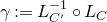 $\gamma := L_{C'}^{-1} \circ L_C$
is obtained from an integral automorphism,
$\gamma := L_{C'}^{-1} \circ L_C$
is obtained from an integral automorphism, $\ell_{C'}^{-1} \circ \ell_C$
, of
$\ell_{C'}^{-1} \circ \ell_C$
, of $\Theta_{\mathbb{Z}} := \{\theta \in \operatorname{Hom}({{\mathbb{Z}}}^{Q_0}, {{\mathbb{Z}}}) \mid \theta(\alpha)=0\}$
, and it maps C to C’ and fixes W pointwise. Lemma 4.11 says that
$\Theta_{\mathbb{Z}} := \{\theta \in \operatorname{Hom}({{\mathbb{Z}}}^{Q_0}, {{\mathbb{Z}}}) \mid \theta(\alpha)=0\}$
, and it maps C to C’ and fixes W pointwise. Lemma 4.11 says that $\gamma^2 = 1$
. Moreover,
$\gamma^2 = 1$
. Moreover, $L_{C'}(R_{C'})=L_C(R_C) = \operatorname{Mov}(X_{\theta{}}/Y)$
implies that
$L_{C'}(R_{C'})=L_C(R_C) = \operatorname{Mov}(X_{\theta{}}/Y)$
implies that $R_{C'}=\gamma(R_C)$
.
$R_{C'}=\gamma(R_C)$
.
Next, inside $N^1(X_{\theta}/Y)$
, [Reference Braden, Licata, Proudfoot and WebsterBLP+16, Proposition 2.17] shows that
$N^1(X_{\theta}/Y)$
, [Reference Braden, Licata, Proudfoot and WebsterBLP+16, Proposition 2.17] shows that $\operatorname{Mov}(X_{\theta{}}/Y)$
is a fundamental domain for the Namikawa–Weyl group, generated by reflections about the boundary walls of
$\operatorname{Mov}(X_{\theta{}}/Y)$
is a fundamental domain for the Namikawa–Weyl group, generated by reflections about the boundary walls of $\operatorname{Mov}(X_{\theta{}}/Y)$
. Since the Namikawa–Weyl group is a Weyl group [Reference NamikawaNam10] acting on the reflection representation, its fundamental regions are simplicial cones. Pulling this back via
$\operatorname{Mov}(X_{\theta{}}/Y)$
. Since the Namikawa–Weyl group is a Weyl group [Reference NamikawaNam10] acting on the reflection representation, its fundamental regions are simplicial cones. Pulling this back via $L_C$
shows that
$L_C$
shows that $R_C$
is a simplicial cone. If s is the reflection in the Namikawa–Weyl group about the wall
$R_C$
is a simplicial cone. If s is the reflection in the Namikawa–Weyl group about the wall $L_C(W)$
then the uniqueness statement of Lemma 4.11 implies that
$L_C(W)$
then the uniqueness statement of Lemma 4.11 implies that $L_C \circ \gamma = s \circ L_C$
. Hence, the reflections about the boundary walls of
$L_C \circ \gamma = s \circ L_C$
. Hence, the reflections about the boundary walls of $R_C$
generate a group
$R_C$
generate a group $\Gamma \subset \operatorname{GL}(\Theta)$
isomorphic to the Namikawa–Weyl group. This group acts with
$\Gamma \subset \operatorname{GL}(\Theta)$
isomorphic to the Namikawa–Weyl group. This group acts with $R_C$
as a fundamental region. In particular,
$R_C$
as a fundamental region. In particular, $\Theta = \bigcup_{g \in \Gamma} g(R_C)$
.
$\Theta = \bigcup_{g \in \Gamma} g(R_C)$
.
We claim $g(R_C) = R_{C'}$
for some GIT chamber C’. This is done by induction on the length of g, the case
$g(R_C) = R_{C'}$
for some GIT chamber C’. This is done by induction on the length of g, the case $\ell(g) = 1$
having been done already. If
$\ell(g) = 1$
having been done already. If $g = \gamma h$
with
$g = \gamma h$
with $\ell(h) \lt \ell(g)$
then
$\ell(h) \lt \ell(g)$
then $h(R_C) = R_{h(C)}$
and applying the previous argument with C replaced by h(C) shows that
$h(R_C) = R_{h(C)}$
and applying the previous argument with C replaced by h(C) shows that $g(R_C) = \gamma(R_{h(C)}) = R_{C'}$
for some C’. A similar induction shows that if
$g(R_C) = \gamma(R_{h(C)}) = R_{C'}$
for some C’. A similar induction shows that if $C'' \subset R_{C'}$
and
$C'' \subset R_{C'}$
and $g(R_C) = R_{C'}$
then
$g(R_C) = R_{C'}$
then $L_{C''} \circ g = L_C$
.
$L_{C''} \circ g = L_C$
.
4.5 Combinatorics and hyperplane arrangements
The results of this final section require that the dimension vector $\alpha$
for the quiver Q is indivisible, but they do not require
$\alpha$
for the quiver Q is indivisible, but they do not require $\alpha$
to come from a non-zero framing. Thus, we write
$\alpha$
to come from a non-zero framing. Thus, we write $\mathfrak{M}_\theta(\alpha)=\mu^{-1}(0)^\theta{{/\!\!/\!}} \; G(\alpha)$
for the quiver variety. Note that the indivisibility assumption on
$\mathfrak{M}_\theta(\alpha)=\mu^{-1}(0)^\theta{{/\!\!/\!}} \; G(\alpha)$
for the quiver variety. Note that the indivisibility assumption on $\alpha$
ensures that
$\alpha$
ensures that $\mathfrak{M}_\theta(\alpha)$
is non-singular for general
$\mathfrak{M}_\theta(\alpha)$
is non-singular for general $\theta$
.
$\theta$
.
For any root $\gamma\in R$
, consider the hyperplane
$\gamma\in R$
, consider the hyperplane $\gamma^\perp:= \{\theta\in \operatorname{Hom}(\mathbb{Z}^{Q_0},\mathbb{Q}) \mid \theta(\gamma)=0\}$
. Note that
$\gamma^\perp:= \{\theta\in \operatorname{Hom}(\mathbb{Z}^{Q_0},\mathbb{Q}) \mid \theta(\gamma)=0\}$
. Note that $\alpha^\perp = \Theta$
.
$\alpha^\perp = \Theta$
.
Definition 4.13. Consider the hyperplane arrangement in $\Theta$
given by
$\Theta$
given by
 $$\mathcal{A}_\alpha = \big\{\beta^\perp \cap \alpha^\perp \mid \textrm{$\alpha = \beta + (\alpha - \beta)$ is a decomposition into two roots in $R^+$} \big\}.$$
The hyperplane arrangement $\mathcal{A}_\alpha$
determines a polyhedral wall-and-chamber decomposition of
$\mathcal{A}_\alpha$
determines a polyhedral wall-and-chamber decomposition of $\Theta$
, and the resulting (closed) cones form a complete fan in
$\Theta$
, and the resulting (closed) cones form a complete fan in $\Theta$
. The interior of each top-dimensional cone in the fan of
$\Theta$
. The interior of each top-dimensional cone in the fan of $\mathcal{A}_\alpha$
is the intersection of
$\mathcal{A}_\alpha$
is the intersection of $\Theta$
with a connected component of the locus
$\Theta$
with a connected component of the locus
 \[ \Theta_{\mathbb{R}} \setminus \bigcup_{\gamma^\perp\in \mathcal{A}_\alpha} \gamma^\perp. \]
The goal of this section is to show that the above fan is precisely the GIT fan. The following result generalises [Reference WuWu21, Corollary 4.7].
Lemma 4.14. If $ \beta,\gamma \in R^+$
and
$ \beta,\gamma \in R^+$
and $\langle \beta,\gamma \rangle \lt 0$
, then
$\langle \beta,\gamma \rangle \lt 0$
, then $\beta+\gamma \in R^+$
as well.
$\beta+\gamma \in R^+$
as well.
Proof. If either $\beta$
or
$\beta$
or $\gamma$
is real then this is true thanks to [Reference KacKac85, Proposition 3.6(a)] (see also Proposition 5.1(c) of op. cit.): if
$\gamma$
is real then this is true thanks to [Reference KacKac85, Proposition 3.6(a)] (see also Proposition 5.1(c) of op. cit.): if $\beta$
is a real root then the restriction of an integral representation to
$\beta$
is a real root then the restriction of an integral representation to $\mathfrak{g}(\beta) \cong \mathfrak{sl}_2$
is a sum of finite-dimensional modules, and the adjoint representation is integrable. We give a purely combinatorial proof of the general case.
$\mathfrak{g}(\beta) \cong \mathfrak{sl}_2$
is a sum of finite-dimensional modules, and the adjoint representation is integrable. We give a purely combinatorial proof of the general case.
Let $\langle \beta,\gamma \rangle = -m \lt 0$
. If
$\langle \beta,\gamma \rangle = -m \lt 0$
. If $\gamma$
is real and
$\gamma$
is real and $m=-1$
, then
$m=-1$
, then $\beta+\gamma$
is a reflection of
$\beta+\gamma$
is a reflection of $\beta$
, so also a root; the same is true swapping
$\beta$
, so also a root; the same is true swapping $\beta$
and
$\beta$
and $\gamma$
. We may assume therefore that either
$\gamma$
. We may assume therefore that either $m\neq -1$
or
$m\neq -1$
or $\beta,\gamma$
are both imaginary.
$\beta,\gamma$
are both imaginary.
Let $\eta^{(0)} := \beta+\gamma, \; \beta^{(0)} := \beta, \;\gamma^{(0)} := \gamma$
. Inductively, let us apply a maximal sequence of simple reflections so that
$\eta^{(0)} := \beta+\gamma, \; \beta^{(0)} := \beta, \;\gamma^{(0)} := \gamma$
. Inductively, let us apply a maximal sequence of simple reflections so that $\eta^{(j)} = s_{i_j}(\eta^{(j-1)})$
, with
$\eta^{(j)} = s_{i_j}(\eta^{(j-1)})$
, with $\eta^{(j-1)} \lt \eta^{(j)}$
; this means that
$\eta^{(j-1)} \lt \eta^{(j)}$
; this means that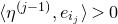 $\langle \eta^{(j-1)}, e_{i_j} \rangle \gt 0$
. Let
$\langle \eta^{(j-1)}, e_{i_j} \rangle \gt 0$
. Let $\beta^{(j)} := s_{i_j}(\beta^{(j-1)})$
and
$\beta^{(j)} := s_{i_j}(\beta^{(j-1)})$
and $\gamma^{(j)} := s_{i_j}( \gamma^{(j-1)})$
. We claim that under this sequence
$\gamma^{(j)} := s_{i_j}( \gamma^{(j-1)})$
. We claim that under this sequence $\beta^{(j)}, \gamma^{(j)}$
always remain positive. If, at some stage,
$\beta^{(j)}, \gamma^{(j)}$
always remain positive. If, at some stage, $\beta^{(j)}$
is negative, then
$\beta^{(j)}$
is negative, then $\beta^{(j-1)}=e_{i_j}$
. Then
$\beta^{(j-1)}=e_{i_j}$
. Then $-m= \langle \beta^{(j-1)}, \gamma^{(j-1)} \rangle = \langle e_{i_j}, \gamma^{(j-1)} \rangle$
. But
$-m= \langle \beta^{(j-1)}, \gamma^{(j-1)} \rangle = \langle e_{i_j}, \gamma^{(j-1)} \rangle$
. But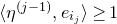 $\langle \eta^{(j-1)}, e_{i_j} \rangle \geq 1$
by assumption, so
$\langle \eta^{(j-1)}, e_{i_j} \rangle \geq 1$
by assumption, so $\langle e_{i_j}, \gamma^{(j-1)} \rangle \geq -1$
. Thus,
$\langle e_{i_j}, \gamma^{(j-1)} \rangle \geq -1$
. Thus, $m=1$
. In this case
$m=1$
. In this case $\beta$
and
$\beta$
and $\gamma$
are both imaginary, which contradicts
$\gamma$
are both imaginary, which contradicts $\beta^{(j-1)}=e_{i_j}$
.
$\beta^{(j-1)}=e_{i_j}$
.
Since $\beta^{(j)}$
and
$\beta^{(j)}$
and $\gamma^{(j)}$
are always positive roots with non-zero pairing, their sum is always connected and positive. So
$\gamma^{(j)}$
are always positive roots with non-zero pairing, their sum is always connected and positive. So $\eta^{(j)}$
remains connected and positive. Eventually, this sequence must terminate (say, at
$\eta^{(j)}$
remains connected and positive. Eventually, this sequence must terminate (say, at $\eta^{(k)}$
). Then
$\eta^{(k)}$
). Then $\langle \eta^{(k)},e_i\rangle \le 0$
for all loop-free vertices i, implying that
$\langle \eta^{(k)},e_i\rangle \le 0$
for all loop-free vertices i, implying that $\eta^{(k)}$
is in the fundamental domain. This implies that
$\eta^{(k)}$
is in the fundamental domain. This implies that $\beta+\gamma$
is an imaginary root.
$\beta+\gamma$
is an imaginary root.
Given a tuple $D := (\alpha^{(1)}, \dots, \alpha^{(m)})$
of roots in
$D := (\alpha^{(1)}, \dots, \alpha^{(m)})$
of roots in $R^+$
, we associate the quiver
$R^+$
, we associate the quiver $Q_D$
whose vertices are
$Q_D$
whose vertices are $1,\dots,m$
, with
$1,\dots,m$
, with $-\langle \alpha^{(i)}, \alpha^{(j)} \rangle$
arrows from i to j for
$-\langle \alpha^{(i)}, \alpha^{(j)} \rangle$
arrows from i to j for $i \neq j$
. Given a decomposition
$i \neq j$
. Given a decomposition $\alpha = \alpha^{(1)} + \cdots + \alpha^{(m)}$
, we associate this tuple and hence the quiver.
$\alpha = \alpha^{(1)} + \cdots + \alpha^{(m)}$
, we associate this tuple and hence the quiver.
Lemma 4.15. Suppose that $\alpha \in \Sigma_{\theta}$
has a decomposition
$\alpha \in \Sigma_{\theta}$
has a decomposition $D : \alpha = \alpha^{(1)} + \cdots + \alpha^{(m)}$
into roots in
$D : \alpha = \alpha^{(1)} + \cdots + \alpha^{(m)}$
into roots in $R^+_{\theta}$
. Then the associated quiver
$R^+_{\theta}$
. Then the associated quiver $Q_D$
is connected.
$Q_D$
is connected.
Proof. If $\{1,\ldots,m\} = I \cup J$
with I and J disconnected from each other in
$\{1,\ldots,m\} = I \cup J$
with I and J disconnected from each other in $Q_D$
, then we get a decomposition
$Q_D$
, then we get a decomposition $\alpha = \alpha_I + \alpha_J$
, where
$\alpha = \alpha_I + \alpha_J$
, where $\langle \alpha_I, \alpha_J \rangle = 0$
. This implies that
$\langle \alpha_I, \alpha_J \rangle = 0$
. This implies that $p(\alpha) \lt p(\alpha_I) + p(\alpha_J)$
. Taking canonical decompositions of
$p(\alpha) \lt p(\alpha_I) + p(\alpha_J)$
. Taking canonical decompositions of $\alpha_I$
and
$\alpha_I$
and $\alpha_J$
, and applying [Reference Bellamy and SchedlerBS21, Lemma 7.3], we get a contradiction to the fact that
$\alpha_J$
, and applying [Reference Bellamy and SchedlerBS21, Lemma 7.3], we get a contradiction to the fact that $\alpha \in \Sigma_{\theta}$
.
$\alpha \in \Sigma_{\theta}$
.
Proposition 4.16. For every decomposition $D: \alpha = \alpha^{(1)} + \cdots + \alpha^{(m)}$
, with connected quiver
$D: \alpha = \alpha^{(1)} + \cdots + \alpha^{(m)}$
, with connected quiver $Q_D$
, the intersection
$Q_D$
, the intersection $\cap_i (\alpha^{(i)})^\perp$
equals an intersection of hyperplanes in
$\cap_i (\alpha^{(i)})^\perp$
equals an intersection of hyperplanes in $\mathcal{A}_\alpha$
.
$\mathcal{A}_\alpha$
.
The proof of this is based on an easy, purely combinatorial statement:
Lemma 4.17. Let Q be a connected (undirected) graph with vertex set $Q_0$
. For
$Q_0$
. For $J \subseteq Q_0$
define
$J \subseteq Q_0$
define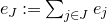 $e_J := \sum_{j \in J} e_j$
, where
$e_J := \sum_{j \in J} e_j$
, where $e_j\in {{\mathbb{Z}}} Q_0$
is the trivial path at vertex j. Then
$e_j\in {{\mathbb{Z}}} Q_0$
is the trivial path at vertex j. Then ${{\mathbb{Z}}} Q_0$
is spanned by the set
${{\mathbb{Z}}} Q_0$
is spanned by the set
 $$S_Q := \{e_J \mid J \subseteq Q_0 \text{ is such that }J \text{ and }Q_0\setminus J \text{ are connected} \}.$$
Proof. By induction on $|Q_0|$
. Note that in a connected graph there is always a vertex
$|Q_0|$
. Note that in a connected graph there is always a vertex $j \in Q_0$
which can be removed leaving a connected graph (this is obvious for a tree, and every connected graph has a spanning tree). Then
$j \in Q_0$
which can be removed leaving a connected graph (this is obvious for a tree, and every connected graph has a spanning tree). Then $e_j$
is in the set
$e_j$
is in the set $S_Q$
above. Let
$S_Q$
above. Let $j_0 \in Q_0$
be such a vertex. Define Q’ to be the graph obtained from Q by deleting the vertex
$j_0 \in Q_0$
be such a vertex. Define Q’ to be the graph obtained from Q by deleting the vertex $j_0$
and all edges that have an endpoint at
$j_0$
and all edges that have an endpoint at $j_0$
. By induction
$j_0$
. By induction ${{\mathbb{Z}}} Q'_0$
is spanned by
${{\mathbb{Z}}} Q'_0$
is spanned by $S_{Q'}$
. But for each
$S_{Q'}$
. But for each $J \subseteq Q_0'$
such that both J and
$J \subseteq Q_0'$
such that both J and $Q_0'\smallsetminus J$
are connected, either
$Q_0'\smallsetminus J$
are connected, either $J \cup \{j_0\}$
or
$J \cup \{j_0\}$
or $Q_0 \setminus J$
is connected, so
$Q_0 \setminus J$
is connected, so $e_J$
or
$e_J$
or $e_J+e_{j_0}$
is in
$e_J+e_{j_0}$
is in $S_{Q'}$
. Thus,
$S_{Q'}$
. Thus, $\operatorname{Span}(S_Q)$
contains
$\operatorname{Span}(S_Q)$
contains ${{\mathbb{Z}}} \cdot e_{j_0}$
, while the quotient
${{\mathbb{Z}}} \cdot e_{j_0}$
, while the quotient $\operatorname{Span}(S_Q)/{{\mathbb{Z}}} \cdot e_{j_0}$
contains
$\operatorname{Span}(S_Q)/{{\mathbb{Z}}} \cdot e_{j_0}$
contains $\operatorname{Span}(S_{Q'}) = {{\mathbb{Z}}} Q'_0$
, so
$\operatorname{Span}(S_{Q'}) = {{\mathbb{Z}}} Q'_0$
, so $S_Q$
spans
$S_Q$
spans ${{\mathbb{Z}}} Q_0$
.
${{\mathbb{Z}}} Q_0$
.
Proof of Proposition 4.16. Lemma 4.14 implies that for every $J \subset (Q_D)_0$
connected, the sum
$J \subset (Q_D)_0$
connected, the sum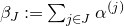 $\beta_J := \sum_{j\in J} \alpha^{(j)}$
is in
$\beta_J := \sum_{j\in J} \alpha^{(j)}$
is in $R^+$
. In the case
$R^+$
. In the case $e_J \in S_{Q_D}$
as in Lemma 4.17, we get that both
$e_J \in S_{Q_D}$
as in Lemma 4.17, we get that both $\beta_J$
and
$\beta_J$
and $\alpha - \beta_J$
belong to
$\alpha - \beta_J$
belong to $R^+$
. Thus,
$R^+$
. Thus, $\beta_J$
is the perpendicular vector to a hyperplane in
$\beta_J$
is the perpendicular vector to a hyperplane in $\mathcal{A}_\alpha$
. Lemma 4.17, applied to
$\mathcal{A}_\alpha$
. Lemma 4.17, applied to $Q_D$
, then says that the intersection of these hyperplanes
$Q_D$
, then says that the intersection of these hyperplanes $\beta_J^{\perp}$
, for
$\beta_J^{\perp}$
, for $e_J \in S_{Q_D}$
, equals the intersection of the hyperplanes
$e_J \in S_{Q_D}$
, equals the intersection of the hyperplanes $(\alpha^{(i)})^\perp$
for
$(\alpha^{(i)})^\perp$
for $1\leq i\leq m$
, since intersecting hyperplanes produce the linear subspace perpendicular to the span of the normal vectors.
$1\leq i\leq m$
, since intersecting hyperplanes produce the linear subspace perpendicular to the span of the normal vectors.
Theorem 4.18. Assume $\alpha \in \Sigma_0$
is indivisible. The GIT fan equals the fan given by the arrangement
$\alpha \in \Sigma_0$
is indivisible. The GIT fan equals the fan given by the arrangement $\mathcal{A}_{\alpha}$
.
$\mathcal{A}_{\alpha}$
.
Proof. It suffices to show that the GIT walls are precisely the union of the hyperplanes in $\mathcal{A}_{\alpha}$
. In other words,
$\mathcal{A}_{\alpha}$
. In other words, $\mathfrak{M}_{\theta}(\alpha)^s = \mathfrak{M}_{\theta}(\alpha)$
if and only if
$\mathfrak{M}_{\theta}(\alpha)^s = \mathfrak{M}_{\theta}(\alpha)$
if and only if $\theta$
lies in the complement to the hyperplanes in
$\theta$
lies in the complement to the hyperplanes in $\mathcal{A}_{\alpha}$
.
$\mathcal{A}_{\alpha}$
.
Assume that $\theta$
is a general element of
$\theta$
is a general element of $\gamma^{\perp} \in \mathcal{A}_{\alpha}$
. Then there exists a positive root
$\gamma^{\perp} \in \mathcal{A}_{\alpha}$
. Then there exists a positive root $\beta$
such that
$\beta$
such that $\alpha - \beta \in R^+$
and
$\alpha - \beta \in R^+$
and $\theta(\beta) = 0$
. It is a consequence of [Reference Bellamy and SchedlerBS21, Theorem 1.3] that there exists a
$\theta(\beta) = 0$
. It is a consequence of [Reference Bellamy and SchedlerBS21, Theorem 1.3] that there exists a $\theta$
-polystable representation of dimension vector
$\theta$
-polystable representation of dimension vector $\eta$
for any
$\eta$
for any $\eta \in \mathbb{N} R^+_{\theta}$
. In particular, this implies that there exist
$\eta \in \mathbb{N} R^+_{\theta}$
. In particular, this implies that there exist $\theta$
-polystable representations M,N of dimension vector
$\theta$
-polystable representations M,N of dimension vector $\beta$
and
$\beta$
and $\alpha-\beta$
, respectively. The point
$\alpha-\beta$
, respectively. The point $[M \oplus N] \in \mathfrak{M}_{\theta_0}(\alpha)$
is strictly
$[M \oplus N] \in \mathfrak{M}_{\theta_0}(\alpha)$
is strictly $\theta$
-polystable. Hence,
$\theta$
-polystable. Hence, $\gamma^{\perp}$
is a GIT wall.
$\gamma^{\perp}$
is a GIT wall.
Conversely, if $\theta \in \Theta$
lies on some GIT wall then, by definition, there exists a properly
$\theta \in \Theta$
lies on some GIT wall then, by definition, there exists a properly $\theta$
-polystable representation
$\theta$
-polystable representation $M = M_1^{\oplus n_1} \oplus \cdots \oplus M_k^{\oplus n_k}$
with
$M = M_1^{\oplus n_1} \oplus \cdots \oplus M_k^{\oplus n_k}$
with $\alpha^{(i)} := \dim M_i$
belonging to
$\alpha^{(i)} := \dim M_i$
belonging to $\Sigma_{\theta}$
. Counting the
$\Sigma_{\theta}$
. Counting the $\alpha^{(i)}$
with multiplicity gives a decomposition D of
$\alpha^{(i)}$
with multiplicity gives a decomposition D of $\alpha$
. Since
$\alpha$
. Since $\alpha \in \Sigma_0$
, the associated quiver
$\alpha \in \Sigma_0$
, the associated quiver $Q_D$
is connected by Lemma 4.15. Then Proposition 4.16 implies that
$Q_D$
is connected by Lemma 4.15. Then Proposition 4.16 implies that $\theta$
lies on some hyperplane in
$\theta$
lies on some hyperplane in $\mathcal{A}_\alpha$
.
$\mathcal{A}_\alpha$
.
We note the following useful consequence of the proof of Theorem 4.18.
Corollary 4.19. If $\alpha \in \Sigma_0$
is indivisible, then the quiver variety
$\alpha \in \Sigma_0$
is indivisible, then the quiver variety $\mathfrak{M}_{\theta}(\alpha)$
is non-singular if and only if
$\mathfrak{M}_{\theta}(\alpha)$
is non-singular if and only if $\theta$
does not lie on any hyperplane in
$\theta$
does not lie on any hyperplane in $\mathcal{A}_{\alpha}$
.
$\mathcal{A}_{\alpha}$
.
We may describe the GIT regions $R_C$
more explicitly. By [Reference Bellamy and SchedlerBS21, Theorem 1.20], the walls in the boundary of
$R_C$
more explicitly. By [Reference Bellamy and SchedlerBS21, Theorem 1.20], the walls in the boundary of $R_C$
all lie in the hyperplanes
$R_C$
all lie in the hyperplanes $\beta^\perp$
where
$\beta^\perp$
where $\beta$
is a codimension-two root, meaning that there is a codimension-two stratum
$\beta$
is a codimension-two root, meaning that there is a codimension-two stratum $\mathfrak{M}_{\theta}(\alpha)_{\tau}$
where the dimension vectors
$\mathfrak{M}_{\theta}(\alpha)_{\tau}$
where the dimension vectors $\beta^{(i)}$
appearing in the representation type
$\beta^{(i)}$
appearing in the representation type $\tau$
are all rational combinations of
$\tau$
are all rational combinations of $\alpha$
and
$\alpha$
and $\beta$
. In fact, one can show that this is equivalent to the condition that
$\beta$
. In fact, one can show that this is equivalent to the condition that $\beta$
and
$\beta$
and $\alpha - \beta$
are both roots, and
$\alpha - \beta$
are both roots, and $(\beta, \alpha- \beta) = -2$
(but we do not need this fact here). Then
$(\beta, \alpha- \beta) = -2$
(but we do not need this fact here). Then $R_C$
is the closure of one of the complementary regions of these hyperplanes, namely, the one containing C. Conversely, every such region can be used as
$R_C$
is the closure of one of the complementary regions of these hyperplanes, namely, the one containing C. Conversely, every such region can be used as $R_C$
, and C can be taken to be any GIT chamber inside it.
$R_C$
, and C can be taken to be any GIT chamber inside it.
5. Hypertoric varieties
We now show that our main results also apply to the class of non-singular hypertoric varieties, leading to a proof of Theorem 1.5. We work over the complex numbers in this section.
5.1 GIT construction
Hypertoric varieties were originally constructed as hyperkähler quotients by Bielawski and Dancer [Reference Bielawski and DancerBD00], where they were called toric hyperkähler manifolds (the name ‘hypertoric’ for the possibly singular algebraic varieties was coined later in work of Harada and Proudfoot, noting that they are not toric varieties). Here we recall their construction as holomorphic symplectic varieties by GIT following Hausel and Sturmfels [Reference Hausel and SturmfelsHS02] (see also Konno [Reference KonnoKon03]).
For $n, r\in \mathbb{N}$
with
$n, r\in \mathbb{N}$
with $r\lt n$
, consider the action of the algebraic torus
$r\lt n$
, consider the action of the algebraic torus $G:=({{\mathbb{C}}}^\times)^r$
on the complex symplectic vector space
$G:=({{\mathbb{C}}}^\times)^r$
on the complex symplectic vector space $T^*{{\mathbb{C}}}^n = {{\mathbb{C}}}^n\times ({{\mathbb{C}}}^n)^*$
, where the matrix that records the weights of the action is of the form
$T^*{{\mathbb{C}}}^n = {{\mathbb{C}}}^n\times ({{\mathbb{C}}}^n)^*$
, where the matrix that records the weights of the action is of the form $(A,-A)$
, where A is an
$(A,-A)$
, where A is an $r\times n$
integer-valued matrix whose columns
$r\times n$
integer-valued matrix whose columns $a_1, \dots, a_n$
span
$a_1, \dots, a_n$
span ${{\mathbb{Z}}}^r$
. Note that this forces the
${{\mathbb{Z}}}^r$
. Note that this forces the $r \times r$
-minors of A to be relatively prime. The G-action is Hamiltonian for the natural symplectic structure on
$r \times r$
-minors of A to be relatively prime. The G-action is Hamiltonian for the natural symplectic structure on $T^*{{\mathbb{C}}}^n$
, and the induced moment map
$T^*{{\mathbb{C}}}^n$
, and the induced moment map $\mu\colon T^*{{\mathbb{C}}}^n\to \mathfrak{g}^*$
satisfies
$\mu\colon T^*{{\mathbb{C}}}^n\to \mathfrak{g}^*$
satisfies
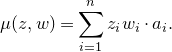 \[ \mu(z,w)=\sum_{i=1}^n z_iw_i \cdot a_i. \]
Choose an integer $n \times (n-r)$
matrix B forming the short exact sequence
$n \times (n-r)$
matrix B forming the short exact sequence
 \[ 0 \to \mathbb{Z}^{n-r} \stackrel{B}{\longrightarrow} \mathbb{Z}^n \stackrel{A}{\longrightarrow} \mathbb{Z}^r \to 0. \]
If no row of the matrix B is zero (equivalently, when the torus G contains no dilations along a single axis) then the locus $\mu^{-1}(0)$
is an affine variety by [Reference Bellamy and KuwabaraBK12, Lemma 4.7], and for any character
$\mu^{-1}(0)$
is an affine variety by [Reference Bellamy and KuwabaraBK12, Lemma 4.7], and for any character $\theta\in G^\vee$
the corresponding hypertoric variety is defined to be
$\theta\in G^\vee$
the corresponding hypertoric variety is defined to be
 \[ X_{\theta{}}:= \mu^{-1}(0){{/\!\!/\!}}_\theta \, G. \]
Recall that a matrix A is said to be unimodular if all of the non-zero $r \times r$
minors of A belong to
$r \times r$
minors of A belong to $\{ -1,0, 1 \}$
(equivalently, the
$\{ -1,0, 1 \}$
(equivalently, the $(n-r) \times (n-r)$
-minors of B belong to
$(n-r) \times (n-r)$
-minors of B belong to $\{ -1,0, 1 \}$
). Under the assumption that no row of the matrix B is zero, it is shown in [Reference Hausel and SturmfelsHS02, Proposition 6.2] that
$\{ -1,0, 1 \}$
). Under the assumption that no row of the matrix B is zero, it is shown in [Reference Hausel and SturmfelsHS02, Proposition 6.2] that $X_{\theta{}}$
is non-singular for general
$X_{\theta{}}$
is non-singular for general $\theta$
if and only if A is unimodular. Note, in addition, that the interior of every top-dimensional cone in the GIT fan is a chamber, because G is a torus [Reference Dolgachev and HuDH98, Corollary 4.1.10].
$\theta$
if and only if A is unimodular. Note, in addition, that the interior of every top-dimensional cone in the GIT fan is a chamber, because G is a torus [Reference Dolgachev and HuDH98, Corollary 4.1.10].
5.2 Applying the main result
In order to apply our Theorem 3.12 to non-singular hypertoric varieties, we show that Condition 3.3 holds. Much of the heavy lifting was done by Konno [Reference KonnoKon03].
Theorem 5.1. Assume that A is unimodular and no row of the matrix B is zero, so the hypertoric variety $X_{\theta{}}$
is non-singular for general
$X_{\theta{}}$
is non-singular for general $\theta$
. Then Condition 3.3 holds for every chamber C, and hence Theorem 3.12 applies. In particular, every projective crepant resolution of
$\theta$
. Then Condition 3.3 holds for every chamber C, and hence Theorem 3.12 applies. In particular, every projective crepant resolution of $X_0$
is a hypertoric variety
$X_0$
is a hypertoric variety $X_{\theta{}}$
for some generic
$X_{\theta{}}$
for some generic $\theta$
.
$\theta$
.
Proof. Let C be a chamber and $\theta \in C$
. Since
$\theta \in C$
. Since $X_{\theta}$
is non-singular, [Reference Špenko and Van den BerghŠVdB21, Theorem 1.1] shows that there exist
$X_{\theta}$
is non-singular, [Reference Špenko and Van den BerghŠVdB21, Theorem 1.1] shows that there exist $\eta_1, \dots, \eta_k \in \Theta$
such that
$\eta_1, \dots, \eta_k \in \Theta$
such that $\mathcal{T} = \bigoplus_{i = 1}^k L_C(\eta_i)$
is a tilting bundle on
$\mathcal{T} = \bigoplus_{i = 1}^k L_C(\eta_i)$
is a tilting bundle on $X_{\theta}$
. This implies that the line bundles
$X_{\theta}$
. This implies that the line bundles $L_C(\eta_i)$
for
$L_C(\eta_i)$
for $1\leq i\leq k$
span the Grothendieck group
$1\leq i\leq k$
span the Grothendieck group $K_0(X_{\theta})$
. Since
$K_0(X_{\theta})$
. Since $\det \colon K_0(X_{\theta}) \to \operatorname{Pic}(X_{\theta})$
is surjective, we deduce that
$\det \colon K_0(X_{\theta}) \to \operatorname{Pic}(X_{\theta})$
is surjective, we deduce that $L_C$
is surjective. We note that the closed cone
$L_C$
is surjective. We note that the closed cone $\overline{C}$
is strongly convex by Lemma 3.21 because
$\overline{C}$
is strongly convex by Lemma 3.21 because $\mu^{-1}(0)$
has a G-fixed point. Thus, Corollary 3.25(1) holds.
$\mu^{-1}(0)$
has a G-fixed point. Thus, Corollary 3.25(1) holds.
In order to apply results from [Reference KonnoKon03, Reference KonnoKon08], we note that condition (C1) from [Reference KonnoKon03] is equivalent to A being unimodular and that condition (C2) is equivalent to no row of B being zero. Assume now that chambers $C_{\pm}$
share a wall in
$C_{\pm}$
share a wall in $R_C$
, and let
$R_C$
, and let $\theta_\pm \in C_\pm$
and choose
$\theta_\pm \in C_\pm$
and choose $\theta_0$
to be general in this wall. Let
$\theta_0$
to be general in this wall. Let $S \subset X_{\theta_0}$
denote the set of points whose corresponding closed G-orbit in
$S \subset X_{\theta_0}$
denote the set of points whose corresponding closed G-orbit in $\mu^{-1}(0)^{\theta_0}$
consists of points with stabiliser of positive dimension. Then Konno says that
$\mu^{-1}(0)^{\theta_0}$
consists of points with stabiliser of positive dimension. Then Konno says that $\tau_{\pm} \colon X_{\theta_{\pm}} \setminus \operatorname{Uns}(\tau_{\pm}) \to X_{\theta_0} \setminus S$
is an isomorphism ([Reference KonnoKon03, proof of Theorem 6.3 on p. 306] or [Reference KonnoKon08, Theorem 6.4(4)]) and
$\tau_{\pm} \colon X_{\theta_{\pm}} \setminus \operatorname{Uns}(\tau_{\pm}) \to X_{\theta_0} \setminus S$
is an isomorphism ([Reference KonnoKon03, proof of Theorem 6.3 on p. 306] or [Reference KonnoKon08, Theorem 6.4(4)]) and $\tau_{\pm} |_{\operatorname{Uns}(\tau_{\pm})}$
is a
$\tau_{\pm} |_{\operatorname{Uns}(\tau_{\pm})}$
is a $\mathbb{P}^r$
-bundle over S ([Reference KonnoKon03, Lemma 6.8(1)] or [Reference KonnoKon08, Theorem 6.4(3)]). Crucially, [Reference KonnoKon03, Lemma 6.8(3)] says that
$\mathbb{P}^r$
-bundle over S ([Reference KonnoKon03, Lemma 6.8(1)] or [Reference KonnoKon08, Theorem 6.4(3)]). Crucially, [Reference KonnoKon03, Lemma 6.8(3)] says that $r \ge 1$
and hence
$r \ge 1$
and hence $\tau_{\pm}$
always contracts a curve. Since
$\tau_{\pm}$
always contracts a curve. Since $\tau_{\pm}$
is a Poisson morphism (with
$\tau_{\pm}$
is a Poisson morphism (with $X_{\theta_{\pm}}$
symplectic) and
$X_{\theta_{\pm}}$
symplectic) and $\tau_{\pm}$
is not an isomorphism over the unstable locus, the image of the unstable locus must equal the singular locus of
$\tau_{\pm}$
is not an isomorphism over the unstable locus, the image of the unstable locus must equal the singular locus of $X_{\theta_0}$
. Thus, Corollary 3.25(2) holds.
$X_{\theta_0}$
. Thus, Corollary 3.25(2) holds.
Finally, we note that a wall is small if $r \gt 1$
, otherwise it is a divisorial boundary wall. In particular, Corollary 3.25(3) holds. We deduce from Corollary 3.25 that Condition 3.3 holds.
$r \gt 1$
, otherwise it is a divisorial boundary wall. In particular, Corollary 3.25(3) holds. We deduce from Corollary 3.25 that Condition 3.3 holds.
Proof of Theorem 1.5. This is immediate from Theorem 5.1.
6. Crepant resolutions of some threefold quotient singularities
We now show that our main results apply to projective, crepant resolutions of certain Gorenstein, threefold quotient singularities, including all polyhedral singularities. That our methods can be applied to threefolds emphasises the fact that our results do not in any way rely on the holomorphic symplectic structure of Nakajima quiver varieties.
6.1 McKay quiver moduli spaces
Let $\Gamma\subset \operatorname{SL}(3,{{\Bbbk}})$
be a finite subgroup. The affine quotient singularity
$\Gamma\subset \operatorname{SL}(3,{{\Bbbk}})$
be a finite subgroup. The affine quotient singularity $\mathbb{A}^3/\Gamma:=\operatorname{Spec} {{\Bbbk}}[\mathbb{A}^3]^\Gamma$
is a normal, Gorenstein threefold that admits a projective, crepant resolution. Rather than recall the construction of Bridgeland, King and Reid [Reference Bridgeland, King and ReidBKR01], it is convenient for our purpose to recall the more general construction appearing in [Reference Craw and IshiiCI04, § 2].
$\mathbb{A}^3/\Gamma:=\operatorname{Spec} {{\Bbbk}}[\mathbb{A}^3]^\Gamma$
is a normal, Gorenstein threefold that admits a projective, crepant resolution. Rather than recall the construction of Bridgeland, King and Reid [Reference Bridgeland, King and ReidBKR01], it is convenient for our purpose to recall the more general construction appearing in [Reference Craw and IshiiCI04, § 2].
Let $\operatorname{Irr}(\Gamma)$
denote the set of isomorphism classes of irreducible representations of
$\operatorname{Irr}(\Gamma)$
denote the set of isomorphism classes of irreducible representations of $\Gamma$
, and write
$\Gamma$
, and write $R(\Gamma)=\bigoplus_{\rho\in \operatorname{Irr}(\Gamma)} {{\mathbb{Z}}} \rho$
for the representation ring of
$R(\Gamma)=\bigoplus_{\rho\in \operatorname{Irr}(\Gamma)} {{\mathbb{Z}}} \rho$
for the representation ring of $\Gamma$
. A
$\Gamma$
. A $\Gamma$
-constellation is a
$\Gamma$
-constellation is a $\Gamma$
-equivariant coherent sheaf F on
$\Gamma$
-equivariant coherent sheaf F on $\mathbb{A}^3$
such that
$\mathbb{A}^3$
such that $H^0(F)$
is isomorphic to the regular representation
$H^0(F)$
is isomorphic to the regular representation $R=\bigoplus_{\rho\in \operatorname{Irr}(\Gamma)} R_\rho \otimes \rho$
as a
$R=\bigoplus_{\rho\in \operatorname{Irr}(\Gamma)} R_\rho \otimes \rho$
as a ${{\Bbbk}}[\Gamma]$
-module. Note that
${{\Bbbk}}[\Gamma]$
-module. Note that $H^0(F)$
is a module over the skew group algebra
$H^0(F)$
is a module over the skew group algebra ${{\Bbbk}}[\mathbb{A}^3]\rtimes \Gamma$
of dimension vector
${{\Bbbk}}[\mathbb{A}^3]\rtimes \Gamma$
of dimension vector $(\dim \rho)_{\rho \in \operatorname{Irr}(\Gamma)}$
, and conversely, the sheaf on
$(\dim \rho)_{\rho \in \operatorname{Irr}(\Gamma)}$
, and conversely, the sheaf on $\mathbb{A}^3$
associated to any such module is a
$\mathbb{A}^3$
associated to any such module is a $\Gamma$
-constellation. Consider the rational vector space
$\Gamma$
-constellation. Consider the rational vector space
 \[ \Theta:=\big\{\theta\in \operatorname{Hom}_{{\mathbb{Z}}}(R(\Gamma),{{\mathbb{Q}}}) \mid \theta(R)=0\big\}. \]
For $\theta\in \Theta$
, a
$\theta\in \Theta$
, a $\Gamma$
-constellation F is
$\Gamma$
-constellation F is $\theta$
-semi-stable if every proper non-zero
$\theta$
-semi-stable if every proper non-zero $\Gamma$
-equivariant coherent subsheaf F’ of F satisfies
$\Gamma$
-equivariant coherent subsheaf F’ of F satisfies $\theta(F'):=\theta(H^0(F')) \geq 0$
; it is
$\theta(F'):=\theta(H^0(F')) \geq 0$
; it is $\theta$
-stable if these inequalities are strict. Two
$\theta$
-stable if these inequalities are strict. Two $\theta$
-semi-stable
$\theta$
-semi-stable $\Gamma$
-constellations are S-equivalent if their composition series agree in the abelian category of
$\Gamma$
-constellations are S-equivalent if their composition series agree in the abelian category of $\theta$
-semi-stable
$\theta$
-semi-stable $\Gamma$
-constellations. The space
$\Gamma$
-constellations. The space $\Theta$
supports a polyhedral fan characterised by the following property:
$\Theta$
supports a polyhedral fan characterised by the following property: $\theta\in \Theta$
lies in the interior of a top-dimensional cone if and only if every
$\theta\in \Theta$
lies in the interior of a top-dimensional cone if and only if every $\theta$
-semi-stable
$\theta$
-semi-stable $\Gamma$
-constellation is
$\Gamma$
-constellation is $\theta$
-stable, in which case we say
$\theta$
-stable, in which case we say $\theta$
is generic [Reference Craw and IshiiCI04, Lemma 3.1]. In particular, the interior of every top-dimensional cone in the GIT fan is a chamber, so a wall is a codimension-one face of the closure of any chamber.
$\theta$
is generic [Reference Craw and IshiiCI04, Lemma 3.1]. In particular, the interior of every top-dimensional cone in the GIT fan is a chamber, so a wall is a codimension-one face of the closure of any chamber.
Let W denote the given three-dimensional representation of $\Gamma$
, and consider the affine scheme
$\Gamma$
, and consider the affine scheme $\{B\in \operatorname{Hom}_{{{\Bbbk}}[\Gamma]}(R,W\otimes R) \mid B\wedge B=0\}$
parametrising
$\{B\in \operatorname{Hom}_{{{\Bbbk}}[\Gamma]}(R,W\otimes R) \mid B\wedge B=0\}$
parametrising $\Gamma$
-constellations. Let V denote the irreducible component of this scheme containing the free
$\Gamma$
-constellations. Let V denote the irreducible component of this scheme containing the free $\Gamma$
-orbits. Isomorphism classes of
$\Gamma$
-orbits. Isomorphism classes of $\Gamma$
-constellations in V correspond to orbits in V under the action of
$\Gamma$
-constellations in V correspond to orbits in V under the action of $G_\Gamma=\prod_{\rho\in \operatorname{Irr}(\Gamma)} \operatorname{GL}(\dim \rho)$
by change of basis on the summands of R. For any integer-valued
$G_\Gamma=\prod_{\rho\in \operatorname{Irr}(\Gamma)} \operatorname{GL}(\dim \rho)$
by change of basis on the summands of R. For any integer-valued $\theta\in \Theta$
, consider the character
$\theta\in \Theta$
, consider the character $\chi_\theta\in {G_\Gamma}^\vee$
satisfying
$\chi_\theta\in {G_\Gamma}^\vee$
satisfying $\chi_\theta(g) = \prod_{\rho\in \operatorname{Irr}(\Gamma)} \det(g)^{\theta(\rho)}$
for
$\chi_\theta(g) = \prod_{\rho\in \operatorname{Irr}(\Gamma)} \det(g)^{\theta(\rho)}$
for $g\in G_\Gamma$
. As in the construction by King [Reference KingKin94], the GIT quotient
$g\in G_\Gamma$
. As in the construction by King [Reference KingKin94], the GIT quotient
 \[ \mathcal{M}_\theta:= V {{/\!\!/\!}}_{\chi_\theta} G_\Gamma \]
is the coarse moduli space of S-equivalence classes of $\theta$
-semi-stable
$\theta$
-semi-stable $\Gamma$
-constellations that are deformations of a free
$\Gamma$
-constellations that are deformations of a free $\Gamma$
-orbit. The dimension vector
$\Gamma$
-orbit. The dimension vector $(\dim \rho)_{\rho\in \operatorname{Irr}(\Gamma)}$
is indivisible, so for any generic
$(\dim \rho)_{\rho\in \operatorname{Irr}(\Gamma)}$
is indivisible, so for any generic $\theta\in \Theta$
, the GIT quotient
$\theta\in \Theta$
, the GIT quotient $\mathcal{M}_\theta$
is the fine moduli space of
$\mathcal{M}_\theta$
is the fine moduli space of $\Gamma$
-constellations (that are deformations of a free
$\Gamma$
-constellations (that are deformations of a free $\Gamma$
-orbit) up to isomorphism.
$\Gamma$
-orbit) up to isomorphism.
The tautological family on $\mathcal{M}_\theta$
is a locally free sheaf
$\mathcal{M}_\theta$
is a locally free sheaf $\mathcal{R}=\bigoplus_{\rho\in \operatorname{Irr}(\Gamma)} \mathcal{R}_\rho \otimes \rho$
and a tautological
$\mathcal{R}=\bigoplus_{\rho\in \operatorname{Irr}(\Gamma)} \mathcal{R}_\rho \otimes \rho$
and a tautological $\Gamma$
-equivariant homomorphism
$\Gamma$
-equivariant homomorphism $\mathcal{R}\to W\otimes \mathcal{R}$
, where
$\mathcal{R}\to W\otimes \mathcal{R}$
, where $\mathcal{R}_\rho$
has rank
$\mathcal{R}_\rho$
has rank $\dim(\rho)$
. We normalise the family so that the summand indexed by the trivial representation is the trivial bundle; see [Reference Craw and IshiiCI04, 2] for details.
$\dim(\rho)$
. We normalise the family so that the summand indexed by the trivial representation is the trivial bundle; see [Reference Craw and IshiiCI04, 2] for details.
Proposition 6.1. Let $C\subseteq \Theta$
be a chamber and let
$C\subseteq \Theta$
be a chamber and let $\theta\in C$
. Then:
$\theta\in C$
. Then:
-
(i) variation of GIT quotient given by sending
$\theta\rightsquigarrow 0$
induces a projective crepant resolution
$f_\theta\colon \mathcal{M}_\theta\to \mathbb{A}^3/\Gamma$
that sends each
$\Gamma$
-constellation to its supporting
$\Gamma$
-orbit; and -
(ii) the linearisation map
$L_C$
is surjective.




Proof. Part (i) is due to [Reference Bridgeland, King and ReidBKR01], though it appears in this form only in [Reference Craw and IshiiCI04, Proposition 2.2, Theorem 2.5]; note that the singularity $\mathbb{A}^3/\Gamma\cong\mathcal{M}_0$
is only an irreducible component of the affine quotient
$\mathbb{A}^3/\Gamma\cong\mathcal{M}_0$
is only an irreducible component of the affine quotient $\{B\in \operatorname{Hom}_{{{\Bbbk}}[\Gamma]}(R,W\otimes R) \mid B\wedge B=0\}{{/\!\!/\!}}\; G$
in general. Part (ii) appears in [Reference Craw and IshiiCI04, § 3.2], or, more explicitly, as [Reference CrawCra21, Corollary 3.9].
$\{B\in \operatorname{Hom}_{{{\Bbbk}}[\Gamma]}(R,W\otimes R) \mid B\wedge B=0\}{{/\!\!/\!}}\; G$
in general. Part (ii) appears in [Reference Craw and IshiiCI04, § 3.2], or, more explicitly, as [Reference CrawCra21, Corollary 3.9].
6.2 The linearisation map
Our interest lies in those quotient singularities for which the linearisation map is an isomorphism. This property can be characterised in several ways as follows.
Lemma 6.2. Let $\Gamma\subset \operatorname{SL}(3,{{\Bbbk}})$
be a finite subgroup. The following statements are equivalent.
$\Gamma\subset \operatorname{SL}(3,{{\Bbbk}})$
be a finite subgroup. The following statements are equivalent.
-
(i) Every non-trivial conjugacy class of
$\Gamma$
is ‘junior’ in the sense of Ito and Reid [Reference Ito and ReidIR96]. -
(ii) Some (and hence any) projective crepant resolution
$f\colon X\to \mathbb{A}^3/\Gamma$
has all fibres of dimension at most one. -
(iii) For any GIT chamber
$C\subset \Theta$
and
$\theta\in C$
, the moduli space
$\mathcal{M}_\theta$
contains no proper surfaces. -
(iv) For any GIT chamber
$C\subset \Theta$
, the linearisation map
$L_C$
is an isomorphism.




Proof. Since $\mathbb{A}^3/\Gamma$
admits a projective crepant resolution
$\mathbb{A}^3/\Gamma$
admits a projective crepant resolution $f\colon X\to \mathbb{A}^3/\Gamma$
, condition (i) is equivalent by [Reference Ito and ReidIR96, Theorem 1.6] to the statement that X contains no proper f-exceptional prime divisors, which is equivalent to f having all fibres of dimension at most one. This holds for one crepant resolution if and only if it holds for all such [Reference Kollár and MoriKM98, Corollary 3.54], so (i) and (ii) are equivalent. For any chamber
$f\colon X\to \mathbb{A}^3/\Gamma$
, condition (i) is equivalent by [Reference Ito and ReidIR96, Theorem 1.6] to the statement that X contains no proper f-exceptional prime divisors, which is equivalent to f having all fibres of dimension at most one. This holds for one crepant resolution if and only if it holds for all such [Reference Kollár and MoriKM98, Corollary 3.54], so (i) and (ii) are equivalent. For any chamber $C\subset \Theta$
and
$C\subset \Theta$
and $\theta\in C$
, the morphism
$\theta\in C$
, the morphism $f_\theta\colon \mathcal{M}_\theta\to \mathbb{A}^3/\Gamma$
is a projective crepant resolution by Proposition 6.1, so (ii) is equivalent to (iii). Finally, [Reference CrawCra21, Lemma 4.2] shows that the kernel of
$f_\theta\colon \mathcal{M}_\theta\to \mathbb{A}^3/\Gamma$
is a projective crepant resolution by Proposition 6.1, so (ii) is equivalent to (iii). Finally, [Reference CrawCra21, Lemma 4.2] shows that the kernel of $L_C$
is dual to a vector space spanned by the numerical classes of proper surfaces in
$L_C$
is dual to a vector space spanned by the numerical classes of proper surfaces in $\mathcal{M}_\theta$
. Thus, there are no such surfaces if and only if
$\mathcal{M}_\theta$
. Thus, there are no such surfaces if and only if $\ker(L_C)=0$
. The result follows from Proposition 6.1(ii).
$\ker(L_C)=0$
. The result follows from Proposition 6.1(ii).
Example 6.3. A simple and much-studied example is that of the subgroup $\Gamma={{\mathbb{Z}}}_2\times {{\mathbb{Z}}}_2$
in
$\Gamma={{\mathbb{Z}}}_2\times {{\mathbb{Z}}}_2$
in $\operatorname{SL}(3,{{\Bbbk}})$
generated by the diagonal matrices
$\operatorname{SL}(3,{{\Bbbk}})$
generated by the diagonal matrices $\text{diag}(1,-1,-1)$
and
$\text{diag}(1,-1,-1)$
and $\text{diag}(-1,-1,1)$
. The toric threefold
$\text{diag}(-1,-1,1)$
. The toric threefold $\mathbb{A}^3/\Gamma$
admits four projective, crepant toric resolutions, one of which has exceptional locus comprising three
$\mathbb{A}^3/\Gamma$
admits four projective, crepant toric resolutions, one of which has exceptional locus comprising three $(-1,-1)$
-curves meeting at a point; the remaining three such resolutions are obtained by flopping one of these curves. All four of these resolutions can be constructed as fine moduli spaces of
$(-1,-1)$
-curves meeting at a point; the remaining three such resolutions are obtained by flopping one of these curves. All four of these resolutions can be constructed as fine moduli spaces of $\theta$
-stable
$\theta$
-stable $\Gamma$
-constellations for some generic
$\Gamma$
-constellations for some generic $\theta$
; see [Reference CrawCra01, Chapter 5] or [Reference WemyssWem18, Example 3.4, Remark 7.5].
$\theta$
; see [Reference CrawCra01, Chapter 5] or [Reference WemyssWem18, Example 3.4, Remark 7.5].
Example 6.4 (Polyhedral singularities). It is classical that every finite subgroup $\Gamma\subset \operatorname{SO}(3,\mathbb{R})$
is a cyclic group, a dihedral group, or the rotational symmetry group of either the tetrahedron, the octahedron or the icosahedron. The quotient singularity
$\Gamma\subset \operatorname{SO}(3,\mathbb{R})$
is a cyclic group, a dihedral group, or the rotational symmetry group of either the tetrahedron, the octahedron or the icosahedron. The quotient singularity $\mathbb{A}^3/\Gamma$
is called a polyhedral singularity. For each of these groups, Gomi, Nakamura and Shinoda [Reference Gomi, Nakamura and ShinodaGNS00, Reference Gomi, Nakamura and ShinodaGNS04] showed that the Hilbert–Chow morphism for the
$\mathbb{A}^3/\Gamma$
is called a polyhedral singularity. For each of these groups, Gomi, Nakamura and Shinoda [Reference Gomi, Nakamura and ShinodaGNS00, Reference Gomi, Nakamura and ShinodaGNS04] showed that the Hilbert–Chow morphism for the $\Gamma$
-Hilbert scheme (this is
$\Gamma$
-Hilbert scheme (this is $f_\theta$
from Proposition 6.1(i) for
$f_\theta$
from Proposition 6.1(i) for $\theta$
as in [Reference CrawCra01, Proposition 5.9]) satisfies the condition from Lemma 6.2(ii). The crepant resolution is unique when
$\theta$
as in [Reference CrawCra01, Proposition 5.9]) satisfies the condition from Lemma 6.2(ii). The crepant resolution is unique when $\Gamma$
is cyclic, but for the dihedral and tetrahedral cases, Nolla de Celis and Sekiya [Reference Nolla de Celis and SekiyaNdCS17] subsequently proved that every projective, crepant resolution of
$\Gamma$
is cyclic, but for the dihedral and tetrahedral cases, Nolla de Celis and Sekiya [Reference Nolla de Celis and SekiyaNdCS17] subsequently proved that every projective, crepant resolution of $\mathbb{A}^3/\Gamma$
is of the form
$\mathbb{A}^3/\Gamma$
is of the form $\mathcal{M}_\theta$
for some generic
$\mathcal{M}_\theta$
for some generic $\theta$
. Compare Remark 6.10.
$\theta$
. Compare Remark 6.10.
6.3 On GIT walls
We now turn our attention to the GIT walls in $\Theta$
. For adjacent chambers
$\Theta$
. For adjacent chambers $C_+, C_-$
separated by a wall, variation of GIT quotient induces morphisms
$C_+, C_-$
separated by a wall, variation of GIT quotient induces morphisms $\tau_\pm \colon \mathcal{M}_{\theta_{\pm}} \to \mathcal{M}_{\theta_0}$
of schemes over
$\tau_\pm \colon \mathcal{M}_{\theta_{\pm}} \to \mathcal{M}_{\theta_0}$
of schemes over $Y=\mathbb{A}^3/\Gamma$
as in (2.6).
$Y=\mathbb{A}^3/\Gamma$
as in (2.6).
The proof of the next result builds on the proof of [Reference Craw and IshiiCI04, Proposition 4.4].
Lemma 6.5. Let $\Gamma$
satisfy the equivalent conditions from Lemma 6.2. Suppose that
$\Gamma$
satisfy the equivalent conditions from Lemma 6.2. Suppose that $\operatorname{Uns}(\tau_-)$
has an irreducible component D of codimension one. Then D is contracted by
$\operatorname{Uns}(\tau_-)$
has an irreducible component D of codimension one. Then D is contracted by $\tau_-$
onto a curve.
$\tau_-$
onto a curve.
Proof. By Lemma 6.2, the divisor D cannot be contracted to a point. We claim that the resolution $f\colon \mathcal{M}_{\theta_-}\to \mathbb{A}^3/\Gamma$
that sends each
$f\colon \mathcal{M}_{\theta_-}\to \mathbb{A}^3/\Gamma$
that sends each $\theta_-$
-stable
$\theta_-$
-stable $\Gamma$
-constellation to its supporting
$\Gamma$
-constellation to its supporting $\Gamma$
-orbit contracts D onto a curve. It suffices to show that f(D) is contained in a curve. The union of the fixed loci in
$\Gamma$
-orbit contracts D onto a curve. It suffices to show that f(D) is contained in a curve. The union of the fixed loci in $\mathbb{A}^3$
under all non-trivial elements of
$\mathbb{A}^3$
under all non-trivial elements of $\Gamma$
is a finite union of lines through the origin, so its image in
$\Gamma$
is a finite union of lines through the origin, so its image in $\mathbb{A}^3/\Gamma$
is a curve Z. Any point in
$\mathbb{A}^3/\Gamma$
is a curve Z. Any point in $\mathcal{M}_{\theta_-}$
lying over the complement of Z corresponds to a simple
$\mathcal{M}_{\theta_-}$
lying over the complement of Z corresponds to a simple $\Gamma$
-constellation because
$\Gamma$
-constellation because $\Gamma$
acts freely on the corresponding locus of
$\Gamma$
acts freely on the corresponding locus of $\mathbb{A}^3$
, so it is
$\mathbb{A}^3$
, so it is $\theta_0$
-stable. But the family of
$\theta_0$
-stable. But the family of $\Gamma$
-constellations over D is not
$\Gamma$
-constellations over D is not $\theta_0$
-stable, so
$\theta_0$
-stable, so $\ell:=f(D)$
is contained in Z as required.
$\ell:=f(D)$
is contained in Z as required.
Let $\pi \colon \mathbb{A}^3 \to \mathbb{A}^3/\Gamma$
be the quotient map and consider a non-zero
$\pi \colon \mathbb{A}^3 \to \mathbb{A}^3/\Gamma$
be the quotient map and consider a non-zero $x\in \pi^{-1}(\ell)$
. Then
$x\in \pi^{-1}(\ell)$
. Then $x\in \mathbb{A}^3$
has a non-trivial stabiliser
$x\in \mathbb{A}^3$
has a non-trivial stabiliser $\Gamma^\prime$
. As in the proof of [Reference Bridgeland, King and ReidBKR01, Lemma 8.1], the restriction functor provides an equivalence from the category of
$\Gamma^\prime$
. As in the proof of [Reference Bridgeland, King and ReidBKR01, Lemma 8.1], the restriction functor provides an equivalence from the category of $\Gamma$
-constellations supported on the orbit
$\Gamma$
-constellations supported on the orbit $\Gamma\cdot x$
to the category of
$\Gamma\cdot x$
to the category of $\Gamma^\prime$
-constellations supported at
$\Gamma^\prime$
-constellations supported at $x\in \mathbb{A}^3$
, and moreover, the restriction map that sends a character
$x\in \mathbb{A}^3$
, and moreover, the restriction map that sends a character $\chi_\theta$
of
$\chi_\theta$
of $G_{\Gamma}$
to the character
$G_{\Gamma}$
to the character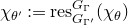 $\chi_{\theta^\prime}:={\mathrm{res}}^{G_\Gamma}_{G_{\Gamma'}}(\chi_\theta)$
of
$\chi_{\theta^\prime}:={\mathrm{res}}^{G_\Gamma}_{G_{\Gamma'}}(\chi_\theta)$
of $G_{\Gamma^\prime}$
determines the
$G_{\Gamma^\prime}$
determines the ${{\mathbb{Q}}}$
-linear map
${{\mathbb{Q}}}$
-linear map $\Theta \to \Theta_{\Gamma^\prime}$
between the spaces of stability parameters for
$\Theta \to \Theta_{\Gamma^\prime}$
between the spaces of stability parameters for $\Gamma$
- and
$\Gamma$
- and $\Gamma^\prime$
-constellations. This compatibility implies in particular that the restriction of a
$\Gamma^\prime$
-constellations. This compatibility implies in particular that the restriction of a $\theta$
-stable
$\theta$
-stable $\Gamma$
-constellation supported on
$\Gamma$
-constellation supported on $\Gamma\cdot x$
is a
$\Gamma\cdot x$
is a $\theta^\prime$
-stable
$\theta^\prime$
-stable $\Gamma^\prime$
-constellation supported on x. Thus, if we write
$\Gamma^\prime$
-constellation supported on x. Thus, if we write $f_{\theta^\prime}\colon \mathcal{M}_{\theta^\prime}(\Gamma^\prime)\to \mathbb{A}^3/\Gamma^\prime$
for the morphism sending each
$f_{\theta^\prime}\colon \mathcal{M}_{\theta^\prime}(\Gamma^\prime)\to \mathbb{A}^3/\Gamma^\prime$
for the morphism sending each $\Gamma^\prime$
-constellation to its supporting
$\Gamma^\prime$
-constellation to its supporting $\Gamma^\prime$
-orbit, and
$\Gamma^\prime$
-orbit, and $E_\ell:= (f_{\theta^\prime})^{-1}(\ell)$
for the preimage of
$E_\ell:= (f_{\theta^\prime})^{-1}(\ell)$
for the preimage of $\ell$
, then the restriction functor identifies
$\ell$
, then the restriction functor identifies $f_{\theta_-}\vert_D \colon D\to \ell$
with
$f_{\theta_-}\vert_D \colon D\to \ell$
with $f_{\theta^\prime}\vert_{E_\ell}\colon E_\ell\to \ell$
.
$f_{\theta^\prime}\vert_{E_\ell}\colon E_\ell\to \ell$
.
This description of $f_{\theta_-}\vert _D$
allows us to study
$f_{\theta_-}\vert _D$
allows us to study $\tau_-\vert_D$
. Indeed, the action of
$\tau_-\vert_D$
. Indeed, the action of $\Gamma^\prime$
fixes
$\Gamma^\prime$
fixes $x\in \mathbb{A}^3\smallsetminus \{0\}$
, so we may choose coordinates with
$x\in \mathbb{A}^3\smallsetminus \{0\}$
, so we may choose coordinates with $\Gamma^\prime\subset \operatorname{SL}(2,{{\Bbbk}})\times \mathsf{id}\subset \operatorname{SL}(3,{{\Bbbk}})$
. Since
$\Gamma^\prime\subset \operatorname{SL}(2,{{\Bbbk}})\times \mathsf{id}\subset \operatorname{SL}(3,{{\Bbbk}})$
. Since $f_{\theta^\prime}$
is a crepant resolution, we have that
$f_{\theta^\prime}$
is a crepant resolution, we have that $f_{\theta^\prime}=f\times \mathsf{id}_{\mathbb{A}^1}$
where f is the minimal resolution of an ADE singularity. The morphism
$f_{\theta^\prime}=f\times \mathsf{id}_{\mathbb{A}^1}$
where f is the minimal resolution of an ADE singularity. The morphism $f_{\theta_-}$
is obtained by varying the stability parameter to zero, so
$f_{\theta_-}$
is obtained by varying the stability parameter to zero, so $f_{\theta_-}$
factors via
$f_{\theta_-}$
factors via $\tau_-$
. The restriction functor identifies
$\tau_-$
. The restriction functor identifies $\tau_-\vert_D$
with the restriction of
$\tau_-\vert_D$
with the restriction of $\tau^\prime\colon \mathcal{M}_{\theta^\prime}(\Gamma^\prime)\to \mathcal{M}_{\theta^\prime_0}(\Gamma^\prime)$
to
$\tau^\prime\colon \mathcal{M}_{\theta^\prime}(\Gamma^\prime)\to \mathcal{M}_{\theta^\prime_0}(\Gamma^\prime)$
to $E_\ell$
, where
$E_\ell$
, where $\theta^\prime_0\in\Theta_{\Gamma^\prime}$
is determined by the character
$\theta^\prime_0\in\Theta_{\Gamma^\prime}$
is determined by the character $\chi_{\theta^\prime_0}:={\mathrm{res}}^{G_\Gamma}_{G_{\Gamma'}}(\chi_{\theta_0})$
of
$\chi_{\theta^\prime_0}:={\mathrm{res}}^{G_\Gamma}_{G_{\Gamma'}}(\chi_{\theta_0})$
of $G_{\Gamma^\prime}$
. The parameter
$G_{\Gamma^\prime}$
. The parameter $\theta_0^\prime$
is in the boundary of the chamber containing
$\theta_0^\prime$
is in the boundary of the chamber containing $\theta^\prime$
since
$\theta^\prime$
since $\operatorname{Uns}(\tau'_-)$
is non-empty, so by Kronheimer [Reference KronheimerKro89],
$\operatorname{Uns}(\tau'_-)$
is non-empty, so by Kronheimer [Reference KronheimerKro89], $\tau^\prime$
is the product of
$\tau^\prime$
is the product of $\mathsf{id}_{\mathbb{A}^1}$
with the contraction of at least one
$\mathsf{id}_{\mathbb{A}^1}$
with the contraction of at least one $(-1)$
-curve. It particular,
$(-1)$
-curve. It particular, $\tau^\prime\vert_{E_\ell}$
contracts a divisor to a curve, and hence so too does
$\tau^\prime\vert_{E_\ell}$
contracts a divisor to a curve, and hence so too does $\tau_-\vert_D$
.
$\tau_-\vert_D$
.
Now, consider the diagram

of schemes over $Y=\mathbb{A}^3/\Gamma$
as in (2.7), where
$Y=\mathbb{A}^3/\Gamma$
as in (2.7), where $\widetilde{\mathcal{M}}_{\theta_0}$
is the normalisation of
$\widetilde{\mathcal{M}}_{\theta_0}$
is the normalisation of $\mathcal{M}_{\theta_0}$
. Since
$\mathcal{M}_{\theta_0}$
. Since $\widetilde{\tau}_\pm$
have connected fibres, we may classify GIT walls into four types. Recall from (2.5) that
$\widetilde{\tau}_\pm$
have connected fibres, we may classify GIT walls into four types. Recall from (2.5) that $L_{C_-}(\theta_0)$
is the semi-ample line bundle that determines the morphism
$L_{C_-}(\theta_0)$
is the semi-ample line bundle that determines the morphism $\widetilde{\tau}_-$
. Then
$\widetilde{\tau}_-$
. Then $L_{C_-}(\theta_0)$
either:
$L_{C_-}(\theta_0)$
either:
-
– is ample, in which case
$\widetilde{\tau}_-$
is an isomorphism and we say that the wall is of type
$\operatorname{0}$
; or it -
– defines a class on the boundary of the ample cone of
$\mathcal{M}_{\theta_-}$
, and since
$\theta_0$
is general in the wall, this class lies in the interior of a codimension-one face of
$\operatorname{Amp}(\mathcal{M}_{\theta_-}/Y)$
and hence
$\widetilde{\tau}_-$
is a primitive contraction. In this case, we say that the wall is:-
* of type I if
$\widetilde{\tau}_-$
contracts a curve to a point; -
* of type III if
$\widetilde{\tau}_-$
contracts a surface to a curve.
-





In principle, the morphism $\widetilde{\tau}_-$
might contract a surface to a point – a type II contraction – but that surface would necessarily be proper, thereby contradicting Lemma 6.2.
$\widetilde{\tau}_-$
might contract a surface to a point – a type II contraction – but that surface would necessarily be proper, thereby contradicting Lemma 6.2.
Since $\mathcal{M}_{\theta_-}$
and
$\mathcal{M}_{\theta_-}$
and $\mathcal{M}_{\theta_+}$
are both crepant resolutions of
$\mathcal{M}_{\theta_+}$
are both crepant resolutions of $\mathbb{A}^3/\Gamma$
, the type of a wall is independent of whether we replace
$\mathbb{A}^3/\Gamma$
, the type of a wall is independent of whether we replace $\widetilde{\tau}_-$
by
$\widetilde{\tau}_-$
by $\widetilde{\tau}_+$
throughout the above. In short, the type is independent of the side from which we approach the wall.
$\widetilde{\tau}_+$
throughout the above. In short, the type is independent of the side from which we approach the wall.
Lemma 6.6. Let $\Gamma$
satisfy the conditions of Lemma 6.2. For any wall of type
$\Gamma$
satisfy the conditions of Lemma 6.2. For any wall of type $\operatorname{I}$
, the unstable loci
$\operatorname{I}$
, the unstable loci $\operatorname{Uns}(\tau_-)\subseteq \mathcal{M}_{\theta_-}$
and
$\operatorname{Uns}(\tau_-)\subseteq \mathcal{M}_{\theta_-}$
and $\operatorname{Uns}(\tau_+)\subseteq \mathcal{M}_{\theta_+}$
each have codimension at least two.
$\operatorname{Uns}(\tau_+)\subseteq \mathcal{M}_{\theta_+}$
each have codimension at least two.
Proof. If $\operatorname{Uns}(\tau_-)$
had an irreducible component D of codimension one, then Lemma 6.5 shows that
$\operatorname{Uns}(\tau_-)$
had an irreducible component D of codimension one, then Lemma 6.5 shows that $\tau_-$
contracts D and hence so does
$\tau_-$
contracts D and hence so does $\widetilde{\tau}_-$
. However,
$\widetilde{\tau}_-$
. However, $\widetilde{\tau}_-$
contracts only a curve, a contradiction. The
$\widetilde{\tau}_-$
contracts only a curve, a contradiction. The $\tau_+$
case is identical.
$\tau_+$
case is identical.
Proposition 6.7. Let $\Gamma$
satisfy the conditions of Lemma 6.2. There are no GIT walls of type
$\Gamma$
satisfy the conditions of Lemma 6.2. There are no GIT walls of type $\operatorname{0}$
.
$\operatorname{0}$
.
Proof. Suppose for a contradiction that chambers $C_-, C_+\subset \Theta$
are separated by a wall of type 0. For
$C_-, C_+\subset \Theta$
are separated by a wall of type 0. For $\theta_-\in C_-$
and
$\theta_-\in C_-$
and $\theta_+\in C_+$
, both
$\theta_+\in C_+$
, both $\widetilde{\tau}_-$
and
$\widetilde{\tau}_-$
and $\widetilde{\tau}_+$
from (6.1) are isomorphisms, and hence so is the rational map
$\widetilde{\tau}_+$
from (6.1) are isomorphisms, and hence so is the rational map $\psi$
from (6.1). However, the tautological families agree only on the locus
$\psi$
from (6.1). However, the tautological families agree only on the locus $\mathcal{M}_{\theta_-}\setminus \operatorname{Uns}(\tau_-) \cong \mathcal{M}_{\theta_+}\setminus \operatorname{Uns}(\tau_+)$
, otherwise the isomorphic fibres of the tautological families over a strictly
$\mathcal{M}_{\theta_-}\setminus \operatorname{Uns}(\tau_-) \cong \mathcal{M}_{\theta_+}\setminus \operatorname{Uns}(\tau_+)$
, otherwise the isomorphic fibres of the tautological families over a strictly $\theta_0$
-semi-stable point would be
$\theta_0$
-semi-stable point would be $\Gamma$
-constellations that are
$\Gamma$
-constellations that are $\theta_+$
-stable and
$\theta_+$
-stable and $\theta_-$
-stable in addition to being strictly
$\theta_-$
-stable in addition to being strictly $\theta_0$
-semi-stable, thereby contradicting Lemma 2.4(i). Since
$\theta_0$
-semi-stable, thereby contradicting Lemma 2.4(i). Since $\mathcal{M}_{\theta_-}\cong \mathcal{M}_{\theta_+}$
is normal, the locus
$\mathcal{M}_{\theta_-}\cong \mathcal{M}_{\theta_+}$
is normal, the locus $\operatorname{Uns}(\tau_-)\cong\operatorname{Uns}(\tau_+)$
where the tautological families differ cannot have an irreducible component of codimension at least two, otherwise these tautological families would extend uniquely over that component [Reference HartshorneHar80, Proposition 1.6], forcing them to agree beyond
$\operatorname{Uns}(\tau_-)\cong\operatorname{Uns}(\tau_+)$
where the tautological families differ cannot have an irreducible component of codimension at least two, otherwise these tautological families would extend uniquely over that component [Reference HartshorneHar80, Proposition 1.6], forcing them to agree beyond $\mathcal{M}_{\theta_-}\setminus \operatorname{Uns}(\tau_-) \cong \mathcal{M}_{\theta_+}\setminus \operatorname{Uns}(\tau_+)$
. Thus, every irreducible component of
$\mathcal{M}_{\theta_-}\setminus \operatorname{Uns}(\tau_-) \cong \mathcal{M}_{\theta_+}\setminus \operatorname{Uns}(\tau_+)$
. Thus, every irreducible component of $\operatorname{Uns}(\tau_-)\cong\operatorname{Uns}(\tau_+)$
is of codimension one. However, if there were such a component, Lemma 6.5 shows that it would be contracted by
$\operatorname{Uns}(\tau_-)\cong\operatorname{Uns}(\tau_+)$
is of codimension one. However, if there were such a component, Lemma 6.5 shows that it would be contracted by $\widetilde{\tau}_-$
, a contradiction.
$\widetilde{\tau}_-$
, a contradiction.
In passing, we record the following fact for groups $\Gamma$
that do not satisfy Lemma 6.2.
$\Gamma$
that do not satisfy Lemma 6.2.
Lemma 6.8. If a finite subgroup $\Gamma\subset \operatorname{SL}(3,{{\Bbbk}})$
fails to satisfy the conditions from Lemma 6.2, then every chamber C whose closure is strongly convex has a wall of type
$\Gamma\subset \operatorname{SL}(3,{{\Bbbk}})$
fails to satisfy the conditions from Lemma 6.2, then every chamber C whose closure is strongly convex has a wall of type $\operatorname{0}$
.
$\operatorname{0}$
.
Proof. The linearisation map $L_C$
is surjective by Proposition 6.1, so the kernel of
$L_C$
is surjective by Proposition 6.1, so the kernel of $L_C$
must be non-zero by Lemma 6.2. Since
$L_C$
must be non-zero by Lemma 6.2. Since $\overline{C}$
is strongly convex, Corollary 3.23 implies that C has a wall such that the morphism
$\overline{C}$
is strongly convex, Corollary 3.23 implies that C has a wall such that the morphism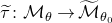 $\widetilde{\tau}\colon \mathcal{M}_\theta\to\widetilde{\mathcal{M}}_{\theta_0}$
into the wall is an isomorphism. This wall is of type
$\widetilde{\tau}\colon \mathcal{M}_\theta\to\widetilde{\mathcal{M}}_{\theta_0}$
into the wall is an isomorphism. This wall is of type $\operatorname{0}$
.
$\operatorname{0}$
.
6.4 Birational geometry
We can now state and prove the main result of this section.
Theorem 6.9. Let $\Gamma\subset \operatorname{SL}(3,{{\Bbbk}})$
satisfy the equivalent conditions from Lemma 6.2. The conclusions of Theorem 3.12 hold for any chamber C and any projective crepant resolution
$\Gamma\subset \operatorname{SL}(3,{{\Bbbk}})$
satisfy the equivalent conditions from Lemma 6.2. The conclusions of Theorem 3.12 hold for any chamber C and any projective crepant resolution $f\colon X\to Y=\mathbb{A}^3/\Gamma$
.
$f\colon X\to Y=\mathbb{A}^3/\Gamma$
.
Proof. Let $C\subset \Theta$
be any GIT chamber. For
$C\subset \Theta$
be any GIT chamber. For $\theta\in C$
, we know
$\theta\in C$
, we know $\mathcal{M}_\theta$
is smooth by Proposition 6.1, and the linearisation map
$\mathcal{M}_\theta$
is smooth by Proposition 6.1, and the linearisation map $L_C$
is an isomorphism by Lemma 6.2, so Condition 3.3(1) holds for C. Next, consider any wall in the interior of the GIT region
$L_C$
is an isomorphism by Lemma 6.2, so Condition 3.3(1) holds for C. Next, consider any wall in the interior of the GIT region $R_{C}$
containing C. The wall cannot be of type
$R_{C}$
containing C. The wall cannot be of type $\operatorname{0}$
or
$\operatorname{0}$
or $\operatorname{II}$
by Proposition 6.7, nor can it be of type
$\operatorname{II}$
by Proposition 6.7, nor can it be of type $\operatorname{III}$
because interior walls of
$\operatorname{III}$
because interior walls of $R_{C}$
must induce small contractions. Therefore, the wall must be of type
$R_{C}$
must induce small contractions. Therefore, the wall must be of type $\operatorname{I}$
, so
$\operatorname{I}$
, so $\widetilde{\tau}_-$
and
$\widetilde{\tau}_-$
and $\widetilde{\tau}_+$
each contract a curve to a point. Lemma 6.6 shows that every such wall satisfies the assumptions of Proposition 2.7. It follows that every interior wall of
$\widetilde{\tau}_+$
each contract a curve to a point. Lemma 6.6 shows that every such wall satisfies the assumptions of Proposition 2.7. It follows that every interior wall of $R_C$
is flipping, so Condition 3.3(2) holds. Finally, given a boundary wall of
$R_C$
is flipping, so Condition 3.3(2) holds. Finally, given a boundary wall of $R_C$
, the only possibility left is that the wall is of type
$R_C$
, the only possibility left is that the wall is of type $\operatorname{III}$
. In particular, the morphism
$\operatorname{III}$
. In particular, the morphism $\widetilde{\tau}_-$
for that wall contracts a (necessarily non-proper) divisor to a curve, so the wall is of divisorial type. Thus, Condition 3.3(3) holds for the chamber C, so the conclusions of Theorem 3.12 hold for the specific projective crepant resolution
$\widetilde{\tau}_-$
for that wall contracts a (necessarily non-proper) divisor to a curve, so the wall is of divisorial type. Thus, Condition 3.3(3) holds for the chamber C, so the conclusions of Theorem 3.12 hold for the specific projective crepant resolution $f_\theta\colon \mathcal{M}_\theta\to\mathbb{A}^3/\Gamma$
, where
$f_\theta\colon \mathcal{M}_\theta\to\mathbb{A}^3/\Gamma$
, where $\theta\in C$
. These same conclusions must therefore also hold for the chamber
$\theta\in C$
. These same conclusions must therefore also hold for the chamber $C_X:=L_C^{-1}(\operatorname{Amp}(X/Y))$
that defines
$C_X:=L_C^{-1}(\operatorname{Amp}(X/Y))$
that defines $X\cong \mathcal{M}_\theta$
for
$X\cong \mathcal{M}_\theta$
for $\theta\in C_X$
.
$\theta\in C_X$
.
Remark 6.10. Theorem 6.9 implies in particular that every projective crepant resolution of $\mathbb{A}^3/\Gamma$
is of the form
$\mathbb{A}^3/\Gamma$
is of the form $\mathcal{M}_\theta$
for some generic
$\mathcal{M}_\theta$
for some generic $\theta$
. As noted in the introduction, this statement follows from the work of Wemyss [Reference WemyssWem18, Theorem 6.2], which generalised the study of dihedral and trihedral singularities by Nolla de Celis and Sekiya [Reference Nolla de Celis and SekiyaNdCS17, Corollaries 1.3 and 1.5]. Our direct, geometric proof bypasses the algebraic approach via mutation introduced in [Reference WemyssWem18], while our description of the relative movable cone
$\theta$
. As noted in the introduction, this statement follows from the work of Wemyss [Reference WemyssWem18, Theorem 6.2], which generalised the study of dihedral and trihedral singularities by Nolla de Celis and Sekiya [Reference Nolla de Celis and SekiyaNdCS17, Corollaries 1.3 and 1.5]. Our direct, geometric proof bypasses the algebraic approach via mutation introduced in [Reference WemyssWem18], while our description of the relative movable cone $\operatorname{Mov}(X/Y)$
follows from Theorem 3.12. In fact, our approach shows that for any chamber C, it is not hard to say which should be the next wall to crash through to induce any given flop of
$\operatorname{Mov}(X/Y)$
follows from Theorem 3.12. In fact, our approach shows that for any chamber C, it is not hard to say which should be the next wall to crash through to induce any given flop of $\mathcal{M}_\theta$
for
$\mathcal{M}_\theta$
for $\theta\in C$
: one simply chooses the wall of
$\theta\in C$
: one simply chooses the wall of $\overline{C}$
that is identified by
$\overline{C}$
that is identified by $L_C$
with the given flopping wall of the nef cone of
$L_C$
with the given flopping wall of the nef cone of $\mathcal{M}_\theta$
for
$\mathcal{M}_\theta$
for $\theta\in C$
.
$\theta\in C$
.
Acknowledgements
We would like to thank the organisers of the ‘Facets of Noncommutative Geometry’ conference, held at the University of Illinois Urbana-Champaign in June 2022, for the opportunity to present a talk on this work in honour of Tom Nevins’s memory. Tom had a great impact on all of us, mathematically and non-mathematically, and in particular on themes related to this article. We would also like to thank the referee for valuable comments and suggestions.
Conflicts of interest
None.
Financial support
The first two authors were partially supported by Research Project Grant RPG-2021-149 from the Leverhulme Trust. The first author was also partially supported by EPSRC grant EP-W013053-1.
Journal information
Compositio Mathematica is owned by the Foundation Compositio Mathematica and published by the London Mathematical Society in partnership with Cambridge University Press. All surplus income from the publication of Compositio Mathematica is returned to mathematics and higher education through the charitable activities of the Foundation, the London Mathematical Society and Cambridge University Press.


 Open access

