





1 Introduction
In recent years, mid-infrared supercontinuum (MIR SC) laser sources have experienced rapid development, as they combine the high coherence and high brightness of laser sources with the broad spectral characteristics of traditional broadband radiation sources. Consequently, MIR SC sources have attracted considerable interest and have been widely applied in atmospheric sensing[ Reference Gasser, Kilgus, Harasek, Lendl and Brandstetter1] and biomedical imaging[ Reference Israelsen, Petersen, Barh, Jain, Jensen, Hannesschläger, Tidemand-Lichtenberg, Pedersen, Podoleanu and Bang2], as well as remote sensing and military-related applications[ Reference Yin, Xing, Zhu, Miao, Jiang, Shan and Gao3, Reference Zhou, Feng, Li, Sun, Su, Nie, Ran and Gao4]. At present, supercontinuum (SC) spectrum generation with a long-wavelength edge extending beyond 5.5 μm is achieved predominantly via cascaded schemes using mid- and long-wave infrared nonlinear fibers. In such architectures, the transition fiber is most commonly a commercially mature fluoride fiber, such as ZBLAN or indium fluoride (InF3) fibers. In 2017, Yin et al. [ Reference Yin, Zhang, Yao, Cai, Liu and Hou5] used a fluoride-fiber-based SC laser source with an operating spectral coverage of 2–4.2 μm as the pump. The laser was coupled into an As2S3 fiber using an aspheric lens, yielding an SC spanning 2050–5050 nm with an average power of 57.6 mW and a 10 dB bandwidth of 3000 nm. When an all-fiber configuration was implemented by fusion-splicing the As2S3 fiber, the output power could be increased to approximately 97.1 mW. In 2018, Martinez et al. [ Reference Martinez, Plant, Guo, Janiszewski, Freeman, Maynard, Islam, Terry, Alvarez, Chenard, Bedford, Gibson and Ifarraguerri6] pumped a cascaded structure composed of ZBLAN and As2S3 fibers by using a master-oscillator power-amplifier (MOPA) system with a three-stage amplifier, generating an SC spanning 1.4–6.4 μm with an output power of 1.39 W. In 2021, Yan et al. [ Reference Yan, Huang, Zhang, Wang, Yang, Yang, Xia, Bai, Zhao, Wu, Liu, Li, Dai and Nie7] generated an MIR SC spanning 2–6.5 μm in cascaded ZBLAN fiber and As2S3 fiber by using a multi-pulse pumping approach. By increasing the butt-coupling distance, the damage to the end-face of the As2S3 fibers was mitigated, and the output power was boosted up to 1.13 W. In 2023, Qiu et al. [ Reference Qiu, Xia, Zhao, Yang, Bai, Dai and Nie8] adopted a similar multi-pulse pumping scheme, combined with the low-loss splicing technology for soft glass fibers, and used InF3 fibers instead of ZBLAN fibers as the transition fibers. Eventually, an MIR SC with a spectral coverage of 1.9–6.45 μm and an output power of 1.06 W was obtained in As2S3 fibers. Building on these efforts, Huang et al. [ Reference Huang, Xia, Wang, Ren, Bai, Yang, Ge, Yang, Qiu, Yang, Mo, Zhang, Zhao, Liu, Wang, Dai and Nie9] conducted research on MIR SC laser sources with a broader spectral coverage by virtue of multiple techniques, including ultra-low-loss splicing technology, high-efficiency fiber butt-coupling technology and precise thermal management technology. Ultimately, an SC laser covering the spectral range of 2–8 μm was achieved in cascaded ZBLAN and As2S3 fibers; unfortunately, the output power was only 730 mW. These studies indicate that although the spectral coverage of SC laser sources generated by cascading fluoride fibers and As2S3 fibers has been significantly expanded, the output power is limited to less than 1.4 W, which is insufficient for high-power applications such as hyperspectral imaging and remote sensing[ Reference Islam, Freeman, Peterson, Ke, Ifarraguerri, Bailey, Baxley, Wager, Absi, Leonard, Baker and Rucci10]. The underlying reasons can be mainly attributed to two factors. On the one hand, the fluoride transition fibers used in these systems exhibit poorer chemical and thermal stability than silica (SiO2) fibers, and their end-face shows limited resistance to deliquescence, making them susceptible to optical damage – such as facet burning and fiber melting – even at relatively low power densities. This constrains the achievable output power of MIR SC lasers[ Reference Tao, Ebendorff-Heidepriem, Stolyarov, Danto, Badding, Fink, Ballato and Abouraddy11, Reference Wang, Jia, Jiang, Zhang, Wang and Liu12]. On the other hand, to maximize spectral broadening, most previous studies have relied on small-core chalcogenide fibers to extend the spectrum toward longer wavelengths. Due to the inherently low damage threshold of chalcogenide fibers themselves, even the highest laser-induced damage threshold (LIDT) reported to date for Ge25As10S65 fiber is only 0.0638 GW/m2 (at 3.6 μm)[ Reference Tian, Hu, Ren, Qi, Yang, Feng and Yang13], which is far lower than the 1.7 GW/m2 of fluoride fibers (at 2.94 μm)[ Reference Wüthrich, Lüthy and Weber14]. High power densities during high-power laser injection cause end-face damage to chalcogenide fibers, which further limits the output power in the long-wavelength spectral region[ Reference You, Dai, Zhang, Xu, Wang, Xu and Wang15]. Consequently, it is imperative to explore novel transition fibers with high stability and high damage threshold, and to use large-mode-area (LMA) chalcogenide fibers to set up a cascaded-pumping SC generation system, so as to achieve a higher-power mid-to-long-wave infrared SC.
In the past few years, the fluorotellurite (TeO2:BaF2:Y2O3, TBY) fibers have exhibited enormous potential in the field of SC laser sources due to their excellent optical properties, as well as chemical and thermal stability[ Reference Li, Wang, Yao, Jia, Zhang, Feng, Hu, Qin, Ohishi and Qin16, Reference Yao, He, Jia, Wang, Qin, Ohishi and Qin17]. The nonlinear refractive index of TBY fiber is approximately two orders of magnitude higher than that of fluoride fibers, such that only tens of centimeters of fibers are required to achieve rapid spectral broadening, thereby facilitating thermal management[ Reference Guo, Jia, Jiao, Li, Yao, Hu, Ohishi, Qin and Qin18]. Yao et al. [ Reference Yao, Jia, Li, Jia, Zhao, Zhang, Feng, Qin, Ohishi and Qin19] used a 6.8 μm TBY fiber as the nonlinear broadening medium, generating an SC laser source spanning 0.95–3.93 μm with an output power of 10.4 W. This study verified the excellent long-term stability of TBY fibers. In 2025, our group used a novel high-peak-power dual-Raman-soliton femtosecond laser as the pump, and obtained a 10.4 W SC laser source with a spectral range of 1.8–4.2 μm in a 34 μm TBY fiber, whose 5 dB bandwidth fully covers the range of 1.9–4.05 μm[ Reference Yang, Wang, Yao, Ren, Pu, Li, Yang, Pan and Li20]. To further extend the spectral coverage, our group subsequently tapered the TBY fiber, pushing the long-wavelength limit to 5.1 μm while maintaining an output power at the 10 W level. The fiber also exhibited excellent power stability during a continuous monitoring period of up to 2 hours[ Reference Yang, Yao, Wang, Liu, Li, Pu, Ren, Yang, Yang, Pan and Li21]. These results demonstrate the strong spectral-broadening capability and operational stability of TBY fibers under high-power conditions, indicating superior performance to ZBLAN fibers. Therefore, in systems that generate mid- and long-wave SC using fiber cascaded-pumping technology, replacing fluoride fibers with TBY fibers constitutes an effective approach to addressing the vulnerability to damage of mid-infrared transition fibers during high-power SC output.
In this paper, we fabricated a low-loss TBY fiber using the rod-and-tube technique and employed it as the transition fiber in the mid-infrared spectral region. By optimizing the pump parameters to increase the peak power and using an LMA TBY fiber to overcome the loss limitation at longer wavelengths, we obtained a high-power flat SC spanning 1.8–4.2 μm, with a 5 dB bandwidth of approximately 2050 nm. Subsequently, cascading with an LMA chalcogenide fiber for secondary spectral broadening, the use of a 30 μm chalcogenide fiber further increased the damage tolerance of the long-wavelength stage. At the maximum pump power, the output power of 30 μm core chalcogenide fiber reached 2.6 W, with the long-wavelength edge extending to 5.7 μm and the 10 dB bandwidth covering 2–4.7 μm. As far as we know, this is the maximum output power of an SC generated in As2S3 fibers reported to date.
2 Experimental setup
Figure 1 shows a schematic of the high-power SC generation system spanning 1–5.7 μm, consisting of a 1960 nm femtosecond pump source, a lens coupling system, a cascaded SC generation system and the relevant testing instrumentation. The 1960 nm femtosecond pump source is a 2 μm chirped-pulse amplification (CPA) system with grating-pair compression at the tail, and its configuration is identical to that used in Ref. [Reference Yang, Wang, Yao, Ren, Pu, Li, Yang, Pan and Li20]. The lens coupling system is used to couple the high-power hundred-femtosecond pulses compressed by the grating pair into the subsequent silica fiber and mid-infrared fiber, enabling further pulse compression and substantial spectral broadening. According to our calculation, the beam diameter of the compressed 1960 nm pulse after collimation by aspheric lens 1 is approximately 7.5 mm. Both aspheric lenses used for coupling in the experiment have a focal length of 50 mm and a numerical aperture (NA) of 0.23. The cascaded SC generation system comprises three fiber sections: a 0.32 m LMA silica fiber (NA = 0.075), a 0.40 m LMA TBY fiber (NA = 0.30) and a 0.60 m LMA chalcogenide fiber (NA = 0.30), with core diameters of 32, 34 and 30 μm, respectively. The relatively large-core diameters are beneficial for increasing the fiber’s damage threshold, enabling a higher-output-power broadband laser. The silica fiber and the TBY fiber were connected by direct fusion splicing, whereas the TBY fiber and the As2S3 fiber were aligned and fixed using a high-precision three-dimensional adjustment stage. Serving as a mid-infrared transition fiber, the TBY fiber is used to extend the spectrum beyond 4 μm, and subsequent pumping of the highly nonlinear chalcogenide fiber further enables spectral extension to the long-wave infrared region. To prevent stronger Fresnel reflections, the input and output ends of both mid-infrared fibers were cut at an 8-degree angle. The output spectrum was finally measured by using a monochromator equipped with a liquid-nitrogen-cooled HgCdTe (MCT) detector. All-solid fluorotellurite fibers were fabricated by our team using a combination of the suction injection method and the rod tube method. The fiber core and inner cladding glass components are TeO2:BaF2:Y2O3 of ratios 70:20:10 and 65:25:10, respectively.
Experimental setup for high-power 1–5.7 μm SC generation. AL1, AL2, aspherical mirrors; OSA, optical spectrum analyzer.

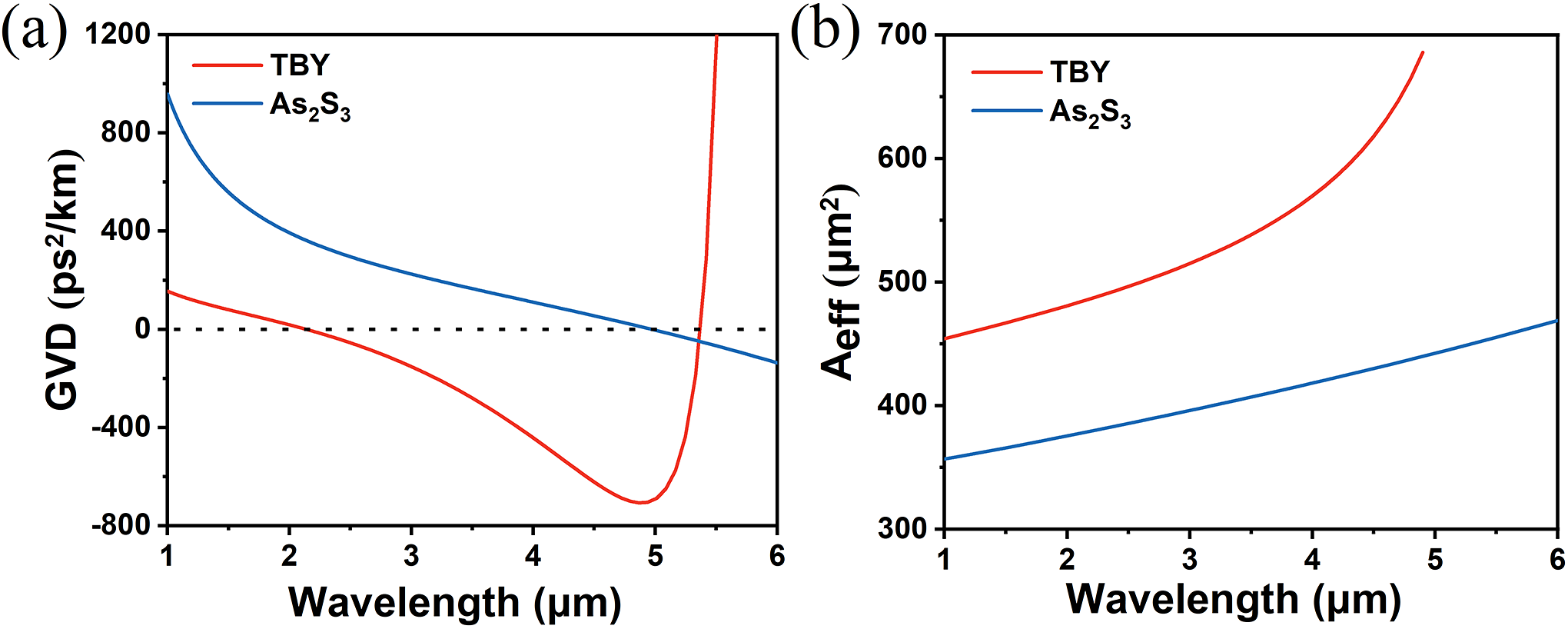
Before conducting the experiment, we first characterized the dispersion and mode-field parameters of the fabricated TBY fiber and the As2S3 fiber. Their losses, measured using the cut-back method, were 0.07 and 0.42 dB/m, respectively. To further investigate the relevant properties of the fluorotellurite and As2S3 fibers, we simulated the mid-infrared materials, core/cladding dimensions and structure using commercial finite element analysis software. By solving for the eigenmodes of the fiber cross-section, the propagation constants β at different wavelengths were obtained, and the dispersion and mode-field parameters were subsequently calculated, as shown in Figure 2. As shown in Figure 2(a), the first zero-dispersion wavelength (ZDW) of the TBY fiber is approximately 2095 nm, indicating that the fiber operates in the anomalous-dispersion regime beyond 2.1 μm. This means that ultrashort pulses beyond 2.1 μm can excite rich nonlinear effects within TBY fiber, such as self-phase modulation (SPM) and soliton self-frequency shift (SSFS), which are highly conducive to spectral expansion. Nevertheless, both material absorption and confinement loss of TBY fibers increase rapidly beyond 4 μm, with the long-wavelength cutoff of untapered TBY fibers only reaching approximately 4.2 μm. To achieve efficient extension of the spectrum toward a longer wavelength, a chalcogenide fiber was cascaded with TBY fiber in the system. The ZDW of the chalcogenide fiber is approximately 4970 nm. For wavelengths below 4.9 μm, the fiber operates in the normal-dispersion regime, and the spectral broadening is dominated primarily by SPM. Figure 2(b) presents the wavelength dependence of the effective mode area for the TBY and As2S3 fibers over 1–6 μm, which is used to assess their coupling characteristics. As shown in Figure 2(b), the TBY fiber exhibits a slightly larger effective mode area than the As2S3 fiber across the entire wavelength range, which is one of the factors leading to the somewhat lower coupling efficiency during subsequent butt-coupling into the chalcogenide fiber.
(a) The group velocity dispersion values and (b) the mode-field area values of TBY fibers and chalcogenide fibers.

3 Supercontinuum generation in a large-mode-area silica fiber
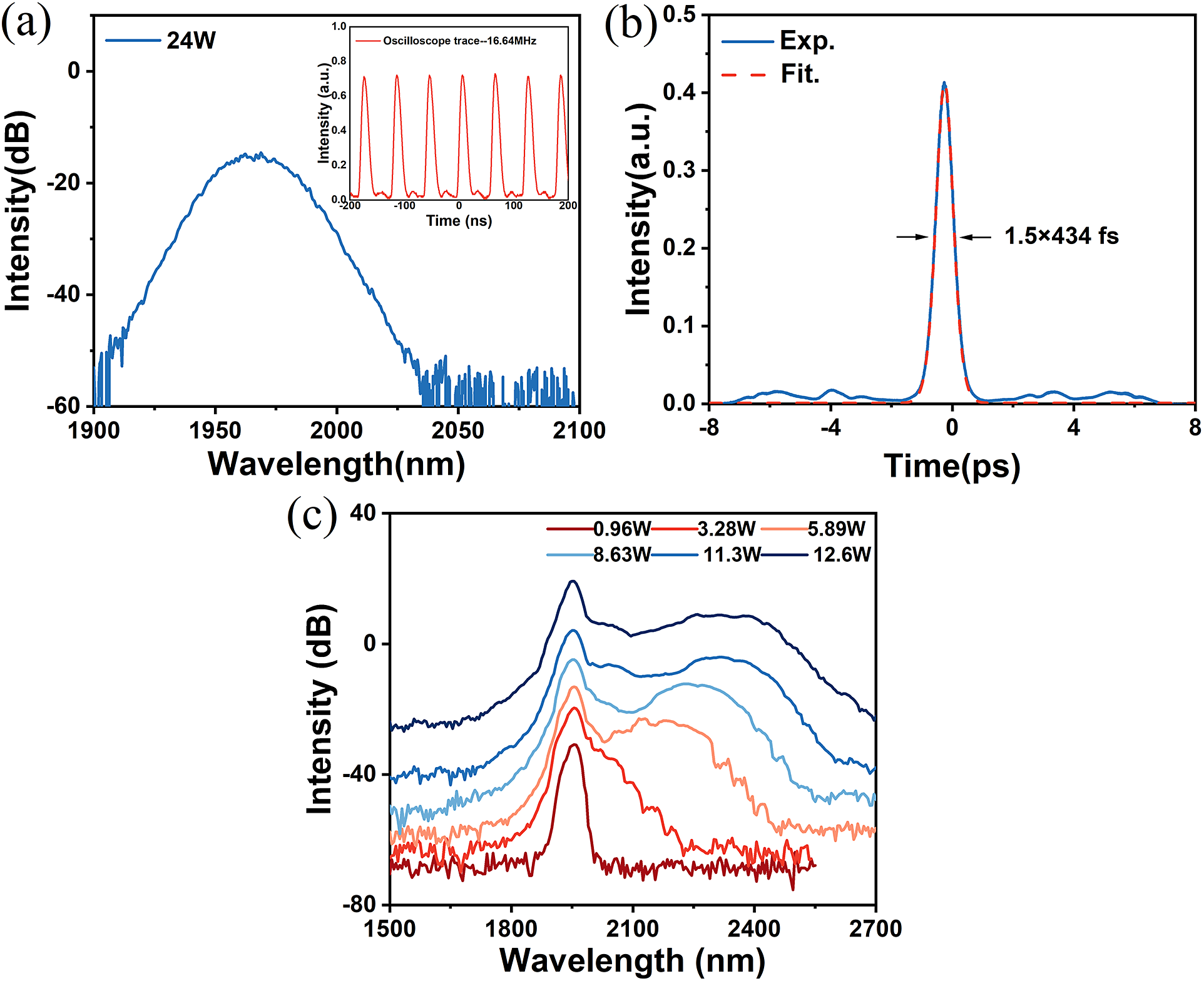
In the experiment, the 1.96 μm femtosecond pump source operates at a repetition rate of 16.64 MHz and exhibits a spectral bandwidth of about 24 nm; the corresponding pulse train and output spectrum are presented in Figure 3(a). By finely adjusting the grating-pair separation to compensate residual second-order dispersion in the system, the amplifier output is compressed to a pulse duration of 434 fs at the maximum pump power and delivers an average power of approximately 24.3 W. As shown in Figure 3(b), the autocorrelation trace of the compressed pulses exhibits a small pedestal on both sides of the main peak. This feature is attributed to residual uncompensated third-order dispersion in the system and nonlinear chirp accumulated during amplification. Then the compressed femtosecond pulses were coupled into the LMA silica fiber using a precise fundamental-mode matching technique[ Reference Yang, Wang, Yao, Xu, Ren, Li and Li22]. To prevent Raman solitons generated in the LMA silica fiber from experiencing excessive long-wavelength loss, a relatively short fiber length of 32 cm was selected to enable self-compression and Raman-SSFS, thereby further increasing the pulse peak power after grating compression. At the maximum main-amplifier pump power of 100 W, the spectrum broadens to a long-wavelength edge of 2.7 μm and the output power reaches 12.6 W (Figure 3(c)). During the initial power-scaling stage, the increase in soliton order promotes high-order soliton self-compression, leading to a substantial expansion of the spectral bandwidth. Subsequently, driven by stimulated Raman scattering (SRS), Raman-soliton fission is observed once the output power reaches 5.89 W. With increasing output power, a pronounced Raman soliton is observed to continuously shift toward longer wavelengths, reaching about 2.3 μm at an output power of 8.63 W. When the output power is further increased to 11.3 W, the Raman-soliton feature becomes less pronounced and slows a red-shift down noticeably. We attribute this behavior to the second-order Raman soliton catching up with the first-order soliton, resulting in partial spectral overlap between them. Overall, once the solitons shifted into the long-wavelength region of the silica fiber, they experienced pronounced attenuation due to the increased loss at longer wavelengths; the free-space coupling efficiency was around 51.8%.
(a) The output spectrum (inset: repetition rate) and (b) autocorrelation trace of the femtosecond laser source. (c) The output spectrum of LMA silica fiber.

4 Supercontinuum generation in a large-mode-area TeO2:BaF2:Y2O3 fiber
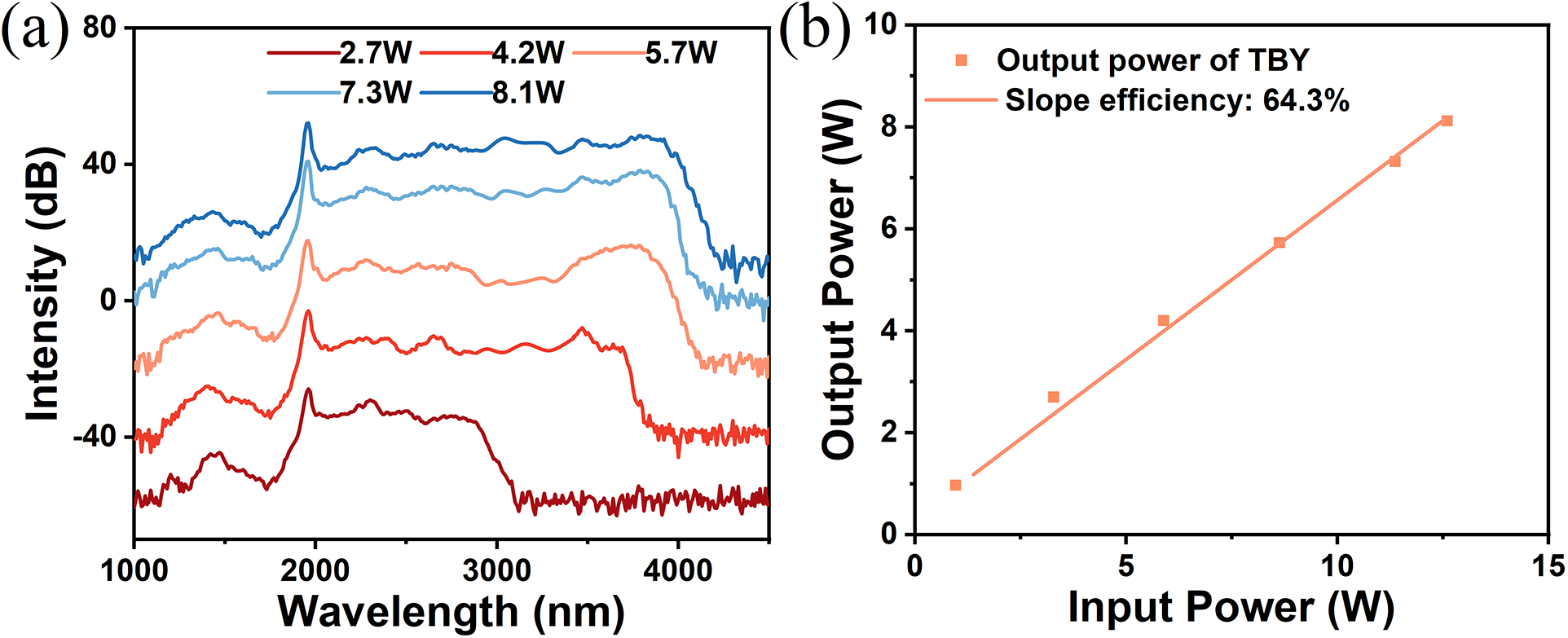
Subsequently, the LMA silica fiber was directly fusion-spliced to the fabricated LMA TBY fiber, thereby improving the overall stability of the system. Due to the significantly lower glass transition temperature of the TBY fiber compared to that of silica fiber, an asymmetric splicing method was employed for the silica fiber and fluorotellurite fiber in the experiments. The splicing loss, measured using a 1550 nm semiconductor laser, was 0.24 dB/m. TBY fibers exhibit a relatively high nonlinear refractive index (3.5 × 10⁻¹⁸ m2·W–1), which is approximately two orders of magnitude higher than that of silica and conventional fluoride fibers. Upon entering the TBY fiber, the silica-generated Raman-soliton pulses evolve into higher-order solitons and split off numerous fundamental-order Raman solitons that rapidly migrate toward longer wavelengths, significantly expanding the spectral range of the SC. As shown in Figure 4(a), when the output power is increased to 5.7 W, the long-wavelength edge of the spectrum extends to 4000 nm. At the maximum output power of 8.12 W, the spectrally flat region broadens to approximately 4050 nm, and the long-wavelength edge further reaches about 4200 nm. The 10 dB bandwidth of the SC spans 1900–4100 nm, fully covering the 2–4 μm region and achieving the optimal spectral coverage typical for high-power SC sources based on conventional ZBLAN fibers. In contrast, the TBY fibers exhibit an exceptionally high nonlinear coefficient and a glass transition temperature (425°C) exceeding that of ZBLAN fibers by over 100°C. They can achieve the same spectral-broadening effect as tens of meters of traditional ZBLAN fiber with just 40 cm of length. In addition, the TBY fiber shows strong resistance to humid environments, avoiding moisture-related degradation (a well-known limitation of many commercial fluoride fibers), and maintains excellent power stability during long-term operation. As shown in Figure 4(b), the output power increased approximately linearly with pump power throughout the process, reaching a maximum of 8.12 W; the fiber-splicing efficiency is approximately 64.3%.
(a) The output spectrum and (b) the output power after the TBY fiber.

5 Supercontinuum generation in a large-mode-area chalcogenide fiber
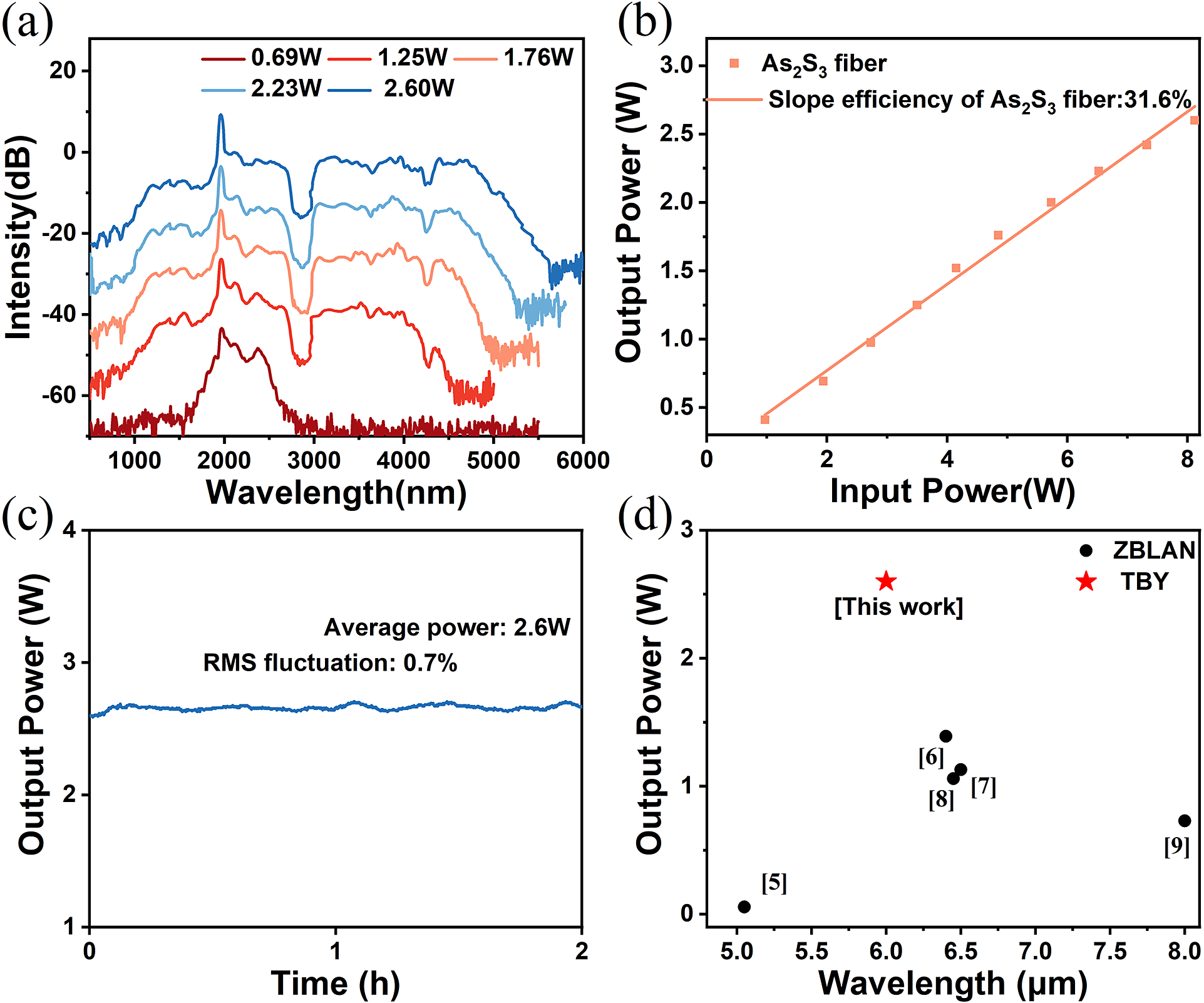
The TBY fiber was subsequently further cascaded with an As2S3 fiber to extend the spectrum into the long-wavelength infrared region (>5 μm). Due to the inherently low damage threshold of chalcogenide fibers, conventional cascaded-pumping schemes have predominantly employed small-mode-area chalcogenide fibers, with the achievable output power typically limited to around 1.4 W. In this work, to further increase the SC output power from the chalcogenide stage, we employed a large-core chalcogenide fiber with a core diameter of approximately 30 μm. As shown in Figure 5(a), pronounced spectral broadening is observed in the 0.6 m As2S3 fiber as the output power is increased. Even at a relatively low launched power of 3.5 W, the long-wavelength edge extends beyond 4.5 μm, highlighting the excellent spectral-broadening capability of the chalcogenide fiber. With further power scaling, the spectrum progressively broadens toward longer wavelengths. At the maximum launched power of 8.12 W, the long-wavelength edge extends to 5.7 μm, and the 10 dB bandwidth spans 2000–4700 nm. It can be seen from the figure that the spectral broadening is dominated by the long-wavelength side. This is because, after the broadened pulses from the fluorotellurite fiber are coupled into the As2S3 fiber, the strong nonlinear interaction readily triggers higher-order soliton fission. The resulting solitons then continue to undergo SSFS under the Raman effect, thereby continuously transferring energy toward longer wavelengths. As shown in Figure 5(a), the output SC exhibits a local dip around 2.8 μm. This feature mainly originates from absorption and can be attributed to the intrinsic absorption of residual hydroxyl (-OH) impurities in the fiber material in the 2.7–2.9 μm wavelength range. As depicted in Figure 5(b), during the spectral-broadening process, the coupling efficiency into the chalcogenide fiber decreases from 42.3% initially to 32%. At the maximum pump power, the output power reaches 2.6 W. To the best of our knowledge, this is the highest output power reported to date for SC generation in As2S3 fiber, as summarized in Figure 5(d). We further evaluated the power stability of the SC generated in the chalcogenide fiber over a period of 2 hours. As shown in Figure 5(c), the maximum value is approximately 2.636 W, the minimum value is approximately 2.564 W and the standard deviation is 0.0182 W. The root mean square (RMS) fluctuation is approximately 0.77%. During the experiments, the output spectral profile and average output power remained stable over time, with no observed trends of power attenuation or spectral degradation, indicating a reasonable match between the pump conditions and the fiber parameters. In addition, within the experimental power range and continuous operation duration, no end-face damage or performance degradation was observed in the silica fiber, TBY fiber or As2S3 fiber.
(a) The output spectrum, (b) output power and (c) power stability after the As2S3 fiber. (d) Comparison of literature parameter results using ZBLAN and TBY fibers as transition fibers.

6 Numerical simulations
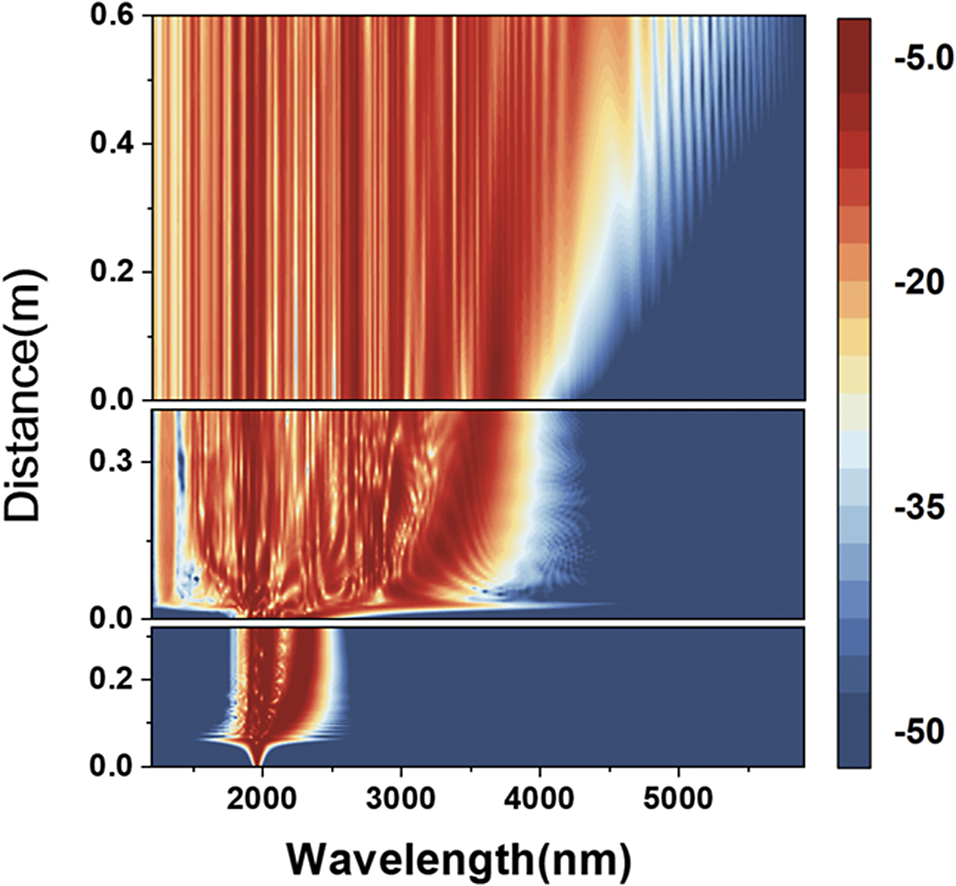
To elucidate the spectral-broadening mechanism of the SC in the chalcogenide fiber, we solved the generalized nonlinear Schrödinger equation (GNLSE)[ Reference Agrawal23] and theoretically investigated the SC generation dynamics of the high-peak-power Raman-soliton femtosecond pump source in the As2S3 fiber. Consistent with the seed-source parameters used in the experiment, the input pulse is configured with a center wavelength of 1.96 μm, a pulse duration of 434 fs and an average input power of 24 W. In addition, the MATLAB model incorporated the nonlinear coefficients, group velocity dispersion curves and loss curves of both the TBY and chalcogenide fibers to ensure simulation accuracy. The cascaded system consists of a 0.32 m LMA silica fiber, a 0.40 m LMA TBY fiber and a 0.60 m LMA chalcogenide fiber; the simulated pulse evolution in the three fiber sections is shown in Figure 6.
Spectral evolution at a pump power of 100 W in the fiber cascade system.

The femtosecond pulses first experience the self-compression effect in the silica fiber. The spectrum broadens rapidly under the action of SPM, accompanied by a progressive reduction in the temporal pulse width. At a propagation distance of approximately 0.05 m, the spectral bandwidth reaches its maximum, while the pulse duration is compressed to its minimum value. Subsequently, the first-order Raman soliton undergoes fission, and the wavelength shift reaches approximately 2400 nm at 0.32 m, in excellent agreement with the experimental observations. The Raman soliton then propagates into the TBY fiber, where further SC broadening occurs. To reflect the experimentally observed splice loss, the total power at the silica-fiber output is scaled to 64.3% in the simulations. However, the incident Raman soliton still maintains a high peak power, undergoing rapid spectral broadening driven by nonlinear effects such as SPM and SSFS. When the pulse propagates to 0.4 m, the long-wavelength edge extends to 4.2 μm. The generated SC subsequently enters the chalcogenide fiber for further spectral extension. To account for the coupling loss in the experiment, the total power at the TBY-fiber output is scaled to 32% in the simulations. Owing to the higher nonlinearity and the broader mid-infrared transmission window of chalcogenide glass, the red-shifted solitons from the TBY fiber can drive even stronger nonlinear dynamics, leading to further spectral broadening. Because the chalcogenide fiber exhibits normal dispersion below 4.8 μm, the Raman solitons first experience strong SPM, which extends the spectrum toward longer wavelengths. When the pulse propagates to 0.6 m, the long-wavelength edge reaches approximately 5.7 μm, thereby enabling mid-infrared SC output with a substantially extended spectral coverage.
7 Conclusions
We reported an ultra-broadband SC laser generation system based on cascaded TBY and As2S3 fibers, achieving a 2.6 W output power with a spectral coverage of 1–5.7 μm. The key innovation of this approach is the use of a high-peak-power fiber laser to pump a fabricated TBY fiber, which generates a 4.2 μm SC with an output power of 8.12 W. This design effectively mitigates the risk of damage to the mid-infrared transition fiber in a cascaded architecture. Subsequently, an LMA As2S3 fiber with a high damage threshold further broadened the SC beyond 5 μm. The achieved output power represents, to the best of our knowledge, the highest reported for As2S3-fiber-based SC generation and is approximately twofold higher than previously reported results. We anticipate that this cascaded-pumping architecture using advanced mid-infrared fibers will provide a promising route toward highly stable, high-power SC sources with an extended long-wavelength edge.
Acknowledgements
This work was supported by the National Natural Science Foundation of China (Grant Nos. 62005004 and 61675009) and the Natural Science Foundation of Beijing Municipality (Grant Nos. 4264138, 4204091 and KZ201910005006).


 Open access

