

Introduction and context
I have always thought that teachers should not teach what to think but how to think, and I wanted to embody this attitude within my own practice of teaching Classics. It was also interesting to me to link this to the ongoing debates in history teaching surrounding the relationship between the acquisition of substantive knowledge (i.e. the facts of history: dates, battles, names, etc.) and the acquisition of second-order concepts (i.e. the framework within which such knowledge is understood: e.g. historical interpretations, ascribing significance to events, understanding causation). According to Ford, ‘the challenge of restoring the link between substantive knowledge and conceptual understanding is one which the whole profession needs to address’ (Ford, Reference Ford2014, p.33). Having previously taught philosophy, causation seemed to me to be a topic I would be well-suited to tackle, and I was intrigued to discover that there were opportunities to teach causation as early as Key Stage 3 (KS3). In fact, enshrined in the current National Curriculum (NC) for KS3 history is the key aim ‘to understand historical concepts such as … cause and consequence’ (DfE, 2013, p.1). Given that Stanford professor Sam Wineburg (Reference Wineburg2001) refers to historical thinking, albeit archly, as an ‘unnatural act’, I wondered whether it was possible for 12 and 13-year old students to ‘understand’ the complex concept of causation. But I was also eager to test out some of the pedagogical theories floated at the beginning of the PGCE course, in particular, Bruner's hypothesis that ‘any subject can be taught effectively in some intellectually honest form to any child at any stage of development’ (Bruner, Reference Bruner1960, p.33).
‘Virgil School’ (anonymised) is an 11-16 mixed comprehensive in East Sussex. It achieved a rating of ‘Good’ in the last Ofsted inspection carried out in 2015. The proportion of pupils that have Special Educational Needs and Disabilities (SEND) is above the national average. However, the number eligible for pupil premium support falls below the national average (Ofsted, 2015). My scheme of work (SoW) is being taught to a mixed-ability Year 8 class of 29 pupils including: four classified as having English as an additional language (EAL), one with known SEN status, five indicated as ‘pupil premium’ (PP)Footnote 1, and three with a dyslexia score. None are considered as ‘gifted and talented’Footnote 2. Classics is taught every other term in Year 8 in rotation with Life Skills, and this was the first time my class had studied Classics that year. The six-week term required a SoW entitled ‘Who were the Romans?’ involving an introduction to the geographical extent of the Roman Empire and to the importance of the Roman army. It would also include an examination of the causes of the Boudiccan revolt framed within a larger question of how the Romans controlled their empire, i.e. the cause of their success. The story of Boudicca is not only one of those ‘need-to-know’ events from British history, but also one that links to a range of topical issues including Britishness, abuse of women and economic austerity. An age-appropriate BBC documentary about Boudicca's revolt, presented by father and son team Peter and Dan Snow (BBC, 2004), and including computer-generated battle scenes and ‘interviews’ with participants, would provide both the centrepiece of the SoW and the springboard for an end-of-unit assessment.
Literature review
Causation has been central to the study of history as far back as ‘the father of lies’ himself. Herodotus wrote that the function of history was not only to record battles but ‘especially to show why the two peoples fought with each other’ (De Sélincourt, Reference De Sélincourt1972, p.3, my emphases). Causation focuses on the ‘why’ of history, on how things happened the way they did. The American ‘father of modern educational psychology’, Edward Thorndike, asserted the superior educational value of examining causation over ‘explaining a record already known’ (Thorndike, Reference Thorndike1912, cited in Wineburg, Reference Wineburg2001, p.30). E.H. Carr (Reference Carr1961) also famously placed causation front and centre, and E.J Tapp unequivocally stated that ‘without it there could be no history’ (Tapp, Reference Tapp.1952, p.68). But while there is consensus as to causation's importance, there is debate as to its nature. Does it derive from human or divine agency, blind chance, biological determinism or Hegelian dialectic (Munro, Reference Munro2017)? A radical post-modernism that would abandon it altogether is a tradition that goes back at least as far as David Hume. But as Brien has it, ‘it is unreasonable to expect history to be written without a functioning concept of sequential time’ (Brien, Reference Brien2013, p.76). Despite, or perhaps because ‘few concepts in academic history are more keenly debated than causation’ (Phillips, Reference Phillips2002, p.42), it is essential that we engage our young students with its slippery nature early on. Perhaps more than ever, given the fingertip access to human history in ‘unprecedented quantities and overwhelming abundance’ (Cannadine et al, Reference Cannadine, Keating and Sheldon2011, p.236), we must heed Shemilt's stark warning of ‘persuasive and partial histories that reinforce simple truths and even simpler hatreds’ (2000, p.100). Successful teaching of causation is therefore critical.
Attitudes and debates
While some commentators on the teaching of history in British schools would like to prioritise the retention of facts and dates, and celebrate (like former Prime Minister, David Cameron) the grand narrative of ‘our island story’ (Holland, Reference Holland2014), it is important that second-order concepts not be sidelined from that narrative. The NC 2007 states that higher attainment targets at KS3 require ‘substantiated analyses about … causation’ (QCA, 2007, p.118). But is this possible for KS3 pupils? A Piagetian model would argue that a sophisticated grasp of an abstract concept such as causation is only possible once the ‘formal-operational’ stage of cognitive development has been reached (Williams, Reference Williams2008). This stage only begins at the age of 12, the age of the majority of the pupils in my class. However, in the ‘concrete-operational’ stage that precedes this, attempts at abstract thinking can be achieved if children are able to work with physical objects in front of them. Given that the AQA mark scheme for GCSE responses at the highest level requires ‘substantiated judgement’ and ‘an awareness of the provisional and problematic nature of historical issues [such as causation]’ (AQA, 2018, p.3, my emphases), this is the goal to which work at KS3 should be directed. A brief history of attitudes towards the teaching of causation follows so that some of the issues that teachers face can be addressed.
The 1973 Schools Council History 13-16 Project (SCHP) was ‘the most systematic and far-reaching effort to implement a pedagogy based on historical disciplines’ (Counsell, Reference Counsell2011, p.202). The project group took a non-chronological approach to history with a strong emphasis on second-order concepts, and began with a course called ‘What is History?’ The project students seemed to outperform a Piagetian picture of adolescent thinking, but, according to Counsell (Reference Counsell1997) and Wineburg (Reference Wineburg2001), the project did not address teachers’ misconceptions about notions such as causation. Other criticisms of the SCHP included the cost of its materials, its lack of focus on below-average children, its overemphasis on concepts like causation, and the fact that students tended to regurgitate model answers (Farmer and Knight, Reference Farmer and Knight1995, p.7-8). Indeed, a caricature of 1970s and 80s ‘new history’ prioritising ‘manhole covers in Wigan’ over World War II (Farmer & Knight, Reference Farmer and Knight1995, p.8) became part of a ‘discourse of derision’ by the political right (Phillips, Reference Phillips2002, p.19) where facts were abandoned in favour of chasing a ‘chimera of historical skills and personal empathy’ (Cannadine et al, Reference Cannadine, Keating and Sheldon2011, p.161). Interestingly, the word ‘causation’ is completely absent from the Blair government's 1999 History NC for Key Stages 1-3 (DfE, 1999), but front and centre is ‘promoting key skills’ such as ‘IT’, ‘problem solving’ and ‘working with others’ (pp.8-9). This is the ‘genericism’ bemoaned by Young (Reference Young2008) and by Fordham's blogs (Reference Fordham2014, Reference Fordham2017). This is the ‘rhetoric of the ‘new cross-curricularity’ which ‘has limited pupils’ entitlement to discrete, specialist-taught history at Key Stage 3’ (Counsell, Reference Counsell2011, p.203). However, Wineburg (Reference Wineburg2001) sees historical understanding as ‘an interdisciplinary enterprise’, and claims that, ‘nothing less than a multidisciplinary approach will approximate its complexity’ (p.52). The distinction between historical knowledge and historical skills may well be ‘a distracting dichotomy’ (Counsell, in Arthur and Phillips, Reference Arthur and Phillips2000, p.54), but it seems that an increased experience of substantive content through stories (see Shemilt, Reference Shemilt, Stearns, Seixas and Wineburg2000), films and re-enactment will facilitate pupils’ more abstract reflections. Content and causation are complementary.
Motivating students
Shemilt (Reference Shemilt1980), Scott (Reference Scott1990), Lee and Ashby (Reference Lee, Ashby, Stearns, Seixas and Wineburg2000), Phillips (Reference Phillips2002, p.43), Lee and Shemilt (Reference Lee and Shemilt2003) and Haydn et al. (2006, p.11) all identify common misconceptions with regard to adolescent thinking about causation which boil down to the following: conflating events and causes; not appreciating multi-causality; an inability to apportion significance; a confusion with scientific causation; and an adolescent attraction toward the concept of inevitability at the expense of contingency. One could argue here that even behaviourists make many of these mistakes given that they often assume a ‘fundamental similarity among the school subjects’ (Wineburg, Reference Wineburg2001, p.48). Either way, these misconceptions are clearly ones to focus on when teaching causation.
The study of history departments in the early 2000s by Husbands et al. (Reference Husbands, Kitson and Pendry2003) leads Counsell to affirm that the achievements of history teachers in relation to second-order concepts can be illustrated through two areas: enquiry questions and activities. (Counsell, Reference Counsell2011, p.207). Enquiry questions are strongly associated with the work of Riley (Reference Riley1997, Reference Riley2000), and the history department at my school takes this approach. It requires each lesson to be led by an enquiry question which is underlined on the board at the beginning of the lesson, written down in the pupils’ books and repeatedly referred back to. This is a drill to which the pupils have become very accustomed and which has the intention of creating focus and curiosity. Given its association with the question ‘why’, linking causation to enquiry is clearly an appropriate idea. However, the question for Howells is ‘how to encourage pupil ownership of the enquiry’ (1998, p.17). On this note, Banergee (Reference Banergee2017) discusses the shift from intrinsic to extrinsic motivation as children move from Key Stage 2 to Key Stage 3. Pupils at this age will feel competing pulls between independent curiosity and dependent approval. Discussing causation, and particularly the often dramatic consequences of causes, can help pupils ‘feel the need to build an argument’ (Clark, Reference Clark2001, p.27), and ‘what if’ questions can ‘capture pupils’ more antagonistic sides’ (Clark, Reference Clark2001, p.30). Could channelling the natural argumentativeness of children be a way to unlock the concept of causation for them?
Channelling natural argumentativeness
According to Wood (Reference Wood1998), children at 13 can express themselves better verbally than through writing (cited in Clark, Reference Clark2001, p.27). Olson, in his critique on literacy, argues that ‘literacy imparts a degree of abstraction to thought which is absent from oral discourse and oral cultures’ (Olson, Reference Olson1994, p.7). Citing Greek culture's oral and dialectic roots, he asks the provocative question ‘is literacy an instrument of domination or an instrument of liberation?’ (Olson, Reference Olson1994, p.10). Barrs (Reference Barrs2004) tempers this by claiming ‘talk is the halfway house between thinking and writing’ (cited in Evans & Pate, Reference Evans and Pate2007, p.24). Clark demands ‘more opportunities for extended, open-ended oral argument’ (Clark, Reference Clark2001, pp.30 & 32) in the classroom, while Woodcock (Reference Woodcock2005) suggests that it is through rich discussion that complex concepts, such as causation, can begin to crystallise. Chapman demands ‘learning experiences’ that ‘encourage, or, even better, necessitate, discussion and debate’ (Chapman, Reference Chapman2003, p.51). But does everyone want to talk in a classroom? Also, some pupils might have the confidence but lack the vocabulary or maturity. In these types of ‘learning experience’, pupils may gain ownership of the enquiry, but the teacher may lose ownership of the classroom. Fullard and Dacey point out that Cohen's (Reference Cohen1994) study of group work reveals ‘a tendency for members to be so concerned about saying their piece that they don't listen to what someone has just said’ (Fullard & Dacey, Reference Fullard and Dacey2008, p.25). Rudham's Reference Rudham2001 article ‘A noisy classroom is a thinking classroom’ seems perhaps a step too far, but it certainly seems important to recognise the value of open discussion when dealing with complex concepts such as causation. Fullard and Dacey suggest that Year 8 can cope with the demands of ‘marrying evidential work with causal reasoning’ (Fullard & Dacey, Reference Fullard and Dacey2008, p.29) provided greater planning and modelling before the debate. But they also found that students who struggled to marshal their ideas on paper, also struggled to marshal them via speaking and listening. So, while discussion is clearly important, it is not the solution to understanding causation.
Other strategies
Haydn et al. recommend the strategy of ‘causation cards’ (Haydn et al., Reference Haydn, Arthur and Hunt2006, p.114) and Evans and Pate see the value of the card sort as a way to ‘work through the problems of causation rather than ignoring them’ (Evans & Pate, Reference Evans and Pate2007, p.20). This would align with Piaget's concrete-operational phase mentioned above. Evans and Pate tried ready-made cards in order ‘to free memory for higher-order thinking’ (Evans & Pate, Reference Evans and Pate2007, p.20), but Fordham (Reference Fordham2014, Reference Fordham2017) and Counsell (Reference Counsell1997, Reference Counsell2011) argue that substantive knowledge and second-order concepts are inseparable in historical enquiry, with knowledge as the enabler. Evans and Pate agreed that ‘the diminished effectiveness of the card sort occurred through a shortfall in the confidence we had in our students’ and that ‘linking was obscuring thinking’ (Evans & Pate, Reference Evans and Pate2007, pp.22-23). It is also important that card sorts, along the lines of the ‘diamond nine’, not fall into the trap of simplification, i.e. ‘this one is the most important’. This is where discussion becomes invaluable. Clearly, a range of well-planned activities is important.
Phillips argues that ‘speculation is useful for raising awareness of contingency and multicausality’ (Phillips, Reference Phillips2002, p.43), and Ferguson (Reference Ferguson1997) has been instrumental in promoting the ‘counterfactual’ as a way of engaging people with history. However, this approach can be dangerous as we have no way of knowing if x would have happened if y had happened, and it can allow children to race off in all sorts of imaginative, distracting and potentially counterproductive directions that could compound the confusion. However, imagining scenarios could be a way to unlock causation. Shuter et al. (Reference Shuter, Child and Taylor1989) created a lesson which looks at the various causes of a broken classroom window, and Chapman's ‘Alphonse the Camel’ lesson of 2003, which investigates the ‘trigger event’ of ‘the straw that broke the camel's back’, has become a standard in the teaching of causation. Chapman emphasises the importance of examining consequences as well as causes: ‘Once students have clarity about effects, they can start to think evaluatively’ (Chapman, Reference Chapman2003, p.51). In line with Counsell's thinking, Chapman values ‘finding out ‘the facts’ and processing them conceptually at the same time’ (Chapman, Reference Chapman2003, p.51). Likewise for Clark, it is not enough to make the link, but also to say what the link is without denying pupils ‘the truth about the provisionality of causal language’ (Clark, Reference Clark2001, pp.30-32). Realising that there is likely to be more than one answer is often very difficult for adolescent minds. Nevertheless, they need to be encouraged that sophisticated historical work is about developing persuasive, if provisional, arguments.
Assessing causation
Some of the issues surrounding the assessment of progress with regard to concepts like causation were identified over a century ago. Judd wrote: ‘Most of the causes and effects which students of history really canvass in their school work are given to them as the result of someone else's thought rather than as a result of their own reaction’ (Judd, Reference Judd1915, p.384). This is an analysis echoed by Haydn et al. who complained of rushed assessments where ‘any analysis that had been done was achieved by the teacher or the author of the textbook’ (Haydn et al., Reference Haydn, Arthur and Hunt2006, p.111). How much true historical thinking is really being done? How much is over-scaffolded to pupils to meet progression targets? The abolition of KS3 levels (DfE, 2015) has caused at once delight and consternation, with many practitioners using it as an opportunity to develop and share their own models of progression with regard to key historical concepts. For example, Alex Ford's progress model for causation identifies ‘signposts’ of improved historical thinking. These signposts need not occur in any particular order, but their gradual accumulation indicates more nuanced understanding.

(Ford, Reference Ford2014, p.32).
My school calls for an end-of-unit written assessment that is to be levelled in accordance with new 9-1 GCSE levels, and there is some resistance to this among teaching staff who feel that pupils are being saddled with essentially meaningless grades. Borne out of Evans and Pate's research is ‘the importance of consolidating progression in historical learning’ and the need to ‘nurture the individual's reaction to historical content and problems’ (Evans & Pate, Reference Evans and Pate2007, p.28, my emphases). Understanding causation is part of an ongoing process and not something that can simply be measured. Haydn et al. draw attention to problems of ‘zero-ing’ (Haydn et al., Reference Haydn, Arthur and Hunt2006, p.117), that is, the rush to start new topics, and Byrom also stresses the importance of a ‘cumulative’ effect with regard to the acquisition of historical concepts (Byron, 2014, p.2). The pupils, it seems, need time to think.
Conclusions
With regard to this review of the literature, a number of conclusions may be reached:
• Causation is a complex, controversial concept and should be approached as such.
• While second-order concepts such as causation have gone in and out of vogue with regard to their teaching at KS3, the current research consensus is that causation and content need to be taught together.
• Understanding causation is a key aim of the teaching of history at KS3 in government policy documents.
• There is an agreed set of misconceptions that pupils have with regard to causation that can be summed up in the difficulty of accepting more than one answer or possibility; or, one might say, thinking ‘multi-dimensionally’.
• Practitioners see causation not so much as something that can be taught per se, and therefore, assessed, but as part of an ongoing process of increasingly sophisticated and nuanced engagement and discussion.
• In terms of the teaching of causation at KS3, it seems that while rich discussion is vital, it needs to be carefully marshalled and modelled, led by enquiry questions, and interspersed with a range of activities such as card sorts, ranking, speculative scenarios and comparisons; i.e. kinaesthetic activities that enable an engagement with the material. Dramatic reconstruction and primary sources will also help pupils to connect with causation.
• Over-scaffolding should be avoided and pupils should be given time to think and to allow the concept of causation to ‘sink in’.
Rationale for my scheme of work
Following from Shemilt's (Reference Shemilt1980) work on the central place of narrative and story-telling within the teaching of history, the exciting, ‘local’, dramatic and disturbing story of Boudicca will provide a gripping focus for pupils in the second half of the SoW. It will be important, however, that the pupils are alerted to the sensitive nature of some of the material, i.e. the rape of Boudicca's daughters and Boudicca's ruthless revenge. Substantive content will be built up in preceding lessons alongside a burgeoning notion of causation. For example, the first lesson, outlining the expansion of the Roman Empire, will aid pupils’ ‘multi-dimensional’ thinking by encouraging them to see time as a map. The next lesson will deal with Roman control of the empire through fear and civilisation, and will look at the causes of the army's success through an examination of different sources.
The value of talk, addressed above, will provide the critical focus of the third lesson which will require a large-scale discussion based around the fictional enquiry question: ‘What caused Mr Day to break his leg?’ This draws on the SCHP's murder of Mark Pullen mystery (1973), Shuter et al.’s broken window (1989), and Chapman's camel (2003) in that it provides a context-free strategy to begin to tackle historical thinking. Members of the class and even members of staff will be pulled in to the ever more complicated web of causes with pupils encouraged to add to it themselves using their own speculative imaginings. This draws on the ideas of Ferguson (Reference Ferguson1997) by creating a ‘free-thinking’ atmosphere while also engaging the pupils ‘where they live’. Pupils will then try to group the causes and decide which was the most important and why. This will be followed by a complementary ‘diamond nine’ ranking activity tackling the more substantive historical question: ‘What caused Romans to join the army?’
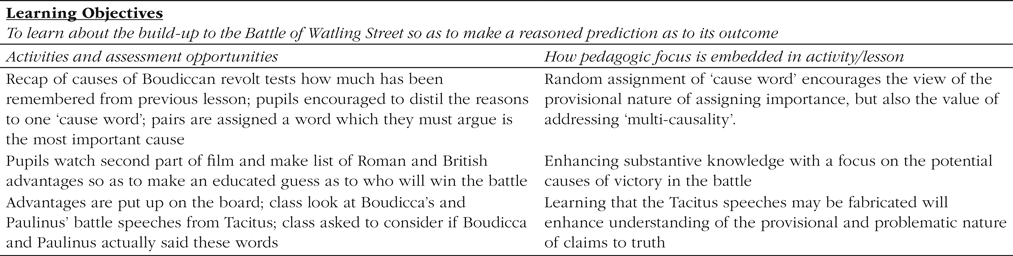
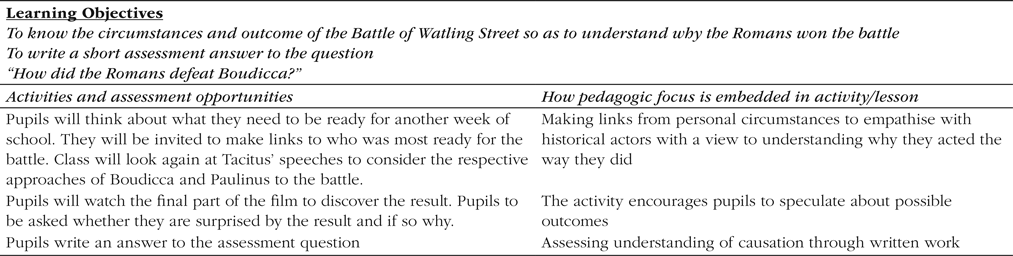
The next three lessons will be built around the BBC film. The first would look closely at the causes of the rebellion and introduce the idea of short term, long term and trigger while encouraging the pupils to group causes into their own categories. This focus on independent thinking is borne out of the research of Howells (Reference Howells1998), Clark (Reference Clark2001) and Evans and Pate (Reference Evans and Pate2007). The next lesson would review the causes of the rebellion and look at different ways of grouping them with a view to demonstrating that there is no one correct way to think about it, as per Phillips (Reference Phillips2002). In this vein, they will be asked to argue for the importance of causes that they might not consider as such. Much would be made of the build-up to the battle and the relative advantages and disadvantages between the Romans and Britons. The pupils will be steered to think that the Britons will win to maintain the sense of drama. By introducing the pre-battle speeches of Boudicca and the Roman governor, Paulinus provided by Tacitus, I will invite pupils to consider who they would rather follow into battle. To engage further, I will choose two speakers to rally the rest of the class. By revealing that Tacitus’ speeches are most likely fabrications, I will once again be muddying the waters of certainty. The final lesson reveals the ultimate success of the Romans against superior numbers due to discipline and tried-and-tested battle tactics. Pupils’ understanding will be assessed by an essay evaluating the causes of the Romans’ success.
The lesson plans are given below (full details omitted for clarity).
How did the Roman Empire expand so rapidly?
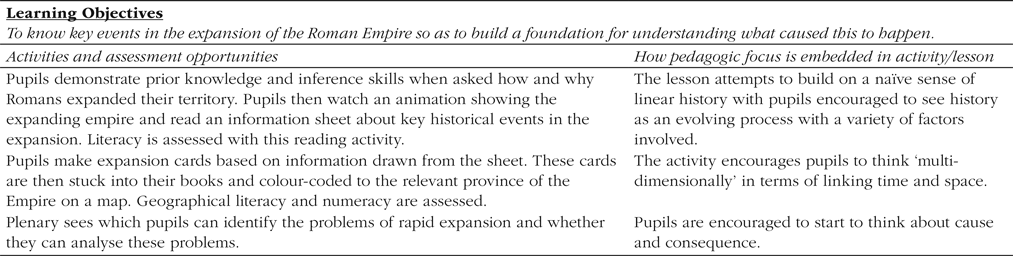
How did the Romans control their empire?

What caused Mr. Day to break his leg? (What caused men to join the Roman army?)
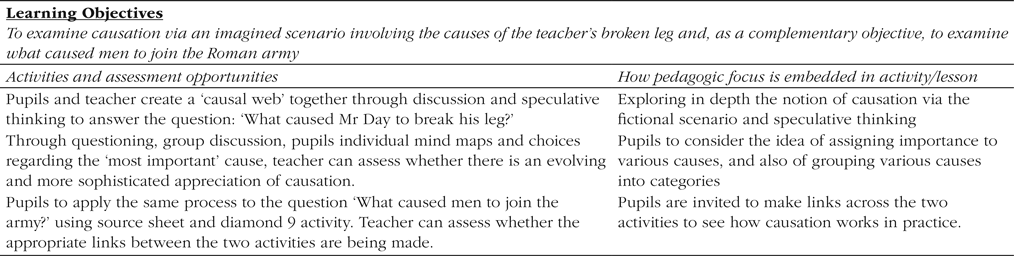
What caused Boudicca to challenge the Romans?
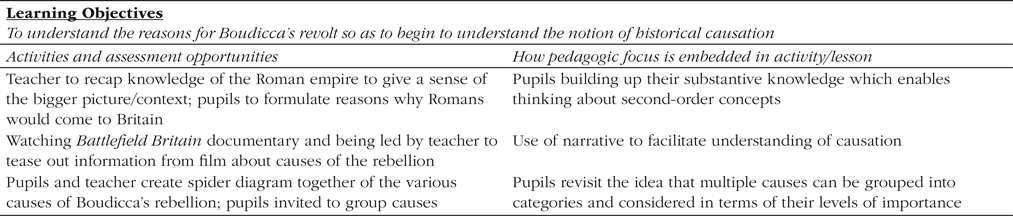
Britons versus Romans: Who will win?
How did the Romans defeat Boudicca?
Evaluation of practice
Group discussion
One of the key aims of the unit was to determine whether time spent in group discussion facilitated a deeper understanding of causation. The class had a number of pupils who were often keen to either disrupt the class or hijack the discussion. These ‘big characters’ included Pupil 9, Pupil 13, Pupil 14 and Pupil 23. Much has been written about the need to create positive relationships with pupils (Kerman et al, Reference Kerman, Kimball and Martin1980; Kohn, Reference Kohn1996; Cowley, Reference Cowley2014; Dix, Reference Dix2017). Indeed, Thompson says that ‘the most powerful weapon available to secondary teachers who want to foster a favourable learning climate is a positive relationship with our students’ (Thompson, Reference Thompson2011, p.6). As evidenced by the lesson observations, I set ‘high expectations of respect and behaviour’ from the beginning. Creating a respectful environment of listening and reflection was clearly going to be important when tackling the complex concept of causation. In the second lesson, during a discussion about the nature of civilisation and invasion, I was able to connect with Pupil 14 by staying in his ‘comfort zone’ and referring to towns in Sussex by way of illustration. Building relationships, developing appropriate questioning techniques and making these kinds of ‘local’ connections would be developed in the causation lesson where I would allow more ‘free rein’ to the discussion.
The use of Initial Stimulus Material (ISM) is strongly promoted by Phillips (Reference Phillips2001, Reference Phillips2002), and the provocative and unusual enquiry question ‘what caused Mr Day to break his leg?’, certainly created immediate focus and ‘buzz’ from the outset. However, the challenge was to effectively marshal this engagement towards my lesson objective. The lesson observation noted that certain challenging students ‘are engaged because you are making causation relevant to them’ (Phillips, Reference Phillips2001, Reference Phillips2002). However, the spirit of free-thinking and speculative reasoning I was attempting to promote was leading to enthusiastic shouting out and then blatant disruptive shouting. Clearly, and particularly with a challenging class, there needed to be far stricter guidelines about how this activity was approached and handled. On account of the disruption, not enough time was available to do justice to the second task, where the causation learning was applied to the causes of joining the army. Accordingly, some pupils failed to make the link, seeing the first half of the lesson as a ‘jolly’ before the boring work bit. I think that if I had more time to build a stronger and more trusting relationship with the class, the discussion activity would be more effective.
However, looking over the causal webs the pupils created, I was able to get a sense of their nascent understanding of causation. The difficulty for teachers of causation, according to Haydn et al., is ‘to encourage pupils to be sceptical about claims that an event was inevitable’ (Haydn et al., Reference Haydn, Arthur and Hunt2006, p.113). This was certainly true of my class who were almost unanimously happy to settle for a single cause rather than to consider ‘multi-causality’ or to group causes into categories. Interestingly, many boys favoured the most immediate cause as the most important (that Mr Day tripped over a log), whereas girls tended to identify various individuals involved in the web. However, a couple of pupils said they found it difficult to say or couldn't give a reason, while others used the speculative nature of the enterprise to indulge in fantastical imaginings.
Activities
The literature demonstrates that a variety of structured activities is important for engaging pupils. Some of the issues I had early on in the unit were to do with the modelling of the activities. For example, the colour-coded map task in the first lesson was not modelled by me at all, which meant that every child did it differently. This meant that the time-space relationship I was trying to suggest was not made clear. Ideally, the causation cards would have been stuck around the map. At KS3, the teacher cannot assume that pupils will make the required connections without clear modelling. However, issues of modelling and timing were improved in the next lesson, in that I carefully modelled the labelling of the soldier and incorporated on-screen timers for the inference activity. The timers in particular created a sense of focus and high expectation. However, some pupils, who were struggling with the demanding nature of some of the sources, responded by disrupting the class. Once again, this impacted on the overall timing of the lesson. After her experiences introducing sources to mixed-attainment classes, Sanchez found that the more successful activities were those which allowed time for ‘structured discussion’ (Sanchez, Reference Sanchez2014, p.29). Activities, modelling and discussion clearly form a critical triangle, which has to be structured and timed with total precision to permit no room for diversion or disruption. While time can sometimes seem to be running away from the student teacher, it is much more likely that it is not being used constructively.
In terms of the teaching of causation, the literature shows that the concept and the content need to work hand in hand. Pupils at my school are very used to card sorts and ranking activities in other subjects, but it is crucial, with regard to second-order concepts, that they see the purpose of them. According to Chapman, ‘the diamond can promote abstraction and synthesis’ (Chapman, Reference Chapman2003, p.51). This may well be true, but, as mentioned above, there was not enough time to properly exploit the ‘diamond nine’ activity that followed the ‘broken leg’ section, and ‘structured discussion’ became impossible. But Chapman also suggests that the diamond activity works best if preceded by a table listing and explaining the various causes. Alternating the approaches allows pupils to ‘see’, as it were, abstract concepts from different angles. I was able to remedy this somewhat in lesson four, which revisited the notion of multiple causes introduced in the previous lesson. The spider-diagrams showing the causes of Boudicca's revolt should have reminded them of the causal web created in the ‘broken leg’ lesson. This strategy builds on Bruner's (Reference Bruner1960) concept of the ‘spiral curriculum’. However, Dawson (2009) argues that new topics can act like a ‘camouflage [which] prevents students [from] realising that they can use what they've learned before to help them’ (Dawson, cited in Counsell, Reference Counsell2011, p.207). Also, Haydn et al. warn that assigning labels to causes, such as ‘short term’ and ‘long term’, can just become another way of ‘categorizing information rather than a basis for discussion about the nature of the concept’ (Haydn et al., Reference Haydn, Arthur and Hunt2006, p.112).
In general, however, I think most of my pupils were able to make the requisite links between the content and the concept. Also, I believe it is important to choose an event where causes can be categorised, and indeed, in lesson 5, it was useful for pupils to discover some genericism in the causes of the rebellion. They were intrigued by the fact that causes, such as inequality, religion and revenge, formed a pattern that repeated across history. I think they valued this level of certainty. Indeed, Froeyman (Reference Froeyman2009) argues that comparisons between similar events and conditions are more useful than speculations in giving ‘weight to causal attribution’ (Froeyman, cited in Brien, Reference Brien2013, p.76). In the same lesson, I also followed a suggestion of Fullard and Dacey of ‘attaching students to particular causes’ (Fullard & Dacey, Reference Fullard and Dacey2008, p.27). My intention was to force pupils to consider the relative importance of their assigned cause, so as to better appreciate ‘multi-causality’. However, it quickly became apparent that this was difficult for them to do without a fuller understanding of the other causes. A careful restructuring of the order of all the activities would be useful.
Use of the documentary and other sources
Shemilt (Reference Shemilt, Stearns, Seixas and Wineburg2000) stresses the importance of narrative in the teaching of history, and I believe the BBC film in the SoW was successful in engaging the students and helping them to acquire the substantive knowledge they needed for the assessment. The disturbing nature of some of the material was sensitively handled and also gave the pupils an emotional investment in the narrative. Obviously, it was vital that the video did not become a distraction. Regular pausing for discussion and breaking the viewing of the hour-long documentary up over three lessons was important. However, it was also important to me that this was not their only source of information about the revolt. This is why I decided to introduced Tacitus in lesson 5. I was surprised that my reading of the original Latin really impressed the students. Not only did it engage them, but it seemed to help them to access what they may have seen as inaccessible; a distant and mysterious past. However, when I revealed that Tacitus is likely to have made up the battle speeches, there was a mixture of disillusionment and delight. This is a productive tension which I perhaps should have exploited. On the one hand, the children are led to the idea that history is just story-telling and therefore untrustworthy, but on the other hand, it invites them to embrace the ‘provisional and problematic’ nature of historical concepts (AQA, 2018, p.3). I was reminded of Lee, who averred that ‘history is impossible either (for younger children) because ‘No one was there’ or (for older students) because ‘Everyone is allowed to hold on to his own opinions’’ (Lee, Reference Lee1998, p.35). My KS3 pupils, at that point in the lesson, seemed to fall somewhere in the middle.
One of the chief issues with the film, however, was the fact that many of the students’ assessments seemed to fall into the rhythms of the documentary, and to parrot phrases used by the presenter, Peter Snow. Judd's century-old concern is still pertinent: ‘if the historical drama is too vivid the student may substitute that which he sees for that which he ought to work out in his own thought’ (Judd, Reference Judd1915, p.388).
Assessment
The assessment question was marked out of eight. 18 out of the 28 pupils who did the assessment got four marks or less. Most pupils got two to three marks. Only one pupil got seven out of eight which was the highest mark. Although even the very weakest students were able to follow the scaffold of the writing frame and the causation cards to produce a list of points, few pupils were able to get beyond a very rudimentary analysis of the causes of the Roman victory. Even some of the brighter students, such as Pupil 1, favoured vivid and engaging storytelling over detail and analysis, possibly influenced by the documentary. A common focus in the essays was the fact that the Britons got drunk and were hungover on the day of the battle. Virtually everyone commented on this, but few expanded on its significance. Also, pupils remembered javelins sticking in shields, but did not expand on why this was important. Again, they knew the wedge was important, but did not link it to the discipline of the Roman army as a key theme, even if they knew that discipline was important. Evans and Pate (Reference Evans and Pate2007) found that many of their best essays merely regurgitated the card sort. They believed this stemmed from a lack of appropriate intervention during the card sort stage and a lack of intermediate activities between the card sorts and essay writing. My SoW could learn a similar lesson by having the assessment on a different day to the viewing of the documentary. But another point to be taken from Evans and Pate's research is the danger of over-scaffolding. Much of this scaffolding seems to be designed to get pupils to fit into pre-arranged assessment criteria. At what point does a scaffold become a cage (Lee & Shemilt, Reference Lee and Shemilt2003)?
Conclusion
While some of the research suggests that over-scaffolding can provide a barrier to learning, my experience has taught me that with a challenging KS3 class, carefully modelled activities and clear and concise explanations are critical in order to promote a productive learning environment. Precision planning of activities and rigid expectations around behaviour are paramount. If lessons are planned carefully enough, with every moment accounted for, there is no room for diversion or disruption. Nevertheless, room must be allowed for individual thought to be nurtured, particularly when it comes to understanding causation. Discussion was critical at unlocking causation for KS3 pupils, but my feeling is that discussion activities should be ‘little but often’, with clearly established regulations (and sanctions for transgressing those regulations), which are agreed upon and understood by the pupils. Although some concepts may have been unlocked through engaging pupils ‘where they lived’, I don't think that many of the pupils were ready for free-flow discussion, and in fact, in some cases its function was to affirm, rather than overcome, misconceptions. I found that many of the pupils were too hooked on certainty to truly embrace the provisional quality of causation. Wray and Lewis (Reference Wray and Lewis1997) have suggested that more time be spent reading non-fiction across the curriculum, and I think that such a strategy would assist in developing children's understanding of more complex concepts.
However, the demanding and unusual activities, such as ‘the broken leg’ and the extracts from Tacitus, truly piqued their interest, and led me to realise that teachers can have faith in their pupils’ desire to be stretched. That said, these activities needed greater structure and purpose. Indeed, I think causation should have been made more explicit throughout the SoW, and should have been more clearly embedded in the assessment question. Six hours is not a long time to develop an understanding of causation, and my concern is whether or not the pupils’ burgeoning understanding will be developed, or remembered if the pupils take the study of history further. Research on ‘depth studies’, such as Banham (Reference Banham2000), has shown that pupils benefit from extended exposure to a specific topic, but as ever in teaching, the issue is time. In these ‘post-truth’ days, perhaps teachers, pupils and policy-makers need to allow more time to study time.


 Open access

