


Introduction
In most Western countries, migrant inclusion in social welfare schemes remains contentious. The Covid-19 pandemic reignited debates over whether immigrants should receive income support and medical care on equal terms with citizens, exposing deep divisions in public opinion (Jones et al., Reference Jones2021, 28–30). These tensions surfaced in political discourse across Europe. In October 2020, Dutch politician Geert Wilders claimed on Twitter that COVID-19 patients of non-Western backgrounds were occupying ICU beds at native Dutch patients’ expense (NOS Nieuws, 2020). More recently, British Conservative leader Kemi Badenoch called for barring foreign nationals from disability and sickness benefits to reduce welfare costs (Morton and Seddon, Reference Morton and Seddon2025). In France, the Rassemblement National (RN) has long advocated a “national preference” (préférence nationale) prioritizing French nationals for social benefits (Chemin, Reference Chemin2024). Comparative research confirms that the trend of expanding welfare inclusiveness for immigrants has ended, giving way to ever more restrictive policies (Koning, Reference Koning2022).
Scholars have extensively documented a general reluctance among the public to extend welfare benefits to immigrants – an attitude known as “welfare chauvinism” – showing that this segment of the population faces a “deservingness penalty” when compared to citizens (van Oorschot, Reference van Oorschot2006; Reeskens and van Oorschot, Reference Reeskens and van Oorschot2012; Mewes and Mau, Reference Mewes and Mau2013; van der Waal et al., Reference van der Waal2013; van Oorschot et al., Reference van Oorschot2017; Reeskens, Reference Reeskens2020; Haderup Larsen and Schaeffer, Reference Haderup Larsen and Schaeffer2021; Careja and Harris, Reference Careja and Harris2022; Eick, Reference Eick2024). In practice, research has shown that there is little support to grant immigrants equal access to social benefits. However, it remains unclear whether such attitudes vary systematically across different categories of immigrants and types of welfare schemes.
Existing research on the perceived “deservingness” of migrants suffers from two significant limitations. First, it treats “migrants” as a monolithic category, obscuring critical distinctions in legal status, migration pathways, and social positioning. Second, it relies on select welfare schemes – often unemployment benefits or social assistance – as proxies for social rights more broadly, failing to capture how deservingness judgments vary across different types of provision. Building on recent arguments for a more nuanced understanding of how various types of migration are governed and perceived by the public (Ruedin, Reference Ruedin2020; Piccoli et al., Reference Piccoli2024; Gschwind et al., Reference Gschwind2025), we argue that this undifferentiated approach to welfare and migration is increasingly inadequate. Given the complexity and multidimensional nature of social rights and migration, research on popular attitudes to welfare access for migrants must better reflect the diverse range of rights, legal statuses, and individual characteristics of migrants. We posit that individual preferences towards migrant access to welfare may be different for different welfare schemes (see e.g., Eick and Larsen, Reference Eick and Albrekt Larsen2022), but also for different types of migrants (e.g., regular immigrants, undocumented immigrants, or asylum seekers). This framework captures what we see as segmented perceptions of deservingness, where public attitudes towards welfare policies for migrants are based on intersecting perceptions of contribution, status, and urgency. People have inclusive attitudes in some policy areas and toward some migrants, but they are exclusionary in others.
To analyze how different migration status may entail different levels of welfare deservingness across welfare schemes, we conducted a vignette experiment in Germany and the United Kingdom to answer the following question: How do the individual characteristics of migrants in terms of legal status and the nature of welfare schemes shape perceptions of welfare deservingness among citizens? The survey was administered between April and August 2024 to a total of 3,488 respondents (1,530 in Germany and 1,958 in the UK). Respondents evaluated migrant access to four types of benefits and services: unemployment benefits, emergency medical treatment, medical care for life-threatening illnesses, and non-urgent primary care. This design allows us to analyze the effects of various factors driving perceived deservingness (e.g., need, reciprocity, etc.) across different welfare domains (e.g., unemployment benefits, urgent healthcare). We also examine how access is evaluated for four population groups (citizens, regular immigrants, undocumented immigrants, and asylum seekers), accounting for length of residence. By linking deservingness criteria to characteristics such as legal status, nationality, residence duration, tax contributions, age, and gender, we demonstrate that public attitudes towards migrant access to welfare are much more differentiated than commonly assumed.
Our study makes two original contributions to social policy, migration studies, and public opinion research. First, we provide evidence of a segmentation of welfare chauvinist attitudes by immigration status and by welfare scheme. Consistent with prior research (Larsen, Reference Larsen2020; Eick and Larsen, Reference Eick and Albrekt Larsen2022; Chueri et al., Reference Chueri2024), we show that opposition to immigrant inclusion in the welfare state is not uniform but varies significantly across different types of social programs. We extend this literature by demonstrating that such variation also depends on the type of migrant considered. While earlier studies have either focused on specific welfare programs or limited migrant categories (Reeskens and Van der Meer, Reference Reeskens and van der Meer2019; Eick and Larsen, Reference Eick and Albrekt Larsen2022), our analysis reveals the multidimensional logic of public attitudes toward migrant welfare access. We find a modest overall deservingness penalty for migrants, concentrated primarily in non-essential services and cash benefits for undocumented immigrants and, to a lesser extent, asylum seekers. By contrast, support for providing urgent and essential medical care remains relatively high across migrant categories, while support for unemployment benefits is consistently low.
Second, we bridge two strands of comparative scholarship that have often remained disconnected: welfare state typologies and immigrant incorporation. While Esping-Andersen’s (Reference Esping-Andersen1990) typology remains foundational for understanding welfare regime variation, it largely centers on native citizens. Sainsbury (Reference Sainsbury2012) extended this framework by showing how welfare regimes also vary in how they include or exclude immigrants based on legal status, labor market attachment, and family ties. Yet much of the literature on public opinion and welfare chauvinism has remained rooted in welfare state theory without engaging with the broad spectrum of migrant categories. We advance this research by examining how individual preferences toward social protection are jointly shaped by the type of welfare program and the legal and temporal status of migrants.
Public attitudes and welfare chauvinism
A large body of research has examined the relationship between immigration and welfare, highlighting restrictive attitudes towards any extension of social solidarity to immigrants and their descendants (Freeman, Reference Freeman1986; Sainsbury, Reference Sainsbury2006; Sainsbury, Reference Sainsbury2012; Alesina and Glaeser, Reference Alesina and Miano2023; Alesina, Miano, et al., Reference Alesina and Miano2023; Enggist and Häusermann, Reference Enggist and Häusermann2024). Despite this growing literature, much research remains at a high level of abstraction, treating “immigrants” as a homogenous group and “welfare” as a monolithic entity. A commonly used indicator in European research illustrates this limitation: a question from the European Social Survey (ESS) asks respondents when immigrants should gain access to social services (e.g., upon arrival, after a year, after a year of paying taxes, after naturalization, never).Footnote 1 While useful for cross-national comparison, this question collapses multiple dimensions, such as the type of benefit, legal status, and individual traits of potential immigrants, limiting analytical leverage.
Recent studies have sought to disaggregate these factors. Some explore support for spending in specific policy areas (Haderup Larsen and Schaeffer, Reference Haderup Larsen and Schaeffer2021; Gandenberger et al., Reference Gandenberger2023; Knotz et al., Reference Knotz2022), while others examine whether the form of provision (e.g., cash benefits or services) shapes support for immigrant inclusion (Eick and Larsen, Reference Eick and Albrekt Larsen2022). Additional work provides a nuanced understanding of attitudes towards different policies targeting regular and irregular migrants (Helbling et al., Reference Helbling2025; Gschwind et al., Reference Gschwind2025). These contributions mark a shift toward greater specificity, but questions remain about the mechanisms that underpin public judgments about immigrants’ access to welfare.
To address these gaps, we draw on the theory of deservingness (van Oorschot, Reference van Oorschot2006; Willen, Reference Willen2012; van Oorschot et al., Reference van Oorschot2017), which conceives of preferences on welfare allocation as based on five heuristic criteria: need, control, reciprocity, attitude, and identity (Petersen, Reference Petersen2012; Jensen and Petersen, Reference Jensen and Bang Petersen2017). We use this theory to examine how public attitudes vary depending on social benefit, migrants’ legal status, and other individual characteristics, including their gender and duration of stay.
Theorizing the perceived deservingness of different types of migrants across welfare schemes
In developing our hypotheses, we focus on four of the five criteria – need, reciprocity, attitude, and identity – since we believe that there is no straightforward way to operationalize control in our experimental design. We recognize that some attributes, such as legal status, may simultaneously reflect multiple criteria (e.g., reciprocity and identity), complicating causal inference; this is a well-known limitation of research grounded in deservingness theory (Knotz et al., Reference Knotz2022). While our design cannot isolate the relative weight of each criterion, it allows us to assess whether and how different attributes associated with deservingness influence support for immigrants’ welfare inclusion.
Need
Perceived deservingness often hinges on the urgency of the requested service or benefit. We expect emergency healthcare services to elicit more inclusive attitudes towards immigrants because they address critical needs. The immediacy of such situations reduces concerns about moral hazard, shifting the focus toward alleviating suffering. As Jensen and Petersen (Reference Jensen and Bang Petersen2017, 71) argue, healthcare activates a particular “deservingness heuristic” that implicitly frames illness as randomly caused and therefore deserving of help. This distinguishes healthcare from other welfare domains, such as unemployment protection, where people may be perceived as more responsible for their circumstances. Emergency healthcare services or treatment for life-threatening illnesses, such as cancer, fit these characteristics especially well. We therefore expect the “deservingness gap” between citizens and immigrants to be smaller in these areas.
By contrast, services perceived as less urgent, such as unemployment benefits or, to a lesser extent, routine GP checkups, invite greater scrutiny. They are more susceptible to concerns about fairness, moral hazard, and whether a recipient’s claim is “earned.” Consequently, moral judgments more heavily influence public support, leading citizens to evaluate the deservingness of migrant recipients more critically.
Hypothesis 1. Support for granting access to emergency medical treatment is higher than support for all other services and benefits.
Attitude
Deservingness theory shows that the perceived attitude of beneficiaries matters. Displays of gratitude, compliance, and rule-following signal a “good attitude,” whereas perceived ingratitude or norm violations substantially reduce deservingness (Meuleman et al., Reference Meuleman2020). Undocumented migrants are frequently seen as having violated legal norms simply because of their presence in the country, which may be interpreted as a sign of disrespect toward the rules. Asylum seekers often fall into this category due to persistent doubts about their motives, as research shows (Sales, Reference Sales2002; Nielsen et al., Reference Nielsen2020; Holmes et al., Reference Holmes2021). For instance, a recent IPSOS poll found that 58% of respondents in 29 countries believed that most people claiming refugee status were primarily motivated by economic gain or access to welfare (Ipsos, 2023). Such perceptions associate irregular entry with a negative attitude, potentially undermining support for welfare inclusion.
Hypothesis 2. Support for access to social services and benefits is lower for asylum seekers and undocumented migrants than for other groups of migrants and citizens.
Identity
Deservingness is also shaped by sentiments of shared perceived identity and social proximity. People are more inclined to support those they identify with, as shown by evidence of in-group favoritism in the distribution of public goods (Alesina, Baqir, et al., Reference Alesina and Baqir1999; Luttmer, Reference Luttmer2001). Immigrants may be perceived as members of an out-group, resulting in lower deservingness. Reeskens and van der Meer (Reference Reeskens and van der Meer2019), for example, show that in the Netherlands immigrants are consistently viewed as less deserving of welfare than citizens, irrespective of their behavior or past contributions.
We therefore expect citizens to be regarded as the most deserving of welfare benefits, as shared citizenship strengthens social proximity and aligns with identity-based deservingness criteria. Scruton (Reference Scruton2010, 94–95) captures this logic by arguing that welfare systems are rooted in a national belonging and shared entitlement among citizens.
Hypothesis 3A. Support for access to social services and benefits is higher for citizens than for regular immigrants, asylum seekers, and undocumented immigrants.
Beyond legal status, ethnic and cultural identity also shapes deservingness considerations. The literature on ethnic hierarchies (Hagendoorn and Hraba, Reference Hagendoornn and Hraba1998) suggests that groups perceived as more ethnically or culturally distant may be viewed as less deserving. In particular, individuals perceived to come from non-white or Muslim-majority countries may be seen as culturally distant and less deserving of welfare support, especially in contexts where perceived similarity and assimilation matter for welfare attitudes (Kootstra, Reference Kootstra2016). By contrast, migrants perceived as ethnically closer to the majority population may benefit from higher perceived deservingness.
Hypothesis 3B. Support for access to social services and benefits is generally lower for immigrants from non-white or Muslim-majority countries.
Reciprocity
Reciprocity is a key condition for welfare support. Individuals are generally more willing to support welfare inclusion when they believe that potential recipients have paid or will pay their “fair share” and won’t freeride on others; more precisely, “citizens who wish to contribute to the common good are only willing to do so if they do not believe others will take undue advantage of their solidarity” (Rothstein, Reference Rothstein1998, 163; see also Cavaillé, Reference Cavaillé2023, 43ff). Groups perceived as having contributed through work and taxation, such as the elderly, are therefore commonly viewed as more deserving (van Oorschot, Reference van Oorschot2006).
Accordingly, we expect individuals who have paid taxes and made social welfare contributions to be regarded as more deserving of welfare benefits, as contributions signal commitment and moral legitimacy.
Hypothesis 4A. Support for access to social services and benefits is generally higher for individuals who have paid taxes and social contributions.
We also expect longer residence in the country to increase perceived deservingness. Length of residence signals commitment and reduces concerns that recipients may leave before reciprocating benefits. Heuer and Zimmerman (Reference Heuer and Zimmermann2020) show that such concerns contribute to lower perceived deservingness towards immigrants.
Hypothesis 4B. Support for access to social services and benefits is higher for individuals who have lived in the country longer.
Interactions between individual attributes and welfare schemes
The literature provides no clear expectations on how these different hypotheses might interact. We therefore explore some possible combinations to understand whether the deservingness gap between citizens and immigrants may vary across welfare schemes depending on individual characteristics such as migration status.
First, we expect the negative effect of factors such as irregular migration status to diminish when the perceived level of need of recipients is high, such as urgent medical care. In contexts such as emergency medical care, immediate suffering may outweigh concerns about legality or reciprocity.
Hypothesis 5A. The negative effect of being an undocumented migrant on support for granting access to social benefits and services is weaker for emergency medical care compared to other services and benefits.
Second, we expect irregular status to undermine other positive deservingness signals. Undocumented migrants may be perceived as having illegitimately accessed the country, rendering their claims to welfare benefits suspect regardless of prior contributions.Footnote 2 In this case, perceived attitude outweighs reciprocity.
Hypothesis 5B. The positive effect of tax and social contributions on support for granting access to social benefits and services is weaker for undocumented migrants than for other migrant groups.
Third, while longer residence generally enhances deservingness, it may have the opposite effect for undocumented migrants and asylum seekers by reinforcing perceptions of prolonged illegitimate presence.
Hypothesis 5C. Support for granting access to social benefits and services is lower for undocumented migrants and asylum seekers who have a longer residence time compared to those who have a shorter residence time.
Finally, for regular migrants, longer residence periods should increase perceived deservingness, as it signals integration and a stronger connection to the host society.
Hypothesis 5D. Support for granting access to social benefits and services is higher for regular migrants who have a longer residence time than for those who have a shorter residence time.
Study design
To test our hypotheses, we designed a vignette experiment. We implemented it in two countries: Germany and the United Kingdom. While we do not formulate explicit hypotheses about the impact of national context, existing research suggests that the type of welfare regime may affect how people evaluate the deservingness of welfare recipients (van Oorschot, Reference van Oorschot2006; Laenen et al., Reference Laenen2019; Taylor-Gooby et al., Reference Taylor-Gooby2019; Vrânceanu and Petrova, Reference Vrânceanu and Petrova2025). Germany is known for its conservative, social insurance-based welfare system, while the United Kingdom features a liberal welfare state regime (Esping-Andersen, Reference Esping-Andersen1990). At the same time, both countries are considered to represent a “restrictive” immigrant incorporation system and face the challenge of balancing the provision of welfare benefits with the practical need to manage public expenditure and deal with increasing ethnic diversity (Sainsbury, Reference Sainsbury2006, Reference Sainsbury2012). In that sense, we do not expect these countries to differ substantially in terms of openness to include foreigners, despite their different position in the three worlds of the Esping-Andersen regime typology. For these reasons, we test whether the country where respondents are based has any effect, but we do not produce explicit hypotheses about national differences. Instead, we assess whether our hypotheses hold in different institutional and national contexts.
The experiment was pre-registered on the Open Science Framework (OSF) on April 8th 2024.Footnote 3 We administered the survey between April 9th and August 12th 2024 in the United Kingdom and Germany through an online representative panel of the population in terms of age, gender and education through the company Respondi, using quotas calculated on the basis of the latest European Social Survey, supplemented in the UK by a smaller number of respondents through an online representative panel of the company Prolific (representative qua age, gender, vote in the latest election).Footnote 4 The survey was administered to 3,488 respondents (1,530 in Germany and 1,958 in the UK), broadly representative with respect to age, gender, and education, though younger and university-educated respondents are somewhat overrepresented (see online Appendix Figure A1).
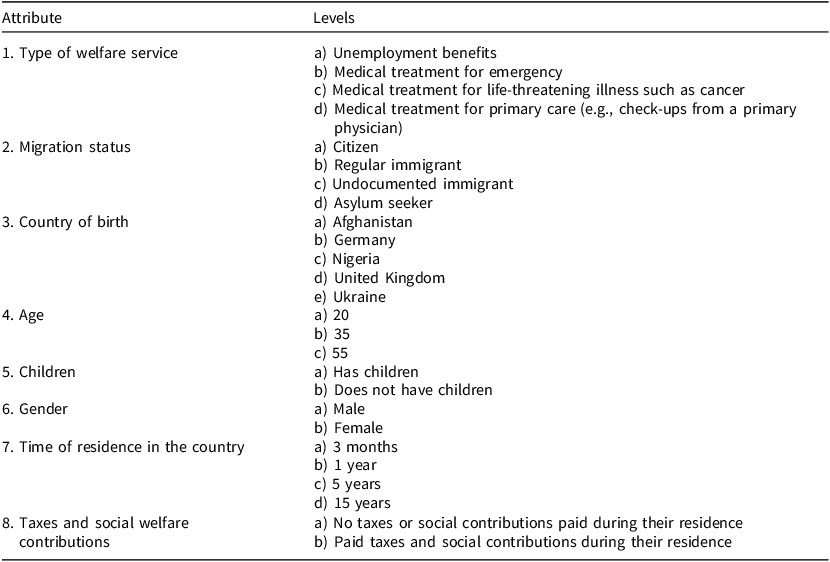
Each respondent evaluated five vignettes describing potential welfare recipients in a within-person design (Aguinis and Bradley, Reference Aguinis and Bradley2014, 360). Vignettes varied across eight attributes, reported in Table 1: migration status, country of birth, gender, age, family status, length of residence, tax and contribution history, and welfare scheme. Welfare schemes included unemployment benefits, emergency medical treatment, treatment for life-threatening illness, and primary care.
Attributes and levels for the vignette experiment

Table 1. Long description
The table presents attributes and levels used in a vignette experiment, detailing eight key attributes: type of welfare service, migration status, country of birth, age, children, gender, time of residence in the country, and taxes and social welfare contributions. The type of welfare service includes unemployment benefits, medical treatment for emergency, medical treatment for life-threatening illness, and medical treatment for primary care. Migration status categories are citizen, regular immigrant, undocumented immigrant, and asylum seeker. Countries of birth listed are Afghanistan, Germany, Nigeria, United Kingdom, and Ukraine. Age categories are 20, 35, and 55 years. Family status is divided into having children and not having children. Gender categories are male and female. Time of residence in the country is categorized into 3 months, 1 year, 5 years, and 15 years. Taxes and social welfare contributions are divided into no taxes or social contributions paid during their residence and paid taxes and social contributions during their residence. The table has 8 rows and 2 columns, with the first column listing the attributes and the second column listing the levels.
The full vignette population comprises 6,144 possible profiles. We excluded some combinations because they are unrealistic (e.g., a German asylum seeker in the United Kingdom). As such, the actual vignette population is thus smaller. Restrictions were minimized to preserve attribute independence, even at the cost of including some less plausible combinations. Two attention checks were included in the questionnaire, the results of which are explained in the online Appendix.
Dependent variable
Deservingness is the outcome variable of our models, that is, the degree (on a scale from 0 to 10) to which a respondent thinks the person should receive access to a given welfare benefit or service. The exact wording of the question was:
To what extent do you agree with the following statement on a scale from 0 to 10:
This person should receive access to [social benefit or service] in [country] under the same conditions as citizens living in this country
Different deservingness criteria for migrants and citizens, in this context, could be an indication of welfare chauvinism, or the support of policies that exclude immigrants from social benefits and services, including those who live permanently within a state (van Oorschot, Reference van Oorschot2006; Larsen, Reference Larsen2020).
Concretely, respondents were presented with the following vignette:
A [age]-year-old [gender] born in [country of birth] who [family situation]. This person is a [migration status], and has been living in the country for [duration of stay]. During this time, this person has [contribution history].
Covariates
Respondents were also asked about various socioeconomic and attitudinal characteristics before the experimental manipulation. We controlled for gender, age, education, and whether the respondent is a citizen of the country in which they reside. Additionally, we control for respondents’ pre-treatment perceptions of immigrants’ impact on the host country, their placement on the left-right ideological spectrum, their views on the importance of reciprocity in social exchanges, and their attitudes toward redistribution. The Appendix provides an overview and further information on the operationalization of these variables. Our baseline model is estimated without these covariates, but we include these variables as controls in separate models. Since the attribute levels were randomized, there is in principle no need to control for these characteristics, as treatment status should be uncorrelated with pre-treatment covariates (Mutz, Reference Mutz2011, 124). However, including these control variables may increase the efficiency of our estimates and allows us to assess whether there is effect heterogeneity in the responses to the vignettes as a function of these respondent-level characteristics.
All models are estimated using multilevel linear regression models to account for the potential correlation between ratings provided by the same respondent. Failing to account for this could result in downwardly biased standard errors and an increased risk of erroneously rejecting the null hypothesis (Auspurg and Hinz, Reference Auspurg and Hinz2014). To address this, we include respondent-level random intercepts in each model (Snijders and Bosker, Reference Snijders and Bosker2011). Moreover, where we test for interactions between the vignettes and respondent-level characteristics, we do so using cross-level interactions rather than segmenting our sample into subgroups or estimating random slopes per attribute (Auspurg and Hinz, Reference Auspurg and Hinz2014).
Balance checks
To assess whether random assignment produced groups comparable on respondent demographics, we examined gender, age, and education level (see Appendix). For age and education, we applied ANOVA tests, and for gender we used a chi-squared test. These bivariate tests suggest some imbalance: respondent age was related to the age attribute (p = .0183), gender to the welfare scheme attribute (p = .021), and education to the migration status (p = .0081) and contribution history attributes (p = .0003). A joint orthogonality test confirmed that only education was systematically associated with the vignette attributes (F = 1.69, p = .033). To address this, we compared models with and without controls for respondent demographics; results remain substantively unchanged.
Experimental results
We tested our hypotheses using multilevel linear regression models, as shown in Figure 1, pooling data from both countries. Model 1 evaluates the impact of vignette attributes on perceived deservingness without respondent-level covariates, while Model 2 incorporates these covariates. Since the inclusion of covariates in Model 2 did not significantly alter the results, our interpretations are based on this model. The category “Western Europe” refers to Germany in the UK sample, and the UK in the German sample, which have been pooled.
Baseline multilevel linear regression models examining the effects of vignette attributes on perceived deservingness.
Note: The dots are the point estimates and the horizotal lines represent 95% confidence intervals. Full tables are available in Table A2 in the Appendix.

Figure 1. Long description
The image contains a combination of bar graphs and error bars representing coefficients from two models examining the effects of different vignette attributes on perceived deservingness. The x-axis represents the coefficients, ranging from negative to positive values, while the y-axis lists various attributes such as age, contributions history, country of birth, duration of residence, family status, gender, migration status, and scheme. Each attribute is further divided into specific categories, such as different age groups, countries, and types of social welfare schemes. The bars are color-coded to represent two different models, with blue and red bars indicating the results from each model. The error bars show the confidence intervals for each coefficient. The graph highlights how different factors influence perceptions of deservingness, with some attributes showing positive coefficients and others negative. For instance, age groups show varying levels of deservingness, with older age groups generally having higher coefficients. Contributions history also plays a significant role, with those who have paid taxes and social contributions perceived as more deserving. Country of birth, duration of residence, family status, gender, migration status, and the type of social welfare scheme all impact perceived deservingness to different extents. The graph provides a comprehensive view of how these various factors interact and influence public opinion on migrant inclusion in social welfare schemes.
Our findings reveal a hierarchy of deservingness across welfare schemes, with respondents significantly more willing to extend benefits for emergency services than for non-emergency care or unemployment benefits, supporting Hypothesis 1. Emergency care ranked highest in perceived deservingness, followed by cancer treatment (b = −.409, p < .01) and general practitioner visits (b = −.935, p < .01). Recipients of unemployment benefits were deemed least deserving (b = −2.093, p < .01), likely due to their lower perceived urgency and higher risk of fraud compared to healthcare services.
Migration status has a significant effect on perceived deservingness. Across all schemes taken together, undocumented migrants are considered less deserving than all other migrant categories (b = −1.364, p < .01), aligning with Hypothesis 2. Asylum seekers also face a deservingness penalty (b = −.565, p < .01), although it is less severe than that of undocumented migrants. Furthermore, Hypothesis 3A is also confirmed by our results: citizens have the highest deservingness scores, followed by regular migrants (b = −.272, p < .01) who, having presumably followed legal pathways, are seen as more deserving than those whose immigration status might involve elements of legal ambiguity or conflict. At the same time, we do not find evidence supporting Hypothesis 3B, or a country of birth effect: similar evaluations are produced for claimants from Afghanistan, Nigeria, Ukraine, Germany, and the UK. This is a somewhat surprising result, but consistent with other survey experimental results that find no effect of country of origin when other characteristics such as legal status, age, and contributions are taken into consideration (Hainmueller and Hopkins, Reference Hainmueller and Hopkins2015; Bansak et al., Reference Bansak, Hainmueller and Hangartner2016; Kootstra, Reference Kootstra2016). Note that we consider country of birth separately from citizenship.
Our findings support Hypothesis 4A: candidates who have not paid taxes and social contributions are less likely to gain support (b = −2.495, p < .01). Furthermore, the duration of residence affects perceived deservingness. Individuals with five years of residence have a small gap in deservingness compared to those with 15 years of residence (b = −.153, p < .01). The differences in perceived deservingness between candidates who have resided for 3 months (b = −.488, p < .01) and those for 1 year (b = −.411, p < .01) were comparable in magnitude.
We further investigated how the migration status of candidates interacts with other attributes to affect perceived deservingness. For this purpose, we estimated several two-way interactions; the results are visualized in Figure 2. As expected, the findings shown in Figure 2 indicate that undocumented migrants are generally viewed as less deserving than other claimants across all types of services. However, consistent with Hypothesis 5A, the gap in deservingness decreases for services that cater to more acute needs, such as emergency hospital visits and cancer treatments, compared to less urgent services like unemployment benefits and visits with a general practitioner.
Predicted level of perceived deservingness for the interaction between migration status and on other attributes of benefit claimant.
Note: The dots are the point estimates and the horizontal lines represent 95% confidence intervals. Full tables are available in Table A3 in the Appendix.

Figure 2. Long description
The image contains multiple horizontal bar graphs depicting the predicted level of perceived deservingness for the interaction between migration status and other attributes of benefit claimant. The graphs are organized into rows, each representing different categories such as emergency care, cancer treatment, GP check-up, unemployment benefits, contributions paid, no contributions paid, 15 years of residence, 5 years of residence, 1 year of residence, and 3 months of residence. Each row contains four bars representing different migration statuses: undocumented migrant, asylum seeker, regular migrant, and citizen. The x-axis represents the predicted level of deservingness, ranging from 4 to 8. The bars are color-coded: red for undocumented migrant, green for asylum seeker, blue for regular migrant, and purple for citizen. The graphs show variations in perceived deservingness across different migration statuses and benefit categories. For example, citizens consistently receive higher deservingness scores across all categories, while undocumented migrants receive the lowest. The trends indicate that longer residence and contributions paid generally lead to higher perceived deservingness. All values are approximated.
Our findings also largely support Hypothesis 5B (Panel B): while taxes and contributions significantly increase the perceived deservingness of citizens and regular migrants, the increase for undocumented migrants is smaller. This suggests that the deservingness gap between these groups and undocumented migrants widens when they have paid taxes and social contributions. Interestingly, the deservingness of asylum seekers does not change noticeably when they have paid into taxes and social contributions.
Turning to the effects of duration of residence, our results do not support Hypothesis 5C (Panel C): the length of residence does not mitigate the negative impact of migration status on the perceived deservingness of migrants’ access to welfare.
In an exploratory step, we examined how respondents’ pre-treatment characteristics influenced the impact of benefit claimants’ migration status on their perceived deservingness. This involved estimating several cross-level interactions, with the results shown in Figure 3. Our analysis revealed that respondents’ pre-treatment immigration attitudes change how the migration status of benefit claimants affects perceived deservingness. Those with more negative pre-existing attitudes towards immigration place greater emphasis on migration status when assessing the deservingness of benefit claimants (Panel A of Figure 3). Conversely, the importance respondents place on reciprocity does not affect the impact of migration status on deservingness (Panel B).
Predicted level of deservingness for different migration statuses conditional on respondent attitudes.
Note: Line represents the slope and shaded areas are 95% confidence intervals. Full model available in Table A4 in the Appendix.

Figure 3. Long description
The image contains four line graphs labeled A, B, C, and D. Each graph shows the predicted level of deservingness for different migration statuses conditional on respondent attitudes. The migration statuses include citizen, regular migrant, asylum seeker, and undocumented migrant, each represented by different colored lines. Graph A plots immigration attitudes on the x-axis against the predicted level of deservingness on the y-axis. Graph B shows reciprocity on the x-axis against the predicted level of deservingness on the y-axis. Graph C depicts left-right self-placement on the x-axis against the predicted level of deservingness on the y-axis. Graph D illustrates support for redistribution on the x-axis against the predicted level of deservingness on the y-axis. Each graph shows how different attitudes influence the perceived deservingness of various migration statuses.
Political orientation also plays a role in how individuals assess the deservingness of benefit claimants based on their migration status. Right-leaning individuals differentiate more in their willingness to grant access to benefits and services based on the claimant’s migration status compared to their left-wing counterparts (Panel C). Additionally, individuals who strongly support income redistribution tend to factor in migration status less when determining whether claimants ought to receive benefits and services (Panel D) or not. Conversely, those opposed to redistribution emphasize citizenship more prominently when deciding whether to support welfare access or not.
Finally, we analyzed our models by dividing our sample by country. The results displayed in the Appendix, show no significant differences in how the various attributes affect perceptions of deservingness across the countries studied. The only exception concerns migration status, where British respondents place more emphasis on the migration status of benefit claimants compared to German respondents. Specifically, British respondents tend to penalize undocumented migrants more severely relative to asylum seekers than do German respondents. This may be due to the higher degree of politicization of irregular migration in the UK, especially at the time when the survey was fielded, when irregular crossings across the English Channel featured prominently in the media. The same pattern emerges when we examine the effects of migration status, conditional on other attributes of the benefit claimants, split by the country of the respondent (Table A7). Additionally, the interactions between migration status and respondents’ pre-treatment covariates yield similar results when we divide our sample by country of respondent (Table A8).
As a final robustness check, we assessed whether ordering effects influenced our findings. We compared results using only the first vignette per respondent and, separately, only the fifth vignette (Tables A20–22). The main results remain unchanged, and interactions between vignette attributes yield substantively identical conclusions. The only difference is that, in the first-vignette analysis, respondents’ immigration attitudes and left–right placement do not moderate the effect of the migration status attribute, whereas in the fifth-vignette analysis they do and closely resemble those obtained when pooling all five vignettes.
Discussion
Our analysis underscores that public perceptions of welfare deservingness for migrants are more nuanced and differentiated than generally assumed. They are shaped by the nature of the welfare scheme, the type of migrant, and concerns about reciprocity.
First, welfare schemes perceived as addressing more urgent needs lead to more favorable attitudes toward recipients, including migrant recipients, and less differentiation between citizens and migrants. Essential services such as emergency care are viewed as inherently legitimate, reducing “welfare chauvinism” and scrutiny of the background of potential claimants. While previous research highlights the difference between benefits and services (Eick and Larsen, Reference Eick and Albrekt Larsen2022), our findings pinpoint the urgency of the need addressed by a scheme as a critical distinction.
Second, the legal status of migrants entails a clear hierarchy of deservingness. Undocumented migrants face the most substantial penalty, reflecting broader societal views that prioritize compliance with legal rules and norms. Asylum seekers are also seen as less deserving than citizens, although the penalty is less severe than for undocumented migrants. Moreover, on average there is only a small difference between regular immigrants and citizens, showing the need to unpack the “migrant” category as we did here. This finding is robust regardless of the recipient’s country of birth and origin. This runs counter to the idea that shared cultural, ethnic, and religious markers make a large difference in individual evaluations on whether a person deserves access to welfare rights, once we control for more objective factors such as legal status.
Third, the principle of reciprocity – whether an individual has contributed or not to the system it claims benefits or services from – is a powerful predictor of deservingness. The gap in support for individuals who have contributed and those who have not is the largest in our experiment, and is far greater than say, immigrants who have contributed and citizens who have contributed. Strikingly, even undocumented migrants who have paid contributions are perceived to be more deserving of welfare support than citizens who have not, showing that reciprocity can outweigh legal status and that the “immigrant penalty” is not insuperable. Citizens’ perceptions of welfare deservingness can be more strongly influenced by a recipient’s perceived behavior and attitude (respect for the rules) than by their ascribed characteristics, such as immigration status or place of birth. In this sense this relates to what Levy and Wright (Reference Levy and Wright2000, 9) call civic fairness, or a “a set of normative beliefs about what current and aspiring members owe their political communities and what these communities owe them in return”. While they define it as typical of American political culture, we provide evidence of the wider applicability of this concept in explaining opinions about immigrants.
Finally, respondents’ own characteristics predictably shape their views. Individuals with negative attitudes toward immigration or right-leaning political views are more likely to differentiate based on migration status. Conversely, those who support income redistribution are less influenced by a claimant’s migration status. These patterns appear consistent across national contexts, as our comparison between Germany and the United Kingdom revealed no statistically significant differences in how these factors influence public opinion.
In addition to the analyses reported above, we conducted several robustness checks. First, we split the sample by respondents’ countries to assess whether respondents in the two countries responded similarly to the experimental stimuli. These country-specific analyses replicate the baseline specification – including vignette attributes and respondent-level covariates – as well as the models examining interactions between vignette attributes; the results are reported in Tables A6 and A7 in the Appendix. Second, we re-estimated all three main models using the original sample without the German top-up. These results are shown in Tables A8–A10 in the Appendix. Third, we re-estimated the models using post-stratification weights so that the sample more closely resembles the target population, using the European Social Survey as a benchmark. The weights were constructed using the cross-classification of age, gender, and education. We refer the interested reader to the Appendix for a more detailed explanation of how these weights were constructed. The results of these weighted analyses are reported in Tables A17–A19 in the Appendix. Across all specifications, the results are consistent with the main findings discussed in the text.
Conclusion
Research consistently documents public reluctance to extend welfare rights to migrants, often finding support for more restrictive access. However, much of this literature treats social rights and migration status as uniform or binary categories. This paper advances the debate by showing that public evaluations of migrants’ welfare deservingness are differentiated across these domains. Using a vignette survey experiment with nationally representative samples in Germany and the UK, we examined how support varies across migrant groups and types of social protection.
Our findings reveal a conditional logic of welfare deservingness shaped by three main factors: migrants’ legal status, perceived urgency of the welfare scheme, and reciprocity. We observe a clear hierarchy by legal status, with citizens ranked highest on the scale of deservingness, followed by regular migrants, asylum seekers, and, at the bottom, undocumented migrants. This hierarchy is particularly pronounced for non-urgent benefits such as unemployment insurance and primary healthcare. By contrast, for urgent needs, especially emergency healthcare and life-threatening illnesses, legal status plays a much weaker role, and undocumented migrants are widely regarded as deserving of protection. These results highlight the central importance of need in attenuating welfare chauvinism.
Reciprocity is also important in deservingness judgements. Migrants who paid taxes and contributions, even if undocumented, were consistently viewed as more deserving than those who have not, including citizens. This finding suggests that perceived contribution can partially offset exclusionary attitudes based on migration status. By contrast, country of birth had no significant effect once other attributes were controlled. Finally, respondents’ political orientations mattered: right-leaning and immigration-sceptic individuals penalized migrants more strongly, while those supportive of redistribution were less influenced by migration status. These patterns were remarkably consistent across Germany and the United Kingdom, suggesting that the mechanisms we identify operate across different welfare regimes.
Taken together, our findings point to the need for a closer connection between welfare and migration research to understand the segmented nature of deservingness perceptions. Rather than treating welfare chauvinism as a uniform phenomenon, our results show that exclusionary preferences are segmented across types of social protection and conditional on both individual attributes and institutional contexts. Understanding public support for welfare provision therefore requires attention to how immigration status intersects with specific forms of social protection, particularly with respect to access, eligibility, and perceived urgency.
At the same time, our study has limitations that open avenues for future research. The stylized design of the survey experiment may hamper external validity: it does not incorporate specific framings of target groups as deserving or undeserving, nor does it consider the broader economic context in which people evaluate deservingness. Moreover, respondents were provided with complete information about individual characteristics, whereas real-world evaluations often rely on group-based inferences under conditions of uncertainty. For example, citizens may assume that individuals from a specific country are generally undocumented and have not paid contributions and therefore consider them as undeserving. By contrast, our design ensures that respondents always have complete information about individual attributes. In a context where research on hiring discrimination has shown that providing less information can increase discrimination (Agan and Starr, Reference Agan and Starr2018), further research could vary the number of attributes provided to respondents to see if it impacts perceptions of deservingness.
Contextual factors also warrant further attention. Data collection in Germany coincided with high-profile violent incidents involving asylum seekers in Mannheim (31 May 2024) and Solingen (23 August 2024), which intensified political debates over deportation and welfare restrictions. This may have impacted how people in Germany answered the survey, although we do not find significant differences between respondents in Germany and the UK. Future studies could more explicitly examine how elite discourse, media framing, and political shocks condition public attitudes toward migrant access to welfare. Similarly, investigating how contextual factors, such as regional economic conditions, influence these perceptions would be valuable. Economic downturns or budget cuts in essential services, for instance, may foster more welfare chauvinist attitudes, with heightened resistance to welfare provision for out-groups, including migrants.
Finally, this paper focuses on medical services and unemployment insurance. Emerging research has suggested that policies of social investment, such as education and job training, may elicit lower levels of welfare chauvinism (Bonoli et al., Reference Bonoli2024; Eick, Reference Eick2024). Future work could extend this approach to welfare domains that vary in urgency and scalability, such as housing or education. Examining how deservingness judgements operate across these domains would further expand our understanding of ways in which welfare chauvinism is segmented across policy areas, migration status, and individual characteristics.
Supplementary material
The supplementary material for this article can be found at https://doi.org/10.1017/S1755773926100551.
Data availability statement
Data will be available on the Open Science Framework. The study was pre-registered under the reference https://doi.org/10.17605/OSF.IO/2BCRX.
Acknowledgements
The authors acknowledge useful comments and input by Lutz Gschwind, Emil Wolff, Rik Joosen, Caelesta Braun, Sebastian Diessner. AI Tools (Claude and Gemini) were used for research purposes (summarize literature) and rephrase certain passages and headings.
Financial support
Funding for this study was provided by the Dutch Organization for Scientific Research NWO, Grant 016.Vidi.185.159. Open access funding provided by Leiden University.
Competing interests
No competing interests.
Ethical standards
This study was given ethical approval by the Ethic Committee of the Faculty of Governance and Global Affairs, decision 2022-014-BSK-Afonso.


 Open access

