


Introduction
Human–wildlife conflicts are a growing global issue for the conservation of wildlife, particularly conflicts with large carnivores, which can result in the injury or death of a person. This type of threat can trigger fear in humans that can result in negative attitudes towards a particular species and its conservation (Trout, Reference Trout2011; Benavides, Reference Benavides2013). Fear may also lead to retribution killings (Barlow et al., Reference Barlow, Greenwood, Ahmad and Smith2010) and an unwillingness to share the landscape with large carnivores.
The leopard Panthera pardus is generally solitary, shy and cryptic. It is the most adaptable of the large cats and is able to persist in human-dominated landscapes (Jacobson et al., Reference Jacobson, Gerngross, Lemeris, Schoonover, Anco and Breitenmoser-Wursten2016; Williams et al., Reference Williams, Williams, Lewis and Hill2017; Bista et al., Reference Bista, Chanchani, Subedi and Bajracharya2022). This often leads to human–leopard conflicts (Kshettry et al., Reference Kshettry, Vaidyanathan and Athreya2017), the majority of which are depredation of livestock, but leopards also occasionally attack people (Bibi et al., Reference Bibi, Minhas, Awan, Ali and Dar2013; Chattha et al., Reference Chattha, Iqbal, Rasheed, Razzaq, Husain and Abbas2013; Dhanwatey et al., Reference Dhanwatey, Crawford, Abade, Dhanwatey, Nielsen and Sillero-Zubiri2013; Kshettry et al., Reference Kshettry, Vaidyanathan and Athreya2017; Naha et al., Reference Naha, Dash, Chettri, Chaudhary, Sonker and Heurich2020; Parchizadeh & Belant, Reference Parchizadeh and Belant2021; Bista et al., Reference Bista, Chanchani, Subedi and Bajracharya2022; Bombieri et al., Reference Bombieri, Penteriani, Almasieh, Ambarlı, Ashrafzadeh and Das2023). Throughout the leopard’s global range attacks on people are relatively rare (Jacobson et al., Reference Jacobson, Gerngross, Lemeris, Schoonover, Anco and Breitenmoser-Wursten2016), except in India and Nepal where an escalation in the number of attacks has been associated with the loss, fragmentation and degradation of leopard habitat and insufficient wild prey (Choudhury et al., Reference Choudhury, Ali, Mubashir, Ahmad, Nabi Sofi and Mughal2008; Kaushik et al., Reference Kaushik, Kausik, Naha, Jhala, Sathyakumar, Qureshi, Mathur, Kaushik, Bist, Mungi and Qureshi2015; Anand & Radhakrishna, Reference Anand and Radhakrishna2017; Naha et al., Reference Naha, Sathyakumar and Rawat2018).
In 2000, there was an increase in attacks by leopards in the Jammu and Kashmir region of India (Choudhury et al., Reference Choudhury, Ali, Mubashir, Ahmad, Nabi Sofi and Mughal2008). Previous studies in this region suggested that the main drivers of this increase include changes in forest cover, land-use practices and livelihood options, and a decrease in wild prey (Choudhury et al., Reference Choudhury, Ali, Mubashir, Ahmad, Nabi Sofi and Mughal2008; Habib et al., Reference Habib, Gopi, Noor and Mir2014; Dar & Bhat, Reference Dar and Bhat2022). The low density of potential prey in the region has caused leopards to have larger home ranges than elsewhere in the subcontinent (Habib et al., Reference Habib, Gopi, Noor and Mir2014), and ultimately this leads to conflict (Shah et al., Reference Shah, Jan, Bhat, Ahmad and Ahmad2009; Dar & Bhat, Reference Dar and Bhat2022).
Here, we document leopard attacks on people in the Kashmir region during 2006–2023 and examine potential causes for any trends. We aimed to gain a better understanding of patterns of leopard attacks, which will hopefully lead to more effective mitigation and leopard conservation practices that can help foster safer coexistence between people and leopards.
Study area
The Jammu and Kashmir Department of Wildlife Protection divides the c. 15,500 km2 Kashmir region into five Divisions: Central, Southern, Northern, Wetland and Shopian (Fig. 1). The c. 8000 km2 Northern Division is the largest and has the most tree cover. A large proportion of the Central Division is protected, and includes Dachigam National Park. The Shopian Division includes the large Hirpora Wildlife Sanctuary. Average elevation in the region is c. 1,850 m, and it is partially surrounded to the north by the higher Himalayan and Pir Panjal ranges. The climate is mild with precipitation occurring throughout the year, although spring is the wettest season. Summer is usually mild and relatively dry. July is the warmest month, with daily temperatures averaging c. 24 °C, and January is the coldest with average daily temperatures of c. 3 °C. The biggest river in the region is the Jhelum. Broadleaved trees such as the Himalayan horse chestnut Aesculus indica, Parrotiopsis jacquemontiana and willows Salix spp. occur at lower elevations, and coniferous trees such as blue pine Pinus wallichiana, deodar Cedrus deodora, silver fir Abies pindrow and West Himalayan spruce Picea smithiana occur on the hill slopes.
The Divisions of Kashmir, India, as defined by the Jammu and Kashmir Department of Wildlife Protection, which is responsible for the handling of human–wildlife conflicts, including attacks by leopards. The map shows tree cover and the locations of protected areas, and the number of attacks and the death rate in each Division.

Methods
We used leopard attack data collected by the Jammu and Kashmir Department of Wildlife Protection (Kashmir region) for 2006–2023. These data were collected for the purpose of paying compensation for human–wildlife conflicts, including attacks by leopards. Not all Divisions reported on all categories, but generally the data included (1) age of the victim, (2) place of the incident (the general location of the attack), (3) date of the attack, (4) time of the attack, (5) injury or death of the victim, (6) activity that the victim was engaged in at the time of the attack, and (7) category of injury.
Information on the precise nature of injuries sustained by victims was not available, but we were able to classify injuries into three categories based on medical reports and the amount of compensation: minor, grievous and permanent disability. Injuries were considered minor if the victim was treated at a local hospital and sent home the same day, grievous if the victim needed to be referred for special treatment (typically to a specialized hospital, where their stay was usually for an extended amount of time), and permanent disability if the victim had some form of permanent incapacitation. We were able to collect data on injuries from only two Divisions (Northern and Southern).
The motivation for leopard attacks (defensive or predatory) could not be readily determined from the data, except for a few encounters that resulted in the leopard eating the victim. In attempting to determine the motivation for an attack, we considered the age of the victim, the time of the attack and the activity in which the victim was engaged at the time. These variables were compared to attack data for the Asiatic black bear Ursus thibetanus collected over the same period in the same region. All Asiatic black bear attacks were considered defensive based on our investigations and the fact that Asiatic black bear predatorial attacks are rare (Penteriani et al., Reference Penteriani, Bombieri, Delgado, Sharp, Yamazaki, Penteriani and Melletii2020).
Results
Information on 424 attacks on people by leopards in the Kashmir region was obtained for 2006–2023 (Fig. 2a), of which 312 (73.6%) resulted in injury and 112 (26.4%) in death. For 413 of the attacks the month of occurrence was available (Fig. 2b). The greatest number of attacks occurred in February (45, 10.9%) and September (46, 11.1%). The fewest attacks occurred in December and April. Reports of 75 attacks included the time of day (Fig. 2c), with the greatest number occurring during 10.00–10.59 (12, 16.0%) and 17.00–17.59 (7, 9.3%).
Number of attacks on people by leopards in the Kashmir Region (Fig. 1) during 2006–2023 that resulted in injury or death, by (a) year (424 records), (b) month (413 records), (c) time of day (75 records) and (d) the victim’s age (177 records).

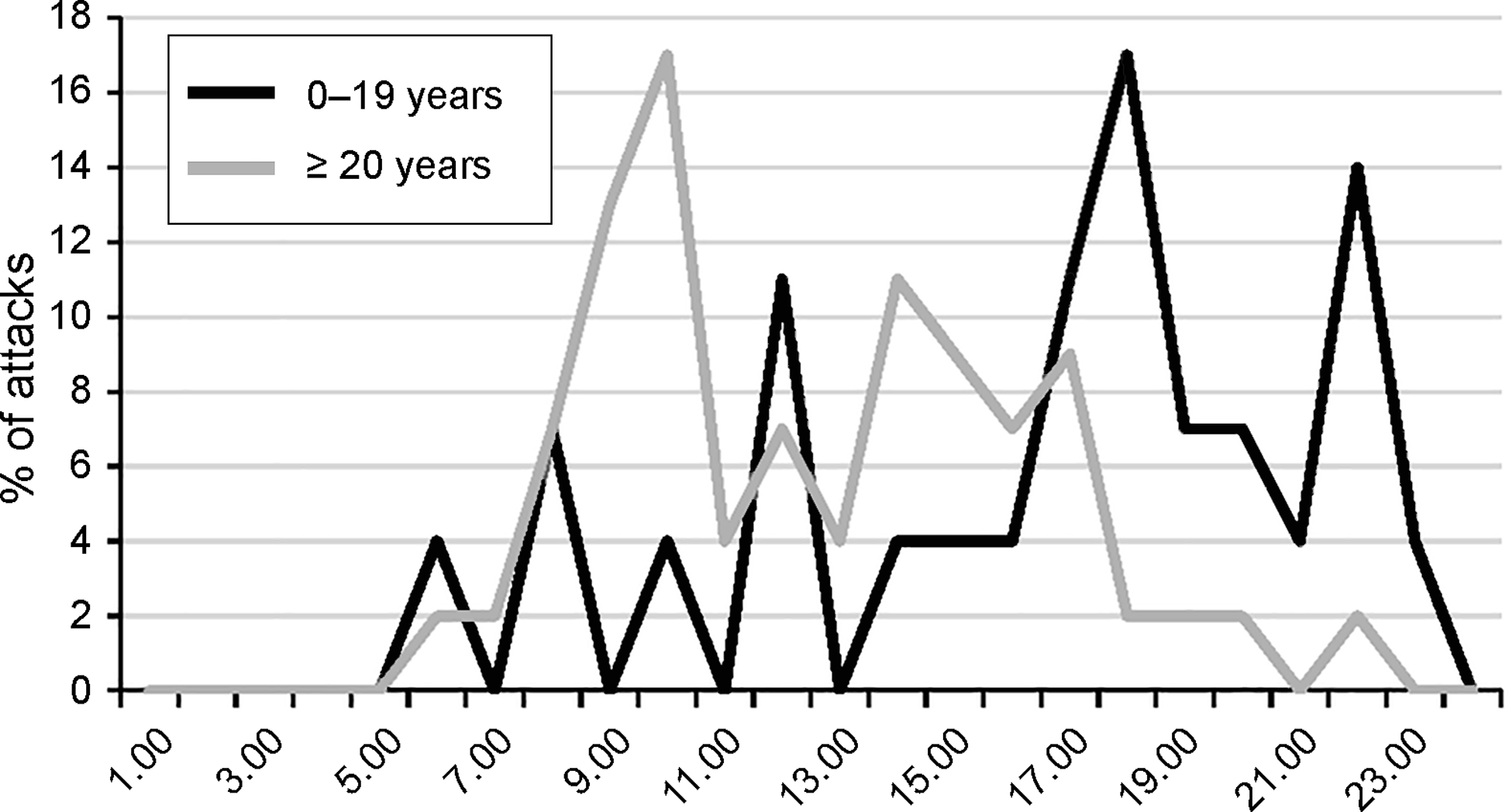
Age was available for 177 victims (Fig. 2d). Leopards attacked across all age groups, with victims aged 2–90 years. Considering 10-year age groups, the greatest number of attacks were on children aged 0–9 years (49, 27.7% of the total victims). Young victims (i.e. 0–19 years) comprised 38.4% (68) of the total. Of the 177 victims for whom we had age data, 53 people died from leopard attacks. The greatest number of deaths were amongst children aged 0–9 years (35, 66.0%) and young people aged 10–19 years (8, 15.1%). For 68 victims both their age and the time of day when they were attacked were available. Adults aged ≥ 20 years (46) were most often attacked in the morning, and children and young people aged 0–19 years (28) were most often attacked in the evening (Fig. 3).
Per cent of attacks on people by leopards in the Kashmir region during 2006–2023 that resulted in injury or death, by time of day and the victim’s age.

Injuries could be categorized for 277 victims, with 170 minor (61.4%), 106 grievous (38.3%) and one permanent (0.4%). Substantially more attacks occurred in the Northern District (270, 63.7% of total attacks) than elsewhere, and there were 102 (24.1%) in the Southern District. Together these two districts comprised 87.7% of leopard attacks in the Kashmir region.
Discussion
Attacks and deaths over time
The highest number of attacks took place in 2007 and 2013. However, attacks have generally been decreasing since 2009 (Fig. 2a). A number of leopards have been removed from the Kashmir region between 2006 and 2023 in an effort to eliminate specific individuals designated as so-called man eaters, although we do not know the total number of leopards involved. A large reduction in human–leopard conflict in Pauri Garhwal in Uttarakhand state may have been a result of intensive removal of leopards during 1990–2005 by forest officials and local communities (Naha et al., Reference Naha, Sathyakumar and Rawat2018). Although the decline in the number of leopard attacks in the Kashmir region may be partially a result of removal of leopards, other factors such as disease, retaliatory killings or education on safety in areas inhabited by leopards (discussed below) may also be responsible. The decline of leopard attacks in the region follows a similar trend to that of attacks by Asiatic black bears over the same period in this region (Mir et al., Reference Mir, Swaminathan, Naqash, Sharp and Arun2023). The Department of Wildlife Protection has been more proactive and better equipped since 2010, and leopard awareness and safety programmes, conducted by Wildlife SOS and other NGOs, have also become more widespread since 2007 and may have contributed to a reduction of attacks, although we are unable to quantify the effects of these programmes.
The per cent of fatalities from leopard attacks varies greatly between regions: a rate of 40% has been reported in Pauri Garhwal, India, 3% in North Bengal, north-east India (Naha et al., Reference Naha, Sathyakumar and Rawat2018), 0% in West Bengal, India (Kshettry et al., Reference Kshettry, Vaidyanathan and Athreya2017), 8% in Kenya and 3% in Iran (Bombieri et al., Reference Bombieri, Penteriani, Almasieh, Ambarlı, Ashrafzadeh and Das2023). The per cent of fatalities we documented in the Kashmir Region (26.4%) was lower than reported by Bombieri et al. (Reference Bombieri, Penteriani, Almasieh, Ambarlı, Ashrafzadeh and Das2023) for leopards in India (54%), but comparable to the 27% recorded in the same source for the leopard’s global range.
Attacks on adults and children
The highest number of attacks on adults took place in the morning hours when people arrived at work in orchards and agricultural lands. Leopards in and around urban areas of Kashmir often use orchards and plant nurseries as hideouts and places to bed down. This sometimes results in surprise encounters that can lead to an attack. Some of the attacks occurred when people threw stones in an effort to chase the predator away. The highest number of attacks on children took place in the evening hours around sunset or after dark. The evening hours are the time of day that children are more likely to be playing or moving about outside, unlike the morning hours when children are in school. This finding was consistent with a similar study in Himachal Pradesh, but differed from studies in Uttarakhand and Maharashtra, where attacks on children were most often diurnal, when children were walking home alone from school or the market (Goyal et al., Reference Goyal, Chauhan and Yumnam2007; Athreya et al., Reference Athreya, Odden, Linnel and Karanth2011; Kumar, Reference Kumar2011).
Leopard attacks by Division
Leopard attacks were greatest in the two largest Divisions, Northern and Southern, which have the highest tree coverage and largest extent of protected areas, with forests, riverine vegetation and meadows that support a more varied prey base than the other Divisions, including markhor Capra falconeri, Alpine musk deer Moschus chrysogaster and Siberian ibex Capra sibirica. Additionally, seasonal, local and inter-divisional migrations of herders are more frequent in the Northern and Southern Divisions, potentially exposing the herders, their families and livestock to conflicts with leopards. A large portion of the herder population in these two Divisions live in makeshift houses called dokas for part of the year (Plate 1), which are often constructed in or near the forested areas where leopards are more likely to be encountered. The Northern and Southern Divisions are also undergoing rapid deforestation and urbanization, with human activities and infrastructure encroaching on leopard habitat and potentially causing more conflicts (Hamid et al., Reference Hamid, Dar and Akintug2024; Wani et al., Reference Wani, Bhat, Gatoo, Islam and Murtaza2025).
An example of a doka, a makeshift house in which many herders and their families live during seasonal migration in the Northern and Southern Divisions of the Kashmir region (Fig. 1). Photograph: Sam Aamir.

Defensive and predatorial attacks
Leopard attacks on people can be defensive or predatory in nature (Mattson et al., Reference Mattson, Logan and Sweanor2011; Bombieri et al., Reference Bombieri, Penteriani, Almasieh, Ambarlı, Ashrafzadeh and Das2023). Defensive attacks occur when leopards react to an involuntary encounter with a person, or while protecting their young. Predatory attacks occur when a leopard attacks for the purpose of consuming prey (Mattson et al., Reference Mattson, Logan and Sweanor2011; Bombieri et al., Reference Bombieri, Penteriani, Almasieh, Ambarlı, Ashrafzadeh and Das2023). As leopards are ambush predators, determining whether an attack is predatory or defensive can be difficult, especially when the detailed circumstances of the attack are not recorded. A leopard reacting to a surprise encounter could appear similar to a leopard ambushing potential prey. The defensive nature of some attacks is clear, such as when a leopard reacts to being chased away or stones are thrown at it. Similarly, some predatory attacks are clear, such as when a leopard kills and eats the person. The high number of attacks on adults in the late morning in orchards or fields where the victims were working suggests that many of these attacks are defensive. This interpretation is supported by four observations: (1) the majority of attacks resulted only in minor injuries, (2) the attacks occurred when leopards had been sleeping, (3) the likelihood that a leopard could be surprised by a person working in an orchard or field is high, as leopards often sleep in these areas, and (4) leopards are often harassed to chase them away from the area. The evening attacks on children are more likely predatory, as evidenced by the following fours factors: (1) the higher rate of fatalities, (2) this is the time when leopards are more active and hunting, (3) it is less likely that leopards are surprised at this time of day, and (4) children are closer to the ideal prey size for leopards.
The leopard, like the cougar Puma concolor and grey wolf Canis lupus, is a medium-sized predator. Predators of this size have historically killed more children than larger predators, possibly because children are within their preferred prey size (Løe & Roskaft, Reference Löe and Röskaft2004; Mattson et al., Reference Mattson, Logan and Sweanor2011; Bombieri et al., Reference Bombieri, Penteriani, Almasieh, Ambarlı, Ashrafzadeh and Das2023). Children attacked by leopards in Kashmir were more likely to die than adults. Although people < 20 years old accounted for 68 of the 177 attacks (38.4%) for which the age of the victim had been recorded, they comprised 43 of the 53 fatalities (81.1%). Similar findings were reported for cougar attacks (Løe & Roskaft, Reference Löe and Röskaft2004; Mattson et al., Reference Mattson, Logan and Sweanor2011). There are two probable explanations for the high fatality rate among children: small victims are less able to survive the attack, and it is likely that attacks on children are predatory. We have documented instances of leopards attacking young children in the vicinity of other children or of adults, and children being saved from predatory leopards when parents intervened, although even with such intervention, some cases still ended in the child’s death (Aaliya Mir, unpubl. data).
Leopard attacks compared to Asiatic black bear attacks
Attacks by leopards (424) were fewer than those by Asiatic black bears (2,565) over the same period (Mir et al., Reference Mir, Swaminathan, Naqash, Sharp and Arun2023), but the per cent of fatal attacks by leopards (26.4%) was substantially higher than reported for Asiatic black bears (4.9%). This is most likely because felids are more efficient predators and a much higher per cent of attacks by felids are predatory (Bombieri et al., Reference Bombieri, Penteriani, Almasieh, Ambarlı, Ashrafzadeh and Das2023). The ages of leopard and bear victims in Kashmir were similar except in the case of children < 10 years old, who accounted for 32% of leopard victims but only 3% of black bear victims, again suggesting that leopards target young children.
Effects of leopard attacks on conservation
Attacks are the most provocative type of conflict, and attacks on children are viewed as even more heinous. The motivation behind the attack, predatory or defensive, is not always readily apparent to the victim or witnesses of an attack (i.e. a defensive attack may appear predatory to the victim), and therefore does not necessarily play a role in how the animal is perceived by the victim or the community at large. Predatory attacks on children understandably result in particularly strong emotional reactions from the community and can hamper leopard conservation. Education and public awareness on how to stay safe in leopard-inhabited areas can help keep people safe and in turn make leopard conservation more feasible. Interaction with the community is key.
Leopard attack patterns and recommendations
Leopard attacks in the Kashmir Region appear to be decreasing, most likely a result of the removal of some leopards (legally and potentially illegally), an increase in the presence of Jammu and Kashmir Wildlife Protection Department personnel, and public education. Our findings do not support the statement of Bombieri et al. (Reference Bombieri, Penteriani, Almasieh, Ambarlı, Ashrafzadeh and Das2023, p. 6) that ‘… leopard attacks were mostly predatory in the Kashmir region [India]’. Rather, our results suggest that the majority of attacks were defensive.
We conclude that children are more likely to be predated than adults. As Mattson et al. (Reference Mattson, Logan and Sweanor2011) wrote of cougar attacks, the presence of adults does not appreciably lessen the odds of a cougar attacking a child, but adult intervention reduces the odds that an attacked child will die. Based on several reports, we believe this is also to be true of leopard attacks. Notably, aggressive behaviour (yelling, throwing objects, charging, looming large, discharging a weapon) by people involved in close encounters with leopards has mixed results. Throwing rocks at or being aggressive towards a resting leopard may cause the animal to attack. However, if a leopard is behaving aggressively, an aggressive response may lessen the odds that the leopard will attack.
Given the danger of predatory attacks on children, parents should be especially vigilant during the evening hours when leopards are likely to be hunting. Outreach efforts in the local communities are vital to communicate the best ways to stay safe in leopard habitat both for adults and children. Wildlife SOS, working with the local government, is conducting leopard and bear safety workshops throughout Kashmir in an effort to mitigate wildlife attacks. Peaceful coexistence of people and large predators such as leopards is a challenge, and is feasible only if there is local willingness for resolution. Although attacks on people by leopards are decreasing in Kashmir, ongoing research and outreach efforts are required to further decrease the number of attacks and mitigate human–leopard conflicts.
Author contributions
All authors contributed equally to the various components of this work.
Acknowledgements
We thank Suresh Kumar Gupta, Chief wildlife warden, Jammu and Kashmir, for permission to analyse the wildlife conflict data of the Kashmir region; wildlife wardens Rouf Zargar (Southern Division), Intesar Suhail (Shopian Division), Mohammad Maqbool Baba (Northern Division), Ifshan Dewan (Wetland Division) and Altaf Ahmed (Central Division) for their support and guidance; the co-founders of Wildlife SOS, Kartick Satyanarayana and Geeta Seshamani; and Shabir Mir for his help and support.
Conflicts of interest
None.
Ethical standards
No animals were handled during this study. The research complied with all ethical standards within the jurisdictions of the authors and with the ethical standards of Oryx.
Data availability
Because of the sensitive nature of the data we are not able to make it publicly available.




 Open access

