





Introduction
Waterhemp is a competitive, dioecious, annual weed. Waterhemp reproduces by seed and can produce more than 1 million seeds on one plant in a noncompetitive environment (Costea et al. Reference Costea, Weaver and Tardif2005; Nordby et al. Reference Nordby, Hartzler and Bradley2007). The seeds produced are small and emerge from shallow depths. As a result, waterhemp is well-adapted to reduced tillage systems (Nordby et al. Reference Nordby, Hartzler and Bradley2007). Growth is rapid in nitrogen-rich soils when temperatures are warm, when moderate to high soil moisture is available, and when light intensity is high (Costea et al. Reference Costea, Weaver and Tardif2005). Waterhemp is a fast-growing weed species that can quickly acquire resources and out-compete crops and other weeds (Horak and Loughin Reference Horak and Loughin2000). Small flowers on the female plant are primarily wind-pollinated (Costea et al. Reference Costea, Weaver and Tardif2005). The male plant produces pollen grains, commonly fertilizing female plants within 50 m; however, viable pollen can travel up to 800 m (Liu et al. Reference Liu, Davis and Tranel2012). The migration of waterhemp pollen is a crucial aspect in the spread of herbicide-resistant (HR) genes (Liu et al. Reference Liu, Davis and Tranel2012). Gene amplification of the glyphosate target site, 5-enolpyruvylshikimate-3-phosphate synthase, is heritable in waterhemp and can be transferred by pollen-mediated gene flow (Sarangi et al. Reference Sarangi, Tyre, Patterson, Gaines, Irmak, Knezevic, Lindquist and Jhala2017). This weed species possesses numerous advantageous traits that contribute to rapid herbicide resistance evolution including dioecious reproduction, high fecundity, and prolonged emergence (Schryver et al. Reference Schryver, Soltani, Hooker, Robinson, Tranel and Sikkema2017b).
Uncontrolled waterhemp competition has been reported to decrease the yield of soybean by 73% in Ontario (Vyn et al. Reference Vyn, Swanton, Weaver and Sikkema2007). Greater yield losses are observed when waterhemp emerges with the crop and is allowed to compete throughout the summer (Steckel and Sprague Reference Steckel and Sprague2004). In Ontario, waterhemp emergence peaks in mid-June, although plants can emerge from May to October (Schryver et al. Reference Schryver, Soltani, Hooker, Robinson, Tranel and Sikkema2017b; Vyn et al. Reference Vyn, Swanton, Weaver and Sikkema2007). This prolonged emergence pattern contributes to the complexity of waterhemp control. New plants can emerge after residual preemergence (PRE) herbicides have dissipated (Hager et al. Reference Hager, Wax and Bollero2002; Steckel and Sprague Reference Steckel and Sprague2004). Plants that emerge after application of a postemergence (POST) herbicide may not be controlled depending on the residual activity of the POST herbicide (Hager et al. Reference Hager, Wax and Bollero2002; Steckel and Sprague Reference Steckel and Sprague2004). Late-season-emerging waterhemp plants are less competitive with reduced seed production; however, these plants can still contribute viable seeds to the soil seedbank (Nordby et al. Reference Nordby, Hartzler and Bradley2007; Steckel and Sprague Reference Steckel and Sprague2004).
Acceptable control of waterhemp is achievable in a two-pass herbicide application strategy when a soil-applied residual herbicide is followed by (fb) a POST herbicide application (Costea et al. Reference Costea, Weaver and Tardif2005). When a two-pass program is implemented greater and more consistent waterhemp control is achieved, and crop yield is increased (Nordby et al. Reference Nordby, Hartzler and Bradley2007). To ensure effective control, POST herbicides should be applied when waterhemp escapes are young (Meyer et al. Reference Meyer, Norsworthy, Young, Steckel, Bradley, Johnson, Loux, Davis, Kruger, Bararpour, Ikley, Spaunhorst and Butts2015). In Ontario, Schryver et al. (Reference Schryver, Soltani, Hooker, Robinson, Tranel and Sikkema2017b) observed >94% control of glyphosate-resistant waterhemp with a two-pass weed control consisting of a PRE fb a POST herbicide in soybean; most one-pass PRE programs did not produce satisfactory waterhemp control. The PRE-applied herbicides with activity on glyphosate-resistant waterhemp in soybean include pyroxasulfone/flumioxazin, pyroxasulfone/sulfentrazone, and S-metolachlor/metribuzin (Schryver et al. Reference Schryver, Soltani, Hooker, Robinson, Tranel and Sikkema2017b); this is supported by research conducted by Hedges et al. (Reference Hedges, Soltani, Hooker, Robinson and Sikkema2019) who found that the aforementioned herbicides controlled glyphosate-resistant waterhemp by 95%, 91%, and 87%, respectively. Studies conducted in Ontario found that a PRE herbicide fb a POST application of glufosinate or 2,4-D choline/glyphosate DMA in herbicide-resistant soybean controlled glyphosate-resistant waterhemp by ≥96% and 98%, respectively (Schryver et al. Reference Schryver, Soltani, Hooker, Robinson, Tranel and Sikkema2017c). Meyer et al. (Reference Meyer, Norsworthy, Young, Steckel, Bradley, Johnson, Loux, Davis, Kruger, Bararpour, Ikley, Spaunhorst and Butts2015) observed that two-pass herbicide strategies employing a total of three or more herbicide sites of action provided increased waterhemp control in soybean.
Glyphosate-resistant waterhemp was initially confirmed in 2005 in Missouri, and has now been confirmed in 19 U.S. states (Heap Reference Heap2022; Legleiter and Bradley Reference Legleiter and Bradley2008). In Ontario, glyphosate-resistant waterhemp was initially reported in 2014 in a field in Lambton County (Schryver et al. Reference Schryver, Soltani, Hooker, Robinson, Tranel and Sikkema2017a). In both confirmed cases, farmers grew glyphosate-resistant soybean continuously with repeated applications of glyphosate over numerous years and limited use of other herbicide modes of action (Legleiter and Bradley Reference Legleiter and Bradley2008; Schryver et al. Reference Schryver, Soltani, Hooker, Robinson, Tranel and Sikkema2017a). The spread of glyphosate-resistant waterhemp occurs through the movement of seeds and by independent selection (Kreiner et al. Reference Kreiner, Giacomini, Bemm, Waithaka, Regalado, Lanz, Hildebrandt, Sikkema, Tranel, Weigel, Stinchcombe and Wright2019). Management of glyphosate-resistant waterhemp should include strategies to limit seed production, seed spread, and selection pressure for glyphosate-resistant biotypes (Kreiner et al. Reference Kreiner, Giacomini, Bemm, Waithaka, Regalado, Lanz, Hildebrandt, Sikkema, Tranel, Weigel, Stinchcombe and Wright2019).
Globally, waterhemp biotypes with confirmed cases of herbicide resistance to seven modes of action have been documented (Heap Reference Heap2022). Populations of waterhemp with resistance to five herbicide modes of action (herbicides in Groups 2, 5, 9, 14, and 27 as categorized by the Weed Science Society of America [WSSA]) were confirmed in Ontario in 2021 (Heap Reference Heap2022). Benoit et al. (Reference Benoit, Hedges, Schryver, Soltani, Hooker, Robinson, Laforest, Soufiane, Tranel, Giacomini and Sikkema2020) reported that in eastern Canada waterhemp from 92% of sites screened had single plants that exhibited resistance to at least two herbicide modes of action. This multiple-herbicide-resistant (MHR) waterhemp population limits herbicide options and intensifies selection pressure on existing effective herbicides (Benoit et al. Reference Benoit, Hedges, Schryver, Soltani, Hooker, Robinson, Laforest, Soufiane, Tranel, Giacomini and Sikkema2020).
As new herbicide-resistant technologies come to the market, POST herbicide options have expanded in soybean and allow alternate mode of actions to be applied in-season. Growers now have access to glyphosate/glufosinate/2,4-D choline-resistant (GG2R) soybean (E3 soybeanTM). Herbicide programs that use new herbicide-resistant technologies, including 2,4-D-resistant soybean, have demonstrated longer and improved control of waterhemp (Meyer et al. Reference Meyer, Norsworthy, Young, Steckel, Bradley, Johnson, Loux, Davis, Kruger, Bararpour, Ikley, Spaunhorst and Butts2015). In a two-pass weed control program, the application of a PRE herbicide can reduce weed size and density at the time of the POST application; the efficacy of the POST herbicide may be improved due to smaller size and less dense weed populations at application (Davis et al. Reference Davis, Kruger, Young and Johnson2010). The objectives of this study are two-fold: first, to assess one- and two-pass herbicide applications; and second, to compare the efficacy of glufosinate and 2,4-D choline/glyphosate DMA applied POST in a two-pass weed control strategy to control MHR waterhemp in GG2R soybean.
Methods and Materials
A study consisting of four field trials was conducted during the 2021 and 2022 growing seasons on commercial farms with confirmed MHR waterhemp populations. MHR waterhemp at each site possess five-way herbicide resistance to herbicides in WSSA Groups 2, 5, 9, 14, and 27 (Symington et al. Reference Symington, Soltani and Sikkema2022). Trials were conducted near Cottam (42.15°N, 82.68°W), Newbury (42.70°N, 81.82°W), and Newbury Station (42.72°N, 81.82°W), Ontario. Site locations, soil characteristics, soybean planting, emergence, and harvest dates, and PRE and POST herbicide application information are presented in Table 1. The trials were conducted using a randomized complete block design with four replications. GG2R soybean [Brevant seeds cultivar ‘B061FE’ (Corteva Agriscience, Calgary, AB)] was planted to a depth of 3.75 cm at a rate of approximately 420,000 seeds ha−1. Plots were 2.25 m wide (three soybean rows spaced 75 cm apart) by 8 m in length. The treatments consisted of S-metolachlor/metribuzin, pyroxasulfone/sulfentrazone, pyroxasulfone/flumioxazin, and pyroxasulfone + metribuzin, applied PRE; glufosinate and 2,4-D choline/glyphosate DMA applied POST; and two-pass programs of a PRE herbicide fb a POST herbicide. The PRE herbicide application timing is referred to as Application A and the POST herbicide application timing is referred to as Application B. Information on the PRE and POST herbicides included in this study is presented in Table 2. The herbicides were applied using a backpack sprayer pressurized with CO2. The spray boom was equipped with four ULD 11002 (Pentair, New Brighton, MN) spray nozzles spaced 50 cm apart producing a spray width of 2 m. The backpack sprayer was adjusted to deliver a 200 L ha−1 spray volume at 240 kPa. The PRE herbicide treatments were applied after planting and prior to soybean emergence. The POST herbicide treatments were applied as soon as MHR waterhemp escapes reached an average of 10 cm in height in any PRE herbicide treatment; one POST application was made. In an effort to reduce the time-of-day at application effect on glufosinate efficacy, the POST herbicide applications were applied after 0900 and before 1100 hours (Martinson et al. Reference Martinson, Durgan, Gunsolus and Sothern2005; Montgomery et al. Reference Montgomery, Treadway, Reeves and Steckle2017; Takano and Dayan Reference Takano and Dayan2020).
Year, location, soil characteristics, soybean, and herbicide application information for four field trials. a
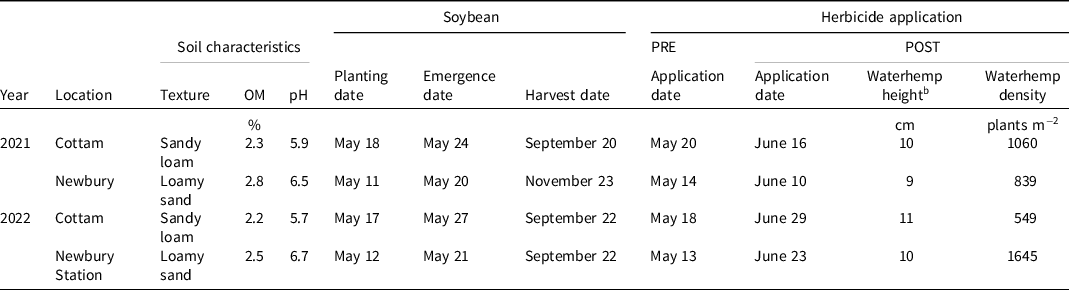
a Abbreviations: OM, organic matter; PRE, preemergence; POST, postemergence.
b Waterhemp height at POST application average the nontreated control.
Herbicides used in trials for two-pass MHR waterhemp control in soybean resistant to glyphosate/glufosinate/2,4-D.
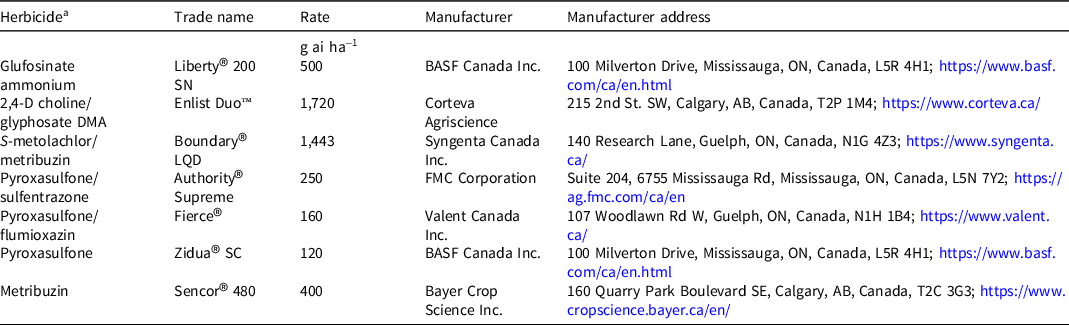
a The recommended adjuvant was applied with each herbicide used: Glufosinate ammonium included ammonium sulfate (Alpine Plant Foods, 30 Neville St, New Hamburg, ON, Canada, N3A 4G7) at 6.5 L ha−1.
Soybean injury was visually assessed 2 wk after crop emergence (WAE), 4 wk after the PRE herbicide application (WAA-A), and 1 and 4 wk after the POST herbicide application (WAA-B). Assessments were performed on a 0% to 100% scale, where 0% represents no injury and 100% represents soybean death. MHR waterhemp control was visually assessed 2 WAA-A, just prior to the POST application (4 WAA-A), and 4 and 8 WAA-B. Waterhemp density and dry weight (biomass) were determined 4 WAA-B. Two 0.25-m2 quadrats were randomly placed within each plot where MHR waterhemp plants were counted, clipped at the soil surface, and placed in labeled paper bags. The bags were then placed in a kiln and dried at 60 C until the biomass reached constant moisture (approximately 2wk), after which the dry weight was recorded. At harvest maturity, the center two rows from each plot were harvested with a small-plot combine, and soybean seed weight and moisture content were recorded. Prior to statistical analysis, soybean yield was adjusted to 13.0% moisture.
Statistical Analysis
Statistical analysis was performed using the GLIMMIX procedure in SAS software (version 9.4; SAS, Cary, NC). The variance consisted of the fixed effect of herbicide treatment and the random effects of environment, and replication within environment. Environment incorporates differences in year and location of the trials. There was no significant treatment by environment interactions; data were pooled across all environments. Assumptions of normality were tested using the Shapiro-Wilk statistic and plotted residuals. Assumptions included that the errors are random, homogenous, independent of effects, have a mean of zero, and are normally distributed. Control data were arcsine square-root transformed to meet these assumptions. The density and dry biomass data were analyzed using a lognormal distribution. All transformed data were subject to back-transformations for the presentation of results. Contrasts were used to compare PRE vs. POST, PRE vs. PRE fb POST, POST vs. PRE fb POST, and to compare the two POST herbicides in a two-pass system. The Tukey-Kramer test was used with a significance of P = 0.05.
Results and Discussion
Soybean Injury
All herbicides evaluated caused minimal soybean injury (<10%); data are not presented.
MHR Waterhemp Control
The MHR waterhemp control among the PRE herbicides evaluated was not significantly different at 2 WAA-A; the PRE herbicides controlled MHR waterhemp by 94% to 98% (Table 3). At 4 WAA-A, pyroxasulfone/sulfentrazone and pyroxasulfone + metribuzin controlled MHR waterhemp greater than S-metolachlor/metribuzin; pyroxasulfone/flumioxazin provided intermediate control, which was similar to that of all PRE herbicides.
Multiple herbicide-resistant waterhemp control with PRE herbicides evaluated prior to a POST herbicide application from four field trials. a, b

a Abbreviations: PRE, preemergence; POST, postemergence; WAA-A, weeks after application A (preemergence herbicide treatment).
b Means in the same column followed by the same letter are not statistically different.
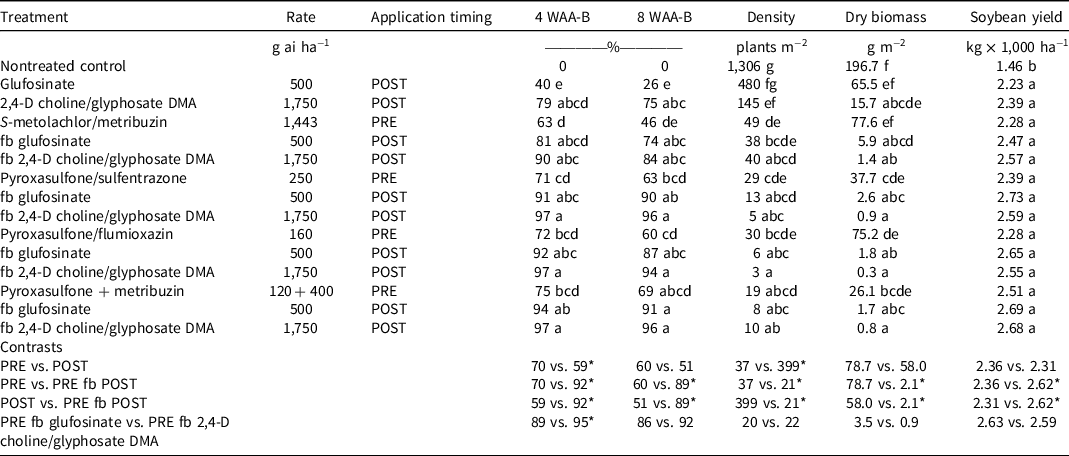
Waterhemp control data 4 and 8 WAA-B, waterhemp density, waterhemp dry biomass, and seed yield of soybean data are presented in Table 4. The PRE application of S-metolachlor/metribuzin, pyroxasulfone/sulfentrazone, pyroxasulfone/flumioxazin, and pyroxasulfone + metribuzin controlled MHR waterhemp by 63%, 71%, 72%, and 75%, respectively at 4 WAA-B; control decreased to 46%, 63%, 60%, and 69%, respectively, at 8 WAA-B. 2,4-D choline/glyphosate DMA applied POST provided greater control of MHR waterhemp by 39 and 49 percentage points compared to glufosinate at 4 and 8 WAA-B, respectively. In greenhouse studies, Chahal et al. (Reference Chahal, Aulakh, Rosenbaum and Jhala2015) observed 95% control of glyphosate-resistant waterhemp plants that were ≤10 cm tall with 2,4-D choline/glyphosate DMA (1,640 g ae ha−1). Following a PRE application of S-metolachlor/metribuzin, pyroxasulfone/sulfentrazone, pyroxasulfone/flumioxazin, or pyroxasulfone + metribuzin, a POST application of glufosinate or 2,4-D choline/glyphosate DMA improved MHR waterhemp control by 18% to 27%, 20% to 26%, 20% to 25%, and 19% to 22%, respectively, 4 WAA-B. Based on nonorthogonal contrasts a single PRE herbicide application provided 11% greater MHR waterhemp control than a single POST application, a two-pass herbicide program provided greater MHR waterhemp control compared to a single-pass of a PRE (22%) or POST (33%) herbicide program, and in a two-pass program, a POST 2,4-D choline/glyphosate DMA application provided greater control of MHR waterhemp than glufosinate (6%) at 4 WAA-B. Results are similar to research conducted by Schryver et al. (Reference Schryver, Soltani, Hooker, Robinson, Tranel and Sikkema2017c) who found enhanced MHR waterhemp control when applying 2,4-D choline/glyphosate DMA POST compared to glufosinate POST. Glufosinate or 2,4-D choline/glyphosate DMA applied POST following S-metolachlor/metribuzin applied PRE improved control by 28 and 38 percentage points, respectively, 8 WAA-A. Following pyroxasulfone/sulfentrazone or pyroxasulfone/flumioxazin applied PRE, 2,4-D choline/glyphosate DMA applied POST improved MHR waterhemp by 33 and 34 percentage points, respectively, 8 WAA-B. Based on nonorthogonal contrasts a two-pass herbicide strategy of a PRE fb a POST application resulted in increased MHR waterhemp control than a single PRE (29%) or POST (38%) application; however, no significant differences were observed between a single PRE compared to POST program, and when applied following a PRE-applied herbicide.
Means and nonorthogonal contrasts for multiple-herbicide resistant waterhemp control, density, dry biomass, and soybean yield. a, b, c
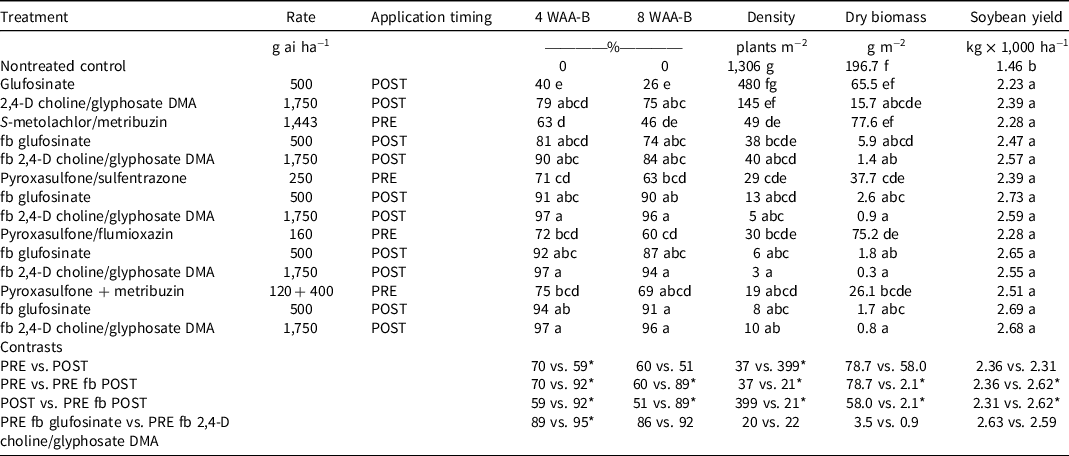
a Abbreviations: fb, followed by; NS, nonsignificant; POST, postemergence; PRE, preemergence; WAA-B, weeks after application B (POST herbicide treatment).
b Means followed by the same lowercase letter within the same column are not statistically different according to the Tukey-Kramer test (P < 0.05).
c An asterisk (*) indicates P < 0.05.
MHR Waterhemp Density and Dry Biomass
All herbicide treatments decreased MHR waterhemp density (89% to 100%) as a percentage of the nontreated control, except for glufosinate applied POST at 4 WAA-B. The PRE-applied herbicides lowered MHR waterhemp density by 96% to 99%. All two-pass herbicide programs reduced MHR density by ≥97%. Based on nonorthogonal contrasts herbicide programs consisting of a PRE fb a POST treatment caused a greater decrease in MHR waterhemp density than one-pass PRE or POST herbicides, and a PRE herbicide application caused a greater decrease in MHR waterhemp density than a single POST application. When applied following a PRE herbicide there was no difference in MHR waterhemp control between the POST application of 2,4-D choline/glyphosate DMA and glufosinate.
S-metolachlor/metribuzin applied PRE and glufosinate applied POST did not decrease MHR waterhemp dry biomass compared to that of the nontreated control. Pyroxasulfone/sulfentrazone, pyroxasulfone/flumioxazin, and pyroxasulfone + metribuzin applied PRE reduced MHR waterhemp biomass similarly at 62% to 87%. The two-pass weed control programs reduced MHR waterhemp biomass 97% to 100%. A POST application of glufosinate or 2,4-D choline/glyphosate DMA following a PRE application of S-metolachlor/metribuzin or pyroxasulfone/flumioxazin decreased dry biomass compared to a single PRE application of the aforementioned PRE herbicides. 2,4-D choline/glyphosate DMA applied POST following pyroxasulfone/sulfentrazone or pyroxasulfone + metribuzin applied PRE decreased dry biomass compared to a single PRE application. Based on nonorthogonal contrasts, a two-pass system of a PRE herbicide fb glufosinate or 2,4-D choline/glyphosate DMA applied POST reduced MHR waterhemp dry biomass compared to a single-pass herbicide application.
Soybean Yield
Soybean seed yield decreased 47% due to MHR waterhemp presence (highest yielding treatment compared to nontreated control). Based on nonorthogonal contrasts reduced waterhemp interference with two-pass weed control strategies resulted in greater soybean yield than a single PRE or POST application. This is consistent with research carried out by Schryver et al. (Reference Schryver, Soltani, Hooker, Robinson, Tranel and Sikkema2017b) that showed increased soybean seed yield with PRE fb POST herbicide treatments evaluated for the control of glyphosate-resistant waterhemp.
In summary, two-pass weed control programs of a PRE fb POST herbicide provided improved MHR waterhemp control, reduced waterhemp density and dry biomass, and greater soybean seed yield. Results are similar to those reported by Craigmyle et al. (Reference Craigmyle, Ellis and Bradley2013) who observed improved waterhemp control with PRE fb POST strategies that incorporate glufosinate and 2,4-D applied POST. 2,4-D choline/glyphosate DMA applied POST provided superior MHR waterhemp control than the POST application of glufosinate. Reduced control with glufosinate may be due to the herbicide’s limited translocation in the weed compared to 2,4-D, which has symplastic translocation (Sterling and Hall Reference Sterling, Hall, Roe, Burton and Kuhr1997; Takano et al. Reference Takano, Beffa, Preston, Westra and Dayan2020). Herbicide programs that use a PRE residual herbicide and a POST treatment of 2,4-D choline/glyphosate DMA provide GG2R soybean growers with solutions for managing MHR waterhemp populations. Season-long control of MHR waterhemp reduces the number of seeds in the soil seedbank and limits the spread of MHR waterhemp. By using a diverse selection of integrated weed management (IWM) strategies growers can reduce the herbicide resistance selection pressure placed on waterhemp populations. IWM strategies include a reduction in crop row width, cover crops, alternating herbicide modes of action, and crop rotation. Herbicide-resistant crop technologies can be an integral part of an IWM program; however, they should be used judiciously to reduce resistance selection and maintain their effectiveness.
Acknowledgments
This study received partial funding from BASF Canada Inc. and Grain Farmers of Ontario. No other conflicts of interest have been declared.



 Open access

