





Highlights
-
1. Older adults made more errors in theory-of-mind (ToM) tasks than younger adults.
-
2. Earlier L2AoA predicted enhanced ToM performance in older bilinguals.
-
3. This effect was over and beyond the effects of age, education, and cognitive ability.
-
4. Bilingual usage, proficiency, and code-switching showed no significant effects on ToM.
-
5. Results indicate early bilingualism may protect against age-related ToM decline.
1. Introduction
To navigate the social world and participate in positive social interactions, theory-of-mind (ToM)—the ability to understand the mental states of others independently from our own—is necessary for understanding the behaviors and needs of others across the lifespan (Baron-Cohen et al., Reference Baron-Cohen, Tager-Flusberg and Cohen1993; Caputi et al., Reference Caputi, Lecce, Pagnin and Banerjee2012; Frith, Reference Frith2008). Despite some mixed evidence, many recent studies have shown that older adults are susceptible to a decline in ToM in normal aging (for reviews and meta-analyses, see Fernandes et al., Reference Fernandes, Barbosa, Martins and Marques-Teixeira2021; Henry et al., Reference Henry, Phillips, Ruffman and Bailey2013; Roheger et al., Reference Roheger, Brenning, Riemann, Martin, Flöel and Meinzer2022). Importantly, while evidence shows that bilingual experience may be beneficial to ToM development in childhood and young adulthood (e.g., Navarro & Conway, Reference Navarro and Conway2021; Nguyen & Astington, Reference Nguyen and Astington2014; Rubio-Fernandez & Glucksberg, Reference Rubio-Fernández and Glucksberg2012; Schroeder, Reference Schroeder2018), research examining bilingual effects on ToM in the aging population is limited (see Feng et al., Reference Feng, Cho and Luk2023). In this article, we seek to examine the relationship between bilingual experience and ToM performance in late adulthood and explore the role of bilingualism in contributing to intact ToM ability against normal age-related deteriorations.
Traditionally, the ToM literature has focused on children, where there is largely a consensus that ToM ability develops in early childhood (Wellman & Liu, Reference Wellman and Liu2004) and continues to improve throughout adolescence (Dumontheil et al., Reference Dumontheil, Apperly and Blakemore2010; Osterhaus & Koerber, Reference Osterhaus and Koerber2021), with performance peaking in young adulthood (Osterhaus & Bosacki, Reference Osterhaus and Bosacki2022). For instance, by 3 years old, children demonstrate some early ability to detect and identify others’ emotions and desires (e.g., Pons et al., Reference Pons, Harris and de Rosnay2004). By age 5, children develop their basic ToM understanding and can explicitly reason about others’ mental states that are different from their own, such as perspective-taking and first-order false belief (e.g., Wellman et al., Reference Wellman, Cross and Watson2001). From age 6 to the teen years, children become more skilled at inferring complex emotional and mental states, such as higher-order emotions and false beliefs, lies, sarcasm, metaphor, and so on (e.g., Osterhaus et al., Reference Osterhaus, Koerber and Sodian2016; Warnell & Redcay, Reference Warnell and Redcay2019).
In recent years, there has been an increasing number of research that attempted to understand how ToM ability changes beyond young adulthood (e.g., Bradford et al., Reference Bradford, Brunsdon and Ferguson2023; Grainger et al., Reference Grainger, Crawford, Riches, Kochan, Chander, Mather, Sachdev and Henry2023; Krendl et al., Reference Krendl, Mannering, Jones, Hugenberg and Kennedy2023; Wang & Su, Reference Wang and Su2013). With a few exceptions (e.g., Dodell-Feder et al., Reference Dodell-Feder, Ressler and Germine2020; Happé et al., Reference Happé, Winner and Brownell1998), current findings suggest an age-related decline in ToM ability, typically starting around 40–50 years of age (e.g., Bradford et al., Reference Bradford, Brunsdon and Ferguson2023; Grainger et al., Reference Grainger, Crawford, Riches, Kochan, Chander, Mather, Sachdev and Henry2023; see Fernandes et al., Reference Fernandes, Barbosa, Martins and Marques-Teixeira2021; Henry et al., Reference Henry, Phillips, Ruffman and Bailey2013, for reviews). For example, using the Director Task where participants must consider the perspective of the “director” to infer the referential target, Bradford et al. (Reference Bradford, Brunsdon and Ferguson2023) reported that middle-aged (41–62 years old) and older (63–86 years old) adults made increasing errors with advancing age across middle and later adulthood, whereas young adults (20–40 years old) performed at ceiling levels in this task. There has been evidence showing age-related differences in ToM as a function of cognitive demands, where cognitive ability is often found to decline with healthy aging (e.g., Phillips et al., Reference Phillips, Bull, Allen, Insch, Burr and Ogg2011; Rahman et al., Reference Rahman, Kessler, Apperly, Hansen, Javed, Holland and Hartwright2021). However, a recent meta-analysis by Roheger et al. (Reference Roheger, Brenning, Riemann, Martin, Flöel and Meinzer2022) revealed that healthy older adults (defined as 50 years old and above) performed significantly worse than young adults (below 50 years old) in all ToM aspects identified in their analysis, including cognitive ToM (i.e., inferences about thoughts, intentions, and beliefs), affective ToM (i.e., inferences about feelings), and mixed ToM (i.e., cognitive and affective ToM not differentiated), with the largest effect size for cognitive ToM.
Thus, while the findings seem consistent in showing a general decline in older adults’ ToM, meta-analyses have indicated a certain level of variability in the reported effects of age in past studies (e.g., Fernandes et al., Reference Fernandes, Barbosa, Martins and Marques-Teixeira2021; Roheger et al., Reference Roheger, Brenning, Riemann, Martin, Flöel and Meinzer2022). This variability may be attributable to methodological limitations in the literature, such as the use of different tasks purported to measure different aspects of ToM and different populations with varying age cutoffs and education backgrounds (e.g., Henry et al., Reference Henry, Phillips, Ruffman and Bailey2013; Raimo et al., Reference Raimo, Cropano, Roldán-Tapia, Ammendola, Malangone and Santangelo2022). For example, Roheger et al. (Reference Roheger, Brenning, Riemann, Martin, Flöel and Meinzer2022) found that studies using cognitive ToM tasks, such as first- and second-order false-belief tasks and the Director Task, generally reported a larger effect size (i.e., greater difference between younger and older adults) than studies using affective ToM tasks, such as facial recognition tasks and the Reading the Mind in the Eyes Tests (RMET). Older adults also appeared to show declined performance only on more complex ToM tasks that required higher-order mental inferences (e.g., McKinnon & Moscovitch, Reference McKinnon and Moscovitch2007). These findings highlight the importance of considering task specificity when examining age-related effects in ToM research.
Moreover, while many studies compared the ToM performance of people from different age groups (e.g., most often young adults versus older adults, sometimes including a third group of middle age), the age cutoffs for these groups are often arbitrary and vary across studies. A meta-analysis by Rahman (Reference Rahman2021) highlighted this variability, showing that the mean reported age of the older adult group ranged from 65–84 across 28 studies. The analysis found a medium age effect for studies with a younger group of older adults (range of mean age: 60–74) and a large age effect for studies with an older group of older adults (mean age 75 and above). This variability underscores a key challenge in aging research: using age groups with arbitrary cutoffs may affect the interpretation of findings and limit our understanding of the trajectory of age-related decline throughout adulthood. Despite these limitations, the categorical approach remains widely used as it allows for direct comparisons between older adults (within a defined age range) and younger adults, who are often assumed to be at their peak cognitive performance. In this study, we compared older and younger adults using age groups while also treating age as a continuous variable within each group of adults to examine how bilingual language experience influences their ToM performance, which tends to decline after midlife. However, we acknowledge recent efforts to explore alternative approaches, such as sampling participants across a broader age range from young to old (e.g., Bradford et al., Reference Bradford, Brunsdon and Ferguson2023). We will discuss this issue in greater detail in our analysis and interpretation of the data.
Fundamentally, some researchers have argued that, when studying adult ToM, its operational definition (including its cognitive and affective component) and assessment are often “vague and inconsistent” (Schaafsma et al., Reference Schaafsma, Pfaff, Spunt and Adolphs2015, p. 65; also see Quesque & Rossetti, Reference Quesque and Rossetti2020; Yeung et al., Reference Yeung, Apperly and Devine2024), and they have called for research with more specific hypotheses regarding ToM in the topics of investigation. Given that our goal is to examine the effects of bilingualism on ToM abilities in young and older adults, we employ the classic definition of ToM as the ability to attribute mental states (such as beliefs, intentions, and emotions) to others (Frith & Frith, Reference Frith and Frith2006; Gallese & Sinigaglia, Reference Gallese and Sinigaglia2011). Thus, our ToM assessments include belief, intention, and emotion inferences across various levels of complexity (e.g., from basic to advanced ToM judgments). We aim to provide evidence on the impact of age and bilingual language experience on general ToM abilities in the aging process.
We propose that there is significant heterogeneity in age-related changes in ToM across individuals, even within the common aspects of ToM alterations (e.g., Grainger et al., Reference Grainger, Crawford, Riches, Kochan, Chander, Mather, Sachdev and Henry2023; Greenberg et al., Reference Greenberg, Warrier, Abu-Akel, Allison, Gajos, Reinecke, Rentfrow, Radecki and Baron-Cohen2023; Otsuka et al., Reference Otsuka, Nakai, Shizawa, Itakura, Sato and Abe2024; Roheger et al., Reference Roheger, Brenning, Riemann, Martin, Flöel and Meinzer2022). The rate and extent of these age-related changes in ToM may be influenced by individual experiences that could account for longitudinal changes in social cognition and the brain (e.g., Dotson & Duarte, Reference Dotson and Duarte2020; Henry et al., Reference Henry, Grainger and von Hippel2023; Li et al., Reference Li, Ng, Wong, Zhou and Yow2024). We draw parallels with the revised Scaffolding Theory of Aging and Cognition (STAC-r; Reuter-Lorenz & Park, Reference Reuter-Lorenz and Park2014), which posits that life-course factors (e.g., experience and environment) influence the developmental course of brain structure, function, and cognition over time. These life-course factors, such as education and social engagement, may increase cognitive reserve, the brain’s ability to actively use other brain pathways to compensate for age- or disease-related deterioration (Stern, Reference Stern2002; Reference Stern2009). Consequently, these experiences allow individuals to better cope with cognitive challenges and mitigate the adverse effects of age-related structural and functional brain changes (Stern et al., Reference Stern, Barnes, Grady, Jones and Raz2019). For example, middle-aged and older adults who engaged more actively in cognitive, leisure, and social activities were reported to have better cognitive ability, less age-related cognitive decline, and a reduced risk of dementia diagnosis than their less-active peers (e.g., Wilson et al., Reference Wilson, Boyle, Yu, Barnes, Schneider and Bennett2013).
Importantly, variables such as bilingualism have been identified as having a positive impact on cognitive aging (e.g., Bialystok, Reference Bialystok2021; Gallo & Abutalebi, Reference Gallo and Abutalebi2023). Both theoretical and empirical work suggest bilingualism contributes to cognitive and brain reserve, helping to protect against cognitive decline with age, with either preserved brain functional efficiency or greater neural tissue in bilingual older adults compared with their monolingual counterparts (e.g., Abutalebi et al., Reference Abutalebi, Canini, Della Rosa, Sheung, Green and Weekes2014; Gallo et al., Reference Gallo, Novitskiy, Myachykov and Shtyrov2021; Luk et al., Reference Luk, Bialystok, Craik and Grady2011; Stevens et al., Reference Stevens, Khan, Anderson, Grady and Bialystok2023; see Anderson et al., Reference Anderson, Hawrylewicz and Grundy2020; Gallo et al., Reference Gallo, DeLuca, Prystauka, Voits, Rothman and Abutalebi2022, for reviews). Remarkably, in cases where bilinguals show accelerated brain atrophy, their cognitive performance remains relatively preserved (Anderson et al., Reference Anderson, Grundy, Grady, Craik and Bialystok2021; Perani et al., Reference Perani, Farsad, Ballarini, Lubian, Malpetti, Fracchetti, Magnani, March and Abutalebi2017; Schweizer et al., Reference Schweizer, Ware, Fischer, Craik and Bialystok2012). Individual differences in brain functional correlates are also associated with a wide range of bilingual experiences, including onset age of bilingualism (e.g., DeLuca et al., Reference DeLuca, Rothman, Bialystok and Pliatsikas2020; Luk et al., Reference Luk, Mesite and Guerrero2020), bilingual language proficiency and usage (e.g., DeLuca & Voits, Reference DeLuca and Voits2022; Sulpizio et al., Reference Sulpizio, Del Maschio, Del Mauro, Fedeli and Abutalebi2020), and language diversity (i.e., language entropy, e.g., Gullifer et al., Reference Gullifer, Chai, Whitford, Pivneva, Baum, Klein and Titone2018; Li et al., Reference Li, Ng, Wong, Lee, Zhou and Yow2021). Thus, it has been suggested that bilingualism offers protection against cognitive decline via compensatory scaffolding, such that it can provide additional support to compensate for declining neurocognitive function with age.
Based on the STAC-r framework, we postulate that life-course enrichment factors, such as individual language experience in a bilingual context, would similarly offer enhancement and compensatory scaffolding to social cognitive ability during aging. Previous research on children and younger adults suggests a link between bilingualism and ToM advantages. A large body of research has reported that bilingual children outperformed monolingual children in ToM-based tasks (e.g., Fan et al., Reference Fan, Liberman, Keysar and Kinzler2015; Kovács, Reference Kovács2009; see Schroeder, Reference Schroeder2018, for a meta-analysis). There is also evidence that bilinguals’ superior ToM performance in childhood continues into young adulthood (e.g., Lorge & Katsos, Reference Lorge and Katsos2019; Navarro & Conway, Reference Navarro and Conway2021; Rubio-Fernandez & Glucksberg, Reference Rubio-Fernández and Glucksberg2012; cf. Ryskin et al., Reference Ryskin, Brown-Schmidt, Canseco-Gonzalez, Yiu and Nguyen2014). For example, Navarro & Conway (Reference Navarro and Conway2021) revealed better perspective-taking ability in bilingual versus monolingual college students (mean age = 27.29 years). Going beyond comparisons between monolinguals and bilinguals, two studies examined whether individual differences in bilingual experience influence perspective-taking or mentalizing skills among young adult bilinguals (e.g., aged 18–35; Navarro et al., Reference Navarro, DeLuca and Rossi2022; Tiv et al., Reference Tiv, O’Regan and Titone2021). It was found that more regular L2 usage and greater childhood exposure to diverse languages both contributed to better perspective-taking ToM in a sample of bilingual participants (mean age = 25.27 years), but L2 fluency or number of languages spoken did not have an impact on their ToM performance (Navarro et al., Reference Navarro, DeLuca and Rossi2022). The effects of bilingualism on ToM may arise from certain aspects of the bilingual experience that foster early development of sociolinguistic sensitivity (i.e., the awareness of other people’s mental states). For example, encountering people from diverse language backgrounds may “train” bilinguals to infer what other people know and do not know (also see Yu et al., Reference Yu, Kovelman and Wellman2021).
The effects of bilingual experience on older adults’ ToM, however, have not yet been well studied. To our knowledge, only one study has administered a ToM task (i.e., the Faux Pas task, “a measure of complex ToM”; p. 299) together with six cognitive tests in monolingual and bilingual participants at age 74 as part of a longitudinal study (Cox et al., Reference Cox, Bak, Allerhand, Redmond, Starr, Deary and MacPherson2016). They found some weak evidence for a bilingual advantage on the Faux Pas task, but this advantage was attenuated when controlling for pre-existing differences in childhood intelligence and social class. Although informative, this study mainly focused on more advanced ToM and did not sufficiently capture individual variability in bilingual experience (e.g.,participants who could communicate in a second language were coded as bilingual). Our study seeks to examine the relation between aging, bilingual experience, and ToM (with a variety of content and complexity), which could provide important insights into how such life-course enriching experience (e.g., early acquisition of a second language or using more than one language) on ToM skills in later life. Lifelong bilingualism may help preserve ToM abilities in older adults, mitigating age-related declines.
In the current study, bilingualism is examined through individual variations in the participants’ diverse language experiences rather than a binary comparison ToM between monolinguals and bilinguals. Recent perspectives on bilingualism have largely converged in agreement that bilingualism exists on a continuum rather than as a strict monolingual-bilingual dichotomy, and research has shifted away from traditional designs with monolingual versus bilingual comparisons and toward a model of bilingualism as a spectrum of experiences that may affect the structure and function of the brain (e.g., DeLuca et al., Reference DeLuca, Rothman, Bialystok and Pliatsikas2019; Luk & Bialystok, Reference Luk and Bialystok2013; Yow & Li, Reference Yow and Li2015). Here, to quantify individuals’ degree of bilingualism and its role in the trajectories of ToM aging, we first extract self-reported measures of bilingualism-related variables on the timing of second language learning (i.e., second language age of acquisition [L2AoA]), usage, and proficiency in the different languages, the relative balance or diversity in language usage, as well as language-switching practices. We then apply data reduction techniques (i.e., principal component analysis [PCA]) to create a more manageable set of variables for analysis (see Gullifer & Titone, Reference Gullifer and Titone2020, for a similar approach). By modeling bilingualism as a multifaceted experience, we aim to examine whether the various experiences of bilingualism contribute to better ToM skills across young and older adulthood.
When examining the effects of aging and bilingualism in relation to ToM, it is also important to consider other behavioral correlates, including general cognitive capacities such as processing speed, memory, and executive functions. Specifically, studies documenting age-related differences in ToM have produced contradictory findings regarding whether such differences are explained by decreased ToM competence or decreased cognitive competence, as general cognitive declines often co-occur with ToM declines in these studies (e.g., Charlton et al., Reference Charlton, Barrick, Markus and Morris2009; Phillips et al., Reference Phillips, Bull, Allen, Insch, Burr and Ogg2011; Sandoz et al., Reference Sandoz, Démonet and Fossard2014; see Hamilton et al., Reference Hamilton, Gourley and Krendl2022, for a review). Some studies reported that older adults’ ToM deficits could be partially or fully explained by a decline in episodic memory (Fischer et al., Reference Fischer, O’Rourke and Loken Thornton2017), executive functions (e.g., updating information in working memory, or inhibitory control; Phillips et al., Reference Phillips, Bull, Allen, Insch, Burr and Ogg2011; Rahman et al., Reference Rahman, Kessler, Apperly, Hansen, Javed, Holland and Hartwright2021), or processing speed (Charlton et al., Reference Charlton, Barrick, Markus and Morris2009). Other studies provided evidence suggesting that age differences in ToM were independent of general cognitive decline such that age remained a significant predictor of ToM performance even after controlling for general cognition (e.g., Cavallini et al., Reference Cavallini, Lecce, Bottiroli, Palladino and Pagnin2013; Grainger et al., Reference Grainger, Crawford, Riches, Kochan, Chander, Mather, Sachdev and Henry2023; Kong et al., Reference Kong, Currie, Du and Ruffman2022). Compounding the issue further is the potential positive effect of bilingualism in maintaining general cognitive ability in older bilinguals (e.g., Ballarini et al., Reference Ballarini, Kuhn, Röske, Altenstein, Bartels and Buchholz2023; Chan et al., Reference Chan, Yow and Oei2020; Schroeder & Marian, Reference Schroeder and Marian2012; see Chen et al., Reference Chen, Lin, Zuo, Wang, Liang, Jiang and Lin2022, or Ware et al., Reference Ware, Kirkovski and Lum2020, for meta-analyses). Although the argument that bilingualism confers a cognitive advantage in older adults has been challenged by recent replication and meta-analytic studies (e.g., Papageorgiou et al., Reference Papageorgiou, Bright, Periche Tomas and Filippi2019; Samuel et al., Reference Samuel, Roehr-Brackin, Pak and Kim2018), it is nevertheless important to control for such variables in our study.
In summary, our study assesses young and older adults on a battery of ToM tasks that evaluated ToM understanding across different types of content (e.g., inferences about others’ beliefs, intentions, or emotions) and levels of complexity (e.g., inferences about basic or higher-order ToM). Our hypotheses are twofold: first, we expect a main effect of age, with older adults overall performing poorer than young adults on ToM tasks. Second, we predict that bilingualism will moderate ToM ability in older adults, due to its potential compensatory effect in supporting social cognitive function against age-related declines. It is possible that older adults with an earlier onset age of bilingualism and/or more extensive bilingual experience would outperform those with later acquisition and/or less extensive experience. However, we did not have a specific hypothesis regarding differential effects for L2AoA and other aspects of bilingualism as prior research on younger adults has yielded mixed findings about which components of bilingualism are associated with ToM (e.g., Navarro et al., Reference Navarro, DeLuca and Rossi2022; Tiv et al., Reference Tiv, O’Regan and Titone2021). To determine whether age and bilingualism effects are independent of general cognition, we also included assessments of processing speed, episodic memory, working memory, and inhibitory control to control for the possible contribution of these variables in explaining participants’ ToM performance in our study.
2. Methods
2.1. Participants
Our sample consisted of 185 participants, including 80 young adults (YA; M age = 22.03 years, range = 19–30; 47 females, 33 males) and 105 older adults (OA; M age = 66.23 years, range = 56–79; 69 females, 36 males). An a priori power analysis suggested that a minimum sample size of 128 (64 per group) is required to achieve 80% power (α = .05) in detecting a moderate effect of age (d = 0.5) based on previous meta-analyses (e.g., Henry et al., Reference Henry, Phillips, Ruffman and Bailey2013). However, we recruited a larger sample size to examine the effects of bilingualism variables using regression analyses. We conducted simulation-based power analysis using the “simr” package (Green & MacLeod, Reference Green and MacLeod2016) in R to determine the achieved power to detect a significant main effect for the tested predictors in the Poisson regression model, which showed that our sample size was sufficient to achieve 80% power (α = .05, 1000 simulations). The young adult sample was mainly undergraduate students and recruited through email or announcements in lectures. Older participants were community residing and recruited via posters in local care service centers, on social media, or through word-of-mouth. Participants received either course credit (students only) or SGD30 gift vouchers for their participation. The study protocol was approved by the Institutional Review Board of the Singapore University of Technology and Design (approval number 16–109 and 21–425). Participant demographic characteristics (means and SDs) and Welch’s t-test statistics, which are appropriate for group comparisons with unequal sample sizes (Delacre et al., Reference Delacre, Lakens and Leys2017), are presented in Table 1. A detailed report of descriptive statistics and distribution for all variables in this study can be found in Supplementary Materials (Table S1).
Descriptive statistics and analysis of age group differences for participants’ demographic, language, cognitive, and ToM measures

Note: ToM = theory of mind; MoCA = Montreal Cognitive Assessment; L2AoA = second language age of acquisition; PC = principal component. Education was coded on a 1–5 scale: 1 = primary school, 2 = secondary school, 3 = high school, diploma, or junior college, 4 = undergraduate, 5 = post-graduate. Language usage was self-reported frequency of usage in a typical week (in proportion), and proficiency was the average score for listening and speaking on a scale from 1 = not proficient to 10 = very proficient.
*p < .05. **p < .01. ***p < .001.
a Scores range from 0 indicating usage of only one language across various social contexts (i.e., home, school, work, and others), to a maximum of 2 indicating equal usage of all different languages, hence, an integrated language context.
b Dependent measures for the cognitive assessments are expressed as z-scores, with higher scores indicative of better performance. The four domains of processing speed, episodic memory, working memory, and inhibitory control were assessed by the Digit Symbol Substitution Test, Rey Auditory Verbal Learning Test, 2-back task, and numeric Stroop task, respectively.
All participants were Singapore citizens except for three young adults who were not Singapore citizens but reported having lived in Singapore for at least 10 years. All were ethnic Chinese. All participants reported having normal/corrected-to-normal visual acuity, normal color vision, and no history of neurological or psychiatric illnesses. Additionally, older adults were screened for abnormal cognitive decline using the Singapore version of the Montreal Cognitive Assessment (MoCA; Nasreddine et al., Reference Nasreddine, Phillips, Bédirian, Charbonneau, Whitehead, Collin and Chertkow2005) that was validated for use in the local older population (e.g., Ng et al., Reference Ng, Feng, Lim, Chong, Lee, Yap, Tsoi, Liew, Gao, Collinson, Kandiah and Yap2015). We used the recommended cutoff score of 23 (out of 30), with those scoring 22 or below suspected of having mild cognitive impairment; this resulted in the exclusion of three additional older adults (scores are 22, 19, and 18) who participated in the study but were not included in the sample reported here. Older participants scored, on average, 27.21 on the MoCA test (SD = 1.71, range = 23–30). Information about education (i.e., the highest level of education completed) was collected to index participants’ socioeconomic status. We coded education on a 5-point scale: 1 = primary school, 2 = secondary school, 3 = high school, diploma, or junior college, 4 = undergraduate, 5 = post-graduate. Older adults’ education ranged from 1 to 5 with a mean of 2.75, which was significantly lower compared with young adults (M = 3.24, range = 3–5), t Welch(153.77) = 4.41, p < .001, d = .63. Hence, education was also included as a control variable in further analyses of the age effect. Given mixed evidence on gender differences in domains of ToM (Dodell-Feder et al., Reference Dodell-Feder, Ressler and Germine2020; Fischer et al., Reference Fischer, O’Rourke and Loken Thornton2017), we also checked for gender differences and gender by age interactions in ToM understanding, but none were found, ps > .83; thus, gender was not considered in the further analyses.
All participants completed a questionnaire on their language background (see 2.2.2. Language background measures, for more details). All participants reported speaking two or more languages; 25 reported knowing two languages (20 YA and 2 OA knew English and Mandarin, 2 OA knew Mandarin and Cantonese, and 1 OA knew Mandarin and Hokkien), and 160 knew three or more languages (60 YA and 98 OA knew English, Mandarin, and one or two of the following languages: Chinese dialects such as Cantonese, Hokkien, Teochew, etc., and other languages such as Malay, Japanese, Korean, German, French, etc., while the remaining 2 OA reported knowing English, Malay, and Chinese dialects). However, these multilingual participants reported minimal usage of their third-most-used (M YA-usage3 = 4.95%, M OA-usage3 = 7.07%) and fourth-most-used (M YA-usage4 = 2.66%, M OA-usage4 = 2.45%) languages as compared with their two most used languages (see Table 1). Hence, we used the term “bilinguals” to refer to the participants in this study. For detailed reports of descriptive statistics for participants’ language variables and comparisons between age groups, refer to Table 1.
2.2. Materials and measurements
All tasks and questionnaires described in this section have validated versions in English and Chinese. During recruitment, participants indicated which language (English or Chinese) they were more dominant and most comfortable speaking in, and this information serves as the language of testing for the respective participants. All 80 young participants and 90 older participants completed the study in English, while 15 older participants completed the study in Chinese. For all tasks except the verbal memory test, the English and Chinese versions use the same stimuli and only differ in their instruction language. For the verbal memory test, different stimuli are used, but both versions have been locally validated (Lee et al., Reference Lee, Collinson, Feng and Ng2012).
2.2.1. Theory-of-mind assessments
The Theory of Mind Task Battery (ToMTB; Hutchins et al., Reference Hutchins, Prelock and Chace2008) was used to examine participants’ ToM abilities. Although the ToMTB was initially developed for use in children (as is the case with most ToM tasks), it has been used to assess ToM in older adults with and without neurocognitive disorders with good validity (e.g., De Rezende et al., Reference De Rezende, Bomfim, Chagas, Osório and Chagas2018; Ferreira Pereira et al., Reference Ferreira Pereira, de Medeiros Cirne, de Oliveira Galvão, Costa, dos Santos Lima Junior, Azevedo Cacho and de Oliveira Cacho2022). The task battery consists of a total of 15 questions across nine tasks that assess ToM understanding across a variety of content and complexity: (a) basic emotion recognition task, (b) desire-based emotion task, (c) perception-based belief task, (d) visual perspective-taking task, (e) perception-based action task, (f) first-order false belief task, (g) belief- and reality-based emotion and second-order emotion task, (h) message-desire discrepant task, and (i) second-order false belief task (see Table S2 in Supplementary Materials, for more details). There were four questions for the task (a), two questions for the task (d), three questions for the task (g), and one question for each of the other tasks.
Tasks were presented as short vignettes that appeared in a story-book format. Participants listened to the experimenter who narrated the vignettes, along with colored visual illustrations. For each vignette, participants were to answer a question about the main character’s beliefs, intentions, or emotions. The experimenter introduced the test by stating, “I am going to read you some short stories and ask you questions about the story. You can answer with words, or you can point to the answer.” For each question, there is one correct response option and three plausible distractors, where any incorrect answer is deemed an error response (examples can be found at https://bit.ly/task-battery). We calculated the number of error responses across all test questions as an index of ToM ability. ToM scores range from 0 to 15, with lower scores indicating fewer ToM errors and hence better ToM understanding.
2.2.2. Language background measures
We used a questionnaire adapted from the Language Background Questionnaire (LBQ; Yow & Li, Reference Yow and Li2015) and the Bilingual Interactional Context Questionnaire (BICQ; Hartanto & Yang, Reference Hartanto and Yang2019) to assess participants’ language background. We constructed the questionnaire in such a way that it captures different aspects of a bilingual experience within a multilingual environment like Singapore. While items from the LBQ mainly assess bilinguals’ general language experiences, such as the age of acquisition, usage, proficiency, and balance (see Dass et al., Reference Dass, Smirnova-Godoy, McColl, Grundy, Luk and Anderson2024), items from the BICQ examine bilinguals’ diverse code-switching and interactional contexts, a “notable characteristics of the Singapore linguistic environment” (Ooi et al., Reference Ooi, Goh, Sorace and Bak2018, p. 869). Participants reported the age at which they were first exposed to each of the languages they knew. Language proficiency in listening and speaking was reported on a 10-point scale (1 = not proficient to 10 = very proficient) and then averaged to obtain one proficiency score per language. Participants were also asked about the amount of time (in percent) spent in different social contexts (i.e., home, work, school, and others) in a typical week, how much they used each language (in proportion) in each of these contexts, and how often (in proportion) they engaged in different interactional contexts (i.e., single-language, dual-language, and dense code-switching; see Green & Abutalebi, Reference Green and Abutalebi2013). To quantify the diversity of language use in participants’ environments, we computed a weighted language entropy score across the different social contexts per participant (following Gullifer & Titone, Reference Gullifer and Titone2018; Li et al., Reference Li, Ng, Wong, Lee, Zhou and Yow2021). Weighted language entropy scores range from 0 indicating usage of only one language across contexts, to 2 indicating equal usage of all possible languages (i.e., a completely integrated context). The group means and SDs for the language variables are reported in Table 1, with a more detailed report of descriptive statistics and correlations presented in Supplementary Materials (Tables S1 and S3).
While we treat bilingualism as a multifaceted experience with multiple language variables, we would like to identify key patterns of the multivariate data for meaningful analyses and interpretation. Thus, we conducted a PCA to analyze and reduce the dimensionality of these language variables. By construction, all principal components extracted from a PCA are orthogonal (i.e., uncorrelated) to each other (Kassambara, Reference Kassambara2017). The variable L2AoA was not included in the PCA as it did not correlate with any language variables (rs < .20, ps > .22; see Supplementary Table S3). Data were standardized before performing PCA. Using the “princomp()” function of the “stats” R package, three principal components were extracted (determined by eigenvalues > 1; also see scree plot in Supplementary Figure S1), which explained 79.1% of the total variance. Table 2 shows the component loadings, which indicate the contributions of variables to each component. Inspection of the variables loaded on each component suggests that Principal Component 1 represents “bilingual usage,” Principal Component 2 represents “bilingual proficiency,” and Principal Component 3 represents “code-switching.” More specifically, the “bilingual usage” component had relatively high positive loadings (> .40) for the usage of the second-most used language and weighted language entropy, and high negative loadings for the usage of the most used language and single-language context (explaining 49.9% of the total variance). The “bilingual proficiency” component had high positive loadings for both proficiency values of the two most proficient languages (16.1% of total variance). The “code-switching” component had a negative loading for dual-language context and a positive loading for dense code-switching context (13.3% of total variance). Next, component scores were extracted via “get_pca_ind()” in R, which computed standardized component scores for each participant and each component by multiplying the individual’s variable-level responses by the component loadings. Based on the attributes of the three principal components, higher component scores for PC1, PC2, and PC3 indicate more balanced bilingual usage, higher proficiency in their two languages, and more dense code-switching interactional experience, respectively. The three component scores, together with L2AoA, are the main measures of bilingualism in this study and are used in further analysis to examine the effects of bilingualism on ToM.
Loading matrix of the three principal components for bilingual language experience

Note: N = 185. Loadings greater than 0.4 (bolded) are considered stable (Stevens, Reference Stevens2009).
2.2.3. General cognition assessments
We used a battery of tasks to assess four general cognitive domains: processing speed, episodic memory, working memory, and inhibitory control (see Supplementary Materials for details). The Digit Symbol Substitution Test (DSST) of the Wechsler Adult Intelligence Scale (WAIS-III; Wechsler, Reference Wechsler2000) was used to index the speed of processing. The Rey Auditory Verbal Learning Test (RAVLT; Schmidt, Reference Schmidt1996) was administered, and the delayed recall score from this task was used as a measure of verbal episodic memory. We computerized the 2-back task and the numeric Stroop task to assess working memory and inhibition, respectively. Raw scores for each of the individual cognitive assessments were transformed into z-scores based on the sample means and SDs across all participants, with higher scores indicating better performance.
2.3. Procedure
Participants were tested individually in a quiet room after providing informed consent. All older participants were assessed on the MoCA at the beginning of the experiment session. All young and older participants completed the assessments in the following order: Stroop, RAVLT, DSST, ToMTB, 2-back, and language background measures.
2.4. Analysis
The preliminary analyses revealed no missing data and no multivariate outliers. As a result, all analyses reported in this article included the full sample (N = 185), unless otherwise noted. Skewness and kurtosis values for all variables were within the acceptable range of (−3, +3) and (−10, +10), respectively (see Supplementary Tables S1 and S4), indicating no violation of the normality assumption (Kline, Reference Kline2011).
To examine the effects of age and bilingualism on ToM scores (i.e., number of errors), we conducted a series of generalized linear models (GLM) with Poisson distributionFootnote 1, which gives the probability of an event happening a certain number of times and is suitable to model count data (Zeileis et al., Reference Zeileis, Kleiber and Jackman2008). Since Poisson regression models the log of the expected count as a linear function of predictor variables (e.g., log(μ) = α + βx), the regression coefficient can be interpreted as follows: for a unit change in the predictor variable, the estimated count is expected to change by a factor of the exponentiated coefficient (i.e., e β). This factor is referred to as a rate ratio, representing a percent change in the response for a unit change in the predictor variable. To estimate model parameters, ToM scores were fitted with hypothesized predictors and covariates using the “glm()” function of the “stats” R package. Model comparisons were done via a chi-squared test using the “anova()” function. We checked the model assumptions using the “DHARMa” package. For all models reported below, no evidence of overdispersion or zero-inflation was detected, and residuals followed uniform distributions with no heteroscedasticity. VIFs for all predictors were < 3, indicating no multicollinearity concern (Zuur et al., Reference Zuur, Ieno and Elphick2010; see Table S5 in Supplementary Materials). For results of the final models, we report beta coefficients (i.e., estimates of standardized predictors), z tests, p values, and rate ratios in the main text, with more detailed reports of model estimates, standard errors, 95% confidence intervals, and model fit statistics (i.e., chi-squared tests, AIC, and Nagelkerke/Cragg–Uhler’s pseudo R 2)Footnote 2 shown in Table 3.
Results from generalized linear models predicting theory-of-mind task performance (number of error responses)

Note: N = 185. Data were fitted to Poisson distribution with a log link. L2AoA = second language age of acquisition; AIC = Akaike information criterion. No multicollinearity was detected in the regression models. Pseudo-R 2 was computed based on log-likelihoods for each model, indicating how well the model explains the data (Nagelkerke, Reference Nagelkerke1991).
+ p < .06. *p < .05. **p < .01. ***p < .001.
The first set of GLM analyses investigated whether there is an age-related decline in ToM performance. As we were interested in whether there are age differences between young and older groups, we constructed two nested models: Model 1 only included control variables of education, processing speed, episodic memory, working memory, and inhibitory control, and Model 2 included age group (dummy coded; young adults = 0, older adults = 1) as an additional predictor in the model. We predicted that age group is a significant predictor of the expected number of errors in the ToM tasks, such that overall, older adults performed poorer (i.e., more errors) than young adults.
Next, we examined whether bilingualism measures (i.e., L2AoA and three component scores derived from the PCA) explain significant variance in ToM performance beyond the age effects observed in our data. To test whether each bilingualism measure independently contributes to variance in ToM performance, we constructed four separate models, each including one bilingualism measure (i.e., L2AoA, PC1 “bilingual usage,” PC2 “bilingual proficiency,” and PC3 “code-switching”) as a predictor, as well as age group and all control variables. Since our hypothesis was to examine the effects of various aspects of the bilingual experience on ToM abilities in aging, we also constructed a full model (Model 3) that included all four bilingualism measures as predictors, together with the predictor of age group and control variables in the same model.
Finally, we examined additional models treating age as a continuous variable to explore how ToM performance changes as a function of increasing age. Because our sample did not include all ages within the full range (with a gap in ages between 30 and 56), we conducted separate analyses for young adults and older adults. We ran similar GLM analyses as in Models 1–3 and treated age as a continuous variable in these models. Model comparisons and assumption checks were the same as those conducted in Models 1–3.
3. Results
3.1. Age differences in ToM
As shown in Table 3, Model 1 (with control variables only) was significant, χ2 = 63.01, N = 185, df = 5, p < .001. Processing speed (DSST score; β = −0.23, z = −2.72, p = .007, rate ratio = 0.80) and working memory (accuracy in 2-back task; β = −0.21, z = −2.83, p = .005, rate ratio = 0.81) were significant predictors of performance in ToM. The effect of episodic memory was marginally significant (delayed verbal recall from RAVLT; β = −0.13, z = −1.95, p = .051, rate ratio = 0.87). The other control variables (education and inhibitory control) were not significant, ps > .29. Overall, faster processing speed and better memory were associated with fewer errors in ToM understanding.
Model 2 which included age group as a predictor variable provided an overall good fit to the data, χ2 = 74.11, N = 185, df = 6, p < .001. It also yielded a significantly better fit than Model 1, χ2 = 11.10, N = 185, df = 1, p < .001. Results revealed a significant effect for age group, β = .77, z = 3.28, p = .001, rate ratio = 2.15, indicating that the number of ToM errors made by older adults was 2.15 times the number of errors made by young adults while holding the control variables (i.e., education and general cognition) constant.Footnote 3 Note that the two control variables of episodic memory (β = −0.14, z = −2.01, p = .044, rate ratio = 0.87) and working memory (β = −0.16, z = −2.15, p = .032, rate ratio = 0.85) individually contributed to the performance in ToM, suggesting that better episodic and working memory led to less errors and hence better performance in ToM tasks. The other control variables (i.e., education, processing speed, and inhibitory control) were not significant, ps > .18. These results provided evidence for an age-related decline in ToM abilities in older adults compared with young adults, which was independent of age-based differences in education experience and general cognition.
3.2. Effects of bilingualism on ToM
Model comparisons that included one bilingualism measure (i.e., L2AoA, PC1, PC2, or PC3) as a predictor in addition to age group and control variables found that only the model with L2AoA (and without any PC) yielded a significantly better fit compared with the model without this predictor (i.e., Model 2), N = 185, χ2 = 4.86, df = 1, p = .027. In contrast, models with an additional predictor of PC1, PC2, or PC3 did not yield a significantly better fit than Model 2 (all ps > .39), indicating no significant contribution of the three component scores to variance in ToM.
Model 3, which included L2AoA, PC1, PC2, PC3, age group, as well as control variables, provided a good fit to the data, χ2 = 80.81, N = 185, df = 10, p < .001 (see Table 3). Additionally, we evaluated the two-way interaction effects between each bilingualism variable and age group by examining whether the inclusion of the interaction term provided a better fit than the model without the interaction term, but none were significant, all ps > .23. The nonsignificant interactions were further confirmed by additional post hoc power analyses showing that it requires either a substantial effect size (rate ratio larger than 2.39) or a sample size of at least 5000 to detect a significant interaction effect with 80% power.
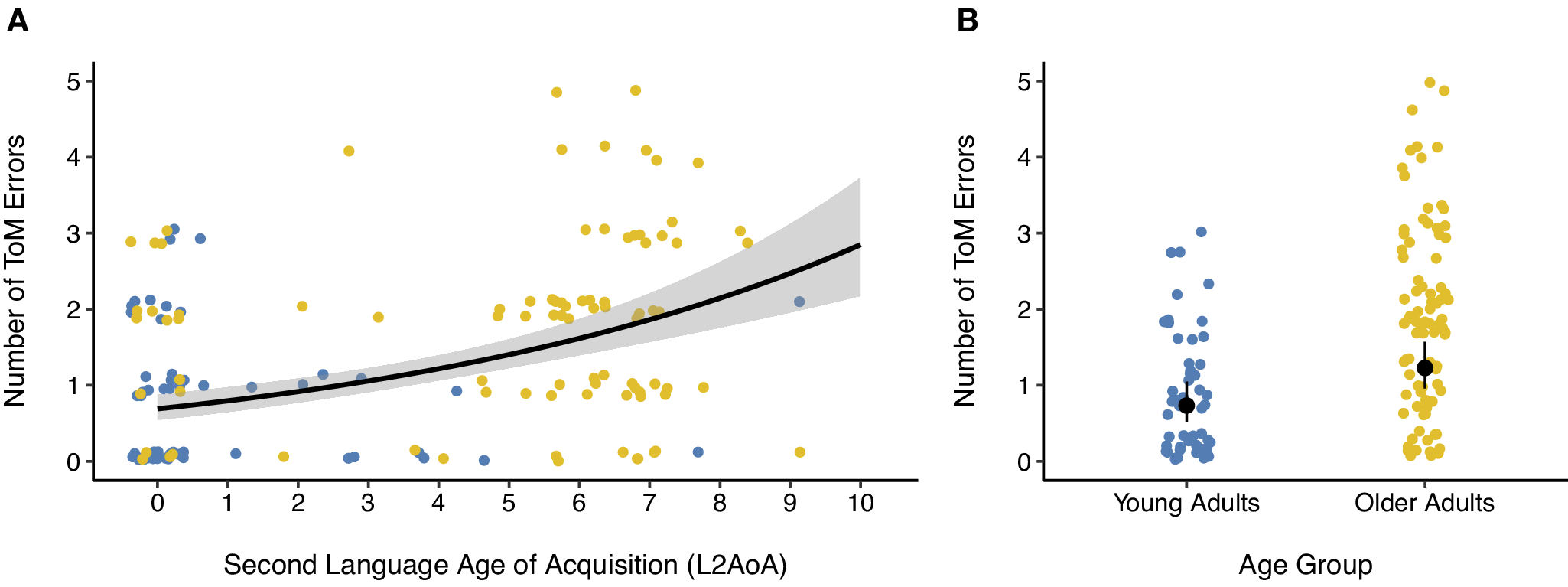
In Model 3, L2AoA emerged as a significant predictor of performance in ToM, β = 0.20, z = 2.22, p = .027, rate ratio = 1.06, where 1 year older in the onset age of bilingualism increased the number of ToM errors by 6% (see Figure 1A). This suggested that earlier bilingual acquisition was associated with better ToM performance within the current combined sample that included both young and older ages. The effect for the age group only reached marginal significance in Model 3, β = −0.51, z = 1.96, p = .050, rate ratio = 1.67 (see Figure 1B). Controlling for the effects of various bilingual language experiences seemed to attenuate the age effects on ToM. However, unlike the experience of early or late L2AoA, the other three aspects of bilingual experience were not significant predictors of ToM: bilingual usage, β = 0.03, z = 0.47, p = .64, rate ratio = 1.03; bilingual proficiency, β = 0.07, z = 0.94, p = .35, rate ratio = 1.07; and code-switching, β = 0.06, z = 0.90, p = .37, rate ratio = 1.06. Meanwhile, episodic memory (β = −0.14, z = −1.96, p = .0498, rate ratio = 0.87) and working memory (β = −0.16, z = −2.05, p = .041, rate ratio = 0.85) explained significant variance in ToM performance, where better episodic and working memory was associated with better ToM. These results revealed that individuals’ early bilingual experience (in particular, L2AoA) contributed to performance in ToM over and beyond the impact of age, education, and cognitive aging on ToM.
Effects of L2AoA and age group predicting theory-of-mind task performance. N = 185. Each colored dot represents an individual participant (jittered). The line in graph (A) represents the estimated regression function between ToM scores and L2AoA obtained from Model 3, holding other variables constant. The black dots in graph (B) represent the estimated group means for young and older adults from Model 3, controlling for other variables, with error bars indicate 95% confidence intervals. There is no significant interaction effect between age group and L2AoA on the number of ToM errors.

3.3. Additional analyses – age as a continuous variable
We conducted additional GLMs treating age as a continuous variable for young adults and older adults separately due to a gap in our samples of those ages between 30 and 56. For the young adult group (N = 80), although the full model—including all predictors (age, L2AoA, bilingual usage, bilingual proficiency, and code-switching) and control variables—demonstrated a good overall fit, χ2 = 19.47, N = 80, df = 10, p = .035, none of the predictors significantly explained the interindividual variance in ToM, all ps > .25. For the older adult group (N = 105), the same full model also yielded a good overall fit, χ2 = 33.20, N = 105, df = 10, p < .001. Importantly, both age and L2AoA emerged as significant predictors of ToM performance in older participants (age: β = 0.27, z = 2.83, p = .005, rate ratio = 1.32; L2AoA: β = 0.18, z = 2.18, p = .029, rate ratio = 1.20). Specifically, the number of ToM errors was expected to increase as age and L2AoA increase in older adults, controlling for other aspects of bilingual experience, education, and cognitive ability. None of the other bilingualism measures and control variables contributed to the variance of ToM performance in older adults, all ps > .12.
4. Discussion
The present research examined the effects of age and bilingualism on the ToM performance of young and older adults. Overall, we found that older adults committed more errors in ToM tasks than young adults. Most importantly, we found that an earlier L2AoA predicted better ToM performance in our sample of young and older bilinguals, over and above the effects of aging. We did not find significant effects of other aspects of bilingual experience, such as bilingual usage, bilingual proficiency, and code-switching interactional experience on ToM performance. The findings suggest that bilingualism, particularly early second language acquisition, appears to contribute to intact ToM performance against normal age-related deteriorations.
In line with our hypothesis, results revealed an overall negative effect of age on ToM performance and this effect of age was robust even when other individual cognitive factors such as education and general cognition were controlled for. Our finding that cognitively healthy older adults (aged 56–79) performed significantly worse than young adults (aged 18–30) in ToM tasks concurs with current converging evidence that older adults face increased difficulties in mental-state reasoning across various ToM tasks, including perspective taking (e.g., Bradford et al., Reference Bradford, Brunsdon and Ferguson2023), false-belief understanding (e.g., Phillips et al., Reference Phillips, Bull, Allen, Insch, Burr and Ogg2011), and/or inference of complex emotions and beliefs (e.g., Greenberg et al., Reference Greenberg, Warrier, Abu-Akel, Allison, Gajos, Reinecke, Rentfrow, Radecki and Baron-Cohen2023; Krendl et al., Reference Krendl, Mannering, Jones, Hugenberg and Kennedy2023; cf. Dodell-Feder et al., Reference Dodell-Feder, Ressler and Germine2020). Moreover, we found that the age difference in participants’ ToM remained significant even after controlling for individual variations in education, processing speed, episodic memory, working memory, and inhibitory control, even though better episodic memory and better working memory were also found to be associated with better ToM performance. This finding is congruent with previous studies suggesting a specific ToM impairment in old age that is independent of educational experience and age-related changes in general cognition during healthy aging (e.g., Cavallini et al., Reference Cavallini, Lecce, Bottiroli, Palladino and Pagnin2013; Kong et al., Reference Kong, Currie, Du and Ruffman2022; cf. Johansson Nalaker et al., Reference Johansson Nolaker, Murray, Happé and Charlton2018; Murphy et al., Reference Murphy, Millgate, Geary, Catmur and Bird2019).
A significant finding from the current research is that early bilingualism, operationalized as an earlier L2AoA, has a positive effect on ToM performance, specifically within the group of older adults. In support of our hypothesis regarding the role of bilingualism in ToM development, we found that earlier L2AoA predicted better ToM performance across both groups of young and older participants, over and beyond the effect of age. Additional analyses revealed that the benefits of an earlier L2AoA were significant and unique to older adults, who tend to experience increased difficulty maintaining ToM abilities as they age. Importantly, we found that L2AoA independently contributed to ToM performance when other experience factors such as education and general cognitive abilities were controlled for, suggesting that earlier bilingual acquisition could directly enhance ToM abilities. This highlights that life-course factors, such as early bilingual experience, could offer opportunities to establish cognitive reserve related to social cognitive processes, as manifested in the performance of ToM tasks in our study. This corroborates past studies that suggested bilinguals’ superior ToM performance in childhood appears to extend into adulthood (e.g., Navarro & Conway, Reference Navarro and Conway2021). In line with the STAC-r framework, lifelong (early onset) bilingual experience could act as an enriching factor that enhances brain structure and function relating to mental state reasoning (e.g., Li et al., Reference Li, Ng, Wong, Zhou and Yow2024), thereby mitigating age-related declines.
We postulate that early bilingual experience contributes to the consolidation of social cognitive abilities in bilinguals. Previous evidence shows bilingual children’s enhanced ability to infer others’ intentions compared to monolingual children (e.g., Yow et al., Reference Yow, Li, Lam, Gliga, Chong, Kwek and Broekman2017). While L2AoA may be considered as an index of prolonged bilingual language use (e.g., DeLuca et al., Reference DeLuca, Rothman, Bialystok and Pliatsikas2020), we argue that the effects of L2AoA observed in our study reflect the importance of early bilingual exposure rather than the sheer duration or frequency of bilingual language use This is because, firstly, all young and older participants in our study reported being lifelong, active bilinguals, and secondly, our data showed no significant effect of individuals’ degree of bilingualism in terms of usage and proficiency in different languages, and code-switching experiences. Early L2AoA may help preserve ToM abilities by enhancing neural plasticity early in life. For example, individuals with early L2AoA have shown greater functional connectivity between the left and right inferior frontal gyrus (IFG) than those with later L2AoA, indicating a greater ability among early bilinguals to manage their languages (Berken et al., Reference Berken, Chai, Chen, Gracco and Klein2016). This, in turn, may transfer to an understanding that others can have different mental states in relation to the same event from the self (i.e., “metalinguistic awareness” account; see Goetz, Reference Goetz2003). The advantage that early L2AoA has on ToM may persist into adulthood and allow early bilinguals to maintain these abilities against natural age-related declines. Nevertheless, given that our study was cross-sectional in nature, we are unable to assess any direct relationship between early bilingual experience and the developmental course of ToM in later adulthood in the absence of longitudinal data.
This finding is significant but should be considered within our model’s constraints. First, the observed predictive effect of L2AoA (β = .20, rate ratio = 1.06) may be considered small (Cohen, Reference Cohen1988). The rate ratio 1.06 illustrated that 1 year difference in L2AoA was associated with a 6% difference in ToM scores. It is noted that studies on social processes or individual differences tend to produce smaller effects than experimental studies (e.g., Schäfer & Schwarz, Reference Schäfer and Schwarz2019), likely due to larger samples in these former types of studies that have sufficient statistical power to detect small but significant effects. Second, our participants’ bilingual language experience was assessed using self-reported measures including language proficiency. Past research suggests that there is a lack of correlation between self-ratings and objective proficiency measures (e.g., Tomoschuk et al., Reference Tomoschuk, Ferreira and Gollan2019), raising questions about the reliability of subjective measures in assessing participants’ relative language proficiency. However, it is not always feasible to use objective measures to measure bilinguals’ language proficiency. For example, the Multilingual Naming Test (MINT; Gollan et al., Reference Gollan, Weissberger, Runnqvist, Montoya and Cera2012) has been shown a reliable proficiency measure for bilinguals speaking English, Spanish, Mandarin, and Hebrew. However, there is no validated MINT or equivalent test in the other languages (e.g., Cantonese, Hokkien, Teochew, etc.) reported in our sample that could be used to assess participants’ proficiency in these different languages. Future research could consider other ways to obtain objective measures of bilingual proficiency, such as developing a Cantonese, Hokkien, or Teochew version of a naming test, to further examine the effects of language proficiency on ToM in aging. Third, we found that better episodic and working memory were associated with higher performance in ToM. Consistent with previous studies (e.g., Jarvis & Miller, Reference Jarvis and Miller2017; Phillips et al., Reference Phillips, Bull, Allen, Insch, Burr and Ogg2011), ToM reasoning is dependent to some extent on these memory processes, as it involves remembering details and feelings associated with the event, as well as updating information about others’ mental states when a situation changes. Nevertheless, the effects of early bilingual experience reported in the current study appear to be robust and remain significant beyond the positive influence of these general cognitive abilities on ToM across both younger and older adults.
One of the limitations of our study is that we considered ToM as a unified construct and used a composite score to represent participants’ ToM ability. The ToM battery used in the present research encompasses a range of classic ToM tasks – emotional recognition, diverse desire, knowledge access, perspective taking, false belief, and complex emotion and belief inferences. However, as there are only a few questions that tap into each ToM component, it is not possible to evaluate the relationship between age-related changes and bilingualism in a specific aspect of ToM. It is possible that aging and bilingual experience are selectively associated with compromised performance on certain ToM aspects but not others (see Grainger et al., Reference Grainger, Crawford, Riches, Kochan, Chander, Mather, Sachdev and Henry2023, with evidence for “multidirectional” changes in four ToM-based tasks with age). For example, although meta-analytic work suggested that normal aging is likely associated with a decline in both cognitive and affective ToM (Roheger et al., Reference Roheger, Brenning, Riemann, Martin, Flöel and Meinzer2022), there is evidence that cognitive ToM may be more affected by aging than affective ToM (Wang & Su, Reference Wang and Su2013). In fact, some researchers have suggested that ToM should not be treated as a dichotomous distinction between cognitive and affective components; instead, one should consider the possibility of multiple distinct or even overlapping processes within ToM (e.g., Navarro, Reference Navarro2022; Schaafsma et al., Reference Schaafsma, Pfaff, Spunt and Adolphs2015). Therefore, future work could administer multiple representative tasks that target clearly defined processes of ToM (e.g., Fischer et al., Reference Fischer, O’Rourke and Loken Thornton2017; Krendl et al., Reference Krendl, Mannering, Jones, Hugenberg and Kennedy2023) to understand the specificity of ToM changes as a function of age and diverse bilingual experience.
A key feature of the ToM assessment in our study, ike many other ToM tasks in the literature, is the use of story vignettes and forced-choice response approach. Participants viewed static stimuli (vs. dynamic, naturalistic stimuli), and their answers were coded as correct or incorrect (i.e., binary). This limits the investigation of “real-world” mental state representation in adults with sufficient variance and sometimes may lead to ceiling effects in neurotypical adults (e.g., Yeung et al., Reference Yeung, Apperly and Devine2024). In addition, while our current ToM measure included tasks with varying complexity (Hutchins et al., Reference Hutchins, Prelock and Chace2008), they may still be relatively simple compared with more complex ToM tasks, such as the Faux Pas or RMET. To better capture individual differences in ToM performance among healthy young and older adults, recent trends suggest extending classical ToM paradigms with more dynamic and naturalistic stimuli (e.g., the Dynamic Theory of Mind Task, which uses clips from the sitcom The Office, see Krendl et al., Reference Krendl, Mannering, Jones, Hugenberg and Kennedy2023) or incorporating other measures such as open questions (e.g., the Edinburgh Social Cognition Test, see Baksh et al., Reference Baksh, Abrahams, Auyeung and MacPherson2018), reaction time (e.g., De Lillo & Ferguson, Reference De Lillo and Ferguson2023), and eye tracking (e.g., Bradford et al., Reference Bradford, Brunsdon and Ferguson2023). For example, Breil & Böckler (Reference Breil and Böckler2020) recorded participants’ eye movements while they performed a social video task that assessed empathy and ToM. Their results showed a substantial inter-individual variance in the time spent looking at the narrator during the videos, which was associated with ToM task performance. Future research could consider adopting these promising paradigms that allow for the investigation of more nuanced mental state representation in young and older adults. Another limitation of our study is that we used a fixed-order design, where all participants completed the ToM task battery after three cognitive assessments (i.e., Stroop, RAVLT, and DSST), which were then followed by a 2-back task and the language questionnaire. One reservation is whether this fixed-order design may have affected the ToM performance of older adults more than in young adults, as aging is associated with limited cognitive resources (e.g., Stern, Reference Stern2002). Although we did not counterbalance the order of tasks, we ensured that participants took sufficient breaks when needed. Neither young nor older adults reported difficulty in understanding or engaging in the tasks, even for tasks that took place at the end of the session. Nevertheless, while it is unlikely that the significant age effects observed in our results were due to order effects, future research should consider counterbalancing the order of the tasks to control for such potential order effects.
Recent concerns has questioned the arbitrary classification of individuals as “older adults” versus “younger adults” in aging studies and the potential loss of information when age is treated as a categorical variable (Raimo et al., Reference Raimo, Cropano, Roldán-Tapia, Ammendola, Malangone and Santangelo2022). However, our study did not include participants aged between 30 and 56, which limits our ability to analyze age as a continuous variable across the entire sample. Thus, we grouped participants into young and older adult categories to facilitate direct comparisons of ToM performance and to examine the impact of bilingualism across distinct developmental periods. This approach is common in aging research to identify critical age-related differences, particularly when exploring the compensatory effects of bilingualism. However, such categorical groupings may fail to capture age-related changes in ToM that occur throughout the lifespan, particularly in middle-aged adults (see Bradford et al., Reference Bradford, Brunsdon and Ferguson2023). Future research should consider alternative approaches, such as using a continuous age sample of participants (e.g., Grainger et al., Reference Grainger, Crawford, Riches, Kochan, Chander, Mather, Sachdev and Henry2023) to provide a more nuanced understanding of how aging and bilingual experience influence ToM across the lifespan.
In conclusion, the ability to maintain intact social cognitive function is important for social interactions with others in healthy aging. Life-course factors can provide neural resource enrichment and compensatory scaffolding that influence the trajectories of aging. Our study suggests that older adults who perform well in understanding the mental states of others might have benefited from compensatory mechanisms developed early in life. By examining the developmental time course of such influences, particularly the early onset of bilingualism, our study provides important insights into the cognitive reserve mechanism at different stages of the life course.
Supplementary material
The supplementary material for this article can be found at http://doi.org/10.1017/S1366728925000240.
Data availability statement
The data and analytical code for the study are available on OSF at https://doi.org/10.17605/osf.io/c69js. The study reported in the manuscript was not preregistered.
Funding statement
We would like to express our appreciation to the participants who took part in the study. We thank Jia Wen Lee, Nina N. Ye, Juan Helen Zhou, Kwun Kei Ng, Joey Ju Yu Wong, and Janice Jue Xin Koi for their support during study design and data collection. This work was supported by the Ministry of Education Academic Research Fund Tier 2 (T2MOE2005) and the SUTD Kick-Starter Initiative Grant (SKI 2021_03_11) to W. Quin Yow.
Competing interest
The authors declare no conflicts of interest.




 Open access

