





Introduction
False-green kyllinga is a problematic C4 perennial sedge (Cyperaceae) species in turfgrass systems (Bryson et al. Reference Bryson, Carter, McCarty and Yelverton1997). It has been reported in 15 US states from Connecticut to North and South Carolina and recently as far west as Nebraska (Bryson et al. Reference Bryson, Carter, McCarty and Yelverton1997, USDA 2018; R. Gaussoin, personal communication). False-green kyllinga produces a dense mat of rhizomes that resembles desirable turfgrass and make it difficult to control with postemergence herbicides (McElroy et al. Reference McElroy, Yelverton and Warren2005).
Acetolactate synthase (ALS)–inhibiting herbicides halosulfuron and imazosulfuron as well as the protoporphyrinogen oxidase (PPO) inhibitor sulfentrazone control false-green kyllinga in cool-season turf (Elmore et al. Reference Elmore, Patton, Tuck, Murphy and Carleo2019). Sequential postemergence herbicide applications usually control kyllinga better than single applications (Elmore et al. Reference Elmore, Patton, Tuck, Murphy and Carleo2019; Gannon et al. Reference Gannon, Yelverton and Tredway2012; McElroy et al. Reference McElroy, Yelverton and Warren2005). Imazosulfuron (≥420 g ha–1) is more effective for false-green kyllinga control than halosulfuron-methyl (70 g ha–1), which is more effective than sulfentrazone (140 g ha–1) (Elmore et al. Reference Elmore, Patton, Tuck, Murphy and Carleo2019). Similarly, in warm-season bermudagrass [Cynodon dactylon (L.) Pers.] turf, Gannon et al. (Reference Gannon, Yelverton and Tredway2012) found that single or sequential applications of sulfentrazone at 140 to 420 g ha–1 controlled false-green kyllinga <60%. Elmore et al. (Reference Elmore, Patton, Tuck, Murphy and Carleo2019) found that two sequential applications of imazosulfuron at 420 or 740 g ha–1 controlled false-green kyllinga 100% at all three locations, but single applications at 420 g ha–1 were less effective at certain locations (Elmore et al. Reference Elmore, Patton, Tuck, Murphy and Carleo2019). There is no research to date that integrates herbicides and nonchemical strategies for postemergence Kyllinga spp. control.
Interseeding cool-season turfgrass in late summer is a common cultural practice for turfgrass management (Reicher et al. Reference Reicher, Throssell and Weisenberger2000). Combining herbicide applications with the cultural practice of interseeding tall fescue controlled perennial weeds dallisgrass (Paspalum dilatatum Poir.) and bermudagrass better than either strategy alone (Brosnan and Breeden Reference Brosnan and Breeden2013; Elmore et al. Reference Elmore, Brosnan, Mueller, Horvath, Kopsell and Breeden2013). Similarly, the biocontrol Sclerotinia minor combined with interseeding a mixture of cool-season turfgrasses controlled dandelion (Taraxacum officinale F.H. Wigg.) better than the biocontrol or interseeding alone (Abu-Dieyeh and Watson Reference Abu-Dieyeh and Watson2007). When interseeding is not integrated with an herbicide or other weed management practice, control of perennial weeds is inconsistent and weed control is poor (Abu-Dieyeh and Watson Reference Abu-Dieyeh and Watson2007; Elford et al. Reference Elford, Tardif, Robinson and Lyons2008; Jensen et al. Reference Jensen, Petersen and Aamlid2014, Reference Jensen, Bühler, Kvalbein and Aamlid2017; Larsen et al. Reference Larsen, Kristofferson and Fischer2004; Larsen and Fischer Reference Larsen and Fischer2005; Miller and Henderson Reference Miller and Henderson2012).
Previous research evaluated only mid- to late-spring applications of postemergence herbicides for false-green kyllinga control and without complementary cultural practices (Elmore et al. Reference Elmore, Patton, Tuck, Murphy and Carleo2019; Gannon et al. Reference Gannon, Yelverton and Tredway2012; McElroy et al. Reference McElroy, Yelverton and Warren2005). Late summer or early fall is the optimum time to seed cool-season turfgrasses such as tall fescue (Reicher et al. Reference Reicher, Throssell and Weisenberger2000). Tall fescue is well adapted throughout regions where cool-season turfgrass is grown because of its improved drought tolerance, insect pest tolerance, and persistence under low fertility (Bonos and Huff 2013). Therefore, the objective of this research was to evaluate the effect of tall fescue interseeding in combination with late-summer herbicide applications for false-green kyllinga control. We propose that combining the cultural practice of interseeding turf-type tall fescue with herbicide applications will control false-green kyllinga better than either seeding or herbicides alone.
Materials and Methods
Site
Replicate field experiments were conducted adjacently from 2019 to 2020 and 2020 to 2021 at Rutgers Hort Farm No. 2 in North Brunswick, NJ (40.47°N, 74.42°W) on a sandy loam soil with a pH of 5.7, 3.6% organic matter, and cation exchange capacity of 12 mEq 100 g–1. The site was infested with false-green kyllinga by sodding turf from an infested golf course fairway at Woodlake Country Club in Lakewood, NJ (40.09°N, 74.17°W) in June 2018. The sod was approximately 80% false-green kyllinga cover at harvest, with annual bluegrass (Poa annua L.) and creeping bentgrass (Agrositis stolonifera L.) the minority species. Foramsulfuron (40 g ha–1) was applied in July 2019 to suppress annual bluegrass and creeping bentgrass. The site was >95% false-green kyllinga cover by August 2019. The site was maintained at a 7-cm height of cut using a walk-behind rotary mower every 5 to 10 d during the growing season and irrigated as needed based on visible wilt to optimize tall fescue and false-green kyllinga growth before and during the experiments.
Treatments
Seven herbicide treatments and a nontreated control were arranged in a complete factorial with tall fescue interseeding or no interseeding, forming a two-by-eight factorial treatment design. Treatments were applied in a strip-plot randomized complete block design with three replications. Tall fescue interseeding was the strip-plot factor. Whole plots (1.2 by 3.0 m) received herbicide treatments, which were single applications of sulfentrazone + carfentrazone at 280 + 30 g ha–1 (Dismiss NXT; FMC Corp., Philadelphia, PA), halosulfuron at 70 g ha–1 (Sedgehammer; Gowan Company, Yuma, AZ), or imazosulfuron at 420 g ha–1 (Celero; NuFarm Americas Inc., Alsip, IL). These three herbicides were applied singly either 4 wk before seeding (WBS) based on label-recommended seeding intervals or the day of seeding, totaling six treatments. The seventh herbicide treatment was glyphosate (Credit 41 Extra; Nufarm Inc., Alsip, IL) at 220 g ae ha–1 applied the day of seeding. Imazosulfuron and halosulfuron were applied with a nonionic surfactant at 0.25% v/v (Activator 90; Loveland Products Inc., Loveland CO), according to the product label. This is the maximum labeled single application rate of halosulfuron and sulfentrazone + carfentrazone in cool-season turf and the lowest labeled single-application rate of imazosulfuron (Anonymous 2020, 2021a, 2021b). The highest labeled rate of halosulfuron and sulfentrazone + carfentrazone was selected, as single applications of these herbicides controlled false-green kyllinga <60% in previous research, and they are good candidates to be improved by interseeding (Elmore et al. Reference Elmore, Patton, Tuck, Murphy and Carleo2019). The same rationale was used to select the lowest label rate of imazosulfuron, which controlled false-green kyllinga 78% to 95% in previous research compared to 89% to 99% control from the highest imazosulfuron rate (740 g ha–1), (Elmore et al. Reference Elmore, Patton, Tuck, Murphy and Carleo2019). The 4-WBS treatments were applied on August 19, 2019 and August 27, 2020. The day of seeding herbicide treatments were applied on September 16, 2019 and September 24, 2020. Herbicide treatments were applied with water carrier at 420 L ha–1 through a single AI11004EVS nozzle (Teejet; Spraying Systems Co., Glendale Heights, IL) using a hand-held CO2-pressurized (300 kPa) sprayer. Treatments were irrigated with 10 mm of irrigation 24 h after application to allow sufficient time for foliar absorption and move the herbicide into the soil in a controlled manner to prevent herbicide movement between plots.
Tall fescue interseeding and associated cultural practices occurred on September 16, 2020 and September 24, 2021, respectively, the same day as “day of seeding” herbicide applications. To prepare a seedbed for interseeding, a strip plot (1.5 m wide) across each block was core-cultivated using reciprocating 2.2-cm diam hollow tines on a 4.0-cm spacing (Toro® ProCore 648; The Toro Company, Bloomington, MN), then verticut twice (Ryan Ren-o-Thin® Power Rake; Schiller Grounds Care, Johnson Creek, WI) to create 0.6-cm-deep slits every 1.5 cm. A turf-type tall fescue blend of ‘Da Vinci’, ‘Leonardo’, and ‘Michelangelo’ (Winning Colors Turf Type Tall Fescue Blend; LebanonTurf, Lebanon, PA) was seeded at 400 kg ha–1 (360 kg pure live seed ha–1) using a shaker jar inside a frame to prevent wind-aided seed drift. After seeding, plots were raked by hand perpendicular to the verticut slits using a leaf rake and then lightly irrigated. Day-of-seeding herbicide treatments were applied shortly after the foliage dried. Beginning 24 h after the day-of-seeding herbicide application, the experiment was irrigated daily until seedling emergence.
Site Management After Treatment
Fertilizer (12 N : 24 P2O5 : 8 K2O; 49 kg P2O5 ha–1; Country Club® MD, 40% N derived from methylene urea; LebanonTurf, Lebanon, PA) was applied to the experiment 7 d after tall fescue seeding. In addition, 45 kg N ha–1 was applied to the entire site on April 18, 2020, June 23, 2020, May 11, 2021, and July 6, 2021 (25 N : 0 P2O5 : 5 K2O; Country Club®, 50% N derived from methylene urea; LebanonTurf, Lebanon, PA) to maintain tall fescue and kyllinga vigor throughout the spring and summer. Dithiopyr (Dimension® 2EW; Dow AgroSciences LLC, Indianapolis, IN) was applied to the entire site at 560 g ha–1 in March 2020 and 280 g ha–1 in April 2021 for preemergence crabgrass (Digitaria spp.) control. Spring dithiopyr application is a standard industry practice. A higher dithiopyr rate was used in 2020 because of COVID-19–related uncertainties about labor and farm management. Crabgrass control was excellent in both study years. Dithiopyr does not affect false-green kyllinga emergence from rhizomes but may have prevented false-green kyllinga establishment from seed. Azoxystrobin + difenconazole (470 + 300 g ha–1; Briskway™; Syngenta Crop Protection, LLC, Greensboro, NC) was applied in late June and late July each year to control brown patch disease (caused by Rhizoctonia solani) of tall fescue. Clopyralid (Lontrel®; Dow AgroSciences LLC, Indianapolis, IN) was applied at 280 g ae ha–1 on July 2, 2020 and July 14, 2021 for broadleaf weed control. Clopyralid was selected, as it does not reduce false-green kyllinga vigor (personal observation, M. Elmore). Glyphosate (Credit 41 Extra; Nufarm Inc., Alsip, IL) was applied at 220 g ae ha–1 to the noninterseeded strips on February 24, 2020 and March 10, 2021 (during false-green kyllinga dormancy) for winter annual weed control.
Data Collection
False-green kyllinga control was evaluated visually on a 0 (no control) to 100% (complete control) scale relative to the nontreated, nonseeded control in June, July, and August following herbicide applications––specifically, June 3, July 15, and August 15 in 2020 and June 17, July 19, and August 9 in 2021. Line-intersect counts were conducted July 15, 2020 and July 19, 2021 using a 0.8- by 0.9-m grid with 90 intersects. The presence or absence of false-green kyllinga under each intersect was recorded. Intersect count data were transformed to be expressed as percent false-green kyllinga cover. Tall fescue seedling injury was visually estimated at 3 wk after tall fescue seeding in both years on a 0 (no seedling stunting, chlorosis, or necrosis) to 100% (complete necrosis) scale relative to the nontreated, interseeded control. To detect meaningful residual effects of tall fescue seedling injury the following year when injury symptoms were no longer visible and turfgrass cover differences were minor, turfgrass quality ratings were conducted in May, June, and July each year. Turfgrass quality was assessed only in the seeded strips using the National Turfgrass Evaluation Program 1 to 9 scale, where 1 equaled low-quality turf, 9 equaled high-quality turf, and 6 was considered the minimum acceptable level of turfgrass quality (Morris and Shearman Reference Morris and Shearman1998). Green cover, density, uniformity, and to a lesser extent, color, were the primary components considered when estimating turfgrass quality. The presence or absence of false-green kyllinga was not considered when evaluating turfgrass quality, as false-green kyllinga displays desirable turfgrass characteristics during the warmer months.
Statistical Analysis
Model assumptions were tested through residual analysis (Shapiro-Wilk statistic) in addition to visual assessments of Q-Q plots and histograms in SAS (Statistical Analysis Software, Inc., Cary, NC), and no transformations were required. The control data and intersect counts were analyzed in a strip-plot randomized complete block design (P = 0.05). Seedling injury and turfgrass quality response variables related only to tall fescue seeding; thus, these variables were analyzed in a single-factor randomized complete block design with herbicide as the only fixed effect. For visible control and tall fescue seedling injury, nontreated control data were removed prior to analysis. Data were pooled across experiment years. ANOVA was performed using the mixed-model procedure in SAS, and Fisher’s protected LSD test (P = 0.05) was used to compare means (Saxton Reference Saxton2010). Herbicide treatment and tall fescue seeding were fixed effects, whereas year and block nested within year were considered random effects (Blouin et al. Reference Blouin, Webster and Bond2011). Year was a random effect, as the objective of the experiments was to estimate treatment effects over broad inference spaces (Blouin et al. Reference Blouin, Webster and Bond2011; Moore and Dixon Reference Moore and Dixon2015). To correlate grid intersect count and visible data, the CORR procedure was conducted in SAS.
Results and Discussion
False-Green Kyllinga Control
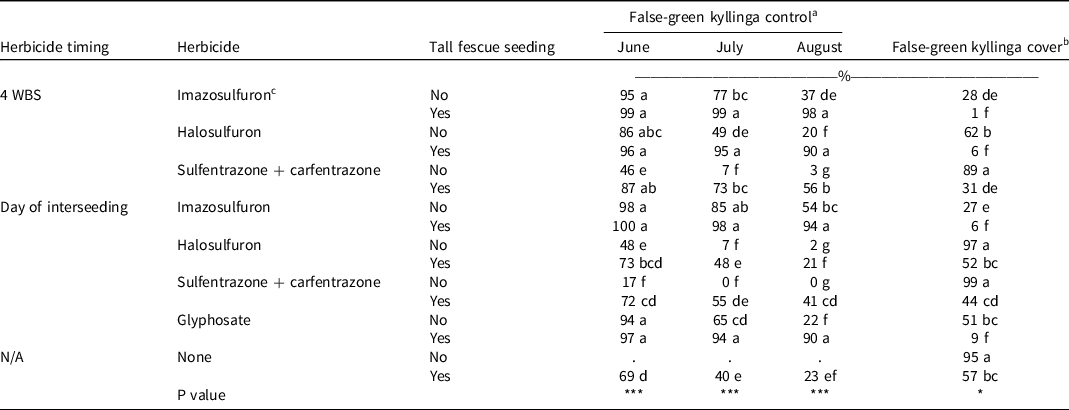
Main effects of herbicide and interseeding were significant (P < 0.001) for all visible control and line-intersect count data but are not presented. Herbicide-by-interseeding main-effect interactions were significant (P < 0.05) for all visible control and line-intersect count data and are presented in Table 1. In June, both imazosulfuron treatments, halosulfuron applied 4 WBS, and glyphosate controlled false-green kyllinga similarly (≥86%), regardless of interseeding treatment (Table 1). By July, imazosulfuron and halosulfuron applied 4 WBS, as well as glyphosate controlled false-green kyllinga ≥94% in combination with seeding compared to ≤77% control without interseeding; in August, these treatments controlled false-green kyllinga <40% without interseeding and ≥90% with interseeding. In combination with interseeding, glyphosate, both imazosulfuron treatments, and halosulfuron applied 4 WBS controlled false-green kyllinga better than sulfentrazone + carfentrazone in July and August. Tall fescue interseeding improved false-green kyllinga control from every herbicide treatment in August. It is possible interseeding effects are overestimated by this research, as false-green kyllinga cover was >95% in August and other turfgrass species and weeds were suppressed before and during the experiments. In the authors’ experience it is common to observe false-green kyllinga cover >90% in managed turf during late summer. Interseeding alone controlled false-green kyllinga 69% in June but only 23% by August. This indicates that false-green kyllinga will outcompete tall fescue during the summertime, even when tall fescue growth is managed with fertilizer to encourage density and fungicides to prevent brown patch disease (caused by Rhizoctonia solani). In the absence of interseeding, among treatments applied 4 WBS, imazosulfuron was more effective than halosulfuron, which was more effective than sulfentrazone + carfentrazone; the relative efficacy of these three herbicides aligns with Elmore et al. (Reference Elmore, Patton, Tuck, Murphy and Carleo2019).
False-green kyllinga control and cover following single late-summer applications of postemergence herbicides alone or in combination with tall fescue interseeding. Herbicide treatments were applied singly 4 wk before tall fescue interseeding (WBS; August 19, 2019 and August 27, 2020) or the day of interseeding (September 16, 2019 and September 24, 2020). Data presented are pooled across experiment years d .
a False-green kyllinga control on a 0 (no control) to 100% (complete control) scale as determined by visual estimates relative to the nontreated control.
b Cover was determined by converting line-intersect count data to percent false-green kyllinga cover. Intersect counts were conducted on July 15, 2020 and July 19, 2021.
c Imazosulfuron (420 g ha–1) and halosulfuron (70 g ha–1) treatments included a nonionic surfactant at 0.25% (v/v). Sulfentrazone + carfentrazone (280 + 30 g ha–1) and glyphosate (220 g ae ha–1) were applied without a surfactant.
d Abbreviations: N/A, not applicable; *, significant at P ≤ 0.05; ***, significant at P ≤ 0.001.
False-green kyllinga cover as determined by line-intersect count align with visible-control estimates. For all herbicide treatments, tall fescue interseeding reduced false-green kyllinga cover compared to the herbicide alone. In combination with interseeding, both imazosulfuron treatments, halosulfuron applied 4 WBS, and glyphosate resulted in less false-green kyllinga cover (<10%) than all other treatments (27% to 99%). Interseeding alone resulted in 57% false-green kyllinga cover compared to 95% for the nontreated control. False-green kyllinga cover as determined by intersect counts and control determined visually in July were highly correlated (r = –0.95; P < 0.001).
Tall Fescue Seedling Injury
Imazosulfuron, halosulfuron, and sulfentrazone + carfentrazone applied the day of interseeding injured tall fescue seedlings substantially (≥55%) at 3 wk after interseeding (Table 2). Similarly, McFadden et al. (Reference McFadden, Fry, Keeley, Hoyle and Raudenbush2022) found that halosulfuron (70 g ha–1) applied 0 or 7 d before seeding reduced tall fescue and Kentucky bluegrass establishment. This contrasts with Li et al. (Reference Li, Sousek and Reicher2015), who reported no injury from sulfentrazone applied the day of seeding buffalograss [Buchloe dactyloides (Nutt.) Engelm.] and suggests that buffalograss is more tolerant to sulfentrazone than tall fescue at seeding. Sulfentrazone + carfentrazone applied 4 WBS caused minor (16%) injury. Imazosulfuron applied 4 WBS caused 13% injury, but this was not statistically different from halosulfuron applied 4 WBS or glyphosate, which caused no injury.
Tall fescue seedling injury and turfgrass quality following single late-summer applications of postemergence herbicides pooled across experiment years. Herbicide treatments were applied singly 4 wk before tall fescue interseeding (WBS; August 19, 2019 and August 27, 2020) or the day of interseeding (September 16, 2019 and September 24, 2020) d .

a Visual turfgrass quality ratings were determined visually using the National Turfgrass Evaluation Program 1 to 9 scale where 1 equaled low-quality turf, 9 equaled high-quality turf, and 6 was the minimum acceptable level of turfgrass quality.
b Injury was determined on a 0 (no seedling stunting, chlorosis, or necrosis) to 100% (complete necrosis) scale as determined by visual estimates relative to the nontreated control.
c Imazosulfuron (420 g ha–1) and halosulfuron (70 g ha–1) treatments included a nonionic surfactant at 0.25% (v/v). Sulfentrazone + carfentrazone (280 + 30 g ha–1) and glyphosate (220 g ae ha–1) were applied without a surfactant.
d Abbreviations: **, significant at P ≤ 0.01; ***, significant at P ≤ 0.001.
Turfgrass Quality
Trends in tall fescue injury at 3 wk after interseeding were apparent in turfgrass quality the following year. In May, imazosulfuron, halosulfuron, and sulfentrazone + carfentrazone applied the day of interseeding reduced turfgrass quality to <6.0. Among treatments applied 4 WBS, imazosulfuron and sulfentrazone + carfentrazone reduced turfgrass quality in May compared to the nontreated control. By June, only imazosulfuron and sulfentrazone + carfentrazone applied the day of interseeding reduced turfgrass quality. In July, only imazosulfuron applied the day of interseeding reduced turfgrass quality compared to the nontreated control. It is possible that the spring broadcast application of dithiopyr slowed tall fescue seedling recovery from autumn injury, but tall fescue plants in 4-WBS treatments were mature and not displaying signs of herbicide injury when the dithiopyr application was made. We did not observe any injury during the spring or summer following the dithiopyr application.
Seedling injury and subsequent turfgrass quality reductions observed from imazosulfuron, halosulfuron, and sulfentrazone + carfentrazone applied the day of interseeding aligns with product labels that restrict seeding within 4 wk of application (Anonymous 2020, 2021a, 2021b). The transient turf quality reduction during springtime caused by imazosulfuron applied 4 WBS is noteworthy, as the lowest labeled rate (420 g ha–1) was applied. Considering the imazosulfuron half-life of 21 to 70 d in aerobic soils (Mikata et al. Reference Mikata, Yamamoto and Tashiro1996; Morrica et al. Reference Morrica, Giordano, Seccia, Ungard and Ventrigilia2001, Reference Morrica, Fidente, Seccia and Ventrigilia2002), this turf quality reduction suggests substantial reductions in tall fescue establishment are possible at the maximum labeled rate of 740 g ha--1, even if the label recommendations of seeding no sooner than 4 wk after application are heeded. Future research should evaluate imazosulfuron safety to tall fescue and other cool-season turfgrass species commonly seeded to lawns. Halosulfuron should be included for comparison to this and previous research of McFadden et al. Reference McFadden, Fry, Keeley, Hoyle and Raudenbush2022. With a half-life of 7 to 28 d, halosulfuron is less persistent than imazosulfuron in aerobic, slightly acidic soils (Kuwatsuka and Yamamoto Reference Kuwatsuka and Yamamoto1997).
Applying imazosulfuron (420 g ha–1) or halosulfuron (70 g ha–1) in late summer followed by interseeding turf-type tall fescue as soon as 4 wk later is an effective strategy for selective postemergence false-green kyllinga control in cool-season turfgrass; glyphosate applied the day of interseeding is an effective nonselective option. Herbicides or interseeding alone provided poor false-green kyllinga control the following August, nearly 1 yr after herbicide application. Integrating herbicides and cultural practices to provide a competitive turf sward is critical for effective postemergence false-green kyllinga control with single-herbicide applications. Future research should investigate tall fescue seeding in autumn followed by postemergence herbicide applications in late spring.
Acknowledgments
This research was supported by funding from the Rutgers Center for Turfgrass Science. The authors would like to thank Christian Pucci, Christine Kochmer, Brandon McNally, and Katie Diehl for their assistance with this research.
The authors declare no conflicts of interest.


 Open access

