


Introduction
This study examines the role of socialization in explaining informal volunteering. Informal volunteering is here defined as helping behaviours for people outside the household, such as friends, neighbours and acquaintances, that do not involve any organizations or institutions (Einolf et al. Reference Einolf, Prouteau, Nezhina, Ibrayeva, Smith, Stebbins and Grotz2016; Li and Ferraro Reference Li and Ferraro2005; Wilson and Musick Reference Wilson and Musick1997). Examples of such types of helping are looking after children, doing garden work, lending materials, or driving someone to an appointment. Informal volunteering is a form of prosocial behaviour, since it involves costs for the self and results in benefits for another person’s well-being (Hastings et al. Reference Hastings, Miller, Troxel, Grusec and Hastings2015; Helms and McKenzie Reference Helms and McKenzie2013; Wittek and Bekkers Reference Wittek, Bekkers and Wright2015). Moreover, abundant informal volunteering by a society’s members is seen as the social glue of a society and a key aspect of community life (Einolf et al. Reference Einolf, Prouteau, Nezhina, Ibrayeva, Smith, Stebbins and Grotz2016; Lim and Laurence Reference Lim and Laurence2015).
A profound study on the impact of socialization on informal volunteering may contribute to the lively debate on the supposed decline of community life. Some scholars have expressed serious concerns, arguing that communities have become less tightly knit in terms of social relations and support, which in its turn reduces community life (e.g. Bellah et al. Reference Bellah, Madsen, Sullivan, Swidler and Tipton1985; Dotson Reference Dotson2017; Putnam Reference Putnam2000). Contrarily, scholars also argued that such concerns are theoretically unfounded and empirically unverified. Social networks would be changing and shifting in focus, but this not necessarily entails a reduction in social support and corrosion of community life (Hampton and Wellman Reference Hampton and Wellman2018; Paxton Reference Paxton1999). Our study on the impact of socialization practices on informal volunteering highlights another relevant aspect in this discussion, namely the motivational side. It is assumed that socialization in informal volunteering foremost nurtures a person’s motivation to volunteer informally. If socialization practices play a meaningful role in the manifestation of informal volunteering, it is likely that society’s community life would remain relatively stable since changes in (the effects of) socialization practices only come about slowly.
Prior research on informal volunteering has revealed several explanatory factors: (a) psychological traits of sociability and emotional stability (Finkelstein Reference Finkelstein2012; Finkelstein and Brannick Reference Finkelstein and Brannick2007), and (b) sociological features such as being religious, higher educated, older and female (Lee and Brudney Reference Lee and Brudney2012; Plagnol and Huppert Reference Plagnol and Huppert2009; van Tienen et al. Reference van Tienen, Scheepers, Reitsma and Schilderman2011; Wang et al. Reference Wang, Mook and Handy2017). However, the impact of socialization practices on informal volunteering has been neglected, despite theories suggesting the relevance of socialization in prosocial behaviour, such as informal volunteering (e.g. Dovidio et al. Reference Dovidio, Piliavin, Schroeder and Penner2006; Hastings et al. Reference Hastings, Miller, Troxel, Grusec and Hastings2015). Moreover, socialization practices have been found to play a prominent role in various other prosocial behaviours (Bekkers Reference Bekkers2005; Lee et al. Reference Lee, Piliavin and Call1999; Nesbit Reference Nesbit2013; Quaranta and Dotti Sani Reference Quaranta and Dotti Sani2016; Wilhelm et al. Reference Wilhelm, Brown, Rooney and Steinberg2008), including formal volunteering which is closely related to informal volunteering. Although formal volunteering is organized by formal institutions and informal volunteering is not, they share similarity in content and motivation and are both considered forms of prosocial behaviour (Reed and Selbee Reference Reed and Selbee2000; Wang et al. Reference Wang, Mook and Handy2017). Hence, it is likely that socialization practices play a role in informal volunteering, but this has not been tested yet.
Underscoring this study’s focus on the impact of socialization on informal volunteering, we will use an extensive approach towards socialization. First, we will distinguish between two forms of socialization: modelling and encouragement (Dovidio et al. Reference Dovidio, Piliavin, Schroeder and Penner2006; Laible et al. Reference Laible, Thompson, Froimson, Grusec and Hastings2015). Modelling has been examined in studies towards formal volunteering relatively often (Bekkers Reference Bekkers2005; Nesbit Reference Nesbit2013; Perks and Konency Reference Perks and Konency2015; Quaranta and Dotti Sani Reference Quaranta and Dotti Sani2016) and refers to the idea that people learn by observing behaviour from relevant others. If these relevant others are more prosocial in their behaviours, this is believed to induce prosocial behaviour in the observant. Yet, most prior studies do not take into account that socialization by direct encouragement may also be relevant (Dovidio et al. Reference Dovidio, Piliavin, Schroeder and Penner2006). People who engage in prosocial behaviours likely discuss their activities and thereby encourage others to do alike. To provide a stricter test of modelling and encouragement as socialization practices, we distinguish the two and examine them simultaneously.
Second, we consider two highly relevant socializing agents that are important in various stages of a person’s life course: parents and partners. Parents are likely the most important socializing agents during a person’s youth (Grusec and Davidov Reference Grusec, Davidov, Grusec and Hastings2015), and partners are most relevant in adulthood (Nesbit Reference Nesbit2013). Both parents and partners as socializing agents share a strong (emotional) bond with a person and have a high frequency of (daily) contact, both contributing to the presumed impact of socialization by modelling and encouragement.
We focus on socializing agents originating from the family. Therefore, we chose to exclude family members as targets of informal volunteering. Reciprocity processes may predict both informal volunteering among relatives and socialization practices, which makes them difficult to separate in the family context.
We will answer the following research question: To what extent do modelling and encouragement by parents and the partner promote informal volunteering?
To answer this question, we use recently collected data from the sixth wave of the Family Survey Dutch Population 2017–2018 (FSDP). This dataset uniquely includes measures of informal volunteering and additionally provides extensive information on socializing activities of respondents’ parents and—if applicable—a partner. To provide a strong test of our expectations, we also include a wide set of control variables in our models. Information on personality traits (Big 5), religiosity, family configuration and a person’s resources is available. In sum, we contribute to the literature by assessing the impact of socialization processes on an important aspect of society’s community life, namely informal volunteering.
The paper is structured as follows: first, we elaborate on the theoretical background of socialization and its impact on informal volunteering. From this theoretical framework, we derive our hypotheses. Next, we describe data and measurements and present estimations from statistical models to test our hypotheses. Finally, we relate our findings to the existing literature, discuss limitations and describe the study’s impact.
Theoretical Background
What is Socialization?
Most often socialization is described as a two-layered process in which people learn to behave appropriately in certain groups or situations (Grusec Reference Grusec and Bornstein2002, p. 143). First, people learn what is considered appropriate or desirable behaviour in a society, certain group or situation. This learning process may take various expressions. People may be directly encouraged to engage in certain behaviour (encouragement), but may also learn by being confronted with rewards or punishments following their displayed behaviours (reinforcement). Another type of learning concerns observational learning (Bandura Reference Bandura1977); people observe behaviours and the (possible) reactions and repercussions of others and learn through this information whether behaviour is appropriate (Dovidio et al. Reference Dovidio, Piliavin, Schroeder and Penner2006; Laible et al. Reference Laible, Thompson, Froimson, Grusec and Hastings2015). After people have learned appropriate behaviours, they may display these behaviours to gain approval and confirmation of others, but will not do so if no one is present to give their approval (Kuczynski and Hildebrandt Reference Kuczynski, Hildebrandt, Grusec and Kuczynski1997). In other words, they do not yet value these behaviours to a high extent themselves.
The second layer of socialization concerns the internalization of behaviour. Experiencing encouragement and reinforcement and observing others’ behaviour gradually results in an internal motivation to perform similar appropriate behaviour (Kuczynski and Hildebrandt Reference Kuczynski, Hildebrandt, Grusec and Kuczynski1997). In this process, people learn to value a behaviour themselves and incorporate this in their inner value system. As a result, it also becomes more likely that they will engage in this type of behaviour (Ajzen et al. Reference Ajzen, Fishbein, Lohmann, Albarracín, Albarracín and Johnson2018). After internalization of behaviours, external control is no longer considered necessary, meaning that people will engage in socialized appropriate behaviour even if no one is present to give (dis)approval (Kuczynski and Hildebrandt Reference Kuczynski, Hildebrandt, Grusec and Kuczynski1997).
Who is Involved in Socialization?
Socialization involves at least two persons or entities: the target (the person, who is socialized) and the agent (the entity that socializes) of socialization. By definition, a target can be of any age and can be in any stage of life when experiencing socialization practices. Understandably, most prior studies have focused on children as targets of socialization, as (young) children are in the initial process of learning to become functional individuals in society (Grusec and Hastings Reference Grusec and Hastings2015).
Various socializing agents may contribute to children’s socialization, but nuclear family members, and particularly parents, are regarded as the primary agents of socialization. Generally, parents are the first adults that children have a strong bond with, they are formally assigned the role of primary caretakers, and they mostly are in close proximity to their children, which gives them a prominent position to socialize them (Grusec and Davidov Reference Grusec, Davidov, Grusec and Hastings2015). Other significant socializing agents that may play a role during a person’s youth include schools, teachers, peers and the media (Grusec and Hastings Reference Grusec and Hastings2015). Customarily, these are regarded as secondary socializing agents. Youth experiences of primary and secondary socialization are expected to have a relevant impact that lasts into adulthood (Grusec and Hastings Reference Grusec and Hastings2015; for example see McFarland and Thomas Reference McFarland and Thomas2006; Perks and Konency Reference Perks and Konency2015).
Actors that play a relevant socializing role in adulthood are regarded as tertiary agents. Although most adults do no longer need to learn how to function in society, their ideas about what is appropriate behaviour in a certain situation can still be moderated (Arnett Reference Arnett, Grusec and Hastings2015; Dovidio et al. Reference Dovidio, Piliavin, Schroeder and Penner2006; Luong et al. Reference Luong, Rauers, Fingerman, Grusec and Hastings2015). Instead of being socialized by parents and original nuclear family members, most adults encounter socialization practices in a romantic relationship with a partner (Arnett Reference Arnett, Grusec and Hastings2015; Maccoby Reference Maccoby, Grusec and Hastings2015). As is the case with parents and children, most partners have a close emotional bond, they are often formally connected, and they live in close proximity, which gives them the opportunity to communicate and encourage ideas about desirable behaviour. For example, prior studies have shown that romantic partners influence each other’s health behaviours (e.g. Perry et al. Reference Perry, Ciciurkaite, Brady and Garcia2016; Smith and Christakis Reference Smith and Christakis2008), financial behaviours (e.g. Curran et al. Reference Curran, Parrott, Ahn, Serido and Shim2018) and prosocial and antisocial behaviours (e.g. Knight Reference Knight2011; Nesbit Reference Nesbit2013; Rotolo and Wilson Reference Rotolo and Wilson2006). Therefore, we consider romantic partners as important tertiary agents. It is, however, important to note that tertiary socializing agents are fundamentally different from primary agents of socialization, because they are to some extent self-selected.
Socialization in Prosocial Behaviour
Although socialization processes play a role in the transmission of various types of behaviours, we here focus on the development of prosocial behaviours (Dovidio et al. Reference Dovidio, Piliavin, Schroeder and Penner2006; Hastings et al. Reference Hastings, Miller, Troxel, Grusec and Hastings2015). Prior research has not only theorized that socialization practices play a significant role in the manifestation of prosocial behaviour (Dovidio et al. Reference Dovidio, Piliavin, Schroeder and Penner2006; Hastings et al. Reference Hastings, Miller, Troxel, Grusec and Hastings2015), empirical studies have also shown the impact of socialization for several forms of prosocial behaviour, such as formal volunteering (e.g. Nesbit Reference Nesbit2013; Perks and Konency Reference Perks and Konency2015), charitable giving (e.g. Bekkers Reference Bekkers2005; Wilhelm et al. Reference Wilhelm, Brown, Rooney and Steinberg2008) and blood donation (e.g. Lee et al. Reference Lee, Piliavin and Call1999).
Various ways in which individuals learn prosocial behaviour may be distinguished, including reinforcement, observational learning (modelling), and talking about and encouraging helping others (Dovidio et al. Reference Dovidio, Piliavin, Schroeder and Penner2006). In this study, our focus is on modelling and encouraging as socialization processes, as we suspect that people will be susceptible to such forces and influences in both their youth and adulthood. Direct reinforcement may be perceived as a threat to a person’s autonomy, especially by adults, which may make this type of socialization less effective in adult life. Below, we outline how parents and partners may be involved in modelling and encouragement and how these socialization processes relate to informal volunteering.
Modelling
Observational learning, or modelling, is a socialization process that is grounded in social learning theory (Bandura Reference Bandura1977). It stresses that people learn a behaviour by observing others performing it and observing the according consequences. This means that socializing agents will teach prosocial behaviours by engaging in prosocial activities themselves, especially when it is possible for targets of socialization to observe them. We argue that formal volunteering is a well-demarcated behaviour that is easily recognizable for others. This likely makes it suitable behaviour for parental modelling. For example, adolescents whose parents formally volunteer are more likely to volunteer formally themselves (Quaranta and Dotti Sani Reference Quaranta and Dotti Sani2016; Wilhelm et al. Reference Wilhelm, Estell and Perdue2014). This parental impact has been found to last into adulthood, as adults whose parents volunteered formally in their school-age years seem more likely to volunteer formally as an adult (Bekkers Reference Bekkers2005, Reference Bekkers2007; Lee et al. Reference Lee, Piliavin and Call1999; Perks and Konency Reference Perks and Konency2015). In addition to direct modelling, formal volunteering can inspire other forms of prosocial behaviour, such as charitable giving (Bekkers Reference Bekkers2005; Hook Reference Hook2004). Hence, we expect that the prosocial norm that is learned by observing parental formal volunteering enhances all kinds of prosocial behaviour, including informal volunteering. We therefore hypothesize that: If parents volunteered formally during individuals’ youth, those individuals will engage more in informal volunteering in adulthood (H1).
While socialization processes have been studied mostly for children, modelling has also been proposed as an effective strategy among adults. As stated before, romantic partners may be seen as important tertiary socializing agents, meaning that they could be effective role models in adulthood. Previous research on volunteering among spouses has found that people are more likely to volunteer formally and provide informal support when their spouse volunteers formally (Hook Reference Hook2004; Nesbit Reference Nesbit2013). According to Nesbit (Reference Nesbit2013), these findings suggest that partnered people engage more in prosocial behaviour when their partner sets the example. Hence, we expect that: Individuals whose partner is a formal volunteer will engage more in informal volunteering than individuals whose partner is not a formal volunteer (H2).
Encouragement
Instead of indirectly observing prosocial behaviour and copying appropriate behaviours, people are also socialized through direct encouragement. This may include both direct instruction, i.e. being instructed to act pro-socially, and also preaching, i.e. being explained that helping is valuable and therefore something the target is expected to do (Dovidio et al. Reference Dovidio, Piliavin, Schroeder and Penner2006). Since parents are primary socializing agents in a person’s youth (Grusec and Davidov Reference Grusec, Davidov, Grusec and Hastings2015), we assume that they are also effective in encouraging children to express prosocial behaviours. Indeed, prior research has found that adolescents whose parents encouraged and discussed charitable giving with them donate more money to charity (Wilhelm et al. Reference Wilhelm, Estell and Perdue2014, Reference Wilhelm, Zhang, Estell and Perdue2017) and volunteer more (Wilhelm et al. Reference Wilhelm, Estell and Perdue2014). We assume that these socialization influences hold into adulthood and work similarly for informal volunteering. We therefore expect that the more parents encouraged prosocial behaviour, the more individuals will engage in informal volunteering in adulthood (H3).
Among adults, it is less likely that direct encouragement is an effective socialization strategy. Because adults do not necessarily perceive socializing agents as more powerful, they may not respond as strongly to direct instruction (Dovidio et al. Reference Dovidio, Piliavin, Schroeder and Penner2006), and since most adults already have established ideas on appropriate and desirable behaviours, also preaching seems less effective. We, however, do consider encouragement by a romantic partner in the form of conversations as an effective socialization strategy for adults. In a conversation among partners, there is room for discussion about what behaviours are important and what would speak against it. Thus, encouragement takes a less commanding form in adulthood, but could still be a relevant socialization practice. Hence, we expect that: the more the partner encourages prosocial behaviour, the more individuals will engage in informal volunteering (H4).
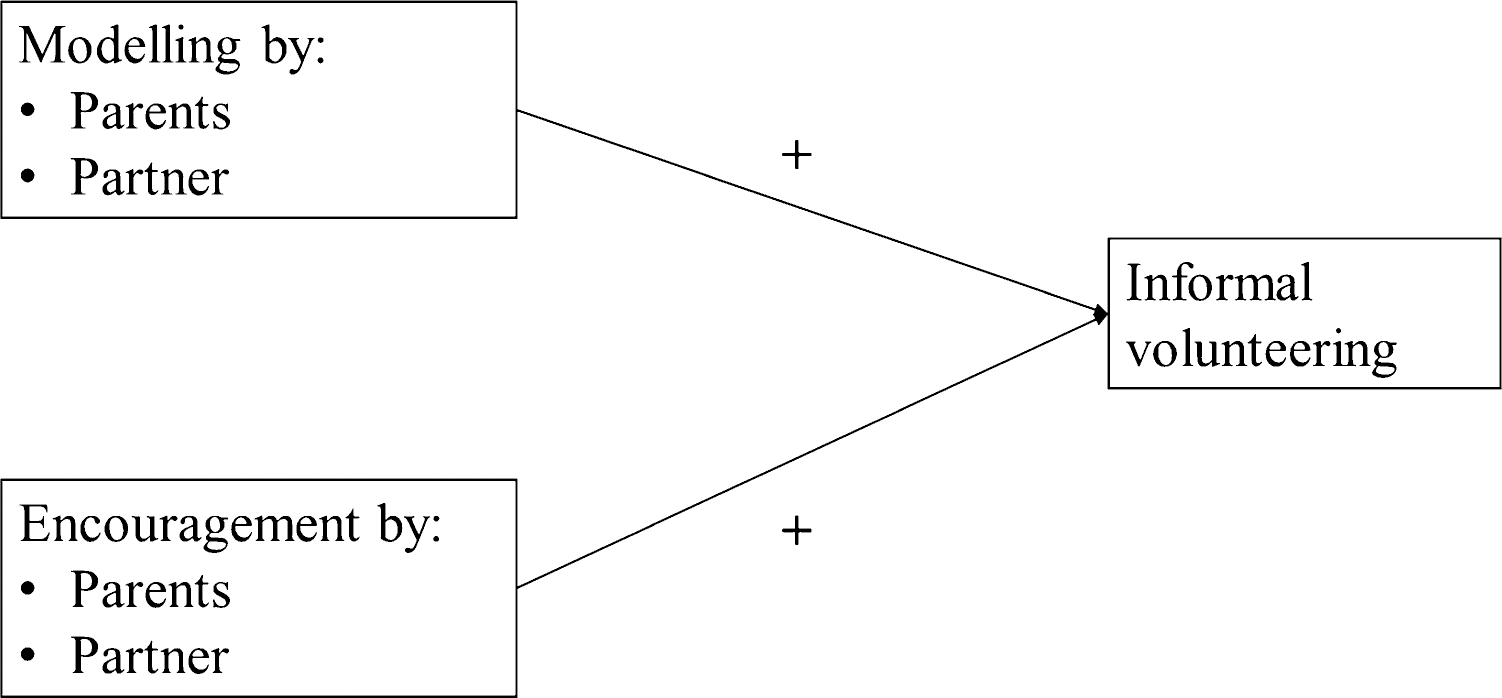
A summary of the hypotheses is presented in Fig. 1.
Conceptual model

Data and Measurements
Data
To test our hypotheses, we employed data from the sixth wave (2017–2018) of the Family Survey Dutch Population (FSDP) (Meuleman et al. Reference Meuleman, Kraaykamp and Tolsma2019). The FSDP registers respondents’ opinions and behaviours as well as their family upbringing and current family situation in the Netherlands. It was conducted among a sample of individuals between 18 and 70 years old (N = 2610) drawn from the Longitudinal Internet Studies for the Social Sciences (LISS) panel, which is representative for the Dutch population. An important quality of the FSDP is that through retrospective questioning, information is gathered on the family situation in a person’s youth. Moreover, from LISS, information is available on respondents’ religious affiliation, personality and aspects of social integration. For an extensive description of matching FSDP and LISS information, see Appendix A.
We excluded individuals from our sample with missing information on informal volunteering (1.8%), and all independent variables, with the exception of parental volunteering (7.0%), partner education (2.2%) and parental education (9.7%). For these variables, respondents had to report information about their partner or parents, which some respondents did not know or could not remember. To avoid an unnecessary loss of respondents, we constructed a separate category for respondents who did not know if their parents volunteered or not during their youth. Respondents who did not know their parents’ or partner’s level of education were assigned a lowest score (4), and we included a dummy (missing information) in our models to control for selectivity in this respect.
We performed our analyses on two separate samples. We tested our hypotheses regarding parental socialization on all respondents (N = 2464). Obviously, hypotheses on the role of partner socialization were analysed only among partnered individuals (N = 1475). In these models, it is possible to include partner characteristics.
Measurements
Informal volunteering was measured with the following question: ‘please indicate how often you have done the following things for a) friends and acquaintances and b) neighbours without receiving money in return in the past 12 months’.Footnote 1 A list was presented to the respondent with types of behaviour indicating emotional support (giving advice; listening to someone’s problems) and indicating practical help (doing small chores in or around the house; lending tools, appliances or clothes; helping with an activity or event; looking after (grand)children; taking care of pets or plants when someone is away; providing transport). Since informal volunteering refers to voluntary work (Einolf et al. Reference Einolf, Prouteau, Nezhina, Ibrayeva, Smith, Stebbins and Grotz2016), we decided to only include the items referring to practical help in our analyses.Footnote 2 Response options for each of the six items were as follows: never (0); once in a while (1); regularly; (2); often (3). To create one composite measure of informal volunteering, we first weighed the items according to the proportion of respondents that had responded ‘never’ to that particular item to take into account that some behaviours (e.g. looking after (grand)children of friends or neighbours) were more exclusive and may take more effort and prosocial motivation than others (e.g. doing small chores in or around the house).Footnote 3 For example, 42% of the respondents indicated that they had never done small chores in or around the house in the last 12 months for friends. Therefore, we multiplied respondents’ original scores by 0.42. A respondent who originally scored 3 on the item scored 0.42 * 3 = 1.26 after this multiplication. As a result, doing small chores was less relevant to the composite measure than other behaviours, such as looking after (grand)children of neighbours (which was never done by 86.1% of respondents). To create a scale, we averaged the weighed scores. The minimum score was 0, meaning that a respondent had not engaged in any informal volunteering. The maximum observed score was 2.04.
Parental modelling referred to whether or not parents (formally) volunteered during a respondent’s youth. Respondents were asked about parental volunteering when they were approximately 15 years old. Although we would have preferred to use parental informal volunteering as a measure of parental modelling, this information was not available. Moreover, it is likely that questions about parental informal volunteering would suffer more from a memory bias than questions about formal volunteering, since it is less formalized and therefore less memorable. Hence, we use parental formal volunteering as an indicator of parents’ modelling prosocial behaviour. A similar strategy was applied for partner modelling, which referred to whether or not a partner was currently active in formal volunteering. For parental and partner encouragement, we used two items, namely ‘I learned from my parents/partner to take others into consideration’ and ‘my parents/partner emphasizes how important it is to help others’, with response categories ranging from ‘totally disagree’ (0) to ‘totally agree’ (4). If respondents answered ‘not applicable’ (2.2%), they were assigned the lowest score (0). A dummy variable controlling for selectivity in this respect (missing information) was included in the analyses.Footnote 4 For both parents and partners, the scores on both items were averaged to create a scale. Higher scores refer to stronger parental and partner encouragement.
We considered several control variables in our models. First, we controlled for gender and for age in years. Second, we take relevant psychological traits and religious motivations into account by inclusion of agreeableness, extraversion and being religious. Agreeableness and extraversion are two of the ‘Big Five’ personality traits (Goldberg Reference Goldberg1992), and prior research indicates that these traits are relevant for people’s prosocial behaviour (Carlo et al. Reference Carlo, Okun, Knight and de Guzman2005). Within LISS, these traits were measured by the IPIP’s Big Five scale which has 50 items in total, 10 for each personality trait (based on Goldberg Reference Goldberg1992). Factor analysis indicated that agreeableness and extraversion were separate dimensions, and a reliability analysis showed high alphas (0.846/0.880) for agreeableness and extraversion. A third group of control variables referred to an individual’s resources. For employment status, individuals were divided into three categories: non-employed (no job or works less than 12 h a week), part-time employed (works 12–36 h a week) and full-time employed (works 36 or more hours a week). Education was measured in years of education based on the highest degree a respondent obtained. The so-called name generator assessed respondents’ core discussion network size; the number of people a respondent named to discuss personal matters with. Health referred to a person’s subjective health. The original five categories were reduced to two categories, namely ‘bad’ (‘bad’ and ‘mediocre’) and ‘good’ (‘good’, ‘very good’ and ‘great’). Household income was measured as the sum of the net monthly income of all household members. To facilitate interpretation of the coefficients, income scores were divided by 100. People who did not answer the question (8.1%) were assigned the average household income, and we included a dummy variable (missing information) to control selectivity therein. Finally, we controlled for several family characteristics. Parental education was measured in years similar to respondents’ own education. In the sample with partnered respondents, we additionally controlled for partner’s education, partner’s employment status, relationship duration and number of children. Partner’s education and partner’s employment status were measured similar to respondent’s own education and employment status. Relationship duration was measured in years, and number of children refers to the number of children that lived in the same household as the respondent.
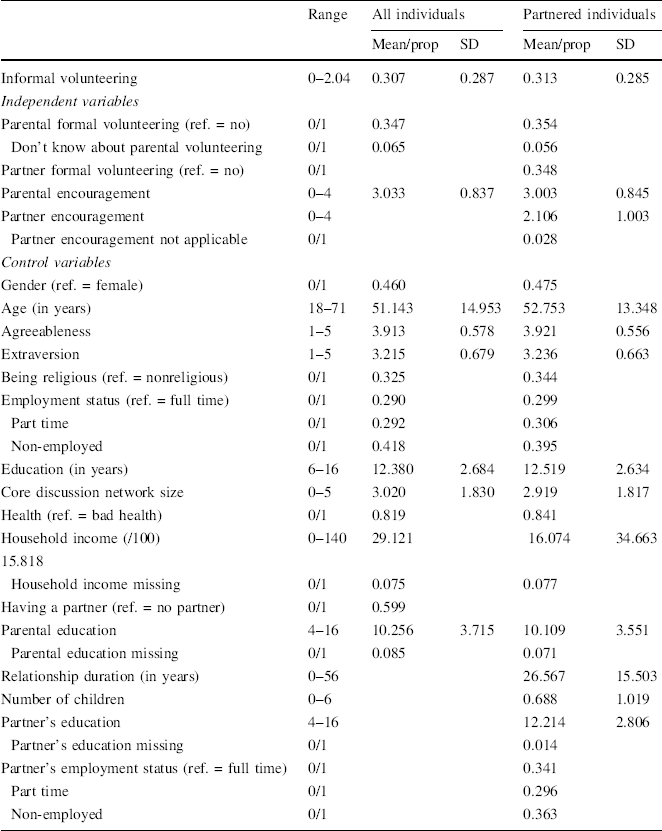
Table 1 shows the descriptive statistics for our full and partnered sample.
Descriptive statistics for the full (N = 2464) and partnered sample (N = 1475).

Range |
All individuals |
Partnered individuals |
|||
|---|---|---|---|---|---|
Mean/prop |
SD |
Mean/prop |
SD |
||
Informal volunteering |
0–2.04 |
0.307 |
0.287 |
0.313 |
0.285 |
Independent variables |
|||||
Parental formal volunteering (ref. = no) |
0/1 |
0.347 |
0.354 |
||
Don't know about parental volunteering |
0/1 |
0.065 |
0.056 |
||
Partner formal volunteering (ref. = no) |
0/1 |
0.348 |
|||
Parental encouragement |
0–4 |
3.033 |
0.837 |
3.003 |
0.845 |
Partner encouragement |
0–4 |
2.106 |
1.003 |
||
Partner encouragement not applicable |
0/1 |
0.028 |
|||
Control variables |
|||||
Gender (ref. = female) |
0/1 |
0.460 |
0.475 |
||
Age (in years) |
18–71 |
51.143 |
14.953 |
52.753 |
13.348 |
Agreeableness |
1–5 |
3.913 |
0.578 |
3.921 |
0.556 |
Extraversion |
1–5 |
3.215 |
0.679 |
3.236 |
0.663 |
Being religious (ref. = nonreligious) |
0/1 |
0.325 |
0.344 |
||
Employment status (ref. = full time) |
0/1 |
0.290 |
0.299 |
||
Part time |
0/1 |
0.292 |
0.306 |
||
Non-employed |
0/1 |
0.418 |
0.395 |
||
Education (in years) |
6–16 |
12.380 |
2.684 |
12.519 |
2.634 |
Core discussion network size |
0–5 |
3.020 |
1.830 |
2.919 |
1.817 |
Health (ref. = bad health) |
0/1 |
0.819 |
0.841 |
||
Household income (/100) |
0–140 |
29.121 |
16.074 |
34.663 |
15.818 |
Household income missing |
0/1 |
0.075 |
0.077 |
||
Having a partner (ref. = no partner) |
0/1 |
0.599 |
|||
Parental education |
4–16 |
10.256 |
3.715 |
10.109 |
3.551 |
Parental education missing |
0/1 |
0.085 |
0.071 |
||
Relationship duration (in years) |
0–56 |
26.567 |
15.503 |
||
Number of children |
0–6 |
0.688 |
1.019 |
||
Partner's education |
4–16 |
12.214 |
2.806 |
||
Partner's education missing |
0/1 |
0.014 |
|||
Partner's employment status (ref. = full time) |
0/1 |
0.341 |
|||
Part time |
0/1 |
0.296 |
|||
Non-employed |
0/1 |
0.363 |
|||
Models
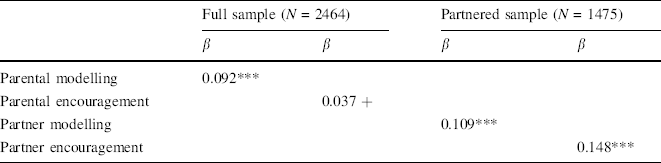
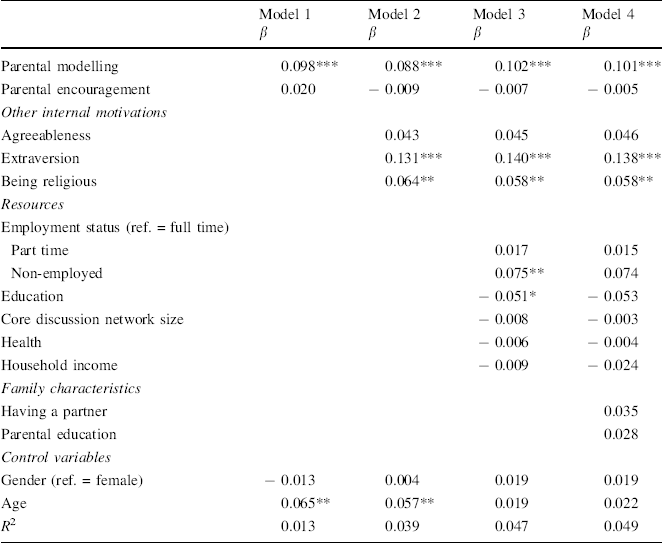
We started our analyses performing bivariate descriptive analyses of the socialization variables and informal volunteering in Table 2. Hereafter, we performed multiple regression analyses. Models 1 to 4 were based on the full sample and are presented in Table 3. Model 1 included both parental modelling and parental encouragement and gender and age. In the models 2 until 4, controls for motivational factors, resources and family characteristics, respectively, were added. In Table 4, we presented models 5 to 8 on the partnered sample. These models were built up similarly but obviously included partners’ rather than parents’ modelling and encouragement measures. Finally, we discuss some of the robustness checks we performed.
Standardized coefficients of parental and partner socialization in single linear regression analyses on informal volunteering.

Full sample (N = 2464) |
Partnered sample (N = 1475) |
|||
|---|---|---|---|---|
β |
β |
β |
β |
|
Parental modelling |
0.092*** |
|||
Parental encouragement |
0.037 + |
|||
Partner modelling |
0.109*** |
|||
Partner encouragement |
0.148*** |
|||
***p < 0.001; **p < 0.01; *p < 0.05; + p < 0.1
Standardized coefficients of the effects of parental modelling and parental encouragement on informal volunteering (N = 2464).

Model 1 |
Model 2 |
Model 3 |
Model 4 |
|
|---|---|---|---|---|
β |
β |
β |
β |
|
Parental modelling |
0.098*** |
0.088*** |
0.102*** |
0.101*** |
Parental encouragement |
0.020 |
− 0.009 |
− 0.007 |
− 0.005 |
Other internal motivations |
||||
Agreeableness |
0.043 |
0.045 |
0.046 |
|
Extraversion |
0.131*** |
0.140*** |
0.138*** |
|
Being religious |
0.064** |
0.058** |
0.058** |
|
Resources |
||||
Employment status (ref. = full time) |
||||
Part time |
0.017 |
0.015 |
||
Non-employed |
0.075** |
0.074 |
||
Education |
− 0.051* |
− 0.053 |
||
Core discussion network size |
− 0.008 |
− 0.003 |
||
Health |
− 0.006 |
− 0.004 |
||
Household income |
− 0.009 |
− 0.024 |
||
Family characteristics |
||||
Having a partner |
0.035 |
|||
Parental education |
0.028 |
|||
Control variables |
||||
Gender (ref. = female) |
− 0.013 |
0.004 |
0.019 |
0.019 |
Age |
0.065** |
0.057** |
0.019 |
0.022 |
R 2 |
0.013 |
0.039 |
0.047 |
0.049 |
***p < 0.001; **p < 0.01; *p < 0.05
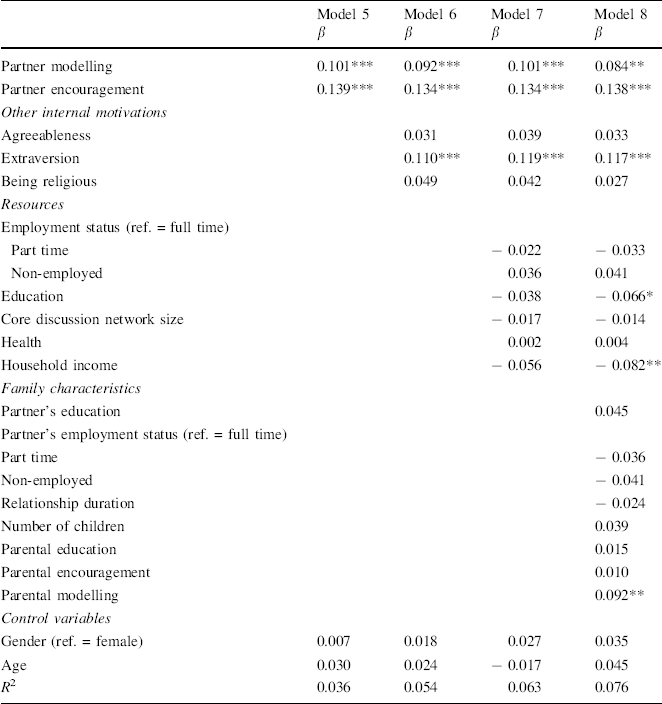
Standardized coefficients of the effects of partner modelling and partner encouragement on informal volunteering (N = 1475)

Model 5 |
Model 6 |
Model 7 |
Model 8 |
|
|---|---|---|---|---|
β |
β |
β |
β |
|
Partner modelling |
0.101*** |
0.092*** |
0.101*** |
0.084** |
Partner encouragement |
0.139*** |
0.134*** |
0.134*** |
0.138*** |
Other internal motivations |
||||
Agreeableness |
0.031 |
0.039 |
0.033 |
|
Extraversion |
0.110*** |
0.119*** |
0.117*** |
|
Being religious |
0.049 |
0.042 |
0.027 |
|
Resources |
||||
Employment status (ref. = full time) |
||||
Part time |
− 0.022 |
− 0.033 |
||
Non-employed |
0.036 |
0.041 |
||
Education |
− 0.038 |
− 0.066* |
||
Core discussion network size |
− 0.017 |
− 0.014 |
||
Health |
0.002 |
0.004 |
||
Household income |
− 0.056 |
− 0.082** |
||
Family characteristics |
||||
Partner's education |
0.045 |
|||
Partner's employment status (ref. = full time) |
||||
Part time |
− 0.036 |
|||
Non-employed |
− 0.041 |
|||
Relationship duration |
− 0.024 |
|||
Number of children |
0.039 |
|||
Parental education |
0.015 |
|||
Parental encouragement |
0.010 |
|||
Parental modelling |
0.092** |
|||
Control variables |
||||
Gender (ref. = female) |
0.007 |
0.018 |
0.027 |
0.035 |
Age |
0.030 |
0.024 |
− 0.017 |
0.045 |
R 2 |
0.036 |
0.054 |
0.063 |
0.076 |
***p < 0.001; **p < 0.01; *p < 0.05
Results
Descriptive Analyses
Our descriptive analyses, as reported in Table 2, show that individuals who experienced prosocial socialization indeed were more active in informal volunteering. More specifically, respondents whose parents volunteered (β = 0.092), whose partner volunteered (β = 0.109) or whose partner encouraged them to help others (β = 0.148) engaged more in informal volunteering. We also found a small positive relationship between parental encouragement and informal volunteering (β = 0.037). Yet, this effect was significant only at p < 0.1.
Multivariate Analyses
Model 1 in Table 3 shows that, controlled for gender and age, parental modelling was still positively related to doing informal volunteering (β = 0.098). So, when parents were active in formal volunteering in a respondent’s youth, this person was inclined to perform more informal help tasks currently. Table 3 also indicates that having experienced parental encouragement in one’s youth was not significantly related to present-day informal volunteering (β = 0.020). Apparently, this encouragement effect was cancelled out by the active modelling of parents. Controlling for possible confounding aspects in Models 2 to 4 did not change our main conclusions. This means that the difference in informal volunteering between respondents with volunteering parents and non-volunteering parents in one’s youth could not be attributed to internal motivations, resources or family characteristics. Thus, our results lead us to support hypothesis 1 and refute hypothesis 3. While estimates in Model 4 suggest that the effect of parental modelling seems relatively small (β = 0.098), it showed larger than the effects of agreeableness (β = 0.043), and being religious (β = 0.058), which have often been linked to various prosocial behaviours (e.g. Bekkers Reference Bekkers2007; Carlo et al. Reference Carlo, Okun, Knight and de Guzman2005; van Tienen et al. Reference van Tienen, Scheepers, Reitsma and Schilderman2011). This indicated that the impact of parental modelling was substantial.
Table 3 also shows that the more extravert and the older a person was, the more often they were active in informal volunteering. The opposite seemed true for education; the higher a person was educated, the less engaged they are in informal volunteering. We further found that religious and non-employed people were more often informal volunteers as compared to non-religious and full-time employed people.
Table 4 reports the estimates of partner modelling and encouragement. Model 5 shows that both partner modelling (β = 0.101) and partner encouragement (β = 0.139) were positively related to informal volunteering. Inclusion of internal motivations, resources or family characteristics (including parental socialization) did not change these results. Our findings support hypotheses 2 and 4 that state that respondents whose partner is a volunteer are more active in informal volunteering, and that people whose partner encourages them to help others engage more in informal volunteering. Again, these effects seem substantially larger than that of agreeableness (β = 0.033) and religious involvement (β = 0.027). Looking at unstandardized effects gives an idea of how substantial the socialization effects are. For example, the unstandardized effect of partner modelling indicated that individuals whose partner volunteered differed 0.05 on the scale of informal volunteering (0–2.04) from individuals whose partner did not volunteer. The unstandardized effect of partner encouragement was 0.039. This means that individuals who received the maximum amount of partner encouragement (score 4) scored 0.039 * 4 = 0.156 higher on informal volunteering than individuals who did not receive any partner encouragement (score 0).
Table 4 also shows that, among partnered individuals, those who were more extravert did more informal volunteering. People with higher levels of educational attainment and higher income volunteered less informally. Our earlier finding is also corroborated in Table 4; people whose parents volunteered in their youth did more informal volunteering currently.
Robustness Checks
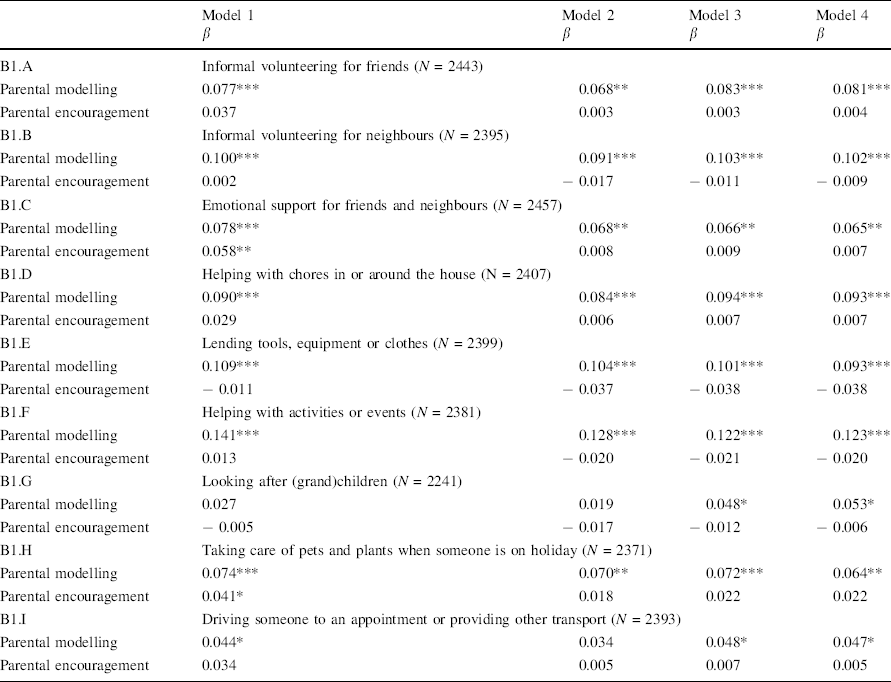
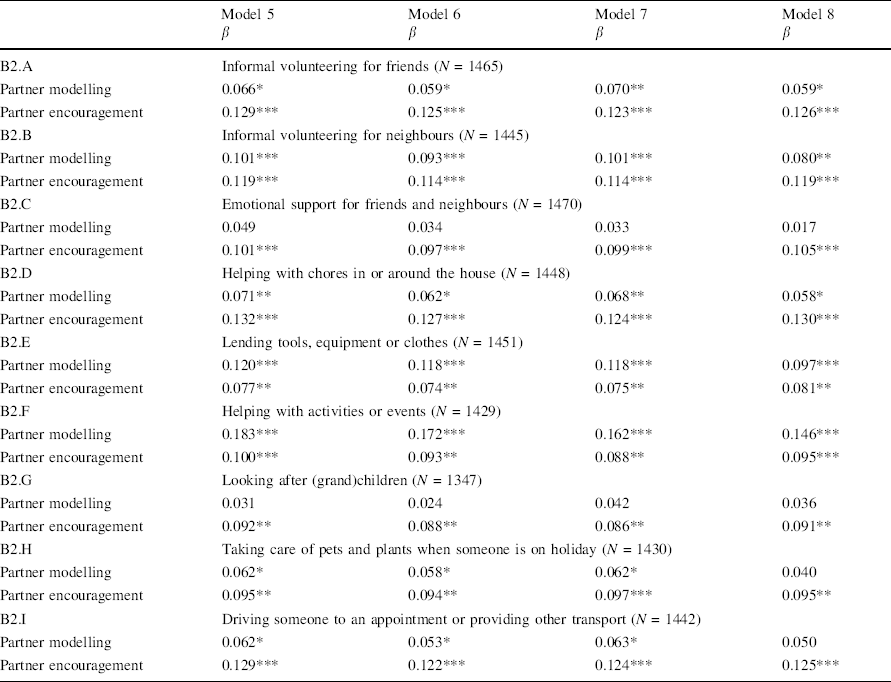
We performed three types of robustness checks, which we report on in Tables 5 and 6 in Appendix B. First, we checked whether differentiating between helping friends and helping neighbours yielded different results (Appendices B1.a, B1.b in Table 5 and, B2.a and B2.b in Table 6). It could be that these two groups instigate different helping norms and that helping friends and neighbours may thus be influenced differently by socialization processes. Although the estimates of the four socialization measures for helping friends were slightly smaller as compared to helping neighbours, the main results were similar, and thus our conclusions are virtually identical.
Second, we performed analyses for all six informal voluntary behaviours separately (Appendices B1.d to B1.i in Table 5 and B2.d to B2.i in Table 6). Our analyses suggested that there was some variation in effect sizes (ranging from β = 0.047 until β = 0.123), but also that the results for parental modelling and partner encouragement were rather robust. These models, however, show that estimates of partner modelling were less robust. Individuals whose partner volunteered only engaged more in chores in or around the house, lending tools, equipment or clothes and helping with activities or events.
Third, we estimated the effects of prosocial socialization solely on items dealing with emotional supportFootnote 5 (Appendices B1.c in Table 5 and B2.c in Table 6), a type of helping behaviour that is sometimes included in informal volunteering (van Tienen et al. Reference van Tienen, Scheepers, Reitsma and Schilderman2011). Again, parental modelling and partner encouragement showed similar effects as found for our practical measures of informal volunteering. It is shown that neither partner modelling, nor parental encouragement was related to providing emotional support. This suggests that providing emotional support is also affected by socialization practices, but to a lesser extent.
Conclusion and Discussion
In this study, we examined the role of socialization practices on informal expressions of volunteering. We expected that modelling and encouragement by both parents and a partner would promote informal volunteering. We tested our expectations with unique recent data from the sixth wave of the FSDP (2017–2018) and extensively controlled for confounding factors to ensure that the reported effects of socialization practices may not be assigned to confounding factors.
In line with research on volunteering in formal organizations (e.g. Bekkers Reference Bekkers2005; Nesbit Reference Nesbit2013; Perks and Konency Reference Perks and Konency2015; Quaranta and Dotti Sani Reference Quaranta and Dotti Sani2016), our study found that socialization was indeed consistently related to informal volunteering, even after controlling for confounding factors and examining various aspects of informal volunteering. More specifically, we found that people whose parents or partner volunteered engaged more in informal volunteering. These findings are strongly in support for the theoretical idea that modelling prosocial behaviour is a relevant socialization practice (Dovidio et al. Reference Dovidio, Piliavin, Schroeder and Penner2006; Nesbit Reference Nesbit2013; Perks and Konency Reference Perks and Konency2015; Quaranta and Dotti Sani Reference Quaranta and Dotti Sani2016). Moreover, as we tested modelling by examining formal volunteering, our findings suggest that observing a parent or partner being active in formal volunteering spills over to prosocial behaviours in other domains. These findings are in line with previous studies that also found a spillover between formal volunteering and charitable giving (Bekkers Reference Bekkers2005; Wilhelm et al. Reference Wilhelm, Estell and Perdue2014), and between formal volunteering and informal support (Hook Reference Hook2004).
With respect to encouragement as a socialization practice, this study found that the more the people were encouraged by their partner to help others, the more they were active in informal volunteering. Parental encouragement, however, did not relate to informal volunteering. This finding contrasts prior research that shows that talking with parents about donating to charity promotes charitable giving (Wilhelm et al. Reference Wilhelm, Estell and Perdue2014, Reference Wilhelm, Zhang, Estell and Perdue2017). It may be that the effect of partner encouragement actually reflects partner’s stimulation to become active in informal volunteering with each other as a social activity, for instance when caring for (grand) children is concerned. Another explanation for why we did not find an effect of parental encouragement may be that the items measuring parental encouragement were rather general. These items referred to learning to ‘take others into consideration’ and ‘helping others’. Likely, almost all parents encouraged these types of behaviours in their children (83% ‘taking into consideration’ and 73% ‘helping others’), and it might be too difficult for respondents to assess the intensity of parental stimulation. This may be less relevant for partner encouragement, as parents are charged with the responsibility to teach what is right and partners are not. When future research would continue to study modelling and encouragement simultaneously, it is preferable to include measures that more strictly differentiate in situations or behaviours in which parental encouragement may play a role.
Obviously, our study also holds limitations. First, while our analyses of the partnered sample may indicate that partners influenced each other’s prosocial behaviour, it is also possible that partners have met each other performing prosocial behaviours, or selected each other because of their prosocial behaviour. Our measurement of partner encouragement takes this into account to some extent by asking respondents about their experience of encouragement instead of their partner’s values. However, to draw stronger conclusions on the direction of partner effects, it is advisable for future research to study longitudinal data.
A second limitation concerns the dyadic aspect of informal volunteering. This study has focused on the motivation of the helper and has made an effort to isolate effects of socialization practices. The decision to informally volunteer, however, may not only depend on personal characteristics of the helper, but also on characteristics of the one that is helped, and the relationship with the helper. Moreover, although informal volunteering indicates that people are willing to help and may point at social cohesion in a neighbourhood or friendship network, informal volunteering may also depend on social cohesion and norms to help others within a certain context. When such norms do not exist, individuals may be less inclined to volunteer informally, regardless of their socialization. Hence, the amount of informal volunteering that one does may also depend on contextual characteristics. Future research could examine how these alter, dyad and context characteristics affect informal volunteering and how they relate to socialization practices.
Finally, although our study distinguished between two types of socialization processes, modelling and encouragement, it was unable to test the underlying mechanisms, most prominently, intentions. We presumed that socialization practices result in prosocial motivations and intentions, which promote informal volunteering. Yet, we were unable to put that notion to the test. Future research could examine the underlying mechanisms further, for example by including motivations and intentions in their empirical models.
Despite its limitations, we are of the opinion that this study makes some meaningful contributions to the literature. First, it tested whether socialization practices are relevant for informal volunteering. Second, our study included socialization practices of parents as primary socializing agents, and partners as tertiary socializing agents, and differentiated between modelling and encouragement processes of socialization, which allowed us to show more accurately that modelling was a more powerful socialization process than encouragement. Finally, our study examined both youth and adult prosocial socialization practices, showing that motivations for prosocial behaviour are not set after a person’s youth, but are affected by significant others in adult life as well.
These findings suggest an optimistic outlook on community life in terms of informal volunteering. Our conclusion that informal volunteering is (partly) shaped by socialization by volunteering parents suggests that community life decline may be a process of slow development. Simultaneously, our conclusions suggest that also in adult life, people still learn informal volunteering from others. One the one hand, this implies that people may be socialized during their adult life in the direction of not engaging in informal volunteering. Yet, on the other hand, it offers opportunities to turn the tide of community life decline, as people are shown to still learn new behaviours, even after they have reached adulthood.
Author Contributions
The authors jointly developed the idea and the design for this study. Ramaekers wrote the main part of the manuscript and conducted the analyses. Verbakel and Kraaykamp substantially contributed to the manuscript.
Funding Statement
This study is part of the research program Sustainable Cooperation—Roadmaps to Resilient Societies (SCOOP). The authors are grateful to the Netherlands Organization for Scientific Research (NWO) and the Dutch Ministry of Education, Culture and Science (OCW) for generously funding this research in the context of its 2017 Gravitation Program (Grant No. 024.003.025).
Code Availability
The codebook of the sixth and seventh wave of the Family Survey Dutch Population (Meuleman et al. Reference Meuleman, Kraaykamp and Tolsma2019) is in the process of being deposited at DANS Easy Archives. The data sets of the sixth and seventh waves of the FSDP are available through the LISS Panel Data Archive (https://www.dataarchive.lissdata.nl/study_units/view/913). The codebooks and data sets of previous waves are accessible through DANS Easy Archives (e.g. https://doi.org/10.17026/dans-x67-64zp). The code used to prepare the data and estimate the models presented in this article is available at the authors.
Appendix A
The main dataset in this study is the sixth wave of the Family Survey Dutch Population (FSDP). These data were collected among the LISS panel, which is a panel of Dutch respondents between 18 and 70 years old who are invited to fill in questionnaires every month. One of the questionnaires they filled in was the FSDP. In addition to irregular questionnaires such as the FSDP, LISS sends monthly questionnaires from the LISS Core Study to the panel. The LISS Core study covers various topics, such as health and family. Each topic is surveyed once a year. For more information on the LISS panel, see https://www.lissdata.nl/about-panel.
Since the FSDP respondents were also invited to fill in the LISS Core Study, we can retrieve additional information about them from this study and link it to the FSDP. We retrieved additional information from four LISS Core Study questionnaires: Religion and Ethnicity, Social Integration and Leisure, Family and Household, and Personality. To do so, we first determined that the tenth wave of the Core Study was collected closest to the FSDP. Second, we matched four (groups of) variables to the FSDP, namely whether the respondent was religious (Religion and Ethnicity), the amount of core discussants mentioned (Social Integration and Leisure), the starting year of the respondent’s relationship (Family and Household) and the BIG-V IPIP scale (Personality).
Because respondents of the LISS panel are not required to fill out every questionnaire they receive, we could not retrieve information on these variables for all respondents of the FSDP from the tenth wave of the Core Study. Therefore, we checked whether respondents with missing data on these variables participated in the ninth wave. If they did, we matched information from that wave to the FSDP. If not, we checked for the eighth wave. We repeated this process until none of the respondents with missing data had participated in an earlier wave. For the starting year of the relationship, we repeated the process for all ten waves because respondents did not have to answer the question if they had the same partner as the previous year. For religiousness, the amount of core discussants and the BIG-V IPIP scale, we repeated the process for the last five, four and three waves, respectively. In the end, we lost 47 (1.8%), 3 (0.1%), 58 (3.8%) and 6 (0.2%) respondents because they did not respond to the Religion and Ethnicity, Social Integration and Leisure, Family and Household and Personality questionnaires, respectively.
Although this procedure allows us to retrieve additional information on most respondents in the FSDP, it forces us to make an additional assumption, namely that scores on the variables from the LISS Core Study remain stable over time. While this assumption may be less theoretically sound for some variables (e.g. core discussion network size) than for others (personality traits), excluding individuals who did not participate in the tenth wave of the Core Study did not result in different conclusions. Hence, we present our results with these individuals included.
Appendix B
See Tables 5
Standardized coefficients of the effects of parental modelling and parental encouragement on informal volunteering for friends and for neighbours, emotional support and various informal volunteering behaviours.

Model 1 |
Model 2 |
Model 3 |
Model 4 |
|
|---|---|---|---|---|
β |
β |
β |
β |
|
B1.A |
Informal volunteering for friends (N = 2443) |
|||
Parental modelling |
0.077*** |
0.068** |
0.083*** |
0.081*** |
Parental encouragement |
0.037 |
0.003 |
0.003 |
0.004 |
B1.B |
Informal volunteering for neighbours (N = 2395) |
|||
Parental modelling |
0.100*** |
0.091*** |
0.103*** |
0.102*** |
Parental encouragement |
0.002 |
− 0.017 |
− 0.011 |
− 0.009 |
B1.C |
Emotional support for friends and neighbours (N = 2457) |
|||
Parental modelling |
0.078*** |
0.068** |
0.066** |
0.065** |
Parental encouragement |
0.058** |
0.008 |
0.009 |
0.007 |
B1.D |
Helping with chores in or around the house (N = 2407) |
|||
Parental modelling |
0.090*** |
0.084*** |
0.094*** |
0.093*** |
Parental encouragement |
0.029 |
0.006 |
0.007 |
0.007 |
B1.E |
Lending tools, equipment or clothes (N = 2399) |
|||
Parental modelling |
0.109*** |
0.104*** |
0.101*** |
0.093*** |
Parental encouragement |
− 0.011 |
− 0.037 |
− 0.038 |
− 0.038 |
B1.F |
Helping with activities or events (N = 2381) |
|||
Parental modelling |
0.141*** |
0.128*** |
0.122*** |
0.123*** |
Parental encouragement |
0.013 |
− 0.020 |
− 0.021 |
− 0.020 |
B1.G |
Looking after (grand)children (N = 2241) |
|||
Parental modelling |
0.027 |
0.019 |
0.048* |
0.053* |
Parental encouragement |
− 0.005 |
− 0.017 |
− 0.012 |
− 0.006 |
B1.H |
Taking care of pets and plants when someone is on holiday (N = 2371) |
|||
Parental modelling |
0.074*** |
0.070** |
0.072*** |
0.064** |
Parental encouragement |
0.041* |
0.018 |
0.022 |
0.022 |
B1.I |
Driving someone to an appointment or providing other transport (N = 2393) |
|||
Parental modelling |
0.044* |
0.034 |
0.048* |
0.047* |
Parental encouragement |
0.034 |
0.005 |
0.007 |
0.005 |
Models are controlled for the same variables as in Table 3. Full models are available at the authors
***p < 0.001; **p < 0.01; *p < 0.05
and 6.
Standardized coefficients of the effects of partner modelling and partner encouragement on informal volunteering for friends and for neighbours, emotional support and various informal volunteering behaviours.

Model 5 |
Model 6 |
Model 7 |
Model 8 |
|
|---|---|---|---|---|
β |
β |
β |
β |
|
B2.A |
Informal volunteering for friends (N = 1465) |
|||
Partner modelling |
0.066* |
0.059* |
0.070** |
0.059* |
Partner encouragement |
0.129*** |
0.125*** |
0.123*** |
0.126*** |
B2.B |
Informal volunteering for neighbours (N = 1445) |
|||
Partner modelling |
0.101*** |
0.093*** |
0.101*** |
0.080** |
Partner encouragement |
0.119*** |
0.114*** |
0.114*** |
0.119*** |
B2.C |
Emotional support for friends and neighbours (N = 1470) |
|||
Partner modelling |
0.049 |
0.034 |
0.033 |
0.017 |
Partner encouragement |
0.101*** |
0.097*** |
0.099*** |
0.105*** |
B2.D |
Helping with chores in or around the house (N = 1448) |
|||
Partner modelling |
0.071** |
0.062* |
0.068** |
0.058* |
Partner encouragement |
0.132*** |
0.127*** |
0.124*** |
0.130*** |
B2.E |
Lending tools, equipment or clothes (N = 1451) |
|||
Partner modelling |
0.120*** |
0.118*** |
0.118*** |
0.097*** |
Partner encouragement |
0.077** |
0.074** |
0.075** |
0.081** |
B2.F |
Helping with activities or events (N = 1429) |
|||
Partner modelling |
0.183*** |
0.172*** |
0.162*** |
0.146*** |
Partner encouragement |
0.100*** |
0.093** |
0.088** |
0.095*** |
B2.G |
Looking after (grand)children (N = 1347) |
|||
Partner modelling |
0.031 |
0.024 |
0.042 |
0.036 |
Partner encouragement |
0.092** |
0.088** |
0.086** |
0.091** |
B2.H |
Taking care of pets and plants when someone is on holiday (N = 1430) |
|||
Partner modelling |
0.062* |
0.058* |
0.062* |
0.040 |
Partner encouragement |
0.095** |
0.094** |
0.097*** |
0.095** |
B2.I |
Driving someone to an appointment or providing other transport (N = 1442) |
|||
Partner modelling |
0.062* |
0.053* |
0.063* |
0.050 |
Partner encouragement |
0.129*** |
0.122*** |
0.124*** |
0.125*** |
Models are controlled for the same variables as in Table 4. Full models are available at the authors
***p < 0.001; **p < 0.01; *p < 0.05

 Open access

