





Highlights
-
1. The present study adopted OoA to simulate age of acquisition (AoA) of L2 words.
-
2. We studied the OoA effect and its relation with AoA of the matching L1 words.
-
3. At the word form and phonological processing levels, the OoA effect is independent of L1 AoA.
-
4. At the semantic processing level, the OoA effect depends on L1 AoA.
1. Introduction
The age at which a word is acquired, known as the age of acquisition (AoA), has long been a focus of research in psychology and linguistics (Elsherif et al., Reference Elsherif, Preece and Catling2023). All other things equal, early-acquired words are processed faster and more accurately than late-acquired words. This AoA effect has been widely observed in many different tasks in first language (L1), including word learning (Peters-Sanders et al., Reference Peters-Sanders, Sanders, Goldstein and Ramachandran2023); word/phrasal lexical decision (Ellis & Morrison, Reference Ellis and Morrison1998; Arnon et al., Reference Arnon, Mccauley and Christiansen2017), word naming (Ellis & Morrison, Reference Ellis and Morrison1995; Elsherif et al., Reference Elsherif, Catling and Frisson2020; Yum & Law, Reference Yum and Law2019), picture naming (Karimi & Diaz, Reference Karimi and Diaz2020), face naming (Smith-Spark & Moore, Reference Smith-Spark and Moore2009), progressive demasking (Ploetz & Yates, Reference Ploetz and Yates2016), semantic classification (Räling et al., Reference Räling, Hanne, Schröder, Keßler and Wartenburger2017), sentences/text reading (Dirix & Duyck, Reference Dirix and Duyck2017; Juhasz & Sheridan, Reference Juhasz and Sheridan2020; Wang et al., Reference Wang, Chen and Jiang2024), and memory tasks (Elsherif & Catling, Reference Elsherif and Catling2023; Volkovyskaya et al., Reference Volkovyskaya, Raman and Baluch2017). Recently, there has been a gradual increase in the number of AoA studies in the second language (L2) (Dirix & Duyck, Reference Dirix and Duyck2017; Izura & Ellis, Reference Izura and Ellis2004; Wang & Chen, Reference Wang and Chen2020; Wang, Jiang, & Chen, Reference Wang, Jiang and Chen2023a; Wang, Liang, & Chen, Reference Wang, Liang and Chen2023b; Xue et al., Reference Xue, Liu, Marmolejo-Ramos and Pei2017). For a L2 word, it has two kinds of AoA. One is the AoA of the L2 word itself (i.e., L2 AoA) during L2 words learning, and the other is the AoA of the corresponding L1 translation equivalent word (i.e., L1 AoA) during L1 word learning (Izura & Ellis, Reference Izura and Ellis2002). The L2 AoA effect has been commonly found (Dirix & Duyck, Reference Dirix and Duyck2017; Izura & Ellis, Reference Izura and Ellis2004). However, there is still controversy about at which processing level the AoA effect of L2 occurs and to what extent the L2 AoA effect is determined by the AoA of the corresponding of L1 words (i.e., the relationship between the L2 AoA effect and L1 AoA). The present study aims to explore these questions.
1.1. Age of acquisition effect in second language
The L2 AoA effect is a commonly observed phenomenon in word processing and memory tasks (Elsherif et al., Reference Elsherif, Preece and Catling2023; Volkovyskaya et al., Reference Volkovyskaya, Raman and Baluch2017). Especially in word processing, the influence of L2 AoA was widely observed in a variety of tasks, for example, lexical decision (Izura & Ellis, Reference Izura and Ellis2002; Wang, Liang, & Chen, Reference Wang, Liang and Chen2023b), word naming (Wang, Jiang, & Chen, Reference Wang, Jiang and Chen2023a), picture naming (Hirsh et al., Reference Hirsh, Morrison, Gaset and Carnicer2003), translation judgement (Izura & Ellis, Reference Izura and Ellis2004), semantic relatedness judgement (Xue et al., Reference Xue, Liu, Marmolejo-Ramos and Pei2017) and text reading tasks (Dirix & Duyck, Reference Dirix and Duyck2017).
Izura and Ellis (Reference Izura and Ellis2002, experiment 4) examined whether the L2 AoA effect was driven by AoA of the L2 words or of the corresponding L1 words. They adopted a semi-factorial experimental design and a lexical decision task. The results showed that the L2 AoA effect was significant, regardless of when the corresponding L1word was acquired. Similar findings were obtained by Izura and Ellis (Reference Izura and Ellis2004), where the L2 AoA effect was driven by L2 AoA rather than L1 AoA, indicating that the L2 AoA effect occurs at the word form level. Dirix and Duyck (Reference Dirix and Duyck2017) used eye-tracking technique and found L2 AoA effects in first/single/total fixation duration and gaze duration during L2 book reading. They found the L1 AoA effect on L2 reading, however, no relationship between the L2 AoA effect and L1 AoA was reported. Recently, Wang, Liang, and Chen (Reference Wang, Liang and Chen2023b) found that the L2 AoA effect at the orthographic level was independent of L1 AoA (experiment 1). At the semantic level, the L2 AoA effect was modulated by L1 AoA for long L2 words (at least 10 letters), that is, the L2 AoA effect was significant when the corresponding L1 word was acquired early (experiment 3). However, in their study, a lexical decision task (filler words were created by changing one letter, e.g., trith) was used to explore the L2 AoA effect at the semantic level (experiment 2 and 3), which is not a typical semantic task. In addition, although some variables like word frequency, concreteness, and word length were controlled, other variables such as cumulative frequency and frequency trajectory may affect the results.
In short, there is no consensus on at which level of processing the L2 AoA effect occurs and the relationship between the L2 AoA effect and AoA of the corresponding L1 word. The influence of L1 AoA on the L2 AoA effect was not found by Izura and Ellis (Reference Izura and Ellis2004) and Wang, Liang, and Chen (Reference Wang, Liang and Chen2023b, experiment 1 and 2) but by Wang, Liang, and Chen (Reference Wang, Liang and Chen2023b, experiment 3). For unbalanced bilinguals, it is typical to have acquired the L1 before starting to learn the L2. Studying the AoA effect in the L2 allows, on the one hand, to examine whether the newly learned language can also produce the AoA effect as the L1, and on the other hand, to further explore the mechanisms of the L2 AoA effect. There are different theories that provide different theoretical predictions on the L2 AoA effect and its relationship with AoA of the corresponding L1 words.
1.2. Theories of the AoA effect
Semantic Hypothesis (Brysbaert et al., Reference Brysbaert, Van Wijnendaele and De Deyne2000; van Loon-Vervoorn, Reference van Loon-Vervoorn1989) argues that AoA influences the organization of the semantic network. Early learned words are the basis of the semantic network and have many semantic connections. The late- acquired words are learned by linking with the early-acquired words, resulting in a higher semantic activation threshold.
The Revised Hierarchical Model (Kroll & Stewart, Reference Kroll and Stewart1994) is one of the major models in the field of bilingualism, proposing a theoretical basis for the research on bilingual word learning and processing. It accounts for the lexical representation and developmental pattern of word meaning access for bilinguals with the increase of their L2 proficiency. For unskilled bilinguals, semantic access to L2 words requires the help of the native language. As far as we know, this model does not provide specifics about the AoA effect. Combining the views of the Semantic Hypothesis and the Revised Hierarchical Model, we speculate that in the semantic processing task, the L2 AoA effect is determined by AoA of L1 translation equivalents for unskilled bilinguals, and there is no independent L2 AoA effect.
Arbitrary Mapping Hypothesis (Ellis & Lambon Ralph, Reference Ellis and Lambon Ralph2000; Monaghan & Ellis, Reference Monaghan and Ellis2002; Zevin & Seidenberg, Reference Zevin and Seidenberg2002), based on the connectionist model, proposes that the AoA effect originates primarily from the connections between input and output representations (e.g., spelling-sound/meaning). Early-acquired words have larger changes in connection weights. With the loss of network plasticity, late-acquired words need to adapt to the networks constructed by early-acquired words. The disadvantage of late acquired words emerges when the input–output mapping is inconsistent or arbitrary, since the knowledge learned from early learned words cannot be used. This theory places the AoA effect at the connections between different representations. According to the Arbitrary Mapping Hypothesis, the L2 AoA effect is determined by L2 AoA and is not affected by the age at which their corresponding L1 equivalents are acquired.
Recently, an Integrated Theory that merges the Semantic Hypothesis and Arbitrary Mapping Hypothesis has been proposed (Brysbaert & Ellis, Reference Brysbaert and Ellis2016; Catling et al., Reference Catling, Pymont, Johnston, Elsherif, Clark and Kendall2021; Catling & Elsherif, Reference Catling and Elsherif2020; Chang et al., Reference Chang, Monaghan and Welbourne2019; Chang & Lee, Reference Chang and Lee2020; Cortese et al., Reference Cortese, Toppi, Khanna and Santo2020; Dirix & Duyck, Reference Dirix and Duyck2017; Elsherif & Catling, Reference Elsherif and Catling2022; Menenti & Burani, Reference Menenti and Burani2007; Wang, Jiang, & Chen, Reference Wang, Jiang and Chen2023a; Wang, Liang, & Chen, Reference Wang, Liang and Chen2023b). This theory proposed that the AoA effect originated from both connections between different representations and within these representations themselves. As far as we know, this theory does not directly predict the relationship between the L2 AoA effect and L1 AoA.
In summary, the Semantic Hypothesis and Arbitrary Mapping Hypothesis offer different views on the origins of the L2 AoA effect and its relationship with L1 AoA. According to the Semantic Hypothesis, combined with the lexical representation and access theory of unbalanced bilinguals (The Revised Hierarchical Model, Kroll & Stewart, Reference Kroll and Stewart1994), there is no independent L2 AoA effect in tasks biased towards semantic processing, whereas according to the Arbitrary Mapping Hypothesis, there should be an independent L2 AoA effect in tasks biased towards orthographic, phonological, and semantic processing. As for the Integrated Theory, we acknowledge that it is difficult to make any specific predictions based on it, even if it is the predominant theory for explaining the AoA effect.
1.3. Order of acquisition (OoA) effect
AoA refers to the estimated age at which a word was first learned. This variable is naturally correlated with multiple variables, such as word frequency, cumulative frequency, frequency trajectory, familiarity, word length, imageability, semantic transparency, concreteness, and sensory experience (Juhasz et al., Reference Juhasz, Lai and Woodcock2015; Juhasz & Rayner, Reference Juhasz and Rayner2003; Lewis, Reference Lewis1999; Liu et al., Reference Liu, Shu and Li2007; Wang & Chen, Reference Wang and Chen2020; Zevin & Seidenberg, Reference Zevin and Seidenberg2004). Specifically, early-acquired words tend to be more frequent, have a high cumulative frequency, have a high frequency of occurrence early in childhood and a low frequency of occurrence in adulthood, be more familiar, shorter, easy to imagine, more semantically transparent, evoke concrete and sensory experiences, and rely more on perceptual inputs when learning the meaning of a concept (Izura et al., Reference Izura, Pérez, Agallou, Wright, Marín, Stadthagen-González and Ellis2011; Juhasz, Reference Juhasz2005; Juhasz et al., Reference Juhasz, Lai and Woodcock2015; Juhasz & Rayner, Reference Juhasz and Rayner2003; Lewis, Reference Lewis1999; Liu et al., Reference Liu, Shu and Li2007; Xue et al., Reference Xue, Liu, Marmolejo-Ramos and Pei2017; Zevin & Seidenberg, Reference Zevin and Seidenberg2004). Such complex correlations make it difficult to select materials that vary only in AoA and match all other irrelevant variables. In particular, some variables, such as cumulative frequency and frequency trajectory, cannot be fully controlled due to the lack of relevant statistical data. Hence, the AoA effect observed in previous studies may not be exclusively triggered by the AoA variable (Lewis, Reference Lewis1999; Zevin & Seidenberg, Reference Zevin and Seidenberg2002, Reference Zevin and Seidenberg2004).
In order to better control the irrelevant variable, some researchers have adopted the order of acquisition (OoA) as a laboratory analogue of AoA (Catling et al., Reference Catling, Dent, Preece and Johnston2013; Izura et al., Reference Izura, Pérez, Agallou, Wright, Marín, Stadthagen-González and Ellis2011; Joseph et al., Reference Joseph, Wonnacott, Forbes and Nation2014; Stewart & Ellis, Reference Stewart and Ellis2008; Tamminen & Gaskell, Reference Tamminen and Gaskell2008). First, the AoA effect appears in L2 that is typically acquired in late childhood or adulthood, suggesting that the L2 AoA effect is not influenced by whether early words were learned during the “critical period” of early childhood. The L2 AoA effect may reflect the influence of the learning order (Ellis & Lambon Ralph, Reference Ellis and Lambon Ralph2000; Hirsh et al., Reference Hirsh, Morrison, Gaset and Carnicer2003; Izura et al., Reference Izura, Pérez, Agallou, Wright, Marín, Stadthagen-González and Ellis2011; Monaghan & Ellis, Reference Monaghan and Ellis2010). Second, researchers can artificially manipulate the order at which the to be learned material is introduced into training while easily matching irrelevant variables, such as cumulative frequency and frequency trajectory (Izura et al., Reference Izura, Pérez, Agallou, Wright, Marín, Stadthagen-González and Ellis2011; Joseph et al., Reference Joseph, Wonnacott, Forbes and Nation2014).
Stewart and Ellis (Reference Stewart and Ellis2008) first attempted a laboratory simulation of the AoA effect. Participants were required to learn to categorize novel random checkerboard stimuli, and the results showed that stimuli introduced early were categorized more quickly than those introduced later. Catling et al. (Reference Catling, Dent, Preece and Johnston2013) found the naming of a group of Greeble pictures could be influenced by the order at which the stimuli entered the training, with stimuli introduced early being named significantly faster than later items. The role of OoA was also observed in word learning (Izura et al., Reference Izura, Pérez, Agallou, Wright, Marín, Stadthagen-González and Ellis2011; Joseph et al., Reference Joseph, Wonnacott, Forbes and Nation2014; Tamminen & Gaskell, Reference Tamminen and Gaskell2008). For example, Tamminen and Gaskell (Reference Tamminen and Gaskell2008) asked native English speakers to learn novel words (e.g., cathedurke, it was derived from the base word “cathedral”), which were introduced into the learning process at different time points (early, middle, and late). They found that the naming speed of early-learned words was faster than that of late-learned words. Izura et al. (Reference Izura, Pérez, Agallou, Wright, Marín, Stadthagen-González and Ellis2011) used a paired associate learning paradigm in which native English speakers viewed a picture of a familiar object and a corresponding unknown Spanish word while the sound of the Spanish word was played. Half of the Spanish words were introduced at the beginning of the training, and the other half were introduced later. The cumulative frequency of learning was the same for the early and late learning materials. They found significant OoA effects in picture naming, lexical decision, and semantic category judgment tasks. Joseph et al. (Reference Joseph, Wonnacott, Forbes and Nation2014) asked participants to learn new words (i.e., English pseudowords) that were assigned with unknown concepts (i.e., tools of imaginary tribe). During the learning phase (Day 1-Day 5), participants read high predictability sentences in which new words were embedded. During the test phase (Day 5, after the learning phase), participants read neutral sentences embedded with new words and then completed an offline memory test. The results of the test phase showed significant OoA effects, with reading time/memory scores for early learned words significantly shorter/higher than those for late learned words.
In summary, to better examine the AoA effect on word processing, some researchers have manipulated the OoA in the laboratory. They found significant OoA effects when the interference of variables such as cumulative frequency was fully controlled. These findings suggest that the OoA effect is similar to the AoA effect that develops in natural language acquisition. Furthermore, using OoA allows for a more rigorous control of the influence of confounding variables, such as cumulative frequency and frequency trajectory. Therefore, the present study adopted the OoA variable to examine the L2 AoA effect and its relationship with AoA of corresponding translation equivalents.
1.4. The present study
As reviewed above, empirical evidence and theoretical interpretations have not yet reached a consensus on at which processing level the L2 AoA effect occurs and how it relates to L1 AoA. Previous research on this question has directly manipulated L2 AoA, however, it is difficult to vary only in L2 AoA and match all other irrelevant variables (Izura & Ellis, Reference Izura and Ellis2004; Wang, Liang, & Chen, Reference Wang, Liang and Chen2023b; Xue et al., Reference Xue, Liu, Marmolejo-Ramos and Pei2017). Therefore, the present study manipulated OoA to examine this question at three different levels: orthography, phonology and semantics. Specifically, we asked Chinese-English bilinguals to learn English pseudowords (henceforth “new words”), each pseudoword artificially paired with a Chinese meaning (i.e., Chinese two-character word, henceforth “Chinese word”). We manipulated OoA of these new words as early and late learning, and at the same time manipulated AoA of the matching L1 words as early and late. After completing the learning task, participants completed the lexical decision, word naming, and semantic category judgement tasks in turn.
In addition, we used the event-related potentials (ERPs) technique, which has high temporal resolution (milliseconds) and can reflect continuous cognitive processes in real time. In the L1, previous studies have employed various tasks and extensively found the influence of AoA on ERP components (Adorni et al., Reference Adorni, Manfredi and Proverbio2013; Bakhtiar et al., Reference Bakhtiar, Su, Lee and Weekes2016; Cuetos et al., Reference Cuetos, Barbón, Urrutia and Domínguez2009; Laganaro & Perret, Reference Laganaro and Perret2010; Perret et al., Reference Perret, Bonin and Laganaro2014; Räling et al., Reference Räling, Holzgrefe-Lang, Schröder and Wartenburger2015; Räling et al., Reference Räling, Hanne, Schröder, Keßler and Wartenburger2017; Tainturier et al., Reference Tainturier, Tamminen and Thierry2005; Weekes, Reference Weekes2011; Yum & Law, Reference Yum and Law2019). Tainturier et al. (Reference Tainturier, Tamminen and Thierry2005) was the first study to demonstrate an ERP correlate of AoA effects. They found in an auditory lexical decision task that early-acquired words elicited a larger P300 than late-acquired words. In the orthographic decision task, Adorni et al. (Reference Adorni, Manfredi and Proverbio2013) showed that AoA modulated the left anterior negativity component (190–220 ms), with late-acquired words eliciting larger negative waves. In delayed naming, word reading and semantic decision tasks, AoA effects on the N400 component (e.g., 280–450 ms, 400–500 ms, 400–610 ms) have been observed (Cuetos et al., Reference Cuetos, Barbón, Urrutia and Domínguez2009; Räling et al., Reference Räling, Holzgrefe-Lang, Schröder and Wartenburger2015; Yum & Law, Reference Yum and Law2019). However, whether early-acquired or late-acquired words elicit a larger N400 has not reached a consensus yet. In summary, in L1, the influence of AoA on ERP components has been found in various tasks.
Based on previous relevant studies, we focused on the N170, P200, and N400 components (Bakhtiar et al., Reference Bakhtiar, Su, Lee and Weekes2016; Wang, Jiang, & Chen, Reference Wang, Jiang and Chen2023a; Yum et al., Reference Yum, Law, Su, Lau and Mo2014). N170 is associated with orthographic processing and is a negative brainwave between 150 ms and 200 ms after stimulus presentation, occurring mainly in the occipito-temporal lobe region (Bakhtiar et al., Reference Bakhtiar, Su, Lee and Weekes2016; Coch & Mitra, Reference Coch and Mitra2010). P200 reflects phonological processing, which occurs approximately 200 ms after stimulus presentation and is mainly distributed in the frontal area (Kramer & Donchin, Reference Kramer and Donchin1987; Zhang et al., Reference Zhang, Zhang and Kong2009). N400 is a typical semantic activation component, usually appearing between 300 and 500 ms after stimulus presentation (Kutas & Federmeier, Reference Kutas and Federmeier2011; Kutas & Hillyard, Reference Kutas and Hillyard1980).
The following predictions were made. According to the Arbitrary Mapping Hypothesis, the OoA effect would occur at the orthographic, phonological and semantic processing levels and does not depend on the AoA of matched L1 words. Combining the Semantic Hypothesis and the Revised Hierarchical Model, we would expect to observe that matched L1 AoA, rather than L2 OoA, affects the processing of new words at the semantic level for unskilled bilinguals. According to previous research (Wang, Liang, & Chen, Reference Wang, Liang and Chen2023b), we would expect the OoA effect to occur independently at the orthographic and phonological processing levels. At the semantic processing level, the OoA effect would only appear in early-acquired L1 words, not in late-acquired L1 words.
2. Method
2.1. Participants
FiftyFootnote 1 Chinese (L1)-English (L2) bilinguals (mean age 22.04 ± 2.30, range 18–28, 39 females) from Beijing Normal University participated in the experiment. They were right-handed with normal or corrected-to-normal vision. They signed a consent form prior to the experiment. The present study was approved by the Ethics Committee of the Faculty of Psychology, Beijing Normal University. All participants started learning English from a classroom setting when they were approximately 7–9 years old and had been learning for 12.80 ± 2.13 (range 8–16) years. A six-point scale (1 low to 6 high) was used to measure participants’ proficiency in Chinese and English, including listening, speaking, reading and writing. The results showed that the mean score for English proficiency (mean 3.20 ± .78, range 1.50–5.00) was lower than the mean score for Chinese proficiency (mean 5.27 ± .64, range 3.50–6.00). Participants were also tested on their English proficiency using the Oxford Placement Test (OPT), which consists of 25 multiple-choice questions and a cloze test for a total of 50 points. The mean OPT score of participants was 36.46 ± 4.84 (range 26–48). Combining the results of the six-point self-assessment scale and the OPT scores, it can be observed that the participants’ English proficiency is lower than their Chinese proficiency, indicating that they are unbalanced Chinese-English bilinguals. Finally, due to electroencephalography (EEG) artifacts, six, seven, and eight participants were excluded in the lexical decision, word naming, and semantic category tasks, respectively. Data from 44 participants (mean age 21.84 ± 2.13, range 18–28), 43 participants (22.19 ± 2.34, range 18–28) and 42 participants (mean age 22.05 ± 2.37, range 18–28) were analysedFootnote 2.
2.2. Design and materials
The design was a 2 (OoA: early and late) × 2 (L1 AoA: early and late) within-subject design.
We chose English pseudowords (i.e., new words) as experimental material in order to exclude, as far as possible, the influence of past English learning experiences. A total of one hundred and sixty orthographically legal and pronounceable.
English pseudowords are selected from the English Lexicon Project (Balota et al., Reference Balota, Yap, Cortese, Hutchison, Kessler, Loftis, Neely, Nelson, Simpson and Treiman2007). The pseudowords were as different as possible from the real words to reduce the associative memory caused by the word form similarity between pseudowords and real words in English. OLD20 measures the average orthographic Levenshtein distance between a pseudoword and its 20 most similar words, with smaller values referring to fewer steps in the transformation of letters into real words (Keuleers & Brysbaert, Reference Keuleers and Brysbaert2010). In the present study, the average OLD20 of 160 pseudowords was 3.06, greater than 2, indicating a low similarity between pseudowords and real words (Lu et al., Reference Lu, Wu, Susan and Chen2017). The word length range of 160 pseudowords was 3–13 letters. We attempted to distribute the number of pseudowords of different lengths equally: 11 words for the shortest 3-letter words, around 20 words each for words with 4–10 letters (20 each for 4, 5, 6, and 9 letters; 18 each for 7 and 10 letters; 22 for 8-letter words), and 11 words for words with 11–13 letters.
Due to the impact of initial letter type on the naming latency of visual words (Treiman et al., Reference Treiman, Mullennix, Bijeljac-Babic and Richmond-Welty1995), we controlled for all 160 pseudowords with initial letters that were not fricatives. Among these, 73 new words began with a vowel, 43 began with a voiceless consonant, and 44 began with a voiced consonant. We invited a native English speaker to read aloud these new words and recorded the sound.
The 160 new words were evenly divided: half were learned on Day 1 (early learned words) and the other half were learned from Day 2 (late learned words). There were no significant differences between early and late learned words in terms of bigram frequency (English Lexicon Project, Balota et al., Reference Balota, Yap, Cortese, Hutchison, Kessler, Loftis, Neely, Nelson, Simpson and Treiman2007) and word length (ps > .10). Table 1 shows the means and standard deviations of the new word characteristics.
Descriptive statistics for new words used in the present study (standard deviations)
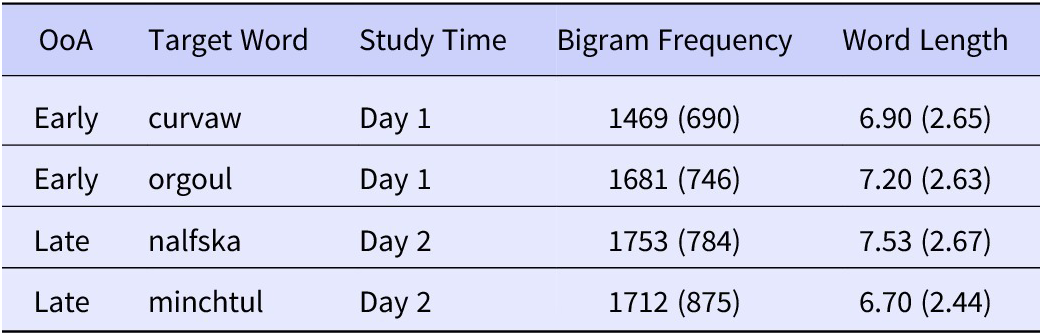
Note: The bigram frequency from the English Lexicon Project (Balota et al., Reference Balota, Yap, Cortese, Hutchison, Kessler, Loftis, Neely, Nelson, Simpson and Treiman2007).
We artificially matched each new word with a Chinese meaning (i.e., a Chinese word). Table 2 lists the descriptive statistics of these matched Chinese words. The AoA data of Chinese words were extracted from Xu et al. (Reference Xu, Li and Guo2020), in which participants were required to write the age (in years) at which they had learned the words in either spoken or written formFootnote 3. The AoA of Chinese words was manipulated as early and late conditions, with a significant difference between the two conditions (t (158) = −27.64, p < .001). No significant differences were found between the two conditions in terms of familiarity, concreteness, and word frequency (familiarity: t (158) = 1.30, p = .20; concreteness: t (158) = −.94, p = .35; frequency: t (158) = .09, p = .93). Familiarity, rated on a 7-point scale (1 meant very unfamiliar, 7 meant very familiar), was cited from Wang et al. (Reference Wang, Huang, Zhou and Cai2019) and Wang and Chen (Reference Wang and Chen2020). Concreteness (5-point scale, 1 meant very concrete, 5 meant very abstract) came from Xu and Li (Reference Xu and Li2020). Word frequency (per million) came from Cai and Brysbaert (Reference Cai and Brysbaert2010). Since participants were required to complete a semantic category judgment task, we manipulated early-acquired Chinese words, half of which were natural words (e.g., 月亮 “moon”) and the other half were manmade words (e.g., 橡皮“eraser”). The same was true for late-acquired Chinese words.
Descriptive statistics for matching Chinese two-character words (standard deviations)

Note: Italics is the English translation of Chinese two-character word. Fam: Familiarity; Fre: Frequency; Con: Concreteness.
Based on the OoA of the new word and the AoA of the matching Chinese two-character word, 160 new words were divided into four conditions: 40 with early OoA and early L1 AoA, 40 with early OoA and late L1 AoA, 40 with late OoA and early L1 AoA, and 40 with late OoA and late L1 AoA.
2.3. Procedure
The present study consisted of a learning and test phase lasting six days. Day 1 to Day 5 were the learning phases, which included two parts: word learning and the daily immediate test. On Day 6, lexical decision, word naming, and semantic category tasks were performed sequentially while recording EEG data.
2.3.1. Learning phases
We first detailed the number and frequency of new words that need to be learned and then introduced the procedure for learning new words and daily immediate tests. To reduce the learning burden, 160 new words were evenly divided into two groups (group A and group B). In group A, half of the new words were learned earlier (group A1), while the other half were learned later (group A2). The same applies to group B, including early learning (group B1) and late learning (group B2). Correspondingly, the participants were divided into two groups (group C and group D). Participants in group C only learned the new words from group A, while participants in group D only learned the new words from group B. In the final data analysis, the data from both groups (160 new words) were merged together.
In addition, to avoid the OoA effect caused by the differences between early and late new words per se, we balanced the presentation order of new words. To be specific, we further divided the participants in group C into two subgroups (group C1 and group C2). Group C1 first learned the new words from group A1 (i.e., early learned new words) followed by learning the new words from group A2 (i.e., late learned new words). Group C2, on the other hand, learned in the opposite order, with participants initially learning the words from group A2 (i.e., early learned new words), and then learning the words from group A1 (i.e., late learned new words). Similarly, group D1 learned new words first from group B1 (i.e., early learned new words) and then from group B2 (i.e., late learned new words); group D2 learned new words initially from group B2 (i.e., early learned new words), followed by learning new words from group B1 (i.e., late learned new words).
Taking the new word “curvaw” from group A as an example, only the participants in group C learned the word, while those in group D did not. For participants in group C1, “curvaw” was introduced early, but for group C2, it was introduced late. Therefore, besides the learning order, we could control that early and late introduced words were identical in all aspects. Table 1 (Supplementary Material) provides the schedule of participants learning new words. Early learned new words were introduced into training from Day 1 to Day 5, except Day 3, while late learned new words were introduced from Day 2 to Day 5. Each new word appeared 6 times per day. Hence, the cumulative frequency (24 times) and frequency trajectory (6 times per day) of early and late words are the same. The number and frequency of learning new words are shown in Table 2 (Supplementary Material).
The following describes the specific experimental procedures for word learning and daily immediate tests.
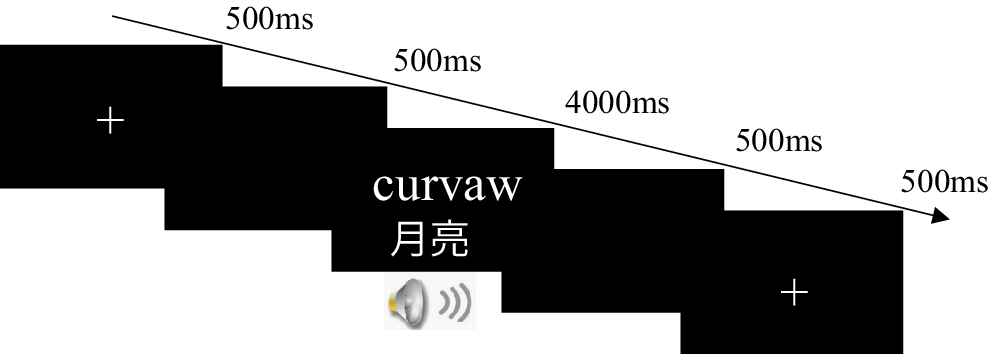
Learning procedure. The procedure is shown in Figure 1. The stimuli were presented on a computer using E-Prime software version 2. A fixation cross was presented in the centre of the screen for 500 ms, followed by a blank screen for 500 ms. The new word and its corresponding Chinese word were presented on the screen for 4000 ms. Meanwhile, the pronunciation of the new word was played through a loudspeaker. Participants were asked to remember the word form, pronunciation and meaning of the word. After an interval of 1,000 ms, the next trial began. Before the formal experiment, participants took seven practice trials to familiarize themselves with the procedure. The stimuli were presented in white on a black background. New words and Chinese words were displayed in 32-point font using Times New Roman and Song, respectively. Participants are approximately 60 centimeters away from the screen.
Procedure of the new word learning.
To facilitate word learning, participants were asked to take two daily immediate tests–a word naming task and a translation task–per day after completing the learning task. Accuracy rates of both tasks were fed back in real time. Participants were informed in advance that they needed to achieve at least an 80% accuracy rate on Day 5.
Word naming task procedure. Each trial began with a 500 ms fixation cross followed by a 500 ms black screen. The new word appeared in the centre of the screen. Participants were asked to name the word as quickly and accurately as possible using a microphone attached to the response box. The new word would automatically disappear after participants spoke it aloud or after 2,000 ms with no response. After a 2,000 ms interval, the correct pronunciation was presented, and participants were asked to memorize it again. After pressing the space bar, a self-assessment screen presented, where participants were asked to judge the accuracy of their pronunciation. Half of the participants were instructed to press the “F” key for correct and the “J” key for incorrect. Button presses among participants were counter-balanced. Seven practice trials were conducted before the formal experiment.
Translation task procedure. A fixation cross was presented in the centre of the screen for 500 ms, followed by a blank screen for 500 ms. A Chinese word was presented on the screen, and participants were asked to write down the corresponding new word in the blank space. After pressing the space bar, the correct answer was presented to the participant, and they were asked to memorize it again. After the space bar was presented, the next trial began. At the beginning of the formal experiment, seven practice trials were conducted.
2.3.2. Testing phases
On Day 6, participants completed lexical decision, delayed word naming, and semantic category judgment tasks in turn while recording EEG data. After completing each task, participants were given ample rest, and the rest time was at their discretion.
Lexical decision task procedure. On each trial, a 500 ms fixation cross appeared in the centre of the screen, followed by a 500 ms blank screen. New words appeared on the screen until a response was registered or after 2,000 ms with no response. New words were presented pseudorandomly. Participants were asked to press the “F” or “J” key to determine whether the word was previously learnt or never seen before. Button presses were counter-balanced across participants. After an interval of 1,000 ms, the next trial began. Participants were told in advance that they should avoid head movements and blinking when the target word was presented. There were seven practices before the formal experiment.
The filler words of the lexical decision task were consonant strings that were orthographically illegal and unpronounceable, generated by a random false word generator (https://www.sttmedia.com/wordcreator). Since each participant learned 80 new words, the number of filler words was also 80. There was no significant difference in word length between filler words and target words.
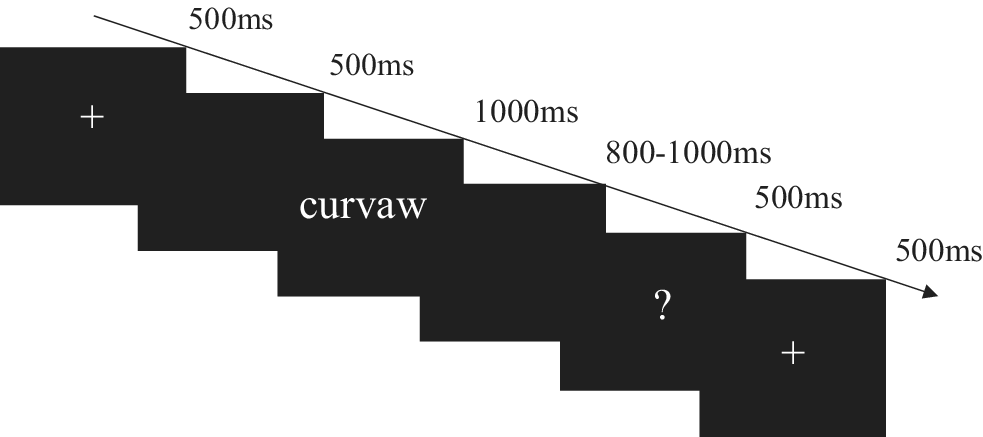
Delayed naming task procedure. To avoid possible artefacts of motor preparation and execution contaminating the EEG signal, we chose a delayed word naming task (Laganaro & Perret, Reference Laganaro and Perret2010; Wang, Jiang, & Chen, Reference Wang, Jiang and Chen2023a). The procedure for the delayed naming task is shown in Figure 2. A fixation cross was first presented in the centre of the screen for 500 ms, and then a blank screen was displayed for 500 ms. The new word appeared on the screen for 1000 ms. After a blank screen for 800–1000 ms, a question mark (?) was shown for 500 ms. New words were presented pseudorandomly. Participants were asked to name the new word as quickly and accurately as possible after seeing the question mark. The question mark appeared in the screen until participants pronounced it or after 500 ms elapsed with no response. Response times were recorded by the computer, while the experimenter recorded error responses and mechanical failures. At the beginning of the experiment, seven practices were performed.
Procedure of the delayed word naming task.
Semantic category judgement task procedure. Each trial began with a fixation cross for 500 ms, followed by a blank screen for 500 ms. New words appeared on the screen until a response was made or after 2,000 ms elapsed with no response. New words were presented pseudorandomly. Participants were required to determine whether the new word was natural or manmade as quickly and accurately as possible. Half of the participants pressed the “F” key for natural and the “J” key for manmade. Button presses were counter-balanced across participants. After an interval of 1,000 ms, the next trial began. Before the formal experiment, seven practice trials were conducted.
2.3.3. EEG recording
EEG data were recorded using 64 Ag/AgCl electrodes with a bandpass of 0.05–100 Hz according to the extended 10–20 system. Electrode impedance is maintained below 5 kΩ with a sampling rate of 500 Hz. Electrodes were referenced online to the intermediate point between electrodes CZ and CPZ. Vertical eye movements were monitored using two electrodes placed below and above the left eye (VEOG). Horizontal eye movements were monitored by electrodes located on the lateral canthi of both eyes (HEOG). Data pre-processing was performed using Scan 4.3 (NeuroScan). EEG data were refiltered offline using a band-pass filter at 0.05–30 Hz and a zero phase shif. Channels affected by eye blinks were corrected using the independent component analysis (ICA). Trials with wrong responses or amplitudes exceeding ±100 μV were excluded. The baseline was corrected with reference to pre-stimulus activity (−200 to 0 ms). Epochs of −200 to 1000 ms were extracted relative to the onset of each stimulus.
3. Results
Prior to reporting the results of the test phase, we first reported the accuracy rates of immediate tests (i.e., word naming and translation tasks) during the learning phases. The results showed that on Day 5, each participant achieved an accuracy rate exceeding 80% (average of 92%) in both word naming and translation tasks. This indicates that the participants have learned the majority of the new words.
3.1. Lexical decision task-behavioral results
Response times and accuracy were analysed using linear mixed-effect models (LMEMs) in R (version 4.0.4; R Core Team, Reference Team2021) with the lme4 package (Baayen et al., Reference Baayen, Davidson and Bates2008; Bates et al., Reference Bates, Maechler, Bolker and Walker2014). LMEMs were performed on a single trial. Response times shorter than 300 ms, beyond three standard deviations of the average mean, and incorrect responses were excluded from the analyses (3.52%).
Response times were inverse transformed (inverse RTs = −1000/RTs), as inverse RTs produce distributions that better match the analysis assumptions (Brysbaert & Stevens, Reference Brysbaert and Stevens2018)Footnote 4. The inverse RTs were analysed using a linear model, whereas accuracy was analysed using a logistic model. A full model was first conducted, with random intercepts for participants and items, as well as by-participants and by-item random slopes of the main effect and interaction. If the full model failed to converge, it was simplified by removing the correlation between random intercepts and random slopes, the by-participants random intercept, and then the random slopes of the main effect and interaction (Karimi & Diaz, Reference Karimi and Diaz2020). We retained random intercepts for both participants and stimuli in the final model.
Mean response times and accuracy rates are presented in Table 3. In response time, the main effect of new words OoA was marginally significant, such that the response time of early learned new words was marginally shorter than that of late learned new words (b = .01, SE = .003, t = 1.86, p = .07, Cohen’s d = .08). The main effect of AoA of the Chinese word (b = .01, SE = .003, t = 1.43, p = .15) and their interaction were not significant (b = −.01, SE = .005, t = −1.60, p = .11). Due to the higher accuracy rate (average of 98.5%), no further analysis was conducted.
Mean response times (RT, ms) and accuracy rates (ACC, %) of three tasks (standard deviations)

3.2. Lexical decision task-ERP results
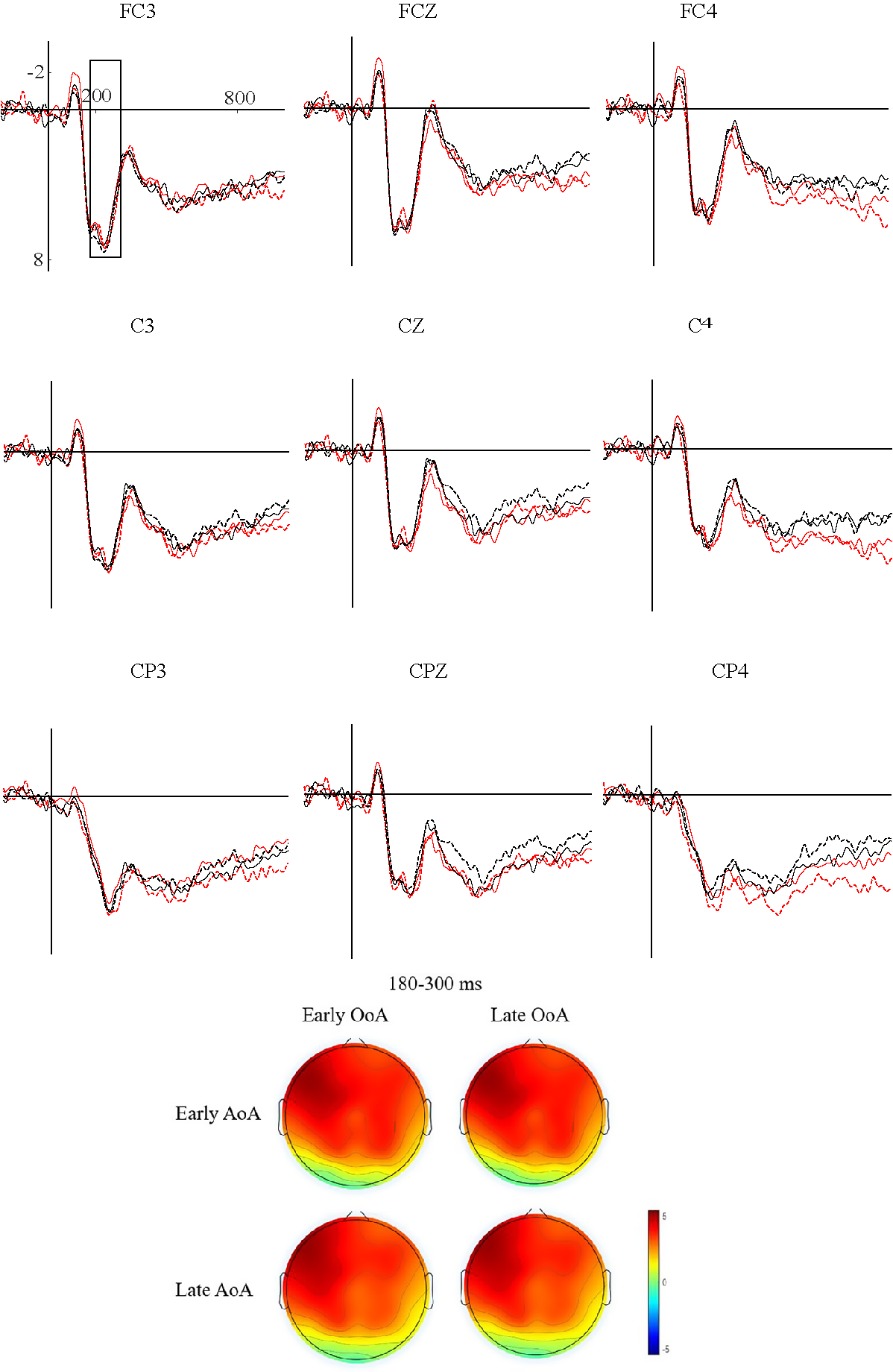
Based on grand average waveforms and previous investigations of AoA effects, we focused on the N170 (150–190 ms) (Adorni et al., Reference Adorni, Manfredi and Proverbio2013; Wang, Jiang, & Chen, Reference Wang, Jiang and Chen2023a). The following electrodes were selected: PO3, PO4, PO5, PO6, PO7, PO8 (Bakhtiar et al., Reference Bakhtiar, Su, Lee and Weekes2016). LMEMs were performed on single-trial amplitudes. A full random structure was constructed in the same way as the behavioral data. The fixed effects in LMEMs were the same as the behavioral data. The hemisphere (left and right) was included in the model as a covariate. Random intercepts for participants, stimuli, and electrodes were also included.
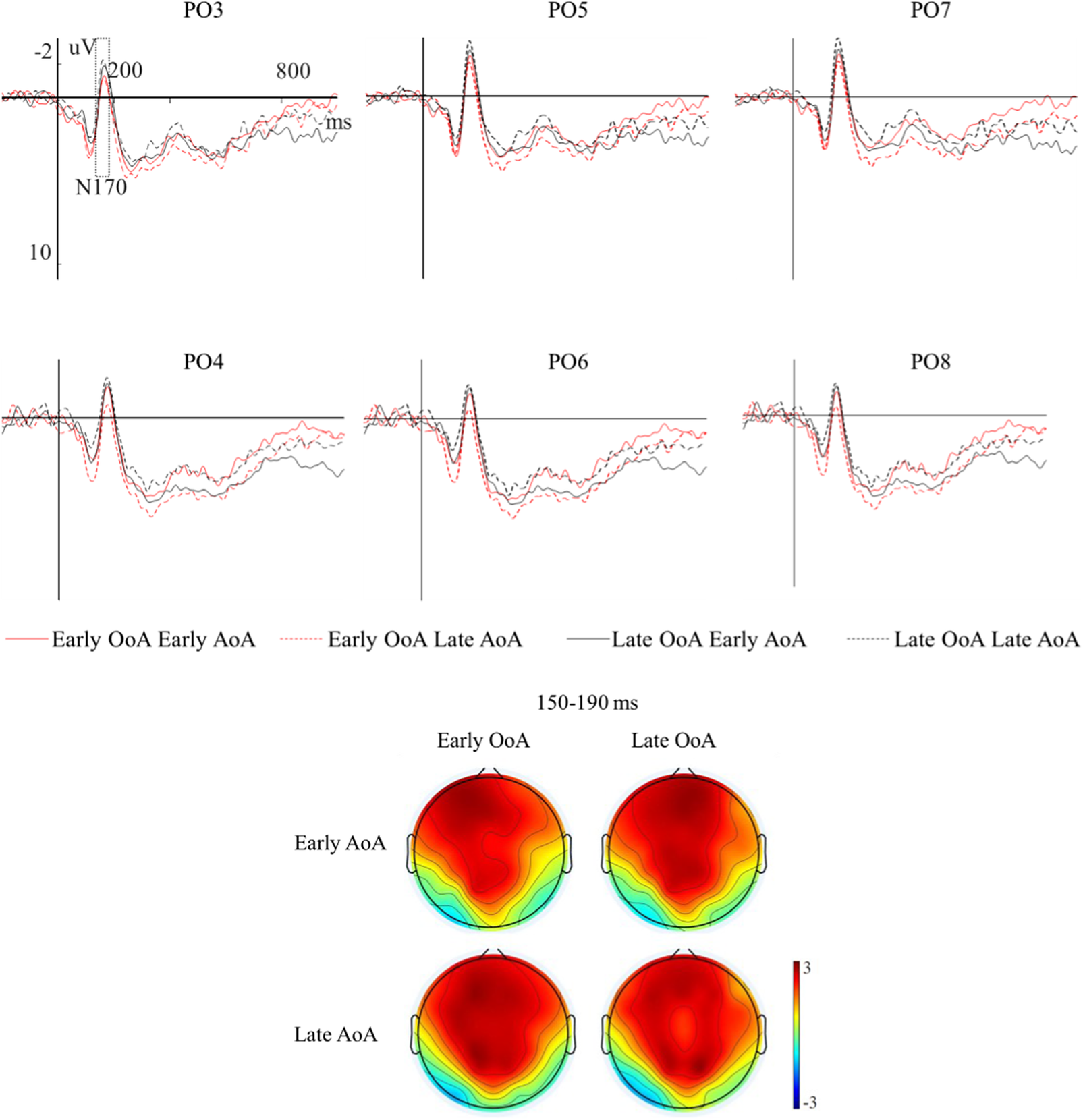
Figure 3 displays the grand average waveforms (top) and the topographic map (bottom) on the N170. Table 4 presents the results of LMEMs on the N170, with significant effects highlighted in bold. When the t-value is greater than 1.96, the p-value is less than 0.05, indicating that the result is statistically significant. The OoA effect was marginally significant (b = −.79, SE = .41, t = −1.93, p = .054, Cohen’s d = .006), which suggested that late learned new words induced marginally larger N170 than the early learned new words. No other effects were found.
Grand average waveforms (top) and topographic maps (bottom) of the N170 component (150–190 ms) under four conditions.
Linear mixed-effect models (LMEMs) estimates of fixed effects for the N170 component
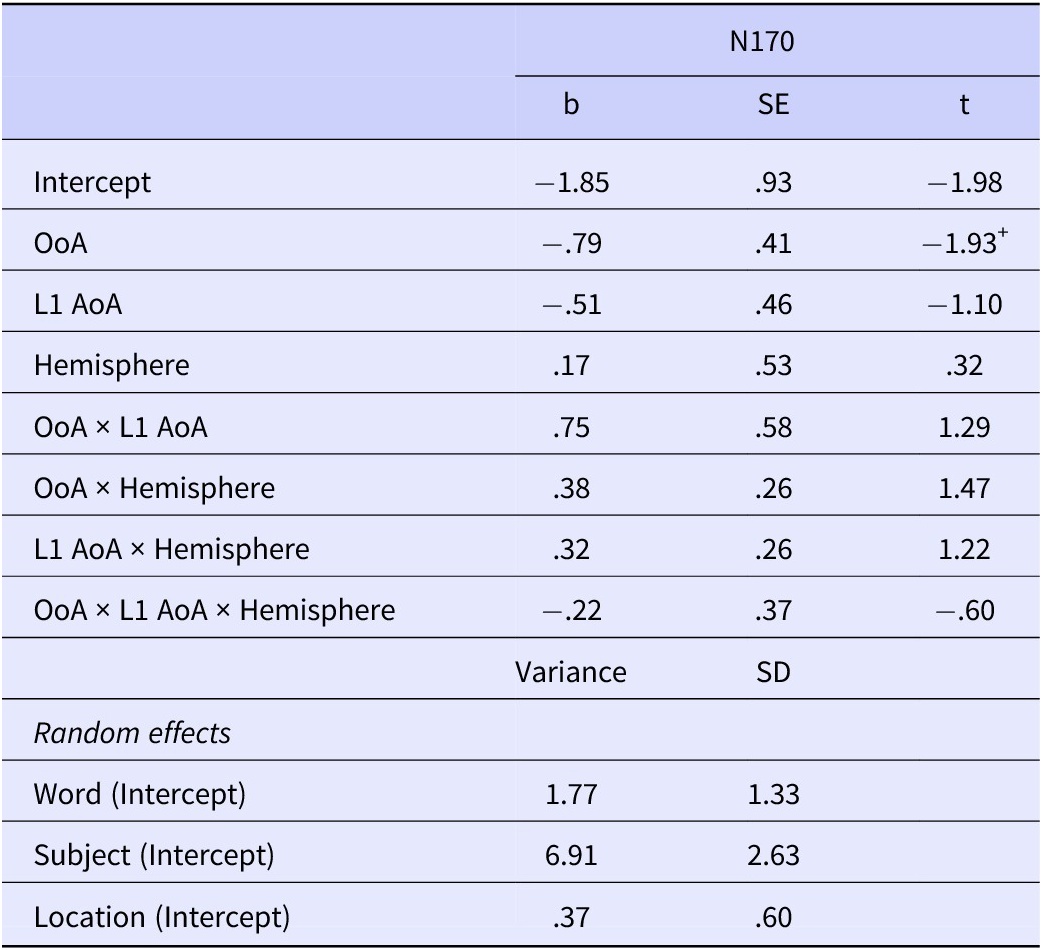
Note: + p < .10. Model structure: depvar.lmer = lmer(N170 ~ OoA*L1AoA*hemisphere+(1|stim) + (1|subject) + (1|location), datafile)
3.3. Delayed word naming task-behavioral results
The data exclusion criteria were the same as those in the lexical decision task, excluding 11% of the data.
The random structure was constructed in the same way as the behavioral data in the lexical decision task. Table 3 presents the mean response times and accuracy rates for items. In response times, no significant effects emerged, neither for the significant main effect of new words OoA (b = −.04, SE = .08, t = −.53, p = .60) or AoA of the Chinese word (b = −.09, SE = .08, t = −1.15, p = .25), nor for their interaction (b = .07, SE = .11, t = .65, p = .52). The accuracy rate was not further analysed because it was much higher (average of 97.5%).
3.4. Delayed word naming task-ERP results
Based on the current data and previous research, we focused on the P200 (180–300 ms) (Landi & Perfetti, Reference Landi and Perfetti2007; Yum et al., Reference Yum, Law, Su, Lau and Mo2014). The following electrodes were chosen: AF3, AF4, F3, F1, FZ, F2, F4, FC3, FC1, FCZ, FC2, FC4, C3, C1, CZ, C2, C4, CP3, CP1, CPZ, CP2, CP4, P3, P1, PZ, P2, P4 (Kramer & Donchin, Reference Kramer and Donchin1987; Zhang et al., Reference Zhang, Zhang and Kong2009). The fixed and random factors were constructed in LMEMs in the same way as the EEG data in the lexical decision task.
Figure 4 displays the grand average waveforms (top) and the topographic map (bottom) on the P200. The results of LMEMs on the P200 are presented in Table 5, with significant effects highlighted in bold. The OoA effect was significant (b = −.20, SE = .09, t = −2.33, p = .02, Cohen’s d = .003), indicating that late learned words induced a larger P200 than early learned words. There was no significant main effect of AoA of the Chinese word (b = −.05, SE = .32, t = −.15, p = .88) or their interaction (b = .20, SE = .12, t = 1.64, p = .10).
Grand average waveforms (top) and the topographic map (bottom) of the P200 component (150–190 ms) under four conditions.
Linear mixed-effect models (LMEMs) estimates of fixed effects for P200, N400 and the delayed N400 components
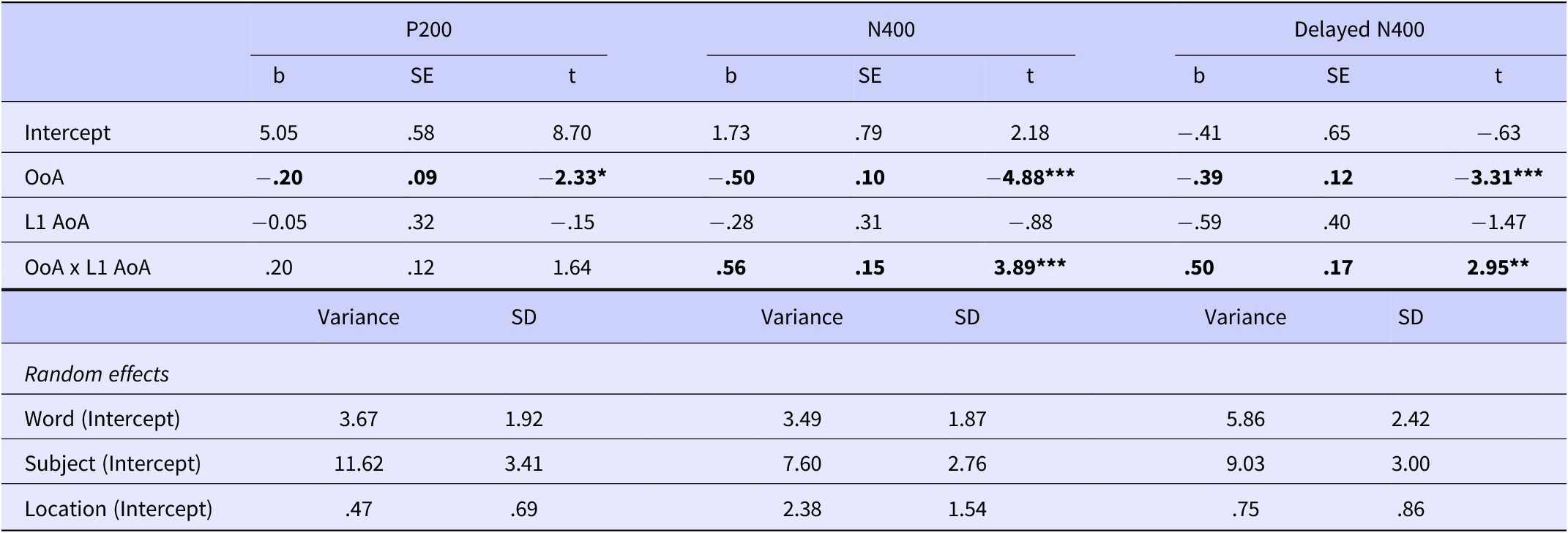
Note: * p < .05; ** p < .01; *** p < .001. Model structure: depvar.lmer = lmer(P200/N400/ Delayed N400 ~ OoA*L1AoA+(1|stim) + (1|subject) + (1|location), datafile)
3.5. Semantic category judgement task-behavioral results
The data exclusion criteria were the same as in the lexical decision task, with 17.97% of the data excluded.
The fixed and random factors were constructed in the same way as in the lexical decision task. The semantic category (natural and manmade) was added into the model as a covariate. Mean response times and accuracy rates for items are presented in Table 3. In response time, there was no effect of the new word OoA, AoA of Chinese meaning, or their interaction. The semantic category effect was significant (b = .09, SE = .02, t = 4.12, p < .001, Cohen’s d = .11), such that response time was shorter when the semantic category was natural than that was manmade.
In accuracy rate, the main effect of new word OoA was not significant (b = .28, SE = .48, z = .57, p = .57). We observed a significant main effect of Chinese word AoA (b = −1.28, SE = .54, z = −2.37, p = .02, Cohen’s d = .06), indicating that the accuracy rate was higher when the Chinese word was acquired early than that was acquired late. The effect of semantic category was significant (b = −.68, SE = .24, z = −2.86, p = .004, Cohen’s d = .11), such that the accuracy rate was higher when the semantic category was natural than that was manmade. The interaction between AoA of Chinese word and semantic category was significant (b = .68, SE = .33, z = 2.03, p = .04), which showed that the AoA effect of Chinese word was significant when the semantic category was natural (b = −.64, SE = .19, z = −3.48, p < .001, Cohen’s d = .22), but this effect disappeared when the semantic category was manmade (b = .20, SE = .19, z = 1.05, p = .29).
3.6. Semantic category judgement task-ERP results
From Figure 5 we could see that a negative wave was induced at about 300 ms, became more obvious after about 500 ms, and lasted until about 800 ms, suggesting the presence of a delayed N400 component. The delayed N400 typically occurs in unskilled bilinguals because their L2 semantic processing is not automated and needs more resources (Berger & Coch, Reference Berger and Coch2010; Moreno et al., Reference Moreno, Rodríguez-Fornells and Laine2008). Following the research by Yum and Law (Reference Yum and Law2019), we analysed the N400 (300–450 ms) and the delayed N400 (600–800 ms), and six regions of interest were analysed: left anterior (FC3, FC1, C3, C1), left posterior (CP3, CP1, P3, P1), middle anterior (FCZ, CZ), middle posterior (CPZ, PZ), right anterior (FC2, FC4, C2, C4), and right posterior (CP2, CP4, C2, C4) (Yum & Law, Reference Yum and Law2019). The semantic category was initially included in the model as a covariate but was eventually removed due to its lack of significance.
Grand average waveforms (top) and the topographic map (bottom) of N400 and delayed N400 components (150–190 ms) under four conditions.
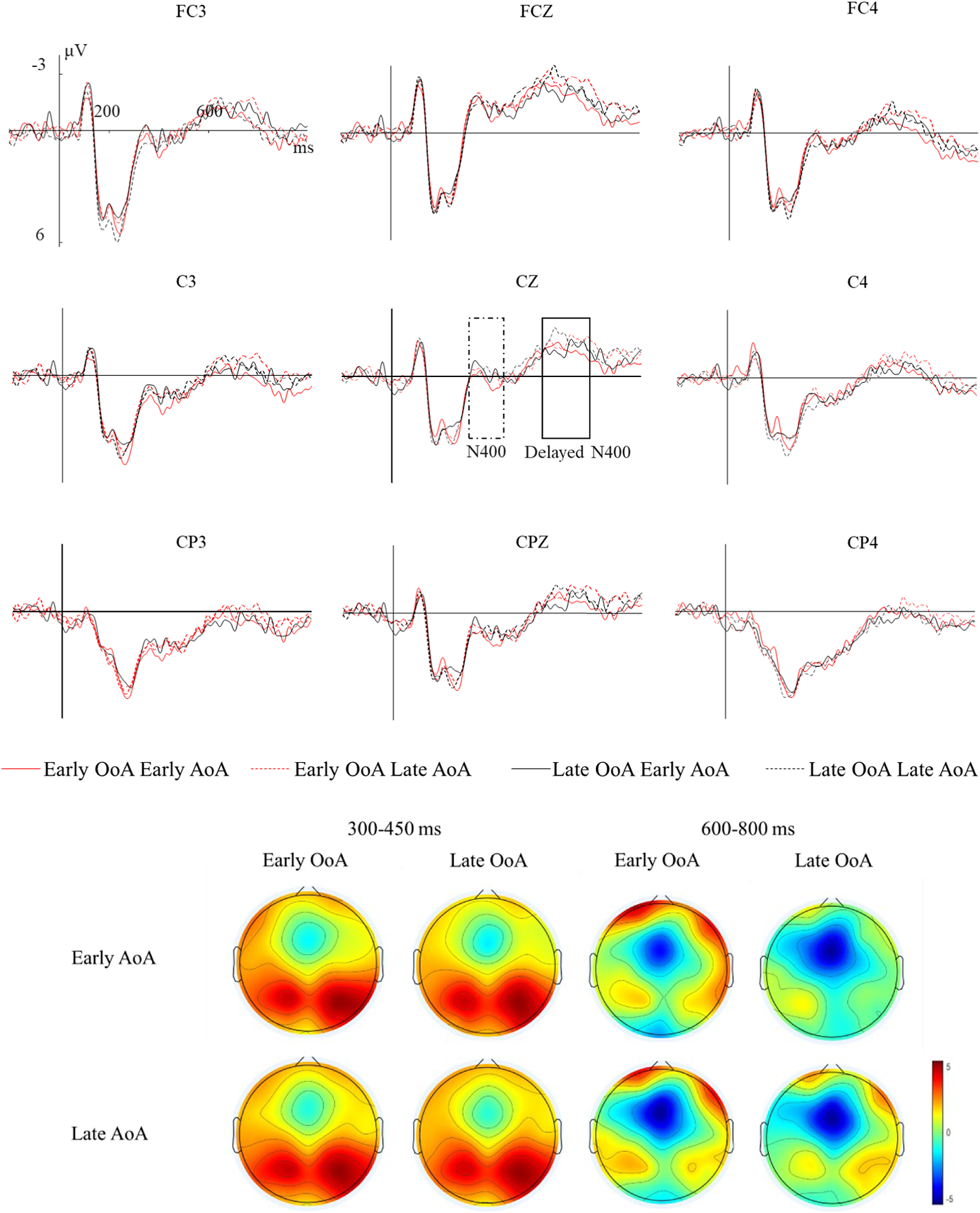
Figure 5 shows the grand average waveforms (top) and the topographic map (bottom). The results of LMEMs on the N400 and the delayed N400 are presented in Table 5, with significant effects highlighted in bold. The results patterns were similar on the N400 and the delayed N400. We found a significant OoA effect (N400: b = −.50, SE = .10, t = −4.88, p < .001, Cohen’s d = .02; delayed N400: b = −.39, SE = .12, t = −3.31, p < .001, Cohen’s d = .02), such that the amplitude of the late learned new words was more negative than the early learned words. No significant effect of Chinese word AoA was found (N400: b = −.28, SE = .31, t = −.88, p = .38; delayed N400: b = −.59, SE = .40, t = −1.47, p = .14). The interaction between them was significant (N400: b = .56, SE = .15, t = 3.89, p < .001; delayed N400: b = .50, SE = .17, t = 2.95, p = .003), showing that the OoA effect was significant (N400: b = −.52, SE = .10, t = −5.03, p < .001, Cohen’s d = .06; delayed N400: b = = − .44, SE = .12, t = −3.70, p < .001, Cohen’s d = .04) when the Chinese word was early-acquired, but disappeared (N400: b = .08, SE = .10, t = .83, p = .41; delayed N400: b = .15, SE = .12, t = 1.30, p = .19) when it was late acquired.
4. Discussion
The present study is the first to our knowledge to simulate L2 AoA in the laboratory using OoA. Chinese native speakers were asked to learn English pseudowords (i.e., new words), each pseudoword matched with an L1 meaning. New words were introduced at the early and late learned time, while the matching L1 word AoA was also manipulated as early and late. Our aim was to investigate the L2 OoA effect and its relationship with AoA of the matching L1 words. Specifically, we performed three tasks using the ERPs technique, exploring this issue from orthographic, phonological and semantic levels, respectively. The results showed that in the lexical decision, delayed naming, and semantic category judgment tasks, early learned new words induced smaller N170 (marginally significant), P200, and N400/delayed N400 than late learned new words, indicating that early learned words had a lower processing load (Wang, Jiang, & Chen, Reference Wang, Jiang and Chen2023a; Yum & Law, Reference Yum and Law2019). More importantly, the L2 OoA effect was modulated by L1 AoA in the semantic category judgement task, that is, the OoA effect was significant only when the matching L1 word was learned earlier.
In our study, OoA was used as a laboratory analogue of AoA, enabling us to easily match some characteristics that were difficult to control using real words, such as cumulative frequency and frequency trajectory. In addition, we balanced the presentation order of new words. For example, a pseudoword (e.g., curvaw) was presented as an early learned word for one participant but as a late learned word for another participant. Hence, new words were completely identical under early and late learned conditions, with the only difference being the learning order. Our results showed that OoA has an early and long-lasting influence, from early orthography and phonology to late semantic processing levels. The OoA effect was independent of L1 AoA at the orthographic and phonological levels but depends on L1 AoA at the semantic level.
To a large extent, our results align with those of Wang, Liang, and Chen (Reference Wang, Liang and Chen2023b), who found that L2 AoA effects were independent of L1 AoA at the orthographic level but dependent on L1 AoA at the semantic level. Yet, it should be noted that Wang et al.’s study used a lexical decision task to examine semantic processing levels, while the present study directly employed a semantic category judgment task. In addition, the present study included a word-naming task to examine the OoA effect at the phonological processing level. Furthermore, Wang et al. found the role of L1 AoA in long L2 words, whereas no role of word length was found in the present study. This may be because we used pseudowords, increasing the difficulty of semantic judgment, thus requiring the mediation of L1 words for semantic retrieval even with short words.
4.1. Theories of the OoA/L2 AoA effect
Semantic Hypothesis and Arbitrary Mapping Hypothesis are two theories to explain the AoA effect. The semantic Hypothesis argues that the AoA effect is placed at the semantic representation (Brysbaert et al., Reference Brysbaert, Van Wijnendaele and De Deyne2000; van Loon-Vervoorn, Reference van Loon-Vervoorn1989). Considering that the semantic access of L2 words for unskilled readers requires the help of the corresponding L1 words (Revised Hierarchical Model, Kroll & Stewart, Reference Kroll and Stewart1994), according to the Semantic Hypothesis, we predict that L1 AoA would affect L2 word processing for unskilled bilinguals. Our results observed that OoA effects were modulated by L1 AoA in the task of semantic processing, supporting this viewpoint. However, the independent OoA effects at the orthographic and phonological levels are difficult to explain by the Semantic Hypothesis.
Arbitrary Mapping Hypothesis (Ellis & Lambon Ralph, Reference Ellis and Lambon Ralph2000; Monaghan & Ellis, Reference Monaghan and Ellis2002; Zevin & Seidenberg, Reference Zevin and Seidenberg2002) proposes that the influence of early-acquired words on the connection weights of the lexical network is greater than that of words acquired later in life. The AoA effect should appear in any representations and connections between different input–output representations. According to this assumption, we predict that it should be L2 AoA rather than L1 AoA that influences the L2 word processing. Our study found the OoA effect at the orthographic and phonological levels, supported the Arbitrary Mapping Hypothesis. However, the OoA effect was modulated by L1 AoA at the semantic processing task, which is inconsistent with the predication of the Arbitrary Mapping Hypothesis.
We acknowledge the difficulty of directly linking the Integrated Theory to our specific results. We try to make a discussion on how to reconcile this theory in light of our findings. The Integrated Theory aligns with the Arbitrary Mapping Hypothesis, meaning that the L2 AoA effect exists in tasks involving the processing of orthography, pronunciation and semantics, and is independent of L1 AoA. However, the Integrated Theory also recognizes the perspective of the Semantic Hypothesis, suggesting that part of the AoA effect stems from the semantic representation of vocabulary, with words acquired earlier having an advantage in processing. Incorporating the view of the Revised Hierarchical Model, for unskilled L2 learners, the L2 AoA effect is modulated by the AoA of L1 translation equivalents.
Based on the above, our results were difficult to interpret only by the Semantic Hypothesis or the Arbitrary Mapping hypothesis. We believed that the order at which words enter the lexical network is important both in L1 and L2, and that AoA effects are present in orthographic, phonological and semantic processing tasks. However, the L2 AoA mechanism may not be exactly the same as L1 AoA.
Bilingualism is clearly not a monolithic phenomenon. The explanation of the L2 AoA effect requires consideration of the specific characteristics of bilinguals. Taking unbalanced Chinese-English bilinguals (i.e., the participants in our study) as an example, the orthography and phonology of these two languages are completely different and are represented separately (Ding et al., Reference Ding, Perry, Peng, Ma, Li and Xu2003). Hence, the OoA/L2 AoA effect may be independent of L1 AoA at the orthographic and phonological levels. However, the two languages of bilinguals share semantic representations (Ding et al., Reference Ding, Perry, Peng, Ma, Li and Xu2003), providing a premise that L1 AoA may influence L2 AoA effects. In the present study, we found that the OoA effect was significant when the matching L1 word was learned earlier in the semantic processing task. This perhaps because if bilinguals have learned their L1 words earlier, then they can build a direct link between L2 word forms and their conceptual representations, leading to an L2 AoA effect independent of L1 AoA. However, if L1 word learning occurs later, the conceptual access of L2 words would require the mediation by L1 words, leading to an L2 AoA effect dependent on L1 AoA.
In summary, we found independent OoA effects at the orthographic and phonological levels, while this effect was modulated by L1 AoA at the semantic processing level. The interpretation of the OoA/L2 AoA effect requires the integration of Semantic and Arbitrary Mapping Hypotheses, while considering the representation and activation characteristics of new/L2 words.
4.2. The guidelines for future studies and limitations
The following are directions for future research and limitations of current research. First, it should be noted that bilingualism is not a monolithic phenomenon. The findings of the present study cannot be generalized to all types of bilinguals. For example, language distance between two languages and the proficiency level of L2 might be influencing factors. If a bilingual’s two languages belong to the same language system, such as English and Spanish, the role of L1 AoA on the OoA/L2 AoA effect may occur not only at the semantic level but also at the orthographic and phonological levels. If bilinguals have a high proficiency level, the semantic access to L2 words does not require the help of the native language, thus, no influence of L1 AoA would be observed. Further research could examine the OoA/L2 AoA effect among different types of bilinguals. Second, words can be classified into different types from different perspectives, such as high-frequency words and low-frequency words, concrete words and abstract words. In the future, we can further investigate AoA effects for different types of L2 words and their relationship with AoA of the corresponding L1 words. Third, sentence reading is closer to daily life and has higher ecological validity compared to individual words. Subsequent studies could use eye tracking techniques to investigate the OoA/AoA effect.
5. Conclusions
The present study adopted OoA to simulate L2 AoA in the laboratory. We are the first to examine the OoA effect of new words and its relationship with the AoA of the matching L1 words using the ERPs technique. We found that OoA effects were present at orthographic, phonological and semantic processing levels. The relationship between this effect and L1 AoA may not be fixed: at the orthographic and phonological processing levels, it is independent of L1 AoA, while it depends on L1 AoA at the semantic processing level. Our results suggested that the mechanism of the OoA/L2 AoA effect is not exactly the same as that of the L1 AoA effect. We proposed that the OoA/L2 AoA effect can be explained by integrating Semantic and Arbitrary Mapping Hypotheses, as well as the representation and activation characteristic of new/L2 words.
Supplementary material
To view supplementary material for this article, please visit http://doi.org/10.1017/S1366728924000713.
Data Availability Statement
The materials, data, and R scripts for Experiment 1, 2 and 3 are available through the Open Science Framework (https://osf.io/5nt6x/). None of the experiments were preregistered.
Acknowledgments
This work was supported by the National Natural Science Foundation of China (31970976) for Baoguo Chen; the Discipline Team Support Program of Beijing Language and Culture University (2023YGF07) and Science Foundation of Beijing Language and Culture University (24QN34) for Jue Wang. We would like to thank the editor and the anonymous reviewer for their valuable comments and suggestions on this work.
Competing interest
The author(s) declare none.


 Open access

