




1. Introduction
The height features of mid vowels have two long-standing representations in phonological theory. Chomsky & Halle (Reference Chomsky and Halle1968:300ff.) argued that these segments were neither [high] nor [low], as in (1a). In this approach, high vowels are encoded with the feature [+high] (and [–low]) because the tongue body is physically raised within the oral cavity. Low vowels are [+low] (and [–high]) due to tongue body lowering. Based on this articulatory logic, mid vowels are necessarily [–high] and [–low] for the simple reason that the tongue cannot physically be [+high] and [+low] at the same time. Earlier work by Jakobson, Fant & Halle (Reference Jakobson, Fant and Halle1952, Reference Jakobson, Fant and Halle1956) did not fully embrace the idea that features were encoded by production. They proposed perceptual definitions for some features. For example, [+diffuse] and [+compact] refer to the spread of spectral energy. High vowels, which are characterized by broad spectral energy, are [+diffuse] (and [–compact]). Low vowels are designated as [+compact] (and [–diffuse]) segments. Insofar as the features [diffuse] and [compact] can relate to Chomsky & Halle’s (Reference Chomsky and Halle1968) [high] and [low], these models are also consistent with the representation in (1a).
An alternative representation of mid vowel height is that these sounds are simultaneously [high] and [low], as in (1b). This kind or representation likely grew out of the perceptually defined features of Jakobson, Fant & Halle (Reference Jakobson, Fant and Halle1952, Reference Jakobson, Fant and Halle1956): If [diffuse] and [compact] are perceptually defined, there is no clear physical limitation on lingual gesturing, which might rule out the simultaneity of [+diffuse] and [+compact] speech signals.Footnote 1 The investigation of such featural co-occurrence is especially characteristic of Dependency Phonology (Anderson & Jones Reference Anderson and Jones1974, Anderson & Durand Reference Anderson, Durand and Durand1986, Anderson & Ewen Reference Anderson and Ewen1987) and related frameworks like Government Phonology (Kaye, Lowenstamm & Vergnaud Reference Kaye, Lowenstamm and Vergnaud1985, Reference Kaye, Lowenstamm and Vergnaud1990, Harris Reference Harris1994), Radical CV Phonology (van der Hulst Reference van der Hulst, Durand and Katamba1995), and Element Theory (Backley Reference Backley2011). I refer to these frameworks collectively as “element frameworks.” In these approaches, the element |I| is largely analogous to the feature [+diffuse] (and [+high]) because it is defined with respect to spectral energy: |I| has two diffuse peaks within the 0-3000 Hz frequency range. The element |A| is consistent with the feature [+compact] (and [+low]) in the sense that its spectral energy is focused more compactly towards the middle of that frequency range. Since the spectral shape of a mid vowel like [e] can be characterized as a melding of the spectral shapes from [i] and [a], element frameworks see mid vowels as the conjunction of high and low vowel elements ([e] obtains from |I| + |A|). See discussion in Backley (Reference Backley2011: 22-31ff.).
There is an independent discussion in phonological theory about the valency of height features (and features in general). In a privative feature approach (alternatively referred to as a “unary” or “monovalent” approach), negative feature values are redundant and never participate in a language’s phonology. Accordingly, the marked/unmarked distinction between segments is captured as the presence or absence of a feature. Researchers like Lahiri & Reetz (Reference Lahiri and Reetz2010:46), who apply Chomsky & Halle’s (Reference Chomsky and Halle1968) logic to the privative approach, conclude that mid vowels “cannot be both [high] and [low].” As such, mid vowels are argued to have an unmarked height representation, as in (1c).
While the element frameworks hold that features are privative, a binary approach with two active height features is also possible. For example, Roca (Reference Roca1994:266) argues, “there is no obvious reason for the raising and lowering gestures not to be attempted at once. This situation would result in mutual cancellation, and thus, according to this interpretation, the representation… [+high, +low] would be equivalentFootnote 2 to [–high, –low].” Such a representation is shown in (1d).Footnote 3
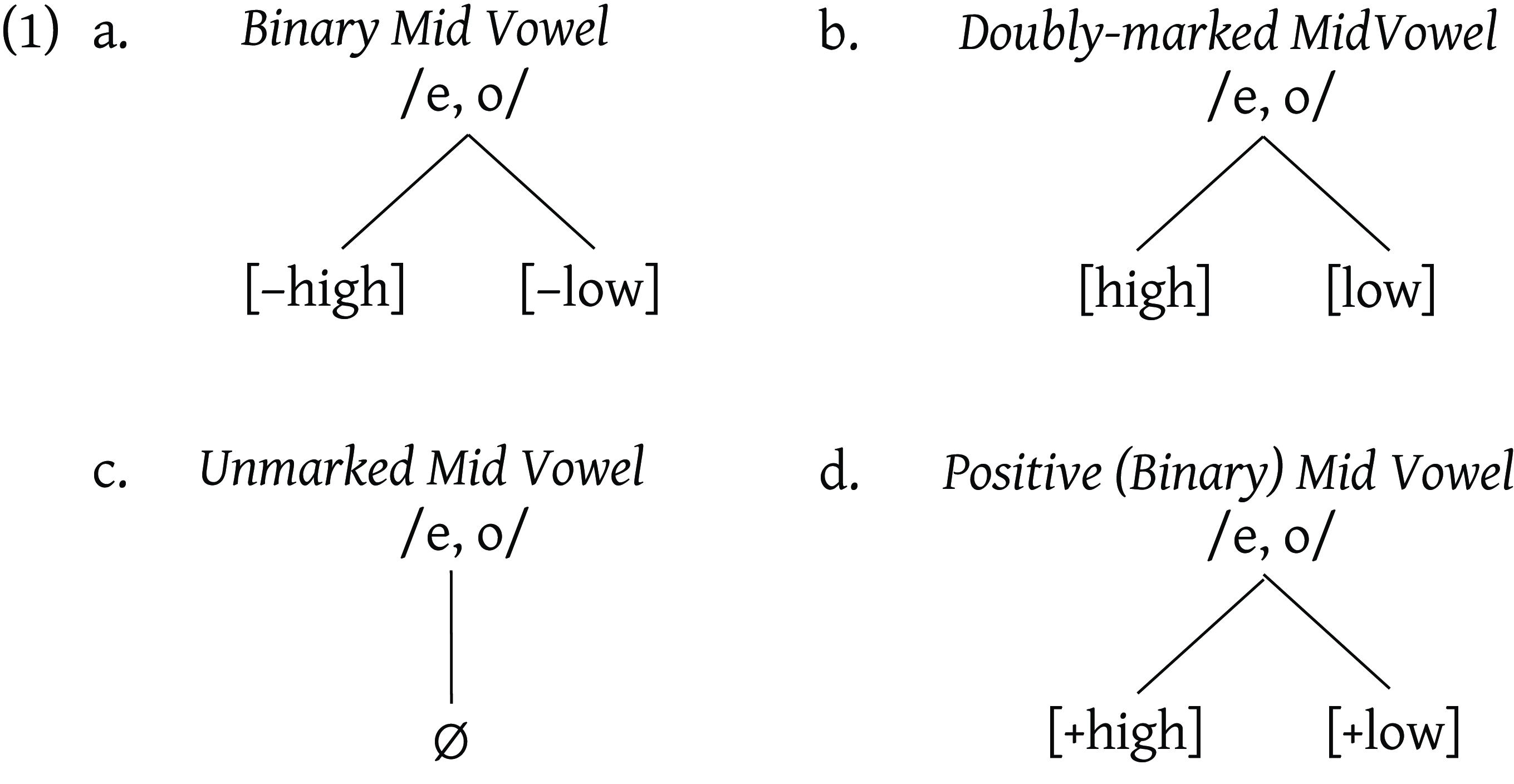
The most significant difference between monovalent and binary approaches is in the treatment of unmarked features. Because unmarked features are absent in unary representations but exist as minus features in binary feature models, only the latter predict that unmarked features can participate in a language’s phonology. Since the binary representation in (1d) does not have any minus features, it makes the same predictions as the privative representation in (1b). These two representations can therefore be collapsed into one (as in (2c)), leaving three representations of mid vowel height, as shown in (2).Footnote 4

Which representation of height is correct? This question is surprisingly difficult to answer because features can be added and subtracted; in binary approaches, they can shift their valency as well. Consequently, it is possible to take an individual sound change and to analyze that change using any one of the representations in (2). For example, a shift from [o] to [a] could be understood as a shift from [–low] to [+low] if mid vowels are binary. In an approach with unmarked mid vowels, the same change would occur by adding the feature [low], while the approach with doubly marked mid vowels would involve the deletion of the feature [high]. If it is possible to take any individual mid vowel development and to analyze that change using any of the representations in (2), how can we argue for one representation over another?Footnote 5
The only feasible way to assess the soundness of one representation over another is to evaluate independent evidence. However, there is growing consensus that feature composition is not universal, as it was originally conceived (see Mielke Reference Mielke2005, Reference Mielke2008 and the notion of feature ambivalence and emergence, respectively). Thus, independent evidence from typologically dissimilar languages may not supply especially persuasive arguments for corroborating one representation over another. For this reason, the present study examines independent evidence from a group of related languages. This is a novel metric for evaluating competing feature representations: It is far more likely that the feature composition of mid vowels is consistent across several related languages since those structures descend from a common origin. Put differently, I am arguing that the comparative method matters for feature reconstruction.
In this article, I argue that numerous independent phonological processes in Germanic language history converge on the representation in (2c).Footnote 6 Those include processes that tease out the [high] and [low] features associated with a single mid vowel into two separate [high] and [low] elements of sound. For example, PGmc +[e] regularly corresponds to ON [ja] (e.g., PGmc bergaz ‘mountain’ > ON bjarg), where [j] is [high] and [a] is [low]. In other cases, a [high] segment and a [low] segment coalesce into a mid vowel. The mid vowels in OHG hōh ‘high’, ōra ‘ear’, and nōt ‘need’, for instance, derive from PGmc +[au]; compare the Gothic cognates hauhs, ausō, and nauþs.
The idea that mid vowels are in some sense [high] and [low] is not new. Even thirty-nine years ago, Goldsmith (Reference Goldsmith1985:254) referred to the representation as an ‘age-old’ idea. Nevertheless, this work makes a number of contributions. Firstly, it lends credibility to a phonological representation that is associated with (and often dismissed as) a ‘fringe theory’ in phonology.Footnote 7 Secondly, it explicitly links the comparative method to feature reconstruction, whereby a large number of sound changes in Germanic language history are collectively accounted for in a novel and coherent way (and in ways that traditional feature models cannot capture). Thus, the article adds clarity and insight into Germanic phonology. Thirdly, this research contributes to our understanding of diphthongs, not only in some of the factors conditioning their emergence (see Section 2.2), but also in how they develop internally from their phonological structure (see Sections 2.2 and 2.5).
The article is structured as follows. A total of eight sound changes (and groups of changes) that elucidate mid vowel structure are presented and analyzed in Section 2. Several points of discussion follow. Section 3 considers data in PGmc and OE that are less clearly relatable to the mid vowel structure in (2c). It is argued that these data are nevertheless compatible with a phonological system in which mid vowels are [high] and [low]. Section 4 addresses some select problems that the Germanic data pose for the alternative mid vowel representations in (2a, b) and Section 5 discusses some data beyond the Germanic sphere. Conclusions are stated in Section 6.
2. Mid Vowels in Germanic Languages
The case studies presented below fall into four categories, namely, changes involving the unpacking, coalescence, distance spreading, and deletion of height features.Footnote 8 Unpacking refers to developments in which a doubly marked mid vowel splits into two new segments. The unpacking is referred to as ‘total’ when neither of the new segments is a mid vowel (e.g., e > ja). ‘Partial’ unpacking occurs when one of the new segments is still a mid vowel (e.g., e > ea). The formal reasons for total and partial unpacking are made explicit below. Section 2.1 presents an instance of total unpacking in ON, Section 2.2 examines a case of partial unpacking in OHG. Examples of total coalescence (e.g., au > o) in OS and OHG are considered in Sections 2.3 and 2.4, respectively. OHG partial coalescence (e.g., au > ou) is examined in Section 2.5. Distance spreading is the focus of Sections 2.6 and 2.7, which correspondingly take up NWGmc metaphony (u > o | – a, o, e)Footnote 9 and OHG primary umlaut (a > e | – i, j). Feature deletion is discussed in Section 2.8, which analyzes EGmc raising (e > i). However, feature deletion also plays a role in the intra-diphthongal changes of OHG that are presented in Section 2.2. A summary of changes is presented in Section 2.9.
There is evidence of unpacking, coalescence, distance spreading, and deletion throughout Germanic language history.Footnote 10 Owing to space, however, it will not be possible to examine each instance. Instead, the article focuses on case studies that are representative of height interaction types between two vowels.Footnote 11 Some of those changes have higher token frequency within the time period. For example, the monophthongization of [ai] to [e] occurred in different contexts in NWGmc, OS, and OHG. I do not discuss and analyze each change. Instead, I focus on one type of change with the understanding that the analysis—in regard to height features—can be extended to the other tokens.Footnote 12
2.1 ON Breaking as Total Unpacking
In the sound change known as ON breaking, reflexes of the PGmc mid front vowel +[e] shifted to the glide-vowel sequence [ja] in ON; cf. Prokosch (Reference Prokosch1939:110), Noreen (Reference Noreen1970:86-91), Haugen (Reference Haugen1982:31ff.), and Barnes (Reference Barnes2008:44).Footnote 13 Some examples from Orel (Reference Orel2003) are given in (3). The first column provides PGmc reconstructions. The OHG forms in the second column represent a conservative Germanic language that retained the original mid vowels from PGmc. The ON forms in the third column show the regular correspondence between PGmc +[e] and ON [ja].Footnote 14

ON breaking is traditionally assumed to be conditioned by back vowels that appeared historically in an immediately following syllable, a view which is still current (e.g., Schalin Reference Schalin2017). The primary evidence for this assumption is in the declension of u-stem nouns, which show an interesting pattern of stem-vowel alternations. An example is presented in (4). The Proto-Scandinavian (PSc) reconstructions in the first column are from Haugen (Reference Haugen1976:159). These forms are reconstructed with a uniform stem containing a mid vowel. There is an implied second stage, referred to below as “pre-ON,” which is shown for the sake of clarity. During this stage, PSc +[e] shifted to +[ja] before a back vowel. Elsewhere it was retained as +[e] (the pertinent forms are emphasized with bold-facing). Corresponding ON forms are listed in the third column. The stem vowel in these forms appears as <jǫ> (IPA [jɔ]) before the reflexes of a PSc [u]-initial suffix, due to a change known as u-umlaut. The stem vowel is [i] where it stood before an [i]-initial PSc suffix, due to early i-umlaut ([e] > [i] | – [i]), elsewhere the stem retains pre-ON [ja]. Similar examples include bjǫrn ‘bear’, fjǫrðr ‘fjord’, hjǫrtr ‘deer’, jǫstr ‘yeast’, kjǫlr ‘keel’, mjǫðr ‘mead’, and stjǫlr ‘rump, tail’.

If the above pre-ON paradigm were correct, the +[e] ∼ +[ja] alternation would be a strong justification for the traditional view that back vowels conditioned ON breaking. However, scholars have long observed that early i-umlaut ([e] > [i] | – [i]) was a process common to all Germanic languages (e.g., Luick Reference Luick1921: 176).Footnote 15 More recent and careful examinations of Germanic data continue to corroborate that idea; see Ringe (Reference Ringe2006:126-128), Ringe & Taylor (Reference Ringe and Taylor2014:220). In (5), I revise Haugen’s (Reference Haugen1976) PSc reconstructions to exhibit early i-umlaut as a reflex from PGmc. With this revision, PSc would have had an alternation between +[e] and +[i]. Consequently, the pre-ON stage is characterized by an alternation between stems with the new +[ja]-sequences and those with an inherited +[i]. It did not have an alternation between +[e] and +[ja].

The revision means that the original assumption that back vowels conditioned ON breaking is not as well justified: The only vowels in PSc that happened to occur after tonic +[e] were the back vowels +[u], +[ō], and +[a]. For that reason, it is difficult to tell if the change was actually conditioned by those vowels, or if it was an unconditioned change that happened to transpire before back vowels.Footnote 16 I am proposing the latter here, which I believe is a novel perspective. The analysis in (6) shows that doubly marked mid vowels possess the internal motivation necessary for a change like ON breaking to be unconditioned.
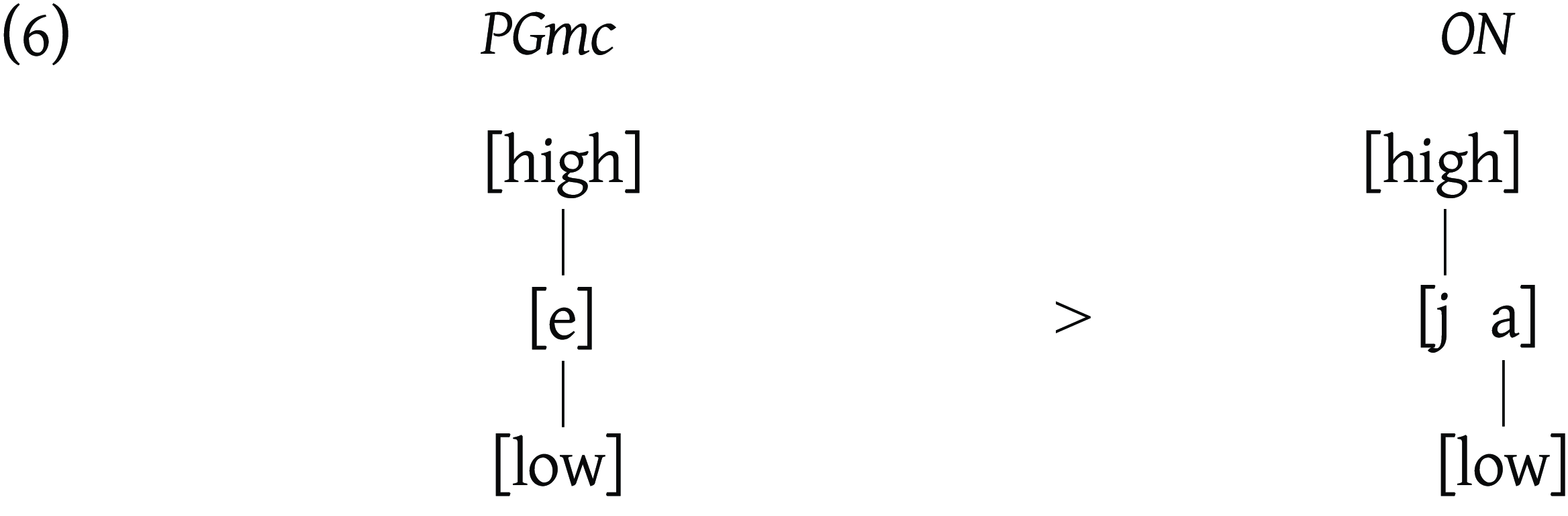
In (6), the PGmc mid vowel +[e] shifts to ON [ja] by unpacking the height features of the doubly marked PGmc mid vowel. The unpacking occurs by creating a timing difference between the inherited mid vowel features. Due to that timing difference, the original height features are teased out and associated with separate ON segments, one [high], the other [low].Footnote 17 In the account of ON breaking in (6), the features of the ON reflexes derive directly from the PGmc ones. There is no question about where any of the features come from. While ON breaking is analyzed as an unconditioned change, that analysis is ultimately not crucial. The diagram in (6) can still help address why breaking could have occurred under assimilatory pressure. Specifically, breaking can be understood as a method of assimilation that retains original height features—which is the only crucial point here—while simultaneously shifting to agree with an anticipatory trigger along a non-height-related dimension.
2.2 Partial Unpacking and Intra-Diphthongal Changes in OHG
In OHG, the reflex of PGmc/NWGmc +[ē]Footnote 18 diphthongized in all contexts to [ea]; cf. Braune & Reiffenstein (Reference Braune and Reiffenstein2004:37-42). Some examples of this sound change are given in (7). Reconstructed NWGmc stems containing a long mid front vowel are given in the first column. The ON forms in the second column represent a conservative NWGmc language that inherited the original mid vowel (ON <é> = [e:]) and the (early) OHG forms in the third column show the process of diphthongization in question. In parentheses, I give later OHG reflexes of the same form. Textual evidence makes clear that [ea] was characteristic of the earliest forms, and that [ea] subsequently shifted to [ia] and then to [ie]. That is, the chronology of the diphthongal changes within OHG is as follows: OHG1 [ea] > OHG2 [ia] > OHG3 [ie], where OHG1, OHG2, and OHG3 represent different informal stages of OHG. I discuss these changes in further detail below. The OHG forms + healt and + reat are not attested, but can be reliably reconstructed.

The table in (8) makes the chronology of the OHG diphthongal changes explicit. Various OHG manuscripts are given in the first column and their approximate date (following Ehrismann Reference Ehrismann1918:450) is given in the second column. As Braune (Reference Braune1886:23-24) explains (and is still maintained in Braune & Reiffenstein Reference Braune and Reiffenstein2004:37-42), [ea] is observed in the oldest manuscripts in (8a). In (8b), from approximately the same time period, there is variation between the older diphthong ([ea]) and the newer one ([ia]). The texts from the second and third quarters of the ninth century in (8c) make general use of the diphthong [ia], and those after the late ninth century in (8d) generally present with the newest form [ie]. There are exceptions to this chronological progression. These are shown in (8e): Tatian appears to be an early adopter of the [ie] diphthong (when compared to the texts in (8c) of a similar time period), while the Reichenau Glossaries represent late OHG documents with conservative diphthongal forms. These exceptions are expected because Tatian represents the most progressive (East Franconian) monastery dialect, while the Reichenau Glossaries represent the most conservative (Alemannic) one.

PGmc/NWGmc +[ō] is generally believed to have developed in parallel to PGmc/NWGmc +[ē]. The long mid back vowel shifted to OHG1 [oa]. Subsequently, OHG1 [oa] > OHG2 [ua] > OHG3 [uo], corresponding to the development OHG1 [ea] > OHG2 [ia] > OHG3 [ie]. The strongest support that [oa] was the initial output of diphthongization comes from the fact that this diphthong is attested in Alemannic records, which are uncontroversially the most conservative. For example, Henning (Reference Henning1874) meticulously documents (dated) ecclesiastical records of personal names containing the diphthongs in question. Henning observes instances of [oa] beginning in records from 760 and rising in frequency throughout the early 800s. He further notes how forms with [ua] and [uo] appear in records dating from 800 to 900. As expected, [oa] is more characteristic of the earlier part of that century, [ua] and [uo] the latter.Footnote 19 For this reason, Braune & Reiffenstein (Reference Braune and Reiffenstein2004:37-42) support the chronology OHG1 [oa] > OHG2 [ua] > OHG3 [uo]. That chronology is assumed here.Footnote 20
I argue that the diphthongization of PGmc/NWGmc +[ē] (and +[ō]) to OHG [ea] (and [oa]) is a partial unpacking. The diphthongization is quite similar to ON breaking (as discussed above) in that it involves an unpacking of height features into two separate segments. The difference between the two processes is that ON totally unpacks both of the mid vowel’s height features, while OHG only unpacks the feature [high] totally; the feature [low] remains associated with both elements of the diphthong. This point is made explicit in (9). The development of the PGmc/NWGmc long mid front vowel is presented in (9a), that of the corresponding back vowel follows in (9b).

The diagrams in (9) show the PGmc/NWGmc mid vowels being teased apart into two diphthongal elements in OHG. The feature [high] is associated with the first element of the new OHG diphthong, but not with the second. The feature [low] is shared by both elements. As a result, the first element is a doubly marked mid vowel, specified as [high] and [low]; the second element is a low vowel. Similar to the ON change in (6), the new OHG forms emerge by altering the temporal alignment of inherited features. There are no features that are being inserted or deleted.
The remainder of this section analyzes the intra-diphthongal changes that transpired after the initial unpacking. The changes from OHG1 [ea]/[oa] to OHG2 [ia]/[ua] are shown in (10a). The later shifts from OHG2 [ia]/[ua] to OHG3 [ie]/[uo] are presented in (10b). The discussion focuses only on height features. Thus, the changes that occur along the front/back dimension (e.g., [a] > [e] and [a] > [o]) are left open, though it is clear that these changes correspond to the frontness and backness of the first diphthongal elements of OHG2.

The OHG2 diphthongs in (10a) only differ from their predecessors with respect to the first diphthongal element. That vowel shifts from an OHG1 mid vowel to an OHG2 high vowel. The second element of the diphthongs remains the same. The mid vowels of the OHG1 diphthongs fall out from linked structures that share the feature [low] between the first and second elements. Raising of the first element is captured as the delinking of the feature [low] from the first element. As a result of that delinking, new diphthongs obtain which consist of a high vowel followed by a low vowel.
In (10b), the first element of the OHG3 diphthongs remains unchanged, while the second element raises from a low vowel to a mid vowel. Since the second element is marked with the feature [low], the new mid vowels of the OHG3 diphthongs come about when the feature [high] spreads from the first element onto the second and produces a doubly marked mid vowel.
2.3 OS Monophthongization as Total Coalescence
In OS, reflexes of PGmc +[ai] and +[au] monophthongized to [ē] and [ō], respectively; cf. Gallée (Reference Galleé1993:70-79), Holthausen (Reference Holthausen1921:38-39). The change was context-free. Some examples from Orel (Reference Orel2003) are provided in (11). The first column of (11) gives PGmc reconstructions. The Gothic forms in the second column represent a conservative Germanic language in which the original diphthongs are retained and the aforementioned monophthongization can be observed in the OS forms in the third column. The monophthongization of PGmc +[ai] to OS [ē] is exemplified in (11a); the examples in (11b) illustrate the shift from PGmc +[au] to OS [ō].

I argue that OS Monophthongization is essentially the opposite of ON breaking. Where the latter change was captured as the unpacking of height features, the OS development reflects a coalescence of those features. The analysis is presented in (12).

The analysis in (12a, b) shows that the first element of the PGmc diphthong was marked with the feature [low] and that the second element was marked with the feature [high]. OS Coalescence transpires when the temporally separate height features of the PGmc diphthong lose their timing difference and coalesce. The new alignment of features is what produces the OS monophthong.
2.4 Total Coalescence in OHG
A similar process of coalescence is observed in OHG. Due to that coalescence, there is a regular correspondence between PGmc/WGmc +[ja] and OHG [e] in the unstressed syllable of first-class weak verbs; cf. Franck (Reference Franck1909:63), Wright (Reference Wright1906:43), and Braune & Reiffenstein (Reference Braune and Reiffenstein2004:61). Some examples from Orel (Reference Orel2003) are given in (13). The reconstructed PGmc forms end with the disyllabic suffix +-janan (sometimes transliterated as +-janą, e.g., by Ringe Reference Ringe2006). The second syllable of that suffix was lost and became -jan, as reflected by the Gothic forms in the second column. The OHG forms in the third column of (13) illustrate the correspondence between PGmc/WGmc +[ja] and OHG [e].

The examples in (14) show that the same change did not occur in nouns. In these forms, the PGmc nominal ending [jan] corresponds to OHG [i].Footnote 21

As in previous sections, I am only concerned with the mechanics of the change, namely, [ja] > [e]. Any phonological and morphological conditions are set aside as independent issues. The analysis for [ja]-coalescence is given in (15).

The coalescence of PGmc +[ja] to OHG [e] is similar to the process of coalescence observed in OS. The change involves two segments, one [high], one [low], that coalesce into a single segment, to wit, a mid vowel.
2.5 Partial and Total Coalescence in OHG
Independently from OS, PGmc +[ai] also shifted to [ē] in OHG; cf. Franck (Reference Franck1909:39-43), Wright (Reference Wright1906:19-20), Russ (Reference Russ1978:52-53), Braune & Reiffenstein (Reference Braune and Reiffenstein2004:44-48), and Salmons (Reference Salmons2012:128). That monophthongization occurred in a much narrower context, as can be observed from the data in (16) from Orel (Reference Orel2003). PGmc reconstructions with the diphthong +[ai] are provided in the first column. That diphthong was inherited into Gothic, which has conservative tendencies among Germanic languages. The OHG forms in the third column show that the PGmc diphthong corresponds to a monophthong before [r] (< PGmc +[r] and +[z]), [x] (orthographic <h>) and [w]. The forms in (16b) indicate that PGmc +[ai] is reflected as OHG [ei] in all other contexts.Footnote 22

The parallel development in the reflexes of PGmc +[au] is exemplified in (17). The PGmc diphthong is realized as OHG [ō] before [x]Footnote 23 (< PGmc +[x]) and coronal consonants, as in (17a); PGmc +[au] shifts to OHG [ou] before all other labial and dorsal sounds (including [x] < PGmc +[k]Footnote 24 ), as exemplified in (17b).

It is well known that the contexts for the monophthongizations in (16a) and (17a) are quite different. Here again, though, I emphasize that I am only concerned with the mechanics of the change and not the reasons why the particular environments triggered those developments. See, however, Vennemann (Reference Vennemann1972) for one possible analysis which proposes ‘relative features’. Note also Scheer’s (Reference Scheer, Honeybone and Salmons2015) remarks on so-called ‘crazy rules’ and their emergence in diachrony.
The analysis for the vocalic changes in (16a, b) is given in (18a, b), respectively. The developments of the PGmc diphthong +[au] from (17a, b) are shown in (18c, d).

In (18), the PGmc diphthongs are characterized by a first element that is marked with the feature [low] and a second element that is marked with the feature [high]. Monophthongization occurs in (18a) and (18c) when the differently timed height features of the PGmc diphthong coalesce onto a single segment. Partial coalescence results in the intra-diphthongal changes in (18b, d). These processes represent partial coalescence in the sense that the height features from the second element of the PGmc diphthong spread regressively onto and are shared by the first element. The feature [low], by contrast, remains distinctly associated with the first element of the OHG diphthong. While the analysis focuses only on height features, it can be observed that the frontness of the second element of the original PGmc diphthong determines the frontness of the later reflexes.Footnote 25
2.6 Metaphony in NWGmc
NWGmc metaphony (sometimes called a-umlaut or a-mutation) is a process of distance lowness assimilation. It is a regular sound change that caused PGmc +[u] to lower to NWGmc +[o] when a non-high vowel followed in an unstressed syllable; cf. Braune & Reiffenstein (Reference Braune and Reiffenstein2004:35-36) and Kostakis (Reference Kostakis2015:102-109). Some examples from Orel (Reference Orel2003) are presented in (19). The PGmc examples in the first column each contain a stem vowel with a high back vowel. That vowel is only retained in EGmc, e.g., PGmc + hulþaz, + huzđan, + mulđōn > Gothic hulþs, huzd, mulda. In the NWGmc languages—represented by ON in the first column, OHG in the second, and OS in the third —PGmc +[u] lowered to NWGmc +[o] due to NWGmc metaphony. In (19a), the unstressed vowel following the stem is a low vowel. In (19b) it is a mid vowel.

NWGmc metaphony was blocked by a coda nasal. Hence the high back vowel in NWGmc reflexes of representative PGmc examples like + đumƀaz ‘dumb’ and + sunđraz ‘asunder’ are retained (cf. ON dumbr, OHG tumb, OS dumb; ON sundr, OHG suntar, OS sundar). There is, to my knowledge, no analysis for this blocking effect in the scholarly literature. Neogrammarian scholars often connect the blocking of NWGmc metaphony with PGmc raising of +[e] to +[i] before a coda nasal. The generalization therefore appears to involve a dispreference for mid vowels before coda nasals (quite possibly nasalized mid vowels).
NWGmc metaphony only targeted the high back vowel. The corresponding front vowel did not change before an unstressed, non-high vowel.Footnote 26

The analysis for NWGmc metaphony is given in (21). The lowering of PGmc +[u] to NWGmc +[o] due to a low vowel trigger is shown in (21a). The same process is triggered by doubly marked mid vowels as made explicit in (21b).

NWGmc Metaphony occurs when the feature [low] that is associated with the non-high vowel in an unstressed syllable spreads regressively onto the high, back vowel of the stressed syllable (a similar Government Phonology account of these data is argued for by Scheer Reference Scheer1995). Due to that spreading, the tonic vowel shifts from a high vowel that is marked with the feature [high] to a doubly marked mid vowel that is marked with the features [high] and [low].
2.7 Metaphony in OHG
Primary umlaut refers to a metaphonic process that shifted a stressed, short, low [a] to a front mid vowel before [j] or [i] in a following syllable; cf. Iverson, Davis & Salmons (Reference Iverson, Davis and Salmons1994). In the first column of (22), PGmc examples from Orel (Reference Orel2003) containing a short +[a] followed by +[j] or +[i] are presented. The inflectional endings of the PGmc forms in (22c–e) are based on Ringe (Reference Ringe2006). Because primary umlaut does not transpire in the EGmc branch of the Germanic family tree, the Gothic forms from Orel (Reference Orel2003) and “Project Wulfila” (Reference Wulfila2004) in the second column are conservative and reflect inherited PGmc +[a]. The OHG examples from Orel (Reference Orel2003), Iverson, Davis & Salmons (Reference Iverson, Davis and Salmons1994), and Krause & Zeldes (Reference Krause and Zeldes2016) listed in the third column show the regular application of the change: PGmc +[a] (before +[j] and +[i]) corresponds to [e]. In other contexts, PGmc +[a] is retained, e.g., PGmc + axtōu ‘eight’, + armaz ‘arm’, and + fastaz ‘fast’ > OHG ahto, arm, fasto.Footnote 27
Primary umlaut is observed in a number of environments in OHG. In stems that retained reflexes of [j] and [i] (beyond the WGmc stage), short +[a] shifted to [e]. It is known that that new [e] was tense (and distinct from inherited [ɛ]) because that distinction is retained in some present-day dialects (see discussion in Russ Reference Russ1978:56-58, 73 and Voyles Reference Voyles1992:214). Primary umlaut occurred in nouns, like the representative examples in (22a), and verbs, like the ones in (22b). Paradigmatic alternations between [a] and [e] were also frequent since a number of inflectional endings began with [i]. Hence the inflected OHG forms in (22c–e) have stem vowels with [e] that alternate with stems containing [a], given in parentheses next to the umlauted form. The examples in (22c) result from verbal inflection. The second- and third-person singular morphemes begin with [i] and therefore trigger primary umlaut. On the other hand, infinitive markers begin with [a] and do not prompt the change (infinitive forms are shown in parentheses). In (22d), the nominative plural forms for ‘lamb’ and ‘guest’ have i-initial morphemes that trigger primary umlaut. Their nominative singular counterparts (in parentheses) have, by contrast, no umlaut trigger. Similarly, the superlative marker in (22d) begins with [i] and therefore triggers umlaut. The uninflected positive form (in parentheses), however, retains inherited PGmc +[a].

The analysis for OHG primary umlaut is presented in (23). The new mid vowel obtains, when the feature [high] from [i] or [j] spreads regressively onto the preceding tonic vowel. The product of that spreading is a segment that is both [high] and [low], to wit, a mid vowel. The feature [front] is a necessary part of capturing the change, since [u], which is also marked for the feature [high], did not trigger the change.

There are three aspects of the data that the change in (23) does not adequately capture. The first is why the product of raising was [e] and not [o]. Here I follow previous work on the subject, namely, Iverson & Salmons (Reference Iverson and Salmons1996), who I believe correctly explain the shift to [e] (and not to [o]) as one which obtains from pressure to sustain the unrounded character of PGmc/WGmc +[a].Footnote 28 In order to keep the focus on height features, this point is not pursued further.
More significantly, the formalism in (23) does not make clear why the output of the change is the tense mid vowel [e] (and not lax [ɛ]). This is a consequence of using minimalistic representations: The data require that additional feature structures be discussed. Here I follow Odden (Reference Odden1991), who argues that the features [high] and [atr] are dependents of a [height] node. If OHG primary umlaut is analyzed as the spreading of that [height] node, the vowel produced by OHG primary umlaut is correctly predicted to be a tense vowel, as illustrated in (24).
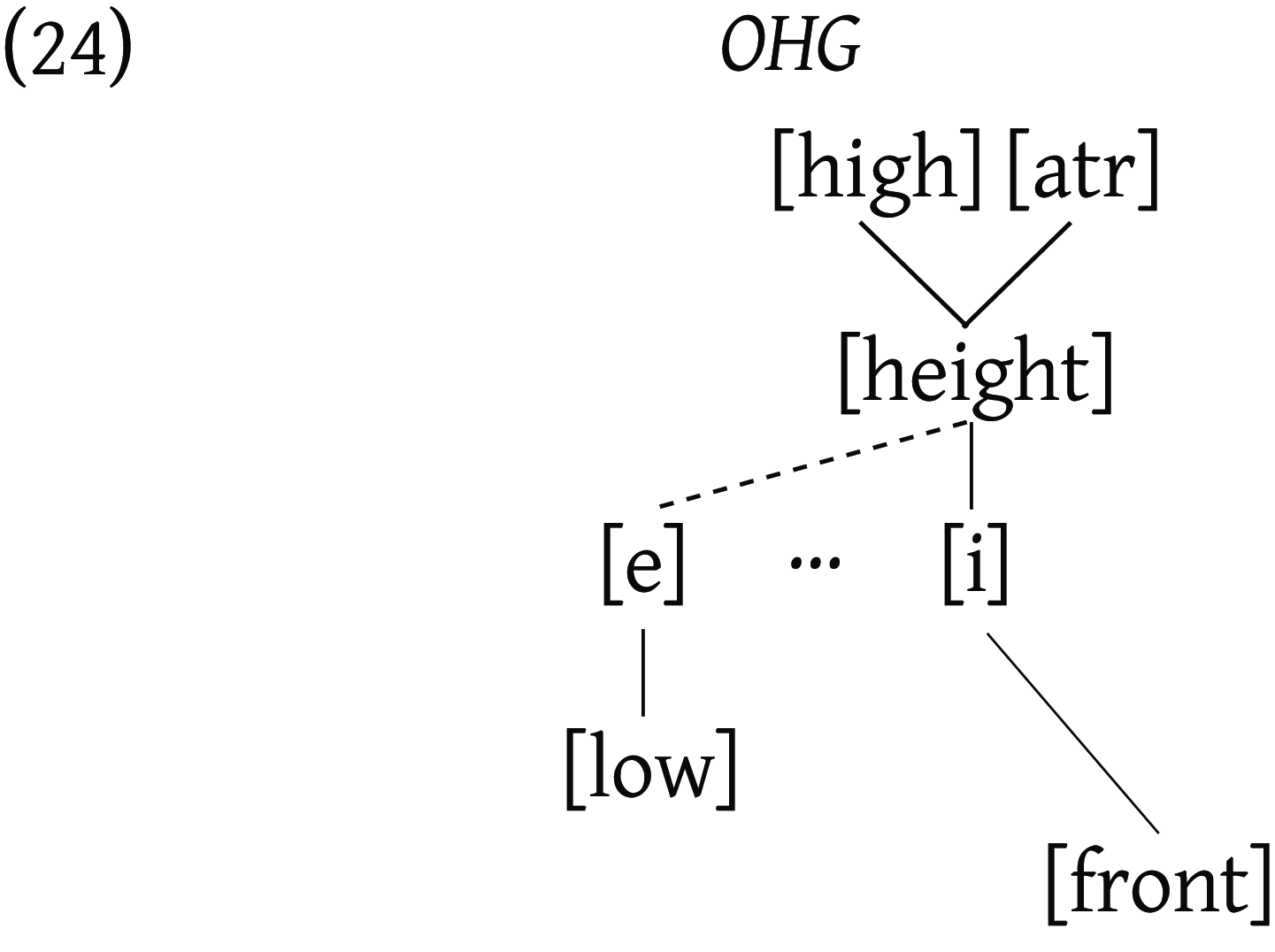
The diagram in (24) shows the regressive spreading of a [height] node that is specified for the features [high] and [atr]. The resulting [e] is [high], [atr], and [low].Footnote 29
A final aspect of OHG primary umlaut that I have not discussed is that the change was blocked (in certain dialects) by [x] and the coda liquids [r] and [l] (or some subset thereof). I do not discuss this blocking in detail here as it speaks to the representation of the blocking consonants and not to mid vowels. However, if blocking effects in metaphonic processes are taken to be the result of a well-motivated cross-linguistic principle like the no-crossing constraint (in the sense of Goldsmith Reference Goldsmith1976), the implication of the analysis presented for OHG is that such consonants must be marked with height features. See additional discussion in Kostakis (Reference Kostakis2019) and Kostakis & Noelliste (Reference Kostakis and Noelliste2022).Footnote 30 Some examples of OHG words exhibiting umlaut blocking are presented in (25).

These forms were subject to a later wave of i-umlaut, referred to here as Middle High German (MHG) secondary umlaut, which caused the examples in (25) to develop into the MHG forms in (26).

In each form in (26), the initial stressed syllable contains an <e>. However, the <e> resulting from MHG secondary umlaut was not the same as the <e> that was produced by OHG primary umlaut. Secondary umlaut produced a low, front vowel ([æ]); primary umlaut resulted in a tense, mid, front vowel ([e]). Hence, MHG heltet (< OHG haltit) represented [hæltət], while MHG geste (< OHG gesti) was pronounced [gestə]. The evidence that the <e> from primary umlaut was [e] while the one from secondary umlaut represented [æ] is not controversial. On the one hand, [æ], but not [e], was occasionally written as <ä> in MHG manuscripts. On the other hand, some conservative dialects retain [æ] and [e] to the present day. Rhyming evidence also indicates that these sounds were distinct. See discussion in Russ (Reference Russ1978:56-59) and Wells (Reference Wells1985:88-93).
The secondary umlaut data are only important to the present discussion insofar as they corroborate the analysis of OHG primary umlaut as a process of height assimilation (and not frontness assimilation). MHG secondary umlaut, by contrast, was straightforwardly a process of frontness assimilation: Unlike OHG primary umlaut, which only targeted and raised the low vowel ([a]), MHG secondary umlaut fronted—and did not raise—[a] to [æ]. Additionally, MHG secondary umlaut fronted all other back vowels. For example, [u] > [y] (e.g., OHG furi > MHG vüre), [o] > [ø] (e.g., OHG bōsi > MHG bœse), etc.Footnote 31 Regardless of the particular feature model that one assumes, the feature active in the process of primary umlaut is necessarily distinct from that of secondary umlaut, as shown in (27).

The diagrams in (27) make explicit that two processes of umlaut can have the same target and the same trigger but still produce distinctive output. Any alternative approach to primary umlaut which might formalize that process as a kind of fronting (akin to other kinds of umlauting processes in Germanic languages) needs to explain the differentiated behavior of /a/ in secondary umlaut. In sum, OHG primary umlaut is best characterized as a regressive process of height assimilation, whereas MHG secondary umlaut should be understood as a process of regressive frontness assimilation. Depending on the assumed model of feature geometry, the MHG change involved a feature like [front], [–back], or [coronal] (not [high]).
2.8 EGmc
The only well-attested EGmc language is Gothic and there is relatively little that can be said about its mid vowels. Concerning long mid vowels, it is debated whether the graphemes transcribed as <ē> and <ō> actually represent long mid vowels (as the close connection between the Gothic graphemes and corresponding Greek graphemes suggests; cf. Braune & Heidermanns Reference Braune and Heidermanns2004) or long low vowels (as structuralist-type analyses of the vowel inventory have concluded, e.g., van Coetsem Reference van Coetsem1994). There do not appear to be any data that shed light on these interpretations.
Concerning short mid vowels, Gothic is unique among all other Germanic languages in that these sounds were always derived, and thus absent from the phonemic inventory. There are two sound changes that systematically eliminated all short mid vowel phonemes from the language. The first was an early PGmc change that merged the reflexes of PIE +/o/ with PIE +/a/; cf. Prokosch (Reference Prokosch1939:100-101) and Ringe (Reference Ringe2006:145-146).Footnote 32 The second change was the EGmc merger of the reflexes of PGmc +/e/ with those of PGmc +/i/; cf. Braune & Heidermanns (Reference Braune and Heidermanns2004:32-33). Due to that merger, EGmc differed from NWGmc languages. Some examples of the change from Orel (Reference Orel2003) are provided in (28). The first column lists PGmc forms with +/e/. That mid front vowel was retained in NWGmc, as the NGmc reflexes in the second column (represented by ON) and the WGmc reflexes in the third column (represented by OS) indicate. The Gothic forms in the fourth column show that PGmc +/e/ is realized as EGmc +/i/.

EGmc raising is consistent with the notion that Germanic languages had doubly marked mid vowels. The change can be analyzed as a delinking of the feature [low] from the doubly marked mid vowel, as shown in (29).
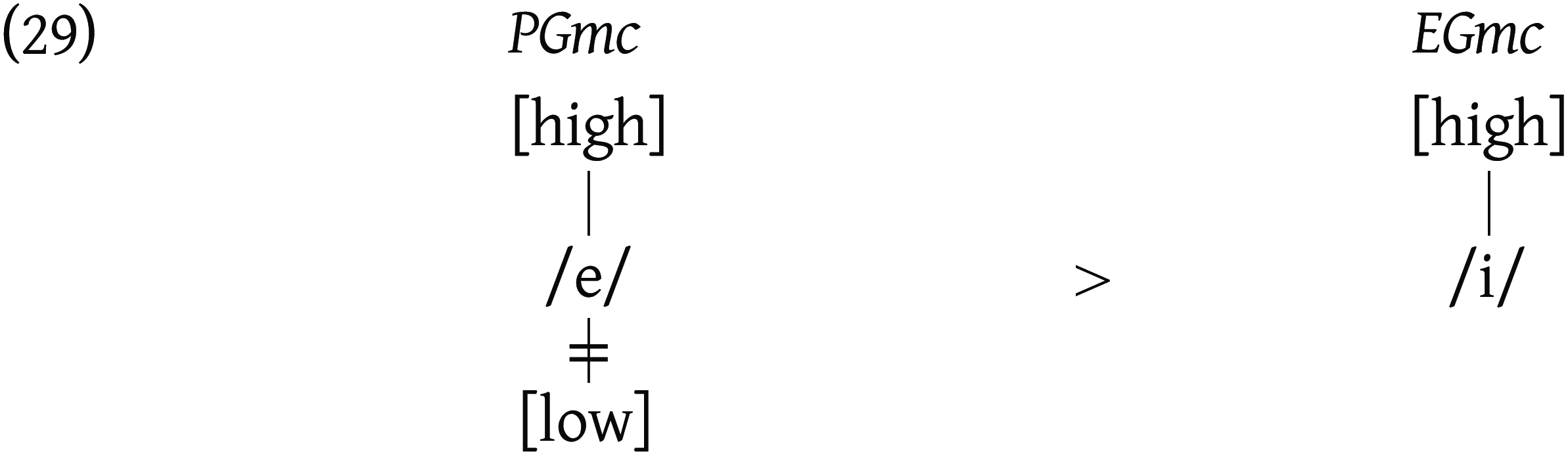
With the delinking of the feature [low] from a doubly marked PGmc mid vowel, EGmc no longer had any mid vowel phonemes.Footnote 33
At a later point, prior to the attested Gothic language, new mid vowels (still not phonemic) entered into Gothic through a process that lowered /i/ and /u/ before the sounds represented by the graphemes <r>, <h>, and <ƕ> (often characterized as [r], [x], and [xw], respectively). This change is left open here since the new vowels have no direct etymological connection to the mid vowels in the other branches and thus may differ structurally. An analysis of the change additionally requires representations for <r>, <h>, and <ƕ>, which goes beyond the scope of this article (see discussion in Vennemann Reference Vennemann1972, Howell Reference Howell and Gentry1988, and Kostakis Reference Kostakis2019 for additional details and analysis).
2.9 Summary of Changes
The changes that have been discussed and exemplified above in Sections 2.1–2.8 are summarized in (30).

As I mentioned above, the goal of Section 2 was to provide a representative list of the types of height-related changes that occurred in the early Germanic languages. Although many of the development types have higher token frequency (i.e., they are attested as parallel developments in additional Germanic languages and dialects), the understanding is that the analysis for one type of change can be extended to parallel developments of the same type. A shift from [ai] to [e] in OS is analytically the same as a shift from [ai] to [e] in NWGmc, OHG, Old Low Franconian, etc.
3. Preliminary Considerations
Readers who are very familiar with Germanic language history are likely to have two immediate questions. The first is about total height harmony or early i-umlaut (the shift from PGmc +[e] to +[i] before [i] and [j]). The second question concerns the status of OE, which has not received any direct attention above. Total height harmony is discussed in Section 3.1, details about OE are taken up in Section 3.2.
3.1 Total Height Harmony
Early accounts of umlaut have long concluded that the raising of PGmc +[e] to +[i] before an +[i] or +[j] in the neighboring syllable was a distinct process from the later waves of i-umlaut that caused back vowels in NWGmc languages to shift to corresponding front vowels. For example, Luick (Reference Luick1921:176) notes, “schon im Urgermanischen e vor einem i oder j der Folgesilbe zu i geworden war.”Footnote 34 This understanding continues to be supported in more recent investigations of Germanic language history, for example, Ringe (Reference Ringe2006:126-128) and Ringe & Taylor (Reference Ringe and Taylor2014: 220). Some representative examples of this early i-umlaut are exhibited in (31). Reconstructions from Orel (Reference Orel2003) are given in the first column. These reconstructions represent a stage of PGmc prior to the advent of early i-umlaut. Reconstructed PGmc forms showing the application of early i-umlaut are presented in the second column. See Ringe (Reference Ringe2006) for additional examples of and argumentation for this later stage of PGmc. ON and OHG reflexes in the third and fourth columns respectively establish NGmc and WGmc reflexes of early i-umlaut.Footnote 35

Following Ringe (Reference Ringe2006:220, 265ff.), early i-umlaut produced phonologically conditioned allomorphy. A partial PGmc paradigm is presented in (32). The examples show that early i-umlaut only applied before i-initial morphemes, elsewhere the stem vowel appeared as +[e]. For consistency with earlier examples, I transliterate the infinitive marker here and below as -anan instead of -aną.

Assuming that PGmc had the same kind of mid vowels that the above-mentioned daughter languages had, early i-umlaut appears to pose a problem: The regressive spreading of the feature [high] from the umlaut trigger should not result in any vocalic change, if the umlaut target is already specified with the feature [high]. The problem is illustrated in (33). The spreading of the feature [high] simply replaces the mid vowel’s original [high] feature. The result is still a mid vowel.

The issue with the PGmc analysis in (33) is a consequence of using minimalistic representations. These representations are not sufficient to capture a process of total height assimilation.
Total height assimilation occurs when the highest node dominating the height features of one segment spreads and replaces that same node of another segment. In the analysis of total height assimilation, I simply add an unspecified dot ‘•’ to represent this node. That dot may represent inter alia a [V-Place], [Aperture], or [Dorsal] node. Whatever its label, total height assimilation occurs when this feature spreads from the umlaut trigger onto the preceding mid vowel and replaces all of the mid vowel’s height features with the features under [i]. The diagram in (34) exemplifies this point (note that the feature structure below accords with the OHG structure presented in (24)).

The analysis in (34) should make clear that the existence of total height assimilation does not preclude the possibility of doubly marked mid vowels. Unlike the metaphonic processes discussed in Sections 2.6 and 2.7, which were structure-building processes, early i-umlaut was a structure-changing process. The node above the [height] feature spread and replaced the height features of [e] with the height features of [i].
An open question is whether or not it is possible for an umlaut trigger to condition a structure-building process concomitantly with a structure-changing process. With respect to this question, OHG is an interesting language to consider, since it inherited [e] ∼ [i] alternations from early i-umlaut, as exemplified in (35a), while primary umlaut produced new alternations between [a] and [e], as in (35b).

These data do not ultimately shed much light on the question of simultaneous structure-building and structure-changing processes because some, if not all of the data, in (35a) reflect morphologically conditioned allomorphy. Early i-umlaut has almost certainly morphologized in imperative forms like +[bir], since those forms never had an umlaut trigger that would have conditioned raising from PGmc +[e] (see the reconstructions in Ringe Reference Ringe2006:236-237). Additionally, raising in OHG first-person singular forms like biru is relegated to verbs. Nouns like OHG metu ‘mead’ do not show a similar pattern of regular, [u]-conditioned raising (although occasional alternate forms like mito ‘mead’ are attested). Future research must assess the extent to which the [bir] stem is integrated into the larger morphological system of ablaut.
If it could be shown that the data in (35a) were only partly morphologized and that the second- and third-person singular forms indeed reflected a phonologically conditioned process as they did in PGmc, OHG could be understood to have a synchronic process of degree raising: /a/ → [e] (primary umlaut) and /e/ → [i] (early i-umlaut) before [i] in a following syllable. Degree raising is not inconsistent with any of the arguments about mid vowel representation. It would only indicate that the rules of assimilation in (23) and (34) co-occurred in the synchronic grammar of OHG. I leave this possibility open here.Footnote 36
3.2 Old English
Hogg (Reference Hogg2011:104) generalizes 20 vocalic changes in the development of OE stressed syllables as in (36).Footnote 37

Some representative examples of OE processes that involve frontness and backness include: i. first fronting, which was a change involving a context-free shift of WGmc +[a] to the corresponding front vowel [æ] (e.g., WGmc + dag- > OE dæġ ‘day’);Footnote 38 ii. OE i-umlaut, which was a change that caused the natural class of back vowels to shift to corresponding front vowels before +[i] or +[j] in a neighboring syllable (e.g., WGmc + trummjan ‘strengthen’, + fōti ‘feet’, + andi ‘and’ > OE trymman, fōēt [fø:t], ænd);Footnote 39 iii. OE breaking, which caused the natural class of front vowels to diphthongize before the consonants represented by <r> (plus another consonant), <l> (plus another consonant), or <h> (with or without a following consonant);Footnote 40 and iv. back umlaut, which caused front vowels to diphthongize when followed by back vowels in a neighboring syllable. These processes, among many others, well support the generalization in (36).
Although rare, there are some developments in OE that plausibly can be understood to involve height features. I now turn to two such processes. The first is the formation of height-harmonic diphthongs; the second is palatal monophthongization. Data for each process are presented below with a brief analytical sketch. Each sketch is fairly speculative in nature. There are two reasons for this. First, the relationship between OE orthography and actual phonetic realization is, in several respects, very uncertain. Perhaps the greatest uncertainty concerns the OE digraphs (<io>, <eo>, and <ea>), which are relevant to both processes discussed below. Second, the purpose of these analytical sketches is only to suggest that the reconstruction of doubly marked mid vowels for OE is at least plausible. The remaining details are left open to future research.
Some representative examples of the development of height-harmonic diphthongs in OE are presented in (37). For historical context, the first column lists PGmc stem vowels which came to be reflected as diphthongs in certain contexts in OE. In (37a–d) the PGmc vowel diphthongized as the result of OE breaking.Footnote 41 The examples in (37e, f) show that OE also inherited some diphthongs from PGmc. The diphthongization observable in the second column of (37a–d) occurred in pre-OE, insofar as those diphthongal changes were fully implemented in the earliest attestations of OE. The pre-OE reconstructions in (37) are intended to be informal reconstructions. They are given for the sake of clarity. These reconstructions take the OE forms and replace the OE stem vowels with the reconstructed, generally accepted pre-literary diphthongs. There are at least two reasons why these reconstructions are maintained. First, there is some early runic evidence, like the form bæurnæ ‘son.dat.sg’ in Rune 48 (Hogg Reference Hogg2011:103), which appears to retain the pre-OE +[u]. Second, the new pre-OE diphthongs in (37a–d) developed in parallel with the pre-OE inherited [u]-final diphthongs in (37e, f); compare the examples in (37c) to (37e) and (37d) to (37f).
The pertinent change can be observed in the OE column: pre-OE +[iu], +[eu], and +[æu] shifted to OE [iu], [eo], [æa], respectively. It is usually understood that the sound [iu] later shifted to [io] and was written as <io>. The diphthong [eo] was represented orthographically as <eo>, while [æa] was spelled <ea>. In sum, the development of height-harmonic diphthongs caused the second element of the pre-OE diphthong to lower to the same vowel height as the first diphthongal element.


If the above description of the change is accepted as true, the development of height-harmonic diphthongs may be taken as evidence that OE had three active levels of vowel height.Footnote 42 An analysis of this development is presented in (38).

Similar to the process of total height harmony presented in Section 3.1, the diagrams in (38) analyze total height harmony as a structure-changing process, whereby the height features situated under some dominant vocalic node spread, in this case progressively, onto the abutting diphthongal element. In consequence, the [u] portion of the diphthong changes its height specification to accord with the first diphthongal element. As above, total height harmony is entirely consistent with doubly marked mid vowels.Footnote 43
Another development in OE that could be understood as a height-related change is palatal monophthongization. Some examples of this process are presented in (39). The examples show that the West Saxon dialect of OE regularly raised and monophthongized the diphthong [æa] to [ē] when situated after a palatal consonant. In OE transliterations, <ċ>, <ġ>, and <sċ> represent [tʃ], [j], and [ʃ], respectively, and are generally designated as the ‘palatal consonants’ of OE.

If palatal sounds are understood as [high] sounds, as they were in the original SPE definition of [high], this kind of change might represent something similar to observations in other Germanic languages where a [high] feature spreads onto a low vowel to produce a mid vowel. A basic analysis is presented in (40) in which the [j] in Early OE [jǣar] <ġear> is representative of all the OE palatal consonants.

The diagram in (40) shows the progressive spreading of the feature [high] from the palatal consonant onto the low height-harmonic diphthong. As a result of the spreading the two [low] elements of the diphthong raise to produce a mid vowel. There are many details of this analysis which are not addressed. For example, [ea] might be an expected result of this change if the feature [high] only spread onto the first element of the original diphthong. Why does that not occur? If the spreading were iterative (that is, the height feature spread through both diphthongal elements), why do we find [ee] (<ē>) and not [eo]? Perhaps [eə] is a conceivable interpretation of <ē> in the West Saxon examples. These questions and speculations are certainly not exhaustive. However, what should be clear from the analytical sketch – and the only point I wish to raise here – is that doubly marked mid vowels do have some potential to account for the change in height in a way that is consistent with height-related phenomena in other Germanic languages.
In sum, the OE data do not preclude doubly marked mid vowels as a possible representation. However, the changes that might have involved height features—like the development of height harmonic diphthongs or the change known as palatal monophthongization—are fraught with a number of empirical and theoretical issues that make their status uncertain.Footnote 44
4. Notes on Alternative Representations
Doubly marked mid vowels can account for the complete set of changes that have been discussed above without resorting to additional rules or principles. Alternative mid vowel representations, by contrast, are problematic for a number of reasons, which are discussed in this section. Each issue highlighted below is not intended to be problematic in an absolute sense. A successful analysis for each type of problem might be surmountable given independent principles that govern the addition and subtraction of features. While the number of independent principles might be restricted reasonably to analyze a single Germanic language at a time, it would be very difficult to constrain the independent principles involved in globally characterizing mid vowels across all early Germanic languages. Therefore, the objections that individual analyses with alternative representations of mid vowels might raise need to be weighed against the pan-Germanic utility that the representation in (2c) has for capturing those data without resorting to any additional principles. The initial focus (in Sections 4.1–4.4) is on the representations in (2a, b), since these are most consistent with “mainstream” conventions of phonological theory. Section 4.5, in turn, gives special attention to contrastive feature theory (Dresher Reference Dresher2009, Reference Dresher, Lightfoot and Havenhell2019, Hall Reference Hall, Oostendorp, Ewen, Hume and Rice2011, and sources therein), which is currently one of the most active areas of research in feature theory.
4.1 ON Breaking
Consider an analysis of ON breaking—the shift from [e] to [ja] in words like ON tjald ‘tent’ and fjall ‘rock’ < PGmc + teldan and + felzan—which assumes mid vowels are not specified for any height features.

Since the [e] in (41) is unmarked, the shift from PGmc +[e] to ON [ja] not only involves a timing difference, as in (6), but also the association of [high] (and not some other feature) with the one segment, and [low] (and not some other feature) with the other. Thus, a successful privative analysis requires: (a) independent motivation for the process that adds the feature [high]; (b) independent motivation for the process that adds the feature [low]; and (c) some way of modeling ON breaking as the expected consequence of both processes.
Any analysis that adopts binary features will encounter similar issues. Consider the treatment in (42), which analyzes mid vowels as [–high] and [–low].

The analysis in (42) presents ON breaking as an unpacking of features from the inherited PGmc mid vowel. The timing of minus features is being teased apart. As in (41), however, features need to be added to fully account for the change. The added features are indicated with bold facing. When the minus features of the mid vowel are teased apart, the feature [+high] must be added to the [–low] autosegment and the feature [+low] must be added to the [–high] autosegment. It is particularly important to motivate the addition of these features as independent processes or default rules since the feature [–low] could be added to the feature [–high] just as well as the feature [+low].
Alternative feature models run into the same issue. For example, Duanmu (Reference Duanmu2016) argues that the feature [αlow] is superfluous because a cross-linguistic analysis of several hundred phoneme inventories suggests that languages cannot support more than four levels of height. A hypothetical inventory with five height levels (e.g., /i/, /ɪ/, /e/, /ɛ/, /æ/) is argued to be impossible.Footnote 45 With four height levels as a universal maximum, Duanmu (Reference Duanmu2016) argues that two (binary) vocalic features are sufficient to account for all possible height contrasts, namely [αhigh] and [αatr].
In this approach, [j] (which is non-syllabic [i]) is [+high] and [+atr]; [a] is [–high] and [–atr]. Mid vowel representation can vary depending on what other phonemes exist in the inventory. For example, if [αatr] is contrastive for a language with the two high vowels /i/ and /ɪ/, then mid vowels must be analyzed as [–high] sounds. However, if there is a contrast between /i/, /e/, /ɛ/, and /æ/ (and /ɪ/ is not a phoneme), /i/ and /e/ will pattern as [+high] vowels, /ɛ/ and /æ/ as [–high] vowels. In such an inventory, /i/ will be distinctive from /e/ with respect to the feature [αatr]: /i/ will be [+atr], /e/ [–atr] (indicating that the tongue is retracted with respect to /i/). Among the [–high] phonemes in such a system, /ɛ/ will be [+atr] and /æ/ [–atr] (as the tongue is further advanced for /ɛ/ than /æ/).
Regardless of the features one assumes for mid vowels, however, the result is similar, because the features are binary. Two features must be added to the ON form. In (43a), those features are [+high] and [–atr]; in (43b), they are [–high] and [+atr].Footnote 46

The analysis in (43a) captures ON breaking as the unpacking of the mid vowel features [–high] and [+atr] into two separate segments. In addition to that unpacking, the feature [+high] is added to the first segment and the feature [–atr] is added to the second. The analysis in (43b) is similar, only it involves unpacking [+high] and [–atr] and adding [–high] and [+atr]. As above, the analysis not only needs to find motivation for the features that are added, it also needs to account for their valency specifications.Footnote 47
4.2 OS Monophthongization
Similar issues are involved in the analysis of monophthongization, as in OS (e.g., OS ēr, lōf < PGmc + airi, + lauƀan). This kind of monophthongization is not well motivated in a monovalent feature model in which mid vowels are non-[high] and non-[low] segments. As can be observed in (44), it is not clear in such an approach why, in addition to the coalescence of the two root nodes of the PGmc diphthong, the height features ([high] and [low]) are deleted from the OS reflexes. It is unclear whether a single sound change can involve a simultaneous alteration to multiple features. The strongest hypothesis is that historical developments fall out from single-operation changes (cf. Scheer Reference Scheer, Honeybone and Salmons2015).

The difficulty with a binary approach is in accounting for the features that are retained as opposed to the ones that are discarded. In (45), [–high] and [–low] are retained, while the positive features (emphasized with bold facing) are lost. But the same set of features associated with the PGmc diphthong could also produce a segment that is [–high] and [+low] (i.e. [ā]), or [+high] and [–low] (i.e. [ī]). Thus, the creation of a mid vowel in (45) is not clearly predictable and requires additional rules and motivations.

4.3 OHG Coalescence
As mentioned in the previous section, there is no clear mechanism that explains the selection process for the features that remain and the features that are discarded in the process of coalescence. In this section, I discuss a further complication for binary approaches to monophthongization that relate to the OHG data. Recall from Sections 2.4 and 2.5 that in unstressed syllables, the OHG sequences [ja] coalesced to [e] and that in stressed syllables, the diphthong [ai] coalesced into [ē].

With binary features, it is difficult to understand why in (46a) the feature [αhigh] of the second segment is preserved (i.e. the [–high] feature of [a] and not the [+high] feature of [j]), while in (46b), it is the feature [αlow] (i.e. the [–low] feature of [i] and not the [+low] feature of [a]). Likewise, the [αlow] feature from the first segment of the PGmc diphthong in (46a) is preserved, and in (46b), it is the feature [αhigh].
4.4 Other OHG Vocalic Changes
In OHG, PGmc +[ai] shifts to [ei] or [ē] and PGmc +[ē] shifts to [ea]. If mid vowels were unmarked in Germanic languages, then the changes would be as follows:

In (47a), the shift from [ai] to [ei] obtains by deleting the feature [low] from the first element of the diphthong and the monophthongization in (47b) is the result of deleting all height features from the PGmc diphthong. Diphthongization in (47c) occurs by separating the long segment in PGmc into two segments and by adding the feature [low] to the latter of those segments. The especially problematic fact for these analyses is that the processes in (47a, b) involve the deletion of the feature [low], while the process in (47c) requires the addition of that feature. Accordingly, these changes are formally paradoxical: The language requires a rule simultaneously deleting and adding the same feature during the same time period.
Were one to adopt an approach with binary features, the same paradox would obtain: The shift from [ai] to [ei] would involve some kind of deletion of the feature [+low] (from the first element of the diphthong [ai]), while the change from [ē] to [ea] requires the addition of that feature (onto the second element of the diphthong [ea]).
4.5 Representations in Contrastive Feature Theory
The notion of doubly marked mid vowels is not clearly compatible with contrastive feature theory, as it is formalized in Dresher (Reference Dresher2009), Hall (Reference Hall, Oostendorp, Ewen, Hume and Rice2011), Dresher (Reference Dresher, Lightfoot and Havenhell2019), and sources therein. In this approach, active phonological features of a language fall out from two mechanisms: i. a Successive Division Algorithm (SDA) and ii. a Contrastive Hierarchy (CH). The SDA looks for contrastive sounds and selects a feature that can actively account for the contrast. The CH organizes active features hierarchically such that the highest features mark the greatest number of segments in the phoneme inventory and the lower features in the hierarchy mark a smaller subset of sounds. Different hierarchical organizations predict differences in the subsets of sounds that are or are not marked for a given feature.
With a three-level height system, where high, mid, and low vowels stand in contrastive distribution, the SDA predicts that two and only two features are responsible for the contrast. Assuming the traditional features [high] and [low] (or, in fact, any two conceivable features, e.g., [closed] and [open], [atr] and [high], etc.), there are four possible ways that the CH can be organized, two in which segments can be simultaneously [+high] and [+low], as in (48a, b), and two in which they cannot, as in (48c, d).Footnote 48

The hierarchies in (48a, b) exemplify the possibility of doubly marked mid vowels within the theory. In (48a), the feature [high] is distinctive for all vowels, while the feature [low] is only distinctive for high and mid vowels. Mid vowels are [+high, +low], high vowels are [+high, -low]. Low vowels do not have a lowness feature. Alternatively, in (48b), all vowels have a lowness specification and the feature [high] distinguishes mid vowels from low vowels. These hierarchies make a counterintuitive prediction: If a language has doubly marked mid vowels, either high vowels will not be marked with the feature [high], as in (48b), or low vowels will not be marked with the feature [low], as in (48a).
For completeness, the hierarchies in (48c, d) demonstrate the alternative configurations, without doubly marked height features. In (48c), the feature [high] is distinctive for all vowels. The feature [low], however, is only contrastive for the non-high vowels. Thus, the high vowels /i, u/ are not specified with any kind of lowness feature. In (48d), all vowels are marked with the feature [low]. Only the non-low sounds are further distinguished by the feature [high]. In this system, [low] segments never have a specification for the feature [high].
All of the hierarchies in (48) pose issues similar to the ones raised in Sections 4.1–4.4. Consider monophthongization as an example that is representative of those issues. Adopting the CH in (48a), a diphthong like [au] is specified as in (49a). Both elements of the diphthong have a specification for the feature [high]. Low vowels, however, are not marked for the feature [low]. Accordingly, the [u]-element of the diphthong is marked [–low], but the [a]-element lacks any [low]-feature specification. The representation in (49b) shows [au] given the CH in (48b).

In (49a), the diphthong [au] lacks the feature [+low]. Monophthongization to [o] will require this feature to be inserted since [o] in this system is [+high] and [+low]. When the diphthong is structured as in (49b), it is the feature [+high] that must be inserted in order for monophthongization to produce [o]. Monophthongization from [au] to [o] additionally involves the deletion of the features [–high] and [–low] from both of the representations in (49a, b).
If the CH in (48c) is assumed, then a diphthong like [au] should be specified as in (50a). Both elements of the diphthong have a specification for the feature [high]. High vowels, however, are not marked for the feature [low]. Accordingly, the [u]-element of the diphthong is marked [+high] but lacks any [low]-feature specification. Given the CH in (48d), the same diphthong should be represented as in (50b). In this system, both elements of the diphthong have a lowness specification. A [high] feature is associated with [u], but not [a], since the feature [high] is not distinctive for low vowels in this system.

Because the feature [–low] is absent from the diphthong [au] in (50a), monophthongization to [o] (which is [–high] and [–low]) requires this feature to be inserted. Alternatively, a diphthong structured as in (50b) lacks the feature [–high]. A [–high] feature must therefore materialize to produce [o] as a result of monophthongization.
Ultimately, the problem with the hierarchies in (48) is that mid vowels must either have a contrastive relationship with high vowels or with low vowels, but not both. A CH can only capture a simultaneous contrast by weakening some aspect of the theory. As with all strong theories, new considerations often require revisions. Both ideas—the idea of doubly marked mid vowels and the idea that active features come about from single-feature contrasts—have weathered many decades of scrutiny. Future work needs to continue evaluating how such theories might be compatible with each other.
5. Complex Mid Vowels Beyond the Germanic Sphere
Unlike Element Theory and related frameworks, it is not the position of this article that mid vowels are universally marked with the features [high] and [low]. In Section 5.1, I offer a brief survey of possible diachronic and synchronic analogues to Germanic mid vowel structure. Section 5.2 follows with a fairly clear case of a language whose mid vowels should not be analyzed as [high] and [low] segments.
5.1 Possible Analogues to Germanic Mid Vowel Structure
Sound changes similar to the ones in Germanic languages are well attested outside of that language family – both diachronically and synchronically. For example, the shift from [au] to [o] occurred in the history of Romance Languages (Boyd-Bowmann Reference Boyd-Bowman1980:24-25). It also occurred in Japanese language history (see Kubozono Reference Kubozono2001, Reference Kubozono and Kubozono2015). The coalescence of [au] to [o] is frequently a development that parallels the shift from [ai] to [e]. Such a development occurred in Baghdad Arabic (see Blanc Reference Blanc1964:50, Iványi Reference Iványi, Kees Versteegh, Elgibali, Woidich and Zaborski2006:641), in the history of Oceanic Languages (see Blust Reference Blust, Auroux, Koerner, Niederehe and Versteegh2001), and variably in Hausa (see Newman & Salam Reference Newman and Salim1981:111). Diphthongs of the reverse order (i.e., [ua] and [ia]) can also coalesce into mid vowels, as should be expected. Such a process is observed in the history of Falam (see Thuan Reference Thuan2008:82-83).
Diachronic unpacking is also observed outside Germanic languages. For example, Mampruli [ja] and [wa] are present-day variants of [ɛ] and [ɔ]. Thus, p[ɛ]seu ‘mats’ and s[ɔ]na ‘wind’ are alternately pronounced p[ja]seu and s[wa]na, respectively (Naden Reference Naden and Dakubu1988:22). Pulleyblank (Reference Pulleyblank1984:23, 200) gives additional examples of diachronic unpacking; Early Middle Chinese [ɛ] shifted regularly to Late Middle Chinese [ia], e.g., n[ɛ]n > n[ia]n (no gloss provided).
These kinds of processes are, at least apparently, similar to some of the developments observed in Germanic languages. The features [high] and [low] appear to coalesce into or unpack from a single, doubly marked mid vowel. The question for future research is this: For each of these examples, is there broader support for doubly marked mid vowels? Do multiple changes within the particular language families converge on the representation in (2c), as in Germanic, or do they converge on a different one? If there is more support for a different representation, then how would the above examples be accounted for?
It is desirable to set diachronic and synchronic processes on comparable terms since, as Scheer (Reference Scheer, Honeybone and Salmons2015:315-316) points out, most diachronic processes are represented in synchrony and vice versa. Indeed, the kinds of diachronic processes discussed in Section 2—unpacking, coalescence, distance spreading, and raising—are all attested synchronically.
Possible examples of synchronic unpacking include Spanish diphthongization in the stressed syllables of words like dormir ‘to sleep’, with final stress, and duermo ‘I sleep’, with penultimate stress (see Harris (Reference Harris1977); see also Bonet & Lloret (Reference Bonet, Lloret, Fischer and Gabriel2016:117-124) for more recent discussion and analysis). Chitoran (Reference Chitoran2002) provides a detailed account of synchronic diphthongization in Romanian. Köhnlein (Reference Köhnlein, Wolfgang Kehrein, Boersma and van Oostendorp2018) discusses synchronic diphthongization in High and Low Franconian German. It is also argued to occur in Kɔnni, a Gur language spoken in Ghana (see Cahill Reference Cahill, Herring and Paolillo1994).
Synchronic coalescence in Cairene Arabic is argued for by Youssef (Reference Youssef2013:185-213). Processes of metaphony are well attested as synchronic phenomena; even in the OHG data presented in Section 2.7, synchronic alternations can be observed, as in the examples in (22c–e). Evidence for synchronic raising comes from Brazilian Portuguese, where mid vowels raise to high vowels in unstressed syllables producing [e] ∼ [i] alternations like [koˈmemus] ‘we eat’ [ˈkomi] ‘s/he eats’ from the underlying thematic vowel /e/ in the stem /kom-e/ (Major Reference Major1985:266-268); note also the discussion of European Portuguese raising in Mateus & d’Andrade (Reference Mateus and d’Andrade2000:33-34, 134-136).
An interesting aspect of the processes discussed above is that there is considerable variety in the output of the mid vowel. In some cases, [au] and [ai] coalesce into long tense vowels ([e:] and [o:]), in other cases, long lax vowels ([ɛ:] and [ɔ:]). The diphthongs may also coalesce to the short tense vowels ([e] and [o]) or the short lax vowels ([ɛ] and [ɔ]). That observed variety is orthogonal to any issues that concern height features. It is to be expected, however, that there is much systematicity to it, owing to the nature of the diphthong. When both elements of the diphthong are moraic (e.g., [aµuµ] and [aµiµ]) then coalescence is predicted to yield a long vowel. Lax mid vowels obtain when both elements of the diphthong are lax (e.g., [aʊ] and [aɪ]) and short mid vowels are the upshot of off-glides which are non-moraic (e.g., [aw] and [aj]). Those short mid vowels may also be lax or tense depending on whether they preserve the tenseness quality of the first or second element of the diphthong. Thus, the variety of mid vowels observed in processes of coalescence will be the consequence of moraicity and laxness, but not of height.
5.2 Evidence for Alternative Mid Vowel Structure
The purpose of this section is to examine a pattern involving mid vowels outside the Germanic sphere, which cannot be analyzed as doubly marked with the features [high] and [low]. The existence of such patterns helps confirm two important things. First, it confirms that the analysis in Section 2 for early Germanic languages is predictive. The fact that the same analysis cannot be extended everywhere gives some weight to the list of changes in (30). Those represent the kinds of phenomena that characterize languages with doubly marked mid vowels. Different phenomena, as we will see below, occur if mid vowels are not doubly marked. Second, the patterns below suggest that representations of mid vowels are not universal in the sense of SPE. Rather, mid vowels may be encoded differently in different languages, consistent with notions of emergent feature theory (Mielke Reference Mielke2008).
To make these points, I focus on data from Maskelynes, an Oceanic language spoken on the Maskelyne Islands of Vanuatu. Healey (Reference Healey2013:43-44) describes a synchronic process of lowness dissimilation in Maskelynes that applies to the nominalizer prefix /na-/, the negative prefix /sa-/, and the purpose prefix /va-/. The examples in (51a) show that the low vowel /a/ in the three prefixes is realized as [a] when situated before [i] or [ə]. The forms in (51b) show that /a/ is realized as [ə] when situated before [a].

In Maskelynes, the mid vowels [e] and [o] pattern with [a] as triggers for lowness dissimilation. For example, the detransitivizer /ma-/ is realized as [mə] before [e], [o], and [a], as shown in (52a). Before [i], [u], and [ə], as in (52b), /ma-/ is realized as [ma].

Furthermore, Maskelynes [i], [ə], and [u] pattern as a natural class in that they trigger height dissimilation. This is exemplified with the realis prefix /u-/ (/l-/ is ‘they’, final /-i/ is the object ‘it’). In (53a), /u/ is realized as [u] before [e], [o], and [a]. Before [i], [u], and [ə], however, /u-/ shifts to [o], as in (53b).

In analyzing the Maskelynes data, Healey (Reference Healey2013:12) argues for one binary height feature. As shown in (54), /i/, /ə/, and /u/ are [+high]; /e/, /a/, and /o/ are [–high].

I accept these feature specifications because they enable two dissimilation rules to capture all of the data. The rule in (55a) accounts for the examples in (51b) and (52a); the one in (55b) captures the data in (53b).

Haley’s (Reference Healey2013) analysis is far more elegant than any account involving doubly marked mid vowels could be. Height dissimilation, in particular, is unpredictable if mid vowels are simultaneously [high] and [low]. The problem is shown in (56).

In (56) an underlying sequence of two high vowels surfaces as a sequence of a doubly marked mid vowel followed by a low vowel. If mid vowels are doubly marked as a universal generalization, then the only way for a low vowel to shift to a mid vowel is by adding the feature [low]. The glaring problem with this analysis is that it does not really appear to be dissimilatory. If the process were dissimilation, it should be captured as an OCP violation. Referring to the OCP, the ungrammaticality of forms like *[luputi] (for underlying /l-u-put-i/), stems from the fact that the realis prefix /u-/ is situated before a syllable containing a high vowel. That ungrammaticality is not improved when the feature [low] is added to the surface form since two adjacent high vowels remain.Footnote 49
The existence of data like those of Maskelynes suggest that there is a typology of ways that mid vowels can be encoded. The Maskelynes data do not support any of the representations in (2). Instead, it seems that Maskelynes has a true two-level height contrast. In this system, mid vowels either pattern as [+high] vowels (like [ə] with [i] and [u]) or [–high] vowels (like [e] and [o] with [a]). Perhaps doubly marked mid vowels are only possible in a three-tiered system of contrastive vowel height. Future research is needed to continue investigating these differences.
6. Conclusion
In this article I have argued that mid vowels in Germanic languages are doubly marked segments that are both [high] and [low]. Evidence for that claim comes from mid vowels that unpack their height features into separate [high] and [low] segments. Such a development occurred in ON (Section 2.1) and was characteristic of vocalic changes in OHG as well (Section 2.2). Additional evidence for representing mid vowels as doubly marked segments comes from the fact that adjacent [high] and [low] vowels (as in diphthongs) may coalesce into mid vowels. This kind of change took place in OS (Section 2.3) and OHG (Sections 2.4 and 2.5). Doubly marked mid vowels are further supported by processes of metaphony, where the feature [low] spreads onto a high vowel and produces a mid vowel (Section 2.6), and where the feature [high] spreads onto a low vowel and produces a mid vowel (Section 2.7). Finally, the raising of mid vowels via the deletion of the feature [low] was argued to corroborate the representation of these sounds as doubly marked segments (Section 2.8).
Two preliminary discussion points were taken up in Section 3. In Section 3.1, I argued that total height harmony is a process that can (and does) occur in languages with doubly marked mid vowels. Total height harmony falls out from the spreading and replacing of a higher auto-segmental tier, namely, one which dominates all vocalic features. Some special attention to OE was given in Section 3.2. OE is unique among Germanic languages in that its historical developments are overwhelmingly characterized by changes in frontness and backness – not height. It is unclear if the few OE developments that involve height features are apparent or actual examples of height-related phenomena. While future work will need to continue investigating that question, I find that doubly marked mid vowels are compatible with the apparent height-related processes of OE. Section 4 presented some of the problems that come from assuming more conventional representations of mid vowels (either as [–high] and [–low] or as non-[high] and non-[low]). These representations frequently require additional processes (often feature additions and subtractions) that are hard to motivate in a systematic way. In some cases, these additional processes can be paradoxical within a single language (like OHG in Section 4.4), let alone across several interrelated languages. Finally, Section 5 looked at some data beyond Germanic. On the one hand, there are synchronic and diachronic processes in a diverse range of languages that—at least superficially—look quite similar to some of the Germanic data. On the other hand, there is clear evidence that not all languages are characterized by doubly marked mid vowels. Future research will need to investigate these two groups to understand how their phonology may differ and the kinds of processes that should and should not be expected for a given group. In line with other current understandings of phonological features, the task of future research is not to find a single, universal structure for mid vowels. Rather, it is to examine languages where multiple phonological patterns converge on one particular representation.
This article has found that a broad range of developments across Germanic languages are best understood if mid vowels are doubly marked with the features [high] and [low]. The evidence for doubly marked mid vowels is present in all branches of the Germanic language family. Because these languages descend from a common source, it follows that doubly marked mid vowels were consistently learned and transmitted for centuries. To answer how and when Germanic speakers acquired doubly marked mid vowels, future research will need a closer examination of the way that diachronic and synchronic changes in Germanic languages have co-occurred. Significantly, even though I have considered context-free changes for certain languages (like OS and ON), synchronic, height-related developments also transpired in those languages. For example, in OS, not only did PGmc +[ai] monophthongize to OS [ē], but—similar to OHG—[a] also raised to [e] before [i]. Thus, we find allomorphic reflexes (g[a]st ‘guest’ ∼ g[e]st ‘guests’) from an earlier allophonic pattern (pre-OS +g[a]st ∼ +g[e]sti). In a similar vein, ON not only had a context-free change from PGmc +[e] > ON [ja], but also a contextual change from PGmc +[a] > ON [ɔ] before a syllable containing [u] or [w]. While it goes beyond the scope of this article to consider all of these details, it is at least plausible to think that synchronic and diachronic alternations, which fall out from doubly marked mid vowels, co-occurred and co-existed throughout Germanic language history.
Acknowledgments
This work has benefited greatly from its anonymous reviewers, whom I wish to thank. Thanks also to Patrick Honeybone and Tyler Kniess for their comments to earlier drafts of this article, and to Stuart Davis for several encouraging discussions about the project. I also relay my gratitude to Leipzig University’s IGRA program, especially to Jochen Trommer and members of his graduate phonology seminar, who read and discussed an early draft of this article with me. For being my teacher of early Germanic languages, I would also like to acknowledge Kari Gade. All errors are my own.
Andrew Kostakis, Department of Languages & Literature, Austin Peay State University, 601 College Street, Clarksville, TN 37044, USA. kostakisa@apsu.edu

 Open access

