




In December 1668, Henry Power, Halifax physician and natural philosopher, and one of the first elected members of the Royal Society, passed away in the city of Wakefield. A pioneer of the budding discipline of microscopy, Henry was known for his Experimental Philosophy (1664), the first English book on microscopical observations.Footnote 1 However, it is less known that a woman was also involved in Henry's microscopical observations of plants – his wife, Margery Power. Henry's memorandum books show that Margery was likely to be in charge of purchasing and handling the scientific instruments at home, at least towards the end of Henry's life. In October or November 1668, she noted down the purchase of ‘A Telescope’ for four pounds and ‘2 Prospectifs’ for fourteen pence, and on 5 April 1669, just after Henry had died, she wrote down a memo to ‘Remember to aske for the Mycroscope at Mr. Mat: Widdops’ with her signature ‘Margery Power’ above it.Footnote 2 Samuel Pepys and his wife famously observed through a microscope together using Henry's book as instruction; it seems that Margery also observed through microscopes, both while alone and together with her husband.Footnote 3
Brought up in the family of Anthony Foxcroft, a wealthy merchant family in the Halifax region just like the Power family, Margery had been receiving education and was familiar with the Halifax intellectuals in her own and the Power family's circle. Around the time she married Henry, her father married Henry's widowed mother, making Henry and Margery stepsiblings as well as husband and wife. According to Kim Sloan, Margery possibly took drawing lessons with her sister-in-law Ellen Power from the glass painter Henry Gyles.Footnote 4 On the same day as she asked for the microscope, Margery also made a note to ‘enquire of Mr Giles about lackering of Picture Frames & write down the Receipt’. All these notes indicate Margery's knowledge of, and dedication to, drawing.
Examining the case of Margery Power tells us a new story about the role and agency of female members of a scientific household. As Deborah Harkness has shown in her work on Jane and John Dee, the early modern natural philosopher often inhabited an ‘experimental household’.Footnote 5 In this paper, we argue that housewifery tasks and everyday practices had not only logistic and practical importance, but also epistemic importance for the emerging culture of experimental philosophy. The female members of the household contributed their intellectual labour such as identification of plants, flower colouring and painting, and experiments on the nature of colour. Using a painting kit Henry bought her, Margery hand-coloured numerous printed images of flowers in herbals and florilegium books. Both she and Ellen each produced a striking watercolour album in which they limned and coloured flowers, insects and animals following the styles of well-known botanical authors and illustrators such as Jacques Le Moyne de Morgues, Johann Theodor de Bry and John Parkinson. For at least fifteen years, painting and colouring flowers were integral parts of Margery's life, and crucial factors for the development of experimental philosophy and microscopic vision within the Power household.
Drawing and colouring plants require a significant amount of botanical knowledge. To produce botanical drawings in correspondence to the plants she drew after, Margery had to read and analyse a number of herbals. In many cases, she compared botanical descriptions from several sources in order to confirm the colour of one single species. She also conducted colour-making experiments alongside Henry. Similarly, the carefully taken notes, comments and scribbles left by Margery on her husband's herbal books and botanical notebooks all suggest shared ownership and use of botanical knowledge within this house: the library, the plant samples and the magnifying glasses and microscopes were never solely Henry Power's tools for knowledge production.
Despite her thoughtful production of botanical drawings, Margery Power has not so far held a place in our histories of the arts and sciences. Margery never published any works of her own, and her scattered botanical notes and recipes could easily be undervalued within the traditional hierarchy of knowledge production, which saw authors prioritized over illustrators, ‘original’ work over commonplaces, and natural-historical observations carried out in scientific settings over ‘amateur’ household flower painting. However, in recent years such hierarchies have been increasingly challenged by scholarship within the history of art and science. Scholars like Alix Cooper, Mary Terrall and Anna Marie Roos have studied the critical role of sometimes named and sometimes anonymous female illustrators, such as Hélène Dumoustier and Susanna and Anna Lister, and shown how they fostered what Lorraine Daston and Peter Galison have called a collaborative ‘four-eyed sight’ of nature.Footnote 6 At the same time, Florike Egmond, Sachiko Kusukawa and others have argued that the practice of copying images was not only a way of learning to draw, but also an integral part of the creation of knowledge that served various epistemic ends.Footnote 7
Yet the intellectual importance of copied images refers not only to images of Thomas Willis's dissected brain or Robert Hooke's enlarged snowflakes, but also to the feminized image reproduction of flower books, usually associated with embroidery and needlework. To re-evaluate the importance of these traditionally feminine image genres, scholars such as Janice Neri and Mary Learner have pointed out that while some natural-history albums, like those of Maria Sibylla Merian, were specifically published to serve as inspiration for embroiderers, at the same time, women embroiderers of botanical images shaped the vision promoted by male experimental philosophers.Footnote 8 Margery and Ellen's drawings were sometimes copied from Jacques Le Moyne's La clef des champs, a book recommended by the author as a pattern book for painters, engravers, embroiderers, weavers and needleworkers.Footnote 9 Building on this re-evaluation, we argue that the drawings of Margery and Ellen significantly shaped the vision of colours in Henry's microscopical observations, which emphasizes the usually ignored household context of early modern microscopic practice. Whereas the few studies of Henry Power have mainly focused on his relation to the male-dominated intellectual spheres of Cambridge, the Royal Society and the so-called Towneley circle, we argue that Henry Power's natural-historical vision was shaped by his collaboration with his wife and sister, Margery and Ellen Power.
Unlike in the collaboration between Susanna and Anna Lister and their father, the natural historian Martin Lister, Margery did not produce images that were published or in other ways used as natural-historical illustrations. Margery's significance for early modern microscopy was not in published images, but in the sensibility of colours she created during her process of image-making and colour-making experimentations. Margery's paintings never left the house, but her knowledge of pigments, tones and hues significantly shaped Henry's way of seeing and recognizing colour. As Henry confessed himself, while the shape and size of small microscopic specimens were comparatively easy to discern and describe, colours proved far more elusive. Therefore it was important for microscopists to master a sharp sense of colours and a refined chromatic vocabulary. In the scholarship on early modern microscopy, emphasis is often put on Hooke's circle of miniature painters and the training he received in the workshop of the portrait painter Peter Lely.Footnote 10 It was this experience of collaborating with skilled artists that allowed Hooke to produce the magnificent illustrations of the Micrographia and, more importantly, sharpened his eye and allowed him to see the details he represented through text and image. In a similar manner, we argue that the household knowledge of producing, observing and representing colours pioneered by Margery shaped Henry's description of the chromatic details of minute plant parts observed through his microscopes. While Brian Ogilvie makes a clear distinction between the technical language of botanical texts and the sparse verbal descriptions of the florilegium genre, Margery's work shows that flower colouring could be an equally technical process. As we argue, the female amateur artist Margery produced a tested, recorded and regularized colour system that had a lasting impact on early modern microscopy.Footnote 11 From books and plants to microscopes, the case of Margery Power calls for a re-evaluation of the importance of female artists within the history of scientific observation, the use of books and paperwork in the botanical disciplines, and the relationship between household science and the emerging experimental philosophy.
A library of their own
Henry Power cared about his books. Two months before his graduation day, the soon-to-be doctor took a good look around the study in his Halifax home, took out a brand new notebook, and started writing on the first page, ‘Left at Halifax May 4th 1654 when I went to Cambridge. On the high shelf – 37 Books in 4to. On the lowe shelfe 38 Bookes in 8vo & 4to togeather. 56 Bookes more in 8vo which lyes upon 13 thin folios on the lower shelfe. In the window 19 folio’.Footnote 12 Ten years later, in 1664, preparing now to move his family from Halifax to Wakefield, Henry did the same thing once again. In the manuscript ‘A Catalogue of all my Bookes’, Henry wrote down the titles of all his books organized by language and size. During these ten years, his book collection had vastly expanded: The number of folio books had increased from thirty-two to sixty-eight, the quartos to seventy-four, and the octavos to more than two hundred.Footnote 13 When Henry died four years later in 1668, his wife Margery seemed to have inherited his books.Footnote 14 A library catalogue titled ‘A Catalogue of Dr Power's Bookes’, currently collected in Sloane MS 4019, f. 149–54, records the changes and expansions of this library. Written in a neat and legible hand, this catalogue noted down the authors and titles of the books more carefully, as well as the prices of all the books.Footnote 15 A comparison between Margery's hand from her drawing album and other sources and the catalogue has shown that ff. 149–53 of the catalogue were very likely written by Margery (Figure 1). The book titles on the final two pages of this catalogue starting with ‘Latin Bookes in 12o’ were written in another hand, potentially other family members or servants working with her, while the price and publication year were written consistently in Margery's hand throughout the catalogue. As such, it seems probable that Margery, the widow, prepared this catalogue either to sell the books or to testify to their value.Footnote 16
Comparison of Margery Power's handwriting and the handwriting in Henry Power's book catalogue in Sloane MS 4019, British Library. Images in solid frames were Margery's signed handwriting, and images in dashed frames were handwriting in Sloane MS 4019 catalogue. Power: Sloane MS 4019, f. 149; Sloane MS 1358, f. 58, bills and notes written by Margery. Booke/Brooke: Sloane MS 4019, f. 149, 152; Sloane MS 1358, f. 65. General Comparison: Sloane MS 4019, f. 150; Add MS 5298, f. 1.

As Anthony Grafton summarized in 2006, ‘A historian of ideas working on a sixteenth- or a nineteenth-century thinker is likely to start, now, by asking how many books survive from the individual's library and investigating notebooks to see how he or she processed what she read’.Footnote 17 Today, this investigation has been expanded to thinkers of all genders who owned and read books in various ways, and in recent years, we have witnessed a growing interest in the book ownership of learned women.Footnote 18 Adopting a gender perspective within library studies also requires us to reconsider private libraries that were traditionally considered to be owned by learned men. In the case of ‘Dr Power's Bookes’, we argue that this library should be regarded as a shared household library used by both male and female members of the Power family. The fact that Margery was able to create an easily readable catalogue of these hundreds of books written in English, Latin, Spanish and French speaks to her familiarity with the library: based on Henry's old catalogue, she added more bibliographical information, such as author name and publication year, into the new catalogue, and recorded titles of books they acquired after 1664. More importantly, this library does contain a book owned by Margery: in the 1664 catalogue, Henry noted down the existence of an unspecified folio book, which he catalogued as ‘my wifes Booke of Plants in Colours’.Footnote 19
This ‘my wifes Booke’ could very possibly be a 1612 copy of Johann Theodor de Bry's Florilegium novum: a folio flower book, hand-coloured by Margery herself with both oil and watercolour and catalogued in Sloane’s library as ‘painted over by Mrs Power’ and in another entry as ‘colour’d by Mrs Power’.Footnote 20 It is the only book we know of with Margery Power's signature on it. To be precise, it is a ‘compiled book’, not a normal book, with the frontispiece and foreword from the 1612 edition and plates from later editions, including the 1613 and 1614 ones, assembled into a single volume. The pagination was thus messy, no longer following the sequence of the 1612 edition, with images of tulips, for example, moved from the beginning to the end of the book. In some cases, there is evidence that the page numbers on the original plates have been somehow erased.Footnote 21 In this Florilegium, flowers on almost every page have been coloured by Margery, with delicate shades and diverse changing colours. She creatively used a combination of differently saturated yellow, green, greenish blue and shiny blackened oil paint to depict the withered parts of the leaves in contrast to the watercoloured fresh green leaves, which added to the three-dimensional depth of her colouring.
Although the Florilegium might be the only book Margery ‘owned’, it was far from the only book she worked with. Another book we know that Margery extensively coloured, a 1591 edition of Matthias de l'Obel's Icones Stirpium, was nonetheless signed with Henry Power's name. It was an expensive book of more than eight hundred pages, bought for fourteen shillings, which could very possibly refer to the entry ‘(price) 14-0. An Old Lattin Herball, 1591’ that appears in Margery's catalogue of the library.Footnote 22 It has Henry's signatures in many places: two on the frontispiece, one under the preface title and some at the end of his annotations, and once he even added ‘H. ower’ to the book's signature ‘P’ at the bottom.Footnote 23 Henry signed off with his title M.D. in this book, which indicates that it was bought after his graduation in 1654 and possibly after his marriage. Margery Power did not sign this copy of Icones Stirpium, but the particular manner of colouring and the insertion of paper slips in her hand indicate her work on it.
In Margery's case, colouring flowers was not simply an easy pastime. To colour all these plants and flowers in an accurate manner, Margery had to identify the species, understand the plants’ taxonomy and assimilate various information about their colours. For example, the Narcissus Africanus aureus maior, or the great yellow daffodil of Africa that Margery coloured in her copy of Florilegium, was accompanied by a slip with colour descriptions in her hand (Figure 2): ‘(1) Narsis Africanus. It hath faire greene leaves the 6 outmast of the flo: yellow; & the cup is more yellow; the roote is a blackish brown’. Although she was colouring a German florilegium, it is possible that this description actually came from Parkinson's Paradisi in Sole (1629), listed as ‘Parkinson's Garden’ in the 1664 book catalogue, as many other contemporary herbals, including Gerard's, did not include this species. The key information in Margery's slip was identical to Parkinson's description of the same flower, as shown by the underlined phrases: their leaves were ‘a better greene colour, then many others that are grayish, among which appeareth a stalke, not rising to the height of the leaues, bearing at the toppe out of a skinnie hose many faire, goodly, and large flowers … of a faire shining yellow colour, hauing large, round, and open cups or boules, yellower then the outer leaues … the roote is great, and couered with a blackish browne coate or skinne’.Footnote 24 The colours she used matched her own commonplaced information: she did colour the inner cup of the flower ‘more yellow’ than the outer pedals. In Margery's process of colouring, bookish botanical knowledge drawn from Henry’s book collection was utilized, extracted and synthesized based on her artistic and natural-historical interests.
The page of Narcissus Africanus coloured by Margery, with her colour description slip and Herry's annotations, in Johann Theodor de Bry, Florilegium novum, Frankfurt, 1612, British Library, 442.g.11.

Margery's labour, knowledge and creativity left their marks on both the botanical books signed with Henry Power's name, and her own album of copied paintings and original drawings. She combined various printer sources to explore the figuration of tulips, presumably one of her favourite flowers.Footnote 25 British Library Add MS 5298 is a drawing album of 140 folios, including flowers, animals, tools and colour plates that were very possibly drawn by Margery and perhaps also by her drawing teacher, Henry Gyles. In this album, more than a hundred pages are drawings of tulips. The album is catalogued as ‘Tulips, Iris's &c Birds &c done by Mrs. Power. Icone. in water colours, some in Oil. not bound’ in Sloane 3972 vol. VI, which indicates that these were probably originally separate pieces of drawings made by Margery and only bound later after being acquired by Sloane.Footnote 26
Judging from the sizes of the flower pictures and the black lead traces left within the ink contour, it is possible that Margery traced these pictures from printed books. Her sources include de Bry's Florilegium, as pointed out by Kim Sloan, and the copy of Parkinson's Paradisi in Sole, owned by the Powers, and potentially other flower books. Using black lead pencils to trace images has been a recorded technique since the second half of the seventeenth century. Odoardo Fialetti described the process in his 1660 text The whole art of drawing, including the use of Venice paper, oil, black lead pencils and charcoal. William Salmon in his Polygraphice (1672) also recorded the same technique using Venice paper, oil and black lead to trace images.Footnote 27 Margery certainly had all these necessary materials for tracing. On 5 July 1654, the day when Henry ‘was admitted Dr in Med in Cambridge’, Margery scribbled down a shopping list in Henry's memorandum book asking him to buy her ‘one quire of royal paper, one quire of Venice quilt paper’, as well as other drawing equipment, including cans and cups of tamarisk and serpentine tone colours, plus a magnifying glass.Footnote 28
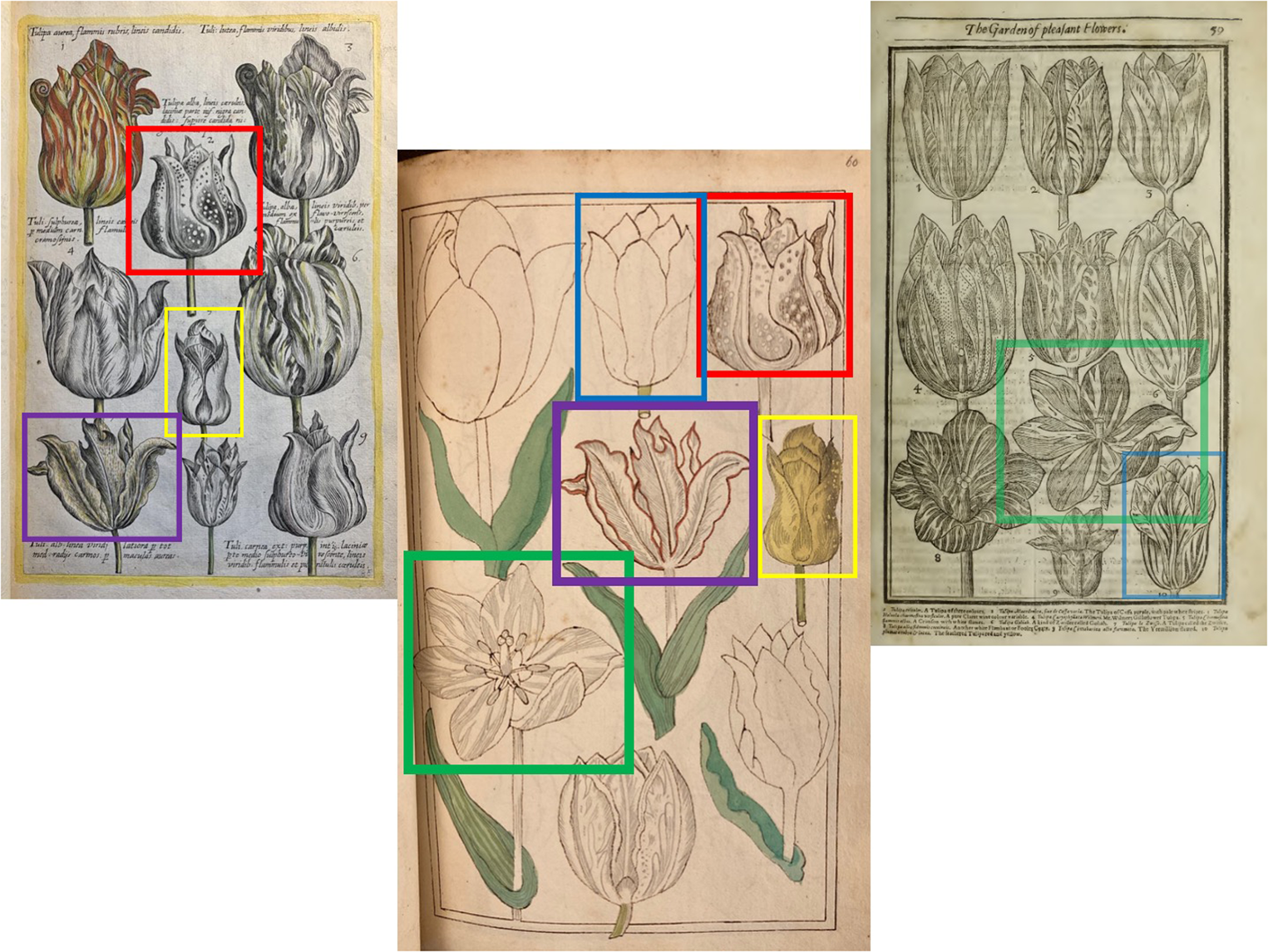
Even though Margery might have been tracing, she curated the flower images from various sources according to her own design. Like the author de Bry himself, who copied images from other herbals onto his metal plates, Margery also combined tulips from different sources into one single image and tried to curate her own flower book, as shown in Figure 3. The tulip flower with a folded petal, for example, was clearly traced from page 59 of Parkinson's Paradisi, but Margery elongated the stem, added a leaf and arranged it in a different way.
Margery's tulip images after de Bry and Parkinson. Left: Johann Theodor de Bry, Florilegium novum, Frankfurt, 1612, British Library, 442.g.11, n.p. Middle: Margery's drawing combining flower figurations from both Parkinson and de Bry, British Library, Add MS 5298, f. 60. Right: John Parkinson, Paradisi in Sole, Paradisus Terrestris: Or, a Choice Garden of All Sorts of Rarest Flowers, London: Humfrey Lownes and Robert Young, 1629, p. 59.
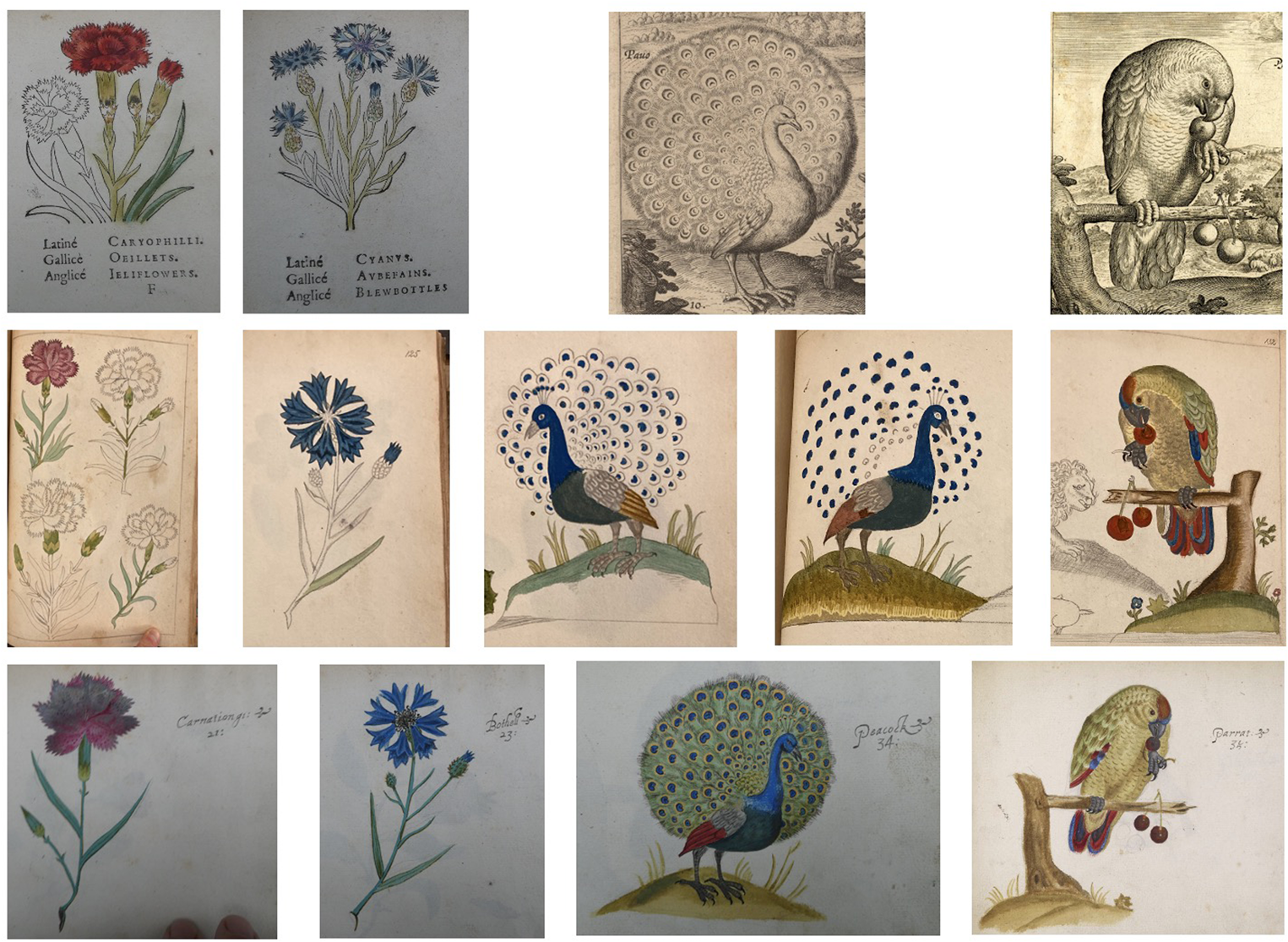
Margery’s flower album contains several drawings of animals and flower patterns, many of which are almost identical to drawings from her sister-in-law Ellen's album, currently British Museum, 1975, U. 1589, with the signature ‘Ellen Power Booke’ on the last page.Footnote 29 These identical images may reflect the time they practised drawing together. In Sloane's catalogue, this album was recorded as ‘Several flowers fruits, Birds & Insects painted in water colours done by Mrs. Ellen Power in an Oblong. 4to,’ which confirms Ellen’s authorship and ownership.Footnote 30 Ellen's album was initially bound together with a pattern book of beasts, fruits and flowers, which was made after Jacques Le Moyne's La clef des champs. Footnote 31 Both Margery's and Ellen's albums included some images drawn after this pattern book, potentially also referencing other pattern books.Footnote 32 They also referred to Adriaen Collaert's Avium vivæ icones in their drawings, which provided models for parrots, peacocks, turkeys and many other animals.Footnote 33
Based on various printed sources, the styles of Ellen's and Margery's drawings drew creatively on both embroidery patterns and natural-historical drawings. Comparing their drawings with the potential sources (Figure 4) shows us how printed sources shaped their artistic styles. The two sisters presented great details and nuances when copying, or possibly tracing, Collaert's parrot, and shifted to stylized, simple forms when creating flower patterns. When creating a piece of art themselves, all these styles could be utilized creatively in combination, as shown by the drawing bound at the end of Margery's album (Figure 5). It is a watercolour on hard paperboard, depicting a delightful scene of flowers, birds and insects living together under the bright sunshine. Compared with other surviving seventeenth-century English embroideries depicting natural scenes, the style, composition and glue-stuck traces on paper indicate that this image by Margery may have been used as a template underneath an embroidered picture.Footnote 34 Margery created figures of irises, tulips, marigolds and other plants based on what she learned from de Bry's, Parkinson's and Le Moyne's images. The form of the columbine, for example, was very likely modelled after fol. 33 of Le Moyne's pattern book, while the realistically depicted iris flower was possibly the end product of the numerous drawings of iris in her album book. Knowledge from flower books and embroidery manuals combined to become Margery's source of artisanal creation.
A comparison of the drawings of Margery and Ellen Power with their original sources. First row: British Museum, 1952, 0522, fol. 33, 25, after Jacques Le Moyne de Morgues, La clef des champs pour trouuer plusieurs animaux, tant bestes qu'Oyseaux, auec plusieurs fleurs & fruitz, London: T. Vautrollier, 1586; Adriaen Collaert, Avium vivæ icones in æs incisæ et editæ ab A. Collardo, Antwerp, 1610. Plates unpaginated. Second row: British Library, Add MS 5298, fols. 116, 125, 121, 131, 132. Third row: British Museum, 1975, U.1589, fols. 21, 23, 34, 35.
Margery's painting. British Library, Add MS 5298, bound at the album's end.

Stories surrounding the women's books in the Power household reveal more historical nuances beyond individual book ownership. Unlike many early modern husbands, Henry seemed to acknowledge his wife's ownership of her book. Apart from cataloguing the book as his wife's, he also signed Margery's name on the book several times on her behalf: the giant-size ‘Margery Power 1657’ on the book lining; the small signatures of the couple both on the hand-coloured, gold-leaf-decorated frontispiece; and the brackets-framed ‘Margery Power Her Booke’ at the end of the preface of this Florilegium were all in Henry Power's hand. Moreover, Henry also took care of Margery's book. In a bill dated 10 October 1656, Henry noted that he ‘paid for my booke vamping’ and the vamping of ‘my wife book’ each five dimes; the latter could very possibly be this Florilegium scrapbook or other books owned by Margery of which we do not yet know.Footnote 35 This reveals a complex dynamic in the Power household regarding the ownership of books. On the one hand, Henry acknowledged Margery's ownership of this book, and actively helped her to mend it; on the other, he still signed his own name on the self-same book, listing it as one of his 508 books in ‘A Catalogue of all my Bookes’. After Henry's death, Margery still catalogued her husband's books as ‘A Catalogue of Dr Powers Bookes’, although intriguingly, the entry ‘My wifes Booke’, or the Florilegium book, does not appear in this version of the catalogue.
In Margery's case, even though she owned few books as an individual, her intellectual pursuits in reading were nonetheless very present in her album of botanical illustrations, her hand-coloured herbals, and her botanical notes on the slips hidden inside the books. While it has been pointed out that early modern women's books were often listed as a part of household property, the libraries of learned men such as Henry Power should not be merely seen as their own either. It was not a private library, but a household library in its nature, and a place for collaborative reading, learning and experiments. The library of the Power household shows another way to ‘own’ books, one that was determined not by the number of books owned by an individual, but by the intellectual endeavour shared among female and male household members.
Everything has many lives
In Sloane 1343, a handy little notebook with extensive reading notes on the botanical tradition from the time of Theophrastus to Parkinson's Theatrum Botanicum, Henry Power scribbled down as a preface a poetic reflection on the value and use of plants.Footnote 36 According to this preface, plants and their products constituted a lively and dynamic economy:
For by the medium of Plants god has bestowed all food clothing & medicine upon man. To this ofspring wee also ow (for the most part) our Houses, shipping & infinite other things though some of them Proteus-like have run through divers shapes, as this paper whereon I write, that first from seed became flax, then after much exation thread, then cloth, where it was cutt & mangle’d to serve the Humours & fashions of Men.Footnote 37
Henry's acknowledgement of this cyclical pattern of use and reuse demonstrates that he, like his contemporaries Isaac Newton and John Beale, lived in the seventeenth-century ‘cyclical cosmos’ characterized by Simon Werrett.Footnote 38 Henry was fully aware that papers and books, those media of his plant knowledge, were originally plants as well. From seeds and flowers to the medicines made from them, from paper to books and notebooks, this section will focus on the economic life of plants in the Power household, putting materials, books and manuscripts under the same lens of recycling. It will show how recycling functioned as a form of collaboration, and how knowledge was produced and transmitted through the recycling of plants in the Power household.
Paper was always recyclable in the household of Henry and Margery Power. As we showed earlier, various volumes of de Bry's Florilegium were torn up and bound into a new volume for Margery to colour. So was the paper Margery used for drawing. The Venice paper that Margery used for tracing was also a popular tool for observation among contemporary natural philosophers: Walter Charleton affirmed that a granule of dust, when observed ‘on a sheet of Venice Paper’, appeared to be ‘conflated of ten hundred thousand millions of insensible Particles’. Similarly, Robert Hooke also advised using ‘a piece of very fine Venice paper’ as the background for observing the fracture of sunbeam in the water.Footnote 39 For microscopists of her time, Venice paper was a very good backing paper for its smoothness and transparency. Henry Power also used paper in similar ways. He used ‘a white sheet of paper’ to hold the falling spark from the striking flint and steel, in order to observe the ‘little dark spot or moat, no bigger then a pins point, which through our Microscope did appear to be a perfectly round ball polished like Steel or Glass’; when cutting a frozen eye to observe the interior structure, he also used ‘an oyled paper’ to hold the object.Footnote 40 We do not know for sure, though, whether Henry borrowed his wife's ‘quire of Royal paper’ and ‘quire of Venice guilt paper’, which seemed to be of high quality judging from the paper used in her drawing album; it is not surprising if he did.
So were their notebooks recycled. The memorandum books that Henry and Margery used were already written in a thrifty manner: written from the beginning to the middle-end in one year, and two years later, flipped upside down and used from the end back to the beginning. As we showed earlier, Margery kept using the same notebooks after Henry's death. In the Power household, recycling was inseparable from collaboration. In the same notebook in which Henry wrote his canon of botanists, notes on Theatrum Botanicum and opinions on plant-made paper, two more people also wrote. Following Henry's botanical commonplaces without leaving many blank pages in between, someone started copying down several pages of recipes from Gerard's herbal in a neat hand. Kim Sloan has suggested that these recipes could have been written by Henry's wife, yet this hand is very different from both Margery's and Henry's tilting, elongated italic hands.Footnote 41 These recipes were written within the grids that Henry drew in his notebook, and intersecting with Henry's: after this compiler had been commonplacing recipes for around ten pages, Henry's familiar hand appears again, noting down a remedy for gonorrhoea. It is possible that these recipes were from other family members or commissioned by Henry or Margery for their servants to copy down. We do not completely exclude the possibility, though, that this could be Henry's earlier, more rigid hand from his student time.
Either way, these recipe notes from Gerard reflects the Power couple's common interest in flowers. An object for artistic and natural-historical interests, the flower received particular attention in the Power household. Suppose that a lively flowering lily by some coincidence fell into the hands of the Power couple, it could face several destinies: it could be dissected on the table, have its long style removed, and pendants tipped off to be ‘pleasantly’ observed through one of Henry's microscopes and reported in the Experimental Philosophy.Footnote 42 Or, its flower could be ‘put into a glasse, & set into a hill of Ants’, closed and stopped for a month there until it turned into a liquid to be applied outwardly for gout, following a recipe in Henry's Theatrum Botanicum notebook commonplaced from Gerard's herbal.Footnote 43 If lucky, it could also survive as a whole plant, be put into a vase and used as Margery's model for drawing and colouring, as she might do with flowers in their garden. Other plants were similarly used by both members of the family. While Margery was colouring and drawing poppy flowers and strawberries in her album, Henry was putting their leaves and seeds under the microscope.Footnote 44 In the botanical world of this couple, flowers were always used in collaboration and for diverse purposes.
It is certain that Margery and Henry had a garden in their house at least after their move into New Hall in 1656. As Jennifer Stead has documented from an analysis of Henry's memorandum books, the Powers spent most of their years at New Hall renovating the gentry house, its garden and its outer walls.Footnote 45 In October 1661, Henry paid a waller named Aspen to rebuild their greenhouse, and in January 1662/1663 he paid a hedger named Hallam to plant 170 trees on their land. Hallam was also hired as a gardener to take care of the root garden, the knot garden and the garden patch under the window of their renovated kitchen.Footnote 46 Unfortunately, Henry does not mention which plants they nurtured in the greenhouse or the exact species growing in the several garden patches. It is likely that he grew medicinal plants himself, though, for he notes down that he had a joiner make shelves and nests of boxes for his collection of materia medica, including a number of long drawers for roots.Footnote 47 It is, then, very possible that the seeds of corn poppies, maidenhair, strawberries and moonwort that Henry observed through his microscope were later planted into the gardens maintained by Margery and their gardener Hallam.
In the Power household, flowers, leaves, fruits and spices used in the kitchen, as well as other commonly used plant products, were both objects for consumption and objects for research. As scholars such as Elaine Leong, Wendy Wall and Simon Werrett have pointed out, culinary art and knowledge of food played an important part in early modern experimental science and medicine.Footnote 48 Henry seems to have been very interested in culinary art: Sloane 1319, a quarto notebook of more than thirty folios, is the result of his encyclopedic efforts in culinary knowledge from descriptions of plants’ medicinal virtues to ale making. Beginning with common bread-making materials such as wheat, rye and barley, including spices such as rosemary, parsley and coriander, as well as the flesh of beef, goats and hares, Henry listed specifically the temperament and degree of all these common foods, which diseases they were good for, and how to process them medicinally. Many of the flowers and fruits Henry studied in this book, such as marigold, rose, violets and turnips, pears, cherries, strawberries and so on, were also painted in Margery's drawing album. While Margery's drawings were from printed sources rather than directly from nature, her selection of species suggests that the fruits and flowers commonly available in the household also caught her interest. Reading and colouring those plant illustrations, Margery learned about both the curious exotic tulips and England's most common plants and products, the latter becoming materials for both Margery's drawing and Henry's experimental research. The poppy seeds, lilies and strawberries we find in Henry's microscopical observations show how his research was conditioned by his familiarity with everyday objects and their characteristics in the household context.Footnote 49
Like plants in the garden, books and paper also performed multiple functions in early modern households. Historians of graffiti have shown how a book in an early modern family could be used simultaneously for pen trials, calligraphic teachings and exercises.Footnote 50 In Margery's case, the books were also her laboratory of artistic experiments. Instead of seeing books as permanent objects, she and her husband also treated them as separable pages and tearable paper. Her compiled copy of the Florilegium made of images from various editions can be seen as an extended form of extra-illustration, a practice of collecting visual materials, usually fine engravings, to insert and paste into books in order to enrich their contents. A unique way of reusing paper materials, extra-illustration was often seen as a rich gentlemen readers’ pastime that requires extra investments in image collecting and bookbinding. The extra-illustration is usually considered to have flourished in England after the 1770s, while recent studies also suggest its epistemic importance among seventeenth-century English botanists.Footnote 51 While Werrett has pointed out the importance of thriftiness in household science, for the affluent Power family their ‘recycling’ was likely more for intellectual than for economic purposes.Footnote 52 Margery and Henry's recycling of a fourteen-shilling flower book was not an example of thrift, but an intellectual indulgence.
One used something for a purpose, the other used it again for another – this kind of recycling was also an important part of the collaboration between Margery and Henry. This can be seen from the annotations and commonplaces from the herbals in their household library. Both of the two books Margery coloured, Florilegium and Icones Stirpium, were annotated by both Margery and Henry. Henry's annotations covered every entry almost from the beginning to the end, while Margery's slips and handwriting appeared occasionally in some pages. It is possible that they read these books together, or they might have taken turns, one working on it after another.
Like many of his contemporaries, Henry's comprehensive annotations showed that plant names and references were his main concern.Footnote 53 While annotating Icones Stirpium, Henry translated Latin and foreign-language plant names into English and cross-referenced to other English and Continental herbals, occasionally adding some findings from his own observations. On page 309, he noted that the two English names of gentian minor were from ‘Ger. Chap.101’. On page 200, on ‘Irio Sive Erisimum Dioscoridis,’ he noted, ‘Bank Cresses. So called first by Dr. Turner. Vid. Gerard. Chap.15. pag.197’. As Gerard did not refer to Turner in his entry, it seems that Henry was examining multiple herbals while checking the images of one plant, including William Turner, Pietro Andrea Mattioli and other herbalists.Footnote 54 This taxonomical interest corresponds with his way of reading Parkinson's Theatrum Botanicum. In the botanical notebook Sloane 1343, Henry noted down a detailed index of every ‘tribe’, or category, of Parkinson's herbal and plants listed in those categories: in the tribe of cathartic or purging plants, for example, he listed the name of aloe, Indian juice, rhubarb, coolquintida and so on, all according to Parkinson's original sequence.Footnote 55
While Henry read Parkinson's Theatrum Botanicum most carefully, Margery frequently referred to the descriptions from Parkinson's Garden for colouring, as analysed in the first section. Like Henry's annotations, her numerous slips were also written in a consistent manner, containing the names, variants and colours of each part of the plant – flowers, leaves, roots and so on. Sometimes Henry might have been working with her, as there are also slips and annotations on plants’ colours in Henry's hand, but it is not clear whether Margery coloured them first or Henry annotated them first. Usually Henry's annotations on colour contain only one or two words, ‘yellow’ or ‘white’, while Margery's slips contain more information and nuances, as much as in her colourings. On page 92 (Figure 6) in Icones Stirpium, we can find a moment when both of them performed the botanical task of translating plant names: Henry's hand ‘Englished’ the two flowers ‘the smallest yellow Lancashire As phodill’ and ‘the gold red day Lilly’, while Margery's hand ‘Englished’ the flower in the middle ‘the yellow day lily’. A slip Margery wrote was also inserted here, about the yellow lily on this page and the gold red day lily on the facing page: ‘Liliaspodillus luteus: it is of a faire yellow the leaves a fresh Greene: the roots yellowish; Liliaspodilus phoeniceus: the gold red day lilie the flo: is of a fair gold red or orang tawney’.Footnote 56 Her husband noted down the English name of the golden lily, but Margery used the Latin name in her slip, and coloured the lily ‘faire’ yellow and fresh green accordingly. It is possible that their annotations resulted from different but continuous rounds of research, one recycling the information produced by the other. Despite their different interests, both of them entered the common seventeenth-century botanical practice of extracting and reorganizing the names and characteristics of plants, with taxonomical awareness of the differentiation of species. Through rounds of engagement with texts, images and plants, Margery and Henry established a cycle of collaboration and knowledge production in this household.
Matthias de L'Obel, Icones stirpium, seu Plantarum tam exoticarum quam indigenarum, in gratiam rei herbariæ studiosorum in duas partes digestæ cum septem linguarum indicibus, etc., Antwerp: Ex officina Plantiniana, 1591, British Library, 443.a.5, pp. 92–3, with a slip attached in between.

Creating colour
Towards the end of the first book of Experimental Philosophy, Henry Power lamented the difficulties he faced when trying to establish the colours of his microscopical specimens: ‘most, if not all, Bodies in their minute particles (through which the Sun's Rays have more freedome to penetrate) seem to lose their Colours, and grow diaphanous, as you may observe in the Microscope’.Footnote 57 Similarly, Henry argued that the reason why insects and fish traditionally had been considered to be bloodless was because their blood vessels were so fine that they only contained a tiny bit of coloured material and not enough to give off a proper red colour.Footnote 58 Seeing colours through microscopes was indeed difficult.Footnote 59
And yet, in the individual microscopical observations of the Experimental Philosophy, we nevertheless find an abundance of colour: the powder of the white lily ‘looks of a pure pale yellow, and like so many pieces of polished Amber’; the seeds of strawberries ‘look not unlike the Strawberry; some reddish, yellowish, and green colours, as the Strawberries themselves are’; the livers of lampreys are ‘a pure grass-green colour, which … presently turned into a faint Olive-colour’; while the eyes of the little white short-legged spider had ‘a pale yellow circle, which encompasseth a violet-blew Pupill, most clear and most admirable’.Footnote 60 Although he complained that the task was difficult because of the tendency to opaqueness, in his descriptions Power revealed a heightened sensibility towards colour and an advanced vocabulary with which to describe them.
Before the eighteenth-century emergence of taxonomical systems based on morphology, descriptions of the colours of naturalia was an important part of any identification of specimens, and especially plant specimens.Footnote 61 As argued by Valentina Pugliano, colour sensibility – that is, the ability to differentiate between the many tones and hues of colours and to describe them using a somewhat stable nomenclature – was crucial for the naturalist in general, and for the microscopist in particular. We should remember that the microscopist was seeing hitherto undescribed coloured objects, so a chromatic vocabulary of precision and accuracy was all the more important. But unlike shapes and sizes, which were easily described using the language of geometry, colour was a more fleeting quality. As the artist and natural philosopher Richard Waller pointed out in 1686, a ‘Standard of Colours’ was yet a ‘thing wanting in Philosophy’.Footnote 62 Thus naturalists had to rely on the experience of those who had mastered colour, such as artisans, painters, chymists and craftsmen.Footnote 63 In this section, we show that attempts to develop a chromatic standard were undertaken within the Power household through experiments with colour production.
Margery was well aware that colours could never be categorized simply by single terms like ‘green’ or ‘red’; she knew that a variety of tones exist in every colour. In her notes on the colours of plants that she extracted from her reading of herbals, she mentioned, for instance, a ‘blackish blew’, ‘a perfect blue colour, tending to purple’, ‘a fair gold red or orange tawney’, and a ‘whitish greene colour’.Footnote 64 And looking carefully at Margery's hand colouring, we can see that while she used the same two kinds of green for most of the flowers, she also mixed these greens to produce either a lighter or a darker green. From their memorandum books, we know that Margery had Henry buy her serpentine tone, a kind of green, from the market, but she would have adjusted the tint of this colour to make it lighter or darker, more yellow or more blue, depending on her needs.Footnote 65 Margery also made her own colours from scratch using a variety of ingredients, tools and manufacturing processes.Footnote 66 On the first two pages of her watercolour album, Margery wrote up her recipes for making coloured ink (Figure 7). Embellished with a number of coloured shields on each side of the margin, Margery detailed how to produce these colours using a variety of highly expensive ingredients. Unfortunately, the pages seem to have been cut up in order to fit the size of the album, which means that twelve of the coloured shields and recipes are missing, but we are still able to get interesting insights into Margery's practice of producing colours.
The colour shields in Margery's drawing album. British Library, Add MS 5298, f. 1.
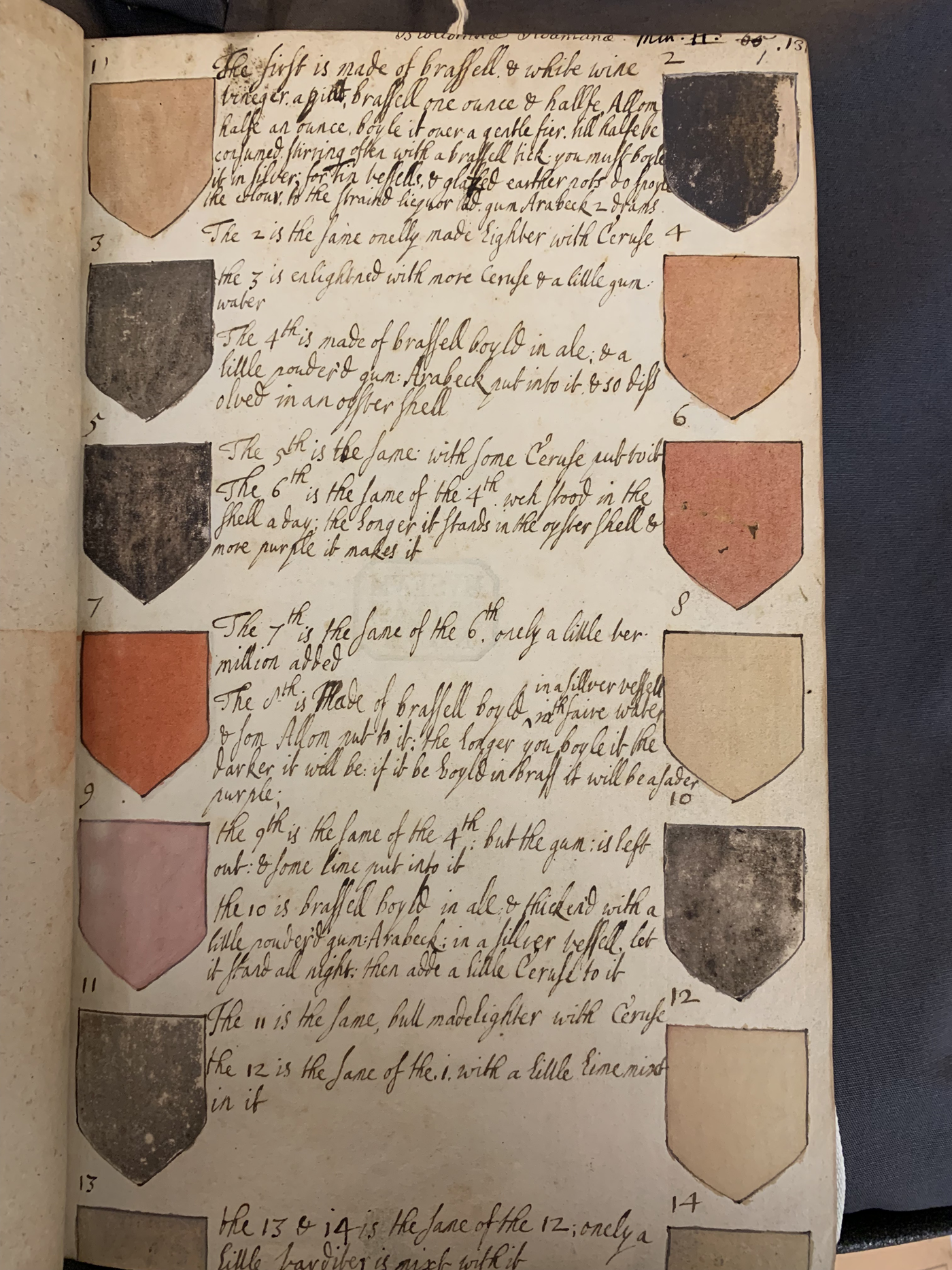
To make her colours, Margery used white wine vinegar, alum, ceruse, gum Arabic, ale, vermillion, lime, sugar candy and logwood water. In order to turn these materials into coloured paints, she either dissolved them in an oyster shell or boiled them in a silver vessel. While Margery did not specify where she had learned to make colours through these methods, her materials, instruments and procedures resemble those circulating in manual books and books of secrets at the time.Footnote 67 The processes of colouring were described in books such as Henry Peacham's The Gentleman Exercise (1612) and John Bate's The Mysteryes of Nature, and Art (1634), just as Margery might have learned about colour tinting in the anonymous cosmetics treatise Artificiall Embellishments, which included recipes to produce make-up using the same materials as Margery's.Footnote 68
Although some of the coloured shields are now faded, we can see that Margery successfully produced some beiges, two slightly different reds, two tones of pink, a blue colour and a purple colour. Reading through the recipes, it is apparent that many of the colours are variations of each other. For instance, Margery wrote that ‘The 2 is the same onelly made lighter with Ceruse’, ‘The 7th is the same as the 6th onely a little vermillion added’. She also described that the 6th colour, a beige-cum-red, was the same as the fourth, which had stood in the oyster shell a day, which had caused it to turn darker: ‘the longer it stands in the oyster shell & more purple it makes it’.Footnote 69 This method of letting the solutions stand for a shorter or longer period in order to reach the desired hue was also generally reported on in the art manual literature, as was the process of adding small quantities of another substance such as ceruse or vermillion.Footnote 70 In total, Margery listed recipes for the making of thirty-one colours, but many of these were slightly different shades of the same colours, such as beige or red. These carefully nuanced experiments tell us about the familiarity with which Margery manipulated colour.
As such, the colour catalogue presented at the beginning of the watercolour album served three purposes. First, it allowed Margery to compare colours easily by presenting them in an organized way on two pieces of paper. Second, giving the recipes for making the colours would have allowed her to re-create them at a later stage in order to ensure some consistency in her homemade colours. But, third, just as with Margery's medical recipes, the purpose of these colour recipes was not only practical. Rather, they show Margery's interest in the ways in which it was possible to change colour through the use of chemical substances and procedures, and as such they constitute an enquiry into the nature of colour itself not at all that different from the debates on colour taking place among her male peers.
Margery shared this interest in the nature of colour with her husband Henry, who produced colours using procedures, techniques and ingredients with a high degree of resemblance to Margery's. In the fourth deduction at the end of his book on microscopy, Henry discussed the nature of colours and concluded that they were nothing but the effect of the specific motion of the ‘solary atoms’, following the arguments made by René Descartes in his Météores and Principia. In the Météores, Descartes had experimented with glassware in order to create ‘artificial’ rainbows, thereby establishing his spin theory of colour.Footnote 71 Henry agreed with this theory and argued that ‘Colour is nothing else but the modification of Light, which by the alteration of its motion is dyed into colours’.Footnote 72 In order to expand on this theory, Henry included a number of experiments in which he altered the colours of liquids by adding different chemical and vegetable solutions to it. For instance, Henry added drops of the oil of tartar to an infusion of violets to create a green liquid, which he then changed into purple by adding some oil of vitriol.Footnote 73 He also changed a red infusion of dried roses into green by adding spirit of harts-horn, and made amber colour by adding ‘a little sharp vinegar’ to an infusion of Brazil wood.Footnote 74
Interestingly, like Margery's catalogue, these experiments are all given as recipes, instructing their reader on how to create the different tinctures. And like Margery, Henry is also interested in how to change the tone of colours: if a few drops of the oil of tartar are added to the ‘reddish Infusion’ of Brazil wood, ‘it will turn it to a pure purplish red, like excellent Claret’.Footnote 75 Henry also noticed that when specific chemical substances were added to the coloured liquids, they turned transparent only to become colourful again when another substance was added. This experiment strongly resembles the chemical experiment referred to as the ‘reduction to the pristine state’ that Robert Boyle published in his 1666 The Origine of the Formes and Qualities.Footnote 76 Here, too, Boyle argued that even though the appearance of a chemical solution, such as its colour, could be altered by adding different substances, it nevertheless remained the same.Footnote 77
Henry's own experience with colours and what he learned from Margery not only allowed him to identify and describe the colours that he observed through his microscopes; they also carried significant epistemic importance. In his discussion of chicken generation in Experimental Philosophy, Henry revisited the observations made by William Harvey on the first appearance of the heart and blood within the chicken egg.Footnote 78 Henry concluded that it was Harvey's lack of attention to colour changes that led to his failure to see that the heart, including the auricles and ventricles, was actually present long before he had assumed, although in a colourless, transparent state. What Harvey had taken to be the gradual appearance of the chicken, Henry recognized merely as a change in colour from white to vivid, red rendering the already-present heart visible. Thus a ‘pretty and beneficial Observation of the Microscope’ showed him that when the chicken heart did appear as a ‘red pulsing Particle’ it was already fully formed.Footnote 79 The awareness of the changing colours thus allowed Henry to develop a new theory of generation that emphasized the preformation of bodily organs.
The sensibility towards delicate colour changes, the standardized language of colour description and the chymical procedures of making and testing colours: it would be hard to distinguish Margery's and Henry's experiments with colours, were it not the case that one of them appeared in a celebrated publication of microscopy, the other in a forgotten manuscript. Even their ingredients were very similar: when Margery used an infusion of logwood with vinegar, Henry used the almost identical Brazil wood. They both had an interest in creating a variety of colours and different tones of colours, and both of their practices speak to a deep knowledge of the malleability of colours and an ability to recognize individual colour tones. ‘One drop’, two drops, they both consciously controlled the amount of substances they were adding, observed the effect, and carefully recorded the process. For Margery, these colour trials were not only a practical procedure, but also an epistemic experiment aiming to understand the nature of colours, and learn how to control colour changes.
Conclusion
Throughout this paper, we have traced how botanical information travelled in the Power household from herbals, to paper slips and recipe notebooks, to Margery's drawing album, to Henry's observations in the Experimental Philosophy. Books, together with the surviving library catalogues of the Power household, served as an important clue and medium of the story. Tracing their collaborative use of books, we have argued that the books of the Power household were a household library shared between Margery and Henry, serving practices that oscillated between practical, artistic and scientific. The textual botanical knowledge went hand in hand with Margery and Henry's practical knowledge, which enabled them to explore common household plants for various epistemic purposes, from drawing and observing to making medicine. By controlling colours, developing a chromatic vocabulary and standardizing ways of plant colouring, Margery created a sensibility of colours that was significant for microscopical observations.
Unlike Henry's Experimental Philosophy, Margery's work on the colours of plants was never published or otherwise disseminated until it arrived in the British Library together with the rest of the Power marginalia. Moreover, unlike Henry, whose introduction to the world of book printing and public letter writing had been facilitated by the university education exclusive to men, Margery did not consider herself an author. However, her artistic collaboration with her sister-in-law Ellen, as well as all the botanical activities that she undertook alone and together with Henry, shows us that she was deeply engaged in an intellectual, experimental approach to nature and plants. This should remind us that it was not only through published work – as with the ‘experimental households’ of the Listers, the Breynes and Réaumur – that these women made significant epistemic contributions.
In one way, though, Margery's work can be said to have left the household. When Henry published his microscopical observations as the first book of Experimental Philosophy, no stable model for reporting such observations had been established. Whereas Henry looked towards the genre of the books of Sir Thomas Browne, William Harvey and Thomas Moffett for inspiration on how to compile his findings, his way of seeing, as we have argued, was developed in tandem with Margery. This particular way of seeing involved a heightened sensibility towards colour, colour changes, the inherent opaqueness of small things, and a general fondness for local flowers that could be grown within or near the household. In the years following the publication of Experimental Philosophy, this approach to studying plant minutiae was continued by Robert Hooke and Nehemiah Grew, who both read and engaged with Henry's work. Thus in Micrographia Hooke makes observations of the powder of lillies and poppy seeds, while also comparing the protrusions on the face of a blue fly with ‘the Pendants in Lillies’.Footnote 80 Furthermore, as he was familiarizing himself with microscopes, Grew took extensive notes on Henry's observations in his commonplace book, and incorporated this way of describing into his published Anatomy of Plants. Here he described how the ‘minute Particles’ ‘of a Tulip or a Lilly, being larger, is more distinctly observable’, and that these powders were yellow or white, but that ‘each Globulet, through a Glass, [is] transparent as Crystal’.Footnote 81 In this way, Margery and Henry's attention to the colours of plants travelled beyond their household.
Acknowledgments
In appreciation of their generous comments and advice, we would like to thank Anke te Heesen, Dániel Margócsy, Heather Wolfe, Jessie Wei-Hsuan Chen, Lauren Kassell, Silvia Marchiori and Yijie Huang. We would also like to thank Trish Hatton and Amanda Rees of the BJHS for their careful editing, as well as the journal's three anonymous reviewers. Christoffer Basse Eriksen's research was supported by the Carlsberg Foundation and Independent Research Fund Denmark. Xinyi Wen's research was supported by Wellcome Trust Doctoral Studentship 221115/Z/20/Z.


 Open access

