





Highlights
-
• Welsh-English bilinguals were more accurate in Reception and Year 1 than monolinguals.
-
• Welsh-English bilinguals had faster responses in Reception and Year 1 than monolinguals.
-
• Effect sizes were much larger in Reception than in Year 1.
-
• Year 2 Welsh-English bilinguals performed comparably to monolinguals on all measures.
1. Introduction
The question of whether bilingualism can enhance different areas of cognition, particularly the executive function (EF) networks, is widely debated, and findings are inconsistent. There is much research which supports the presence of a bilingual effect (BE) in some way, including: Barac et al. (Reference Barac, Bialystok, Castro and Sanchez2014), Bialystok and Craik (Reference Bialystok and Craik2022) and Cape et al. (Reference Cape, Vega-Mendoza, Bak and Sorace2018). However, these results are challenged by others (Lowe et al., Reference Lowe, Cho, Goldsmith and Morton2021; Paap et al., Reference Paap, Johnson and Sawi2015; Paap & Greenberg, Reference Paap and Greenberg2013) who find that monolinguals and bilinguals perform comparably in relevant tasks. The debate and contradicting findings in the field become immediately apparent when reading meta-analytic reviews (e.g., Gunnerud et al., Reference Gunnerud, Ten Braak, Reikerås, Donolato and Melby-Lervåg2020; Lehtonen et al., Reference Lehtonen, Soveri, Laine, Järvenpää, de Bruin and Antfolk2018).
Given this ongoing debate and the mixed findings on the BE on EF, researchers are increasingly investigating the specific conditions under which BEs may emerge (e.g., whether the intensity of the language exposure plays a role [Carlson & Meltzoff, Reference Carlson and Meltzoff2008]; or whether the domains of use of the two languages influence performance [Beatty-Martínez et al., Reference Beatty-Martínez, Navarro-Torres, Dussias, Bajo, Guzzardo Tamargo and Kroll2020]). Whilst most existing research on children focuses on substantial bilingual exposure – whether in immersive environments, formal education, or bilingual/heritage language households (e.g., Gathercole et al., Reference Gathercole, Thomas, Kennedy, Prys, Young, Viñas Guasch, Roberts, Hughes and Jones2014; Papastergiou & Sanoudaki, Reference Papastergiou and Sanoudaki2022) – far less is known about populations with minimal but consistent exposure to an additional language. To address this gap, the current study includes children who receive approximately 1 hour of incidental Welsh exposure per week during term time, with no Welsh spoken at home or in their broader community – this group will be referred to as the emergent bilinguals. The emergent bilinguals’ exposure to Welsh includes learning key concepts such as numbers and colours in Welsh alongside learning these concepts in English. As children progress throughout school, they become able to produce simple sentences, ask and answer questions through the medium of Welsh (e.g., asking and answering questions about their family and the weather, Welsh Government, 2015). However, for English medium schools, there is no set amount of Welsh exposure that must occur weekly. The Curriculum for Wales (Welsh Government, 2022) encourages the use of incidental Welsh throughout the day. Many schools require teachers to use certain key phrases in Welsh throughout the day, for example, asking ‘pwy sy’n barod?’ (who is ready?), or ‘dwylo i fyny’ (hands up) in Welsh every time, rather than using English. These phrases occur at random intervals throughout the day with no warning, for example, at the end of an activity, and often require a response in Welsh. When these switches to Welsh do occur, they require emergent bilinguals to inhibit their overwhelmingly dominant L1 and respond in a much weaker L2, requiring the allocation of a significant amount of cognitive resources to respond appropriately (Borragan et al., Reference Borragan, Martin, de Bruin and Duñabeitia2018). Overall, the linguistic environment of the emergent bilinguals in the current study is highly challenging, necessitating the allocation of a significant amount of cognitive resources to respond appropriately. The emergent bilinguals in the current study are in Reception, Year 1 and Year 2 of primary school (aged 4–7 years); therefore, they are all in the Foundation Phase (FP, Welsh Government, 2015). The guidance regarding incidental Welsh is the same for all school years across the FP. There are no differences in the way Welsh is delivered to emergent bilingual participants depending upon their school year; the cumulative amount of exposure they have to the L2 increases as they progress throughout school.
Previous research with individuals with Welsh as a second language has demonstrated the importance of consistent exposure to and input in the language, particularly for successfully acquiring the more complex features of the language (Thomas et al., Reference Thomas, Williams, Jones, Davies and Binks2014). Furthermore, L2 Welsh learners have been demonstrated to lag behind L1 speakers of the language in several key areas, including the acquisition of complex morphology, receptive vocabulary and reading comprehension (Rhys & Thomas, Reference Rhys and Thomas2013). There is little research on the cognitive skills of L2 Welsh learners, although Young et al. (Reference Young, Rhys, Kennedy, Thomas, Lauchlan and Parafita-Couto2017) found that balanced English-Welsh bilingual children outperformed English monolinguals on measures of EF, including sustained attention. However, the context of acquisition of L2 Welsh in these studies is significantly different from that of the emergent bilingual children in the current study. In the above-discussed studies, pupils were either acquiring Welsh simultaneously alongside English in the home or in a Welsh-medium education setting; thus, all L2 Welsh speakers in the above studies had significantly higher levels of L2 exposure than the emergent bilinguals in the current study. Young et al. (Reference Young, Rhys, Kennedy, Thomas, Lauchlan and Parafita-Couto2017) noted that the pattern of performance of their participants varied depending upon their bilingual experience (i.e., whether they acquired both languages at home or one of them at school), thus demonstrating the importance of studying a wide range of bilingual contexts and experiences. The current study provides a novel insight into the cognitive effects of emergent minority-language bilingualism in a population that is significantly dominant in their L1, a group which is currently absent from the research field, and which has been suggested to be a likely candidate to exhibit a BE by previous research (e.g., Gathercole et al., Reference Gathercole, Thomas, Kennedy, Prys, Young, Viñas Guasch, Roberts, Hughes and Jones2014). By assessing the emergent bilinguals’ performance on a battery of EF tests and comparing it to that of monolingual peers in England, this study aims to determine whether even limited exposure to an additional language can influence cognitive performance.
2. Literature review
EFs are a series of high-level cognitive processes that impact a wide array of mental abilities (Lehtonen et al., Reference Lehtonen, Soveri, Laine, Järvenpää, de Bruin and Antfolk2018). Diamond (Reference Diamond2013) describes the core EFs as: inhibition, updating and cognitive flexibility (‘shifting’ will be used in this paper to reflect the more common term used; Monsell, Reference Monsell and Bruce1996, as cited in Miyake et al., Reference Miyake, Friedman, Emerson, Witzki, Howerter and Wager2000), and discusses the multitude of goal-related behaviours which these networks underpin. Inhibition is the ability to resist impulses and control attention, emotions, thoughts and behaviours in order to demonstrate the appropriate or necessary response. This must be deliberate and intentional rather than reflexive (Diamond, Reference Diamond2013; Miyake et al., Reference Miyake, Friedman, Emerson, Witzki, Howerter and Wager2000). Updating refers to the constant updating and revision of working memory constructs – limited pieces of information which are temporarily accessible during online processing (Blom et al., Reference Blom, Küntay, Messer, Verhagen and Leseman2014) – due to receiving new information, and replacing already-held representations with newer, more relevant ones (Miyake et al., Reference Miyake, Friedman, Emerson, Witzki, Howerter and Wager2000). Updating is an active, dynamic process, rather than a passive ‘information storage’ technique. Shifting involves changes in perspective when approaching a problem, adjusting to new rules or priorities and switching and shifting between tasks and goals (Diamond, Reference Diamond2013; Miyake et al., Reference Miyake, Friedman, Emerson, Witzki, Howerter and Wager2000). These EFs cover a significant number of high-level cognitive processes and are instrumental to all aspects of human life, for example, problem-solving skills, multitasking and switching between tasks and activities. Furthermore, they have been found to develop asynchronously throughout childhood (Anderson, Reference Anderson2002; Huizinga et al., Reference Huizinga, Dolan and van der Molen2006).
It is hypothesised that the management of more than one language within the brain trains these EF networks, due to the highly challenging nature of dual-language management (Grundy, Reference Grundy2020). Recent studies, however, have produced mixed results, suggesting that the situation is more nuanced than originally anticipated. It is also important to note that much of the variation recently observed has been attributed to factors such as improper matching (Paap & Greenberg, Reference Paap and Greenberg2013; Papastergiou et al., Reference Papastergiou, Pappas and Sanoudaki2022, Reference Papastergiou, Sanoudaki, Tamburelli and Chondrogianni2023), variation in task selection (Antoniou, Reference Antoniou2019) and task impurity (Laine & Lehtonen, Reference Laine and Lehtonen2018), amongst other factors. Presently, it seems likely that the nature of the bilingual experience is an important determining factor as to whether groups will show superior performance to monolingual peers (Purić et al., Reference Purić, Vuksanović and Chondrogianni2017). For example, the type of switches that typically occur in a bilingual’s language environment can influence the overall demands placed on the shifting network of EF, with some switches (i.e., those which occur within an utterance) being more demanding than others (Blanco-Elorrieta & Pylkkänen, Reference Blanco-Elorrieta and Pylkkänen2017).
The adaptive control hypothesis (ACH; Green & Abutalebi, Reference Green and Abutalebi2013) stipulates that bilingual minds adapt to the language environments in which they frequently operate. The authors distinguish between single- and dual-language contexts, and dense code-switching environments, arguing that bilinguals will show enhancements in the specific EF networks that they recruit depending on the language environment, as opposed to seeing enhancements in all EF networks. This is also supported by Khodos et al. (Reference Khodos, Moskovsky and Paolini2020), who argue that it is the way in which multiple languages are used, rather than bilingualism itself, that affects cognitive control networks, which is often not considered when selecting participants.
However, the linguistic environment of the emergent bilinguals in the current study does not align with the three contexts proposed in the ACH. The different language contexts are defined as follows: a single language context is one where the two languages are used in two distinct contexts with no switching between them; a dual-language context occurs when both languages are used in the same environment, but with difference interlocutors – for example the child will communicate with one adult in Welsh, and another in English; finally, a dense code-switching context occurs when all interlocutors in the environment speak both languages, and routinely use the two languages within a single utterance (Green & Abutalebi, Reference Green and Abutalebi2013). Neither of these contexts aligns with the linguistic environment of the participants in the current study, where the majority of communication occurs in English, with brief and infrequent switches into Welsh; however, the majority of interlocutors in the environment (both children and school staff) do not have full proficiency in Welsh, therefore, dense code-switching is not possible.
As a result, it is possible that these emergent bilinguals rely on their overall monitoring skills instead. Lehtonen et al. (Reference Lehtonen, Soveri, Laine, Järvenpää, de Bruin and Antfolk2018, p. 403) define monitoring as ‘the ability to monitor conflict in information processing and to evaluate the need for cognitive control’. This skill is critical for the emergent bilinguals in this study, who must frequently monitor their linguistic environment for cues indicating when a language switch may occur. As discussed above, the switches to Welsh that occur throughout the school day for the emergent bilinguals occur randomly, with no warning. This means that they must monitor their environment for non-linguistic cues for a switch, for example, when an activity is coming to an end. Many of these language switches also require a response in Welsh, rather than the pupils’ L1, consequently placing significant demands on their EF systems, more so than in environments where switching can occur freely. Monitoring is carried out by the Anterior Cingulate Cortex, which is closely associated with domain-general EFs (Abutalebi et al., Reference Abutalebi, Della Rosa, Green, Hernandez, Scifo, Keim, Cappa and Costa2012). Therefore, monitoring can be measured using tasks that tap into domain-general EF skills. Previous research has found superior monitoring abilities in early bilingual children (Kapa & Colombo, Reference Kapa and Colombo2013) and older adults (Schroeder & Marian, Reference Schroeder and Marian2012); however, the overall results are mixed (Teubner-Rhodes et al., Reference Teubner-Rhodes, Bolger and Novick2020).
The controlled dose hypothesis (CDH; Paap, Reference Paap and Schwieter2019) offers a potential explanation for recent studies that find no differences between monolingual and bilingual participants. In contrast with much of the previous research in the field suggesting that cognitive enhancements associated with bilingualism come with increased experience with the L2 (e.g., Barac et al., Reference Barac, Bialystok, Castro and Sanchez2014; Poarch & van Hell, Reference Poarch and Van Hell2012), this hypothesis suggests that cognitive enhancements will emerge after a ‘controlled dose’ of bilingualism, where individuals have only a small amount of experience with the L2. Paap (Reference Paap and Schwieter2019) argues that the cognitive demands of the bilingual experience are more important in shaping any cognitive enhancements than the duration of the L2 exposure or the proficiency level reached – the CDH stipulates that the cognitive enhancements of bilingualism emerge when the bilinguals are consistently faced with tasks that require high levels of cognitive control, and when the execution of this cognitive control remains significantly effortful for the individuals. Paap argues that the cognitive demands of bilingualism are at their highest when an individual has little experience managing both languages; therefore, it is at this point in an individual’s bilingual development that they will be most likely to demonstrate cognitive enhancements compared to monolinguals.
There are two assumptions to the CDH: (i) any prolonged activity requiring intense EF will generate a boost in EF ability, provided the EF demands exceed an individuals’ current adaptation levels; and (ii) the observed ‘boost’ to EF emerges rapidly at the onset, but then dissipates with disuse – either total disuse, or disuse due to the transition from controlled to automatic processing. Once the bilingual language management processes have begun the transition to automatic processing, the conscious recruitment of EF networks to carry out these processes ceases. If the previously observed BEs are due to the consistent conscious recruitment of EF networks for language management, it is hypothesised that once this conscious recruitment ends (due to the transition to automatic processing), bilinguals will no longer demonstrate the previously observed cognitive enhancements. This suggests that BEs are likely to be observed in populations of emergent bilinguals with limited experience managing both of their languages, for whom this task still requires conscious cognitive effort, as opposed to being completed automatically.
Much of the recent research into the cognitive consequences of bilingualism has focused on participants with equal, or relatively equal proficiency in both of their languages, (e.g., Gold et al., Reference Gold, Kim, Johnson, Kryscio and Smith2013; Timmer et al., Reference Timmer, Grundy and Bialystok2017; Yow & Li, Reference Yow and Li2015), a group for whom Paap (Reference Paap and Schwieter2019) argues language management is already automated, therefore they cannot be expected to demonstrate a BE. Gathercole et al. (Reference Gathercole, Thomas, Kennedy, Prys, Young, Viñas Guasch, Roberts, Hughes and Jones2014) suggested that the reason their study found no differences between Welsh-English bilinguals and English monolinguals was due to the bilinguals’ language management being highly practiced and occurring automatically. They instead suggested recruiting populations for whom language management remained challenging in order to observe cognitive enhancements. With this in mind, the participants selected for this study operate in a highly challenging linguistic environment, yet have only limited exposure to the L2. Consequently, bilingual language management remains highly challenging for this group, and they can be expected to demonstrate enhanced EF abilities compared to monolinguals, due to the consistent, conscious recruitment of their EF networks under challenging conditions to carry out language management processes.
3. Research questions and hypotheses
There are three research questions guiding this study:
-
1) Do emergent bilingual primary school children exposed to a small amount of L2 Welsh perform better on a battery of EF tasks than their monolingual English peers?
-
2) If there are differences in EF performance between language groups, are these differences observed for the EF networks that experience the highest level of cognitive demand during bilingual language management, in accordance with the ACH (Green & Abutalebi, Reference Green and Abutalebi2013)?
-
3) Is there any observed effect of increased exposure to the L2 (as measured by increased length of time in school) on performance?
In line with the CDH, it is hypothesised that the emergent bilingual children will show superior performance compared to the monolingual controls on some of the EF measured used, and that this superior performance can be attributed to the challenging nature of managing two languages in a group with such little exposure to the L2, thus necessitating significant recruitment of the EF networks to manage both languages. However, we do not anticipate the emergent bilinguals to outperform the monolingual controls on all five of the EF measures used. Instead, in line with the ACH (Green & Abutalebi, Reference Green and Abutalebi2013), it is hypothesised that the emergent bilinguals’ inhibition and switching networks will be affected, as these networks have the greatest cognitive demands placed upon them during the emergent bilinguals’ language management. Additionally, it is hypothesised that the group differences will be greater when the participants have the least amount of exposure to the L2 (therefore are in the Reception group of participants), in line with the CDH (Paap, Reference Paap and Schwieter2019).
4. Method
4.1. Participants
Sixty-three participants, aged 54–90 months, in Reception, Year 1 and Year 2 of primary school, took part in this study. Participants are divided into two language groups: emergent bilinguals (N = 38, 23f, mean age 71.4 months) and monolinguals (N = 25, 12f, mean age 73.4 months). Emergent bilingual children were recruited from three English-medium schools in the same county in North-East Wales. This group was exposed to 20 minutes to 1 hour of incidental Welsh per week, during term time only. Monolingual children were recruited from three schools across England. Neither group had any exposure to any additional languages (apart from Welsh for the bilingual group) as ascertained by an adaptation of the Language and Social Background Questionnaire (LSBQ; Luk & Bialystok, Reference Luk and Bialystok2013) filled out by their caregivers. More details on this questionnaire are provided in Section 4.2.
As the emergent bilingual participants’ exposure to Welsh is dependent on the duration of time they have spent in school (i.e., the longer they have spent in school, the greater their cumulative exposure to the L2), groups were further divided based on their school year. This results in six smaller subgroups: monolingual Reception (N = 10, 4f), emergent bilingual Reception (N = 13, 6f), monolingual Year 1 (N = 8, 3f), emergent bilingual Year 1 (N = 16, 12f), monolingual Year 2 (N = 7, 5f) and emergent bilingual Year 2 (N = 9, 5f). Monolingual and emergent bilingual children in the same school year are compared to one another. The emergent bilingual participants received approximately 1 hour per week of incidental Welsh exposure. The data collection for this study took place in the ‘Spring 2’ term; thus, at the time of collection, the Reception emergent bilingual children had been attending school for 28 weeks, and consequently, they had received approximately 28 hours of incidental Welsh exposure. The Year 1 emergent bilinguals had been in school for a total of 67 weeks, thus received approximately 67 cumulative hours (split over 2 years at school), and the Year 2 s approximately 109 hours cumulative exposure to Welsh (split over 3 years at school).
Independent samples t-tests revealed no statistically significant differences between monolinguals and emergent bilinguals on a number of important background variables in any school yearFootnote 1. There were no significant differences between language groups for age in months in any school year: Reception: t(21) = 2.15, p = .117; Year 1: t(22) = −.42, p = .676; and Year 2: t(14) = 1.61, p = .131. There were also no significant differences between language groups on nonverbal intelligence, measured using the K-BIT Matrices standard score (Kaufman & Kaufman, Reference Kaufman and Kaufman2004), for any school years, Reception: t(20) = −1.64, p = .117; Year 1: t(22) = −.32, p = .751; and Year 2: t(14) = −1.10, p = .290. There were also no statistically significant differences between language groups on English receptive vocabulary scores, measured using the British Picture Vocabulary Scale (BPVS, Third Edition; Dunn & Dunn, Reference Dunn and Dunn2009), for Reception: t(18) = −1.04, p = .311; Year 1: t(22) = .32, p = .754; or Year 2: t(14) = .63, p = .541. Finally, there were no significant differences between language groups for SES, measured using maternal education (as ascertained from the parental questionnaire) in Reception: t(15) = −.84, p = .412, Year 1: t(13) = 1.08, p = .298 or Year 2: t(8) = 1.06, p = .321. These measures are discussed in more detail in Section 4.2. Chi-square tests of independence revealed no significant association between gender and language group in Reception:
$ {\chi}^2 $
 (1, N = 23) = .09, p = .768. However, there was a significant association between gender and language group in Year 1, with emergent bilinguals more likely to be male:
$ {\chi}^2 $
(1, N = 23) = .09, p = .768. However, there was a significant association between gender and language group in Year 1, with emergent bilinguals more likely to be male:
$ {\chi}^2 $
 (4, N = 24) = 49.87, p < .001. There was also a significant association between language group and gender in Year 2, with monolinguals more likely to be female:
$ {\chi}^2 $
(4, N = 24) = 49.87, p < .001. There was also a significant association between language group and gender in Year 2, with monolinguals more likely to be female:
$ {\chi}^2 $
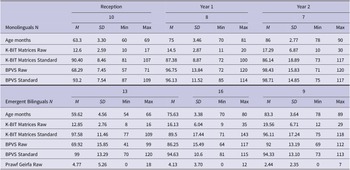
 (4, N = 16) = 24.64, p < .001. Regression analyses indicated that gender was not a significant predictor of performance on any measure in any school year. Descriptive statistics are presented below in Table 1.
Descriptive statistics for age, K-BIT and BPVS scores by school year (monolinguals and emergent bilinguals)

Table 1. Long description
The table is divided into two main sections: Monolinguals and Emergent Bilinguals. Each section provides data for Reception, Year 1, and Year 2 students across four metrics: M (Mean), S D (Standard Deviation), Min, and Max.
Monolinguals Section:
* Reception (N=10): Age M 63.3; K B I T Matrices Raw M 12.6; K B I T Matrices Standard M 90.40; B P V S Raw M 68.29; B P V S Standard M 93.2.
* Year 1 (N=8): Age M 75; K B I T Matrices Raw M 14.5; K B I T Matrices Standard M 87.38; B P V S Raw M 96.75; B P V S Standard M 96.13.
* Year 2 (N=7): Age M 86; K B I T Matrices Raw M 17.29; K B I T Matrices Standard M 86.14; B P V S Raw M 98.43; B P V S Standard M 98.71.
Emergent Bilinguals Section:
* Reception (N=13): Age M 59.62; K B I T Matrices Raw M 12.85; K B I T Matrices Standard M 97.58; B P V S Raw M 69.92; B P V S Standard M 99; Prawf Geirfa Raw M 4.77.
* Year 1 (N=16): Age M 75.63; K B I T Matrices Raw M 16.13; K B I T Matrices Standard M 89.5; B P V S Raw M 86.25; B P V S Standard M 94.63; Prawf Geirfa Raw M 4.13.
* Year 2 (N=9): Age M 83.3; K B I T Matrices Raw M 19.56; K B I T Matrices Standard M 96.11; B P V S Raw M 92; B P V S Standard M 94.33; Prawf Geirfa Raw M 2.44.
Note: The measures included are as follows:
Age months: The participant’s age in completed months at the time of the first data collection session.
K-BIT Matrices Raw: The participant’s raw score on the Matrices subsection of the Kaufman Brief Intelligence Test, 2nd Edition (Kaufman & Kaufman, Reference Kaufman and Kaufman2004), which was used as a measure of nonverbal intelligence. This score is out of a maximum possible of 46.
K-BIT Matrices Standard: The participant’s standard score on the Matrices subsection of the Kaufman Brief Intelligence Test, 2nd Edition (Kaufman & Kaufman, Reference Kaufman and Kaufman2004), which was used as a measure of nonverbal intelligence. This standard score was calculated using the data provided by the test manufacturer.
BPVS Raw: The participant’s raw score on the British Picture Vocabulary Scale 3rd Edition (Dunn & Dunn, Reference Dunn and Dunn2009), which is a measure of English receptive vocabulary. This score is out of a maximum possible of 168.
BPVS Standard: The participant’s standard score on the British Picture Vocabulary Scale 3rd Edition (Dunn & Dunn, Reference Dunn and Dunn2009), which is a measure of English receptive vocabulary. This standard score was calculated using the data provided by the test manufacturer.
Prawf Geirfa Raw: The participant’s raw score on the Prawf Geirfa Cymraeg (Gathercole & Thomas, Reference Gathercole and Thomas2007), which is a measure of Welsh receptive vocabulary. This test was only completed by the emergent bilingual children. The administration of this test differed from the manufacturer’s instructions; therefore, only raw scores are presented (see further discussion in Section 4.3).
All participants had normal or corrected-to-normal vision. No child involved had any form of SEND (special education needs and disability, in England) or ALN (additional learning needs, in Wales), was undergoing assessment for SEND/ALN, or awaiting referral for assessment.
Additionally, all pupils came from schools with a high percentage of children receiving free school meals (FSM). FSM percentage has been found to be a valid indicator of social disadvantage across the UK (Gorard, Reference Gorard2012; Ilie et al., Reference Ilie, Sutherland and Vignoles2017). At the time of data collection, the average percentage of pupils receiving FSM was 23.8%, yet schools in Wales and England participating in the current study had an FSM percentage ranging from 28.8% to 45%, indicating that all participating schools were situated in areas with low SES (Office for National Statistics, 2024; StatsWales, 2024). Further information is discussed in Section 4.2.
4.2. Materials
4.2.1. LSBQ
The LSBQ (Luk & Bialystok, Reference Luk and Bialystok2013) was used to collect the language and social background information for both groups. This was sent to caregivers electronically via their child’s school. This questionnaire was sent only in English, as the bilingual group comes from an English-speaking community and the exposure to Welsh occurs only when they are in school.
The LSBQ is split into three sections: Section 1 gathers basic details about the child, as well as demographic information such as parental education levels, which was used to calculate SES. Maternal education was used as the index for SES in the current study – this was measured using a five-point scale taken from the original questionnaire (Luk & Bialystok, Reference Luk and Bialystok2013), with the wording changed to correlate with the British education system, reflective of the classification used by Gathercole et al. (Reference Gathercole, Woolgar, Team, Kievit, Astle, Manly and Holmes2016). The possible ratings were: No Qualifications, GCSE, A-Level, Bachelor’s Degree and Postgraduate or Professional Degree. This was then assigned a numerical value (from 1 to 5, 1 equating the lowest option) for each participant. Parents were also asked to indicate their occupation, which was then coded from Level 1 to 4 according to the Standard Occupational Classification (SOC; Office for National Statistics, 2020).
Section 2 of the questionnaire gathers information about the child’s abilities in speaking and understanding English, as well as experience with EF-enriching activities such as musical training or computer-game use (Valian, Reference Valian2015). Caregivers rated their child’s abilities for speaking and understanding English separately, on a five-point Likert scale from ‘Poor’ to ‘Excellent’. The purpose of this section was to highlight whether caregivers had any concerns about their child’s development in English or whether they spent a significant amount of time doing other EF-enriching activities. Section 3 includes questions about the child’s language use with different interlocutors and for different activities (e.g., ‘what language does your child use for watching television with siblings?’). This was also rated on a five-point Likert scale, ranging from ‘Only English’ to ‘Only Other Language’ – five-point intervals were chosen to allow parents to more easily assess their child’s language use in 20% increments. It is noted that changing the Likert scale from seven points to five changes the scale from continuous to ordinal (Sullivan & Artino, Reference Sullivan and Artino2013). These measures were used as inclusion criteria; therefore, any child for whom it was indicated that any language other than English was used for any activity was not included in the study. Consequently, the change from seven to five points does not affect the data gathered, as all responses were at the floor.
4.2.2. Nonverbal intelligence
Nonverbal intelligence was measured using the K-BIT Matrices sub-test of the Kaufman Brief Intelligence Test, Second Edition (K-BIT; Kaufman & Kaufman, Reference Kaufman and Kaufman2004). The test consists of 46 items, including a series of abstract images, such as designs and symbols, and visual stimuli, such as pictures of people and objects. Participants are required to pick an image from a panel at the bottom of the page to complete a set, in order to demonstrate that they understand the relationship between their chosen image and the other images presented in the set. Participants can select images by either pointing or stating the corresponding letter to the required option. Each item offers at least five possible answers, thereby minimising the likelihood of guessing. This standardised test was individually administered and scored according to the developer’s instructions and discontinued after four consecutive incorrect responses. Participants’ raw scores are calculated as the ceiling item reached, minus the total number of errors. These raw scores are then converted into standard scores, which are used in the group matching procedure. Participants’ raw scores are compared to the scores of a norming sample of the same age and converted to a standard score using the test manual. This standard score allows comparison of performance between peers of the same age. This test is reliable, with good internal consistency (α = .88, Kaufman & Kaufman, Reference Kaufman and Kaufman2004).
4.2.3. Language measures
All participants also completed a standardised test of Standard English receptive vocabulary – the British Picture Vocabulary Scale (BPVS), Third Edition (Dunn & Dunn, Reference Dunn and Dunn2009). For this task, the researcher reads a word aloud, and the participant must pick the correct image out of a set of four in a 2 by 2 matrix that best corresponds to that word. Selection can be carried out orally or by pointing. This is a standardised test for children ranging from 3 years to 16 years and 11 months. The assessment consists of 14 sets of 12 words of increasing difficulty (e.g., ball, island and fictional) for a maximum score of 168. This test was individually administered and scored according to the developer’s instructions and discontinued once the participants had made eight errors out of a set of 12 items. Raw scores are calculated as the ceiling item reached minus the total number of errors. These scores are then converted to standard scores, which are used in the group matching procedure. Participants’ raw scores are compared to the scores of a norming sample of the same age and converted to a standard score using the test manual. This standard score allows comparison of performance between peers of the same age. This test is also reliable, with good internal consistency (α = .91, Dunn & Dunn, Reference Dunn and Dunn2009).
The emergent bilingual group also completed the Prawf Geirfa Cymraeg Fersiwn 7–11 (PGC; Gathercole & Thomas, Reference Gathercole and Thomas2007), which is the only standardised test of Welsh receptive vocabulary, designed for children aged 7–11 years. This test follows the same format as the BPVS, where the researcher reads a word aloud and the participant must select the correct image from a selection of four. Items increase in difficulty as the test progresses. This test is split up into three sets of 37 items. The bilingual participants were not expected to perform at an age-appropriate level on this test due to their limited exposure to Welsh. Due to this limited exposure to Welsh, as well as them being below the intended age range for this measure, the paper version of this test was used as opposed to an electronic version, which does not allow for discontinuation at any point, meaning that participants must respond to all 111 items. This procedure allowed for only the first set of 37 items to be administered. After this point, it was assumed that participants did not know any further answers and would perform at chance level. Due to the administration procedure of this test differing from manufacturers’ instructions, standardised scores were not calculated for the PGC, and raw scores (out of 37) were calculated instead.
4.2.4. Executive function measures
This study used five different EF measures, which were administered on a 15.6-inch laptop screen and were run using Eprime 2.0 software (Schneider et al., Reference Schneider, Eschman and Zuccolotto2002), which automatically recorded accuracy (1 for correct, 0 for incorrect responses) and reaction time (RT) in milliseconds (ms) data for each response.
4.2.5. Inhibition
Inhibition was measured with two tasks: the Spatial Stroop (adapted from Lukács et al., Reference Lukács, Ladányi, Fazekas and Kemény2016) and the Attentional Network Task (ANT; Fan et al., Reference Fan, McCandliss, Sommer, Raz and Posner2002). The Spatial Stroop is a nonverbal adaptation of a classic Stroop task, which avoids priming participants for the use of either language. This task has three blocks (control, congruent and incongruent) with 60 trials per block, totalling 180. It requires participants to look at arrows that appear on the laptop screen and press the corresponding arrow key on the keyboard in the direction in which the arrow on the screen is pointing, regardless of its position on the screen. During the control block, all arrows appear in the centre of the screen. For the congruent and incongruent blocks, the arrows appear in four different locations around the screen (top of the screen, bottom of the screen, left-hand side and right-hand side) and the arrow’s position can be either congruent or incongruent (e.g., an arrow appears at the top of the screen, but it is pointing downwards). The incongruent block of this task requires participants to inhibit their prepotent response to press the button that matches the arrow’s location and instead focus on the direction of the arrow itself.
The second measure of inhibition was the ANT. Participants are presented with a series of five fish with arrows in them, and the fish is facing in the direction that the arrows are pointing. Participants are instructed to focus on the central fish and to press the corresponding button on the mouse in the direction in which the central fish is pointing (e.g., if the central fish is pointing to the left, then they must press the left-hand mouse button). This task begins with 16 practice trials, followed by four blocks of 32 trials, totalling 128 trials. The instructions for all trials are the same, with the participant required to focus on the central fish; the four surrounding fish can be either congruent or incongruent to the central fish, requiring participants to inhibit the distracting information and focus only on the target.
4.2.6. Shifting
Shifting was measured with the Colour-Shape Sorting Task (Purić et al., Reference Purić, Vuksanović and Chondrogianni2017). This task consists of three blocks – participants are presented with two shapes (a triangle and a circle), either in red or blue. For the first block, these shapes appeared in the top half of the screen, in the second block, they appeared in the bottom half of the screen, and for the third block, they could appear on both halves. Participants are instructed to press a key on the keyboard to correspond to one dimension of the stimulus (either shape or colour). Stickers were placed on the relevant keys to remind participants which criteria they corresponded to prior to the commencement of this task (one key for circle and blue, and another for red and triangle). In the first block, participants are instructed to respond based on shape, and in the second block, instructed to respond based on colour. The final block is a mixed block, where the criteria depend upon the position of the stimulus on the screen – responding to shape when the stimulus is on the top half of the screen and colour when it is on the bottom half. These trials can be either non-switch, where the sorting criterion does not change between trials, or switch, where the criterion does change between trials. The proportion of switch- and non-switch trials in this block is equal. Blocks one and two contained 32 trials each, and block three had 64 trials.
4.2.7. Updating
Updating was measured with two tasks, the Reverse Digit Recall (adapted from Huizinga et al., Reference Huizinga, Dolan and van der Molen2006), and a Counting Recall Task, an adaptation of the Automated Working Memory Assessment (Alloway, Reference Alloway2007). In the Reverse Digit Recall, participants were instructed to listen to a series of digits and type them into the computer in the reverse order. For example, if the participants heard 1, 9, they were required to type 9, 1. This task began with two practice trials – if the participant made any mistakes on this, then the instructions were repeated and an example given to ensure they were understood. The sequences of digits got progressively longer up to a maximum of eight, and the task stopped once a child had made three consecutive errors. During the Counting Recall task, children were presented with images with varying numbers of red circles and blue triangles. They were instructed to count and memorise the number of red circles only. The number of images the children were presented with increased as the task went on, beginning with one and ending with seven images for the participants to remember. There were four trials per block; for example, in the third block, participants were presented with three images and asked to recall the number of circles on each screen. They repeated this a further three times, totalling four trials per block.
4.3. Procedure
Ethical approval was obtained by the University’s Ethics Committee before the project began. Informed consent was gathered from the school headteacher and from caregivers before collection began. Once informed consent had been received, an online adaptation of the LSBQ using Google Forms was sent to caregivers via the school’s parental communication platform to be completed in their own time.
The collection was completed in a quiet room in the child’s school, with only the participant and the researcher present to minimise distractions. Children’s assent was secured before the session began. Data collection was split into two sessions for all children: a cognitive session and a literacy session. This was partially to avoid fatigue, and to also ensure that the tests of Welsh- and English-receptive vocabulary were administered in separate sessions for the bilinguals to avoid priming participants for language switching. There were two slight differences in procedure between groups. First, only the emergent bilingual group completed the PGC. Second, the Reception pupils did not complete the Forward Counting task as this was found to be too difficult for this age group during a pilot study. Aside from this, the procedure remained consistent for all participants.
The first session was the cognitive session, which began with the PGC (emergent bilinguals only). All participants then completed the K-BIT Matrices as a measure of nonverbal intelligence. Participants then completed the EF measures in the following order: (i) Spatial Stroop, (ii) Reverse Digit Recall, (iii) ANT, (iv) Forward Counting (excluding Reception) and (v) Colour-Shape Sorting Task. Participants were encouraged to take breaks in between tasks and between trials if needed. At the end of the session, participants were rewarded with stickers for their participation and returned to class.
The second session occurred after a break of at least 7 days. Participants’ assent was again secured before the session began. This session began with the BPVS to assess English receptive vocabulary scores. Participants then completed several tests of early literacy, which were used as part of a wider study. Data from the literacy session will not be analysed or discussed in this paper, but can be found in Collins (Reference Collins, Papastergiou and Sanoudaki2026, under review).
5. Results
RT in ms and accuracy (out of 1) were recorded for all EF tasks. All RT for incorrect trials were excluded from the analysis; thus, only RT from correct responses were analysed (e.g., Purić et al., Reference Purić, Vuksanović and Chondrogianni2017). For both inhibition tasks, RT and accuracy for congruent and incongruent trials were analysed separately. Additionally, General (GSC) and Local Switch Costs (LSC) were calculated in ms on the Colour-Shape Task, and mixing costs on the Colour-Shape Task were also calculated to be taken as a measure of participants’ monitoring abilities. Measures of inhibition cost were calculated on both the Spatial Stroop and the ANT tasks. GSC was calculated as the difference between the average RT on the mixed block and the average RT for the two control blocks together. LSC was calculated in the mixed (third) block as the difference between the average RT for the switch trials and the average RT for the non-switch trials. In accordance with the procedure used in Prior and MacWhinney (Reference Prior and MacWhinney2010), mixing costs were calculated by subtracting performance on single-task trials from that on non-switch trials in the third block and used to indicate participants’ monitoring costs. Inhibition costs were calculated as the difference in RT and accuracy on congruent and incongruent trials.
There were no differences between monolinguals and emergent bilinguals in any school year for several important background variables, namely: age (months), K-BIT standard score, BPVS standard score and maternal education (see Sections 4.1 and 4.2.1). These variables were also included as covariates in the ANCOVAs, as they have been found to significantly impact EF abilities in childhood (e.g., see Ardila et al., Reference Ardila, Rosselli, Matute and Guajardo2005; Stephens et al., Reference Stephens, Langworthy, Short, Goldman, Girault, Fine, Reznick and Gilmore2018; Xing et al., Reference Xing, Wei and Wang2022).
5.1. Executive function measures
The data from the current study met all assumptions required for conducting ANCOVAs, which were performed on both RT and accuracy data. Performance was compared between monolinguals and emergent bilinguals within the same school year on all EF measures, with age in months, maternal education, K-BIT standard score and BPVS standard score as covariates. The Reception pupils did not complete the forward counting task, therefore it is not presented in the analyses. Accuracy is measured out of 1 (100%); therefore, a higher number represents a more accurate performance. RT is measured in ms; therefore, a low number represents a faster response. GSC, LSC, inhibition and mixing costs are also measured in ms – a lower number indicates less of a cost, therefore more efficient switching, inhibition or mixing. A negative number on this measure indicates that the individual responded faster on the Mixed Blocks than on the Control Blocks. Tables with descriptive statistics for both RT and Accuracy on the EF tasks are presented in the Supplementary Tables S2–S7 (divided by pupils’ school year).
The ANCOVAs on RT data between monolinguals and emergent bilinguals revealed several significant differences. In Reception, there was a significant main effect of language group on Reverse Digit Recall RT (F(1,20) = 21.09, p < .001, η2ₚ = .51). In Year 1, a significant main effect of language group was found for Spatial Stroop Congruent RT (F(1,21) = 12.60, p = .002, η2ₚ = .38), ANT RT Congruent (F(1,21) = 6.39, p = .020, η2ₚ = .23) and ANT RT Incongruent (F(1,21) = 4.59, p = .044, η2ₚ = .18). No other significant main effects were found for RT on any other EF measure. There were no significant main effects of language group on any measure in Year 2.
The ANCOVAs on Accuracy data also revealed several significant differences. For Reception, a significant main effect of language group was found for Reverse Digit Recall (F(1,20) = 22.40, p < .001, η2ₚ = .53), ANT Congruent (F(1,20) = 19.17, p < .001, η2ₚ = .49), ANT Incongruent (F(1,20) = 30.47, p < .001, η2ₚ = .60), Colour Stimuli (F(1,20) = 40.14, p < .001, η2ₚ = .67), Shape Stimuli (F(1,20) = 5.93, p = .024, η2ₚ = .23) and Colour Test (F(1,20) = 4.98, p = .037, η2ₚ = .20). In Year 1, significant main effects of language group were found for the Spatial Stroop Incongruent (F(1,18) = 14.13, p = .001, η2ₚ = .44), Reverse Digit Recall (F(1,21) = 4.55, p = .029, η2ₚ = .21) and inhibition cost (F(1,18) = 10.40, p = .005, η2ₚ = .37). There were no significant effects of language group on any measure in Year 2. All significant language group effects for both RT and accuracy favoured the emergent bilingual group.
6. Discussion
The present study investigated differences in the EF of emergent bilingual children in Wales compared to English monolingual peers. There were no differences between monolingual and emergent bilingual groups on age, non-verbal intelligence, English receptive vocabulary or SES. Responses from the LSBQ reveal that none of the participants spent a significant amount of time completing EF enriching activities, such as learning a musical instrument or playing videogames or sports (Valian, Reference Valian2015; Vestberg et al., Reference Vestberg, Gustafson, Maurex, Ingvar and Petrovic2012), therefore, we are confident that observed differences in EF abilities between mono- and emergent bilingual participants can be attributed to the bilingual group’s exposure to an additional language. As the emergent bilinguals’ exposure to Welsh occurs only when they are in school, the number of years spent in school can be used as a proxy to measure cumulative exposure to the language, whereby those participants who have been attending school for the longest time (i.e., the Year 2 group) have the greatest cumulative exposure to the language, and those who have been in school for the shortest time (i.e., the Reception group) have the least cumulative exposure to the L2.
For the EF tests, accuracy and RT for correct responses were recorded and analysed. In terms of RT, there was superior emergent bilingual performance in Reception on the Reverse Digit Recall test, measuring participants’ updating skills, and in Year 1, emergent bilinguals showed superior RT on congruent trials of the Stroop, and both congruent and incongruent trials of the ANT task – both tests which measure inhibition. In terms of Accuracy, superior emergent bilingual performance was observed in Reception for all three EF networks, on the Reverse Digit Recall, both congruent and incongruent trials of the ANT task, and three measures of the Colour Shape Sorting Task. In Year 1, emergent bilinguals showed superior performance on the incongruent trials of the Stroop task, inhibition cost on the Stroop and on the Reverse Digit Recall, thus demonstrating superior inhibition and updating abilities to their monolingual peers. There were no differences between monolinguals and emergent bilinguals in Year 2 in terms of either RT or accuracy. The results for this study provide early support for the CDH (Paap, Reference Paap and Schwieter2019), as enhanced bilingual performance was observed for the groups in the earliest stages of bilingualism, and not for those groups with more cumulative experience with the L2. They can also explain many of the observed null differences between mono- and bilingual participants (for further discussion, see Paap & Greenberg, Reference Paap and Greenberg2013 and Paap et al., Reference Paap, Johnson and Sawi2016), suggesting that the cognitive advantages of bilingualism emerge at very early stages of L2 exposure, and decrease with increased exposure to the L2.
There are several factors that differentiate the current study from other recently published research, which may help to explain these findings. First, the bilingual participants in this study operate in a highly challenging linguistic environment, which is unique compared to published literature, which frequently focusses on immersion education (e.g., Bialystok et al., Reference Bialystok, Peets and Moreno2014; Purić et al., Reference Purić, Vuksanović and Chondrogianni2017). Their educational environment is overwhelmingly dominant in their first language (L1); however, there are infrequent, brief and intra-sentential switches into Welsh, which are initiated by the classroom staff and occur with no warning. These types of switches have been previously identified to be particularly challenging, for example, see: Blanco-Elorrieta and Pylkkanen (Reference Blanco-Elorrieta and Pylkkänen2017), Hofweber et al. (Reference Hofweber, Marinis and Treffers-Daller2020) and Yang et al. (Reference Yang, Hartanto and Yang2016) amongst others. Pupils are required to be constantly monitoring the linguistic environment, switch to a significantly weaker L2, inhibit an overwhelmingly dominant L1, and then switch back again – managing and appropriately responding to these linguistic demands is highly taxing for the pupils’ EF system, particularly given their limited experience managing two languages. Interestingly, there were no differences observed for GSC and LSC on the Colour-Shape task between language groups in any school year; however, in Reception, the emergent bilingual group was more accurate on this measure than their monolingual peers, suggesting they were able to switch more accurately, but that the costs of this switching were comparable to the monolingual group. The complex linguistic environment can also explain the enhanced bilingual performance on the inhibition tasks, as when switches occur, participants are taxed with inhibiting a hugely dominant L1 in order to appropriately respond to the Welsh input. Borragan et al. (Reference Borragan, Martin, de Bruin and Duñabeitia2018, p. 2) note that a ‘relatively high level of inhibition’ is needed in situations such as this where the L1 is significantly stronger than the L2. This places notable demands on the EF systems of the young participants, serving to train and enhance these networks relative to monolingual peers for whom this is not necessary.
Green and Abutalebi’s (Reference Green and Abutalebi2013) ACH posits that bilingual minds adapt to the situations in which they frequently find themselves, differentiating between single-language, dual-language and dense code-switching environments and proposing that BEs will be observed in the most frequently recruited EF networks, consequently. For example, they argue that bilinguals who operate in dual-language contexts (where both languages are used but typically with different interlocutors) will show reduced switching costs as this skill has become strengthened due to their specific language environment. However, the linguistic environment of the present study does not align with any of the interactional contexts discussed by Green and Abutalebi (Reference Green and Abutalebi2013), and instead, bilingual participants have to frequently recruit all their EF networks to manage their languages and respond accordingly. Pupils are required to constantly inhibit one of their languages, whilst also being prepared to switch to the other language at any moment. They also have to allocate vast amounts of working memory resources to the learning of the L2 – a process which is ongoing and inter-woven with many classroom activities throughout the day in small doses. The unique combination of demands placed on the young pupils’ EF systems can explain why enhanced bilingual performance was seen for all the EF networks in terms of accuracy, in contrast with much of the recent literature (e.g., Blom et al., Reference Blom, Küntay, Messer, Verhagen and Leseman2014; de Cat et al., Reference de Cat, Gusnanto and Serratrice2018).
As the participants’ linguistic environment is different from those set out in the ACH (Green & Abutalebi, Reference Green and Abutalebi2013), it is possible that the emergent bilinguals are relying on their monitoring abilities when they are in school to prepare them for any potential language switches. Mixing costs were calculated in accordance with the procedure from Prior and MacWhinney (Reference Prior and MacWhinney2010) and taken to be an indication of participants’ monitoring abilities. The current study did not find any differences between monolinguals and emergent bilinguals’ mixing costs in any school year, suggesting that the emergent bilinguals are relying on different strategies to cope with the linguistic demands. It is possible that the highly challenging nature of the emergent bilinguals’ linguistic environment necessitates the recruitment of all EF networks to manage these demands, hence why bilinguals were demonstrating superior performance on all three EF networks.
Additionally, the participants have only a small amount of exposure to the L2, meaning that they are likely below the threshold for language management automatisation, as discussed in the CDH (Paap, Reference Paap and Schwieter2019). It is frequently observed that bilingual children have reduced receptive vocabularies in a single language compared to their monolingual peers; however, this was not the case with the groups in this study (Barbosa et al., Reference Barbosa, Jiang and Nicoladis2019; Bialystok et al., Reference Bialystok, Luk, Peets and Yang2010). Comparable English receptive vocabulary scores to their English monolingual peers, alongside the emergent bilinguals’ consistently low scores on the Welsh receptive vocabulary measure, clearly demonstrate how minimal their exposure to and proficiency in L2 Welsh is. As discussed above, the CDH posits that bilingual advantages occur at early stages of bilingual exposure, when language management is not yet automated. The participants in the current study receive between 20 minutes and 1 hour of informal and incidental exposure to Welsh per week, during term time only (39 weeks per year), with no Welsh exposure in the community. Consequently, they exist below the ‘threshold’ for automatisation, meaning that dual-language management remains highly challenging for them, strengthening their EF networks as a result. Segalowitz and Hulstijn (Reference Segalowitz, Hulstijn, Kroll and de Groot2005) note that the automatisation of an L2 means that it no longer requires the consumption of cognitive resources. If it is the effortful recruitment of cognitive networks that leads to the enhancement of those networks and the observed BEs, once language management has surpassed the point of automatisation, the BEs will no longer be observed. It is important to note that the transition from controlled to automatic processing is gradual, and there are stages where the two types of processing co-occur for particular tasks, with controlled processing being dropped only after several hundred trials (Schneider & Chein, Reference Schneider and Chein2003). The present study provides support for the CDH, as enhanced bilingual performance was observed in the two groups of participants with the smallest amounts of cumulative exposure to the L2, whilst the group with the most L2 exposure demonstrated comparable performance to their monolingual peers. It appears that as cumulative exposure to the L2 increases, as pupils progress through school, their language management becomes more automated and the beneficial cognitive effects of bilingualism cease.
The current study is one of the first to investigate EF skills in this bilingual population. Results suggest that the beneficial effects of bilingualism emerge at early stages of L2 exposure. Gathercole et al. (Reference Gathercole, Thomas, Kennedy, Prys, Young, Viñas Guasch, Roberts, Hughes and Jones2014) argue that previous research with Welsh-English bilingual children that found no differences between language groups at various age ranges is due to the bilinguals’ extremely high proficiency in managing multiple languages, suggesting that a group of bilinguals with less experience managing their languages would be more likely to exhibit a BE. Similar patterns have been reported in other populations, for example, Chamorro and Janke (Reference Chamorro and Janke2023) studied a group of monolingually-raised but bilingually educated children (aged 6–7). The authors found superior bilingual performance at their first test point (at the end of Year 1) on measures of selective attention and response inhibition; however, there were no differences between language groups when participants were re-tested at a second testing point, at the end of Year 2 (Chamorro & Janke, Reference Chamorro and Janke2023). The authors attribute the lack of differences at the second testing point to a plateau in the general development of their bilingual participants; however, it may be the case that these results also support the CDH (Paap, Reference Paap and Schwieter2019), and the participants had surpassed the ‘threshold’ of exposure by the second testing point.
In addition to the ANCOVAs conducted on both accuracy and RT, which demonstrate superior performance for the emergent bilinguals in Reception and Year 1, with no group differences in Year 2, there are larger effect sizes observed in the Reception group compared to those in Year 1. This suggests that there is a greater degree of difference between monolinguals and emergent bilinguals in Reception than there is between groups in Year 1, thus further supporting the CDH as the group with the least amount of exposure to the L2 is showing the greatest differences to their monolingual peers. This is a pattern that has not been reported in previous literature. The different components of EF follow different developmental trajectories, developing somewhat independently of each other (Anderson, Reference Anderson2002; Huizinga et al., Reference Huizinga, Dolan and van der Molen2006), hence why differential patterns of performance were observed for each of the EF networks (e.g., Year 1 pupils are showing enhancements to inhibition and updating, but not to switching). All interpretations of the results suggest that the group with the smallest amount of total exposure to the L2 is showing the most cognitive benefit, with performance becoming comparable to monolingual controls as language exposure increases.
The current study also found evidence of differential performance within an EF network. For example, Reception pupils showed superior RT on the Reverse Digit Recall task (which measures updating) compared to monolinguals, but there were no differences in performance on the Forward Counting Task, which is also a measure of updating. This issue may be related to the reliability and validity of commonly used EF tasks. Many researchers argue that these tasks are far from optimal (e.g., Laine & Lehtonen, Reference Laine and Lehtonen2018; Paap & Greenberg, Reference Paap and Greenberg2013; Paap & Sawi, Reference Paap and Sawi2014; Soveri et al., Reference Soveri, Antfolk, Karlsson, Salo and Laine2017). The observed dissociation between tasks could also stem from the lack of a clear theoretical framework regarding the bilingual advantage in EF, as well as ambiguities in the structural organisation of EF – despite Miyake et al.’s (Reference Miyake, Friedman, Emerson, Witzki, Howerter and Wager2000) model, which divides EF into three interrelated components: shifting, inhibition and working memory. Although these tasks are assumed to measure the same domain, this does not necessarily mean they are correlated (Jylkkä et al., Reference Jylkkä, Soveri, Wahlström, Lehtonen, Rodríguez-Fornells and Laine2017; Laine & Lehtonen, Reference Laine and Lehtonen2018). Whilst some studies suggest that forward and backward recall tasks load onto the same factor in factor analysis (e.g., Colom et al., Reference Colom, Abad, Rebollo and Shih2005; Engle et al., Reference Engle, Tuholski, Laughlin and Conway1999), others argue that reversing the order of recall engages executive-attentional resources (e.g., Elliot et al., Reference Elliot, Smith and McCulloch1997).
7. Limitations
This study suggests that exposure to L2 Welsh in primary school has benefits for individuals’ EF abilities, demonstrating the positive consequences of bilingualism from a different viewpoint, aside from the clear benefits associated with learning a new language. However, the sample size for this study is relatively small, and a larger sample size would increase confidence in the results. Additionally, there are significant differences between the Curricula in England and Wales (Department for Education, 2013; Welsh Government, 2020); the Welsh Curriculum offers more opportunities for play than the English Curriculum – it is possible that the differences in approach can account for some of the observed variation (see, e.g., Veraksa et al., Reference Veraksa, Sukhikh, Veresov and Almazova2022). Furthermore, the PGC (Gathercole & Thomas, Reference Gathercole and Thomas2007) is the only standardised test of Welsh receptive vocabulary available, and there are some limitations to its application with the current population due to their home language background. This test was normed on three samples of participants: those from Welsh-only homes, those from Welsh-English bilingual homes and those from English-only homes who are attending Welsh medium education. Consequently, none of these groups accurately represent the emergent bilinguals’ language background, and thus their receptive abilities in Welsh may not be fully captured by this test. In the current study, the group of participants with the (descriptively) lowest scores on the PGC is the group with the most cumulative exposure to the L2. They are also the only group that is not showing BEs, which creates further questions surrounding the role of L2 proficiency and exposure in shaping BEs in such populations; however, it is possible that this group’s true receptive abilities in Welsh are not being accurately represented, due to the aforementioned issues with the applicability of the PGC for this population.
8. Conclusion
The current study demonstrates that minimal exposure to L2 Welsh affords emergent bilingual primary school children with cognitive advantages over their monolingual peers, in support of the CDH (Paap, Reference Paap and Schwieter2019). Superior performance for the younger bilingual participants was observed on EF measures, with no differences between groups for the oldest participants. There is evidence that all three networks of EF were affected by emergent bilingualism in Reception, with only updating and inhibition affected in Year 1. In addition, effect sizes were larger for the Reception group than the Year 1s, suggesting that the differences between monolinguals and bilinguals are greater in the group with the least amount of exposure to the L2, thus supporting the CDH (Paap, Reference Paap and Schwieter2019).
Supplementary material
The supplementary material for this article can be found at http://doi.org/10.1017/S1366728926101357.
Data availability statement
The datasets generated for this study are available on request to the corresponding author.
Funding statement
This study was supported by the Welsh Graduate School for the Social Sciences (WGSSS), Economic and Social Research Council (ESRC) Doctoral Training Partnership (DTP) PhD studentship awarded to Bethan Collins, based at the School of Arts, Culture and Language at Bangor University.
Competing interests
The authors declare none.


 Open access

