

Are citizens’ policy preferences better represented by elected officials who share their gender? If so, then women citizens are disadvantaged because men hold a greater proportion of seats in virtually all of the world’s parliaments. Much of the theoretical and empirical research in gender and politics suggests that women are indeed better represented by women officeholders. Empirical studies find that women legislators are more likely to support and pursue women-friendly policies (Barnes 2012; Bratton and Ray Reference Bratton and Ray2002; Schwindt-Bayer and Mishler Reference Schwindt-Bayer and Mishler2005). Normative accounts of representation go beyond linking women’s presence in office to positive outcomes on women’s policy issues, arguing that gendered socialization shapes elected women’s positions on a range of issues, whether those issues are explicitly gendered or not (Kathlene Reference Kathlene1995; Mansbridge Reference Mansbridge1999; Phillips Reference Phillips1995).
Most scholars of women’s substantive representation operationalize it as promoting or pursuing “women’s interests” (Escobar-Lemmon and Taylor-Robinson Reference Escobar-Lemmon and Taylor-Robinson2014; Franceschet, Krook, and Piscopo Reference Franceschet, Krook and Piscopo2012; O’Brien and Piscopo Reference O’Brien, Piscopo, Franceschet, Krook and Tan2018), although more recent research has sought to study it more agnostically. Celis (Reference Celis2007) and Erzeel (Reference Erzeel2012), for example, avoid predetermining the content of women’s interests, instead examining the representative claims MPs make about women. Scholars employing the concept of women’s interests try to acknowledge women’s diversity, by defining them as those issues that emerge from the gender division of labor and hierarchies of status and influence that disadvantage women relative to men (Escobar-Lemmon and Taylor-Robinson 2014). Understood that way, the policy issues associated with women’s substantive representation include reproductive rights, childcare, family law, sexual harassment and violence, and equal pay, among others.
On these policy issues, research generally confirms gender gaps among politicians. Surveys of elected officials find that women are more likely than men to prioritize issues relating to gender equality (Lovenduski and Norris Reference Lovenduski and Norris2003; Tremblay Reference Tremblay1998; Wängnerud Reference Wängnerud2000). This research tends to assume rather than empirically demonstrate that women citizens also prioritize such issues and want their elected representatives to promote them. A separate body of research documents gender gaps in policy preferences, political attitudes, and vote choice, showing that women tend to be more likely to support left-leaning political parties (Erickson and O’Neill Reference Erickson and O’Neill2002; Gidengil et al. Reference Gidengil, Hennigar, Blais and Nevitte2005; Inglehart and Norris Reference Inglehart and Norris2000) and tend to have more left-leaning policy preferences than men on a wide range of issues, from crime to social spending and wealth redistribution, to gender equality issues (see Gidengil et al. Reference Gidengil, Blais, Nadeau, Nevitte, Tremblay and Trimble2003; Shapiro and Mahajan Reference Shapiro and Mahajan1986).
The mechanisms assumed to shape gender gaps in policy preferences are also presumed to link women’s presence (descriptive representation) to favorable policy action (substantive representation) — namely, shared experiences emerging from socialization into society’s gender norms and the gendered division of labor. The fact that girls are socialized to be nurturing and cooperative and that women take on greater responsibilities in childrearing and domestic work is also expected to create shared policy preferences among women. Yet elected women, like men officeholders, are often drawn from the elite and may therefore have very different experiences than women in the population (see Schwindt-Bayer Reference Schwindt-Bayer2010). In that case, even if many women share experiences of gender-based discrimination, reproduction, and childrearing, their different class positions may create diverging experiences and policy preferences on issues not directly related to their gender roles (Wiener Reference Wiener2022).
Although shared experiences are presumed to link women’s descriptive and substantive representation, we cannot determine empirically whether they do, in fact, function as theorized, with shared experiences leading directly to shared policy preferences. We can, however, explore whether women officeholders — regardless of their own experiences and policy preferences — know more about what women in their constituencies want, particularly when compared to elected men. In this study, we bring together two strands of research — women’s substantive representation and politicians’ knowledge of their constituents’ preferences — to explore two questions about what elected representatives know about their constituents: are politicians aware of gender differences in policy preferences among their constituents? And are they better able to predict the policy preferences of constituents who share their gender? We test both questions using findings from large-scale surveys of Canadian local politicians and the Canadian public.
Disentangling the mechanisms underlying women’s substantive representation is important both theoretically and practically. Theoretically, determining whether shared preferences or prior knowledge is the main source of effective substantive representation contributes to discussions about the mechanisms behind why women politicians might be better equipped to represent women constituents. On a practical level, determining whether women politicians are better than men at predicting women’s policy preferences can inform strategies about how to improve women’s political representation and whether the main focus ought to be on electing more women or electing representatives — men or women — who share women’s policy preferences. Of course, we recognize that shared knowledge, and preferences do not lead automatically to action. The vast literature on women in public office shows the myriad constraints on elected women who might want to pursue women-friendly policies. Despite such obstacles, it is worth exploring whether a foundational element of substantive representation — namely, knowledge of constituents’ policy preferences — is shaped by gender and whether sharing a gender identity is necessary for substantive representation.
Our findings suggest that elected politicians are, in the aggregate, well aware of gender gaps in policy preferences, even when issues are not explicitly gendered. Contrary to expectations from previous research, we find that women do not perform better than elected men when asked to predict the policy preferences of constituents who are women — in fact, we find that both men and women politicians have more accurate predictions of women’s policy preferences. We conclude by reflecting on the possible factors contributing to our findings, with a particular focus on projection and gender-based stereotypes.
Political Representation, Knowledge, and Gender
Political scientists have long been interested in the quality of democratic representation. Gender scholars have noted the “poverty” of women’s political representation (Celis and Childs Reference Celis and Childs2020). Women are descriptively under-represented in nearly all the world’s legislatures, and the question of whether numerical under-representation undermines women’s substantive representation (promoting women’s policy interests) has been a central focus of research on gender and politics (see O’Brien and Piscopo Reference O’Brien, Piscopo, Franceschet, Krook and Tan2018). Normative theorists of representation argue that the shared experiences among those with similar ascriptive characteristics like race, gender, or socioeconomic status produce valuable knowledge for politicians, making them better representatives of historically under-represented groups (Mansbridge Reference Mansbridge1999, Reference Mansbridge2003; Phillips Reference Phillips1995).
Politicians’ knowledge of their constituents’ preferences is one important pathway through which descriptive presence may translate into substantive representation. Since Miller and Stokes’s (Reference Miller and Stokes1963) foundational research, many normative and empirical studies of representation have explored politicians’ knowledge of their constituents’ preferences as a key mechanism for substantive representation (Dovi Reference Dovi2007; Hedlund and Friesema Reference Hedlund and Friesema1972; Mansbridge Reference Mansbridge2003). Unfortunately, however, research on politicians’ knowledge of constituents’ preferences has not been encouraging; recent studies have found that politicians regularly misperceive public opinion by 20 percentage points or more (Broockman and Skovron Reference Broockman and Skovron2018; Kalla and Porter Reference Kalla and Porter2019; Walgrave et al. Reference Walgrave, Jansen, Sevenans, Soontjens, Pilet, Brack and Varone2023). While elected representatives express a strong interest in public opinion (Walgrave et al. Reference Walgrave, Soontjens and Sevenans2022), politicians in many countries appear to systematically overestimate citizens’ conservatism (Broockman and Skovron Reference Broockman and Skovron2018, Pilet et al. Reference Pilet2023) and systematically misperceive public preferences even among salient subgroups in the population (Sevenans et al. 2021; Varone and Helfer Reference Varone and Helfer2021).
More specific empirical scholarship linking women’s descriptive and substantive representation has produced somewhat mixed findings, largely because scholars operationalize substantive representation differently (Escobar-Lemmon and Taylor Robinson Reference Escobar-Lemmon and Taylor-Robinson2014; Franceschet and Piscopo Reference Franceschet and Piscopo2008). Most studies look exclusively at women in office, although focusing on different stages of the policy process. Some scholars ask whether elected men and women have different attitudes and policy priorities (Schwindt-Bayer Reference Schwindt-Bayer2012), while others look at policy outcomes to see if women’s greater presence in office is associated with policy outcomes that benefit women (Atchison and Downs Reference Atchison and Down2009; Bratton and Ray Reference Bratton and Ray2002). Several scholars find gender gaps in policy preferences between elected men and women, with women politicians more likely to support women’s rights policies, but also more resources for welfare, education, and health and less public spending on defense (Barnes Reference Barnes2016, Poggione Reference Poggione2004; Swers Reference Swers1998).
When it comes to policy outcomes, however, the empirical evidence is less conclusive about the link between descriptive and substantive representation, largely because other factors — like party, seniority, and parliamentary culture — matter more than gender (Beckwith Reference Beckwith2002; Franceschet Reference Franceschet, Krook and Mackay2011). Yet some studies do find an association between larger numbers of women in parliament and positive policy outcomes for women (Bratton and Ray Reference Bratton and Ray2002; Kittilson Reference Kittilson2008). Many such studies focus on policies directly related to women’s rights, such as reproduction, maternity leave, sexual harassment, and workplace equality (Atchison Reference Atchison2015; Atchison and Down Reference Atchison and Down2009; Bird Reference Bird2005; Childs and Withey Reference Childs and Withey2004). Other studies go beyond women’s rights policies, finding that women’s greater presence in office is associated with greater public spending on health care and less on militaries (Caprioli Reference Caprioli2000; Clayton and Zetterberg Reference Clayton and Zetterberg2018; Koch and Fulton Reference Koch and Fulton2011).
An emerging area of research moves beyond a focus on elected women to ask whether the policy preferences of elected women align with those of women in the population and whether women’s preferences are under-represented at the elite level. Examining the United Kingdom, Campbell, Childs, and Lovenduski show that, as expected, there is more alignment among women voters and women officeholders on issues relating to gender equality and traditional gender roles (2010, 194). Clayton et al. (Reference Clayton, Josefsson, Mattes and Mozaffar2019) examine the degree of congruence of mass-elite policy preferences in Africa, finding important gender differences among legislators when it comes to prioritizing women’s rights policies and poverty amelioration (2019, 93). The authors conclude that women are indeed better represented by politicians who are women.
Findings from a study of European democracies, however, complicate any straightforward conclusion that elected women are necessarily better representatives for women. Examining congruence in policy preferences between women in the mass public and elected representatives on policies that go beyond traditional feminist issues, Dingler et al. (Reference Dingler, Kroeber and Fortin-Rittberger2019) find that electing larger proportions of women MPs is not related to better substantive representation for women voters. Their study shows that women’s preferences are better represented than men’s — that is, more congruent with politicians’ preferences. Most important, they show that such outcomes are not driven by women’s descriptive representation but by gender gaps in voting. Congruence is greater where women’s turnout at the polls is higher than men’s (Dingler et al. Reference Dingler, Kroeber and Fortin-Rittberger2019, 313). Reher’s study takes the analysis even further by looking at policy outcomes rather than politicians’ policy preferences. She finds that while men and women agree on many issues — including gender equality issues — policy outcomes are more likely to represent men’s preferences on those areas where men and women disagree (Reference Reher2018, 623–24). Like Dingler et al. (Reference Dingler, Kroeber and Fortin-Rittberger2019), Reher also finds that women’s parliamentary representation is not associated with better representation (understood as policy congruence).
Once again, more general research on politicians’ knowledge of constituents’ preferences is relevant to this discussion, because this literature has consistently found that politicians are much better at predicting their constituents’ policy preferences when they themselves share those preferences (Clausen et al. Reference Clausen, Holmberg and deHaven-Smith1983; Holmberg Reference Holmberg, Schmitt and Thomassen1999; Norris and Lovenduski Reference Norris and Lovenduski2004). In a study of politicians in Belgium, Canada, Germany, and Switzerland, Varone and Helfer (Reference Varone and Helfer2021) find that politicians from parties that “own” a policy issue tend to more accurately perceive support for that issue among their party’s supporters, which may reflect a form of in-group knowledge. Similarly, Miguel Pereira (Reference Pereira2021) finds strong evidence of “social projection” in Swedish and Swiss politicians’ perception of public opinion, meaning that politicians tend to assume that a majority of constituents share their own view on an issue. Hertel-Fernandez et al. (Reference Hertel-Fernandez, Mildenberger and Stokes2019) find that the same is true among Congressional staffers in the United States. Using data from Canadian local politicians, Lucas et al. (Reference Lucas, Loewen and Sheffer2022) generalize this finding to suggest that politicians’ overall performance in knowing their constituents’ preferences is closely linked with their performance in sharing those preferences; across nine policy issues, politicians who agree with their constituents more accurately predict their constituents’ attitudes as well.
Taken together, the findings from these strands of research point in different directions. On the one hand, shared preferences create a foundation for greater knowledge, thereby opening a pathway for substantive representation (Druckman et al. 2023). On the other hand, we have evidence that politicians’ perceptions are biased toward the views of more politically active or privileged members of society, and that misperception is especially acute when privileged citizens (e.g., wealthy, highly educated) hold views that differ from their less privileged compatriots (Pereira Reference Pereira2021; Sevenans et al. Reference Sevenans, Soontjens and Walgrave2022). Since politicians themselves are more likely to be drawn from the elite, there are reasons to be skeptical that elected women necessarily have shared experiences with and thus greater knowledge about women in their constituencies, although the findings on policy preference alignment by Dingler et al. (Reference Dingler, Kroeber and Fortin-Rittberger2019) indicate that mass-elite differences may not drive shared preferences, at least among women.
Another reason for skepticism is that some studies find that politicians’ sex has no effect on knowledge about their constituents’ policy preferences. Although most studies of politicians’ perceptual accuracy do not directly explore gender and representation, some make passing mention of gender in their analyses. Broockman and Skovron (Reference Broockman and Skovron2018) find that candidates’ perceptual accuracy differs dramatically by party and modestly by other factors, such as district competitiveness and incumbent status, but that a candidate’s gender is unrelated to their knowledge of public opinion. Sevenans et al. (Reference Sevenans, Soontjens and Walgrave2022) find the same; while politicians in Belgium, Canada, and Israel appear to be more responsive to men’s policy priorities, this bias is present regardless of a politician’s gender. In other words, women do not appear to be more accurate than men in their understanding of women’s policy preferences, and indeed appear to share the same representational biases as their male colleagues.
The competing findings about whether women’s policy interests are more likely to be shared and thus represented by women politicians indicate that more research is needed, and, more specifically, research is needed to better understand the mechanisms of substantive representation.
Data and Methods
Motivated by past research on the link between descriptive and substantive representation and politicians’ perceptual accuracy, we designed a study that would enable us to explore if elected women are better than elected men at predicting the policy preferences of women constituents, even on policy issues that are not explicitly gendered or widely framed as “women’s issues.” To test this possibility, we designed and preregistered a study of Canadian municipal politicians’ knowledge of the policy preferences of men and women, as well as older and younger residents, among their local constituents.Footnote 1
Research Design
In the first stage of our study, we conducted a survey of 3,750 Canadians in the fall of 2021 containing questions on municipal policy attitudes across a number of policy domains. Survey recruitment was carried out by Abacus Data from an existing online panel between September 30, 2021, and October 12, 2021, with sample quotas for province, language, gender, and age. Our issue position questions were adapted from past research on municipal policy attitudes in Canada and the United States and were deliberately constructed as policy trade-offs to avoid acquiescence bias and “cheap talk” responses and more accurately measure policy preferences (Bucchianeri et al. Reference Bucchianeri, Carney, Enos, Lakeman and Malina2021; Einstein and Glick Reference Einstein and Glick2018).
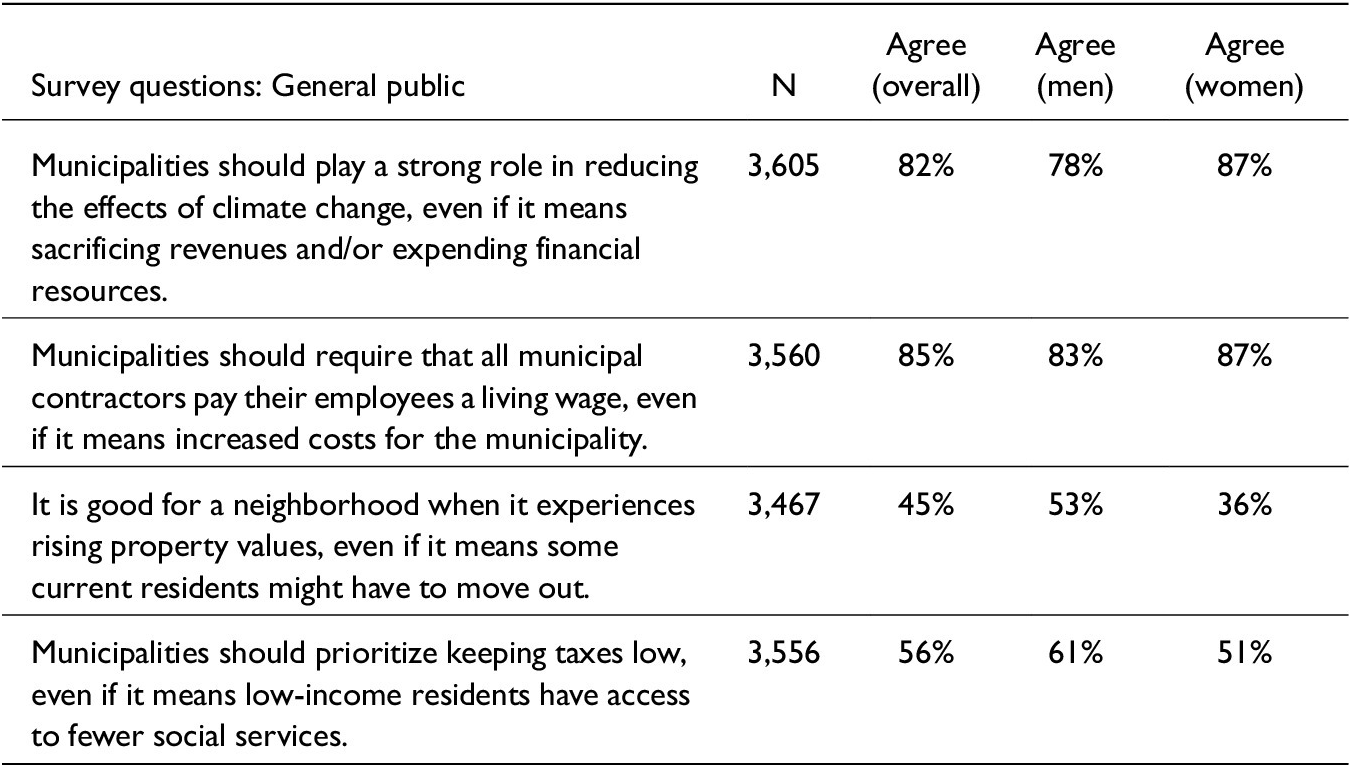
Having collected the survey data, we simplified all responses into a binary agree/disagree scale. We then selected four policy issues, intentionally choosing issues that were not framed as “women’s issues” or explicitly gendered but which nevertheless had substantively meaningful and statistically significant gender gaps in issue support. The gender gaps on these four issues are consistent with those found in previous studies of gender gaps in Europe and North America, with women more supportive of compassion issues (like social protection, higher wages, and supports for the poor) as well as policies that address climate change (Bush and Clayton Reference Bush and Clayton2023; Caughey et al. Reference Caughey, O’Grady and Warshaw2019; Iversen and Rosenbluth Reference Iversen and Rosenbluth2006; Shapiro and Mahajan Reference Shapiro and Mahajan1986). The four issues we chose are listed in Table 1, along with overall means and mean values among men and women respondents.Footnote 2
Summary of survey questions in public opinion survey
After selecting the issues, we then designed and preregistered our study of currently elected municipal politicians — the politicians who are most directly responsible for the issues that were included in the public opinion survey. We randomly assigned each politician a vignette describing a constituent who was either a man or a woman and either 35 or 65 years of age, and asked municipal politicians to predict how that constituent would respond to each of the four policy issue questions. We include age alongside gender in the survey vignette for two reasons. First, we felt it may be valuable to have a second demographic gap to which we could compare the gender results; as we will see below, comparing politicians’ performance on gender and age gaps helps to put their performance into perspective. Second, and more importantly, we added age to the vignette to distract our respondents somewhat from our main variable of interest (gender). Following the vignette, we asked each politician for their own view on each of the four issues. We provide the full wording for all survey questions in the Supplementary Material (SM3).
There is, of course, significant diversity among women, and additional characteristics for the hypothetical constituent could have been specified in the vignette — such as race, income, or educational attainment. Our decision to include only gender and age, however, was intentional. By inviting politicians to imagine a 35- or 65-year-old woman or man in their municipality, they are left to think about a constituent with these features in their community. This “imagined” constituent will be different from one municipality to the next. By specifying the constituent’s age and gender, we allow our elite respondents to fill in additional detail and intersecting identities based on the demographics of their own community. A politician in a suburb outside Toronto might imagine a highly educated South Asian woman, while a politician in a small rural community in Nova Scotia might imagine a low-income white woman. Our approach allows us to account for the considerable diversity in the municipalities that are included in our survey (as we explain below, we develop a multilevel model that predicts municipality-specific policy preferences among men and women) without creating hypothetical constituents who are implausible for some respondents (that is, constituents whose specific characteristics are rare, or even nonexistent, in a politician’s municipality).
Our elite survey data are taken from the Canadian Municipal Barometer (CMB), an annual survey of mayors and councilors in every municipality in Canada above 9,000 population. In Canada, municipal governments are responsible for a wide range of policy tasks, including transportation and transit, parks and recreation, local land use planning and regulation, policing and public safety, and public health. Municipal politicians are elected every four years; in most provinces, these elections are formally nonpartisan (i.e., no party labels on the ballot), though the provincial or federal partisanship of some high-profile candidates may be well known to voters. We follow many studies in advanced democracies in leveraging data from local politicians to inform our broader understanding of political representation (e.g. Butler et al. Reference Butler, Volden, Dynes and Shor2017; Lee et al. Reference Lee, Nyhan, Reifler and Flynn2021; Sheffer Reference Sheffer2019).
Our questions were included in the 2022 annual survey, which was fielded from January 3 to February 28, 2022. The response rate for the 2022 survey was 23% (867 responses), a very strong response rate that is comparable to other high-quality surveys of North American political elites. In the supplementary material, we show that our sample of elected politicians is broadly representative of population size, province, and regional distributions among the larger population of municipal politicians in Canada. Compared to the population as a whole, our sample includes slightly more women than expected (41% of the sample, compared with 35% of the population), but these additional women are helpful for the purposes of our analysis.
In summary, our preregistered research design involved (1) collecting data from a nationally representative survey of Canadians on municipal policy attitudes that would enable us to estimate gender gaps in Canadians’ issue attitudes across a number of policy domains; (2) asking politicians to predict the attitudes of men and women constituents; and then (3) assessing if politicians’ gender is related to their performance in the prediction task. Our pre-analysis plan, which covered steps (2) and (3) of this design, was published at an online repository prior to the completion of the politician survey. We include the full pre-analysis plan in our supplementary material.
Outcome Variables and Correlates
We are interested in politicians’ knowledge of their constituents’ preferences and how that knowledge varies by both politicians’ and constituents’ gender. Our main outcome variable of interest is therefore a binary measure of each politician’s success in predicting their constituent’s agreement or disagreement with each policy issue statement. To calculate this variable, the first step is to estimate the probability that men, women, 35-year-olds, and 65-year-olds (the four demographic groups in the survey vignette) support each of the four policy issues. We do so using our public opinion data. Because policy attitudes vary substantially across regions and even municipalities in Canada (Lucas and Armstrong Reference Lucas and Armstrong2021), these estimates need to incorporate not only the age and gender of survey respondents, but also differences in baseline levels of support across municipalities — that is, the model needs to account for the fact that overall support for municipal action on climate change will be different in Vancouver than in rural Alberta. For this reason, we fit a multilevel model of citizens’ preferences for each issue, containing respondents’ age and gender along with varying intercepts by municipality and region. This model allows us to measure the age and gender gaps that are central to our analysis while also incorporating information about municipal and regional variation in policy preferences. Incorporating this additional information makes for a fairer test of politicians’ knowledge of their constituents’ preferences.Footnote 3
Using this multilevel logit model, we then calculate the predicted probability of agreement on each issue for each of the four demographic subgroups in every municipality for which we have data from local politicians. This allows us to calculate a perceptual accuracy score for each politician, scoring politicians correct (1) if their prediction aligns with the predicted probability we have estimated, and incorrect (0) if their prediction does not align with the predicted probability. For example, if the predicted probability that a 35-year-old woman in Halifax agrees that taxes should be kept low is 65%, the politician would receive a score of one if they predicted agreement, and zero if they predicted disagreement. We preregistered this outcome measure in our pre-analysis plan, along with two more complex measures, both of which incorporate the probability of the citizens’ responses into the politician’s correctness score. In the supplementary material, we describe these three measures in more detail and show that our results are substantively identical when using any of the three preregistered outcome measures.Footnote 4 Overall, politicians’ performance in predicting their constituent’s attitudes varied substantially across issues, ranging from very good (climate change, 72% correct), to good (living wage and gentrification, 62% correct), to no better than chance (taxes and services, 49% correct).
Having calculated these scores, the remaining variables in our analysis are straightforward. We measure politicians’ gender using a standard survey question with an open-ended response option to allow for non-binary gender identities.Footnote 5 Two respondents to the 2022 Canadian Municipal Barometer survey indicated a non-binary gender identity. For reasons both of statistical power and individual privacy, these non-binary representatives are excluded from our analysis. We thus employ a binary variable for gender, with men coded as (0) and women coded as (1) in all models.
Results
We begin by summarizing gender and age gaps in citizens’ policy preferences alongside politicians’ collective perceptions of those same gender and age gaps. In Figure 1, the gray coefficients summarize the marginal effects for the general public. Each gray coefficient captures the effect of a shift from men to women (in the left panel) or a shift from 35-year-olds to 65-year-olds (in the right panel) on the probability of agreement with each policy issue. Under “keep taxes low,” for example, we can see that the gray marginal effect for men versus women is negative, indicating that women are less likely to agree with the statement than men. Similarly, the negative marginal effect for the same policy question in the right-hand panel indicates that older respondents were less likely to agree with this statement than younger respondents. In other words, the gray marginal effects visualize gender gaps and age gaps in support for each policy issue from the public opinion survey. Positive marginal effects indicate that women (left panel) or older respondents (right panel) were more likely to agree with the statement than men or younger respondents, and negative marginal effects indicate that women or older respondents were less likely to agree with the statement than men or younger respondents.
Estimates of policy issue agreement (public opinion survey) and predictions of constituent preferences (elite survey) by gender and age. Full tables available in Supplementary Material (SM3).

There are substantively large and statistically significant differences between men and women in support for all four issues, as illustrated by the gray marginal effects in the left-hand panel. We see especially large differences on the questions about local taxes and gentrification. These gender gaps are consistently larger than the age gaps in the right-hand panel, which are statistically significant for just two of the four issues. Thus, in keeping with past research, we find meaningful differences between men and women’s average support for these policy issues, with women tending to take a less conservative position on all issues: they are less supportive of tax reductions than men, more supportive of climate change initiatives, more supportive of living wages for contractors, and less supportive of gentrification.
Turning to politicians’ knowledge of gender and age gaps, we see that politicians accurately predict gender gaps in support for these four policy issues but are less knowledgeable about the policy preferences of different age groups. Alongside the gray marginal effects in Figure 1, the black coefficients summarize effects from the elite survey. We can interpret each black coefficient as the change in politicians’ prediction about a constituent’s support for the issue when we randomly assign politicians a woman constituent rather than a man (left panel) or an older constituent rather than a younger one (right panel). For example, on the first issue (“keep taxes low”), the black coefficient for “men vs. women” is large, statistically significant, and negative, indicating that politicians are much less likely to predict that their constituent supports the statement when the constituent is a woman than when the constituent is a man. We can therefore interpret the black coefficients as capturing the expected change in politicians’ predictions about their constituents’ policy attitudes when we randomly vary the gender or age of those constituents. This quantity might be thought of as politicians’ collective understanding of age and gender gaps in policy preferences.
Comparing the black and gray coefficients for each issue in the left-hand panel in Figure 1, we can see that politicians have a remarkably good sense of gender differences in support for the four policy issues among their constituents. Politicians’ expectations shift in the correct direction on all four issues, reflecting a good overall sense of gender gaps in policy preferences. In the right panel, politicians are correct in their directional estimate on two of the four issues (climate change and gentrification), modestly incorrect on one issue (living wages), and entirely incorrect on the one question (keeping taxes low).Footnote 6 Politicians thus perform better when asked about gender gaps than age gaps — an important finding, given that generational differences in policy attitudes are a salient area of discussion in contemporary politics. Most importantly for our purposes, however, the “collective wisdom” of elected politicians that is captured in the figure suggests that they are not only well aware that gender gaps in policy preferences exist among their constituents but are also aware of the direction of those gender gaps even when the content or focus of the issues is not explicitly gendered.
Individual-Level Correlates of Predictive Accuracy
In the aggregate, politicians have a good understanding of gender gaps in public policy preferences. But do politicians perform better at this perceptual task when asked about constituents who share their gender? If shared experiences produce shared knowledge, then we should expect more accuracy when representatives and constituents have the same gender. To answer this question, we now turn to our individual-level analysis. Table 2 summarizes the correlates of predictive accuracy among politics. The first column summarizes overall results among all politicians; the second and third columns then summarize the same relationship among women politicians (column 2) and men politicians (column 3). The remaining columns replicate the same model but add projection to the model — agreement between the politician and the constituent whose attitude is being predicted.
Shared gender and predictive accuracy
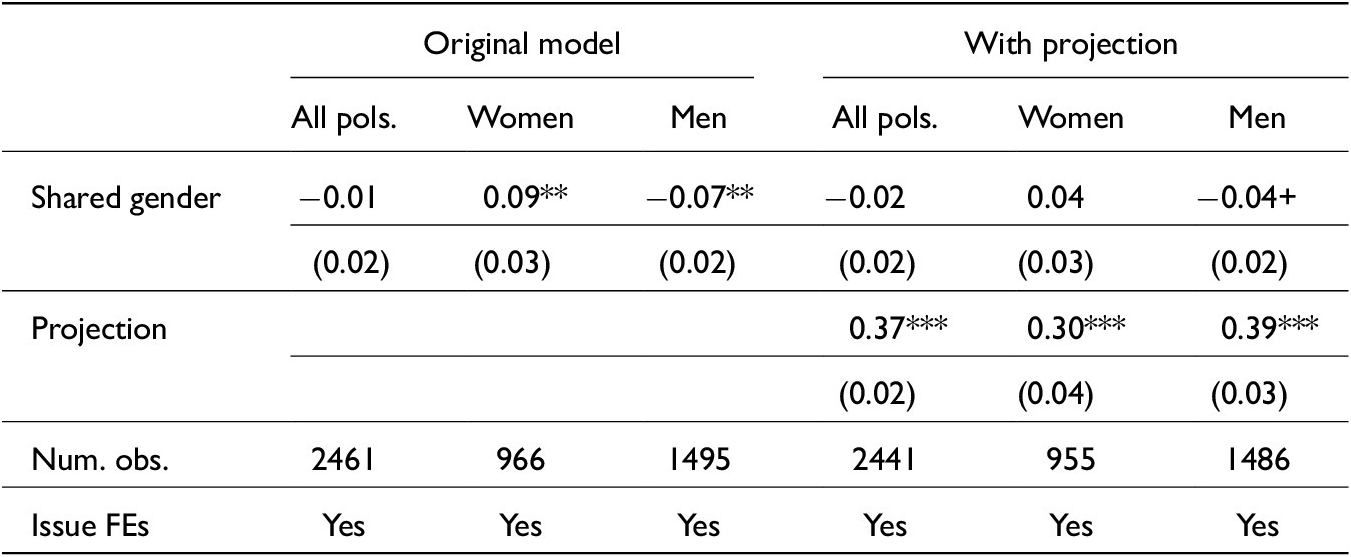
+ p < 0.1, * p < 0.05, ** p < 0.01, *** p < 0.001. Standard errors in parentheses.
The results in Table 2 suggest that gender is related to politicians’ perceptual accuracy, but not quite in the way we might have expected. In the first column, the relationship between shared gender and predictive accuracy is small and not statistically significant. However, this null finding hides important heterogeneity: the relationship is positive and statistically significant for women (column 2) and negative and statistically significant for men (column 3). These results indicate that both women and men politicians are more likely to predict their constituent’s opinion when the constituent is a woman rather than a man. Put another way, all politicians in our sample — regardless of their gender — perform better when predicting women’s policy preferences and worse when predicting men’s preferences.
As we discussed earlier, several studies have identified politician-constituent alignment as an important ingredient in perceptual accuracy: these studies have found that politicians are much more likely to correctly predict their constituents’ opinions when they share those opinions. Given this past finding, our pre-analysis plan included a final analysis to understand the role of projection from the politician’s own view as a possible mechanism for the connection between gender and predictive accuracy. We summarize this analysis in the three additional columns in Table 2. The models are identical to the earlier columns, except that we now add projection as an additional predictor.
As expected, the relationship between projection and predictive accuracy is extremely strong and statistically significant: when politicians share the views of the constituent whose opinion they are asked to predict, they are some 37 percentage points more likely to correctly predict the constituent’s opinion. Even more important, for our purposes, is the effect of the added variable on the “Shared Gender” coefficients. Among women politicians, the coefficient is now less than half the size of the coefficient in the original analysis and no longer statistically significant. This suggests that projection is crucially important for predictive accuracy among women politicians: a major reason that women politicians more accurately perceive women constituents’ attitudes is because they are more likely to agree with those constituents. In the final column, the coefficient for shared gender has also shrunk considerably and is only marginally significant (p<0.1), suggesting that projection plays an important role in men politicians’ perceptual accuracy as well — specifically, the men politicians in our sample are more likely to agree with women in their municipalities than with men, which substantially improves their knowledge of women constituents’ policy preferences.
Why would men politicians be more likely to agree with women constituents? We cannot fully explain this result here, but we note that it may originate in a slight leftward bias among Canadian municipal politicians, relative to their constituents. This leftward bias, combined with a gender gap in political ideology among constituents, would mean that men and women politicians are slightly more likely to agree with constituents who are women than with constituents who are men. We provide suggestive evidence to support this possibility in the online supplementary material.Footnote 7 However, the lingering (if marginal) statistical significance of the “shared gender” coefficient in column 6 suggests that other factors may also be involved in men’s perceptual accuracy when asked about women constituents. We return to this issue in the next section.
Discussion and Conclusion
As a group, Canadian local politicians have a very good general understanding of gender gaps in policy preferences on important and salient local policy issues. When asked to predict their constituents’ preferences, politicians understand not only that men and women may differ in their policy preferences, but also correctly estimate the direction of those differences even on issues that are unlikely to have been explicitly discussed in gendered terms in local policy discussions or media coverage.
At the level of individual politicians, we found that gender plays an important role in shaping politicians’ perceptual accuracy. But contrary to expectations, it is the gender of the constituents rather than the politicians’ gender that matters. Both women and men politicians perform better when asked to predict women’s preferences than men’s preferences. Our additional analysis illustrated the important role of shared policy preferences as a mechanism for this predictive accuracy: when politicians share preferences with their constituents on policy issues, they are also more accurate in their perception of their constituents’ attitudes. In our analysis, women’s improved performance in accurately perceiving constituents’ preferences appears to be due to the likelihood that they share policy preferences with those constituents.
Projection, however, is not the only factor that accounts for politicians’ ability to better predict women constituents’ policy preferences. The results presented in the final column of Table 2 suggest that the men politicians in our sample continue to perform better when predicting women constituents’ preferences even after accounting for shared preferences. We consider this an important finding and one that warrants additional research to identify which other factors may be contributing to politicians’ ability to correctly predict the policy preferences of women constituents as a group. We think the literature on gender stereotypes and gendered socialization would be ideal starting points in seeking a potential explanation. Women are socialized to be more communal and other-regarding while men are encouraged to be competitive and autonomous. While gendered socialization contributes to gender gaps in public opinion, it also creates perceptions and stereotypes about women and men’s roles and behavior. Deeply ingrained beliefs that men are assertive, tough, and confident while women are caring, collaborative, and nurturing tend to create mental shortcuts that associate certain policy issues with either men or women (Huddy and Terkildsen Reference Huddy and Terkildsen1993). Scholars have shown that such beliefs, understood as "gender role congruity,” play a powerful role in public perceptions about who is qualified for specific types of public offices (Eagly and Karau Reference Eagly and Karau2002).
A second potential explanation worthy of further research is that men tend to be constructed as the norm or default category in politics, whereas women are presented as divergent from that norm. Media discussions at election time frequently frame women as a politically salient group with distinctive preferences from men on a range of issues, not just on “women’s issues.” Such discussions often draw on what we know about gender gaps in public opinion (Gidengil et al. Reference Gidengil, Blais, Nadeau, Nevitte, Tremblay and Trimble2003; Inglehart and Norris Reference Inglehart and Norris2000; Lizotte Reference Lizotte2020) and the framing of these discussions tends to draw attention to women’s preferences as being different. Gender gaps in policy preferences, in turn, have electoral consequences, with women more likely to support left parties and men leaning toward conservative parties. Again, women’s preferences are routinely discussed during elections. The alignment of gender stereotypes with certain policy positions and the salience of gender as a factor that shapes those preferences, particularly for women, may provide politicians with clearer cues about women’s policy preferences, as a group, than about men’s preferences.
In light of our findings about the connection between projection and perceptual accuracy, future research should seek to identify contexts in which women politicians share the preferences of women constituents — both in terms of the specific policy issues and in terms of the legislative and institutional contexts in which mass-elite policy congruence among women is likely to occur. Research has consistently found that the tendency for women politicians to mirror those of women voters is strongest on issues that are more clearly related to gender equality (Campbell, Childs and Lovenduski Reference Campbell, Childs and Lovenduski2010; Clayton et al. Reference Clayton, Josefsson, Mattes and Mozaffar2019; Lovenduski and Norris Reference Lovenduski and Norris2003). Investigations of mass-elite policy congruence among women on a wider range of policy issues — including issues that are not explicitly gendered, like those explored here — would provide better insight into the conditions under which the presence of women in politics might be particularly important for the effective representation of women’s interests. Research across a range of institutional and legislative contexts, including partisan national legislators, would also be valuable. Additionally, research designs that explicitly incorporate variation among women along a range of intersectional dimensions would provide a clearer understanding of which women’s preferences are better understood by politicians.
Our study serves as a valuable contribution to research on women’s descriptive and substantive representation and the growing research on politicians’ knowledge of their constituents’ policy preferences. We find that politicians who share their constituents’ policy preferences are better at accurately identifying those preferences. This provides clarity about the mechanism through which women politicians might be better equipped to represent women — namely, shared preferences. Whether those shared preferences develop from shared experiences does not really matter; it is the shared preferences that provide the link between descriptive and substantive representation. If constituents are better represented by those who share their policy preferences, and women politicians are more likely to have the same policy preferences as women constituents — as the literature discussed above suggests — then it follows that there is good reason to continue to expect that women’s substantive representation will be improved by the presence of more women politicians.
Acknowledgments
We thank Laura Conrad for her research assistance; Jack Lucas acknowledges support from the Social Sciences Research Council of Canada for funding the research (Grant number 890-2018-0019).
Replication materials are available at University of Calgary’s Data Repository, https://doi.org/10.5683/SP3/QS87TG
Supplementary material
The supplementary material for this article can be found at http://doi.org/10.1017/S1743923X24000060.
Competing interest
The authors have no conflicts of interest to disclose.


 Open access

