


1. Introduction
The growing urgency of environmental degradation and the increasing reliance on finite resources have heightened the demand for systemic change towards more sustainable production and consumption. The circular economy has emerged as a transformative response, encouraging more regenerative and sustainable practice over the traditional linear model of “take-make-dispose” (Reference Geissdoerfer, Savaget, Bocken and HultinkGeissdorfer et al., 2017).
Prototyping is a vital phase within design and innovation, enabling designers to experiment with ideas, test design functionalities and iterate concepts before final production (Reference Dow, Heddleston and KlemmerDow et al., 2009). However, despite its value within the design process, prototyping regularly embodies traditional linear processes, producing models with short lifespans that are often discarded or left unused. Studies have shown that prototyping through additive manufacturing processes such as 3D printing or laser cutting can produce significant amounts of waste (Reference Prasad, Arunav, Dwight, Ghosh, Jayadev and NairPrasad et al., 2024; Reference Soomro, Casakin and GeorgievSoomro et al., 2021). For example, a study by Reference Vasquez, Wang and VegaVasquez et al. (2020) involving sixty advanced users of digital fabrication techniques found that participants often keep their prototypes for more than a year before disposing of them, with 64% of participants admitting to disposing of the prototypes via landfill with no recycling measures in place. Only 23% recycle parts and 13% reuse prototype parts and/or materials. While prototyping is essential for innovation, it also contributes to unsustainable material practices with prototype end-of-life being overlooked (Reference Soomro, Casakin and GeorgievSoomro et al., 2021). This creates an opportunity to integrate circular principles directly into prototyping.
This paper presents a design-based experimental study that explores how circular design principles can be embedded meaningfully into the design and prototyping process. The study introduces a prototype deployed in three distinct outdoor environments, designed to avoid landfill disposal at the end of the study period through planned reuse and repurposing strategies. The prototype integrates an embedded sensor system and is remotely connected to an external Application Programming Interface (API), enabling comparison of the environmental implications of the two environmental data collection methods in terms of emissions, energy consumption, and material use.
The study specifically asks:
-
• How do embedded sensors and external APIs compare in their ability to support environmental monitoring in outdoor conditions, contributing to understanding how environmental data collection methods inform sustainable design decisions?
-
• Can a prototype be designed to align with circular economy principles, exploring how material waste can be reduced and planned reuse or repurposing of all components can be enabled, even at the early stages of the design process?
By evaluating these questions, the research aims to show how prototyping can function not just as a design validation tool, but as a testbed for sustainable and regenerative design practices.
This study does not aim to deliver a full Life Cycle Assessment (LCA) or a comprehensive sustainability evaluation in accordance with ISO 14040/44 standards. Instead, it adopts a design-led exploratory approach using simplified proxy indicators which include energy consumption, material mass, estimated carbon emissions, and planned end-of-life pathways to examine how circular design can be integrated into prototyping. The findings should therefore be interpreted as indicative and design-informing rather than definitive sustainability conclusions.
2. Background
In this study, sustainability is defined in relation to design-stage proxy indicators relevant to prototyping: operational energy consumption, material usage, estimated carbon emissions, and planned reuse and repurposing at the end of the study period. These indicators were selected because they represent the most immediate environmental factors at the prototyping stage, where material choice, component quantity and operational energy demand are directly controlled by designers. Carbon emissions were included as a synthesis metric, translating both energy use and material demand into a common climate impact measure, enabling comparison between environmental sensing methods. Impact categories such as toxicity, water emissions, resource depletion, and biodiversity were not assessed and considered out of the study scope.
2.1. Circular economy principles in design
The circular economy offers an alternative to the dominant linear economic model of extraction, production, use, and disposal. Circular systems aim to keep products, components, and materials in use for as long as possible, extracting maximum value, reducing the demand for virgin resources, and minimising the volume of waste entering landfill (Reference Geissdoerfer, Savaget, Bocken and HultinkGeissdorfer et al., 2017). While these principles are typically discussed at the product system level, this study examines how they can be interpreted and applied within prototyping contexts.
Designers have the ability to play a critical role in incorporating more circularity into product design with reportedly “80% of a product’s environmental impact being determined at the design stage” (European Commission, 2012). That said, embedding circular principles at the prototyping stage offers an opportunity to explore and model circular lifecycle strategies early in the design process.
Material selection is an important factor within circular design, but its effectiveness depends on interactions with electronics, manufacturing, system complexity, and geographical supply chains (Reference DuméeDumée, 2022; Reference Mesa, González-Quiroga and MauryMesa et al., 2020). Renewable, biodegradable, recyclable or recycled materials are the most desirable circular material choices due to their reduced harm to the environment across the lifecycle (Reference Mesa, González-Quiroga and MauryMesa et al., 2020).
When it comes to replacement or recycling of parts or products, design for disassembly becomes a key approach. This strategy enables products to be easily taken apart at the end of their use phase, allowing individual components and materials to be separated, repaired, reused, or recycled without damage (Reference Ostapska, Rüther, Loli and GradeciOstapska et al., 2024).
In this study, circular strategies were embedded within fixed functional requirements rather than altering the prototype’s core specification. The focus is therefore on circular design within the lifecycle of a research prototype rather than full product lifecycle optimisation. Circularity considerations influenced form, assembly, and material choices, but the sensing function of the prototype remains constant.
2.2. Environmental sensing in design research
Environmental sensing supports sustainable design by enabling evaluation of material performance under real-world exposure conditions (Reference Chen, Ma, Li, Wu, Zhou, Wang, Chen, Guo, Li, Chowwanonthapunya, Li and ZhangChen et al., 2025; Reference Andrady, Heikkilä, Pandey, Bruckman, White, Zhu and ZhuAndrady et al., 2023). Two common approaches to collecting environmental data are embedded sensors and remote data access via APIs. Embedded sensors provide hyper local data, useful for monitoring material degradation or weather-related impacts. However, with physical sensors, they bring added circuitry and power requirements, often increasing the number of components and resulting in a more complex assembly and disassembly process. Remote sensing via APIs removes the need for on-board hardware by sourcing data from external infrastructure. While efficient, API-based data may lack the precision of on-site measurement. The findings aim to inform which data collection method is the most suitable within circular prototyping design contexts.
2.3. Physical prototyping
Physical prototyping remains a central practice within design research and innovation, providing a method for testing, iterating, and communicating design concepts (Reference Petrakis, Wodehouse and HirdPetrakis et al., 2021). However, traditional prototyping approaches often reflect linear production models featuring rapid production, short-term use, and disposal (Reference Sole, Barber and TurnerSole et al., 2022). Physical prototypes are frequently made using mixed or composite materials, adhesives and non-recyclable components that affect the ability to reuse and recover materials or resources (Reference Vasquez, Wang and VegaVasquez et al., 2020). These limitations reinforce the need to rethink physical prototyping as a platform for experimenting with circular design strategies.
3. Methodology
The study follows a design-led experimental research methodology approach, using the prototype as a tool for exploring circular economy strategies and environmental sensing technologies simultaneously. Embedded sensing was implemented using an Arduino-based microcontroller connected to commercially available temperature, humidity, air quality, and light sensors, collecting environmental exposure data relevant to outdoor material performance. The prototype was deployed across three climate-diverse locations across Scotland to compare the accuracy and reliability of accumulated data as well as the environmental implications of either method, with the equivalent environmental variables retrieved from an external weather API for comparison. The evaluation therefore focuses on the environmental implications of sensing approaches within a prototype research context, rather than product-scale deployment. The sensing system was used for environmental monitoring and prototype exposure assessment only; real-time data streaming was considered outside the study scope.
3.1. Identifying requirements
The first stage of the design process involved defining the functional requirements of the prototype to ensure it could operate outdoors while supporting circular design principles. System planning was structured around three key areas: power, data storage, and data collection.
Power was supplied via a rechargeable battery, chosen to reduce electronic waste and enable long-term, off-grid use. Data storage was addressed through the integration of an SD card module to allow low-energy, offline data logging, minimising dependency on wireless transmission and improving energy efficiency. Data collection incorporated temperature, humidity, air quality, and light sensors, selected for their relevance to outdoor material monitoring. These components required access to airflow and light while being protected from water exposure which had to be accounted for in the prototype’s design.
3.2. Circular ideation
The ideation phase focused on generating design solutions that integrated circular economy strategies from the outset. This phase was guided by the nine r-strategies of circular design – refuse, reduce, reuse, repurpose, repair, remanufacture, refurbish, recycle, and recover - which acted as a criteria for circularity (Reference Potting, Hekkert, Worrell and HanemaaijerPotting et al., 2017).
Biomimicry was used as a driver for concept generation during this phase, encouraging the design to take cues from natural forms and systems that exhibit efficiency and closed-loop behaviours (Reference Ilieva, Ursano, Traista, Hoffmann and DahyIlieva et al., 2022). Inspiration was taken from the structure of a beehive structure, due to its high strength-to-material ratio and association with environmental resilience (Reference Mohammadi, Ahmad, Petrů, Mazlan, Johari, Hatami and KoloorMohammadi et al., 2023). The geometric form also supported exposure to environmental conditions while also enabling efficient use of material in the fabrication process.
This study does not adopt formal Design for Sustainability (DfS), Design for Circularity (DfC), or Design for Recycling (DfR) frameworks as standalone methodologies. Instead, principles associated with material and energy reduction, modularity and recovery, and planned reuse were selectively integrated according to the needs of the research prototype. Biomimicry was used solely as a form and efficiency inspiration method rather than as a circularity framework. To reduce unnecessary waste during development, the form was iterated extensively using CAD modelling prior to fabrication to assist in minimising resource consumption (Reference Soomro, Casakin and GeorgievSoomro et al., 2021). Consideration of potential secondary uses for components after the study, such as reuse and repurposing, were also introduced at this stage.
3.3. Plan for end-of-life
End-of-life planning, including intended repurposing pathways for components, was considered from the outset to ensure no component or material of the prototype would be discarded or sent to landfill. Taking this approach aligns with the opinions of Reference Braungart and McDonoughBraungart and McDonough (2002, p. 104) that waste should be treated as a design flaw, as though it simply “does not exist”. This reference reflects a conceptual inspiration rather than a claim of adherence to Cradle-to-Cradle certification or closed-loop technical nutrient cycles. The strategies applied here focus on reuse and repurposing within a prototyping context, acknowledging that material recovery without degradation is not guaranteed.
Each part of the prototype was assessed for its potential to serve a secondary purpose beyond the study. This was done through anticipating the condition each part will be in following the study and embedding features that allow for part recovery. Each of the nine r-strategies listed by Reference Potting, Hekkert, Worrell and HanemaaijerPotting et al. (2017) were mapped and ways of incorporating each strategy into the design of the prototype parts were brainstormed.
A section view of the final prototype as well as an image of the prototype in its fully assembled form is shown in Figure 1. The design consists of a base container (housing the circuit and forming the main body of the prototype), a two-part lid and the internal sensor-embedded circuit. All parts were designed without adhesives or permanent fixings, enabling design for disassembly (Reference Ostapska, Rüther, Loli and GradeciOstapska et al., 2024).
Prototype section view and image of prototype physically assembled

The base was an externally sourced indoor plant pot that could therefore be used again as its intended purpose following use in the study, anticipating it endured minimal damage in the study. This aspect of the design reflects principles of durability and reusability, similar to reuse-oriented product strategies such as the Royal VKB Jar Tops by Jorre van Ast (Dutch Design Awards, 2011). The lid features a slot-in mechanism for the two parts to assemble with no glue or fasteners and can be easily detached with a simple twisting motion. The lid is then easily assembled with the base by being placed on top of it. Once removed from the prototype, the lid can then function as a casing for a small light, providing an extended, secondary life. The enclosed circuit is designed to be in a non-fixed position so can therefore be removed, disassembled, and each module reused in future prototypes or studies.
Although reuse and repurposing were prioritised, some electronic components were sourced as new to ensure consistent functionality and compatibility across deployments. This reflects a practical constraint in research prototyping, where reliability and data integrity requirements may limit the ability to adopt reused components.
Together, these design decisions embed the principles of circular design through treating waste reduction as a design objective and incorporating multiple strategies for offering each part with a second life beyond the study (Reference McDonough and BraungartMcDonough & Braungart, 2013).
3.4. Finalising design
Material and process choices were made to support the prototype’s functionality while aligning with circular design principles. The base container was externally sourced and made from recycled plastic, reducing the need for new material production and supporting principles of recycling within the 9R framework (Reference Potting, Hekkert, Worrell and HanemaaijerPotting et al., 2017).
The lid was 3D printed using PETG, selected for its strength, weather resistance, recyclability, and potential for closed-loop recovery (Reference Seno Flores, de Assis Augusto, Lopes Vieira Cunha, Gonçalves Beatrice, Henrique Backes and CostaSeno Flores et al., 2024). PETG is not biodegradable; however, its durable and resistant characteristics make it suitable for extended reuse scenarios. In this context, PETG was selected as a practical circular design choice, prioritising longevity, reusability, and material recovery potential over biodegradability.
Additive manufacturing, more specifically 3D printing, enabled the form to be produced efficiently, with minimal waste and no need for adhesives. However, additive manufacturing is not impact-neutral and may generate material waste through failed prints, support structures, and energy use during fabrication (Reference Prasad, Arunav, Dwight, Ghosh, Jayadev and NairPrasad et al., 2024). Material waste in additive manufacturing is further influenced by the geometric complexity of parts, iterative redesign and print tolerance errors which may require reprinting. In this study, digital iteration prior to fabrication was used to reduce these effects.
While previous studies have highlighted the environmental burden of 3D printing in prototyping due to material waste and short-term lifespans (Reference Vasquez, Wang and VegaVasquez et al., 2020; Reference Soomro, Casakin and GeorgievSoomro et al., 2021), this project sought to address those limitations through a circular design approach ensuring that all printed components were designed for reuse, repurposing and material recovery after the study. This approach demonstrated how additive manufacturing can be adapted to support circularity, contributing to the prototype’s reusability and reduced material waste relative to conventional disposable prototyping practices.
3.5. Use and testing
Following the design and production of the physical prototype, the sensor circuit was constructed to record temperature, humidity, air quality, and light locally on an SD card. These variables were selected for their predicted relevance in assessing environmental exposure and their influence on material performance. The same environmental metrics were retrieved from an external weather API, with the prototype’s specific location provided. The prototype was then deployed in three different Scottish environmental contexts - coastal, rural, and urban – to explore variation across climates and test the adaptability of both data collection methods. Within each location, the prototype was placed outdoors for a maximum of 12 hours a day, returned indoors to recharge the power bank before being placed outdoors again the following day. One base container was used per deployment location, resulting in a total of three bases, one for each of the distinct environments. While the internal sensor circuit and 3D printed lid were reused across all three locations to minimise material use and ensure consistent functionality, the base containers were left with the local participants following the study.
To improve comparability, the same sensor circuit and 3D-printed lid were reused across all locations, with only the base containers changed to reflect specific site deployment. Temperature, humidity, light and air quality data were recorded both locally (via embedded sensors) and remotely (via a weather API) using synchronised timestamping. Readings were aligned and manually cleaned for easier interpretation and analysis. While this was not a large-scale comparison, it offered insight into contrasts between getting specific data and designing for sustainability performance in environmental sensing.
4. Findings
The following findings present a comparison of sensing approaches using simplified design-stage proxy metrics. These metrics focus on operational energy consumption, material use, and estimated carbon emissions derived from secondary data, as these represent the most quantifiable environmental variables at the prototyping scale. Broader environmental impacts (e.g. toxicity, water emissions, biodiversity) and full lifecycle modelling were outside the scope of this study. As such, results should be interpreted as exploratory insights into circular prototyping rather than comprehensive sustainability assessments. All results reflect a 15-day deployment period across three sites.
4.1. Data accuracy & reliability
The environmental data generated in the study was stored locally on SD cards for the embedded system and accessed via historical query through the external weather API. The embedded sensors were found to provide highly localised data specific to the prototype’s immediate environment. This data was most present in the urban location, where shade, wind exposure and built-up surroundings were most prevalent, producing data variations not reflected in the API data. However, the embedded system did present some issues translating into data inconsistencies. While embedded sensors provided richer microclimatic detail, this came with considerable material and energy costs. Sensor drift and internal condensation introduced potential inaccuracies, suggesting that precision does not always equate to reliability.
In contrast, the API-based method delivered consistent and reliable data across all locations. While it lacked the localised readings offered by the embedded system, it was more stable over time and required no calibration or physical protection. The API data generally aligned with the embedded readings, with some expected variation in specific readings such as temperature peaks, particularly in shaded or enclosed placements. The API data was also found to have consistently lower temperature readings and higher humidity readings than the embedded sensors, again indicating the sensors providing a more realistic depiction of the internal conditions of the prototype rather than external.
Overall, the API method was found to be sufficiently accurate for the purposes of prototype exposure assessment, especially when paired with circular design objectives which opt for reduced operational energy consumption and material usage. However, embedding sensing may still be preferred when more localised, location-specific data is desired. While the API and embedded sensors produced broadly comparable trends, the study does not claim that both methods are universally equivalent; suitability depends on the level of spatial precision and system complexity required.
4.2. Energy consumption
Energy consumption was measured over the deployment period for both systems, with results indicating a clear difference in power requirements. The embedded sensor circuit required continuous energy to power the multiple components assembled in the circuit. Power ratings were derived from manufacturer specifications and energy use calculated using E=P x t based on 12-hour daily operation over the 15-day study period. This resulted in a total energy consumption across all components of 0.3924kWh.
In contrast, the API-based approach required no physical sensors and consumed energy only through data transmission. Its energy consumption was therefore calculated using the number of API requests (n=180) and the average data size per request (0.78KB), measured using a Python script. Using 0.06 kWh/GB as the energy intensity (Reference Aslan, Mayers, Koomey and FranceAslan et al., 2018), a total energy consumption of 8.03 × 10⁻⁶kWh was calculated. The findings suggest that from an operational energy standpoint, API-based sensing presents a lower-impact option for scenarios where real-time, localised precision is not essential, and where reducing power consumption supports circular prototyping goals.
4.3. Material use
The sensor equipped circuit significantly impacted the material use of the prototype. Multiple physical components were required adding approximately 0.36kg of virgin material. While these were able to be reused, they still introduce a higher resource demand. The API-based approach however required no additional hardware, reducing the material load by 100%.
4.4. Carbon emissions
Operational carbon emissions were estimated by considering both the embodied carbon of materials used and the operational energy consumption of either sensing method. Carbon dioxide equivalents (CO₂e) were estimated using an energy-based emission factor approach, where operational electricity consumption was multiplied by published national and global emission intensity factors. This provides an indicative operational carbon comparison rather than a full life cycle impact assessment.
For the embedded sensor system, total emissions were calculated as being 0.0812kgCO₂e over the deployment period from measured energy use (0.3924kWh) using the 2024 UK Government’s average electricity emission factor of 0.207kgCO₂e/kWh. In comparison, the API-based approach generated only 3.5 × 10⁻⁶kgCO₂e, derived from its operational energy consumption (8.03 × 10⁻⁶kWh) multiplied by the global average data centre intensity of 0.436kgCO₂e/kWh (International Energy Agency, 2022). This represents 0.004% of the sensor system emissions, demonstrating the benefits of reduced material use and minimal energy consumption. Although both methods performed within acceptable limits, the API-based system offered a clear advantage in reducing the operational energy use and associated carbon emissions within the scope of the study.
4.5. Durability and environmental performance
The prototype demonstrated strong durability across all three test environments. The PETG lid retained its structural integrity throughout exposure to varying temperatures, UV levels, moisture, and wind. No signs of warping, cracking or UV degradation were observed, indicating PETG maintained integrity during the study period, suggesting suitability for short to medium term prototyping applications.
The recycled plastic base also performed well, with neither of the three used showing any deformation or water damage. The authors understand that material observations were limited to the 15-day deployment period which limits environmental impact observations. Long-term weathering, degradation, or material fatigue were not evaluated.
4.6. Circularity outcomes
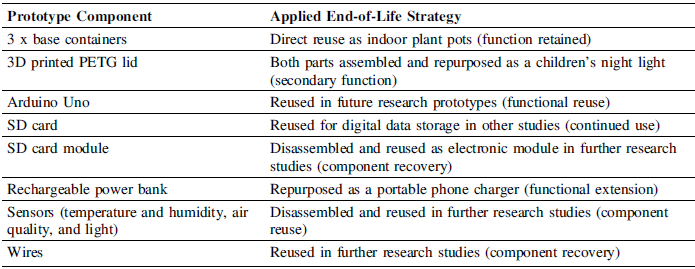
The prototype demonstrated alignment with several circular design strategies, with landfill disposal avoided at the end of the study period. Each component was evaluated at the end of the study to ensure that no materials were discarded or sent to landfill. Table 1 summarises the applied end-of-life strategies for each part of the prototype, demonstrating how every element was either reused or repurposed to maintain material value and extend useful lifespan.
Applied end-of-life strategies for each component of the circular prototype

The three base containers were converted into functional plant pots. The PETG lid, designed without adhesives or permanent fixings, was repurposed as a children’s nightlight casing. Electronic components were carefully disassembled and either reused or repurposed to maintain the prototype’s circular lifecycle. The rechargeable battery module was reused as a portable phone charger, facilitated by its adaptable USB ports. Remaining electronic components such as the sensors, SD card module and Arduino Uno were repurposed for subsequent research projects. The SD card itself was reused for further data storage within other studies, ensuring all parts continued to support ongoing research rather than be discarded.
These outcomes demonstrate the effectiveness of the prototype as a testbed for circular strategies, validating the potential of early-stage design decisions to extend component value and reduce waste. By integrating circularity into both the product’s physical lifecycle and its data collection function, the prototype served as a practical example of sustainable and regenerative design.
5. Discussion
This study set out to explore how a circular design-based prototype could be used to compare environmental sensing methods. This discussion interprets the findings in relation to research prototypes, where material efficiency and lifecycle planning are prioritised over final product performance.
In response to the first research question:
“How do embedded sensors and external APIs compare in their ability to support environmental monitoring in outdoor conditions, contributing to understanding how environmental data collection methods inform sustainable design decisions?”
One of the clearest outcomes under the selected proxy indicators was the benefit of remote API-based sensing compared to embedded systems. The embedded system consumed 0.3924kWh compared to 8.03 × 10⁻⁶kWh for the API approach, while material demand increased by approximately 0.36kg of additional hardware. Although embedded sensors offered greater detail and hyper local data, the cost was higher energy consumption, resource use, and carbon emissions. Operational carbon emissions were estimated at 0.0812kgCO₂e for the embedded system compared to 3.5 × 10⁻⁶kgCO₂e for the API approach under the applied proxy method. With the API method requiring minimal hardware, using less energy, and forming a low-impact digital system, it was found to be a lower-impact approach under the study conditions and selected metrics.
However, this does not suggest that embedded sensing is completely unsustainable. In applications where localised readings are essential, embedded sensors are invaluable. This illustrates a trade-off between spatial precision and environmental intensity, where higher data granularity is associated with increased material and energy demand. In applying this method in external environmental sensing however, for each application the environmental impact should be considered and justified for use.
In response to the second research question:
“Can a prototype be designed to align with circular economy principles, exploring how material waste can be reduced and planned reuse or repurposing of all components can be enabled, even at the early stages of the design process?”
The study demonstrated that circular economy principles can be meaningfully integrated into technology-integrated prototypes. Through careful material selection, modular construction, and a plan in place for secondary use, the prototype avoided landfill disposal at the end of the study through planned reuse and repurposing strategies.
Although the API-based system performed better across most sustainability metrics, it is not without weaknesses. Relying on external infrastructure limits applicability in remote areas, and the abstraction of data introduces a layer of generalisation that may be unsuitable for certain design applications. Furthermore, while the prototype avoided landfill disposal at the end of the study period through planned reuse and repurposing strategies, longer-term durability, user uptake of secondary use, and recyclability under real-world conditions were not fully evaluated.
While circular strategies can reduce material waste at the prototyping stage, this introduces a trade-off compared to conventional prototyping approaches. Lower-impact materials, reduced component redundancy or reuse focused design may limit the ability to stress-test systems under extreme conditions or validate long-term performance. Conventional prototypes often prioritise robustness, redundancy, and performance certainty, sometimes at the expense of higher material and energy consumption (Reference Petrakis, Wodehouse and HirdPetrakis et al., 2021; Reference UllahUllah et al., 2013). Circular prototyping therefore shifts the balance toward resource efficiency and lifecycle planning but may increase uncertainty in performance validation. The suitability of circular prototyping is consequently context-dependent, being most appropriate in early-stage exploratory research and less suited to safety-critical or high reliability-testing contexts.
6. Conclusion
This study demonstrated that circular design principles can be integrated into the lifecycle of a research prototype while still enabling functional testing of environmental sensing strategies. Within the limited 15-day deployment period and small sample of three sites, API-based sensing showed lower operational energy demand (8.03 × 10⁻⁶kWh vs 0.3924kWh), reduced material requirements associated with additional sensing hardware (0.36kg) and lower estimated carbon emissions under the study conditions (3.5 × 10⁻⁶kgCO₂e vs 0.0812kgCO₂e) compared to embedded sensing using the proxy indicators applied. These findings indicate that lower-impact sensing approaches can support circular prototyping goals in exploratory research contexts, but they do not represent full lifecycle sustainability assessments or long-term performance validation. Furthermore, all components were either reused or repurposed after the study, illustrating the potential of designing for circularity at the prototype stage, a phase often associated with material waste and disposability (Reference UllahUllah et al., 2013).
6.1. Limitations
Despite the contributions mentioned, the study has limitations. First, the sample size was intentionally small and context-specific with only three deployment sites. This limited the scope of the findings, particularly for longer-term applications. Additionally, while emissions and energy use were estimated based on typical usage patterns and literature data, real-time energy monitoring could provide more precise and dynamic insights. Finally, while the prototype’s disassembly and repurposing were successful, the user experience of such reuse was not evaluated, leaving space for further work on long-term usability.
6.2. Future work
Future research could scale the study across larger and more varied environmental contexts to further test the robustness of API-based sensing as a low-impact alternative. Further investigation into the energy implications of large-scale data servers supporting API systems would strengthen understanding of their true environmental performance. There is also potential for further exploration of user interaction with repurposing and/or reusing the prototype components, which could provide valuable insight into how circular design is perceived, adopted, and maintained over time.


 Open access

