





Introduction
According to their morphological traits, Garnham (Reference Garnham1966) classified haemosporidian parasites (Haemosporida, Apicomplexa) into 3 families – Haemoproteidae, Leucocytozoidae and Plasmodiidae. However, Lainson et al. (Reference Lainson, Landau and Shaw1971) created a fourth family, Garniidae. Those malaria-like parasites belonging to Garniidae were considered similar to Plasmodium species by the presence of merogony in blood cells. Still, they were set apart due to the absence of visible malarial pigment granules (haemozoin) in blood stages (meronts and gametocytes), including the stages developing in red blood cells. Family Garniidae contains 3 genera Garnia, Fallisia and Progarnia. Garnia species develop only in red blood cells, Fallisia spp. develop only in thrombocytes or leucocytes (Lainson et al., Reference Lainson, Landau and Shaw1974) and Progarnia spp. develop in red blood cells, thrombocytes or leucocytes (Lainson, Reference Lainson1995). The latter parasites were found only in crocodiles. Garniidae parasites have been reported in birds and reptiles (Gabaldon et al., Reference Gabaldon, Ulloa and Zerpa1985; Lainson, Reference Lainson2012). However, the status of such genera has been controversial.
Telford (Reference Telford1973) did not accept the family Garniidae as a valid taxon and considered it a synonymy of Plasmodiidae. Likewise, the genus Garnia was also proposed to be a synonymy of Plasmodium (Telford, Reference Telford1973). However, the possibility of a subgenus Garnia under the genus Plasmodium was kept open for consideration if evidence was provided. This taxonomic proposal was based on an experimental infection using an isolate of Garnia telfordi, in which he observed blood stages both containing and not containing visible pigment granules. To validate this taxonomic change, Telford (Reference Telford1973) suggested broadening a definition for the Plasmodiidae, including the parasites that do not contain visible malarial pigment at some stages of development in blood. Others adopted this proposal (Ayala, Reference Ayala1978). However, Garnham and Duggan (Reference Garnham and Duggan1986); Boulard et al. (Reference Boulard, Landau, Baccam, Petit and Lainson1987); Paperna and Landau (Reference Paperna and Landau1990a); Diniz et al. (Reference Diniz, Silva, Lainson and de Souza2000) and Valkiūnas (Reference Valkiūnas2005) considered this taxonomic change premature based on limited morphological observations and still considered Garniidae as a family of the Haemosporida.
Nevertheless, recent molecular phylogenies have supported Telford's (Reference Telford1973) opinion regarding Garniidae. It was shown that some Garniidae species likely belong to Plasmodium because the parasites lacking hemozoin in blood stages were placed along with Plasmodium species in phylogenetic hypotheses constructed with cytochrome b (cytb) fragments and mitochondrial genomes (Perkins, Reference Perkins2000; Córdoba et al., Reference Córdoba, Ferreira, Pacheco, Escalante and Braga2021). For example, Plasmodium ouropretensis features fit with the characteristics of Fallisia parasites due to infection of white blood cells and thrombocytes. Other examples of unpigmented malarial parasites are Plasmodium leucocytica and Plasmodium azurophilum (Perkins, Reference Perkins2000).
In a recent expedition developed in the Sierra Nevada de Santa Marta in the Caribbean zone of Colombia, a parasite lacking visual malarial pigment was detected infecting a specimen of Turnip-tailed gecko (Thecadactylus rapicauda). This paper aimed to characterize this unpigmented haemosporidian parasite.
Only a handful of studies have reported the frequency of Garnia-like parasites (Picelli et al., Reference Picelli, Ramires, Masseli, Pessoa, Viana and Kaefer2020). Most of the information about the distribution of these haemosporidians has been obtained using microscopic examination of blood films, while molecular data are available only for 5 species (Perkins, Reference Perkins2000; Córdoba et al., Reference Córdoba, Ferreira, Pacheco, Escalante and Braga2021). Thus, this study provides molecular evidence that will further our understanding of the diversity and phylogenetic relationships of haemosporidian parasite species without visible malarial pigment in blood stages under light microscopy.
Materials and methods
Study area and sample collection
Sampling was performed in 2 localities of the Magdalena Department: the surroundings of ‘Santa Marta’ and ‘El Congo’ biological stations. In total, 26 reptiles belonging to 16 species were captured. Only 1 specimen of Turnip-tailed gecko (T. rapicauda) was captured manually at ‘El Congo’ biological Station belonging to ‘Pro-Sierra Nevada de Santa Marta’ Foundation (10.99N, −74.06W; 980 m above sea level). The ‘Sierra Nevada de Santa Marta’ is an isolated mountain range of Colombia located north beside the Caribbean Sea, with an annual precipitation of less than 2000 mm and a mean annual temperature under 20°C (Restrepo et al., Reference Restrepo, Higgins, Escobar, Ospino and Hoyos2019).
The Turnip-tailed gecko, which most probably corresponds to a species complex (Kronauer et al., Reference Kronauer, Bergmann, Mercer and Russell2005), has a wide geographical distribution in the New World, being recorded in northern South America: Venezuela, the Guianas, Brazil, both sides of the Andes in Ecuador and Colombia, and the eastern side of Peru and Bolivia; Central America up to Mexico and in the Lesser Antilles (Avila-Pires, Reference Avila-Pires1995). It is a relatively large, primarily arboreal lizard found in primary and secondary forests and sometimes in houses or animal shelters close to patches of trees. It is principally nocturnal in habits and spends the daylight hours under cover of loose bark, hollow trees and other secluded retreats, and it may also be found on the ground (Russell and Bauer, Reference Russell and Bauer2002).
Microscopic examination and parasite morphology
After the specimen was captured, the puncture of the caudal vein was performed to obtain 3 thin blood smears and blood drops were stored in absolute ethanol. Smears were air-dried, fixed with absolute methanol for 5 min and stained with 4% Giemsa for 45 min (Rodríguez and Matta, Reference Rodríguez and Matta2001). Later, they were examined double-blind using an Olympus BX43 microscope (Olympus Corporation, Tokio, Japan). Parasites were photographed with CellSens (Olympus Corporation). Morphometric features studied were those described by Lainson and Naiff (Reference Lainson and Naiff1999) and Valkiūnas (Reference Valkiūnas2005). At least 100 images of the parasite were obtained and analysed and ImageJ (Schneider et al., Reference Schneider, Rasband and Eliceiri2012) was used to obtain measurements. The parasitaemia was estimated at 1000× magnification, measuring the percentage of parasites where blood cells formed a monolayer (no. of parasites/10 000 erythrocytes) (Staats and Schall, Reference Staats and Schall1996).
DNA extraction and mitochondrial genome (mtDNA) amplification
DNA was extracted from the whole blood of the only haemosporidian parasite microscopy-positive Turnip-tailed gecko using the QIAamp DNA Micro Kit (Qiagen GmbH, Hilden, Germany). Partial parasite mitochondrial DNA genome (mtDNA, 5884 bp) was obtained using a nested polymerase chain reaction (PCR) protocol with Takara LA Taq™ polymerase (TaKaRa Takara Mirus Bio) following Pacheco et al. (Reference Pacheco, Matta, Valkiūnas, Parker, Mello, Stanley, Lentino, Garcia-Amado, Cranfield, Kosakovsky Pond and Escalante2018, Reference Pacheco, Ceríaco, Matta, Vargas-Ramírez, Bauer and Escalante2020). The mtDNA was amplified using the outer oligos forward AE170-5′ GAGGATTCTCTCCACACTTCAATTCGTACTTC 3′ and reverse AE171-5′ CAGGAAAATWATAGACCGAACCTTGGACTC 3′, and the inner oligos forward AE176-5′ TTTCATCCTTAAATCTCGTAAC 3′ and reverse AE136-5′ GACCGAACCTTGGACTCTT 3′. PCR reactions were carried out in 50 μL, and negative (dH2O) and positive controls (samples from infected humans) were included. Five μL of the total DNA was used for the primary PCR, and then 1 μL of the PCR product was used for the nested PCR. Amplification conditions for both PCRs were a partial denaturation at 94°C for 1 min and 30 cycles with 30 s at 94°C and 7 min at 67°C, followed by a final extension of 10 min at 72°C. At least 2 independent nested PCR products (50 μL) were excised from the gel (bands of ~6 kb), purified using the QIAquick Gel extraction kit (Qiagen, GmbH, Hilden, Germany) and cloned into the pGEM-T Easy Vector systems (Promega, Madison, USA) following the manufacturer's instructions. Both strands of 3 clones were sequenced using an Applied Biosystems 3730 capillary sequencer. Inconsistencies between the clones were not found, and no mixed infection (2 distinct parasite species) was detected. The mtDNA genome sequence obtained in this study was identified as Plasmodium using BLAST (Altschul et al., Reference Altschul, Madden, Schäffer, Zhang, Zhang, Miller and Lipman1997) and submitted to GenBank under accession number ON161138.
Phylogenetic analyses
Phylogenetic relationships between the lineage found in the Turnip-tailed gecko and other haemosporidian parasites infecting lizards were inferred. Two alignments were constructed using ClustalX v2.0.12 and Muscle as implemented in SeaView v4.3.5 (Gouy et al., Reference Gouy, Guindon and Gascuel2010) with manual editing. The first alignment included 80 partial cytb gene sequences (410 bp excluding gaps) belonging to 4 genera (Leucocytozoon, Haemoproteus, Haemocystidium and Plasmodium) available from GenBank and the cytb sequence extracted from the mtDNA genome obtained in this study. This partial sequence of cytb gene is the most commonly sequenced fragment (460–1113 bp out of 1131 bp) that allows broader comparisons between the new sequence obtained from the Turnip-tailed gecko and those from other reptilian Plasmodium parasites deposited in the public database GenBank (Benson et al., Reference Benson, Karsch-Mizrachi, Clark, Lipman, Ostell and Sayers2012). A second alignment (5242 bp excluding gaps) was done using 58 mtDNA genome sequences of parasites belonging to 4 genera (Leucocytozoon, Haemoproteus, Haemocystidium and Plasmodium), including the mtDNA genome reported here (ON161138) and those available in the GenBank (Benson et al., Reference Benson, Karsch-Mizrachi, Clark, Lipman, Ostell and Sayers2012). The phylogenetic relationships were inferred using 6 partitions (Pacheco et al., Reference Pacheco, Matta, Valkiūnas, Parker, Mello, Stanley, Lentino, Garcia-Amado, Cranfield, Kosakovsky Pond and Escalante2018). Although the mtDNA genome has more informative sites and yielded a better phylogenetic signal than the small cytb fragment (410 vs 5242 bp excluding gaps), the second alignment had fewer lineages (N = 81 vs 58) given the lack of data from those haemosporidian parasites infecting reptiles (N = 12).
Then, 2 phylogenetic hypotheses were inferred based on those alignments. Trees were estimated using a Bayesian method implemented in MrBayes v3.2.6 with the default priors (Ronquist and Huelsenbeck, Reference Ronquist and Huelsenbeck2003) and a general time-reversible model with gamma-distributed substitution rates and a proportion of invariant sites (GTR + Γ + I). This was the best model that fits the data with the lowest Bayesian information criterion scores, as estimated by MEGA v7.0.14 (Kumar et al., Reference Kumar, Stecher and Tamura2016). In both analyses, Bayesian support was inferred for the nodes in MrBayes by sampling every 1000 generations from 2 independent chains lasting 2 × 10⁶ Markov Chain Monte Carlo steps. The chains were assumed to have converged once the potential scale reduction factor value was between 1.00 and 1.02, and the average s.d. of the posterior probability was <0.01. Then, 25% of the samples were discarded once convergence was reached as a ‘burn-in’. GenBank accession numbers of all sequences (cytb and mtDNA genomes) used in these analyses are shown in the phylogenetic trees. Also, the average evolutionary divergence over all sequence pairs was estimated using both alignments (mtDNA and partial cytb gene) and the Kimura 2-parameter model (Kimura, Reference Kimura1980) in MEGA v7.0.14 (Kumar et al., Reference Kumar, Stecher and Tamura2016).
Results
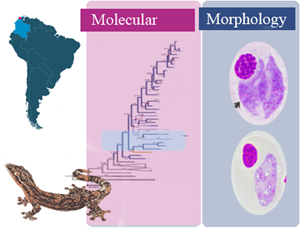
A haemosporidian parasite lacking malarial pigment was found in the blood of the Turnip-tailed gecko (Fig. 1). This parasite certainly belonged to Haemosporida based on the evident sex dimorphism observed in gametocytes (see description below). Based on phylogenetic analyses, this parasite was identified as Plasmodium sp. lineage TERAP_01. The parasitemia was 0.86%. Because only gametocytes were present (no trophozoites or meronts were observed), we consider prematurely reporting a species' description.
Macrogametocytes (a–e) and microgametocytes (g–h) of a non-pigmented Plasmodium TERAP_01 EB256PB were found in Thecadactylus rapicauda. Scale bar = 10 μm. Triangle-headed arrow: granules in the cytoplasm. Black triangle: A small space, like a capsule surrounding the parasite. Two-headed arrow: Space between parasite and nucleus of the erythrocyte. Fine black arrow: small vacuoles. Bold black arrow: Nucleus of the parasite. Asterisk: a cytoplasmic space.

Description of Plasmodium sp. (lineage TERAP_01)
Gametocytes have variable shapes, being predominantly of fusiform with more or less narrowed ends (Fig. 1a–c, f–h, Table 1). It is important to highlight that they possess numerous tiny (dust-like) reddish volutin granules, which are not refractive and readily distinguishable from true malarial pigment (hemozoin). Volutin is often present in gametocytes of haemosporidian parasites (Valkiūnas, Reference Valkiūnas2005). None of the observed gametocytes adhere to the erythrocyte nuclei (Fig. 1). They were predominantly located laterally to the nuclei. The volutin granules and the small vacuoles (0.08–0.89 μm, Table 1) were randomly scattered in the cytoplasm (Fig. 1). A thin band-like space, which appears like the pale-stained cytoplasm of host cells, was often visible around gametocytes (Fig. 1a, g, h).
Morphometric measurements (in μm) (range followed by mean ± standard deviations in parentheses) of Plasmodium MAG026 (EB256PB) found in Turnip-tailed gecko (Thecadactylus rapicauda)

Measurements of G. karyolytica found in the same host species were provided for comparison.
Macrogametocytes (Fig. 1a–j) were fusiform (79%) (Fig. 1a and b, Table 1), halteridial (9%) (Fig. 1c, Table 1) and round-shaped form (2%, Fig. 1e, Table 1). Some circumnuclear macrogametocytes (6%), which nearly surround the nuclei of erythrocytes without displacing the nuclei, were seen occasionally (Fig. 1d, Table 1). Multiple infections of 1 host cell with 2 gametocytes were seen (Fig. 1f, Table 1).
Microgametocytes (Fig. 1k and l) have pale staining of the cytoplasm and diffuse nuclei compared to macrogametocytes. The nuclei occupy approximately 1/3 of the parasite cells in the microgametocytes (Fig. 1g and h). The nuclei are pale and poorly distinguishable from the cytoplasm; the reddish nucleole-like structure was conspicuous and visible in all microgametocytes (Fig. 1f–h). Microgametocytes are generally located laterally to nuclei of erythrocytes, and they displace the nuclei laterally (Fig. 1k and l).
Phylogenetic relationships
Figures 2 and 3 show the phylogenetic relationships between the Plasmodium sp. TERAP_01 found in Turnip-tailed gecko and other reptilian parasites with partial cytb gene (Fig. 2) and mitochondrial genomes (mtDNA, Fig. 3). The phylogenies, overall, coincide with those previously reported that included other parasites from reptiles (González et al., Reference González, Pacheco, Escalante, Jiménez Maldonado, Cepeda, Rodríguez-Fandiño, Vargas-Ramírez and Matta2019; Pacheco et al., Reference Pacheco, Ceríaco, Matta, Vargas-Ramírez, Bauer and Escalante2020; Córdoba et al., Reference Córdoba, Ferreira, Pacheco, Escalante and Braga2021). Both phylogenetic hypotheses showed that the parasite found in Turnip-tailed gecko shares a common ancestor with Plasmodium species found in lizards. In the phylogeny using partial cytb sequences, the parasite reported in this study shares a common ancestor with Plasmodium floridense, Plasmodium hispaniolae and Plasmodium (Lacertamoeba) sp., which are species that produce hemozoin, and all are from the Caribbean region (Fig. 2). Nevertheless, it is distantly related to other non-pigmented species like Plasmodium azurophylum, P. leucocytica and P. ouropretensis, with genetic distances of 0.059 ± 0.012, 0.062 ± 0.013 and 0.062 ± 0.012, respectively (Fig. 2, Table 2 and Supplementary Table S1).
Bayesian phylogenetic hypothesis of reptilian haemosporidian parasites based on partial cytb gene (410 bp excluding gaps). The values at the nodes are posterior probabilities, and parasites described as morphospecies are in bold. Branch colours indicate different genera/hosts. Grey branches show the species used as an outgroup. GenBank accession numbers for all parasite sequences used in this analysis are provided in parentheses, and the geographic origins of the sequences are indicated with a coloured square.

Bayesian phylogenetic hypothesis of reptilian haemosporidian parasites based on mitochondrial genomes (mtDNA, 5242 bp excluding gaps). Parasites' names described also using morphology are given in bold. Branch colours indicate different genera/hosts. Grey branches indicate the species used as an outgroup. GenBank accession numbers for all parasite sequences used in this analysis are provided in parentheses.

Pairwise genetic distance among Plasmodium species (lineages MAG026, EB256PB) found in Turnip-tailed gecko (T. rapicauda) and other reptilian Plasmodium spp. using partial cytb gene sequences

Genetic divergence was estimated in MEGA 7.0.18 and the standard error estimate(s) are shown above the diagonal. Given that not all partial cytb gene sequences have the same length, for this analysis there were a total of 1045 positions in the final dataset excluding gaps. Genetic divergence between parasites that do not produce haemozoin pigment are show in bold. See Fig. 2 for reference.
It is worth noticing that non-pigmented species do not form a monophyletic group, which is consistent with what has been found recently by Córdoba et al. (Reference Córdoba, Ferreira, Pacheco, Escalante and Braga2021) using similar approaches. However, in the case of the phylogenetic relationships estimated using mtDNA genomes, the Plasmodium sp. TERAP_01 found in the Turnip-tailed gecko appears to share a common ancestor with Plasmodium kentropyxi, Plasmodium carmelinoi, P. ouropretensis and Plasmodium tropiduri tropiduri. Although the mtDNA genome yielded a better phylogenetic signal than the small cytb fragment (Fig. 2 vs 3), this result is inconclusive given the lack of molecular data for other reptilian haemosporidian taxa. However, the genetic distance between Plasmodium sp. TERAP_01 and the only unpigmented parasite P. ouropretensis, for which molecular data of mtDNA genome are available, is 0.063 ± 0.03 (Table 3), similar to the genetic distance estimated with the partial sequence of cytb (Table 2).
Pairwise genetic distance among Plasmodium species (MAG026, EB256PB) found in Turnip-tailed gecko (T. rapicauda) and other reptilian Plasmodium spp. with mtDNA genomes available

Genetic divergence was estimated in MEGA 7.0.18 and the Standard error estimate(s) are shown above the diagonal. There were a total of 5426 positions in the final dataset excluding gaps. Genetic divergence between parasites that do not produce haemozoin pigment are show in bold. See Fig. 3 for reference.
Discussion
Gametocytes of the parasite reported here do not possess visible hemozoin pigment granules. This species infects mature red blood cells and is similar to Garnia karyolytica described in the same host species in Brazil (Table 1) (Lainson and Naiff, Reference Lainson and Naiff1999; Picelli et al., Reference Picelli, Ramires, Masseli, Pessoa, Viana and Kaefer2020). However, the parasite found in Colombia can be readily distinguished because it does not induce lysis of the host cell's nuclei.
This parasite is likely a new species for this host. Three Plasmodium species have been reported in the Turnip-tailed gecko in Panama, Brazil and Venezuela. First, Plasmodium aurulentum, whose blood stages share features of P. tropiduri and Plasmodium morulum, develops exo-erythrocytic merogony in thrombocytes and lymphocytes (Telford, Reference Telford1971). Second, an unidentified Plasmodium species (Telford, Reference Telford1978), and third, G. karyolytica (Lainson and Naiff, Reference Lainson and Naiff1999). The latter 2 haemosporidian have unpigmented blood stages.
It is worth noting that Lainson and Naiff (Reference Lainson and Naiff1999) found only gametocytes in an infected individual of T. rapicauda when it was sampled. Two months later, while the infected lizard was maintained in captivity, the other parasite stages, i.e. trophozoites and meronts, were detected. The predominance of gametocytes in peripheral blood was observed in Plasmodium (Billbraya) australis in the Australian gecko Phyllodactylus marmoratus. Indeed, an occasional and short-lasting erythrocytic merogony was reported (Paperna and Landau, Reference Paperna and Landau1990b). Whether this is the case with the parasite from Colombia reported here cannot be determined.
The observed malarial pigment is considered a diagnostic trait in Plasmodium. The digestion of haemoglobin by Plasmodium parasites results in the release of haem, which is toxic for haemosporidians (Egan, Reference Egan2008). The haem is converted into hemozoin or malarial pigment in developing parasites. However, recent studies have demonstrated that Plasmodium berghei can develop even when different genes associated with hemozoin production are disrupted (Lin et al., Reference Lin, Spaccapelo, Schwarzer, Sajid, Annoura, Deroost, Ravelli, Aime, Capuccini, Mommaas-Kienhuis, O'Toole, Prins, Franke-Fayard, Ramesar, Chevalley-Maurel, Kroeze, Koster, Tanke, Crisanti, Langhorne, Arese, Van den Steen, Janse and Khan2015). As a result, the mutant strains do not produce hemozoin, and then undigested haemoglobin remains in vesicles, which confers the parasites’ drug resistance (Lin et al., Reference Lin, Spaccapelo, Schwarzer, Sajid, Annoura, Deroost, Ravelli, Aime, Capuccini, Mommaas-Kienhuis, O'Toole, Prins, Franke-Fayard, Ramesar, Chevalley-Maurel, Kroeze, Koster, Tanke, Crisanti, Langhorne, Arese, Van den Steen, Janse and Khan2015). A study using electron microscopy carried out using Garnia gonadati showed that malarial pigment was not detected (Diniz et al., Reference Diniz, Silva, Lainson and de Souza2000), and this parasite lacks a vacuolar system of digestion (Boulard et al., Reference Boulard, Landau, Baccam, Petit and Lainson1987). That may indicate an alternative pathway for detoxification in these parasites that is worth studying.
The absence of visible malarial pigment granules has been described during parasitemia in some reptilian Plasmodium species, for example, Plasmodium balli, Plasmodium gonatodi and P. morulum (Telford, Reference Telford1974) as well as Plasmodium scorzai and Plasmodium lainsoni (Telford, Reference Telford1988). Unfortunately, there is no molecular information on these parasites. Nevertheless, Plasmodium spp. have a markedly different spectrum of malarial pigment morphology (Telford, Reference Telford2009); e.g. in P. azurophilum, pigment granules were seen only in 0.2% of gametocytes (Telford, Reference Telford1975; Perkins, Reference Perkins2000). Thus visible malarial pigment seems to exhibit phenotypic plasticity in Plasmodium from reptiles, questioning its utility to separate taxa, at least among haemosporidian in reptiles (Telford, Reference Telford1973).
Consistent with this observation (Telford, Reference Telford1973), the phylogenetic analyses using cytb and mitochondrial DNA indicated that the lineage found here shares its most recent common ancestor with other species in the genus Plasmodium. Further, this parasite does not form a monophyletic group with other parasites without malarial pigments, such as P. leucocytica, P. azurophilum and P. ouropretensis (Fig. 2).
Based on the results presented here, Plasmodium sp. TERAP_01 and other unpigmented parasites may have originated independently from evolutionarily distinct lineages (Figs 2 and 3). This is consistent with the observation that visible malarial pigment is a variable character in reptile haemosporidia (Telford, Reference Telford1973) and the fact that unpigmented parasites are not a monophyletic group (Perkins, Reference Perkins2000; Galen et al., Reference Galen, Borner, Martinsen, Schaer, Austin, West and Perkins2018; Córdoba et al., Reference Córdoba, Ferreira, Pacheco, Escalante and Braga2021). Perhaps, visible pigment production could have been gained or lost throughout the evolutionary history of these parasites, as has been proposed by Galen et al. (Reference Galen, Borner, Martinsen, Schaer, Austin, West and Perkins2018).
There is a discussion regarding the presence or absence of visible malarial pigment, a debate that can be separated into 2 non-mutually exclusive issues: whether there is truly no malarial pigment in some parasites and how valuable this trait is, presence or absence of visible malarial pigment, as a diagnostic tool for a taxon such as Garniidae. Regarding the first issue, part of the problem is that these reptile parasites' biology and life cycles remain insufficiently studied. Hemozoin may appear only in specific stages of the life cycle. Long-lasting experimental observations are needed to answer this question, but such studies remain rare. Perhaps, a more sensitive technique, such as flow cytometry or histochemistry, could detect malarial pigment in some haemosporidian reptile parasites even below the detection by microscopy (Rebelo et al., Reference Rebelo, Sousa, Shapiro, Mota, Grobusch and Hänscheid2013; Orbán et al., Reference Orbán, Butykai, Molnár, Pröhle, Fülöp, Zelles, Forsyth, Hill, Müller, Schofield, Rebelo, Hänscheid, Karl and Kézsmárki2014).
We now return to the question posed above i.e., is visible malarial pigment a valuable trait for diagnosing the genus Plasmodium or creating a taxon such as Garniidae? (Telford, Reference Telford1973). Indeed, it is difficult to rule out that some parasites classified as Garnia spp. have few discrete dust-like hemozoin granules, which are difficult to detect by light microscopy, the tool used in the classical taxonomy of Haemosporida. As indicated earlier, Plasmodium spp. have a broad spectrum of malarial pigment morphology (Telford, Reference Telford1975, Reference Telford2009; Perkins, Reference Perkins2000; Noland, et al., Reference Noland, Briones and Sullivan2003). Thus, the evidence suggests that visible malarial pigment is not a valuable trait for separating taxa (Telford, Reference Telford1973).
Overall, the taxonomic characters currently used to define the Plasmodium genus are not found in all related species of reptile parasites (Figs 2 and 3). Considering that it has been long proposed that Plasmodium is a paraphyletic group (Escalante et al., Reference Escalante, Freeland, Collins and Lal1998; Galen et al., Reference Galen, Borner, Martinsen, Schaer, Austin, West and Perkins2018; Pacheco et al., Reference Pacheco, Matta, Valkiūnas, Parker, Mello, Stanley, Lentino, Garcia-Amado, Cranfield, Kosakovsky Pond and Escalante2018), the reptile parasites seem to add evidence to this pattern.
Recent studies have suggested different solutions to deal with this taxonomic issue, at least in parasites from reptiles. One of which is to broaden the definition of Plasmodium, which in the case of reptiles should include morphological features proposed for Garnia, Fallisia and Progarnia (Telford, Reference Telford1973; Ayala, Reference Ayala1978; Galen et al., Reference Galen, Borner, Martinsen, Schaer, Austin, West and Perkins2018). In other words, the definition of the genus Plasmodium should be broadened to include parasites with and without visible hemozoin under the light microscope and should also consider parasites that are capable of infecting various red blood cells, leucocytes and thrombocytes as part of the genus.
Due to the incomplete knowledge of the biology of putative Garniidae species, it would be logical not to make changes in the taxonomy until information on the biology and molecular systematics of more putatively garniid species is available. Although molecular phylogenies that include parasites from reptiles are still limited (Perkins, Reference Perkins2000; Galen et al., Reference Galen, Borner, Martinsen, Schaer, Austin, West and Perkins2018; Córdoba et al., Reference Córdoba, Ferreira, Pacheco, Escalante and Braga2021, and this study), they seem to indicate that Garniidae may not be a valid taxon, as previously proposed (Telford, Reference Telford1973).
Conclusion
This study provides a molecular and morphological characterization of the unpigmented parasite Plasmodium sp. (lineage TERAP_01) that exhibit Garnia-like traits but shares a common ancestor with Plasmodium species found in reptiles. Haemosporidian parasites in reptiles remain poorly investigated concerning life cycles and biology, which is particularly true for Garnia species. It will be interesting to apply targeting sensitive techniques to detect hemozoin in the blood stages of haemosporidian parasites. Thus far, the molecular evidence seems to question the validity of Garniidae as a family. However, additional studies are required before revising the taxonomy of Haemosporida. In-depth taxonomic sampling and experimental research is necessary to understand better the evolutionary relationships of Plasmodium spp. and other haemosporidians, which are remarkably diverse in reptiles.
Supplementary material
The supplementary material for this article can be found at https://doi.org/10.1017/S0031182022001421.
Data availability
The sequence obtained in this study was submitted to GenBank under accession number ON161138. All sequences used in the analyses performed here are available at GenBank.
Acknowledgements
The authors thank Ingrid Lotta and German Gutierrez for technical assistance and helpful discussions; their collaboration was essential to advancing this work. The authors also thank Ariana Cristina Pacheco Negrin for the silhouette's design and Scott Bingham from the DNA Laboratory at the School of Life Sciences (Arizona State University) for their technical support. The authors are grateful to Juan Pablo Hurtado-Gomez, Angela Suarez-Mayorga, Juan Manuel Vargas-Ramírez and Esteban Betancourt for assistance in the fieldwork. The authors acknowledge Fundación ProSierra Nevada de Santa Marta for allowing them to stay and perform sample collection at the El Congo Biological Station.
Author's contribution
N. E. M.: conceived, oriented and supervised the research, funding acquisition, wrote and edited the manuscript. LPG: conducted microscopical and morphometrical analyses and prepared the plate. MVR: conducted fieldwork and funding acquisition. GV: conceptualization, methodology, formal analysis, wrote and edited the manuscript. MAP and AE: performed laboratory work, phylogenetic and genetic analyses, prepared the figures and wrote and edited the manuscript. All authors read and agreed to the final version of the manuscript.
Financial support
AE and MAP were supported by the grant DEB-2146654 from the US-NSF. NEM, LPG and MVR were supported by Universidad Nacional de Colombia.
Conflict of interest
The authors declare that they have no competing interests.
Ethical standards
This study uses the permit, which allows the collection of wild species with research aims and no commercial goals, Autoridad Nacional de Licencias Ambientales (ANLA) Colombia Act Number No 0255 from 14th of March 2014). And the Bioethics Committee (Facultad de Ciencias of the Universidad Nacional de Colombia Act number: 04 of 2017).


 Open access

