

Civil wars are typically portrayed as dampening governments’ efforts to increase their capacities, fiscal or other. Indeed, the failure of Latin American nations to build effective states has been attributed to the negative impact of domestic conflicts (Reference CentenoCenteno 2002). Nonetheless, some interesting variation is obvious not only between these countries but also within them. Nicaragua manifests a stronger state capacity than neighboring Honduras and El Salvador, even though all went through deadly domestic conflicts. Likewise, Peru’s dismal record on state capacity has been blamed on the existence of an unrest-prone Andean corridor where fiscal extraction never took root. In the years after civil war, some countries, and regions within them, seem to recover faster than others (Reference SlaterSlater 2010; Reference ToftToft 2010). Do the legacies of war help explain this variation?
We study the long-term effects of the local dynamics of the War of Independence (1810–1821) on local state capacity building. The eleven years of conflict involved a generalized process of decentralization, which transferred powers away from Mexico City and strengthened the fiscal and military position of local elites throughout the nineteenth century. The war did not end with a clear military victory for one side. Rather, it ended when a number of royalist officials switched sides and brokered a deal with the insurgents to declare independence.Footnote 1 This outcome hindered efforts to build the central state after the war. Despite sharing a common fear of peasant unrest, Spanish American elites were divided along other geographical and social cleavages (e.g., creole vs. peninsular) and could not agree on who should hold power in Mexico City (Reference CentenoCenteno 2002, 140–142). In this way, local state building remained dissociated from central state-building efforts.
We analyze the variation in state capacity at the municipal level in Mexico in the early nineteenth century. We measure local state capacity with the number of public servants reported in the 1900 census and the 1910 municipal fiscal budgets approved by local congresses. Our key independent variable is the type of war dynamic experienced during the War of Independence. We distinguish four dynamics: (1) municipalities initially with an insurgent presence but that were later recaptured by militias; (2) municipalities where local militias were organized but without an insurgent presence; (3) municipalities with an insurgent presence until the end of the war; and (4) municipalities with no organized insurgent or militia presence. Different dynamics entail different territorial and financial strategies deployed during the civil war.
Our empirical results show that municipalities that managed to organize and finance a local militia during the war years have higher levels of local state capacity in the long term. These municipalities (and more so those with militia recapture) have more public servants per one thousand people in 1900 and higher per capita budgets in 1910 than municipalities with only an insurgent presence, relative to municipalities with no conflict. Our results are robust when controlling for geographic variables (altitude and soil suitability), the distance to the closest productive mine in 1800, the closest colonial city, the distance to Mexico City, the presence of a colonial treasury office, and the average sales tax collected in the ten years prior to the war’s onset. We restrict the sample to only neighbors as an empirical strategy to deal with problems of omitted variables, and the results hold.
We complement the statistical analysis with a number of illustrations to trace the mechanisms through which early-century internal war may have had a lasting impact on local state capacity. In studying the mechanisms, we rely on existing theories of intra-elite conflict. Besley and Persson (Reference Besley and Persson2011) argue that underinvestment in state capacity can result in equilibrium, when one political faction is in rivalry with an economic elite that supports the opposition to avoid the risk of losing political power. A low-capacity equilibrium allows the incumbent to commit to not expropriating assets from the nonruling economic elite, when the latter can credibly threaten to seize political power and holds opposing distributive preferences (Reference GarfiasGarfias 2018). López-Alves (Reference López-Alves2000, 1718), Soifer (Reference Soifer2015), and Slater (Reference Slater2010) also highlight the critical role of war mobilization on shaping elite alliances for state formation.Footnote 2
The historical evidence indeed points to the preeminence of local conflict between the new layer of insurgent leaders and landed and other colonial-era economic elites, who considered public jobs an entitlement from colonial times. Municipalities that organized militias during the war were less concerned about new incumbent political rivals taking over public jobs. The war also facilitated local state building in municipalities that created local fiscal councils (juntas de arbitrios) during the war and maintained them years after in light of decentralization and weakness of the central government. Narratives for the cases of Guanajuato, the state of Mexico, and San Luis Potosí provide support for the importance of local rivalries.
Many empirical studies find that civil wars have a negative effect on state building, yet others provide evidence for internal violence promoting state building. Besley and Persson (Reference Besley and Persson2011) find that civil wars typically happen in poor countries with weak states. To the extent that ruling elites in weak states foresee they will prevail over the rebels, they have no interest in boosting fiscal receipts. The technology of warfare may also hinder fiscal extraction, as irregular warfare imposes a lower burden on the budget than more conventional military tactics. In Latin America, civil wars seem to have had a negative effect on state building (Reference ThiesThies 2005, Reference Thies2006; Reference JaggersJaggers 1992; Reference HoldenHolden 2004). Disagreements among elites after independence and the recourse to external borrowing by national governments dampened the incentives for state capacity building (Reference López-AlvesLópez-Alves 2000).
In contrast, Slater (Reference Slater2010) demonstrates that internal threats were a stimulus for state building in Southeast Asia. Similarly, for Colombia, the arrival of rebel threats to urban centers encouraged industrial elites to cooperate with state building (Reference Rodríguez-FrancoRodríguez-Franco 2016). Toft (Reference Toft2010) finds that rebel victories in civil war guarantee a more stable postwar period and a lower probability of war recurrence.Footnote 3 In recent work, Ch et al. (Reference Ch, Shapiro, Steele and Vargas2018) reveal divergent local fiscal capacity outcomes from internal conflict. We contribute to the debate on the net effect of civil warfare on state building by showing that war-driven institutions and legacies of elite conflict can lead to divergent local state-building efforts in the long run.
Charles Tilly’s honorable tradition of works drawing on European history finds that medieval protostates were able to strengthen the central state by increasing tax efforts over their subjects under recurrent threats of foreign invasion or actual warfare (Reference TillyTilly 1990; Reference DinceccoDincecco 2011). Researchers looking at other areas have found a weaker effect of war on state capacity, in part because arbitrary country borders were rarely challenged (Reference HerbstHerbst 2000). In Latin America, interstate wars were clustered in a few regions, of short duration, and mostly land grabs by the more powerful neighbor (Reference CentenoCenteno 2002, 37–44).
We contribute to the debate by providing micro-level evidence that underscores the territorial and financing strategies developed during the war at the local level and the conditions under which those strategies can endure. Many contemporary conflicts go beyond the traditional civil war versus external war divide, sharing features of both types with long-term effects at the micro level. In this context, giving careful consideration to local war dynamics is necessary to understand the long-term state-building legacies of warfare.
Historical Background
An event exogenous to conditions in Mexico (then part of New Spain, a viceroyalty of Imperial Spain) triggered the revolt leading to civil war. In 1808 Charles IV and Ferdinand VII abdicated the throne of the Spanish Empire as a result of Napoleon’s unexpected intervention of Spain. Power at the center of the Spanish Empire broke down.
The Junta Suprema Central was formed in Cadiz endowed with the executive and legislative powers of the absent king and proceeded to call elections to choose the deputies that would represent the viceroyalties in the council. This ignited the first regional struggles by calling elections in the capital cities and not the towns (Reference Serrano OrtegaSerrano 2001). The Cadiz Constitution was approved by the Junta Suprema Central deputies and implemented in American territory between 1812 and 1814, and again in 1820. The constitution entailed a devolution of power from the center to the regions through a new bureaucratic structure. Municipal cabildos multiplied, increasing the political sway of local communities (Reference Serrano OrtegaSerrano 2007, 32). Constitutional city councils were created with new judicial, fiscal, and electoral powers.
While the collapse of the Spanish monarchy prompted the civil war, structural factors may have played a role in its development. Unlike most civil wars (Reference ButcherButcher 2015), the revolt broke out in the most economically dynamic area at the time in central Mexico, the Bajío. Violence, however, did not follow the wealth trail; it spared New Spain’s two most opulent cities: Puebla and Mexico City. Furthermore, violence spared several regions during the eleven years of warfare.
The subsistence crisis in 1808–1810 facilitated peasant mobilization for the initial Hidalgo revolt (Reference TutinoTutino 1988). Nevertheless, this was not the first time that a hunger crisis triggered revolts that were usually self-contained, with little appetite for larger institutional reform, and sought to redress food scarcity. Hamnett (Reference Hamnett1986) has documented that the onset of the insurgency was not related to the food crisis. The initial rebellion spared some of the areas affected by the subsistence crisis, for example, the Yucatan peninsula, and took root in others, for example, Michoacán, where the scarcity was less acute. Overall, the indigenous population participated with both insurgent and royalist forces and remained detached from the conflict for the most part (Reference HamnettHamnett 1986).
The colonial royal treasury
Prior to the war, colonial Mexico had a network of treasuries (cajas) well connected to the central treasury in Mexico City and transferring large amounts of tax revenue. During the second half of the eighteenth century, the crown implemented fiscal and political reforms that increased the centralization of the treasury and augmented fiscal pressures on various colonial groups.
After 1810, two circumstances began to severely weaken the link between the regional and central treasuries. The first was the civil war itself, which increased insecurity in the roads and the risk of sending silver to the Mexico City mint. Local treasury and military officials began disposing of the local fiscal monies in the name of order (Reference TePaske, Jáuregui and OrtegaTePaske 1998). In 1811, tobacco monopoly revenues had practically disappeared, the internal sales tax (alcabala) was difficult to collect, and little was coming in from minting (Reference Serrano OrtegaSerrano 2007, 26–27). Minting houses were created in the main silver producing regions (Reference Marichal, Carmagnani, Bordo and Cortés-CondeMarichal and Carmagnani 2001, 295–296). Most resources stayed in the regions.
Second, the liberal reforms triggered by the 1812 Cadiz Constitution devolved power to the regions. The number of ayuntamientos increased from thirty prior to 1808 to more than eight hundred in 1812 (Reference Hernández ChávezHernández Chávez 1993, 25). City councils were granted fiscal powers to impose and enforce taxes. In addition, a new tax on income was implemented by the fiscal authorities, justified as an extraordinary measure responding to the civil conflict (Reference Sánchez Santiró and LudlowSánchez 2013, 105–107). In 1814, with the return of King Ferdinand VII, the Cadiz Constitution was abolished. Yet because of the rebellion, the order to collect the direct contribution remained in place.
When the constitution was reinstated in 1820, an influential section of the creole military officialdom, led by Agustín de Iturbide, decided to opt for independence. In less than half a year they managed to co-opt most loyalist officials, who turned in their soldiers and local coffers. The war ended when the creole military signed a pact with the insurgents, headed by Vicente Guerrero, and agreed to declare independence, without major battles or bloodshed, in 1821. Thus insurgents obtained military category and political power in the regions they controlled.
Independent Mexico was born with deep-seated fiscal and military decentralization, the latter a result of the formal power granted to insurgents who were made generals and the many local royalist militias created around the country, the former a result of war policies and the war itself. One of Iturbide’s first decrees after independence was to abolish various colonial-era taxes and the majority of the extraordinary fiscal measures imposed during the war (Reference Serrano OrtegaSerrano 2007, 47). Not surprisingly, the ensuing fiscal crisis led to Iturbide’s demise and the creation of the Federal Republic in 1824, which put on paper the reality of the political and fiscal strength of regional elites.
The Dynamics of the Civil War
By war dynamics we mean the territorial and financial strategies that each side successfully deployed during the conflict. We focus on the conditions left by the mobilization of insurgents and royalist militias in the different regions at the end of the civil war.
A varied lot of insurgents
The initial Hidalgo revolt did not seek independence from Spain at its origins (Reference RodríguezRodríguez 1998). Father Hidalgo declared American autonomy and also swore loyalty to the ousted Fernando VII. His rebellion spread over several key towns around the Bajío, with Guanajuato, Querétaro, and Guadalajara as his main victories. Taken by surprise, the viceregal government was slow to recognize the army. This first phase was characterized by open battles between insurgents and the royal army. Less than a year after the so-called grito (cry) of Dolores, Hidalgo was killed in Chihuahua in 1811. The fiscal measures decreed by Hidalgo during this first stage of the war were short-lived. Hidalgo abolished the Indian tribute—a tax paid only by the natives—and the diezmo (tithe on agriculture) and reduced the alcabala. Some of these strategies were later followed by Morelos and others (Reference Moreno Gutiérrez, Ibarra, Landavazo, Escamilla, Serrano and TeránMoreno 2014).
Father Morelos took the lead in spearheading the second phase of the insurgency. With a clear military vision, Morelos moved the conflict from the Bajío axis—where royal militias had successfully organized—to Mexico, Puebla, and Michoacán. His tactics relied heavily on irregular warfare, carrying out hit-and-run attacks that granted his units the advantage of surprise. Morelos conquered important towns such as Acapulco and Oaxaca but failed to attack the city of Puebla.
In line with Hidalgo and the new liberal ideas, the insurgents emphasized equality for all and abolished the tribute and all other ethnic exceptions (Reference Sánchez SantiróSánchez 2016). A (reduced rate) alcabala and the tithe on agriculture now applied to the natives (Reference Serrano OrtegaSerrano 2008, 51–57). A National Congress was summoned in Chilpancingo in 1813 to create and organize a parallel government. The Congress directed a committee of neighbors (juntas de padrón) to collect a “general and extraordinary contribution” resembling the direct contribution established by the viceregal authorities (Reference Serrano OrtegaSerrano 2008, 65; Reference Moreno Gutiérrez, Ibarra, Landavazo, Escamilla, Serrano and TeránMoreno 2014, 141). The implementation of the new taxes was slow, and many refused to pay in the name of tradition. The Indians were more willing to embrace the abolition of the tribute than the payment of the new taxes. The parallel administration was relatively more successful in parts of Guanajuato, Morelia, Oaxaca, Puebla, Veracruz, and what is today Morelos and Guerrero (Reference Serrano OrtegaSerrano 2008, 66–73; Reference Archer, Kuethe and MarchenaArcher 2005).
Altogether, the insurgents obtained most resources through confiscating or seizing fincas and the control of trade routes (Reference Serrano OrtegaSerrano 2008; Reference Jáuregui and KuntzJáuregui 2010, 254).Footnote 4 To avoid the rampage of the Hidalgo insurgents, Morelos clearly mandated that property could be confiscated only from those supporting the royalists and if authorized by the chief of the expedition (Reference Serrano OrtegaSerrano 2008, 68–72). In some cases, the insurgents did not take over but offered protection in exchange for a fee.Footnote 5
Morelos lost momentum once Fernando VII was restored as king of Spain in 1814. Morelos was executed in December 1815, and thus began the third and final phase of the war, between 1816 and 1821. This phase was characterized by irregular bands of insurgents roaming across countryside areas of Guerrero, Michoacán, and Veracruz. The insurgents accepted an amnesty in the provinces where the royalists were stronger, yet the regions of permanent foci of the insurgents remained strong even if as a set of guerrilla groups (Reference Archer, Kuethe and MarchenaArcher 2005, 227). To some extent, Spanish policies kept the revolt alive: rather than propose a workable political solution, Ferdinand VII insisted on fighting the insurgents (Reference CosteloeCosteloe 1986; Reference AdelmanAdelman 2006). This stalemate remained until 1820.
Royal militias
The inability of the standing army to crush the insurgents led the viceregal government to create “patriotic units” (regional garrisons) in the main cities recaptured from the insurgents, and it later called for a general mobilization of local militias to curb the insurgents (Reference Ortíz EscamillaOrtíz 2014; Reference Sánchez Santiró and LudlowSánchez 2013, 98–99). Both the urban and rural populations were mobilized against the rebellion.
In 1811, the Calleja Plan organized an extensive network of juntas de arbitrios in the “cities, villas and towns of New Spain loyal to the Crown” (Reference Serrano OrtegaSerrano 2007, 30) to obtain cooperation from local elites in the war effort. The new councils were endowed with the capacity to collect taxes and create special taxes to finance the newly created local militias (Reference JáureguiJáuregui 1999). These fiscal prerogatives resided previously in the capital city of each province. The royal administration endorsed the multiplication of juntas de arbitrios in light of the disarray of the royal bureaucracy.
The prerogatives of the local councils were only strengthened during the rest of the war, more so in the regions with local militias. With the return of Ferdinand VII in 1814 and the abolishment of the Cadiz Constitution, viceroy Calleja kept in force the fiscal authority of the juntas de arbitrios to finance the militias. In this way, in some regions direct taxes and fiscal prerogatives started taking root at the local level. The collection of the new direct taxes in 1812 was relatively successful in Mexico City, Zacatecas, Yucatán, and San Luis Potosí, in part because of the support of merchants and in part because of the threat of the insurgents and organization of militias ((Reference Serrano OrtegaSerrano 2007, 29–31, 40–42). Later, however, many local councils refused to collect the taxes despite the faculties granted them by the Cadiz Constitution. The lack of compliance with the central fiscal guidelines shows the degree to which the country had decentralized only three years into the war.
When the Constitution was reinstated in 1820, many city councils called for their right to supersede military-led local militias with voluntary ones, where officials would be popularly selected. The requests show the profound impact that the organization of local militias had in local governments (Reference Moreno Gutiérrez, Ibarra, Landavazo, Escamilla, Serrano and TeránMoreno 2014).
We categorize the local dynamic of the war in four types from the above narrative. The first two involve the presence of militias: (1) municipalities with an initial insurgent presence but later recaptured by the military, with organized militias by the end of the war; (2) those with militias organized during the conflict but no early presence of insurgents; (3) municipalities with an insurgent presence throughout the conflict and which remained in control of the insurgents until the end of the war; and (4) municipalities with no organized insurgent or militia presence.
Municipalities with elites organized to finance local militias inherited the “custom” (Reference LeviLevi 1988) of local taxes and the institutional means to increase their fiscal capabilities. In municipalities where insurgents took an early lead but later militias were set up, the threat of insurgent takeover was strong, which potentially helped in garnering cooperation for the financing of local militias.
Municipalities with insurgents up to 1821 inherited practically no institutional means for fiscal extraction, yet they inherited tensions between the new insurgent generals and the local landowners and economic elite. As a result of the negotiated settlement that ended the war, insurgents such as Vicente Guerrero obtained political authority in their regions of control.
The areas with no direct experience of the war had no legacy of militia-led fiscal build-up nor elite tensions. These regions roughly overlap with the border territories, a feature that correlated negatively with income in the early nineteenth century (see Figure 1 and Table 1). This changed by 1900, mostly in the states close to the northern border, because of the growing economic ties to the US economy. These regions bore other features that allowed them to build fiscal capacity autonomously.
Spatial distribution of war dynamics.

Summary statistics by type of war dynamic.

Note: The table demonstrates means with standard deviations in parentheses across types of war dynamic. See Appendix Table A.5 for pairwise tests of the differences in means.
Data
We use historical data at the municipal level for Mexico. We proxy local state capacity with two measures: public servants per one thousand people in 1900 and the approved municipal budget per capita in 1910. We obtained the number of public servants from the 1900 Census, the second nationwide population census undertaken in independent Mexico with municipal-level data.Footnote 6 Of the 2,064 municipalities in the 1900 census that we match to the 2010 municipal codes, 2,007 have information for both public servants and population (97 percent of the observations).Footnote 7
The number of public servants serves as proxy for the size of the local bureaucracy. The census does not specify whether the public employees are local or federal. Notwithstanding, the intrastate and federal transfers were minimal compared to those transfers during the colonial period. In 1900, around 10 percent of the total federal budget was spent on the federal administration in the states in contrast to 15 percent that went to the central administration in Mexico City; around 20 percent of total federal expenditures went to pay for the military (Reference CarmagnaniCarmagnani 1994, 317).
Our second measure of state capacity is the municipal budget per capita for 1910 from Sánchez-Talanquer (Reference Sánchez-Talanquer2017).Footnote 8 The data provide information on the nominal budgets approved by the local congress and represent the planned expenditure for the year. The state-level, total municipal revenue data from Villers (Reference Villers1911) suggest that most of these expenditures were financed with municipal taxes. As an example, the total tax income collected by all municipalities in Campeche, in 1909, was 165,840; adding up all municipal budgets gives 142,161 pesos.Footnote 9
Type of war dynamic
The data on localities with insurgent groups and those with civilian-organized local royalist militias come from Ortíz Escamilla (Reference Ortíz Escamilla2014, tables 1.1, 2.2), who gathered the information from various archival sources, for instance letters exchanged between the military or between the insurgents. To our knowledge, this is the most exhaustive and compelling effort to date to document systematically the local dynamics of the war of independence in Mexico.Footnote 10
We aggregate up to the municipality level by creating a dummy variable that equals 1 if there is at least one locality in the municipality with a group of insurgents and 0 otherwise, and a corresponding dummy variable for militias. Some municipalities had an early insurgent presence but were later recaptured and organized militias; this is war dynamic (1) above and corresponds to municipalities with both Militias = 1 and Insurgents = 1. Type (2) municipalities had militias but no insurgents (Militias = 1 and Insurgents = 0); type (3) municipalities had only insurgents (Insurgents = 1 and Militias = 0); and type (4) are no-conflict municipalities (Militias = 0 and Insurgents = 0).
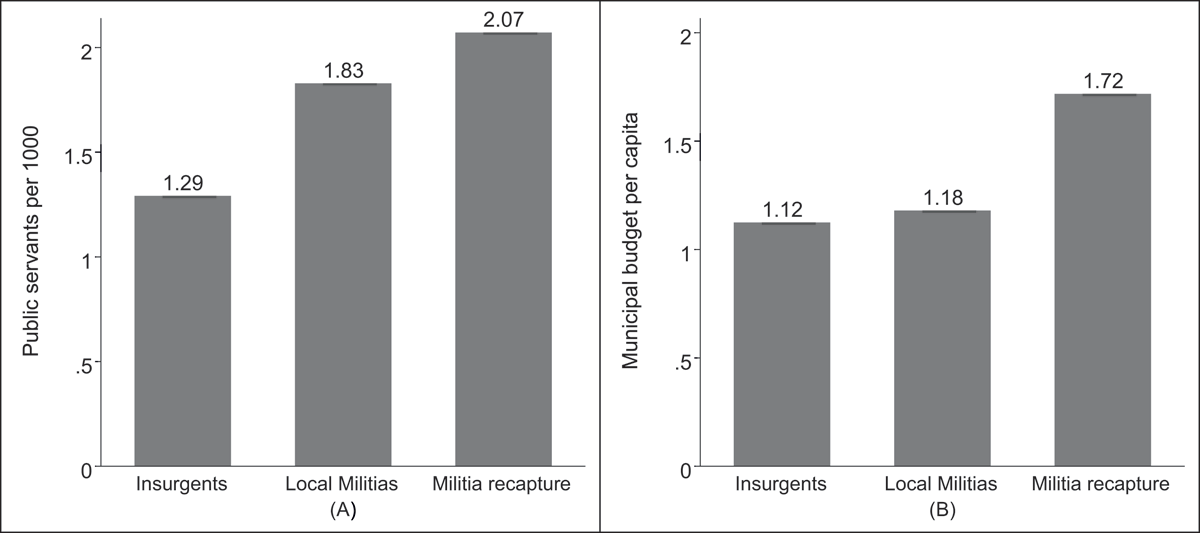
Of the 2,007 observations, 169 involve the presence of local militias (8 percent), of which 64 had early insurgents (type 1) and 105 did not (type 2); 180 municipalities had insurgents (9 percent). The remaining 1,658 (83 percent) did not experience the civil war. Notice that the latter regions are mostly north of the center and in the southeast (Figure 1). We analyze also a restricted sample with only the no-conflict municipalities that are neighbors to those with another war dynamic: no-conflict observations reduce to 814 (41 percent). The raw data by type of dynamic (Figure 2) show that regions with local militias had more public servants per one thousand people (Panel A) and a higher municipal budget per capita (Panel B), than regions with an insurgent presence until the end of the war, and more so in regions with early insurgent threat. The local organization of militias in a municipality seems to be positively correlated with local state building efforts years later.Footnote 11
Local fiscal capacity and type of war dynamic, raw values.
Controls
A third variable could be driving both the war dynamic in 1810–1821 and local state capacity building years later. In particular, relatively rich regions in 1810 were more likely to be protected by local militias and also more likely to develop higher local state capacity than relatively poor regions. To account for this, first, we include data on geographic characteristics related to potential agricultural productivity: we include median altitude (kilometers) and soil suitability for each municipality. Tropical countries like Mexico have better conditions for agriculture in regions with relatively higher altitudes. Certain soils are more conducive to agriculture than others. The index of soil suitability takes the values {0,1,2}. Types that are more conducive to agriculture receive a higher index number.Footnote 12 From Table 1, it is not clear whether royalists or insurgents targeted the areas more suitable for agriculture. Municipalities with local militias by the end of the war (columns 3 and 4) appear to have lower levels of soil suitability, yet higher altitude. Mean differences in altitude between (3) and (4), and no-conflict neighbors are not statistically significant.Footnote 13 Municipalities with insurgents by the end of the war have lower altitude than those with local militias.
Second, mining was a major productive activity during the colonial period. We obtain the exact location of productive mines circa 1800 from Alexander von Humboldt (Reference Humboldt and Arnao1822) and calculate the Euclidian distance from the centroid of each municipality to the nearest mine. Regions with no direct contact with the war are farther away from a mine than those with other types of dynamic (see Table 1), and the difference is statistically significant at the 99 percent level regardless of whether we restrict the sample to neighbors. Municipalities that experienced insurgent threat (4) appear to be closer to a mine; the mean difference is statistically significant with respect to all other types of dynamic. Notice regions with only insurgents or only local militias are similar in terms of their closeness to a mine.
Third, municipalities with organized militias may be closer to an urban center than those with an insurgent presence until the end of the war. Urban centers likely remain urban and have higher levels of state capacity. We include the (Euclidean) distance from the centroid of each municipality to the nearest urban colonial center (Reference Tanck EstradaTanck 2005).Footnote 14 Table 1 shows that all regions with some form of insurgent or militia dynamic are closer to urban centers than regions without conflict when considering the full sample (statistically significant at the 99 percent level).
Fourth, Mexico City was the main urban center and concentrated most economic activity. Royal militias may have located closer to Mexico City and this may also explain a higher level of local fiscal capacity later. We include the distance from the centroid of each municipality to Mexico City. Municipalities with local militias and those recaptured by militias are closer to Mexico City.
Fifth, local state building and war dynamic may both be influenced by other precolonial characteristics such as colonial fiscal income. Local royalist militias may have been easier to organize in municipalities with higher fiscal capacity, which may have persisted until the end of the century. We include two alternative proxies for precolonial fiscal capacity: (i) a dummy equal to “1” if there was an internal customs office (receptoria or subreceptoria) in the municipality, and (ii) the average amount of sales taxes collected by each during the ten years prior to the war onset.Footnote 15
Municipalities with militia recapture indeed have the highest proportion of customs offices and the highest income from sales taxes (see Table 1). The difference in means relative to all other types of dynamic is statistically significant. Notice, however, that while in regions with local militias (3) sales taxes provided higher average income than those with insurgents (2), the proportion of customs offices is higher in regions with insurgents; the mean differences are not statistically different from zero. Thus, while it could be that the royal authorities strove to recapture and hold rich towns under initial insurgent control, and this advantage endured over the century, it also appears that towns with only insurgent or only militia presence had relatively similar conditions in terms of fiscal potential before the war. Notice also that insurgent municipalities are on average different from their no-conflict neighbors. Lastly, no-conflict municipalities have on average similar proxies for fiscal capacity in both the full and the neighbor samples, that is, irrespective of their distance to the economic center of colonial Mexico.Footnote 16
Our final strategy to mitigate the possibility of omitted variable bias is to restrict the sample to only geographic neighbors with different war dynamic. We perform the following empirical exercise:

where ym is the proxy for state capacity in municipality m, Militiasm takes a value of 1 if municipality m had local militias organized, Insurgentsm takes a value of 1 if municipality m had presence of insurgents, MilitiaRecapturem takes a value of 1 if municipality m had early insurgents but was later recaptured, and Xm is a vector of controls. We estimate both equations using ordinary least squares with state fixed effects to incorporate other omitted variables that could vary at the state level. We also cluster standard errors to account for correlation in unobservables for municipalities within the same state. The results hold if we use heteroskedasticity-robust standard errors (see Appendix Tables A.1 and A.2).
Results
The three types of dynamic with militias or insurgents are positively correlated with local bureaucracy in 1900, relative to regions with no conflict (Table 2), yet the magnitude of the coefficients on militia recapture and local militias is higher than that for insurgents. The coefficients on both types of militia presence remain statistically significant after including the controls, in both the full and the neighbor samples. For the latter sample, the number of public servants per thousand is 0.52 higher in municipalities with local militias than in those without civil conflict, and 0.63 higher in municipalities with militia recapture (column 6). These correspond to increases of 43 percent and 53 percent, respectively, from the average value of public servants per thousand. The coefficients on insurgents are not statistically different from zero.
Public servants in 1900 and type of war dynamic.

Note: OLS with state fixed effects and standard errors clustered at the state level; (4), (5) and (6) include only neighbors.
*** p < 0.01; ** p < 0.05; * p < 0.1.
Notice the coefficient on local militias is higher than that for insurgents, relative to municipalities with no conflict, and statistically different from zero. The difference between the two coefficients is statistically significant at the 95 percent level, in all specifications. Recall that these two types of municipalities began with similar prewar fiscal capacity and distance to the nearest mine (see Table 1), nonetheless they appear to develop differently years later in terms of the size of the local bureaucracy. In contrast, no-conflict municipalities differ from those with insurgents early on, yet their number of local bureaucrats is not significantly different years later.
The results for the municipal fiscal budget in 1910 are in Table 3. We find consistent results. The municipal budget per capita is higher in municipalities with all three types of war dynamic relative to municipalities with no conflict, and the coefficient on municipalities with militia recapture shows the highest magnitude. The inclusion of treasury office and alcabala income as controls reduce the coefficients on both war dynamics with militias. This highlights that part of the correlation can be accounted for by prewar differences in capacity, yet the coefficients remains statistically significant after controlling for our proxies of prewar differences. The coefficient on local militias remains statistically significant at the 99 percent level in all specifications. The omission of cases from Oaxaca and Michoacán may be driving the differences with respect to Table 2.Footnote 17
Municipal budget in 1910 and type of war dynamic.

Note: OLS with state fixed effects and standard errors clustered at the state level; (4), (5) and (6) include only neighbors.
*** p < 0.01; ** p < 0.05; * p < 0.1.
In sum, the results suggest that a municipality was able to develop more local state capacity if it managed to organize and finance a local militia during the war years. The number of public servants per thousand and the municipal budget per capita are higher in municipalities with militia recapture than in municipalities with insurgents, relative to no-conflict regions, and the difference remains statistically significant when including the controls. In contrast, an insurgent legacy may have hindered state development. Local state capacity in 1900 in regions with insurgent legacy is not statistically different from that in regions with no conflict, despite displaying a head start in fiscal capacity, and being closer to a mine and a colonial urban center in early 1800.
Legacy of Civil War Dynamics for Local State Building
Why do the differences between types of war dynamic persist after the war, and despite other conflicts during the nineteenth century? We analyze below various explanations for the long-term effect of the War of Independence on local state building.
One first possible explanation is a persistence-of-conflict argument. A higher likelihood of local uprisings in regions with an accumulation of insurgent-warfare skills may have undermined local state building repeatedly, regardless of the war’s legacy for municipalities with organized militias. For instance, independent Mexico was shaken by various local military coups, pronunciamientos (Reference FowlerFowler 2016, Reference Fowler2012). Insurgent leaders may have provided the manpower for these local uprisings. A correlation of our war dynamic data with the location of the sixteen major pronunciamientos is indeed positive, yet it is so regardless of whether the municipality had an insurgent or royalist militia legacy.
Other conflicts during the nineteenth and twentieth centuries also do not seem to be driven by municipalities with an insurgent presence in 1821. A correlation analysis of our conflict data with (a) reform municipalities: those with major battles during the War of the Reform (1857–1862); (b) revolution municipalities: with rebel forces operating during the 1910–1917 Revolution; and (c) municipalities with rebellions during the 1928 Cristero War, finds a strong persistence of violence; however, violence again affects only municipalities with independence war insurgents and those with militias.Footnote 18 War of Independence insurgent municipalities have a higher correlation with Cristero War municipalities (p = 0.17) than other types of conflict municipalities, but this relation flips for revolution and reform municipalities, which show a stronger correlation with militia-recaptured municipalities (p = 0.10 and p = 0.21, respectively). In sum, conflict does not seem to have persisted only in those municipalities with an insurgent presence.
A second possible explanation centers on state building efforts at the federal level. The Federal Republic of 1824 conferred practically full fiscal prerogatives to the states, who relied on the local administrations to collect taxes. The foreign trade taxes collected by the federal government were routinely insufficient to confront recurrent fiscal crises (Reference TenenbaumTenenbaum 1986; Reference Carmagnani, Jáuregui and OrtegaCarmagnani 1998). Fiscal crisis turned into political crisis: between 1821 and 1867, the central government saw fifty-six administrations (Reference Vázquez-GómezVázquez-Gómez 1997). The attempt at centralization between 1830 and 1835 failed. Local governments thus retained autonomy in tax collection and policy during the nineteenth century (Reference Marichal, Miño and RiguzziMarichal, Miño, and Riguzzi 1994; Reference Ortíz Escamilla and OrtegaOrtíz and Serrano 2007).
Still, the political stability achieved during the Porfirian era may explain the differences in local state capacity. Porfirio Díaz, a liberal general from Oaxaca, came to power in 1876 and was able to craft a three-decade-long period of political stability and economic growth. The Porfiriato may have triggered a federal-fed clientelistic machine at the local level. The scant evidence on the creation of the local administration during this period does not support the idea that the differences on the number of local bureaucrats are driven by the federal government (Reference CadenaCadena 2005, chap. 2). Fiscal pressure during the Porfiriato did not increase compared to the previous liberal period. Díaz’s fiscal success was largely a result of an efficient reorganization of the administration and of economic growth. The budget was largely allocated to public infrastructure (Reference CoatsworthCoatsworth 1981).
That bureaucratic building was a task of the lower tiers of government during most of the nineteenth century suggests a third hypothesis more directly linked to the civil war. The War of Independence helped some municipalities build fiscal strength through the local fiscal councils that organized and financed the militias. This effect did not wash away because the negotiated settlement that brought the war to an end facilitated local state building in towns where militias had been organized, while undermining it in towns born with tensions between the new insurgent leaders and colonial era elites. Municipalities with previous militia experience did not only have local knowledge for fiscal extraction but were less concerned about facing local challengers that took over public jobs.
This third explanation builds on theories of state building driven by conflict among domestic elites. Intra-elite conflict, in which one faction is in rivalry with an economic elite that supports the opposition, can result in low capacity building to avoid the risk of losing political power. Investing in state capacity not only allows the opponent to use the increased state capacity against the current incumbent in the future (Reference Besley and PerssonBesley and Persson 2011) but also risks breaking a political equilibrium in which the economic elite does not seize political power from the incumbent rival because of the low capacity of the state to expropriate economic assets (Reference GarfiasGarfias 2018).
We offer fine-grained evidence in favor of this mechanism for the states of Guanajuato, Mexico, and San Luis Potosí. Guanajuato was a state mostly controlled by royalist militias during the war. After the war, political power remained in the hands of military officers who had previously sided with the royalist army. In addition to having militias, both Mexico and San Luis Potosí also included areas with a strong insurgent presence. After the war, some insurgent leaders were appointed military generals and fought for political power against previously royalist elites.
In the early war years in Guanajuato, insurgents occupied the region around the town of Dolores seeking resources from mining sites and from agricultural landholdings in the Bajío, considered the granary of New Spain. By 1818, however, militias had been organized in most of the state and local authorities collected the alcabala (Reference Serrano OrtegaSerrano 2015, 41). By 1821, the insurgents had mostly fled the state, now in control of the militias.
The fiscal attributions of the municipal governments outlived the war: the new town councils (ayuntamientos) resulting from the Cadiz Constitution assumed the functions of the juntas de arbitrios and had control over most of the monies generated in their territories. The municipalities remained fiscally strong and negotiations between the state-level colonial economic elite and the empowered municipal elites shaped the fiscal structure of Guanajuato during the nineteenth century (Reference Serrano OrtegaSerrano 2001, chap. 5).
In contrast, the western part of what was then the state of Mexico experienced a stronger insurgent presence up to the negotiated end of the conflict, and insurgent leaders leveraged this strength to access political power at the municipal level. Militias in these areas were weak or lacking by the end of the war, and the fiscal structure was in disarray given the insurgents’ reluctance to organize a system of extraction. Once in office, creating new taxes or increasing existing ones was contrary to the political agenda of former insurgents (Reference Hernández Jaimes and RojasHernández Jaimes 2006, 210). The new political leadership relied for support on the network of the rural poor mobilized during the rebellion. For instance, Juan Alvarez allied with the peasants to displace the colonial landed elite in the municipalities that later became the state of Guerrero (Reference GuardinoGuardino 1991).
The partition of the state of Mexico during the first three decades of independent life provides evidence of the tensions between former and new insurgent-led elites. During the colonial period, the state of Mexico hosted the seat of government and amassed most of the regional wealth. After independence, leaders from other (mostly northern) states feared that centralization-prone leaders in Mexico City could transfer resources and power from the states to the center by using the state of Mexico’s influence in their favor. To prevent this, several congresses passed laws to reduce the territorial reach of the state (Reference MacuneMacune 1970). As of 1870, the territory of the state of Mexico had been dramatically reduced with the creation of the Federal District (1824) and the new states of Guerrero (1849), Morelos (1869), and Hidalgo (1869).
Interestingly, Mexican elites sought to repeal some of these partitions but not others. Mexico City, the capital city of the state, became the Federal District. This was a large fiscal shock to the state since Mexico City was a staunch stronghold of the army during the War of Independence, with well-funded militias. The loss of fiscal revenues collected in the city created a large hole in the state of Mexico’s finances. State elites tried several times to reverse this decision, to no avail (Reference MacuneMacune 1970, 24–40). In a remarkable contrast, the declaration of statehood for the western lands (the districts of Taxco and Acapulco, which became the core of Guerrero) met little contestation (Reference GuardinoGuardino 1991, 172). As mentioned before, these districts had been insurgent bastions during the war, and they hosted the political base of former insurgent leaders such as Vicente Guerrero, Nicolás Bravo, and Juan Alvarez.
The political elite did not contest the creation of the state of Guerrero, yet it did fight for districts located close to the new state border. For instance, Sultepec was initially controlled by the rebels during the War of Independence but remained solidly royalist after the creation of a local militia. In June 1848, the mayor of Sultepec submitted a letter to the governor of the state of Mexico in which he called for joining Guerrero (Reference McGowanMcGowan 2004, 152–153). The letter recognizes that a high-ranking official of Juan Alvarez’s army, promoter of the creation of Guerrero, had set up camp in the district. Two months later, another statement from the local landowners expressed their strong opposition to being part of the new state. The municipality, they claimed, had been standing for annexation to the new state under duress of troops of neighboring War of Independence insurgent towns, Temascaltepec and Zacualpan (Reference McGowanMcGowan 2004, 167). In the end, Sultepec stayed within the state of Mexico, and the new state of Guerrero did not advance further north.
The third narrative concerns San Luis Potosí, another Bajío region. During the independence war, the state was divided between its rebel-held eastern tip, surrounding Ciudad Valles, and its central and western parts around the state capital, under safe royalist control. These tensions came to the fore during the US invasion in 1847. After the fall of Saltillo, San Luis Potosí was next in the advance of the US troops toward Mexico City, so the state had to ready its defense. Unlike Guanajuato (Reference Serrano OrtegaSerrano 2001), where local elites shouldered the war effort and created a militia to hold the line, in San Luis Potosí internal divisions slowed down the preparation for war.
The Mexican army commanded by President Santa Anna was stationed in the state capital from October 1846 to March 1847, draining local resources. But when Santa Anna retreated to Mexico City, the state administration could not coordinate local elites to garner armed units to contain the US advance. The call by the state governor for local leaders to create voluntary guerrillas soon got out of hand as indigenous armed parties in the eastern Sierra Gorda fought for land redistribution (Reference Calvillo, Monroy and VázquezCalvillo and Monroy 1997). The war took its toll on the powerful merchant elite in favor of an uneasy alliance among local elites facing permanent land-driven unrest (Reference Corbett and VázquezCorbett 1997).
San Luis Potosí also provides a closer look into how elites understood the distribution of public jobs. The traditional elite entrenched in the state capital considered the local administration as part of its endowment. Consider, for instance, the following quote in which a creole-apologetic journalist complained about sharing public posts with the rebel-born elite in the aftermath of the US invasion: “The rebels are fixated on seizing public jobs, because they are too flattered to hold them and because many expect to obtain advantages from holding power, such as capturing public revenue—as they are used to doing whenever they can.” Public posts represented a key position in the local economy, and colonial-era elites felt threatened by the chance of losing them (Reference Corbett and VázquezCorbett 1997, 476–477; our translation).
The tension originated in the composition of the local, founding state elites repeatedly surfaced over the nineteenth century in Mexico, and, more generally, added fuel to the divide between liberals/federalists and conservatives/centralists. Decades of political turmoil and economic instability helped cement the original dynamics of warfare and local elite conflict.
Conclusion
Our analysis puts forth that war-driven institutions and local elite conflicts resulting from the dynamics of civil warfare may have enduring implications for local state building. We find that municipalities where militias were financed and organized through war-created local councils have higher capacity by the end of the century than those without militias, and more so in regions with open confrontation. Although some research on civil war highlights the negative impact of violence on state capacity, we find that local capacity in municipalities with an insurgent legacy is not significantly different from that in regions with no direct war experience, despite starting with divergent prewar conditions.
The War of Independence appears to have reset the political and economic elite of the country by adding a war-born insurgent layer of strongmen in some regions that fought for political preeminence along with the colonial-era economic and political elite. The weakness of the central government and the process of decentralization that the civil conflict set in motion brought to the fore local elite conflicts, while the local authorities remained in charge of collecting many taxes, and the militias were not disbanded. For decades, central governments were overthrown under the pressure of regional military leaders whose strength went back to the war years. With Porfirio Díaz the country began to be pacified, although the foundations of the Pax Porfiriana were shattered with the breakout of the Mexican Revolution in 1910. Nonetheless, the impact of region-centered politics and decentralization may have outlasted the Revolution, as some scholars have argued (Reference RubinRubin 1996; Reference Sánchez-TalanquerSánchez-Talanquer 2017).
Our findings speak to two important discussions. First, the evidence suggests that the conversation between those emphasizing the advantageous consequences of conflict for state building and those singling out its negative impact may have to zoom in on the internal dynamics of each conflict. A better understanding of the local war-financing strategies of the different countries in early modern Europe, for instance, may help us better understand why elites were willing to support the buildup of fiscal institutions in some regions more than in others, and how the strengthened institutions endured. Additional studies giving careful consideration to local conflict dynamics are necessary if we want to understand what good can come out of war.
Second, we contribute to the debate on colonial institutions and their legacies (Reference Acemoglu, Johnson and RobinsonAcemoglu, Johnson, and Robinson 2002; Reference NunnNunn 2009; Reference Maloney and ValenciaMaloney and Valencia 2015) by showing that colonial institutions may or may not persist, and that persistence or change may be endogenous to the local dynamics of civil war. As nineteenth-century Mexico attests, multiple institutional changes did not lead to state building across the board; rather, the effect of institutions appears to be mediated by war practices developed during the War of Independence. Wars shatter the foundations of society. We still need to understand more carefully their dynamics and implications for the building and consolidation of effective state institutions, especially in contexts where the conflict between armed actors reaches a negotiated termination without a clear triumph for one side.
Additional Files
The additional files for this article can be found as follows:
Online Appendix Appendix. DOI: https://doi.org/10.25222/larr.962.s1
Data File Data set for replication. DOI: https://doi.org/10.25222/larr.962.s2
Acknowledgements
We are grateful to Diana Flores, Victor Hugo Gónzales, Lucy Hackett, and Erik Lozada for excellent research assistance. We also thank Dan Bogart, Francisco Garfias, Mariano Sánchez-Talanquer, three anonymous referees, and participants at the Conference on Long Range Development in Latin America at Stanford University, the Carlos III-Juan March Institute Research Seminar, and APSA and LASA meetings for helpful comments. All remaining errors are ours. The research benefited from financial support from Research Grant 0416-850 FAI-CIDE.


 Open access

