




Introduction
Across the world, approximately 70% of cultivated crops are either dependent on, or see yield increases driven by, animal-mediated pollination (Klein et al., Reference Klein, Vaissiere, Cane, Steffan-Dewenter, Cunningham, Kremen and Tscharntke2007), which has an estimated economic value of approximately $217 billion per year (Gallai et al., Reference Gallai, Salles, Settele and Vaissière2009). The European honey bee Apis mellifera (Hymenoptera: Apidae) is the most frequently utilized pollinator globally, due to its ease of management by humans and ability to pollinate a wide range of crops (Garibaldi et al., Reference Garibaldi, Steffan-Dewenter, Winfree, Aizen, Bommarco, Cunningham and Klein2013). However, honey bee stocks worldwide have seen large fluctuations in recent years due to multiple factors, including pesticide exposure, susceptibility to pathogens and parasites, and a lack of dietary diversity and access to essential nutrients (Ellis, Evans and Pettis, Reference Ellis, Evans and Pettis2010; Potts et al., Reference Potts, Roberts, Dean, Marris, Brown, Jones and Settele2010). While the reliability of honey bee stocks has declined, the global demand for agricultural pollination continues to significantly increase (Aizen and Harder, Reference Aizen and Harder2009; Breeze et al., Reference Breeze, Vaissière, Bommarco, Petanidou, Seraphides, Kozák, Scheper, Biesmeijer, Kleijn, Gyldenkærne, Moretti, Holzschuh, Steffan-Dewenter, Stout, Pärtel, Zobel and Potts2014). In light of these conflicting trends, interest in utilizing alternative pollinators to honey bees, including wild bees and managed bumble bees (Bombus spp.) has greatly increased. While wild bees found in and around many agroecosystems are capable of substantial pollination service delivery (Winfree et al., Reference Winfree, Williams, Gaines, Ascher and Kremen2008), wild bee populations are also highly variable in species composition and abundance due to the influence of temperature, precipitation, nutritional availability, habitat availability and landscape composition, among other factors (Koh et al., Reference Koh, Lonsdorf, Williams, Brittain, Isaacs, Gibbs and Ricketts2016; Ogilvie et al., Reference Ogilvie, Griffin, Gezon, Inouye, Underwood, Inouye and Irwin2017; Papanikolaou et al., Reference Papanikolaou, Kühn, Frenzel and Schweiger2017). This variability may raise concerns among growers about the reliability of wild bees as agricultural pollinators, especially for pollinator-dependent crops. Managed bumble bees may be an appealing alternative for growers in light of these concerns, as they combine the reliability of managed honey bees with some of the benefits of wild pollinators, while overcoming many of the shortfalls of either group of bees alone.
Bumble bees have been commercially reared as alternative or supplemental pollinators of many crops since the mid 1980's. In the field, managed bumble bees are typically deployed in ‘quads’, a compact arrangement of four colonies (Velthuis and Van Doorn, Reference Velthuis and Van Doorn2006). Currently, two species of bumble bee dominate the commercial sphere: Bombus impatiens in North America, and B. terrestris for the rest of the world, though several more species are currently utilized for commercial pollination and yet more species are under evaluation for their commercial potential (Velthuis and Van Doorn, Reference Velthuis and Van Doorn2006; Garibaldi et al., Reference Garibaldi, Requier, Rollin and Andersson2017). The greenhouse tomato industry is the largest consumer of managed bumble bee colonies, as tomatoes have poricidal anthers which require buzz pollination for fruit set (Buchmann, Reference Buchmann, Jones and Little1983). Many other crops benefit substantially from pollination by managed bumble bees, including apple (Goodell and Thomson, Reference Goodell and Thomson1996), lowbush blueberry (Javorek et al., Reference Javorek, Mackenzie and Vander Kloet2002; Stubbs and Drummond, Reference Stubbs and Drummond2001), cranberry (Cane and Schiffhauer, Reference Cane and Schiffhauer2003), melon (Campbell, Daniels and Ellis, Reference Campbell, Daniels and Ellis2018), pumpkin (Artz and Nault, Reference Artz and Nault2011), raspberry (Willmer, Bataw and Hughes, Reference Willmer, Bataw and Hughes1994), sweet cherry (Eeraerts et al., Reference Eeraerts, Vanderhaegen, Smagghe and Meeus2020), and sweet pepper (Serrano and Guerra-Sanz, Reference Serrano and Guerra-Sanz2006). For many of these crops, bumble bees are more efficient pollinators than honey bees, due to a number of factors including their ability to buzz pollinate flowers with poricidal anthers, greater visitation frequency to flowers, greater per-visit pollen deposition, and ability to forage at lower temperatures (Broussard et al., Reference Broussard, Rao, Stephen and White2011; Cane and Schiffhauer, Reference Cane and Schiffhauer2003; Velthuis and Van Doorn, Reference Velthuis and Van Doorn2006).
Cranberry (Vaccinium macrocarpon Aiton, Ericaceae) is a highly valuable and native plant to North America, cultivated in temperate regions of the United States and Canada (UN FAOSTAT, 2019). Wisconsin (WI) is the largest cranberry producer in the United States, producing over 60% of US cranberries with 234 farms managing over 21,000 acres and an economic value estimated at $161 million USD in 2019 (USDA NASS, 2021). Quebec (QC) is Canada's largest cranberry producer, with QC growers managing more than 11,000 acres of cropland on 81 cranberry farms (Association des Producteurs de Canneberges du Québec, 2021) and a 2019 harvest valued at $78.5 million USD (Statistics Canada, 2021). Cranberries benefit substantially from insect pollination, particularly by bees (Gaines-Day and Gratton, Reference Gaines-Day and Gratton2015), and the majority of cranberry growers throughout North America utilize rented honey bees for pollination. This is despite the fact that honey bees are incapable of performing buzz pollination (De Luca and Vallejo-Marin, Reference De Luca and Vallejo-Marin2013) and cranberries have poricidal anthers which release large quantities of pollen when buzz pollinated (Buchmann, Reference Buchmann, Jones and Little1983). Honey bees instead liberate small amounts of pollen from cranberry flowers by drumming on the anthers with their forelegs (MacKenzie, Reference MacKenzie1994). Although there have been numerous studies demonstrating the benefits of bumble bees for cranberry pollination (Broussard et al., Reference Broussard, Rao, Stephen and White2011; Cane and Schiffhauer, Reference Cane and Schiffhauer2003; MacKenzie, Reference MacKenzie1994; Ratti et al., Reference Ratti, Higo, Griswold and Winston2008), grower utilization of commercially available bumble bees has remained relatively low in WI (Guédot, Atucha and Jonjak, Reference Guédot, Atucha and Jonjak2020) and no data was available on their utilization in Canada prior to this study.
Here, we conducted a survey of WI and QC cranberry growers to better understand current grower pollination practices and attitudes toward managed bumble bees and to compare pollination practices and attitudes between these two major cranberry-producing areas. Published surveys of grower pollination practices are rare in the literature (Hanes et al., Reference Hanes, Collum, Hoshide and Asare2015; Park et al., Reference Park, Joshi, Rajotte, Biddinger, Losey and Danforth2020), and despite the economic importance of this native fruit crop, only a single survey has been published on grower practices in cranberry (Gaines-Day and Gratton, Reference Gaines-Day and Gratton2017). A better understanding of cranberry grower pollination practices and attitudes toward managed bumble bees could result in better targeted outreach efforts to growers and bumble bee suppliers, increasing adoption rates of managed bumble bees and improving the overall sustainability of the cranberry industry. Specifically, we surveyed WI and QC growers about their farm characteristics, current pollination practices, the importance of a number of factors and sources of information in determining their current pollination practices, their knowledge about managed bumble bees and perceived benefits and challenges of utilizing managed bees for pollination services.
Materials and methods
Survey methodology
This study was designed to document the current pollination practices of Wisconsin (WI) and Quebec (QC) cranberry growers, to better understand barriers to the utilization of managed bumble bees for pollination, and to contrast approaches to cranberry pollination between these two regions, which represent the largest cranberry growing states/provinces within their countries. To that end, we designed a survey with Qualtrics (Qualtrics, Provo, UT, 2020) that contained 20 questions grouped into three distinct sections: (1) grower and farm characteristics, (2) grower pollination practices, factors influencing these practices, and sources of information about pollination, and (3) grower perceptions of managed bumble bees for cranberry pollination (Supplemental Information 1).
Between February and October 2019, digital surveys written in English were distributed to WI cranberry growers through the University of Wisconsin-Division of Extension ‘Virtual Marsh’ email list, a large directory of North American cranberry growers. To gather data from QC cranberry growers, the survey was translated into French prior to distribution, as the vast majority of QC residents either speak French exclusively or are proficient in both French and English (Statistics Canada, 2012). Surveys were then digitally distributed to QC growers between August and October 2020 through a virtual newsletter belonging to the Quebec Cranberry Growers' Association. Survey data was cleaned to remove responses with greater than 50% of fields left blank, and to remove responses from cranberry growers outside the focal range of our study (non-QC and non-WI responses made up less than 10% of total recorded responses). Survey approval was granted by the University of Wisconsin-Madison Institutional Review Board (IRB, submission 2019-0035-CP001).
Data analysis
Descriptive statistics were utilized to summarize results for a majority of survey questions due to the low response rate from many important cranberry growing counties of WI (Table 1). For survey questions which had continuous responses (Table 2), means and standard errors of means were calculated in R (R Core Team, 2014). Responses to some categorical survey questions were simplified to facilitate comparison (e.g., ‘strongly agree’ and ‘agree’ collapsed into a single ‘agree/strongly agree’ category).
Proportion and percentages of growers surveyed and recorded in agricultural censuses (2017 census US, 2016 census Canada)

Grower and farm characteristics for Wisconsin and Quebec

All prices from Quebec were converted to USD at a rate of $1 CAD to $0.8 USD. Only responses from growers who responded affirmatively to stocking honey bees and/or bumble bees were included when determining average costs of purchase or rental.
Results
Grower and farm characteristics
Reported grower and farm characteristics from Wisconsin (WI) and Quebec (QC) were largely similar, and likely have limited explanatory power when considering how pollination practices or attitudes toward managed bumble bees may vary by region (Table 2). WI respondents have been producing cranberries for an average of a decade longer (28.85 yrs) than QC respondents (18.76 yrs) and manage a lower average acreage (186.32 acres) than QC respondents (302.14 acres). In both areas, ‘Stevens’, the industry standard cultivar (Vorsa and Johnson-Cicalese, Reference Vorsa, Johnson-Cicalese, Badenes and Byrne2012), is the predominant cranberry variety grown (94.23 and 100% respondents in WI and QC respectively grow this cultivar most on their farms, Supplemental Information 2). ‘Mullica Queen’, an early-blooming and high yielding hybrid cultivar (Rutgers Licensing and Technology, 2021) is an important secondary cultivar grown in both regions (26.68 and 45.00% of respondents in WI and QC grow this cultivar second most on their farms, Supplemental Information 2). Cranberry yields at harvest were similar between WI and QC, reaching almost 300 barrels (1 barrel = 100 lbs.) per acre. WI and QC have similar climates, both being classified as warm-summer humid continental climates under the Köppen system (Peel, Finlayson and McMahon, Reference Peel, Finlayson and McMahon2007), which likely contributes to the similarities in their reported agricultural practices. It is important to note, however, that the respondents to our survey may not be fully representative of all WI and QC cranberry growers. Many important cranberry growing counties in WI, such as Jackson, Monroe, and Wood counties, were not well represented in our survey (Jackson: 23.68%, Monroe: 10.64%, Wood: 11.63% of the total number of farms reported in the federal agriculture census included in our survey). Additionally, respondents to our survey managed much larger farms than official census averages (WI respondents: 186.32 acres, WI census: 91.94 acres, QC respondents: 302.14 acres, QC census: 119.13 acres) and attained higher yields at harvest (WI respondents: 293.84 barrels acre−1, WI census: 224.40 barrels acre−1, QC respondents: 274.28 barrels acre−1, QC census: 224.40 barrels acre−1, USDA NASS, 2017; Statistics Canada, 2016).
Pollination practices
Pollination practices reported by respondents in WI and QC were largely similar, with some notable regional differences in how respondents support pollinators on their farms (Table 3). The utilization of rented honey bees for cranberry pollination was widespread in both regions (90.91% WI, 100.00% QC). Purchasing bumble bee quads for pollination was less common than renting honey bees in both regions, but more frequently reported in QC (32.65% WI, 40.00% QC). Though there are no prior published estimates of the percentage of growers who utilize managed bumble bees for pollination in QC, the percentage of WI respondents who report purchasing bumble bees corresponds well to previous survey data obtained at the 2019 Wisconsin Cranberry School, where 40.00% of surveyed growers reported stocking managed bumble bees (Guédot, Atucha and Jonjak, Reference Guédot, Atucha and Jonjak2020). Utilizing a combination of managed honey and bumble bees for cranberry pollination was also more common in QC than WI (22.45% WI, 42.11% QC). No respondents in either region reported doing nothing for crop pollination, which would entail relying exclusively on wild insects and abiotic factors for pollination services. Likewise, very few of the respondents reported owning their own honey bee colonies (0.00% WI, 5.56% QC). This high reliance on rented honey bees in both regions for cranberry pollination mirrors the broader reliance of many agricultural crops on managed bees for pollination (Klein et al., Reference Klein, Vaissiere, Cane, Steffan-Dewenter, Cunningham, Kremen and Tscharntke2007), though growers in some systems, including apples and pumpkins (Park et al., Reference Park, Joshi, Rajotte, Biddinger, Losey and Danforth2020; McGrady, Troyer and Fleischer, Reference McGrady, Troyer and Fleischer2020), have found that honey bees can be superfluous in terms of their effects on crop yield.
Prevalence of cranberry pollination and pollinator support practices among growers

Managed bees are brought to farms between 10–15% cranberry bloom in either region, which is calculated by growers dividing the number of open flowers on ten cranberry uprights by the number of flowers and buds on those uprights (van Zoeren and Guédot, Reference van Zoeren and Guédot2018). In both regions, the majority of respondents report determining when to bring in managed pollinators by calculating the percent bloom themselves (57.14% WI, 81.82% QC). A substantial proportion of WI respondents report drawing on past experiences (17.86% WI, 0.00% QC) to determine this timing as well. Bees stay on farms for almost 10 days longer in WI than in QC. Some QC respondents may keep managed bees on their marshes for a shorter amount of time to avoid dietary deficiency in their honey bees on the marshes, a phenomenon previously documented in the province on cranberry and blueberry farms (Dufour, Fournier and Giovenazzo, Reference Dufour, Fournier and Giovenazzo2020).
Densities of honey bee hives and bumble bee colonies were similar in both regions, between 2 and 3 hives per acre for honey bees and 1 and 2 quads per acre for bumble bees. Overall costs for managed pollinators were higher in QC, particularly for honey bee rentals (appx. $40 USD greater per colony for honey bees and $10 USD greater per quad for bumble bees in QC compared to WI). The price discrepancy for honey bee hives between WI and QC is likely a result of supply and demand, as there were nearly four times more honey bee hives in the United States than Canada in 2019 (Statistics Canada, 2019; USDA NASS, 2021). Few respondents in either region appeared sensitive to the cost for purchasing or renting managed bees, as only 9.09% of QC and 17.86% of WI respondents reported they would stop stocking managed bees if prices got ‘too high’. Though stocking managed honey bees is an industry standard practice and benefits cranberry yield in some situations, dependent on landscape context (Gaines-Day and Gratton, Reference Gaines-Day and Gratton2016), variations in wild bee fauna may partially explain why QC respondents seemed more sensitive to pollinator-associated costs than WI respondents. QC's cranberry agroecosystem was reported to host 103 species of wild bees (Gervais et al., Reference Gervais, Fournier, Sheffield and Chagnon2017), compared to WI's 198 species (Amon, Reference Amon2021 and Gaines-Day, Reference Gaines-Day2013 combined). Though the true relationship between wild bee biodiversity and cranberry yield remains unclear (Amon, Reference Amon2021; Broussard et al., Reference Broussard, Rao, Stephen and White2011; Evans and Spivak, Reference Evans and Spivak2006; Gaines-Day, Reference Gaines-Day2013; Kevan et al., Reference Kevan, Gadawski, Kevan and Gadawski1983; Ratti et al., Reference Ratti, Higo, Griswold and Winston2008), studies have demonstrated that increased wild bee richness drive greater yields in a variety of crops (Hoehn et al., Reference Hoehn, Tscharntke, Tylianakis and Steffan-Dewenter2008; Mallinger and Gratton, Reference Mallinger and Gratton2015; Rogers, Tarpy and Burrack, Reference Rogers, Tarpy and Burrack2014). This is supported by the fact that while 95.45% of QC respondents agreed or strongly agreed that they stocked managed bees for peace of mind or insurance, this percentage was only 58.18% for WI respondents (Supplemental Information 3). WI respondents may feel more confident that wild bees provide a substantial amount of pollination services on their farms than QC respondents, decreasing their need to stock managed bees for peace of mind. Alternatively, the phrasing of our survey statement may have led WI respondents to not agree with the statement- rather than stocking managed bees for peace of mind or insurance, WI respondents may simply consider managed bees as essential for production rather than ‘insurance’.
Methods of supporting pollinators also varied by region, with a surprising amount of respondents in both regions reporting that they plant pollinator gardens, though this percentage was far greater in QC than in WI (50.94% WI, 90.48% QC, Table 3). Pollinator gardens are a commonly used strategy in many agroecosystems to support wild bees by providing forage and nesting opportunities through the planting and maintenance of native, perennial vegetation (Albrecht et al., Reference Albrecht, Kleijn, Williams, Tschumi, Blaauw, Bommarco, Campbell, Dainese, Drummond, Entling, Ganser, Arjen de Groot, Goulson, Grab, Hamilton, Herzog, Isaacs, Jacot, Jeanneret, Jonsson, Knop, Kremen, Landis, Loeb, Marini, McKerchar, Morandin, Pfister, Potts, Rundlöf, Sardiñas, Sciligo, Thies, Tscharntke, Venturini, Veromann, Vollhardt, Wäckers, Ward, Wilby, Woltz, Wratten and Sutter2020), driving subsequent increases in the abundance and diversity of wild bees (Williams et al., Reference Williams, Ward, Pope, Isaacs, Wilson, May and Peters2015) and crop yield (Blaauw and Isaacs, Reference Blaauw and Isaacs2014) in several agroecosystems. This relatively high rate of pollinator garden adoption in both regions may be due to the way our survey defined pollinator gardens- ‘gardens designed to provide pollinators with nectar and pollen, and have flowers bloom throughout the growing season’. Ostensibly, swathes of white clover or food plot mixes planted to attract white-tailed deer (Odocoileus virginianus) by survey respondents would be considered ‘pollinator gardens’ under our survey definition. Indeed, we see that the percentage of WI respondents in our survey here far exceeds the 30% of surveyed WI growers who reported planting a pollinator garden at the 2019 Wisconsin Cranberry School (Guédot, Atucha and Jonjak, Reference Guédot, Atucha and Jonjak2020). Regardless of the way pollinator gardens are defined, it is notable that their rate of adoption is substantially higher among QC respondents than WI respondents. This regional difference in pollinator garden establishment rates could be driven by the perceived difficulty of establishing and maintaining pollinator gardens among WI growers. A previous survey of WI cranberry growers found that financial and time commitments, compounded with a lack of technical support, were barriers to their entry into cost-share programs for managing bee habitat (Gaines-Day and Gratton, Reference Gaines-Day and Gratton2017). QC respondents also may be more eager than WI respondents to establish alternative sources of forage for managed bees on their farms, as a previous study from Canada indicated that cranberry agroecosystems lack sufficient nutritional resources for managed bee colonies, and may negatively affect colony health (Dufour, Fournier and Giovenazzo, Reference Dufour, Fournier and Giovenazzo2020). Canadian farms are also eligible for up to approximately $32,000 USD in government subsidies to facilitate the planting of pollinator gardens on farms, with up to 70% of project costs covered for conventional growers and up to 90% for organic growers (Canadian Agricultural Partnership, 2018). Some growers in both regions also reported utilizing other strategies to support pollinators on their farms, including maintaining natural habitats (either through reduced mowing on field margins or maintaining patches of undisturbed wild land on their farms). This practice was reported by 21.88% of WI respondents and 30.77% of QC respondents, and may be practiced by a small percentage of respondents due to the general intolerance for weeds within the cranberry industry (Sandler, Reference Sandler2018). Less common practices for supporting pollinators included supplementing honey bee nutrition through feeding sugar water (21.88% WI, 7.69% QC), and providing additional nesting area on farms (9.38% WI, 7.69% QC).
Factors influencing pollination practices
The majority of respondents in both WI and QC reported stocking managed pollinators for insurance or peace of mind (QC, 95.45%, WI, 58.18% agreeing/strongly agreeing, Supplemental Information 3). The perceived importance of factors that influence pollination practices was quite different between QC and WI respondents (Fig. 1), though unsurprisingly, the most important factor remained the same in both regions: the desire by respondents to maximize cranberry yield, with 98.21 and 81.82% of WI and QC respondents answering that this was a ‘very important’ consideration. In WI, the second most important factor influencing respondent pollination strategies was the desire to improve fruit quality (80.33% for WI and compared to 45.45% in QC); while in QC, it was the relationship between respondents and their beekeepers (68.18% for QC compared to 57.14% for WI). Respondents from QC may place a stronger emphasis on maintaining good relationships with their beekeepers compared to WI respondents due to the overall lower number of beekeepers in Canada than the United States (Statistics Canada, 2019; USDA NASS, 2021). The factors with the greatest regional differences in perceived importance for making decisions about pollination were minimizing risk or uncertainty regarding pollination, and ‘other’ factors not covered in our survey. For WI respondents, 67.86% considered minimizing risk or uncertainty regarding pollination a ‘very important’ factor compared to 50.00% of QC respondents. Other factors, such as avoiding pesticide applications perceived to be harmful to bees, or considering the number of bees per hive/quad, were considered ‘very important’ by 11.54% of WI respondents and 33.33% of QC respondents, respectively.
Percentage of Quebec and Wisconsin survey respondents indicating that each factor is very important in determining their crop pollination approach.

Respondents in both regions value the same sources of pollination information, with beekeepers (58.18% WI, 90.48% QC), university specialists (62.50% WI, 71.43% QC), and crop consultants (42.59% WI, 80.95% QC), being considered the top three ‘very important’ sources of crop pollination information in both regions (Fig. 2, Supplemental Information 5). Beekeepers, who directly manage and transport bees to a variety of different crops for pollination and derive a substantial portion of their revenue in the United States and Canada from pollination services (Ferrier et al., Reference Ferrier, Rucker, Thurman and Burgett2018; Melheim et al., Reference Melheim, Weersink, Daly and Bennett2010), would logically be an important source of pollination information for growers. Likewise, crop consultants are paid by growers to supply them with information about their crop, making them an obviously important source of pollination information. The prevalence of university specialists as trusted sources of information on pollination by QC respondents is noteworthy, as QC (and Canada, more broadly) lacks the cooperative extension system which facilitates much of the contact between growers and university specialists in WI. Neighbors (10.91% WI, 17.65% QC) and sales representatives (10.91% WI, 20.00% QC) had the smallest percentage of respondents considering them ‘very/extremely important’ sources of crop pollination in both regions. The sources of pollination information with the greatest regional differences in perceived importance were crop consultants (42.59% WI, 80.95% QC), grower extension or conference days (35.18% WI, 70.00% QC), and beekeepers (58.18% WI, 90.48% QC). These survey results highlight the opportunities for beekeepers, crop consultants, and university specialists to work together in order to keep cranberry growers informed about current best practices for cranberry pollination, and to increase the overall sustainability of the cranberry industry. These trusted sources of information on pollination could also work together to advance the cause of wild bee conservation, through promoting the establishment of pollinator gardens on cranberry farms. Crop consultants and university specialists should continue to develop informative materials which explain the benefits of pollinator gardens toward promoting wild bee biodiversity (Amon, Reference Amon2021; Williams et al., Reference Williams, Ward, Pope, Isaacs, Wilson, May and Peters2015), greater pollination service delivery (Blaauw and Isaacs, Reference Blaauw and Isaacs2014), and providing additional support to managed bees (Evans et al., Reference Evans, Smart, Cariveau and Spivak2018).
Percentage of Quebec and Wisconsin survey respondents indicating that each factor is a very or extremely important source of information in determining their crop pollination approach.

Grower perceptions of managed bumble bees
Grower attitudes and knowledge about managed bumble bees varied considerably by region (Table 4, Fig. 3). A substantial proportion of respondents in both regions reported not knowing much about managed bumble bees (40.00% WI, 22.73% QC responding ‘agree/strongly agree’), though more QC respondents reported feeling well informed than WI respondents (38.18% WI, 54.54% QC responding ‘disagree/strongly disagree’). Perceptions of pollinator efficiency varied by region, with 50.00% of QC respondents agreeing or strongly agreeing that honey bees are more efficient pollinators of cranberry than bumble bees, compared with 14.29% of WI respondents. Conversely, 22.73% of QC respondents agree or strongly agree that bumble bees are more efficient pollinators of cranberry than honey bees, while 58.18% of WI respondents felt the same. The results from QC are noteworthy, as scientific literature has long maintained that bumble bees are more efficient pollinators of cranberry than honey bees (Broussard et al., Reference Broussard, Rao, Stephen and White2011; Cane and Schiffhauer, Reference Cane and Schiffhauer2003; Evans and Spivak, Reference Evans and Spivak2006), yet half of QC survey respondents believe that honey bees are more efficient pollinators of cranberry than bumble bees. Additionally, over half of QC respondents reported feeling well-informed about managed bumble bees, a far greater proportion than what was observed for WI respondents. This seemingly paradoxical result may be due to the way previous scientific literature has defined pollination efficiency in cranberry- namely, the amount of pollen vectored per bee on a per-visit basis. QC growers may instead conceive of pollination efficiency on a per-colony/hive basis, or by inferring that a heavier yielding crop was more efficiently pollinated. Additionally, since QC respondents had larger marshes (on average) than WI respondents, the larger foraging range of honey bees (Beekman and Ratnieks, Reference Beekman and Ratnieks2000) compared to bumble bees (Osborne et al., Reference Osborne, Clark, Morris, Williams, Riley, Smith and Edwards1999) may lead growers to believe honey bees are better suited to the task of cranberry pollination. Also noteworthy is that in neither region do the majority of respondents believe that using a combination of honey and bumble bees improves farm profitability (45.45% QC, 26.79% WI agreeing or strongly agreeing). Though pollination complementarity between honey bees and wild bees has not been documented in cranberry, it is speculated to occur in closely related blueberry (Vaccinium corymbosum) (Rogers, Tarpy and Burrack, Reference Rogers, Tarpy and Burrack2014) and has been demonstrated in a number of other crops, including squash (Hoehn et al., Reference Hoehn, Tscharntke, Tylianakis and Steffan-Dewenter2008), strawberry (Chagnon, Gingras and DeOliveira, Reference Chagnon, Gingras and DeOliveira1993), and sunflower (Greenleaf and Kremen, Reference Greenleaf and Kremen2006).
Grower perceptions regarding managed bumble bees as pollinators of cranberry
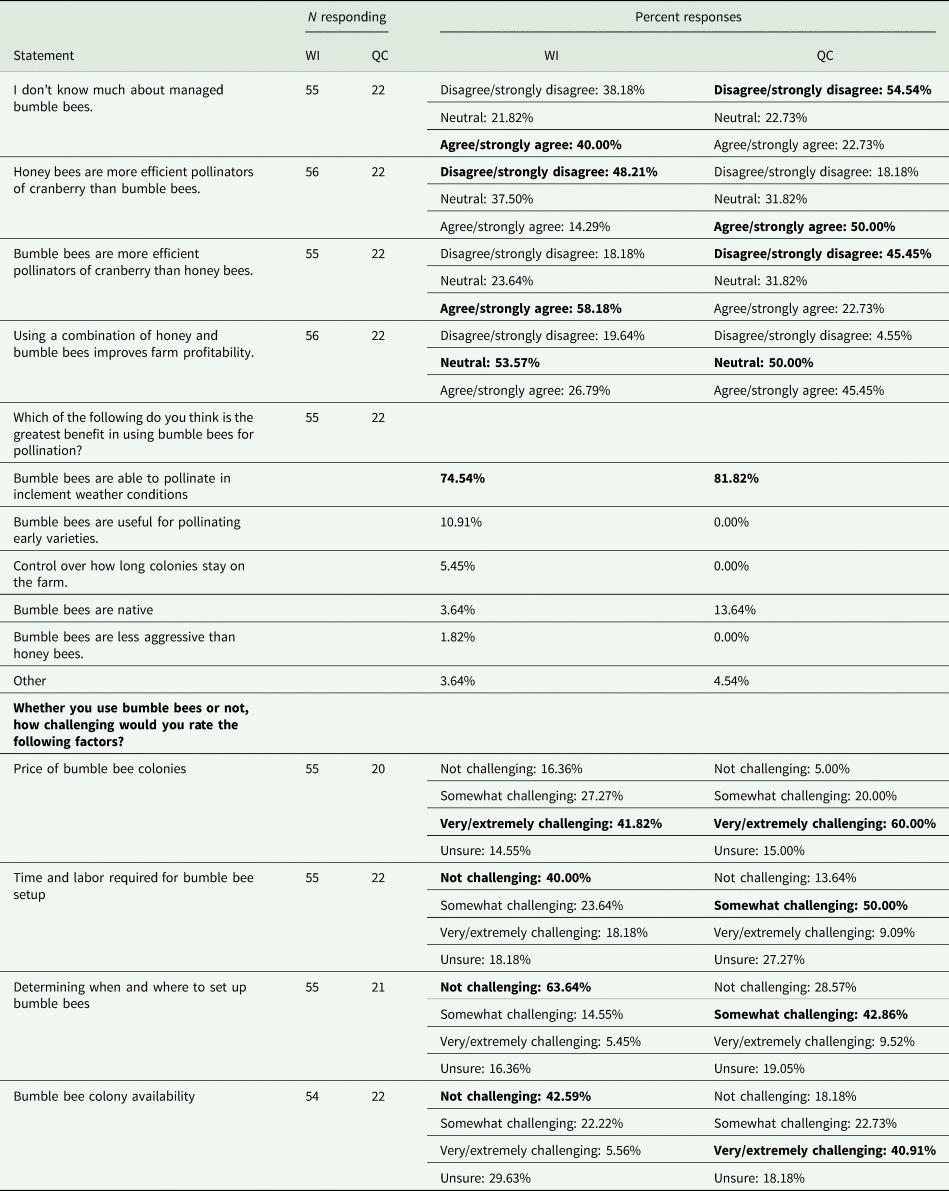
Percentage of Quebec and Wisconsin survey respondents indicating that they agree or strongly agree with a number of statements regarding honey bee and bumble bees as pollinators of cranberry.

Survey respondents were also asked about perceived declines in honey bee quality or availability over the last five years. The majority of respondents in both regions did not feel that there had been any decrease in honey bee colony availability over the last five years (50.00% WI, 63.64% QC respondents answering ‘disagree/strongly disagree’, Supplemental Information 3). This tracks with data available from national agricultural censuses (Statistics Canada, 2019; USDA NASS, 2021), which have not reported any substantial decline over the last five years in honey bee colony stocks. However, a substantial proportion of QC respondents felt that there had been a decrease in the quality of honey bee colonies offered over the last five years, while most WI respondents have not noticed a decrease in quality (17.86% WI, 40.91% QC respondents answering ‘agree/strongly agree’).
The greatest perceived benefit of utilizing managed bumble bees for pollination in both regions was their ability to pollinate in inclement weather (74.54% WI, 81.82% QC respondents). This makes sense, as the cranberry growing season in both WI and QC is often cool and rainy (Peel, Finlayson and McMahon, Reference Peel, Finlayson and McMahon2007), and bumble bees are able to fly better and forage at lower temperatures than honey bees in cranberry (Broussard et al., Reference Broussard, Rao, Stephen and White2011). For QC respondents, the second most important advantage of utilizing bumble bees for pollination services was the fact that they are native to North America (13.64% QC, 3.64% WI), while in WI it was the utility of bumble bees for pollinating early blooming cranberry cultivars (0.00% QC, 10.91% WI). The greatest perceived challenge of utilizing managed bumble bees for pollination in both areas was the price of colonies (41.82% WI, 60.00% QC respondents considered this ‘very/extremely’ challenging). This is somewhat perplexing, as bumble bee quads are less expensive to purchase than the rental price for colony rentals in either region, with an approximately $40 USD discrepancy in QC (Table 2). Survey respondents may believe that higher costs for honey bee colonies are justified due to their greater number of bees/colony, leading to a sense of a greater number of pollinators per dollar spent. The time and labor involved in bumble bee colony setup was the second most frequent factor considered ‘very/extremely challenging’ in WI (18.18% WI, 9.09% QC respondents), while the availability of bumble bee colonies was the second most common factor selected as ‘very/extremely challenging’ by QC respondents (5.56% WI, 40.91% QC). It may prove beneficial for suppliers of managed bumble bees to increase their product availability in QC, as a lack of colony availability is hindering the more widespread adoption of managed bumble bees for cranberry pollination within the region.
Conclusion
As agricultural intensification continues to increase throughout the world, the demand for pollination services continues to increase. Global honey bee stocks are not growing fast enough to keep up with this increased demand (Aizen and Harder, Reference Aizen and Harder2009; Breeze et al., Reference Breeze, Vaissière, Bommarco, Petanidou, Seraphides, Kozák, Scheper, Biesmeijer, Kleijn, Gyldenkærne, Moretti, Holzschuh, Steffan-Dewenter, Stout, Pärtel, Zobel and Potts2014), leading some industries to consider the benefits of managed bumble bees for crop pollination (Velthuis and Van Doorn, Reference Velthuis and Van Doorn2006; Garibaldi et al., Reference Garibaldi, Requier, Rollin and Andersson2017). Here, we found that Wisconsin (WI) and Quebec (QC) cranberry growers largely follow similar pollination practices, but with some differences in the price growers pay for pollination services and the duration managed bees are left on farms. Almost all respondents utilize honey bees for pollination and the demand for managed pollinators in both regions seems fairly inelastic, as fewer than 20% of respondents in either region reported that they would stop stocking managed bees if prices got ‘too high’. In both regions, respondents consider beekeepers, crop consultants, and university specialists important sources of crop pollination information. Respondent attitudes on managed bumble bees varied considerably by region regarding their knowledge of the relative efficiency of bumble bees and honey bees to pollinate cranberry flowers, though respondents from both regions agreed that the greatest potential benefit for bumble bees was their ability to pollinate in inclement weather, and their greatest challenge was the price of quad purchase.
A greater understanding of cranberry grower characteristics, pollination practices, and attitudes toward managed bumble bees from some of the world's largest cranberry producing areas will assist in the development of educational materials and recommendations that will increase the overall sustainability of the cranberry industry. It is vital to note that many of the largest cranberry growing counties in WI were not thoroughly surveyed within our study, and future efforts should be made to gather responses from more growers in the region- potentially by distributing the survey physically (as in Gaines-Day and Gratton, Reference Gaines-Day and Gratton2017) rather than solely by email. Nevertheless, the recommendations we make here will hopefully result in a diversification in pollination services by encouraging greater adoption of managed bumble bees and planting of pollinator gardens to foster wild bees in cranberry agroecosystems. While this study focused on WI and QC, other cranberry growing regions in North America could also benefit from these recommendations. If growers become less reliant on pollination services provided by honey bees, either through the adoption of managed bumble bees on their farm, greater support of wild bees already within the agroecosystem, or some combination of these two factors, it may provide a buffer from some of the many concerns regarding honey bee colony health, or increased prices for honey bee hive rentals as the demand for pollination continues to outpace the growth of honey bee stocks.
Supplementary material
The supplementary material for this article can be found at https://doi.org/10.1017/S1742170523000352.
Acknowledgements
We sincerely thank all the anonymous growers in Quebec and Wisconsin who participated in our surveys. Survey questions were reviewed by and built on a previous survey conducted by Hannah Gaines-Day. Questions were approved by the University of Wisconsin-Madison Institutional Review Board for domestic and international use (IRB # 2019-0035-CP001). Maria Kamenetsky provided valuable statistical insight. Funding for research was provided by grants to C. Guédot from the Wisconsin Cranberry Growers' Association and the Wisconsin Department of Agriculture, Trade, and Consumer Protection, Specialty Crop Block Grant #19-04.
Authors’ contributions
Christelle Guédot, Monica Quezada, and Nolan Amon designed the research. Christelle Guédot secured funding. Nolan Amon and Didier Labarre collected the data and Nolan Amon analyzed the data. Nolan Amon and Christelle Guédot wrote the manuscript. All authors read and approved this manuscript.


 Open access

