





Highlights
-
• Bilinguals adapt language choice and risk levels to feedback in a betting game.
-
• Positive feedback in Chinese increases the subsequent use of Chinese over English.
-
• Bilinguals take more risks following positive than negative feedback.
-
• Negative feedback prompts language switching more than positive feedback.
-
• Bilinguals respond faster after negative feedback when telling the truth.
1. Introduction
Bilingual individuals who possess the capacity to regularly use two languages tend to alternate between their linguistic repertoires to varying degrees, contingent upon surrounding circumstances. Recent evidence indicates that bilinguals can use their languages strategically when faced with the choice of being truthful or engaging in deception (Yang et al., Reference Yang, Rauwolf, Frances, Molina-Nieto, Duñabeitia and Thierry2024). Strategic language use (SLU), in a bilingual context, can be defined as the preference for using a language over the other to achieve a particular goal. Identifying the factors that influence SLU may be crucial to understand the dynamics of bilingual communication. One such factor is verbal feedback, because the language in which one receives feedback is likely to shape the way one uses that language in return. Here, we investigated how verbal feedback influences SLU in a coin-drawing game incentivising lying (Yang et al., Reference Yang, Rauwolf, Frances, Molina-Nieto, Duñabeitia and Thierry2024).
The concept of SLU is linked to that of the Foreign Language Effect (FLE, Keysar et al., Reference Keysar, Hayakawa and An2012), according to which bilinguals may process information and make decisions differently depending on the current language context (native or foreign). In a seminal study, Keysar et al. (Reference Keysar, Hayakawa and An2012) showed that reasoning in a non-native language can mitigate decision-making biases in bilinguals, causing them to assess the positive and negative consequences of situations differently in their native and foreign language. By presenting participants with emotionally charged scenarios like the “Asian disease” problem (Tversky & Kahneman, Reference Tversky and Kahneman1985) in three experiments, the authors found evidence for more rational behaviour when participants operate in the non-native language.
In a study that explored the impact of verbal feedback on risk-taking, Gao et al. (Reference Gao, Zika, Rogers and Thierry2015) examined the ratio of “play” to “drop” decisions in Chinese-English bilingual participants engaged in an equal-odds betting game. Verbal feedback, either positive or negative, was provided after each trial based on the outcome of the bet and delivered either in the participants’ native language, Chinese, or the foreign language, English. Participants had a greater inclination to take risks after receiving positive feedback in Chinese as compared to English. ERP results further showed that the impact of feedback was stronger in Chinese than in English, as reflected by a greater amplitude of the feedback-related negativity. At first glance, the outcomes of this study may seem inconsistent with the findings of Keysar et al. (Reference Keysar, Hayakawa and An2012), who found a decrease in the negative bias when using the foreign language. However, in both cases, the source of the effect may be attributed to relative emotional detachment in a foreign language (Caldwell-Harris, Reference Caldwell-Harris2015; Gao et al., Reference Gao, Luo and Gou2020; Hsu et al., Reference Hsu, Jacobs and Conrad2015; Jończyk et al., Reference Jończyk, Boutonnet, Musiał, Hoemann and Thierry2016; Pavlenko, Reference Pavlenko2004, Reference Pavlenko2005, Reference Pavlenko2012; Puntoni et al., Reference Puntoni, De Langhe and Van Osselaer2009; Wu & Thierry, Reference Wu and Thierry2012).
Zheng et al. (Reference Zheng, Mobbs and Yu2020) found no difference between languages in a similar even-probability gambling task as that used by Gao et al. (Reference Gao, Zika, Rogers and Thierry2015), but their participants showed enhanced neural responses to positive feedback in the foreign language, manifested through increased activation of the brain’s reward circuit. In an fMRI study using the same task concept, Hu et al. (Reference Hu, Li, Li, Zhang, Lan, Gao and Gao2022) further showed that positive feedback in English reduces the probability of risk-taking, but no difference between language context was found for negative feedback, a result that mirrors the effects reported by Gao et al. (Reference Gao, Zika, Rogers and Thierry2015). The above studies thus show different (but not nessarily inconsistent) effects of verbal feedback on risk-taking depending on valence and language, highlighting the complex interplay between language, feedback, and decision-making in bilinguals.
While a substantial amount of research has focused on decision-making in bilinguals, few studies have examined the relationship between the emotional context in which deception takes place (Bereby‐Meyer et al., Reference Bereby‐Meyer, Hayakawa, Shalvi, Corey, Costa and Keysar2020; Caldwell-Harris & Ayçiçeği-Dinn, Reference Caldwell-Harris and Ayçiçeği-Dinn2009; Duñabeitia & Costa, Reference Duñabeitia and Costa2015; Gai & Puntoni, Reference Gai and Puntoni2018; Suchotzki & Gamer, Reference Suchotzki and Gamer2018). This is important considering the potentially wide-ranging implications of the intuitive relationship between language and deception in domains such as the justice system, employment, and politics, to name only a few. Since lying can occur is likely to occur in such contexts, understanding how language use interacts with emotional feedback may reduce misunderstandings, and improve fairness and transparency in critical verbal interactions. For example, a witness interviewed in their second language may find it easier to lie or omit details when giving a statement, whereas being interviewed in their native language may encourage truthfulness. One possible explanation for the limited research in this area is the inherent difficulty of implicitly manipulating participants’ intention to deceive. Simply instructing participants to lie under specific experimental conditions while concurrently manipulating the language of operation is inherently artificial and likely to trigger metacognitive evaluation and unrealistic strategic behaviour. Some studies conducted on bilinguals have suggested that individuals found it less effortful to lie in a foreign language, but the findings remain inconclusive (Bereby‐Meyer et al., Reference Bereby‐Meyer, Hayakawa, Shalvi, Corey, Costa and Keysar2020; Caldwell-Harris & Ayçiçeği-Dinn, Reference Caldwell-Harris and Ayçiçeği-Dinn2009; Duñabeitia & Costa, Reference Duñabeitia and Costa2015; Gai & Puntoni, Reference Gai and Puntoni2018; Suchotzki & Gamer, Reference Suchotzki and Gamer2018; Yang et al., Reference Yang, Rauwolf, Frances, Molina-Nieto, Duñabeitia and Thierry2024).
Caldwell-Harris and Ayçiçeği-Dinn (Reference Caldwell-Harris and Ayçiçeği-Dinn2009), for instance, asked Turkish-English participants to read truthful and deceptive statements aloud in their native and foreign languages before rating their emotional experience. They showed a stronger negative emotional impact in bilinguals producing lies in Turkish as compared to English, even though higher skin conductance responses (SCRs) were elicited by L2-English statements. This suggests that “double stressor” (i.e., both emotional arousal from lying and anxiety) associated with producing speech in a second language influence electrodermal activity. Duñabeitia and Costa (Reference Duñabeitia and Costa2015) investigated Spanish-English bilinguals as they were instructed to produce truthful and untruthful descriptions of animal pictures. Although no interaction between the language of operation and truthfulness was found, participants responded slower and exhibited larger pupil dilations when using the foreign language and when lying compared to telling the truth. In a study by Bereby‐Meyer et al. (Reference Bereby‐Meyer, Hayakawa, Shalvi, Corey, Costa and Keysar2020), a large cohort of bilinguals was asked to roll a die three times and report the first number drawn, which determined a monetary reward. Participants tended to lie less frequently in the foreign than their native language, which the authors attributed to decision-making in the foreign language being less intuitive and thus leading to more explicit deliberations. Suchotzki and Gamer (Reference Suchotzki and Gamer2018) presented German-English bilinguals with neutral and emotionally challenging private questions in both their languages and found that the foreign language tends to impede truth-telling. They also found a smaller difference in reaction times between lying and truth-telling in the foreign language compared to the native language, despite extended response times in the truth-telling condition. Gai and Puntoni (Reference Gai and Puntoni2018) had bilingual participants do a spot-the-difference task in images and showed that foreign language use decreased “minor lies” (i.e., when there is only one difference between the images, requiring minimal dishonesty) and increased “major lies” (i.e., when participants reported differences despite none being present, which required the highest level of dishonesty). The authors argued that because emotional intensity was reduced in the foreign language, negative emotions related to cheating tended to be stronger as the level of dishonesty increased, outweighing positive emotions associated with major cheating.
To study how lying can influence language choice, we previously designed an online coin-drawing game that allowed Chinese-English bilinguals to freely decide whether to use the native or the foreign language when announcing the result of a coin draw in a betting game (Yang et al., Reference Yang, Rauwolf, Frances, Molina-Nieto, Duñabeitia and Thierry2024). Participants showed a preference for telling the truth in their native language and were primed to use Chinese after telling the truth, which is conceptually equivalent to choosing English over Chinese when telling lies. The results indicated that Chinese-English bilinguals tend to use their native and foreign languages strategically when making true and false statements, a phenomenon that we labelled SLU. However, a key element of everyday interactions that carries emotional valence and is likely to affect bilinguals’ SLU, is feedback. Due to language priming effects, where the use of one language increases the likelihood of using the same language in the next trial, or because differential sensitivity to verbal feedback can override more subtle strategic trends, one can expect that verbal feedback will interfere with SLU in bilinguals. To our knowledge, this has never been tested experimentally.
1.1. The current study
Here, we focus on the constraints imposed by positive and negative feedback in English and Chinese on bilinguals’ SLU and risk-taking behaviour. In other words, we tested how verbal feedback provided by a virtual AI opponent modulates language use in a game of bets. In essence, our study focuses on SLU as a form of “reversed FLE,” whereby bilinguals’ intention, modulated by verbal feedback, determines their subsequent language choice, rather than how the language context influences decision-making. In this case, language use serves as a measured (dependent) variable rather than a manipulated (independent) variable. Given that lying requires more cognitive effort than telling the truth (Verschuere et al., Reference Verschuere, Köbis, Bereby-Meyer, Rand and Shalvi2018) and that the foreign language elicits less emotional arousal compared to the native language (as discussed previously), bilinguals might exhibit a preference for using the foreign language when they intend to lie. This preference may be congruent with our previous findings, which showed a tendency to use a foreign language in deceptive situations. However, it is unclear whether and how verbal feedback changes bilinguals’ tendency to use their native language for telling the truth and the foreign language for lying.
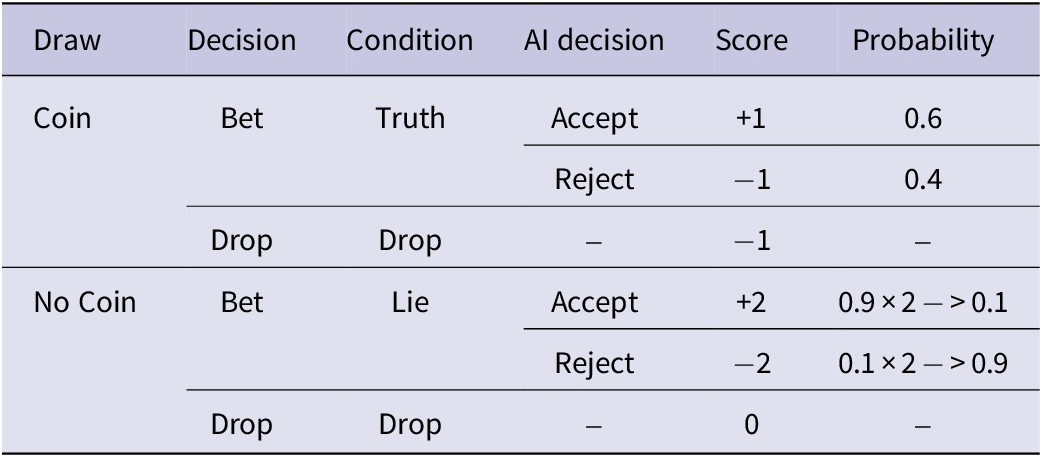
To investigate this, we adapted an online coin-drawing game from Yang et al. (Reference Yang, Rauwolf, Frances, Molina-Nieto, Duñabeitia and Thierry2024) and recruited Chinese-English bilingual participants to play against a virtual opponent. In each trial, participants were given the option to choose either their native (Chinese) or foreign language (English) to announce a coin. The game started with an animation of a coin flickering with two possible outcomes: Coin (a coin has been drawn) or No Coin (no coin has been drawn; see Table 1 for details).
Possible coin draw outcomes, conditions, and AI decisions

Note: In the No Coin – Bet condition, the probability of AI acceptance was 0.9 for two consecutive bets (0.9 × 2) and changed to 0.1 after that, until the participant chose to drop once.
Following the display of the draw outcome on the screen, participants were required to make a decision: Announce the presence of a coin (Bet) or drop. If participants had drawn a coin, they were instructed to announce it (i.e., bet every time) and thus tell the truth (Truth condition). Conversely, if they were in the No Coin condition, they could either deceptively announce a coin (Lie condition) or drop. Coin announcements were directed toward an “Artificial Intelligence” agent (AI) who accepted or rejected the participants’ bet in each trial and provided verbal feedback accordingly. This paradigm implicitly placed participants in a strategic situation, prompting them to work out a pattern in AI decisions to maximise their wins, despite the underlying mechanism of the “AI” being quite simpleFootnote 1. As a result, participants were incentivised to provide self-serving lies, in a context where they were free to respond in either language. This allows us to examine how verbal feedback modulates bilinguals’ tendency to choose a particular language. Additionally, we can also observe their language-switching behaviour from one trial to the next. We hypothesised that participants would switch languages based on the context and that such language switch could be strategic.
First, we hypothesised that bilinguals would take more risks after receiving positive feedback (Gao et al., Reference Gao, Zika, Rogers and Thierry2015) and use their native language (Chinese) more to bet when positive feedback was received in Chinese in the previous trial. This hypothesis aligns with the results obtained by Keysar et al. (Reference Keysar, Hayakawa and An2012), suggesting that the native language prompts higher emotional response than the foreign language. If positive feedback in the native language leads to heightened emotional responses, it may drive a preference for continuing to use that language, as it would be perceived as more emotionally satisfying. We also predicted that they would select Chinese faster than English after receiving positive feedback, and after choosing Chinese in the previous trial, due to language priming, where the recently used language is easier to access when participants are not motivated to switch. For exploratory purposes, we investigated whether verbal feedback lead participants to choose one language over the other, depending on whether they were telling the truth or not. The study was pre-registered on aspredicted.com (https://aspredicted.org/8R8_8XP)Footnote 2.
2. Methods
2.1. Participants
Fifty-seven Chinese-English bilinguals from China (25 females; Mean age = 22, SD = 2.16; 40 right-handed, 2 left-handed, 9 ambidextrous users) were recruited online. The number of participants was based on a power simulation conducted with the Superpower package (Lakens & Caldwell, Reference Lakens and Caldwell2021) in R (RStudio Team, 2015) using pilot data collected from 14 participants (not included). After 10000 simulations, based on the effects observed in the pilot group, this analysis showed that a sample size of 9 participants would be required to achieve a threshold of 90% power (α = 0.05) for detecting an interaction between Feedback Language and Feedback Valence, 51 participants would be needed to detect an interaction between Feedback Language and Language Choice, 22 participants would be required to detect an interaction between Feedback Valence and Language Choice, and 29 participants would be required to detect a three-way interaction. Given concerns regarding the use of effect sizes derived from pilot data to conduct power simulation (e.g., Kraemer et al., Reference Kraemer, Mintz, Noda, Tinklenberg and Yesavage2006, Thabane et al., Reference Thabane, Ma, Chu, Cheng, Ismaila, Rios, Robson, Thabane, Giangregorio and Goldsmith2010), we also checked that we would not be underpowered by calculating observed power in our previous study, which used the same coin drawing game (Yang et al., Reference Yang, Rauwolf, Frances, Molina-Nieto, Duñabeitia and Thierry2024). We found that a sample size of 20 participants was sufficient to achieve over 90% power to detect the interaction between Language and Truth Value.
We excluded six participants who were in one of the following situations: basic misunderstanding of the game rules or failure to follow instructions, incomplete datasets due to aborted experiments (number of participants: 3), systematic and non-strategic betting throughout the experiment resulting in constant point loss (i.e., continuously betting without ever choosing to drop; number of participant: 1), use of the same key throughout the experiment regardless of the associated language (number of participant: 1), and experiment repetition or reporting awareness of the game’s purpose (number of participant: 1). The 51 participants included all had college-level education (average duration of education 15.8 + 2.2 years).
Participants were monetarily compensated (an amount of RMB 30) and, to boost their motivation, they were informed that the top three scorers would receive a bonus award (an amount of RMB 80, 50, and 30, respectively) at the end of data collection. All participants self-reported having normal or corrected-to-normal vision, without any hearing impairments or learning and language disabilities. Prior to their participation, they gave written consent to participate in the study. Ethics approval was granted by the ethics committee of the School of Human and Behavioural Sciences at Bangor University (authorisation number: 2021–16892).
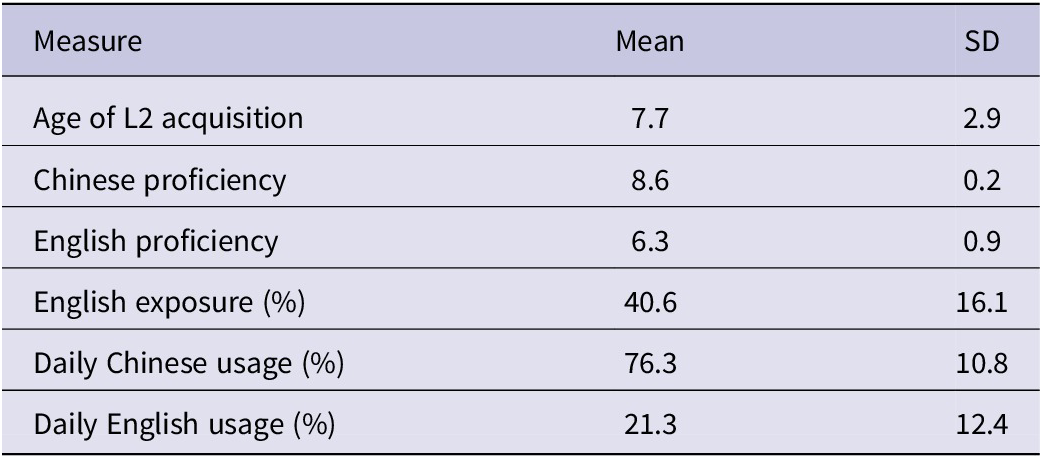
Participants’ language use and handedness information was measured by the Language Experience and Proficiency Questionnaire (LEAP-Q; Marian et al., Reference Marian, Blumenfeld and Kaushanskaya2007) and the Edinburgh Handedness Inventory (EHI, Oldfield, Reference Oldfield1971). Table 2 provides a summary of their language background. Following the experiment, participants were also asked post-experiment questions about their perceptions of AI behaviour and the potential connection between their language choices and decisions (Chinese translations of answers can be found on the Supplementary Materials 2).
Chinese-English bilinguals’ language background

Note: Participants’ language background including the L2 age of acquisition, L1 and L2 self-rated proficiency averaged over listening comprehension, speaking and reading on a scale of 1 to 10 (10 = very high/native), L2 exposure at the time of testing, and daily L1 and L2 usage (in percentage).
2.2. Materials
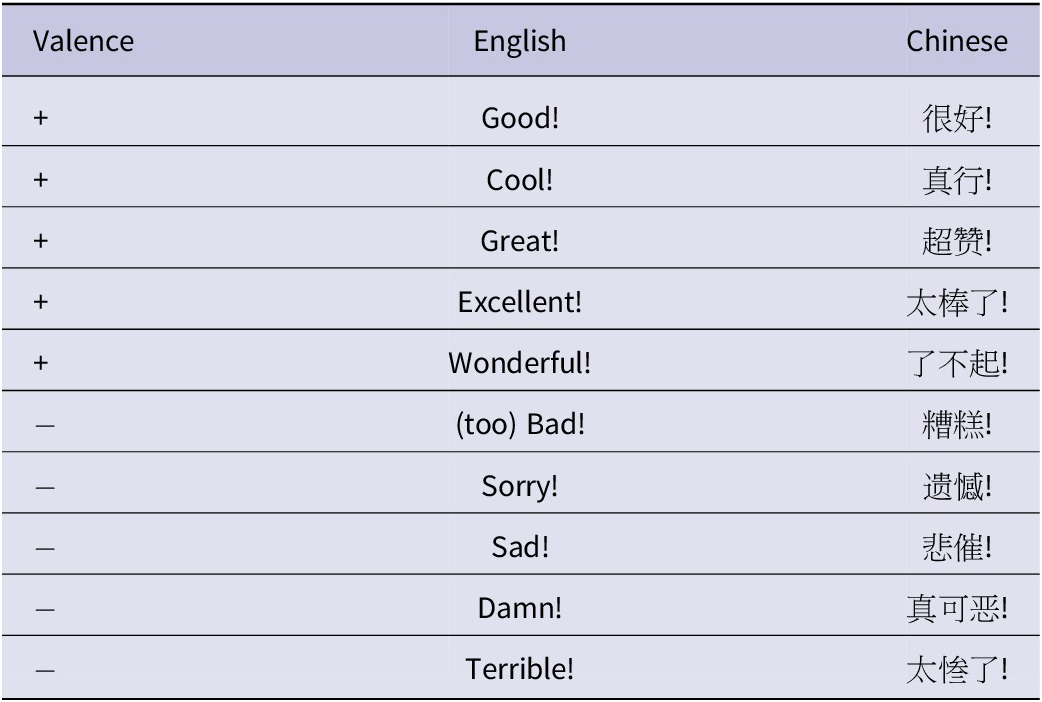
Two sets of written instructions in Mandarin Chinese and English were provided and further visualised with situational illustrations of the game rules. The overall design of the main experimental screen is shown in Figure 1: A circle representing the potential presence of a coin was displayed, indicating the outcome of the current draw. Positioned above the circle were the options for “announcements” written in both Chinese and English, corresponding to the keyboard keys F and J. The image of the coin appeared between these two keys, and an empty circle was inserted above the spacebar to associate the spacebar with a drop decision. Twenty instances of verbal feedback varying in language (ten in Chinese, ten in English) and valence (ten positives, ten negatives; see Table 3; Gao et al., Reference Gao, Zika, Rogers and Thierry2015) were used to announce AI decisions. Finally, the score for the current trial and overall score were displayed to the left and right of the feedback, respectively.
Examples of instructions screens of the coin-drawing game with verbal feedback (left: case when a coin is drawn, right: case when no coin is drawn). Note that the commentaries in grey rounded boxes appear only during the pre-session instructions.

Verbal feedback used in the coin game

2.3. Experimental design and procedure
The coin-drawing game was designed like the interface of a mobile app. Each trial started with the presentation of a circle containing a flickering coin representation, which either vanished (No Coin) or persisted (Coin). Subsequently, participants were instructed to announce whether they had drawn a coin or not. If participants had drawn a coin, they were required to announce a coin/bet (Truth condition) by pressing either the F or J key, depending on the preferred language. Then the AI opponent “made a decision” to accept or reject the bet. Acceptance resulted in the addition of one point, whereas rejection led to the loss of one point (Table 1). Given the instruction to always bet when a coin was drawn, participants automatically incurred a loss of one point if they chose to drop with a coin (i.e., press the spacebar). When participants did not draw a coin (No Coin), they were free to either bet or drop. If they chose to bet without a coin, they were de facto lying (Lie condition). If the AI accepted the bet, they scored two points as they had managed to trick the AI, but if the bet was rejected, they lost two points, since the lie had been “detected.” However, participants did not get penalised when they dropped without a coin. After any bet, participants received verbal feedback from the AI (see Table 3). The language of feedback was always the same as the language they selected to announce their bet, and valence was always consistent with the AI decision (positive for acceptance, and negative for rejection). The actual words used for verbal feedback were randomly selected within valence on each trial.
Language options for betting were assigned randomly to the F and J keys in each trial to prevent participants from using the same key throughout the experiment unless they paid no attention to language. It is important to note that there was no instruction or explicit mention of language choice at any point. Also, note that the decision to drop (i.e., pressing the spacebar) involved no language choice.
Unbeknownst to the participants, the “AI” agent was a simple probability algorithm. In the truth condition (Coin), the AI accepted bets at a consistent rate of 60% to secure an overall trend of increasing scores. Conversely, in the lie condition (No Coin), the AI accepted bets at a 90% rate for two consecutive lies, before switching to a 10% acceptance rate from the third lie onwards. The acceptance rate reverted to 90% only after participants had chosen to drop at any point after the first two consecutive lies. This prompted participants to bet cautiously (since systematic betting would lead to consistent loss of points) and focus on AI decision patterns to maximise their score. Since the experiment was conducted online, the experimenter could not influence the participants’ strategy or their knowledge of the procedure (i.e., participants were blind regarding the objectives of the experiment and its construction).
The experiment consisted of a practice block with eight trials and a test block with 248 trials (equal numbers of Coin and No Coin draws). Since they were not supposed to drop the bet when they had a coin, a warning image was presented to participants in this situation during the practice blocks.
After completing and signing the consent form, participants either completed the questionnaires (LEAP-Q and EHI) on Qualtrics (https://www.qualtrics.com) or started the experiment (the game) with order randomised between participants, to mitigate the potential impact of order effects or other biases on experimental outcomes. The experiment was programmed in OpenSesame (Mathôt et al., Reference Mathôt, Schreij and Theeuwes2012) and ran in JATOS (Lange et al., Reference Lange, Kühn and Filevich2015). To immerse participants in a bilingual setting, the experiment started with written instructions sequentially presented in English and Mandarin Chinese paragraph-by-paragraph. The first paragraph in either language was assigned randomly to each participant. Participants were explicitly informed of their goal, which was to strive for the highest achievable score in the game. Then, screen captures depicting all possible conditions (six cases in total) were displayed, accompanied by explanatory text and directional arrows presented in either the participants’ native or foreign language. This comprehensive pre-session familiarisation aimed to ensure participants’ understanding of the game dynamics. After the experiment, participants were asked to answer questions regarding their thoughts about the AI’s behaviour and possible relationships between their language use and decisions.
2.4. Analyses
Unless stated otherwise, all data analyses conducted in this study concern bet trials, i.e., the trials where participants announced to the AI that they had a coin, regardless of the outcome of the draw. Note that drop trials do not contribute information about language choiceFootnote 3. As outlined in the pre-registration of the study, trials with response times (RTs) that were either too short to be deemed valid (< 200 ms) or too long to be representative (> 5000 ms) were excluded from the analyses. This led to a loss of 7.2% of trials overall. The total number of trials was 11735, comprising 5887 Coin trials and 5848 No Coin trials, with 9634 bet trials (82.1%), and 2101 drop trials (17.9%). Within the Coin condition, there were 5767 bet trials (98.0%) and 120 drop trials. In the No Coin condition, there were 3,867 bet trials (66.1%) and 1,981 drop trials. As regard language switching, there were 2126 switch trials (36.1% in the Coin condition), and 1350 switch trials (23.1% in the No Coin condition).
2.5. Pre-registered analyses
2.5.1. Language choice ~ feedback
First, to test how feedback from the previous trial modulates participants’ Language Choices (Chinese or English) in the subsequent trial, the counts of language choices in betting trials (including trials in both Coin and No Coin conditions) were analysed using binary logistic mixed-effects models. In this regression, Feedback Language (Chinese, English) and Feedback Valence (positive, negative) from the previous trial were used as predictors, with Language Choice in the current trial as the dependent variable. We also conducted paired samples t-tests to determine if participants’ language choices significantly differed from 50% chance of random selection, since participants could select either language and the order of languages was counterbalanced. If participants preferred one language over the other, there should be a significant difference in their language choices.
2.5.2. Betting decision ~ feedback
Second, we modelled counts of participants’ Betting Decisions (bet, drop) in the No Coin condition (concerning all trials) using binary logistic regression. Feedback Language and Feedback Valence from the previous trial were used as predictors, with Betting Decision in the current trial as the dependent variable. This analysis aimed to test whether participants’ risk-taking behaviour was influenced by feedback valence.
2.6. Exploratory analyses
2.6.1. Language choice ~ truth value in the current/previous trial
Third, exploratory analyses (concerning all trials) were conducted to investigate the relationship between Language Choice and Truth Value (truth, lie), considering both the truth value in the current and previous trials. The goal was to examine whether bilingual participants tended to use a specific language in truthful or deceptive conditions. Counts of Language Choices as the dependent variable and Truth Value as a predictor were analysed using binary logistic mixed-effects modelling.
2.7. Switching occurrence
Another exploratory analysis (concerning all trials) focused on participants’ Language Switching (switch, no switch), considering the influence of Truth Value and Feedback Valence from the previous trial. We computed binary logistic mixed-effects models of switch counts to test whether participants tended to switch language when telling the truth or lying and depending on whether they received positive or negative feedback in the previous trial. In summary, these analyses aimed to replicate findings from our previous study (Yang et al., Reference Yang, Rauwolf, Frances, Molina-Nieto, Duñabeitia and Thierry2024), thereby providing further insight into the dynamics of language choice and truthfulness. Instructions, compiled data, and statistical output are available on the Open Science Framework (https://osf.io/24pdj/?view_only=60deee910e1e41648d5480da2bca12f0).
For the above analyses, logistic mixed-effects models were tested using the glmer function from the lme4 package (Bates et al., Reference Bates, Mächler, Bolker and Walker2015) in R (R Studio Team, 2020), employing a binomial link function. The estimated marginal means (emmeans) and contrast results are presented on the logit and log odds ratio scales, respectively. Furthermore, corresponding RTs for participants’ language choice, betting decision, and language switching were examined using linear mixed-effects regression (lmer function). Trial NumberFootnote 4 was used as a predictor in all analyses to track differences in participants’ performance and RTs over time.
Detailed information on the analyses, including the selection of the baseline model, can be found in the Supplementary Materials 2, alongside statistics concerning non-significant main effects and interactions.
3. Results
The statistical significance of the results reported below was determined through structured model comparisons. Notably, when examining the interactions and main effects within full models, the significance still remains evident.
3.1. Pre-registered hypothesis testing
3.1.1. Language choice ~ feedback: counts
First, we analysed counts of announcements in either of the two languages and the corresponding reaction times (RTs) in bet trials.
3.2. Analysis (4) in pre-registration
The highest-ranking significant interaction found was between Feedback Language and Feedback Valence, χ2(1) = 26.32, 95% CI = [−0.66, −0.29], p < .001. Pairwise comparisons indicated that participants were more likely to choose Chinese after receiving positive feedback in Chinese (M = .29, SE = .06) compared to positive feedback in English (M = −0.15, SE = .06), β = .44, SE = .09, z = 4.96, p < .001, see Figure 2A, whereas no such difference was found for negative feedback conditions, β = −0.03, SE = .09, z = −0.35, p = .985, see Figure 2b.
Language use after receiving verbal feedback over trial. (a) Proportions of language use (0 is 100% English and 1 is 100% Chinese) following positive feedback. (b) Proportions of language use (0 is 100% English and 1 is 100% Chinese) following negative feedback. CN, negative feedback in Chinese in the previous trial; EP = positive feedback in English in the previous trial; EN = negative feedback in English in the previous trial. Dots represent data for each participant. ***p < 0.001, **p < 0.01, *p < 0.05.

Furthermore, we conducted paired samples t-tests to determine if participants’ language choices significantly differed from random selection (defined as a 50% chance of choosing English or Chinese). Selecting Chinese after receiving positive feedback was marginally above chance but not significant, t (50) = 1.90, p = .063, but selecting Chinese after receiving negative feedback was not different from chance, t (50) = 1.14, p = .262.
3.3. Analysis (2) in pre-registration
In addition, we found that participants preferred choosing Chinese when receiving negative feedback (M = .08, SE = .06) compared to positive feedback (M = −0.15, SE = .06) in English, β = .23, SE = .07, z = 3.50, p = .003. Conversely, they were more likely to choose English following negative feedback (M = .05, SE = .06) as compared to positive feedback (M = .29, SE = .06) in Chinese, β = −0.25, SE = .07, z = −3.76, p = .001.
3.4. Analysis (3) in pre-registration
The main effect of Feedback Language was significant, χ2(1) = 7.74, 95% CI = [−0.38, 0.07], p = .005, showing that participants were more likely to choose Chinese when feedback was provided in Chinese (M = .18, SE = .05) as compared to English (M = −0.05, SE = .05), β = .23, SE = .08, z = 2.90, p = .004.
3.4.1. Language choice ~ feedback: RTs
As regards RTs, we found a main effect of Trial Number, showing that participants tended to respond faster over time, χ2(1) = 11.61, 95% CI = [−531.80, −172.18], p < .001. There was also a main effect of Feedback Valence, χ2(1) = 7.67, 95% CI = [23.64, 130.38], p = .006, such that participants tended to respond faster following negative feedback (M = 1162, SE = 66.5) than positive feedback (M = 1239, SE = 71.7).
3.4.2. Betting decision ~ feedback: counts
We analysed counts of Betting Decisions (bet, drop) and corresponding RTs in the No Coin condition (Lie condition).
3.5. Analysis (1) in pre-registration
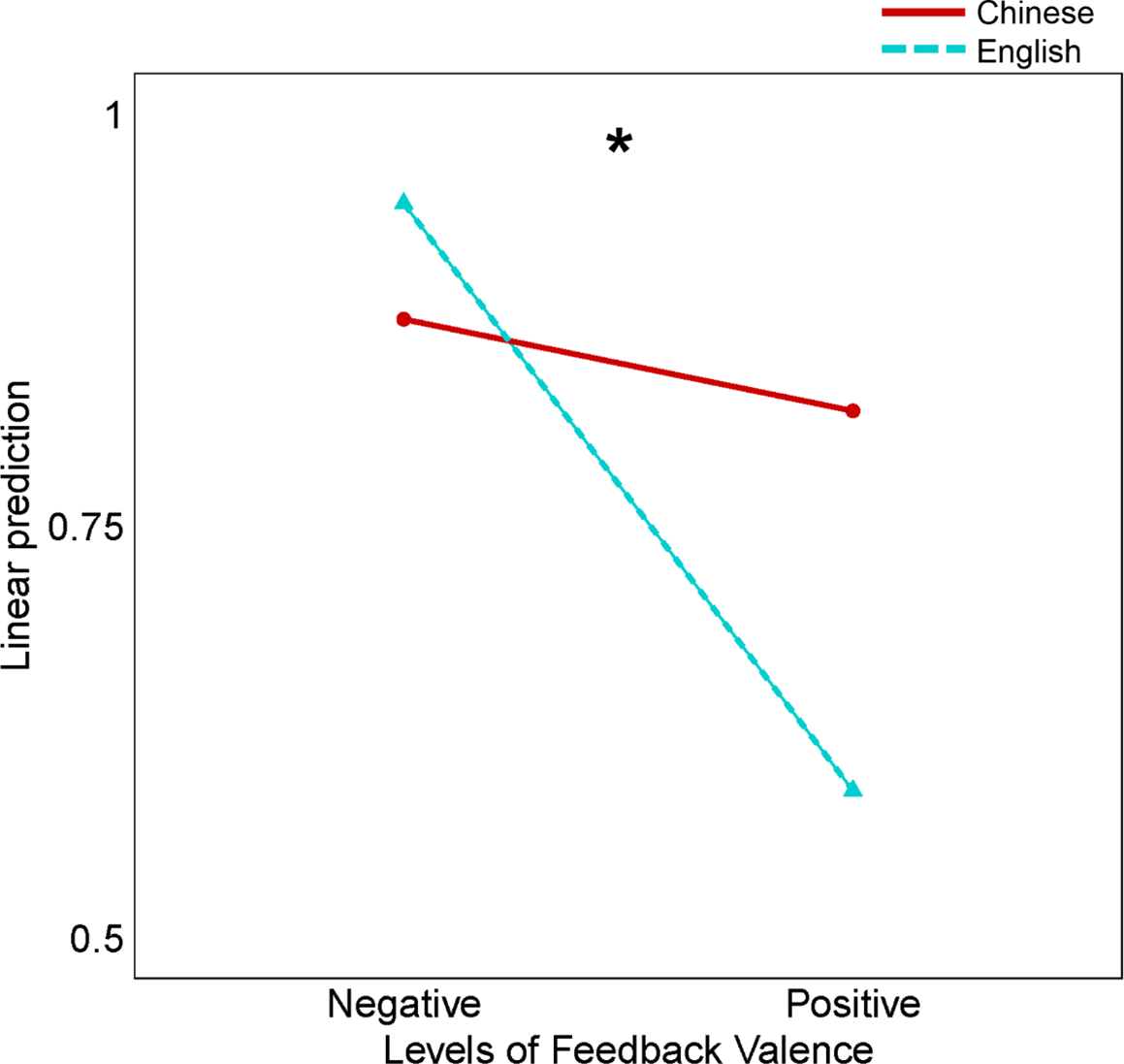
We found an interaction between Feedback Language and Feedback Valence on betting decision counts, χ2(1) = 4.40, 95% CI = [−0.58, −0.02], p = .036. Pairwise comparisons showed that after receiving positive feedback, participants tended to bet more after feedback in Chinese (M = .82, SE = .22) than feedback in English (M = .59, SE = .19), β = .23, SE = .11, z = 2.12, p = .034, see Figure 3.
Linear prediction of betting decision after receiving verbal feedback. ***p < 0.001, **p < 0.01, *p < 0.05.

There was also an interaction between Trial Number and Feedback Valence, χ2(1) = 7.56, 95% CI = [0.20, 1.19], p = .006, such that participants tended to bet more after receiving negative feedback in the early phase of the game but not the later phase. We also found an overall main effect of Trial Number, χ2(1) = 4.25, 95% CI = [−0.97, −0.05], p = .039, showing that participants tended to bet less over time.
3.5.1. Betting decision ~ feedback: RTs
As regards RTs, we found a main effect for Trial Number, χ2(1) = 26.04, 95% CI = [−688.89, −338.07], p < .001, such that participants responded faster over time.
4. Exploratory analyses
4.1. Language choice ~ truth value: counts and RTs
First, we analysed counts of announcements in the two languages and the corresponding reaction times (RTs) by considering the truth value of the current bet.
As regards RTs, there was an interaction between Trial Number and Truth Value, χ2(1) = 8.06, 95% CI = [45.90, 249.16], p = .005, such that participants responded more slowly in lying trials (M = 1247, SE = 73.3) than truth trials (M = 1178, SE = 65.2) during the first half of the experiment although this effect tended to vanish in the second half, β = 69.1, SE = 31.7, z = 2.18, p = .029, see Fig. 4. The main effect of Truth Value was significant also, χ2(1) = 4.78, 95% CI = [−420.29, −320.73], p = .029, participants responded more slowly in lie trials (M = 1248, SE = 73.3) than truth trials (M = 1178, SE = 65.2) overall.
Reaction times for truth/lie announcement over trial. Dots represent data for each participant. ***p < 0.001, **p < 0.01, *p < 0.05.

4.2. Language choice ~ truth value in the previous trial: counts and RTs
We analysed counts of language choices and the corresponding RTs considering the truth value in the previous trial.
As for RTs, there was a marginally significant main effect of Truth Value, χ2(1) = 3.79, 95% CI = [−541.56, −180.04], p = .051, such that participants responded faster to tell the truth (M = 1190, SE = 69.7) compared to lying (M = 1231, SE = 66.5). There was also a main effect of Trial Number, χ2(1) = 14.44, 95% CI = [−562.11, −203.34], p < .001, showing that participants responded more faster over time.
4.3. Switching occurrence ~ feedback valence and truth value: counts
We analysed the occurrence of language switching in relation to Feedback Valence, Truth Value, and Trial Number. We found a main effect of Feedback Valence, χ2(1) = 4.97, 95% CI = [−0.44, −0.03], p = .026, showing that participants were less likely to switch language after receiving positive feedback (M = −0.27, SE = 0.08), as compared to negative feedback (M = −0.03, SE = 0.05), see Figure 5a.
Language switching after receiving verbal feedback over trial. (a) Proportions of switching occurrence (0 is 100% no switch and 1 is 100% switch). (b) Reaction times of truth/lie announcement following feedback. P = positive feedback; N = negative feedback. (c) Reaction times following positive/negative feedback for truthful responses. ***p < 0.001, **p < 0.01, *p < 0.05.

We also found a main effect of Truth Value (marginally significant), χ2(1) = 3.27, 95% CI = [−0.25, −0.06], p = .073, showing a higher likelihood of language switching when participants were telling the truth (M = −0.07, SE = 0.04) than when lying (M = −0.16, SE = 0.05).
4.4. Switching occurrence ~ feedback valence and truth value: RTs
As regards RTs, we found an interaction between Truth Value and Trial Number, χ2(1) = 5.09, 95% CI = [22.26, 306.17], p = .024, showing that participants responded slower when lying (M = 1264, SE = 70.4) than telling the truth (M = 1166, SE = 62.0), especially in the second half of the experiment compared to the first half of the experiment, β = 98.0, SE = 27.9, z = 3.52, p < .001, see Figure 5b. We also found an interaction between Truth Value and Feedback Valence, χ2(1) = 26.44, 95% CI = [−12.47, 116.12], p < .001, showing that when telling the truth, participants responded faster after receiving positive feedback (M = 1088, SE = 61.2) than negative feedback (M = 1195, SE = 65.0), β = −106.9, SE = 30.0, z = −3.57, p = .002, see Figure 5c.
There was a main effect of Trial Number, χ2(1) = 5.84, 95% CI = [−429.33, −140.49], p = .016, indicating that participants responded faster over time. There was also a main effect of Truth Value, χ2(1) = 6.23, 95% CI = [−478.92, −140.49], p = .013, showing that participants responded more slowly in lie trials (M = 1237, SE = 70.5) than truth trials (M = 1137, SE = 62.3), β = 99.9, SE = 32.3, z = 3.09, p = .002.
5. Discussion
Here, we explored how positive and negative verbal feedback modulates SLU and risk-taking in Chinese-English bilinguals engaged in a game of bets. Participants displayed a tendency to choose L1 Chinese (the native language) over L2 English after receiving feedback in L1, whereas no language preference was found when they received feedback in L2. This effect was further enhanced when feedback in Chinese was positive and disappeared when it was negative. Participants chose a language faster after receiving negative than positive feedback. They were also more inclined to take risks (i.e., bet) after receiving positive feedback in the previous trial in Chinese compared to English. Finally, the preference for Chinese when telling the truth found in our previous study (Yang et al., Reference Yang, Rauwolf, Frances, Molina-Nieto, Duñabeitia and Thierry2024) was not found in the current study. However, participants had a greater tendency to switch between languages after receiving negative feedback (i.e., a rejection) than after receiving positive feedback (i.e., an acceptance), and did so faster when telling the truth.
5.1. Discussion of pre-registered analyses
A main finding of the current study is that participants were more likely to choose Chinese than English after receiving feedback in Chinese, which may simply reflect language priming (Schacter & Buckner, Reference Schacter and Buckner1998). That is, Chinese feedback appeared to prime participants to select Chinese if they decided to bet in the next trial, which, in turn, increased the probability of feedback being presented in Chinese in that trial, and so on (since feedback language was tied to language choice in the current trial). However, this result might also in part reflect strategic switching. Indeed, participants were more likely to switch language when they received negative feedback, which is congruent with the trend to not switch when they received positive feedback. When the feedback was negative, therefore, switching behaviour was no longer language-specific, suggesting that language priming and feedback valence had partly antagonistic effects. Considering the results obtained by Gao et al. (Reference Gao, Zika, Rogers and Thierry2015), we speculate that this might be because negative feedback had no meaningful impact on risk-taking, thus, the cross-language difference was primarily driven by positive feedback, making language choice less relevant or criticalFootnote 5.
The fact that we did not observe the same for English as for Chinese feedback may be due to language priming being weaker in the foreign language. This can be attributed to increased cognitive load when participants process information in a non-native language (Corey et al., Reference Corey, Hayakawa, Foucart, Aparici, Botella, Costa and Keysar2017). Alternatively, feedback in the foreign language may be less effective than feedback in the native language, due to reduced emotional resonance (Costa et al., Reference Costa, Foucart, Arnon, Aparici and Apesteguia2014), and/or lesser exposure and practice with a foreign language (Tenderini et al., Reference Tenderini, de Leeuw, Eilola and Pearce2022). These two explanations could also apply together. These results are broadly consistent with those obtained by Gao et al. (Reference Gao, Zika, Rogers and Thierry2015), who reported that participants take more risk after receiving positive feedback in Chinese, whereas English feedback fails to influence risk-taking regardless of valence.
Participants’ preference for switching language after receiving negative feedback may be linked to aversion, whereby negative stimuli are thought to prompt avoidance behaviour (Solarz, Reference Solarz1960). Negative feedback would trigger aversion to the language in which it is received, prompting participants to choose the other language in the next trial as a form of emotional shielding. Participants were also faster in that condition, consistent with observations that gamblers often persevere in quick gambling decisions to recover their losses (Verbruggen et al., Reference Verbruggen, Chambers, Lawrence and McLaren2017), likely due to the felt urgency to recoup losses as quickly as possible. However, such speeded response after negative feedback appears inconsistent with the greater likelihood of language switching observed in this condition, since language switching is a notably slow process (Jackson et al., Reference Jackson, Swainson, Cunnington and Jackson2001; Meuter & Allport, Reference Meuter and Allport1999). We contend that the negative emotional response to feedback was strong enough to override language switching costs. We also note that this response was only observed in the case of verbal feedback since no such effect was observed in our previous study (Yang et al., Reference Yang, Rauwolf, Frances, Molina-Nieto, Duñabeitia and Thierry2024).
Participants’ slower responses to lies than truths are likely due to the fact that they face a dual decision when they lie: the decision to bet and then the choice of language. Indeed, in the truth trials, participants had a coin and they had to bet. But this could also reflect the added time required to suppress a truthful response when having opted for a lie, consistent with numerous studies reporting slower RTs for lying than telling the truth (Seymour et al., Reference Seymour, Seifert, Shafto and Mosmann2000; Seymour & Kerlin, Reference Seymour and Kerlin2008; Suchotzki et al., Reference Suchotzki, Verschuere, Van Bockstaele, Ben-Shakhar and Crombez2017; Ziano & Wang, Reference Ziano and Wang2021).
Regarding betting decision (No Coin/Lie trials only), participants’ tendency to bet more when they received positive feedback in Chinese as compared to English replicates the findings of Gao et al. (Reference Gao, Zika, Rogers and Thierry2015), who found that positive feedback in the L1 prompted a ‘hot hand’ fallacy effect, absent in the case of L2 feedback. Here, risk-taking took the form of betting without a coin, i.e., lying. This pattern of results is consistent with the concept of affect heuristic proposed by Slovic et al. (Reference Slovic, Finucane, Peters and MacGregor2007), according to which positive situations are perceived as less risky and negative ones as riskier. However, the tendency to bet more after receiving feedback in Chinese seems to go against our previous findings, whereby bilinguals tend to be more truthful in the L1 (Yang et al., Reference Yang, Rauwolf, Frances, Molina-Nieto, Duñabeitia and Thierry2024). Therefore, the effect of language feedback on risk-taking appears stronger than the effect of native language prompting truth statements.
5.2. Discussion of exploratory analyses
The exploratory analyses aimed to replicate the findings on language choice association with truths or lies (Yang et al., Reference Yang, Rauwolf, Frances, Molina-Nieto, Duñabeitia and Thierry2024). When verbal feedback was taken into account, the language patterns found previously changed, however. Verbal feedback may have taken precedence over the participants’ language choice independently of truth status. This may be explained by participants taking into consideration the feedback language when choosing the announcement language. Even if this was the case, according to self-reports, participants did not gain a greater awareness of potential links between feedback language and decision-making. Thus, receiving verbal feedback in the native or foreign language results in a language-priming effect that seems to supersede SLU.
To explain why the tendency to choose Chinese to make a truthful statement did not emerge here, we need to consider the interplay between verbal feedback, risk-taking, language use, and lying. Gao et al. (Reference Gao, Zika, Rogers and Thierry2015) found that positive feedback in the native language prompts bilinguals to take more risks. However, in the current study, risk-taking was greater in the Lie than the Truth condition (since participants could win or lose more points in the Lie condition). In addition, the FLE predicts that bilinguals would be more inclined to use a foreign language when engaging in deception. Thus, on the one hand, positive feedback in Chinese should have prompted more lies but, on the other hand, lying should be more likely in the foreign language. Therefore, the two forces at work determining SLU appear to operate in opposite directions, and we also need to consider the “hot hand” effect discussed above.
Nevertheless, this effect of verbal feedback did not extend to changing participants’ switching behaviour, as in Yang et al. (Reference Yang, Rauwolf, Frances, Molina-Nieto, Duñabeitia and Thierry2024). Their study showed a tendency to switch more after receiving negative feedback (i.e., being rejected) than after receiving positive feedback. It was further linked to a faster response time, showing that negative feedback may have triggered a less deliberative response, and prompting a shift in language use as a coping mechanism. This evidence is also consistent with SLU in Chinese-English bilinguals, since strategic choices about language use need not be only proactive (when participants want to achieve a particular outcome) but can also be reactive (e.g., when participants have suffered a defeat). When considering why this effect was more pronounced for truth-telling than lying, it may be that negative feedback prompted a need to uphold credibility vis-à-vis the AI agent: Participants would respond faster and more truthfully so as to compensate for the preceding negative evaluation.
Overall, this suggests that SLU, as a production counterpart to the FLE, is affected by language input: The feedback language acts as a prime and dilutes links between Truth Value and Language choice, possibly through language priming. The latter explanation is not entirely satisfactory, however, since language priming failed to occur in the foreign language English (receiving feedback in English in the previous trial did not mean preferring English in the current trial).
We would like to note the limitations of the current investigation:
-
(1) In this study, language choice and language of verbal feedback were linked such that participants always received feedback in the language in which they had bet. In theory, we could consider decoupling language choice and language of feedback to test the effects of code-switching, which may yet elicit different patterns of language use. However, such patterns would be even more artificial than in the current experiment, because it is unusual to receive feedback in a different language than that in which we choose to communicate.
-
(2) The design of the experiment may seem overly complicated. However, to measure language use, our approach was to make language selection irrelevant by diverting participants’ attention from language use towards the game’s heuristics, and indeed this was successful. Participants failed to report at the debrief any awareness of a possible connection between language choice and betting outcome and they were reportedly unaware of the mechanism behind the experiment as regards AI decision (with the exception of one, excluded, participant; See Supplementary Materials 1).
In relation to the latter observation, it is interesting to note that no participant (except one) thought language was important, and yet, as in our previous study (Yang et al., Reference Yang, Rauwolf, Frances, Molina-Nieto, Duñabeitia and Thierry2024), we consistently found that people are influenced by the outcome of a bet when switching language. This suggests that participants thought that language matters (on some level), even if they were not cognitively aware of that fact. Thus, our task was successful in implicitly eliciting SLU.
-
(3) It is important to acknowledge that the obtained results likely reflect the influence of various uncontrolled extraneous variables, which were not manipulated in the present study. These variables include age of acquisition (e.g., Ferré et al., Reference Ferré, Anglada-Tort and Guasch2018; Tremblay, Reference Tremblay2006), frequency of language use (e.g., Kroll & Stewart, Reference Kroll and Stewart1994), exposure to different languages (e.g., Tremblay, Reference Tremblay2006), affective relationship towards the foreign language (e.g., Eilola & Havelka, Reference Eilola and Havelka2011), cultural effects, and so on. For instance, the age of acquisition can modulate strategic effects because early bilinguals are likely to operate more similarly across languages than late bilinguals: the sooner they are in contact with the second language, the stronger the emotional links with that language. In terms of frequency and exposure, bilinguals who are highly exposed to the second language may develop greater sensitivity to it. Furthermore, if an individual uses the second language in particularly emotional (with family) or strategic (at work) contexts, there will be repercussions on their decision-making.
-
(4) We presented exploratory results recognising that there are probably a number of false positives included. However, as it is the exploratory component of the study, we do not correct for multiple comparisons but acknowledge that a number of false positives may be found, and leave it to future work to use confirmational null hypothesis significance testing to replicate these effects.
Participants in this study were unbalanced late bilinguals in China, thus immersed in Chinese culture, with considerably higher proficiency in Chinese than English. They started learning English at approximately eight years of age and used English in approximately one-fifth of their daily activities. These factors likely contributed to the observed differences in language use and would need further investigation.
Considering the practical implication of our findings, the impact of verbal feedback in a given language is worth considering given the preponderance of bilingualism in the world today. Indeed, our results suggest that feedback language may supersede SLU effects driven by attitudes and decision-making, which may have implications for language policy in political and diplomatic contexts. One may consider the challenges faced by leaders from non-English speaking countries in upholding public trust and effectively connecting with diverse populations (bearing in mind that many countries have more than one official language). For instance, does exposure (feedback) to a lesser-known language shape the emotional response and subsequent behaviour of bilingual and multilingual executives? Does a negative or positive outcome of a UN vote communicated in English have the same impact and implications as the same results communicated in a nation’s official language?
6. Conclusion and future directions
The current study aimed to investigate how verbal feedback modulates Chinese-English bilinguals’ language decisions and risk-taking behaviour in a game that incentivises lying. For the first time, we establish that Chinese-English bilinguals are more likely to choose Chinese to bet after receiving positive feedback in Chinese, whilst English produces no such trend. They also tended to take more risks after receiving positive feedback in the previous trial in Chinese compared to English. Furthermore, bilinguals are more likely to switch languages after receiving negative than positive feedback, and are faster to do so when telling the truth. The results provide new evidence for proactive and reactive strategic language use in condition where participants are encouraged to lie. Future research could explore whether strategic language use can be observed under conditions of emotional stress, time pressure, or conflict resolution, and explore how it can be exploited in educational contexts.
Supplementary material
The supplementary material for this article can be found at http://doi.org/10.1017/S136672892500029X.
Data availability statement
The data that support the findings of this study are available from Open Science Framework: https://osf.io/24pdj/?view_only=60deee910e1e41648d5480da2bca12f0
Acknowledgements
W.Y. is supported by the China Scholarship Council (202006070017). G.T. was supported by the Polish National Agency for Academic Exchange (NAWA) under the NAWA Chair Programme (PPN/PRO/2020/1/00006).
Competing interests
The authors declare none.




 Open access

