

I must begin by saying how pleased I am to be here once more among my peers, and how touched I am that you elected to honour me with the invitation to give this distinguished lecture. I feel it singularly appropriate that this is the first public presentation I have given since my mandate as Ambassador to Brazil came to an end thirteen days ago. I realized only this morning that I first discovered ASA as an undergraduate fifty years ago on a Junior Year Abroad, when, it was still almost a one-man operation on the edge of the campus of Brandeis University. It has been a long journey. It is good to be back.
When thinking of what I wished to speak about this evening, I felt I should honour the Global Africa theme of this meeting as well as reflect on my experiences as a diplomat over this last seven years. However, in addition, I wanted to find a subject that went beyond the bilateral diplomatic concerns of my own country and also embraced the concerns of the South American region I was sent to serve. The Ghana mission to Brazil serves not only that country but is accredited to all twelve countries of continental South America. As it turned out, the time I was worrying about how these disparate things could come together, was the time when in Brazil we were preparing for the Congress of the African Union (AU) 6th Region to be held in Salvador de Bahia, a meeting which was seen as preparatory to the AU-endorsed 9th Pan-African Congress to be held in Lomé at the end of October 2024. This proved an ideal confluence of events.
I have in fact been thinking about the issues surrounding the mobilization of the 6th Region for some time, though the more I worked on this presentation, I realized the less I knew. The moment I first had occasion to address my concerns in public in May 2023 was in an address celebrating African Union Day at the Ministry of Foreign Affairs, in Brazil. At that time we were working in confidence that the meeting would take place in Salvador de Bahia in November of that year. That meeting was in fact postponed, first to February and then to May 2024. After these three aborted attempts we finally met in the last week of August 2024.
As I have indicated, that convening was conceived of as preparation for the 9th Pan-African Congress, scheduled for the last week of October 2024. Therefore when I sent off my proposed title for this lecture, in the months between the Salvador Convention and the proposed Lomé Congress, I wrote in full confidence that my concluding remarks would be based on the results of that expected congress. It is perhaps apropos to the concerns I want to raise here that this Congress seems to be following the way of the convenings before it. In truth, it did not take place: it was abruptly postponed about a month before the scheduled date, with no explanation, and no new forward date. I will return to this point.
First, a word on my title: “On the Demanding Forward Flight of the Diasporan Sankofa Bird.” It is not simply a poetic flight of fancy to come up with an interesting sounding title. In the end, each word—including “demanding”—is fraught with the need for inquiry. I mean “demanding” both in the sense of something insistent and persistent, as well as something that is challenging, arduous. And for the unlikely few of you who do not know that bird, its singular feature is that its neck is turned, looking back.
But it is important to bear in mind that it is not running back. The version of the bird I like is the one in Figure 1, because you can see the forward direction of the feet. “Sankofa,” shorthand for a proverb meaning, “if you’ve forgotten it, go back and fetch it,” reminds us that the desired forward movement can’t take place if you’ve left something valuable behind. But the point is the empowerment to move forward.
Illustration of Sankofa Bird.

This symbol has become so treasured in the diaspora because it is viewed as the symbol for reclaiming our African heritage, knowing your past. And it is that egg, fragile and in need of defending, which represents that past. The call to reclaim it is insistent, the means to do so, especially in the context in which I am speaking, as a mobilized and legitimately activated coherent community, remains challenging.
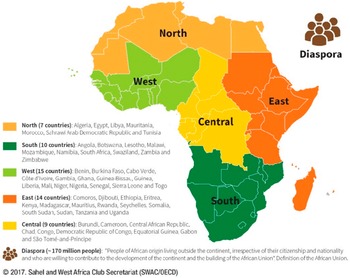
This an enormous task and I want to use this opportunity to speak about why we shouldn’t be surprised by the daunting nature of mobilizing this 6th region of the African Union, let alone follow it up with a Pan-African Congress under the formalized corporate style of the AU. If you look at a map of the union with respect to its regions (Figure 2), you will see very clearly the difference between the 6th region and the others, which has practical structural and administrative consequences. First, the other regions are continentally based, delineated by regional land mass and divided into the distinct mostly contiguous nation states contained within that region of the continent of Africa. As you see, there are seven countries in the North, ten in the South, fifteen in the West, fourteen in the East, nine in Central, and then you reach the 6th region of the Diaspora where we are given not numbers of nations, but an estimated population of 170 million people. This indeed is both the challenge and the opportunity.
The six regions of the African Union.

It is the opportunity of this region that led to the 2003 Heads of States Summit Declaration that: “The AU decides to recognize the African Diaspora as an effective entity contributing to economic and social development of the continent.” But what, in 2003, did the Heads of State mean by “The African Diaspora”? Two years later the Report of the Meeting of Experts from Member States on the Definition of the African Diaspora declared the AU meant “people of African origin living outside the continent irrespective of their citizenship and nationality and who are willing to contribute to the development of the continent and the building of the African Union.” However, it is that very phrase “people of African origin” which has led to great debate, especially in countries like the USA where a large, recent twentieth-century migration lives alongside a large domestic community of Afro-descendants of centuries long standing.
There is no time at this juncture to elaborate on the complex history of the concept of the “African Diaspora,” a designation which brackets many distinct and overlapping groups. I will simply ask you to accept that I am working here with three chronological configurations, sometimes in tension. The most recent grouping is the one comprising those sometimes called “Heritage Children” in their “host lands” of Europe and the USA. They are born abroad of immigrant parents who most importantly raise them as best they can in homes that are culturally the best approximations of their own “homelands” they could make. In these homes the combinations of food, language, clothing, ceremonies, and everyday rituals, have marked these children out as of Ghanaian, Moroccan, Cameroonian, Somali, or Namibian etc. heritage, in a sense marked as foreigners in the lands of their birth which their parents, loved ones, and caregivers do not themselves consider home.
The second, perhaps initially the pivotal group for the AU, are people like myself and possibly many of you my colleague contemporaries in this room: people born and at least partially raised at home on the continent; who may have followed parents into economic or political exile, or in migrations only after their schooling started, or of their own accord for further education at a higher level, and who, however many years or decades away, eventually return or plan to return to the place considered unambiguously a home-land, whatever the manifold reasons for spending a lifetime away. We have a clear memory of a kinship-group on the continent even if we left as children. For us the demarcations—geographic, cultural, and sometimes even moral—between “homeland” and “host-land” remain emotionally clear. I believe it fair to say that it is this group of us that was the initial focus of the African Union when the debates about Diaspora began. We are those ready to lend that economic and political support they are calling us to.
However, as we found out, it did not take long for that notion of “The African Diaspora” to be challenged by the communities most people outside the continent think of when the term “African Diaspora” is used today: those millions of people scattered around the world—particularly South America, the Caribbean, and North America—whose largest populations are in fact in Brazil, and not as is assumed in the popular imagination, the United States. It is these populations, whose dispersal was caused by the cataclysmic and traumatic transatlantic slave trade whose existence in millions outside the African continent who over the last two centuries have forced an engagement with the concepts of the African Diaspora.
There can be no argument that the Transatlantic Slave Trade altered the processes and landscapes of human history on at least three continents. Its effects linger with us to this day for good or ill because those captured peoples changed the known world at every level and made the modern world in which we live today. The realms of demography and history, all the cultural arts including language, food, sacred knowledge, you name it, have been inexorably transformed by that 400-year legacy of forced migrations.
This group also are a target of opportunity, and after seven years in South America, I believe them to be a largely underestimated site of alliances. I arrived in South America as Ghana’s first female ambassador on December 29, 2017, resident in Brasilia and accredited to every country in continental South America: namely Argentina, Bolivia, Chile, Colombia, Ecuador, Guyana, Paraguay, Peru, Suriname, Uruguay, and Venezuela. In the seven years (six years, eleven months and one day) afforded me, I had the privilege also of becoming the first Ghanaian ambassador to present my credentials to all twelve presidents of the continent, including, sometimes under difficult circumstances, Peru, Venezuela, Bolivia, and Ecuador.
In almost every country, I engaged not only with the resident Ghanaian communities, but also with the Afro-descended communities of those nations. And like in other parts of the world, the differences between those two communities are sometimes crucial, sometimes negligible, but always present. That is to say, we must never forget that migrations and movements are an ever-present factor of human life and have been so for as long as recorded human memory.
Though I do not have the space here to discuss this, I do want to recognize that though the stress on the Transatlantic Slave Trade is comprehensible, it does often obliterate the history of those millions of Africans who for thousands of years were part of the flow of human movements and migrations in and out of the continent and have lived in all parts of the world for centuries, but with ancestry, and mythologies which trace them back to an African homeland. They are an unjustifiably neglected collective. Furthermore we need more frequently to raise questions about the ways that traumatic history sometimes overtakes the stories of the millions of Africans who are displaced from their homeland but still living in various states of security or insecurity, comfort, or precarity, on the continent itself today. There are of course thousands of people living displaced within the African continent itself. These are histories which can’t be ignored but can’t be tackled here today, except in so far as they are or are not integrated into the population counted as part of the 6th region in question.
What I want to emphasize is that we live with different modes of dispersal which continue to impact our daily lives, in visible and invisible ways with greater or lesser impact. In many academic settings we can display a tendency to focus on the forced removals of us as peoples occasioned by the brutality of the transatlantic slave trade, and it is important to do so because the peculiar nature of that trade has had a lasting impact on the history of the world on all sides of the Atlantic. Nonetheless it is important to bear in mind that when we speak of African diasporas, there are always in the mix people, those who, as Ivan Van Sertima asserted for North America, “came before the Mayflower,” as well as those who in the United Kingdom we identify as the post-World War II “Windrush generation”—arrivals all living willingly or unwittingly, cheek by jowl together in contiguous communities of diasporas.
I have traveled much over the last seven years where my experiences have been varied and fascinating: from Cali and Cartagena in Columbia, where I had the opportunity to address a conference on the implications of ethno-education; to Argentina to visit our national youth Olympic team and debate the origins of tango; to Suriname where I accompanied the Asantehene on his official visit to the country on their Independence Day and was present at a cultural display so profoundly Akan that he stood up and declared “you are my children.” I have engaged with Afro-descended communities in places like Bolivia and Paraguay where I had no idea they were as culturally resilient as they are.
I feel the need to stress here the specific focus of these remarks: that of someone who was Ambassador of Ghana to South America. It is this factor which determined my movements and focused my attentions. My observations and activities are thus determined by the limits of the stated countries to which I was accredited. My point is very personal: what all these trips have done is to confirm the vibrancy of African communities, old and new, in the diaspora, and to emphasize the necessity of developing and upholding the work of making those connections stronger, and more visible, and thus more meaningful.
In truth, before even arriving in Brazil I sailed around the world teaching on the “Semester at Sea,” a voyage which took us from Europe to West and Southern Africa, Southeast Asia, the Indian subcontinent, and on to Hawaii before touching the West Coast of mainland USA. What this meant was that we experienced the connections created by the trade routes of those empires—the Portuguese, Spanish, French, Dutch, and British that shaped the histories of all our countries between the fifteenth and twentieth centuries. The consequence of the slow and deliberate nature of the journeys meant that those connections became a viscerally embodied experience.
There really is a connection between the maroons of Suriname and Akan culture, which remains a lived experience after all these centuries. Similarly, being able to see the material legacy of the cloth trade in the former Dutch empire from the East Indies through India and South Africa all the way to what has become “traditional” in Suriname, or seeing Ghanaian “akara” become “acaraje” in Bahia, and having savoury “dokunu” on the streets of Accra become a sweet food cooked the same way but with raisins and sugar cane added in the presidential palace of Georgetown, has been a truly powerful experience. There are examples in every country on the continent.
Not enough of us have had the privileged experience of connecting the dots that traveling to our interconnected communities gives. Having done so I’m determined to work with any community or organization to find ways to share our knowledge and above all to create experiential ways of learning our stories and best practices. We need sustained activism across the board on education about our diaspora literacies. It was particularly opportune to be the Ambassador for Ghana, a country which declared a decade of return for Afro-descendants (overlapping with the UN Decade of the African Diaspora) to encourage global returns and is engaged in creating favorable programs for such, which I trust will continue through the next administration.
But here I must turn to a matter which has long been a source of debate in the academy, but apparently less evidently in need of disaggregation, until now, in the corridors of the African Union—the distinction between these African Diasporas, and Pan-Africanism. Pan-African means many things to many people and even those who identify themselves as Pan-Africanists are sometimes divided as to its parameters as a political and cultural movement and what means should be used to further its aims. At heart it seems to me a term used to signal the unity of peoples of African descent around the world that recognizes our collective need for independence and liberation from the legacies of imperial and colonial rule. These legacies are manifold and encompass such things as the strangulation of the development of our national economies to the needs of capitalist European countries of colonial oppression, to the impact of that oppression in the destruction of our cultural institutions, the dismissing of our sacred systems, the debasing of our languages, the appropriation without attribution of our aesthetic forms: we all know the list. The issue has always been around the politics of resistance, transformation, and revolution in bringing about the changes.
Part of the contestation in fact lies in who claims authority in being the voice of the Pan-African Movement. A small but perhaps telling example within the movement itself lies in the very counting of the Congresses, because that count generally begins with the first congress convened by US-born W. E. B. Du Bois in Paris in 1919, ignoring the meeting generally called a “conference,” which was convened at Westminster Hall in London by Trinidadian born Henry Sylvester Williams in 1900 to protest racial discrimination and the land policies of colonial countries. In addition to this first Pan-African Conference held in London in 1900, there have allegedly been eight Pan-African Congresses:
1919: The 1st Pan-African Congress was held in Paris
1921: The 2nd Pan-African Congress was held in London, Brussels, and Paris
1923: The 3rd Pan-African Congress was held in London and Lisbon
1927: The 4th Pan-African Congress was held in New York City
1945: The 5th Pan-African Congress was held in Manchester
1974: The 6th Pan-African Congress was held in Dar es Salaam
1994: The 7th Pan-African Congress was held in Kampala
2014: The 8th Pan-African Congress was planned and eventually held in Accra in 2015.
I want to single out the 5th Congress in Manchester in 1945, which was clearly a landmark turning point, in terms of timing, size, and above all, representation. For the first time, there were several Continental Africans present, not only Africans from the Diaspora. Furthermore, those Africans were there as representatives of political organizations and parties, not simply as distinguished individuals, and there were also representatives of labour and trade unions. The absence of any adoption or regulatory mechanisms (such as exist today for UN resolutions, for instance) makes the direct influence of the congresses hard to quantify.
However, even if one can debate what direct influence the congresses had on the independence movements in Africa, The 5th Congress clearly had a great indirect influence; three of the known young attendees, Kwame Nkrumah, Jomo Kenyatta, and Hastings Banda had become, before the end of the 1960s, the political leaders of their independent countries, and the ideas debated there permeate discussions on Pan-Africanism to this day. There are some who would assert that the movement of the collective body from OAU to AU to the inclusion of the Diaspora as a 6th region is in part a response to the impetus of those congresses. Each transformation has brought us closer towards systemic unity.
Nonetheless, it is relevant to the matter at hand that not only is the beginning of this list of congresses controversial, so is the end. The Accra congress itself was subject to much controversy in terms of timing, inclusive representation, and even subject matter too complex to condense here. However, the issues that challenged it, are the very ones that have proved challenging to the organization of the 9th Congress in Lomé.
For example, I was informed that the 9th Congress, originally planned for the end of October, was postponed to allow the organizers to make arrangements for consultation with all stakeholders interested in the issue of Pan-Africanism in order to make it a successful event. This is one of the very issues that plagued the meeting in Ghana, which the North Americans declared that it should more appropriately be called a regional meeting because of the exclusion of North Africa, amongst other pertinent issues. In the end, there is a report on that meeting, which is called a “First Phase,” but there are no reports of subsequent phases, as there were for earlier congresses, such as the second and third, counted as one, but held at different times in different cities.
The unresolved issues remain the same: Are the recent Pan-African Congresses representative of a Pan-African Movement? Who defines that movement? What is the status of the different national and transnational bodies as representatives of civil society in the eyes of the AU? By this I mean, just to name some of those I have visited over the last seven years, organizations and communities such as the African Diaspora Development Institute, the International Decade of People of African Descent Assembly, the Pan African Councils in different countries, the Palmares Foundation in Brazil, the Fundación Cultural Colombia Negra, the Organization Mundo Afro Uruguay, and so on—the list is endless! How do such communities and organizations get factored in to have a seat at the congressional table? What role do national governments and the AU itself play? How far-reaching are the AU attempts to structure a process into these civic organizations within and beyond the nation-state? What rules of order are in play in conducting meetings, and how do we square that with the much more informal rules under which the nongovernmental organizations, who often dominate the meetings, operate? The issues are vast, primarily ideological, but also procedural, structural, and organizational. You name it, there is a problematic strategic issue lurking behind everything.
The point I am trying to make is that we live with this foundational contradiction. A real recognition of us as vibrant communities of Africans around the world, wanting to find a way to reach out to each other, and finding different informal ways of doing so, despite being contentious communities of divergent interests with real ideological rifts, and insufficient coherence and funding to build a recognizable movement that can agree on the legitimate ways of representing each other through coherent congresses. These issues became more acute the minute the African Union embraced a 6th region, and that region needed to meet.
The AU has instituted a process to respond to these issues in the creation of the Citizens and Diaspora Directorate (CIDO), the department responsible for leading the AU’s engagement with nonstate actors through diaspora and civil society engagement. According to its website, it works closely with the AU Mission Offices to engage with the diaspora and engages with civil society through the work of the Economic, Social and Cultural Council (ECOSOCC). CIDO has a unit that serves as the Secretariat for ECOSOCC, the advisory organ of the AU that provides African civil society organizations with a platform to influence AU decision-making processes and institutions, directly. However, I have been unable to determine how those civil society organizations are selected, and what is the criteria for their representative nature in the countries they come from. Which organizations know enough about ECOSOCC to get a seat at the table? I can attest, however, to one successful collaboration, taking place in Ghana this week as I make these revisions (see “Concluding Coda”).
As I have stated, my primary concern here is the activities in the countries of South America to which Ghana’s Brasilia mission is accredited, and the civil society institutions in those places. Though the Caribbean is a part of the 6th region, only the two countries, Suriname and Guyana (which hosts the headquarters of CARICOM), are situated on the mainland of South America and thus included in my portfolio. (In the arrangement of the Ghana Foreign Service, the Caribbean islands and Central America are accredited to the Ambassador to Cuba, with Mexico accredited to the Ambassador of the USA.) I was therefore not party to any of the deliberations concerning the Caribbean diaspora, except those conducted within their respective countries by organizations in Guyana and Suriname to which I was invited. These did not include the multinational convenings, which were attended by Ghana’s Ambassador to Cuba.
The region was active, however, in response to the call to organize as a 6th region, and I mention briefly here meetings in the Caribbean whose antecedent histories and outcomes had bearing on the progress towards the Brazil meeting and the links between Africa and the Brazilian and Caribbean Diasporas. These meetings are examples of two important organizational aspects of these convenings; first, that far from being disconnected, the decisions made at the relevant UN and AU meetings build on and refer back to each other in cumulating steps of transformative decision-making, against the odds. (One such meeting referred to in the speeches and communiqués of almost all these meetings, governmental and civil society alike, is the UN’s 2001 World Conference Against Racism in Durban, South Africa.) And secondly, that, however challenging, the AU as a body is indeed taking steps to rectify the underrepresentation of Civil Society organizations in their deliberations by acting on their own resolutions.
For example, from August 31 to September 4, 2021, the first International Day of People of African Descent took place in Costa Rica. The theme of the meeting was: “Reaffirming the Commitment to the People of African Descent for their Recognition, Justice, and Development.” This International Day of People of African Descent is an example of the AU’s successful working with the UN ECOSOC. The Keynote Speaker, Ms. Dorothy M. Davis, was the ECOSOC Designee for the Congressional Black Caucus Institute’s Global African Diaspora Initiative. The Congressional Black Caucus Institute is a nongovernmental organization and the policy advocacy and leadership training arm of the US Congressional Black Caucus. Present on the day were First Vice President H.E. Epsy Campbell Barr of the Republic of Costa Rica, who had initiated the resolution adopted by the UN General Assembly on December 28, 2020, proclaiming August 31 the International Day of People of African Descent; Dr. Michelle Bachelet, the United Nations High Commissioner for Human Rights (UNHCR); Dr. Natalia Kanem, Executive Director, United Nations Population Fund (UNFPA); H.E. Ambassador Fatima Kyari Mohammed, Permanent Observer of the African Union to the United Nations; H.E. Odeneh Kwafo Akoto III, Paramount Chief of Akwamu, Ghana, one of the more prominent of Ghana’s traditional rulers, and Harold Robinson Davis, Regional Director for Latin America and the Caribbean, United Nations Population Fund (UNFPA). I mention this list to underscore the cooperation necessary to claim these moments of recognition.
Shortly after this, on September 7, 2021, the heads of state and governments of member states of the AU and the Caribbean Community (CARICOM) met virtually for the inaugural Africa-CARICOM Summit. This meeting had been endorsed by both the AU at its 33rd Ordinary Meeting in February 2020 and the 31st Inter-Sessional Meeting of CARICOM the same month. The theme of the Summit was “Unity Across Continents and Oceans: Opportunities for Deepening Integration” and was hosted by His Excellency Uhuru Kenyatta, President of the Republic of Kenya. The stated objective of this historic summit was to reaffirm the bonds of ancestry and friendship between Africa and CARICOM and to build a foundation for lasting, robust socioeconomic and political engagements as well as partnerships between the two regions for a collective prosperous future.
It was the final communiquéFootnote 1 of this summit which called for the establishment of a Forum of African and Caribbean Territories (FACTS), to be jointly coordinated by the AU and CARICOM Secretariats, and the establishment of an Africa-CARICOM Commission as a precursor to the wider Africa Brazil Caribbean Diaspora Commission. This move was a commitment to further institutionalize cooperation between Africa, CARICOM and the diaspora with the hopes of signing a Memorandum of Understanding (MOU) within six months prior to a second summit in 2022.
The second summit did not take place until 2025 (see “Concluding Coda”) but there was significant progress following this meeting. Most notably: the establishment of the African Caribbean Trade and Investment Forum taking place annually since 2022; in July 2023, a high-level delegation of the African Union undertook a study tour to Barbados, with a view to developing stronger AU-CARICOM cooperation in advancing the agenda on reparations and racial healing; in August 2023 the official opening of the Afrexim Bank Caribbean regional headquarters in Bridgetown, Barbados; and finally in September 2024, the signing of the MOU between the AU and CARICOM.
On the subject of Caribbean-Africa relations, mention must be made of the central place of CARICOM in the demands for reparations. Featured prominently in the discussions and debates at the Durban global forum, reparations has become a worldwide movement in which the Caribbean has been central. Since the launch of the CARICOM Reparations Commission (CRC) in July 2013, the global movement advocating for reparatory justice has been reenergized. Over the years, the CRC has inspired the formation of various entities, including the National African American Reparations Commission, the European Reparations Commission, and similar formations in Canada and Great Britain.
Notably, the Accra Reparations Conference was convened in fulfilment of a proposal from Ghana and endorsed by the 36th Ordinary Session of the AU heads of state and government in February 2023. The conference aimed at “Building a United Front to Advance the Cause of Justice and the Payment of Reparations to Africans,” and took place in Accra, Ghana from November 14 to 17, 2023, with delegates from all the regions of Africa and the African Diaspora, including the Caribbean, North and South America, Europe, and the United Kingdom. The conference underscored a collective commitment to confronting historical injustices and the grievous crimes perpetrated against Africans and individuals of African descent, particularly through transatlantic enslavement, colonialism, and apartheid. These actions have left an enduring legacy in the contemporary economic order and the consequent need for reparatory justice and healing as both a legal and a moral imperative.
The main recommendations of the final declarations as declaredFootnote 2 were:
Establishment by the African Union Commission and inauguration of a Committee of Experts on Reparations, in consultation with Member States, ECOSOCC and other AU Organs as well as the Regional Economic Communities (RECs), for the purpose of developing a Common African Policy on Reparations and incorporating therein, an African Reparatory Programme of Action, in accordance with due process and taking into consideration the following proposals:
-
1. Establishment of a Global Reparations Fund,
-
2. Establishment of the Office of AU Special Envoy on Reparations for Africans,
-
3. Recognition of African civil society efforts on reparations: The African Union Commission, through the Citizens and Diaspora Directorate (CIDO) and the Economic, Social and Cultural Council (ECOSOCC), made significant strides in engaging and collaborating with African communities via civil society actors, and expanding engagement with the African Diaspora community through State and non-state institutions.
-
4. Creation of a transcontinental partnership framework between the AU, CARICOM Latin American States, and the African diaspora in Europe and all other regions in the world, including, where appropriate, relevant CSOs.
It is important to put the Bahia 6th regional meeting in these much larger multiple contexts, including this call for reparations. As the country with the largest population of people of African descent outside the continent, Brazil was the most clear choice for the 6th regional meeting. However, this meeting must also be seen in the context of the multi-year process towards formal cooperation between the AU and the African Diasporas outside the continent. The history of the Africa, Brazil, Caribbean Diaspora (ABCD) Commission championed by the Honourable Ralph E. Gonsalves of St. Vincent and the Grenadines has, like every move towards unity, made complex but steady progress. Envisaged as a Pan-African project that would bring together Africa, Brazil, the Caribbean, and the African Diaspora populations in Europe and North America to pursue cooperative, mutually beneficial programs and projects, the ABCD Prime Ministerial Sub-Commission was one of the outcomes of the CARICOM Heads of Government Conference in St. Lucia in July 2019. Later that year, Prime Minister Mia Mottley of Barbados visited Ghana as part of the celebrations concluding “The Year of Return,” a visit aligned with the objectives of Ghana’s Beyond the Year of Return Project, to pursue cooperative, mutually beneficial programs and projects. After a one-year delay due to COVID, Prime Minister (PM) Ralph Gonsalves of St. Vincent and the Grenadines proposed the full establishment of a permanent ABCD Commission at the first Africa-CARICOM Summit in August 2021. The commission’s goal would be to create a single institutional framework to unite people of African descent across these regions to advance shared interests, including the pursuit of reparations for slavery and native genocide. The CARICOM Prime Ministerial Committee comprised PM Ralph Gonsalves, President Desi Bouterse of Suriname, and PM Mia Amor Mottley of Barbados.
Thus, in February 2022, at bilateral meetings between PM Mottley and President Akufo-Addo of Ghana on the sidelines of the International Energy Expo in Guyana, when Akufo-Addo was president of Economic Community of West African States (ECOWAS), the matter was raised again. That same Expo provided an opportunity for our Brasilia Mission to organize discussions between the Ghana delegation and Diaspora organizations from Guyana. This encounter between the Ghanaian officials and the various groups representing civil society and the necessary private-sector interests led to very engaging exchanges. The following month, as the Guest of Honor at Ghana’s Independence Day celebrations, PM Mottley emphasized that support from Presidents Akufo-Addo of Ghana and Kenyatta of Kenya spurred the first Africa-CARICOM meeting, held the previous September, and she reiterated its resolutions: that they agreed to establish a permanent Forum of African and Caribbean States and Territories, and that the Forum would be jointly coordinated by the African Union and the CARICOM Secretariats; that they agreed to take steps to make 7th September Africa/CARICOM Day a day of remembrance of our unbreakable bonds; and that the establishment of this Forum would encourage synergies between the CARICOM Single Market and Economy and the African Continental Free Trade Area.
For us in Brazil, with this context in mind and with a long-term view, starting with informal meetings between us, inspired by the close relationship between Ghana and Barbados, the Ambassador of Barbados and I held several informal meetings to consider how to promote such engagements and find ways to develop cooperative ventures, especially in the field of the creative economy. These conversations became more formal with the appointment of Her Excellency Margarete Menezes as Minister of Culture, following the election of President Lula in January 2023. After a series of consultations with us, the Ministry of Culture organized “Dialogos Culturais: Africa Brazil Caribe Diaspora” at the Centro Cultural Banco do Brasil on November 27, 2023, at which the Ambassador of Barbados and I both spoke on behalf of our respective communities about the importance of culture in keeping such engagements open.
Meanwhile, one month earlier, on September 23, 2024, at the Africa Center in Harlem, New York, Prime Minister Gonsalves delivered the keynote lecture at the official launch of the Global Africa Gateway, led by the Africa Export-Import Bank (AfreximBank), which had opened its Caribbean headquarters the month before. The Africa Center serves as a central hub for the exchange of ideas related to the African continent, deepening the world’s understanding of Africa, its Diaspora, and the role of people of African descent in the world. In that speech, he again made the case for the work of an ABCD Commission.
Finally, the Bahia 6th regional meeting was the last of the scheduled pre-congress regional meetings of the AU which had taken place in the previous nine months. The first Regional Preparatory Conference for the Southern Region, hosted by South Africa on the theme “Pan-Africanism, Science, Knowledge and Technology,” took place on December 4, 2023 in South Africa; the second for West Africa on March 14–15, 2024 in Bamako, Mali under the theme Diasporas, Afro-Descendants and Development; the third on April 18 was held online for North Africa organized by Morocco under the theme Pan Africanism and Migration; the fourth, also online for Central Africa was held on May 24 by the Republic of Congo under the theme Economic Pan-Africanism and African Emergence; the fifth for East Africa in Tanzania on July 6, under the theme Africanophony, Cultures, Education and Pan-African Identity. Brazil then hosted the Diaspora Regional Conference on Memorial, Restitution, Reparation and Reconstruction in Bahia in August 2024.
The decision to hold a 9th Pan-African Congress in Lomé was agreed upon at the 36th Ordinary Session of the Assembly of AU Heads of State and Government held on February 18 and 19, 2023. It was conceived of as a landmark event of the Decade of African Roots and the African Diaspora (2021–31) decreed by the 34th Ordinary Session of the AU Summit on February 6 and 7, 2021. That decade itself was decided upon in response to a request made by the Republic of Togo the year before.
In support of this decision to hold the congress, the AU decided that, under the direction of Togo, six preparatory regional conferences be organized in the six regions of the African Union to prepare for the 9th Pan-African Congress. And one of the specifically articulated purposes of the decade was “to prepare, promote and support projects, initiatives and events of people of African ancestry. While it harnesses the talents and contributions of Africans and peoples of African descent in the service of development, it aims at contributing to boost a reinvented Pan-Africanism in a polycentric world of transitions and crises.”
Thus, from August 29 to 31, 2024, at the request of the African Union and jointly organized by the government of Togo, in partnership with the Federal Government of Brazil and the Government of the State of Bahia, the city of Salvador hosted the Conference of the African Diaspora in the Americas. It is important to state that among the official supporters were the Federal University of Bahia [Universidade Federal da Bahia] and the Brazil-Africa Institute [Instituto Brasil-África]. One aim of the event was “to strengthen African roots around the world and to establish greater dialogue between representatives of the State and civil society of the countries of the African Union and the Americas.” I do not know where the people and organizations of the other areas of the diaspora such as Europe and Asia found a structural avenue for their voice. However, Brazil has the largest Afro-descendant population outside of Africa as well as two decades of experience with racial equality promotion policies, so was invited to host the meeting.
The task of articulating the aims of these convenings, each of which had a different focus, has fallen on His Excellency Professor Robert Dussey the Minister for Foreign Affairs of Togo and it is he who is now tasked with managing the consultations with stakeholders. No new date has been announced for the 9th Congress other than an assurance that it will take place in 2025.Footnote 3
Thus, we are grappling with what to me is a bifurcation of purpose and process. We are back to the question of how to mobilize this diversity of people into an effective regional voice for the purpose of impacting the deliberations of the African Union. That is a seriously complex problem. The challenge is clearly a logistical one. However they choose to do it, the other regions can more easily organize themselves to have a place at the table. The government of Ghana, for instance, has an Office of Diaspora Affairs seated in the Office of the President. This officer, who works in Ghana with Ghanaian Civil Society organizations abroad, sits as an observer at the AU and is the person who was designated to attend the 6th regional assembly, from Accra. It is important to note that this is a different officer from Ghana’s ambassador to Addis who is also the permanent representative to the AU who represents government affairs, who was also present. The former attended the Civil Society Meeting, the latter that of the Heads of State, the two meetings running parallel until the final session when the Heads of State received the resolutions of the Civil Society organizations. Thus, from the Brasilia mission, as ambassador I accompanied the deputy minister for foreign affairs and the ambassador to the AU to the meetings of the Heads of State, while the Mission’s First Secretary accompanied the representative of the Diaspora Officer from the Office of the President to the Civil Society meetings.
The presence of this officer from the Office of the President highlighted the fact that in terms of institutional procedures, if we, Ghanaians at least, need something heard or something taken to the African Union, we know the vehicle through which we can channel those concerns. The measure of success of this unit in the Office of the President is that it is increasingly recognized by other countries. Nations across the African continent come to Ghana to the Diaspora Affairs Office to learn about the successes and processes to emulate. The countries that have been to the Diaspora Affairs Office in Ghana include Senegal, Swaziland, Morocco, Kenya, Mozambique, Eswatini, and Botswana. But these government-sponsored offices are still primarily focused on how, as nation states, they deal with their own natives abroad, or at best mobilize those who become resident aliens within their borders. Questions about how to deal with the representation of organizations not associated with the nation state, remain.
From the perspective of the instruments of the AU there are platforms of organizations through which they engage. They have established regional institutions such as the Western Hemisphere African Diaspora Network, and institutions such as the Economic Social and Cultural Council, in addition to working through the continent’s regional organizations such as ECOWAS and Southern African Development Community (SADC), as well as extra-continental regional organizations such as CARICOM. They have also established a Diaspora Division with a Citizens and Diaspora Directorate. Though how effectively they are currently functioning is open to debate. But more important, individual nations are making greater efforts to redefine their sense of Diaspora.
Following Ghana’s lead, many other African countries enacted policies and measures to give structure and substance to their Diaspora. Kenya has issued Diaspora bonds and launched the world’s first mobile based bond; Senegal created systems and institutions allowing Senegalese Diaspora to both invest and to vote in national elections; Cabo Verde has given its citizens living abroad the right to vote in presidential and legislative elections; Rwanda formalized its Diaspora General Directorate within the Ministry of Foreign Affairs—the list is long and growing. At least forty-one countries have, in some way, institutionalized Diaspora engagement—twenty-one have specific policies and thirty have dedicated institutions. Still, it is noticeable that apart from the granting of dual citizenship to those born outside the nation, most of the gestures are directed towards harnessing the engagement of those who would otherwise be national citizens, those who I identified in the first and second groups, labeled, regardless of citizenship or residency rights, as migrants or heritage children in their host countries; these are not gestures directed to the “old diaspora” but seductions for the “new diaspora” to call them back “home.”
However, I do recognize that, famously in 2018, Ghana instituted the Year of Return, a party which has gone on each December for the last six years and counting. More crucially, it led to the Beyond the Return Initiative with its seven pillars of operation, embracing educational programs, investment, and accelerated dual citizenship, considered by many the most monumental accomplishment of and for the 6th region (see Appendix A). In the first historic mass swearing-in sponsored by the Diaspora African Forum in 2017 in Ghana, thirty-five African-American diasporans were sworn in as citizens of Ghana. By 2019 that number had grown to 126 in one ceremony, though perhaps the one ceremony that has gone the most viral was the granting of Ghanaian citizenship to the great Stevie Wonder at a unique ceremony on his birthday in May 2024. Since the first ceremony, Sierra Leone, Guinea-Bissau, and Nigeria have worked with the forum in Ghana to prepare such new programs.
Nonetheless, the question remains how to mobilize the populations these individuals represent, to impact the AU. To begin with, we are dealing with individuals who, whatever their affective and political sensibilities, remain citizens of other states. And in those states as a rule, if they have offices dealing with Afro populations, it has to do with their internal racial and ethnic politics, not how to deal with AU. For instance, President Lula has been invited to the 9th Congress and the Ministers he is slated to take with him are those of Justice, Racial Equality and Culture, all three Afro-descended, whose brief is the internal populations of Brazil. However, several leaders of Afro-descendant organizations have also been invited, about a hundred of them, but I have been unable to determine exactly who they are or what was the selection process.
All this raises again, questions about how to deal with organizations not associated with the nation state; that question has not, to my understanding, been resolved. And though it has not been articulated as such, it seems to me it could be one of the underlying reasons why the 9th Pan-African Congress has not yet met. What do we do with this uneasy tension between the formal AU structures and the AU having decreed that there shall be a Pan-African Congress which, by definition, needs to organize civil society groups that have no formal affiliation or structure to the African Union other than an affective relationship. How do you organize 170 million people, associated in different, discrete, cultural and social groups of different ideological persuasions, get them at the table and call them the 6th region of the diaspora? How do you mobilize and prioritize them?
These are organizations of passionate populations. As ambassador of Ghana based in Brazil whose mission is accredited to all twelve nation states of continental South America, I have visited Afro-descended populations in every country and had the honor of seeing the pride and resilience of those communities. I have also had the opportunity to witness the attempts of African identified civil society organizations to claim a voice in this process at radically different levels. This goes from being invited by national cells of the African Diaspora Development Institute in Suriname and Ghana, the International Decade of People of African Descent Assembly in Guyana, the Pan African Council in Cali, Colombia and Rio de Janeiro, Brazil, the Fundación Cultural Colombia Negra in Bogota, the Organization Mundo Afro Uruguay or events organized by Ministries or Secretaries of Education in Cartagena, Colombia, and Salvador da Bahia, Brazil. The point I’m making about these journeys is that these have been civil society organizations diffuse and passionate but not necessarily with any clear sense, or clearly approved or accepted way, of how they are going to impact the debates of the AU, of how they fit into the organogram of a 6th regional assembly. Wonderful and appropriate as the diffuseness and variety of these organizations are, that sense of authoritative belonging seems to me to be the next significant move.
There is no end to the story; and as I said, there is not even what I thought would be an end to this talk. So I will conclude by making mention of the letter from the Civil Society organizations of the Americas which did meet in Bahia, to the high-level meeting convened to hear them. In true UN-like fashion, the Civil Society organizations had their own meeting and delivered their deliberations to the presidents and foreign ministers empowered to approve and find ways of enacting those deliberations. I know that such preambles are ritualistic and formulaic, but given what I have said, I think it important to hear how their eighteen-point letter began:
Honouring ancestry and celebrating the diversity of Afro-diasporic voices from experts, cultural personalities, references from social movements, and other representatives of civil society,
Recalling the Conference of Intellectuals of Africa and the Diaspora, held in Dakar in 2004, the 2nd Conference of Intellectuals of Africa and the Diaspora, held in Salvador in 2006, and the Global African Diaspora Summit, held in Johannesburg in 2012,
Reaffirming the Durban Declaration and Programme of Action, adopted in 2001,
Recalling the proclamation of the International Decade for People of African Descent (2015–2024) and supporting its renewal for an additional ten years,
Celebrating the Decade of African Roots and the African Diaspora (2021 to 2031) established by the African Union,
Considering the need to establish a new paradigm of humanity that integrates philosophical and epistemological values inherited from Africa by the diaspora such as circularity, playfulness, and a matriarchal foundation,
We, the participants of the 1st Conference of the African Diaspora in the Americas, held on August 29 and 30, 2024, in Salvador, address the authorities of the African Union and the countries of the Americas who will meet on August 31, 2024, as well as the 9th Pan-African Congress in Lomé, from October 29 to November 2, 2024, to make the following recommendations on “Pan-Africanism Memory, Restitution, Reparation, and Reconstruction”:
The letter that followed (see Appendix B) was a comprehensive clarion call on behalf of the African descendant world covering everything from the playfulness of our aesthetics, the need for the transformation of educational systems, to reparations and climate justice. It was indeed a document bearing witness to the state of the Afrodiasporic world. It remains to be seen how the heads of state and government of the continent to whom it is addressed will carry forward that testament to our history.
Thank you for your attention.
Coda: 2025 developments in AU–DIASPORA relations
In the twelve months since delivering this lecture, there have been significant activities which the need to revise this lecture for publication gives me the opportunity at least to list.
-
• January 1, 2025: United Nations Second International Decade for People of African Descent, declared on December 17, 2024, begins.
-
• February 2025: AU Theme of the Year 2025.
The African Union designated 2025 as the “Year of Justice for Africans and People of African Descent Through Reparations.” This initiative underscores the AU’s commitment to addressing historical injustices, including the trans-Atlantic slave trade, colonialism, apartheid, and genocide. It builds on decades of advocacy and collaboration, aiming to foster unity and establish mechanisms for reparatory justice on a global scale.
It must be recognized that for the AU “reparations” includes the recognition of cultural artifacts. In 2021, the AU held a Continental Experts Workshop on the Restitution of Cultural Property and Heritage in collaboration with the government of Senegal and the Open Society Initiative in West Africa. The workshop focused on developing a Common African Position Paper on the Restitution of Cultural Property and Heritage and a Framework for Action on the Negotiations for the Return/Restitution of Illicitly Trafficked Cultural Property from the Continent.
In addition, following the International Decade for People of African Descent (2015–2024) acknowledging the significance of the International Decade for Recognition, Justice, and Development of people of African descent worldwide, the AU declared 2026–2036 the Decade of Reparations.
-
• April 30, 2025: Georgetown Guyana
The first official meeting of the CARICOM-Brazil Joint Commission to advance technical cooperation convenes at the CARICOM Secretariat in Turkeyen, Greater Georgetown.
-
• September 7, 2025: 2nd Africa-CARICOM Summit, Addis Ababa, Ethiopia
The 2nd Africa-CARICOM Summit brought together African nations, Caribbean states, and the global African diaspora to strengthen unity, deepen integration, and jointly pursue reparations and reparatory justice through a comprehensive transcontinental partnership framework, under the theme: “Transcontinental Partnership in Pursuit of Reparatory Justice for Africans and People of African Descent through Reparations.” The summit highlighted the deep historic ties between Africa and the Caribbean and emphasized solidarity, cooperation, and reparative justice, while outlining shared goals in trade, investment, innovation, and youth engagement, and calling for a united voice on the global stage to advance prosperity and equity for all peoples of African descent.Footnote 4
-
• December 8–12, 2025: 9th Pan-African Congress, Lomé, Togo
The much-postponed summit is finally taking place this week as I write, and we await the final communiqué. The theme of the Congress is “Renewal of Pan-Africanism and Africa’s Role in the Reform of Multilateral Institutions: Mobilizing Resources and Reinventing Itself to Act,” with Brazil as the special guest of honour country.Footnote 5
-
• December 16–17, 2025: The African Summit, Accra, Ghana
In Accra AU-ECOSOCC has collaborated with the Center for Strategic African Development (CENSADEV) to hold its inaugural summit on “Building a New United Africa.” The panels were filled and the conference attended by Civil Society and business organizations from within Ghana and across the region as well as by officials representing the government of Ghana, regional bodies, the AU, and other international organizations and businesses.
CENSADEV was established around eight pillars and eight cross-cutting subthemes to articulate practical advances in the implementation of the myriad of resolutions towards unity. The Summit Chair and CENSADEV founder, having learned of my presence in Accra, added me to the plenary session on “Enhancing the Use of Creative Industry as a Catalyst for Economic Growth in Africa,” the eighth pillar of the conference. The other presenter was the President’s Special Envoy to the Caribbean Region, King Kwasi Kyei Darkwa.
-
• December 19–20, 2025: The Diaspora as 17th Region of Ghana
In the same manner as the AU created the Diaspora as the 6th region, Ghana has made a parallel gesture. The country has sixteen regions and the Ghanaian Diaspora has been declared the 17th region. This declaration is to be made at the first congress of the Diaspora as the 17th region here in Accra on December 19–20. Notably, that conference is to be addressed by such speakers as the Honorable Zohran Mamdani, Mayor Elect of New York City, whose subject is “The Role of Diaspora Cities in Advancing Trans-Generational Healing and Reparative Justice”; Mr. Khaled El-Enany Director-General of UNESCO; King Kwasi Kyei Darkwa, the Presidential Special Envoy to the Caribbean Region; and Mr. Jermaine Nkrumah, the Founding Chairman of the Ghlobal Diasporan Council, an umbrella organization and lobbying group for Ghanaian organizations around the world.
Appendix A: Seven pillars of beyond the return
The seven pillars of the Beyond the Return initiative create specific avenues or focus areas for strategic engagement with the African Diaspora. This is the summary of the program as released in September 2020.
-
1. EXPERIENCE GHANA: Experience the culture, warmth, and rhythm
The core of the project is the tourism drive and the invitation to the Global African family to visit and experience Ghana. Underpinning this core will be the introduction of Sankofa and healing journeys and the promotion of December in Ghana as a must-do for the Ghanaian and African Diaspora.
-
2. INVEST IN GHANA: Diverse investment opportunities
Ghana, the fastest growing economy in the world in 2019, is an established business destination for investors with progressive government, transparent regulations and a dynamic private sector ready for partnerships.
This pillar will create special investment programs and ease of doing business for the diaspora. Key activities will be the Diaspora Investment programs, Sankofa Savings accounts, and Diaspora’s housing schemes.
-
3. DIASPORA PATHWAYS TO GHANA: Easing your travel experience
This pillar will see to the adoption of legal and policy frameworks on visa acquisition (e-visa) and the institution of a diaspora visa. It will facilitate key diaspora pathway programs such as citizenship programs, educational and work exchanges, and residence and work permits.
-
4. CELEBRATE GHANA: Diverse investment opportunities
Create a sense of national consciousness anchored on key cultural festivals, media programs, adoption of contemporary festivals unto the national calendar, and promotion of domestic tourism.
-
5. BRAND GHANA: Your real home
Promote Ghana as a leading tourism destination and a hub for the African renaissance. Craft a new narrative on Ghana and strategically promote to the world.
-
6. GIVE BACK TO GHANA: Support Ghana
Foster a new sense of community service and giving that will create ongoing legacies for the project. Service areas will include tree planting, community clean-ups, and adoption of certain community impact projects.
-
7. PROMOTE PAN-AFRICAN HERITAGE AND INNOVATION: Roots tourism
This pillar will focus on promoting Pan-African and Ghanaian heritage and developing pilgrimage infrastructure around sites of memory; the development of tourism infrastructure for target sites beyond the highly frequented sites of Cape Coast and Elmina Dungeons, such as the Salaga Slave market in the Northern Region, Pikworo Slave camp in the Upper East Region, Assin Praso in the Central Region—all of which are essential parts of the history of slavery in Ghana.Footnote 6
Appendix B: Eighteen-point text of letter of recommendations from the Conference of the African Diaspora in the Americas, Salvador, Bahia, August 30, 2024
-
1. Strengthen the Ubuntu philosophy within Pan-Africanism in the 21st century, characterized by the recognition of the cultural, spiritual and linguistic unity and circularity of African peoples and the Diaspora, composed of their emigrant communities and populations of African origin living in countries of other continents.
-
2. Incorporate the ideals of Pan-Africanism and the Ubuntu philosophy into efforts to seek reparations and reform international institutions and policies within states, thereby increasing the representation of African countries in international organizations and forums and coordinating positions among African and African diasporic countries on topics of common interest in these forums and organizations.
-
3. Establish a permanent agency, preferably in Salvador, Bahia, in the spirit of the establishment of the 6th Region of the African Union, as a means and tool to recover a history of Pan-Africanism, that acknowledges the contributions of women, youth, grassroots organizations etc., in order to develop a Pan-African consciousness among the collectives of African peoples, using traditional and contemporary technologies.
-
4. Organize, strengthen, and fund global academic, educational, artistic, cultural, and political networks for dialogue, preservation, and the right to memory, ancestral and spiritual knowledge, and the shared history between African populations and the Diaspora, including through the creation of cartographic materials.
-
5. Identify, take stock of, and promote the cultural heritage of African diasporic peoples, highlighting the importance of women as central figures in the production and preservation of identity, knowledge, culture, and memory.
-
6. Encourage the creation of transnational initiatives for museums, libraries and repositories of the African Diaspora and a network of African and diasporic archives focused on safeguarding and providing access to documentation in various formats.
-
7. Encourage the creation of comprehensive educational programs that integrate the history and memories of Africa and the Diaspora at all levels of education, with the support of specific forums and funds for the exchange of best practices in African and African diasporic countries.
-
8. Combat algorithmic racism in the context of new technologies through regulation and by increasing the representation of Black people in social media, ensuring the integrity of information about the history of Africa and the African Diaspora, and establishing an open database of relevant information for the preservation of African and African diasporic memory.
-
9. Strengthen, promote, and adequately fund anti-racist policies for sustainable development and the promotion of rights, which may include: restructuring energy mixes, with the development of renewable and safe sources; encouraging efficient food production and programs to combat hunger, poverty, and food insecurity; promoting sustainability and environmental justice; overhauling justice systems, including criminal and penal systems; expanding health strategies that take into account the epidemiological characteristics of diverse countries and enable actions to prevent and eradicate diseases, as well as the promotion of mental health; providing education and curricula that recognize the contributions of African and African diasporic peoples, their knowledge, culture, traditions, writers, and strengthen black identity, with special attention to children and adolescents and rural education; promoting gender equality and combating violence; promoting access to housing; encouraging historically involved countries to recognize the trafficking of enslaved people as a crime against humanity; and increasing participation of people of African descent, especially women and LGBTQIAPN+ people, in international and national forums of discussion and spheres of power.
-
10. Strengthen international cooperation in projects dedicated to the links between the African continent and the Diaspora, including through: facilitated mobility and support for students, teachers, and researchers; strengthened institutions and educational programs that promote the mobility of African and African diaspora students; creation of a Federal Africa-Brazil University in Bahia, with a focus on expanding cooperation with other African and African diasporic countries; exchanges between traditional Afro-descendant communities to share knowledge, including intergenerational exchanges, taking into account the characteristics of each people.
-
11. Manage and defend the interests of the African Diaspora by establishing a multilateral institution headquartered in Salvador, Bahia, Brazil.
-
12. Promote knowledge management, with a focus on the Black communities of the African Diaspora, by encouraging, training, and recognizing racial equality managers; conducting censuses of the African Diaspora to learn about and understand how many and who the Afro-descendants are in each country and worldwide, and how they move between Africa and other regions of the world; and promoting digital inclusion, especially among the youth.
-
13. Promote the full implementation of the Durban Declaration and Programme of Action, through a holistic approach to reparation in its political, economic, financial, and social dimensions, including the recognition of slavery and transatlantic trafficking as crimes against humanity. Consider reparations as a means to combat institutional racism, for the full integration of Africans into African diasporic societies and for the redistribution of power. These goals should be achieved through:
-
a) National and international institutions dedicated to this topic, and specific funds from countries that have promoted colonization and slaveholding institutions to promote the economic, social, and cultural development of African and Afro-descendant populations, both in Africa and in the countries of the African Diaspora;
-
b) Broad social participation that recognizes local and community needs;
-
c) The dissemination of statistical tools that recognize the existence of African populations and prevent their sense of invisibility;
-
d) The creation of international mechanisms, such as the Reparations Commission at the Human Rights Council and an International Reparations Tribunal, and the conclusion of the negotiations on the United Nations International Declaration on the Rights of People of African Descent;
-
e) International cooperation on reparations policies, with the creation of an electronic portal to collect information on this topic in several languages; and
-
f) The opposition of coercive measures and sanctions that impede the advancement of the social rights of Afro-diasporic populations.
-
-
14. Promote the rights of Black people in Africa and the African Diaspora, including the migrant populations, prioritizing the health and well-being of both the African and the Diaspora peoples, and addressing the persistent wrongs of slavery, colonialism and neo-colonialism, including by establishing affordable mental and physical health policies specifically for Black peoples, anti-racist public security policies, especially for Black youth, and decent labor policies, including for former inmates.
-
15. Promote social and intersectional policies to protect women, the elderly, children and youth, incarcerated people, people with disabilities, LGBTQIAPN+ people and migrants, and create mechanisms, including financial, to ensure greater participation of women in positions of power in politics and the private sector, and foster interfaith dialogue to promote peace and a culture of tolerance.
-
16. Establish funds for restitution of material and non-material cultural assets, natural resources and other historical heritage that have been destroyed or unjustly taken from Africans and their descendants, as well as for their preservation, with a view to recognizing and increasing the visibility of the intellectual, spiritual, scientific, and technological contributions of African and Afro-diasporic peoples.
-
17. Ensure, as a reparatory policy, that traditional African descendent communities have access to and ownership of lands and locations, from where they have been systematically excluded, including recognition and financial compensation for their contributions to environmental conservation and sustainable development, in order to combat climate change and environmental racism.
-
18. Recognize the importance of Haiti and its historic role in the struggle against slavery, colonialism, and racism, taking into account the need to prioritize the Haitian people as beneficiaries of compensatory measures for the losses they endured during the decolonization process, and, in this context, support a complete decolonization of the Caribbean region. Haiti has paid a huge price for its independence and is still subject to historical boycotts.


 Open access

