




The opening of the Royal Hospital of King Charles II at Kilmainham in 1684 on the south bank of the River Liffey two miles west of the city of Dublin marked a major advance in the care of retired and elderly soldiers in Ireland. The institution was more commonly known as the Royal Hospital Kilmainham (RHK) and was famously inspired by the ‘Hôtel des Invalides’ which opened in 1674 in Paris on the orders of Louis XIV.Footnote 1 The Paris and Dublin hospitals stimulated, in turn, the opening in 1692 of the Royal Hospital Chelsea.Footnote 2 All three institutions provided food, clothing, accommodation and a basic level of medical care to soldiers who had been injured while serving their monarchs, or had become ill or incapacitated after leaving the armed forces. The officers, non-commissioned officers (NCOs) and men who were resident in these hospitals often lived for many years or even decades before they died.
In considering how the men in the Irish hospital (who were called ‘Pensioners’) passed their days, this article examines the creation of a library on site in the early 1710s. It discusses how and why a library was established and the types of books that were provided. It seeks to address the question of how the books were used in the decades after the opening of the library and will also shed light on the nature and extent of literacy among the soldiers, as well as the culture of book collecting among the privileged members of Irish society who donated books for the library in response to an appeal by the master of the RHK, Sir Charles Feilding. This study is based on the first ever examination of the surviving books from the library and makes significant use of the minute books of the board of the RHK and its sub-committees. Historians have long assumed that these records were lost or destroyed after the evacuation of British troops from the Irish Free State, but at some point they were transferred to the National Archives of Ireland (NAI), where there are 145 volumes that include board minutes and other records from 1684 to 1929.Footnote 3 The most recent book about the RHK, Childers and Stewart’s The story of the Royal Hospital Kilmainham, appeared more than a century ago, in 1921, just before the final closure of the hospital.Footnote 4 The modern scholarly neglect of the Dublin hospital is surprising, and it is necessary to recount some of the most pertinent information about the nature and functioning of the RHK before attempting an analysis of its library.
I
In its early years, the Royal Hospital Kilmainham lodged a total of around half a dozen former military officers, as well as 400 NCOs and men from the ranks. In 1703, the maximum number of NCOs and men who could be housed on site as ‘Pensioners’ was increased to 425.Footnote 5 The figures could fluctuate slightly over time — in 1726, there were 430 NCOs and men on site, but four years later, their number was reduced to the original figure of 400. This was the maximum number that would be permitted on the books at any one time for the rest of the eighteenth century, and the number of former military officers on site was fixed at twelve for most of this period. There was a huge demand for assistance from former soldiers, and as early as 1688, the civil and military authorities in Dublin felt obliged to create a category of NCOs and men who lived beyond the walls and received a monetary payment in lieu of the food, clothing and shelter that came with a place in the hospital. In 1702, there were ninety-eight ‘Old & Disabled Souldiers’ across the island who received an ‘Out-Pension’ from the RHK of eighteen pence per week.Footnote 6 The number of men on this Out-Pension grew steadily over the following decades, and in 1739, a total of 635 men depended on the payment.Footnote 7 The Seven Years’ War saw the creation of a British army and navy of a size and scale that had previously been unimaginable, and the end of the conflict brought the demobilisation of huge numbers of troops, many of whom were in a desperate financial position or in poor health, particularly those who had served abroad in tropical or sub-tropical climates. By April 1749, there were 888 men on the Out-Pension, a figure which grew to 1,023 in January 1763 and peaked at 3,719 in February 1776, before gradually falling off to 2,678 men in July 1800.Footnote 8
There was a waiting list of men who wished to enjoy the comforts and comradeship available to the Pensioners. The men on this waiting list could only enter when a Pensioner died, was turned out for infringing the rules and regulations, left of his own volition to find employment or live with family, or, as sometimes happened, absconded to escape the rules and regulations of the house.Footnote 9 A spirit of conviviality was important among the Pensioners as they lived in such proximity to each other, and the hospital authorities had little compunction in turning men out for a range of infractions, including theft, poor discipline and ‘Outragious behaviour & contempt of Orders’. On 2 July 1739, for example, William Steerman was expelled from the House for ‘Impudence & Irregularity’ even though it was acknowledged that this would place him in real difficulty because he would be without ‘a Provision in his Old Age’. Steerman’s place was allocated to the man who at that point was at the top of the waiting list.Footnote 10
How did the officers, NCOs and men who lived onsite spend the hours, days, weeks, months and years in Kilmainham? The Pensioners were subject to the standing rules and orders of the hospital and although their age and physical condition meant that those rules could sometimes be implemented with a certain degree of leniency or even indulgence, the rules were ultimately those of a military institution governed by a clear chain of command. The Pensioners rose early and those who were fit enough paraded in the central courtyard. All those who were not ill were expected to attend ‘Morning and Evening Prayer’ in the Anglican chapel dedicated to Charles I ‘king and martyr’. After the morning prayers, the men would have filed the short distance from the chapel to the dining hall for breakfast. The rest of the day would have been structured around the two other meals, the evening parade and evening prayers.Footnote 11 The men retired to their shared rooms at around 8.00 pm, and after the order for ‘lights out’, they would not have been allowed to move around the hospital. The gates at the east (heading towards the city) and west (towards Kilmainham) of the boundary walls were closed by the guards at night, and anybody who had not returned by that time was denied entry and reported in the first instance to the adjutant and then to the deputy master.
On Sundays, attendance at church service was compulsory for all those who were not bed-ridden. The men in the infirmary were visited regularly by the chaplain and his assistant, the reader, but it is not known how often those in the ‘Mad House’ received religious comfort. In the periods between the regular communal activities that structured the day, the able-bodied officers, NCOs and men were free to congregate and socialise within the rules of the house. The NCOs and men could return to the rooms in which they and five (or sometimes more) of their comrades slept. Before the year 1796, two men shared each bed and there were usually three beds in each room, as well as several chairs and one or two small tables.Footnote 12 Each room had a small fire and an allowance for coals and candles. There were regular reminders from the administration that Pensioners were precluded from bringing their meals from the dining hall to their rooms. This suggests that the practice was common even though it was officially discouraged. The rooms of the officers were larger, more salubrious and better furnished than those of the NCOs and rank-and-file. In the first decades after the establishment of the hospital, two officers shared one room on the comfortable first floor of the main building, but from the mid eighteenth century, each of the officers had a room to himself.
The grounds consisted of 64 acres surrounded by countryside, so there was plenty of outdoor space for the more able-bodied officers, NCOs and men, including, as the decades progressed, the much-admired Elm Walk. Pensioners could not marry after entering the hospital, but they could receive visits from family and friends. They sometimes went down to the adjoining River Liffey for general recreation purposes or to fish, but the drowning of four men between 1732 and 1740 shows this amenity was not without its dangers.Footnote 13 The men were not supposed to leave the premises without permission but were sometimes seen in their distinctive uniforms around the village of Kilmainham to the west of the hospital, to the east in Smithfield on the northside of the Liffey and in the area around Thomas Street and St James’s Gate on the southside of the river. In many instances, a public house or tavern was their chosen destination beyond the walls. The most able-bodied were called upon to provide guard duty in Dublin town on a regular rota as well as at the hospital itself. Some of the men acted as porters or hall keepers on the premises or undertook other tasks such as labouring in the master’s garden or helping with the officers’ horses, but the most desired post was that of the messenger who delivered letters or documents between the hospital and individuals and institutions across the city. The messenger could expect to receive a small gratuity from many, if not all, of those with whom he interacted in the course of his duties.
Much of the men’s free time, particularly during the colder months of the year, would have been spent in the great hall where the large fire provided a focal point and the men were allowed to play games including cards, so long as they did not gamble or, at the very least, were not discovered gambling by an officer or any member of the hospital administration. The Royal Hospital offered a life of order and routine; it was a structured, sociable and stress-free life in which the officers, NCOs and men benefitted from a high level of care and attention in comparison with how many of them would otherwise have lived their final days beyond the walls of the hospital. Yet, there must have been times when almost every man felt himself bored, weary or under-stimulated after months or years of experiencing the same events in the same place among the same people. One of the ways to escape such tedium would have been for the men to read or to have materials read to them by their comrades in small groups of friends in their rooms or larger social settings around, say, the fire in the great hall.
II
From its inception, the head porter at Les Invalides in Paris oversaw ‘une petite Bibliotheque destinée à l’usage des Officiers, Soldats & domestiques de l’Hostel’. It was composed for the most part of ‘livres de devotion, de quelques Vies de Saints, & d’autres personnages dont la vie a esté toute exemplaire’. The French hoped these books would divert men from idleness and inspire them to live a virtuous life. The names of those who borrowed the books were recorded to avoid losses and to ensure that they could be recalled when requested by others resident in or working at Les Invalides.Footnote 14 According to Thomas Povey, an English visitor to Paris in 1682, the library of the hospital had books in several languages, including English.Footnote 15 This level of provision was in stark contrast to the situation at Kilmainham where (apart from bibles and the Book of Common Prayer in the chapel) there was no mention of printed material anywhere on the premises during the first two decades of the institution.
Men and women from very humble backgrounds often owned a few cheap books in eighteenth-century Ireland.Footnote 16 Some Pensioners surely owned one or more cheap ballad sheets, chapbooks or newspapers and short topical pamphlets which might have been kept with other personal items in their bedside locker or on a shelf in their room. Those who were literate or semi-literate must have spent time reading in their rooms, in the great hall, or, depending on the weather, in the grounds of the hospital. Even those who were completely illiterate surely heard newspapers or other topical material being read aloud by comrades in social settings. At the best of times, such flimsy and ephemeral items have an exceptionally low survival rate, and there is no surviving example of any such material from the Royal Hospital from this period. If they existed, and they almost certainly did, these printed texts were either disposed of soon after use or they were used over such a long period by a succession of men that they were, in effect, read to destruction.Footnote 17
The first indication of plans for a library at the Royal Hospital occurred in March 1708 when a sub-committee of the board decided that the architect Sir Thomas Burgh should prepare an estimate for ‘Wainscoating the Vestry belonging to the Hospitall Chappell, and making Presses for Books’ to be stored there. The job was completed before 8 December 1710 by a Dublin-based contractor named Richard Totton. Totton charged £7 10s. to construct thirty-one yards of ‘presses for books with sash doors’ and a further £6 for glazing the doors with French glass. Painting the book presses cost £1 6s., and adding brass locks and hinges to the doors increased the bill by £1 15s. There would have been copies of the bible and the Book of Common Prayer stored in the vestry for use during the services at the chapel, but surely not enough to fill thirty-one yards of shelving.Footnote 18
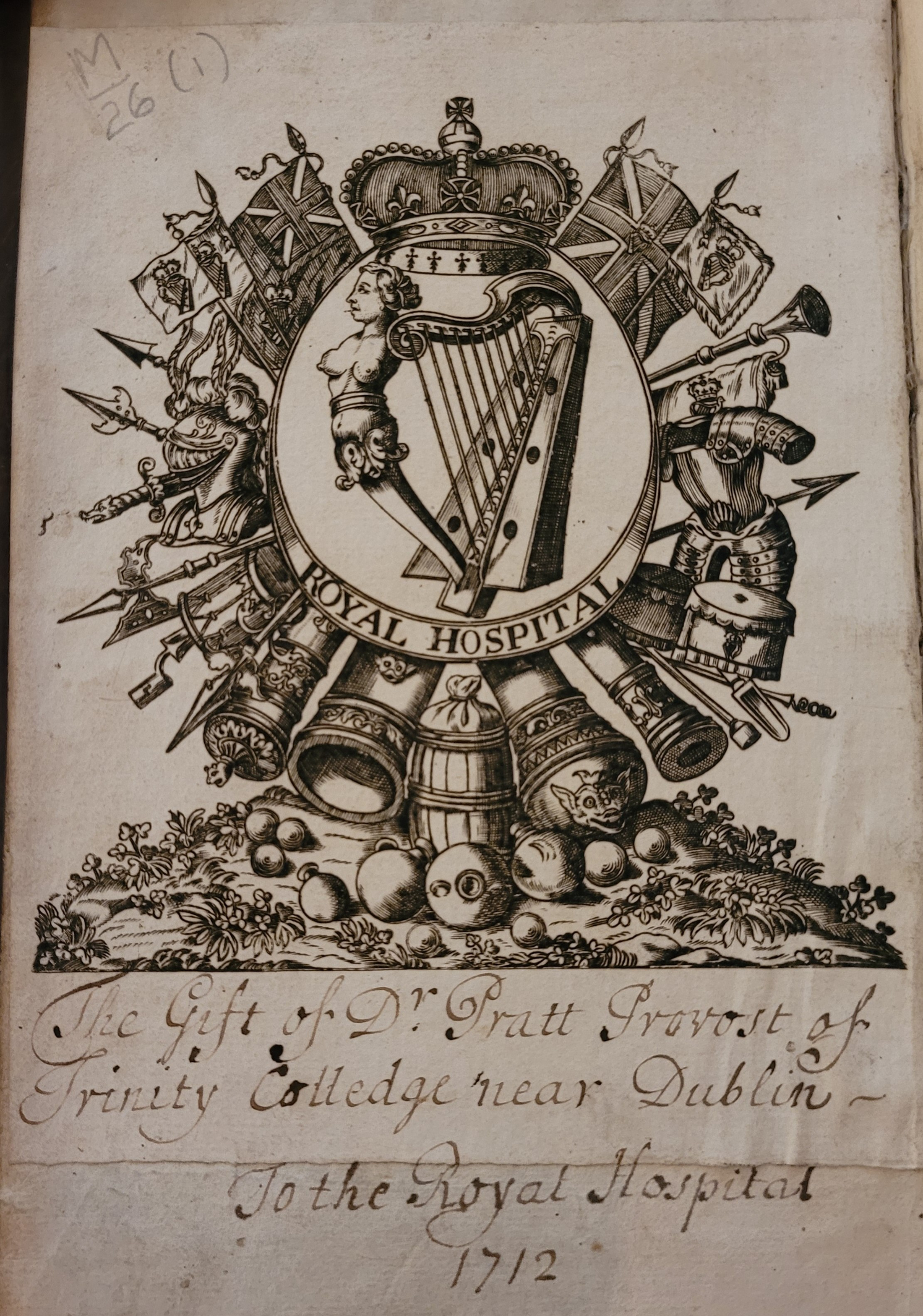
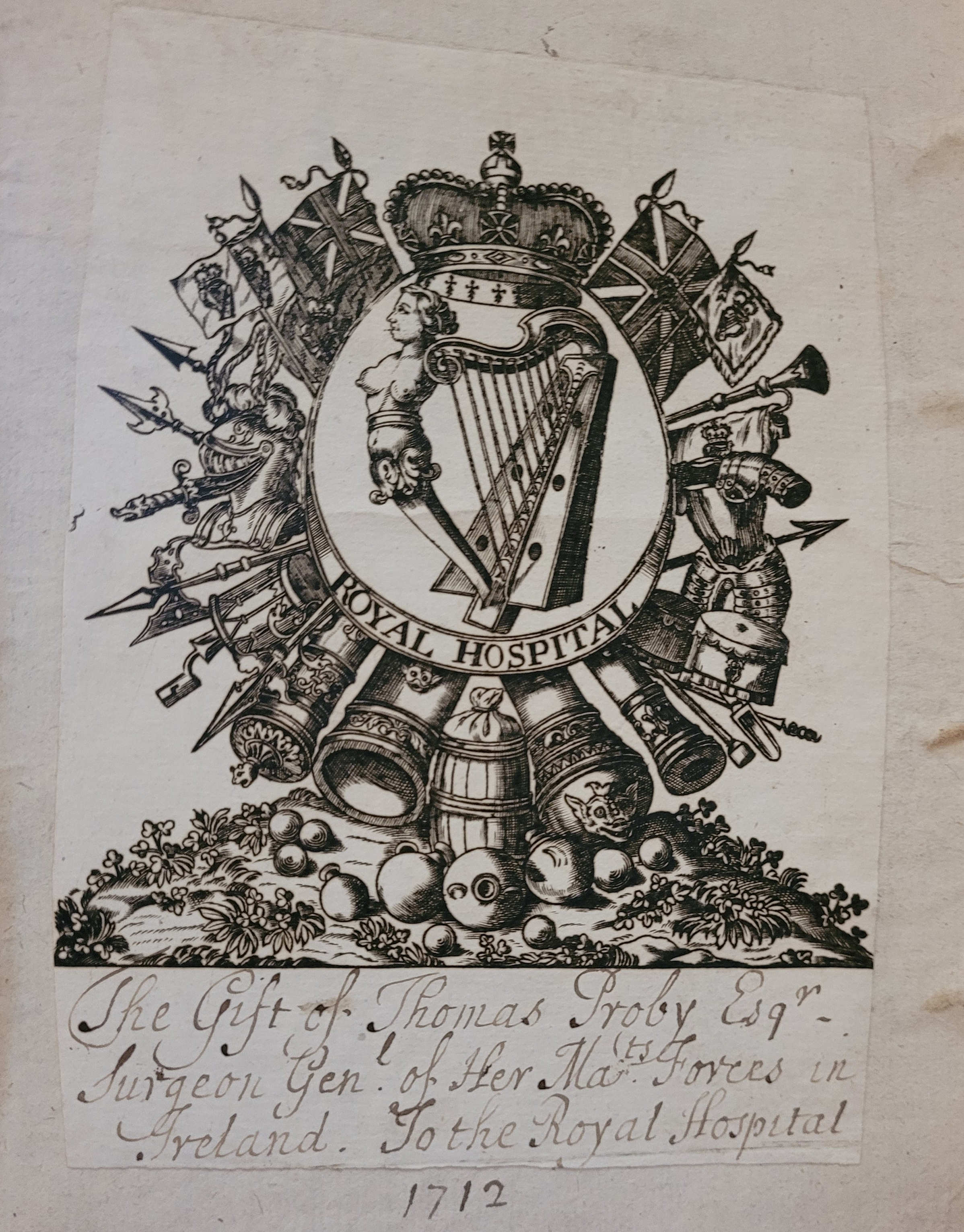
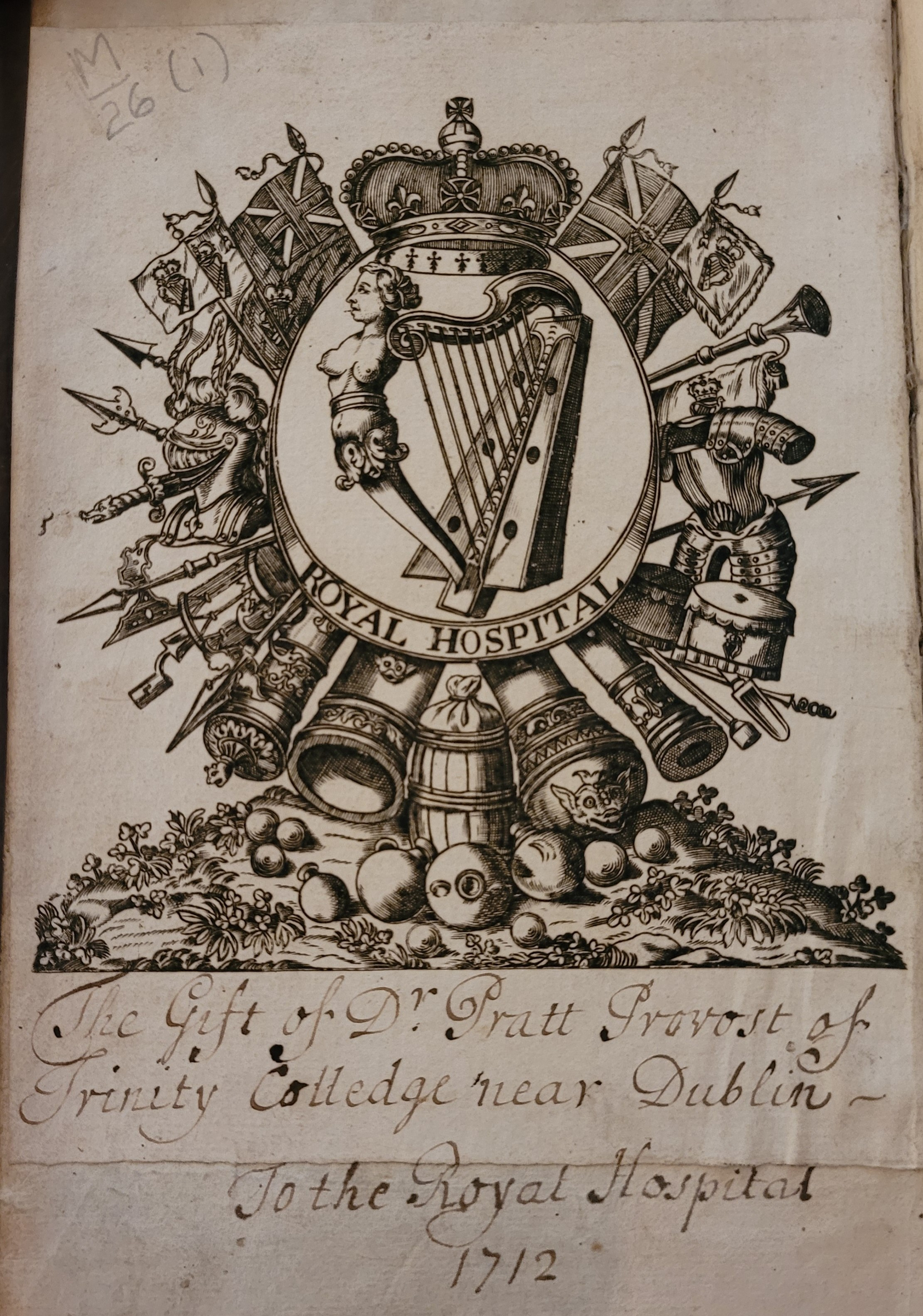
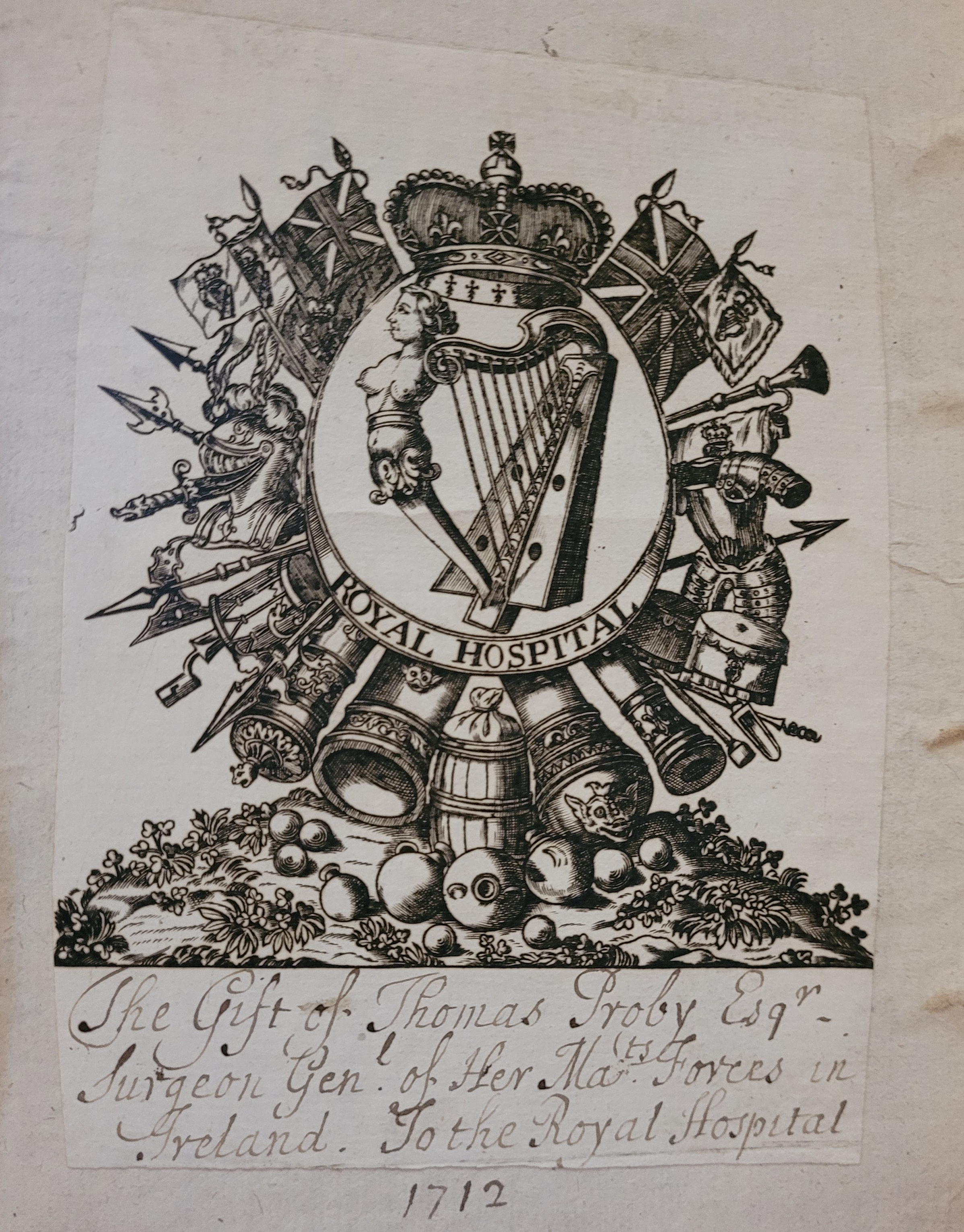
The total cost of these presses was £16 11s.,Footnote 19 but there was no financial provision for the purchase of books to fill the shelves. Instead, between 24 December 1711 and an unspecified date in 1715 the institution received donations from a broad cross-section of the upper ranks of Irish Protestant society. These donations were clearly the result of an appeal because a printed bookplate with the name and emblem of the Royal Hospital was pasted into the front of each volume and a clerk wrote the name of the donor and the year of the gift in a neat, uniform hand at the bottom of the bookplate.
It is not known how many books were initially donated to the Royal Hospital. However, in January 1850, a survey was undertaken by a certain Sergeant Andrew Hill of all the books in what was then called the ‘old library’. He listed 244 volumes of 153 separate titles dating from the late sixteenth to the early nineteenth century.Footnote 20 Unfortunately, the perfunctory short titles used and the lack of dates of publication make it difficult to identify many of the books on Sergeant Hill’s list, and he recorded no details about donors. Later, at some point around 1910, an unknown soldier was tasked with creating a full list of all the books in the old library. He found slightly more than 200 titles in the library, and 119 of them had bookplates recording that they were donated to the RHK by seventy-one people (six women and sixty-five men).Footnote 21 The original of this list does not seem to survive, but a copy was made sometime around 1990 and deposited in Trinity College Dublin.Footnote 22 There was only one donation in 1711 and one in 1715. All the other donations were recorded in 1712, 1713 and 1714. Today, a physical survey of the books from the old library, which is now at Farmleigh House in the Phoenix Park under the care of the Office of Public Works (OPW), has located only 108 surviving titles donated by 66 people (5 women and 61 men).
The 119 titles listed in the early twentieth century were given by men and women who represented a broad cross-section of the elite of Irish Protestant society, drawn from the ranks of business, the clergy, the military, the legal profession, MPs, the peerage and Trinity College, Dublin. Some donors had official stipendiary positions in the Royal Hospital, such as the surgeon’s mate, Robert Curtis, and the chaplain, Rev. John Twells. Others were ex-officio governors of the Royal Hospital due to their positions in the upper echelons of the military, clergy or judiciary. These included the chief justice of common pleas, Sir Robert Doyne; the chief baron of the exchequer, Robert Rochfort; the chief physician to the state, Sir Patrick Dunn; and Thomas Proby, surgeon general to army in Ireland. The key common denominators between the donors with no formal link to the Royal Hospital must have been a general interest in the institution and some sort of personal or social relationship with one or more of the Pensioners, or, perhaps more likely, the military and civilian officials who ran the site.
Only two of the 119 gifted books were published in Dublin, but fully ninety of them were produced in London. There was a scattering of books published in Basel (1), Amsterdam (3), Antwerp (1), Frankfurt (4), Geneva (1), Louvain (1), Lyon (2), Oxford (3), Paris (1), Rome (2), Rotterdam (1), The Hague (3) and Venice (1). The language of the books was overwhelmingly English (92), but the Dublin citizen Mr Daniel Weybrants donated a Dutch-language bible that had been published exactly a century earlier in Rotterdam and seems to have been a family heirloom. The eight French titles remind us of the presence of Huguenot refugees in the civilian population of Dublin and across Ireland, as well as among the military Pensioners in the Royal Hospital. These books included the anti-Catholic Lettres et memoires de Francois de Vargas, de Pierre de Malvenda … touchant le Concile de Trente (Amsterdam, 1700), donated by a certain Captain Rimblière, and Laurent Drelincourt’s Sonnets chrétiens sur divers sujets (Amsterdam, 1701), donated by Messieurs Du Case and Degalinier, ministers of the French Church near the old St Mary’s Abbey on the northside of the Liffey. The fourteen titles in Latin were divided almost equally between theological works and a scattering of medical, pharmaceutical or botanical treatises.
Fifty-two of the seventy-one donors gave only one book, although a title might consist of several volumes. So, for example, James, Lord Viscount Lanesborough donated the works of the theologian Dr Simon Patrick in ten volumes. Mr Capel-Moore provided eight volumes of Voyages historiques de l’Europe (Amsterdam, 1701) and the medic Sir Patrick Dunn gave a beautiful three-volume set of John Foxe’s influential Acts and monuments (London, 1684). Each of the six female donors provided one book. Lady Ursula Feilding (the wife of the master of the RHK) gave Thomas Fuller’s The church-history of Britain; from the birth of Jesus Christ, until the years 1648 (London, 1655); Mary, Countess of Drogheda donated Richard Lucas’s Religious perfection: or, a third part of the enquiry after happiness in several parts (London 1704); and Mrs Katherine Hamilton gifted Henry Hammond’s A paraphrase and annotations upon all the books of the New Testament (London, 1689).
Fourteen separate men each provided two books for the new library. These included Thomas Walls, the archdeacon of Achonry; Dr Richard Hoyle, the professor of anatomy at TCD; John Pooley, bishop of Raphoe; the wealthy banker Ephraim Dawson (who was also paymaster to the hospital and an MP); and Arthur Forbes, the 2nd earl of Granard. Two men each gave three books in response to the appeal. They were Rev. Peter Ward and Edward Wetenhall, bishop of Kilmore and Ardagh. Six books were given by James, the 6th earl of Abercorn, and the name of the master of the Royal Hospital, Colonel Charles Feilding, appeared on seven of the bookplates. The twenty-three titles given by Thomas Herbert, 8th earl of Pembroke represent a very significant contribution in terms of the total number of books received. Pembroke had a short spell as lord lieutenant of Ireland in 1707 and 1708 but thereafter retired from active politics. He was ‘a learned and refined man’ who was president of the Royal Society in 1689–90. He donated £500 to the library of Trinity College, Dublin in 1707, and there is a bust of him alongside (among others) Aristotle, Cicero, Homer, Newton and Shakespeare in the beautiful Long Room of the library.Footnote 23
Around half of the 119 donated texts were of a religious nature. These extant books concentrate on guides for practical Christian living, expositions on the meaning of books of the bible, and run-of-the-mill anti-Roman Catholic polemics. The bible in English and the Book of Common Prayer are absent from the donations, presumably because many in the Royal Hospital had their own personal copies and others were available in the chapel. The authors of the donated books were almost all Anglican clergymen writing after the Restoration, but there are a few earlier religious staples such as Arthur Lake’s Sermons with some religious and divine mediations (London, 1629) or George Hakewill’s An apologie or declaration of the power and providence of God in the government of the world (London, 1630). There were several works which dealt with the history of the Reformation during the sixteenth century and the Council of Trent convened by the Catholic Church, but the three-volume folio set of John Foxe’s Acts and monuments (1684) stood out from almost every other title in the library because it was so lavishly illustrated.
History comprised the second largest category of books in the library. Classical history consisted almost entirely of military history. There was a copy of Plutarch’s Lives, two separate histories of the Punic Wars between Rome and Carthage, Clement Edmonde’s observations upon Caesar’s conquest of Gaul, Edward Eachard’s popular The Roman history from the settlement of the empire by Augustus Caesar to the removal of the imperial seat by Constantine the Great (1703), and Sir Roger L’Estrange’s edition of Flavius Josephus’s history of the first-century AD wars between the Jews and the Romans. History from the post-Classical era was strongly weighted in favour of England and Scotland (there was nothing specifically about Ireland) during the troubles of the seventeenth century. The royalist William Sanderson’s A compleat history of the life and raigne of King Charles from his cradle to his grave (London, 1658) was published during the dark days (for royalists and Episcopalians) of the Commonwealth. There were several polemics of the early 1680s warning of the dangers of popery and arbitrary government,Footnote 24 as well as works which traced the victory of liberty, law and Protestantism under William III and, later, Anne.Footnote 25
The Pensioners had often served abroad and there were several books about exotic places and long-distance voyages, including two of the most widely read ‘travel’ books of the period: Peter Heylyn’s, Cosmographie … containing the chonographie and history of the whole world (London, 1666) and John Harris’s A collection of voyages and travels, some now first printed from original manuscripts (London, 1704). In these patriotic works, both Heylyn and Harris celebrated English naval discoveries and military conquests in settings across the globe. Science or, perhaps more accurately, natural philosophy was represented by a mixture of practical English-language introductions to botany, anatomy and mathematics.Footnote 26 A three-volume abridgement of The philosophical transactions and collections (London, 1705) was a useful guide to developments reported in the famous journal of the Royal Society, but it is hard to imagine that many of the Pensioners — even the most educated of the officers among them — could have had any use for the medical books in Latin gifted by the surgeon Dr Thomas Proby. These were probably intended as reference works to be used by the medical officers in the hospital.Footnote 27
The realm of imaginative literature was poorly represented in the new library. There was a 1692 single-volume edition of the works of the playwright Ben Jonson; an epic poem by Richard Blackmore ostensibly about the ancient British hero King Arthur but actually in praise of William III; three volumes of The Tatler; and five volumes of The Spectator (London, 1712).Footnote 28 There was an English translation of Pierre Bayle’s Historical and critical dictionary (London, 1710), as well as a copy of Edward Philips’s dictionary of the etymology of English words derived from other languages.Footnote 29 There were two books normally associated with strains of Whiggish politics: a 1698 edition of Algernon Sideny’s Discourses concerning government and a 1705 edition of John Locke’s An essay concerning human understanding. All the other books donated to this military institution in the final years of the reign of Queen Anne were strongly loyal, royal, Anglican and Tory.
Did the donors send books from their own libraries, or did they purchase new texts in response to the appeal by the Royal Hospital Kilmainham? Some of the benefactors clearly gave titles they already owned, although it is impossible to say whether they gave a book because it was particularly important to them or because they considered it superfluous to their personal collection. So, for example, Peter Weybrants’s copy of An exposition of the catechism of the Church of England (London, 1685) contains a hand-written note that he had bought it on 27 April 1705. Rev. Peter Ward’s copy of Observations upon Caesar’s commentaries (London, 1609) contains the names and inscriptions of several owners across the decades, the last of whom was Ward himself. Rev. Richard Synnott of Armagh scratched out the handwritten words ‘Ex Libris Ric Synnott’ from the front of his copy of The new world of words. Or a general English dictionary, and both Lady Ursula Feilding and her husband, Colonel Charles, each donated a book which had earlier belonged to Lady Ursula’s first husband, the English judge Sir William Aston (1613–71). Finally, three of the books gifted by the earl of Abercorn contain printed bookplates which show they had been in his own personal library in 1707.
Many of the surviving 108 titles were new or recently published folios bound in a standard plain calf binding with simple panel designs on the back and front boards and no decoration on the spine. These hefty folio volumes would not have been easily used by men suffering from physical disabilities associated with war wounds or old age. The donated texts can all be characterised as serious works, and are very far from the small, ephemeral and ‘popular’ books that were supplied for the soldiers and staff at Les Invalides in Paris. There is strong reason to believe that the master, Colonel Charles Feilding, may have drawn up a list of books he wished to see donated to the RHK. This list was probably then circulated to a wide range of potential donors who could simply give a title or titles from their own collection or agree to provide funds to the hospital to allow it to purchase a book or books from a nominated bookseller in Dublin who would arrange delivery to the hospital. One reason for this suggestion is that, as noted above, many of the new or recently published books display identical plain calf bindings with simple blind-tooled decoration. A second reason for suggesting that the library may have been built around a list circulated to potential benefactors is the number of times that more than one individual donated the same book. So, for example, both Dr Richard Hoyle of TCD and the architect Sir William Robinson donated a copy of the 1629 edition of XCVI. sermons by the Right Honorable and Reverend Father in God, Lancelot Andrewes. Mr Dobbin and the earl of Abercorn both donated a copy of Samuel Daniel’s The collection of the history of England, and there were three separate sets of John Harris’s best-selling Voyages; one each given by Viscount Mount Cashell, the earl of Inchiquin, and the earl of Pembroke. A copy of Gabriel Towerson’s An exposition of the catechism of the Church of England (London, 1685) was given by both Peter Weybrants and John Pooley, Bishop of Raphoe. The same five-volume set of The Spectator was given by both Sir John Davis and the Earl of Pembroke. The chances of so many overlapping choices would seem small unless there was a list that was seen by all potential donors and from which they were free to choose without knowing what other recipients of the list had chosen or would choose.
Why might a library collection have been built at the Royal Hospital Kilmainham at this time? The first public library in the kingdom, Marsh’s Library, had opened in 1707 and the founder of that institution was one of the governors of the hospital. Yet, Archbishop Narcissus Marsh was not a particularly active member of the governing body, which was only one of many such trusteeships he held by dint of his successive positions in the hierarchy of the Church of Ireland. The year 1712 saw the provost and fellows of Trinity College, Dublin attend the laying of the foundation stone for their new library building. The beautiful building constructed on the southern side of the new Library Square is today universally acknowledged as a masterpiece of architectural design and one of the most important university libraries in Europe.Footnote 30 The provost of Trinity College, like Archbishop Narcissus Marsh, was one of the trustees of the Royal Hospital, but there was probably no direct link between the building of two new libraries in Dublin and the creation of one at the RHK, other than a general sense that the provision of books and book collections was becoming the ‘done thing’; a fashionable idea that took inspiration from the move towards greater library provision across the three kingdoms.Footnote 31
Abstract concepts need an advocate or champion if they are to see the light of day and it was probably the master, Colonel Charles Feilding, who played the leading role in organising the donations. Two separate titles donated by the earl of Pembroke contain handwritten notes that they were given to Feilding ‘for the use of ye Royall Hospitall’.Footnote 32 The fact that all the surviving bookplates refer to the books being for the use of the hospital is significant. It seems they were initially intended only for the use of the governors of the hospital and, by extension, those who had senior positions in the administration and management of the site such as the registrar, the providore, the paymaster, the chaplain, the surgeon, the physician and the apothecary. Whatever the original intentions for the library, Charles Feilding may have come to feel a sense of ownership over the collection. This would explain why after his death in 1722 (seven years after he had been acrimoniously removed as master in favour of a military officer acceptable to the new Whig administration),Footnote 33 the executors of his will found twenty-eight volumes of seventeen separate books ‘with the Hospital Armes in them’ among his personal possessions. When the books were returned to the hospital, the trustees of the hospital clearly stipulated that the volumes were ‘for the use of the Governors’ rather than the Pensioners.Footnote 34
III
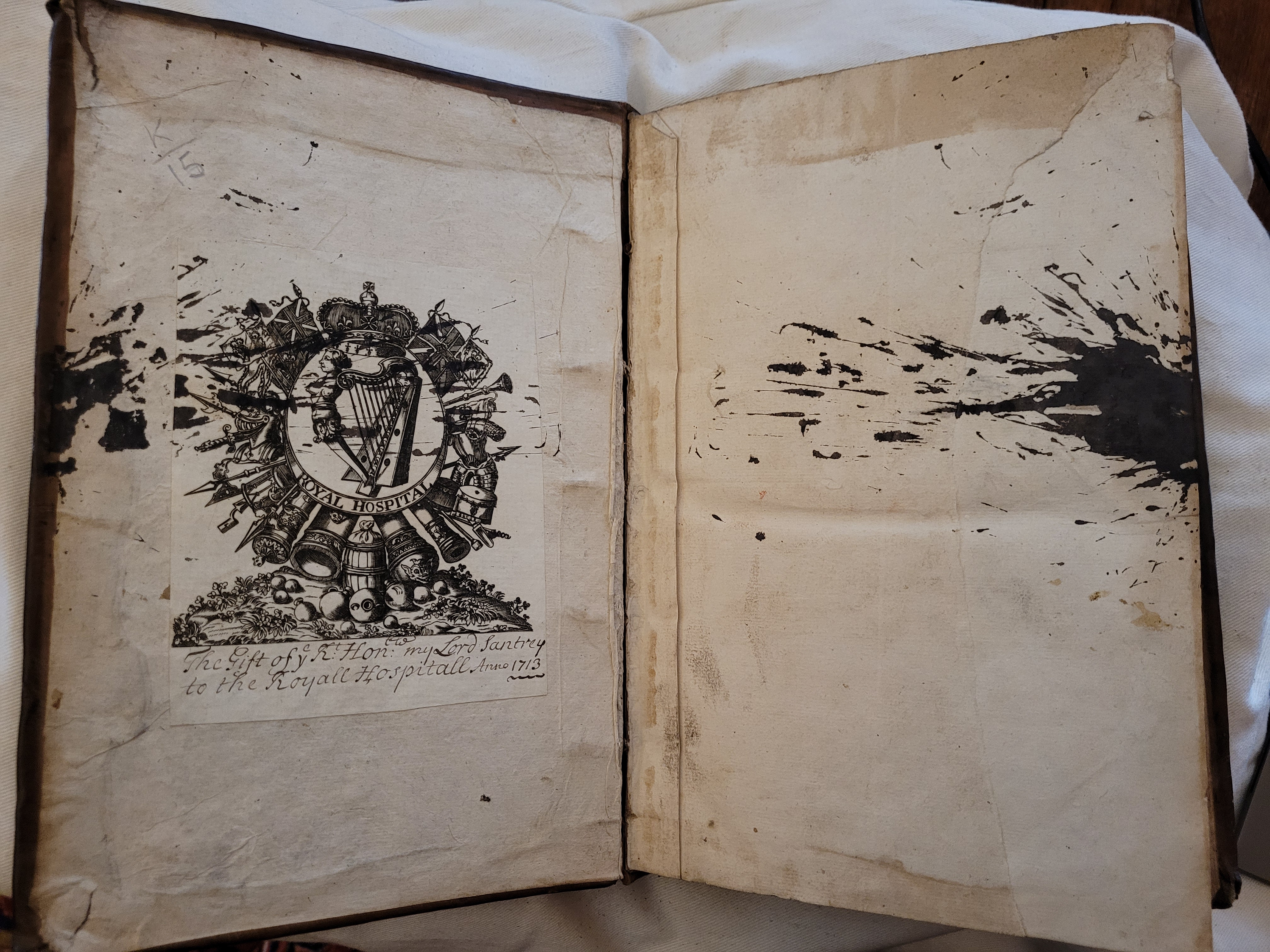
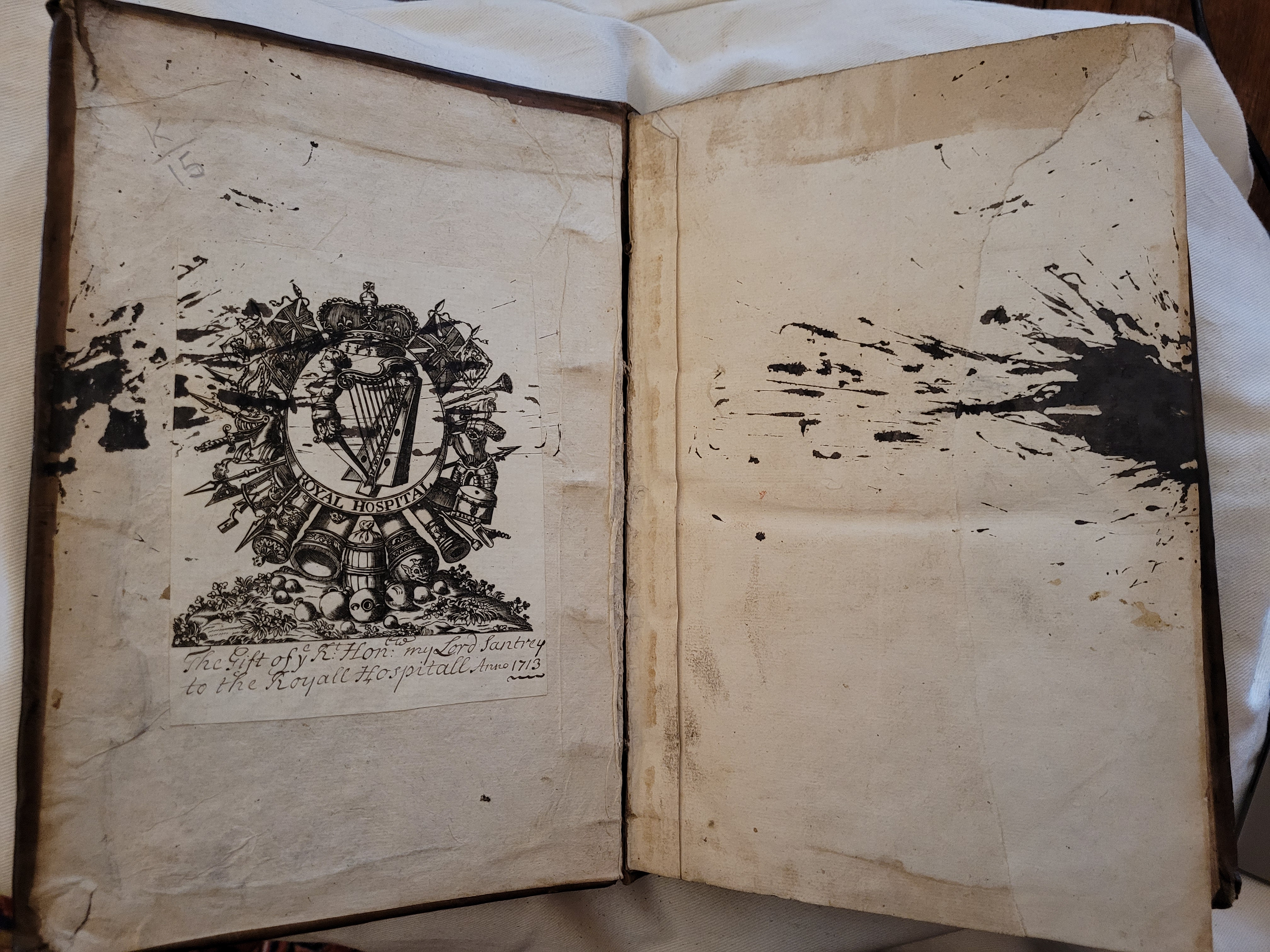
The first recorded use of the library books at the Royal Hospital Kilmainham concerns their illicit removal from the premises by the master, Colonel Feilding, but the second piece of evidence for reading is more positive. A note written inside a volume of William Howell’s An institution of general history (London, 1680) reads: ‘Returned this book to ye Library ye 27 January 1724/5. Thos Baker.’Footnote 35 There was obviously some provision for the books to be taken from the vestry room in which they were housed. There is a handwritten note dated ‘1732’ about the quality of the food at the RHK inside the library’s copy of The lives of the noble Grecians and Romaines (London, 1603). However, none of the small number of other indications that a book was read can be ascribed to a particular date or person. There are some soot marks on individual pages (indicating that the book was read beside a coal fire) of otherwise pristine copies of both Jeremy Collier’s The great historical, geographical, genealogical and poetical dictionary (London, 1701) and Antoine Furetière’s Dictionaire universel contenant generalement tous les mots françois (Amsterdam, 1701). A clumsy reader spilled an ink pot over the front board and flyleaf of the copy of A general collection of discourses of the virtuosi of France (London, 1664) donated by Lord Santry (figure 3). Inside one copy of John Harris’s A collection of voyages and travels (London, 1704) there is a fragment of an eighteenth-century newspaper used as a bookmark, and there are two separate fragments of printed paper from the eighteenth century used as bookmarks within Thomas Fuller’s The church-history of Britain (London, 1655). Yet, if truth be told, this is a very small amount of evidence for the use of these books. Even if the officers and senior staff of the RHK were wary of writing in or marking these texts, one would expect volumes in regular use to show signs of wear such as finger marks, cracked spines and loose front and back boards, as well as paper tears. A striking number of books in this library are in a remarkable state of preservation, displaying tight original bindings and clean, bright pages with no soiling or marking of any kind. In fact, the folded maps inside the three volumes of Voyages historiques de l’Europe (The Hague, 1701) were almost certainly never opened before this author first consulted them in 2021.
Printed bookplate recording donation by Dr Benjamin Pratt, provost of Trinity College, Dublin, of a copy of A catechetical course of sermons for the whole year (London, 1700) to the RHK.
Printed bookplate recording donation by Thomas Proby, surgeon general of Her Majesty’s Forces in Ireland, of a copy of Pharmacopoeia medico-chymica (Lyon, 1649) to the RHK.
Ink-stained copy of A general collection of discourses of the virtuosi of France (London, 1664), donated to the RHK by Henry, 3rd Baron Santry.
There were some fitful attempts to add to the collection during the 1720s. The providore of the RHK gave two volumes of The theological works of the reverend Mr Charles Leslie in 1724, and three years later, the hospital acquired an eight-volume set in English of the ever-popular Plutarch’s Lives. At the end of the decade, Thomas Baker (almost certainly the man who had returned a book to the library in January 1725) gave a copy of Richard Fiddes’s Theologia speculativa: or the first part of a body of divinity. In 1729, the governors of the Royal Hospital formally entrusted the chaplain with ‘the charge of the Library, and to take care that none of the Books are lost or injured’.Footnote 36 From the 1730s onwards, however, the library became frozen in time as there was a very small number of no more than two dozen new acquisitions over the following century. In fact, there are only a few passing references to the existence of the library in the financial accounts of the hospital during that time. In September 1744, the RHK received estimates for ‘a Front and Back Hearth’ and ‘a Black Stone Chimney Piece for the Library’.Footnote 37 Three decades later, in May 1773, the purchase of a set of fire irons and bellows was deemed necessary for ‘the library’.Footnote 38 A decade after that, four chairs, an ink stand and a table with drawers and locks ‘covered with green cloth’ were provided.Footnote 39 These were probably replacements for library furniture that had become worn and the green cloth on the library table was again replaced in the late 1790s.Footnote 40 So, the library was obviously in use during the eighteenth century, but it is unclear how often it was open and how frequently it was used. It is almost certain that it was not frequented by NCOs and men from the ranks and was only open to the governors, the senior administrative officials of the hospital and former military officers who were Pensioners of the RHK. It is also entirely possible that the library was used primarily as a sociable space for these officers and senior staff. As such, the main reading matter even among the senior officers may not have been the imposing folio volumes lining the walls but newspapers and magazines which have not survived.
The old library was clearly moribund by the nineteenth century; there was no mention of it in the printed bye-laws, rules and orders of the RHK published in 1828.Footnote 41 Five years later, however, a new ‘Pensioners’ Library’ supported by contributions from the NCOs and men was established under the supervision of the chaplain.Footnote 42 This new collection was located in the great hall and grew rapidly, such that by 1887, the four dozen members of the library had access to a sizeable range of just over 3,400 volumes across ten subject areas. During the second half of the nineteenth century there were dozens of references to the new library in the minute books of the board and sub-committees of the RHK, but not one single reference to the old library. The inaccessibility of this ancient collection is made clear by the experience of the Irish bibliographer Ernest McClintock Dix. When, in 1898, McClintock Dix published the first part of a bibliography of early Irish printing he listed the books he had found in eighteen libraries but acknowledged there was more work to be done: ‘references to Dublin-printed works of the 17th century are urgently solicited, and will be gratefully received and acknowledged.’Footnote 43 He had not been aware of the old RHK library when he prepared the first instalment of his work, but by July 1900, he had somehow heard of its existence and wrote to the governors requesting permission to ‘see the Catalogue of books in the old Library and consult any 17th century works therein’. The secretary to the board replied to McClintock Dix conveying the trustees’ regret that his request could not be granted because ‘there are no facilities for giving access to the books’.Footnote 44 By 1921, the old library had been moved to an alcove near the main entrance to the great hall.Footnote 45 This new location was purely to display the volumes and it seems that neither McClintock Dix nor any other scholar ever got to consult the books.Footnote 46
Both the old library and the nineteenth-century pensioners’ library remained onsite after Irish independence and the subsequent closure of the hospital in the late 1920s. The governors and guardians of the RHK were dissolved as a corporate body on the last day of 1955, and seven years later, all the RHK’s ‘furniture, fittings, fixtures, pictures, books, documents, and other chattels whatsoever’ became the property of the Irish state.Footnote 47 The Kilmainham site was long neglected and fell into a state of considerable disrepair. It was refurbished during the 1980s by the Office of Public Works (OPW), the government agency charged with maintaining the property portfolio of the nation, and reopened in 1991 as the Irish Museum of Modern Art (IMMA). As already noted, at various points during the twentieth century, military papers and administrative records found at Kilmainham were transferred to the NLI and the NAI, but the books from both the ‘old library’ and the nineteenth-century Pensioners’ Library remained on site. A librarian employed by the OPW surveyed the RHK books at IMMA in 2003, when they were kept in a storage room on the first floor of the main building. She made suggestions for improved on-site environmental monitoring, better shelving and enhanced security but there was obviously a feeling within IMMA that these dusty old books had no place in a beautifully refurbished modern art gallery. The books were transferred in 2011 from Kilmainham to Farmleigh House in the Phoenix Park, another site managed by the OPW. They remain there today.
IV
The Pensioners of the Hôtel des Invalides in Paris had access to a library from the inception of the building in 1674. Although the RHK was consciously modelled on the French institution, it did not make provision for such a facility. This may tell us something about the presumptions of those behind the Dublin hospital as to literacy levels of the men who were likely to be in residence, as well as the broader absence of a culture of books and print culture in the public realm in Ireland in the 1680s. A library was created at the RHK in the first half of the 1710s by soliciting donations from among the governors of the hospital, senior officers in the army and well-to-do civilians with an interest in the mission of the hospital. The impetus for the library probably lay with the master of the institution, Sir Charles Feilding. The donated books consisted overwhelmingly of large folio editions across a range of religious, historical, literary and practical topics. They were intended for use by the former military officers who were ‘inmates’ of the RHK, as well as the senior military officers and civilian officials who worked (and often lived) on site. The books were not intended for men of humble education such as NCOs or private soldiers, and nothing is known about what the lower ranks read during their time in the hospital.
The donated books were not a random assortment of volumes. Instead, the collection seems to have been constructed around a ‘wish-list’ of core texts. Some donors probably paid for new books to be donated to the RHK on their behalf, but others evidently provided books from their own collections. It is impossible to say whether this was because they matched items on the list of desirable books or because the appeal afforded an opportunity to get rid of unwanted or superfluous volumes. Most donors gave only one book, but others gave several, thereby affording us insight into other contemporary book collections among this particular social milieu. Yet, the books are not a record of what anyone in the hospital necessarily wanted to read; they are rather evidence of what the master, Colonel Feilding, and the great and the good of Irish society felt should be present in a library likely to be frequented by men of some social standing. Colonel Feilding’s notion of what the RHK library should contain seems to have been so lofty that in practical terms the volumes served largely as ornamentation on the shelves before gradually ossifying into an ‘old library’ that was rarely (if ever) used by the officers in the hospital and was unavailable to later generations of historians and scholars. The personal libraries of all the men and women who contributed books to the RHK between 1711 and 1715 have long since disappeared. By contrast, the books they donated have survived largely intact because they were almost entirely unused.
Acknowledgments
I am grateful to Nuala Canny of the OPW for first drawing my attention in 2021 to the RHK books held at Farmleigh House in the Phoenix Park, Dublin. I am indebted to the NAI archivist Deirdre O’Connell, who first provided me in 2022 with the list of the surviving RHK manuscripts. The archivist Vera Moynes provided invaluable advice. I wish to thank the following members of the productions team in the NAI: Peter Goode, Neil Cloake, Jennifer Nolan, Gillian Dowling, Jeff Cooney, Bernie Murphy and Cian Grogan.

 Open access

