




Understanding population change in late medieval towns can make a significant contribution towards urban studies. The number of inhabitants may influence a town's extent, through expansion or contraction of its limits or of the built environment. Understanding the nuances of population change may also contribute towards the interpretation of economic change, for example, by showing patterns of migration. Population studies have tended to concentrate on providing estimates of the number of people in years in which taxes were levied, sometimes using those estimates to rank towns by size. English towns during the late medieval period were smaller than many of their European counterparts. Although this article wishes to move discussion of populations away from estimates based on taxation documents alone, it is important to provide some context of the size of English towns. Alan Dyer's estimates of the 57 largest provincial towns suggested that in 1377, one town had a population of 550, 25 towns had a population of between 1,000 and 2,000, 21 had a population of between 2,000 and 5,000, eight had a population of 5001–9999, and only two (Bristol and York) had populations exceeding 10,000.Footnote 1 Although they may provide a possible means of comparing different towns, these estimates are unhelpful, as will be shown, because they take a generic approach that overlooks the circumstances of different towns. Furthermore, by concentrating on absolute figures, for specific points in time, the nuances of population change over the course of the late medieval period are poorly understood. This is because population change has usually been considered in relation to the number of taxpayers in 1377 compared to the number who contributed to the Tudor subsidies a century and a half later. An alternative approach is presented here utilising multiple strands of evidence which, it is argued, enables examination of these nuances to identify and better understand population trends throughout the late medieval period and forms a more robust methodology which can be applied to some towns, as will be shown using Nottingham as a case study. Due to the nature of the available source material, the most compelling conclusions relate to the fourteenth and early to mid-fifteenth centuries, but later documents allow important inferences about population trends. It is the view of this study that population trends provide a better means of understanding the scale and nature of population flux during the late medieval period than creating population estimates for two years, a century and a half apart, which rely upon a single source.
1. Previous methods
Previous methods used in English towns are briefly outlined here, before demonstrating how an alternative approach provides information from which compelling interpretations may be inferred. Detailed consideration of pre-plague population trends has not been attempted for most towns, largely due to the limited nature of early to mid-fourteenth century sources. David Palliser formed a broad overview of medieval population change for English towns.Footnote 2 He suggested that through migration urban populations peaked by around the year 1300, with London's population thought to have reached 80,000–100,000, and that towns were overpopulated prior to the Black Death.Footnote 3 From this zenith there was, according to Palliser, a period of population decline, with the most acute pre-Black Death reduction between 1315 and 1322 as a result of famines stemming from the agrarian crisis, which, he argued, may have killed more than 10 per cent of the urban population.Footnote 4 According to Philip Slavin, England and Wales suffered a 62 per cent bovine mortality in 1319–1320, and crop failure contributed to a human mortality of 10–15 per cent.Footnote 5 Further outbreaks of cattle plague are believed to have occurred in central England in 1324 and 1333–1334, possibly resulting in further population decline.Footnote 6
The suggested pattern of population growth until c.1300 can be nuanced by looking at the towns of Norwich and Lynn (modern-day King's Lynn), which provide different chronologies for the peak of population based upon tithing rolls and leet court records. All adult males, other than clergy, were required to enrol in urban tithing rolls, and so these documents, where they survive, ought to be a valuable tool in calculating populations of towns.Footnote 7 Elizabeth Rutledge's study of the early fourteenth century tithing rolls for the leetFootnote 8 of Nedham and Mancroft, one of the four leets of Norwich, led her to conclude that tithing rolls could be used to measure the pre-Black Death population, as well as population change, suggesting Norwich's population continued to rise rapidly up until 1333, although she emphasised that interpretations based upon a single source should be used with caution.Footnote 9 Records of the leet court (a court which sat infrequently and heard cases of minor offences) for the town of Lynn include more than 1,000 individuals who lived or traded in Lynn in the late 1370s, which is more than the number taxed in 1379.Footnote 10 Susan Maddock used leet court records to estimate the number of households and adults in Lynn between 1309 and 1434, identifying a rising population into the 1340s.Footnote 11 The examples of Norwich and Lynn indicate differences in the chronologies of population change between individual towns, and act as a warning about the use of generic models of population change.
High mortality and population decline followed the arrival of plague in 1348 and 1349, with recent studies suggesting a population fall of at least 50 per cent.Footnote 12 It has further been suggested that in England plague epidemics occurred every two to five years between 1361 and 1580.Footnote 13 Together, famine and plague are thought to have had a particular impact upon the population of the Diocese of York (which covered Nottingham) until the second half of the fifteenth century.Footnote 14 Epidemics and infectious diseases are rarely documented during the medieval period. For instance, other than ‘some death’ in Nottingham in 1518, there are no clear records for epidemics in Nottingham until the earliest record of plague in 1541.Footnote 15
Richard Britnell used Colchester's court rolls to argue that for more than half a century following the arrival of plague, population grew.Footnote 16 References to individuals involved in regulated trades associated with food and drink could, he believed, be used to infer increases in foodstuffs and therefore sustained population growth.Footnote 17
Most late medieval population studies have concentrated on the years 1377 to 1523–1525, using the poll taxes of 1377, 1379 and 1381, and the lay subsidies of 1523–1525 because these documents provide the largest figures for people living in towns at any one time, though these documents enable only long-term trends to be identified. The number of contributors to a particular tax may be known, but it is calculating the non-contributors where difficulties arise, with each tax having different requirements. The 1377 tax required a flat rate of payment of 4d. (pennies) from every lay person over the age of 14. In 1379 different rates of tax were applied depending upon an individual's status, on those aged 16 and over. The 1381 tax was applied to those aged 15 and over, with a minimum rate of 4d., but an expectation that collectors would obtain a mean average of 12d. per person. This latter tax was particularly resented, with increased evasion, contributing to the Peasants’ Revolt. The Tudor lay subsidies taxed land and wages valued at 40s. (shillings) or more, and goods (movables) valued at 20s. or more.
It may be possible to estimate, with reasonable confidence, the proportion of a population who were too young to pay the 1377 tax, but the sixteenth century subsidies are more problematic as will be shown. Even when the approximate proportion of a population who ought to have paid a tax is known, it is difficult to estimate the levels of evasion, exemption and underassessment.
Historians have attempted to overcome this by multiplying the number of taxpayers by a factor which accounts for the non-taxpayers. It is the accuracy of these multipliers upon which population estimates hinge. Some of the estimates assume taxpayers were heads of a household, with the number of taxpayers multiplied by an estimate of the number of people in each household and making a reasonable guess as to the proportion of the population who avoided paying, to reach a total for the town. For example, Josiah Cox Russell argued that an estimate of the population in 1377 can be obtained by adding an additional 50 per cent to the number of taxpayers, but other historians believe the number of taxpayers should be doubled in order to allow for those aged under 15, tax evaders and those too poor to pay.Footnote 18 Alan Dyer thought the multiplier should be 1.9, but Christopher Dyer argued this is too low because the householding poor were exempt from the tax and because there were ‘considerable omissions in some towns.’Footnote 19 Stephen Rigby estimated that those aged 14 and under formed between 35 per cent and 45 per cent of the population and that of those eligible to pay tax, between 8 per cent and 25 per cent did not.Footnote 20 Nigel Goose and Andrew Hinde believed evasion may have accounted for 5–25 per cent, and that between one third and 45 per cent of people were too young to pay the tax.Footnote 21
There is more doubt about the proportions for the 1381 tax. Christopher Dyer believed minimum and maximum estimates can be obtained by doubling and tripling the number of taxpayers.Footnote 22 Even greater uncertainty surrounds the Tudor lay subsidies. Christopher Dyer advocated multiplying the number of contributors by 5 and 7 to create minimum and maximum estimates.Footnote 23 Alan Dyer used multipliers of 6 and 6.5 to create minimum and maximum estimates.Footnote 24 Julian Cornwall used a multiplier of 5, whilst Jei Yang used 4.6, Goose used 4.4 and 5, and Bruce Campbell and Marjorie McIntosh used a multiplier of just 4.Footnote 25 Alan Dyer's calculation was based upon ‘a mean household size of 4.4–4.5 persons and a level of omission of about 25 per cent, or 4.1–4.3 and 30 per cent.’Footnote 26 Exemptions and evasion for some towns are likely to have been much higher than the multipliers suggest. For example, the 1523–1524 subsidy roll for Nottingham, which lists those individuals taxed on their goods, landed income and the wages of some servants, did not include children (except for three orphans), and recorded only 18 women, indicating a high level of exemption.Footnote 27 Fifteen of the 67 session court jury members recorded in 1525 did not contribute to the same subsidy, which suggests a potentially high level of evasion. Of 552 individuals recorded as living in Nottingham between 1520 and 1529, the names of 251 do not appear in the subsidy roll and the population may therefore be much higher than the multipliers suggest.Footnote 28 Alan Dyer used the chantry certificate of 1548 to supplement the data from the subsidy for Nottingham, to refine his methodology and create an estimate of 2,220 for the year 1524.Footnote 29
Multipliers work on the assumption that towns shared the same, or similar, demographic proportions and took the same, or similar, strategies regarding tax collection. Different towns have different circumstances, however, so it is not possible to use a generic approach. According to Jeremy Goldberg, through migration, driven by ‘economic vitality’, York achieved remarkable population recovery by 1377.Footnote 30 However, recession after c.1460 had a negative impact upon the city's population.Footnote 31 Regional differences appear to have occurred during the second half of the fifteenth century, especially in communities involved in overseas trade: a major decline in exports from port towns such as Hull affected the North, and led to increased trade from southern ports, resulting in significant growth in towns such as Norwich by the late fifteenth century and Exeter in c.1480–1510.Footnote 32 Economic vitality varied regionally, and consequently so did trends of population growth and decline. In addition to towns having experienced different rates of population growth or decline, some towns may have had a higher proportion of people too poor to pay tax, and different towns may have enforced the collection of taxes more effectively.
Historians accept that multipliers are arbitrary, but they have used this approach as the best means available to make comparisons and identify long-term change. These multipliers do not allow inferences into what may have occurred during the almost century and a half between 1377 and the Tudor subsidies.
Before continuing, it is important to apply these multipliers to Nottingham to highlight the range of estimates produced. The number of individuals in Nottingham who contributed to each tax or subsidy is shown in Table 1 and the multipliers are applied in Table 2.
The number of individuals contributing to taxes in Nottingham between 1327–1328 and 1523–1524
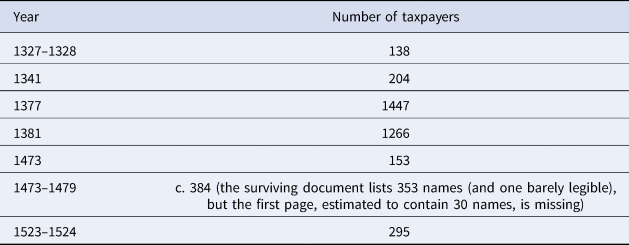
Sources: Vanderzee, Nonarum Inquisitions, 290–2; Fenwick, The Polls Taxes of 1377, 1379 and 1381, 272; Stevenson, Records of the borough of Nottingham, volume II, 284–97; Nottinghamshire Archives CA 8019; Stevenson, Records of the borough of Nottingham, volume III, 162–81.
Population estimates for Nottingham between 1377 and 1524 based upon methodologies applied by different named historians
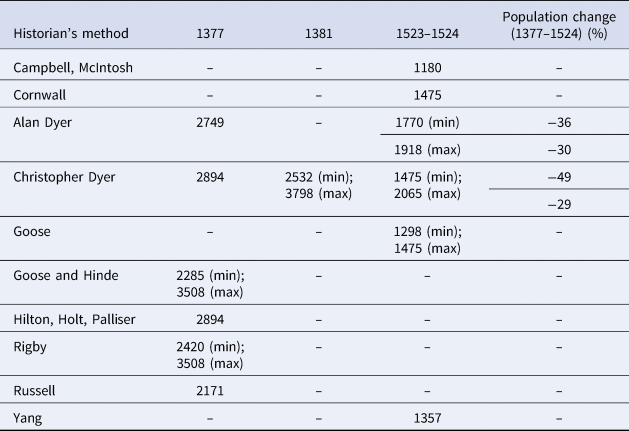
Sources: Campbell, ‘The population of early Tudor England’, 145–54; Cornwall, ‘English population in the early sixteenth century’, 32–44; Dyer, Decline and growth in English towns 1400–1640, 64, 66; Dyer, “Urban decline” in England, 1377–1525’, 266, 272; Dyer, ‘Small towns 1270–1540’, 536; Goose, Economic and social aspects of provincial towns, 242, 249, 252; Goose and Hinde, ‘Estimating local population sizes at fixed points in time’, 78–80; Hilton, ‘Towns in English medieval society’, 22; Holt, ‘Gloucester in the century after the Black Death’, 149; McIntosh, Working women in English society, 1300–1620, 18; Palliser, ‘Urban decay revisited’, 9; Rigby, ‘Urban decline in the later middle ages’, 48; Yang, Wage earners in early sixteenth century England, 110–20.
Clearly the estimates vary greatly, with a population in 1377 of anywhere between 2,171 and 3,508 people, and populations in the 1520s of between 1,180 and 2,065, though all estimates imply Nottingham's population significantly declined by 1523–1524.
Sixteenth century muster documents, which were intended to record the names of every able-bodied man aged between 16 and 60, have sometimes been used to estimate population. Goose and Hinde assumed 57 per cent of males were aged 16–60, and believe population can be estimated by establishing the total number of males, and then doubling that figure to account for females.Footnote 33 A muster for Nottingham, dating to 1539, names just 284 men, having omitted all the streets of St Nicholas’ parish.Footnote 34 Applying this methodology provides an unsatisfactorily low population estimate for Nottingham of 996 people.
Parish records can, with care, be used to estimate population by allowing inferences to be made regarding birth and death rates. Official records of baptisms and funerals were not compiled before 1538, and often the earliest records do not survive. Records of baptisms and funerals from Nottingham's three parishes (St Mary's, St Peter's and St Nicholas’) do not exist until the 1560s, and so these sources cannot be used to estimate medieval populations.
If the methods thus far used by historians produce widely varying results, and provide only long-term trends, how can we proceed in obtaining a fuller understanding of population change?
2. Introducing an alternative approach
An alternative approach, suitable for the study of individual towns, is presented here, although this approach does not easily allow comparisons to be made between towns. Several strands of evidence are used and whilst individual strands may be of limited value, the totality of the evidence produces a more compelling account. This alternative approach has novel aspects in that it examines population trends rather than estimating absolute numbers. It also considers the nuances of population change throughout the later medieval period, reflecting shorter term change, rather than making comparisons between 1377 and the 1520s, and in doing so moves the historiography forward.
Goldberg has called for further study of inland towns such as Nottingham and Leicester with regards to economic recovery following the plague, up to the sixteenth century, to gain a more balanced understanding of change in English towns.Footnote 35 Economic and demographic recovery go hand in hand and therefore it is essential to also study inland towns with respect to population change. Goldberg has further argued for more case studies which utilise a wide range of evidence, rather than simply focussing on ‘extreme’ cases of change at ‘selected moments in time’.Footnote 36 The approach presented here is a suggestion of how this may be achieved for some towns where court records exist, including London, York, Norwich, Lincoln, Lynn, Chester, Exeter, Yarmouth and Colchester.
This approach uses three main strands of evidence: court records (from the leet and borough courts); tax documents, but only to a limited extent; and archaeological evidence in conjunction with the wider corpus of documentation.
3. The source material
3.1 Court records
Surviving records of Nottingham's borough court commence in 1303, with sessions recorded on rolls until 1455, although there are gaps (most notably there are no records for the years 1337–1350, and there are missing and damaged rolls for other years or partial years).Footnote 37 These have been translated from the original Latin and transcribed by Trevor Foulds and Jill Hughes. Sessions were held fortnightly and heard cases ranging from small debts to theft and serious assault. Separate rolls detailing cases between Nottingham townspeople and outsiders exist for several years (1396–1397, 1407–1408, 1410–1411, 1429–1430, 1431–1438, 1441–1442, 1445–1447, 1451–1453).Footnote 38 The court was therefore used by people residing outside of the town, but the figures in the present study have omitted those individuals. Theresa Phipps’ analysis has shown that most cases heard by the court (up to c.80 per cent in the late fourteenth and early fifteenth centuries) related to debts.Footnote 39 Changes to the way the court was operated and economic changes, which may have led to an increased likelihood of debts being incurred, may have resulted in increased or decreased numbers of cases in some years.Footnote 40
Later surviving borough court records are in books, with this format continuing beyond the medieval period. These have yet to be transcribed but examination reveals they are less comprehensive in the details of cases and so the focus of research has been upon the rolls. On balance, most disputes at the borough court involved property owners, but property ownership was not a condition of bringing a case to court. The records of Nottingham's leet court are published in volumes of the Records of the borough of Nottingham, and were translated and transcribed by William Stevenson.Footnote 41
3.2 Tax lists
Tax lists have been extensively discussed in general terms. For Nottingham, tax records exist for 1327 (the twentieth), 1341 (two ninths and fifteenths and tax on wool), the ‘poll taxes’ of 1377 and 1381 (unfortunately nominal lists do not exist), 1473 (in response to the 1472 Subsidies Act, taxing issues and profits of land, tenements, rents, fees, annuities, offices, corrodies and pensions), a tax dating to sometime between 1473 and 1479 (it is unknown what this tax relates to because the first page is missing) and the lay subsidy of 1523–1524.Footnote 42 A property tax was levied in 1504 and this has some value in countering arguments that areas of the town were sparsely populated at that time.Footnote 43 The number of taxpayers per street, and the amount of tax paid, for 1473–1479 and 1523–1524 are shown in Tables 3 and 4.
The number of taxpayers and sums paid per street in the tax dating to between 1473–1479
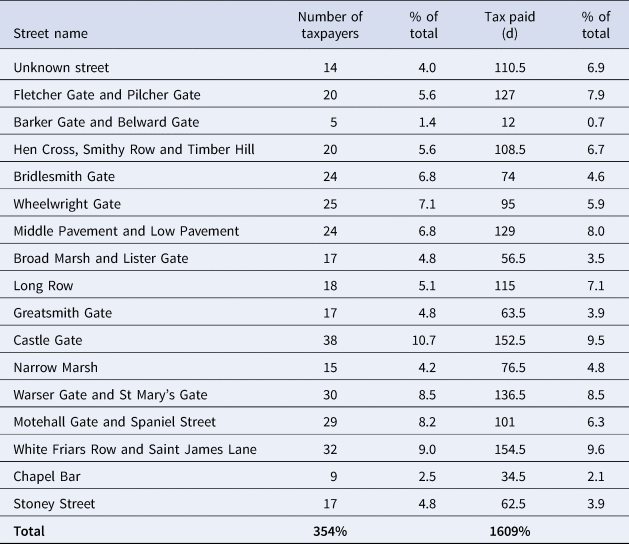
Source: CA 8019, held at Nottinghamshire Archives.
The number of taxpayers and sums paid per street in the 1523–1524 subsidy
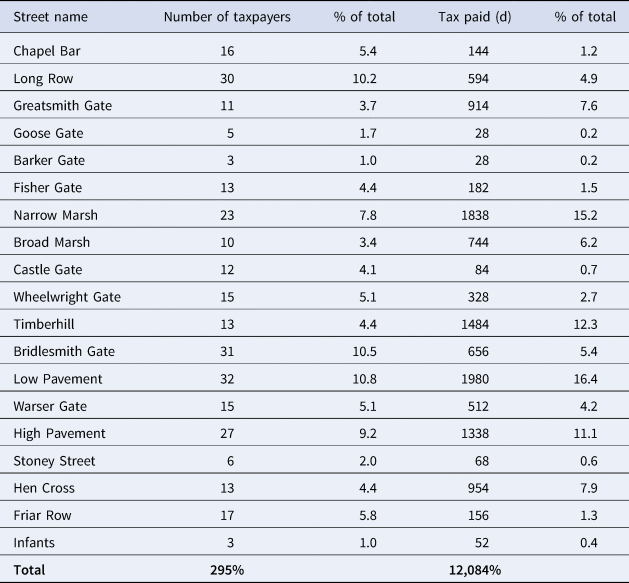
Source: Stevenson, Records of the borough of Nottingham, volume III, 162–81.
3.3 Archaeological evidence
Archaeological evidence is a useful tool for understanding population change by enabling examination of the changing intensity and nature of land-use and the consequent expansion and contraction of urban space.Footnote 44 There are, however, important considerations with such evidence. Archaeological remains are difficult to date to within a period of less than half a century.Footnote 45 Sherds of pottery frequently form the basis of dating remains, but only a rudimentary knowledge exists of the pottery types of many areas of England. There is no published ceramic type series for Nottingham, although a draft type series exists, and so the different forms and fabrics, which are crucial details when approximately dating pottery, are little understood. Consequently, studies of medieval pottery recovered from Nottingham excavations rarely enable sherds to be dated within a 50-year period, and sometimes only to within one or even two centuries. Scientific dating, including radiocarbon dating, can refine site chronologies, but the use of this technique in Nottingham highlights its imprecise nature. For example, a horn core from Goose Gate was radiocarbon dated to 1448–1621 calAD, with 95.4 per cent confidence.Footnote 46 This does not mean that archaeological evidence is of limited value, but that care is needed in its interpretation. Due to wide date ranges, it is difficult to connect archaeological evidence with documented events, though it can be achieved where a large body of both archaeological and documentary evidence exists, as in the example of Narrow Marsh, discussed here. Archaeology is suited to studying longer-term trends of urban change, over a period of at least several decades.Footnote 47
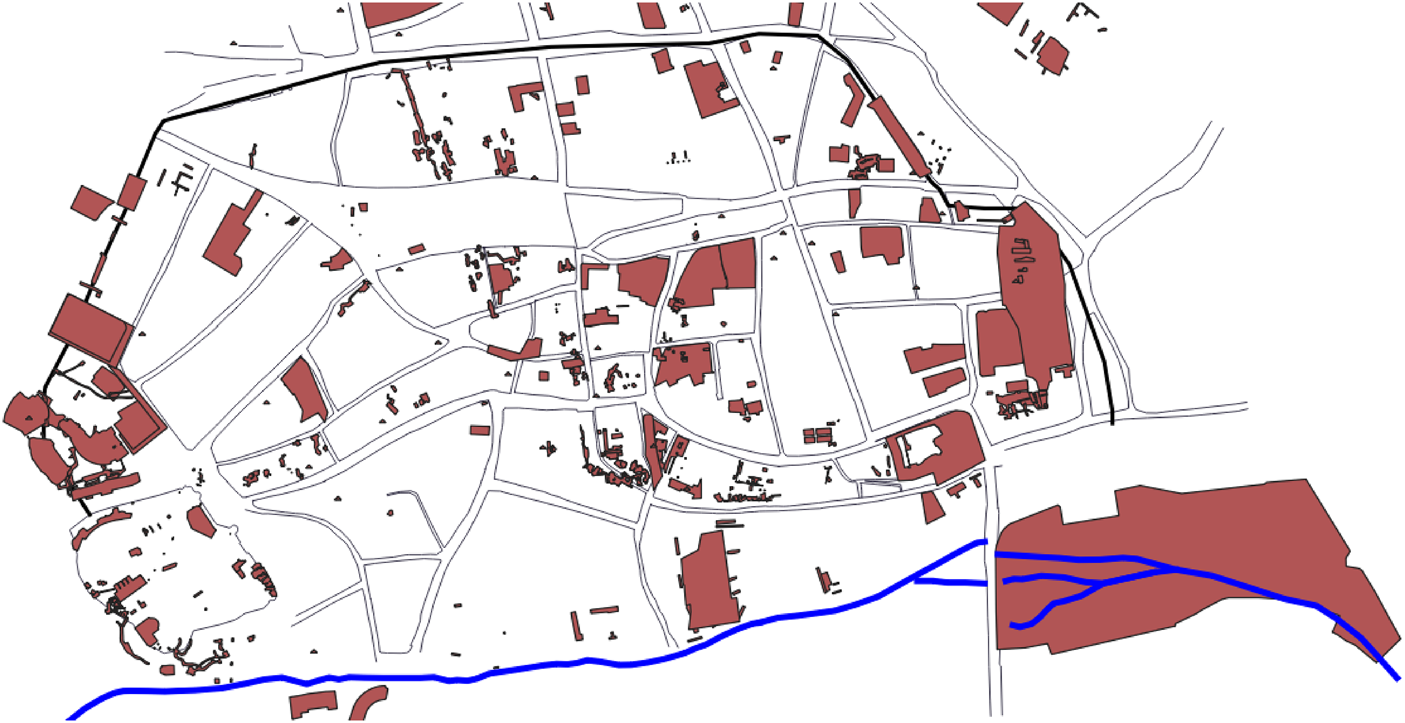
Another limitation of archaeological data relates to the extent of fieldwork within the areas of medieval towns, which means many areas of towns are poorly understood. By way of example, the extent of archaeological excavations (specifically trial trench evaluations and open area excavations) and large-scale monitoring of groundworks for the area of the medieval town of Nottingham are shown in Figure 1. In addition to sites shown in Figure 1, many small monitoring works have been undertaken, usually during the digging of geotechnical test pits or foundations, and trenches for services, but these have not provided useful information regarding the occupation of land in medieval Nottingham. Of the larger excavations, reporting is of variable quality. For example, the report of one important site refers to features simply as ‘medieval’, with an unspecified number of sherds of pottery dated only broadly to the medieval period.Footnote 48 With the archive never deposited with a museum, and the archaeological unit having ceased trading, it is impossible to examine the archive and establish a chronology. Key excavations such as those by Nottingham City Museums Field Archaeology Section (discussed below) were never written up and so are little understood.
The area of the medieval town showing locations of excavations (the excavation extents are derived from the Nottingham City Historic Environment Record, maintained by Nottingham City Council).
4. The Nottingham case study
Let us examine how these different strands of evidence can be used to show population change in Nottingham.
4.1 Decennary records
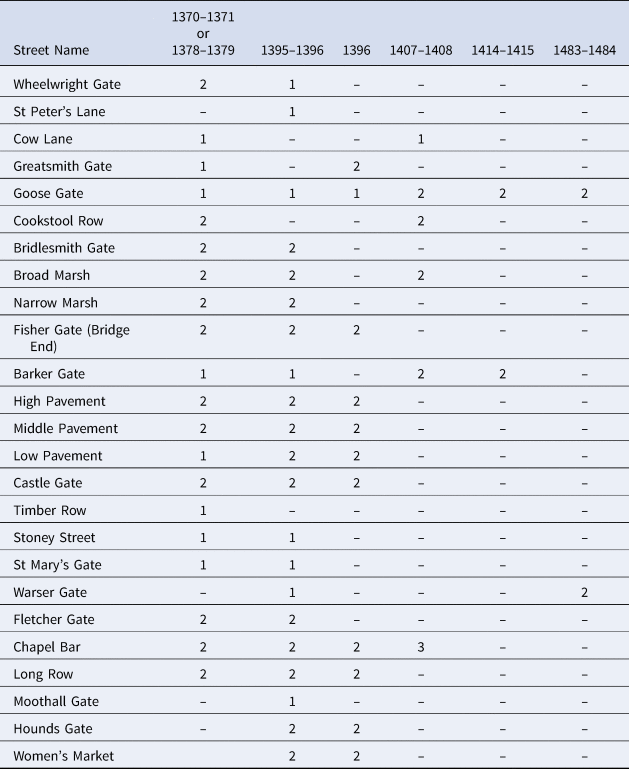
Decennaries were officers, who acted as street constables, responsible for the twice-yearly presentment of alleged offenders before the leet court. The decennary system was based on the tithing or frankpledge system, whereby each decennary represented ten households.Footnote 49 The number of decennaries for Nottingham, shown in Table 5, reflects the number of households on a given street with sufficient population required to justify the payment of officials. Unfortunately, records specifying the number of decennaries only survive for the years shown in Table 5. Where two decennaries were responsible for two streets (as in the case of St Mary's Gate and Warser Gate, and Wheelwright Gate and St Peter's Lane, both in 1395–1396) the streets have been separated and each assigned one decennary to allow for comparisons with later years. Where a street had only one decennary, the words ‘sole decennary’ were used in the court records.
The number of decennaries (street constables) per street according to Leet Court records
Sources: Stevenson, Records of the borough of Nottingham, volume I, 201–7, 292–309, 312–17; Stevenson, Records of the borough of Nottingham, volume II, 46–9, 104–7, 338–9.
Goose Gate, Barker Gate, Greatsmith Gate, Low Pavement and Chapel Bar had an increase in decennaries, between the latter years of the fourteenth century and the early fifteenth century. In the first two streets, this challenges a traditional narrative described in further detail when addressing archaeology, that the eastern periphery (which included Goose Gate and Barker Gate) was abandoned in c.1350 and remained largely abandoned until the sixteenth or seventeenth centuries. The number of decennaries at Warser Gate rose at some time between 1395/6 and 1483/4. Whilst it is possible there was movement of people into more central zones, perhaps explaining the increase in number of decennaries on Low Pavement, the increases in peripheral areas on the eastern side of the town appear to indicate population growth around the turn of the fifteenth century. Interestingly, Wheelwright Gate saw a reduction in decennaries between the 1370s and 1395–1396, suggesting localised population reduction.
It can be argued that streets may have had only a single decennary due to an inability to elect or appoint a second individual. Even if true, the inability to elect two officials may have been due to a limited population. Streets needed to have had sufficient population to justify the appointment of a second, or third individual, and so the presence of two or more decennaries on a particular street is indicative of a reasonably large population. Although the figures are patchy, it can be tentatively suggested there were at least 38 decennaries in the 1370s and at least 42 as of 1407–1408 if the streets with no records remained unchanged (representing an increase from around 380 households to approximately 420 households); an increase in the order of 11 per cent. The figures in Table 5 suggest particular growth between 1395–1396 and 1407–1408.
4.2 Court users as an indicator of population
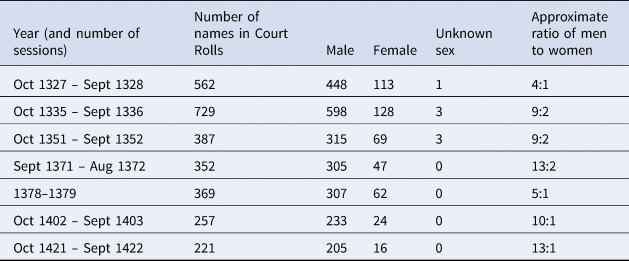
Britnell used numbers of named victuallers in the Colchester court rolls to support his argument for growth in the amounts of foods being produced, and therefore population growth in the second half of the fourteenth and early fifteenth centuries.Footnote 50 A more extensive application of court rolls is used here to present trends in Nottingham's population. The number of named individuals in the court rolls has been calculated for the following years, each representing 12 months: 1327–1328, 1335–1336, 1351–1352, 1371–1372, 1402–1403 and 1421–1422. Unfortunately, after 1421–1422 the records are less complete due to missing or damaged rolls. Although there are some names missing, or illegible, from sections of the rolls in the sample years, lists of new suits and details of cases were frequently repeated over multiple sessions, and so it is believed most names have been captured and the omission of a small number of names does not significantly alter the figures in Table 6.
The number of names recorded in the Nottingham Borough Court rolls for selected sample years
Sources: Nottingham Borough Court rolls held at Nottinghamshire Archives CA1260, CA1262, CA1263, CA 1277a-b, CA 1277b, CA 1280a, CA 1300 and CA 1317.
The 369 names in 1378–1379 represented between 10.5 per cent and 17 per cent of the population estimates for 1377, and between 9.7 per cent and 14.6 per cent of the estimates for 1381, in Table 2. What proportion of a town's population are represented in its court rolls? Although research of borough court rolls has been undertaken by historians including Phipps and Maryanne Kowaleski, the proportion of a town's population represented in such rolls is unknown.Footnote 51 Britnell's comparison of the Colchester court rolls with the 1377 tax assessment led him to conclude that ‘less respectable social groups’ were under-represented in court rolls, although the under-representation of the adult population was between only 5 and 20 per cent.Footnote 52
The evidence from Nottingham suggests greater under-representation. In Nottingham, 62 per cent of debt pleas related to sums under five shillings, implying the court was mainly used for small matters.Footnote 53 The court rarely heard pleas for sums exceeding 40s. because such cases required a writ.Footnote 54 There were fees involved in taking a case to court, with each stage of the process incurring costs, which could mount up quickly, and may often have exceeded the amount of money involved in a dispute, although borough courts remained a popular means of resolving disputes.Footnote 55 Phipps agrees that use of the borough courts was popular, and ‘a relatively normal part of urban life’.Footnote 56 Costs were, she argues, relatively small, with fines often being 2–3d., which was lower than the average daily wage of skilled labourers.Footnote 57 This may have made use of the court within the means of the skilled, but arguably outside the means of the many unskilled. If money was not a barrier, in many cases the legal process itself was, with the presence of attorneys at many court sessions implying legal knowledge was sometimes needed. Such knowledge and understanding may have been beyond the skillset of many townspeople, particularly the poor.
We have seen the poor were likely under-represented in the court rolls, but what about those with financial means? Comparison of the number of users of Nottingham's borough court for some of the sample years in Table 6, with the number of individuals mentioned in other sources for those years, is revealing. The wealthiest of the town did not necessarily regularly use the court. Despite 562 individuals being named in 1327–1328, the records for this year only include 78 of the 137 (57 per cent) of those who paid tax in 1327. Of the 157 individuals mentioned in a session of the leet court in either 1370–1371 or 1378–1379, 99 (63 per cent) appear in the court rolls for the years 1370–1372 and/or 1378–1379. A membership list of St Mary's Guild exists for 1371.Footnote 58 Ignoring those listed as either dead or living outside the town, and four whose names are too faded to be read, there are 125 named individuals. Only between 37 and 39 (29–31 per cent) of those individuals appear in the court rolls for 1371–1372. Therefore, even among those who had some financial means, there were a large number whose names are not represented by the figures in Table 6.
It appears that the borough court may not have been as popular as Phipps and Kowaleski have suggested. Nonetheless, the figures in Table 6 can be used to make some observations regarding population change, if we use them as a benchmark to make comparisons between years. It should be borne in mind that the popularity of the court may have fluctuated over time and so this could have contributed to changes in the numbers of court users. However, it is felt that the most significant proportion of the change relates to population change.
Between 1327–1328 and 1335–1336, the number of court users rose by 30 per cent. It seems plausible that migration contributed to this rise, a theme which is explored shortly, but it can be tentatively suggested that Nottingham's population rose well into the 1330s. The figures then suggest significant population decline between 1335–1336 and 1351–1352, with a further significant fall between 1378–1379 and 1402–1403. In the former case this change is not unexpected. A crude suggestion may be that between 1335–1336 (the last complete year in which records exist prior to the plague) and 1351, the proportion of the population who used the court fell by approximately 47 per cent. This is broadly consistent with the accepted plague mortality rate of at least 50 per cent. The number of court users remained broadly stable, though with small fluctuations, between 1351–1352 and 1378–1379 despite further outbreaks of plague, which suggests population replacement through migration.
Regarding the late fourteenth and early fifteenth century reduction, the figures are misleading because whilst the number of individuals in 1402–1403 was less than half that of 75 years earlier, the proportion of women appearing in the court drastically fell. Study of the 1377 tax for several large towns led Kowaleski to conclude that women were as numerous as men, or even outnumbered them, yet Table 6 shows that five times as many men appeared in Nottingham's borough court than women in 1378–1379, with this disparity growing over time.Footnote 59 Pre-plague, and in the early years after the Black Death, the approximate ratio of men to women was consistent, but this significantly changed by the 1370s, and changed further still by the early fifteenth century. Phipps has demonstrated wives often could be subject to coverture, whereby their husbands were responsible for them, and the wives did not have a legal or financial identity of their own.Footnote 60 Coverture did not have a set of rules and was used in different ways depending upon circumstances (such as when the wife could benefit from her husband's presence).Footnote 61 According to Phipps, the application of coverture varied between towns, with Nottingham exercising joint litigation whereby husbands and wives generally appeared together, unlike Winchester and Chester.Footnote 62 Occasionally wives used coverture when they could not, or did not wish to, appear in court.Footnote 63 This dynamic obscures a significant proportion of the population.
Even correcting for this, the numbers of individuals was still lower by the fifteenth century than in the previous sample years, suggesting a reduced number of those able to bring a case to the borough court. For example, the ratio of men to women in 1402–1403 was approximately 10:1, with 233 men and 24 women. The ratio of men to women in 1378–1379 was approximately 5:1. If we were to double the number of women to 48 to achieve a 5:1 ratio, to give greater parity between 1378–1379 and 1402-1403, this gives a total of 281 individuals which is considerably lower than the 369 men and women who attended the court in 1378–1379. This does not necessarily mean the town's population continued to decline at this time and must be considered alongside other evidence discussed below, which suggests an increase in the urban poor who were less likely to come to the attention of the court.
4.3 Migration
Examining the court rolls more closely, they can, with care, be used to infer population growth through migration, especially for the early fourteenth century. Migration, of people from all social levels, into towns was the primary way in which population increased during the late medieval period.Footnote 64 Researchers such as Peter McClure have used toponymic (placename) bynames to identify migrants, or people of migrant descent.Footnote 65 McClure's methodology cannot reliably be applied to Nottingham for most of the late medieval period because of the growth in hereditary naming by the early fourteenth century. References in the court rolls to the likes of John le Colier jnr and Astin de Athilwell jnr, both of whom were adults in 1304 and 1308 respectively, indicate hereditary naming was established by the late thirteenth century.Footnote 66 It was not universal, but hereditary naming had become firmly entrenched by the mid-fourteenth century.
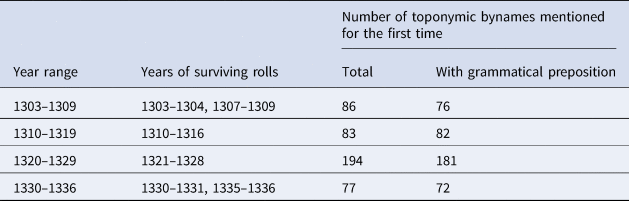
Toponymic bynames generally best demonstrate migrant heritage rather than recent migration. However, the use of the Latin grammatical preposition ‘de’ (meaning ‘of’) prior to a placename, may indicate an individual was a migrant and it is argued here that this may infer migration. It is possible to tease useful information about potential recent migrants from the documentary record for the early to mid-fourteenth century where a new byname appears in the records for the first time. Table 7 shows the number of toponymic bynames by the decade in which that byname first appears, and it is argued here that these figures can be used to identify decades which may have witnessed higher than normal levels of migration.
The chronological distribution of toponymic bynames, and those with the grammatical preposition ‘de’, in the Nottingham Borough Court rolls by the decade in which they are first mentioned (1303–1336)
Sources: Nottingham Borough Court rolls held at Nottinghamshire Archives CA 1251a-b, CA1252–CA1255, CA1266, CA1267, CA 1258a-b, CA 1259–CA 1262.
There are, of course, other factors to consider. It is possible the introduction of a new toponymic byname was the result of no one with that name having previously been involved in a dispute at the court, or that the family had moved up the social hierarchy and so was more likely to come to the court's attention, or that the byname first appeared in one of the missing rolls.
The figures for 1303–1309 include names which are not necessarily new to that decade, with some likely to have been present in the late thirteenth century but in the absence of earlier court rolls the extent of this is unknown. They are presented to provide as full a record as possible for the early to mid-fourteenth century.
Despite these caveats, it is possible to tentatively make interesting observations for this short period of time. The data for 1321–1329 is of particular interest, especially when one considers most new names (154 names, representing 79 per cent of the total for that decade) appeared within the years 1321–1325, and therefore may represent evidence of an influx of migrants between 1317 and the early 1320s. One interpretation is that this represents migration of large numbers of people displaced by the famine of 1315–1322. The number of new names in 1330–1331 and 1335–1336 is also high and indicates high rates of continued migration into the town, which is consistent with the evidence already remarked upon from the number of named individuals in the rolls. For the years 1351–1360, 177 toponymic bynames appeared for the first time (with 131 of them appearing between 1351 and 1355) but given the lack of rolls for the years 1337–1350 there is too much risk in suggesting that most of these names represent post-plague migrants, though they may have done. All we can reasonably infer from this evidence is that there was high migration between 1337 and the early 1350s, and we can speculate that much of this occurred in the aftermath of plague. Where more complete rolls exist for other towns, it may be possible to test this methodology to better understand migration in the early years following the Black Death.
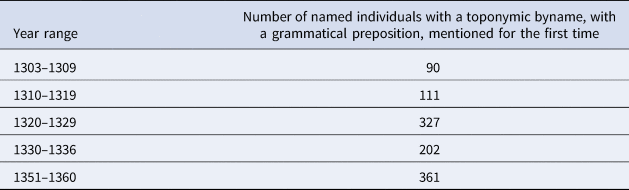
Table 8 shows the numbers of named individuals with toponymic bynames, rather than just the bynames themselves, for the same period, as well as the years 1351–1360, focussing only upon those with the ‘de’ grammatical preposition. The ‘de’ preposition suggests these may have been migrants and so there may be greater confidence that the huge number of named individuals in 1351–1360 represents migrants, albeit those who first arrived in the town, or were first recorded, either in the first decade following the Black Death or in the years of the earlier missing rolls. Names such as John de Ripon jnr in 1358 show the ‘de’ preposition was still a feature of hereditary naming as late as the mid-fourteenth century. Some of these names feature across many years, and in some cases multiple decades, and therefore may represent a parent and child, or multiple individuals from the same town (particularly in the case of the bynames de Beeston, de Sneinton and de Derby, with these three places all near Nottingham). For this reason, only the first reference is used to show when that name first appeared in the records. However, if there is a gap of more than three decades during which time a byname does not feature in the court rolls, it is considered a possibility that the individual may represent a new wave of migration. There is a sense that some names from the mid-fourteenth century are evidence of recent migration, even where the court rolls mention the byname towards the beginning of the fourteenth century. For example, Elena de Doncaster was mentioned in 1308, with no further references to the byname Doncaster until 1352.Footnote 67 Roger de Adbolton had a tenement on Baxter Gate prior to 1311, but this byname was not mentioned again until Robert de Adbolton was a defendant in 1351.Footnote 68
The chronological distribution of individuals with toponymic bynames containing the ‘de’ grammatical preposition, in the Nottingham Borough Court rolls by the decade in which they are first mentioned
Sources: Nottingham Borough Court rolls held at Nottinghamshire Archives CA 1251a-b, CA1252–CA1257, CA 1258a-b, CA1259–CA1269.
Once again, the majority (255 individuals, representing 78 per cent) of those in the 1320s, were mentioned for the first time between 1321 and 1325. Although the risks outlined previously apply to the named individuals in the 1350s, it is notable that 80 per cent appeared in the records for the years 1351–1355.
Looking at some of the sample years in Table 6, 50 individuals (14 per cent) had toponymic bynames with a grammatical preposition in 1371–1372 (there was also a man described as a Brabantine). This is compared with 162 individuals (42 per cent) in 1351–1352. Although hereditary naming became increasingly common by the 1370s, consideration of the grammatical preposition raises the possibility that by the early 1370s recent migrants may have formed a much lower proportion of the users of the borough court, and perhaps represented a lower proportion of the town's population, than in the years around the arrival of plague. Migration may therefore have been at a lower rate in the 1370s and was insufficient to enable growth of the population.
There is insufficient evidence to be sure that Nottingham follows Goldberg's model for York which, according to him, experienced sustained population growth in the decades following the plague, with the highest migration, including the highest rate of female migration, during the late fourteenth and early fifteenth centuries.Footnote 69 However, the evidence presented earlier suggests population growth did occur in the early years of the aftermath of plague and again between the late fourteenth and early fifteenth century, and this can only have been achieved through significant migration, but with a possible slump in migration by the 1370s, with this slump probably commencing during the 1350s. There is certainly evidence that female migrants came to Nottingham, for work, in the early fifteenth century, but this evidence only exists in cases where a hired worker was accused of withdrawing from service. The court rolls show servants from nearby towns and villages were sought. For example, in 1434 Henry Smalley of Nottingham agreed with Henry Nayler of Langley in Heanor, for Nayler's daughter, Margery, to work for Smalley in housewifery for one year.Footnote 70 Other female migrants included Joan Turnour, ‘lately of Derby’, who was hired in 1432 for a year by John Dorham.Footnote 71 That same year Margaret Drake, ‘lately of Lynn’, was hired as a mower.Footnote 72 Richard Wolaton hired Isabella Bradshagh, ‘lately of Chesterfield’, for a year in 1438.Footnote 73 With only a minority of women brought to the court's attention, it may be inferred that female migrants arrived in Nottingham in significant numbers, at least during the 1430s. Significant numbers of male migrants also appear to have arrived in Nottingham, from nearby towns and villages, with eight men recorded in the 1430s (including three in 1432 and three the following year). These were also described as being ‘lately’ of their place of origin. By the late 1370s, the grammatical preposition ‘de’ appears to be unreliable for Nottingham, but it may be inferred that the word ‘lately’ indicates recent migration, although its use is infrequent. There are a further 13 uses of the word ‘lately’ showing migration for the years 1441–1453. There is insufficient evidence to determine whether Goldberg's suggestion that towns may have become ‘less receptive’ to rural migrants by the late fifteenth century, applies to Nottingham.Footnote 74
Short term migration is often difficult to identify in the records but needs to be considered. For example, women seeking work during harvests.Footnote 75 Seasonal migration meant towns could significantly change in terms of their population, with temporary growth lasting only a few weeks or months. Some documented references to migrants may be evidence only of seasonal workers and not of lasting population rise. This seasonal migration may have resulted in neighbourhoods, perhaps in peripheral areas, periodically experiencing occasional population booms.
Immigration from overseas contributed to the population of towns such as Nottingham, but given the small numbers involved discussion here is limited. Toponymic bynames such as Braban occur in the borough court rolls, but these could be hereditary, indicating foreign descent, and immigrant status can only be confirmed if specifically stated in the sources. Data published by the England's Immigrants project presents the most reliable record of immigrants residing in Nottingham, with the chief sources being Alien Subsidies and Letters of Denization.Footnote 76 Alien subsidies were taxes, first levied in 1440, on first-generation immigrants. For Nottingham, such records only survive for 14 of the years between 1440 and 1483. In 1440 and 1441 the place of origin was rarely recorded, but later records often included this information. The number of immigrants per year is very small (with a peak of 16 in the year 1440 and only six of the 14 years reaching double digits). The methods of assessment for individual years differed and some underassessment may be possible. Short-term immigration did occur, for instance in the case of Icelandic immigrants who appear to have been seasonal migrants, residing in Nottingham for just months at a time.Footnote 77 Very short-term immigrants, such as those who resided in the town for a few weeks or months, may not have been present when the tax was levied and therefore will also not be represented in the statistics.
4.4 References to property
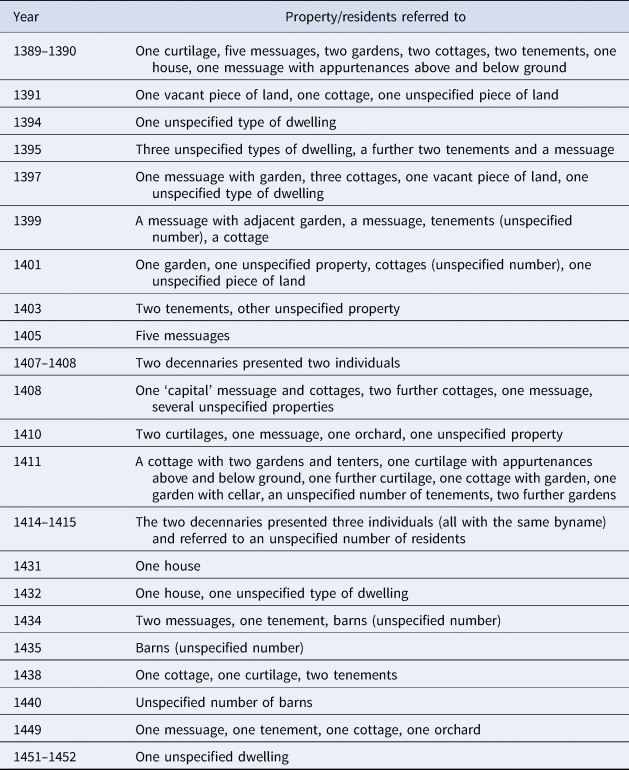
In addition to the evidence from decennary records which show growth in the eastern periphery of the town, court records show an increase in references to property in this area, which implies an increase in population and occupation. In 1353, Walter Ingram had a house on Barker Gate, with adjoining land of sufficient size that ash trees grew there.Footnote 78 A tenement formerly held by John Palmer was referred to in 1363.Footnote 79 In 1378–1379, William Shipwright was presented by the sole decennary of Barker Gate, Roger de Beeston, for selling ale against the assize.Footnote 80 These scarce records of individuals for the first few decades following the Black Death may imply low population. From 1389–1390 onwards, references in the court records, to occupants of this street became more frequent as shown in Table 9, which may tentatively suggest population growth.
Properties/residents referred to on Barker Gate in the Nottingham Borough Court rolls and Leet Court records
Nottingham Borough Court rolls held at Nottinghamshire Archives CA1290–CA1295, CA1295/I, CA1295/II, CA1296, CA1296/I, CA1296/II, CA1297–CA1304, CA1304B, CA1305–CA1321, CA1322/I, CA1322/II, CA1323–CA1334, CA1336–CA1341; Stevenson, Records of the borough of Nottingham, volume II, 48–9, 106–7.
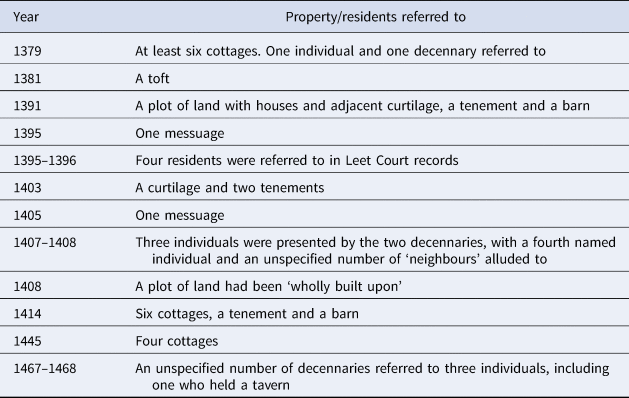
At Goose Gate, there were no references for almost a 30-year period after the plague's arrival which, as with Barker Gate, raises the possibility of population decline, or at least stagnation, in the eastern periphery of the town in the early decades after the Black Death. However, it is also possible that there were inhabitants of the streets, but they did not appear in court due to being of limited economic and social standing. As with Barker Gate, references to property and residents in Goose Gate become more plentiful in the court records from the 1390s onwards, as shown in Table 10, possibly indicating population growth towards the end of the fourteenth century.
Properties/residents referred to on Goose Gate in the Nottingham Borough Court Rolls and Leet Court records
Sources: The Nottingham Borough Court rolls held by Nottinghamshire Archives (CA1280a; CA1281–CA1295, CA1295/I, CA1295/II, CA1296, CA1296/I, CA1296/II, CA1297–CA1304, CA1304B, CA1305–CA1321, CA1322/I, CA1322/II, CA1323–CA1334, CA1336–CA1341); Stevenson, Records of the borough of Nottingham, volume I, 202–3, 308–9; Stevenson, Records of the borough of Nottingham, volume II, 48–9, 270–1.
References to cottages may indicate the presence of the urban poor. Cottages were small dwellings, associated with the poorer elements of society. Keith Lilley's study of Coventry suggested the urban poor were marginalised in the suburbs.Footnote 81 Goldberg's research of York has suggested that the poll tax of 1377 indicates women formed the majority of migrants attracted to towns such as York, but also Hull and Colchester.Footnote 82 In York in 1377, the female migrants were found to be living in the cheap tenements or cottages of the urban periphery.Footnote 83 The eastern periphery of Nottingham may have also formed a community for female migrants, and others from the urban poor.
4.5 Movement within the town
Movement within a town adds complexity to a model of population change. It is possible some areas of a town grew, at the expense of other areas, and so evidence of very localised population growth does not necessarily mean the population of a town grew. In tandem with archaeological evidence to be discussed, tax lists show a movement of wealth and taxpayers into newly reclaimed marshland at Narrow Marsh. Tax lists also demonstrate a movement of wealth, and taxpayers, from St Nicholas’ parish, seemingly into the more central parish of St Peter. A convincing display of this movement can be found in those streets adjacent to the Carmelite Friary (in St Nicholas’ parish) which saw a reduction from 15.9 per cent of tax paid and 17.2 per cent of the taxpayers in 1473–1479 to just 1.3 per cent of tax paid and 5.8 per cent of taxpayers in 1523–1524.Footnote 84 It is apparent, also, with Castle Gate, which contributed 9.5 per cent of the tax in 1473–1479 but only 0.7 per cent in 1523–1524.Footnote 85 At the same time a number of streets in St Peter's parish showed economic growth. The inhabitants of Low Pavement (and probably Middle Pavement) paid the highest proportion of the town's contribution in the 1523–1524 subsidy (16.4 per cent).Footnote 86 This was an increase from the 8 per cent in 1473–1479 for Low and Middle Pavement.Footnote 87 Residents of Hen Cross, Smithy Row and Timberhill paid 6.7 per cent of the total in 1473–1479, but 20.2 per cent in 1523–1524.Footnote 88 They formed 5.6 per cent of the number of taxpayers in 1473–1479, versus 8.8 per cent in 1523–1524.Footnote 89 Even considering the incomplete nature of the 1473–1479 document, and the issues of evasion and underassessment, this large change suggests a shift of taxpayers away from St Nicholas’ parish into St Peter's parish, and perhaps into other areas of the town. This does not, however, mean the population of St Nicholas’ parish drastically fell (though it may have done). The population may simply have become poorer.
4.6 Archaeological evidence of population growth
Major archaeological excavations were undertaken by Nottingham City Museums Field Archaeology Section between 1969 and 1980.Footnote 90 According to Charles Young, who managed the excavations, the fieldwork demonstrated that ‘by c.1350 most of the town east of St Mary's Gate had become derelict, much of it not to be re-occupied until the latter half of the sixteenth century or early seventeenth century.’Footnote 91 His pessimistic view of decay and abandonment, which may have been influenced by the urban decline debate of the time, has formed the accepted narrative of the town's fortune's during this period, with historians also claiming ‘a large part of the English borough was abandoned by the late fifteenth century’ and that peripheral areas of Nottingham were, by the early sixteenth century, characterised by few tenements, but a high proportion of closes, barns and gardens.Footnote 92 According to John Schofield and Alan Vince, land in Nottingham ‘lapsed into cultivation or dereliction’.Footnote 93 Palliser cited Young's narrative when using Nottingham as an example of peripheral contraction in English towns, arguing that ‘most towns shrank in size’.Footnote 94 The experience of Nottingham, as interpreted by Young, has therefore influenced the view of urban change, including demographic change, in English towns during the late medieval period. Such abandonment of tenements or significant change in land-use, has been used as the ‘most incontrovertible evidence’ of decline in towns.Footnote 95 The question is, was Young's interpretation correct, or may it have been used to form an erroneous theory by some historians? The documentary evidence already cited casts doubt on this hypothesis, but what does the archaeology show?
When studying archaeological evidence, it is important to recognise that absence of evidence is not evidence of absence. Re-analysis of excavations in the eastern peripheral streets of Barker Gate and Goose Gate (excavated in 1972 and 1976 respectively), along with the evidence from court records and tax documents, contradicts Young's narrative. Evidence for buildings at these sites was not found for the post-plague period because any evidence which may have existed was lost through street widening. The First Edition Ordnance Survey map of 1881 shows that Barker Gate was 8.5 m wide, and this likely represented the width of the street in medieval times, but by 1972 it had been widened to 19 m. Goose Gate was 8 m wide in 1881, increasing to 12 m by 1976. In Winchester, excavations revealed late medieval cottages measuring 3.2 m × 3.2 m in plan.Footnote 96 Standing buildings, and excavated remains, in York have shown that many vernacular buildings measured between c.3 m × 3 m and 3.65 m × 3.65 m, with the largest buildings measuring between 4.5 m × 4.2 m and 4.9 m × 3.6 m in plan.Footnote 97 Such small buildings would have been obliterated by street widening at Barker Gate and Goose Gate. Therefore, Young's excavations only investigated areas less likely to have structural remains. The Goose Gate excavation was set back from the modern street frontage, further reducing the possibility of encountering structural remains although excavation revealed features associated with late medieval malting and horn working.Footnote 98 Notwithstanding the street widening, there was a notable absence of evidence of mid- to late-fourteenth century activity at the site, though ephemeral activity may have left no discernible trace.
Reclamation of land adjacent to the River Leen enabled the eastern end of Narrow Marsh, which had been rendered uninhabitable by the deteriorating climatic conditions of the Little Ice Age from c.1290, to be occupied once again, with growing intensity, particularly from the latter years of the fourteenth century onwards and with rapid growth from the second half of the fifteenth and early sixteenth century onwards. In 1300 a former tannery was referred to as being located at the eastern end of Narrow Marsh, at the head of the Leen Bridge.Footnote 99 This was the same land referred to in a document predating the expulsion of Jews from England in 1290, implying the site was abandoned some years before the commencement of the fourteenth century.Footnote 100 Reclamation began with the infilling of small river channels sometime between 1295 and 1404 (almost certainly towards the beginning of that date range) with the ground level raised by the dumping of waste from the town in the late thirteenth century onwards.Footnote 101 Archaeological evidence for occupation nearer the river is entirely absent until the end of the fourteenth century, with climatic conditions a likely key factor, and documentary evidence relates only to a very small number of properties set back from the river. There was major flooding of the River Trent in 1349, which destroyed the Hethbeth Bridge, less than a mile from Narrow Marsh, and it seems likely that the River Leen, as a tributary to the Trent, similarly flooded.Footnote 102 During the 1370s there were two decennaries, indicating perhaps approximately 20 households, suggesting this was already a well-populated area by that time.
Following late fourteenth century ground raising, a row of small buildings was erected to the immediate west of the Leen Bridge. The structures, which fronted the street on its southern side, were of poor construction, suggestive of buildings of short-term existence, with rear yard boundaries demarcating individual plots, extending towards the Leen.Footnote 103 In 1391, John de Plumptre, founder of Plumptre Hospital, was granted six cottages described as being immediately to the west of the Leen Bridge, on the southern side of the street, with their curtilages extending to the Leen.Footnote 104 These are likely to be the same structures revealed through excavation, and demonstrate increased occupation by the end of the fourteenth century. Tanners were noted as dwelling in Narrow Marsh, on its southern side, in 1395, providing further evidence of buildings by the end of the fourteenth century.Footnote 105
Further deposits were laid down to increase the ground level, possibly in response to ‘great floods’ which destroyed the adjacent Leen Bridge in 1402 or a flood of 1424, which also caused damage to the bridge.Footnote 106 Following the likely early- to mid-fifteenth century flood prevention measures, a more substantial row of buildings was built over the foundations of the earlier structures.
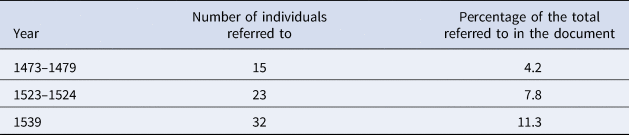
Increased occupation evidenced through archaeology is reflected in the documentary sources, with more frequent references to property in the court rolls, from the fifteenth century onwards, and even a ‘capital messuage’ in 1447–1448.Footnote 107 The actual numbers of people recorded as living in Narrow Marsh in the tax of 1473–1479, the 1523–1524 subsidy and the 1539 muster, shown in Table 11, may also suggest a progressive increase in population.Footnote 108 My previous research indicates population growth in Narrow Marsh was matched with the growth of leatherworking, especially tanning, at this riverside location.
The number of individuals referred to as living in Narrow Marsh in the 1473–1479 and 1523–1524 taxes and a muster of 1539
Sources: Nottinghamshire Archives CA 8019; Stevenson, Records of the borough of Nottingham, volume III, 162–81; Gardiner and Brodie, Letters and papers, 286.
5. A summary of the Nottingham evidence
Whilst population estimates at any one point in time can only be arbitrary it is possible, with great care, to tentatively present trends, and even suggest approximate rates of population growth and decline based on information obtained from the methodology outlined. Had the court rolls and other sources been more complete, these statistics may have been more refined and reflect a greater period of time and so this methodology may be more successful when applied to towns with more complete rolls.
The figures indicate significant growth in the number of users of the borough court during the early fourteenth century. Toponymic bynames can be used to infer the increase was driven by migration.Footnote 109 Nottingham appears to correspond well with Lynn and Norwich with continued population growth beyond Palliser's postulated ‘zenith’ of 1300. The agrarian crisis caused a significantly increased population, through migration, at some point after 1316 and certainly by the early 1320s. Although there was a significant rise in new toponymic bynames appearing in the court rolls in the first half of the 1320s, the true scale of migration is likely to have been less than this. The figures also do not include the deaths which would have arisen from famine and disease arising from the agrarian crisis. Conservatively, the population rose by at least 10 per cent in the early 1320s, rather than experiencing a loss of 10 per cent as suggested by Palliser, with further significant migration into at least the 1330s.
It can be suggested that following this period of increased migration, the number of those likely to use the borough court experienced a net decline of approximately 47 per cent between 1335–1336 and 1351–1352, largely due to plague. The impact on that proportion of the population who did not use the borough court, and thus the population of the entire town, is unknown. Those living in overcrowded neighbourhoods, including the urban poor, may have been more susceptible to infection. We have seen that a large influx of new toponymic bynames appeared in the court rolls at some time between 1337 and the early 1350s and that, crucially, hundreds of individuals with the grammatical preposition ‘de’ appeared in the records which may add weight to the suggestion of significant migration at this time. Based on this evidence, it seems reasonable to suppose that significant migration occurred following the arrival of plague and that some of these names were the result of such migration. This could mean one of two things: 1) the population continued to rise after 1336 until the Black Death, and the population reduced by in excess of 50 per cent (perhaps somewhere in the order of 60 per cent) in 1349, with migration resulting in a net decline of 47 per cent; 2) the population peaked around 1336, Nottingham suffered a mortality of approximately 50 per cent during the 1349 outbreak, and it achieved some population recovery through migration by 1351. It is the view of this study that population continued to rise beyond 1336 until sometime before the Black Death, and that mortality in 1349 exceeded 50 per cent.
The number of court users fell by 9 per cent between 1351 and 1371–1372. From at least 1351, the ratio of men to women began to change, with a higher ratio of men and consequently women were less represented (from 9:2 in 1351–1352 to 6:1 in 1371–1372). Taking this into consideration the relative fall in court users during this 20-year period may have been less than 9 per cent. This decline corresponds well with the absence of archaeological evidence for this period at sites excavated in the eastern periphery of the town, and the absence of documentary references to properties in the key eastern periphery streets of Barker Gate and Goose Gate. The population remained generally stable until at least 1378/9, with the number of court users rising by only approximately 5 per cent. These small percentage changes may be the result of slight variations in the cases brought to court and may not reflect significant population change. It can be inferred that following an influx of migrants in the immediate aftermath of the first outbreak of plague, the population remained almost unchanged for at least three decades. Mortality from ongoing outbreaks of plague (particularly the second major outbreak of plague in 1361), was offset by migration, but migration was insufficient to result in growth.
Between the 1370s and 1407–1408, the estimated number of decennaries increased by approximately 11 per cent, meaning that the number of households in the town may have increased by somewhere in the order of 11 per cent. The figures in Table 5 suggest this increase was most notable between 1395–1396 and 1407–1408. This was, however, when the number of people using the borough court declined. The increase in population was likely to have been of those less likely to use the court, a significant proportion of which appear to have been the urban poor who dwelt in the increasingly frequently referenced cottages in the eastern periphery of the town, and those who bolstered the new suburb of Narrow Marsh. The increase was the consequence of further migration, although reliable measures of migration do not exist for Nottingham for this time. Some movement within the town is also likely to have occurred during this period.
Migration continued during the fifteenth century, with migrants actively sought from nearby villages, and the court rolls imply significant numbers of migrants were attracted to Nottingham, particularly in the early 1430s. Some of the migrants were in the town only for short periods of time, with this transient migration resulting in significant and frequent population flux.
A movement of taxpayers, and wealth, from St Nicholas’ parish to the central St Peter's parish in the late fifteenth or early sixteenth century may indicate population growth in some of the streets of the latter parish. Any reduction in the population of St Nicholas’ parish was more than compensated for by growth in other parts of the town.
It is to archaeology that we must turn to look at the longer-term trends. The archaeological and documentary evidence demonstrates the emergence of Narrow Marsh as a suburb of the town in the second half of the fourteenth century, and a booming one by the early sixteenth century. Growth in Narrow Marsh, and apparent continuity and growth in the eastern periphery, especially at Barker Gate and Goose Gate, where the urban poor and migrants appear to have found homes in cottages, following the arrival of plague, challenges the traditional narrative and proves that areas of the town were more densely occupied than previously thought, and raises the distinct possibility of population growth, especially during the late fifteenth and early sixteenth centuries.
The population changes of Nottingham are clearly more complex than the estimates presented in Table 2 suggest. There was growth, decline, stability or stagnation and further growth. Some areas of the town experienced rapid growth, whilst others may have simultaneously declined. Overall, it is felt the town's population did not decline to the extent suggested by other historians’ estimates, and there may have been notable population recovery by the early sixteenth century (though population remained well below pre-plague levels), and the population was overall much poorer than two centuries earlier.
6. Conclusion
The Nottingham case study has demonstrated this alternative approach enhances our understanding of late medieval population change in English towns, with the available sources from Nottingham allowing a more nuanced approach through understanding of shorter-term change than is offered from taxation documents, even if it does not provide estimates of the numbers of people living in the town at any point in time.
Population estimates based upon tax assessments, using a generic methodology, are risky in terms of understanding urban population change during the late medieval period. The approach suggested here recognises and attempts to study these circumstances, as well as the fluctuations which cannot be estimated through taxation documents and uses multiple strands of evidence to show change over the full period of the fourteenth to early sixteenth centuries. Whilst each individual strand of argument may be questionable, cumulatively the strands form a robust argument. Archaeology has much to offer but the example of Nottingham shows that a dual disciplinary approach must be undertaken by someone competent in the study of both archaeology and history.
One of the most interesting conclusions of this research is that the population of Nottingham appears to have continued to grow beyond the supposed ‘zenith’ of 1300. As with Lynn and Norwich, the population seems to have significantly increased during the early fourteenth century, until at least the 1330s, and that significant migration was a feature of most of the fourteenth and early fifteenth centuries. Research of other towns may establish whether such growth was a more common characteristic of English demographic change than has previously been believed.
The methodology requires testing with other towns which have the required sources, in particular court rolls and reports of major archaeological excavations. Other towns with court rolls include London, York, Norwich, Lincoln, Lynn, Chester, Exeter, Colchester, and Yarmouth. If its application is successful elsewhere, this approach can make a significant contribution, by generating more case studies, to enhance our understanding of urban population change during the late medieval period.
Acknowledgements
I would like to thank my PhD supervisors Dr Chris King and, particularly, Dr Richard Goddard for their helpful comments in the preparation of this article. I would also like to thank Susan Maddock for sharing details of her research and for commenting on an early draft.
Competing interests
None.


 Open access

