


1 Introduction
If icebergs are to be towed and used as sources of fresh water we need a basic understanding of their mechanical stability. As an iceberg melts, the change of shape can cause it to list or to become unstable and capsize. Similarly, if a section of a large tabular iceberg is about to break off, naturally or by design, it may be important to know whether it will simply float away upright, list to a new stable position, or capsize.
To analyse this, one could use the standard physical principles governing the statical equilibrium of floating objects that are familiar to naval architects. Recently, however, there has been an important conceptual advance (Reference ZeemanZeeman 1977) which uses the new mathematics called “catastrophe theory” to provide a different way of viewing the statics of a floating object. Although the new method could lead eventually to advances in ship design, its immediate advantage lies rather in the conceptual clarity that it provides. This advantage is preeminently present in the iceberg problem because the catastrophe-theory approach focuses attention on precisely the feature of most interest, namely the interplay between the different positions of equilibrium and their stability as the shape of the iceberg changes with time. We have therefore taken some of the ideas from catastrophe theory that Zeeman applies to ships and have used them to study the statics of icebergs.
Dynamical effects are more complicated to deal with than are statical effects; therefore we ignore dynamical behaviour in this first study. Although rolling and pitching and other motions are of great importance in ships, very large tabular icebergs are much larger than ships and, crudely speaking, the larger the body the smaller will be its oscillations.
A very useful introduction to Zeeman’s theory, with some extensions, is given by Reference Poston and StewartPoston and Stewart (1978, chapter 10). Reference PotterPotter (unpublished) and Reference DavisDavis (unpublished) have written full reports of the study we describe here. We first review the main theoretical ideas and then describe computations on specific iceberg shapes.
2 General Theoretical Background
2(a) Two dimensions
We begin with a two-dimensional model which would be appropriate for studying the rolling of an iceberg whose length is much greater than its width. Consider an inhomogeneous body with cross-section S floating in a static fluid of uniform density and not necessarily in equilibrium (Fig. 1a). The resultant of the forces exerted by the fluid is an upward force equal to the weight of the displaced fluid K (Fig. 1b) acting at the geometric centroid B of the submerged region of S which replaces K. B is called the centre of buoyancy. If θ denotes the angular displacement from an equilibrium position, there will be for each θ a unique height of the body for which the upthrust of the water equals the weight of S. The equilibrium we study is that associated with changes in θ. For each θ, since there is a definite height for S, there is a well-defined shape for K with its centroid B.
(a) Two-dimensional iceberg of cross-section S and (b) the fluid it displaces. B, centre of buoyancy; G, centre of gravity of S; r, righting arm.

For equilibrium it is clearly necessary for B and G, the centre of gravity of S, to be in the same vertical line. When they are not, the upward buoyancy force through B and the equal downward weight of S through G give a turning moment which tends to change θ. The distance between the lines of action of these two forces is called the righting arm, r (positive when the torque tends to decrease |θ|, as in Figure 1a).
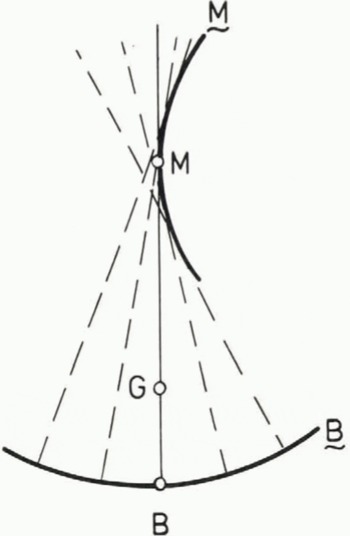
To decide whether a position of equilibrium is stable or unstable we proceed as follows: The shape of K, and hence the position of B relative to the body, changes with θ. The locus of B in the body, denoted B̰, is called the buoyancy locus (Fig. 2). We emphasize that the curve B̰ is fixed relative to the body. We can now draw the evolute of B̰, that is, the locus of its centre of curvature M. This is called the metacentric locus and we denote it by M̰; it is the same as the envelope of the normals to B̰. It may be proved (see, for example, Reference Poston and StewartPoston and Stewart 1978, p 197) that when the body is at an angle θ the buoyancy locus B̰ passes horizontally through the point B corresponding to this angle. Thus M lies vertically above B. G can, in principle, lie anywhere, but if it lies on the vertical through B the body is in equilibrium. If G lies below M (as in Figure 2) the equilibrium is stable, and if it lies above M the equilibrium is unstable. This is the leading principle. The body behaves as a pendulum suspended from M. The distance of M above G is called the metacentric height. Note that it is not the position of G with respect to B that is important but its position with respect to M.
B, centre of buoyancy; B̰, buoyancy locus; M, metacentre; M̰, metacentric locus; G, centre of gravity.
An important special case occurs when there is symmetry about θ = 0. Then M is a cusp point of M̰ and locally M̰ has the form of either Figure 3a (standard cusp) or Figure 3c (dual cusp). In Figure 3a G is below M and the equilibrium is stable. If G is above M (Fig. 3b) the equilibrium is unstable. But this does not mean that the body will topple over completely, for, passing through G, there are three lines, GM, GM’, GM”, which are all tangents to M̰. Thus, if the body is now turned (carrying M̰ with it) so that G is vertically below M’ or M”, there will be stable equilibrium. We can now see that if G should rise continuously from a position below the cusp point M to a position above it the equilibrium will always be stable, but after G has risen above M the body will list more and more to one side or the other. One position of stable equilibrium has bifurcated into a position of unstable equilibrium flanked by two positions of stable equilibrium. This bifurcation of equilibrium positions is called a cusp catastrophe and the angle associated with M’ or M” the angle of list. Such mergings of the stationary points of functions, here the maxima and minima of the potential-energy function, are the basic subject matter of catastrophe theory.
(a) and (b) Standard cusp with G below and above M. (c) and (d) Dual cusp with G above and below M. (e) Standard cusp with G off-centre.

It is important to note that in a melting iceberg the cusp catastrophe can equally well be brought about by M̰ moving through G rather than vice versa; only their relative positions matter.
The situation is radically different when the cusp points the other way. Then if G is above M (Fig. 3c) the equilibrium at θ = 0 is unstable and if G is below M (Fig. 3d) the equilibrium at θ = 0 is stable. But it is a precarious stability because, if θ is changed enough to bring GM’ (or GM” ) vertical (this change of θ being called the capsizing angle), we encounter a position of unstable equilibrium. Further change of θ causes a capsize. Thus, if G rises continuously from below the cusp (or the cusp sinks continuously from above G), stable equilibrium becomes increasingly precarious and then disappears completely as G passes through M. Zeeman points out that ships are designed to give the safe cusp catastrophe while the more primitive canoe gives the unsafe dual cusp.
In these examples we have kept G on the symmetry line of the cusp. If this condition is relaxed it is easy to see that for the standard cusp (Fig. 3e), whatever the position of G, there is always at least one position of stable equilibrium near θ = 0. For the dual cusp, if G is outside M̰ there is only one equilibrium and it is unstable; if G is inside M̰ there is a stable equilibrium position but it is closely flanked by unstable ones.
Symmetry about a vertical line, but no further restriction, necessarily produces a cusp (standard or dual) in M̰ (that is, a curve whose local form is given by the equation  ; in this special case the x axis of the cusp points vertically upwards or downwards). Ships are designed to be symmetrical; icebergs, however, are not designed but are shaped by circumstance. This is one of the features that makes catastrophe theory in its usual form particularly appropriate for our study, for it identifies and analyses precisely those singularities in M̰ that occur generically, that is to say, without any special conditions. Even when there is no symmetry M̰ will still possess cusps, for cusps in M̰, of the form with x no longer “vertical”, are generic. Moreover, catastrophe theory shows that the cusp is the only type of singularity on M̰ that will occur generically. (This result depends on S being smooth; the rectangles and trapezia we use for calculation in section 3, later,are not smooth but the difference is not serious.)
For a body of given shape and weight, the locus B̰, and therefore M̰, is independent of the position of G, and therefore of the distribution of density. Given a complete locus M̰ (as, for example, in Figure 5), the rule for finding all possible equilibrium positions corresponding to a given position of G is first to draw all possible tangents through G to M̰: GM 1, GM 2…, and then to choose any one of these, GM i say, and rotate the body so that GM i is vertical with the tangent point M i above (rather than below) its associated point on B̰. If G is then below M i the body is in stable equilibrium, and if G is above M i it is in unstable equilibrium.
-
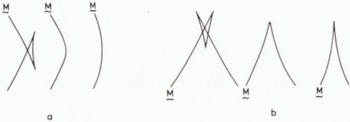
a Swallowtail event.
-
b Butterfly event
The metacentric locus M̰ for a rectangle computed for a relative density λ = 0.828 and aspect ratio Z = 1.0 and 1.2. The thickness is taken as unit length; note the small size of M̰.

Notice that as G moves through M̰ from the convex side (or as M̰ moves through G) two possible tangents are lost. Thus two equilibrium positions, one stable and one unstable, merge together and disappear. This leads to the simplest type of catastrophe, the fold catastrophe. Thus if the body is in fact in the stable position under discussion (and not in some other stable position) it will suddenly tip over as G crosses M̰.
For a body of given weight and shape, B̰ and M̰ depend on the ratio λ of the density of the body to that of the fluid, the relative density. If the shape of the body and its relative density change with time, B̰ and M̰ will change too, and it is generic for pairs of cusps on M̰ to merge together and annihilate in the swallowtail event (Fig. 4a). We call this occurrence on M̰ an event, reserving the word catastrophe to denote what happens when G passes through M̰ or one of its singular points. Higher cuspoid events such as the butterfly (Fig. 4b) will not occur generically as time evolves, but they will be encountered in theoretical problems such as those of section 3 where the shape is artificially constrained to remain symmetrical.
We can now see that, as the shape and relative density of an irregular two-dimensional “iceberg” change with time, the path of G will be a curved line which will, in general, intersect M̰, but not (except with vanishingly small probability) at a cusp or a swallowtail. Of course, during this process M̰ is changing too. Thus, since there is no symmetry, we can assert that the only catastrophe that will occur generically is the fold.
2(b) Three dimensions
These ideas carry over quite naturally into three dimensions. The iceberg can be of any shape and the buoyancy locus B̰ is now a surface, which is strictly convex (Reference ZeemanZeeman 1977, p. 445, Reference Poston and StewartPoston and Stewart 1978, p. 197). Associated with each point on B̰ there are now two centres of curvature, corresponding to the two principal radii of curvature of B̰, and their locus M̰ is now a surface with two sheets. The surface possesses sharp creases, or cusp lines, and generically these lines themselves contain three different kinds of singular points called swallowtail, elliptic umbilic, and hyperbolic umbilic.
Given the position of G, the centre of gravity of the floating body, the rule for finding all possible equilibrium orientations is as follows. Draw all possible normals from G to B̰; usually there will be several. Each of these normals, when set vertical with the foot of the normal below G, represents an equilibrium orientation. Taking any one of these orientations, it is stable if, and only if, G lies below both centres of curvature (that is, below both sheets of M̰ looking upwards).
As the shape of the iceberg and its relative density change with time, G moves along a curved line and M̰ changes its shape. Generically the path of G will intersect M̰, but not on one of its singular lines or at one of its singular points. We conclude that, as in two dimensions, the only catastrophe that will occur generically is the fold. That is to say, a stable orientation can be destroyed if it merges with an unstable one (a minimum in the potential-energy surface merges with a saddle), and anything more complicated that this only occurs with vanishingly small probability.
3 Application to Icebergs
Classical theory has always been used for ship design, usually with great success. Why then should we use catastrophe theory for icebergs? The main reason is that by considering the whole of the buoyancy locus B̰ and the metacentric locus M̰ we can study the stability of a given iceberg three-dimensionally in any orientation in one global view. Once B̰ and M̰ are computed we can also see at a glance how stable equilibrium positions can be destroyed or created as the iceberg evolves.
One could imagine a computer program which could be applied routinely to any iceberg of particular interest and which would calculate B̰ and M̰ in three dimensions. One has to locate the normals from G to B̰. One of them will be vertical. If G should happen to be near the relevant part of M̰ there will also be another normal which is near-vertical, signalling a nearby unstable orientation. The subsequent track of G relative to M̰ as the iceberg melted would then be crucial for stability.
The relative density of icebergs is much higher than that of ships and this leads to a very small metacentric locus M̰ (for a relative density of unity it would be a point); this tells us that quite small changes in M̰ or in the position of G can be important. By contrast, ships have larger loci M̰ and they are designed to be safe and reliable in the worst weather. The stability of an iceberg may thus be much more precarious despite its reassuring size.
Coming now to specific computations, we first note that tabular icebergs suitable for towing are usually roughly rectangular in vertical cross-section. A better approximation to the cross-section of a weathered iceberg might be a near-rectangular trapezium. We have therefore made two-dimensional computations, first on rectangles, because they are simpler, and then on trapezia, using the catastrophe theory outlined above. Reference DavisDavis (unpublished) and Reference BrooksBrooks (1979) also report analyses of stability for rectangles and other shapes.
3(a) Rectangular icebergs
By fitting a quadratic curve to the empirical density-depth curve for tabular icebergs reported by Reference Weeks and MellorWeeks and Mellor (1978), we computed both the mean relative density λ and the position of the centre of gravity G as functions of the thickness of the iceberg. For example, λ for a 250 m-thick iceberg was calculated to be 0.828.
Reference Poston and StewartPoston and Stewart (1978) give equations for the buoyancy locus B̰ for rectangles valid for 0 < λ ≤ 0.5 and show how these may be transformed to apply to 0.5 ≤ λ < 1, which is the range we need and which is the case we consider. For a rectangle the locus B̰ is oval in shape and consists (unless λ = 0.5) of parts of four parabolae and four hyperbolae. B̰, and therefore M̰, is determined completely by λ and by Z, the aspect ratio of the rectangle (ratio of width to thickness). M̰ is a figure containing either 8 cusps (4 standard and 4 dual) or 16 cusps (8 standard and 8 dual), such is the complexity of the global stability pattern for a shape as simple as a rectangle. For example, Figure 5 shows M̰ for λ = 0.828 and Z = 1.0 and 1.2. Sections suggesting the dual butterfly event appear at the top and bottom of the figures and this is typical for Z ≥ 1. As Z and λ change, the movements of the pattern are extremely rapid, and at Z = 2(1 − λ) and 1/2(1 − λ) pairs of cusps annihilate one another in four swallowtail events of the type shown in Figure 4a. For λ = 0.828 these events occur at Z = 0.344 and 2.907. To collapse the butterfly sections to obtain the butterfly event shown in Figure 4b the cross-section of the floating body would have to be made non-rectangular (Reference ZeemanZeeman 1977).
The rapid movements mean that the stability properties depend strongly on Z and λ With λ ≈ 0.8 the M̰ locus is quite small, as expected, being typically one-tenth of the size of the iceberg for shapes which are almost square. This makes the variation of density with depth and other density inhomogeneities very important because these effects shift the centre of gravity G away from the centre of the iceberg, and even small shifts can be significant. In a 200 m-thick iceberg the normal increase of density with depth depresses G below the centroid by 4.75 m. Abnormalities of density could change further the height of G by perhaps 0.01 of the ice thickness and could raise the mean λ by, say 0.013. We also estimated the lateral shifts of G that could be caused by cavities or by surface melt water permeating the upper layers of a tilted iceberg preferentially on one side. In this way we arrived at intermediate and worst-expected cases of density abnormalities.
To draw the metacentric locus for each choice of Z and λ would give complete information but would be very lengthy. Therefore we chose two classical measures of stability, the righting arm, as a function of attitude θ, and the metacentric height, and then computed graphs to show their dependence on Z and λ. (The capsizing angle, the value of θ for which the righting arm becomes negative, is often chosen to measure stability but we found that this can be misleading. One iceberg can have a larger capsizing angle than another but be easier to capsize, because its maximum righting arm is less.)
If the centre of gravity G were at the centroid and if λ < 0.79, a rectangular iceberg would not be stable with its long dimension vertical for any aspect ratio Z. Larger λ and a lower position of G tend to stabilize the iceberg when it is in this attitude by raising the position of the relevant standard cusp relative to G. With a realistic depth-density curve as used above (λ = 0.828), but without density anomalies, there is stability without listing if Z > 0.8, for the relevant standard cusp is then above G. For 0.7 < Z < 0.8 the cusp is below G, so the iceberg lists, while if Z < 0.7 even this listed position becomes unstable because G encounters a dual cusp. The upright stability for Z = 0.8 may rest anywhere in the range θ = 0 to 5°, but very little turning moment is needed to topple the iceberg to another more stable equilibrium at about 60° to the vertical. Typically density anomalies are able to reduce the metacentric height to half its former value.
3(b) Trapezoidal icebergs
If an iceberg is larger below the water line than above, it is not obvious whether this will tend to make it more or less stable. Calculations with symmetrical trapezia (Fig. 6) throw some light on this question. There is now one extra parameter, the angle of inclination of the side φ. Laboratory experiments by Reference DavisDavis (unpublished), involving melting ice blocks a few centimetres across, showed that the irregular trapezium shapes into which they evolve are more liable to sudden toppling than rectangular shapes. These experiments and others made with floating blocks of paraffin wax (λ = 0.9) also suggested that it would only be profitable to consider the two attitudes shown in Figure 6a and b, because models in other orientations invariably capsized to give the-attitude shown in Figure 6a, upside down, which was always stable. (These experiments also showed, incidentally, that surface tension can have a major, and unwanted, effect on stability on this scale.) The equations for the relevant parts of the buoyancy locus and the metacentric locus for trapezia were calculated from first principles and simple numerical techniques were needed to solve them. For φ = 0, the results coincide with those for rectangles, as they should.
Trapezium attitudes used for computation.

Whereas M̰ for the rectangle had two lines of symmetry at right angles, there is now only one, which is vertical. As φ increases from zero, an evolution in the top half of M̰ takes place whereby two pairs of cusps annihilate one another by two swallowtail events (Fig. 7 and Reference PotterPotter, unpublished). As for rectangles, we computed graphs to show how the righting arm curve (righting arm as a function of θ) and the metacentric height depend on the parameters Z (which is now the ratio of the half-height width of the trapezium to its thickness), λ, φ, and the coordinates of G. It was impossible to explore all combinations and we had to content ourselves with a cursory study.
The relevant part of the metacentric locus M̰ for trapezia with Z = 1.1, showing how it changes with the side inclination φ. Corresponding cusps are labelled by the same letter. As φ increases the standard cusp A moves down, decreasing the metacentric height. The dual cusps B, B’ annihilate the standard cusps C, C’ in two swallowtail events. The origin O is on the centre line mid-way between the top and bottom of the trapezium. The scale line shows 0.01 × the thickness.

The most important result is that only a small value of φ (with Z and all other parameters held constant) decreases the metacentric height greatly. A value for φ of 10° may decrease the metacentric height by some 25%. It must be remembered that, since 83% of an iceberg is submerged, a value of 10° may be very difficult to distinguish from 0. For φ = 10° and Z near 1, the righting arm r is much reduced for nearly all θ. This can be seen in the righting curves for φ = 0, 10, and 20° shown in Figure 8 for Z = 1.0 and 1.4. For Z = 1.0 and φ = 20° the slope of r (θ) becomes negative at the origin, signifying instability. The implication of these results for trapezia is that icebergs with enlarged underwater bases are less stable than rectangular icebergs with the same Z value. Reference PotterPotter (unpublished) shows nine families of righting curves for trapezia with φ as parameter for various Z and for normal density, intermediate density abnormalities (considering water permeation), and worst density abnormalities (considering both water permeation and cavities).
The righting arm r (see Fig. 1) as a function of attitude θ for trapezia of different aspect ratio Z and side inclination φ (shown in degrees against each curve). The normal density distribution of Reference Weeks and MellorWeeks and Mellor (1978) was used, r is measured in units of the thickness of the trapezium.

4 Conclusion
The main advantage that catastrophe theory has to offer over conventional techniques is that it provides a global view of all the possible equilibrium attitudes, in three dimensions, of a given iceberg. It replaces the concept of the metacentre by the metacentric locus, which, for a given relative density and shape of iceberg, is a surface whose shape can be computed. Together with the buoyancy locus and the position of the centre of gravity the metacentric locus summarizes the geometric information. One can then find the equilibrium attitudes of the iceberg, whether they are stable or unstable, and whether a stable attitude is dangerously close to an unstable one. As the iceberg melts, the metacentric locus evolves; its relation to the centre of gravity determines how the various equilibrium attitudes change and how attitudes of stable equilibrium may be destroyed.
Two-dimensional computations show that icebergs with certain, almost square cross-sections can topple over readily. An iceberg with a trapezoidal shape, larger below the water line, is significantly less stable than one with a rectangular shape and the same aspect ratio.
Acknowledgements
The work described here was completed as part of an undergraduate project by Reference PotterJ.R. Potter and Reference DavisC. Davis, supervised by J.F. Nye. We are grateful to Christine Davis for putting her work at our disposal for the writing of this paper. We are also grateful to John Alcock for help with some of the analytical work.



