





1. Introduction
The force and moment due to surface waves interacting with floating or submerged bodies include oscillatory components at the same frequency as the waves and steady mean components known as drift forces and moments. With the usual assumptions of linear potential theory the oscillatory components are of first order, proportional to the amplitude of the incident waves, and the drift force and moment are of second order. If the body is unrestrained the horizontal component of the drift force causes a slow translation and the vertical component of the moment affects its angular orientation. The effect on ships and offshore structures was the original motivation for studying these problems. The range of applications has been broadened by recent attention to the transport of floating plastic and other marine pollution (Xiao et al Reference Xiao, Calvert, Yan, Adcock and van den Beremer2024, Reference Xiao, McAllister, Adcock and van den Beremer2025), and also to the slow drift of icebergs and bergy bits (Marchenko et al Reference Marchenko, Jensen, Rabault, Sutherland and Zenkin2025).
Theoretical analysis of the drift force and moment is simplified by the fact that while they are of second order, only the first-order solution is required for the velocity potential. The drift force and moment can be evaluated directly by integrating the mean component of the pressure over the body surface. However, in the Eulerian description it is necessary to include not only contributions from the second-order mean pressure, but also products of the first-order body motions and the pressure gradient, to account for the difference between the mean and oscillatory positions of the body surface. Simpler and more robust relations can be derived from conservation of the fluid momentum, equating the drift force and moment to the time average of the momentum flux across a control surface which surrounds the body, either at a finite distance or in the far field.
Maruo (Reference Maruo1960) used conservation of momentum to derive relations for the horizontal drift force in terms of the Kochin function, which represents the amplitude of the diffracted and radiated waves in the far field. Newman (Reference Newman1967) extended this analysis to include the vertical component of the drift moment. This far-field method has been extended to include the effects of current by Grue & Palm (Reference Grue and Palm1993) and to the added resistance of ships in waves by Wicaksono & Kashiwagi (Reference Wicaksono and Kashiwagi2018), Amini-Afshar & Bingham (Reference Amini-Afshar and Bingham2021) and others.
In the present work the far-field method is used to analyse the drift force and moment acting on a floating or submerged body which is small compared with the wavelength $\lambda$
or, equivalently, where the frequency of the incident waves and body motions is small. In this case
$\lambda$
or, equivalently, where the frequency of the incident waves and body motions is small. In this case $kL\lt \lt 1$
where
$kL\lt \lt 1$
where $k=2\pi / \lambda$
is the wavenumber and
$k=2\pi / \lambda$
is the wavenumber and $L$
is the length scale of the body. This approximation is well known for first-order forces and body motions (Simon & Hulme Reference Simon and Hulme1985; McIver Reference McIver1994; Linton & McIver Reference Linton and McIver2001; McIver Reference McIver2012).
$L$
is the length scale of the body. This approximation is well known for first-order forces and body motions (Simon & Hulme Reference Simon and Hulme1985; McIver Reference McIver1994; Linton & McIver Reference Linton and McIver2001; McIver Reference McIver2012).
Maruo (Reference Maruo1960) derived approximations for the drift force in long waves when the body is fixed, but not when it is free. McIver (Reference McIver1987, Reference McIver1994) also derived approximations for fixed bodies. Newman (Reference Newman1967) included a slender-body approximation for free bodies, but it is not sufficiently accurate to evaluate the drift force and moment and the results based on this approximation are not correct. Herreman et al (Reference Herreman, Dhote, Danion and Moisy2024) analysed the drift moment on small freely floating bodies using a local analysis based on the Froude–Kryloff approximation, which neglects diffraction and radiation effects. The converse approximation for the drift force in short waves is described by Faltinsen (Reference Faltinsen1990).
The principal focus here is on freely floating bodies, which oscillate to leading order in long waves with the same amplitude and phase as the fluid in the incident waves. Thus the relative motion between the body and adjacent fluid and the disturbance of the fluid by the body are small. Special attention is required to derive consistent approximations for the drift force and moment since there is cancellation between the components due to diffraction of the incident waves by the fixed body and to radiation caused by its motions. As will be shown in § 4 these separate components of the Kochin function are of order one with respect to the wavenumber in infinite depth or $O(k)$
in finite depth, but when the body is free their sum is
$O(k)$
in finite depth, but when the body is free their sum is $O\bigl(k^2\bigr)$
or
$O\bigl(k^2\bigr)$
or $O\bigl(k^3\bigr)$
. To obtain consistent approximations for the drift force and moment it is necessary to expand each component including terms of order
$O\bigl(k^3\bigr)$
. To obtain consistent approximations for the drift force and moment it is necessary to expand each component including terms of order $k^3$
.
$k^3$
.
The theoretical background is reviewed in § 2. In § 3 a procedure is developed to expand the velocity potentials of the incident and diffracted waves in ascending powers of $k$
, extending a similar method used by Simon & Hulme (Reference Simon and Hulme1985). In § 4 the expansion of the Kochin function is derived. The approximations for the drift force and moment are derived in § 5. The corresponding relations for fixed bodies are considered briefly in § 6. Simpler slender-body approximations are derived in § 7. Special relations are derived in § 8 for cases where the body is neutrally stable in its vertical motion (heave) and for rotation about the horizontal axes (roll and pitch); this enables applications to neutrally buoyant submerged bodies. The angular orientation of the body relative to the incident waves is analysed in § 9, using the characteristics of the drift moment to determine the angles of stable and unstable equilibrium. Conclusions and discussion are presented in § 10.
$k$
, extending a similar method used by Simon & Hulme (Reference Simon and Hulme1985). In § 4 the expansion of the Kochin function is derived. The approximations for the drift force and moment are derived in § 5. The corresponding relations for fixed bodies are considered briefly in § 6. Simpler slender-body approximations are derived in § 7. Special relations are derived in § 8 for cases where the body is neutrally stable in its vertical motion (heave) and for rotation about the horizontal axes (roll and pitch); this enables applications to neutrally buoyant submerged bodies. The angular orientation of the body relative to the incident waves is analysed in § 9, using the characteristics of the drift moment to determine the angles of stable and unstable equilibrium. Conclusions and discussion are presented in § 10.
Figures are shown comparing the long-wavelength approximations with computations for small finite wavenumbers. The examples include floating and submerged spheres, spheroids and parallelepipeds. These computations require an unusually high degree of accuracy since the drift force and moment are very small when $k\lt \lt 1$
. The program used to obtain the numerical results is described in Appendix A.
$k\lt \lt 1$
. The program used to obtain the numerical results is described in Appendix A.
2. Theoretical background
Cartesian coordinates $(x,y,z)$
are used with
$(x,y,z)$
are used with $z=0$
the equilibrium plane of the free surface and
$z=0$
the equilibrium plane of the free surface and $z\lt 0$
in the fluid domain. The
$z\lt 0$
in the fluid domain. The $x$
-axis is in the longitudinal direction of the body, which is floating on or submerged beneath the free surface. The body is assumed to be rigid, and symmetric about
$x$
-axis is in the longitudinal direction of the body, which is floating on or submerged beneath the free surface. The body is assumed to be rigid, and symmetric about $x=0$
and
$x=0$
and $y=0$
. The principal dimensions are length
$y=0$
. The principal dimensions are length $L=2a$
, beam
$L=2a$
, beam $B=2b$
and draft
$B=2b$
and draft $D$
. Linear potential theory is assumed, with complex time dependence
$D$
. Linear potential theory is assumed, with complex time dependence $\exp {(-\mathrm{i} \omega t)}$
for all first-order quantities, where
$\exp {(-\mathrm{i} \omega t)}$
for all first-order quantities, where $\omega$
is the frequency and
$\omega$
is the frequency and $t$
denotes time. The dimensional measure is assumed such that
$t$
denotes time. The dimensional measure is assumed such that $L=O(1)$
and the wavenumber
$L=O(1)$
and the wavenumber $k\lt \lt 1$
. The fluid depth
$k\lt \lt 1$
. The fluid depth $h$
is assumed to be either infinite or finite and constant. If the depth is finite it is assumed that
$h$
is assumed to be either infinite or finite and constant. If the depth is finite it is assumed that $h=O(1)$
, of the same order as
$h=O(1)$
, of the same order as $L$
; thus in the long-wavelength approximations
$L$
; thus in the long-wavelength approximations $kh\lt \lt 1$
.
$kh\lt \lt 1$
.
Derivations and further details for the following equations can be found in the references by Wehausen & Laitone (Reference Wehausen and Laitone1960), Newman (Reference Newman1976, Reference Newman2017), Mei et al (Reference Mei, Stiassnie and Yue2017) and Chatjigeorgiou (Reference Chatjigeorgiou2018).
The incident waves are represented by the velocity potential
 \begin{equation} \phi _I ={gA \over \omega }{\cosh k(z+h) \over \cosh kh} \exp {\left [ \mathrm{i} k (x \cos \beta + y \sin \beta ) \right ]}, \end{equation}
where $A$
is the amplitude,
$A$
is the amplitude, $g$
is the gravitational acceleration and
$g$
is the gravitational acceleration and $\beta$
is the angle of propagation relative to the
$\beta$
is the angle of propagation relative to the $x$
-axis. The wavenumber
$x$
-axis. The wavenumber $k$
is the positive real root of the dispersion relation
$k$
is the positive real root of the dispersion relation
 \begin{equation} K=\omega ^2/g = k \tanh kh . \end{equation}
The complete potential is
 \begin{equation} \phi = \phi _I + \phi _B = \phi _I + \phi _D + \phi _R = \phi _I + \phi _D + \sum _{j=1}^6 v_j \phi _j . \end{equation}
Here, $\phi _B$
represents the effects of the body, including the diffraction potential
$\phi _B$
represents the effects of the body, including the diffraction potential $\phi _D$
due to the disturbance of the incident waves by the body and the radiation potential
$\phi _D$
due to the disturbance of the incident waves by the body and the radiation potential $\phi _R$
due to its oscillatory motions in six degrees of freedom with complex velocity
$\phi _R$
due to its oscillatory motions in six degrees of freedom with complex velocity $v_j$
. The potentials
$v_j$
. The potentials $\phi _j$
represent the fluid motion due to oscillation in each mode with unit velocity.
$\phi _j$
represent the fluid motion due to oscillation in each mode with unit velocity.
Each component of $\phi _B$
is a solution of the Laplace equation in the fluid domain, subject to the linear free-surface condition
$\phi _B$
is a solution of the Laplace equation in the fluid domain, subject to the linear free-surface condition
 \begin{equation} K \phi - {\partial \phi \over \partial z}=0 \quad \textrm {on} \quad z=0, \end{equation}
the homogeneous Neumann condition $\partial \phi / \partial z=0$
on
$\partial \phi / \partial z=0$
on $z =-h$
and the radiation condition of outgoing waves in the far field.
$z =-h$
and the radiation condition of outgoing waves in the far field.
The boundary conditions on the body surface $S_b$
are
$S_b$
are
 \begin{align} {\partial \phi _D \over \partial n} &= - {\partial \phi _I \over \partial n} , \end{align}
 \begin{align} {\partial \phi _j \over \partial n} &= n_j = (n_x,n_y,n_z) \quad (j=1,2,3) , \end{align}
 \begin{align} {\partial \phi _j \over \partial n} &= n_j = ( \textbf {x} \times \textbf {n})_{j-3} \quad (j=4,5,6). \end{align}
The unit normal vector $\textbf {n}$
is directed into the body and out of the fluid domain.
$\textbf {n}$
is directed into the body and out of the fluid domain.
Except in § 6, where the body is fixed, it will be assumed that it is free and unrestrained, with its motions governed by the equations
 \begin{equation} \sum _{j=1}^6 \left [- \mathrm{i} \omega (a_{\textit{ij}}+m_{\textit{ij}}) + b_{\textit{ij}} +(\mathrm{i} / \omega ) c_{\textit{ij}} \right ] v_j = X_i \qquad (i=1,2,\ldots ,6) . \end{equation}
The complex coefficients $X_i$
represent the amplitude and phase of the six components of the exciting force and moment due to the presence of the incident waves. The coefficients on the left-hand side of (2.8) are real. Here,
$X_i$
represent the amplitude and phase of the six components of the exciting force and moment due to the presence of the incident waves. The coefficients on the left-hand side of (2.8) are real. Here, $(a_{\textit{ij}}+m_{\textit{ij}})$
are the virtual-mass coefficients, including the added-mass
$(a_{\textit{ij}}+m_{\textit{ij}})$
are the virtual-mass coefficients, including the added-mass $a_{\textit{ij}}$
and the inertia coefficients
$a_{\textit{ij}}$
and the inertia coefficients $m_{\textit{ij}}$
of the internal body mass;
$m_{\textit{ij}}$
of the internal body mass; $a_{\textit{ij}}$
and the damping coefficients
$a_{\textit{ij}}$
and the damping coefficients $b_{\textit{ij}}$
represent the hydrodynamic pressure force and moment acting on the body in response to its motions;
$b_{\textit{ij}}$
represent the hydrodynamic pressure force and moment acting on the body in response to its motions; $m_{11}=m_{22}=m_{33}=M$
is the body mass and
$m_{11}=m_{22}=m_{33}=M$
is the body mass and $m_{44},m_{55},m_{66}$
are the moments of inertia. Here,
$m_{44},m_{55},m_{66}$
are the moments of inertia. Here, $M$
is equal to the displaced mass
$M$
is equal to the displaced mass $\rho V$
where
$\rho V$
where $\rho$
is the fluid density and
$\rho$
is the fluid density and $V$
the submerged volume of the body. Uniform distribution of the internal mass is assumed, except for the vertical coordinate
$V$
the submerged volume of the body. Uniform distribution of the internal mass is assumed, except for the vertical coordinate $z_{\textit{cg}}$
of the body’s centre of gravity which is assigned independently. Since the body is symmetric about
$z_{\textit{cg}}$
of the body’s centre of gravity which is assigned independently. Since the body is symmetric about $x=0$
and
$x=0$
and $y=0$
the only non-zero coupling coefficients are with the indices
$y=0$
the only non-zero coupling coefficients are with the indices $(i,j)=(1,5)$
or
$(i,j)=(1,5)$
or $(5,1)$
(surge–pitch) and
$(5,1)$
(surge–pitch) and $(i,j)=(2,4)$
or
$(i,j)=(2,4)$
or $(4,2)$
(sway–roll). The corresponding inertia coefficients are
$(4,2)$
(sway–roll). The corresponding inertia coefficients are $m_{15}=m_{51} = M z_{\textit{cg}}$
and
$m_{15}=m_{51} = M z_{\textit{cg}}$
and $m_{24}=m_{42} = -M z_{\textit{cg}}$
. The static restoring coefficients
$m_{24}=m_{42} = -M z_{\textit{cg}}$
. The static restoring coefficients $c_{\textit{ij}}$
include the components due to hydrostatic pressure. The only non-zero restoring coefficients are
$c_{\textit{ij}}$
include the components due to hydrostatic pressure. The only non-zero restoring coefficients are
 \begin{align} c_{33} &= \rho g S , \end{align}
 \begin{align} c_{44} &= \rho g S_{\textit{yy}} + Mg \left (z_{\textit{cb}} - z_{\textit{cg}} \right )\!, \end{align}
 \begin{align} c_{55} &= \rho g S_{\textit{xx}} + Mg \left (z_{\textit{cb}} - z_{\textit{cg}} \right )\!, \end{align}
where $S$
is the waterplane area,
$S$
is the waterplane area, $S_{\textit{xx}}$
and
$S_{\textit{xx}}$
and $S_{\textit{yy}}$
the second moments of
$S_{\textit{yy}}$
the second moments of $S$
and
$S$
and $z_{\textit{cb}}$
is the vertical coordinate of the centre of buoyancy.
$z_{\textit{cb}}$
is the vertical coordinate of the centre of buoyancy.
The pressure $p$
is given by the linearised Bernoulli equation
$p$
is given by the linearised Bernoulli equation $p = \mathrm{i} \omega \rho \phi -\rho g z$
. Thus
$p = \mathrm{i} \omega \rho \phi -\rho g z$
. Thus
 \begin{equation} X_j = \mathrm{i} \omega \rho \int \!\!\!\int _{S_b} (\phi _I + \phi _D) n_j \,\text{d}S , \end{equation}
and
 \begin{equation} a_{\textit{ij}} + \mathrm{i} b_{\textit{ij}}/\omega = \rho \int \!\!\!\int _{S_b} \phi _i n_j \,\text{d}S. \end{equation}
The added-mass and damping coefficients are symmetric ( $a_{\textit{ij}} = a_{ji}$
and
$a_{\textit{ij}} = a_{ji}$
and $b_{\textit{ij}} = b_{ji}$
).
$b_{\textit{ij}} = b_{ji}$
).
Most of the forces and moments acting on the body can be related to the amplitude of the far-field waves, which is proportional to the Kochin function
 \begin{equation} H (\theta ) = \int \!\!\!\int _{S_b} \left ({\partial \phi _B \over \partial n} - \phi _B {\partial \over \partial n} \right ) {\cosh k(z+h) \over \cosh kh} \exp {\left [ \mathrm{i} k (x \cos \theta + y \sin \theta ) \right ] } \,\text{d}S , \end{equation}
where $\theta$
is the polar angle about the
$\theta$
is the polar angle about the $z\hbox{-}$
axis. This function is represented in the form
$z\hbox{-}$
axis. This function is represented in the form
 \begin{equation} H = H_D + H_R = H_D + \sum _{j=1}^6 v_j H_j , \end{equation}
where the subscripts have the same meaning as in (2.3). From Green’s theorem and the boundary conditions it follows that
 \begin{equation} X_j = \mathrm{i} \omega \rho \int \!\!\!\int _{S_b} \left (\phi _I {\partial \phi _j \over \partial n} - \phi _j {\partial \phi _I \over \partial n} \right ) \,\text{d}S = \mathrm{i} \rho gA H_j(\beta ) . \end{equation}
From conservation of energy the work done to oscillate the body in opposition to the damping force is equal to the wave energy radiated in the far field. Thus
 \begin{equation} b_{\textit{ij}} = { \rho g k \over 8 \pi v_g} \int _0^{2\pi } H_i(\theta ) H_j^* (\theta ) \,\text{d}\theta . \end{equation}
The asterisk (*) denotes the complex conjugate and $v_g=\text{d}\omega / \text{d}k$
is the group velocity.
$v_g=\text{d}\omega / \text{d}k$
is the group velocity.
The horizontal components ${F}_x, \, {F}_y$
of the mean drift force acting on the body and the vertical component
${F}_x, \, {F}_y$
of the mean drift force acting on the body and the vertical component ${M}_z$
of the moment also can be evaluated from the Kochin function, based on conservation of linear and angular momentum. Thus
${M}_z$
of the moment also can be evaluated from the Kochin function, based on conservation of linear and angular momentum. Thus
 \begin{align} {\left(\begin{matrix}{F}_x \\ {F}_y \end{matrix}\right)} &= {\rho g k^2 \over 16 \pi \omega v_g } \int _0^{2\pi } | H (\theta ) |^2 {\left(\begin{matrix} \cos \theta + \cos \beta \\ \sin \theta + \sin \beta \end{matrix}\right)} \,\text{d}\theta , \end{align}
 \begin{align} {M}_z &=- {\rho g k \over 16 \pi \omega v_g }\mathrm{Im} \int _0^{2\pi } H^* (\theta ) H'(\theta ) \,\text{d}\theta - {\rho g A \over 2 \omega } \mathrm{Re} \, H'(\pi +\beta ) \end{align}
(Maruo Reference Maruo1960; Newman Reference Newman1967; Faltinsen Reference Faltinsen1990; Mei et al Reference Mei, Stiassnie and Yue2017). Here Re and Im denote the real and imaginary parts and $ H'$
is the derivative of the Kochin function with respect to
$ H'$
is the derivative of the Kochin function with respect to $\theta$
. It should be noted that (2.18) is derived with the restriction that there is no net energy flux in the far field, which is the case here. In a more general expression which applies without this restriction the factors (
$\theta$
. It should be noted that (2.18) is derived with the restriction that there is no net energy flux in the far field, which is the case here. In a more general expression which applies without this restriction the factors ( $\cos \beta$
,
$\cos \beta$
, $\sin \beta$
) in the integrand are replaced by a linear contribution from the imaginary part of the Kochin function. Equation (2.18) is used here since it is less sensitive to the neglected terms in the truncated expansion of the Kochin function and to numerical errors in the computations for small finite wavenumbers.
$\sin \beta$
) in the integrand are replaced by a linear contribution from the imaginary part of the Kochin function. Equation (2.18) is used here since it is less sensitive to the neglected terms in the truncated expansion of the Kochin function and to numerical errors in the computations for small finite wavenumbers.
3. Expansion of $ \phi _I$
and
$ \phi _D$
$ \phi _I$
and
$ \phi _D$


For $k\lt \lt 1$
the ratio of hyperbolic functions in (2.1) can be expanded in the form
$k\lt \lt 1$
the ratio of hyperbolic functions in (2.1) can be expanded in the form
 \begin{align} {\cosh k(z+h) \over \cosh kh} = \cosh kz +T \sinh kz = 1 + \frac {1}{2} (kz)^2 + T \left [kz + \frac {1}{6} (kz)^3 \right ] + O\bigl(k^4\bigr), \end{align}
where $ T=\tanh kh$
. The principal cases of interest are infinite depth, where
$ T=\tanh kh$
. The principal cases of interest are infinite depth, where $T=1$
, and finite depth where
$T=1$
, and finite depth where $ kh\lt \lt 1$
and
$ kh\lt \lt 1$
and $T \simeq kh$
. Using (3.1) permits both cases to be included. The expansion of (2.1) is then given by
$T \simeq kh$
. Using (3.1) permits both cases to be included. The expansion of (2.1) is then given by
 \begin{align} \phi _I &= {gA \over \omega }\Bigl ( \Bigl [ 1 +kT \, z + \frac {1}{2} k^2 z^2 + \frac {1}{6} k^3 T \, z^3 \Bigr ] \Bigl [ 1 + \mathrm{i} k \bigl ( x \cos \beta + y \sin \beta \bigr ) \nonumber \\ & \quad -\frac {1}{2} k^2 \bigl ( x \cos \beta + y \sin \beta \bigr )^2 - \frac {1}{6} \mathrm{i} k^3 \bigl ( x \cos \beta + y \sin \beta \bigr )^3 \Bigr ] + O(k)^4 \Bigr ) \nonumber \\ &= {gA \over \omega } \Bigl [ \varphi _0 + k \bigl ( \mathrm{i} \varphi _1 \cos \beta +\mathrm{i} \varphi _2 \sin \beta + T \varphi _3 \bigr ) \nonumber \\ & \quad + k^2 \bigl ( \mathrm{i} {T \varphi }_7 \cos \beta + \mathrm{i} T \varphi _8 \sin \beta + \varphi _9 + \varphi _{10} \cos 2\beta + \varphi _{11} \sin 2\beta \bigr ) \nonumber \\ & \quad + k^3 \bigl ( \mathrm{i} \varphi _{12} \cos \beta + \mathrm{i} \varphi _{13} \sin \beta + T \varphi _{14} + T \varphi _{15} \cos 2\beta + T \varphi _{16} \sin 2\beta \nonumber \\ & \quad + \mathrm{i} \varphi _{17} \cos 3 \beta + \mathrm{i} \varphi _{18} \sin 3\beta \bigr ) + O(k)^4 \Bigr ], \end{align}
where the internal potentials $\varphi _j$
are the polynomials in column three of table 1. It will be useful to define the summation in (3.2) such that
$\varphi _j$
are the polynomials in column three of table 1. It will be useful to define the summation in (3.2) such that
 \begin{equation} \phi _I = {gA \over \omega } \left [ {\sum _{j=0}^{18}}{}^{\prime } \varphi _j f_j(k,\beta ) + O(k)^4 \right ]\! , \end{equation}
where the functions $f_j$
are defined in column two of table 1. The primed summation
$f_j$
are defined in column two of table 1. The primed summation $\sum '$
indicates that the terms
$\sum '$
indicates that the terms $j=4-6$
are omitted.
$j=4-6$
are omitted.
The functions $f_j$
, internal potentials
$f_j$
, internal potentials $\varphi _j$
and normal components
$\varphi _j$
and normal components $n_j$
for
$n_j$
for $j=0-18$
. The internal potentials do not exist for the rotational modes
$j=0-18$
. The internal potentials do not exist for the rotational modes $j=4-6$
. The normal components shown for these modes are the conventional components (2.7) for rigid-body rotation.
$j=4-6$
. The normal components shown for these modes are the conventional components (2.7) for rigid-body rotation.

The normal derivative on the body surface is expanded in the corresponding form
 \begin{equation} {\partial \phi _I \over \partial n} = {gA \over \omega } \left [ {\sum _{j=1}^{18}}{}^{\prime } n_j f_j(k,\beta ) + O(k)^4 \right ]\! , \end{equation}
where the normal components $n_j = \partial \varphi _j / \partial n$
are shown in the last column of table 1.
$n_j = \partial \varphi _j / \partial n$
are shown in the last column of table 1.
It is also useful to define the coefficients
 \begin{equation} \mu _{\textit{ij}}= - \int \!\!\!\int _{S_b} \varphi _i n_j \,\text{d}S \end{equation}
for $(i=0,1,2,3,7,8,\ldots ,18)$
and
$(i=0,1,2,3,7,8,\ldots ,18)$
and $(j=1,2,\ldots ,18)$
. The coefficients which are required in the analysis to follow are listed in Appendix B. These are extended to include the rotational modes
$(j=1,2,\ldots ,18)$
. The coefficients which are required in the analysis to follow are listed in Appendix B. These are extended to include the rotational modes $(i=4,5,6)$
with the definitions
$(i=4,5,6)$
with the definitions
 \begin{equation} \mu _{\textit{ij}} = m_{\textit{ij}}/\rho \quad (4 \le i \le 6, \ \ 1 \le j \le 6), \end{equation}
where $m_{\textit{ij}}$
are the inertia coefficients of the body in the equations of motion (2.8). This does not conflict with (3.5) since
$m_{\textit{ij}}$
are the inertia coefficients of the body in the equations of motion (2.8). This does not conflict with (3.5) since $\varphi _i$
does not exist for the rotational modes.
$\varphi _i$
does not exist for the rotational modes.
A set of ‘extended potentials’ $\phi _j$ $(j=7-18)$
is defined in the fluid domain, satisfying the same conditions as the radiation potentials
$(j=7-18)$
is defined in the fluid domain, satisfying the same conditions as the radiation potentials $(j=1-6)$
, with the normal velocity on the body surface specified by the corresponding component
$(j=1-6)$
, with the normal velocity on the body surface specified by the corresponding component $n_j$
. With these definitions the expansion of the diffraction potential satisfying the boundary condition (2.5) is given by
$n_j$
. With these definitions the expansion of the diffraction potential satisfying the boundary condition (2.5) is given by
 \begin{align} \phi _D = - {gA \over \omega } \left [ {\sum _{j=1}^{18}}{}^{\prime } \phi _j f_j(k,\beta ) + O(k)^4 \right ]\! . \end{align}
For $j\gt 6$
the functions
$j\gt 6$
the functions $\phi _j$
can be interpreted as radiation potentials due to flexible motions of the body surface with the normal velocity
$\phi _j$
can be interpreted as radiation potentials due to flexible motions of the body surface with the normal velocity $n_j$
. Similar but more restricted expansions are derived by Simon & Hulme (Reference Simon and Hulme1985), who refer to the functions
$n_j$
. Similar but more restricted expansions are derived by Simon & Hulme (Reference Simon and Hulme1985), who refer to the functions $\phi _j$
as ‘associated radiation potentials’.
$\phi _j$
as ‘associated radiation potentials’.
The added-mass and damping coefficients can be extended using (2.13). It is useful to define the complex coefficients
 \begin{equation} \zeta _{\textit{ij}} = \left ( a_{\textit{ij}} + \mathrm{i} b_{\textit{ij}}/\omega \right )/\rho = \int \!\!\!\int _{S_b} \phi _i n_j \,\text{d}S ,\end{equation}
and
 \begin{equation} Z_{\textit{ij}} = \zeta _{\textit{ij}} + \mu _{\textit{ij}} , \end{equation}
for $(1 \le i \le 18)$
and (
$(1 \le i \le 18)$
and ( $1 \le j \le 18$
), and also the real coefficients
$1 \le j \le 18$
), and also the real coefficients
 \begin{equation} A_{\textit{ij}} = \mathrm{Re} \,( Z_{\textit{ij}}) = a_{\textit{ij}}/\rho + \mu _{\textit{ij}} . \end{equation}
The coefficients $\zeta _{\textit{ij}}$
and
$\zeta _{\textit{ij}}$
and $a_{\textit{ij}}$
are symmetric, but some of the coefficients
$a_{\textit{ij}}$
are symmetric, but some of the coefficients $\mu _{\textit{ij}}$
,
$\mu _{\textit{ij}}$
, $Z_{\textit{ij}}$
and
$Z_{\textit{ij}}$
and $A_{\textit{ij}}$
are asymmetric.
$A_{\textit{ij}}$
are asymmetric.
4. Expansion of the Kochin function
For each component of the radiation potential ( $j=1-6$
) and the extended potentials
$j=1-6$
) and the extended potentials $(j=7-18)$
the corresponding component of the Kochin function (2.14) is
$(j=7-18)$
the corresponding component of the Kochin function (2.14) is
 \begin{equation} H_j (\theta ) = H_j^{(1)} (\theta ) - H_j^{(2)} (\theta ) ,\end{equation}
where
 \begin{align} H_j^{(1)} (\theta ) &= \int \!\!\!\int _{S_b} n_j {\cosh k(z+h) \over \cosh kh} \exp {\left [ \mathrm{i} k (x \cos \theta + y \sin \theta ) \right ] } \,\text{d}S , \end{align}
 \begin{align} H_j^{(2)} (\theta ) &= \int \!\!\!\int _{S_b} \phi _j {\partial \over \partial n} {\cosh k(z+h) \over \cosh kh} \exp {\left [ \mathrm{i} k (x \cos \theta + y \sin \theta ) \right ] } \,\text{d}S . \end{align}
Using the expansion (3.3) with $\beta$
replaced by
$\beta$
replaced by $\theta$
 \begin{eqnarray} H_j^{(1)} (\theta )= \int \!\!\!\int _{S_b} n_j {\sum _{i=0}^{18}}{}^{\prime } \varphi _i f_i(k,\theta ) \,\text{d}S + O(k)^4 = - {\sum _{i=0}^{18}}{}^{\prime } \mu _{\textit{ij}} f_i(k,\theta ) + O\bigl(k^4\bigr) . \end{eqnarray}
Similarly, using (3.4) and (3.8)
 \begin{eqnarray} H_j^{(2)}(\theta ) &=& {\sum _{i=1}^{18}}{}^{\prime } \zeta _{ji} f_i(k,\theta ) + O\bigl(k^4\bigr) . \end{eqnarray}
Since $\zeta _{\textit{ij}}$
is symmetric
$\zeta _{\textit{ij}}$
is symmetric
 \begin{eqnarray} H_j (\theta ) &=& -\mu _{0j} - {\sum _{i=1}^{18}}{}^{\prime } Z_{\textit{ij}} f_i(k,\theta ) + O\bigl(k^4\bigr) . \end{eqnarray}
The only coefficients $\mu _{0j}$
that are non-zero are
$\mu _{0j}$
that are non-zero are $\mu _{03}$
,
$\mu _{03}$
, $\mu _{0,14}$
and
$\mu _{0,14}$
and $\mu _{0,15}$
, as shown in Appendix B. Thus
$\mu _{0,15}$
, as shown in Appendix B. Thus $H_j=O(1)$
if
$H_j=O(1)$
if $j$
is in the set {3,14,15} and
$j$
is in the set {3,14,15} and $H_j=O(k)$
or smaller for all other values of
$H_j=O(k)$
or smaller for all other values of $j$
. It follows from (2.17) that
$j$
. It follows from (2.17) that $b_{\textit{ij}}/\omega =O(k/T)$
if both
$b_{\textit{ij}}/\omega =O(k/T)$
if both $i$
and
$i$
and $j$
are in the set and
$j$
are in the set and $b_{\textit{ij}}/\omega =O(k^2/T)$
or smaller if one index is in the set; otherwise
$b_{\textit{ij}}/\omega =O(k^2/T)$
or smaller if one index is in the set; otherwise $b_{\textit{ij}}/\omega =O(k^3/T)$
or smaller. For the terms in (4.6) where the contribution from the damping coefficient can be neglected
$b_{\textit{ij}}/\omega =O(k^3/T)$
or smaller. For the terms in (4.6) where the contribution from the damping coefficient can be neglected $Z_{\textit{ij}}$
will be replaced by
$Z_{\textit{ij}}$
will be replaced by $A_{\textit{ij}}$
.
$A_{\textit{ij}}$
.
The translational modes of the body are proportional to the incident-wave amplitude, of order one with respect to the wavenumber, but the rotational modes are proportional to the slope $O(k)$
. To achieve an accuracy of order
$O(k)$
. To achieve an accuracy of order $k^3$
in (2.15) it is necessary to evaluate
$k^3$
in (2.15) it is necessary to evaluate $H_j$
to order
$H_j$
to order $k^3$
for
$k^3$
for $j=1-3$
, but only to order
$j=1-3$
, but only to order $k^2$
for
$k^2$
for $j=4-6$
. (If
$j=4-6$
. (If $kh\lt \lt 1$
the modes
$kh\lt \lt 1$
the modes $j=1,2,6$
are larger by a factor
$j=1,2,6$
are larger by a factor $(1/T)$
, but the first neglected terms in the corresponding Kochin functions are smaller by
$(1/T)$
, but the first neglected terms in the corresponding Kochin functions are smaller by $(T)$
, maintaining the
$(T)$
, maintaining the $O\bigl(k^3\bigr)$
accuracy of the products
$O\bigl(k^3\bigr)$
accuracy of the products $v_jH_j$
.) For the diffraction component
$v_jH_j$
.) For the diffraction component $H_D$
a sum similar to (3.7) will be used and it is necessary to evaluate
$H_D$
a sum similar to (3.7) will be used and it is necessary to evaluate $H_j$
to order
$H_j$
to order $k^2$
for
$k^2$
for $j=7-11$
, but only to order
$j=7-11$
, but only to order $k$
for
$k$
for $j=12-18$
.
$j=12-18$
.
After accounting for the symmetries of each potential the functions $H_j$
are given by
$H_j$
are given by
 \begin{align} H_1(\theta ) &= - \mathrm{i} \cos \theta \bigl ( k Z_{11} + k^2 T A_{71} + k^3 A_{12,1} \bigr ) - \mathrm{i} k^3 A_{17,1} \cos 3\theta +O\bigl(k^4 T\bigr) , \hspace {5mm} \end{align}
 \begin{align} H_2(\theta ) &= - \mathrm{i} \sin \theta \bigl ( k Z_{22} + k^2 T A_{82} + k^3 A_{13,2}\bigr ) - \mathrm{i} k^3 A_{18,2} \sin 3\theta +O\bigl(k^4 T\bigr) , \end{align}
 \begin{align} H_3(\theta ) &= S - kT Z_{33} - k^2 ( Z_{93} + Z_{10,3} \cos 2 \theta ) - k^3 T ( A_{14,3} + A_{15,3} \cos 2 \theta ) + O\bigl(k^4\bigr) , \end{align}
 \begin{align} H_4(\theta ) &= - \mathrm{i} \sin \theta \bigl [k A_{24}+ k^2 T A_{84} \bigr ] +O\bigl(k^3\bigr) , \end{align}
 \begin{align} H_5(\theta ) &= - \mathrm{i} \cos \theta \bigl [k A_{15} + k^2 T A_{75} \bigr ] +O\bigl(k^3\bigr) , \end{align}
 \begin{align} H_6(\theta ) &= - k^2A_{11,6} \sin 2 \theta +O\bigl(k^3 T\bigr), \end{align}
 \begin{align} H_7(\theta ) &= - \mathrm{i} \cos \theta \bigl [ k A_{17} + k^2 T A_{77} \bigr ] +O\bigl(k^3\bigr), \end{align}
 \begin{align} H_8(\theta ) &= - \mathrm{i} \sin \theta \bigl [ k A_{28} + k^2 T A_{88} \bigr ] +O\bigl(k^3\bigr), \end{align}
 \begin{align} H_9(\theta ) &= - k T A_{39} - k^2 ( A_{99} + A_{10,9} \cos 2 \theta ) +O\bigl(k^3 T\bigr), \end{align}
 \begin{align} H_{10}(\theta ) &= - k T A_{3,10} -k^2 ( A_{9,10} + A_{10,10} \cos 2 \theta ) +O\bigl(k^3 T\bigr), \end{align}
 \begin{align} H_{11}(\theta ) &= -k^2 A_{11,11} \sin 2 \theta +O\bigl(k^3 T\bigr), \end{align}
 \begin{align} H_{12}(\theta ) &= - \mathrm{i} k A_{1,12} \cos \theta +O\bigl(k^2 T\bigr), \end{align}
 \begin{align} H_{13}(\theta ) &= - \mathrm{i} k A_{2,13} \sin \theta +O\bigl(k^2 T\bigr) , \end{align}
 \begin{align} H_{14}(\theta ) &= - \frac {1}{4} (S_{\textit{xx}}+S_{\textit{yy}}) - k T A_{3,14} +O\bigl(k^2\bigr) , \end{align}
 \begin{align} H_{15}(\theta ) &= - \frac {1}{4} (S_{\textit{xx}}-S_{\textit{yy}}) - k T A_{3,15} +O\bigl(k^2\bigr) , \end{align}
 \begin{align} H_{16}(\theta ) &= O\bigl(k^2\bigr) , \end{align}
 \begin{align} H_{17}(\theta ) &= - \mathrm{i} k A_{1,17} \cos \theta +O\bigl(k^2 T\bigr) , \end{align}
 \begin{align} H_{18}(\theta ) &= - \mathrm{i} k A_{2,18} \sin \theta +O\bigl(k^2 T\bigr). \end{align}
If the expansion (3.7) of $\phi _D$
is substituted for
$\phi _D$
is substituted for $\phi _B$
in (2.14) it follows that
$\phi _B$
in (2.14) it follows that
 \begin{eqnarray} H_D(\theta ) = - {gA \over \omega } \left [ {\sum _{i=1}^{18}}{}^{\prime } H_i (\theta ) f_i(k,\beta ) +O\bigl(k^4 H_j\bigr) \right ]\! . \end{eqnarray}
The neglected terms indicated in (4.8) include factors $(k^4/\omega ) H_j$
where
$(k^4/\omega ) H_j$
where $j\gt 18$
. These terms are
$j\gt 18$
. These terms are $O(k^5/\omega )$
unless
$O(k^5/\omega )$
unless $H_j=O(1)$
. The contribution to
$H_j=O(1)$
. The contribution to $H_D$
from all
$H_D$
from all $O(1)$
terms can be evaluated directly from the integral
$O(1)$
terms can be evaluated directly from the integral
 \begin{eqnarray} \int \!\!\!\int _{S_b} {\partial \phi _D \over \partial n} \,\text{d}S &=& - \int \!\!\!\int _{S_b} {\partial \phi _I \over \partial n} \,\text{d}S = - \int \!\!\!\int _{S_0} {\partial \phi _I \over \partial z} \,\text{d}S = - K \int \!\!\!\int _{S_0} \phi _I \,\text{d}S \nonumber \\ &=& - \omega A \Bigl [ S -\frac {1}{2} k^2 (S_{\textit{xx}} \cos ^2 \beta + S_{\textit{yy}} \sin ^2 \beta )+ O\bigl(k^4\bigr) \Bigr ], \end{eqnarray}
where $S_0$
is the waterplane
$S_0$
is the waterplane $z=0$
enclosed by the waterline of the body. The boundary conditions ((2.4)–(2.5)) and the expansion (3.3) are used here, as well as the fact that
$z=0$
enclosed by the waterline of the body. The boundary conditions ((2.4)–(2.5)) and the expansion (3.3) are used here, as well as the fact that $\phi _I$
is harmonic in the interior domain enclosed by
$\phi _I$
is harmonic in the interior domain enclosed by $S_b + S_0$
. Only even powers of
$S_b + S_0$
. Only even powers of $x$
and
$x$
and $y$
contribute to the last integral and since
$y$
contribute to the last integral and since $z=0$
it includes only even powers of
$z=0$
it includes only even powers of $k$
. Thus there are no neglected terms of order
$k$
. Thus there are no neglected terms of order $(k^4/\omega )$
in (4.8).
$(k^4/\omega )$
in (4.8).
Substituting the functions (4.7) in (4.8) and collecting terms of the same order gives the diffraction component of the Kochin function in the form
 \begin{equation} H_D(\theta ) = {gkA \over \omega } \bigl [ D_0 + k D_1 + k^2 D_2 + k^3 D_3 + O\bigl(k^4\bigr)\bigr ] ,\end{equation}
where
 \begin{align} D_0 &= - S T , \end{align}
 \begin{align} D_1 &= T^2 Z_{33} - Z_{11}\cos \beta \cos \theta - Z_{22}\sin \beta \sin \theta , \end{align}
 \begin{align} D_2 &= T \bigl [ 2 A_{93} - (2 A_{71}-S_{\textit{xx}}) \cos \beta \cos \theta - ( 2 A_{82}-S_{\textit{yy}} ) \sin \beta \sin \theta \nonumber \\ & \quad +A_{10,3} ( \cos 2\beta +\cos 2\theta ) \bigr ] , \end{align}
 \begin{align} D_3 &= T^2 \bigl [ 2 A_{3,14} - A_{77} \cos \beta \cos \theta - A_{88} \sin \beta \sin \theta + A_{3,15} (\cos 2\beta + \cos 2\theta ) \bigr ] \nonumber \\ &\quad + A_{99} -2 A_{1,12} \cos \beta \cos \theta -2 A_{2,13} \sin \beta \sin \theta \nonumber \\ &\quad + A_{9,10} (\cos 2 \beta + \cos 2\theta ) + A_{10,10} \cos 2\beta \cos 2 \theta + A_{11,11} \sin 2\beta \sin 2\theta \nonumber \\ &\quad - A_{1,17} (\cos \theta \cos 3 \beta + \cos \beta \cos 3\theta ) -A_{2,18} (\sin \theta \sin 3 \beta + \sin \beta \sin 3\theta ) . \end{align}
The symmetry relations $a_{\textit{ij}} = a_{ji}$
and the coefficients
$a_{\textit{ij}} = a_{ji}$
and the coefficients $\mu _{\textit{ij}}$
in Appendix B have been used in (4.13) and (4.14).
$\mu _{\textit{ij}}$
in Appendix B have been used in (4.13) and (4.14).
For the radiation component $H_R(\theta )$
in (2.15) the velocity components
$H_R(\theta )$
in (2.15) the velocity components $v_j$
are evaluated from the equations of motion (2.8). This can be done separately for heave (
$v_j$
are evaluated from the equations of motion (2.8). This can be done separately for heave ( $j=3$
) and yaw (
$j=3$
) and yaw ( $j=6$
) but it is necessary to account for the coupling between surge and pitch, and between sway and roll.
$j=6$
) but it is necessary to account for the coupling between surge and pitch, and between sway and roll.
For heave, using (2.2), (2.9), (2.16) and (3.9), the solution of (2.8) is
 \begin{equation} v_3 = -\mathrm{i} \omega X_3 \big / \bigl ( c_{33} - \omega ^2 \rho Z_{33} \bigr ) = \omega A H_3(\beta ) \big / \left ( S - kT Z_{33} \right )\!. \end{equation}
After evaluating $H_3$
from (4.7), and assuming that
$H_3$
from (4.7), and assuming that $|S|\gt 0$
, the contribution to
$|S|\gt 0$
, the contribution to $H_R$
is
$H_R$
is
 \begin{align} v_3 H_3(\theta ) &= \omega A \Bigl ( S - kT Z_{33} -k^2 \bigl [ 2 Z_{93} +Z_{10,3} ( \cos 2 \beta + \cos 2 \theta ) \bigr ] \nonumber \\ & \quad -k^3 T \bigl [ 2 A_{14,3} + A_{15,3} ( \cos 2 \beta + \cos 2 \theta ) \bigr ] + O\bigl(k^4\bigr) \Bigr ) . \end{align}
Similarly for yaw
 \begin{align} v_6 H_6(\theta ) &= - \omega A H_6(\beta ) H_6(\theta ) \big / ( K Z_{66}) \nonumber \\ &= - \omega A \Bigl ( k^3 \sin 2 \beta \sin 2 \theta \bigl (A_{11,6} \bigr )^2 \big /( A_{66} T ) + O\bigl(k^4\bigr) \Bigr ) . \end{align}
The coupled equations for surge and pitch are
 \begin{align} - gK Z_{11} v_1 - gK Z_{51} v_5 = -\mathrm{i} \omega X_1 /\rho &= \omega g A H_1(\beta ), \end{align}
 \begin{align} - gK Z_{51} v_1 + (c_{55} /\rho - gK Z_{55}) v_5 =-\mathrm{i} \omega X_5 /\rho &= \omega g A H_5(\beta ) , \end{align}
with the solutions
 \begin{align} v_1 &= - \omega A \bigl [ (c_{55}/\rho g- K Z_{55} )H_1(\beta ) + K Z_{51} H_5(\beta ) \bigr ] \big / \mathcal{D} , \end{align}
 \begin{align} v_5 &= - \omega A \bigl [ K Z_{51} H_1(\beta ) - K Z_{11} H_5(\beta ) \bigr ] \big / \mathcal{D} , \end{align}
where
 \begin{equation} \mathcal{D} = K Z_{11} (c_{55}/\rho g- K Z_{55} ) + (K Z_{51})^2 . \end{equation}
Thus
 \begin{align} v_1 H_1(\theta ) + v_5 H_5(\theta ) &= - \omega \ A \bigl [ (c_{55}/\rho g - K Z_{55} )H_1(\theta ) H_1(\beta ) /K + Z_{51} H_1(\theta ) H_5(\beta ) \nonumber \\ &\quad + Z_{51} H_5(\theta ) H_1(\beta ) - Z_{11} H_5(\theta ) H_5(\beta ) \bigr ] \big / \mathcal{D} . \end{align}
Substituting the Kochin functions and expanding $1/\mathcal{D}$
with the restriction that
$1/\mathcal{D}$
with the restriction that $ | c_{55}| \gt 0$
, it follows that
$ | c_{55}| \gt 0$
, it follows that
 \begin{align} v_1 H_1(\theta ) + v_5 H_5(\theta ) &= \omega A \Bigl [ \cos \beta \cos \theta \bigl ( k Z_{11} /T + k^2[ 2A_{71} - c_{55}/\rho g ] \nonumber \\ &\quad +2\bigl(k^3 /T\bigr) A_{12,1} + k^3 T [ (A_{71}+ A_{51})^2 /A_{11} -2A_{75} - A_{55} ] \bigr ) \nonumber \\ &\quad + \bigl(k^3 /T\bigr) A_{17,1}\bigl ( \cos \beta \cos 3\theta + \cos \theta \cos 3\beta \bigr ) + O\bigl(k^4\bigr) \Bigr ] . \end{align}
Similarly for sway and roll, if $ | c_{44}| \gt 0$
,
$ | c_{44}| \gt 0$
,
 \begin{align} v_2 H_2(\theta ) + v_4 H_4(\theta ) &= \omega A \Bigl [ \sin \beta \sin \theta \bigl ( k Z_{22} /T + k^2[ 2A_{82} - c_{44}/\rho g ] \nonumber \\ &\quad +2\bigl(k^3 /T\bigr) A_{13,2} + k^3 T [ (A_{82}- A_{42})^2 /A_{22}+2A_{84} - A_{44} ] \bigr ) \nonumber \\ &\quad + \bigl(k^3 /T\bigr) A_{18.2}\bigl ( \sin \beta \sin 3\theta + \sin \theta \sin 3\beta \bigr ) + O\bigl(k^4\bigr) \Bigr ] . \end{align}
Combining (4.16), (4.17), (4.24) and (4.25) and using the relation
 \begin{align} \omega A= {gkA \over \omega } (K/k) = {gkA \over \omega } T \end{align}
gives the radiation component of the Kochin function in the form
 \begin{equation} H_R(\theta ) = \sum _{j=1}^6 v_j H_j (\theta ) = {gkA \over \omega } \bigl [ R_0 + k R_1 + k^2 R_2 + k^3 R_3 +O\bigl(k^4\bigr) \bigr ] , \end{equation}
where
 \begin{align} R_0 &= ST , \end{align}
 \begin{align} R_1 &= -T^2 Z_{33} + Z_{11} \cos \beta \cos \theta + Z_{22} \sin \beta \sin \theta , \end{align}
 \begin{align} R_2 &= - T \bigl [ 2 A_{93} - ( 2 A_{71} - c_{55}/\rho g ) \cos \beta \cos \theta - ( 2 A_{82} - c_{44}/\rho g ) \sin \beta \sin \theta \nonumber \\ &\quad + A_{10,3}( \cos 2 \beta + \cos 2 \theta ) \bigr ], \end{align}
 \begin{align} R_3 &= - 2T^2 A_{14,3} -T^2 A_{15,3} ( \cos 2 \beta + \cos 2 \theta ) -\sin 2 \beta \sin 2 \theta \bigl (A_{11,6} \bigr )^2 \big / A_{66} \nonumber \\ &\quad + \cos \beta \cos \theta \bigl [2 A_{12,1} - T^2 \bigl ( A_{55} + 2 A_{75} - ( A_{71}+ A_{51} )^2 / A_{11} \bigr ) \bigr ] \nonumber \\ &\quad + \sin \beta \sin \theta \bigl [2 A_{13,2} - T^2 \bigl ( A_{44} + 2 A_{84} - ( A_{82}- A_{42} )^2 / A_{22} \bigr ) \bigr ] \nonumber \\ &\quad + A_{17,1} ( \cos \theta \cos 3 \beta + \cos \beta \cos 3 \theta ) + A_{18,2} ( \sin \theta \sin 3 \beta + \sin \beta \sin 3 \theta ) . \end{align}
Here, $R_0$
and
$R_0$
and $R_1$
are equal and opposite to the corresponding coefficients (4.11) and (4.12) in the expansion of
$R_1$
are equal and opposite to the corresponding coefficients (4.11) and (4.12) in the expansion of $H_D$
. Thus the complete Kochin function is
$H_D$
. Thus the complete Kochin function is
 \begin{equation} H(\theta ) = H_D(\theta ) + H_R(\theta ) = {gkA \over \omega } \bigl [ k^2 G_2 + k^3 G_3 +O\bigl(k^4\bigr)\bigr ], \end{equation}
where
 \begin{align} G_2 &= D_2+R_2 \nonumber \\ &= V T (z_{\textit{cg}} - z_{\textit{cb}}) (\cos \beta \cos \theta + \sin \beta \sin \theta ) \nonumber \\ &\equiv \gamma _0 T \cos (\beta -\theta ) , \end{align}
 \begin{align} G_3 &= D_3+R_3 \nonumber \\ &= A_{99} + A_{9,10} (\cos 2 \beta + \cos 2\theta ) \nonumber \\ &\quad + A_{10,10} \cos 2\beta \cos 2 \theta + \bigl [ A_{11,11} - (A_{11,6} )^2 / A_{66} \bigr ] \sin 2\beta \sin 2\theta \nonumber \\ &\quad + T^2 \bigl [ -A_{55} -A_{77} -2 A_{75} + ( A_{71}+ A_{51} )^2 / A_{11} \bigr ] \cos \beta \cos \theta \nonumber \\ &\quad + T^2 \bigl [ - A_{44} - A_{88} + 2 A_{84} + ( A_{82} - A_{42} ) ^2 \big / A_{22} \bigr ] \sin \beta \sin \theta \nonumber \\ &\equiv c_0 + c_1 \cos \beta \cos \theta + s_1 \sin \beta \sin \theta + c_2 \cos 2 \theta + s_2 \sin 2 \beta \sin 2 \theta , \end{align}
and
 \begin{align} \gamma _0 &= V (z_{\textit{cg}} - z_{\textit{cb}}), \end{align}
 \begin{align} c_0 &= A_{99} + A_{9,10} \cos 2\beta , \end{align}
 \begin{align} c_1 &= -T^2 \left [ A_{55} + A_{77} + 2A_{75} - ( A_{51}+ A_{71} )^2 / A_{11} \right ]\! , \end{align}
 \begin{align} s_1 &= - T^2 \left [ A_{44}+ A_{88} -2 A_{84} - ( A_{42} - A_{82} ) ^2 \big / A_{22} \right ]\! , \end{align}
 \begin{align} c_2 &= A_{9,10} + A_{10,10} \cos 2\beta , \end{align}
 \begin{align} s_2 &= A_{11,11} - \bigl ( A_{11,6} \bigr )^2 \big / A_{66} . \end{align}
The terms in (4.10) and (4.27) of order one and order $k$
are associated with the translation modes. These cancel for the free body since the velocity in these modes is the same as the incident waves to leading order. This has been referred to as the ‘relative motion hypothesis’ (McIver Reference McIver1994; Newman Reference Newman2017). If
$k$
are associated with the translation modes. These cancel for the free body since the velocity in these modes is the same as the incident waves to leading order. This has been referred to as the ‘relative motion hypothesis’ (McIver Reference McIver1994; Newman Reference Newman2017). If $z_{\textit{cg}} = z_{\textit{cb}}$
the same equality of motion applies to the roll and pitch modes since the distribution of body mass is uniform. Thus
$z_{\textit{cg}} = z_{\textit{cb}}$
the same equality of motion applies to the roll and pitch modes since the distribution of body mass is uniform. Thus $G_2=0$
if
$G_2=0$
if $\gamma _0 = 0$
and the
$\gamma _0 = 0$
and the $O\bigl(k^2\bigr)$
terms also cancel.
$O\bigl(k^2\bigr)$
terms also cancel.
The added-mass coefficients in (4.34) are only required for the rigid-body modes $j=1,2,4,5,6$
and the extended modes
$j=1,2,4,5,6$
and the extended modes $7-11$
. These coefficients can be evaluated in the limit
$7-11$
. These coefficients can be evaluated in the limit $k=0$
, applying the homogeneous Neumann condition
$k=0$
, applying the homogeneous Neumann condition $ \partial \phi / \partial z =0$
on the free surface. This simplifies their evaluation. For floating bodies in finite depth the added-mass coefficients for modes 3, 14 and 15 are logarithmically singular when
$ \partial \phi / \partial z =0$
on the free surface. This simplifies their evaluation. For floating bodies in finite depth the added-mass coefficients for modes 3, 14 and 15 are logarithmically singular when $k \to 0$
, but the coefficients in (4.34) have well-defined finite limits.
$k \to 0$
, but the coefficients in (4.34) have well-defined finite limits.
For any finite value of the depth it is appropriate to assume that $kh\lt \lt 1$
in the asymptotic expansions. Thus
$kh\lt \lt 1$
in the asymptotic expansions. Thus $T = kh + O\bigl(k^3\bigr)$
and
$T = kh + O\bigl(k^3\bigr)$
and $G_2=O(k)$
. In this case the separate expansions of
$G_2=O(k)$
. In this case the separate expansions of $H_D$
and
$H_D$
and $H_R$
include only terms of odd order in
$H_R$
include only terms of odd order in $k^n$
. On that basis (4.32) is replaced by
$k^n$
. On that basis (4.32) is replaced by
 \begin{equation} H(\theta ) = {gkA \over \omega } \bigl ( k^3 \widehat G_3 +O\bigl(k^5\bigr)\bigr ), \end{equation}
where
 \begin{equation} \widehat G_3 = c_0 + \gamma _0 h \cos (\beta -\theta ) + c_2 \cos 2 \theta + s_2 \sin 2 \beta \sin 2 \theta . \end{equation}
When these expansions are applied to evaluate the drift force the depth will be considered to be either infinite or finite. Equation (4.32) will be used for infinite depth with $T=1$
. For finite depth (4.41) will be used. It is necessary to make this distinction for the drift force, which depends on the square of the Kochin function, since it is not consistent to retain the term
$T=1$
. For finite depth (4.41) will be used. It is necessary to make this distinction for the drift force, which depends on the square of the Kochin function, since it is not consistent to retain the term $(G_3)^2$
in
$(G_3)^2$
in $H^2$
unless
$H^2$
unless $k^2 G_2$
and
$k^2 G_2$
and $k^3 G_3$
are of the same order.
$k^3 G_3$
are of the same order.
5. Expansion of the drift force and moment
The expansion of the drift force follows from (2.18). Using (4.32) for infinite depth
 \begin{align} {\left(\begin{matrix}{F}_x \\ {F}_y \end{matrix}\right)} &= { \rho g^2 A^2 k^7 \over 16 \pi T \omega v_g } \int _0^{2\pi } \left [ (G_2)^2 + 2k G_2G_3 \right ]{\left(\begin{matrix} \cos \theta + \cos \beta \\ \sin \theta + \sin \beta \end{matrix}\right)} \,\text{d}\theta + O\bigl(k^9\bigr) \nonumber \\ &= { \rho g A^2 \over 8 } \Bigl ( k^7 \gamma _0^2 + k^8 \gamma _0 \bigl [ 2 c_0+2 c_1 \cos ^2 \beta +2 s_1 \sin ^2 \beta \nonumber \\ &\quad \pm c_2 + s_2 \left ( 1 \mp \cos 2 \beta \right ) \bigr ] \Bigr ) {\left(\begin{matrix} \cos \beta \\ \sin \beta \end{matrix}\right)} + O\bigl(k^9\bigr) , \end{align}
where the relation $\omega v_g = {1}/{2} g$
is used. The leading-order term, of order
$\omega v_g = {1}/{2} g$
is used. The leading-order term, of order $k^7$
, is simply proportional to
$k^7$
, is simply proportional to $\gamma _0^2$
. If
$\gamma _0^2$
. If $z_{\textit{cg}}=z_{\textit{cb}}$
,
$z_{\textit{cg}}=z_{\textit{cb}}$
, $\gamma _0=0$
and the drift force is
$\gamma _0=0$
and the drift force is $ O\bigl(k^9\bigr)$
.
$ O\bigl(k^9\bigr)$
.
Drift force on a floating hemisphere of unit radius. In (a) the depth is infinite and the centre of gravity is at different positions between the free surface and the centre of buoyancy. (b) Shows the drift force for different depths with $z_{\textit{cg}}=0$
. The solid lines are the results from computations for wavenumbers
$z_{\textit{cg}}=0$
. The solid lines are the results from computations for wavenumbers $k \gt 0$
. The dashed lines are the long-wavelength approximations (5.1) for infinite depth and (5.2) for finite depth. The drift force is divided by
$k \gt 0$
. The dashed lines are the long-wavelength approximations (5.1) for infinite depth and (5.2) for finite depth. The drift force is divided by $ \rho g A^2 k^{7}$
.
$ \rho g A^2 k^{7}$
.

Using (4.41) for finite depth
 \begin{align} {\left(\begin{matrix}{F}_x \\ {F}_y \end{matrix}\right)} &= { \rho g^2 A^2 k^9 \over 16 \pi T \omega v_g } \int _0^{2\pi } \bigl ( \widehat G_3 (\theta ) \bigr )^2 {\left(\begin{matrix} \cos \theta + \cos \beta \\ \sin \theta + \sin \beta \end{matrix}\right)} \,\text{d}\theta + O\bigl(k^9\bigr) \nonumber \\ &= { \rho g A^2 k^7 \over 16 h^2}\Bigl ( \gamma _0 ^2 h^2 +\gamma _0 h \bigl [2 c_0 \pm c_2 + s_2 (1 \mp \cos 2 \beta ) \bigr ] \nonumber \\ &\quad + 2 c_0^2 + c_2^2 + s_2^2 \sin ^2 2 \beta \Bigr ) {\left(\begin{matrix} \cos \beta \\ \sin \beta \end{matrix}\right)} + O\bigl(k^9\bigr) , \end{align}
where the approximations $T \simeq kh$
and
$T \simeq kh$
and $\omega v_g \simeq g k h$
are used. In this case all of the terms are of the same order
$\omega v_g \simeq g k h$
are used. In this case all of the terms are of the same order $k^7$
, and (5.2) is non-zero when
$k^7$
, and (5.2) is non-zero when $z_{\textit{cg}}=z_{\textit{cb}}$
.
$z_{\textit{cg}}=z_{\textit{cb}}$
.
Comparisons of these approximations with computations for small finite wavenumbers are shown in figures 1, 2 and 3, with the drift force divided by $\rho g A^2 k^7$
. The approximations are shown by dashed lines and the finite-wavenumber computations by solid lines. The rate of convergence toward the
$\rho g A^2 k^7$
. The approximations are shown by dashed lines and the finite-wavenumber computations by solid lines. The rate of convergence toward the $k=0$
limit is linear for infinite depth and quadratic in finite depth, consistent with (5.1) and with the neglected terms of order
$k=0$
limit is linear for infinite depth and quadratic in finite depth, consistent with (5.1) and with the neglected terms of order $k^9$
in (5.2).
$k^9$
in (5.2).
Figure 1(a) shows the drift force on a floating hemisphere in infinite depth with four different values of $z_{\textit{cg}}$
, ranging from the free surface (red lines) to the centre of buoyancy (blue line). The blue line tends to zero as
$z_{\textit{cg}}$
, ranging from the free surface (red lines) to the centre of buoyancy (blue line). The blue line tends to zero as $k \to 0$
with zero slope, confirming that the drift force is
$k \to 0$
with zero slope, confirming that the drift force is $O\bigl(k^9\bigr)$
when
$O\bigl(k^9\bigr)$
when $z_{\textit{cg}}=z_{\textit{cb}}$
. The approximation shown by the red dashed line for
$z_{\textit{cg}}=z_{\textit{cb}}$
. The approximation shown by the red dashed line for $z_{\textit{cg}}=0$
uses the special relations in § 8 for the coefficients
$z_{\textit{cg}}=0$
uses the special relations in § 8 for the coefficients $c_1$
and
$c_1$
and $s_1$
since the restoring moments are zero in this case. Resonance of the coupled surge and pitch modes occurs when
$s_1$
since the restoring moments are zero in this case. Resonance of the coupled surge and pitch modes occurs when $z_{\textit{cg}}\lt 0$
. This resonance is highly tuned since there is no damping in the pitch mode and the surge damping coefficient is
$z_{\textit{cg}}\lt 0$
. This resonance is highly tuned since there is no damping in the pitch mode and the surge damping coefficient is $O\bigl(k^3\bigr)$
. In figure 1(b) the drift force is shown for three different depths with
$O\bigl(k^3\bigr)$
. In figure 1(b) the drift force is shown for three different depths with $z_{\textit{cg}}=0$
. The red lines, for infinite depth, are the same as in (a). For
$z_{\textit{cg}}=0$
. The red lines, for infinite depth, are the same as in (a). For $k\gt 0.2$
the blue curve for
$k\gt 0.2$
the blue curve for $h=20$
is practically the same as the red curve and the green curve for
$h=20$
is practically the same as the red curve and the green curve for $h=2$
appears to be converging with the red curve for
$h=2$
appears to be converging with the red curve for $k\gt 0.5$
. For smaller values of
$k\gt 0.5$
. For smaller values of $k$
the curves for finite depth diverge from the infinite-depth curve and approach the finite-depth approximation (5.2) for each depth with zero slope as
$k$
the curves for finite depth diverge from the infinite-depth curve and approach the finite-depth approximation (5.2) for each depth with zero slope as $k \to 0$
.
$k \to 0$
.
It is evident from (5.1) and (5.2) that if the depth is large but finite ( $h\gt \gt 1$
) the drift force is half of the leading-order approximation for infinite depth. This is confirmed qualitatively by comparison of the limits of the red and blue curves in figure 1(b) at
$h\gt \gt 1$
) the drift force is half of the leading-order approximation for infinite depth. This is confirmed qualitatively by comparison of the limits of the red and blue curves in figure 1(b) at $k=0$
.
$k=0$
.
Components of the drift force on a rectangular parallelepiped of semi-length $a=1$
, semi-beam
$a=1$
, semi-beam $b= 1/4$
and draft
$b= 1/4$
and draft $D=1/4$
in different depths. (a) Shows
$D=1/4$
in different depths. (a) Shows $F_x$
at
$F_x$
at $\beta =0$
and (b) shows
$\beta =0$
and (b) shows $F_y$
at
$F_y$
at $\beta =90^\circ$
. The dashed lines are the approximations (5.1) for infinite depth and (5.2) for finite depth. The red dash-dot lines in (b) are the same as the red lines in (a), re-plotted to show the relative magnitudes of
$\beta =90^\circ$
. The dashed lines are the approximations (5.1) for infinite depth and (5.2) for finite depth. The red dash-dot lines in (b) are the same as the red lines in (a), re-plotted to show the relative magnitudes of $F_x(0)$
and
$F_x(0)$
and $F_y(90^\circ )$
and their common limit at
$F_y(90^\circ )$
and their common limit at $k=0$
. The centre of gravity is at
$k=0$
. The centre of gravity is at $z_{\textit{cg}}=-1/16$
.
$z_{\textit{cg}}=-1/16$
.

Drift force on a prolate spheroid with semi-length $a=1$
, semi-beam
$a=1$
, semi-beam $b= 1/4$
and draft
$b= 1/4$
and draft $D=1/4$
for infinite depth (a) and
$D=1/4$
for infinite depth (a) and $h=1$
(b). The dashed lines in (a) are the approximations based on (5.1), with the black dashed line representing the contribution from the term
$h=1$
(b). The dashed lines in (a) are the approximations based on (5.1), with the black dashed line representing the contribution from the term $ k^7 \gamma _0^2$
. In (b) the black dashed line is based on (5.2). The centre of gravity is at
$ k^7 \gamma _0^2$
. In (b) the black dashed line is based on (5.2). The centre of gravity is at $z_{\textit{cg}}= z_{\textit{cb}}/2=-3/64$
. Here,
$z_{\textit{cg}}= z_{\textit{cb}}/2=-3/64$
. Here, $\beta$
is the angle of propagation of the incident waves relative to the longitudinal axis of the body.
$\beta$
is the angle of propagation of the incident waves relative to the longitudinal axis of the body.

Figure 2 shows the components of the drift force on a rectangular parallelepiped in different depths. $F_x$
at
$F_x$
at $\beta =0$
is shown in (a) and
$\beta =0$
is shown in (a) and $F_y$
at
$F_y$
at $\beta =90^\circ$
in (b). The two scales differ by a factor of 10. Here,
$\beta =90^\circ$
in (b). The two scales differ by a factor of 10. Here, $F_x$
is larger than
$F_x$
is larger than $F_y$
, except near the resonant peaks and where they have the same limit at
$F_y$
, except near the resonant peaks and where they have the same limit at $k=0$
in infinite depth. The red curves for
$k=0$
in infinite depth. The red curves for $F_x$
in (a) are reproduced in (b) using dash-dot lines, to confirm that the limits at
$F_x$
in (a) are reproduced in (b) using dash-dot lines, to confirm that the limits at $k=0$
are the same. The effect of roll resonance is an obvious feature in (b). Pitch resonance occurs at wavenumbers beyond the range shown in (a) with a more moderate effect on the drift force. It may be surprising that the drift force is greater at
$k=0$
are the same. The effect of roll resonance is an obvious feature in (b). Pitch resonance occurs at wavenumbers beyond the range shown in (a) with a more moderate effect on the drift force. It may be surprising that the drift force is greater at $\beta = 0$
than at
$\beta = 0$
than at $90^\circ$
, since the projected area facing the incoming waves is smaller; this is due to the relative motion, which is smaller for an elongated body in beam seas (
$90^\circ$
, since the projected area facing the incoming waves is smaller; this is due to the relative motion, which is smaller for an elongated body in beam seas ( $\beta =90^\circ$
) except near the resonant frequency for roll.
$\beta =90^\circ$
) except near the resonant frequency for roll.
Figure 3 shows the drift force on a spheroid as a function of $\beta$
for infinite depth (a) and
$\beta$
for infinite depth (a) and $h=1$
(b). In infinite depth the leading-order approximation shown by the black dashed line is independent of
$h=1$
(b). In infinite depth the leading-order approximation shown by the black dashed line is independent of $\beta$
, corresponding to the
$\beta$
, corresponding to the $ O(k^7)$
term in (5.1). The other curves all display the effects of reduced relative motions as
$ O(k^7)$
term in (5.1). The other curves all display the effects of reduced relative motions as $\beta \to 90^\circ$
.
$\beta \to 90^\circ$
.
The expansion of the drift moment follows by substituting (4.32) in (2.19). Since $G_2'(\pi +\beta )=0$
the drift moment is given by
$G_2'(\pi +\beta )=0$
the drift moment is given by
 \begin{align} M_z = - { \rho gA^2 \over 2T} k^3 G_3'(\pi +\beta ) + O\bigl(k^4\bigr) = { \rho gA^2 \over T} k^3 \bigl ( d_1 \sin 2 \beta + d_2 \sin 4 \beta \bigr ) + O\bigl(k^4\bigr), \end{align}
where
 \begin{align} d_1 &= A_{9,10} + \frac {1}{4} T^2 \bigl [-A_{44}+A_{55} + A_{77} - A_{88}+2 A_{84} + 2A_{75} \nonumber \\ &\quad - ( A_{51}+ A_{71} )^2 /(A_{11}) + ( A_{42} - A_{82} ) ^2 \big / A_{22} \bigr ] , \end{align}
 \begin{align} d_2 &= \frac {1}{2} \bigl [ A_{10,10} - A_{11,11} + \bigl (A_{11,6} \bigr )^2 \big / A_{66}\bigr ] . \end{align}
For infinite depth $T=1$
and
$T=1$
and $M_z = O\bigl(k^3\bigr)$
. For finite depth
$M_z = O\bigl(k^3\bigr)$
. For finite depth $T \simeq kh$
and the drift moment is
$T \simeq kh$
and the drift moment is $O\bigl(k^2\bigr)$
, inversely proportional to the depth except for the relatively weak dependence of the added-mass coefficients on the depth. The only dependence of (5.3) on the vertical centre of gravity
$O\bigl(k^2\bigr)$
, inversely proportional to the depth except for the relatively weak dependence of the added-mass coefficients on the depth. The only dependence of (5.3) on the vertical centre of gravity $z_{\textit{cg}}$
is from the inertia coefficients
$z_{\textit{cg}}$
is from the inertia coefficients $m_{42}$
and
$m_{42}$
and $m_{51}$
, which are included in the coefficients
$m_{51}$
, which are included in the coefficients $A_{42}$
and
$A_{42}$
and $A_{51}$
in (5.4). In finite depth these terms are higher order and
$A_{51}$
in (5.4). In finite depth these terms are higher order and $z_{\textit{cg}}$
does not affect the leading-order approximation for the drift moment.
$z_{\textit{cg}}$
does not affect the leading-order approximation for the drift moment.
Drift moment on a prolate spheroid (a) and rectangular parallelepiped (b) in infinite depth. In both cases the semi-length $a=1$
, the semi-beam
$a=1$
, the semi-beam $b= 1/4$
, the draft
$b= 1/4$
, the draft $D=1/4$
and the centre of gravity is at the centre of buoyancy. The drift moment is divided by
$D=1/4$
and the centre of gravity is at the centre of buoyancy. The drift moment is divided by $\rho g A^2 k^{3}$
. The dashed lines are the long-wavelength approximations based on (5.3). Here,
$\rho g A^2 k^{3}$
. The dashed lines are the long-wavelength approximations based on (5.3). Here, $\beta$
is the angle of propagation of the incident waves relative to the longitudinal axis of the body.
$\beta$
is the angle of propagation of the incident waves relative to the longitudinal axis of the body.

Drift moment on the rectangular parallelepiped in finite depth $h=1$
in (a). In (b) the moment at
$h=1$
in (a). In (b) the moment at $\beta =30^\circ$
is shown for four different depths. The drift moment is divided by
$\beta =30^\circ$
is shown for four different depths. The drift moment is divided by $\rho g A^2 k^{2}$
. With this normalisation the drift moment for infinite depth tends to zero at
$\rho g A^2 k^{2}$
. With this normalisation the drift moment for infinite depth tends to zero at $k=0$
since it is
$k=0$
since it is $O\bigl(k^3\bigr)$
. The other parameters are the same as in figure 4.
$O\bigl(k^3\bigr)$
. The other parameters are the same as in figure 4.

Figure 4 shows the drift moment on a prolate spheroid and rectangular parallelepiped in infinite depth. Similar results are shown in figure 5(a) for the parallelepiped in finite depth $h=1$
. Figure 5(b) shows the drift moment for the parallelepiped in four different depths at
$h=1$
. Figure 5(b) shows the drift moment for the parallelepiped in four different depths at $\beta =30^\circ$
, where the moment is close to its maximum. The rate of convergence toward the
$\beta =30^\circ$
, where the moment is close to its maximum. The rate of convergence toward the $k=0$
limit is linear for infinite depth and quadratic in finite depth, consistent with the neglected terms of order
$k=0$
limit is linear for infinite depth and quadratic in finite depth, consistent with the neglected terms of order $k^4$
in (5.3). For these elongated bodies the drift moment is very small in the sector
$k^4$
in (5.3). For these elongated bodies the drift moment is very small in the sector $80^\circ \lt \beta \lt 90^\circ$
; this is another result of the reduced relative motion as
$80^\circ \lt \beta \lt 90^\circ$
; this is another result of the reduced relative motion as $\beta \to 90^\circ$
.
$\beta \to 90^\circ$
.
Figure 6 shows the coefficients $d_1$
and
$d_1$
and $d_2$
for ellipsoids, rectangular and rhombic parallelepipeds for different values of
$d_2$
for ellipsoids, rectangular and rhombic parallelepipeds for different values of $b$
and
$b$
and $D$
, normalised by the second moment
$D$
, normalised by the second moment $V_{\textit{xx}}$
of the body volume. This enables the evaluation of (5.3) for a wide range of body dimensions.
$V_{\textit{xx}}$
of the body volume. This enables the evaluation of (5.3) for a wide range of body dimensions.
Coefficients of the drift moment $d_1/V_{\textit{xx}}$
(solid lines) and
$d_1/V_{\textit{xx}}$
(solid lines) and $d_2/V_{\textit{xx}}$
(dashed lines) for ellipsoids, rectangular and rhombic parallelepipeds for different values of the semi-beam
$d_2/V_{\textit{xx}}$
(dashed lines) for ellipsoids, rectangular and rhombic parallelepipeds for different values of the semi-beam $b$
and draft
$b$
and draft $D$
. The depth is infinite in (a–c) and
$D$
. The depth is infinite in (a–c) and $h=1$
in (d–f). Here,
$h=1$
in (d–f). Here, $V_{\textit{xx}}$
is the second moment of the submerged volume. The semi-length
$V_{\textit{xx}}$
is the second moment of the submerged volume. The semi-length $a=1$
and the centre of gravity is at the centre of buoyancy.
$a=1$
and the centre of gravity is at the centre of buoyancy.

6. Fixed bodies
If the body is fixed the only contribution to the Kochin function is from the diffraction component. Substituting the first two terms of (4.10) in (2.18) gives the approximation for the drift force in infinite depth
 \begin{eqnarray} {\left(\begin{matrix}{F}_x \\ {F}_y \end{matrix}\right)} &=& \frac {1}{4} \rho g A^2 \Biggl [ k^3 S^2 + k^4 S \Biggl ( {\left(\begin{matrix} A_{11} \\ A_{22} \end{matrix}\right)} -2 A_{33} \Biggr ) \Biggr ] {\left(\begin{matrix} \cos \beta \\ \sin \beta \end{matrix}\right)} + O\bigl(k^5\bigr). \end{eqnarray}
McIver (Reference McIver1987, Reference McIver1994) has derived the $O\bigl(k^3\bigr)$
term for arrays of hemispheres and truncated circular cylinders.
$O\bigl(k^3\bigr)$
term for arrays of hemispheres and truncated circular cylinders.
If the depth is finite
 \begin{align} {\left(\begin{matrix}{F}_x \\ {F}_y \end{matrix}\right)} = { \rho g A^2 k^3 \over 16 h^2}\Bigl [ 2 S^2 h^2 + 2Sh {\left(\begin{matrix} A_{11 } \\ A_{22} \end{matrix}\right)} + \bigl ( A_{11} \cos \beta \bigr )^2 + \bigl (A_{22} \sin \beta \bigr )^2 \Bigr ] {\left(\begin{matrix} \cos \beta \\ \sin \beta \end{matrix}\right)}\! +\! O\bigl(k^5\bigr) . \end{align}
For elongated bodies where $A_{22} \gt A_{11}$
the drift force is greater in beam seas, in accordance with the projected area. This is opposite to the situation for free bodies as discussed in § 5.
$A_{22} \gt A_{11}$
the drift force is greater in beam seas, in accordance with the projected area. This is opposite to the situation for free bodies as discussed in § 5.
The approximation for the drift moment is
 \begin{eqnarray} M_z &=& \frac {1}{4} \rho g A^2 ( k/T ) \bigl ( A_{11}-A_{22} \bigr ) \sin 2 \beta + O\bigl(k^2\bigr) . \end{eqnarray}
In finite depth the moment is of order one unless $A_{11} = A_{22}$
. For elongated bodies
$A_{11} = A_{22}$
. For elongated bodies $M_z$
is negative in the first quadrant, which also is opposite to the examples for free bodies in § 5. Another distinction is that (6.3) is simply proportional to
$M_z$
is negative in the first quadrant, which also is opposite to the examples for free bodies in § 5. Another distinction is that (6.3) is simply proportional to $\sin 2\beta$
; thus there is no sector near
$\sin 2\beta$
; thus there is no sector near $\beta = 90^\circ$
with small values of
$\beta = 90^\circ$
with small values of $M_z$
as in figures 4 and 5(a).
$M_z$
as in figures 4 and 5(a).
The drift moment (6.3) is identical to the Munk moment which acts on a ship in a steady current $U$
, as given by Faltinsen (Reference Faltinsen1990, (6.27)), if
$U$
, as given by Faltinsen (Reference Faltinsen1990, (6.27)), if $U^2$
is replaced by the time average of the square of the horizontal velocity of the incident wave.
$U^2$
is replaced by the time average of the square of the horizontal velocity of the incident wave.
Many fixed structures are bottom mounted. In that case the evaluation of the coefficients $\mu _{\textit{ij}}$
must be modified to account for the boundary surface on the bottom which is not included in
$\mu _{\textit{ij}}$
must be modified to account for the boundary surface on the bottom which is not included in $S_b$
. This changes some of the coefficients but (6.2) and (6.3) are not changed. For vertical cylinders which extend from the bottom to the free surface the zero-frequency limits of
$S_b$
. This changes some of the coefficients but (6.2) and (6.3) are not changed. For vertical cylinders which extend from the bottom to the free surface the zero-frequency limits of $a_{11}$
and
$a_{11}$
and $a_{22}$
are equal to the two-dimensional added mass for the cross-section, multiplied by the depth, and it follows that both the drift force and moment are independent of the depth. For the drift force on a circular cylinder McIver (Reference McIver1987) derived the same result as given by (6.2) with
$a_{22}$
are equal to the two-dimensional added mass for the cross-section, multiplied by the depth, and it follows that both the drift force and moment are independent of the depth. For the drift force on a circular cylinder McIver (Reference McIver1987) derived the same result as given by (6.2) with $A_{11 }=A_{22 }=2Sh$
.
$A_{11 }=A_{22 }=2Sh$
.
7. Slender bodies
For a slender body with small beam and draft, floating on the free surface, the coordinates $y, z$
are of order
$y, z$
are of order $\epsilon \lt \lt 1$
. The only normal components
$\epsilon \lt \lt 1$
. The only normal components $n_j$
of order one for
$n_j$
of order one for $j \le 11$
are
$j \le 11$
are
 \begin{eqnarray} n_2 &=& n_y,\nonumber \\ n_3 &=& n_z, \nonumber \\ n_5 &=& zn_x-xn_z \simeq - x n_z , \nonumber \\ n_6 &=& xn_y-yn_x \simeq x n_y , \nonumber \\ n_7 &=& xn_z+zn_x \simeq x n_z , \nonumber \\ n_{11} &=& -\frac {1}{2}(xn_y+yn_x) \simeq - \frac {1}{2} x n_y . \end{eqnarray}
The leading-order potentials $\phi _2, \phi _3, \phi _5, \phi _6, \phi _7, \phi _{11}$
are
$\phi _2, \phi _3, \phi _5, \phi _6, \phi _7, \phi _{11}$
are $O(\epsilon )$
and the corresponding added-mass coefficients are
$O(\epsilon )$
and the corresponding added-mass coefficients are $O(\epsilon ^2)$
. From the approximations for the normal components it follows that
$O(\epsilon ^2)$
. From the approximations for the normal components it follows that
 \begin{align} a_{77} \simeq a_{55} \simeq -a_{57}, \quad a_{71} \simeq -a_{51}, \quad a_{6,11} \simeq -\frac {1}{2} a_{66} , \quad a_{11,11} \simeq \frac {1}{4} a_{66} . \end{align}
With these approximations the added-mass coefficients of order $ \epsilon ^2$
cancel in (4.34) and the only contributions of this order are from the coefficients
$ \epsilon ^2$
cancel in (4.34) and the only contributions of this order are from the coefficients $\mu _{\textit{ij}}$
. Similar approximations apply with
$\mu _{\textit{ij}}$
. Similar approximations apply with
 \begin{eqnarray} \mu _{55} &\simeq & \mu _{66} \simeq -\mu _{75} \simeq \mu _{77} \simeq V_{\textit{xx}} ,\nonumber \\ \mu _{99} &\simeq & \mu _{9,10} \simeq \mu _{10,10} = \mu _{11,11} \simeq \frac {1}{4} V_{\textit{xx}} ,\nonumber \\ \mu _{11,6} &\simeq & - \frac {1}{2} V_{\textit{xx}}, \end{eqnarray}
where $V_{\textit{xx}}$
is the second moment of the submerged volume. The other coefficients in (4.34) are
$V_{\textit{xx}}$
is the second moment of the submerged volume. The other coefficients in (4.34) are $O(\epsilon ^3)$
, except for
$O(\epsilon ^3)$
, except for $\mu _{11} = \mu _{22} = V$
. Thus
$\mu _{11} = \mu _{22} = V$
. Thus
 \begin{equation} G_3 \simeq \frac {1}{4} V_{\textit{xx}} (1+\cos 2\beta ) (1+\cos 2\theta ) . \end{equation}
Using (7.4) with (5.1) the drift force on a slender body in infinite depth is
 \begin{equation} {\left(\begin{matrix}{F}_x \\ {F}_y \end{matrix}\right)} \simeq { \rho g A^2 \over 8 } \left [ k^7 \gamma _0^2 + {\left(\begin{matrix}3/4 \\ 1/4 \end{matrix}\right)} k^8 \gamma _0 V_{\textit{xx}} \left ( 1 + \cos 2 \beta \right ) \right ] {\left(\begin{matrix} \cos \beta \\ \sin \beta \end{matrix}\right)} . \end{equation}
Since $\gamma _0 = O(\epsilon ^3)$
the two leading-order contributions are
$\gamma _0 = O(\epsilon ^3)$
the two leading-order contributions are $O(\epsilon ^6 k^7)$
and
$O(\epsilon ^6 k^7)$
and $O(\epsilon ^5 k^8)$
. For finite depth (5.2) gives the result
$O(\epsilon ^5 k^8)$
. For finite depth (5.2) gives the result
 \begin{equation} {\left(\begin{matrix}{F}_x \\ {F}_y \end{matrix}\right)} \simeq {3 \rho g A^2 \over 256 \, h^2} k^7 V_{\textit{xx}}^2 \left ( 1 + \cos 2 \beta \right )^2 {\left(\begin{matrix} \cos \beta \\ \sin \beta \end{matrix}\right)} . \end{equation}
The utility of (7.5) and (7.6) is restricted to very slender bodies. For the spheroid with $z_{\textit{cg}}=z_{\textit{cb}}$
the slender-body approximation (7.6) for
$z_{\textit{cg}}=z_{\textit{cb}}$
the slender-body approximation (7.6) for $F_x$
at
$F_x$
at $\beta =0$
is
$\beta =0$
is $4\%$
less than (5.2) when
$4\%$
less than (5.2) when $b/a=0.05$
,
$b/a=0.05$
, $13\%$
less when
$13\%$
less when $b/a=0.1$
and
$b/a=0.1$
and $33\%$
less when
$33\%$
less when $b/a=0.2$
.
$b/a=0.2$
.
The corresponding result for the drift moment is
 \begin{equation} M_z \simeq {\rho g A^2 k^3 V_{\textit{xx}} \over T} \left ( \frac {1}{4} \sin 2 \beta + \frac {1}{8} \sin 4 \beta \right ) = {\rho g A^2 k^3 V_{\textit{xx}} \over T} \sin \beta \cos ^3 \beta . \end{equation}
The values of $d_1/V_{\textit{xx}}$
and
$d_1/V_{\textit{xx}}$
and $d_2/V_{\textit{xx}}$
shown in figure 6 converge to the slender-body limits
$d_2/V_{\textit{xx}}$
shown in figure 6 converge to the slender-body limits $ 1/4$
and
$ 1/4$
and $1/8$
when
$1/8$
when $b\lt \lt 1$
and
$b\lt \lt 1$
and $D\lt \lt 1$
. For
$D\lt \lt 1$
. For $b=D=0.1$
and
$b=D=0.1$
and $b=D=0.2$
the relative errors are less than
$b=D=0.2$
the relative errors are less than $5 \%$
for the ellipsoid and
$5 \%$
for the ellipsoid and $2 \%$
for the rhombic parallelepiped, but much larger for the rectangular parallelepiped.
$2 \%$
for the rhombic parallelepiped, but much larger for the rectangular parallelepiped.
Similar approximations can be used if the body is submerged with the longitudinal axis at a depth of order one. In that case the relations above for the coefficients $ a_{\textit{ij}}$
and
$ a_{\textit{ij}}$
and $ \mu _{\textit{ij}}$
are modified and the modes
$ \mu _{\textit{ij}}$
are modified and the modes $j=8$
and
$j=8$
and $j=9$
must be included. If (8.4) and (8.5) are used to account for the neutral buoyancy there is no change in (7.4). Thus the slender-body approximations ((7.5)-(7.7)) for the drift force and moment are applicable for both floating and submerged bodies if the longitudinal axis is horizontal.
$j=9$
must be included. If (8.4) and (8.5) are used to account for the neutral buoyancy there is no change in (7.4). Thus the slender-body approximations ((7.5)-(7.7)) for the drift force and moment are applicable for both floating and submerged bodies if the longitudinal axis is horizontal.
8. Special relations for conditions of neutral stability
In the expansion of the Kochin function $H_R$
in § 4 it is assumed that the restoring coefficients
$H_R$
in § 4 it is assumed that the restoring coefficients $c_{33}$
,
$c_{33}$
, $c_{44}$
and
$c_{44}$
and $c_{55}$
are non-zero. Normally these coefficients are greater than zero to ensure positive stability, but in special cases one or more of them may be zero.
$c_{55}$
are non-zero. Normally these coefficients are greater than zero to ensure positive stability, but in special cases one or more of them may be zero.
If $c_{33} = \rho g S=0$
it follows from (4.15) and (4.7) that
$c_{33} = \rho g S=0$
it follows from (4.15) and (4.7) that
 \begin{equation} v_3 = - ( gA/ \omega ) H_3(\beta ) / Z_{33} ,\end{equation}
and
 \begin{align} H_3(\theta ) = - k T Z_{33} -k^2 ( Z_{93} + Z_{10,3} \cos 2 \theta ) - k^3 T ( A_{14,3} + A_{15,3} \cos 2 \theta ) +O\bigl(k^4\bigr) . \end{align}
Thus
 \begin{align} v_3 H_3(\theta ) &= -\, ( gkA / \omega ) \Bigl ( kT^2 Z_{33} +k^2 T \bigl [ 2 A_{93} +A_{10,3} (\cos 2 \theta + \cos 2 \beta ) \bigr ] \nonumber \\ & \quad + k^3 \bigl [ 2 T^2 A_{14,3} + T^2 A_{15,3} (\cos 2 \theta + \cos 2 \beta ) \nonumber \\ &\quad + ( A_{93} + A_{10,3} \cos 2 \theta ) ( A_{93} + A_{10,3} \cos 2 \beta ) \big / A_{33} \bigr ] +O\bigl(k^4\bigr) \Big ). \end{align}
Compared with (4.16) the only difference is the addition of the last line in (8.3). Thus $R_3$
is modified by subtracting this line from (4.31). In the coefficients for the complete Kochin function (4.36) and (4.39) are replaced by
$R_3$
is modified by subtracting this line from (4.31). In the coefficients for the complete Kochin function (4.36) and (4.39) are replaced by
 \begin{align} c_0 &= A_{99} + A_{9,10} \cos 2\beta - A_{93} \bigl ( A_{93} + A_{10,3}\cos 2 \beta \bigr ) \big / A_{33} , \end{align}
 \begin{align} c_2 &= A_{9,10} + A_{10,10} \cos 2\beta - A_{10,3} \bigl ( A_{93} + A_{10,3}\cos 2 \beta \bigr ) \big / A_{33} . \end{align}
If $c_{44}=0$
it follows that
$c_{44}=0$
it follows that $A_{24}=A_{42}$
. After some reduction (4.25) is replaced by
$A_{24}=A_{42}$
. After some reduction (4.25) is replaced by
 \begin{align} v_2 H_2(\theta ) + v_4 H_4(\theta ) &= (gkA/\omega ) \sin \theta \sin \beta \Bigl (k Z_{22} + 2k^2 T A_{82} \nonumber \\ & \quad + k^3 \bigl [ 2A_{13,2} + A_{18,2} ( \cos 2 \theta + \cos 2 \beta ) - T^2\bigl ( A_{44} (A_{82})^2 \nonumber \\ & \quad - 2 A_{42} A_{82} A_{84}+ A_{22} ( A_{84} )^2 \bigr ) \big / \bigl ( (A_{42})^2 - A_{22} A_{44} \bigr ) \bigr ] \Bigr ). \end{align}
Comparing this result with the corresponding terms in ((4.28)–(4.31)), the only change is to replace the last line of (4.31) by the last line of (8.6). For the complete Kochin function (4.38) is replaced by
 \begin{align} s_1 &= - T^2 \Bigl ( A_{88} + \bigl[A_{44} (A_{82})^2 - 2 A_{42} A_{82} A_{84}+ A_{22} ( A_{84} )^2 \bigr] \big / \bigl [ (A_{42})^2 - A_{22} A_{44} \bigr ]\Bigr ) . \end{align}
Similarly, if $c_{55}=0$
, (4.37) is replaced by
$c_{55}=0$
, (4.37) is replaced by
 \begin{align} c_1 &= - T^2 \Bigl ( A_{77} + \bigl[A_{55} (A_{71})^2 - 2 A_{51} A_{71} A_{75}+ A_{11} ( A_{75} )^2 \bigr] \big / \bigl [ (A_{51})^2 - A_{11} A_{55} \bigr ] \Bigr ) . \end{align}
Figure 7 shows the drift force on a submerged sphere for different positions of the centre of gravity. $c_{33}=0$
in all cases, with (8.4) and (8.5) used to evaluate the approximations shown by the dashed lines. Equations (8.7) and (8.8) are used in figure 7(a) when
$c_{33}=0$
in all cases, with (8.4) and (8.5) used to evaluate the approximations shown by the dashed lines. Equations (8.7) and (8.8) are used in figure 7(a) when $z_{\textit{cg}}=z_{\textit{cb}}$
, and also for the floating hemisphere in figure 1 for the case where
$z_{\textit{cg}}=z_{\textit{cb}}$
, and also for the floating hemisphere in figure 1 for the case where $z_{\textit{cg}}=0$
and the depth is infinite.
$z_{\textit{cg}}=0$
and the depth is infinite.
Drift force on a submerged sphere of unit radius with different heights of the centre of gravity. The centre of the sphere is at $z=-1.25$
. The depth is infinite in (a) and
$z=-1.25$
. The depth is infinite in (a) and $h=2.5$
in (b). Here,
$h=2.5$
in (b). Here, $c_{44}=c_{55}=0$
for the blue curves and
$c_{44}=c_{55}=0$
for the blue curves and $c_{33}=0$
for all curves.
$c_{33}=0$
for all curves.

Figure 8 shows an example where the restoring moment in roll is very small but non-zero. The drift moment is shown, acting on a rectangular parallelepiped with half-beam $b=0.1$
and draft
$b=0.1$
and draft $D=1$
. The centre of gravity is at
$D=1$
. The centre of gravity is at $z=-0.6$
in (a) and at the centre of buoyancy
$z=-0.6$
in (a) and at the centre of buoyancy $z=-0.5$
in (b). The long-wavelength approximations shown by the black dashed lines are practically the same in the two cases. In (a), where the centre of gravity is lower,
$z=-0.5$
in (b). The long-wavelength approximations shown by the black dashed lines are practically the same in the two cases. In (a), where the centre of gravity is lower, $c_{44}=0.0413$
and resonance in roll occurs at the wavenumber
$c_{44}=0.0413$
and resonance in roll occurs at the wavenumber $k_{\textit{res}}=0.56$
. For
$k_{\textit{res}}=0.56$
. For $k \lt k_{\textit{res}}$
the drift moment is negative, approaching the asymptotic limit as
$k \lt k_{\textit{res}}$
the drift moment is negative, approaching the asymptotic limit as $k \to 0$
. In (b), where
$k \to 0$
. In (b), where $c_{44}=0.0013$
,
$c_{44}=0.0013$
, $k_{\textit{res}} = 0.013$
and very small values of the wavenumber are required to confirm the trend towards the asymptotic limit. Also shown by the black dash-dot line in (b) is the approximation for the drift moment that follows by assuming that
$k_{\textit{res}} = 0.013$
and very small values of the wavenumber are required to confirm the trend towards the asymptotic limit. Also shown by the black dash-dot line in (b) is the approximation for the drift moment that follows by assuming that $c_{44}=0$
and using (8.7). The curves for wavenumbers between
$c_{44}=0$
and using (8.7). The curves for wavenumbers between $1/8$
and
$1/8$
and $1/2$
are close to this line, confirming that it is a valid approximation in the intermediate regime
$1/2$
are close to this line, confirming that it is a valid approximation in the intermediate regime $k_{\textit{res}} \lt \lt k \lt \lt 1$
.
$k_{\textit{res}} \lt \lt k \lt \lt 1$
.
Drift moment acting on a rectangular parallelepiped with $a=1$
,
$a=1$
, $b=0.1$
and
$b=0.1$
and $D=1$
. In (a)
$D=1$
. In (a) $z_{\textit{cg}}=-0.6$
. In (b)
$z_{\textit{cg}}=-0.6$
. In (b) $z_{\textit{cg}} = z_{\textit{cb}}=-0.5$
. The black dashed lines show the long-wavelength approximation (5.3). The black dash-dot line in (b) with
$z_{\textit{cg}} = z_{\textit{cb}}=-0.5$
. The black dashed lines show the long-wavelength approximation (5.3). The black dash-dot line in (b) with $M_z\gt 0$
is the approximation that results assuming that
$M_z\gt 0$
is the approximation that results assuming that $c_{44}=0$
and using (8.7). The depth is infinite. The legend in (a) applies to all the solid lines in (a) and to the solid lines in (b) where
$c_{44}=0$
and using (8.7). The depth is infinite. The legend in (a) applies to all the solid lines in (a) and to the solid lines in (b) where $M_z\gt 0$
. The legend in (b) applies for the extra wavenumbers where
$M_z\gt 0$
. The legend in (b) applies for the extra wavenumbers where $M_z\lt 0$
.
$M_z\lt 0$
.

9. Angular orientation
The angular orientation of unrestrained bodies relative to the incident waves is determined by the drift moment $M_z$
. Stable equilibrium exists if
$M_z$
. Stable equilibrium exists if $M_z=0$
and
$M_z=0$
and $dM_z/d\beta \gt 0$
. Since the body is symmetric about
$dM_z/d\beta \gt 0$
. Since the body is symmetric about $x=0$
and
$x=0$
and $y=0$
,
$y=0$
, $M_z=0$
at
$M_z=0$
at $\beta = 0$
and
$\beta = 0$
and $90^\circ$
and it is only necessary to consider angles of wave propagation in this quadrant.
$90^\circ$
and it is only necessary to consider angles of wave propagation in this quadrant.
The long-wavelength approximation of $M_z$
given by (5.3) depends on the coefficients
$M_z$
given by (5.3) depends on the coefficients $d_1$
and
$d_1$
and $d_2$
. If
$d_2$
. If $|d_1/d_2| \ge 2$
the only zeros are at
$|d_1/d_2| \ge 2$
the only zeros are at $\beta = 0$
and
$\beta = 0$
and $90^\circ$
; if
$90^\circ$
; if $d_1 + 2 d_2 \gt 0$
the body is stable at zero and unstable at
$d_1 + 2 d_2 \gt 0$
the body is stable at zero and unstable at $90^\circ$
; if
$90^\circ$
; if $d_1 + 2 d_2 \lt 0$
it is unstable at zero and stable at
$d_1 + 2 d_2 \lt 0$
it is unstable at zero and stable at $90^\circ$
. If
$90^\circ$
. If $|d_1/d_2| \lt 2$
there is also a zero at the intermediate angle
$|d_1/d_2| \lt 2$
there is also a zero at the intermediate angle
 \begin{equation} \beta _0 = \pi /2- \frac {1}{2} \cos ^{-1} (d_1/2d_2). \end{equation}
In this case, if $d_1 + 2 d_2 \gt 0$
the body is stable both at zero and
$d_1 + 2 d_2 \gt 0$
the body is stable both at zero and $90^\circ$
and unstable at
$90^\circ$
and unstable at $\beta _0$
, as in the example shown in figure 8; if
$\beta _0$
, as in the example shown in figure 8; if $d_1 + 2 d_2 \lt 0$
the body is only stable at
$d_1 + 2 d_2 \lt 0$
the body is only stable at $\beta _0$
.
$\beta _0$
.
Figure 9 shows the angles of stable and unstable equilibrium based on the coefficients in figure 6. For the cases where an intermediate unstable angle $\beta _0$
exists the angle of stable orientation is assumed to be on the side with the largest range of positive stability, shifting between zero and
$\beta _0$
exists the angle of stable orientation is assumed to be on the side with the largest range of positive stability, shifting between zero and $90^\circ$
when
$90^\circ$
when $\beta _0=45^\circ$
; thus the solid lines are vertical at these points. In practice the orientation will depend on the initial conditions.
$\beta _0=45^\circ$
; thus the solid lines are vertical at these points. In practice the orientation will depend on the initial conditions.
For elongated bodies where $b$
and
$b$
and $D$
are small the bodies are stable at
$D$
are small the bodies are stable at $\beta =0$
, with a large range of positive stability as shown in figures 4 and 5(a), but
$\beta =0$
, with a large range of positive stability as shown in figures 4 and 5(a), but $M_z$
is very small near
$M_z$
is very small near $\beta = 90^\circ$
and
$\beta = 90^\circ$
and $\text{d}M_z/\text{d}\beta$
is positive in some cases. This is effectively a narrow sector of neutral stability with respect to the angular orientation. The same conditions apply in finite depth if the body is thin, without restricting
$\text{d}M_z/\text{d}\beta$
is positive in some cases. This is effectively a narrow sector of neutral stability with respect to the angular orientation. The same conditions apply in finite depth if the body is thin, without restricting $D$
to be small.
$D$
to be small.
Angles of stable equilibrium (solid lines) and unstable equilibrium (dashed lines) in infinite depth (a–c) and depth $h=1$
(d–f). The other parameters are the same as in figure 6.
$h=1$
(d–f). The other parameters are the same as in figure 6.

Drift moment at larger wavenumbers on the spheroid (a), rectangular parallelepiped (b) and rhombic parallelepiped (c). The solid lines show the moment for finite depth $h=1$
and the dashed lines for infinite depth. In all cases
$h=1$
and the dashed lines for infinite depth. In all cases $a=1$
,
$a=1$
, $b=D=1/4$
and the centre of gravity is at the centre of buoyancy.
$b=D=1/4$
and the centre of gravity is at the centre of buoyancy.

In the limit $b=1$
the ellipsoid is axisymmetric about the vertical axis and
$b=1$
the ellipsoid is axisymmetric about the vertical axis and $M_z = 0$
. The parallelepipeds are square and the drift moment is proportional to
$M_z = 0$
. The parallelepipeds are square and the drift moment is proportional to $\sin (4 \beta )$
. The rectangular parallelepiped is stable at
$\sin (4 \beta )$
. The rectangular parallelepiped is stable at $\beta = 0$
and
$\beta = 0$
and $ 90^\circ$
and unstable at
$ 90^\circ$
and unstable at $45^\circ$
. The opposite applies for the rhombic parallelepiped.
$45^\circ$
. The opposite applies for the rhombic parallelepiped.
In most cases the stable angle of orientation is zero for the three types of body shown in figure 9. The only exceptions are thin bodies with small values of $b/D$
which are stable at
$b/D$
which are stable at $ 90^\circ$
in infinite depth, as in the example shown in figure 8, and the rhombic parallelepiped for values of
$ 90^\circ$
in infinite depth, as in the example shown in figure 8, and the rhombic parallelepiped for values of $b$
greater than 0.6–0.8 where the stable angle changes to approach the limit
$b$
greater than 0.6–0.8 where the stable angle changes to approach the limit $ 45^\circ$
when
$ 45^\circ$
when $b \to 1$
.
$b \to 1$
.
The situation is quite different when $k \gt 1$
, as shown in figure 10. The spheroid is stable at
$k \gt 1$
, as shown in figure 10. The spheroid is stable at $\beta = 90^\circ$
when
$\beta = 90^\circ$
when $k \ge 2$
. The rectangular parallelepiped is stable at both
$k \ge 2$
. The rectangular parallelepiped is stable at both $0$
and
$0$
and $ 90^\circ$
when
$ 90^\circ$
when $k=2$
, with greater stability at
$k=2$
, with greater stability at $ 90^\circ$
. At
$ 90^\circ$
. At $k=4$
it is stable at both
$k=4$
it is stable at both $45^\circ$
and
$45^\circ$
and $ 90^\circ$
, with
$ 90^\circ$
, with $45^\circ$
dominant. At
$45^\circ$
dominant. At $k=8$
the only stable orientation is
$k=8$
the only stable orientation is $ 90^\circ$
. The rhombic parallelepiped is stable at
$ 90^\circ$
. The rhombic parallelepiped is stable at $0$
for
$0$
for $k \le 2$
and at intermediate angles for larger wavenumbers. The effects of finite depth are negligible for
$k \le 2$
and at intermediate angles for larger wavenumbers. The effects of finite depth are negligible for $kh \gt 1$
.
$kh \gt 1$
.
10. Discussion
Asymptotic approximations have been derived for the drift force and moment which act on floating and submerged bodies when the wavelength is large and the wavenumber $k$
is small. These approximations are derived from the expansion of the Kochin function, which represents the amplitude and phase of the outgoing waves in the far field. If the body is free its motions in long waves tend to follow the motion of the incident waves. Thus there is cancellation between the components of the Kochin function which represent the diffraction of the incident waves by the fixed body and the radiation due to its motions. To achieve consistent approximations it is necessary to retain terms of order
$k$
is small. These approximations are derived from the expansion of the Kochin function, which represents the amplitude and phase of the outgoing waves in the far field. If the body is free its motions in long waves tend to follow the motion of the incident waves. Thus there is cancellation between the components of the Kochin function which represent the diffraction of the incident waves by the fixed body and the radiation due to its motions. To achieve consistent approximations it is necessary to retain terms of order $k^3$
in the expansions.
$k^3$
in the expansions.
The assumptions of infinite or finite depth result in long-wavelength approximations which are fundamentally different. This is evident for the drift force from comparison of equations (5.1) and (5.2) and from the results shown in figures 1, 2 and 7. In infinite depth the leading-order term, of order $k^7$
, is simply proportional to the square of the distance between the centre of gravity
$k^7$
, is simply proportional to the square of the distance between the centre of gravity $z_{\textit{cg}}$
and the centre of buoyancy
$z_{\textit{cg}}$
and the centre of buoyancy $z_{\textit{cb}}$
. If
$z_{\textit{cb}}$
. If $z_{\textit{cg}}=z_{\textit{cb}}$
this term and the next term of order
$z_{\textit{cg}}=z_{\textit{cb}}$
this term and the next term of order $k^8$
are zero. In finite depth this factor is less important and the leading-order term, also of order
$k^8$
are zero. In finite depth this factor is less important and the leading-order term, also of order $k^7$
, is generally non-zero. The approximation for the drift moment is of order
$k^7$
, is generally non-zero. The approximation for the drift moment is of order $k^3$
in infinite depth and
$k^3$
in infinite depth and $k^2$
in finite depth.
$k^2$
in finite depth.
In infinite depth the incident-wave velocity components are of the same magnitude $O(\omega A)$
, but if the depth is finite the vertical component is reduced by the factor
$O(\omega A)$
, but if the depth is finite the vertical component is reduced by the factor $\tanh {kh}$
due to the constraint of the bottom. In the long-wavelength approximation where
$\tanh {kh}$
due to the constraint of the bottom. In the long-wavelength approximation where $\tanh {kh} = O(kh) \lt \lt 1$
the velocity field of the incident waves is two-dimensional to leading order, commonly known as the ‘shallow-water approximation’. Thus it is not surprising that the long-wavelength approximations for the drift force and moment are fundamentally different in the two cases.
$\tanh {kh} = O(kh) \lt \lt 1$
the velocity field of the incident waves is two-dimensional to leading order, commonly known as the ‘shallow-water approximation’. Thus it is not surprising that the long-wavelength approximations for the drift force and moment are fundamentally different in the two cases.
For practical applications it is appropriate to use the finite-depth approximations unless the fluid depth is of the same order as the wavelength or larger. More formally, the infinite-depth approximations are based on the assumptions that $kL\lt \lt 1$
and
$kL\lt \lt 1$
and $kh\gt \gt 1$
whereas the finite-depth results apply if
$kh\gt \gt 1$
whereas the finite-depth results apply if $kL\lt \lt 1$
and
$kL\lt \lt 1$
and $kh\lt \lt 1$
. The results shown in figure 1(b) for the drift force on the hemisphere illustrate the distinction between these two regimes; when
$kh\lt \lt 1$
. The results shown in figure 1(b) for the drift force on the hemisphere illustrate the distinction between these two regimes; when $k\gt 0.2$
the drift forces for infinite depth and
$k\gt 0.2$
the drift forces for infinite depth and $h=20$
are practically identical, approaching the infinite-depth approximation as
$h=20$
are practically identical, approaching the infinite-depth approximation as $k \to 0$
, but the
$k \to 0$
, but the $h=20$
curve diverges below
$h=20$
curve diverges below $k=0.2$
to approach a different limit consistent with the finite-depth approximation.
$k=0.2$
to approach a different limit consistent with the finite-depth approximation.
The approximate results are expressed in terms of added-mass and inertia coefficients for flexible modes of body motion at zero wavenumber. In most cases these coefficients require numerical solutions. If the body is slender the approximations only depend on $V_{\textit{xx}}$
, the second moment of the submerged body volume. (In infinite depth the drift force also depends on
$V_{\textit{xx}}$
, the second moment of the submerged body volume. (In infinite depth the drift force also depends on $ z_{\textit{cg}}-z_{\textit{cb}}$
, as noted above.) The comparisons in § 7 between the complete long-wavelength approximations and the simpler slender-body approximations indicate that this simplification is useful for the drift moment if the body is moderately slender, but not for the drift force unless it is very slender.
$ z_{\textit{cg}}-z_{\textit{cb}}$
, as noted above.) The comparisons in § 7 between the complete long-wavelength approximations and the simpler slender-body approximations indicate that this simplification is useful for the drift moment if the body is moderately slender, but not for the drift force unless it is very slender.
The static restoring force and moment are particularly important in evaluating the body motions at low frequencies. Special approximations are derived for cases such as neutrally buoyant submerged bodies where the restoring force or moment is zero.
Several examples are shown in the figures where the approximations are compared with computations for small finite wavenumbers, confirming the asymptotic convergence as the wavenumber tends to zero. For the drift moment on the rectangular parallelepiped with small beam/draft shown in figure 8(b) this confirmation is only achieved at very small wavenumbers, due to the small restoring moment for roll.
The relative motion between the body and fluid is especially small for elongated bodies in beam waves. As a result the drift force is generally larger in head or following waves, as shown in figures 2 and 3, even though the projected area facing the waves is smaller. This may also explain the very small values of the drift moment near $\beta = 90^\circ$
in figures 4 and 5.
$\beta = 90^\circ$
in figures 4 and 5.
For fixed bodies the relative motion is much larger. The drift force is of order $k^3$
, with the leading-order term proportional to the square of the waterplane area in infinite depth and to quadratic products of the waterplane area and virtual-mass coefficients for surge and sway in finite depth. The moment is of order
$k^3$
, with the leading-order term proportional to the square of the waterplane area in infinite depth and to quadratic products of the waterplane area and virtual-mass coefficients for surge and sway in finite depth. The moment is of order $k$
in infinite depth and order one in finite depth, proportional in both cases to the difference between the virtual-mass coefficients.
$k$
in infinite depth and order one in finite depth, proportional in both cases to the difference between the virtual-mass coefficients.
The angle where the body is in stable equilibrium relative to the incident waves is determined by the drift moment. Various cases are described in § 9. For elongated bodies where the beam and draft are small compared with the length the principal stable orientation is with the longitudinal axis parallel to the direction of wave propagation and perpendicular to the wave crests. This corrects the author’s erroneous conclusion (Newman Reference Newman1967) of stability in beam seas with the longitudinal axis parallel to the wave crests, which resulted from an inconsistent approximation of the drift moment. Thin bodies with small beam and large draft are stable in beam seas, but only when the depth is infinite (or large relative to the wavelength). The situation changes at larger wavenumbers, as illustrated in figure 10.
The expansions of the Kochin functions in § 4 can also be used to derive approximations for the damping coefficients and exciting forces. Similar approximations have been derived by McIver (Reference McIver1994) and others, but generally only to leading order or for specific body shapes. The present expansions permit higher-order approximations to be obtained for general three-dimensional bodies.
Acknowledgements
The author is grateful for comments and suggestions from the reviewers.
Funding
This research received no specific grant from any funding agency, commercial or not-for-profit sectors.
Declaration of interests
The author reports no conflicts of interest.
Appendix A. Computational details
The numerical results shown in the figures have been evaluated using a special program based on the methods described by Lee & Newman (Reference Lee and Newman2005) and in WAMIT (2023). The boundary-integral-equation method is used with the free-surface Green’s function, which satisfies the boundary conditions on the free surface and bottom as well as the radiation condition in the far field. The body surface is defined analytically, without approximation. The potential on this surface is represented by continuous B-splines. The coefficients of the B-splines are the unknowns in a linear system which is solved by Gauss reduction. For the results shown in the figures the number of unknowns is between 525 and 2025.
Special polynomial approximations and series are used to evaluate the Green’s function, with the objective to achieve a minimum absolute accuracy of 10–12 decimals. This is necessary to obtain consistent results for the normalised drift force $F/k^7$
and moment
$F/k^7$
and moment $M_z/k^3$
or
$M_z/k^3$
or $M_z/k^2$
at the smallest wavenumbers. These algorithms are described by Newman (Reference Newman1985, Reference Newman1990). Aside from the principal Rankine singularity the Green’s function for infinite depth depends on two coordinates (radial and vertical), normalised by the wavenumber. This two-dimensional domain is subdivided in a total of 231 rectangular sub-domains where the Green’s function and its derivatives are approximated by economised polynomials, or combinations of polynomials and analytic functions. A total of 45 coefficients are used in each sub-domain. For finite depth the eigenfunction expansion is used if the radial coordinate is greater than 0.25 times the depth, otherwise the Green’s function is approximated by combinations of three-dimensional polynomials, the infinite-depth functions with modified vertical coordinates, and analytic functions.
$M_z/k^2$
at the smallest wavenumbers. These algorithms are described by Newman (Reference Newman1985, Reference Newman1990). Aside from the principal Rankine singularity the Green’s function for infinite depth depends on two coordinates (radial and vertical), normalised by the wavenumber. This two-dimensional domain is subdivided in a total of 231 rectangular sub-domains where the Green’s function and its derivatives are approximated by economised polynomials, or combinations of polynomials and analytic functions. A total of 45 coefficients are used in each sub-domain. For finite depth the eigenfunction expansion is used if the radial coordinate is greater than 0.25 times the depth, otherwise the Green’s function is approximated by combinations of three-dimensional polynomials, the infinite-depth functions with modified vertical coordinates, and analytic functions.
The coefficients $A_{\textit{ij}}$
required for the long-wavelength approximations were evaluated in the zero-frequency limit using the same program, but the accuracy required to evaluate these approximations is much less.
$A_{\textit{ij}}$
required for the long-wavelength approximations were evaluated in the zero-frequency limit using the same program, but the accuracy required to evaluate these approximations is much less.
Appendix B. The coefficients
$\boldsymbol{\mu}_{\textit{ij}}$

The coefficients (3.5) can be evaluated from the divergence theorem, applied to the closed surface $S_b+S_0$
where
$S_b+S_0$
where $S_0$
is the waterplane
$S_0$
is the waterplane $z=0$
interior to the waterline of the body. Using the potentials and normal components in table 1 gives the results
$z=0$
interior to the waterline of the body. Using the potentials and normal components in table 1 gives the results
 \begin{eqnarray} \mu _{03} &=& -S \nonumber \\ \mu _{0,14} &=& \frac {1}{4} \left (S_{\textit{xx}}+S_{\textit{yy}}\right ) \nonumber \\ \mu _{0,15} &=& \frac {1}{4} \left (S_{\textit{xx}}-S_{\textit{yy}}\right ) \nonumber \\ \mu _{11} &=& \mu _{22} = \mu _{33}= V \nonumber \\ \mu _{15} &=& V z_{\textit{cb}}+S_{\textit{xx}} \nonumber \\ \mu _{17} &=& V z_{\textit{cb}} - S_{\textit{xx}} \nonumber \\ \mu _{24} &=& - V z_{\textit{cb}}- S_{\textit{yy}} \nonumber \\ \mu _{28} &=& V z_{\textit{cb}} - S_{\textit{yy}} \nonumber \\ \mu _{39} &=& \mu _{71} = \mu _{82} = V z_{\textit{cb}} \nonumber \\ \mu _{3,10} &=& 0 \nonumber \\ \mu _{75} &=& V_{\textit{zz}} - V_{\textit{xx}} \nonumber \\ \mu _{77} &=& V_{\textit{xx}} + V_{\textit{zz}} \nonumber \\ \mu _{84} &=& V_{\textit{yy}} - V_{\textit{zz}} \nonumber \\ \mu _{88} &=& V_{\textit{yy}} + V_{\textit{zz}} \nonumber \\ \mu _{93} &=& \frac {1}{4} \left (S_{\textit{xx}}+S_{\textit{yy}}\right ) + V z_{\textit{cb}} \nonumber \\ \mu _{99} &=& \frac {1}{4} (V_{\textit{xx}}+ V_{\textit{yy}}) + V_{\textit{zz}} \nonumber \\ \mu _{9,10} &=& \mu _{10,9} = \frac {1}{4} \left ( V_{\textit{xx}} - V_{\textit{yy}} \right ) \nonumber \\ \mu _{10,3} &=& \frac {1}{4} \left ( S_{\textit{xx}} - S_{\textit{yy}} \right ) \nonumber \\ \mu _{10,10} &=& \mu _{11,11} = \frac {1}{4} \left ( V_{\textit{xx}} + V_{\textit{yy}} \right ) \nonumber \\ \mu _{11,6} &=& \frac {1}{2} \left ( V_{\textit{yy}} - V_{\textit{xx}} \right ) \nonumber \\ \mu _{1,12} &=& \mu _{12,1} = - { \frac{3}{8}} V_{\textit{xx}} - \frac {1}{8} V_{\textit{yy}} + \frac {1}{2} V_{\textit{zz}} , \nonumber \\ \mu _{2,13} &=& \mu _{13,2} = - \frac {1}{8} V_{\textit{xx}} - { \frac{3}{8}} V_{\textit{yy}} + \frac {1}{2} V_{\textit{zz}}, \nonumber \\ \mu _{3,14} &=& \mu _{14,3} = - \frac {1}{4} (V_{\textit{xx}} + V_{\textit{yy}}) +\frac {1}{2} V_{\textit{zz}} , \nonumber \\ \mu _{1,17} &=& \mu _{17,1} = \mu _{2,18} = \mu _{18,2} = \frac {1}{8} \left ( V_{\textit{yy}} - V_{\textit{xx}} \right )\! , \nonumber \\ \mu _{3,15} &=& \mu _{15,3} = \frac {1}{4} \left ( V_{\textit{yy}} - V_{\textit{xx}} \right )\! , \end{eqnarray}
where $S$
is the area of the waterplane,
$S$
is the area of the waterplane, $ S_{\textit{xx}}$
and
$ S_{\textit{xx}}$
and $S_{\textit{yy}}$
are the second moments of
$S_{\textit{yy}}$
are the second moments of $S$
,
$S$
, $V$
is the submerged volume and
$V$
is the submerged volume and $ V_{\textit{xx}} , V_{\textit{yy}} ,V_{\textit{zz}}$
are the second moments of
$ V_{\textit{xx}} , V_{\textit{yy}} ,V_{\textit{zz}}$
are the second moments of $V$
. Note that
$V$
. Note that $\mu _{\textit{ij}} \ne \mu _{ji}$
for combinations of
$\mu _{\textit{ij}} \ne \mu _{ji}$
for combinations of $i$
and
$i$
and $j$
where the integral over
$j$
where the integral over $S_0$
is non-zero since this surface is not included in (3.5).
$S_0$
is non-zero since this surface is not included in (3.5).
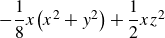


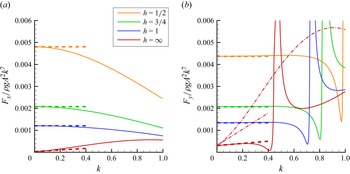


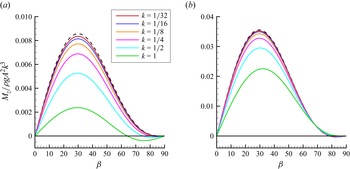


 Open access

