

1. INTRODUCTION
This paper describes a construction that is largely unknown in an otherwise well-studied language family, even though it has been used since ancient times. While it is well known that North Germanic languages have imperatives, it is not known that they also have a second class of prescriptive infinitives with their own grammatical and pragmatic constraints. The word ‘prescriptive’ indicates that the function of this infinitive is to state a command, instruction, order or request, i.e. a jussive function.
Imperatives in the North Germanic languages – Danish, Faroese, Icelandic, Norwegian and Swedish – typically have a form that is identical to the verb stem (though with additional person suffixes in the case of Icelandic and Faroese), i.e. they are identical to those infinitives that have a word-final vowel as part of their stem, and are shorter than those infinitives that have a vowel suffix. The picture is complicated somewhat by the well-known fact that for some verb classes in some of the languages or dialects, the imperative has the form of the infinitive.
What I will show in this paper, however, is that all these languages have a full, thriving set of infinitives used in a prescriptive context alongside the imperatives. These infinitives constitute the only verb of the sentence in which they are contained, and are thus as independent as imperatives and finite verbs generally, and very different from other uses of the infinitive, which are limited to embedded contexts. They are used in a very limited pragmatic context of a pleasant atmosphere by adults towards very young children, or towards pets or adults that are (perhaps temporarily) on a lower point in the social hierarchy than the speaker. These ‘child-directed prescriptive infinitives’ have a set of syntactic properties that distinguish them from imperatives: Negation is always pre-verbal, subjects are pre-verbal, subjects are third person, and are generally expressed by lexical words, not personal pronouns.Footnote 1 An example is presented in (1). (Here and elsewhere the imperative form of the verb is provided for comparison.)
-
(1)


These child-directed infinitives can be found in child language corpora, and are probably used by most native speakers when the appropriate context arises. The fact that the same characteristics are shared by all the languages indicates that the child-directed prescriptive infinitives have existed since before the languages separated, i.e. since before ad 500.
The paper starts by presenting the standard imperatives (Section 2), with the basic facts on the order of negation and the presence and position of subjects. Section 3 presents the child-directed prescriptive infinitives, and provides authentic examples from a number of sources, including child language corpora. It discusses the pragmatics of the construction, and then looks at the syntactic differences between prescriptive infinitives and imperatives, dealing with the position of negation and subject, and the type of subjects that are possible. It also contains a short discussion of the age of this construction. Section 4 presents some other prescriptive infinitival constructions in the North Germanic languages, showing that these are not the same as the child-directed prescriptive infinitives. Section 5 presents prescriptive infinitives in other languages, arguing that while they may have formal characteristics in common with each other and the child-directed prescriptives, they do not share the same pragmatic constraints. Section 6 provides a discussion of theoretical points that can be drawn on the basis of the new empirical material constituted by the prescriptive infinitives, and an account incorporating syntax and context roles will be given. Section 7 concludes the paper.
2. STANDARD IMPERATIVES IN THE NORTH GERMANIC LANGUAGES
The imperative in the North Germanic languages is generally identical to the stem of the verb, and the general word order when negation is involved, is imperative–negation (though Norwegian differs somewhat from the latter generalisation). Based on examples from the reference grammars of Swedish, Danish and Norwegian, the word order involving imperatives and negation is as shown in (2)–(4). (Here and elsewhere bold print highlights the words that are relevant in the sentence.)
-
(2)
-
(3)
-
(4)
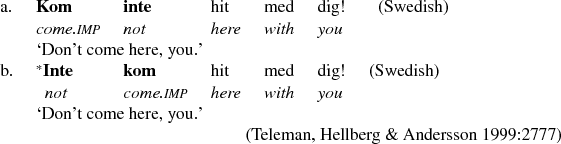


Thus, in Swedish and Danish, the imperative is the first word in the sentence, with negation following the imperative verb, V–Neg, while in Norwegian, both V–Neg and Neg–V are possible word orders. It should be mentioned that according to Platzack & Rosengren (Reference Platzack and Rosengren1998:214), colloquial Danish actually does not have negation in imperatives at all. (Instead they use the alternative phrase: Lad være med, lit.: ‘let be with’, meaning ‘don't’.) Garbacz & Johannessen (Reference Garbacz and Johannessen2013) show that these generalisations are supported by spontaneous speech data and by a grammatical survey for Swedish and Norwegian (Danish was not investigated to he same extent), using the Nordic Dialect Corpus (Johannessen et al. Reference Johannessen, Priestley, Hagen, Åfarli and Vangsnes2009) and Nordic Syntax Database (Lindstad et al. Reference Lindstad, Nøklestad, Johannessen and Vangsnes2009), but that it is the Neg–V order that is most acceptable and most used in Norwegian.
The Faroese reference grammar shows that there are two inflected imperative forms in this language, one in the singular and one in the plural (Thráinsson et al. Reference Thráinsson, Petersen, Jacobsen and Svabo Hansen2004), see (5):
-
(5)

If the imperative is negated, the negation is post-verbal, as in (6):Footnote 2
-
(6)

Icelandic imperatives can be found only in the singular form, as in (7a) below. In very formal contexts they can be followed by a pronoun, as in (7b). The most common way of expressing the imperative, though, is with a reduced form of the second person pronoun attached to the imperative verb (Thráinsson Reference Thráinsson2007:6–7), as in (7c).
-
(7)

Like in Faroese, negation in Icelandic follows the imperative (but more variation will be presented in Section 4), (8).
-
(8)

3. CHILD-DIRECTED SPEECH
This section presents prescriptive infinitives in the North Germanic languages, and then discusses how they differ pragmatically and with respect to word order from ordinary imperatives. Finally a short discussion of the age of this construction is presented. To the extent that it has been possible, data have been taken from spoken language corpora.
3.1 Prescriptive infinitives
Somebody listening to a parent talking to their toddler in any of the North Germanic languages will soon realise that their language contains prescriptives that are not imperatives, but infinitives. This pan-North Germanic class of prescriptives has not been previously studied, though the use of the infinitive with prescriptive function is briefly mentioned in Hansen & Heltoft (Reference Hansen and Heltoft2011) for Danish, and in Collberg & Håkansson (Reference Collberg and Håkansson1999) and Teleman et al. (Reference Teleman, Hellberg and Andersson1999) for Swedish.
3.1.1 Norwegian
Transcriptions from dialogues between parents (and interviewers) and toddlers in a Norwegian part of the Childes Corpus, the Anderssen Corpus of Northern Norwegian Child Language, and the N-LARSP corpusFootnote 3 show a sizeable number of prescriptive infinitives. Some examples are given in (9)–(12) below. Since it could otherwise be argued that these infinitives just echo verbs previously used in the context by the children, they are provided with a bit of context.
-
(9)
-
(10)
-
(11)
-
(12)


In (9), the child opposes the command imposed on it, in (10), the conversation is about something other than the eating action that the mother brings in, and in (11)–(12), there is no linguistic context, but the use is clearly prescriptive.
One could ask whether these are really examples of a special construction. Perhaps they are simply examples of a child-like language that parents adopt, one in which there is little or no inflection? This hypothesis can be quickly rejected. The rest of the language spoken by the parents is not child-like, except in some cases where the parent is clearly echoing the child; repeating it verbatim, as seen in (14)–(15) below. The example in (13) shows how the mother is using a language of fully inflected forms to the child, here exemplified with a noun correctly inflected with the masculine definite form and a verb in the present tense.
-
(13)

Uninflected forms can occur as an echo of something just said in the discourse, as in (14), where the mother repeats what the child has said, and in (15), where the father repeats parts of a modal construction previously uttered by himself, in both cases using a bare infinitival form. These examples do not show anything about the prescriptive infinitives; they simply show that echo utterances are as much part of child-directed speech as they are in other forms of speech.
-
(14)
-
(15)


3.1.2 Swedish
Although in Swedish some verb classes have imperatives with the same form as infinitives (see Section 4 below for more on this), there are some verb classes where they differ morphologically. Swedish child-directed prescriptive infinitives in these classes are like the Norwegian ones. Some corpus examples are given in (16) and (17):
-
(16)
-
(17)


Like with Norwegian, there is ample evidence that the same parents in the same conversations use ordinary inflected language, and not a simplified variety. Example (18) shows the mother using a verb in the present tense and a noun inflected in the singular masculine definite.
-
(18)

A Swedish posting on an Internet forum, answering somebody who asks about the Scandinavian equivalents of the standard Swedish Spring inte! ‘run.imp not’ confirms the child-directedness of these infinitives:
-
(19) Inte springa är om du frågar mig lite mer barnsligt språk, ungefär som när mödrar talar med sina barn eller när man talar med ett djur.
-
[Inte springa ‘not run.inf’ is if you ask me a bit more childish language, as when mothers speak to their children or when one talks to an animal.]
Teleman et al. (Reference Teleman, Hellberg and Andersson1999) corroborates this by mentioning briefly that an infinitival phrase, normally when negated, can be used prescriptively towards children and animals, as in (20):
-
(20)

3.1.3 Danish
Danish, too, has a prescriptive infinitive in child-directed speech, illustrated in the corpus example (21).
-
(21)

Example (22) shows that the language towards the children is otherwise inflectionally complex, illustrated here with a noun fully inflected for neuter singular definite.
-
(22)

The infinitive is mentioned in Hansen & Heltoft (Reference Hansen and Heltoft2011:73). They describe it as an infinitival clause that has a modal meaning, and provide a number of examples, of which a couple are reproduced in (23).
-
(23)

3.1.4 Icelandic and Faroese
In Icelandic child-directed speech, too, an infinitive form is used with prescriptive function, (24). There is no Childes Corpus for Icelandic or Faroese, so the data in this paper have been provided by the linguists mentioned with each example.
-
(24)

3.1.5 Faroese
In Faroese, too, this construction is used with children, as in (25).
-
(25)

3.2 Pragmatic differences?
A question now is whether the prescriptive infinitives in child-directed speech have different pragmatic functions from the standard imperatives. Could it not just be that child-directed speech should be interpreted as a separate dialect, so that these infinitives have the same pragmatic function in that dialect as the standard adult-to-adult imperatives have in the adult-directed dialect? If the language that parents generally use towards children differs in significant ways from the standard one, a case could be made for an affirmative answer to the question. If, however, other inflectional patterns are the same as in the standard language, it would be more difficult to maintain that child-directed speech is a separate variety. If, further, we find examples of both imperatives and prescriptive infinitives in the child-directed variety, we expect some pragmatic, functional, difference.
Looking closer at the Norwegian, Swedish and Danish corpus data it is clear that the child-directed language is not very different from the standard language: In Section 3.1 we saw that inflections (both verbal and nominal) are present in the parent-to-child language. Here we will see that we also find examples of the standard imperatives in the same dialogues as those where we find the prescriptive infinitives (26)–(29), all from the same dialogues where we earlier found the infinitive type.
-
(26)
-
(27)
-
(28)
-
(29)


The data suggest that imperatives and prescriptive infinitives exist side by side, so we should look for a possible pragmatic difference between them. Having studied the child corpus dialogues, it appears that when the adult is upset and possibly annoyed with the child, it is the standard imperatives that appear. The infinitives, on the other hand, are used when the situation is calm and pleasant, in a caring and loving manner. This is further supported by the finding that it is rarely the investigator (unrelated to the child) that uses the prescriptive infinitives; it is usually the parent who does this. They seem to be reserved for a particular use that would sometimes be too intimate for somebody from the outside. This particular pragmatic context cannot be confirmed by references to the literature, given its lack of previous description, but the present author has presented this work at several conferences (see the acknowledgements section) and also talked to many Scandinavian linguists about it. The common reaction to this claim is energetic nodding and a smile of confirmation.Footnote 6
This is not to say that they can only be used in child-directed speech. Any speaker who has a superior position with respect to the listener, and who feels warmly towards them in the conversation, could use these infinitives. The following utterance was overheard used in a friendly manner by an expert on boating and sea to a younger man who had performed a very dangerous swim the year before. The older man wagged his index finger at the younger man, and said (30) with a glimpse in his eye:
-
(30)

A recent Facebook posting shows something similar. A female lecturer in English linguistics wrote (31) on her wall to Mr. Ari Behn, who is not an academic, but whose claim to fame is his former marriage to the Norwegian Princess Märtha Louise, suggesting that he learn better English. This happened after he had published an article in an English newspaper with a number of spelling errors. She disclosed later that she liked him, which confirms the prerequisite positive attitude suggested in this paper.Footnote 7 , Footnote 8
-
(31)

It can also be used towards animals. The following text was found as an illustration in a student newspaper, where a representative in the Students's Parliament comments on the arrival of a new student list, the Trojan List, depicted as a horse in the illustration, (32). A cartoon (with the popular young man Pondus as a protagonist) recently depicted Pondus and his dog, saying (33) to the dog.
-
(32)
-
(33)


Heltoft & Hansen (Reference Hansen and Heltoft2011:738) observe something similar for Danish. They say that the infinitive used in an imperative function marks that the speaker is in a position of strength relative to the receiver, so that it is not always easy to use this infinitival imperative towards adult speakers.Footnote 11 Their example seems to be uttered by a football trainer towards a grown-up player on his team, (34).
-
(34)

Without more context it is difficult to tell whether the Danish utterance is said in an agitated mood or in a friendly (and perhaps humorous) atmosphere.
Faroese prescriptive infinitives can also be used towards adults. In those cases, they must be negated (a requirement we also saw has been raised for the Swedish prescriptive infinitives, note 5, and which has also been reported for some Norwegian dialects and Icelandic, as will be shown in Section 4). The hierarchical social dimension is necessary for the construction to occur. According to Hjalmar P. Petersen (p.c.), (35) is often uttered by his older sister, ten years his senior, to him, but could never be uttered by him towards her:
-
(35)

The Icelandic prescriptive can also be used towards adults. There is a pragmatic difference between it and the imperative, in that the latter is more formal (Eiríkur Rögnvaldsson, p.c., and recall also Norwegian in note 8). Thus, (36a) is almost exclusively found in spoken language, in contrast with (36b).
-
(36)

The fact that the prescriptive infinitive is a grammatical form whose use depends on the pragmatic context, is reminiscent of the honorifics in other languages, from Japanese (Okada Reference Okada1963) and Korean (Lee Reference Lee1991) to many Indo-European languages. Prescriptive infinitives can only be used towards very small children (and animals) or towards people who are very clearly at the lowest point of the relevant hierarchy, and who can accept this fact in a pleasant atmosphere. Without such a mutual understanding of their roles among the participants in the speech event, the prescriptive infinitive would be unbearably condescending.Footnote 12
3.3 Syntactic differences
3.3.1 Word order with respect to verb and negation in child-directed speech
Imperatives and prescriptive infinitives are not just different in morphological form and pragmatic function, but also syntactically. The prescriptive infinitives have preposed negation and typically no subject, while the inflected imperatives in all the North Germanic languages have postposed negation (although Norwegian more often has preposed), (37a–d):
-
(37)

In Swedish, imperatives standardly have V–Neg order, like Danish, Icelandic, and Faroese. The child-directed prescriptive infinitives, however, have only preposed negation, (38):
-
(38)

Interestingly we also find this word order in child-directed speech even with the verbs of those verb classes in which there is no formal contrast between the imperative and the infinitive in standard Swedish. This word order would not be acceptable in a non-child-directed context. Examples of both negated child-directed prescriptives and standard imperatives (found in adult-directed Internet newspapers and magazines) are given below in (39)–(41).
-
(39)
-
(40)
-
(41)


In Österbottnian Swedish (Finland), pre-verbal negation is also found with prescriptive infinitives. Huldén (Reference Huldén1996) notes that this is especially in the language used towards children, (42a). This contrasts with the normal imperatives in this dialect, (42b):
-
(42)

Although the actual verb form in (42a) looks like a standard imperative form, it is an infinitive; this dialect has apocope, and the imperative form therefore is identical to the infinitive. The two are distinguished by the order of negation and verb, like the Swedish ambiguous examples above and other dialects discussed in this paper, Section 4.
In Icelandic, there are also verbs that have the same form in imperative and infinitive. Like in Swedish, the position of their negation depends on the pragmatic use. When these verbs are used in child-directed speech, the same word-order pattern as in Swedish occurs, as demonstrated in (43) vs. (44). Negation in Faroese prescriptive infinitives is also preposed, as was shown in (25).
-
(43)
-
(44)


Standard Danish, like Swedish, has post-verbal negation with imperatives, to the extent that they can be negated at all, but child-directed Danish, like Swedish and Icelandic, has pre-verbal negation with prescriptive infinitives, (45). It should also be mentioned that some Danish speakers find the prescriptive infinitive to be more acceptable with negation (Tanya Karoli Christensen, p.c.), cf. note 5.
-
(45)

All the languages thus have the same pattern, which is that the imperative is (or in the case of Norwegian, can be) negated post-verbally while the child-directed prescriptive infinitive is negated pre-verbally.
3.3.2 Word order with respect to verb and subject in child-directed speech
Inflected imperatives typically occur without explicit subjects, with the Icelandic cliticised subjects presented in (7c) being an exception. But when they do occur overtly, imperative subjects are post-verbal in all the languages (Platzack & Rosengren Reference Platzack and Rosengren1998:218; Eide Reference Eide2002:232, Reference Eide2016). We saw an example of an Icelandic post-imperative subject in (7b). An example from spontaneous speech with both negation and a subject is given in (46), and one with a subject only in (47):
-
(46)
-
(47)


It has not been easy to find examples of subjects in the child corpora, probably because they are rare. Below, in (48), is a Norwegian example, repeated from (9), Section 3.1.1, and Swedish has this word order, too, (49). (Note that the subject in these two examples is third person, and is a DP (determiner phrase) rather than a pronoun – these facts will be discussed further in Sections 3.3.3 and 6.)
-
(48)
-
(49)


It could be argued that Nora and Sara are not subjects here, but rather vocatives. It is difficult to argue against this, since vocatives will always be allowed. Not having access to sound files, these examples are hard to judge, but to the present author, as a native Norwegian speaker, they sound equally good with either intonation pattern. With a subject reading, the name will be pronounced with a high pitch, no break, and with the rest of the clause following in a lower pitch (apart from the last name in (48), which must be interpreted as a right-dislocated element). With a vocative reading, the name would be pronounced in a pitch no higher than the next part of the clause, and there would be an audible break after it.
In Icelandic and Faroese the same contrast is found. While the imperative subjects are post-verbal, those of the prescriptive infinitives are pre-verbal, as illustrated in (56) for Faroese, in Section 3.3.3.
3.3.3 Subject type: Second or third person
Subjects of imperatives (called imperative NPs by Platzack & Rosengren Reference Platzack and Rosengren1998) are normally second person to the extent that they are used at all. In prescriptive infinitives, the subject is often third person, as in the Norwegian and Swedish (48) and (49), respectively, above. Consider also (50), repeated from (31), and (51)–(52).
-
(50)
-
(51)
-
(52)


Although there is no overt subject in (50)–(52), the third person reflexive shows that the unexpressed antecedent subject is third person. Prescriptive infinitives unlike imperatives thus have third person subjects.
It should be pointed out that the third person subject should not be regarded as an uninflected default subject. Rather, the subject agrees in number with the predicate (the same way that second person subjects do); there is therefore a difference between singular and plural third person subjects, parallel to the way there is between singular and plural second person subjects in imperatives, (53) and (54).
-
(53)
-
(54)


In Faroese and Swedish, prescriptive infinitives can have either second or third person subject, (55)–(56):
-
(55)
-
(56)


While Danish and Icelandic may not accept overt subjects in child-directed speech, verbs with reflexives reveal the type of unexpressed, covert subject:Footnote 13
-
(57)

It should be mentioned here that the choice of third person subject in the child-directed prescriptive infinitives does not mean that these infinitives are copies of the children's own language. Example (58) (possibly an immature modal construction, where the modal verb is missing and just the infinitive is present) shows an infinitive accompanied by first person personal pronouns. If such pronouns are possible with child-language (elliptical) modals, and they were the model for the child-directed infinitive, we should expect subject pronouns in the latter constructions, contrary to fact.
-
(58)

3.3.4 Object type: Third person
The object, too, shows a preference for third person. Consider (59):
-
(59)

In the Swedish (60), the verb belongs to the class that is ambiguous between imperative and infinitive, and there is no negation whose position would help disambiguate this form. However, it could be a prescriptive infinitive given that it is uttered by a father who has also used an unambiguous non-negated prescriptive infinitive (recall note 5).
-
(60)

However, although these examples do contain a DP object where ordinary adult-directed language would have a first person pronoun, there seems to be no hard restriction against pronouns in this position, and certainly not like the one for the subject position. In fact child-directed language frequently uses DPs instead of pronouns in all kinds of constructions. They do not occur just with prescriptive infinitives, and certainly not as the only choice of argument. Consider for example the constructed (61):
-
(61)

So the object lexical nouns in the prescriptive infinitives represent an option on a par with pronouns, and not something that is forced upon them for some grammatical reason.Footnote 14
3.3.5 Summary of the syntactic facts
A summary of the syntactic facts in imperatives and child-directed prescriptive infinitives is given in Table 1. For all five standard languages, we see that the finite imperatives are V–Neg; negation is postposed (apart from Norwegian, where negation is preferred pre-verbally). Subjects of finite imperatives, if expressed, are second person, and they are post-verbal.
The syntactic differences between imperatives and prescriptive infinitives.
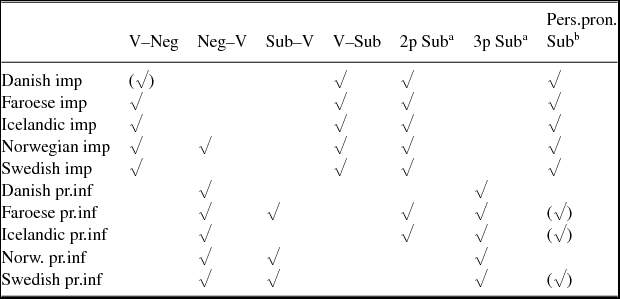
Abbreviations expanded: Verb–Negation, Negation–Verb, Subject–Verb, Verb–Subject, second person subject, third person subject, personal pronoun subject
a Although an overt subject may not be acceptable in these languages, reflexive pronouns reveal the person of the subject.
b Parentheses have been used in this column to indicate that these data have not been found in any source independent of the informants, who were uncertain about them.
The child-directed prescriptive infinitives have pre-verbal negation and pre-verbal subject. The preferred subject is third, not second person. Subjects are normally unexpressed or lexical, not pronouns (but third person reflexive pronouns are OK).
3.4 On the history of the child-directed infinitival imperatives
Determining the age of a construction is not easy, especially if we have to go back to a time, more than a thousand years ago, when daily life was not as frequently documented in writing. The child-directed prescriptive infinitives exist across all the North Germanic languages, with largely the same pragmatic and syntactic properties. It is improbable that five languages over such a vast area should have developed, independently in each language, a construction with the same formal and pragmatic characteristics. The most likely history is therefore one of a common origin.
An alternative might have been one of borrowing; that the construction developed first as an innovation in one place and then spread to the rest of the languages in the area. But this is unlikely. If the change had happened after the languages split, they (especially Icelandic and Faroese as against Norwegian, Swedish and Danish) would not have been mutually intelligible, so the borrowing of a particular syntactic phenomenon would be surprising. On the other hand, specific language features, such as the uvular trill /ʀ/, the development of the perfect verb form and even articles, have been known to spread across very different languages, so borrowings are not totally out of the question. However, for prescriptive infinitives, it is hard to fathom how this construction could have spread, because of its pragmatics. It is mainly used by parents towards little children, and in a nice and pleasant atmosphere, as we have seen. This is not a situation that is typically visible to outsiders, and especially not to people speaking a different language. It is therefore unlikely that it could have spread across such a vast area by way of borrowing.
One last possibility might have been that the child-directed prescriptive infinitives were a relic of an earlier stage of imperatives, but diachronic facts rule this out. In Section 4 we will see that there are some dialects in Trøndelag, Norway, which have both an inflected imperative and a prescriptive infinitive. According to Haugen (Reference Haugen1982:99, 142, 149) and Munch (Reference Munch2013), the latter must be newer than the former. Haugen says that while the imperative form in Old Norse was identical to the stem (i.e. our inflected imperative), these forms have now died out in the Oppdal dialect (Haugen Reference Haugen1982:99). Thus, while there are dialects in which prescriptive infinitives are the only jussic alternative, they are actually newer than the imperatives.
The word order Neg–V also seems new for imperatives generally. Munch (Reference Munch2013:260–262) concludes that it is a ‘(rather new) innovation’ in Norwegian, in contrast to V–Neg. The literature suggests that Old Norse had V–Neg order, see Haugen (Reference Haugen1982) and Faarlund (Reference Faarlund2004:228). The Neg–V order is first mentioned in a grammar of the Bergen dialect (Larsen & Stoltz Reference Larsen and Stoltz1912), according to Munch's findings. Her conclusion is supported by the fact that Aasen's (Reference Aasen1864) thorough grammar of Norwegian only mentions the V–Neg order with imperatives, as in (62):
-
(62)

It cannot be the case, then, that the prescriptive infinitives have developed from some earlier stage of imperatives. The most likely history of the child-directed prescriptive infinitives is that they have existed in all the languages since before the languages separated, i.e. before ad 500, and probably even long before that. One could ask why there is no documentation of this variety in the written sources from earlier times; the answer probably lies in the genre. The kind of pragmatic context needed for the child-directed imperatives is highly marked, and probably would not be considered suitable in written texts.
4. OTHER CASES OF PRESCRIPTIVE INFINITIVES IN THE NORTH GERMANIC LANGUAGES
For the sake of completeness we include some other prescriptive infinitives that exist in the North Germanic languages that do not share all the syntactic characteristics shown in Table 1 above.
According to Sigurðsson (Reference Sigurðsson, Rothstein and Thieroff2010), in Icelandic, infinitives can be used as prescriptives with the constraint that they have to be negated, see (36a), Section 3.2. No pragmatic constraint is mentioned.
Note that this prescriptive infinitive has pre-verbal negation, like the child-directed ones (recall Table 1). This is also the case with another use of the infinitive in Icelandic, where the infinitival marker is present, as in (63), and which it shares with similar examples in some dialects of Swedish and Norwegian (compare the examples from Huldén Reference Huldén1996 in (42a) above and from Munch Reference Munch2013 in (74a) below). With the ordinary imperative, the negation is post-verbal, as we saw in Section 2 and in Table 1 above.
-
(63)

These Icelandic examples and the child-directed prescriptive infinitives might suggest that pre-verbal negation depends on an infinitival form. This should immediately be countered. First of all, we saw in Section 2 that negation in Norwegian imperatives is usually pre-verbal. Further, Petersen (Reference Petersen2008) also shows that there is a tendency among young speakers of Faroese to negate their imperatives pre-verbally, as in (64).
-
(64)

Dialects of Swedish and Danish can also have negation preceding the imperative verb. For example, we saw in Section 3.3.1 that Österbottnian Swedish (spoken in Finland), noted by Huldén (Reference Huldén1996) can have preposed negation in certain imperative expressions. And according to Pedersen (to appear), most dialects of Danish can have preposed negation, exemplified in (65).
-
(65)

Infinitives used as prescriptives can also be found without pragmatic constraints in the mainland languages. In these cases they either belong to a subclass of imperatives that happen to have the same form as infinitives due to some historical accident (as mentioned for Swedish in Sections 3.1.2 and 3.4 above, and below), or that they even overlap completely with imperatives for all verbs (as in the Norwegian Inntrøndelag dialect, see below). There may also be phonological reasons for a neutralised distinction between infinitives and imperatives (see below for Norwegian). Some of these types will be presented here. Note that these are not pragmatically or syntactically different from other imperatives.
The Swedish standard language and the written Norwegian standard Nynorsk including some Norwegian dialects (Aasen Reference Aasen1848:§296, Reference Aasen1864:§236, page 227; Faarlund et al. Reference Faarlund, Lie and Vannebo1997) have verb classes where the imperative has the same form as the infinitive (the kasta class in Norwegian, Språkrådet 2015).Footnote 15 This is illustrated for Swedish by examples from Teleman et al. (Reference Teleman, Hellberg and Andersson1999:vol. 2:544, §35), who show how some Swedish verb classes distinguish between infinitives and imperatives, (66), while others have the same form, (67).
-
(66)
-
(67)


It is illustrated for Norwegian in (68) and (69).
-
(68)
-
(69)


The Norwegian Oslo dialect is illustrated in (68) with examples by Larsen (Reference Larsen1907), with different inflection on infinitives and imperatives. Examples (69a, b) illustrate Nynorsk Norwegian, which has three possible inflections for the imperative of the kasta class, whereas (69c, d) illustrate that the old Oslo working class dialect also used the infinitive form with imperatives for some verbs.
In some Norwegian dialects, all imperatives in all verb classes have the same form as their corresponding infinitives (see also Haugen Reference Haugen1982). The Inntrøndelag dialect is a case in point: It has one class of verbs in which bisyllabic words have the same vowel in stem and suffix. It also has a class of mono-syllabic verbs with a circumflex pitch accent, an accent that shows that the words originally had two syllables. Neither class distinguishes formally between infinitives and imperatives, as seen in (70) and (71) (the circumflex accent is annotated with a ∧).
-
(70)
-
(71)


In all varieties of Norwegian, there is a phonological problem when the verb stem ends in a consonant cluster of rising sonority (Rice Reference Rice2003), exemplified in (72). The solution varies between dialects and speakers, but one common method is adding a vowel suffix to the stem, thereby obtaining a form that is identical to the infinitive (Rice Reference Rice2003:377). This does not change the pragmatic and syntactic properties of the imperative. Some example verbs whose imperative is phonologically impossible and that can obtain an infinitival form are given in (72).Footnote 16
-
(72)

Munch (Reference Munch2013:286–287) says that in the Trøndelag dialect area, there are in fact two ways of expressing the imperative, depending on age and dialect. One way would be as in (70)–(71), where there is no difference between the imperatives and infinitives, while another one is like in standard Norwegian, where there is a difference, as described in Section 1. Faarlund et al. (Reference Faarlund, Lie and Vannebo1997:953) says that in many dialects the infinitive can be used instead of the imperative, but only if the clause is negated. This is exemplified as in (73), but the geographical area for this phenomenon is not stated.
-
(73)

There are also infinitives that include not just the infinitive, but also the infinitival marker (as in the Icelandic (63), this section, and Österbottnian Swedish, (42a), Section 3.3.1). Munch (Reference Munch2013:§7.6) has found some examples in the Trøndelag area. These, too, apparently must be negated, see (74) and (75):
-
(74)
-
(75)


The order between verb and negation in the Oppdal dialect of the Trøndelag area seemingly follows the same pattern as in Icelandic and Faroese: If the imperative is expressed by an infinitival verb, the negation is pre-verbal, while if it is expressed by an imperative form, it is post-verbal, see (76):
-
(76)

It should be noted, though, that according to Haugen (Reference Haugen1982:99), the original imperative form (the stem form) in the Oppdal dialect has died out in the modern dialect, so that only the infinitive is used nowadays. This would be the same as in the Inntrøndelag dialect above. It also means that the examples in (76) do not represent two synchronic choices with a word order matching the form of the verb, since it represents a historic development, where the word order between negation and verb in (76a) is the same as that for imperatives across Norway.
We have seen that prescriptive infinitives can be found in non-child-directed contexts. In these cases they do not seem to have any particular pragmatic constraints, and neither do they seem to have the constraints on the arguments presented in Section 3. The extent to which the negation is preposed or postposed is not so clearly linked to the imperative–infinitive contrast here. However, there are indications that negation is necessary for the infinitival form to be used. In this respect there is a certain similarity between some of the North Germanic languages and dialects mentioned in this section, and child-directed speech in Swedish and Danish, as described in Section 3. I refer to Zanuttini (Reference Zanuttini, Belletti and Rizzi1996) for more on the relationship between negation and imperative mood, as this is not limited to the North Germanic languages.
Eide (Reference Eide2002:232) also points out that only the V–Neg order is compatible with a sentential adverb like derfor ‘therefore’. Neither subjects nor sentential adverbs can co-oocur with the order Neg–V. The example in (77) illustrates the only possible word orders when the imperative is modified by a sentential adverb and/or is accompanied by a subject. (Parentheses indicate possible pronoun positions.)
-
(77)

5. PRESCRIPTIVE INFINITIVES IN OTHER LANGUAGES
Many other Indo-European languages have some overlap between imperatives and prescriptive infinitives, and this section will present relevant examples from German, French and Polish. In these languages the choice seems to be pragmatically determined, though not necessarily in the same way as the North Germanic child-directed prescriptives.
We start looking at German. Duden (1995:§306) shows how the infinitive is used with imperative function, see (78a, b) below, in contrast to the second person singular and plural imperative, as well as the polite third person imperative, see (79):
-
(78)
-
(79)


It is remarked in Duden (1995:§306) that the infinitive in (78a) loses the reflexive pronoun this verb would normally have (sich vorsehen ‘plan.inf’). Gärtner (Reference Gärtner, Meibauer, Steinbach and Altmann2013) shows several examples of how the infinitive used prescriptively does not have reflexive pronouns. Neither of them mentions that there is a relation between the form of the verb and the negation, but the examples in Duden suggest that the basic facts are the same as in Swedish, Danish, Icelandic and Faroese, where the imperative verbs have post-verbal negation, while the prescriptive infinitives have pre-verbal negation, see (80a, b) (the latter repeated from the beginning of this section, (78b)).
-
(80)

An additional point about German prescriptive infinitives is that they cannot be used with transitive verbs that have pronominal objects (Lutz Edzard, p.c.). This could be the reason that they occur without reflexives (recall Duden 1995 and Gärtner Reference Gärtner, Meibauer, Steinbach and Altmann2013). Thus, (80a) could not have been replaced by an infinitive.
Pragmatically, the prescriptive infinitive in German is almost the opposite of the North Germanic one. It is used in public notices, and is rarely used in spoken language, perhaps with the exception of military use. It is quite formal, and could even be considered impolite (Lutz Edzard, p.c.).
In French, the imperative and the infinitive are homophonous, but are written differently, and are different syntactically with respect to reflexives and negation, and pattern like Swedish, Danish, Icelandic, Faroese and German. Note that with the infinitive, (82), reflexives and negation are pre-verbal, while with the imperative, (81), the non-consecutive negation is pre- and post-verbal as in other finite verbs, and the reflexive is also post-verbal.
-
(81)
-
(82)


The pragmatic use of the French infinitives seems quite similar to that of German. It is found in special contexts, such as recipes, instructions, commands or outbursts (Helland Reference Helland2006:331).
Polish is exemplified in (83) and (84).
-
(83)
-
(84)


Pragmatically, the infinitive is used in a setting where there is a hierarchical social difference between the participants, such as teacher to pupil or parent to child, while it is not used between, for example, spouses or friends. Lubecka (Reference Lubecka2000:87) expresses the pragmatic constrains as follows: ‘[i]nfinitives appear when the power distance is big and the request/invitation is to be marked with disrespect, rudeness and even impertinence’. Wierzbicka (Reference Wierzbicka1985:154) also stresses the unfriendly pragmatics of the Polish infinitive: ‘When the speaker gets really angry with the addressee s/he will often avoid the imperative and resort to “stronger” devices, in particular, to the bare infinitive’.
There are many other languages that use infinitives as prescriptives. Aikhenvald (Reference Aikhenvald2013:281) mentions Estonian, Russian, Armenian, Modern Hebrew, Turkic languages (exemplified by Yakut), Korean and Spanish. Her generalisation of their pragmatics is that they imply strong commands and prescriptions, i.e. the opposite of our child-directed prescriptive infinitives. However, she says about the Armenian ones that they can only be used ‘by a superior to their subordinates’, perhaps like Polish. Bennis (Reference Bennis, Ackema, Brandt, Schoorlemmer and Weerman2006:fn. 2) mentions that infinitives can be used with imperative force in Dutch. Modern Greek does not have infinitives, but subjunctives can be used as prescriptives (Joseph & Philippaki-Warburton Reference Joseph and Philippaki-Warburton1987:18), as can imperfectives in the Slavic languages (Alvestad Reference Alvestad2013). It is also common that imperatives cannot be negated by simply adding negation to the structure. Other forms of the verb, typically infinitive or subjunctive, are used in these cases, for example in Greek, Spanish and Italian (Poletto & Zanuttini Reference Poletto, Zanuttini and Tortora2003; Postma & van der Wurff Reference van der Wurff2007; Iatridou Reference Iatridou2008:23). Imperatives frequently require other negative and modal particles than declarative structures do.
To conclude this section, prescriptives can be expressed by infinitives in many other languages than the North Germanic ones. While there may be similarities between the position of negation in imperatives and infinitives, and maybe even other comparable word-order facts, between North Germanic and other languages, there seem not to be other syntactic similarities, such as those regarding person categories and subjects, or indeed regarding lexical versus pronominal arguments. Neither does there seem to be the same pragmatic constraints that the North Germanic child-directed prescriptive infinitives have. The fact that the North Germanic languages share characteristics that do not extend to the other Germanic or Indo-European languages should be taken as further support that the child-directed infinitives are indeed an old phenomenon.
6. THEORETICAL IMPLICATIONS
The prescriptive infinitives present a series of puzzles that need to be understood. Drawing on relevant literature some solutions will be proposed here.
6.1 Adressee: Third person and not second person
We have seen (Sections 3.3.2 and 3.3.3) that child-directed prescriptive infinitives do not have pronominally expressed subjects for the addressee, and that subjects tend to be a third person non-pronominal DP. Exactly how this is encoded in the grammar should be investigated. A first step is to study how the relationship between a syntactic function and a discourse context role has been treated in the literature. The most relevant literature will be presented in this section.
Prescriptives (infinitival as well as imperatives generally) have in common that the subject is the addressee. Formalising the relationship between a syntactic category and a contextual role has been proposed in the literature. Sigurðsson (Reference Sigurðsson, Bianchi and Safir2004, Reference Sigurðsson2014:182) links syntax to pragmatic context, and argues that the person category is a syntactic category. Sigurðsson's theory assigns the person category by computation, so that when an argument is personal (normally not inanimate and not indefinite), and it has a negative value for logophoric agent and a positive value for logophoric patient, it is ‘second person by computation’. First person, on the other hand, has a positive value for logophoric agent, and a negative value for logophoric patient. Third person has a negative logophoric value for both agent and patient, or if the argument is non-personal. Sigurðsson formalises it this way:
-
(85) NP+Pn → NP+Pn/+LA, –LP = 1st person by computation
NP+Pn → NP+Pn/–LA, +LP = 2nd person by computation
NP+Pn → NP+Pn/–LA, –LP = 3rd person by computation
NP−Pn = 3rd person by default
(Sigurðsson Reference Sigurðsson2014:180)
Since Sigurðsson's theory does not take imperatives (or prescriptives generally) into account, it does not predict the right person for the logophoric roles. Subjects are [+Pn/+LA, –LP], i.e. first person by Sigurðsson's theory, while in imperatives they ought to have been computed as second person, and in prescriptive infinitives as third person.
Alcázar & Saltarelli (Reference Alcázar and Saltarelli2014:Chapter 4), building on work by Ross (Reference Ross, Jacobs and Rosenbaum1970), Bianchi (Reference Bianchi, Guéron and Tasmowski2003), Sigurðsson (Reference Sigurðsson, Bianchi and Safir2004) and Zanuttini (Reference Zanuttini2008:197), propose a syntactic minimalist analysis of imperatives. They, too, formalize the relationship between the syntax and the context. Splitting up the verb into the roles of A = speaker, B = addressee and C = performer, they account for canonical and extended imperatives, respectively, as in (86a, b). In canonical imperatives, such as Go!, the speaker is first person, while the addressee is the same as the performer, second person. The extended type, on the other hand, for sentences like Let us/him/*you go!, distinguishes between addressee (who must be second person) and performer (who must be first or third person). It is the light verb that assigns the speakers associated with the roles, according to their ‘light’ performative hypothesis (LPH; Alcázar & Saltarelli Reference Alcázar and Saltarelli2014: 111).
-
(86)

This model has the advantage that it encodes the speech act into the syntax, so the speaker is first person and the addressee second person. Bennis (Reference Bennis and Wurff2007:§5, 133), too, proposes that second person is part of the actual syntactic structure, specifically as a feature in the imperative C-position. Alcázar & Saltarelli (Reference Alcázar and Saltarelli2014:111 ex. (5)) take the ‘prescribe’ label of the v node in the diagrams to include meanings such as demand, request and prohibition. However, the computational mechanism that derives person and number restrictions is actually not argued for: ‘Thus, under LPH, the Speaker>Addressee relation is ultimately derived as a syntactic dependency theorem, conceivably along with Person (/Number) restrictions’ (Alcázar & Saltarelli Reference Alcázar and Saltarelli2014:117, my emphasis). For prescriptive infinitives, their theorem does not capture the correct generalization, since addressee (B) would need to be third person.
A more fine-grained distinction is needed. We should distinguish between syntactic function (such as subject), syntactic category (pronoun or DP), context roles (speaker, addressee, etc.) and syntactic person (such as second or third person). Collins & Postal (Reference Collins and Postal.2012), citing work as early as Jespersen (Reference Jespersen1924), discuss various types of third person DPs, which they call imposters, that are used instead of pronouns, such as in (87a), where the DP replaces a first person pronoun, and (87b) a second person pronoun:
-
(87)
-
a. This reviewer was unable to follow the logic of the submission.
-
b. Would the baroness like more wine?
(Collins & Postal Reference Collins and Postal.2012:2)
-
They provide an analysis which builds on that of appositive structures (such as We, the present writers, disagree with the following points), where both the imposter and the antecedent pronoun are present in the structure.
While Collins & Postal (2012) propose a way that imposter DPs can be analysed with the correct interpretation, they do not account for the cases where the imposter DPs, as we can call the explicit non-pronominal subjects of our prescriptive infinitives, are obligatorily expressed as imposters, if they are to be expressed at all, as in the subjects in the Norwegian child-directed infinitives.
The integration of syntax and discourse that has been illustrated in this section will be a basis for an analysis of imperatives and prescriptive infinitives in Sections 6.2–6.3.
6.2 Lack of case: Subject is DP not pronoun
We have seen that the prescriptive infinitives do not have second person arguments. Instead of following Sigurðsson (Reference Sigurðsson, Bianchi and Safir2004, Reference Sigurðsson2014) and Alcázar & Saltarelli (Reference Alcázar and Saltarelli2014), who assign person directly as a function of the roles of speaker and addressee, it would be more desirable if this could follow from purely general syntactic facts. The main characteristic of the prescriptive infinitives is that they are infinitival, i.e. they lack finiteness.
Could the finiteness feature be related to the missing first and second person subject? Finiteness has been known to have the property of assigning case (since Chomsky Reference Chomsky1980). With null case assignment, an argument is realised as PRO (Chomsky Reference Chomsky1995:119–120), typically with infinitives. Other infinitives discussed in the literature are not independent sentences as they are in our case, but are the argument of a verb or an infinitival marker that lays out the conditions for a controlled or a free PRO, or they become part of an ECM construction. Prescriptive infinitives have no higher verb that could licence ECM for their external argument. Neither can they have free PRO: Like imperatives, they have a defined set of agents – speaker, addressee and performer – which follows from their imperative force feature. Prescriptive infinitives have no finiteness projection, so there is no licencer of case. Without case assignment pronouns cannot be licenced, since they are the only category in Norwegian that has overt case-marking. This is particularly true for first and second person pronouns, whose case distinctions are kept distinct in most dialects, in contrast to the third person, in which the morphological case contrasts have disappeared both in the singular and the plural. Lexical words, on the other hand, are not case-marked in the vast majority of Norwegian dialects, and proper names are never case-marked. It could be, therefore, that lack of overt case-assignment by a finiteness feature excludes case-marked pronouns from the prescriptive infinitives.
The proposal makes a prediction: A pronoun (overtly case-marked) can never be the subject of the prescriptive infinitive. Up to this point we have assumed that there is some kind of ban on the second person categories for the infinitival participants, since the arguments must be lexical DPs. But we have not considered third person pronouns, which fare no better, compare the authentic (88a) (repeated from (9) above) with the constructed (88b).
-
(88)

It is pronouns that are the problem, not the person category. And as we have seen, lexical DPs, and more specifically names and name-like nouns such as mamma ‘mother’, as arguments are fully acceptable. What distinguishes pronouns from lexical words is that the latter have no expression of morphological case.Footnote 17 , Footnote 18
It should be clear from the above that the term ‘morphological case’ does not mean ‘inherent morphological case’, for which the dative subjects in Icelandic are typical representatives, but ‘structural, morphological case’ (see Sigurðsson Reference Sigurðsson2001). Sigurdsson (Reference Sigurðsson2001:18) stresses that even if an argument has structural case, or is argument-licenced, as he calls it (and which is done via vP), and even if it is a case-marking language, it does not have to mark the argument DPs this way. This can be seen in Icelandic dative subjects, and it can be seen in the prescriptive infinitives. With Legate (Reference Legate2008) it can be assumed that the morphologically unmarked nouns in the prescriptive infinitive are marked by a default case, inserted because the morphological case-marking (and hence the availability of having pronouns), is unavailable. There would then be a sharp distinction between morphological case and no case. Abstract case is not relevant. This is in accordance with the arguments posited by McFadden (Reference McFadden2008) and Sundaresan & McFadden (Reference Sundaresan and McFadden2009).
However, there is an understood subject argument in the prescriptive infinitives even if it is not phonologically realised. We have seen this in the examples where there is a third person reflexive object ((54), (55) and (57), Section 3.3.3), which must mean that the subject argument is third person. Prescriptive infinitives would have a PRO that is controlled, not by an explicitly mentioned argument, but by the arguments provided by the speech act: speaker, addressee and performer.
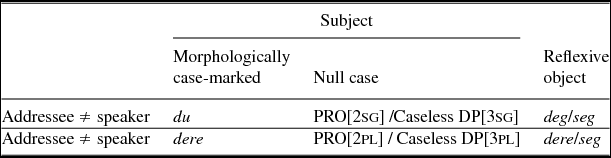
The imperative force in C assigns participants of the event, and the phonological realisation of their person values depends on whether they are pronounced or not. Table 2 summarises the person features for both imperatives and prescriptive infinitives.
Assignment of person to the subject and object arguments of finite imperatives and prescriptive infinitives.
6.3 Infinitives, future tense and context roles
It has been discussed in the literature whether infinitives have tense and in what way. Wurmbrand (Reference Wurmbrand2014) argues that infinitives do not have tense, even the type that has usually been called (from Stowell Reference Stowell1982 to Landau Reference Landau1999, Reference Landau2000) future irrealis infinitive, (89a), in contrast to the propositional (89b):
-
(89)
-
a. Leo decided to read a book.
-
b. Leo believes Julia to be a princess.
(Wurmbrand Reference Wurmbrand2014:404)
-
The future infinitive has been held to have the following characteristics: It has tense, controlled subject, null case, episodic interpretation. Landau also adds agreement to this list. The infinitives that are tenseless from a traditional point of view, have ECM subjects, and cannot have episodic interpretation.
Wurmbrand shows (Reference Wurmbrand2014:410) that it is wrong to assume that there is a built in future tense in the future infinitives, since it is possible to use them for past events, as in (90a), contrasting with the finite clause in (90b). This shows that infinitives have relative tense, while finite verbs have an absolute tense.
-
(90)
-
a. Leo decided a week ago to go to the party yesterday.
-
b. Leo decided a week ago that he will go to the party (*yesterday).
(Wurmbrand Reference Wurmbrand2014: 411)
-
Wurmbrand suggests, following Abusch (Reference Abusch1985, Reference Abusch and Borer1988), that future is a composite category, involving a future modal woll. This way the tense of infinitives can be relative, as we have seen they are – note past tense in (90a). In (91) below, the difference between finite and non-finite future is depicted. Note the absence of the TP projection in the non-finite future.
-
(91)

Unlike other infinitives, prescriptive infinitives (and the imperatives) refer to an absolute future. Wurmbrand (Reference Wurmbrand2014) does not discuss imperatives or prescriptive infinitives. However, imperatives must be finite, and must have an absolute, not relative, future. But finite imperatives cannot have a morphological merger of T[pres] and woll into will, as she proposes. Her idea is well suited for declarative finite clauses, where this merger can actually be spelt out as will in sentences like (90b). It seems less suitable as an analysis of a sentence type like imperatives, which are never spelt out with a modal verb. A possible suggestion is that [+fut] is a feature in T. Abusch's (Reference Abusch, Gueron and Lecarme2004) proposal is semantically rendered as λPλtP(t, ∞), i.e. a point in time unconstrained from time t. Given that imperatives have absolute future, and that child-directed prescriptive infinitives in addition to this have a rather immediate scope, the present author suggests that [+fut] is rendered as a special case of Abusch: λP.P(now, straight after).Footnote 19
The prescriptive infinitive is derived in a similar way, but without a finiteness feature, and hence nothing that makes this into anything other than an infinitive, albeit with imperative force.
In the present proposal, the category TP is where tense resides and is an anchoring category, with Ritter & Wiltchko (Reference Ritter and Wiltschko2014:1334). The tree in (92), proposed by the present author, is actually the same as their syntactic spine, with the difference that their label is IP rather than TP, which reflects the main argument of their paper; that IP is a very general category that can be instantiated by different language-specific, deictic anchoring contents such as tense, location or participant. In the present proposal it is the imperative force in C that is responsible for the future tense in T, which is very similar to Ritter & Wiltchko (Reference Ritter and Wiltschko2014:1369–1370), who posit that T is valued as [+coincidence] (the event situation coincides with the plan set). The roles of speaker, addressee and performer in (92)–(93) are represented by A, B and C, respectively, following Alcázar & Saltarelli (Reference Alcázar and Saltarelli2014). Notice that it is significant in the present proposal that A and B are not specified as being a particular person (unlike Alcázar & Saltarelli, who posit that A is encoded as 1sg and B as 2sg/2pl, see (86) above). B is usually the same as C, but there are some verbs in which the performer is somebody else, like the Norwegian verb få ‘receive’, see example (11) above, Section 3.1.1, in which the one who receives (= C) is the speaker (= A).
-
(92)

Ritter & Wiltchko (Reference Ritter and Wiltschko2014:1351–1354) take infinitives to be tenseless and to get their tense from the predicate above. With a feature [+coincidence], the IP of infinitives gets the same tense as the predicate above, while with a [–coincidence] feature, the infinitive must be interpreted as future, see also Wurmbrand's (Reference Wurmbrand2014) account. This is different from the present proposal, in which the future tense in T is determined by the imperative force in C, just as with finite imperatives.
-
(93)

The finite imperative resides in C, while the infinitive verb resides in T. This explains most of the word order facts as well: Infinitives have categories like adverbs and subjects to their left, while imperatives have these categories to their right.
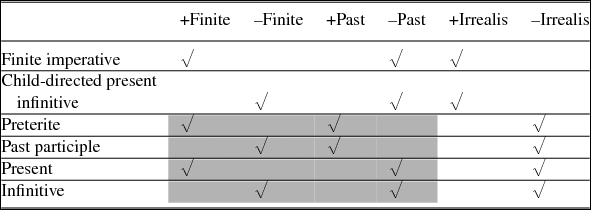
Eide (Reference Eide, Alexiadou, Hankamer, McFadden, Nuger and Schäfer2009, Reference Eide2011, Reference Eide2016) has developed a classification of Norwegian verb forms according to the minimal features they contain. These are [± Finiteness] and [±Tense]. It seems that [±Irrealis] should be added to this set of features. The irrealis feature in the grammar of Norwegian has been pointed out in recent years by Sandøy (Reference Sandøy1991), Dørum (Reference Dørum2000), Julien (Reference Julien2003) and Eide (Reference Eide2011). The [+Irrealis] feature typically reflects hypothetical or counterfactual meanings, and it has been shown by the authors mentioned that these are morphologically encoded, even in modern Norwegian, which no longer has a fully productive subjunctive. [±Irrealis] is also a category that could be used to unify the two directive types imperatives and prescriptive infinitives. Neither can be used to ascertain that something has actually happened or is actually the case. Rather, they are expressions that contain some uncertainty as to whether the desired event will ever take place. The matrix of Norwegian verb features is thus proposed to be as Table 3.
Expanded table of feature distinctions for verbs. (The original distinctions from Eide (Reference Eide, Alexiadou, Hankamer, McFadden, Nuger and Schäfer2009, Reference Eide2011, Reference Eide2016) are shown here in the shaded cells.)
6.4 Word order: The position of negation and subject
As seen in Section 3 (and partly in Sections 4 and 5) above, prescriptive infinitives only have pre-verbal negation, while inflected imperatives have post-verbal negation (though Norwegian also has pre-verbal negation). This implies that finite imperatives move further, possibly to C, due to their finiteness feature. This way they move past the position of negation (adjoined to TP), see Zanuttini (Reference Zanuttini, Belletti and Rizzi1996), Platzack & Rosengren (Reference Platzack and Rosengren1998:213) and Lindstad (Reference Lindstad2007:Chapter 5). Prescriptive infinitives, being non-finite, do not move, and thus the negation ends up being pre-verbal. When Norwegian finite imperatives can also have pre-verbal negation, it may be because they can go to the general topic position of the clause; [Spec, CP]. It is not clear why the other Scandinavian finite imperatives cannot also have a topicalised negation in [Spec, CP]. However, it is known that Norwegian generally allows negation in this position, also in declaratives, not just imperatives.
The same general movement can be assumed to explain the position of the subject: The finite verb moves past it, while the non-finite prescriptive infinitive stays in situ.
7. CONCLUSION
The paper describes a hitherto largely unknown, full set of prescriptive infinitives in all the five North Germanic languages (Danish, Faroese, Icelandic, Norwegian, and Swedish). These infinitives exist side by side with the well-known imperatives. They differ from finite imperative constructions in a number of ways syntactically, by having (i) pre-verbal, not post-verbal, negation; (ii) pre-verbal, not post-verbal, subjects; (iii) third, not second, person subjects; and (iv) lexical DP, not pronominal, subjects. They also have special pragmatics, in that they can mainly be used in a hierarchical social context in which there is a nice and amiable atmosphere, typically parents towards very young children.
A number of theoretical implications have been suggested. The child-directed prescriptive infinitive is a CP, but with no finiteness, unlike ordinary imperatives. This accounts for all the syntactic differences between the finite imperative and the prescriptive infinitive. The account builds on insights from Sigurðsson (Reference Sigurðsson, Bianchi and Safir2004, Reference Sigurðsson2014), Collins & Postal (Reference Collins and Postal.2012), Alcázar & Saltarelli (Reference Alcázar and Saltarelli2014), Ritter & Wiltschko (Reference Ritter and Wiltschko2014) and Wurmbrandt (Reference Wurmbrand2014).
Since all five North Germanic languages have the child-directed prescriptive infinitive, the null hypothesis is that it originated before the languages split, i.e. before ad 500. Otherwise, an unlikely process of innovation and spread would have to be accounted for. It is therefore argued that the prescriptive infinitive is a category that has existed for more than 1500 years, though its existence and especially its grammatical and pragmatic characteristics in a common North Germanic perspective have gone mostly unnoticed.
ACKNOWLEDGEMENTS
I am grateful to the participants at Grammatik i fokus 2013 at Lund University, especially Lars-Olof Delsing, Verner Egeland, Elisabet Engdahl, Gunlög Josefsson, Ida Larsson, Johanna Prytz and Anna-Lena Wiklund for providing information on Swedish. I am also grateful for helpful comments by the participants at the 25th Scandinavian Conference of Linguistics 2013 at University of Iceland, especially Eefje Boef, Piotr Garbacz, Hans-Martin Gärtner, Marit Julien and Rafaella Zanuttini, and by the participants at the Norwegian linguistics conference MONS 15, University of Oslo, 2013. I would also like to thank the participants at the Forum for Theoretical Linguistics at the University of Oslo, February 2015, for valuable feedback: Silje Alvestad, Atle Grønn, Kjersti Kola, Signe Laake, Per Erik Solberg, Bror Sviland Strand, Kjell Johan Sæbø, Ingebjørg Tonne, Urd Vindenes and Arnfinn Muruvik Vonen. I am also grateful to the audience at my guest lecture at the University of Cambridge in February 2015, especially: Theresa Biberauer, Tam Blaxter, Kari Kinn, Ian Roberts and Richard Stockwell. A number of other linguists have also provided information: Jan-Ola Östman on Finland Swedish; Thórhallur Eythórsson, Eiríkur Rögnvaldsson and Birna Arnbjörnsdóttir on Icelandic; Tanya Karoli Christensen and Karen Margrethe Pedersen on Danish; Arnstein Hjelde on the Norwegian Inntrøndelag dialect; Zakaris Svabo Hansen, Petra Eliassen and Hjalmar P. Petersen on Faroese; Lutz Edzard on German; Guri Bordal on French; and Paweł Kazimierz Urbanik on Polish. Special thanks are due to Professors Helge Lødrup and Ida Larsson, who provided detailed and constructive comments on an earlier version of this paper. Finally I would like to thank the three anonymous reviewers and NJL editor Marit Julien for valuable and insightful comments, and copy-editor Ewa Jaworska for her very thorough work and helpful suggestions. This work was partly supported by the Research Council of Norway through its Centres of Excellence funding scheme, project number 223265.


 Open access

