


Introduction
Referendums, while direct democratic instruments, are widely considered to be “embedded within the institutions of representative democracy” (Kriesi, Reference Kriesi2006: 600), with recent work arguing they are exercises of the latter outright, a way for voters to give direction to their representatives (Trueblood, Reference Trueblood2024). Moreover, there is ample evidence that they are largely controlled by political elites. In Europe, parties and politicians are frequently the initiators of referendums (Gherghina and Silagadze, Reference Gherghina and Silagadze2021), and even if these are citizen-initiated, elites can be instrumental in their organization by facilitating signature collection (Serdült and Welp, Reference Serdült and Welp2012). A large body of scholarly work argues that elites “instrumentalize” referendums, calling them strategically in order to achieve institutional, electoral, or policy goals (e.g., Bjørklund, Reference Bjørklund1982; Morel, Reference Morel, Mendelsohn and Parkin2001; Rahat, Reference Rahat, Setälä and Schiller2009; Hollander, Reference Hollander2019; Gherghina, Reference Gherghina2019a; Oppermann, Reference Oppermann2013). As such, while in theory designed to empower citizens (Gherghina, Reference Gherghina2019a: 687), referendums are frequently leveraged by parties to enhance their own competitive standing or undermine rivals.Footnote 1
However, the ways in which this strategic behavior regarding referendums unfolds during the subsequent campaigns has so far not received similar dedicated attention. Scholarship has noted the importance of referendum campaigns, suggesting that they are more influential than their electoral counterpart since referendums require voters to make binary decisions on complex issues in an often volatile information context (de Vreese and Semetko, Reference de Vreese and Semetko2004). Parties are argued to serve as key information providers here (Hartliński, Reference Hartliński2019), able to shape referendum outcomes by providing strong and clear cues that can influence voter decisions (see, for instance, Szczerbiak and Taggart, Reference Szczerbiak and Taggart2004; Silagadze and Gherghina, Reference Silagadze and Gherghina2018; McAllister and Biddle, Reference McAllister and Biddle2024). Additionally, referendum instrumentalization studies often hint at the critical role of campaigns in achieving the goals that motivated referendum initiation (Gherghina et al., Reference Gherghina2024), such as electoral benefits (Nemčok and Spáč, Reference Nemčok and Spáč2019; Stoychev and Tomova, Reference Stoychev and Tomova2019; Gherghina, Reference Gherghina2019b) or enhancing popularity and legitimacy of the party (Hollander, Reference Hollander2019; Gherghina, Reference Gherghina2019a).
Nevertheless, despite these works clearly suggesting the importance of referendum campaigns to parties, they also indicate that insights into how and why parties engage in this arena are fragmented at best. As such, there is a clear need for additional, dedicated attention to party behavior regarding referendum campaigns. This study looks to make a first step in bridging this gap by examining the extent of party engagement with referendum campaigns, from here on referred to as “campaign intensity,” through a political finance lens, i.e., the expenditure of parties in these campaigns. Existing perspectives on campaign finance in direct democratic contexts have largely been limited to the American case (see, for instance, Bowler et al., Reference Bowler1998; Gerber, Reference Gerber1999; Lupia and Matsusaka, Reference Lupia and Matsusaka2004). Comparative scholarship, meanwhile, has focused exclusively on referendum campaign finance regulations (Gilland Lutz and Hug, Reference Gilland Lutz and Hug2010; Reidy and Suiter, Reference Reidy and Suiter2015; Qvortrup, Reference Qvortrup2021; Paulissen and Horncastle, Reference Paulissen and Horncastle2024), with empirical research on the concrete financial behavior of political parties in these contexts solely pertaining to single-case studies (Ghaleigh, Reference Ghaleigh, Lutz and Hug2010; Paulissen and Maddens, Reference Paulissen and Maddens2023; Paulissen, Reference Paulissen2024). By attempting to uncover which factors might explain variation in campaign expenditure between different parties, referendums, and countries, we aim to foster our understanding of how parties look to leverage a referendum’s campaign for strategic purposes.
To address the theoretical and empirical gaps illustrated above, this study adopts a comparative political finance approach towards uncovering the determinants of party campaign intensity in referendums. Our focus is specifically on those parties that participate in referendum campaigns, leading to the following question: what factors drive the intensity of party campaign spending in European referendums? An analytical framework integrates theoretical insights from referendum instrumentalization and cognate literatures with empirical observations from campaign finance studies, identifying three potential strategic factors with corresponding hypotheses. We focus specifically on these factors as they allow us to theorize about the underlying motives they might indicate if found to be influential regarding party expenditure. In the methodology section, we also identify several contextual factors which are less strategic in nature but are equally expected to offer some explanatory power and are thus added as control variables in the analysis. We test hypotheses using a dataset of 108 individual observations of campaign spending dispersed over 47 parties participating in 24 referendum campaigns in eight countries. Influential factors are identified through bivariate and multivariate analyses, the latter consisting of a gamma regression with log link to account for the exponential distribution of the dependent variable.
The study proceeds by first outlining the analytical framework, after which we discuss our research design, highlighting our case selection, variable operationalization, and data analysis strategies. A third section presents our findings, which are coupled back to the analytical framework in the discussion. The conclusion reflects on the theoretical, methodological, and empirical implications of our analysis, as well as its limitations and how it might influence future research.
Instrumentalizing referendum campaigns
A substantial body of research has theorized about the strategic goals driving parties to initiate referendums (Bjørklund, Reference Bjørklund1982; Morel, Reference Morel, Mendelsohn and Parkin2001; Walker, Reference Walker2003; Qvortrup, Reference Qvortrup2006; Rahat, Reference Rahat, Setälä and Schiller2009; Oppermann, Reference Oppermann2013). Recently, these efforts have been synthesized into two frameworks that distinguish different analytical dimensions. Hollander (Reference Hollander2019) identifies act-contingent (conflict mediation, depoliticization, legitimization) and outcome-contingent motives (policy-seeking), depending on whether the referendum’s initiation or its outcome is of importance to the party. Gherghina (Reference Gherghina2019a) employs a two-dimensional framework, differentiating between policy vs. institutional goals and party-oriented (centripetal) vs opponent-oriented (centrifugal) action. Centripetal action aims to enhance the initiator’s position through agenda promotion and image building (policy) or resolving organizational challenges (institutional). Centrifugal action instead seeks favorable outcomes at the detriment of the initiator’s opponents. Electoral mobilization is then a policy goal, while creating deadlocks, bypassing institutions, or calling early elections are institutional.
Cultivating a presence in a referendum campaign has previously been recognized as a relevant avenue for policy-related goals, as the aforementioned research on referendum outcomes shows that strong and clear elite cues can play a decisive role. However, perspectives regarding the role of campaigns in achieving other strategic objectives, such as visibility, voter mobilization, electoral benefits, or conflict mediation, have been less explicit. For instance, parties arguably use referendums in order to take advantage of increased publicity and visibility (Gherghina, Reference Gherghina2019a: 682), offering smaller parties a way to also overcome organizational constraints and efficiently address and mobilize potential new supporters (as was the case in Latvia, see Møller, Reference Møller2002). In order to achieve this, we can assume that parties use the subsequent campaigns as platforms. Similarly, if referendums become election weapons, as is the case in Lithuania due to intense polarization and competition between two main parties (Møller, Reference Møller2002), their campaigns will likely become another arena where each will attempt to trump the other. Finally, parties might also look to minimize their presence if they aim to mediate conflict within a party/government coalition or depoliticize a controversial issue, like the Conservative Party in the 2016 Brexit referendum in the United Kingdom (Hollander, Reference Hollander2019: 190–192).
The literature thus clearly hints at the strategic importance of referendum campaigns to parties, as cultivating a strong presence can equally deliver strategic benefits that can go beyond the policy decision that is up for vote. The referendum instrumentalization lens can thus be helpful in achieving our research objective of explaining referendum campaign spending intensity by parties, which is argued to be a proxy for the extent to which a party wants to be present in a campaign. As such, the following framework will combine insights from this literature with observations from existing empirical studies to identify three strategic factors that might explain referendum campaign spending by parties: the referendum’s public salience, its overlap with elections, and who initiated the referendum. The factors, which are not considered as mutually exclusive, are accompanied by several corresponding hypotheses regarding their relation with party campaign spending. As mentioned in the introduction, these factors were selected because they provide indications of the underlying strategic motives driving party campaign expenditure if found influential, on which we will expand in more detail below.Footnote 2 Finally, we acknowledge that party campaign spending can equally be influenced by more contextual, less strategic factors such as spending limits, a referendum’s competitiveness, or party strength. These will be included as control variables in our analysis and discussed in more detail in the methodology section.
The first factor of our explanatory framework is thus a referendum’s public salience. Research suggests that voters care more about referendums when its salience in the public sphere is high, linking it to turnout (Gherghina et al., Reference Gherghina2019; Goldberg and Sciarini, Reference Goldberg and Sciarini2023). As such, voters will likely pay more attention to the campaigns of salient referendums, providing parties with opportunities for image building, agenda promotion, and voter mobilization. Early work on Ireland seemingly contradicts this argument by stating that referendums safeguard the party system from potentially divisive topics (Sinnott, Reference Sinnott2002; Reidy, Reference Reidy, Browne and Calkin2020), implying limited activity in their campaigns. However, contemporary empirical work suggests that parties are sensitive to the aforementioned benefits as they campaign more intensely in salient referendums (Paulissen, Reference Paulissen2024). Additional evidence regarding more intense campaigning by parties in the salient Scottish independence and Brexit referendums in the UK (Paulissen and Maddens, Reference Paulissen and Maddens2023) provides further reasoning to expect a favoring effect of public salience. However, causality might be reversed as intense campaigns might drive salience instead of vice versa (as noted by Paulissen, Reference Paulissen2024), necessitating careful analysis when testing H1:
Hypothesis 1: High public attention for a referendum favors party campaign spending intensity.
A second potential factor is whether the referendum coincides with an election, i.e., electoral overlap. Parties generally initiate referendums with the concrete goal of influencing consequent elections (Nemčok and Spáč, Reference Nemčok and Spáč2019; Stoychev and Tomova, Reference Stoychev and Tomova2019; Musiał-Karg and Casal Bértoa, Reference Musiał-Karg and Casal Bértoa2025) and have been argued to intentionally create electoral overlap so that the referendum can act as a “direct political advertisement” for the initiating party (Gherghina, Reference Gherghina2019b: 795). Such an overlap may then favor campaign spending intensity as parties may achieve direct electoral benefits by profiling themselves in the referendum campaign, something that has previously been found with regards to the American context (Smith and Tolbert, Reference Smith and Tolbert2001: 753). It also allows joint campaigns, i.e., concurrent messaging for the referendum and the election. This would reduce the overall organizational and opportunity costs as parties can link the referendum campaign to their electoral campaign and vice versa. Without overlap, a joint campaign is not possible, and voters may disengage by the time the next elections come around. H2 is thus as follows:
Hypothesis 2: A referendum overlapping with an election favors party campaign spending intensity.
The type of election will likely determine the extent to which electoral overlap favors campaign spending intensity; for instance, previous research suggests that European elections are “second order elections” for parties when compared to general elections as they spend more in the latter (Petithomme, Reference Petithomme2010), regardless of their size (Bartels, Reference Bartels2023). However, testing for this goes beyond the scope of this study due to issues with our sample, as will be discussed in the methodology.
The final strategic variable considers who initiated the referendum. If a specific party was involved in the initiation of a referendum, they might have done so to mediate conflict within its organization/government coalition or with its supporter base, likely resulting in low campaign intensity (as discussed above). However, in general, there are many compelling reasons for a referendum’s initiator to cultivate a strong campaign presence. For one, it can contribute to the successful outcome of a referendum, particularly if there exists a large parliamentary majority supporting the referendum (Silagadze and Gherghina, Reference Silagadze and Gherghina2018). For governing parties, it could establish them as the referendum’s owner, in which case a successful outcome can be linked to their merit and amplify their popularity (de Vreese and Semetko, Reference de Vreese and Semetko2004). This effect might be exacerbated when there is also electoral overlap and additional electoral benefits come into play, as was the case for the Polish 2023 referendum. This was intentionally initiated and organized concurrently with general elections by the ruling party in an attempt to “boost electoral support” (Musiał-Karg and Casal Bértoa, Reference Musiał-Karg and Casal Bértoa2025: 8) and was followed by heavy campaigning by said party. As such, we can formulate the following hypotheses:
Hypothesis 3a: A party being involved in the initiation of a referendum favors campaign spending intensity by that party.
Hypothesis 3b: The favoring effect of a party being involved in the initiation of a referendum on its campaign spending intensity is amplified if the referendum also overlaps with an election.
We argue that the behavior of non-initiating parties is then dependent on whether or not other parties were involved in the referendum’s initiation. This follows Hollander (Reference Hollander2019: 43–44), who posited it as a key criteria to classify referendums from an instrumentalization perspective as it determines who holds control over their processes and thus the decision-making. Political elites hold this power in legislative (triggered by parliament) and presidential referendums, as well as in some constitutionally mandatory referendums that allow for elites “to control the triggering process indirectly through the setting of the agenda and through interpretation of the constitution” (Ibid.). In other mandatory referendums, as well as those initiated by citizens or other actors, the power lies outside of these elites. Thus, when a referendum is initiated by other parties, non-initiators are likely aware of the strategic gains those initiators seek to achieve. They will consequently invest more in their campaigns due to reluctance to let the initiators dominate the campaign uncontested, as doing so could weaken their relative standing in the political arena. If non-party actors such as citizens or interest groups initiate a referendum, or the referendum was mandatory without indirect initiation by parties, instead, such considerations are likely absent. Additionally, if a party claims ownership of a referendum but loses the vote, it is detrimental to that party’s image (de Vreese, Reference de Vreese2006), which might incentivize strong campaign efforts by other parties in order to steer the vote away from the outcome desired by the initiator. Our final hypothesis is thus as follows:
Hypothesis 3c : A referendum triggered by parties favors campaign spending intensity by non-initiating parties.
Methodology
Our study focuses on referendum campaign expenditure by political parties from European countries, focusing solely on those parties that display non-zero spending. We use a convenience sampling approach for case selection to maximize observations, acknowledging that this makes generalization to all European parties and referendums impossible. Yet, systematic and comparative studies on the strategic behavior of parties regarding referendum campaigns are lacking, meaning that the field is thus in need of initial insights that can be further fine-tuned with later efforts. Additionally, our sample consists of a considerable amount of high-profile referendums while also offering variation in terms of political systems and referendum traditions. We therefore argue that our approach is justified.
First, we identified European countries that had organized national referendums between 1994 and 2024. For this exercise, we consider “referendums” as all direct democratic instruments that require the electorate to vote on a specific question/legislation/policy decision. This includes constitutionally mandated as well as optional referendums that are elite- or citizen-initiated. Next, we identified eight countries with official data available on referendum campaign expenditure by political parties: Denmark, France, Ireland, the Netherlands, Portugal, Romania, Slovenia, and the UK. A notable exclusion here is Switzerland, often referred to as a “semi-direct democracy” (Serdült, Reference Serdült and Qvortrup2024: 200) since it combines a representative party system with by far the most extensive referendum tradition in the world (Brüggemann et al., Reference Brüggemann2024). Yet, this means that its inclusion in a comparative analysis would lead to severe distortion due to the high number of referendums it introduces. Furthermore, there is very little official data available on how much parties spend in referendum campaigns (Swiss Federal Audit Office, n.d.). In total, our sample covers 24 referendums in which at least one party made campaign expenditure according to official data. If concurrent referendum questions overlap thematically, such as in the 2019 Romanian referendum which posed two questions on judiciary reform, the questions are considered as a single referendum. If coinciding questions do not have thematic overlap, they are treated as separate referendums (in line with Silagadze and Gherghina, Reference Silagadze and Gherghina2018), as was the case for the 2022 and 2024 Slovenian referendums, which were both split up into three individual cases. However, there exists the possibility that these coinciding questions are not perceived as inherently different by parties and/or the wider public, thus risking artificial inflation of our sample size. An additional robustness test treating these instances as one referendum will therefore be included in the analysis. The resulting dataset includes 47 parties with non-zero expenditure and 108 observations regarding campaign spending intensity. A schematic overview of our final sample is included in the online Supplementary Materials.Footnote 3
Dependent variable
Our dependent variable consists of officially disclosed expenditure data. It is worth noting that this is possibly an indication/approximation of actual party spending in the respective referendum campaigns. Dark money, i.e., undisclosed campaign-related spending, is a universal issue for democracy (see, for instance, Torres-Spelliscy, Reference Torres-Spelliscy2017; Geoghegan, Reference Geoghegan2020) resulting from campaigners circumventing expenditure limits or disclosure legislation or otherwise passing it through other organizations. As such, the reported amounts might not offer a completely accurate picture, and it is difficult to mitigate these issues as firsthand data (e.g., bank account statements) are not available. However, we follow Scarrow’s (Reference Scarrow2007: 206) argument that when it comes to comparing expenditure amounts, “big differences may be more important than details”: reported amounts are likely proportional to actual spending and thereby still a reliable indicator of campaign intensity.
To ensure comparability over time and across countries, we address variations in inflation, currencies, and electorate sizes by transforming expenditure amounts into Nassmacher’s (Reference Nassmacher2009) Index of Political Spending (IPS) using the following formula:

Expenditure is divided by electorate size to create a relative measure (expenditure per voter). The denominator sees GDP/capita (expressed in the local currency) divided by 2000 (based on 50 yearly working weeks with 40 working hours each), thus representing hourly rates of national income per average person. For the GDP/capita numbers, we used the data from the year before the referendum as provided by the World Bank Group Open Data repository, which allows for an expression in current local currency. In the case of Portugal’s referendum in 1998, the original expenditure data were first converted into euros using the conversion rate as originally set by the European Council (n.d.).
Independent & control variables
Public salience is measured using Google Trends data, which provides interest scores from 0 to 100 to indicate the popularity of specific search terms over certain periods in a specific country/region. 100 indicates the day a specific term was the most popular in the requested period and area in terms of the absolute number of searches. Other days are scored relative to how popular the term was in relation to the aforementioned peak (Google News Initiative, n.d.). For each referendum, the average score for the 30 days preceding (but excluding) the polling date is calculated using the 2016 Brexit referendum in the UK as a benchmark to make the results comparable. Additional information can be found in the Supplementary Materials.Footnote 4
Electoral overlap is operationalized as a binary variable indicating whether or not a referendum was organized within a month from a subsequent general, European, or local election. None of the referendums overlapped with a presidential election. While testing for effect variation between the different election types would have been preferred, our sample does not allow for that as it would require a dummy variable for each type. In the case of overlap with a general election, this would have been imbalanced, with only six out of 108 cases taking a positive value, preventing reliable model estimation. Instead, we cluster the categories together to establish an effect of electoral overlap at large and perform a robustness test with the dummy variables to estimate whether one type of election might show different results.
Finally, the initiator of the referendum is identified using two dummy variables, a first one indicating whether or not the party in question was involved in the initiation of a referendum. The second one identifies whether a party was a non-initiator, but other parties were involved instead. In both cases, we look specifically at whether party leadership was involved. This is particularly relevant for the Dutch 2005 referendum on the EU constitution, which was the result of a bill presented by three individual MPs from Green Left, Labour Party and Democrats’66 respectively. However, there is no evidence that this was driven by party leadership and as such, we do not code the latter two parties as initiators in this case (Green Left is excluded from the dataset as it did not report any spending).
As mentioned before, our study also controls for additional contextual variables. Firstly, studies on electoral contexts have already established that expenditure limits can affect campaign spending (García Viñuela and Caselles, Reference García Viñuela and Caselles2008). In referendum campaigns, we can generally anticipate a similar constraining effect, although Paulissen and Maddens (Reference Paulissen and Maddens2023) previously showed that this was not the case in UK referendums. The variable is operationalized as a binary predictor indicating whether their existed spending limits for the referendum campaign, based on data collected by Paulissen and Horncastle (Reference Paulissen and Horncastle2024). We decide against including the exact expenditure limit in statistical analyses for availability reasons; instead, additional attention is paid to this during the discussion.
On the level of the referendum, we control for the competitiveness of a referendum, i.e., the extent to which it can be deemed as a close vote or not. Opinion polls make it easy for parties to understand the competitiveness of a referendum, and when close races are apparent, they will make the incentive to invest larger for both sides; losing parties will arguably feel that they can flip the vote in their favor, while the winning side will likely feel the pressure of holding on to a slim/dwindling lead (Paulissen and Maddens, Reference Paulissen and Maddens2023: 30). However, creating a comparative, cross-national measure that incorporates opinion poll data is difficult, as it would entail using a variety of different sources with individual methodologies, which significantly decreases their comparability. Nevertheless, controlling for this factor is important as it mitigates an endogeneity problem, i.e., the fact that spending levels can heavily depend on the expected outcome of a vote (see, for instance, Stratmann, Reference Stratmann2006; de Figueiredo et al., Reference de Figueiredo2011; Jaquet et al., Reference Jaquet2021). We therefore use the percentage-point difference in votes for the two sides of a referendum in its final result as a proxy for its competitiveness, even though this is likely not the most accurate reflection of the image parties had of the referendum’s closeness during the campaign.
Finally, we control for party-level factors that determine their ability to overcome the costs that come with high campaign spending. Those could take the shape of opportunity costs, i.e., the financial costs of propaganda materials or advertising, as well as personnel costs, i.e., staff that is occupied with creating this material as well as campaigning strategies. “Stronger” parties are likely to be better equipped to overcome these costs, and we therefore control for three additional variables that can indicate the strength of the party at the time of the referendum, i.e., seat share, party age and incumbency. In the case of party age, if the party is the result of (several) merger(s) between parties, we go back until we find the oldest relative party (i.e., with seats in national parliament) and use their founding date to calculate the age of the party at the time of the referendum. We initially also set out to control for the financial resources available to parties, operationalizing it as the revenue of the party in the year prior to the referendum as it appears in their financial reports. However, this introduced additional missing values in the dataset, even if we replaced it with data from the year of the referendum itself, and therefore chose not to include it in the analysis.Footnote 5
Data analysis
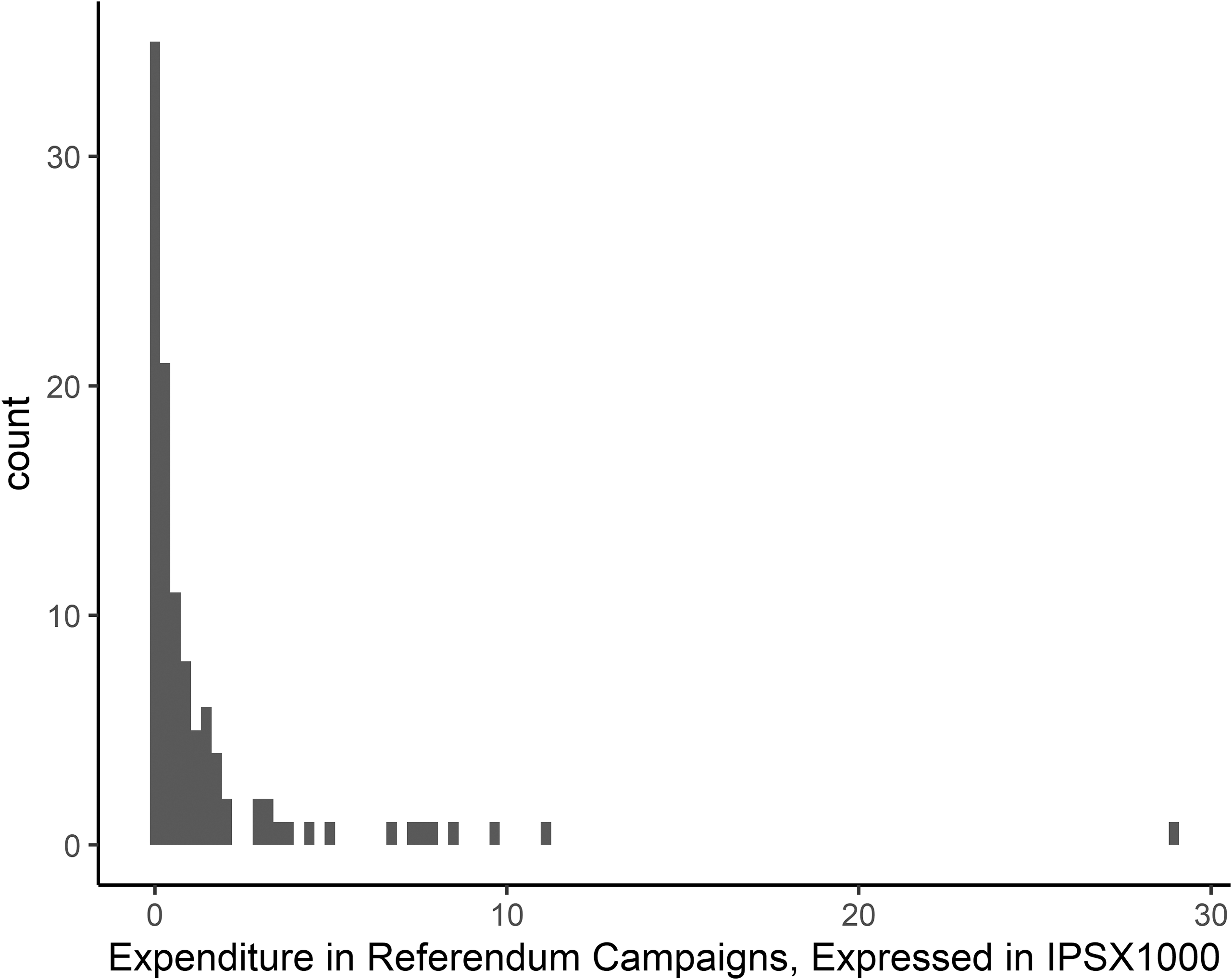
Figure 1, which is expressed in IPSX1000 for clarity, shows that our dependent variable is exponentially distributed, i.e., positively skewing with a long right-hand tail. A single clear outlier can be determined here, which is the PS in the 1998 regionalization referendum in Portugal (28.9 IPSX1000). In our analyses, this case will therefore be excluded. All analyses and diagnostics are done in RStudio (version 2024.09.1 + 394), with codebook and outcomes available in the Supplementary Materials.Footnote 6 Continuous independent variables are first transformed by their natural log to deal with non-normality and then grand-mean centered. For the measure of public salience, this involves first adding .0001 to all values in the variable to deal with zeroes before log transformation. Our analysis consists of a bivariate and a multivariate part, with the former consisting of the Mann-Whitney U test for binary predictors and calculating Spearman’s rank correlation for continuous predictors, as normality was not met for any correlation test. For the bivariate part, the outcome variable is log-transformed. Concerning the multivariate analysis, because Figure 1 shows exponential distribution even when disregarding the outlier, while all values of the dependent variable are positive, and a priori testing shows that variance tends to increase alongside its mean, we use gamma regression modeling with log link to estimate the effect of our predictors on party campaign spending intensity.
Distribution of referendum campaign expenditure by political parties with non-zero spending (N = 108).
Note: No zero-expenditure data points are present; apparent zeroes result from binning many near-zero values.

An additional point to make is that our data clearly show a hierarchical structure (107 party spending amounts nested into 24 referendum campaigns nested into eight countries), but the amount of observations on the highest level is too low for standard multilevel modeling approaches. While small sample risks could be mitigated through Restricted Maximum Likelihood combined with a Kenward-Roger correction, a gamma regression is a generalized linear model. To use a multilevel estimation procedure in such a model, either a larger sample size or the use of a Taylor series expansion, which is known to be biased, is needed (Hox and McNeish, Reference Hox, McNeish, Van de Schoot and Miočević2020: 219). Instead, we consider the factors on the different levels as proxies for that level, while the outcome variable, i.e., expenditure expressed in IPS, also controls for country-level variation regarding electorate size and GDP/capita. This decision is further justified since including country- or referendum-level fixed effects through a categorical variable leads to high variance inflation factors (VIF), indicating multicollinearity (>5).Footnote 7
The final models partly excluded the party incumbency variable due to convergence issues. Based on VIF, no multicollinearity problems arose in the final models (all <5), while none of the observations breached Cook’s distance and could therefore be considered as influential/outliers. Finally, diagnostic checks vis-à-vis the gamma regression models suggest they are generally well-specified, further confirming that gamma regression models with log-link is appropriate in this case. Specifically, the Pearson correlation between fitted values and residuals is close to zero, indicating no major pattern left in the residuals, while Pregibon’s link test shows no significant association between the squared predicted values and the observed expenditures, suggesting that the log link is appropriate. Finally, in terms of the Akaike Information Criterion (AIC), the gamma regression models performed much better than alternative (i.e., lognormal linear regression) models.
Results
Before turning to the bivariate and multivariate statistical models explaining party campaign spending intensity in referendums, we discuss some descriptive statistics. Figure 2 shows total expenditure per referendum, expressed in IPSX1000 for clarity. In total, campaign expenditures for all the referendums add up to 163.42 IPSX1000, almost a third of which is accounted for by the Portuguese 1998 referendum on regionalization with 48.41 IPSX1000. The second highest total expenditure occurred in the Romanian 2012 referendum (24.48), followed by the Portuguese 2007 abortion referendum (22.42), the 2016 Brexit referendum in the UK (15.17) and the French 2005 EU constitution referendum (9.62). At least three of the five outliers make sense at first glance. For one, the 2016 Brexit referendum in the UK and the French vote on the EU constitution in 2005 were two of the most high-profile referendums in recent memory, taking place in countries with divided electorates regarding European integration. As such, these likely created a fertile ground for intense competition among parties. Similarly, the Romanian referendum on the removal of president Traian Băsescu in 2012 can arguably be put on the same level as a presidential election, which generally see much higher turnout than parliamentary elections, even though the role itself is mainly decorative (Gherghina and Miscoiu, Reference Gherghina and Miscoiu2013). As such, it provided large incentives for the party supporting Băsescu, the Democratic Liberal Party,Footnote 8 to become the biggest spender with 9.69 IPSX1000. The other two large parties in Romania at the time, being the Social Democratic Party and the National Liberal Party, initiated the impeachment procedure and were the only other spenders in the campaign, with 6.85 and 7.94 IPSX1000 respectively.
Total campaign spending per referendum (N = 24), Expressed in IPSX1000.

The Portuguese referendums are more difficult to explain. For one, the 1998 regionalization and 2007 Abortion votes had six and five parties participating respectively, while the average number of parties participating per referendum in our sample lies just above four. In other words, there was not a disproportionately high number of parties active in the campaigns. Additionally, not all votes in Portugal lead to such high expenditures, as the 1998 abortion referendum only totaled 2.64 IPSX1000. The high expenditures in the 1998 regionalization and 2007 abortion votes might be the result of a “get out the vote”-campaign in response to the low turnout of 32% in the 1998 abortion referendum. This caused the result to be invalid (Freire and Baum, Reference Freire and Baum2003: 137), and with the regionalization vote being organized five months later, parties in favor might have increased their campaign intensity in order to avoid the certain loss another invalid referendum would represent (in which they were eventually unsuccessful, as turnout increased but only to 48%). Parties on the opposing side, in turn, might have responded to this to prevent the campaign being solely dominated by voices in favor of the referendum. In 2007, parties were further removed from the initial vote in 1998, potentially reducing the sense of urgency, which could have resulted in the relatively lower expenditures vis-à-vis the regionalization vote.
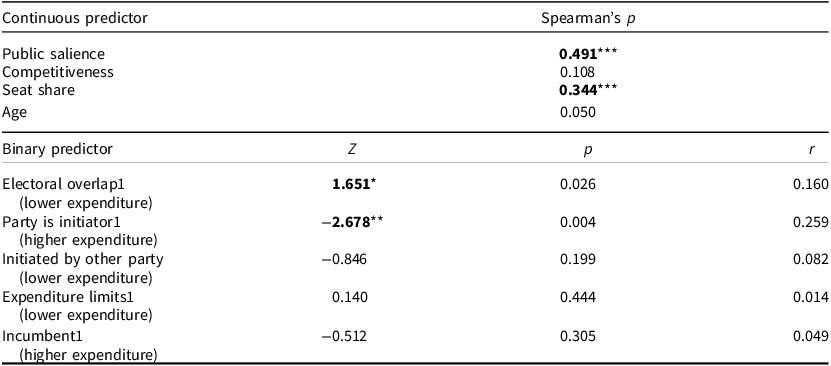
The total spending levels presented in Figure 2 inevitably conceal substantial differences between individual parties. Parties in our sample spend 0.83 IPSX1000 on average, and in what follows, we present the results of our bivariate and multivariate analyses, which are then further interpreted in the discussion. Table 1 shows the bivariate relationships of party campaign spending with our predictors. In line with H1, public salience of a referendum tends to correlate positively with campaign spending intensity. Regarding the control variables, parties with higher seat shares tend to spend more in referendum campaigns, as expected, while referendum competitiveness and party age show only a minor and non-significant correlation. Table 1 also displays the results of Mann-Whitney U tests for binary predictors. The direction of each tested relationship, indicated in parentheses, aligns with hypothesized/expected effects unless p was >0.95, reflecting a significant correlation in the opposite direction. The rank-biserial correlation provides effect sizes ranging from –1 to 1. The results indicate that party campaign spending intensity in referendums goes down where there is a concurrent election, contradicting H2. In contrast, H3a finds support as referendum initiators are more active in their consequent campaigns, but the same cannot be said of H3c as non-initiators do not spend more if the referendum is initiated by other parties. Finally, no significant correlation exists regarding expenditure limits or incumbent parties.
Results of bivariate analyses - Spearman rank correlation tests for continuous predictors, Mann-Whitney U tests for binary predictors

Note: Significant Z-value indicates that observations coded as 1 for the variable has significantly higher/lower median expenditure than observations coded as 0 (tested direction in parentheses). r indicates effect size as rank-biserial correlation.
*p < 0.05; **p < 0.01; ***p < 0.001.
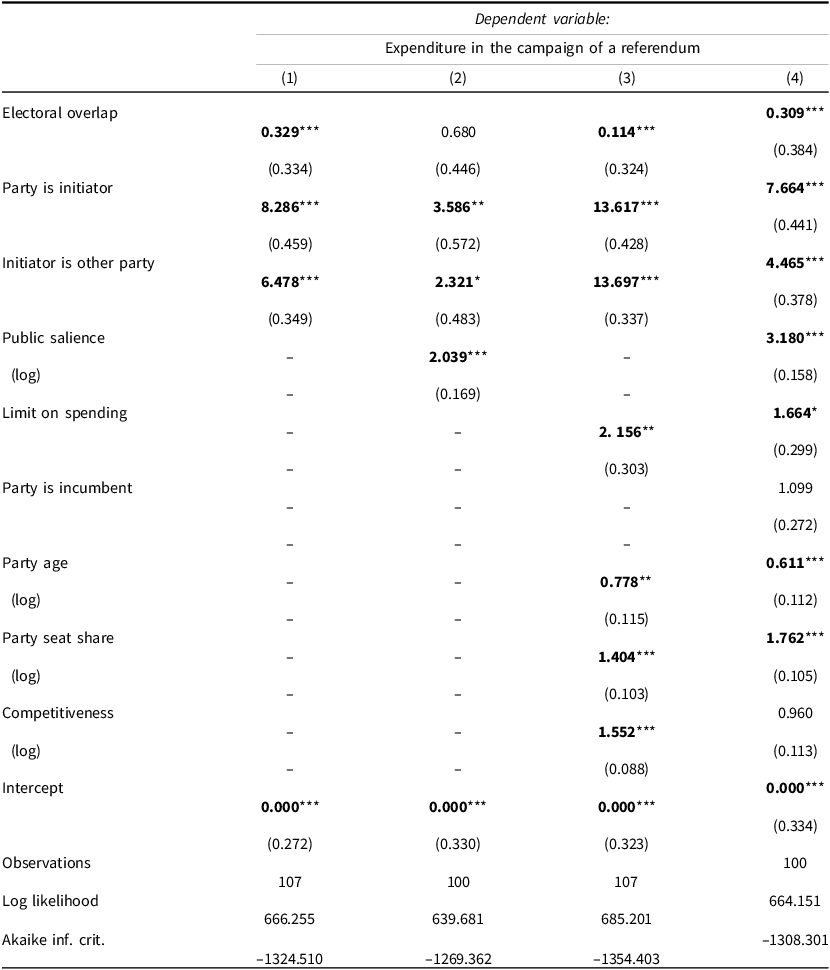
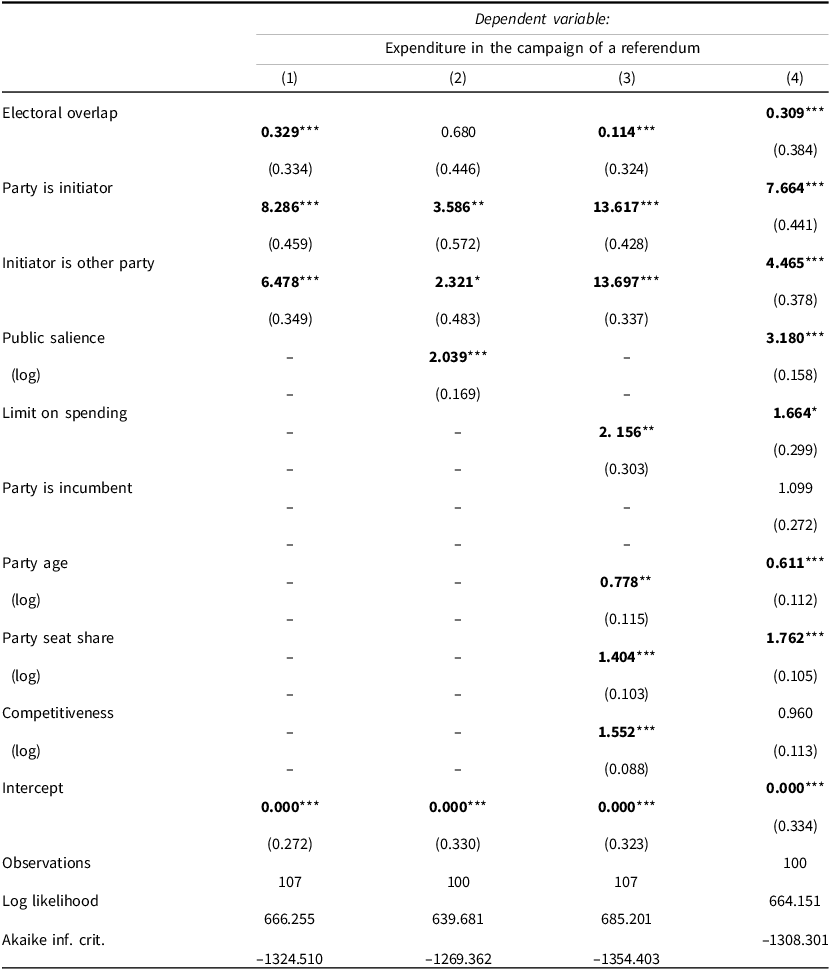
To examine whether the factors can then actually explain party campaign spending intensity, Table 2 shows the results of the multivariate gamma regression model with log link. Each coefficient represents a multiplicative effect on expected expenditure, or the factor by which the expected mean expenditure changes for a one-unit increase in the corresponding predictor. Model (1) includes only complete predictors, model (2) introduces public salience, and models (3) and (4) include control variables. With the limited sample size (N ≤ 107), significance is interpreted as p < 0.1. Based on the AIC, including controls improves model fit, but the introduction of public salience introduces noise by reducing the sample size due to missing values. Specifically, the 1998 Portuguese referendums are omitted from the analysis, and in particular the regionalization referendum, which had exceptionally high expenditures, affects observed patterns.
Results of Gamma regression (log-link) predicting party campaign expenditures if non-zero
Note: Coefficients indicate multiplicative changes in the means (standard error in brackets).
*p < 0.1; **p < 0.05; ***p < 0.01.
Despite the noise it introduces, public salience emerges as a significant determinant of campaign spending, with parties spending more on average the higher the salience of the referendum in the public sphere, supporting H1. The aforementioned reverse causality problem warrants attention here, as it is unclear whether public salience influences expenditure or vice versa. As a robustness test, we recalculate the public salience variable based on a modified timeframe (60 to 30 days before the referendum), arguing that parties are unlikely to be very active in this period and thus the public salience should be unaffected by party campaigning. A gamma regression with the new variable yields similar results (higher public salience in this period leads to higher expenditure on average), and while not offering conclusive evidence, it further hints at public salience affecting expenditure as expected, instead of the other way around.Footnote 9
Additionally, the estimated effect of a party being an initiator on campaign expenditure is consistently significant and positive across all models, suggesting a potential association in line with H3a. We find a similar but less strong effect for non-initiators when the referendum is initiated by other parties, which is in line with H3c. Next, we find no support for H2 regarding electoral overlap; instead, the findings suggest it is a limiting factor, resulting in significantly lower spending on average in almost every model. This result persists when we take into account different types of elections, as all types consistently displayed negative effects in the robustness test.Footnote 10 The controls further highlight the apparent inefficiency of expenditure limits, with systems imposing them seeing significantly higher spending. Additionally, younger parties seem to spend more on average, and the same is true for parties with a higher seat share. Regarding H3b, no consistently significant interaction effect was found in cases where a party initiating a referendum concurrent with an election.Footnote 11 Finally, an additional robustness test was performed in which multiple referendum questions occurring at the same time were treated as a single referendum, but results were not meaningfully different.Footnote 12
Discussion
The results presented above firstly indicate that the parties in our sample campaign spent more intensely on average when a referendum receives significant public attention, supporting H1. Among the five referendums with the highest overall campaign expenditure (see Figure 2), four have above-average public salience (i.e., an average Google Trends interest score higher than 9.4), the one exception being the 1998 Portuguese regionalization referendum for which we have no data. A within-country comparison further compounds this finding: the UK Brexit referendum had the highest salience score in our sample, and almost all parties participated quite intensely, with Labour spending over 7 IPSX1000 while the Liberal Democrats, UKIP and the Conservatives each spent at least 1 IPSX1000. In contrast, the 2011 AV referendum was among the least salient referendums and saw limited participation, with only the Conservatives barely exceeding 1 IPSX1000 in spending. Additionally, there are strong effects indicating that parties who initiate referendums tend to campaign more intensely on average, in line with H3a, and that non-initiators invest more when the referendum is triggered by parties compared to those initiated by non-parties, which confirms H3c. A descriptive examination reveals that 12 of the 19 referendums initiated by parties (or 11 of the 15 if coinciding questions are treated as a singular referendum) show at least one initiator amongst the highest spenders (Denmark 2022, France 2005, all three Irish referendums, Portugal 1998 regionalization and 2007, Romania 2019, Slovenia 2024 electoral reform and cannabis and 2022 pensions, and UK 2011). When parties were not involved in the initiation of a referendum, they spent around 1.6 IPSX1000 when another party initiated them; in referendums not triggered by parties, this number drops to 0.3 IPSX1000.
Linking back to the analytical framework, these results suggest that the studied parties view referendum campaigns as potential platforms to enhance their visibility by leveraging increased (media) attention and publicity, instead of as safeguards against controversial issues. Furthermore, they indicate that initiators aim to position themselves as owners of a referendum through strong presence in the consequent campaign. As noted before, this can have particular popularity benefits if the referendum is successful, and strong and clear elite cues can be instrumental in this regard. It could also be the case that this latter point fuels the campaign intensity of initiators if the referendum was called to seek certain policy outcomes. Finally, the findings suggest that when a party is not involved in the initiation of a referendum, they are nevertheless cognizant of the benefits that it might have for other parties that were involved. They put up stronger campaigns in these situations compared to when a referendum is not triggered by parties, seemingly in an attempt to contest the benefits that an opponent within the political arena might otherwise receive and that can potentially be detrimental to the party’s position in that arena.
H2 posited a favoring effect of electoral overlap on campaign intensity, but instead, the results suggest that coinciding elections limit campaign intensity, thereby rejecting the hypothesis. This contradicts aforementioned arguments that referendums organized concurrently with elections act as direct political advertisements, as well as our expectation that parties would benefit from having a joint campaign. Instead, it is more likely that parties prioritize the concurrent election campaign when deciding to distribute their resources. For instance, the Romanian National Liberal Party was the initiator of the 2019 Justice Referendum, for which it was the only spender with over 5 IPSX1000. In the concurrent European elections campaign, it was responsible for over 50 IPSX1000 (i.e., 23,324,805.17 Romanian Leu), or ten times as much (Romănia Autoritatea Electorală Permanentă, 2020: 86). H3b was also rejected due to a lack of an interaction effect between a party initiating a referendum and an existing electoral overlap.
Finally, the findings also highlight the inability of expenditure limits to constrain party campaign expenditure. This seems linked to their generosity. In PortugalFootnote 13 and Romania,Footnote 14 the limits for referendums are equivalent to those for elections, but parties rarely approach these limits in referendum contexts. For instance, the Portuguese Socialist Party spent 28.95 IPSX1000 on the 1998 regionalization referendum but 57.79 IPSX1000 (or 498,246,695 Portuguese Escudo) in the 1999 general election (Comissão Nacional de Eleições Portugal, 2000). Similarly, in Romania, the Democratic Liberal Party spent 9.69 IPSX1000 in the 2012 referendum, compared to 44.88 IPSX1000 (or 11,962,205 Romanian Leu) in the elections later that year (Romaniă Autoritatea Electorală Permanentă, 2013). In Slovenia, the limit lies at 0.25 EUR per individual eligible voter,Footnote 15 translating to about 17 IPSX1000 for the 2024 referendums and up to as 27 IPSX1000 in the 2015 referendum. Yet, the highest single-party expenditure in Slovenian referendums within the sample was the Freedom Movement in the 2022 referendum on the public television station with 3.5 IPSX1000. Finally, as noted before, parties in UK referendums barely approach their expenditure limits, the closest being Labour in the 2016 Brexit referendum with about 82.5% (Paulissen and Maddens, Reference Paulissen and Maddens2023). As such, the earlier finding that expenditure limits do not adequately capture the expenditure of political parties in the UK extends to other European countries as well.
Conclusion
This study examined the drivers of referendum campaign spending intensity of European parties. Analyzing 47 parties across 24 referendums, we find that public salience of the referendum and its initiator determine party expenditure and argue that these results reflect parties’ intentions to enhance their visibility as well to claim ownership of the referendum they initiated, or, if they are a non-initiator, contest the benefits that other parties might be aiming for. All in all, it seems likely that campaign spending intensity by European political parties in the studied referendums is driven mainly by a strategy of image building, but this does not exclude the possibility of other, interlinked goals. Parties want to win the referendums they initiate to create policy change, which they can then attribute to their own merit, which contributes to their image-building goals. In turn, image building, which can also be achieved by participating in the campaigns of highly publicized and visible (i.e., salient) referendums, likely has as its end goal to get more votes in future election cycles.
The concrete contributions of this study are threefold: first, we fill a theoretical gap in the referendum instrumentalization literature by integrating brief and fragmenting considerations hinting at the strategic importance of referendum campaigns to parties into a cohesive analytical framework. This allows for systematic analyses inclusive of all parties, not just initiators, and is adaptable to other regions, continents, or global perspectives. Future research can also use our framework to design more qualitative approaches for single case studies, in line with existing work regarding the strategic initiation of referendums. Additionally, our work has empirical implications as, to our knowledge, it is the first comparative examination of referendum campaign expenditures in Europe. Previously, research was limited to a handful of single case studies. Our study transforms official expenditure data for 24 referendums over eight EU member states into a readily comparable measure using Nassmacher’s (Reference Nassmacher2009) Index of Political Spending, which can be leveraged by future research to examine how it affects referendum outcomes and turnout. Finally, our study has practical implications for policy-makers as we demonstrate that current campaign spending regulations are ineffective due to overly generous limits, which are unable to adequately capture party expenditure. This prevents “regulated equality,” i.e., a level playing field between both sides in a campaign addressing its inherent inequalities (Reidy and Suiter, Reference Reidy and Suiter2015), and spending limits should be adjusted to prevent dominance by strong parties.
Our study also deals with limitations. The convenience sampling limits the generalizability of our findings beyond our sample. Future research can address this by using additional operationalizations for campaign intensity with more data availability, or through archival research for some of the high-profile cases for which expenditure data is missing. Additionally, our operationalization of a referendum’s competitiveness as the difference in percentage points between yes- and no-votes remains an unideal solution to the endogeneity problem of spending levels being dependent on the expected outcome of a vote. Pending a more comparable and truly cross-national measure for opinion polling during the campaign, future research should test the results for each country individually with the available polling data (see Paulissen and Maddens, Reference Paulissen and Maddens2023). In a similar vein, our measure for electoral overlap disregards differences between types of elections out of necessity, although our robustness test shows that there is seemingly no difference in effect direction when taking this into account. Researchers should nevertheless continue to be wary of differences when testing for similar effects in the future. Furthermore, while we link influential factors to specific party goals, this does not mean that this is correct for every party in our sample nor that they are the only determinants at play. Qualitative approaches, such as in-depth interviews or surveys among party officials, are necessary to fully understand strategic considerations. Finally, future research would do well to also take into account the a priori decision of whether or not to participate in a referendum campaign at all, which currently falls out of the scope of this research. Despite these limitations, however, we hope that the study has been able to demonstrate that studying the referendum campaigning behavior of parties is essential for fostering our understanding of referendums as an intersection between direct and representative democracy.
Supplementary material
The supplementary material for this article can be found at https://doi.org/10.1017/S1755773926100356.
Data availability statement
The datasets on referendum campaign spending analyzed during the current study is available in the OpenICPSR repository at the following DOI:
Paulissen, Toine. Replication Data EPSR. Ann Arbor, MI: Inter-university Consortium for Political and Social Research [distributor], 2025-09-18. https://doi.org/10.3886/E217241V3.
Acknowledgements
The authors would like to express their gratitude to Sergiu Gherghina for his excellent feedback at multiple times while writing this manuscript. Special thanks also goes to the anonymous reviewers for their thoughtful comments and suggestions.
Financial support
This work was supported by the Research Foundation - Flanders (FWO), grant ID 1119123N. The funding organization played no role in the conduct of the research or the preparation of the article.
Competing interests
The authors report there are no competing interests to declare.



 Open access

