


Introduction
The recent discovery of the kipunji Rungwecebus kipunji, a new genus and species of monkey endemic to southern Tanzania (Jones et al., Reference Jones, Ehardt, Butynski, Davenport, Mpunga, Machaga and De Luca2005; Davenport et al., Reference Davenport, Stanley, Sargis, De Luca, Mpunga, Machaga and Olson2006), demonstrated how much there is still to learn about Africa's montane forests. Kipunji were first located and identified as a new taxon by teams working in the Southern Highlands and Udzungwa Mountains in 2003 and 2004, respectively (Davenport, Reference Davenport2005, Reference Davenport2006; Davenport & Jones, Reference Davenport and Jones2005; Davenport et al., Reference Davenport, Jones, Mpunga, Machaga, De Luca and Laizzer2005, 2006; Jones et al., Reference Jones, Ehardt, Butynski, Davenport, Mpunga, Machaga and De Luca2005). The new taxon was initially placed in the genus Lophocebus (Jones et al., Reference Jones, Ehardt, Butynski, Davenport, Mpunga, Machaga and De Luca2005) but subsequent molecular and morphological analyses led to the monkey's placement in a new monospecific genus Rungwecebus, making it the first new genus of African monkey to be described since 1923 (Davenport et al., Reference Davenport, Stanley, Sargis, De Luca, Mpunga, Machaga and Olson2006).
Kipunji are large, group-living, forest-dependent and primarily arboreal monkeys, although on Mount Rungwe they do occasionally leave the forest and move on the ground to raid crops (Davenport, Reference Davenport2005; Davenport et al., Reference Davenport, Jones, Mpunga, Machaga, De Luca and Laizzer2005, Reference Davenport, Stanley, Sargis, De Luca, Mpunga, Machaga and Olson2006). They are found in submontane and montane forest over 1,300–2,450 m (Davenport et al., Reference Davenport, Stanley, Sargis, De Luca, Mpunga, Machaga and Olson2006) where they form multi-male groups, often associating with other monkey species (Davenport et al., Reference Davenport, Jones, Mpunga, Machaga, De Luca and Laizzer2005; Davenport & Jones, Reference Davenport and Jones2005). Their diverse diet includes fruit, seeds, leaves, bark, lichen, moss and invertebrates (Davenport et al., Reference Davenport, Jones, Mpunga, Machaga, De Luca and Laizzer2005, Reference Davenport, Stanley, Sargis, De Luca, Mpunga, Machaga and Olson2006; Davenport, in press; Davenport & Butynski, in press). Although we speculated that the kipunji may be severely threatened (Davenport, Reference Davenport2005), to implement conservation measures we needed to determine the full extent of the kipunji's distribution and abundance. We therefore carried out systematic investigations to provide the first quantitative assessment of the species’ status, both for conservation purposes in Tanzania and to categorize kipunji on the IUCN Red List (IUCN, 2007).
Forest primates are notoriously difficult to survey and many techniques have been suggested (Brockelman & Ali, Reference Brockelman, Ali, March and Mittermeier1987; Whitesides et al., Reference Whitesides, Oates, Green and Kluberdanz1988; Plumptre & Cox, Reference Plumptre and Cox2006; Rovero et al., Reference Rovero, Struhsaker, Marshall, Rinne, Pedersen and Butynski2006). The cryptic nature of the kipunji, its scarcity, fear of humans and predilection for montane forest canopy exacerbate the difficulties. Nevertheless, based on our experience with the species and its habitat, we selected methods that would allow us to (1) determine distribution, (2) census the known populations, and (3) provide, based on comprehensive and quantitative data, the first Red List assessment.
Study area
This study was carried out in two forested areas 350 km apart. In the Southern Highlands the sites were the Kitulo National Park (comprising the Kitulo Plateau and adjacent Livingstone and Numbe forests) as well as the forest reserves of Mount Rungwe, Sawago, Irenga, Irungu, Mporoto Ridge, Madehani and Ndukunduku. In the Udzungwa Mountains the sites were Ndundulu and Nyumbanitu forests within the Kilombero Nature Reserve and Luhomero forest within the Udzungwa Mountains National Park. The habitats comprise submontane, montane, upper montane and bamboo forests over 1,300–2,500 m.
Methods
Distribution data were collected from May 2003 to September 2006 using presence/absence surveys. Census data were recorded from November 2005 to September 2006 using total counts made during group follows in Rungwe-Kitulo and Ndundulu, and a sweep census in Ndundulu in March 2006.
Presence/absence surveys
Forests were selected for presence/absence surveys based on prior knowledge of the areas, information from previous surveys, interviews with villagers, and the habitat type, quality and altitudinal range from which kipunji were already known. Survey effort at each site was proportional to the area being surveyed. Teams of 2–5 pairs of observers concurrently searched for kipunji along separate pre-planned routes using 1:50,000 topographic maps (Tanzania Surveys and Mapping Division, Series Y742), global positioning systems (GPS) and binoculars. Vocalizations were verified by sightings. New areas were surveyed each day, adjacent to the area covered the previous day. Some areas were revisited if they contained a high density of fruiting trees and other primates or if inclement weather had hindered earlier work. Survey routes followed wildlife trails and human tracks to survey a large area thoroughly. Each team walked slowly and quietly, scanning the understorey and canopy, at 1–2 km h-1 between 06.50 and 18.30. When an individual or group was detected the observer remained until confident that the species had been identified. The species, group size estimate, and location were recorded for all primates encountered.
Census
To ascertain an absolute figure for the kipunji population, rather than an estimate based on density, we adopted the complete count method, widely accepted as being the most accurate primate census technique (Plumptre & Cox, Reference Plumptre and Cox2006). To increase accuracy further, we based collection methods on direct observations of individual animals only, adapting the gorilla census methods developed by Harcourt & Fossey (Reference Harcourt and Fossey1981) and McNeilage et al. (Reference McNeilage, Plumptre, Brock-Doyle and Vedder2001), who carried out complete counts of indirect sign.
To count all individuals we aimed to locate and follow every kipunji group for a minimum of 5 consecutive days. Once located, a group was followed at a distance that enabled the team to maintain contact but that minimized stress upon the group (usually 20–50 m). Grid reference positions of the group were recorded by GPS every 15 minutes. During follows the numbers of individuals in each group were counted daily, whenever possible. The person counting was always the same in each team. In any forest block kipunji groups were considered unique if: (1) They were seen at the same time by different observation teams, spending more than 75% of the observation time at a distance of at least 300 m apart (this was verified a posteriori). (2) One team saw a group other than the one they were following, at least 400 m away, and later verified that no other team had been near the group. (3) The groups were recorded > 300 m apart, at the same time, and subsequently moved in different directions. In cases where there was any doubt, at least two teams returned at a later date to verify group identity. We also carried out a 7-day sweep census in southern Ndundulu to verify population size (Jones, Reference Jones2006). This census, involving three teams walking parallel transects 100–300 m apart, encompassed 11 km2, which is more than the kipunji's known total extent of occurrence. Teams collected data in the same way as in the presence/absence surveys.
Occupancy and occurrence
We used the geographical information system (GIS) ArcView v. 3.2 (ESRI, Redlands, USA) to analyse observation data from all groups recorded in the survey and census work. These data permitted a calculation of the area of occupancy, defined as the area within the species’ extent of occurrence that is occupied by a taxon, excluding cases of vagrancy (IUCN, 2007). The measure reflects the fact that a taxon will not usually occur throughout the area of its extent of occurrence, which may contain unsuitable or unoccupied habitats. We used the grid method of area of occupancy representation and calculation (Horner & Powell, Reference Horner and Powell1990; Powell, Reference Powell, Boitani and Fuller2000), whereby a grid of individual cells is overlaid on observation points. As the size of the area of occupancy should be at a scale appropriate to relevant biological aspects of the taxon (IUCN, 2007), cell size should take into account objective information about the radius of an animal's perception, and knowledge of all location data (Powell, Reference Powell, Boitani and Fuller2000). We therefore empirically calculated a cell size of 190 × 190 m based on our data of the kipunji's daily movements (one half of the mean of the longest interior distance of daily range polygons being 190 m; D.W. De Luca & T.R.B. Davenport, unpubl. data). Any grid cell that contained an observation point was thus included in calculation of area of occupancy, and the totals for each group summed.
A taxon's extent of occurrence is the area contained within the shortest continuous boundary that can be drawn to encompass all the known, inferred or projected sites of present occurrence (IUCN, 2007). We measured the extent of occurrence by calculating the area of minimum convex polygons (the smallest polygons in which no internal angle exceeds 180 degrees and that contains all the sites of occurrence), as defined by IUCN (2007) and using a GIS. As this measure may exclude discontinuities within the overall distribution, such as areas of unsuitable habitat (IUCN, 2007), in Rungwe-Kitulo the polygons were developed around neighbouring and overlapping kipunji groups only, and did not include heavily degraded forest between group clusters with no records of kipunji.
Results
Presence and absence
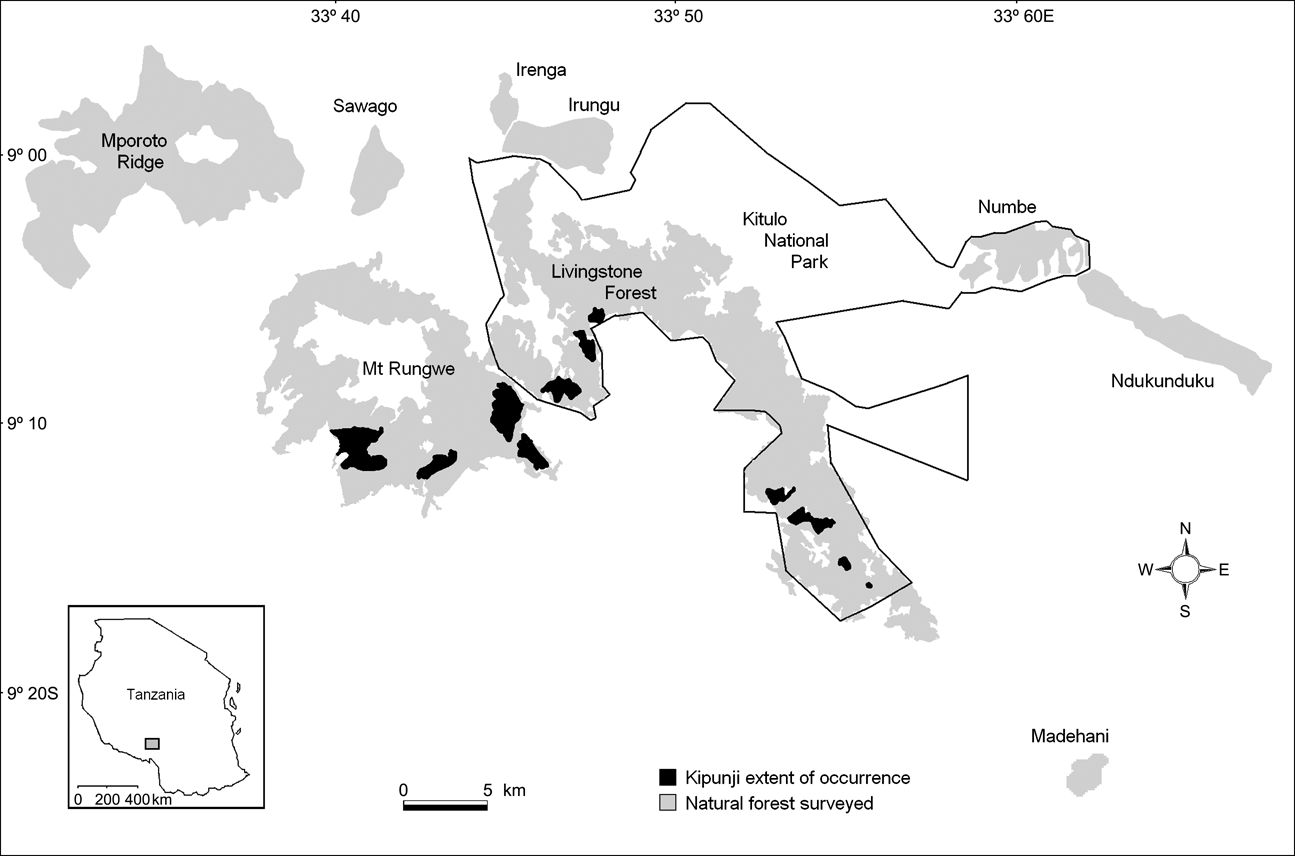
Table 1 illustrates the search effort at each site between 2003, when the kipunji was first sighted during biodiversity inventories (Davenport, Reference Davenport2005; Jones et al., Reference Jones, Ehardt, Butynski, Davenport, Mpunga, Machaga and De Luca2005), and September 2006. A total of 3,456 km were walked in a total of 2,864 team hours, with 3,009 km and 447 km, and 2,497 and 367 hours, in the Southern Highlands and Udzungwa Mountains, respectively. The surveys indicate that the kipunji is restricted to a number of discrete portions of the forests of Mount Rungwe and the adjacent Livingstone forest in Kitulo National Park in the Southern Highlands, and the Vikongwa area of the Ndundulu forest in the Udzungwa Mountains (Figs 1–2). Despite extensive surveys kipunji were not recorded (and are therefore presumed to be absent) in the Sawago, Irenga, Irungu, Mporoto Ridge, Madehani and Ndukunduku Forest Reserves or the Numbe forest in Kitulo National Park, in the Southern Highlands, nor in the Nyumbanitu forest in Kilombero Nature Reserve or Luhomero forest in the Udzungwa Mountains National Park, in the Udzungwa Mountains. The closest record of kipunji to Udzungwa Mountains National Park is 1.9 km outside the Park boundary. The absence data are further supported by our socio-economic surveys and conservation work in the villages immediately adjacent to the above mentioned forests. None of the villagers, environment committees, hunters or scientists with knowledge of the forests where kipunji were not observed claimed any observations to the contrary (Machaga et al., Reference Machaga, Massawe and Davenport2005; Jones, Reference Jones2006).
Forests in the Southern Highlands surveyed for kipunji, and the species' range (extent of occurrence) in the Rungwe-Kitulo forests. Inset indicates the location of the main map in Tanzania.
Forests in the Udzungwa Mountains surveyed for kipunji, and the species' range (extent of occurrence) in Ndundulu forest. Inset indicates the location of the main map in Tanzania.

Total number of team hours spent, km walked and altitudinal range covered in presence/absence surveys for the kipunji and group follows during 2003–2006. The four locations in which kipunji were found are in italics.

Census
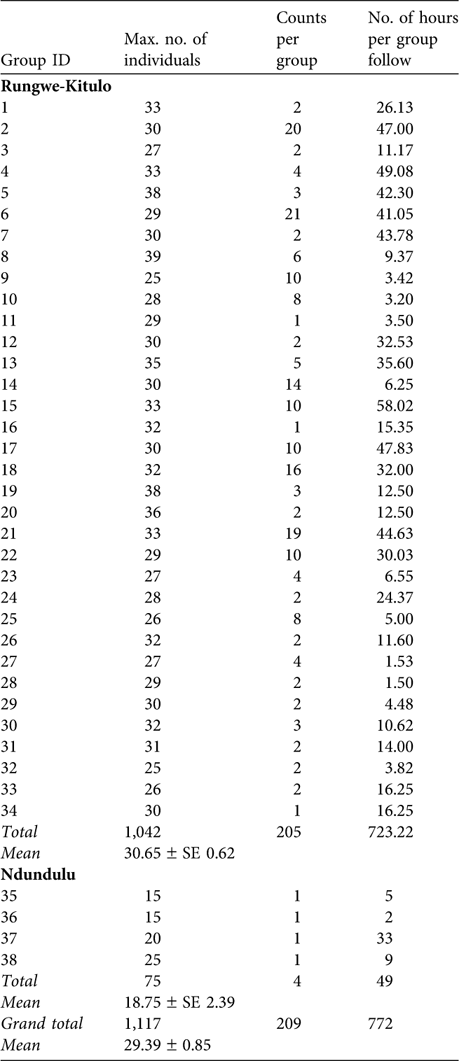
During the census of January–September 2006 a total of 1,025 km were walked and 1,238 hours spent following kipunji in Rungwe-Kitulo. We collected 2,118 spatially-referenced observations representing a total of 149 group follows, and identified a total of 34 kipunji groups, of which 205 counts were made (Table 2). We estimate a total of 1,042 individuals in the Southern Highlands, with a mean of 30.65 ± SE 0.62 (range 25–39, n = 34) individuals per group. Of these, 501 individuals in 16 groups were counted in Rungwe and 541 in 18 groups in Livingstone forest of Kitulo National Park. In Ndundulu, in the Kilombero Nature Reserve, 61.3 km were walked over 132.5 hours, and an additional 49 hours were spent following the four groups that were identified. We estimate a total of 75 animals with a mean of 18.75 ± SE 2.39 (range 15–25, n = 4) individuals per group. We estimate, therefore, a total kipunji population of 1,117 animals, based on 209 counts of 38 groups during 772 hours of group follows, with a mean of 29.39 ± SE 0.85 (range 15–39, n = 38) individuals per group. Mean group size in the Rungwe-Kitulo and Ndundulu populations were significantly different (t = 4.81, df = 3, P = 0.017).
Group identity number, maximum number of individuals counted, number of counts made per group, and number of hours spent per group follow in Rungwe-Kitulo and Ndundulu.
Occupancy and occurrence
The surveys and group follows permitted a determination of the kipunji's area of occupancy based on all observations made in the grid squares. We calculated area of occupancies of 671.5, 407.9 and 198.6 ha in Mount Rungwe, Livingstone Forest of Kitulo National Park, and Ndundulu, respectively. The total for Rungwe-Kitulo was therefore 1,079.4 ha, and the total species area of occupancy was 1,277.9 ha based on all data collected over 3 years (Table 3). We estimate the extent of occurrence for kipunji to be 815.4, 425.4 and 528.3 ha for Mount Rungwe, Livingstone and Ndundulu, respectively. The total for Rungwe-Kitulo was 1,240.8 ha and the estimated total extent of occurrence 1,769.1 ha.
Areas of occupancy (AoO), extent of occurrence (EoO) and density of the kipunji in Mount Rungwe, Livingstone (within Kitulo National Park), combined Rungwe-Livingstone, Ndundulu, and for the species as a whole.
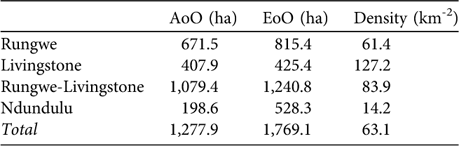
Determining group home range size depends upon an understanding of the extent of overlap between groups. (D.W. De Luca & T.R.B. Davenport, unpubl. data). However, a raw estimate of density derived from the census data and the estimated extent of occurrence gives 83.9 individuals per km2 in Rungwe-Kitulo, and 14.2 km-2 in Ndundulu (Table 3). The combined species density (within their extent of occurrence and excluding home range overlaps) is 63.1 km-2.
Discussion
Whilst extrapolative estimates of population size and speculative discussions on the range of the kipunji have been made (Jones et al., Reference Jones, Ehardt, Butynski, Davenport, Mpunga, Machaga and De Luca2005; Davenport et al., Reference Davenport, Stanley, Sargis, De Luca, Mpunga, Machaga and Olson2006), our results provide the first systematically derived data on the abundance and distribution of this new monotypic genus. Many methods have been developed for censusing primate populations (Brockelman & Ali, Reference Brockelman, Ali, March and Mittermeier1987; Plumptre & Cox, Reference Plumptre and Cox2006) and, although line transect methods have become the most widely used (Struhsaker, Reference Struhsaker1981, Reference Struhsaker2002), there is still debate about data analysis and accuracy (Plumptre & Reynolds, Reference Plumptre and Reynolds1996; Struhsaker, Reference Struhsaker1997; Plumptre & Cox, Reference Plumptre and Cox2006; Rovero et al., Reference Rovero, Struhsaker, Marshall, Rinne, Pedersen and Butynski2006). Given the urgency for conservation of the kipunji we performed a complete count after a long-term survey, thereby ensuring an accurate population estimate. Kipunji are shy, rare and primarily arboreal (Davenport & Jones, Reference Davenport and Jones2005; Jones et al., Reference Jones, Ehardt, Butynski, Davenport, Mpunga, Machaga and De Luca2005; Davenport et al., Reference Davenport, Stanley, Sargis, De Luca, Mpunga, Machaga and Olson2006). However, the considerable survey effort undertaken, our knowledge of the animal gained during continuous study over 2 years, and supporting information provided by socio-economic research (Machaga et al., Reference Machaga, Massawe and Davenport2005; Jones, Reference Jones2006) all provide additional confidence in the accuracy of the data. The survey protocol and remote sensing analyses used to determine habitat type and quality further support our contention that all existing groups in the Southern Highlands have been located. It is possible that there are groups in or near Ndundulu that remain undetected although, in our judgement, it is unlikely.
A total population of 1,117 animals is extremely small. The status of the population in Ndundulu is of particular cause for concern, and given current thinking on primate population sizes (Harcourt, Reference Harcourt2002) it may be that it is no longer viable. The causes of this are yet unclear and are currently being investigated. Both the Rungwe and Livingstone forests are heavily degraded (Davenport, Reference Davenport2005, Reference Davenport2006; Davenport & Jones, Reference Davenport and Jones2005), and based on remote sensing analysis of forest cover the extent of connection between the various sub-populations is probably limited. The difference in mean group size between the Rungwe-Kitulo and the Ndundulu populations is significantly different and is the subject of ongoing research. It could be linked to the small total population size in Ndundulu, or to fragmentation, reduced resource patches and food availability in Rungwe-Kitulo, as demonstrated for other species (Chapman et al., Reference Chapman, Chapman, Bjorndal and Onderdonk2002, Reference Chapman, Chapman, Rode, Hauk and McDowell2003; Struhsaker et al., Reference Struhsaker, Marshall, Detwiler, Siex, Ehardt, Lisbjerg and Butynski2004).
The kipunji is more sparsely distributed than we initially thought (Jones et al., Reference Jones, Ehardt, Butynski, Davenport, Mpunga, Machaga and De Luca2005). The total area of occupancy determined by the sum of the occupied grid squares is 12.78 km2 and the total extent of occurrence (the species’ range) is just 17.69 km2. The small extent of occurrence in Ndundulu and the patchy distribution in Rungwe-Kitulo give grounds for considerable conservation concern and the total extent of occurrence of 17.69 km2 demonstrated by our data is considerably less than the 100 km2 required to fulfil criterion B of the IUCN Red List (IUCN, 2007) status Critically Endangered (IUCN, 2001). In addition, the range is severely fragmented (criterion B1a), and remote sensing analysis of forest loss over the last 20 years in Rungwe-Kitulo leads us to infer there has been a decline and that this is continuing. Moreover, the unmanaged state of Mount Rungwe, the continued forest destruction of Mount Rungwe and Livingstone Forest in Kitulo National Park, persistent hunting of monkeys across Rungwe-Kitulo, as well as the highly precarious nature of the small population in Ndundulu, leads us to project a continuing decline (criterion B1b) in the extent of occurrence, area of occupancy, area, extent and quality of habitat, the number of locations or subpopulations, and the number of mature individuals of kipunji. As a consequence, we propose an IUCN Red List assessment for kipunji of Critically Endangered based on criteria (IUCN, 2001) B1ab(i,ii,iii,iv,v), with the genus facing an extremely high risk of extinction in the wild.
An estimated 541 individuals reside within the Livingstone Forest of Kitulo National Park. However, the forest is severely degraded (Davenport, Reference Davenport2006) and illegal activities, including logging and hunting of kipunji, continue. Meanwhile, > 51% of the total kipunji population lives in Forest Reserves with little or no management. All of these problems are consistent with those facing primates across Africa (Chapman et al., Reference Chapman, Lawes and Eeley2006). Immediate focus should be applied to Mount Rungwe, where edge effects, forest clearance and a lack of corridors pose the greatest threats. Across Rungwe-Kitulo the small, isolated sub-populations may already be subject to a loss of genetic variability due to low effective breeding populations and the effects of inbreeding (Frankham, Reference Frankham, Ballou and Briscoe2002). Some may no longer be viable. Whilst southern Ndundulu is in excellent condition due chiefly to its remote location (Davenport & Jones, Reference Davenport and Jones2005), the long-term viability of this 6.7% of the population must be considered uncertain at best, although whether any conservation measures could or should be applied in a largely undisturbed habitat is a moot point. The focus of our current kipunji conservation work is the protection and restoration of the montane habitats of Mount Rungwe, research into the reasons for, and viability of, the extremely small Udzungwa population, and local conservation education and long-term monitoring of both populations.
Acknowledgements
Work in the Southern Highlands was funded by the Wildlife Conservation Society (WCS). We thank in particular an anonymous donor, Karen and Dan Pritzker, Ashley Scott and Gary Fink. The Udzungwa work was funded by the Critical Ecosystem Partnership Fund, the Fauna & Flora International Flagship Species Fund and WCS. Research permission was granted by the Tanzania Wildlife Research Institute, Tanzania Commission for Science and Technology, Tanzania National Parks, Tanzania Forestry and Beekeeping Division, Rungwe District and Udekwa Village Councils. We thank Andrew Ferdinands, Mazao Fungo, Buto Kilasa, Sylvanos Kimiti, Richard Laizzer, Athumani Mndeme, Obadia Mwaipungu, Willy Mwalwengele, Atupele Mwamtobe, Francesco Rovero, Haruna Sauko, Bill Stanley, Link Olson and Eric Sargis for assistance and advice, and three anonymous referees for their valuable comments.
Biographical sketches
Tim Davenport has worked in the UK, Uganda and Cameroon, and is Country Director for the Wildlife Conservation Society (WCS) in Tanzania. He set up the WCS Southern Highlands Conservation Programme (SHCP) in 2000. Daniela De Luca is the SHCP's Technical Advisor, specializing in carnivore and threatened species ecology, conservation and monitoring. Trevor Jones runs several research and capacity-building projects in Tanzania and Scotland, and is carrying out research on predictors of mammalian abundance. Noah Mpunga and Sophy Machaga are the SHCP's Assistant Director and Senior Conservation Biologist, respectively. Noah's research focuses on carnivore and primate ecology, ethnozoology and conservation management, and Sophy has interests in mammal biology, biodiversity and hunting studies, and GIS. Amani Kitegile is the Co-ordinator of the Udzungwa Ecological Monitoring Centre, with an interest in primate feeding ecology. Guy Picton Phillipps is the East African Remote Sensing and GIS Technical Advisor for WCS.



