





Non-alcoholic fatty liver disease (NAFLD) is a multisystem disease that presents as the hepatic manifestation of metabolic syndrome(Reference Kim and Younossi1). There has been a growing consensus to replace the term NAFLD with metabolic dysfunction-associated steatotic liver disease (MASLD) in recent years. This name change has been proposed to more accurately reflect the disease’s strong association with metabolic disorder and to reduce the stigma associated with the term ‘fatty’. However, descriptions of NAFLD and MASLD differ, as NAFLD specifically excludes excessive alcohol consumption and other hepatic disorders(Reference Younossi, Kalligeros and Henry2). In the most recent systematic review and meta-analysis, the global prevalence of NAFLD increased from 25·3 % in 1990–2006 to 38·0 % in 2016–2019, reflecting an increase of approximately 50 %(Reference Younossi, Golabi and Price3). In a multicentre study examining data from 113 239 individuals in Türkiye between 2007 and 2016, the overall prevalence of NAFLD was determined to be 48·3 %, with a 22 % increase reported during this period. This increase is consistent with the prevalence of obesity(Reference Değertekin, Tözün and Demir4). As a result, liver disease has become the second leading cause of mortality among individuals aged 35–49 years(Reference Lake, Hyatt and Feng5). The ongoing rise in the prevalence of diabetes and obesity has become a major driver of the increasing global burden of liver diseases(Reference Cheemerla and Balakrishnan6).
The liver is particularly susceptible to damage from factors such as excessive exposure to toxins and unhealthy dietary habits due to its central role in metabolism and detoxification(Reference Melaram7). Physical activity and healthy habits are among the key lifestyle factors associated with NAFLD(Reference Hallsworth, Thoma and Moore8,Reference Ullah, Rauf and Nabi9) . Accordingly, lifestyle modification represents the cornerstone of both primary prevention and treatment in NAFLD. Effective management strategies focus on weight reduction and the control of key co-morbidities, including insulin resistance, dyslipidaemia and type 2 diabetes mellitus. These interventions are essential to slow disease progression, improve metabolic parameters and reduce associated morbidity and mortality(Reference Rinella, Neuschwander-Tetri and Siddiqui10).
Dietary management of NAFLD typically involves adherence to diets low in processed foods, such as the Mediterranean diet, combined with energy restriction(Reference Semmler, Datz and Trauner11). While the Mediterranean diet is influenced by environmental factors, cultural practices and various socio-economic determinants, it is primarily characterised by a dietary pattern rich in fresh fruits and vegetables, extra virgin olive oil, whole grains and nuts. It includes moderate consumption of wine (typically red, during meals), fish, poultry and legumes and is limited in red and processed meats as well as foods high in added sugars(Reference Anania, Perla and Olivero12). A randomised controlled trial reported that a 6-month Mediterranean diet intervention could improve anthropometric parameters and lipid profile and contribute to the reduction of hepatic fat accumulation and liver stiffness(Reference Abenavoli, Greco and Milic13). An observational study reported that adherence to the Mediterranean diet was associated with reduced insulin resistance and hepatic fat content in patients with NAFLD(Reference Kontogianni, Tileli and Margariti14). In another study, higher adherence to the Mediterranean diet was significantly associated with a lower prevalence of ultrasound-diagnosed hepatic steatosis(Reference Khalatbari-Soltani, Imamura and Brage15). The findings collectively underscore the possible preventive effect of the Mediterranean diet against the development of NAFLD; nevertheless, additional research is necessary to investigate this association across other populations. This study aims to assess the role of the Mediterranean diet and its components in reducing the risk of developing NAFLD in Turkish adults.
Materials and methods
Study design and participants
This case–control study was conducted with 252 adults (63·9 % women; mean age 50·4 (sd 11·52) years) at the Gastroenterology Outpatient Clinic, Faculty of Medicine, Ondokuz Mayıs University, Samsun/Türkiye. A post hoc power analysis was conducted using G * Power software. Based on a total sample of 252 participants distributed across tertiles (T1:99, T2:94, T3:59) and a medium effect size (w = 0·27), the estimated power was 0·98 at an α level of 0·05, suggesting that the sample size was adequate for detecting group differences.
The study consisted of two groups: the first group consisted of those diagnosed with NAFLD (n 126) by a physician based on liver enzyme tests and/or abdominal ultrasonography, and the second group consisted of age- and sex-matched controls (n 126). The inclusion criteria required that participants be diagnosed with NAFLD by a physician and not following any diet. Exclusion criteria were alcohol consumption (≥ 30 g/d for men and ≥ 20 g/d for women), presence of HBsAg or anti-HCV antibodies, pregnancy and breast-feeding, hereditary hemochromatosis, history of jejunoileal bypass surgery or gastroplasty, taking hepatotoxic drugs such as Ca channel blockers and high doses of synthetic oestrogen, having a history of hypothyroidism, Cushing’s syndrome, renal failure and kidney stones. The control group was matched with those who applied to the Gastroenterology Outpatient Clinic, who were not diagnosed with NAFLD and met the same exclusion criteria. Controls were matched to NAFLD cases by age (±5 years) and sex using a frequency matching approach.
Data acquisition and tools
Data were collected using a questionnaire. Descriptive and health data were taken, including sex, age, education level, income, marital status, smoking status and co-morbidities. Physical activity level, Mediterranean diet adherence and food consumption were assessed for each participant.
Anthropometric measurements
Body weight (kg) and height (cm) were measured using standard measurement protocols. Height was measured with a stadiometer while the participants were in a Frankfort plane. The body weight was obtained using a bioelectrical impedance analyser (BC 730, Tanita). BMI was calculated by dividing body weight (kg) with height (m) squared.
Physical activity levels
Physical activity levels were assessed using the seven-item short form of the International Physical Activity Questionnaire (IPAQ) developed by Craig et al. (Reference Craig, Marshall and Sjöström16) and validated by Sağlam et al. (Reference Saglam, Arikan and Savci17). A metabolic equivalent of task (MET) value of 3·3 was used for walking, 4·0 for moderate activity and 8·0 for vigorous activity. Scores are obtained as MET-min/week using MET values of each activity, activity duration (min) and number of days of activity (per week). The physical activity levels of the individuals were grouped as low (< 600 MET-min/week), moderate (600–3000 MET-min/week) and high (> 3000 MET-min/week).
Food consumption records
The food consumption of the participants was examined in face-to-face interviews using the 24-h dietary recall method by researchers. Portion sizes were collected using food photographs to improve recall accuracy. The dietary energy intakes were calculated using a nutrition information system(18). This system has a database containing Turkish food compositions(18).
Mediterranean diet adherence
Mediterranean Diet Adherence Screener (MEDAS) was used to assess the participants’ Mediterranean diet adherence. The tool was administered through face-to-face interviews conducted by trained researchers. The validation of the Turkish language version of the tool was performed by Özkan Pehlivanoğlu et al. (Reference Pehlivanoğlu, Balcıoğlu and Ünlüoğlu19) and Bekar and Göktaş(Reference Bekar and Goktas20). The tool consists of fourteen items and a two-point scoring system (0–1). The highest score is 14, and increasing scores reflect higher adherence to the Mediterranean diet.
Statistical analysis
Analyses were performed using the SPSS version 21 statistical package programme. Normality was checked with the Kolmogorov–Smirnov test. Quantitative data were given as mean and standard deviation, and qualitative data as number (n) and frequency (%). Binary logistic regression models (crude and adjusted) were performed to estimate OR and 95 % CI for NAFLD (+/–) according to tertiles of Mediterranean diet adherence (T1–T3), with the lowest tertile (T1) used as the reference category. OR for Mediterranean diet components in relation to NAFLD were estimated using binary logistic regression model, compared participants responding ‘no’ v. ‘yes’ (reference) for each component. Adjusted models included age, sex, BMI, energy intake, physical activity level and co-morbidities as potential confounders. Visualisation was performed using R software (R version 4.5.0 (2025-04-11), R Foundation for Statistical Computing). The significance value was taken as P < 0·05.
Results
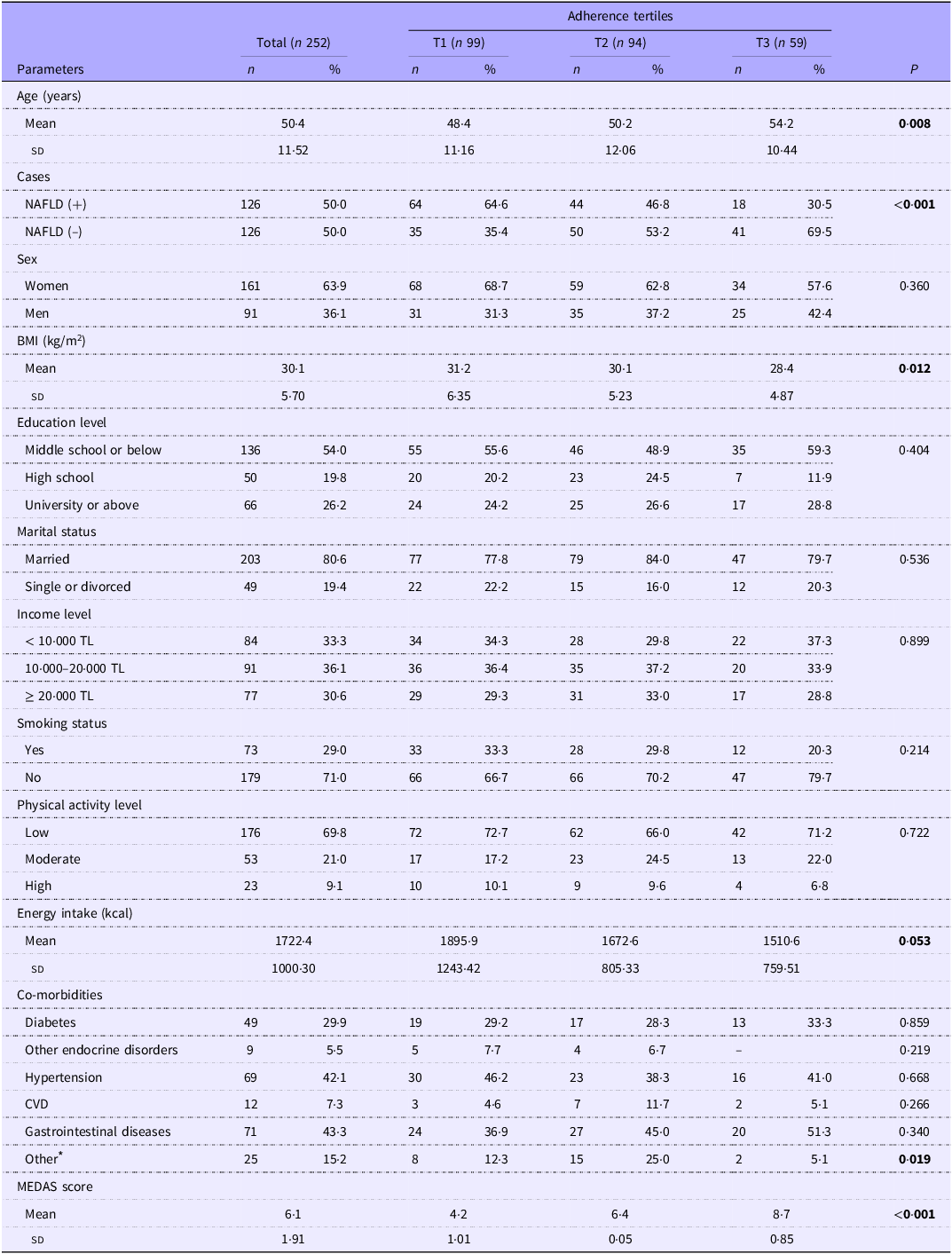
Characteristics of participants according to the Mediterranean diet adherence are shown in Table 1. The mean age of the participants was 50·4 (sd 11·52) years, and age tended to increase as the level of adherence to the Mediterranean diet increased (P = 0·008). The BMI was significantly lower in the highest adherence group (P = 0·012). The MEDAS score showed a significant difference between compliance groups (P < 0·001). The prevalence of NAFLD was higher in the lowest tertile (64·6 %) and lower in the highest tertile (30·5 %; P < 0·001). No significant difference was observed between the tertiles in terms of other variables (sex, education level, marital status, income, smoking and physical activity) (P > 0·05).
Characteristics of participants according to the Mediterranean diet adherence

Table 1. Long description
A table with 12 rows and 10 columns comparing characteristics of participants based on Mediterranean diet adherence. The table includes data on age, cases of non-alcoholic fatty liver disease (NAFLD), sex, body mass index (BMI), education level, marital status, income level, smoking status, physical activity level, energy intake, co-morbidities, and the Mediterranean Diet Adherence Screener (MEDAS) score. The table is divided into four columns: Total (n 252), Adherence tertiles T1 (n 99), T2 (n 94), and T3 (n 59). Notable trends include increasing age and MEDAS score with higher adherence to the Mediterranean diet, and a lower prevalence of NAFLD in the highest adherence group.
NAFLD, non-alcoholic fatty liver disease; TL, Turkish liras; MEDAS, Mediterranean diet adherence screener.
Statistically significant (P < 0·05) data are shown in bold.
* Depression, anxiety, autoimmune diseases, cancer, neurological diseases.
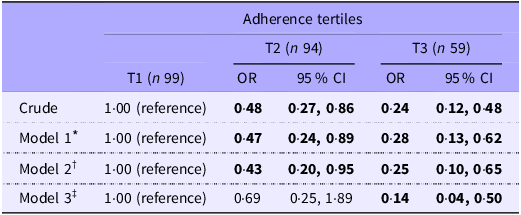
Increased adherence to the Mediterranean diet was associated with a significant reduction in the risk of NAFLD (Table 2). With reference to individuals with low dietary adherence, the risk of NAFLD was reduced by 52 % in the group with moderate adherence according to the crude model (OR = 0·48; 95 % CI 0·27, 0·86). This reduction reached 53 % after adjusting for age, sex and BMI (model 1) (OR = 0·47; 95 % CI 0·24, 0·89), and when energy intake was included in the model (model 2), the risk was 57 % lower (OR = 0·43; 95 % CI 0·20, 0·95). The reduction in NAFLD risk was much more pronounced in individuals with a high level of adherence to the Mediterranean diet. In the crude model, the risk of the disease was 76 % lower (OR = 0·24; 95 % CI 0·12, 0·48). In model 1 and model 2, this reduction was 72 % (OR = 0·28; 95 % CI 0·13, 0·62) and 75 % (OR = 0·25; 95 % CI 0·10, 0·65), respectively, while in model 3, which controlled for all variables, the risk was reduced by 86 % (OR = 0·14; 95 % CI 0·04, 0·50).
Binary logistic regression analysis of NAFLD risk according to Mediterranean diet adherence tertiles (n 252)
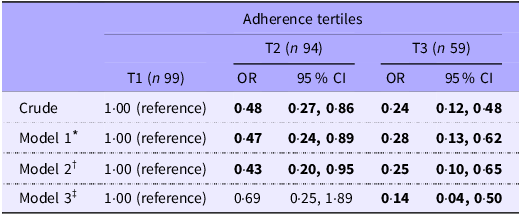
Table 2. Long description
A table with four rows and five columns presents the binary logistic regression analysis of NAFLD risk according to Mediterranean diet adherence tertiles. The columns are labeled as Adherence tertiles, T1 (n 99), T2 (n 94), and T3 (n 59), with sub-columns OR and 95 percentage CI. The rows are labeled as Crude, Model 1, Model 2, and Model 3. Row 1: Crude, 1.00 (reference), 0.48, 0.27, 0.86, 0.24, 0.12, 0.48. Row 2: Model 1, 1.00 (reference), 0.47, 0.24, 0.89, 0.28, 0.13, 0.62. Row 3: Model 2, 1.00 (reference), 0.43, 0.20, 0.95, 0.25, 0.10, 0.65. Row 4: Model 3, 1.00 (reference), 0.69, 0.25, 1.89, 0.14, 0.04, 0.50. The table indicates that increased adherence to the Mediterranean diet is associated with a significant reduction in the risk of NAFLD.
NAFLD, non-alcoholic fatty liver disease.
Statistically significant (P < 0·05) data are shown in bold.
* Adjusted for age, sex, BMI.
† Adjusted for age, sex, BMI, energy intake.
‡ Adjusted for age, sex, BMI, energy intake, co-morbidities (other).
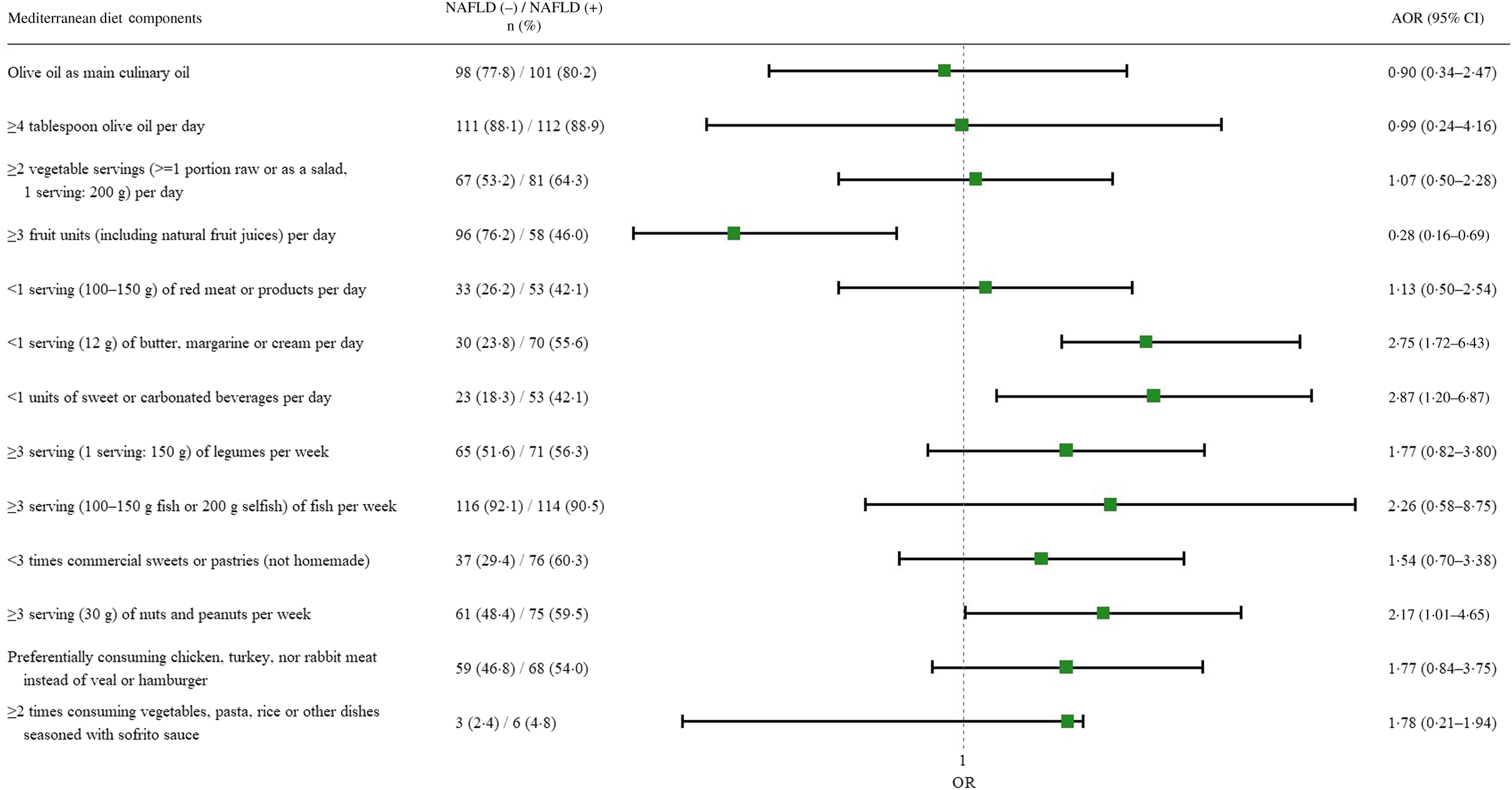
In Figure 1, some components of the Mediterranean diet were found to significantly affect the risk of NAFLD. In individuals who did not consume ≥ 3 servings of fruit daily, the risk of NAFLD was significantly reduced (OR = 0·28; 95 % CI 0·16, 0·69; P < 0·05). Daily consumption of > 1 serving of butter, margarine or cream (OR = 2·75; 95 % CI 1·72, 6·43) and > 1 unit of sweet or carbonated drinks (OR = 2·87; 95 % CI 1·20, 6·87) increased the risk of NAFLD by 2·75 and 2·87 times, respectively. A significantly increased risk was also observed in individuals who did not consume ≥ 3 servings of nuts and peanuts weekly (OR = 2·17; 95 % CI 1·01, 4·65). No statistically significant association was found between other dietary components (olive oil consumption, vegetable consumption, fish consumption, etc.) and NAFLD.
OR for Mediterranean diet components according to NAFLD. n (%) indicates the number and percentage of participants responding ‘no’ for each component. OR represent the odds of NAFLD for ‘no’ v. ‘yes’ responses (reference). AOR, adjusted for age, sex, BMI, energy intake and co-morbidities (other). NAFLD, non-alcoholic fatty liver disease. Statistically significant (P < 0·05) data are shown in bold. None of the participants consume ≥ 7 glasses of wine per week.

Figure 1. Long description
The table presents data on the association between various Mediterranean diet components and the presence of non-alcoholic fatty liver disease (NAFLD). It includes columns for diet components, the number and percentage of participants responding ‘no’ for each component, and the odds ratio (OR) for NAFLD. The table has 15 rows and 5 columns, with headers for diet components, NAFLD status, and adjusted odds ratios. Notable trends include significant associations for certain diet components, such as the consumption of olive oil, fruits, and vegetables, with lower odds of NAFLD. The table also highlights components like butter and sweets, which show higher odds of NAFLD when not consumed as per the Mediterranean diet guidelines. The data is adjusted for age, sex, BMI, energy intake, and co-morbidities.
Discussion
In the present study, greater adherence to the Mediterranean diet was associated with a reduced risk of NAFLD. This was reflected by the substantially lower prevalence observed in the high adherence group (30·5 %) compared with the low adherence group (64·6 %). Regression analyses further revealed that the risk of NAFLD was reduced by 57·0–86·0 % lower in the moderate and high adherence groups after adjusting for potential confounding variables such as age, sex, BMI and energy intake.
Previous studies examining the relationship between adherence to the Mediterranean diet and NAFLD consistently support the protective effects of this dietary model. In a study conducted by Trovato et al., in 532 NAFLD patients and 667 control individuals, the Mediterranean diet adherence score was identified as a strong and independent predictor of the severity of fatty liver disease(Reference Trovato, Martines and Brischetto21). Similarly, a cross-sectional study reported a significant and inverse relationship between the Mediterranean diet score and the risk of NAFLD in adjusted models(Reference Baratta, Pastori and Polimeni22). Consistent with these findings, a recent meta-analysis also revealed that adherence to the Mediterranean diet reduced the risk of NAFLD by 23 %(Reference Hassani Zadeh, Mansoori and Hosseinzadeh23). The Mediterranean lifestyle is an effective non-pharmacological strategy for improving liver health and preventing liver-related complications in patients with MASLD(Reference Monserrat-Mesquida, Bouzas and García24). Although some literature refers to MASLD terminology, the present findings are discussed within the NAFLD to maintain consistency with the study design and diagnostic criteria. Collectively, these findings suggest that the Mediterranean diet may be an effective nutritional strategy in the prevention and management of NAFLD.
The beneficial effects of the Mediterranean diet on NAFLD are likely explained by synergistic interactions among its characteristic food components. SFA have been shown to increase cellular dysfunction by activating endoplasmic reticulum stress pathways, negatively affect NAFLD-related metabolic pathways and increase systemic and hepatic insulin resistance. MUFA represent the main source of fatty acids in the Mediterranean diet. Olive oil is the main source of MUFA in the Mediterranean diet, which may partially explain some of the findings(Reference Del Bo’, Perna and Allehdan25). Numerous studies have reported positive effects of olive oil on reducing cardiovascular risk, improving lipid metabolism (especially preventing the oxidation of LDL-cholesterol, thereby reducing the atherogenicity of LDL) and balancing glycaemic levels(Reference Berrougui, Ikhlef and Khalil26,Reference Jiménez-Sánchez, Martínez-Ortega and Remón-Ruiz27) . The Mediterranean diet may also lower plasma cholesterol levels, particularly through water-soluble fibres in beans, vegetables, fruits and whole grains(Reference Del Bo’, Perna and Allehdan25).
An unexpected observation was that participants consuming fewer than three servings of fruit on a daily basis had a lower likelihood of NAFLD. In line with our findings, a study demonstrated that consuming more than four servings of fruit per day worsened steatosis, dyslipidaemia and glycaemic control in patients with NAFLD(Reference Alami, Alizadeh and Shateri28). A case–control study found that a fruit-rich dietary pattern (more than 2–3 servings/d of fruits and > 20 g/d of fructose) was associated with a 4-fold increased likelihood of developing NAFLD. The mechanism behind this may be related to the intake of large amounts of sugars, such as fructose(Reference Fakhoury-Sayegh, Younes and Heraoui29). Decreased fatty acid oxidation in skeletal muscle results in free fatty acids being directed to the liver, which increases hepatic fat accumulation. Fructose can also increase liver fat through de novo lipogenesis. After absorption, glucose is primarily metabolised by peripheral tissues, while fructose is directly transported to the liver. Due to the lack of feedback control, fructose is metabolised more rapidly than glucose and enters the lipogenesis pathway(Reference Alami, Alizadeh and Shateri28). However, prospective cohort study involving 52 280 Korean adults found that higher consumption of fruits, vegetables and total fruit/vegetable intake is associated with a significantly reduced risk of NAFLD(Reference Kim and Sangah30). Furthermore, a meta-analysis of eleven observational studies (including 493 682 participants) concluded that increased consumption of vegetables and fruits is generally correlated with a lower likelihood of developing NAFLD(Reference Wang, Yan and Jiao31). Therefore, the present finding should be interpreted with caution. The result does not imply a protective effect of low fruit intake per se and may reflect reverse causation, whereby individuals with fatty liver modify their dietary habits. It has been reported that people with fatty liver are more likely to consume fruits and confectionery containing simple carbohydrates compared with people with diabetes(Reference Kobayashi, Tatsumi and Hattori32).
In the present study, high intake of saturated fat-rich butter, margarine and cream products, as well as sweetened and carbonated beverages, was positively associated with NAFLD, supporting evidence on the adverse metabolic effects of saturated fats and added sugars(Reference Fridén, Kullberg and Ahlström33–Reference Tsompanaki, Thanapirom and Papatheodoridi36). Furthermore, the observed increased risk among individuals consuming fewer than three servings of nuts per week highlights the protective role of nuts (attributed to their healthy fatty acid profile and antioxidant content), in maintaining liver health(Reference Pan, Sui and Xu37).
Strengths of this study include the use of the validated MEDAS tool and adjustment for key confounders. Nevertheless, the case–control design limits causal inference, and dietary intake relied on self-report, including a single 24-h recall, which may not reflect habitual intake. As Mediterranean diet adherence was assessed using the MEDAS screening tool and energy intake was included only as a covariate, participants were not excluded based on potential under- or over-reporting of energy intake. Fatty liver disease was defined according to NAFLD criteria, as data were collected prior to the introduction of MAFLD/MASLD terminology. Given the differences in diagnostic frameworks, direct reclassification was not feasible and may limit comparability. Although an a priori sample size calculation was performed for the parent thesis (see acknowledgements), the current analysis relied on post hoc power estimation, which should be interpreted cautiously. The inverse association observed for fruit consumption should be interpreted with caution and does not indicate that lower fruit intake is protective against NAFLD. Future prospective and intervention-based studies are recommended to further investigate the mechanistic effects of the Mediterranean diet on NAFLD.
In conclusion, the findings suggest that adherence to the Mediterranean diet is associated with reduced NAFLD risk. Limiting the intake of saturated fats and sugar-sweetened beverages while prioritising nutrient-dense foods may represent a relevant dietary strategy.
Supplementary material
For supplementary material/s referred to in this article, please visit https://doi.org/10.1017/S0007114526107545
Acknowledgements
The authors would like to acknowledge the participants for taking their time and voluntarily participating in the study. This article is derived from the master’s thesis of RKF, conducted at Ondokuz Mayıs University, Institute of Graduate Studies, Department of Nutritional Sciences, as part of the requirements for the Master of Science degree under the supervision of YEÖ. EA participated in the project as part of the research team.
This study was supported by Ondokuz Mayıs University, Scientific Research Projects Unit, with project number 1908.23.0025.
R. K. F.: Conceptualisation, Methodology, Investigation, Formal analysis and Writing – original draft, E. A.: Investigation, Formal analysis and Writing – original draft, Y. E. Ö.: Conceptualisation, Methodology, Writing – review and editing and Supervision
The authors declare that they have no competing interests.
Ethical permission was obtained from the Ondokuz Mayıs University Clinical Research Ethics Committee (date: 14.02.2023 and decision number: 2022/581). Written information was provided, and consent was obtained for their volunteer participation. The study was conducted in accordance with the Declaration of Helsinki and reported in accordance with the STROBE guidelines for observational studies.
The voluntary consent form was signed by the participants.
The datasets used and/or analysed during the current study are available from the corresponding author on reasonable request.


 Open access

