





INTRODUCTION
Corpus-based research has shown that second language (L2) learners need to know from 3,000 to 9,000 words to achieve reasonable comprehension of different kinds of discourse (e.g., Dang & Webb, Reference Dang and Webb2014; Nation, Reference Nation2006). Explicitly teaching all these words within the classroom may be a too daunting task. Therefore, it is essential to identify sources of L2 input from which words can be learned incidentally. Earlier studies have investigated how incidental vocabulary learning occurs through reading graded readers (e.g., Brown et al., Reference Brown, Waring and Donkaewbua2008), listening to songs (Pavia et al., Reference Pavia, Webb and Faez2019), and watching television programs (e.g., Peters, Reference Peters2019). Academic input is also a potential source of incidental vocabulary learning for L2 learners studying at universities where English is the medium of instruction, as well as in English for Academic Purposes (EAP) programs (Vidal, Reference Vidal2003, Reference Vidal2011). Academic input contains frequently occurring topic-related vocabulary that is central to learning a subject (Chung & Nation, Reference Chung and Nation2003). The close relationship between topic-related vocabulary and academic content also means that academic input such as lectures are likely to be carefully attended to by learners (Coxhead, Reference Coxhead2018). As repetition of topic-related words and learners’ attention to input are important factors for incidental vocabulary learning to occur (Godfroid et al., Reference Godfroid, Ahn, Choi, Ballard, Cui, Johnston, Lee, Sarkar and Yoon2018), academic lectures are likely to be an important source of incidental vocabulary learning for L2 learners studying at universities where English is the medium of instruction, as well as in EAP programs.
Several studies have investigated vocabulary learning from reading academic texts (e.g., Elgort & Warren, Reference Elgort and Warren2014; Gablasova, Reference Gablasova2015; Vidal, Reference Vidal2011). Very few studies have examined vocabulary learning through viewing academic lectures. This is surprising given that English is the medium of instruction in many university programs in both English and non-English-speaking countries (Hyland & Shaw, Reference Hyland, Shaw, Hyland and Shaw2016). Two studies have indicated that viewing academic lectures could lead to the learning of individual words (Smidt & Hegelheimer, Reference Smidt and Hegelheimer2004; Yang & Sun, Reference Yang and Sun2013). However, neither study investigated incidental vocabulary learning through viewing a single lecture without support, and the extent to which the results could be attributed to viewing academic lectures was difficult to determine because neither study included a control group. Whether collocations are learned incidentally through viewing academic lectures is yet to be investigated. There are several reasons why it is important to examine the potential for learning collocations through viewing academic lectures. First, knowledge of formulaic sequences is essential for language development (Siyannova-Chanturia & Pellicer-Sánchez, Reference Siyannova-Chanturia and Pellicer-Sánchez2019). However, learning collocations is challenging for many L2 learners (Laufer & Waldman, Reference Laufer and Waldman2011; Nguyen & Webb, Reference Nguyen and Webb2017), and explicitly teaching all collocations may be impossible given the limited classroom time (Puimège & Peters, Reference Puimège and Peters2020). Second, corpus-based research has revealed that academic speech consists of a reasonable proportion of frequently occurring sequences of words (Biber et al., Reference Biber, Conrad and Cortes2004; Simpson-Vlach & Ellis, Reference Simpson-Vlach and Ellis2010). Thus, academic lectures may contribute to incidental learning of collocations. To address this gap, the present study aims to investigate the learning of single words and collocations through viewing a video of an unmodified academic lecture. A secondary aim of this study is to examine the influence of frequency of occurrence in the experimental lecture and prior knowledge of general vocabulary on the learning gains. The study provides useful insights into the potential of academic lectures for incidental vocabulary learning and useful implications for EAP teachers and learners when selecting materials for incidental vocabulary learning.
BACKGROUND
In the present study, incidental vocabulary learning is defined as a by-product of other activities (e.g., listening to songs, reading novels, watching television programs) (Ellis, Reference Ellis1999). This definition means that vocabulary learning occurs when learners focus on understanding language rather than through intentionally learning a set of words. Incidental learning plays a significant role in L2 vocabulary learning. There are a large number of words that L2 learners need to know, but the classroom time is insufficient to teach them all (Webb & Nation, Reference Webb and Nation2017). Encountering words repeatedly in contexts helps learners to develop both their breadth and depth of vocabulary knowledge. For these reasons, incidental vocabulary learning has been recommended as an essential part of principled vocabulary programs (Nation, Reference Nation2007), and researchers have actively identified potential sources of incidental L2 vocabulary learning.
INCIDENTAL L2 VOCABULARY LEARNING OF SINGLE WORDS
L2 studies examining incidental learning of single words have mainly focused on written input. These studies have suggested that single words can be learned through reading sets of short sentences (Webb, Reference Webb2007), graded readers (e.g., Brown et al., Reference Brown, Waring and Donkaewbua2008; Horst et al., Reference Horst, Cobb and Meara1998; Webb & Chang, Reference Webb and Chang2015a, Reference Webb and Chang2015b), authentic nonacademic texts (Pellicer-Sánchez & Schmitt, Reference Pellicer-Sánchez and Schmitt2010), and academic texts (Elgort & Warren, Reference Elgort and Warren2014; Vidal, Reference Vidal2011). A relatively small number of studies have investigated incidental vocabulary learning through aural input. These studies have shown that learning can also occur through listening to short authentic texts (van Zeeland & Schmitt, Reference van Zeeland and Schmitt2013a), graded readers (Brown et al., Reference Brown, Waring and Donkaewbua2008; Webb & Chang, Reference Webb and Chang2015a, Reference Webb and Chang2015b), songs (Pavia et al., Reference Pavia, Webb and Faez2019), EFL teacher talk (Jin & Webb, Reference Jin and Webb2020), and audio academic lectures (Vidal, Reference Vidal2003, Reference Vidal2011). Several studies indicate that incidental vocabulary learning gains occurring through listening are likely to be smaller than those from written input (Brown et al., Reference Brown, Waring and Donkaewbua2008; Vidal, Reference Vidal2011). Among these studies, only Vidal (Reference Vidal2003, Reference Vidal2011) has examined incidental vocabulary learning through listening to academic lectures. Vidal (Reference Vidal2003) conducted an experiment in which the participants listened to three lectures in the area of tourism. The lectures were 14–15 minutes long. To measure the learning gains and retention of the 36 target words, the participants were asked to complete a pretest before the treatment, an immediate posttest right after the treatment, and a delayed posttest 1 month after the treatment. The results showed that there was a significant increase in the mean scores from the pretest to the posttest, suggesting that listening to the lectures led to learning gains of the target words. In a follow-up study, Vidal (Reference Vidal2011) compared incidental learning through academic listening and academic reading. The participants were divided into three groups: listening, reading, and control. The listening group listened to the three lectures used in Vidal’s (Reference Vidal2003) study. The reading group read three messages that had similar content and length as the lectures and also contained the 36 target words. The control group did not receive any treatment. Similar to Vidal (Reference Vidal2003), a pretest-posttest design was adopted by Vidal (Reference Vidal2011). The results showed that there was no significant difference between the pretest, immediate posttest, and delayed posttest scores of the control group. In contrast, both the listening group and the reading group got significantly higher scores on the immediate posttests and delayed posttests than the pretests. Additionally, the reading group achieved greater learning gains than the listening group. The results suggested that both academic listening and academic reading led to incidental learning of single words but the learning gains from academic listening was smaller than that from academic reading. While Vidal (Reference Vidal2003, Reference Vidal2011) provided important insights into the value of audio academic lectures as a source for incidental vocabulary learning, the lectures in her studies were modified from authentic sources and recorded by a lecturer who “rephrased some of the information as if she were interacting with the listeners” (Vidal, Reference Vidal2003, p. 62) to fit the purpose of Vidal’s studies rather than a lecture that was recorded in an actual class. The video of an unmodified lecture encountered by participants in the present study would have greater ecological validity.
Recently there has been a growing interest in incidental vocabulary learning through viewing audiovisual input. Research indicates that single words could be learned incidentally through viewing short video clips (e.g., Neuman & Koskinen, Reference Neuman and Koskinen1992; Puimège & Peters, Reference Puimège and Peters2019), full-length television programs (Feng & Webb, Reference Feng and Webb2020; Peters, Reference Peters2019; Peters & Webb, Reference Peters and Webb2018), extensive television viewing (Rodgers & Webb, Reference Rodgers and Webb2020), and academic lectures (Smidt & Hegelheimer, Reference Smidt and Hegelheimer2004; Yang & Sun, Reference Yang and Sun2013). Smidt and Hegelheimer (Reference Smidt and Hegelheimer2004) conducted an experiment in which participants completed a CALL task. In this task, they watched a 15-minute digitalized online video of an academic lecture about horticulture with overhead transparent notes, picture slides, and an online dictionary. The participants completed a pretest, an immediate posttest, and a delayed posttest to measure their knowledge of 20 target words. Results showed that the mean scores significantly increased from the pretest to the immediate posttest and the delayed posttest whereas there was no significant difference between the immediate posttest and delayed posttest scores. This indicated that watching a video of an academic lecture with an online dictionary led to vocabulary learning. However, Smidt and Hegelheimer (Reference Smidt and Hegelheimer2004) examined the effect of vocabulary learning under a CALL setting in which the academic lecture had been modified and integrated with other activities. Consequently, it is unclear whether the learning gains were attributed to viewing the academic lecture or the CALL activities. Additionally, Smidt and Hegelheimer (Reference Smidt and Hegelheimer2004) did not include a control group, which makes it less transparent whether the learning gains could be solely attributed to the treatment or other factors.
Yang and Sun (Reference Yang and Sun2013) examined the learning of 33 target words through viewing videos of three academic lectures on psychology, music, and physics. Each lecture was 20–36 minutes long. Similar to previous studies, Yang and Sun followed a pretest-posttest design. The results showed that the posttest scores were significantly higher than the pretest scores, indicating that single words could be learned through viewing videos of academic lectures. Unfortunately, Yang and Sun’s (Reference Yang and Sun2013) study lacked the inclusion of a control group, raising the question of whether vocabulary learning gains could be attributed to the treatment. Additionally, Yang and Sun (Reference Yang and Sun2013) examined the learning through viewing multiple lectures and so the extent to which learning occurs through viewing a single lecture remains to be determined. It is important to examine the gains from a single lecture because learners may not always watch a series of related lectures. If the research shows that viewing only a single lecture could lead to vocabulary learning, that would be encouraging because it would help to clarify the potential of this source of input for L2 learners.
INCIDENTAL L2 VOCABULARY LEARNING OF COLLOCATIONS
The present study follows the frequency-based approach by defining collocations as the combinations of two words whose frequency of co-occurrence in the corpus is statistically greater than by chance regardless of their semantic relationship or level of compositionality (Gablasova et al., Reference Gablasova, Brezina and McEnery2017). This approach was chosen because there may be variation in human judgment of semantic relationship or level of compositionality (Boers & Webb, Reference Boers and Webb2018). Using statistical measures from corpora offers a quick and objective way to identify collocations. Moreover, frequency of occurrences is an important factor in the selection of lexical items for learning because it helps to avoid including low-frequency collocations that may have limited value for learners (Nguyen & Webb, Reference Nguyen and Webb2017).
Knowledge of collocations is an essential part of L2 vocabulary acquisition because it allows learners to reach a higher level of language proficiency (Nation, Reference Nation2013). However, learning collocations is challenging for many L2 learners (Laufer & Waldman, Reference Laufer and Waldman2011; Nguyen & Webb, Reference Nguyen and Webb2017). Although collocations can be learned through explicit instruction, class time is limited (Puimège & Peters, Reference Puimège and Peters2020). Therefore, a small but increasing number of studies have explored incidental learning of collocations from exposure to L2 input.
Several studies have focused on written input. Their findings have been inconsistent. Szudarski (Reference Szudarski2012) investigated the learning of 10 verb-noun collocations at the form recognition and form recall levels, while Szudarski and Carter (Reference Szudarski and Carter2016) measured knowledge of 10 verb-noun collocations and 10 adjective-noun collocations at the meaning recall, form recall, and form recognition levels through reading short stories. Both studies reported no significant difference in the knowledge of collocations of participants who read short stories containing these collocations and participants who did not receive the treatment. However, Pellicer-Sánchez’s (Reference Pellicer-Sánchez2017) research on the learning of six adjective-pseudoword collocations through reading stories found that encountering these collocations in the texts eight times resulted in gains of 0.90 items (15%) at the form recall level and 3.20 items (53.33%) at the form recognition level while encountering these collocations in the texts four times led to gains of 0.43 items (7.17%) at the form recall level and 2.90 items (48.33%) at the form recognition level. Similarly, Webb and Chang (Reference Webb and Chang2020) investigated the learning of 17 noun-noun and adjective-noun collocations at the form recognition level through reading, listening to, and reading while listening to a graded reader. All three treatments resulted in significantly higher learning gains than the no treatment condition. At the form recognition level, reading while listening led to the highest learning gains of 4.64 collocations (27.29%), followed by listening (2.58 collocations) (15.18%) and reading (2.04 collocations) (12%). Likewise, Webb et al. (Reference Webb, Newton and Chang2013) examined the learning of 18 collocations with a low degree of congruence through reading while listening to a graded reader. They found that depending on the number of occurrences of the target collocations in the input, reading while listening to a graded reader resulted in learning gains of 0.74 collocations (4.11%), 3.06 collocations (17%), 3.66 collocations (20.33%), 6.53 collocations (36.28%), and 8.24 collocations (45.78%) at the form recognition level.
Subsequent studies also provided evidence that collocations could be learned through listening to other kinds of spoken input. Pavia et al. (Reference Pavia, Webb and Faez2019) examined the learning of collocations through listening to two English songs for several times. The results showed no learning gains for one song regardless of the number of times to which it was listened. However, listening to the other song for three times and five times lead to the learning gains of 1.34 of out 7 collocations (19.14%) and 0.63 collocations (9%) at the form recognition level, respectively. Similarly, Jin and Webb (Reference Jin and Webb2020) investigated the learning of seven verb-noun collocations and three adjective-noun collocations through listening to EFL teacher talk and found learning gains of 0.86 out of 10 collocations (8.6%) at the form recognition level.
Two studies have investigated the learning of collocations through audiovisual input. Puimège and Peters (Reference Puimège and Peters2019) explored the learning of 20 formulaic sequences which represented various kinds of collocations through viewing a short video clip. Analysis revealed significant learning gains of 3.95 formulaic sequences (19.75%) at the form recall level. In a follow-up study, Puimège and Peters (Reference Puimège and Peters2020) examined the learning of 56 formulaic sequences representing different kinds of collocations through viewing a full-length television program. They found learning gains of 9.4 formulaic sequences (16.79%) at the form recall level and 6.88 formulaic sequences (12.29%) at the meaning recall level.
To the best of our knowledge, no studies have investigated the potential for incidental learning of collocations through viewing academic lectures. This is surprising because corpus-based research has shown that academic speech consists of a reasonable proportion of frequently occurring formulaic sequences (Biber et al., Reference Biber, Conrad and Cortes2004; Chon & Shin, Reference Chon and Shin2013; Coxhead et al., Reference Coxhead, Dang and Mukai2017; Dang, Reference Dang2018; Simpson-Vlach & Ellis, Reference Simpson-Vlach and Ellis2010) and may be a potential resource for incidental learning of collocations. Taken together, the previously mentioned studies indicate a clear need for research on the learning of single words and collocations through viewing academic lectures.
FREQUENCY OF OCCURRENCE AND INCIDENTAL VOCABULARY LEARNING
Frequency has received considerable attention in studies of incidental vocabulary learning. Many studies have indicated that frequency significantly contributes to learning single words through reading (e.g., Horst et al., Reference Horst, Cobb and Meara1998; Pellicer-Sánchez & Schmitt, Reference Pellicer-Sánchez and Schmitt2010) and listening to graded readers (e.g., Brown et al., Reference Brown, Waring and Donkaewbua2008; van Zeeland & Schmitt, Reference van Zeeland and Schmitt2013a), listening to songs (Pavia et al., Reference Pavia, Webb and Faez2019), and viewing television programs (Peters et al., Reference Peters, Heynen and Puimege2016; Peters & Webb, Reference Peters and Webb2018). One study (Feng & Webb, Reference Feng and Webb2020) did not find a significant relationship between frequency and learning gains through reading, listening to, and viewing television programs. Few studies have examined the influence of frequency on incidental learning of collocations. Webb et al. (Reference Webb, Newton and Chang2013) found that frequency has a positive impact on incidental learning of collocations through reading while listening to graded readers. However, Pellicer-Sánchez (Reference Pellicer-Sánchez2017) and Jin and Webb (Reference Jin and Webb2020) did not find a significant correlation between frequency and learning gains through reading and listening, respectively. Uchihara et al. (Reference Uchihara, Webb and Yanagisawa2019) carried out a meta-analysis of 26 primary studies on the effect of frequency of occurrence on L2 incidental vocabulary learning. They reported a medium correlation of 0.34 between the two variables and significant variation in the size of the frequency effects across these studies. The analysis also showed that a number of learner-related, treatment-related, and methodological variables contributed to this variation. Therefore, recently researchers have pointed out that while frequency is important, it is not the only factor that accounts for L2 incidental vocabulary learning (Peters, Reference Peters and Webb2020; Uchihara et al., Reference Uchihara, Webb and Yanagisawa2019; Webb & Nation, Reference Webb and Nation2017).
Previous research has found that frequency had a significant contribution to the learning of single words through listening to three modified academic lectures (Vidal, Reference Vidal2003, Reference Vidal2011) and viewing three unmodified academic lectures (Yang & Sun, Reference Yang and Sun2013). However, no study has looked at the relationship between frequency in the experimental lectures and viewing a video of an unmodified academic lecture. As the value of frequency on incidental learning may vary according to the amount and kind of input, there is a need to look at how it affects incidental vocabulary learning through viewing a single unmodified academic lecture. The extent to which frequency influences the learning of collocations in academic lectures remains to be investigated.
PRIOR VOCABULARY KNOWLEDGE AND INCIDENTAL VOCABULARY LEARNING
Most studies examining the impact of prior vocabulary knowledge on incidental vocabulary learning have focused on knowledge of single words. Research indicates that prior vocabulary knowledge positively contributed to vocabulary learning through reading (e.g., Horst et al., Reference Horst, Cobb and Meara1998), reading while listening to graded readers (Webb & Chang, Reference Webb and Chang2015a, Reference Webb and Chang2015b), and viewing television programs (e.g., Peters & Webb Reference Peters and Webb2018; Peters, Reference Peters2019). The two studies (Puimège & Peters, Reference Peters2019, Reference Peters and Webb2020) investigating the effect of prior vocabulary knowledge on the learning of collocations also reported a positive relationship between these factors. As for academic lectures, Vidal (Reference Vidal2003, Reference Vidal2011) found that language proficiency had a positive impact on the learning of single words through listening to academic lectures. To the best of our knowledge, there is no research that has investigated the relationship between prior knowledge of general vocabulary and the learning of single words and collocations through viewing academic lectures. It is important to address this gap because it would shed light on how learners’ existing vocabulary knowledge may affect learning through viewing academic lectures and help teachers to determine the suitability of academic lectures as a source of input for learners with different vocabulary levels.
RESEARCH QUESTIONS
This study aimed to determine whether single words and collocations can be learned through viewing an unmodified academic lecture. A second aim was to examine the effect of frequency of occurrence in the lecture and prior knowledge of general vocabulary on the learning gains. It would address three research questions:
-
1. Does viewing an academic lecture lead to incidental learning of single words?
-
2. Does viewing an academic lecture lead to incidental learning of collocations?
-
3. What are the relationships between vocabulary learning through viewing an academic lecture and the following variables: frequency of occurrence in the lecture and prior knowledge of general vocabulary?
METHODOLOGY
PARTICIPANTS AND LEARNING CONTEXT
The participants were 55 postgraduate students from two intact classes in an EAP course at a university in China. They had learned English for an average of 13.18 years (SD = 2.29). The EAP course ran for 4 months as a compulsory course at the beginning of the participants’ postgraduate program. After completing the EAP course, the participants were going to study their academic major (technology and engineering) in both Chinese (about 80% of the lectures) and English (about 20% of the lectures). The lectures in English were delivered by both native speakers of English and highly proficient L2 speakers of English. Moreover, the participants needed to understand academic spoken English at conferences, seminars, and workshops as part of their academic and professional development. The EAP course aimed to help students to develop skills for their study in English-medium courses. The classes took place twice a week, each for 90 minutes. Although the students needed to understand academic spoken English, including academic lectures in their subsequent academic study, activities in the EAP course mainly focused on improving students’ academic reading and writing skills. Students had limited exposure to academic lectures in their EAP courses due to a lack of resources. The materials used to help students deal with academic listening were mostly TED Talks and some videos related to the topics of each unit. None of the other materials in the EAP course were related to algorithms. Informal discussion with teachers in the EAP course revealed that there was a need to conduct this kind of research to provide research-based evidence for the implementation of unmodified academic lectures in this EAP course.
Each of the two intact EAP classes was randomly assigned to either an experimental group or a control group. The inclusion of the control group ensured that any learning that occurred would be attributed to the treatment alone. The participants were administered Webb et al.’s (Reference Webb, Sasao and Ballance2017) Updated Vocabulary Levels Test (UVLT) (see Table 1 for their mean scores). An independent-samples t-test found no significant difference in the UVLT mean scores of the two groups (p > 0.05 in all cases), indicating that the two groups had similar vocabulary levels.
Mean scores (SD) on the Updated Vocabulary Levels Test 1 (N = 55)
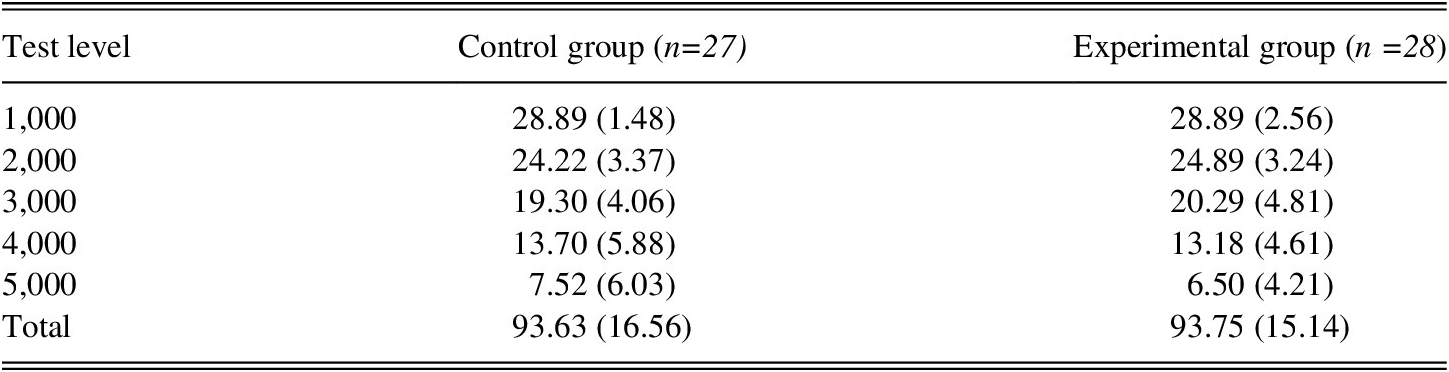
1 Webb et al. (Reference Webb, Sasao and Ballance2017) suggested 29/30 (96.67%) as the cut-off point for mastery of the 1,000, 2,000, and 3,000 word levels. However, this cut-off point is stricter than those applied to the Vocabulary Levels Test by earlier researchers: 26/30 (86.66%) (Schmitt et al., Reference Schmitt, Schmitt and Clapham2001) and 24/30 (80%) (Dang et al., Reference Dang, Webb and Coxhead2020; Hu & Nation, Reference Hu and Nation2000; Rodgers, Reference Rodgers2013; Xing & Fulcher, Reference Xing and Fulcher2007). Moreover, from the perspective of language testing, mastery cut-off points of tests should be set in relation to the purpose of the study in which the tests are used (Brown & Hudson, Reference Brown and Hudson2002). If the UVLT scores were to estimate the level of comprehension of audiovisual input, a lenient cut-off point for mastery is more appropriate because, apart from vocabulary knowledge, other factors such as imagery also contribute to comprehension of audiovisual input (Durbahn et al., Reference Durbahn, Rodgers and Peters2020; Peters, Reference Peters2019). Therefore, following Hu and Nation (Reference Hu and Nation2000), Xing and Fulcher (Reference Xing and Fulcher2007), Rodgers (Reference Rodgers2013), and Dang et al. (Reference Dang, Webb and Coxhead2020), we adopted a lenient cut-off point of mastery (24/30) (80%).
MATERIAL
The material was a video without captions of a lecture in an introductory undergraduate course in algorithms at the Massachusetts Institute of Technology. It was 50 minutes long and contained 5,871 running words (see Appendix 1 in the Supplementary Materials). This lecture followed the “rhetorical style” according to Dudley-Evans’s (Reference Dudley-Evans and Flowerdew1994) classification. That is, the lecturer was more like a performer who presented the content. He did not use PowerPoint presentation but wrote key information and formulas on the blackboard. The lecturer sometimes asked for students’ opinions, but it was very brief and he was the main speaker. Algorithms was a compulsory course in the participants’ subsequent academic study; therefore, they were likely to be interested in the content of the lectures. van Zeeland and Schmitt (Reference van Zeeland and Schmitt2013b) found no significant difference in comprehension of spoken input when the 90% and 95% coverage cut-off points were adopted. This indicates that good comprehension of spoken input could still be achieved at the 90% coverage. However, Durbahn et al. (Reference Durbahn, Rodgers and Peters2020) suggested that audiovisual input may require lower lexical coverage for comprehension than spoken input and written input because the combinations of imagery and audio may provide learners contextual clues to enhance their comprehension. In fact, Durbahn et al. (Reference Durbahn, Rodgers and Peters2020) found that although comprehension of audiovisual input increased from the 87% coverage to the 99% coverage, there was no coverage point at which comprehension increased dramatically. Therefore, they suggested that although the higher lexical coverage, the better comprehension, good comprehension of audiovisual input could still be achieved at the 87% coverage cut-off point. The lecture used in the current study was audiovisual input. Analysis of the vocabulary in the lecture using Heatley et al.’s (Reference Heatley, Nation and Coxhead2002) RANGE revealed that the most frequent 1,000 words covered 88.33% of the words in the lecture and the most frequent 2,000 words covered 93.85%. Considering Durbahn et al.’s (Reference Durbahn, Rodgers and Peters2020) findings, it is likely that the participants could have sufficient comprehension of the lecture. The suitability of the lecture to the participants was confirmed by the fact that the participants got an average of 7.14 out of 10 correct answersFootnote 1 (SD = 1.9) in the comprehension test delivered right after the treatment.
TARGET VOCABULARY
Fifty single words and 19 collocations were selected as the target vocabulary. Tables 2–3 present these target words and collocations. Further information about the target vocabulary is presented in Appendices 2 and 3 (see Supplementary Materials). These lexical items are diverse in terms of frequency, number of letters, number of syllables, part of speech, mutual information (MI) scores, types of vocabulary (nonspecialized, administrative, academic, technical), verbal elaboration, and nonverbal elaboration. For ecological validity, we did not manipulate the lecture nor the target items. As a result, some target items were likely to vary to some degree in their difficulty. The 50 target words and 19 target collocations were selected based on a series of pilot studies.
Target single words (N = 50)

Note: FoO = frequency of occurrence.
Target collocations (N = 19)

Note: FoO =Frequency of occurrence.
The first pilot study was conducted with 65 learners in an EAP course in Vietnam. These learners had a fairly similar language proficiency level and the same major as the participants in the main study. The target items in the first pilot study were 188 single words and 20 collocations. The single words were content words that (a) appeared in the lecture, (b) were outside the most frequent 2,000 general words, and (c) were unlikely to be known by the participants based on the judgment of their EAP lecturers. The collocations were combinations of two content words that (a) occurred in the lecture, (b) had an MI score in academic spoken English of 3.0 or higher, and (c) were unlikely to be known by the participants based on the judgment of their EAP lecturers. The MI scores were checked in Dang et al.’s (Reference Dang, Coxhead and Webb2017) Academic Spoken Corpus, the largest academic spoken corpus yet created (13 million words). Participants in the first pilot study were asked to explain the meanings of the single words in either English or their L1, write the symbols that the word stood for, or use any means to express their knowledge of the meaning of the words. Also, they needed to complete a check list test in which they ticked the collocations that they knew.
Based on the results of the first pilot study, 50 single words and 19 collocations that were unknown to 50% of the participants in the first pilot study were used as the target vocabulary in the second pilot study with EAP students in China. Ideally, only items unknown to 80% of the participants in the first pilot study should be selected. However, a lower cut-off point (50%) was chosen to take the difference between EAP students in Vietnam and China into account. Apart from these target items, seven items from the most frequent 2,000 general words (e.g., computation, probability, squared) that were not included in the first pilot study were also used as the target words in the second pilot study. It is because participants might know the general meanings of these words but not their specialized meanings.
The second pilot study was conducted with 53 postgraduate students from two intact classes in the same EAP course as the participants in the main study. Results of a one-way between groups ANOVA showed that there was no significant difference in the UVLT mean scores of the participants in the second pilot study and those in the main study (p > 0.05 in all cases). This suggests that these groups had similar vocabulary levels. In the second pilot study, for the single words, the participants completed a meaning recall test which had the same format as that in the first pilot study. For the collocations, they completed a multiple-choice test in which they had to select among four options (the target collocation, three distracters, and an I don’t know option). Results of the second pilot study showed that 50 out of 57 single words and all 19 collocations were unknown to at least 80% of the participants. They were selected as the target vocabulary in the main study.
PRETEST, IMMEDIATE POSTTEST, AND DELAYED POSTTEST
A two-component test was created to measure the participants’ knowledge of the target single words and collocations (see Appendix 4 in the Supplementary Materials). This test was used as the pretest, immediate posttest, and delayed posttest. Items in the pretest and posttests were the same but in different orders to minimize the chances of a testing effect. Apart from the target items, following previous research (e.g., Jin & Webb, Reference Jin and Webb2020; Webb & Chang, Reference Webb and Chang2020), two single words (machine, analysis) and one collocation (computer science) known by at least 80% of the participants in the pilot study were included in the test to motivate the participants to complete the test. Responses for these three items were not included in the analysis. It is important to include some items that were likely to be known by most participants because if only the target words were included in the test, participants would find that they did not know most of the test items and become discouraged and not take the tests seriously (Webb & Chang, Reference Webb and Chang2020).
Instructions were given in Chinese to ensure that the participants understood the tests. The first test component used a meaning recall format to elicit knowledge of the target single-word items. The participants were told that they should explain the target word meanings in either English or Chinese, write the symbols that the word stood for, or use any means to express their knowledge of the meaning of the words (Figure 1).
Example of the single word component.

The second test component used a multiple-choice format to measure recognition of the forms of the target collocations. The participants had to select from three options (the target collocation and two distracters) the combination of words that they thought was the most likely to occur together (Figure 2). If they did not know the answer, they could choose an “I don’t know” option.
Example of the collocation component.

There are three reasons for selecting different test formats to measure the learning of single words (meaning recall) and collocations (form recognition). First, earlier research designs have been successful in showing that incidental learning occurred at the meaning recall level for single words (e.g., Jin & Webb, Reference Jin and Webb2020; Pellicer-Sánchez & Schmitt, Reference Pellicer-Sánchez and Schmitt2010) and at the form recognition level for collocations (e.g., Jin & Webb, Reference Jin and Webb2020; Pavia et al., Reference Pavia, Webb and Faez2019; Pellicer-Sánchez, Reference Pellicer-Sánchez2017). Therefore, we expected that learning might occur at the meaning recall level for single words and at the form recognition level for collocations if we chose these test formats in our study. Second, the choice of test formats was to provide an accurate measurement of learning without the potential of having a ceiling or floor effect. Before the first pilot study, we also conducted a trial with 30 learners in the same EAP courses as those in the first pilot study to select the test formats for our study. In this trial, the participants completed two meaning recall tests: one for single words and one for collocations. It was found that scores on the meaning recall test for single words resulted in neither a floor nor ceiling effect; therefore, this format was chosen to measure knowledge of single words in the main study. However, there was a floor effect for collocations. Feedback from the participants revealed that they could recognize the forms of some collocations because they remembered having met them in the lecture, but they could not recall their meanings. Therefore, the form recognition format was chosen to measure knowledge of collocations because it is more sensitive to learner knowledge (Webb et al., Reference Webb, Newton and Chang2013). Third, this study aimed to explore incidental learning of single words and collocations through viewing an academic lecture rather than to compare the amount of learning of the two types of lexical items. It would not be appropriate to compare the learning of single-word items and collocations in the present study because there are a large number of factors that affect learning of both individual words and collocations (Peters, Reference Peters and Webb2020; Uchihara et al., Reference Uchihara, Webb and Yanagisawa2019; Webb, Reference Webb and Webb2020), and these factors were not controlled. Finally, the university at which the study was conducted only allowed us to collect the data during the participants’ class time over 3 weeks. The limited class time made it impractical for us to measure knowledge of both single words and collocations at the meaning recall level.
This study measured incidental vocabulary learning through audiovisual input. The participants may encounter either the spoken form or written form, or both forms of the target vocabulary in the input. Therefore, the pretest and posttests presented both aural and written forms of the target vocabulary to give credit to any learning gains from the spoken and written input. This approach was also taken by Peters and Webb (Reference Peters and Webb2018) when examining incidental learning through viewing television programs. The internal consistency of the test was very good in the case of the single words (Cronbach’s α = .93) and good in the case of collocations (Cronbach’s α = .76).
DISTRACTERS
The selection of the distracters in the collocation component was as follows. First, three distracters were selected for each node word of the target collocations. Following Nguyen and Webb (Reference Nguyen and Webb2017), these distracters were chosen from one of the following groups: (a) words appearing in the lecture, (b) collocates of other words in the test, and (c) words that do not appear in the lecture. Second, distracters whose combinations with the node word had MI scores lower than 3.0 in both the Academic Spoken Corpus (Dang et al., Reference Dang, Coxhead and Webb2017) and the Corpus of Contemporary American English (COCA) were selected to ensure that the distracters and node words were not collocations in academic spoken English nor general English. Third, the test was given to four experts:
-
(a) A native speaker of English, who had a BA degree in computer science, technology, and engineering and was currently working in this field in New Zealand.
-
(b) An Italian native speaker who was highly proficient in English and was a lecturer in computer science, technology, and engineering at a university in the United Kingdom.
-
(c) A Vietnamese native speaker who was highly proficient in English and was a lecturer in computer science, technology, and engineering at a university in New Zealand.
-
(d) A Chinese native speaker who was highly proficient in English, had a PhD degree in computer science, technology, and engineering, and was working in this field in a multinational company in China.
The purpose of this step was to ensure that no distracters were common terms in the field of computer science, technology, and engineering. Based on the feedback from the experts, the distracters were revised. Fourth, the revised items were then checked in the Academic Spoken Corpus and with the experts to ensure that they were not specialized vocabulary in computer science, technology, and engineering. These distracters were also checked in the COCA and with the third author who is a native speaker of English to ensure that they were unlikely collocations in general English. Lastly, the test was piloted with the 53 postgraduate students in a second pilot study (see the “Target Vocabulary” section in the preceding text for further information about these students).
To determine which distracters to remove, the participants in the second pilot study were divided into groups based on the total number of correct answers that they scored on the collocation test. The responses of the top 25% participants (those who got the highest number of correct answers) and bottom 25% (those who got the lowest number of correct answers) were closely examined. Responses to each item in the collocation test were evaluated based on three criteria:
-
(a) The correct answer should be chosen by more strong students (top 25% students) than weak students (bottom 25%).
-
(b) The distracters should be chosen by at least one or two weak participants (bottom 25%).
-
(c) The number of students choosing distracters in the immediate posttest should be lower than that choosing the correct answer.
-
(d) The I don’t know option should be chosen by fewer students in the pretest than in the immediate posttest.
Based on the evaluation, the two best distracters were kept for each test item. There are several reasons for including two rather than three distracters for each test item in the main study. First, it would save time from administering and completing the tests. Therefore, with the same amount of allocated time, researchers can test more target items. Second, the key to a good multiple-choice item is the quality of the distracters rather than the number of the distracters (Haladyna & Downing, Reference Haladyna and Downing1993). The two distracters for each test item in the main study were the best out of the three distracters used in the second pilot study. Third, using more distracters may mean providing more opportunities for learners to be exposed to the aspects of the materials (Rodgers, Reference Rodgers2013).
COMPREHENSION TEST
A true/false items comprehension test was given to the participants at the end of the treatment to measure their comprehension of the lecture (see Appendix 5 in the Supplementary Materials). It had 10 items that corresponded to the number of idea units in the lecture. The test was in the participants’ L1 to reduce their anxiety and to better reflect their comprehension (Rodgers, Reference Rodgers2013). The test had a very good internal consistency reliability (Cronbach’s α = .81).
UPDATED VOCABULARY LEVELS TEST
Webb et al.’s (Reference Webb, Sasao and Ballance2017) UVLT was used to measure the participants’ receptive knowledge of the form and meaning relationship of the most frequent 5,000 words. The test is available on Stuart Webb’s website https://www.edu.uwo.ca/faculty-profiles/stuart-webb.html. It has five levels measuring knowledge of the 1,000-, 2,000-, 3,000-, 4,000-, and 5,000-word levels. Each level has 30 items. Test takers had to put a check under the word that goes with each meaning (see Figure 3). The test had been validated with 1,463 participants from a wide range of cultural backgrounds and ages.
Items in the Updated Vocabulary Levels Test (Webb et al., Reference Webb, Sasao and Ballance2017).

The UVLT was chosen for several reasons. First, its items were sampled from updated frequency word lists—Nation’s (Reference Nation2012) British National Corpus/Corpus of Contemporary American English (BNC/COCA) word lists. Therefore, they better reflect current vocabulary than items in earlier versions of the test (Nation, Reference Nation1983; Schmitt et al., Reference Schmitt, Schmitt and Clapham2001), which were based on Thorndike and Lorge’s (Reference Thorndike and Lorge1944) list, Francis and Kučera’s (Reference Francis and Kučera1982) list, and West’s (Reference West1953) General Service List. Moreover, research comparing the most frequent 2,000 words in the BNC/COCA lists with other high-frequency word lists using lexical coverage, learners’ knowledge, and teacher perceptions of word usefulness has indicated that items from the BNC/COCA lists are more appropriate for EFL learners than those from other word lists (Dang & Webb, Reference Dang and Webb2016; Dang et al., Reference Dang, Webb and Coxhead2020). Furthermore, unlike earlier versions of the Vocabulary Levels Test, the UVLT has separate 1,000-word levels, which can provide a precise estimation of the participants’ knowledge of words at each 1,000-word level.
PROCEDURE
The experiment was conducted in 3 consecutive weeks during the participants’ class time. In the first week of the experiment, both groups completed the pretest. After a week, the experimental group saw the video of the academic lecture. To encourage the participants to focus on the content of the lecture rather than deliberately paying attention to unknown words during the treatment, they were informed that this study aimed to explore the effect of viewing academic lectures on comprehension. Immediately after the treatment, the participants completed the comprehension test and the immediate posttest. The control group did not receive any treatment but had their normal EAP lectures that mainly focused on developing their academic reading and writing skills and none of the activities were related to algorithms. The control group also completed the same immediate posttest as the experimental group. After another week, both groups took the delayed posttest. The UVLT was delivered as part of the entry test in the participants’ EAP programs 2 weeks before the treatment. The real purpose of this study was revealed to the participants after the completion of the delayed posttest. We did not provide the participants any feedback during the experiment to avoid biasing the results of the study toward other factors. However, after the experiment was completed, the participants received the feedback on their testing scores with some tips on how to improve their vocabulary knowledge.
SCORING
Data were scored dichotomously with 0 for incorrect answers and 1 for correct answers. In the collocation component, the “I don’t know” option was scored as an incorrect answer. All test papers were first scored by the second author. Then, 16% of the test papers were randomly selected and scored by a native speaker of Chinese who was proficient in English, had a PhD degree in computer science, technology, and engineering, and was currently working in this area. Cohen kappa showed almost perfect agreement between their ratings, κ = .99, p < .0005. The two raters discussed any inconsistencies to reach an agreement. Then, the second author checked all data again and adjusted the scoring according to the agreement.
ANALYSIS
Preliminary analysis was done with the pretest and posttest scores. Normality was confirmed by Kolmogorov–Smirnov test of normality (p > .05 in all cases) (see Appendix 6 in the Supplementary Materials for details). Research questions 1 and 2 concern whether viewing an academic lecture leads to a greater increase in incidental learning of single words and collocations. To find the answers to these questions, we constructed two single linear mixed-effects models using the lme4 package in R statistical platform. Unlike more traditional statistic techniques such as ANOVA and ANCOVA, mixed-effects models allow the inclusion of both group (control vs. experimental) and time (pretest, immediate posttest, and delayed posttest) in a single model while taking into account any potential variance due to individual difference through the inclusion of random effects. Model 1 was for single words (RQ1) and Model 2 was for collocations (RQ2). The dependent variable in Model 1 was the overall score on the single word test component whereas the dependent variable in Model 2 was the overall score on the collocation test component. In each model, group (control, experimental), time (pre, immediate, and delayed), and the interaction between group and time were fixed effects. Participant was a random effect. Group and time were categorical variables and were coded following the treatment coding. For group, the control group was the reference level, and for time, the pretest was the reference level. In both cases of single words and collocations, the variance information factor (VIF) scores of Time and Group were around 1.0, indicating no problems with multicollinearity.
Research question 3 examines the extent to which frequency of occurrence and prior knowledge of general vocabulary explained the learning gains in the posttests. Following previous studies (e.g., Jin & Webb, Reference Jin and Webb2020; Peters & Webb, Reference Peters and Webb2018; Puimège & Peters, Reference Peters and Webb2020), logistic regression was carried out to find the answer to this question. Separate analysis was done for the immediate posttest of single words, the delayed posttest of single words, the immediate posttest of collocations, and delayed posttest of collocations in SPSS (Version 23.0). Only the data of the experimental group were used and cases in which the participants knew the words in the pretest were excluded. The analysis is based on the number of cases rather than the total test scores or total learning gains per participant. That is, the combination “participant, item, responses” defines for each observation a score (correct/incorrect) on a particular item for a specific participant. For the single word test component, there were 28 participants and each participant responded to 50 target single words. As a result, there were 1,400 raw cases in total (28 students × 50 words). However, there were 369 cases in which participants knew the words in the pretest. These cases were excluded, resulting in 1,031 observations. For the collocation test component, there were 532 raw cases (28 students × 19 collocations). Yet the number of observations used in the analysis was 331 observations because there were 201 cases in which the participants knew the words in the pretest. For each parameter, the odds ratio was calculated to predict the odds of a correct response. Frequency of occurrence and prior vocabulary knowledge were entered into the model as predictors. In this study, frequency of occurrences refers to the number of occurrences of target vocabulary in the academic lecture used in the treatment, while prior knowledge of general vocabulary was represented by the UVLT scores.
RESULTS
THE LEARNING OF SINGLE WORDS AND COLLOCATIONS THROUGH VIEWING AN ACADEMIC LECTURE
Table 4 presents the mean scores of each group for single words and collocations. In all cases, the mean scores of these groups increased from the pretest to the immediate posttest and from the pretest to the delayed posttest.
Mean score (SD) on the pretest, immediate posttest, and delayed posttest

Note: The maximum score on the single word component was 50 and the maximum score on the collocation component was 19.
Analysis with the first single linear mixed-effects model (for single words) revealed that the whole model explained 87% of the variance (conditional R2 = 0.87) and the fixed effects explained 20% of the variance (marginal R2 = 0.20) in the scores on the single word test component. As shown in Table 5, there was a significant main effect for group (p < 0.05), indicating that the overall mean scores of the viewing group were higher than the control group. Similarly, a significant main effect was found for time (p <0.05), which means that the overall mean scores of the participants increased from the pretest to posttests. We did not find significant group by time interaction (p > 0.05).
Comparison of the single word test scores of the two groups over the three testing times (Model 1)

∗ p < .05; ∗∗p < .01; ∗∗∗p < .001 (two-tailed). The categories provided in parentheses are compared to the reference categories.
To further explore the differences, we ran a series of pairwise comparison tests using the emmeans package with R with Bonferroni adjustment for multiple comparisons. The results revealed that for each group, the estimate of mean of the pretest scores was always lower than that of the posttest scores (p < 0.05) while no significant difference was found between the estimate of mean of the immediate posttest scores and that of the delayed posttest (p > 0.05). This indicated that learning happened for both groups. The results also showed that there were no significant differences between the estimate of mean of the pretest scores of the two groups (p > 0.05), indicating that the two groups had similar knowledge of the target words at the meaning recall level before the treatment. However, the control group had significantly lower scores than the experimental group in both the immediate posttest (p = 0.02) and the delayed posttest (p = 0.01). This suggested that the treatment (viewing) led to the learning of single words at the meaning recall level.
Analysis with the second single linear mixed-effects model (for collocations) showed that the whole model explained 71% of the variance (conditional R2 = 0.71) and the fixed effects explained 43% of the variance (marginal R2 = 0.43) in the scores on the collocation test component. Table 6 showed that there were significant main effects for both group and time (p < .001). This means that the overall collocation mean scores of the viewing group were higher than those of the control group, and the overall collocation mean scores of the participants increased from the pretest to the posttests. We only found significant group by time interaction in the case of immediate posttest (p < 0.01), not in the case of delayed posttest (p >0.05).
Comparison of the collocation test scores of the two groups over the three testing times (Model 2)
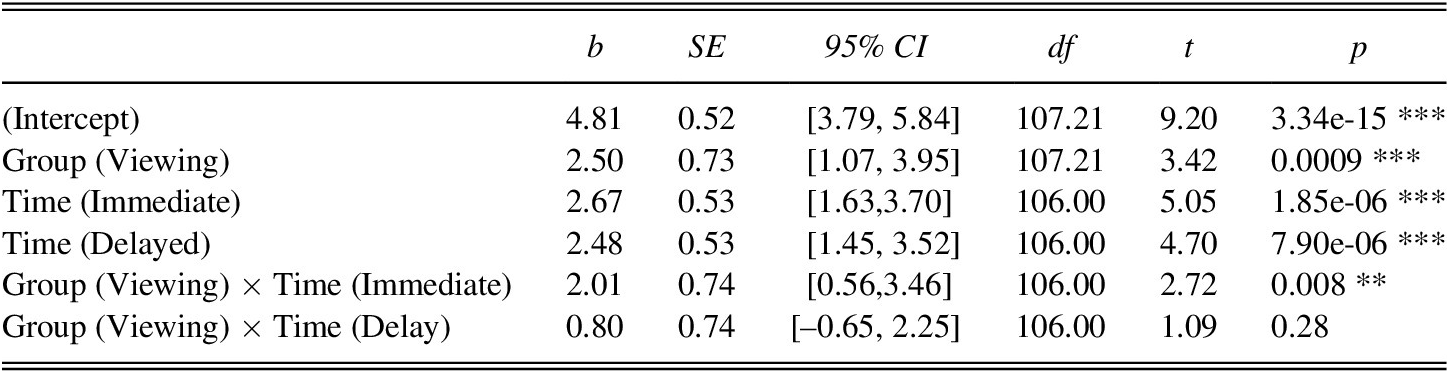
∗ p < .05; ∗∗p < .01; ∗∗∗p < .001 (two-tailed). The categories provided in parentheses are compared to the reference categories.
To further examine the differences, we conducted a series of pairwise comparison tests using the emmeans package with R with Bonferroni adjustment for multiple comparisons. The results showed that for each group, the estimate of mean of the pretest scores was always significantly lower than that of the posttests (p < 0.05), and there was no significant difference in the mean of the immediate posttest and the delayed posttest (p > 0.05). This suggests that both groups learned the target collocations at the form recognition level. No significant difference was found between the estimate of mean of the pretest scores of the control group and the experimental group (p > 0.05), indicating that at the beginning of the treatment, the two groups had similar knowledge of the target collocations at the form recognition level. However, the control group had significantly lower estimate of mean than the experimental group in both the immediate posttest and delayed posttest (p <0.001). This suggests that the treatment led to the learning of collocations at the form recognition level.
THE CONTRIBUTIONS OF FREQUENCY OF OCCURRENCE AND PRIOR KNOWLEDGE OF GENERAL VOCABULARY TO VOCABULARY LEARNING
Table 7 shows that in the case of single words, the frequency of occurrence significantly contributed to the model (p < 0.0001). The odd ratio values (Exp (B)) showed that as frequency increased by one unit, the odds of a correct response in the immediate posttest increased by 11% and the odds of a correct response in the delayed posttest rose by 12%. In contrast, prior knowledge of general vocabulary knowledge did not make a significant contribution to the model in any cases (p > 0.05 in all cases). Table 8 shows that in the case of collocations, neither frequency nor prior knowledge of general vocabulary had a significant contribution to the learning gains (p > 0.05).
Logistic regression for single words

Note: FoO = Frequency of occurrence; PVK = prior knowledge of general vocabulary.
Logistic regression for collocations

Note: FoO = Frequency of occurrence; PVK= prior knowledge of general vocabulary.
DISCUSSION
The current study extends previous research in several ways. It is the first study to investigate the learning of both single words and collocations through viewing a video of an unmodified academic lecture. In fact, this study is among the very few studies examining incidental learning of collocations. It is also the first study to explore the influence of frequency in the experimental lecture and prior knowledge of general vocabulary on the learning of both single words and collocations through viewing academic lectures.
DOES VIEWING AN ACADEMIC LECTURE LEAD TO INCIDENTAL LEARNING OF SINGLE WORDS AND COLLOCATIONS?
This study found that the experimental group learned an average of 4.07 out of 50 words (8.14%) from the pretest to the immediate posttest and 5.21 words (10.42%) from the pretest to the delayed posttest, while the control group learned an average of 2.48 words (4.96%) from the pretest to the immediate posttest and 2.77 words (5.54%) from the pretest to the delayed posttest. Similarly, the experimental group gained an average of 4.68 out of 19 collocations (24.63%) and 3.29 collocations (17.32%) from the pretest to immediate posttest and delayed posttest, respectively. Meanwhile, the learning gains of the control group was 2.66 collocations (14%) and 2.48 collocations (13.05%) from the pretest to the immediate posttest and delayed posttest. The increase from the immediate posttest to the delayed posttest across both the experimental and control groups indicated that the delayed posttest results were not attributed solely to the treatment but might be because of a learning effect from taking the tests. Testing effects are fairly common in studies of incidental vocabulary learning (e.g., Jin & Webb, Reference Jin and Webb2020; Webb et al., Reference Webb, Newton and Chang2013), which is why control groups are needed to ensure that gains can be attributed to treatments. In fact, this study found that there was no significant difference in the pretest scores of the two groups, but the experimental group always had higher posttest scores than the control group. This suggested that viewing an academic lecture led to a significant improvement in the learning of single words at the meaning recall level and collocations at the form recognition level.
This study found that watching an academic lecture resulted in a gain of 4.07 out of 50 words (8.14%) at the meaning recall level. This gain was comparable to the gains from viewing an academic lecture under a CALL setting: 3.2 out of 20 words (16%) (Smidt & Hegelheimer, Reference Smidt and Hegelheimer2004) and viewing three academic lectures: 16.69 out of 165 points (10.12%) (Yang & Sun, Reference Yang and Sun2013). By including a control group, this study provided solid evidence supporting the value of viewing academic lectures for learning single words.
Moreover, expanding on previous studies, the present study suggested that collocations could also be learned through viewing an academic lecture at the form recognition level. As this study is the first to explore incidental learning of collocations through viewing an academic lecture, it is impossible to compare its findings with those from previous research. Moreover, different researchers have focused on different kinds of input and collocations, which makes comparisons a little problematic. However, readers might be interested to know how the results of the present study compared to those from previous studies on incidental learning of collocations at the form recognition level. This study found that viewing an academic lecture led to a learning gain of 4.68 out of 19 collocations (24.63%). This amount was larger than the learning gains through reading stories (no significant learning gains) (Szudarski, Reference Szudarski2012; Szudarski & Carter, Reference Szudarski and Carter2016) and graded readers (2.04 out of 17 collocations) (12%) (Webb & Chang, Reference Webb and Chang2020) and listening to teacher talk (0.86 out of 10 collocations) (8.6%) (Jin & Webb, Reference Jin and Webb2020), songs (1.34 and 0.63 out of 7 collocations) (19.14%, 9%) (Pavia et al., Reference Pavia, Webb and Faez2019), and graded readers (2.58 out of 17 collocations) (15.18%) (Webb & Chang, Reference Webb and Chang2020). It was fairly similar to the gains from reading while listening to graded readers (4.64 out of 17 collocations) (27.29%) (Webb & Chang, Reference Webb and Chang2020) and reading stories (3.20 and 2.90 out of 6 collocations) (53.33%, 48.33%) (Pellicer-Sánchez, Reference Pellicer-Sánchez2017), and was lower than those found by Webb et al. (Reference Webb, Newton and Chang2013) with reading while listening to graded readers (6.53 and 8.24 out of 18 collocations) (36.28%, 45.78%). However, it is important to note that the present study used an unmodified academic lecture whereas Webb et al. (Reference Webb, Newton and Chang2013), Pellicer-Sánchez’s (Reference Pellicer-Sánchez2017), and Webb and Chang (Reference Webb and Chang2020) used modified nonacademic texts in which the occurrences of the target collocations in the input had been controlled. Therefore, the present study has greater ecological validity.
This study found that the viewing group could learn an average of more than four words at the meaning recall level and nearly five collocations at the form recognition level while the control group could learn an average of just over two words at the meaning recall level and nearly three collocations at the recognition level. Although the viewing group had significantly higher learning gains than the control group, the small number of lexical items learned by the viewing group may make readers wonder whether the gains are meaningful. Some may argue that it is more beneficial for students to spend time intentionally learning vocabulary than incidentally learning it through viewing academic lectures, because the former is likely to lead to a greater number of words learned than the latter.
However, there are several reasons why the learning gains found in this study are meaningful. First, this study only measured knowledge of single words at the meaning recall level and knowledge of collocations at the form recognition level, and only examined the learning gains of target lexical items. Yet research indicates that other aspects of vocabulary knowledge of the target items and nontarget items are also picked up through repeated exposure to meaning-focused input (Webb, Reference Webb and Webb2020). Therefore, the gains demonstrated in this study through viewing an academic lecture are likely to be smaller than occurred. In addition, watching academic lectures may help learners to realize how known vocabulary was used in specialized contexts and gradually acquire its specialized meaning. Second, in this study, the participants only watched a single lecture and watched it once. However, incidental learning is an incremental process. Studies have found greater learning gains from exposure to multiple texts than from a single text (Rodgers & Webb, Reference Rodgers and Webb2020; Webb & Chang, Reference Webb and Chang2015a, Reference Webb and Chang2015b). They have also shown that exposure to the same text multiple times resulted in greater learning gains than being exposed to the text once (Pavia et al., Reference Pavia, Webb and Faez2019). Thus, the learning gains would likely to be greater if learners were exposed to a larger number of academic lectures or repeatedly viewed the lecture. Third, in many EAP courses, like the one in the present study, explicit teaching of specialized vocabulary might be challenging because class time is limited and teachers do not have sufficient subject-specific knowledge. Viewing academic lectures offers good opportunities for learners to incidentally learn vocabulary in specialized input.
By indicating that academic lectures are a source of incidental learning of single words at the meaning recall level and collocations at the form recognition level, this study effectively expands on earlier research on incidental vocabulary learning, especially those that have shown that graded readers (e.g., Pellicer-Sánchez, Reference Pellicer-Sánchez2017; Webb et al., Reference Webb, Newton and Chang2013), television programs (Puimège & Peters, Reference Peters2019, Reference Peters and Webb2020), songs (Pavia et al., Reference Pavia, Webb and Faez2019), and EFL teacher talk (Jin & Webb, Reference Jin and Webb2020) are rich sources for L2 learners to learn collocations. This finding is important given that knowledge of formulaic sequences is essential for achieving a high language proficiency level (Siyannova-Chanturia & Pellicer-Sánchez, Reference Siyannova-Chanturia and Pellicer-Sánchez2019). It is even more encouraging given the limited amount of specialized spoken input in many EFL contexts (Dang, Reference Dang2020). The current study also supports the findings of corpus-based research that academic speech consists of a reasonable number of frequently occurring sequence of words (Biber et al., Reference Biber, Conrad and Cortes2004; Chon & Shin, Reference Chon and Shin2013; Coxhead et al., Reference Coxhead, Dang and Mukai2017; Dang, Reference Dang2018; Simpson-Vlach & Ellis, Reference Simpson-Vlach and Ellis2010) and may be a useful resource for incidental vocabulary learning.
There are two reasons why single words and collocations could be learned through viewing an academic lecture. To begin with, the vocabulary and content of the academic lecture were related to the participants’ academic major, which may draw their attention to the lecture and unfamiliar vocabulary. Moreover, the images used in audiovisual input such as the lecturer’s gestures or the words or formulas written on the board may help learners notice unknown vocabulary (Peters, Reference Peters2019; Rodgers, Reference Rodgers2018). Apart from the reasons shared with single words, there are two other reasons why collocations were learned through viewing an academic lecture. First, in audiovisual input, a collocation (e.g., homework lab, insertion sort) is spoken as a chunk without hesitations or pauses between its components, which might help learners to process the collocation as a single unit (Wray, Reference Wray2002). Additionally, the prosodic forms, intonations and stresses in the speech also make collocations salient in audiovisual input (Lin, Reference Lin2012). Together the findings of the present study add to the growing body of evidence supporting learning vocabulary through audiovisual input (Montero Perez, Reference Montero Perez2020; Peters & Muñoz, Reference Peters and Muñoz2020).
WHAT IS THE RELATIONSHIP BETWEEN THE VOCABULARY LEARNING THROUGH VIEWING AN ACADEMIC LECTURE AND FREQUENCY OF OCCURRENCE IN THE LECTURE AND PRIOR KNOWLEDGE OF GENERAL VOCABULARY?
Frequency of occurrence in the lecture appeared to make a significant contribution to the learning of single words at the meaning recall level in both the immediate posttest and the delayed posttest. The analysis showed that as frequency increased by one unit, the odds of a correct response increased in the immediate and delayed posttest by 11% and 12%, respectively. Previous studies also found a positive relationship between frequency and the learning gains through listening to (Vidal, Reference Vidal2003, Reference Vidal2011) and viewing (Yang & Sun, Reference Yang and Sun2013) multiple academic lectures. By examining the learning of single words through viewing one academic lecture, the present study expands on the earlier studies by showing the more times a word is encountered in an academic lecture, the more likely it is noticed and learned. This is important because topics may change across lectures and unfamiliar words that are encountered in one lecture may not necessarily be encountered in another lecture.
The present study, however, did not find a significant relationship between frequency and the learning of collocations at the form recognition level. This finding is in line with two earlier studies that found that frequency did not significantly contribute to the learning of collocations through reading graded readers (Pellicer-Sánchez, Reference Pellicer-Sánchez2017) and listening to teacher talk (Jin & Webb, Reference Jin and Webb2020), but contrasts Webb et al.’s (Reference Webb, Newton and Chang2013) and Webb and Chang’s (Reference Webb and Chang2020) finding related to reading while listening to graded readers. There are several reasons for the lack of a significant relationship between frequency and the learning of collocations. First, the range in number of encounters (1–9) with the target collocations in the present study might have been insufficient to reveal a significant relationship with learning. The difference between the results of the present study and Webb et al. (Reference Webb, Newton and Chang2013) and Webb and Chang (Reference Webb and Chang2020) may be due to the difference in range of frequencies between the three studies. In the earlier two studies, a larger range in frequency of encounters with target collations (1–15 in Webb et al. [Reference Webb, Newton and Chang2013] and 1–16 in Webb and Chang [Reference Webb and Chang2020]) may have better reflected the potential for a frequency effect. It may be that the smaller range in repetition of collocations in the lecture (1–9 encounters), teacher talk (3–6 encounters) and reading a graded reader (4–8 encounters) reduced the potential for frequency to contribute to incidental learning. However, because the present study included unmodified input, the findings may provide ecologically valid results for frequency effects for collocations in lectures. Second, other factors such as salience of the items in the input, the degree of elaboration for collocations in the input, the kinds of vocabulary (nonspecialized, administrative, academic, technical) may have a greater influence on the learning of collocations than frequency. Third, the form recognition format used to assess knowledge of collocations might have made the effect of frequency less salient. Uchihara et al.’s (Reference Uchihara, Webb and Yanagisawa2019) meta-analysis revealed that the effects of frequency on incidental vocabulary learning appeared to be smaller when vocabulary knowledge was measured at the recognition level than at the recall level. Fourth, a higher number of occurrences of the target collocations might be needed for frequency to have an impact. Given that few studies have examined the incidental learning of collocations and no studies have investigated the relationship between frequency and the learning of collocations in academic genres, the results of the present study provide further evidence of the complexity of the role of frequency on incidental vocabulary learning mentioned by earlier studies (e.g., Uchihara et al., Reference Uchihara, Webb and Yanagisawa2019), and suggest that further research on the role of frequency in incidental vocabulary learning of collocation is needed.
One unanticipated finding was the lack of a relationship between the prior knowledge of general vocabulary and learning gains in both the cases of single words and collocations. This finding contrasts the studies showing that prior vocabulary knowledge is significantly related to the learning of single words (e.g., Feng & Webb, Reference Feng and Webb2020; Horst et al., Reference Horst, Cobb and Meara1998; Peters, Reference Peters2019; Peters & Webb, Reference Peters and Webb2018) and collocations (Puimège & Peters, Reference Peters2019, Reference Peters and Webb2020). There are several possible reasons for the inconsistency in findings. First, previous studies have examined nonacademic genres (e.g., graded readers, television programs) while the present study focused on an academic genre. Knowledge of general vocabulary might not always support the learning of specialized vocabulary (Hyland & Tse, Reference Hyland and Tse2007). For example, several target words are among the most frequent 2,000 words of general vocabulary but also have technical meaning (e.g., uniform, squared). Students might know the general meaning of the words but not the technical meaning. Second, most studies examining the effects of prior knowledge have investigated the learning of the forms and meanings of words, while the present study looked at recognition of the forms of collocations. Because tests of prior vocabulary knowledge such as the UVLT tap into knowledge of form-meaning connection, the similarity between tests of prior knowledge and learning form-meaning connection may account for the difference in findings.
LIMITATIONS AND FUTURE RESEARCH
The present study has several limitations. First, for ecological validity, this study did not manipulate the examined lecture to control the number of occurrences of the target items. Apart from frequency and prior vocabulary knowledge, other factors such as word length, part of speech, elaboration, type of vocabulary (nonspecialized, administrative, academic, and technical) may affect the learning of single words and collocations. Therefore, cautions should be taken when generalizing the findings of the present study. Second, although it is unlikely that the participants in the experimental group would rely on their background knowledge in algorithms to answer the comprehension test, we did not do follow-up checking with participants to confirm this fact. Third, this study only measured knowledge of single words at the meaning recall level and knowledge of collocations at the form recognition level. Last, this study only examined vocabulary learning from one lecture style (“rhetorical style”).
A number of areas need attention in future research. First, research with graded readers (e.g., Webb & Chang, Reference Webb and Chang2015a, Reference Webb and Chang2015b) and television programs (Rodgers & Webb, Reference Rodgers and Webb2020) suggests that the amount of learning gain tends to increase according to the amount of input. Future research could explore whether the same pattern occurs with academic lectures. Second, with advances in technology, academic lectures are available in different formats (e.g., audios, transcripts, videos, and videos with captions). Future research could explore the learning of vocabulary in academic lectures through different modes of input. Third, the present study defined frequency as the number of times the target vocabulary occurred in the lecture because it is a common approach taken by research examining the effect of frequency on incidental vocabulary learning. Additionally, there were strong correlations between the frequency of the target lexical items in the lecture and their frequency in the academic spoken corpus in both the cases of single words (r = .70, p < .001) and collocations (r = .71, p=.001). If both frequency of occurrence in the lecture and frequency of occurrence in academic speech were entered into the model, there would be issues with multicollinearity. However, given that frequency in L2 input is an important factor contributing to vocabulary learning (Peters, Reference Peters and Webb2020), it would be useful to examine the effect of the frequency of the target vocabulary in language use at large. Fourth, apart from frequency and prior vocabulary knowledge, it would be useful for future research to explore the extent to which different factors such as elaboration and type of vocabulary (nonspecialized, administrative, academic, and technical) may influence vocabulary learning gains that occur through viewing academic lectures. Fifth, future research could explore how viewing academic lectures contributes to the development of form recall and form and meaning recognition for individual words and form and meaning recall for collocations. Sixth, when viewing academic lectures, learners are exposed to both academic language and new subject-specific content. It would be interesting to explore the relationship between learners’ lexical knowledge (and potential lexical gains) and their content knowledge. Finally, it would be also useful to investigate vocabulary learning through viewing other lecture styles (“reading style” and “conversational style”).
PEDAGOGICAL IMPLICATIONS
Recently many well-known universities (e.g., Massachusetts Institute of Technology, Yale University, Stanford University) have made their courses freely available online. The findings of the present study indicate that academic lectures from these courses can be potential sources for incidental L2 vocabulary learning. These findings are valuable given that in many EAP courses like the one in the current study, there is a need for students to understand academic spoken English (e.g., academic lectures) in their subsequent academic study, but resources to help students develop knowledge of academic spoken vocabulary are very limited and teachers do not have sufficient subject-specific knowledge and time to explicitly teach specialized vocabulary. Importantly, this study found that only viewing a single academic lecture could lead to learning of single words at the meaning recall level and collocations at the form recognition level. This is encouraging, especially when considering the fact that collocations are crucial for reaching a high level of language proficiency, and that they are difficult to learn (e.g., Siyannova-Chanturia & Pellicer-Sánchez, Reference Siyannova-Chanturia and Pellicer-Sánchez2019). This study found that frequency was likely to play a significant role in incidental vocabulary learning, or at least in the case of single words. Therefore, EAP teachers should provide opportunities for students to repeatedly encounter vocabulary in academic lectures. This could be done by asking students to repeatedly view the same academic lecture or viewing academic lectures from the same course in a sequence from the first to the last sessions. It would allow them to encounter specialized vocabulary in their field multiple times and at the same time develop subject-specific knowledge, which would then further support incidental vocabulary learning. Last but not least, this study revealed that prior knowledge of general vocabulary did not have a significant effect on incidental vocabulary learning through viewing an academic lecture. This finding suggests that teachers should not assume that a good knowledge of general vocabulary is sufficient for students to deal with academic spoken English. Apart from helping students learn new vocabulary, it is equally important to help them acquire specialized meanings of general vocabulary (Dang, Reference Dang2020; Dang et al., Reference Dang, Coxhead and Webb2017). Viewing academic lectures is an excellent way to raise students’ awareness of specialized meanings because vocabulary is used in subject-specific contexts.
CONCLUSION
The present study is the first attempt to investigate incidental learning of both single words and collocations through viewing an unmodified academic lecture. It is also the first study that has examined the influence of frequency and prior vocabulary knowledge on learning under this condition. The results suggest that (a) vocabulary learning is likely to occur through viewing an academic lecture, (b) frequency of occurrence is likely to affect the learning of single words, but not collocations, and (c) prior vocabulary knowledge does not seem to significantly contribute to the learning of single words nor collocations in a single academic lecture.
Supplementary Materials
To view supplementary material for this article, please visit http://doi.org/10.1017/S0272263121000474.


 Open access

