


Introduction
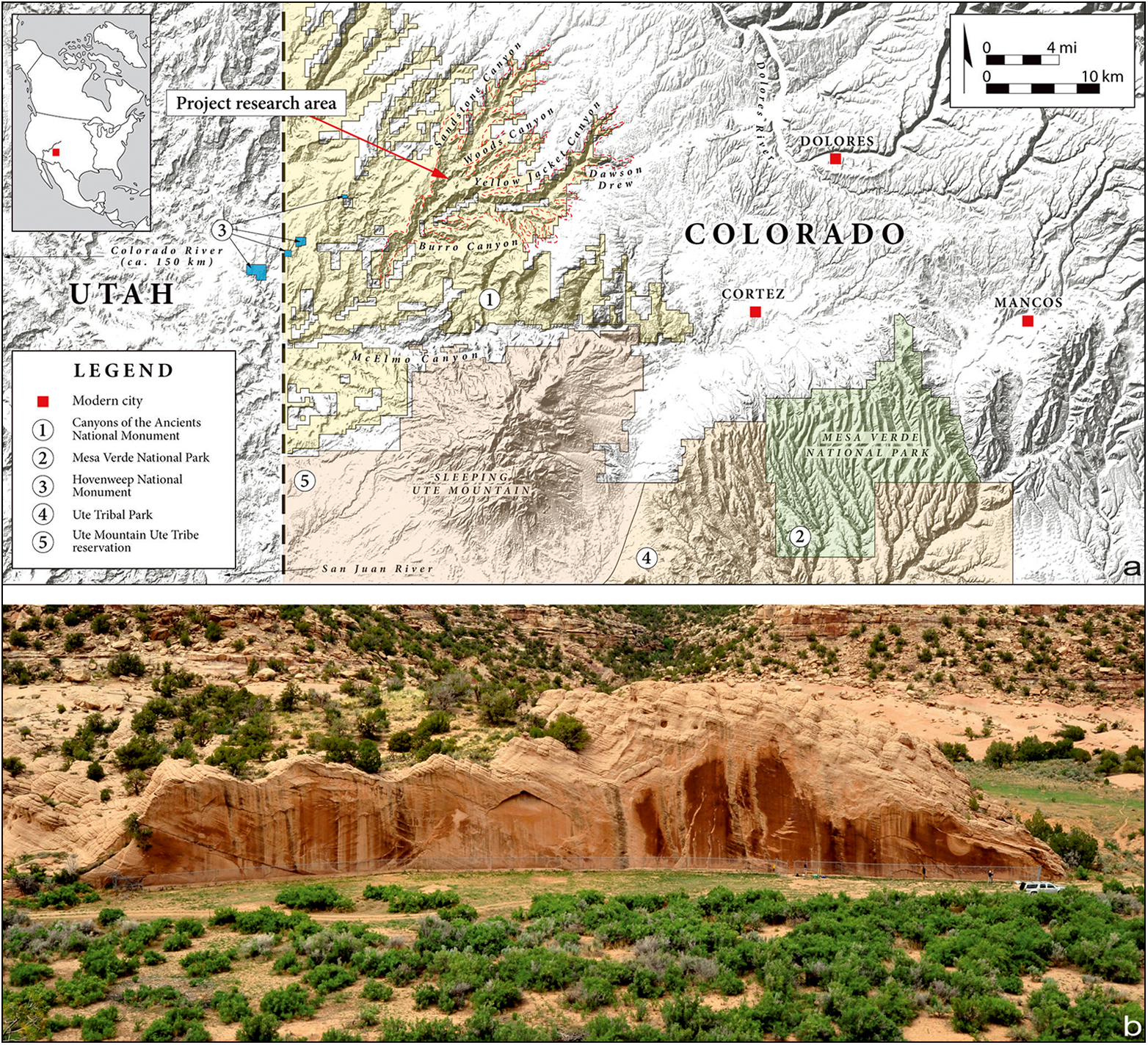
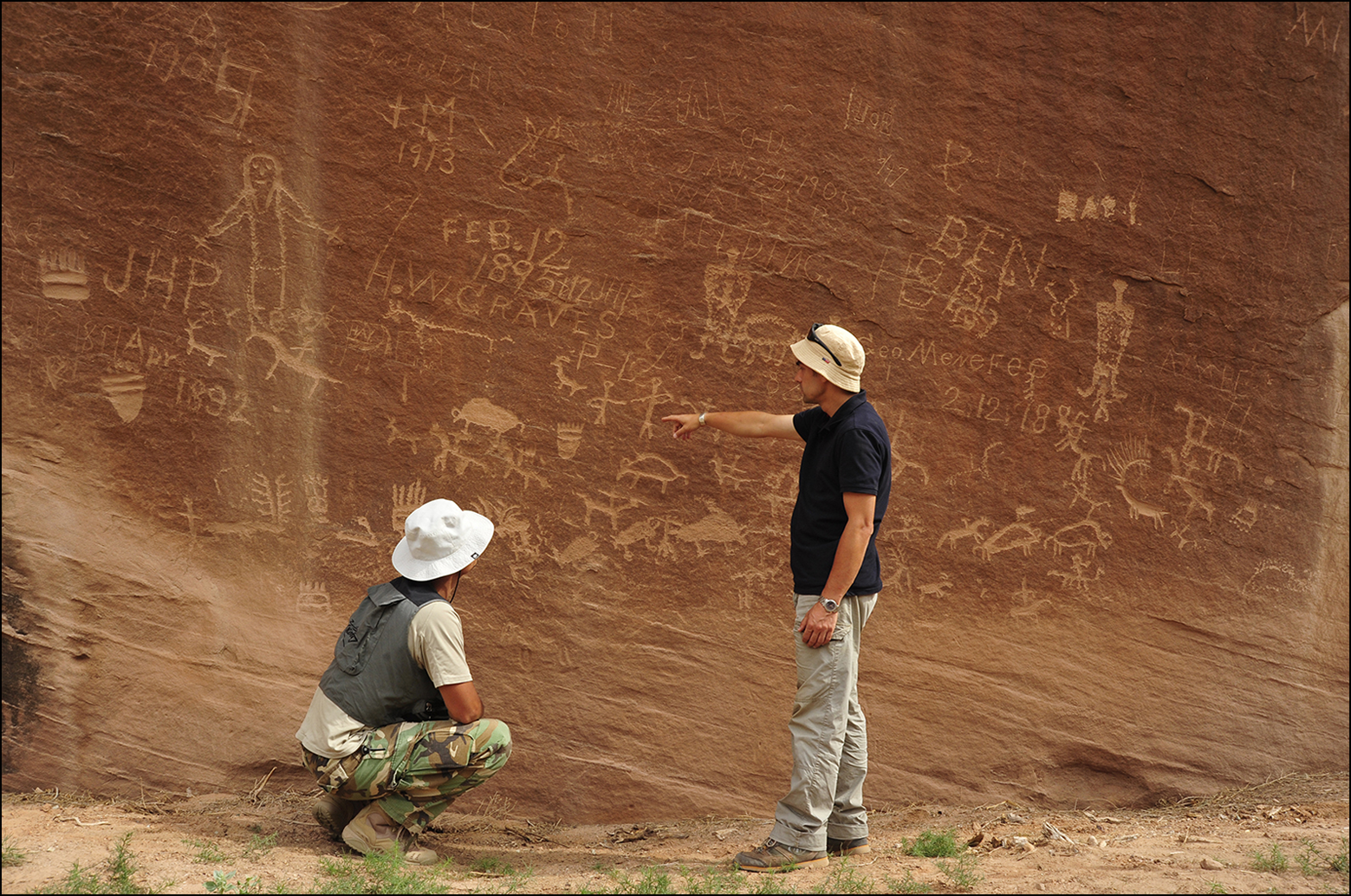
Rock art is one of the traces of pre-Hispanic and historic Indigenous cultures in the North American Southwest (e.g. Schaafsma Reference Schaafsma1980; Palonka Reference Palonka2022). The Painted Hand Petroglyph Panel/Strawman Panel (5MT13288), a 129m long and 26m high canyon wall, is located in the Canyons of the Ancients National Monument (CANM), in the Mesa Verde region of south-western Colorado (Figure 1). The panel contains a great density of petroglyphs of Ancestral Pueblo farming communities, dating back to at least the thirteenth century AD (if not earlier), historic hunter-gatherer Ute tribes, and inscriptions of Euro-American origin (Figure 2).
The location of the research area (a); (b) view of the site looking from the south (map by M. Znamirowski & R. Palonka, based on the USGS; photograph by R. Słaboński).
The central part of the Strawman Panel during documentation (photograph by R. Słaboński).
Methodology
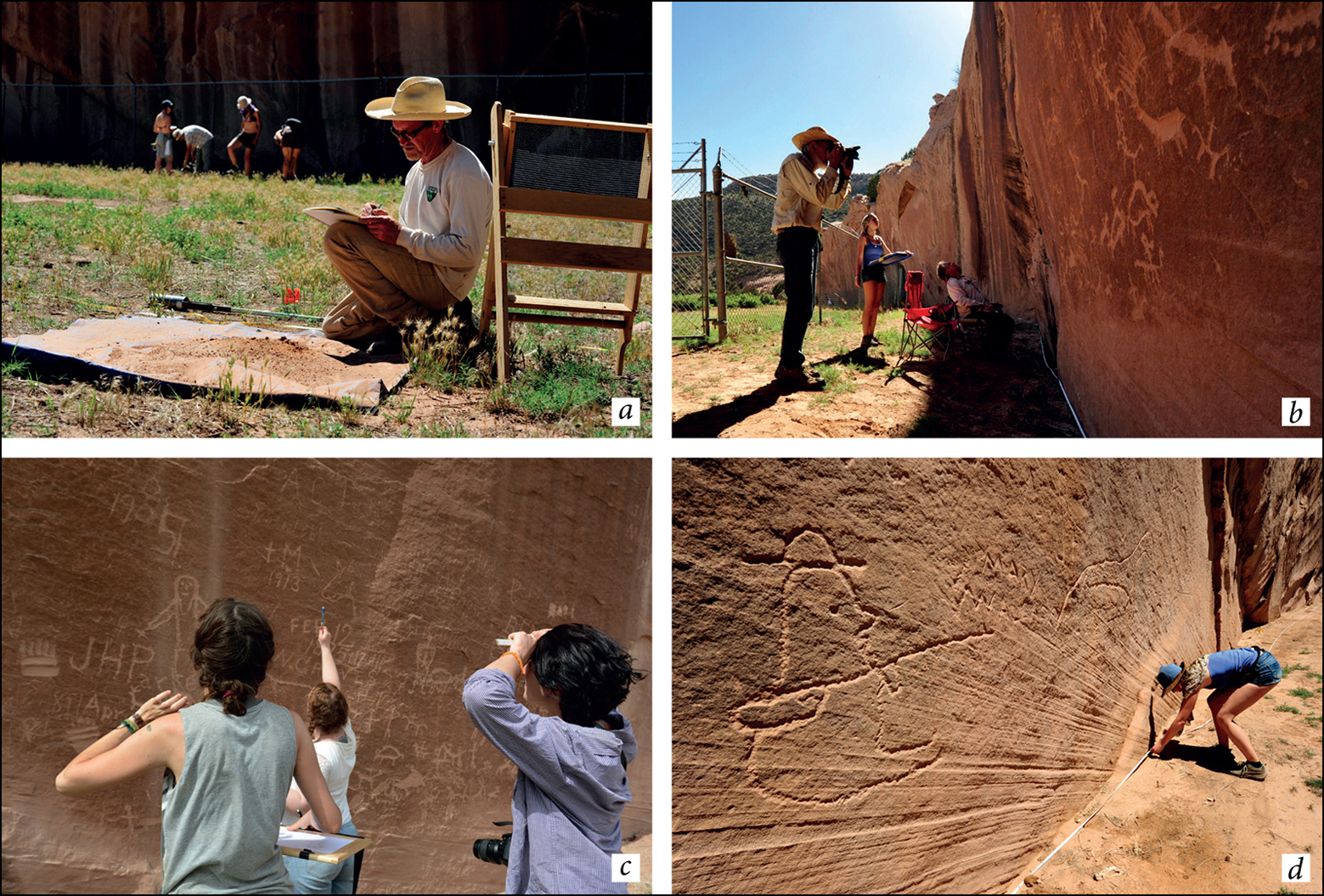
The Strawman Panel was first recorded in 1998 and 2005 (Bowman Reference Bowman1998; Cole Reference Cole2005). Since 2014, detailed digital documentation, geophysics research, sondage excavations and consultations with rock art scholars (Figure 3) have been conducted by the Institute of Archaeology, Jagiellonian University in Kraków (e.g. Palonka Reference Palonka and Rozwadowski2017; Palonka et al. Reference Palonka, Macmillan, Ciomek and Lewandowska2019, Reference Palonka, Lewin´ska and Zych2023; Palonka & Zych Reference Palonka, Zych, Medici, Döhl and Carrero2022; Schaafsma Reference Schaafsma2022), in cooperation with the CANM. The site is now protected from vandals and animals by a metal fence.
Examples of methods used: a) boreholes, excavations and geophysics; b) digital photography and consultations; c–d) hand tracing (photographs by R. Słaboński and R. Palonka).
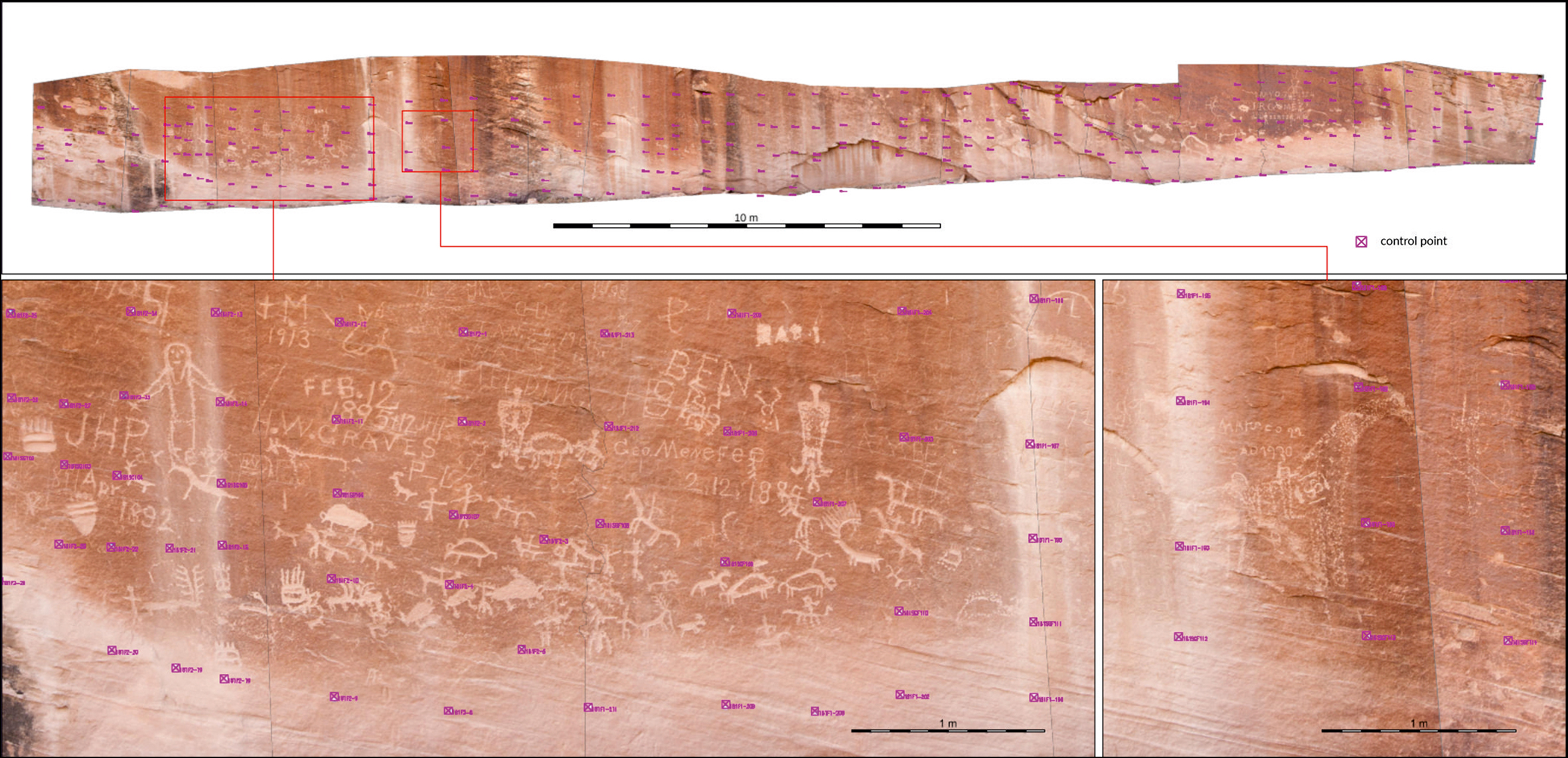
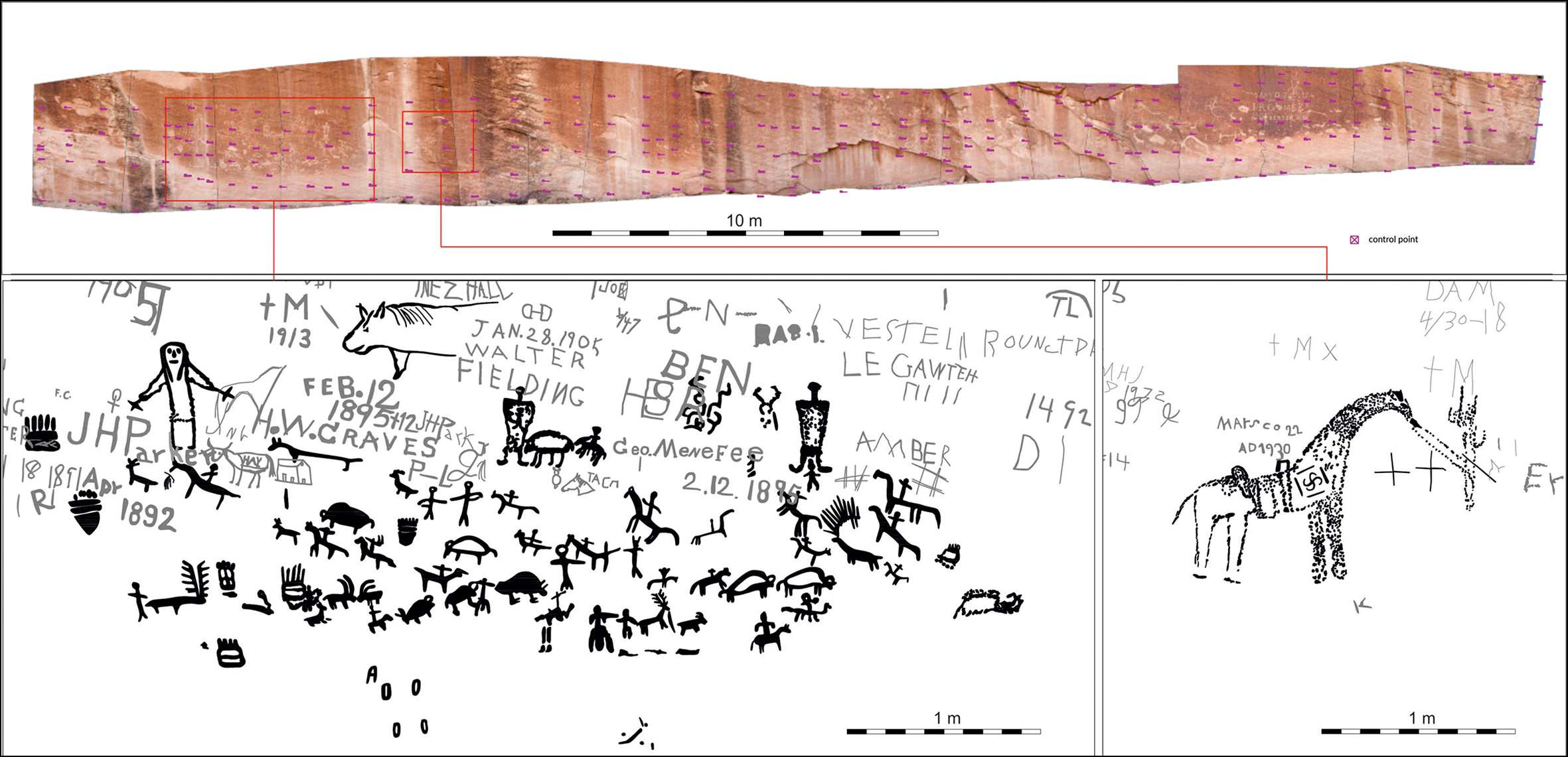
The main method for rock art documentation was single-image rectification photogrammetry (Remondino & Campana Reference Remondino and Campana2014; Historic England 2017: 9–11)—a method chosen for its accuracy and the limited time we were able to spend in the field. The team positioned 918 control points/markers between petroglyphs. Photographs were taken using a digital Nikon D700 camera with 24, 35 and 55mm lenses; a subsequent 2D drawing was made using AutoCAD and CorelDRAW graphic software (Figures 4 & 5). In the next field season, we checked the drawings based on the photogrammetry and found that 8–10 per cent of the images required hand tracing corrections, possibly because of the strong sunlight that shines on the panels for most of the day. This is a good example of the integration of traditional hand documentation and current digital methods for unveiling multi-level details of a site that is difficult to document. Such integrated methods could be applied at sites with abundant rock art around the world.
Examples of the documentation by single-image rectification photogrammetry (photogrammetry by P. Micyk and R. Słaboński).
Drawings of selected panels based on photogrammetry (photogrammetry by P. Micyk; drawings by K. Ciomek).
Panoramic photographs (using GigaPan EPIC Pro) and 3D laser scanning were also conducted for further analysis of the rock art and publication/presentation of results in digital format. These are available at: http://www.gigapan.com/gigapans/5cb2afa7d45e97293bcdab019c655d76 and: https://sketchfab.com/radek.palonka.
Cultural-chronological diversity
The chronological and cultural associations of the Ancestral Pueblo petroglyphs are well established, based on style, content and associated archaeological data by previous research in the region (Schaafsma Reference Schaafsma1980, Reference Schaafsma2022). The oldest Ancestral Pueblo petroglyphs (c. 1000‒1300 AD) include pecked and/or incised human figures with upraised arms and a few abstract motifs. They are located on the lowest section of the wall and have endured rough treatment by wind, soil deposits, sheep and cattle. Older Ancestral Pueblo petroglyphs may well be buried underground: our geophysics and test-pit excavations revealed the possibility that some structures are located approximately 1.6–2.0m deep (such accumulation of soil is probably due to catastrophic floods that occurred in the past).
The site predominantly features Ute historic figurative rock art, including clan or ritual symbols—bear paws, hunting of bison, deer or elk (sometimes hard to distinguish), and bighorn sheep; bison were probably not present (at least in large herds) in this region at that time (Plumb & McMullen Reference Plumb and McMullen2018; Palonka et al. Reference Palonka, Macmillan, Ciomek and Lewandowska2019) and Ute hunters would have had to travel several hundred kilometres to find them. Other depictions include pedestrians, some with dogs, possible animal drives and riders on horses, and hunters/warriors with bows, arrows and firearms (Figure 5). Narrative scenes are located mostly near the base of the central and eastern part of the site; most figures are solidly carved, although there are a few bison in outline. Some pecked horses, deer, possibly mountain lion, and water birds are distributed at a higher level, suggesting that they represent the later Ute Representational style (1880–1950 AD) (see Figure 3d), based on their iconography. Sometimes superimposition is difficult to evaluate, where the images have the same degree of patina due to the lack of a significant time gap between their creation.
Spanish/Mexican-American names, dates and cattle brands are numerous throughout. There are some notable local names still recognised today, including “Joe Ismay” (the Ismay Trading Post was established in 1921); “Melvin Forest”, the government trapper; or members of the Tozer family. Some of the stock brands carved in the wall are still in use. There is at least one signature (Ira C.) and date (1936) left by Ira Cuthair—a famous Ute rodeo cowboy.
Conclusions
The main methods we used to record rock art at Strawman Panel were photogrammetry and laser scanning. The benefits of photogrammetric documentation are its combination of accuracy and the ability to gather large quantities of data in a short time, at a relatively low cost. Following our analysis, Strawman Panel's history can be divided into three periods:
1) pre-Hispanic: Ancestral Pueblo farming communities (c. 1000–1300 AD, possibly also earlier); at the end of the thirteenth century, Ancestral Puebloans migrated out of the present Utah-Colorado border to north-central Arizona and New Mexico (Kohler et al. Reference Kohler, Varien and Wright2010; Palonka Reference Palonka2022);
2) historical: nomad Ute and possibly Navajo tribes (fifteenth/seventeenth to nineteenth/early twentieth centuries); and
3) late historic: Spanish-Mexican and American missionaries, shepherds and cattle ranchers who travelled through and settled nearby.
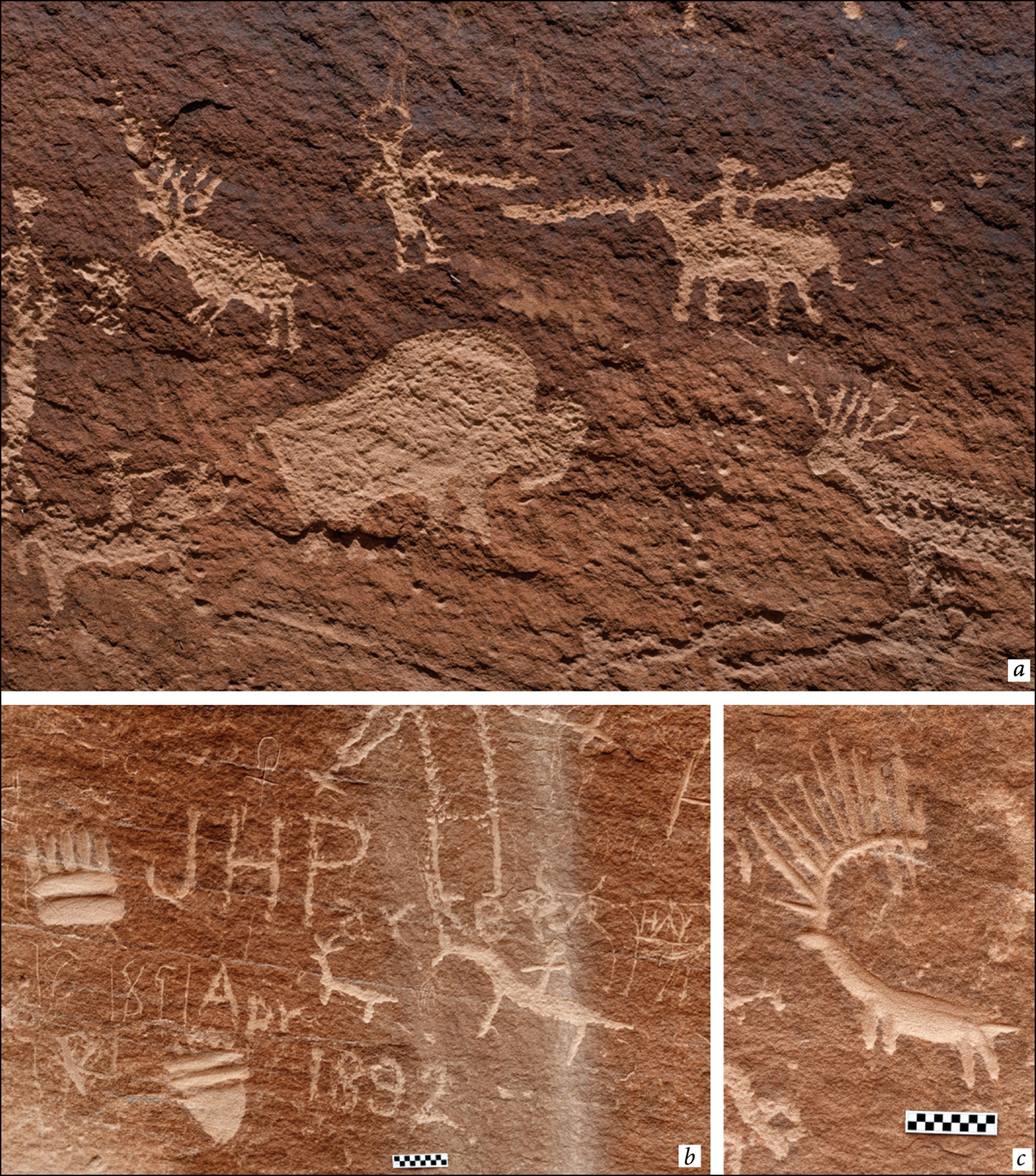
Some of the oldest rock art is underground, probably buried by early twentieth-century catastrophic floods and the resulting deep-soil deposits; our surveys revealed that floods had also occurred earlier. Ute petroglyphs prevail at the site, with depictions of hunters and warriors, as well as bison, deer and bighorn sheep (Figure 6). Nevertheless, some of the later pictorial content, such as larger, cartoon-like people, animals and houses, make it difficult to differentiate between the work of Ute and Anglo-Hispanic cowboys and sheep-herders as they all participated in a common ‘cowboy culture’.
Details of historic rock art: horseback riders, hunting/fighting scenes, bison, deer/elk, and bear tracks of Ute origin (the cultural origins of the latter are ambiguous), and initials and dates of 1891 and 1892 (photographs by M. Znamirowski & J. Śliwa).
Inevitably, many cultures contributed to the figurative inventory at this site—Indigenous and newcomers alike; they all created the history of this unique place.
Acknowledgements
We are very thankful to Canyons of the Ancients National Monument and Crow Canyon Archaeological Center, Colorado. Access to the site was permitted by Bob Johnson and Mary Austin, and datums were established by Gerald Huddleston. Rock art/historical inscription consultants were Curtis Schaafsma, James D. Keyser and Fred Blackburn; the panels were initially scanned by Jakub Śliwa and Bogumił Pilarski; the site was investigated with the help of students from the Institute of Archaeology, Jagiellonian University in Kraków.
Funding statement
This research was financed by the National Science Centre, Poland (grant UMO-2017/26/E/HS3/01174) and CANM/US Bureau of Land Management.


 Open access

