


Introduction
The role of architecture in defining cultural entities is a central theme of discussion in archaeology. The development of ‘monumental’ building is often regarded as a sign of cultural progress (e.g. Clark & Reepmeyer Reference Clark and Reepmeyer2014), together with other factors such as social hierarchies or writing systems. This article argues that the generalised distinction between ‘monumental’ and ‘non-monumental’ architecture is not the result of careful research based on available evidence, but is an assumed paradigm imposed onto archaeological remains. I claim that archaeology is in a good position to pioneer the rejection of this distinction, and that challenging this paradigm—just like the questioned differentiation between objects of art and other kinds of material culture (Dean Reference Dean2006)—would be beneficial for our discipline.
The word ‘monument’ stems from the Latin monēre, which translates to ‘remind’. In its most original meaning, a ‘monument’ is a mnemonic device, marking a place or recalling a particular episode in the collective memory of a population. In this sense, monuments are symbols, and may be buildings, sculptures or natural features of the landscape with meaning for a group of people. The word ‘monumental’ has also come to be synonymous with ‘big’, used to describe objects, buildings or natural features of large size. In this sense, a mountain such as Everest may be described as ‘monumental’, as may the Great Pyramid of Giza.
But it is a different acceptation of the term that concerns this article: ‘monumental’ as a supposed characteristic of architecture, which is linked to the representational role of buildings. In this sense, ‘monumental’ is to a building what ‘artistic’ is to an object. It is related to its value, and to the intellectual merit of its creation. Like objects of ‘art’, the design of ‘monumental’ structures goes beyond mere functional needs to attain additional meaning. The opposite of ‘monumental’ building in this sense is ‘craft’, ‘functional’ or simply ‘non-monumental’ architecture. This paradigm has also been expressed as the distinction between ‘singular’ buildings and ‘ordinary’ ones, ‘architecture’ (Architektur) and mere ‘building’ (Gebäude) (e.g. Pevsner Reference Pevsner1963: 15; Schirmer Reference Schirmer1990), “‘high’ or ‘academic’ or ‘art’ architecture versus vernacular architecture, … elite versus popular aesthetics” (Upton Reference Upton2002: 709). This diversity of definitions and terms makes the problem at hand particularly elusive. While the differentiation between two distinct kinds of architecture is present in our discussions, there is not one word universally used to refer to these ‘singular’ buildings in the same way that ‘art’ designates a particular kind of material culture. And this may be why the associated inconsistencies have gone largely unnoticed, hiding in plain sight.
‘Monumental’ architecture—a social construct
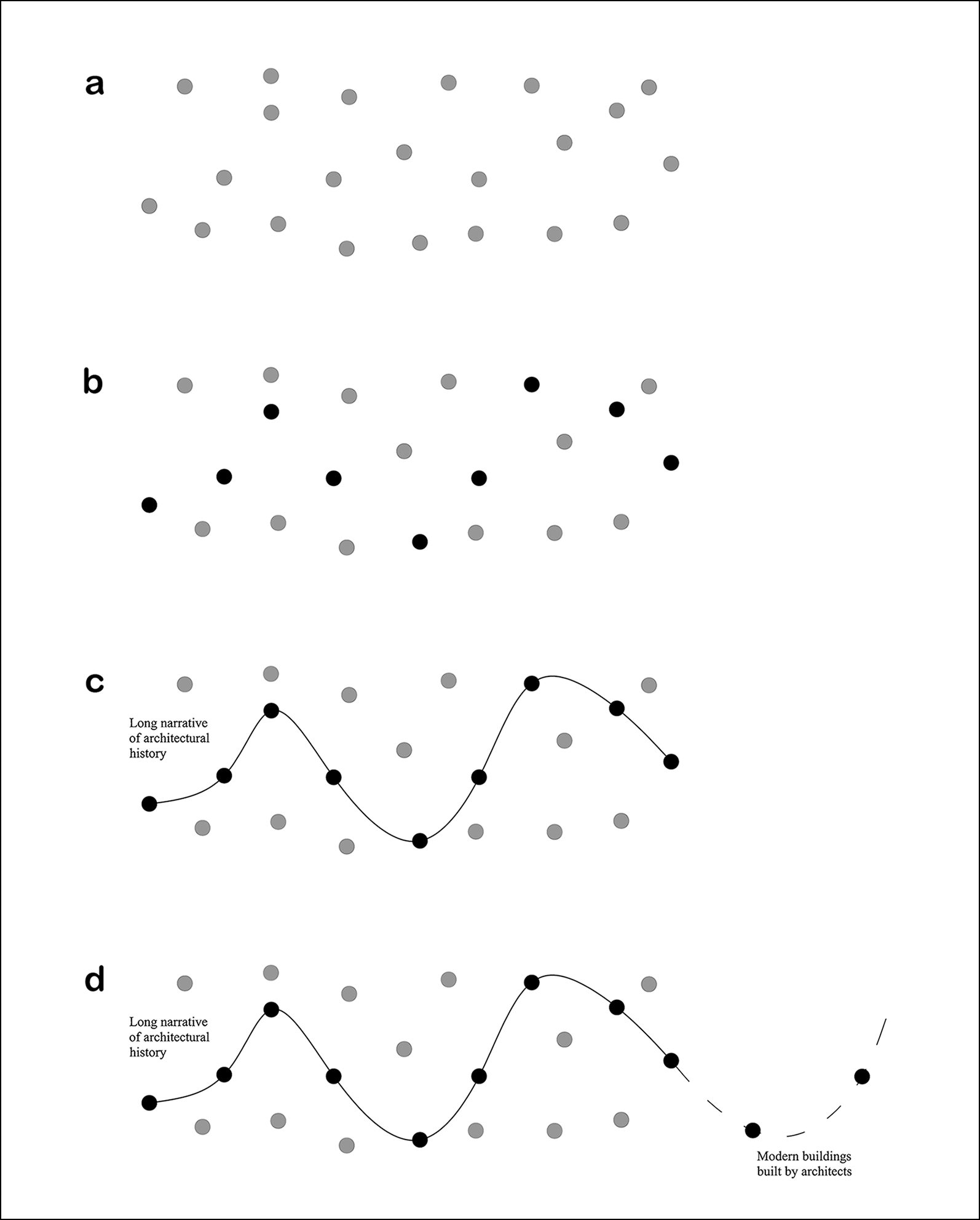
There is no consensus on what ‘monumental’ as a characteristic implies, as shown by extant debates about the very definition of the term (Levenson Reference Levenson and Buccellati2019). This is because designating a building as ‘monumental’ does not describe an objective characteristic inherent to the building, such as a material or a colour, but is instead a social construct. The framework stems from narratives constructed by humanists since the Italian Renaissance (c. fourteenth–seventeenth centuries), which were taken up and reinforced by architects in the eighteenth and nineteenth centuries when architecture was professionalised as a discipline. Through this discourse architects differentiated themselves from “uneducated, unskilled and immature practitioners”, as professed in an undated (c. 1883–1885) transcript of the annual address to the American Institute of Architects by Thomas U. Walter (Upton Reference Upton and Ockman2012). In defining their profession, architects reviewed and reassessed older (and newer) buildings, which led to many of the earlier historical accounts of architecture being authored by architects themselves (e.g. Stuart & Revett Reference Stuart and Revett1762; Pugin Reference Pugin1836). Some buildings were considered part of the intellectual development whose legitimate heirs were architects, while other structures were disregarded for not being considered worthy of attention (Figure 1). Such historical narratives served as inspiration for the writing of architectural treatises, and placed architects as part of a much larger tradition that justified their socioeconomic status (Upton Reference Upton1991: 195).
a) Circles representing a group of buildings; b) some buildings are identified as ‘monumental’; c) a narrative is built around the changes observed in those buildings, ignoring other structures; d) newly built buildings are presented as the continuation of that supposed long intellectual tradition (figure by author).

Figure 1 Long description
The scatter plot consists of four sections labeled a, b, c, and d. Section a displays a grid of evenly spaced gray circles representing a group of buildings. Section b highlights some of these circles in black, identifying them as monumental buildings. Section c introduces a wavy line connecting some of the black circles, illustrating a narrative of architectural history while ignoring other structures. Section d extends this narrative with a similar wavy line and adds a few new black circles on the right side, representing modern buildings built by architects. The plot visually argues that newly built buildings are presented as a continuation of a supposed long intellectual tradition.
The architectural historian Sigfried Giedion, the artist Fernand Léger and the architect José Luis Sert defined monuments as “human landmarks which men have created as symbols for their ideals, for their aims, and for their actions. They are intended to outlive the period which originated them, and constitute a heritage for future generations” (Sert et al. Reference Sert and Giedion1958: 48). They went on to say that “monuments are the expression of man’s highest cultural needs” and that “every bygone period which shaped a real cultural life had the power and the capacity to create these symbols” (p.48). In this manifesto, the authors argue that the “people want the buildings that represent their social and community life to give more than functional fulfilment”, calling on architects to build monuments, as they had for too long focused on “the simpler problems, the more utilitarian buildings like low-rent housing, schools, office buildings, hospitals” (p.49).
Although such notions of architecture were not unfamiliar to archaeologists of the time (e.g. Childe Reference Childe1950: 12), definitions of ‘monumental’ architecture have become greatly nuanced over the past decades. Bruce Trigger (Reference Trigger1990: 119) stated that the principal defining feature of ‘monumental’ architecture is “that its scale and elaboration exceed the requirements of any practical functions that a building is intended to perform”. Bernard Knapp (Reference Knapp2009: 47) also emphasised the large size and complexity of ‘monumental’ buildings, which he defined as “culturally constructed places, enduring features of the landscape that actively express ideology, elicit memory and help to constitute identity”. More recently, Anne Teather (Reference Teather and Gebaer2020: 10) defined a monument as “a type of prehistoric archaeological site whose construction typically followed a normative design, required considerable effort to create and was likely to have had enduring social meaning for both its creators and for succeeding generations of people”.
These definitions could be applied to most buildings, ‘monumental’ or not: houses—a paradigmatic example of ‘non-monumental’ architecture—often follow similar designs (which could be called normative), require considerable effort to build (at least considering the capacity of those who build or commission them) and have enduring social meaning for the families that inhabit them, often over generations (e.g. Düring Reference Düring2007). Domestic architecture expresses ideology, shapes memories and identities, and is often built in scales that exceed its practical functions (Steadman Reference Steadman2015: 221–34). Just like the clothes that we wear, the houses that we inhabit have a representational role that reflects our identities—whether we consider this feature part of their practical function or not is a subjective matter.
The blurriness of the limits between ‘monumental’ and ‘non-monumental’ structures has been noted before. Already in the previous century, Andrew Sherratt (Reference Sherratt1990: 147) had argued that it would be misleading “to approach all monumentality with the same model in mind” and advised against the mistake of seeing the effort devoted to special and other kinds of buildings as fundamentally different in character. More recently Edward B. Banning (Reference Banning2011: 619) warned us of the biases that come along with this distinction, arguing that the identification of non-domestic ritual buildings in the Near Eastern Neolithic “is often equivocal or depends on ethnocentric distinctions between sacred and profane spaces”. The ongoing debate about the character of the buildings of Göbekli Tepe, Türkiye (c. tenth–ninth millennia BCE (Dietrich Reference Dietrich2011)), and whether they should be understood as ‘special’/‘ritual’ or ‘residential’ is illustrative (Banning Reference Banning2011; Hodder Reference Hodder and Gebaer2020; Kinzel & Clare Reference Kinzel, Clare and Gebaer2020; Banning Reference Banning2023). As recent studies show, the architecture of this site does not adhere to these binary categories but “is much more complex and shows a much more extensive range of building types than previously described”, while “the earlier focus on the ‘special buildings’ with their unique sculptured T-shaped pillars has culminated in a myopic view that disregards the other structures at the site” (Kinzel & Clare Reference Kinzel, Clare and Gebaer2020: 34).
Three-dimensionalism and architectural change as evolutionary process
Three-dimensionalism is at the heart of our contemporary Western perception of architecture, and the assumptions derived from it are often present, even if implicitly, in our interpretations of archaeological sites. On an ontological level, a three-dimensional perspective assumes that objects (or buildings) are wholly present, in their three spatial dimensions, at any given time. From this point of view, a building is formed by its spatial parts (bricks, walls, etc.) and comes into being through its initial construction to then persist through time (Sider Reference Sider2001: 63). In contrast, a four-dimensional view considers a building at a particular moment as only one of its temporal parts, and the whole building as a ‘space-time worm’ formed by all of its temporal components (Sider Reference Sider2001: xiv).
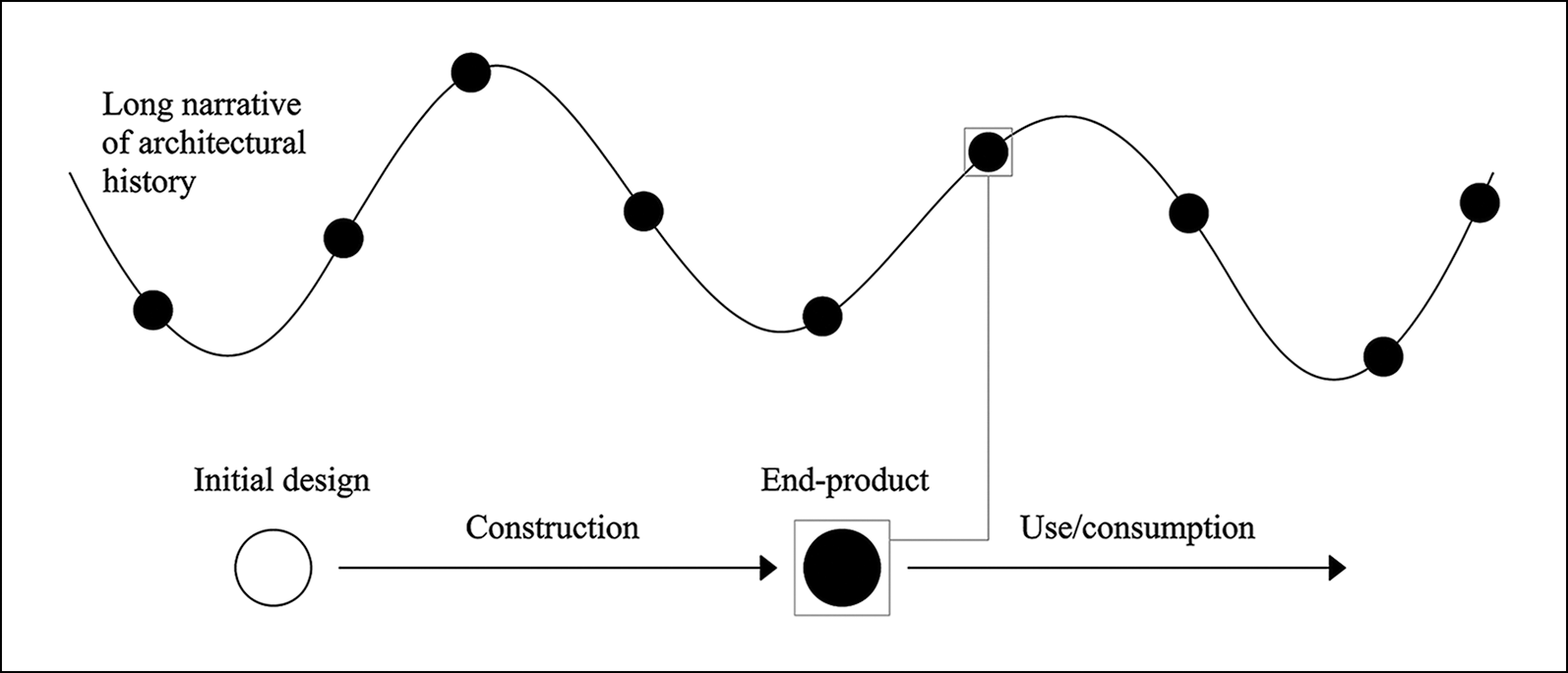
Through a three-dimensional lens, the construction process is perceived as the means to obtain an end-product that is ready to be used. This creates a dichotomy between the construction process, when a building is considered fluid and dynamic, and its time of use, when the structure is perceived as static and stable. This approach adequately suits the mode of production that followed the demands of the nascent collective of professional architects in the nineteenth century. In limiting access to a growing and tantalising market this collective required that building ventures be led only by licensed architects (Upton Reference Upton1991: 195). The initial creative stage of architectural production was presented as a highly intellectual enterprise, unattainable to non-trained builders—whose actions were thereby presented as improvised or spontaneous, lacking intellectual reflection and merit. The shape of the end-product, as conceived by the architect, may have a place in historical narratives of architecture (Figure 2). Unless made by another ‘genius’ architect who could interpret the needs of the space, later modifications or additions to the structure are perceived as secondary or intrusive. By this token, scholars have often searched for the original shape of buildings in the past (e.g. Alarcón Robledo Reference Alarcón Robledo2018; Arnold Reference Arnold2023: 59–67).
The construction process is perceived as the means to obtain an end-product that is ready to be consumed. This final shape of the building may have a place in the histories of architecture (figure by author).

Figure 2 Long description
The line graph depicts the long narrative of architectural history, with several peaks and troughs indicating significant changes over time. The timeline starts with the initial design phase, represented by a circle, followed by the construction phase leading to the end-product, marked by a black dot. This end-product then enters the use or consumption phase. The graph highlights various points in architectural history where notable changes or developments occur, illustrating the dynamic nature of architectural evolution. All values are approximated.
Another bias derived from this three-dimensional perspective of architecture that often permeates archaeology is the idea that only ‘special’ buildings require planning. In an analysis of Çayönü Tepesi, Türkiye (c. ninth–seventh millennia BCE), for instance, Wulf Schirmer (Reference Schirmer1990: 364) dealt with the very origins of architecture, departing from “the principle that not every simple building can be classified as ‘architecture’, for the term ‘architecture’ implies conscious planning which manifests itself in aspects of order and form revealed in the outer appearance as well as the internal plan of buildings”. ‘Architecture’ should be understood here in the German sense, equivalent to ‘monumental’. Generally, all architectural undertakings, ‘monumental’ or not, require some degree of prior planning. The supposedly unique need for planning often leads to the assumed presence of architects in the construction of ‘monumental’ architecture. It is common to find references to Imhotep as the architect of the step pyramid at Saqqara, to Senenmut as that of Hatshepsut’s buildings, or to Iktinus and Kallikrates as the architects of the Parthenon (e.g. Kostof Reference Kostof and Kostof1977). While we know that these individuals played relevant roles in the constructions of their time, we are far from understanding their specific responsibilities, and we cannot assume that they operated under the paradigms of modern Western architecture. Calling them architects seems, at the very least, anachronistic.
One more relevant bias that derives from three-dimensionalism is the perception of architectural change as an evolutionary model. In the view of a three-dimensionalist, the shapes that result from the culmination of construction processes can be compared to organise the end-products in sequences of gradual architectural development (Figure 2). If ‘monumental’ buildings are the cultural expression of the society that produces them, then variations in their design are proxies for the society’s intellectual advances (e.g. Arnold Reference Arnold2022). Every building is thus understood as an adaptation or replication of pre-existing ones, with structures that occasionally differ from their predecessors (Kubler Reference Kubler1962; Schirmer Reference Schirmer1990: 364). Buildings are thereby deemed historically relevant insofar as: 1) they embody cultural meaning, representing a moment in the development of a cultural trend; 2) they present changes in comparison with previously built structures; and 3) they serve as a model, influencing the production of later buildings. These narratives often ignore ‘non-monumental’ buildings, and the ‘beginnings of architecture’ have often been equated (or rather mistaken) with the beginnings of ‘monumental’ architecture (e.g. Giedion Reference Giedion1964; Hyman & Trachtenberg Reference Hyman and Trachtenberg1986; Schirmer Reference Schirmer1990).
I do not intend to imply that every archaeologist abides by such narratives. On the contrary, our discipline has pioneered alternative views. Scholars have incorporated the fourth dimension by describing monuments as culturally built places made by the continuous intertwining of human activities that imbue buildings with memories and values, and that acquire special relevance for the identity of the societies that inhabit them (e.g. di Lernia Reference di Lernia2013; Harmanşah Reference Harmanşah2015; McFadyen Reference McFadyen, Bille and Sørensen2016; Brysbaert Reference Brysbaert and Brysbaert2018; Fisher Reference Fisher2023). Building biographies, which consider structures as active agents, also address the long-term entangled relationships between people and buildings. The fact that such approaches were initially more common in studies within the domestic sphere (e.g. Düring Reference Düring2007) may be related to the fact that our perception of ‘non-monumental’ structures was less affected by the premises of a three-dimensional view, since their fluidity and constant change were more widely accepted.
De-monumentalisation of ancient Egyptian architecture
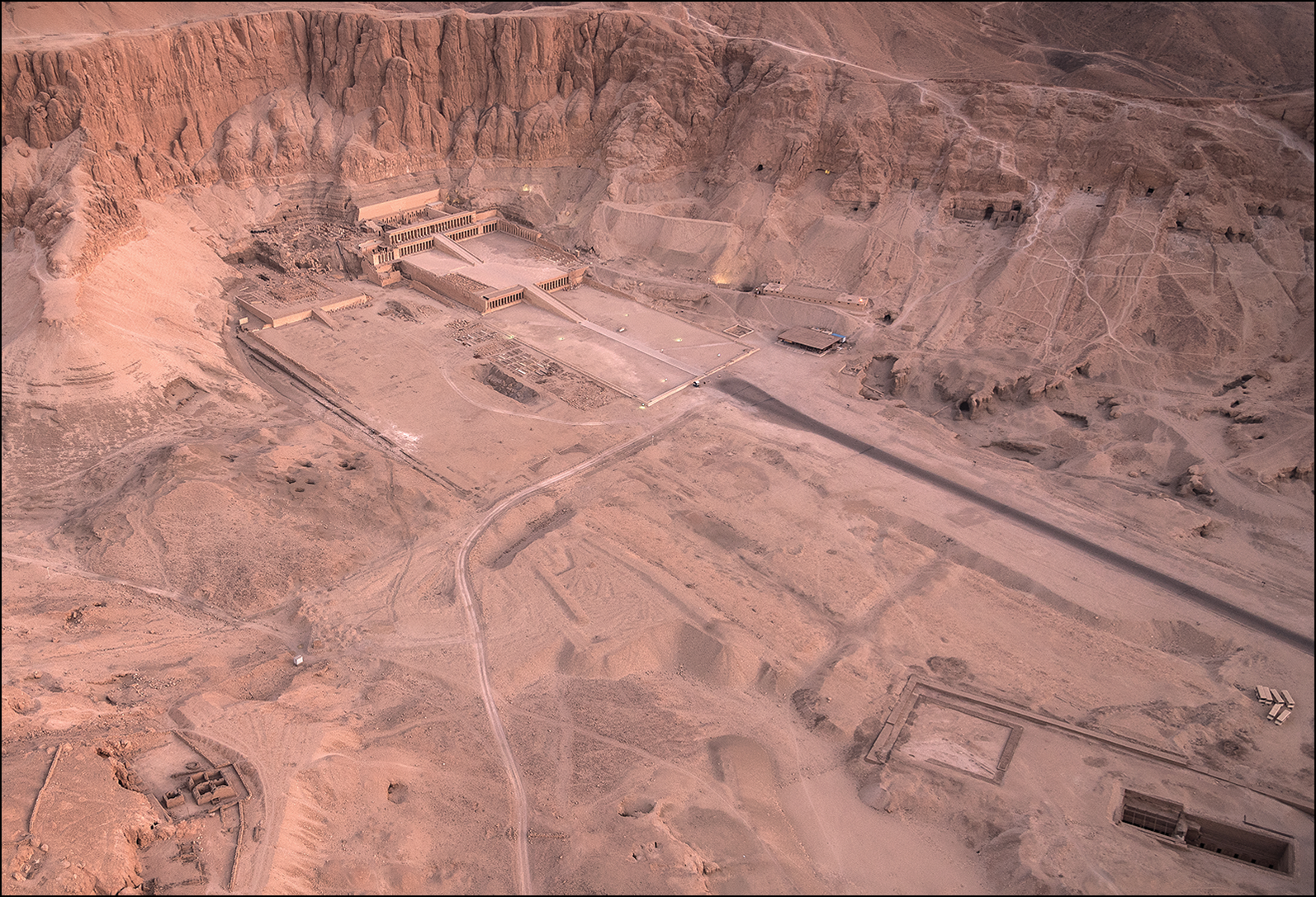
Few would argue that ancient Egyptian tombs and temples are not ‘monumental’. Advanced knowledge and complex planning were doubtless necessary for these building ventures. Their religious purpose, large scale and durable materials have turned ancient Egyptian architecture into the example par excellence of ‘monumental’. Here, I use the example of the temple of Hatshepsut (c. 1479–1458 BCE) at Deir el-Bahari, Egypt (Figure 3), to showcase the interpretative assumptions carried with our modern perspective of built environments.
Aerial view (looking north-west) of the temples of Hatshepsut and Mentuhotep II in Deir el-Bahari, Luxor West Bank, Egypt (photograph © Patricia Mora Riudavets; licensed use only).

Figure 3 Long description
An aerial view looking north-west captures the ancient temples of Hatshepsut and Mentuhotep II nestled in the cliffs of Deir el-Bahari on the west bank of Luxor, Egypt. The temples are surrounded by a rugged, arid landscape with winding paths leading to the structures. The temple of Hatshepsut, known for its terraced design, is prominently visible, while the temple of Mentuhotep II is situated nearby, showcasing the architectural grandeur of these historical sites.
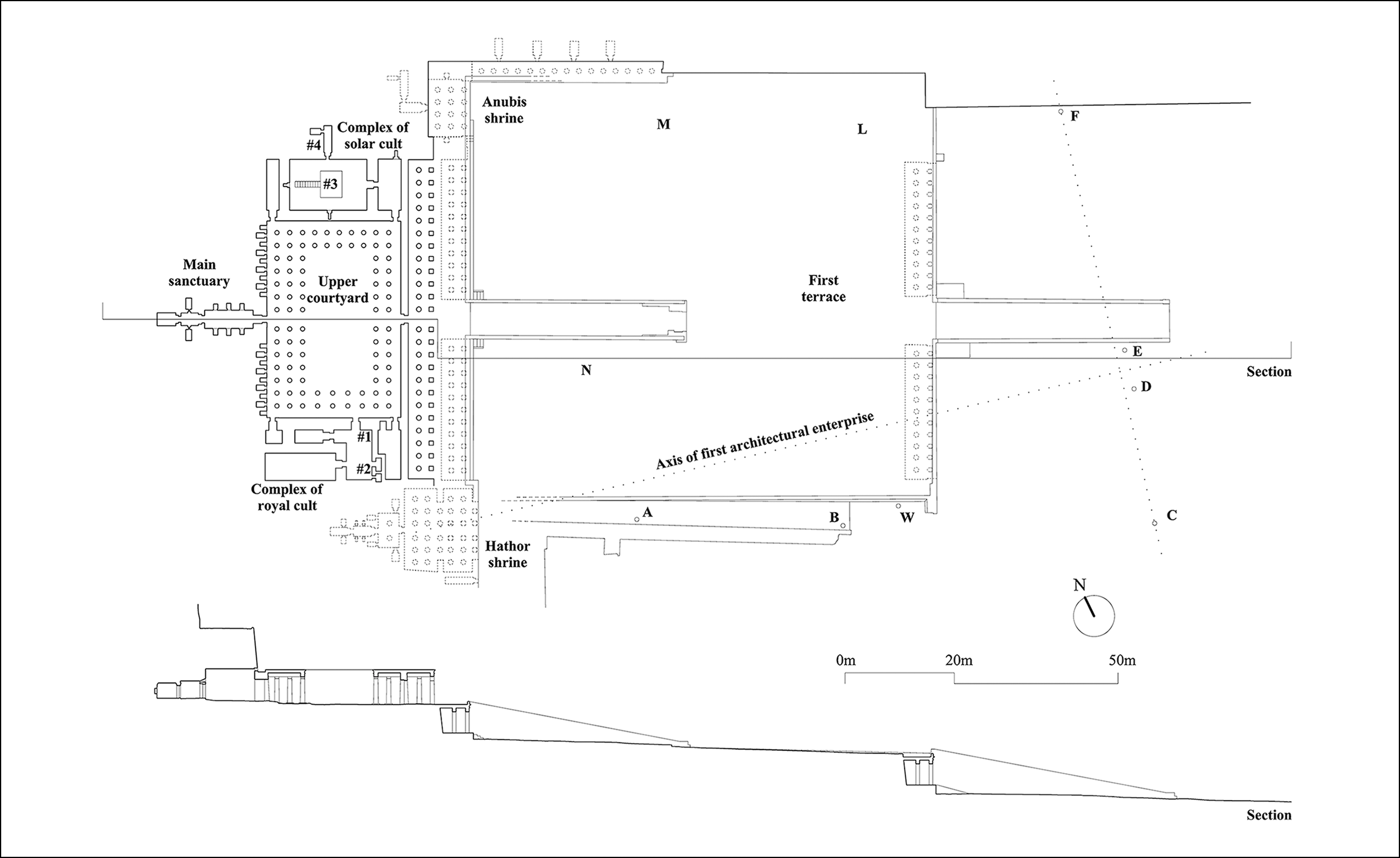
The temple of Hatshepsut at Deir el-Bahari is a terraced structure, formed by two platforms elevated from the ground and connected by large ramps (Figure 4). These ramps created a processional route along the central axis of the temple, which connected an avenue of sphinxes with the upper courtyard and the main sanctuary. Pillared porticoes served as façades for the terraces. The rich religious layout included spaces in which to worship various gods, as well as the king Hatshepsut and her father Tuthmosis I. Two religious complexes, dedicated to Anubis and Hathor, were built in the first terrace on either side of the porticoes. The latter had a separate ramp that provided independent access. The main sanctuary of the temple, dedicated to the cult of Amun, was accessed from the upper courtyard of the second (and highest) terrace. A complex of the solar cult was built to the north of the courtyard, and dependencies dedicated to the royal cult were placed to its south.
Plan of the temple of Hatshepsut in Deir el-Bahari. Labels A to W mark the places where foundation deposits were found; numbers indicate architectural features discussed in the text (figure by author, after Konikowski Reference Konikowski, Krzyżanowski and Olbryś1991: figs. 10 & 11 and Spence Reference Spence, Schneider and Szpakowska2007: figs. 1 & 2).

Figure 4 Long description
The plan of the temple of Hatshepsut in Deir el-Bahari features various labeled sections and architectural features. Labels A to W mark the places where foundation deposits were found. Numbers indicate specific architectural features discussed in the text. The plan includes the main sanctuary, upper courtyard, complex of solar cult, complex of royal cult, Anubis shrine, Hathor shrine, and the first terrace. The layout shows the intricate design and structure of the temple, with detailed sections and relationships between different parts.
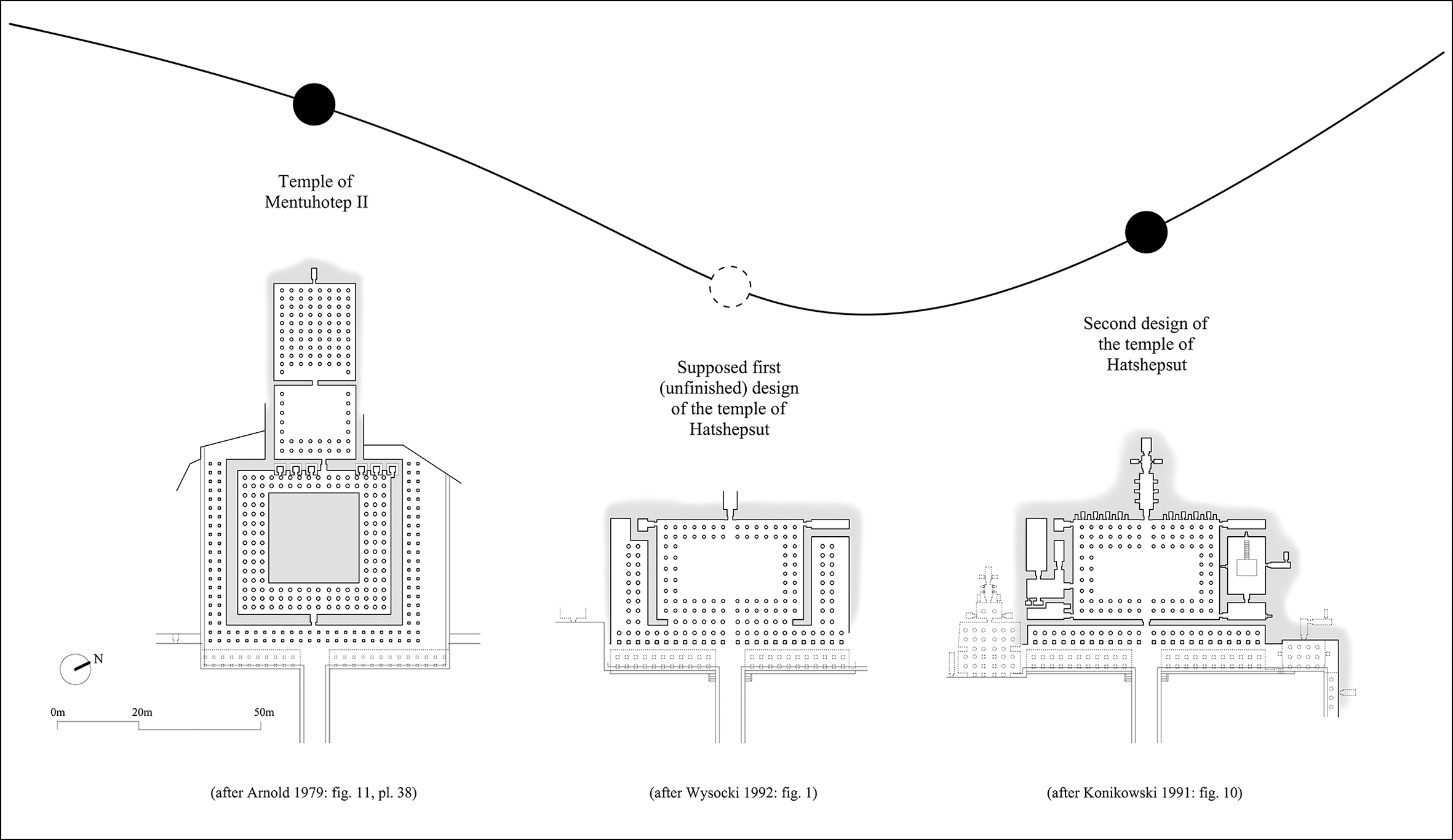
The changes made to this structure have been a frequent concern of scholars, which is reflected in the extended literature on the topic (e.g. Naville Reference Naville1908: 30–31; Winlock Reference Winlock1942: 210; Wysocki Reference Wysocki1985, Reference Wysocki1987, Reference Wysocki1992; Kwaśnica Reference Kwaśnica and Szafrański2001, Reference Kwaśnica2023; Karkowski et al. Reference Karkowski2003: 35–46; Caban Reference Caban2015; Alarcón Robledo Reference Alarcón Robledo2018). While such a concern with architectural modifications shows an awareness of the ‘unstillness’ of the structure, references to the ‘original’ conception or the ‘final’ shape of the built structure are common in these publications. Looking at the many alterations observed on the structure holistically, Zygmunt Wysocki (Reference Wysocki1986, Reference Wysocki1992) concluded that the changes did not represent independent modifications of the structure, but a larger cohesive shift in the architectural plan of the whole temple, going as far as to suggest that the significance of the changes must reflect a change of rulers. The hypothetical first design of the temple resembled the neighbouring Middle Kingdom structure of the temple of Mentuhotep II (c. 2009–1959 BCE) (Wysocki Reference Wysocki1986: 228; Reference Wysocki1992: 235). This argument allowed researchers to explain the unprecedented shape of the temple of Hatshepsut: the supposed first design of the temple filled a gap in the line of architectural development between the structure of the Middle Kingdom and the temple’s final shape (Figure 5).
Identifying a supposed initial design of the temple of Hatshepsut in Deir el-Bahari, scholars were able to trace a clear line of architectural development with the neighbouring temple of Mentuhotep II (figure by author).

Figure 5 Long description
Blueprint of three temple designs, including the Temple of Mentuhotep II and two designs of the temple of Hatshepsut. The first design of the temple of Hatshepsut is shown as unfinished. The second design of the temple of Hatshepsut is more detailed and includes additional structures. The Temple of Mentuhotep II is depicted with a clear layout and measurements. The blueprint includes labels and annotations to indicate different parts of the temples.
Contrary to this vision, the archaeological evidence suggests that the shape of the temple is not the result of two successive master plans, but that its conception implied a much more fluid gestation process that only stopped when the structure fell out of use. Foundation deposits provide us with evidence that the design of the building underwent modifications even before its construction began. In ancient Egypt, foundation deposits were set during the foundation ceremony that celebrated new building enterprises. They were placed close to architectural features such as corners or gates (Weinstein Reference Weinstein1973: lxix–lxx). Various foundation ceremonies could be performed in the same building, each of them indicating the beginning of a different construction initiative. Five groups of foundation deposits that were placed during the reign of Hatshepsut have been identified at the temple (Spence Reference Spence, Schneider and Szpakowska2007). One of the groups, formed by four deposits (C, D, E & F in Figure 4), shows that the complex was initially designed with its axis following a different direction. One more group of foundation deposits (L, M & N in Figure 4) is not spatially related to any of the physical remains of the temple, which suggests that they celebrated the beginning of another architectural enterprise that was likely abandoned early in the constructional sequence, and whose material remains have not survived (Spence Reference Spence, Schneider and Szpakowska2007: 366).
The physical remains of the temple hold evidence of changes made to the layout of the building during its initial construction. The two terraces were built on sloped terrain, which led to part of the upper platform being built at a varying height of between four and six metres above the bedrock. The walls that were planned from the beginning had foundations set directly on the bedrock (e.g. Stefanowicz Reference Stefanowicz, Krzyżanowski and Olbryś1991), while the foundations of a wall of the complex of the royal cult were set on a higher level (#1 in Figure 4), evincing its addition at a later stage of the construction process (Szafrański Reference Szafrański2010: fig. 7; Reference Szafrański2013: fig. 2B). The blocks that shape this wall do not intertwine with those of the southern wall of the upper courtyard (Kwaśnica Reference Kwaśnica2023: fig. 7), whose foundations are set on the bedrock. The fact that the surface covered by the abutment is undecorated shows that this wall of the complex was added before the decoration of the earlier wall had started (Wysocki Reference Wysocki1986: 215).
Modifications were also made to parts of the structure that were already finished. Also within the complex of the royal cult, two niches (#2 in Figure 4) show evidence of having been moved from the main sanctuary (Kwaśnica Reference Kwaśnica2023), which was finished and decorated while the walls of the complex of the royal cult were still under construction—and not yet decorated. Similar evidence is found in the upper courtyard. The reliefs that cover the wall surfaces of the temple consistently show that bas-relief was preferred for shaded areas, while sunk relief was used in areas exposed to direct sunlight. The decoration of a whole row of columns and architraves in the upper courtyard was eventually transformed from sunk reliefs into bas-reliefs, presumably because it had been covered by an added row of columns (Kwaśnica Reference Kwaśnica and Szafrański2001).
Detailed analysis of various parts of the temple has shown archaeologists that change was more the norm than the exception: the complex of the solar cult alone underwent four stages of construction, including the building of an altar over a smaller one (#3 in Figure 4), the addition of a shrine dedicated to Anubis (#4 in Figure 4) and the opening and blocking of various doorways (Karkowski et al. Reference Karkowski2003: 35–46). The complex of the royal cult shows a similar process, and the ‘final shape’ was the result of at least four consecutive architectural initiatives (Barwik Reference Barwik2021: pl. 30). The chapel dedicated to the cult of Hathor had four different access ramps built, each a different architectural enterprise (Wysocki Reference Wysocki1985). We should keep in mind that all these changes occurred during the reign of Hatshepsut, which was just over two decades long. This evidence indicates an average of at least one architectural enterprise starting every two years, highlighting the fluid nature of the conception of the structure of the temple.
Similar examples from the same and other periods of Egyptian history abound. The temple of Karnak in Luxor, for instance, was a continuous construction site, which kings subsequently changed and enlarged, dismantling or adding to extant elements. The hypostyle hall of the temple, for example, was the result of successive building efforts that transformed the space during the reigns of Akhenaton, Tutankhamun, Horemheb, Seti I and Ramesses II (c. 1353–1213 BCE) (Carlotti & Martinez Reference Carlotti and Martinez2013). The temple of Horus in Edfu provides similar evidence from the Graeco-Roman period (c. 332 BCE–395 CE). The final shape of the building was not conceived as one master plan, but resulted from continuous architectural works during more than 160 years, following the initiatives of at least seven kings (Cauville and Devauchelle Reference Cauville and Devauchelle1984). A remarkably similar attitude towards architecture can be observed in tombs (e.g. Galán Reference Galán and Bryan2014), which underwent similar processes since at least the Early Dynastic Period (c. 3100 BCE).
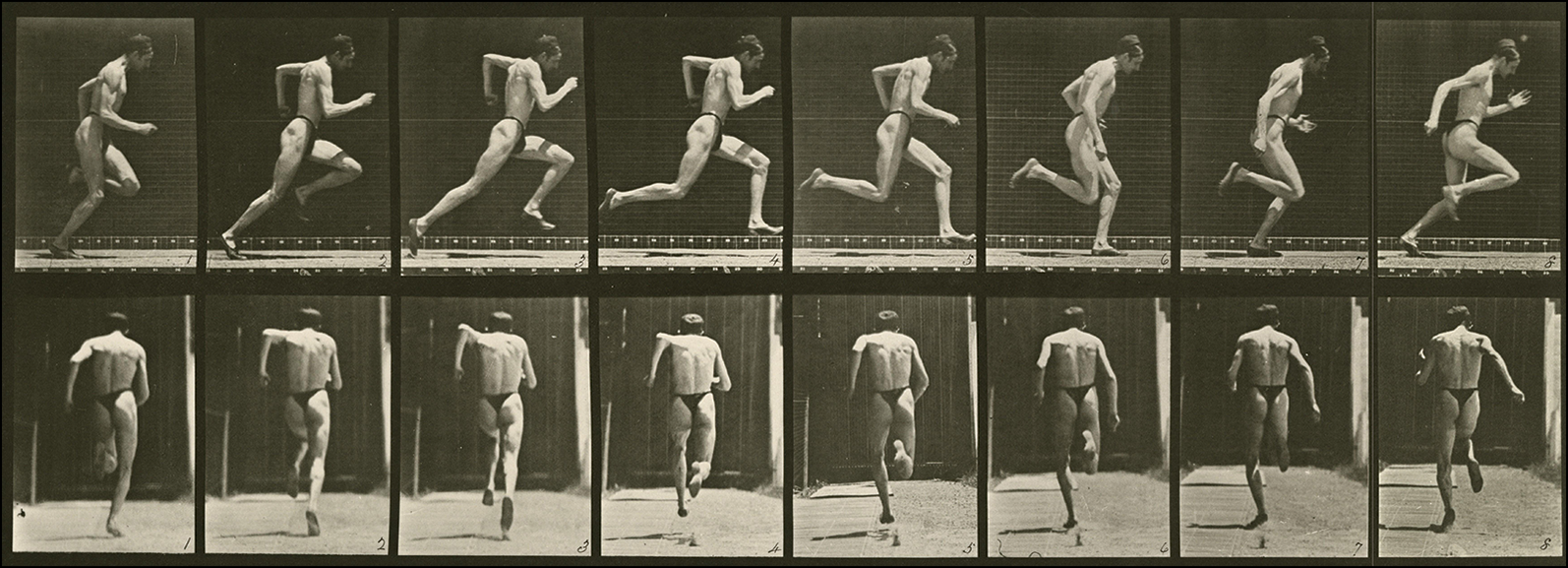
This evidence may indicate that building was not the means to obtain a structure as an end-product, but a royal prerogative, and perhaps a means for the king to show their generative capacity. The large number of unfinished buildings found in Egypt confirm that this view did not only affect royalty, and that our modern three-dimensional paradigm does not meet the material evidence of Egypt broadly. Despite the literature acknowledging the changes in structures and identifying the different layouts that structures undergo, we may still be missing the very essence of the fluid process of conception and production of architecture in ancient Egypt. Consider, for example, that no matter how many still photographs of a running athlete you take, they will not capture the essence of movement (Figure 6). Similarly, no matter how many three-dimensional moments in the life of a building we may cement in our knowledge and understanding, we may not be able to grasp the inherent fluid nature of that building over time.
Motion study photograph taken by Eadweard Muybridge, c. 1887, animal locomotion, plate 61 (courtesy of University of Pennsylvania: University Archives Image Collection).

Figure 6 Long description
The image consists of two rows of photographs, each row containing ten individual frames. The top row shows a man running from a side view, capturing different stages of his stride. The bottom row shows the same man running from a rear view, again capturing various stages of his movement. The photographs are arranged sequentially to illustrate the progression of the running motion. The man is depicted in various poses, demonstrating the dynamics of his limbs and body as he runs. The background is a simple, uncluttered setting that allows the focus to remain on the subject and his movement.
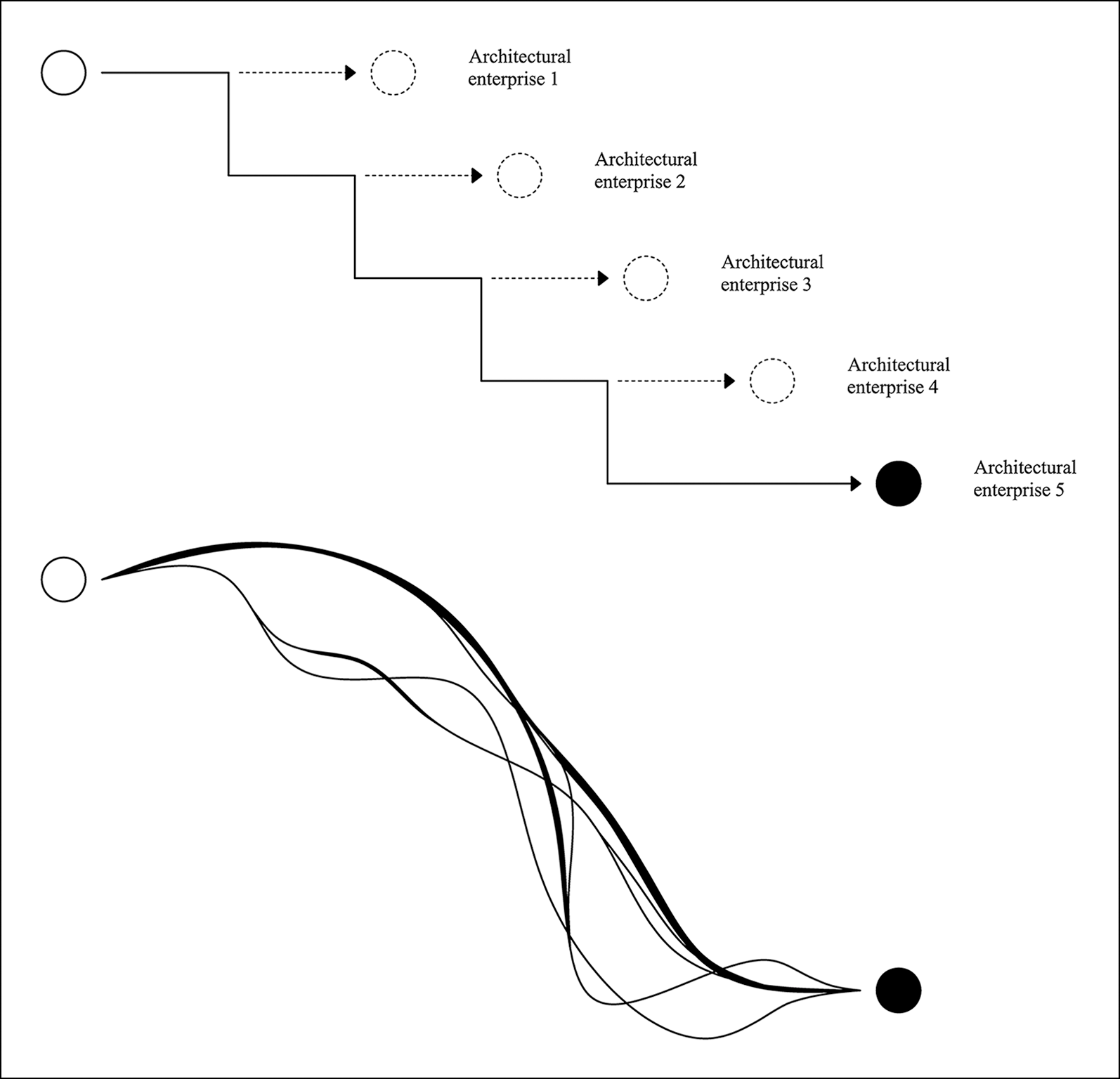
The ‘final’ shape of the temple of Hatshepsut was not the result of the execution of one master plan, but of many subsequent modifications that may have rendered it an almost permanent construction site. What made the final shape ‘final’ was only the eventual abandonment of the building. A four-dimensional model fits this material reality much better than a three-dimensional one (Figure 7), as it erases the differentiation between the stages of production and consumption. The construction process is thereby perceived as the intertwining of the space-time worms of each individual element (that is, each block, pigment, etc., of the structure) as well as the humans involved in arranging them spatially. Exactly when, in the process of intertwining, we stop seeing a construction site and identify the structure as a temporal part of the temple of Hatshepsut is not an objective matter. The placing of foundation deposits that included the name of the temple before any construction effort had started seems to indicate that ancient Egyptians identified the place as the holy structure long before it resembled any supposed master plan.
The final shape of a building can be understood as the result of a succession of architectural enterprises (three-dimensional model, top), or as the fluid intertwining of space-time worms (four-dimensional model, bottom) (figure by author).

Figure 7 Long description
The image contains two diagrams. The top diagram is a line graph illustrating the final shape of a building as a result of a succession of architectural enterprises. It features a single starting point branching into five distinct architectural enterprises, each represented by a dotted circle. The bottom diagram depicts the fluid intertwining of space-time worms, showing a more dynamic and interconnected evolution of architectural structures. The lines in the bottom diagram are wavy and interconnected, indicating a continuous and fluid process. All values are approximated.
The absence of an ‘original’ design of the temple of Hatshepsut has implications for its placement in architectural histories. If the shape of the structure was formed gradually (and almost constantly), differences from the shapes of other structures reflect variations of the ritual practices at play, and not an ever-developing intellectual discourse of architectural masters. Practices that occur in temples are ritualised, and it may be argued that this ritualisation could attest for the higher intellectual merit of the conception of temples over houses. Domestic behaviour is equally ritualised (Douglas Reference Douglas1991), and I do not see a reason to value temple rituals over those of the home.
Concluding thoughts
As I have argued, the quality of ‘monumental’ is not an intrinsic feature of buildings. It is a social construct that stems from the oversimplified narratives of eighteenth- and nineteenth-century architects. Such views permeated art history and archaeology, universalising a dichotomy that does not do justice to the complexity of the material record. In Egypt, this view has blinded us to the importance of the continuous entanglement of building processes and use. As scholars have encountered these contradictions in different parts of the world, we have realised that a single definition of ‘monumental’ cannot be applied across cultures and periods, which has taken us a long way toward problematising the model. Definitions of what being ‘monumental’ means have been greatly nuanced and broadened to adapt the category to the specific archaeological contexts under study (e.g. di Lernia Reference di Lernia2013; Fisher Reference Fisher2023). I wonder what use there is for a term that needs to be redefined in virtually every situation, and argue that it creates a sense of comparability of buildings among populations and periods that betrays the ultimate purpose of our own discipline: understanding the past in its own context.
Every society has produced architecture that exceeds its pure functional needs. Labelling those buildings as ‘monumental’ does not help us understand the specific circumstances that caused their production. On the contrary, it carries a heavy load of assumptions and values that bias our interpretations. Some cultures surely also differentiated between two or more types of architectural production (to an ancient inhabitant of Egypt, for example, a temple was certainly not the same as their home), and our task is to understand the paradigms that dictated their views. Paying careful attention to the physical remains of buildings is embedded in the very nature of archaeology. It is essential to consider the specific context in which every structure was produced and used, instead of projecting our own assumptions (Bußmann Reference Bußmann and Buccellati2019). Through this article I hope to have made the latent implications of modern views of architecture more tangible. By freeing ourselves from extant categories we may be able to escape the biases derived from the seemingly coherent but oversimplified three-dimensional vision of buildings and give the material remains of architecture a voice of their own.
Acknowledgements
For their insightful comments and generous advice, I am very grateful to Camille Acosta, Bettina Bader, Laurel Bestock, Nicholas Brown, Jake Colloff, Peter Der Manuelian, Abraham I. Fernández Pichel, Mar Ivars Ribes, José Ignacio Linazasoro, Patricia Mora Riudavets, Antonio J. Morales, Stella Nair, John Papadopoulos, Hratch Papazian, Stephen Shennan (Harvard University), Kate Spence, Zbigniew E. Szafrański, Dell Upton, Jason Ur and Willeke Wendrich. Thanks are also due to the reviewers of the manuscript and to the editor of Antiquity.
Funding statement
This research received no specific grant from any funding agency or from commercial and not-for-profit sectors.

 Open access

