




1. Introduction
Ion cyclotron range of frequency (ICRF) heating is a widely adopted and highly efficient auxiliary heating scheme in magnetic confinement fusion devices. In tokamaks, ICRF heating directly transfers energy to resonant minority ions through cyclotron resonance, leading to efficient perpendicular acceleration. Moreover, ICRF heating generates a significant population of fast ions that carry substantial energy (Zhang et al. Reference Zhang2023a ). These fast ions play a critical role in achieving fusion conditions, making their study particularly important. One of the key aspects in achieving high-performance plasma operation is the understanding and control of fast-ion distribution, which is significantly influenced by auxiliary heating methods such as ICRF (Eriksson & Helander Reference Kazakov1994; Kazakov et al. Reference Zhang2014; Kazakov et al. Reference Kazakov2021; Salewski et al. Reference Salewski2025). To date, many fusion devices have been equipped with ICRF heating systems, including ASDEX Upgrade (Bobkov et al. Reference Zhang2016; López et al. Reference Schilling2019), JET (Lamalle et al. Reference Song2006; Lerche et al. Reference Yang2016; Mantsinen et al. Reference Zhang2023), DIII-D (Pinsker et al. Reference Zhang1992; Choi et al. Reference Salewski2003), JT-60 (Kimura et al. Reference Kimura1991, Reference Kimura1993), EAST (Yang et al. Reference Yang2018, Reference Yang2021; Song et al. Reference Song2023), KSTAR (Kwak et al. Reference Yang2010; Saito et al. Reference Zhang2020) and TFTR (Schilling Reference Schilling1994). Furthermore, future devices such as ITER will also incorporate ICRF heating systems (Messiaen et al. Reference Messiaen2009; Noterdaeme et al. Reference Zhang2019; Bobkov et al. Reference Zhang2021).
On the Experiment Advanced Superconducting Tokamak (EAST), ICRF heating achieves ion heating through minority species heating. The ICRF system installed on EAST consists of eight transmitters, each capable of delivering a maximum power of 1.5 MW, yielding a total maximum power output of 12 MW. Operating in the frequency range from 25 to 70 MHz, the ICRF antenna power feedthroughs are mounted at the I-port and N-port of the EAST tokamak (Zhang et al. Reference Zhang2022). The waves launched by ICRF antennas are absorbed by protons via resonant interactions, and subsequently, these ICRF accelerated protons are decelerated through collisions with background plasma. Previous experiments have revealed that ICRF heating generates a significant population of fast ions (Zhang et al. Reference Zhang2023b ). While extensive experiments have been conducted on EAST regarding ICRF and neutral beam injection (NBI) synergy, second harmonic heating and third harmonic heating (Zhang et al. Reference Zhang2023b ; Zhu et al. Reference Zhu2023), a systematic investigation of proton heating by ICRF remains notably absent. To address this critical knowledge gap, our work focuses specifically on fast-proton physics under ICRF heating conditions. This study may provide essential insights into fast-ion generation mechanisms, energy partition dynamics and wave–particle interaction physics. The research represents a significant contribution to EAST’s ICRF physics program by filling a crucial knowledge gap in minority ion heating on EAST, supporting optimisation of auxiliary heating schemes for high-performance plasma scenarios and advancing understanding of the fundamental mechanisms of ICRF minority heating, particularly how the radio frequency (RF) power deposition governs the energy, pitch angle and spatial distribution of fast protons, and how these distributions evolve with increasing heating power in tokamaks.
The fundamental condition for resonant absorption of ICRF waves by protons requires satisfaction of the cyclotron resonance condition (Hillairet Reference Hillairet2023)
 \begin{equation*} \omega -\mathit{n}\omega _{\mathit{ci}}-\mathit{k}_{\parallel }\mathit{v}_{\parallel }=0 ,\end{equation*}
where $\omega$
is the angular frequency of ICRF waves (rad s−1),
$\omega$
is the angular frequency of ICRF waves (rad s−1), $\omega _{\mathit{ci}}$
= ZeB/
$\omega _{\mathit{ci}}$
= ZeB/ $\mathit{m}_{\mathit{i}}$
is cyclotron frequency of protons, Z is ion charge number, e is elementary charge, B is magnetic field,
$\mathit{m}_{\mathit{i}}$
is cyclotron frequency of protons, Z is ion charge number, e is elementary charge, B is magnetic field, $\mathit{m}_{\mathit{i}}$
is ion mass, n is Harmonic number (
$\mathit{m}_{\mathit{i}}$
is ion mass, n is Harmonic number ( $n = 1$
for fundamental resonance),
$n = 1$
for fundamental resonance), $\mathit{k}_{\parallel }$
is parallel wavenumber component and
$\mathit{k}_{\parallel }$
is parallel wavenumber component and $\mathit{v}_{\parallel }$
is parallel velocity of particles. For the fundamental cyclotron resonance condition (neglecting Doppler broadening), the following physical considerations apply:
$\mathit{v}_{\parallel }$
is parallel velocity of particles. For the fundamental cyclotron resonance condition (neglecting Doppler broadening), the following physical considerations apply: $\omega =\omega _{\mathit{cH}}$
(for protons). This study primarily investigates the distribution of fast protons under fundamental cyclotron resonance conditions, employing numerical simulations to characterise the fast-ion population dynamics.
$\omega =\omega _{\mathit{cH}}$
(for protons). This study primarily investigates the distribution of fast protons under fundamental cyclotron resonance conditions, employing numerical simulations to characterise the fast-ion population dynamics.
The organisation of this paper is structured as follows. Section 2 provides an overview of the heating systems on EAST and describes the experimental conditions. Section 3 presents the experimental results under varying ICRF power levels along with corresponding simulation analyses. Section 4 concludes the paper with a summary and future perspectives.
2. Experimental set-up
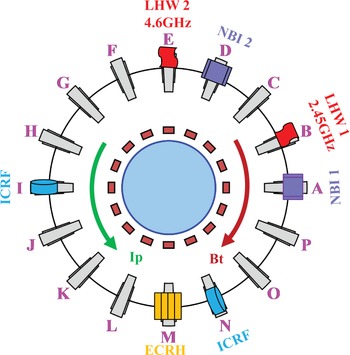
The EAST device employs an all-superconducting magnet system capable of high-steady-state magnetic field control while offering flexible magnetic flux configurations. With a major radius of 1.9 m and a plasma minor radius of 0.45 m, EAST achieves long-pulse, high-confinement and high-power operations, sustaining plasma discharges for up to 1000 s. EAST is equipped with multiple auxiliary heating systems, including ICRF heating, NBI, lower hybrid wave (LHW) heating and electron cyclotron resonance heating (ECRH) (Liu et al. Reference Zhang2019, Reference Liu2020; Hu et al. Reference Yang2023; Zhang et al. Reference Zhang2024, Reference Zhang2025a ,Reference Zhang b ). The spatial arrangement of these systems, along with the directions of the plasma current I p and toroidal magnetic field B t during experiments, is illustrated in figure 1.
Schematic top view of the EAST tokamak, showing the installation positions of auxiliary heating systems – including the LHW, ECRH, NBI and ICRF system, along with the directions of the plasma current I p and toroidal magnetic field B t.

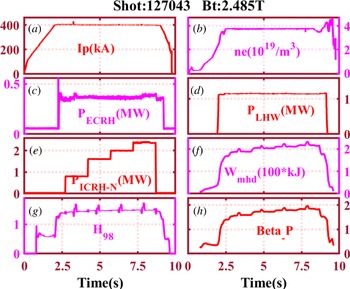
To investigate the distribution of energetic protons under ICRF heating conditions, we conducted experiments with varying ICRF power levels. During these experiments, the ICRF power was incrementally increased within a single discharge shot and the hydrogen-to-deuterium ratio is approximately 5 % (n H/(n H + n D) ≈ 0.05) under the experimental conditions. In shot no. 127043, key plasma parameters – including plasma current, magnetic field strength, plasma density, ECRH power, LHW power and ICRF power – are shown in figure 2.
Plasma parameters during the H-mode discharge of EAST shot no. 127043 ( $t = 0{-}10$
s), including: (a) plasma current I
p, (b) plasma line-averaged density n
e, (c) ECRH power, (d) LHW power, (e) ICRF power, (f) plasma stored energy, (g) H98 confinement factor and (h) poloidal beta
$t = 0{-}10$
s), including: (a) plasma current I
p, (b) plasma line-averaged density n
e, (c) ECRH power, (d) LHW power, (e) ICRF power, (f) plasma stored energy, (g) H98 confinement factor and (h) poloidal beta $\beta_{\text{p}}$
.
$\beta_{\text{p}}$
.

3. Experimental results and simulation analysis of fast-proton distribution
Since energetic particle driven magnetohydrodynamics (MHD) instabilities, such as Alfvén eigenmodes (AE) or energetic particle modes (EPM), may induce fast-ion redistribution and losses (Osakabe et al. Reference Zhang2006; Nabais et al. Reference Nabais2010; Jones et al. Reference Zhang2015; Todo et al. Reference Todo2019; Pan et al. Reference Zhu2025, Reference Pan2026; Ruiz Ruiz et al. Reference Ruiz Ruiz2025), magnetic fluctuation signals from the Mirnov coil array were analysed during the ICRF heating. No coherent Alfvénic modes were observed in the frequency range of 0–300 kHz throughout the discharge. The magnetic fluctuation level remained close to the background level, indicating that AE/EPM activity was not triggered under the present experimental conditions. Therefore, the fast-ion distribution discussed in this work is not significantly affected by MHD-induced transport.
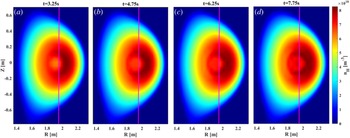
Spatial distribution of energetic protons in the R–Z plane of EAST under different ICRF power levels calculated by ASCOT code: (a) 0.8 MW ( $t = 3.25$
s), (b) 1.6 MW (
$t = 3.25$
s), (b) 1.6 MW ( $t = 4.75$
s), (c) 2.0 MW (
$t = 4.75$
s), (c) 2.0 MW ( $t = 6.25$
s), (d) 2.4 MW (
$t = 6.25$
s), (d) 2.4 MW ( $t = 7.75$
s), resonance layers at 37 MHz (magenta).
$t = 7.75$
s), resonance layers at 37 MHz (magenta).

The shot 127043 was operated in a high-confinement mode (H-mode), with the ICRF power incrementally increased from 0.8 to 1.6 MW, then to 2 MW and finally to 2.4 MW. The ICRF wave frequency was fixed at 37 MHz, which corresponds to the fundamental cyclotron resonance of hydrogen, the resonance condition is satisfied at $B \approx 2.43$
T, corresponding to
$B \approx 2.43$
T, corresponding to $R \approx 1.94$
m. Therefore, the resonance layer is located slightly on the low-field side of the magnetic axis, within the plasma core region. Throughout the experiment, only the ICRF power was varied while all other parameters remained unchanged. As shown in figure 2(f), the plasma stored energy increased with the rise in ICRF power. Figure 2(g) demonstrates that the plasma entered H-mode shortly after ICRF application, as the heating power exceeded the L–H transition threshold. Consequently, the H98 factor remained around 1.4 throughout the H-mode, indicating sustained high confinement performance, while the poloidal beta (
$R \approx 1.94$
m. Therefore, the resonance layer is located slightly on the low-field side of the magnetic axis, within the plasma core region. Throughout the experiment, only the ICRF power was varied while all other parameters remained unchanged. As shown in figure 2(f), the plasma stored energy increased with the rise in ICRF power. Figure 2(g) demonstrates that the plasma entered H-mode shortly after ICRF application, as the heating power exceeded the L–H transition threshold. Consequently, the H98 factor remained around 1.4 throughout the H-mode, indicating sustained high confinement performance, while the poloidal beta ( $\beta_{\text{p}}$
) reached 1.8. Here, H98 is the energy confinement enhancement factor and
$\beta_{\text{p}}$
) reached 1.8. Here, H98 is the energy confinement enhancement factor and $\beta$
is the pPlasma beta (Ratio of plasma pressure to magnetic pressure). This represents a high-performance steady-state H-mode.
$\beta$
is the pPlasma beta (Ratio of plasma pressure to magnetic pressure). This represents a high-performance steady-state H-mode.
Since the fast-ion distribution cannot be directly measured in EAST, we employed a combination of simulation tools to investigate the behaviour of fast protons under different ICRF power levels. The study utilised the ASCOT4 (Accelerated Simulation of Charged Particle Orbits in a Tokamak, the fourth edition is used.) code – a test particle Monte Carlo orbit-following program developed in the early 1990s for simulating fast-ion populations and widely used for neoclassical studies of charged particles in toroidal fusion devices – along with the RFOF (RF interactions in Orbit Following codes) library and the full-wave solver TORIC to simulate the heating process of protons and background plasma via RF waves. The fast-ion population was generated through self-consistent ASCOT–RFOF simulations of ICRH in the fundamental, where TORIC provided the wave solutions for the RF field (Heikkinen & Sipila Reference Schilling1997; Brambilla Reference Kazakov1999; Hirvijoki et al. Reference Song2014; Sipilä et al. Reference Zhang2021). In this work, four representative time slices corresponding to different ICRF power levels were selected. For each case, experimentally measured plasma parameters were used as static inputs to the ASCOT–RFOF simulation. The RF acceleration acts as a continuous source term within each simulation, while collisional processes provide sink and redistribution mechanisms. The simulations at different power levels are independent and do not represent the temporal evolution between power steps. Therefore, the results correspond to time-local quasi-stationary solutions rather than a fully time-dependent source–sink evolution.
In the simulations, plasma parameters such as density, electron temperature, ion temperature, magnetic equilibrium, hydrogen/deuterium ratio and effective ionic charge Z
eff were provided as input files. The magnetic equilibrium for each time slice was reconstructed using equilibrium fitting code and used consistently in the corresponding simulations. The high-energy proton density profiles under different ICRF power levels, obtained from ASCOT simulations, are shown in figure 3, while their fast-ion distributions in energy-pitch space are presented in figure 4. As seen in figure 3, the high-energy protons are mainly generated in the vicinity of the fundamental resonance layer. Although the resonance surface itself corresponds to a narrow vertical region in the poloidal cross-section, the finite orbit width of energetic protons leads to a spatially broadened distribution around this layer. The radial excursion of fast ions increases with energy, resulting in a finite-width region rather than a thin line. At $t = 3.25$
s (ICRF power
$t = 3.25$
s (ICRF power $= 0.8$
MW), the fast-ion distribution is relatively localised near the plasma core and exhibits approximate up–down symmetry. As the ICRF power increases, the maximum proton energy rises significantly, leading to larger orbit widths and enhanced radial excursion. Consequently, the fast-ion spatial profile becomes broader, extending further toward the low-field-side region. This outward broadening is therefore primarily associated with the increase in fast-ion energy and orbit width at higher RF power levels. As shown in figure 4, the location of the maximum of the distribution function in pitch-angle space remains concentrated around
$= 0.8$
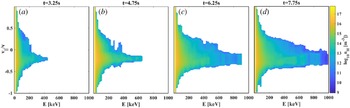
MW), the fast-ion distribution is relatively localised near the plasma core and exhibits approximate up–down symmetry. As the ICRF power increases, the maximum proton energy rises significantly, leading to larger orbit widths and enhanced radial excursion. Consequently, the fast-ion spatial profile becomes broader, extending further toward the low-field-side region. This outward broadening is therefore primarily associated with the increase in fast-ion energy and orbit width at higher RF power levels. As shown in figure 4, the location of the maximum of the distribution function in pitch-angle space remains concentrated around $|\textit{v}_{\|}/\textit{v}| \lt 0.5$
for all power levels, indicating a predominantly perpendicular acceleration mechanism. With increasing ICRF power, the distribution becomes more anisotropic, with a stronger population at lower
$|\textit{v}_{\|}/\textit{v}| \lt 0.5$
for all power levels, indicating a predominantly perpendicular acceleration mechanism. With increasing ICRF power, the distribution becomes more anisotropic, with a stronger population at lower $|\textit{v}_{\|}/\textit{v}|$
. This trend is consistent with fundamental minority heating, where energy is primarily transferred to the perpendicular component of ion motion.
$|\textit{v}_{\|}/\textit{v}|$
. This trend is consistent with fundamental minority heating, where energy is primarily transferred to the perpendicular component of ion motion.
Fast-proton distributions under varying ICRF power inputs (averaged over full radial and poloidal ranges): (a) 0.8 MW ( $t = 3.25$
s), (b) 1.6 MW (
$t = 3.25$
s), (b) 1.6 MW ( $t = 4.75$
s), (c) 2.0 MW (
$t = 4.75$
s), (c) 2.0 MW ( $t = 6.25$
s), (d) 2.4 MW (
$t = 6.25$
s), (d) 2.4 MW ( $t = 7.75$
s). The abscissa represents ion energy (E keV−1), while the ordinate shows pitch angle (v
∥/v).
$t = 7.75$
s). The abscissa represents ion energy (E keV−1), while the ordinate shows pitch angle (v
∥/v).

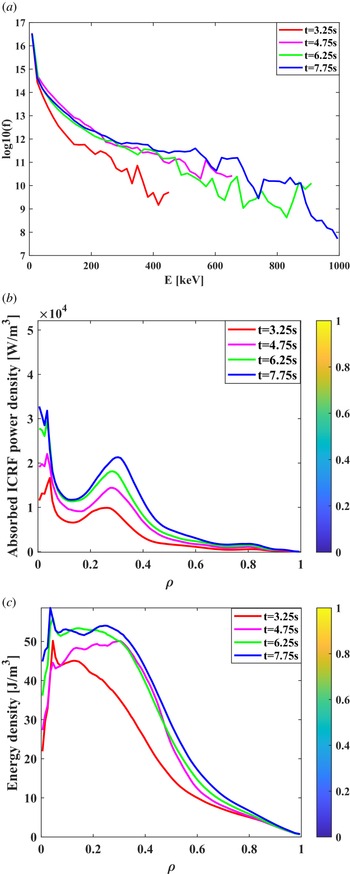
Figure 5(a) presents the logarithmic energy spectrum (log10(f)) of fast protons as a function of ion energy (E). The distribution exhibits two distinct characteristics, a high particle density dominates the low-energy regime ( $\lt 200$
keV), with the spectral intensity decreasing monotonically with increasing energy. While this trend persists across mostly time slices, significant power-dependent variations emerge in the high-energy tail. At
$\lt 200$
keV), with the spectral intensity decreasing monotonically with increasing energy. While this trend persists across mostly time slices, significant power-dependent variations emerge in the high-energy tail. At $t = 6.25$
and 7.75 s (higher ICRF power), the high-energy tail (600–900 keV) shows remarkable enhancement. This temporal evolution demonstrates stronger acceleration efficacy during later ICRF operation stages. The observed spectral broadening aligns with the velocity-space expansion shown in figure 3, providing cross-validated evidence for ICRF potent acceleration capability on fast protons.
$t = 6.25$
and 7.75 s (higher ICRF power), the high-energy tail (600–900 keV) shows remarkable enhancement. This temporal evolution demonstrates stronger acceleration efficacy during later ICRF operation stages. The observed spectral broadening aligns with the velocity-space expansion shown in figure 3, providing cross-validated evidence for ICRF potent acceleration capability on fast protons.
Fast-proton distributions under varying ICRF heating power: (a) logarithmic fast-ion distribution function in energy space (log10(f) vs. E), (b) absorbed ICRF power density profile, (c) energy density profile.

As shown in figure 5(b), the fast-ion energy density peaks in the core region ( $\rho \lt 0.4$
) for all ICRF power levels, with a gradual outward expansion observed at later stages (around
$\rho \lt 0.4$
) for all ICRF power levels, with a gradual outward expansion observed at later stages (around $\rho \sim 0.6$
). Figure 5(c) indicates that the ICRF power deposition is mainly concentrated in the central-core region (
$\rho \sim 0.6$
). Figure 5(c) indicates that the ICRF power deposition is mainly concentrated in the central-core region ( $\rho \sim 0.2-0.4$
). This spatial distribution can be explained by the fundamental cyclotron resonance condition: protons near the resonance layer absorb RF power efficiently, and their finite orbit width leads to a spatially broadened density profile. The core-localised and outward-broadened fast-ion distribution is therefore a natural result of the combination of RF power deposition and fast-ion orbit dynamics, as confirmed by ASCOT simulations.
$\rho \sim 0.2-0.4$
). This spatial distribution can be explained by the fundamental cyclotron resonance condition: protons near the resonance layer absorb RF power efficiently, and their finite orbit width leads to a spatially broadened density profile. The core-localised and outward-broadened fast-ion distribution is therefore a natural result of the combination of RF power deposition and fast-ion orbit dynamics, as confirmed by ASCOT simulations.
The ICRF heating demonstrates effective generation and sustained maintenance of high-energy fast protons throughout the entire heating duration. The spatio-temporal evolution of fast ions in configuration space, velocity space and the energy spectrum exhibits pronounced temporal correlation and regional characteristics, with their acceleration properties showing strong dependence on the power deposition profile. These findings provide substantial support for optimising ICRF wave parameters, enhancing heating efficiency, and elucidating the underlying mechanisms of fast-ion–background plasma interactions and the numerical simulations also support the interpretation that the ICRF heating mechanism predominantly affects core-localised fast protons.
In addition, similar studies of ICRF heated minority ions and numerically the ICRF minority accelerated protons by using the ASCOT code have been extensively carried out in other tokamaks, such as ASDEX Upgrade, where the formation and confinement of energetic ion populations have been investigated using both simulations and diagnostics (Sipilä et al. Reference Zhang2021). Compared with ASDEX Upgrade, the present work focuses on EAST under long-pulse, high-confinement conditions, where the plasma parameters and heating scenarios differ significantly, particularly in terms of pulse duration, RF power deposition and confinement characteristics. In particular, the long-pulse operation capability of EAST provides a unique platform to study the evolution of fast-ion distributions under quasi-steady conditions. Therefore, this study does not aim to introduce fundamentally new physics mechanisms, but rather to extend and validate established modelling approaches under EAST-specific operational conditions, providing insight into fast-ion behaviour in steady-state oriented tokamak plasmas.
4. Summary
In this work, we examined the generation and distribution of fast protons under ICRF minority heating conditions in EAST. Through experiments with increasing ICRF power and validated by ASCOT simulations, we observed that fast protons are primarily localised near the resonance layer and exhibit enhanced energy and broader spatial profiles with increasing RF power. The ions achieved energies up to ∼ 1MeV and showed distinct anisotropy in pitch-angle space. The alignment between the power deposition region and the fast-ion energy density supports the notion of core-localised and efficient heating. These findings provide critical insight into ICRF heating physics, especially under minority species resonance, and demonstrate the effectiveness of ICRF in generating and sustaining high-energy fast-ion populations. The results contribute to improving heating efficiency, controlling fast-ion behaviour and preventing undesirable loss or redistribution in future high-performance plasma scenarios. For future work, integrating synthetic diagnostics and advanced kinetic modelling will further validate simulation predictions. These outcomes are directly relevant for next-step fusion devices like ITER and CFETR, where precise control over the fast-ion dynamics is essential for achieving burning plasma conditions and steady-state operation.
Acknowledgements
This work is supported by the National Natural Science Foundation of China under grant Nos. 12175273, 12105184, 11975265, National magnetic confinement fusion energy development research project under grant Nos. 2022YFE03190200, 2019YFE03070000, the Comprehensive Research Facility for Fusion Technology Program of China under Contract No. 2018-000052-73-01001228 and the Strategic Priority Research Program of the Chinese Academy of Sciences (Grant No. XDB07 90303), the National Natural Science Foundation under Grant No. 12175226, the National Key R&D Program of China (Grant No. 2024YFE03040002).
Editor Eleonora Viezzer thanks the referees for their advice in evaluating this article.
Declaration of interests
The authors report no conflict of interest.









 Open access

