


Introduction
Seed banks are one of a number of complementary strategies used in integrated plant conservation (Sharrock et al., Reference Sharrock, Oldfield and Wilson2014), particularly to achieve targets 8 and 9 of the 2011–2020 Global Strategy for Plant Conservation (Wyse Jackson & Kennedy, Reference Wyse Jackson and Kennedy2009; Convention on Biological Diversity, 2012). Storing plants as seeds is a widespread practice and can be used as a key approach to ex situ conservation. There are significant advantages to seed banking, including ‘ease of storage, economy of space, relatively low labour demands and consequently, the capacity to maintain large samples at an economically viable cost’ (BGCI, 2016a). In addition, ‘seeds are a convenient means of long-term storage of genetic diversity, as the samples are small in size, are easily handled, require low maintenance and frequently remain viable for long periods’ (BGCI, 2016a). In this context, regional networks of seed banks are important frameworks for the development of national and regional conservation strategies and action plans.
Examples of such networks include the Australian Seed Bank Partnership, which brings together Australia's leading botanical institutions, seed scientists and conservation and restoration experts to collaborate in the collecting and banking of native seed for conservation (Sutherland & Aylott, Reference Sutherland, Aylott and Cummine2015), and the U.S. Center for Plant Conservation network, which maintains the National Collection of Endangered Plants, which is a bank of seeds, cuttings and other plant material from the country's most imperilled native plants (Galbraith & Kennedy, Reference Galbraith and Kennedy2006; BGCI, 2016b).
In Europe, the European Native Seed Conservation Network (ENSCONET) was funded under the European Commission's Sixth Framework Programme for Research and Technological Development (FP6) between November 2004 and October 2009. ENSCONET aimed to integrate the activities of partners networked through virtual centres of excellence focusing on clearly defined scientific and technological objectives. The objective of the project was to ‘improve quality, coordination and integration of European seed conservation practice, policy and research for native plant species and to assist EU conservation policy and its obligations to the Convention on Biological Diversity and its Global Strategy for Plant Conservation’ (Müller et al., Reference Müller, Eastwood and Linington2012). Thirty-one partner organizations from 20 European countries worked together in activity groups focused on areas such as seed collecting, seed curation, data management and dissemination of information. The final project report (ENSCONET, 2010) lists among the major achievements of the data management activity group the implementation of the joint database platform ENSCOBASE, the European Native Seed Conservation Database. At the end of the funded project, in October 2009, ENSCOBASE contained entries from 29 seed banks across Europe, representing 39,292 accessions from 8,973 taxa native to Europe, and covering 11 biogeographical regions in Europe. Since July 2009, access to ENSCOBASE has been freely available via the internet. ENSCOTOOL, a local data management system linked directly to the main ENSCOBASE server, was developed, and released in September 2009 to facilitate institutional data providers to populate ENSCOBASE with new data records.
After the end of the FP6-funded project, the project partners continued their collaborative work across Europe. They established the ENSCONET Consortium in August 2010, with the aim of maintaining significant levels of seed conservation activity across the continent. The ENSCONET Consortium continues to rely on ENSCOBASE as the central data platform for European native seed conservation. During 2011 there was an increase in records, to 41,928 accessions representing 9,294 taxa (Godefroid et al., Reference Godefroid, Rivière, Waldren, Boretos, Eastwood and Vanderborght2011). At that time, the ENSCONET network held in long-term conservation storage c. 44% (243 species) of the plants listed in the Habitats Directive Annex II, excluding bryophytes (Council Directive 92/43/EEC), and 27% (515 species) of plants listed by Botanic Gardens Conservation International as threatened in Europe (Sharrock & Jones, Reference Sharrock and Jones2009).
To help data providers mobilize their data more quickly and in a more standardized way, a new data import system was developed in 2013, with which data providers could import data in bulk via a web platform. As new data are being uploaded into ENSCOBASE continually, it became clear that such a coordinated effort would become instrumental in informing progress towards internationally agreed plant conservation targets such as target 8 (at least 75% of threatened plant species in ex situ collections, preferably in the country of origin, and at least 20% available for recovery and restoration programmes) and target 9 (70% of the genetic diversity of crops, including their wild relatives and other socio-economically valuable plant species, conserved, while respecting, preserving and maintaining associated indigenous and local knowledge) of the 2011–2020 Global Strategy for Plant Conservation. In addition to assessing the coverage of the Strategy's targets by ENSCOBASE at species level, it is also essential, as highlighted by Sharrock et al. (Reference Sharrock, Oldfield and Wilson2014), to assess the infraspecific genetic diversity of ex situ collections. A species may possess high genetic variability in natural stands yet may be underrepresented in ex situ collections, as is the case for the Endangered tree Zelkova abelicea (Christe et al., Reference Christe, Kozlowski, Frey, Fazan, Bétrisey and Pirintsos2014). We therefore assessed the contribution of ex situ plant conservation initiatives of the ENSCONET Consortium to meeting targets 8 and 9 of the 2011–2020 Global Strategy for Plant Conservation, and the level of infraspecific diversity of the threatened species.
Methods
A baseline list of threatened species, related to target 2 of the Global Strategy for Plant Conservation (an assessment of the conservation status of all known plant species, as far as possible, to guide conservation action) is essential for the reporting of progress on other targets, especially target 8 (Paton & Nic Lughadha, Reference Paton and Nic Lughadha2011). However, there have been considerable barriers to progress in relation to target 2 because of complex data, and inconsistency of global data with IUCN Red List standards. To assess the contribution of seed banks across Europe towards targets 8 and 9 we compared data on seed accessions from ENSCOBASE against seven checklists. The first two checklists (1 and 2 below) were used to map ENSCOBASE holdings against two international taxonomic checklists to ensure consistency in the taxonomy used for ENSCOBASE, especially with regard to accepted names/synonyms. Checklists 3 and 4 were used to assess the progress of the ENSCONET Consortium towards target 8. Checklists 5, 6 and 7 contained socio-economically important plants, such as crop wild relatives, medicinal plants, ornamental plants, and food, forage and timber species, and were used to assess the progress of the ENSCONET Consortium towards target 9.
As targets 8 and 9 of the Global Strategy for Plant Conservation refer to the term ‘species’, infraspecific taxa were excluded from the combined checklists 3 & 4 and 5, 6 & 7. The following accessions were also excluded from the ENSCOBASE holdings: seed accessions not identified to species (i.e. species epithet was ‘sp.’); seed accessions not fully identified (i.e. with identification qualifier ‘cf.’); historical seed accessions, which were imported into the database but no longer refer to an active conservation accession (e.g. in cases where the original seeds have been used for propagation purposes).
Checklists 1 & 2: Euro+Med PlantBase and The Plant List
We mapped the multi-taxonomy system represented in ENSCOBASE against the Euro+Med checklist (Euro+Med, 2006). Some names were corrected and synonyms were identified. This, together with the analysis using checklist 2 (The Plant List, 2010), resulted in a decrease in the total number of taxa under consideration from > 13,000 to 11,515. The synonymy system was used for all families covered by Euro+Med. In 2016, Euro+Med comprised 190 families (corresponding to c. 95% of the European vascular flora), but did not include an additional 32 families (five non-European native families were excluded: Bignoniaceae, Cactaceae, Martyniaceae, Rafflesiaceae and Tropaeolaceae). We therefore mapped these 32 families using a second taxonomic system, represented by The Plant List (The Plant List, 2010; Supplementary Table S1).
Checklist 3: 2011 European Red List of Vascular Plants
We used the European Red List of Vascular Plants (Bilz et al., Reference Bilz, Kell, Maxted and Lansdown2011) to assess the progress of the ENSCONET Consortium towards target 8 of the 2011–2020 Global Strategy for Plant Conservation. From this checklist we selected only threatened species, thereby excluding species categorized as Extinct, Extinct in the Wild, Near Threatened, Least Concern or Data Deficient, following the definition of a threatened species according to the IUCN Red List Categories & Criteria version 2.3 (IUCN, 1994). The total number of species selected was 421.
Checklist 4: IUCN Red List 2015
Checklist 3 is not a complete Red List of European flora because it includes only selected groups. Therefore, we added additional European assessments available from the IUCN Red List 2015.4 (IUCN, 2015).
Checklist 3 & 4
We combined checklists 3 and 4, and mapped the result against checklists 1 and 2 to maintain taxonomic consistency and to cover as many species as possible. Any duplicates were removed, synonyms were identified and infraspecific taxa (i.e. infraspecific ranks ‘subsp.’ and ‘var.’) were excluded, leaving a total of 560 species. We used this combined checklist 3 and 4 to assess the progress of ENSCOBASE regarding target 8 of the 2011–2020 Global Strategy for Plant Conservation.
Checklist 5: Harlan and de Wet Crop Wild Relative Inventory checklist
We downloaded a list of species from the Harlan and de Wet Crop Wild Relative Inventory website (Crop Wild Relative Inventory, 2016), selecting four regions (Eastern, Northern, Southern and Western Europe). Any duplicates across the regions were removed, as were species and subspecies that are not native to Europe (Cerasus nipponica, Corylus mandshurica, Glycine max subsp. soja, Glycine soja, Fragaria mandshurica, Fragaria nipponica, Fragaria nipponica subsp. nipponica, Fragaria yezoensis, Malus baccata, Malus mandshurica, Malus pumila, Medicago cancellata, Miscanthus sacchariflorus, Miscanthus sinensis, Padus maackii, Prunus maackii, Prunus mandshurica, Prunus nipponica, Prunus pedunculata, Prunus sibirica, Prunus ussuriensis, Prunus x eminens, Pyrus ussuriensis, Ribes mandshuricum and Rorippa cantoniensis).
Checklist 6: 2014 IUCN European Red List of Medicinal Plants
The list of species we used originated from Appendix 1 of Allen et al. (Reference Allen, Bilz, Leaman, Miller, Timoshyna and Window2014).
Checklist 7: 1995 catalogue of the wild relatives of cultivated plants native to Europe
The list of species we used originated from the catalogue of the wild relatives of cultivated plants native to Europe (Heywood & Zohary, Reference Heywood and Zohary1995). To the best of our knowledge, all species and subspecies that are not native to Europe (i.e. Avena byzantina, Brassica rapa subsp. chinensis, Brassica rapa subsp. pekinensis, Brassica juncea, Cannabis spp., Ficus carica, Medicago sativa subsp. sativa and Phoenix dactylifera) or garden origin (i.e. Viola x wittrockiana) were excluded.
Checklist 5, 6 & 7
We combined checklists 5, 6 and 7 into a single list and removed any duplicates. Synonyms were identified and infraspecific taxa (i.e. infraspecific ranks ‘subsp.’ and ‘var.’) were excluded. We then mapped this combined checklist against checklists 1 and 2 to maintain taxonomic consistency and to cover as many species as possible. We obtained 913 unique accepted species. We used this combined checklist to assess the progress of ENSCOBASE regarding target 9 of the 2011–2020 Global Strategy for Plant Conservation.
Infraspecific diversity
We compiled ENSCOBASE accessions collected across all countries and all biogeographical regions for both target 8 (combined checklist 3 & 4, with synonyms, duplicates and infraspecific taxa removed) and target 9 (combined checklist 5, 6 & 7, with synonyms, duplicates and infraspecific taxa removed). We then considered the threshold of five accessions as described in Godefroid et al. (Reference Godefroid, Rivière, Waldren, Boretos, Eastwood and Vanderborght2011) and as recommended in Brown & Briggs (Reference Brown, Briggs, Falk and Holsinger1991) to ensure a good representation of the genetic diversity found within and among populations in situ.
Results
All results presented here were produced from the data analysis menu of ENSCOBASE in November 2016 (ENSCOBASE, 2016). It is important to note that results obtained from the portal are dynamic and represent a snapshot in time, as the database is evolving continually.
ENSCOBASE holdings
From mappings against Euro+Med PlantBase (checklist 1) and The Plant List (checklist 2), names of taxa were changed in ENSCOBASE because of misspellings or because different synonymy systems were used by individual data providers. Since the end of the European Commission-funded ENSCONET Coordination Action, in October 2009, the database has been used to store data on European native seed accessions (see Table 1 for the evolution of holdings). As of November 2016, 63,582 native accessions were conserved ex situ by seed banks across Europe, representing a total of 11,515 accepted taxa native to Europe, of 164 families. Thirty-four institutional data providers, most of them members of the ENSCONET Consortium, collected seeds from 42 European and transcontinental countries such as Turkey and Georgia. All European biogeographical regions are covered, with the highest number of accessions from the West Mediterranean region. The biggest individual data provider is the Millennium Seed Bank, Royal Botanic Gardens, Kew, with 11,513 accessions (5,186 taxa). The project ‘Ensuring the survival of endangered plants in the Mediterranean’ (Bacchetta et al., Reference Bacchetta, Gil Gil, Vicens Fornés, Müller, Kyratzis and Fournaraki2013), which was run by seven partner seed banks during 2011–2014, used ENSCOBASE as its data platform for ex situ conservation storage, and added 1,142 accessions representing 942 accepted native taxa to the list of holdings.
Annual evolution of ENSCOBASE since October 2009.

2011–2020 Global Strategy for Plant Conservation targets 8 and 9
Mapping the target 8 accessions against checklists 1 and 2 produced accepted names and synonyms, but also invalid designations (one species) and misapplied names (two species) with the Euro+Med checklist, unresolved names with The Plant List (10 species) or no hits with either list (nine species). Mapping the target 9 accessions against checklists 5, 6 and 7 produced accepted names and synonyms, but also unresolved names with The Plant List (12 species) or no hits with either list (28 species).
Regarding the first part of target 8 (8a: at least 75% of threatened plant species in ex situ collections, preferably in the country of origin; Convention on Biological Diversity, 2012), ENSCOBASE holdings were mapped against the 2011 European Red List of Vascular Plants (Bilz et al., Reference Bilz, Kell, Maxted and Lansdown2011). ENSCOBASE includes 351 (62.68%) of the 560 species on the combined checklist 3 and 4. The number of accessions held for each threatened species conserved ex situ by ENSCONET (target 8a) is in Supplementary Table S2. To reach the 422 species required to meet target 8a, European seed banks would need to collect and conserve 71 additional species from the 2011 European Red List of Vascular Plants and the IUCN Red List 2015.4 by 2020 (Table 2).
Summary of progress towards meeting targets 8 and 9 of the 2011–2020 Global Strategy for Plant Conservation using ENSCOBASE.

The second part of target 8 (8b) states a requirement of ‘at least 20% (of threatened plant species) available for recovery and restoration programmes’ (Convention on Biological Diversity, 2012). ENSCOBASE introduced a seed availability field to record whether an accession is available for recovery and restoration programmes. The number of accessions held for each threatened taxon conserved ex situ by ENSCONET and available for recovery and restoration programmes (target 8b) is reported in Table 2. ENSCOBASE includes 269 (48.04%, thus already exceeding the set target) of the 560 species on the combined checklist 3 & 4. The number of accessions held for each threatened taxon conserved ex situ by ENSCONET (target 8b) is in Supplementary Table S2.
With respect to target 9 (70% of the genetic diversity of crops, including their wild relatives and other socio-economically valuable plant species, conserved, while respecting, preserving and maintaining associated indigenous and local knowledge; Convention on Biological Diversity, 2012), the mapping shows that ENSCOBASE includes 688 (75.36%, thus already exceeding the target for the European region) of the 913 species of the combined checklists 5, 6 & 7. This analysis derives from the combined checklists 5 (Crop Wild Relative Inventory, 2016), 6 (Allen et al., Reference Allen, Bilz, Leaman, Miller, Timoshyna and Window2014) and 7 (Heywood & Zohary, Reference Heywood and Zohary1995). The numbers of accessions conserved ex situ by ENSCONET for each taxon of the combined lists (target 9) are reported in Supplementary Table S3.
Infraspecific diversity
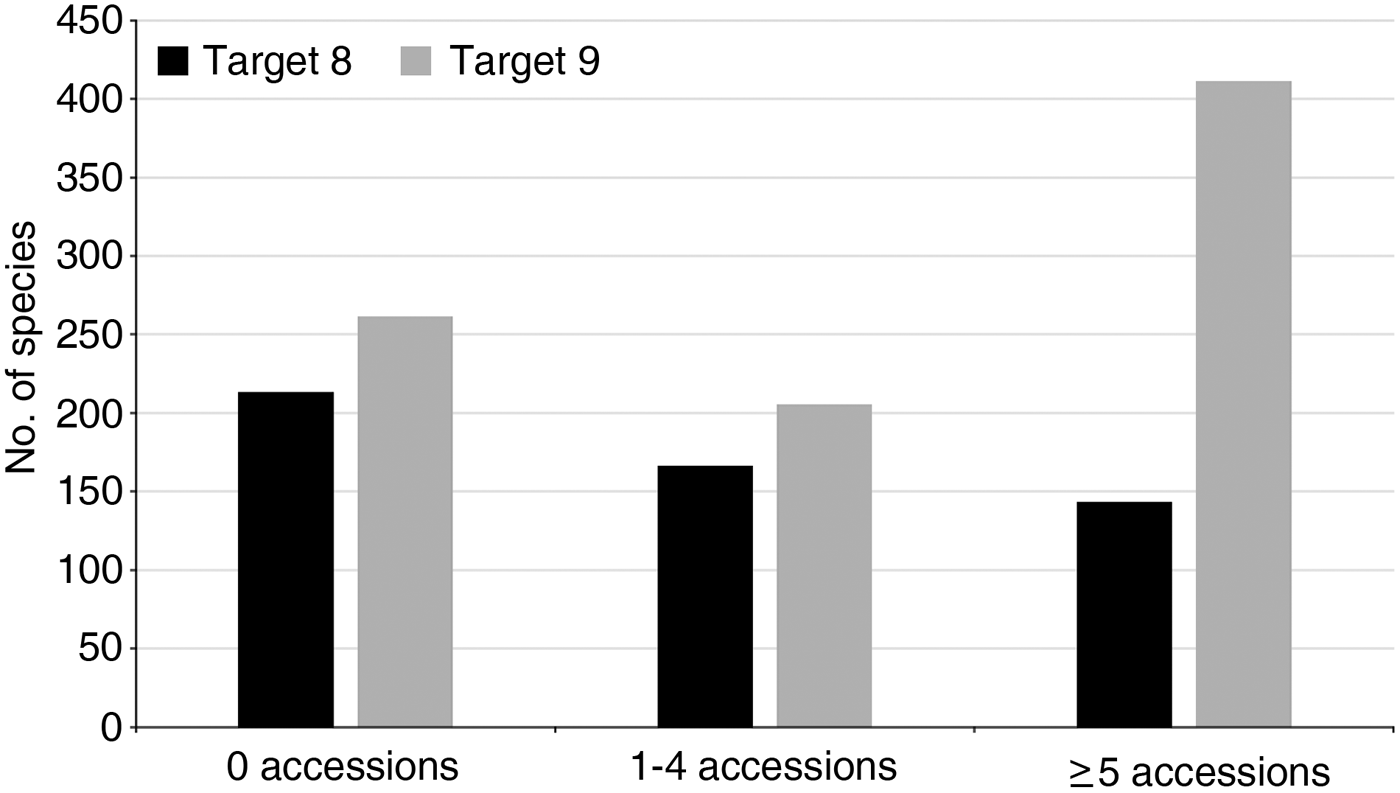
Regarding the infraspecific diversity of the collections held in the ENSCONET Consortium seed banks, the results for target 8 show that 379 species on the combined checklist 3 & 4 are represented by 0–4 accessions in ENSCOBASE, including 213 species not represented at all (i.e. 0 accessions) (Supplementary Table S4). We can consider 143 species to be conserved effectively, according to Godefroid et al. (Reference Godefroid, Rivière, Waldren, Boretos, Eastwood and Vanderborght2011), with five or more accessions conserved ex situ (Fig. 1). With respect to target 9, the results show that 466 species on the combined checklist 5, 6 & 7 are represented by 0–4 accessions in ENSCOBASE, including 261 species not represented at all (i.e. 0 accessions) (Supplementary Table S5). We can consider 411 species to be conserved effectively, according to Godefroid et al. (Reference Godefroid, Rivière, Waldren, Boretos, Eastwood and Vanderborght2011), with five or more accessions conserved ex situ (Fig. 1).
Number of species considered for targets 8 and 9 of the 2011–2020 Global Strategy for Plant Conservation according to number of accessions stored in European seed banks (0, 1–4 and ≥ 5).
Discussion
Seed banks across Europe belonging to the ENSCONET Consortium have made significant progress in the conservation, storage and dissemination of information of European native species, meeting targets 8b and 9 of the 2011–2020 Global Strategy for Plant Conservation well in advance of the 2020 deadline. The Consortium could also meet target 8a with a push towards collecting and conserving ex situ another 71 species. Clearly, after each update of checklists 1 and 2 our analysis would need to be rerun. The Consortium has been able to reach such targets by keeping and collating information on European ex situ seed conservation through its partnership and through the virtual infrastructure developed since 2004. This has been aided by automated procedures that have been implemented for importing, analysing and disseminating the information uploaded into ENSCOBASE.
Another feature offered by ENSCOBASE is the possibility to order a seed lot from an institute where it is flagged as being available. Those ordering may be concerned with restoration and reintroduction programmes and may want to check first whether a seed lot has already been used in such programmes. Some information on restoration and reintroduction use has already been provided by institutes in France, Germany, Poland, Spain and the UK, and is available via a search menu in ENSCOBASE.
Overall, activities undertaken by the ENSCONET Consortium are key for plant conservation in Europe. ENSCOBASE has become instrumental in disseminating information about the status of conservation of native seeds in Europe, especially with regard to targets 8 and 9 of the 2011–2020 Global Strategy for Plant Conservation. When seeking to compare our results with those of other studies examining progress towards the Strategy's targets we found little published information at either national or regional/continental levels (Table 3). A study focused on target 8 in Greece found that of 558 threatened and near-threatened national endemics, 268 (48%) are conserved ex situ (Krigas et al., Reference Krigas, Menteli and Vokou2016). Of these, 44.8% are accessioned in a single botanic garden and 48.9% in a single seed bank accession. Krigas et al. (Reference Krigas, Menteli and Vokou2016) concluded that a significant effort needed to be made to achieve target 8. In a regional study in North America, Hird & Kramer (Reference Hird and Kramer2013) found that 35% of North America's nearly 5,000 threatened taxa were stored in ex situ collections. They recommended further conservation actions focusing on increasing the representation of threatened species in ex situ collections and on assessing their genetic diversity. In a study of the Hawaiian flora, Weisenberger & Keir (Reference Weisenberger and Keir2014) found that 73% of the threatened species of conservation importance were represented in ex situ collections. To our knowledge, there is no published literature on progress towards target 8 in tropical regions, and a single reference suggested that the coverage was ‘most likely well below the 75% goal’ (Krupnick, Reference Krupnick2013). Although this global comparison suggests that the situation in Europe is advanced compared to other areas, the ENSCONET Consortium will need to continue steering activities related to seed collection, curation, ex situ conservation and data-mobilization among its contributing members in future years to meet international conservation target 8a by 2020. New targeted seed collecting activities should be started, focusing on the gaps in European ex situ collections highlighted in this study. In particular, additional species should be targeted for collection based on a coordinated effort across biogeographical regions to fill in the infraspecific gaps (i.e. threatened species occurring in a specific bioregion that are missing) and tailor specific collection targets, for example for crop wild relatives. This can be facilitated by the ENSCONET Consortium network of representatives responsible for collection in specific bioregions, with collectors going beyond country borders to cover as much infraspecific diversity as possible. A gap analysis of crop wild relatives in England showed that clear gaps existed in ex situ collections of crop wild relatives (target 9), with only just over half of priority crop wild relatives having any stored accessions (Fielder et al., Reference Fielder, Brotherton, Hosking, Hopkins, Ford-Lloyd and Maxted2015). The genetic diversity of these collections was also underrepresented, with only 16% of priority crop wild relatives having more than five stored accessions. A gap analysis, through ENSCOBASE, of the use of stored and available collections for research and conservation indicates that some threatened species are represented by only one or a few collections. This should spur the establishment of more diverse collections, especially across biogeographical regions.
Summary of studies of progress towards targets 8 and 9 of the 2011–2020 Global Strategy for Plant Conservation in various geographical regions.

Although storing, for example, one accession per species is only a start in aiding research and conservation, the ENSCONET Consortium network, with limited resources, has been trying to assemble the widest range of genetic diversity in the shortest time. The ENSCONET Consortium now needs to improve the infraspecific diversity of its collections, and for this it can rely on ENSCOBASE, which provides key information to identify necessary targets.
In an effort to extend our comparison to 2011–2020 Aichi Strategic Goal C ‘to improve the status of biodiversity by safeguarding ecosystems, species and genetic diversity’ (Convention on Biological Diversity, 2011), we found that a first midterm review did not indicate any relevant progress towards the Global Strategy for Plant Conservation targets (Tittensor et al., Reference Tittensor, Walpole, Hill, Boyce, Britten and Burgess2014). In another study, two targets of 2011–2020 Aichi Strategic Goal C were reviewed (Secretariat of the Convention on Biological Diversity, 2014): target 12 ‘by 2020, the extinction of known threatened species has been prevented and their conservation status, particularly of those most in decline, has been improved and sustained,’ and target 13 ‘by 2020, the genetic diversity of cultivated plants and farmed and domesticated animals and of wild relatives, including other socio-economically as well as culturally valuable species, is maintained, and strategies have been developed and implemented for minimizing genetic erosion and safeguarding their genetic diversity.’ Regarding target 12, two indicators showed either no progress towards the objective, with further extinctions expected by 2020 (e.g. for amphibians and fish, whereas for bird and mammal species some actions had prevented extinctions), or a regression, as the Red List Index was still declining, and no overall sign of reduced risk of extinction across groups of species. Regarding target 13, the first indicator, ‘genetic diversity of wild relatives maintained’, showed no progress towards the objective, and although there was a gradual increase in ex situ conservation of crop wild relatives, their conservation in situ remained largely insecure. There were insufficient data available to evaluate a second indicator for this target. Our analysis of the ENSCOBASE holdings has increased the information available related to the status of the ex situ conservation of threatened plant species in Europe, as well as the genetic diversity of crop wild relatives and other socio-economically valuable plant species.
Acknowledgements
We would like to thank all ENSCOBASE data providers. We are especially grateful to Alexander Antonakakis and Nicolas Boretos for the ongoing maintenance of the ENSCOBASE server at the Mediterranean Agronomic Institute of Chania, Crete, Greece. We also thank Suzanne Sharrock, Malin Rivers, Adelaide Clemente and Simon Linington for their constructive feedback on an earlier version of this article. We are very grateful to Eckhard von Raab-Straube (Botanischer Garten und Botanisches Museum Berlin-Dahlem) for providing us with the latest version of the Euro+Med taxonomic data.
Author contributions
Both authors planned the study, and contributed to the article. SR carried out the data compilation and analysis, and produced the results.
Biographical sketches
Stéphane Rivière has a background in plant physiology, forest biology and information sciences. He is interested in how mobilizing and disseminating information on seed collection can be used by conservationists to plan and optimize future collecting activities to improve ex situ seed collections and thus facilitate research for conservation and improvement of livelihoods. Jonas Müller is a plant ecologist with a wide range of research interests. He is particularly interested in the behaviour of individual plants, such as seed germination, in relation to environmental factors, and in the responses of plants to human interference at various temporal and spatial scales. He is also interested in crop wild relatives and their contribution towards global food security.



