

Introduction
Informal exchange poses an institutional puzzle in affluent welfare states: Despite dense regulation, extensive welfare provision, and strong enforcement, off-the-books work continues to organise economic exchange. Its persistence shows that socially enforced coordination continues to shape who exchanges with whom, on what terms, and with what degree of security, even where courts, welfare bureaucracies, and labour regulation are strong (Hodgson, Reference Hodgson2025).
This article treats formal and informal institutions as interacting rule systems: codified legal rules, and socially enforced norms, expectations, trust, reputation, and reciprocity that organise exchange. Informal institutions may reinforce formal compliance, but undeclared work may also persist where formal rules are opaque, misaligned with everyday constraints, or associated with high transaction and compliance costs (Adriaenssens et al., Reference Adriaenssens, Theys, Verhaest and Deschacht2023; Buchen, Reference Buchen2024; de Kort and Bekker, Reference de Kort and Bekker2024; Ram et al., Reference Ram, Edwards, Meardi, Jones and Doldor2020). The relevant boundary is not a simple divide between regulated and unregulated spheres. It is an institutional interface in which multiple rule systems coexist and organise exchange at the transaction level (Nason and Bothello, Reference Nason and Bothello2023).
Research on informal exchange in advanced economies has explained its persistence through three main lenses. The first emphasises institutional incongruence, labour-market exclusion, and low trust in state institutions (Williams et al., Reference Williams, Horodnic and Windebank2015). The second focuses on constrained livelihoods and subsistence-oriented income maintenance (Dencker et al., Reference Dencker, Bacq, Gruber and Haas2021; O’Donnell et al., Reference O’Donnell, Leger, O’Gorman and Clinton2024). The third examines how trust, reputation, and community sanctions stabilise exchange, often in interaction with legal enforcement (Jackson and Xing, Reference Jackson and Xing2024; Mike and Kiss, Reference Mike and Kiss2019). These literatures explain participation, motivation, and stabilisation but rarely specify how legitimacy, access, and enforcement combine within concrete transactions in a high-capacity welfare state. Dense welfare regulation, labour-market exclusion, childcare obligations, administrative oversight, and local social relations shape whether informal exchange is feasible. They do not, by themselves, explain how such exchange is governed.
This study addresses that gap through a mechanism-based reanalysis of 216 interviews conducted in 1997–1999 in Dutch low-income neighbourhoods. It asks how moral norms, trust relations, and community-based enforcement governed and coordinated off-the-books exchange as a historical welfare-state baseline. This article specifies how informal exchange was governed at the transaction level, understood here as a micro-level focus on concrete exchange episodes, under strong formal regulation. While existing work has examined moral legitimacy, trust, and formal–informal enforcement separately or in pairwise combinations (Horodnic and Williams, Reference Horodnic and Williams2022; Jackson and Xing, Reference Jackson and Xing2024; McCannon et al., Reference McCannon, Tokar Asaad and Wilson2018; Mike and Kiss, Reference Mike and Kiss2019; Williams et al., Reference Williams, Horodnic and Windebank2015; Williams and Öz-Yalaman, Reference Williams and Öz-Yalaman2021), this article develops an integrated account of how these mechanisms can operate jointly in everyday transactions. It conceptualises moral norms as shaping the boundaries of legitimate exchange, trust relations as structuring access to low-visibility opportunities, and community-based enforcement as stabilising exchange through reputation, reciprocity, and sanctioning. In doing so, it extends institutional accounts of informal economies as structured governance environments within strong formal systems. It offers a micro-institutional model of triadic informal governance that explains how legitimacy, access, and enforcement combine in low-visibility exchange.
Theoretical framework: informal governance under strong formal regulation
Governance is treated here as the rule-based organisation of expectations, incentives, and sanctions in repeated transactions (North, Reference North1990; Ostrom, Reference Ostrom1990). Recent work on formal–informal institutional interaction shows why these mechanisms remain analytically relevant in developed legal systems and high-capacity regulatory settings (Hodgson, Reference Hodgson2025; Jackson and Xing, Reference Jackson and Xing2024; Mike and Kiss, Reference Mike and Kiss2019).
The first transaction-level function is legitimacy: Moral norms define which forms of informal exchange count as fair, necessary, tolerable, or excessive. In the moral-economy tradition, economic action is shaped by judgements of fairness, obligation, subsistence, and acceptable gain, not formal incentives alone (Sayer, Reference Sayer2000; Scott, Reference Scott1976; Thompson, Reference Thompson1971). These judgements become more salient where formal rules are perceived as poorly aligned with citizens’ informal norms, values, and beliefs (Williams et al., Reference Williams, Horodnic and Windebank2015). Particularistic obligations may strengthen in-group reciprocity while weakening generalised trust and tax morale (Marè et al., Reference Marè, Motroni and Porcelli2020). Participants in informal or illegal markets may also construct moral narratives that justify rule-breaking as fairness, survival, or protection rather than mere opportunism (Abid et al., Reference Abid, Bothello, Ul-Haq and Ahmadsimab2023; Fernández-Kelly, Reference Fernández-Kelly2015).
Moral norms define fairness and acceptable gain. Sanction expectations concern inspection, fines, benefit loss, and detection. Conflating these domains collapses normative evaluation into deterrence and obscures the difference between voluntary and enforced compliance (Cole, Reference Cole2017; Gneezy and Rustichini, Reference Gneezy and Rustichini2000; Kirchler et al., Reference Kirchler, Hoelzl and Wahl2008). Where informal norms conflict with legal rules, behavioural change depends not only on prohibition but also on normative alignment and perceived legitimacy (Abraham et al., Reference Abraham, Lorek, Richter and Wrede2017; Lipari and Andrighetto, Reference Lipari and Andrighetto2021).
Trust relations organise access to informal exchange: they circulate information, identify reliable partners, reduce uncertainty, and sustain reciprocity. In institutional terms, this reflects how ongoing social relations reduce uncertainty and structure exchange (Granovetter, Reference Granovetter1985). In the empirical setting, such relations became especially important because access to informal work depended less on formal placement channels than on being known, vouched for, and trusted within neighbourhood, kinship, or acquaintance networks. Research on undeclared work suggests that trust operates across levels. Low vertical trust in government and low generalised horizontal trust in other citizens are associated with greater participation in undeclared work. Particularistic trust within known networks, by contrast, facilitates access and coordination in concrete transactions (Marè et al., Reference Marè, Motroni and Porcelli2020; Williams and Öz-Yalaman, Reference Williams and Öz-Yalaman2021).
Community-based enforcement becomes important once trust alone is insufficient to sustain informal exchange. It refers to socially embedded mechanisms that attach consequences to breach, including monitoring, gossip, reputational damage, reciprocal sanctioning, exclusion, and the withdrawal of future access (Jackson and Xing, Reference Jackson and Xing2024; Mike and Kiss, Reference Mike and Kiss2019; Ostrom, Reference Ostrom1990). Trust and reciprocity support routine coordination; community-based enforcement intervenes when expectations are violated. Without monitoring and sanctioning, trust-based exchange remains vulnerable to opportunism despite reputational accumulation (Gräbner et al., Reference Gräbner, Elsner and Lascaux2021; Schippers and Soetevent, Reference Schippers and Soetevent2024). Formal rules may also strengthen informal norm enforcement by signalling what counts as socially appropriate conduct (Mulder et al., Reference Mulder, Kurz, Prosser and Fonseca2024).
Distinguishing trust relations from community-based enforcement links the argument to institutional economics. Cooperation depends not only on shared expectations but also on sanctioning capacity. Actors often combine formal and informal enforcement rather than choosing between them (Jackson and Xing, Reference Jackson and Xing2024; Mike and Kiss, Reference Mike and Kiss2019; Ostrom, Reference Ostrom1990). Informal sanctions may operate in the shadow of formal legal and regulatory enforcement, especially where formal detection can trigger reputational or relational consequences (Buchen, Reference Buchen2024). Recent studies show similar dynamics in collusive tax evasion, unofficial wage practices, under-reporting, and formalisation policies that leave relational governance partly intact (Abraham et al., Reference Abraham, Lorek, Richter and Wrede2017; Adriaenssens et al., Reference Adriaenssens, Theys, Verhaest and Deschacht2023; Bjørneby et al., Reference Bjørneby, Alstadsæter and Telle2021; Doerr and Necker, Reference Doerr and Necker2021; Ram et al., Reference Ram, Edwards, Meardi, Jones and Doldor2020; Safuta and Camargo, Reference Safuta and Camargo2019). Such arrangements affect more than lost tax revenue. They also shape cooperation, compliance, contractual reliability, and market efficiency. Informal governance should therefore be analysed as an economic coordination problem, not merely as rule-breaking (Balafoutas et al., Reference Balafoutas, Beck, Kerschbamer and Sutter2015).
The triadic model is theory-led and abductively refined: Legitimacy makes exchange acceptable, trust makes it accessible, and community-based enforcement makes it durable. Although these mechanisms may unfold sequentially, they are mutually dependent. Norms alone do not explain entry; trust alone does not secure repeated exchange where breach risks arise; and enforcement without legitimacy remains fragile because sanctions lack shared normative support. Informal exchange is therefore treated as transaction-level governance within overlapping rule orders. It is shaped by how actors assess risk, returns, visibility, opacity, and compliance costs. These factors are not separate mechanisms but operating conditions: They determine when the triadic sequence can coordinate exchange and how legitimacy, trusted access, and enforcement interact. The formal–informal interface cannot be reduced to substitution or complementarity, since informal governance also sets the acceptable scale, visibility, and organisation of exchange under strong formal regulation.
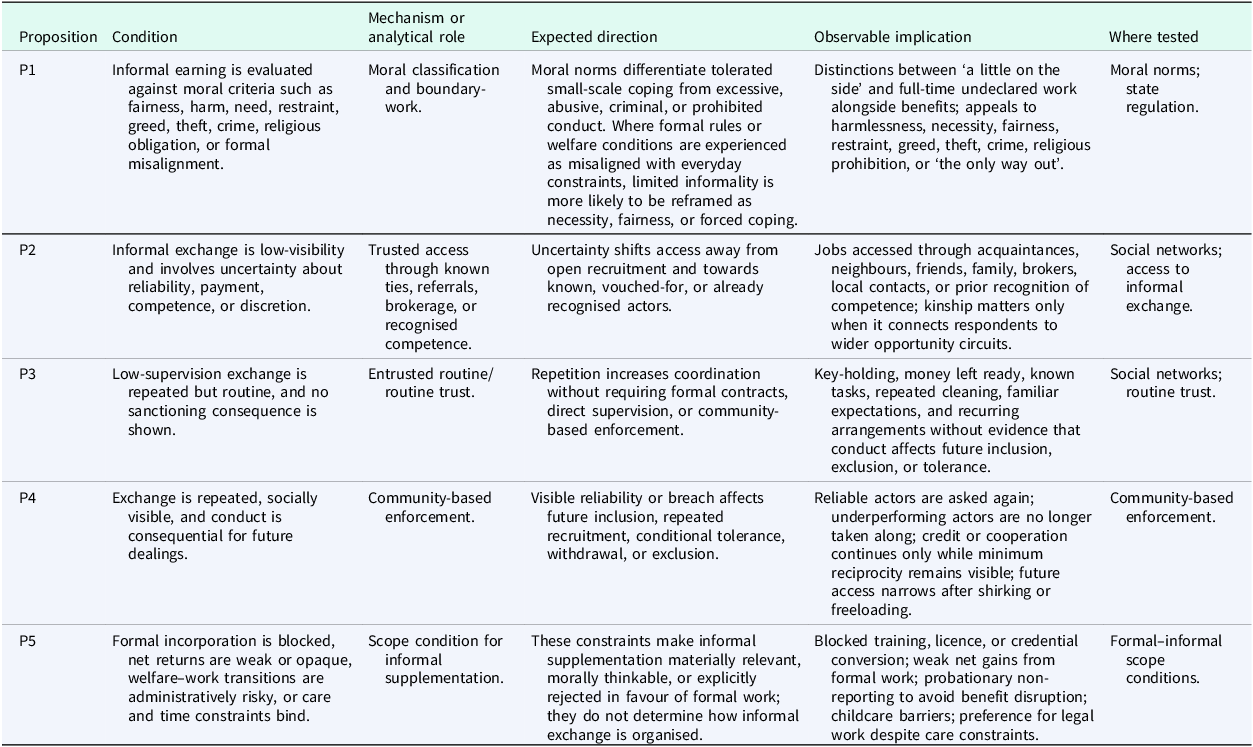
Table 1 translates the theoretical framework into five theory-driven propositions with directional expectations. These propositions are not population-level hypotheses or regression coefficients. They specify qualitative expectations about when particular conditions should increase a mechanism’s salience, accessibility, or durability, and what traces would support, qualify, or challenge that expectation. The findings follow this mechanism-oriented logic, moving from scope conditions to legitimacy, access, and enforcement. Although analytically distinct, the mechanisms may overlap and reinforce one another in concrete exchange episodes.
Theory-driven propositions and observable implications

Table 1. Long description
The table has five rows and six columns. The columns are labeled Proposition, Condition, Mechanism or analytical role, Expected direction, Observable implication, and Where tested. Each row describes a different proposition related to informal earning and exchange. Row 1: Proposition P1, Condition Informal earning is evaluated against moral criteria such as fairness, harm, need, restraint, greed, theft, crime, religious obligation, or formal misalignment, Mechanism or analytical role Moral classification and boundary-work, Expected direction Moral norms differentiate tolerated small-scale coping from excessive, abusive, criminal, or prohibited conduct, Observable implication Distinctions between a little on the side and full-time undeclared work alongside benefits, appeals to harmlessness, necessity, fairness, restraint, greed, theft, crime, religious prohibition, or the only way out, Where tested Moral norms, state regulation. Row 2: Proposition P2, Condition Informal exchange is low-visibility and involves uncertainty about reliability, payment, competence, or discretion, Mechanism or analytical role Trusted access through known ties, referrals, brokerage, or recognised competence, Expected direction Uncertainty shifts access away from open recruitment and towards known, vouched-for, or already recognised actors, Observable implication Jobs accessed through acquaintances, neighbours, friends, family, brokers, local contacts, or prior recognition of competence, kinship matters only when it connects respondents to wider opportunity circuits, Where tested Social networks, access to informal exchange. Row 3: Proposition P3, Condition Low-supervision exchange is repeated but routine, and no sanctioning consequence is shown, Mechanism or analytical role Entrusted routine/routine trust, Expected direction Repetition increases coordination without requiring formal contracts, direct supervision, or community-based enforcement, Observable implication Key-holding, money left ready, known tasks, repeated cleaning, familiar expectations, and recurring arrangements without evidence that conduct affects future inclusion, or tolerance, Where tested Social networks, routine trust. Row 4: Proposition P4, Condition Exchange is repeated, socially visible, and conduct is consequential for future dealings, Mechanism or analytical role Community-based enforcement, Expected direction Visible reliability or breach affects future inclusion, repeated recruitment, conditional tolerance, withdrawal, or exclusion, Observable implication Reliable actors are asked again, underperforming actors are no longer taken along, credit or cooperation continues only while minimum reciprocity remains visible, future access narrows after shirking or freeloading, Where tested Community-based enforcement. Row 5: Proposition P5, Condition Constraints make informal supplementation materially relevant, morally thinkable, or explicitly rejected in favour of formal work, they do not determine how informal exchange is organised, Mechanism or analytical role Blocked training, licence, or credential conversion, weak net gains from formal work, probationary non-reporting to avoid benefit disruption, childcare barriers, preference for legal work despite care constraints, Expected direction Formal incorporation is blocked, net returns are weak or opaque, welfare transitions are administratively risky, or care and time constraints bind, Observable implication Scope condition for informal supplementation, Where tested These conditions.
Methodology
This article draws on 216 respondent-level files from semi-structured interviews conducted in 1997–1999 in Amsterdam-Noord, Amsterdam-Zuidoost/Bijlmermeer, and Rotterdam-Delfshaven, three Dutch low-income urban sites. Full details on case selection, coding rules, and respondent characteristics are provided in the Supplementary Appendix. Respondents were recruited through purposive, multi-entry sampling, supplemented by chain referrals. Entry points included community organisations, schools, neighbourhood centres, social workers, employment agencies, street-level recruitment, and advertisements. Eligibility required low income, operationalised as resources not exceeding roughly 105–110 per cent of the social-policy minimum. In the 46 focal cases, undeclared or informally compensated activities are therefore best understood as necessity-oriented income maintenance rather than opportunity-driven entrepreneurship; this article uses this lens descriptively, while its main analytical focus remains the institutional governance of exchange. These recruitment channels document how access to respondents was obtained; they do not define the explanatory level of the analysis.
This strategy suits hidden, stigmatised practices that standard surveys capture poorly (Burgstaller et al., Reference Burgstaller, Feld and Pfeil2022; Tourangeau and Yan, Reference Tourangeau and Yan2007). Chain referrals risk network homophily and ‘who-you-know’ bias (Biernacki and Waldorf, Reference Biernacki and Waldorf1981; Marcus et al., Reference Marcus, Weigelt, Hergert, Gurt and Gelléri2017). This risk was mitigated by using multiple non-network entry points across three sites. The analysis uses the material for qualitative mechanism inference, rather than to estimate prevalence. Because network-mediated access is one of the findings, referral-based evidence was coded conservatively: Trust-mediated access is assigned only when the interview shows that a concrete informal activity was obtained, coordinated, or made safer through a known tie.
Case selection proceeded in two steps. The 216 files first yielded 82 candidate cases with coded indications of income-generating activity outside formal registration. These were then reduced to 46 unambiguous, attributable, temporally proximate cases suitable for mechanism tracing. Ambiguous, indirect, hypothetical, distant-past, or purely normative references were excluded from the focal subset but retained as contextual material.
Sample description
The full corpus and the strict analytical subset were heterogeneous. Gender data are available for 215 cases: 143 women and 72 men; the one-case difference reflects archival organisation. Household composition comprised 77 single-person households, 66 single-parent households, 53 couple households, and 20 ‘other’ cases. Respondents ranged from 18 to 85 (mean: 46). The corpus included a large native Dutch group alongside Turkish (36), Surinamese (30), Cape Verdean (20), Antillean (11), Moroccan (6), and other respondents (11). Poverty was often prolonged, and labour-market positions ranged from working poor and subsidised workers to medically unfit respondents, temporarily exempt single parents, elderly respondents, and two undocumented cases.
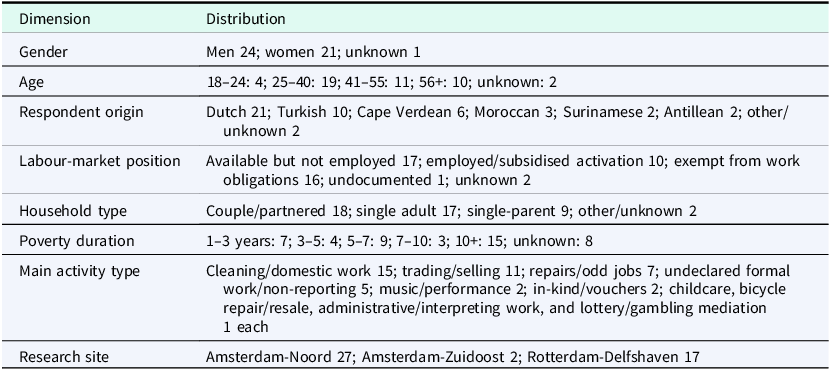
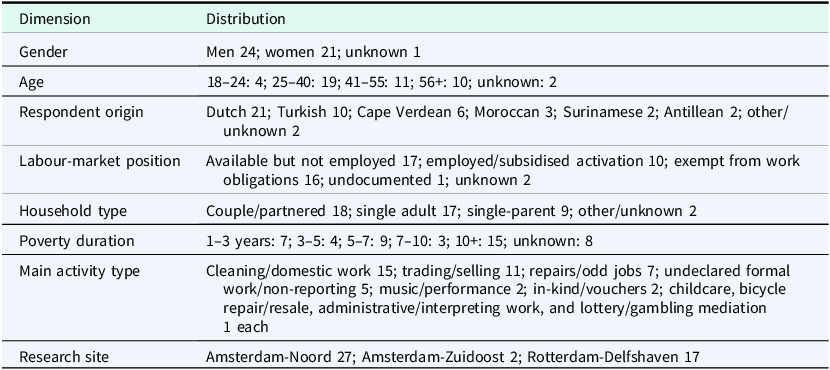
Table 2 summarises the composition of the strict analytical subset (N = 46), including respondent characteristics, activity types, and research sites. The table is descriptive and intended for transparency rather than prevalence estimation; the uneven site distribution reflects traceability criteria, not neighbourhood-level prevalence.
Analytical subset (N = 46; compact overview)
Data collection
Eleven interviewers used a guide of roughly 200 items, combining standardised questions with open-ended prompts covering labour histories, income, welfare encounters, debt, networks, informal practices, rule interpretations, and sanction risks. Available records show that 97 respondents were interviewed once, 81 twice, and 25 three times. Because some records are incomplete, these counts do not sum to 216. Interviews were conducted face-to-face in respondents’ homes or other trusted settings. They lasted over four hours on average and addressed sensitive topics such as undeclared work, welfare circumvention, debt, and poverty stigma. Most interviews were conducted in Dutch; a subset with Turkish respondents in Delfshaven was conducted and translated by a Turkish-speaking researcher and cross-checked within the team. Interviews were audio-recorded and transcribed; where transcript detail was incomplete, passages were excluded from high-confidence focal evidence. Quoted passages were verified against the original-language material.
Analytical strategy
This article conducts a targeted qualitative secondary analysis of a corpus originally coded for a doctoral study (Noordhoff, Reference Noordhoff2008) and re-analysed for the present research question. Where respondents were interviewed more than once, all interview material was consolidated at the respondent-case level. The respondent case is the reporting unit. The mechanism-tracing unit is the transaction-level exchange episode within that case. The analysis reconstructs how informal exchange was justified, accessed, coordinated, and stabilised in concrete accounts. It evaluates the directional propositions developed in the theoretical section by tracing whether the expected links between moral norms, trust relations, and community-based enforcement appear within and across cases. Variation in gender, origin, age, household form, labour-market position, activity type, and site is treated as a set of scope conditions, not as causal controls.
The material was processed in Atlas.ti through interpretive coding, generating 213 codes on situations, interactions, attitudes, strategies, and institutional encounters. The present re-analysis focused on informal economic activity and the mechanisms through which it was justified, accessed, coordinated, and sanctioned. Interpretation proceeds abductively through iterative movement between data and theory (Timmermans and Tavory, Reference Timmermans and Tavory2012).
The triadic model was theory-informed and empirically refined. Moral norms, trust relations, and enforcement were derived from the theoretical framework, while their sequencing, overlap, and boundary conditions were refined through systematic re-reading of focal, contrastive, and boundary cases. Cases cited in the findings were selected as information-rich mechanism cases, not as representative examples. Passages were treated as mechanism evidence when they met four criteria. They had to be traceable to a respondent, activity, and context; show how a mechanism operated; support one mechanism more directly than plausible alternatives; and have a defined evidentiary role as core, contrastive, boundary, scope-condition, or multi-role evidence. Anchor, boundary, and contrastive cases were used to prevent overcoding. The corpus is therefore approached as causal-process observations tracing how actors interpret rules, justify departures from them, enter exchanges, and anticipate or impose sanctions (Beach and Pedersen, Reference Beach and Pedersen2019; Bennett and Checkel, Reference Bennett and Checkel2015; Sayer, Reference Sayer1992).
Coding distinguishes four concepts. Moral norms are legitimacy judgements and boundaries around acceptable or excessive informal exchange. Trust relations are embedded ties enabling access, coordination, discretion, and uncertainty reduction. Community-based enforcement comprises non-contractual social mechanisms that condition continued exchange. These include reputation, reciprocity, gossip, exclusion from future opportunities, and forms of visibility management in which socially observed conduct affects future inclusion, exclusion, or local sanctioning. Formal sanction expectations are anticipated detection, fines, benefit withdrawal, or other state penalties. This distinction prevents the analysis from conflating normative justification with fear of punishment.
Traceability rests on linking coded exports, respondent overviews, and transcript-level documentation. The Supplementary Appendix provides the case-selection flow, respondent-level subset description, and anonymised quote-to-code mapping. Analytical rigour was strengthened through repeated reading, iterative recoding, memo writing, cross-case comparison, and theoretical triangulation.
Scope and limitations
The design supports analytic generalisation rather than statistical inference (Yin, Reference Yin2018). A purposive, partly referral-based subset is used to reconstruct the plausibility, structure, and boundary conditions of a micro-institutional governance model. Because informal institutions are not directly observable, the analysis relies on converging qualitative traces: legitimacy judgements, networked access, reciprocity, monitoring, and sanctioning (Voigt, Reference Voigt2018).
Three evidentiary boundaries follow. First, the late-1990s corpus cannot support direct claims about the current prevalence or organisation of undeclared work; later changes in welfare conditionality, labour-market flexibilisation, childcare, surveillance capacity, and platform-mediated work are therefore contextualised separately. Second, because the activity is hidden and the subset is restricted, this study cannot estimate prevalence, population parameters, econometric models, or statistical significance. Such modelling would require proxies that risk flattening the relational and normative dimensions central to the mechanism. Third, the strict subset is non-representative and unevenly distributed by site, gender, and household type, with Amsterdam-Zuidoost/Bijlmermeer weakly represented. The analysis therefore makes no site-comparative claims and treats site, gender, household form, and origin only as possible scope conditions.
Findings
The findings proceed in two steps. Firstly, they identify the formal–informal scope conditions under which small-scale undeclared earning became materially relevant or morally defensible. Secondly, they trace how such exchange was governed through moral norms, trust relations, and community-based enforcement. Most mechanism evidence comes from the strict N = 46 analytical subset. The wider corpus is used only for scope-condition and contrastive evidence, including cases where respondents rejected undeclared work. These cases clarify moral boundaries, risk perceptions, legitimacy conditions, and points where mechanisms did not operate. Bracketed numbers are archival identifiers. Respondent origin is reported for transparency and as a possible scope condition, not for ethnic-group comparisons of community-based enforcement.
Scope conditions at the formal–informal interface
The material does not identify a distinct ‘informal worker’ type. Instead, it identifies recurrent situations in which small-scale undeclared earning became relevant: inaccessible formal employment, weak or opaque formal returns, unstable work–benefit transitions, and care-constrained paid work. These conditions made informal supplementation materially relevant, morally defensible, or explicitly rejected in favour of formal work; they shaped participation without determining it.
Entry into formal work was often blocked by institutional gatekeeping rather than by unwillingness to work (Brodkin and Majmundar, Reference Brodkin and Majmundar2010; Carpenter et al., Reference Carpenter, Knepper, Erickson and Ross2015). A 52-year-old Dutch single woman [104] wanted computer training but was told by the welfare office that she had to remain immediately available for work. A 36-year-old Cape Verdean man [207] had prior truck-driving experience but could not convert this experience into employment because employers required a Dutch licence that he could not finance. A 32-year-old Dutch welfare recipient [175] had completed taxi training but could not move into work after the welfare office refused a loan for the licence and vehicle. Together, these cases show that formal labour-market entry could remain blocked despite skills, plans, and clear work intentions.
Even where entry into formal work was possible, formal uptake did not always generate a reliable household gain (Cairo and Mahlstedt, Reference Cairo and Mahlstedt2023). Respondent [201], a 50-year-old Cape Verdean mother, described a subsidised job as financially disappointing and noted that she would not have accepted it had she known that her income would remain almost unchanged. Respondent [321], a 42-year-old Surinamese woman, made the same point more directly: Once rent-subsidy losses were included, ‘there is no incentive to work’. Here, formal employment appeared not as a clear improvement, but as an uncertain or negligible gain.
Administrative instability created a further constraint (Moynihan et al., Reference Moynihan, Herd and Harvey2015). Respondent [148], a 27-year-old Surinamese single mother, concealed a new job during a probationary period because a failed job match could trigger prolonged bureaucratic disruption before benefit payments resumed. Without a secure contract, movement from benefit into work created short-term exposure rather than stability. The central risk was transition failure followed by income uncertainty.
Care and time constraints shaped both formal and informal work through household organisation (Bettendorf et al., Reference Bettendorf, Jongen and Muller2015; Knoef and van Ours, Reference Knoef and van Ours2016). Respondent [121], a 32-year-old Dutch single parent, left a job because early departures, childcare demands, and negligible financial gain could not be sustained together. Respondent [231], a 32-year-old Surinamese single mother in a subsidised-work/job-training trajectory, described how formal childcare could not be arranged, making standard employment unworkable and shifting feasible earning into home-based arrangements. Respondent [354], a 33-year-old Surinamese mother, approached the same condition from the opposite direction: If childcare had to be arranged and financed either way, she preferred a legal job to undeclared side-work. Care constraints did not automatically produce informality, but they shaped which forms of earning were feasible.
These four conditions clarify when undeclared earning became relevant, but not how it was organised; under them, undeclared work appeared as a bounded supplement, temporary fallback, or practical adjustment.
Mechanism 1: moral norms and the boundary of legitimate informality
The first mechanism is moral classification (Boltanski and Thévenot, Reference Boltanski and Thévenot2006). Respondents evaluated undeclared earning in terms of fairness, harm, need, greed, obligation, and acceptable gain (Meuleman et al., Reference Meuleman, Roosma and Abts2020). These judgements did not simply mirror legal categories (Abid et al., Reference Abid, Bothello, Ul-Haq and Ahmadsimab2023). Instead, respondents distinguished between limited supplementation and abuse, necessity and opportunism, or acceptable side earning and morally excessive evasion.
Respondents drew sharply different moral boundaries (Bicchieri, Reference Bicchieri2017; Luttmer and Singhal, Reference Luttmer and Singhal2014). Respondent [105], a 21-year-old Surinamese single mother with young children and not yet obliged to work, approved of off-the-books work because ‘everybody is happy’ and ‘you do not hurt anybody’. Respondent [117], a 29-year-old Moroccan single mother available for the labour market, rejected undeclared work by describing people who worked off the books as ‘thieves’. A 58-year-old Dutch participant classified as medically unfit [110] called undeclared work ‘very unfair’ to those who tried to do things properly and linked it to greed. Informality could thus be normalised, condemned, or treated as morally ambiguous.
More common was bounded tolerance of limited supplementation (Luttmer and Singhal, Reference Luttmer and Singhal2014; Wenzel, Reference Wenzel2005). Respondent [119], a 73-year-old Dutch pensioner, accepted undeclared work as ‘an addition to the benefit’ because she understood that people might otherwise fail to get by, but rejected ‘a full-time job next to the benefit’. A supplementary passage shows the same boundary logic: Respondent [141], a 40-year-old Dutch former nurse classified as medically unfit, drew a similar line after taking a small off-the-books cleaning job herself. Occasional supplementation was understandable, while people working “on the side all week” crossed the line. Here, the relevant moral question was not only whether income was declared but also whether the scale and purpose of the activity remained defensible.
Respondent [251], a Turkish single mother available for the labour market, expressed this distinction explicitly. Although she defined undeclared work as work not reported to the welfare office or tax authorities, she stated: ‘If someone has little income and cannot make ends meet, then I find it completely normal that they work off the books. What else should they do?’ At the same time, she rejected such behaviour among those with sufficient income. Tolerance therefore depended on perceived necessity, not on legality alone.
Respondent [335], a 46-year-old Dutch woman available for the labour market, personally opposed undeclared work. Yet she treated it as understandable under hardship (Feld and Frey, Reference Feld and Frey2007; Wenzel, Reference Wenzel2005). She defined it as work over which ‘no tax is paid’ and said she would feel ‘incredibly guilty’, yet added: ‘If you have to live on such a minimum… I can completely understand it. If I could not make ends meet, I would be forced to do it myself’. Personal rejection and contextual justification coexisted within the same legitimacy judgement. For the previously discussed single mother [231], undeclared home-based work became morally defensible only after a formal job opportunity was blocked by the welfare office’s refusal to provide childcare support. She knew that off-the-books work was ‘not right’ and ‘not allowed’, yet added: ‘I saw it, at that moment, as the only way out’. Necessity did not erase the illegality of the act, but it changed its moral interpretation.
Respondent [163], a 65-year-old Turkish man in an extended household, classified as medically unfit/disabled, rejected undeclared work categorically: ‘Working off the books is wrong. Our religion does not allow it’ (Bicchieri, Reference Bicchieri2017; Tyler, Reference Tyler2006). In this case, moral norms excluded informal earning regardless of circumstance.
Across these cases, moral norms bounded informal earning: Limited supplementation could be tolerated, while greed, durable evasion, or full-time undeclared work alongside benefits was condemned. Where reasoning shifted to detection, fines, repayment, or benefit loss, the operative logic became sanction expectation rather than moral classification (Kirchler et al., Reference Kirchler, Hoelzl and Wahl2008).
Mechanism 2: trust relations and social access
The second mechanism concerns access. Trust mattered first at entry and then in the coordination of repeated, low-supervision exchange. It was not a general stock of social capital. It was a relational filter through which actors were admitted to small jobs, occasional tasks, or informal earning opportunities (Hardin, Reference Hardin2002; Marin, Reference Marin2012; Smith, Reference Smith2005). Respondents had to be known, recommended, or familiar enough to be trusted outside formal recruitment (DiMaggio and Louch, Reference DiMaggio and Louch1998; Pallais and Sands, Reference Pallais and Sands2016).
Respondent [204], a Cape Verdean-Dutch man in his mid-twenties living alone, described access through brokerage rather than anonymous exchange (Stovel and Shaw, Reference Stovel and Shaw2012). He positioned himself between people and opportunities: ‘People call me up and say, can you arrange this or that?’ His role connected information, people, and opportunities across separate circuits. He also distinguished between partners with whom arrangements could be made reliably and those who did not pay or took too long. Access depended on selective inclusion based on perceived reliability.
Other cases showed the same access logic in smaller jobs. Respondent [151], a 43-year-old Dutch mother in a subsidised-work trajectory, entered side-work through a friend’s shop, where she cleaned for six weeks before looking elsewhere. Respondent [166], a 38-year-old Dutch woman in a subsidised-work trajectory, described her husband’s informal odd jobs as coming through ‘friends, acquaintances and family’, because people already knew what he could do and called when such work was needed. In these cases, prior recognition of competence created access to informal work (Pallais and Sands, Reference Pallais and Sands2016; Smith, Reference Smith2005).
Kinship mattered when it connected respondents to wider exchange circuits. A 50-year-old Dutch man classified as medically unfit [122] obtained off-the-books work through his brother-in-law, who was already ‘in the circuit’ and connected him to a workshop via broader pub-based contacts. The mechanism was referral into an existing opportunity circuit, not kinship intimacy itself (Kramarz and Skans, Reference Kramarz and Skans2014; Stovel and Shaw, Reference Stovel and Shaw2012).
Trust also operated through routine and entrusted repetition. Respondent [225], a 66-year-old Dutch pensioner, cleaned for a man across the street, held the key to his house, and entered daily for a short clean and weekly for a longer one. A supplementary routine-trust trace comes from respondent [133], a 26-year-old Dutch single mother classified as working poor, who described entering with a key, knowing what had to be done, and finding the money ready in the house. In these cases, familiarity substituted for formal contracting and made low-supervision exchange possible (DiMaggio and Louch, Reference DiMaggio and Louch1998; Hardin, Reference Hardin2002; Safuta and Camargo, Reference Safuta and Camargo2019). Across these cases, need alone did not create access; access depended on brokerage, referral, recognised competence, and entrusted routine.
Mechanism 3: community-based enforcement and reciprocal governance
Community-based enforcement regulates repeated informal exchange among people who meet, observe, remember, and deal with one another. It is narrower than general social control or welfare-sanction fear: observed conduct in a repeated relation must affect future exchange, turning visibility into inclusion, tolerance, withdrawal, or exclusion.
It resembles private ordering: Where formal contracts, courts, or official enforcement are absent, unusable, or risky, cooperation can be sustained through repeated dealings, reputational information, ostracism, and exclusion (Bernstein, Reference Bernstein1992; Ellickson, Reference Ellickson1991; Greif, Reference Greif1993; Kandori, Reference Kandori1992; Milgrom et al., Reference Milgrom, North and Weingast1990). Here, enforcement is fragile and less formalised: not stable sanctioning, but traces of repeated relations, visibility, conduct evaluation, reputational memory, and consequences for work, credit, information, or tolerance.
Respondent [136], single, around forty, childless, formally unemployed and on social assistance, is clearest. His informal economic life moved through a neighbourhood meeting place, local bar, informal work broker, lottery mediation, borrowing relations, and small work crews. He described his weekly routine as ‘the same little circuit’, and work for the broker as something he did ‘usually’, not once. Repetition made conduct observable: People knew who was available, who had money, who borrowed, who repaid, who worked hard, and who avoided effort.
Visibility was central. After an earlier undeclared newspaper round, [136] was confronted by the welfare office with ‘an anonymous tip’, after which he felt as if ‘there was an enemy behind every tree’. This marks the local-formal interface. Horizontally, he had to ‘watch who you tell things to’, because information could be passed on, and ‘as soon as they see that you are doing a bit better than someone else, then there is trouble’. Being seen created opportunity and risk.
Visible conduct was evaluated. A poorly performing co-worker was criticised as someone who ‘would rather do nothing than do a little’. It was ‘shameful to hold out your hand for money in the evening’ after contributing so little. By contrast, [136] presented his own value through punctuality and competence: ‘I am never late for anything’, and ‘if you are a bit handy, that makes a difference’. Those who consumed without contributing were ‘freeloading on others’. Reciprocity transfers not only resources but also obligations and moral assessments (Molm, Reference Molm2010).
Evaluation became enforcement when remembered and carried into future dealings. In [136], reputational memory circulated through talk. Others might label him ‘the borrower’, and negative stories were ‘talked around’. Reputation could also be positive: People told his mother he was ‘always proper, always tidy’. The strongest evidence concerns the informal work broker. At first, the broker ‘did not want to see’ that another worker contributed little; later ‘he had seen it’. Once underperformance was recognised, future access changed. The poorly performing co-worker was no longer taken along, while [136] was preferred: ‘now he has seen it; when he asks someone along, he asks me’. Reliable conduct was rewarded with renewed recruitment: ‘if you sign up for something, you have to give yourself to it. That is why people often ask you again — a job here, a job there’.
The same logic appeared more weakly in [136]’s credit relation with a local bar owner. Debt was tolerated as long as he visibly brought money back: ‘at least I come and bring my money’. Enforcement operated through conditional tolerance rather than immediate exclusion; actors remained included while their conduct remained minimally credible.
Other cases provide partial and boundary evidence. Respondent [225], 66, Dutch, living alone on an old-age pension after long-term social assistance, shows repeated relations, trust, and selective monitoring. She cleaned undeclared for a man across the street, held his key, and had ‘free rein’: routine trust enabling low-supervision exchange. Her wider neighbourhood account shows visibility: card games for money outside, police passing by, observed drug premises, and underletting visible through ‘different faces’ in the building. She reported drug premises, but not underletting, because she was ‘not a traitor’. This shows distinctions between violations to report, tolerate, or ignore, not [136]’s work-circuit enforcement.
Respondent [114], a Dutch pensioner living alone, adds softer reciprocal governance: neighbourhood babysitting, club contacts, weekly coffee, small gifts, repair help, and later a packet of rolling tobacco as a return gesture. These exchanges lacked formal pricing and strict sanctioning, but small gestures maintained local balance. She also drew moral boundaries: A welfare mother earning ‘a little on the side’ was understandable, but people earning substantially while on benefits and ‘bragging about it’ were resented. This is adjacent evidence: conditional tolerance and reciprocal balancing, not a complete enforcement sequence.
A final boundary appears when neighbourhood knowledge becomes administratively actionable rather than socially sanctioned. Respondent [305], a Dutch pensioner living alone, marks the closest boundary between community-based enforcement and formal welfare control. She suspected that a small cleaning arrangement had ‘probably been reported‘, after which the Social Service appeared; after earlier inspection, she ‘would not dare’ again. Local visibility may therefore have exposed the arrangement to formal intervention, but the sanctioning force came from the welfare office. Respondent [207], mentioned earlier, marks the stricter boundary: his withdrawal from side work followed administrative detection and repayment, not exclusion or loss of trust within a repeated exchange relation. These cases show how neighbourhood information can activate formal welfare control, while clarifying that formal sanction risk remains distinct from community-based enforcement proper (Gilliom, Reference Gilliom2001; Soss et al., Reference Soss, Fording and Schram2011).
Community-based enforcement is not general neighbourhood policing, mere secrecy, or formal welfare surveillance. It is repeated relations making conduct visible, evaluated, and consequential for future exchanges. In [136], reliable actors are asked again, and unreliable actors lose access; in [114] and [225], local actors maintain reciprocal balance, tolerate some violations, and mark others as reportable or excessive; in [207] and [305], the mechanism is formal sanction risk. The effect is selective but important: Access, tolerance, credit, and cooperation depend on being seen as reliable, discreet, and minimally reciprocal. In constrained livelihoods where earning, security, and social obligation intersect (Carr et al., Reference Carr, Napolitano and Keating2007), formal rules are joined by reputational consequences.
Synthesis: the triadic governance of informal exchange
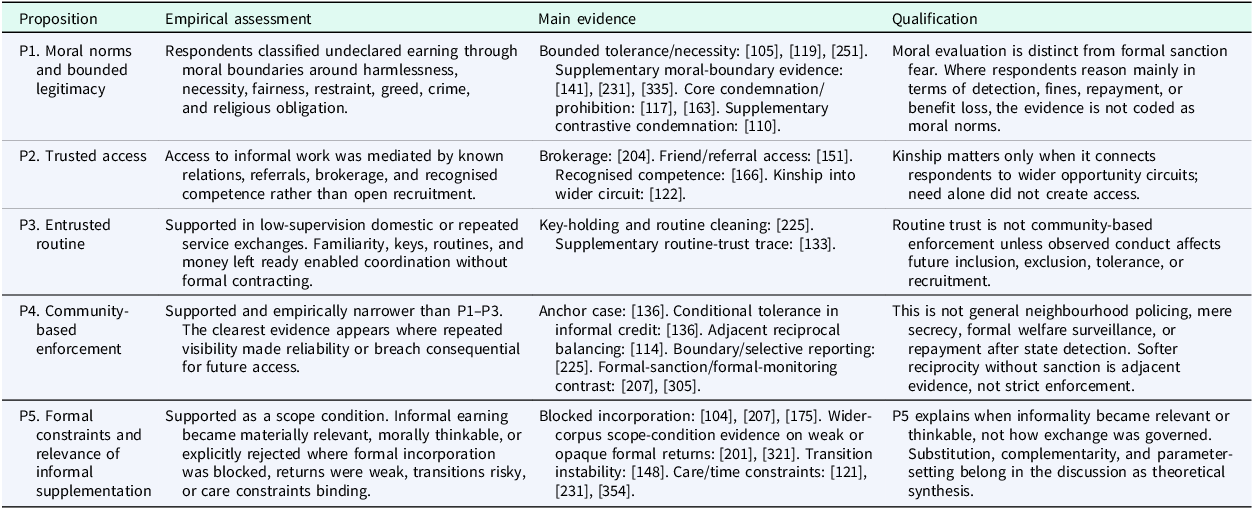
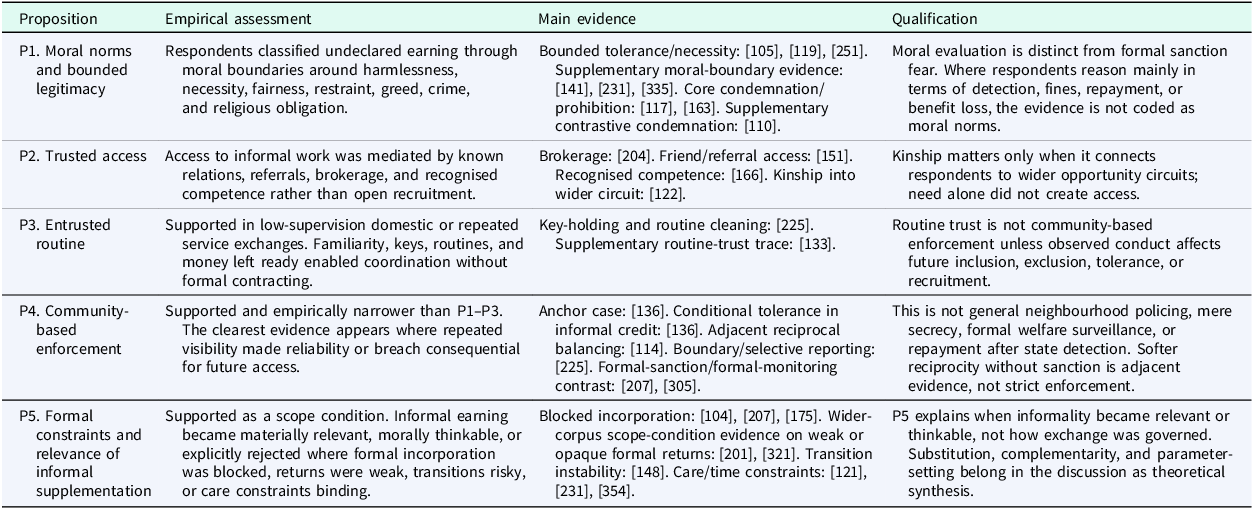
The findings show that formal constraints explained when informal supplementation became relevant, but not how it was governed. Table 3 summarises the proposition-level synthesis and shows how the three mechanisms interact under the identified scope conditions. Informal exchange became governable when three analytically distinct mechanisms aligned: Moral norms bounded the acceptable scale and purpose of informal earning, trust relations opened access to opportunities, and community-based enforcement stabilised repeated exchange when conduct became visible and consequential. The full triad was not present in every case. Some cases showed moral evaluation, others trust-based access or routine exchange, and only a smaller subset showed repeated interaction in which conduct affected future dealings. The contribution therefore lies not in claiming that all three mechanisms were always present, but in showing how they could align under particular conditions. Informal economic activity was coordinated through repeated relations and adjusted under constraint. It did not form a stable alternative to formal labour-market participation.
Proposition-level synthesis of findings
Discussion
The interviews function as a late-1990s Dutch historical baseline for identifying mechanisms of exchange governance, not as evidence about present-day incidence. Informal order did not arise outside strong formal institutions, but at their margins, where institutional constraint interacted with transaction-level informal governance. Since then, the formal–informal interface has been reconfigured: Welfare governance has become more conditional and closely monitored (van Berkel, Reference van Berkel2020; Oldenhof et al., Reference Oldenhof, Kersing and van Zoonen2024); labour-market flexibilisation has widened the zone between stable incorporation and insecure livelihood maintenance (Eleveld, Reference Eleveld2022; Knoef and van Ours, Reference Knoef and van Ours2016); and digitalisation and platform intermediation have reorganised access, visibility, and traceability through digital matching, reputation systems, and algorithmic control (Vallas and Schor, Reference Vallas and Schor2020; Wood and Lehdonvirta, Reference Wood and Lehdonvirta2023). These shifts changed the coordination infrastructures through which access, concealment, trust, and visibility were organised.
Contemporary indicators are used only for contextual triangulation. Measured at a different level, they indicate that the formal–informal interface remains relevant under changed conditions: Undeclared work is estimated at 4.8 per cent of labour input; self-reported participation is around 10 per cent; the flexible workforce is large; and platform activity remains largely supplementary (Centraal Bureau voor de Statistiek, 2023, 2024; European Labour Authority, 2023; Eurostat, 2023; Williams and Horodnic, Reference Williams and Horodnic2020). These indicators neither validate the interviews nor prove continuity. They position the corpus as a historical baseline for assessing the plausibility of the mechanisms. What was historically specific was the analogue infrastructure of access and concealment: face-to-face networks, word-of-mouth, cash payment, neighbourhood visibility, and personal reputation. What remains analytically durable is the triadic logic visible under institutional misalignment, sanction risk, and administrative uncertainty.
Community-based enforcement appeared as subtle, uneven relational governance rather than collective sanctioning. Its evidentiary base was narrower than that for moral norms and trust relations, but it clarified an important part of the mechanism: Informal exchange became more durable when repeated interaction made conduct visible, remembered, and consequential. The findings therefore show that informal exchange was not sustained by a single mechanism. It was governed through the transaction-level interaction of moral boundaries, trusted access, and socially mediated consequences. The triadic framework connects this evidence to a central concern of institutional economics: How institutions reduce uncertainty, structure incentives, and govern exchange where formal rules alone do not settle coordination.
The findings refine substitution/complementarity accounts by showing that formal–informal relations varied across transactions, even within the same setting and sometimes within the same respondent’s account. Informal arrangements substituted for formal channels when those channels were inaccessible, unusable, or too risky; supplemented formal livelihoods while often circumventing reporting rules; and complemented formal institutions only in the narrower sense that formal risk and legality shaped the boundaries within which informal exchange was organised. Informal institutions also set parameters: They shaped the feasible scale, visibility, access routes, and moral limits of exchange. Substitution, complementarity, and parameter-setting are therefore best understood as transaction-level modes rather than mutually exclusive system properties (Buchen, Reference Buchen2024; Bylund and McCaffrey, Reference Bylund and McCaffrey2017; Gërxhani and Cichocki, Reference Gërxhani and Cichocki2023).
The framework complements existing accounts rather than replacing them. Labour-market exclusion explains why informal supplementation became relevant; deterrence and welfare surveillance explain why visibility and reporting became risky; embeddedness and trust explain why access was socially mediated; and moral-economy accounts explain why informal earning was evaluated through necessity, fairness, and abuse rather than legality alone (Becker, Reference Becker1968; Granovetter, Reference Granovetter1985; Piore, Reference Piore1979; Portes, Reference Portes1998; Williams et al., Reference Williams, Horodnic and Windebank2015). The contribution of the triadic model lies in connecting these explanations at the level of exchange governance. It shows how structural pressure, legal risk, relational access, and moral evaluation were translated into concrete decisions about whether actors reported, delayed, concealed, limited, or combined income streams.
The necessity–opportunity distinction is descriptive rather than explanatory. It captures the fact that most activities were closer to income maintenance than to entrepreneurial growth but is too coarse as the main analytical lens. As O’Donnell et al. (Reference O’Donnell, Leger, O’Gorman and Clinton2024) note, necessity entrepreneurship is conceptually ambiguous, and Dencker et al. (Reference Dencker, Bacq, Gruber and Haas2021) argue that it should be understood through context and institutional conditions rather than a push–pull binary. What appeared as necessity was structured by welfare risk, opaque returns, administrative uncertainty, care constraints, moral limits, and trust-mediated access. Together, these conditions channelled exchange into small-scale, low-visibility forms (Williams et al., Reference Williams, Horodnic and Windebank2015; Williams and Öz-Yalaman, Reference Williams and Öz-Yalaman2021).
Implications for institutional design
Formalisation policy should target the conditions that make informal governance useful, credible, and accessible through social ties, rather than relying on enforcement, incentives, or moral appeals in isolation. Formalisation becomes more plausible when formal participation is legitimate, administratively navigable, economically worthwhile, reversible, and compatible with household constraints.
Where welfare-to-work transitions are opaque or hard to reverse, limited informality can become protection against administrative loss. Trial periods, rapid re-entitlement, income bridges, and low-friction claiming can make formal participation more credible (Castell et al., Reference Castell, Gurgand, Imbert and Tochev2025; Kolsrud et al., Reference Kolsrud, Landais, Nilsson and Spinnewijn2018). Where formal work offers weak or opaque net gains, actors have stronger incentives to combine formal and informal income. Earnings disregards, personalised net-return calculations, and trusted intermediary support can make gains visible and reliable (Cairo and Mahlstedt, Reference Cairo and Mahlstedt2023; Knoef and van Ours, Reference Knoef and van Ours2016). Where care constraints make formal work difficult, stricter surveillance may redirect income-generating activity into less visible arrangements; formalisation is most plausible when declared work is care-compatible and supported by accessible childcare (Bettendorf et al., Reference Bettendorf, Jongen and Muller2015; Leduc and Tojerow, Reference Leduc and Tojerow2024). Enforcement must be designed to preserve legitimacy: If it heightens visibility while leaving transitions opaque, returns uncertain, and care constraints unresolved, it may strengthen the conditions under which informal governance becomes attractive. Moral legitimacy, trusted access, and enforcement are therefore interdependent dimensions of institutional design for formalising exchange.
Limitations and future research
These findings offer a historically grounded mechanism analysis of late-1990s welfare-state informality, not evidence of how undeclared work is currently organised or how it varies across regimes. Because conditionality, labour-market flexibilisation, childcare, surveillance, and platform work have changed, contemporary indicators serve only as contextual triangulation. Retrospective accounts may over-represent exchanges that were memorable, easily narrated, or socially visible. Future research should examine whether, and how, moral norms, trust relations, and community-based enforcement operate across contemporary institutional and technological settings. Future research could compare Dutch-origin and non-Dutch-origin groups, since this study reports origin for transparency but was not designed to identify systematic subgroup differences.
Conclusion
This article reconstructed how informal exchange was governed in late-1990s Dutch low-income urban settings. Its central claim is not that informal exchange survives because formal institutions are weak. Rather, strong formal institutions can leave transaction-level coordination problems that informal norms, trusted ties, and relational sanctions help solve. The evidence showed how exchange was bounded and coordinated at the margins of welfare and labour markets: Moral norms delimited acceptable supplementary earning, trust relations organised access to low-visibility opportunities, and community-based enforcement stabilised obligations where repeated exchange made conduct socially visible. Formal and informal institutions interacted not only through substitution and complementarity but also through parameter-setting: Informal norms, ties, and sanctions shaped scale, visibility, access, and moral limits. Where formal participation is unpredictable, risky, or incompatible with household constraints, informal governance may remain useful and defensible. Formal institutions become more credible only when they are predictable, worthwhile, reversible, and usable.
Supplementary Material
The Supplementary Appendix is available online at: https://osf.io/hf52m/files/gfa72.
Acknowledgements
All conceptualisation, interpretation, literature selection, empirical claims, and final wording are solely the responsibility of the author, who reviewed, revised, and approved all AI-assisted language suggestions before submission. No AI system qualifies for authorship. Total word count, including abstract, references, tables and table equivalents: 9800. The original research on which this article draws was funded by the Dutch Ministry of Social Affairs and Employment as part of the Landscapes of Poverty project. No additional funding was received for the preparation, analysis, or writing of this article.


 Open access

