




1. Introduction
The concealed passive construction (CPC) in English is structurally characterized by a matrix verb such as need, require, deserve, want or bear, plus its -ing complement (Visser Reference Visser1963–73: 1886–8; Huddleston & Pullum et al. Reference Huddleston and Pullum2002: 1199–1200; Toyota Reference Toyota2006; Kim Reference Kim2018), as illustrated in (1):

In these examples, the subject is understood as the undergoer of the event described by the -ing complement. They are then semantically equivalent to the standard be-passive construction counterparts in (2):

This equivalence challenges traditional syntax–semantics mappings because the active form of the CPC unexpectedly induces a passive interpretation. Previous studies hold differing views on this issue. Some suggest that CPCs and standard passives share a common feature related to the ‘raising’ operation (Huddleston & Pullum et al. Reference Huddleston and Pullum2002; Strelluf Reference Strelluf2022), while others argue that CPCs and standard passives represent distinct constructions, emphasizing differences in the matrix verbs permitted in each (Puckica Reference Puckica2009; Toyota Reference Toyota2006, Reference Toyota2009; Kim Reference Kim2018).
Despite these debates, relatively little research has explored specific characteristics of the CPC, such as interactions between matrix verbs and -ing complements, agent by-phrases and subject animacy, leaving gaps in our understanding of the construction. Addressing these gaps matters not only for describing the CPC itself but also because the construction exemplifies a striking form–function mismatch: an active surface form that consistently yields a passive interpretation. Understanding how such mismatches arise is central to theories of argument structure and the syntax–semantics interface. Moreover, the CPC provides insights into wider processes of complementation change, contributes to debates about raising vs. control, and connects with other morphologically active but passively interpreted constructions (e.g. middle and passival constructions). For these reasons, clarifying the status of the CPC is not only valuable in its own right but also sheds light on more general mechanisms of grammatical organization and change.
In this study, we attempt to examine the CPC in more detail using data from the Corpus of Contemporary American English (COCA) (Davies Reference Davies2008). In doing so, we apply three types of collostructional analysis to evaluate the statistical association of matrix verbs (or verb types) and statistical relationships between specific matrix verbs (or verb types) and other elements in the construction. Based on the corpus observations, we also propose a structural analysis within the framework of Construction Grammar.
The rest of this article proceeds as follows. Section 2 reviews previous literature on the CPC and outlines our research questions. Section 3 describes the methods used for data collection and analysis. Section 4 presents and discusses the findings from our corpus-based investigation of the CPC, in comparison with previous studies. Section 5 addresses the syntactic issues related to the construction and offers a construction-based analysis. Section 6 connects our major findings with the constructional analysis and section 7 discusses their implications for constructional changes. Section 8 concludes the article.
2. Previous studies: key grammatical properties of the CPC
2.1. Matrix verbs
Previous studies on matrix verbs in the CPC have largely revolved around a specific subset of verbs (Visser Reference Visser1963–73; Quirk et al. Reference Quirk, Greenbaum, Leech and Svartvik1985; Huddleston & Pullum et al. Reference Huddleston and Pullum2002; Toyota Reference Toyota2006; Puckica Reference Puckica2009; Kim Reference Kim2018). For instance, Visser (Reference Visser1963–73: 1888) identified an initial set of 22 such verbs, including abide, avoid, await, bear, continue, deserve, desire, escape, fear, hate, lack, merit, miss, mot (obsolete), need, prefer, prevent, repay, require, stand, suffer and want, which have been used historically in the construction. On the other hand, Quirk et al. (Reference Quirk, Greenbaum, Leech and Svartvik1985: 1189–90) and Huddleston & Pullum et al. (Reference Huddleston and Pullum2002: 1199–1200) only included the matrix verbs that generally take a to-infinitive complement such as deserve, need, require and want.
Subsequent studies have explored the diachronic distribution changes of these matrix verbs, utilizing corpus data (Toyota Reference Toyota2006, Reference Toyota2009; Kim Reference Kim2018). According to Toyota (Reference Toyota2009), throughout the history of English, matrix verbs in the CPC can be categorized into three types in terms of chronological order: Type I includes abide, avoid, continue, escape, lack and suffer, used around the seventeenth–eighteenth century. Type II, including await, miss, prevent, repay and stand, emerged in the nineteenth–twentieth century. Type III includes bear, deserve, merit, need, require and want, used from 1400 to the present day. Kim (Reference Kim2018) further demonstrated that the most frequently used matrix verb in the construction has changed over time, based on raw frequencies of matrix verbs extracted from two diachronic corpora: CLMET 3.0 and BYU-BNC fiction register. Specifically, he showed that during the Late Modern English period (1710–1920), want was the most frequently used matrix verb, while in Present-day English (1980s–1993), need took that role.
2.2. -ing complements
Next, previous studies have observed that verbs in this slot exhibit various syntactic types, as illustrated in (3) (Puckica Reference Puckica2009; Kim Reference Kim2018):

Building on this finding, Puckica (Reference Puckica2009) compared these complement types with those of the standard be-passive construction and argued that the verbs in the VP[-en] complement of the be-passive construction are indistinguishable from those in the -ing complement of the CPC. From a diachronic perspective, Kim (Reference Kim2018) noted that in the early stages of the late modern English period, the CPC predominantly featured monotransitive verbs in the -ing complement. Over time, however, this usage expanded to a wider variety of verb types.
Another important aspect of the -ing complement is its syntactic nature; specifically, whether it is as a VP or an NP (Huddleston & Pullum et al. Reference Huddleston and Pullum2002: 1200; Toyota Reference Toyota2006; Puckica Reference Puckica2009; Strelluf Reference Strelluf2022).

In (4a), the presence of an agent by-phrase renders coaxing verbal while in (4b), the presence of some that modifies coaxing shows its nominal property. The more complex case is (4c), where coaxing appears on its own, leaving the interpretation ambiguous; it could be verbal, meaning ‘to be coaxed’, or nominal, meaning ‘some coaxing’. Huddleston & Pullum et al. (Reference Huddleston and Pullum2002) argued that the -ing complement here should be analyzed as a VP, given that ‘coaxing’ is directed toward the children, suggesting a passive construction. Strelluf (Reference Strelluf2022) expanded on this idea by indirectly supporting the VP analysis, comparing the -ing complement in the CPC to the Alternative Embedded Passive (AEP; see also Edelstein Reference Edelstein, Zanuttini and Horn2014). He compared three structural variants: the infinitival passive (e.g. needs to be fixed), the AEP (e.g. needs fixed) and the CPC (e.g. needs fixing), as demonstrated in (5).Footnote 1

Although these structures are truth-conditionally equivalent, the nature of their complements varies. According to Tenny (Reference Tenny1998) and Edelstein (Reference Edelstein, Zanuttini and Horn2014), verbs with reversative un- (e.g. unwrap) are compatible with both the infinitival passive structure and the AEP, as in The package needs {to be unwrapped/unwrapped}. However, verbs with non-reversative, negative un- (e.g. unwash) are incompatible with the AEP but remain acceptable in the infinitival passive structure, as in The car needs {to be unwashed/*unwashed}. They explain this discrepancy by arguing that reversative un- can function verbally, while negative un- cannot, serving only an adjectival function (e.g. the unwashed car). In Strelluf’s corpus study, AEP and CPC examples only appeared with reversative un-, such as Just like Pereira would unlock Pogba, now Lingard needs unlocked too (AEP) and Looks like Klopp needs unlocking (CPC) (Strelluf Reference Strelluf2022: 58); however, no instances were found with non-reversative/negative un- items, which are typically adjectival (e.g. unwashed). Based on these findings, Strelluf concluded that both the AEP and CPC involve VP structures.
2.3. Agent by-phrases
Another notable grammatical property of the CPC is the use of an agent by-phrase. Researchers have debated over this property with differing grammatical judgments. Huddleston & Pullum et al. (Reference Huddleston and Pullum2002: 1200) argued that the CPC can optionally include an agent by-phrase, similar to the canonical be-passive construction, by providing examples like The article needs checking (by the editor) and The article needs to be checked (by the editor). On the other hand, Toyota (Reference Toyota2006) claimed that the CPC differs from the canonical be-passive in its inability to co-occur with an agent by-phrase, considering sentences like This TV needs fixing by the electrician to be ungrammatical, unlike This TV needs to be fixed by the electrician.
Puckica (Reference Puckica2009) contributed to this discussion by providing corpus examples, such as Cataclysmic first-quarter figures from MIPS Computer Systems Inc. … underline how much the company needs rescuing by Silicon Graphics Inc. This indicates that the construction can, in practice, include an agent by-phrase. Furthermore, Kim (Reference Kim2018) showed that out of his 609 CPC examples only one example contained an agent by-phrase, suggesting its rare usage throughout the history of English.
2.4. Subject (in)animacy
The final characteristic of the CPC concerns the animacy of the subject within the construction. Research, including Toyota (Reference Toyota2006) and Kim (Reference Kim2018), has shown that approximately 40 percent of CPC examples feature an animate subject. This trend has remained relatively consistent since the late modern English period. However, Kim (Reference Kim2018) further observed a notable change in Present-day English, where the frequency of CPC examples with want as the matrix verb and an animate subject has risen significantly to 85.7 percent. This represents a substantial increase from 30–35 percent during the Late Modern English period. This trend suggests a diachronic change in the usage of the CPC when want serves as the matrix verb, in particular in terms of the preference for the animate subject.
2.5. Research questions
We have thus far reviewed several key grammatical properties of the CPC discussed in previous studies. However, many of these studies were based on the researchers’ own intuitions, leading to varied grammatical judgments (Quirk et al. Reference Quirk, Greenbaum, Leech and Svartvik1985: 1189–90; Huddleston & Pullum et al. Reference Huddleston and Pullum2002: 1199–1200; Albrespit Reference Albrespit2007; Puckica Reference Puckica2009). Additionally, while some studies incorporated corpus examples, they often provided limited frequency data from relatively small samples (Visser Reference Visser1963–73: 1886–8; Toyota Reference Toyota2006). Moreover, a significant gap in the literature is related to the lack of exploration into strongly associated matrix verbs (or verb classes) and possible interrelations between matrix verbs (or verb types) and other constructional elements. Lastly, previous literature lacks an account of the passive interpretation of the CPC induced without any overt passive morphology.
Considering all these together, our present study seeks to address the following research questions:
-
1. What is the distribution of verbs in Visser’s list within the CPC’s matrix verb slot in Contemporary American English, and how strong are their statistical associations? Should these verbs be grouped together or divided into subtypes?
-
2. Among the various semantic types of -ing complements, are there any correlations between matrix verbs (or verb types) and -ing complement types?
-
3. How common is the use of the agent by-phrase in the CPC, and are there any specific verbs (or verb types) that are strongly associated with its presence or absence?
-
4. What are the distribution patterns of animate and inanimate subjects in the CPC, and which matrix verbs (or verb types) show strong correlations with the (in)animacy of the subject?
-
5. What are the mechanisms that can account for its passive interpretation induced without any overt passive morphology?
To answer these questions, we conducted a comprehensive analysis of the CPC using real-life data from a large and balanced corpus, adopting both quantitative and qualitative methods.
3. Data and methodology
3.1. Data
For this study, we utilized data from the Corpus of Contemporary American English (COCA) (Davies Reference Davies2008). The corpus is composed of more than one billion words, with an annual contribution of 24–25 million words from 1990 to 2019. This extensive collection is fairly equally distributed into eight distinct registers: five fundamental registers (i.e. spoken, fiction, popular magazines, newspapers and academic texts) and three newly added informal registers (TV and movie subtitles, blogs and webpages).
For our current study, we focused on the five primary registers. The initial step in our methodology involved extracting all combinations of the 22 matrix verbs identified by Visser (Reference Visser1963–73: 1888) and -ing verb forms. To achieve this, we employed specific search strings in COCA, as exemplified in the following:

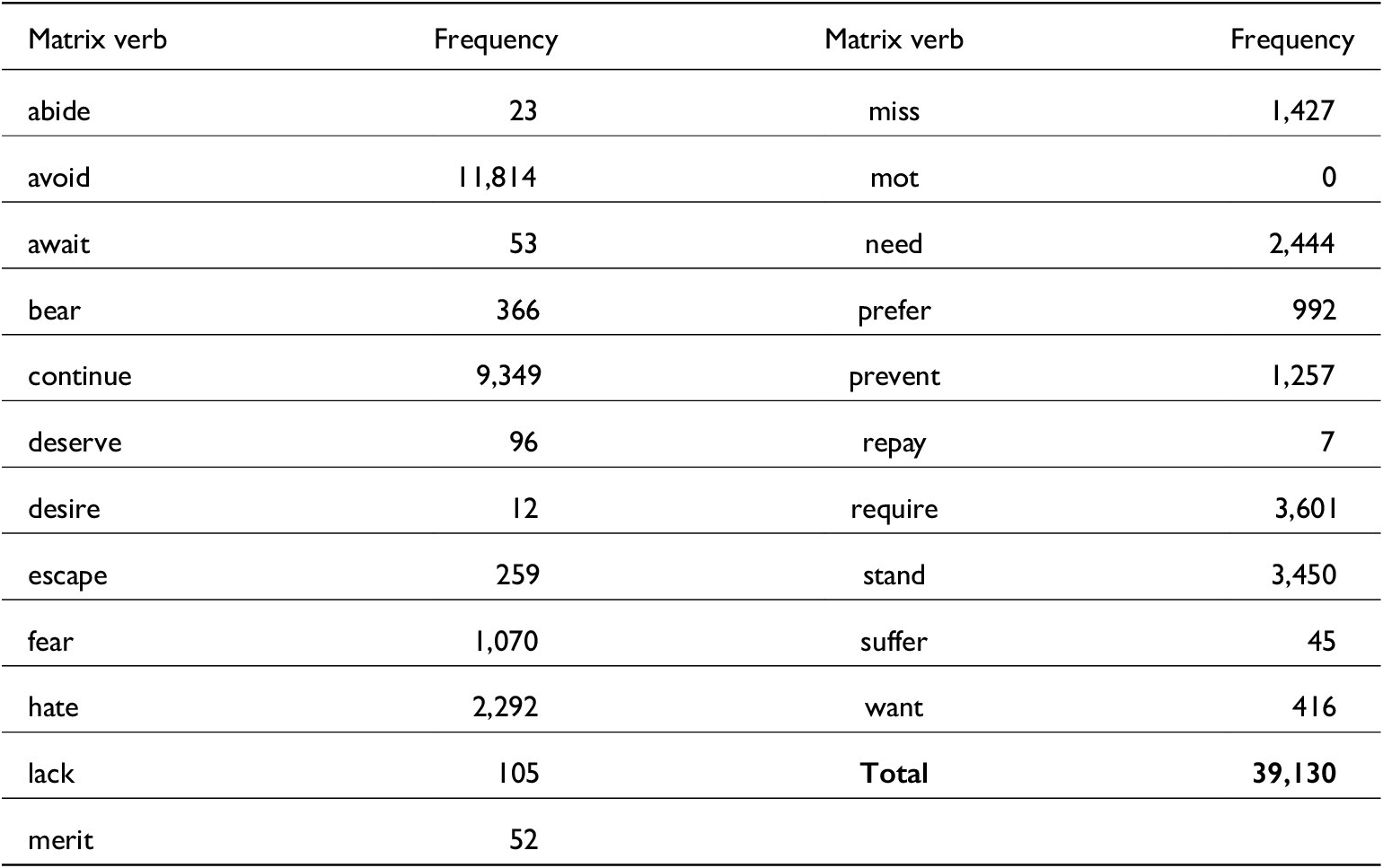
In this query, [need]_vv represents all variants of the verb need (i.e. need, needs, needing and needed), and v?g corresponds to an -ing verb. This search string helped us to gather all instances where any form of need as a lexical verb was followed by an -ing verb. We replicated this method for each of the 22 matrix verbs listed in Visser’s work, and the initial raw frequencies of these combinations, before manual filtering, are presented in table 1.
Raw frequencies of combinations of 22 matrix verbs listed in Visser (Reference Visser1963–73) and -ing verb forms in COCAFootnote 2

Note: Frequencies in table 1 represent raw instances retrieved from COCA prior to manual exclusion of irrelevant tokens (see (7)).
Then, we manually filtered out irrelevant examples as in (7):

In (7a), the matrix verb hated is followed by an -ing complement having, but it does not yield a passive interpretation. In (7b), needed is not directly complemented by hiding; instead, hiding modifies places and, thus, is not a complement of the verb needed. After this data-cleaning process, we identified a total of 2,541 CPC examples for analysis. To ensure reliability in this filtering and classification step, all 39,130 instances initially retrieved from the corpus were checked manually by both authors and subsequently reviewed by an independent non-author. Clear non-CPC cases were excluded. Borderline cases, such as suffer bruising and bear repeating, were retained when a passive reading remained contextually available, even if a non-passive interpretation was also plausible. We acknowledge that this conservative inclusion strategy may allow some non-passive tokens into the dataset, but we consider it appropriate because such borderline cases reflect how English speakers actually use the CPC in practice.
3.2. Methodology
Collostructional analysis is a family of quantitative methods in corpus linguistics used to examine the interaction between words and their grammatical constructions. In this study, we applied three types of collostructional analysis to statistically investigate the real-life grammatical properties of the CPC: collexeme, covarying collexeme and distinctive collexeme analyses.
Firstly, we employed the collexeme analysis to scrutinize verbs within the CPC’s matrix verb slot. This method reveals how specific semantic classes of words are naturally attracted to, or repelled from, particular construction slots (Stefanowitsch & Gries Reference Stefanowitsch and Gries2003; Gries & Stefanowitsch Reference Gries, Stefanowitsch, Achard and Kemmer2004a; Wulff Reference Wulff, Gries and Stefanowitsch2006; Hilpert Reference Hilpert, Allan and Robynson2012; Stefanowitsch Reference Stefanowitsch, Hoffmann and Trousdale2013, Reference Stefanowitsch, Herbst, Schmid and Faulhaber2014; Perek Reference Perek, Glynn and Robinson2014). A notable application of this method can be seen in Stefanowitsch & Gries’ study, where they discovered that in the British National Corpus (BNC), the V1 slot of the transitive into -ing construction is often filled with trickery verbs like trick and mislead or force verbs like coerce and force (e.g. They {tricked/forced} him into believing them).
Secondly, we used the covarying collexeme analysis to identify patterns between verbs (or verb types) in the matrix verb slot and those in the -ing slot of the CPC (Gries & Stefanowitsch Reference Gries, Stefanowitsch, Achard and Kemmer2004a, Reference Gries, Stefanowitsch, Newman and Rice2010; Stefanowitsch & Gries Reference Stefanowitsch and Gries2005; Stefanowitsch Reference Stefanowitsch, Hoffmann and Trousdale2013; Hilpert Reference Hilpert, Glynn and Robinson2014). This method is particularly useful for discovering combinations of two lexemes that co-occur more frequently than expected by chance within two slots of a construction. For example, Stefanowitsch & Gries (Reference Stefanowitsch and Gries2005), using BNC data, found a strong correlation between a trickery frame and a belief frame in the transitive into -ing construction, as evidenced by the four strongest covarying collexeme pairs such as fool–thinking and mislead–believing (e.g. They {fooled/misled} him into thinking he would never find out the truth).
Thirdly, we also applied the distinctive collexeme analysis to examine whether specific verbs (or verb types) in the matrix verb slot tend to be more strongly associated with certain types of subjects (animate or inanimate) and the presence/absence of an agent by-phrase (Gries & Stefanowitsch Reference Gries and Stefanowitsch2004b; Gilquin Reference Gilquin2006, Reference Gilquin, Leino and von Waldenfels2012, Reference Gilquin2015; Hilpert Reference Hilpert2006; Stefanowitsch Reference Stefanowitsch2006, Reference Stefanowitsch2018; Wulff Reference Wulff, Gries and Stefanowitsch2006; Wulff et al. Reference Wulff, Stefanowitsch, Gries, Radden, Köpcke, Berg and Siemund2007; Gries & Wulff Reference Gries and Wulff2009). This method is typically used to analyze one slot in two or more related constructions. For instance, Gries & Stefanowitsch (Reference Gries and Stefanowitsch2004b) used it to identify distinctive verbs in the ditransitive versus the to-dative constructions. They showed that verbs like give, tell, show and offer, which deliver a sense of direct or metaphorical contact between the agent and recipient, are more strongly associated with the ditransitive construction, while verbs like bring, take and pass, conveying a sense of accompanied motion or distance between the agent and recipient, are more preferably used with the to-dative construction.
At this juncture, it is important to note that raw frequency counts alone cannot reliably capture the strength of association between a verb and a constructional slot. A verb may occur frequently in the corpus simply because it is common overall, without being especially characteristic of the construction. Collostructional analysis, therefore, employs statistical association measures that compare observed frequencies against expected distributions, thereby identifying genuine attraction or repulsion (Gries & Stefanowitsch Reference Gries, Stefanowitsch, Achard and Kemmer2004a; Stefanowitsch Reference Stefanowitsch, Hoffmann and Trousdale2013; Desagulier Reference Desagulier2017).
However, the ‘canonical’ version of collostructional analysis has been the subject of sustained debate. Bybee (Reference Bybee2010), from a usage-based perspective, questioned the normalization procedures and, more broadly, the cognitive plausibility of downweighting frequent lexemes. In her view, frequency is not statistical ‘noise’ but a key factor in entrenchment and category formation. For instance, highly frequent verbs such as go or know often appear across many constructions, and thus may receive a low collostructional score. Yet, as Bybee shows with be going to or the discourse marker I don’t know, these high-frequency items are cognitively central: they anchor constructions in speakers’ mental grammar, undergo reduction and semantic bleaching, and drive processes of grammaticalization. From this viewpoint, procedures that minimize the role of frequent items risk overlooking precisely the elements that most strongly shape grammatical knowledge.
Schmid & Küchenhoff (Reference Schmid and Küchenhoff2013) and Küchenhoff & Schmid (Reference Küchenhoff and Schmid2015) added further methodological critiques, particularly of the Fisher-Yates exact test (FYE), one of the most widely used statistics in early collostructional studies. They argue that FYE tends to conflate effect size with sample size, rests on questionable assumptions of randomness and complicates direct comparisons with alternative descriptive measures such as attraction and reliance.
In response, Gries (Reference Gries2012, Reference Gries2015) has emphasized that collostructional analysis is not bound to FYE and that multiple association measures can be applied depending on the research question. Moreover, he has shown that results obtained via collostructional analysis consistently align with experimental findings, often more reliably than approaches based on raw frequency alone.
In line with Gries’ argument that association measures should be chosen to match the research question (rather than relying on raw frequencies alone), we adopt collostructional analysis in this study and implement it in the coll.analysis 4.0 package in R Studio, with the log-likelihood ratio (LLR) as the association measure.Footnote 3 LLR has become one of the most widely used statistics in collostructional studies (Stefanowitsch & Gries Reference Stefanowitsch and Gries2003; Hilpert Reference Hilpert, Allan and Robynson2012) and ensures comparability with prior work. It is sensitive to both frequency and association strength, and G²/LLR is among the most widely used association measures in collostructional analysis (Gries Reference Gries2019).Footnote 4
4. Results
4.1. Matrix verbs
In our analysis of 2,541 CPC examples from COCA, we first classified them according to matrix verbs. Drawing from Visser’s research, which lists 22 possible matrix verbs, we identified 12 of these verbs in the corpus. In our data, we found that need is by far the most frequent matrix verb, accounting for 78.90 percent of all instances (2,005 out of 2,541). Other relatively frequent matrix verbs include bear (226), require (171), deserve (36), want (31) and await (31). The remaining verbs, escape (15), merit (11), prevent (6), avoid (4), suffer (4) and hate (1), are comparatively rare, each occurring fewer than 15 times. The verbs found in COCA can be grouped into several semantic groups as in (8):
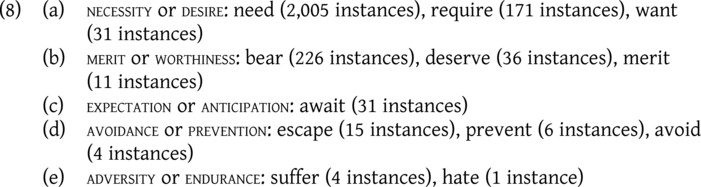
Verbs of necessity or desire in (8a) indicate actions or states considered essential or strongly wished for by the subject: need and require convey a sense of imperative or essential necessity, while want generally reflects desire or wish.Footnote 5 Verbs of merit or worthiness in (8b) relate to deservingness or entitlement based on one’s actions, qualities or achievements: bear, deserve and merit imply a judgment of worthiness or eligibility for some reward or recognition. Verbs in (8c) describe expectation or anticipation: await denotes the act of expecting something to happen, often with a sense of anticipation. Verbs of avoidance or prevention in (8d) express the intention to evade or stop something undesirable from happening: escape involves getting away from a threat or confinement, prevent means to stop something from occurring and avoid suggests keeping away from something harmful or undesirable. Verbs of adversity or endurance in (8e) depict situations of experiencing difficulty or negative emotions: suffer indicates undergoing discomfort, while hate denotes intense dislike, often resulting from negative experiences. Notably, the most dominant semantic class of matrix verbs in the CPC is necessity or desire, led by need. The second most frequent group is merit or worthiness, followed by expectation or anticipation, avoidance or prevention and finally adversity or endurance.
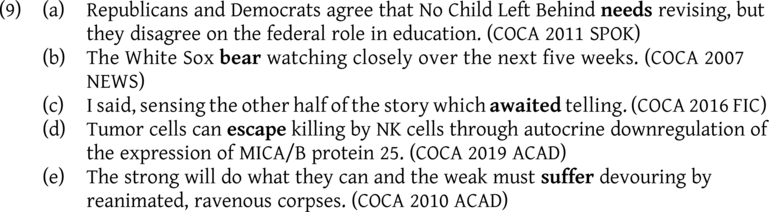
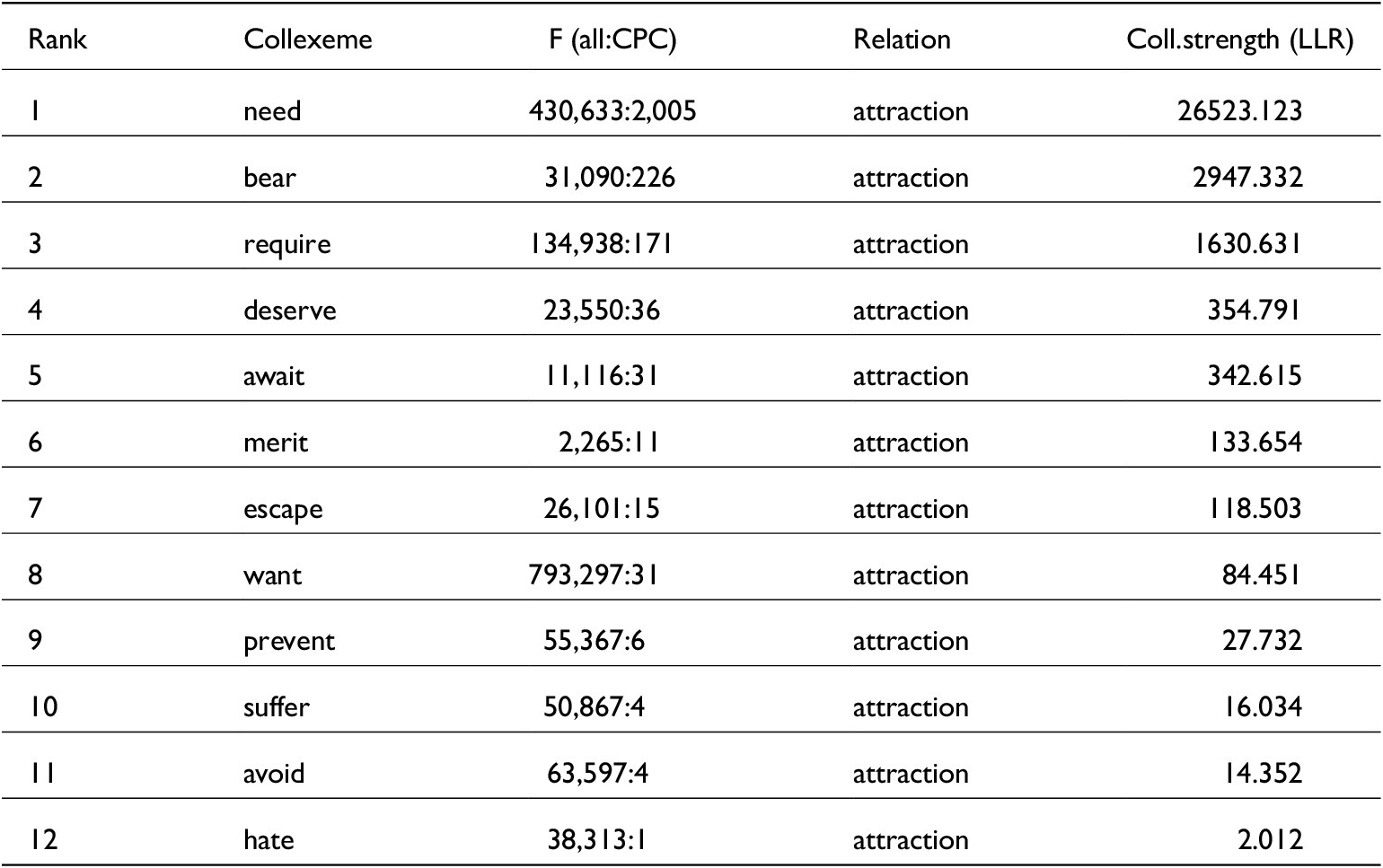
As previously discussed in section 3.2, raw frequency counts may not accurately indicate the strength of association between a matrix verb and its position in the CPC. To investigate this relationship more thoroughly, we conducted a collexeme analysis. The results are summarized in table 2, and examples from actual usage are presented in (9).
Collexeme verbs in the matrix verb slot of the CPC in COCA

The results show that, overall, all 12 verbs are attracted to the CPC. Notably, need emerged as the strongest collexeme verb and this underscores need’s exceptional attraction to the matrix verb slot of the CPC. Other verbs such as bear, require, deserve, await, merit, escape, want, prevent, suffer and avoid also exhibit significant associations, each exceeding the collostruction strength threshold of 3.8415 (equivalent to p < 0.05). Among these verbs, hate is the only one that does not show a strong attraction to the CPC.Footnote 6
4.2. -ing complements
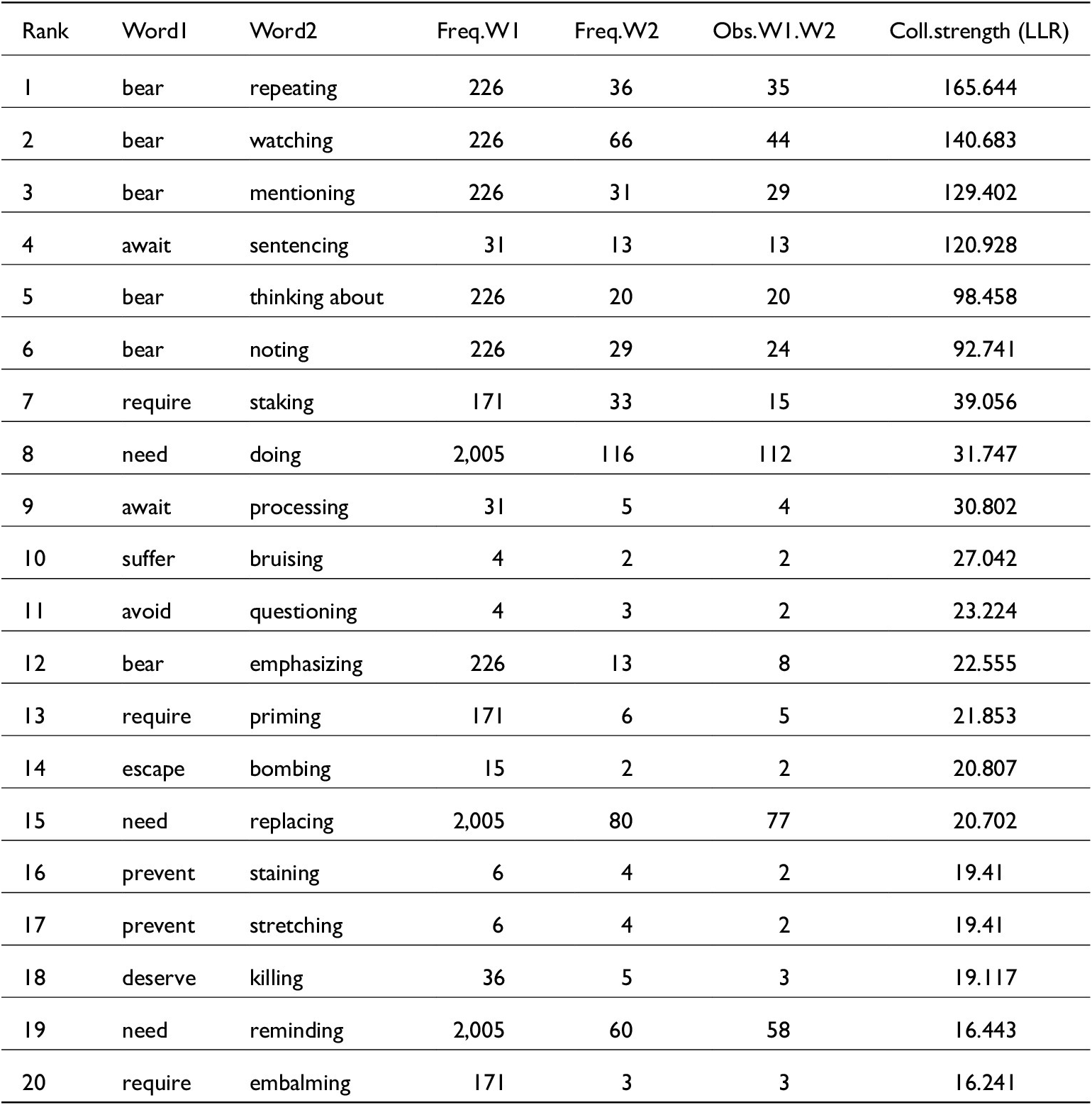
Next, we analyzed whether certain matrix verbs (or verb types) pair with particular -ing complements. Table 3 displays the 20 strongest co-occurring pairs (Word1 = matrix verb, Word2 = -ing complement), ranked by collostruction strength. In addition, some representative examples from actual usage are provided in (10).

The 20 strongest covarying collexeme pairs of the matrix verb slot and the -ing complement slot in the CPC from COCA

Note: ranked by collostruction strength, LLR ≥ 3.8415, p < 0.05.
The strongest pair is bear–repeating (165.644), followed by bear – watching (140.683) and bear–mentioning (129.402). This indicates that bear frequently co-occurs with terms related to repetition, attention or emphasis. Other significant patterns include await–sentencing (120.928) and await–processing (30.802), suggesting that await is commonly paired with terms implying forthcoming action or judgment. The matrix verb require pairs notably with staking (39.0556) and priming (21.853) as well, which represent contexts of necessity or preparation. In a similar manner, need often co-occurs with doing and replacing wherein practical actions aim at improvement. Other statistically strong pairs like suffer–bruising (27.042) and escape–bombing (20.807) involve physical harm or avoidance of danger, often carrying negative connotations.Footnote 7
4.3. Agent by-phrases
We then examined whether the identified CPC examples contain an agent by-phrase. Only 42 out of our 2,541 CPC examples (1.65%) involve an agent by-phrase with 9 matrix verbs, as exemplified in (11):

The agent by-phrase can refer to an animate entity by others as in (11a), an organization/group that has animate entities as members by Swedish authorities as in (11b), or an inanimate causer by the state Legislature as in (11c). The proportion of the agent by-phrase in the data indicates that it is rarely included in the CPC in real-life uses.
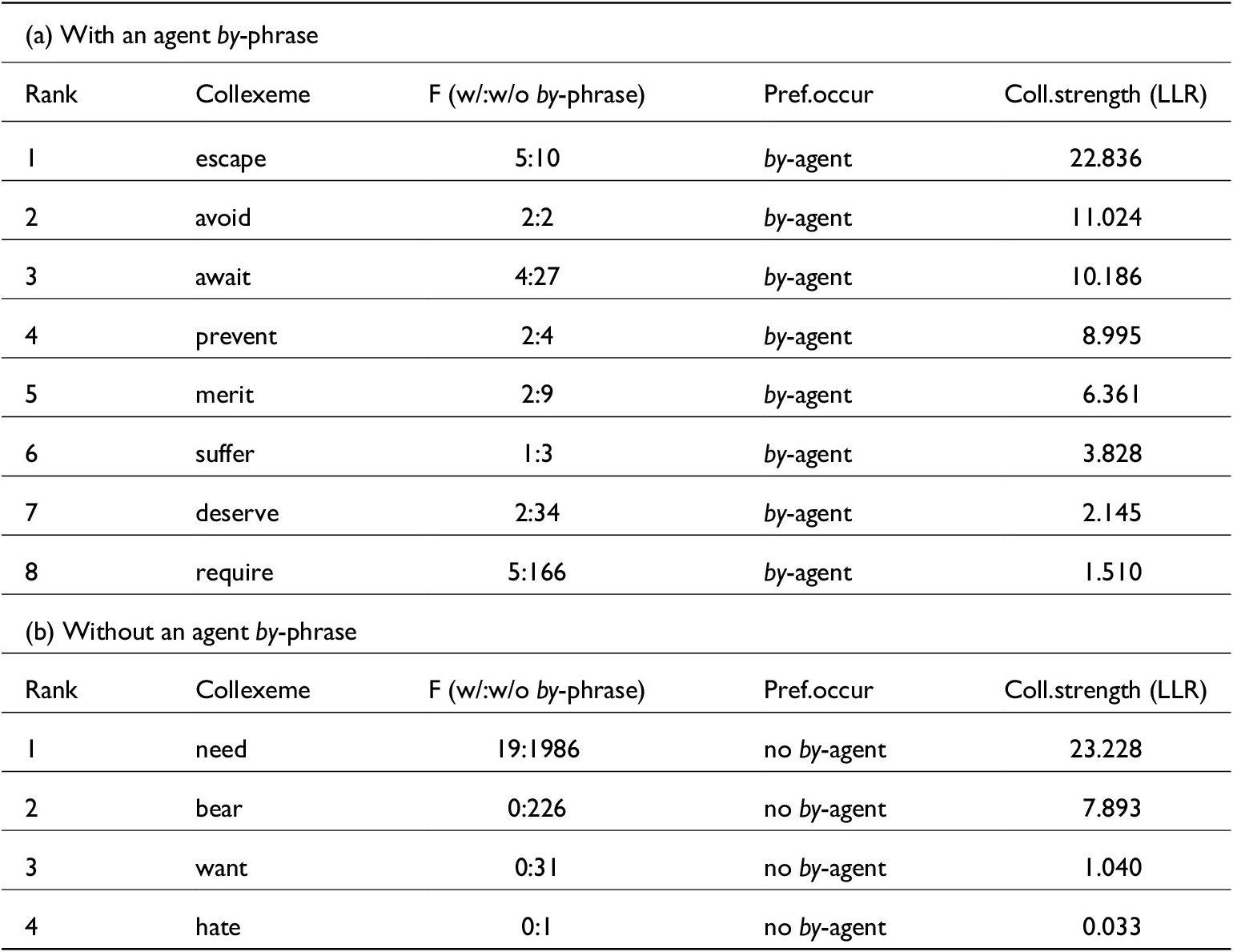
We also performed a distinctive collexeme analysis to examine whether the presence or absence of an agent by-phrase is statistically associated with particular matrix verbs (or verb types). The results are presented in table 4, divided into two panels: verbs that prefer contexts with an agent by-phrase (a) and verbs that prefer contexts without an agent by-phrase (b). Within each panel, verbs are ranked by collostruction strength (LLR).
Distinctive collexeme analysis results for the matrix verbs and the presence/absence of the agent by-phrase in the CPC in COCA

The results show that the most distinctive collexeme for the presence of the agent by-phrase is escape, with a collostruction strength value of 22.836, followed by avoid, await, prevent and merit. In contrast, the most distinctive collexeme associated with the absence of the agent by-phrase is need, with a collostruction strength value of 23.228, followed by bear.
We further investigated which semantic types of matrix verbs are statistically more strongly associated with or without an agent by-phrase. This contrast is shown in (12):

This indicates that matrix verbs describing avoidance or prevention and expectation or anticipation tend to be strongly associated with an agent by-phrase, while those expressing necessity or desire tend to be strongly associated with its absence.
4.4. Subject (in)animacy
Lastly, we examined whether the observed CPC examples in COCA involve animate or inanimate subjects. Consider the following examples:

Out of our 2,541 CPC examples, 427 (16.9%) have animate subjects, as shown in examples (13a) and (13b), where animate subjects include typical animate entities and expressions referring to organizations or groups composed of animate members. The remaining 2,114 examples (83.1%) contain inanimate subjects, including typical inanimate entities as in (13c) and expletive subjects like it as in (13d).
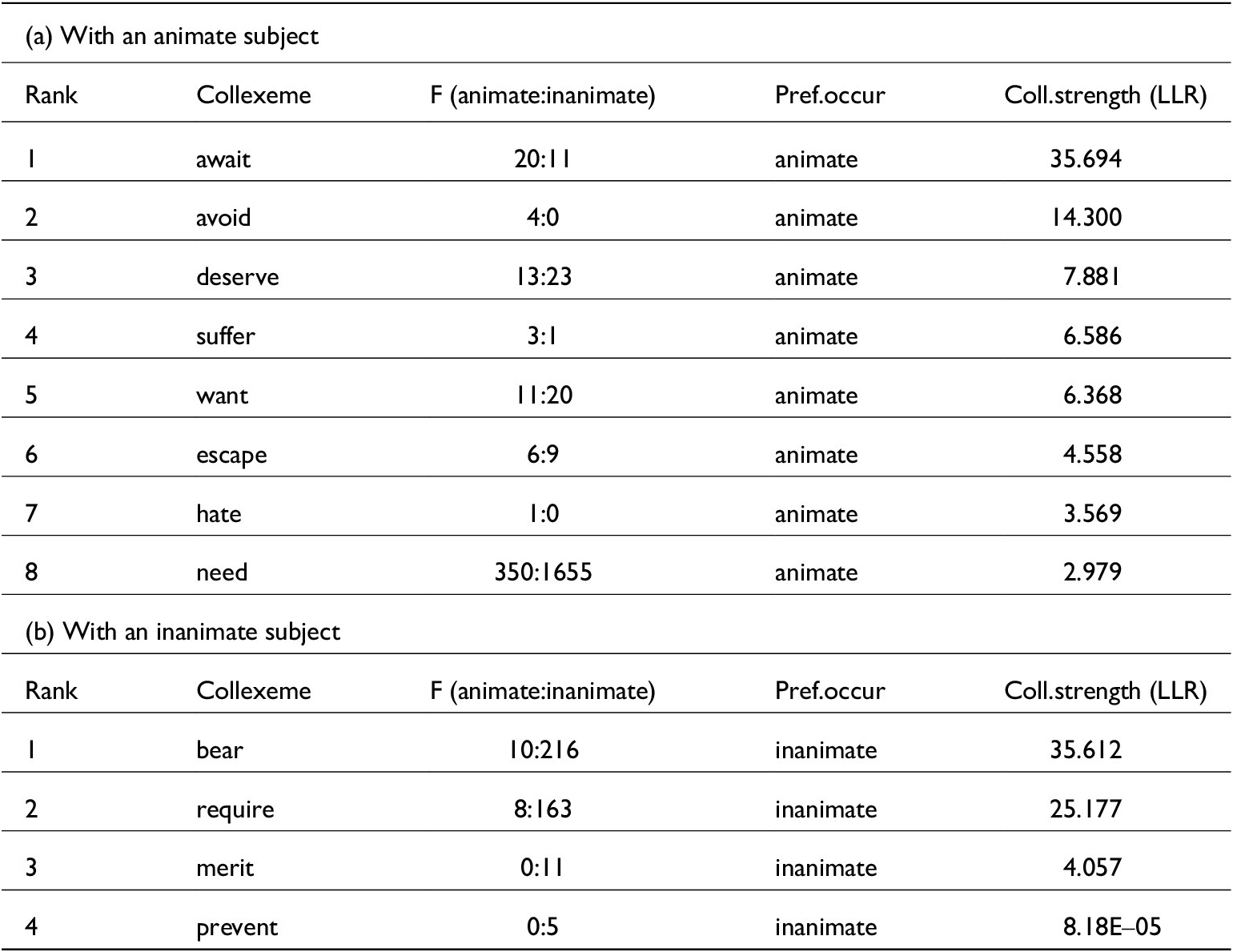
We also conducted a distinctive collexeme analysis to assess whether particular matrix verbs are statistically associated with animate or inanimate subjects. The results are presented in table 5, divided into two panels: verbs that prefer animate subjects (a) and verbs that prefer inanimate subjects (b). Within each panel, verbs are ranked by collostruction strength (LLR).
Distinctive collexeme analysis results for matrix verbs and subject (in)animacy in the CPC in COCA

The results indicate that for CPC examples with animate subjects, await is the most distinctive collexeme with a collostruction strength value of 35.694, followed by avoid, deserve, suffer, want and escape. On the other hand, for CPC examples with inanimate subjects, bear is the most distinctive collexeme, followed by require and merit.
We also checked which semantic types of matrix verbs are statistically strongly associated with animate or inanimate subjects. This distinction is given in (14):

This indicates that verbs expressing expectation or anticipation, avoidance or prevention and adversity or endurance are statistically strongly associated with animate subjects, while certain verbs describing merit or worthiness and necessity or desire and are statistically strongly associated with either animate or inanimate subjects.
4.5. Interim summary
Section 4 above provides preliminary answers to our research questions.
-
• RQ1: What is the distribution of verbs in Visser’s list within the CPC’s matrix verb slot in Contemporary American English, and how strong are their statistical associations? Should these verbs be grouped together or divided into subtypes?
Our corpus finding revealed that 12 of Visser’s 22 verbs appear in the matrix verb position. Need is by far the most frequent, occurring in 78.9 percent of the identified CPC examples, followed by bear and require, with others appearing less often. The collexeme analysis further confirms that need exhibits an exceptionally strong association with the CPC, surpassing all other verbs, including the second most strongly associated verb bear. We categorized the 12 matrix verbs by five major semantic groups: (i) necessity or desire, (ii) merit or worthiness, (iii) expectation or anticipation, (iv) avoidance or prevention and (v) adversity or endurance. Overall, these findings expand on Kim (Reference Kim2018) by showing that need and bear are the key verbs in the CPC due to their strong associations, while no single semantic category dominates the matrix verb slot.
-
• RQ2: Among the various semantic types of -ing complements, are there any correlations between matrix verbs (or verb types) and -ing complement types?
Certain matrix verbs (or verb types) correspond strongly to particular -ing complements. For instance, need and require are statistically strongly associated with practical or corrective actions, such as doing and replacing, reflecting necessity. Bear is statistically strongly associated with complements like repeating and watching, describing emphasis or worthiness. Await is statistically tightly linked to procedural complements, such as sentencing and processing, expressing anticipation. Escape and avoid are strongly related to -ing complements like bombing and questioning, indicating avoidance or prevention of harm. These pairings illustrate the interaction between certain matrix verbs (or verb types) and specific semantic domains of -ing complements.
-
• RQ3: How common is the use of the agent by-phrase in the CPC, and are there any specific verbs (or verb types) that are strongly associated with its presence or absence?
The agent by-phrase is rarely used in the CPC, occurring in only 1.65 percent of the observed COCA examples. This pattern aligns with Kim (Reference Kim2018), who also found that the by-phrase is generally uncommon. Compared to the canonical be-passive construction, which exhibits a 20 percent occurrence rate for the agent by-phrase, the CPC shows different behavior. Nonetheless, verbs like escape, avoid, await and prevent show strong statistical associations with the presence of the agent by-phrase. In contrast, need and bear are strongly associated with its absence.
-
• RQ4: What are the distribution patterns of animate and inanimate subjects in the CPC, and which matrix verbs (or verb types) show strong correlations with the (in)animacy of the subject?
Our corpus-based observation revealed distinct patterns of animate and inanimate subjects in the CPC. Animate subjects appear in 16.9 percent of the identified examples, often with verbs like await, avoid, deserve, suffer and want; inanimate subjects occur in 83.1 percent, frequently collocating with verbs like bear and require.
Although no single, straightforward pattern emerges regarding properties of matrix verbs (or verb types) and interrelations between matrix verbs (or verb types) and other elements of the CPC, a widely known distinction between ‘raising’ and ‘control’ helps us group these varied behaviors in a more streamlined way. We argue that this ‘raising’ vs. ‘control’ contrast is not arbitrary but arises from the two senses of the verb need, which exhibits a particularly strong statistical association with the CPC. Before examining how this distinction accounts for the real-life uses of the CPC, we repeat our final research question (RQ5) below, whose answer will be addressed in section 5:
-
• RQ5: What are the mechanisms that can account for its passive interpretation induced without any overt passive morphology?
5. Syntactic issues and a construction-based analysis
5.1. Syntactic issues
The most intriguing syntactic and semantic characteristic of the CPC is its passive interpretation without any overt passive verb form. Such a mismatch between an active form and a passive meaning has been observed in other constructions like the middle and passival constructions as in (15) (O’Grady Reference O’Grady1980; Ackema & Schoorlemmer Reference Ackema and Schoorlemmer1994; Warner Reference Warner1995; Hundt Reference Hundt, Mair and Lindquist2004; Smitterberg Reference Smitterberg2016):

As with the CPC in (15a), the middle construction as in (15b) and the passival construction as in (15c) do not involve any overt passive form, but they still induce passive interpretations, such that their subject referent should be understood as an undergoer of the event denoted by the active verb form sell in (15b) or the -ing complement building in (15c).
An important question is how a passive interpretation of the CPC is achieved. To address this, one may consider the structure developed by Strelluf (Reference Strelluf2022), which was originally proposed for similar constructions by Tenny (Reference Tenny1998) for the AEP need washed and by Huddleston & Pullum et al. (Reference Huddleston and Pullum2002) for the CPC need washing.
First, as discussed in section 2.2, AEP complements, unlike to-infinitival passive complements, do not allow the adjectival prefixes like un- ‘not’ as in (16a). Furthermore, they also do not allow negation within the complement, whereas to-infinitival passive complements do, as illustrated in (16b).

Edelstein attributes this contrast to syntax, which distinguishes AEP from the to-infinitival passive. Edelstein provides structures as in (17). The to-infinitival passive (17a) involves need selecting a full Tense Phrase (TP), which contains a Passive Phrase (PassP). This allows elements such as negation to appear within the complement (e.g. The car needs not to be fixed). By contrast, (17b), the structure for the AEP lacks those additional projections and involves only Aspectual Phrase (AspP).

Because the AEP lacks the projections needed to host negation, forms such as The car needs not fixed are ungrammatical.
Strelluf (Reference Strelluf2022) provides empirical support for this analysis using Twitter corpus data, where he examines three structures: the to-infinitival passive, AEP and CPC. His findings confirm that, like AEP, CPC constructions do not appear with the adjectival prefix un-, as seen in (16a), and do not include negation within the complement, as seen in (16b). These patterns suggest that CPC shares the same structural properties as AEP, aligning with (17b), whereas the to-infinitival passive follows (17a). Considering all these together, Strelluf concluded that they are all raising constructions, where the argument (e.g. the car) of the verb fix within the embedded verb phrase is ‘raised’ to the matrix subject position.
Strelluf’s (Reference Strelluf2022) so-called ‘raising’ analysis primarily focuses on the verb need, but this analysis can also be extended to other verbs that appear in the CPC. To understand why the CPC with need involves raising, consider the examples in (18):

In (18a), this construction is not a matrix argument. Semantically, (18a) can be paraphrased either as (18b) or as (18c). This demonstrates that the verb need in the CPC does not directly assign a thematic role to the subject but instead raises it to the subject position.
Similarly, other matrix verbs in the CPC, such as want, require, deserve, bear and merit, can be taken to involve this type of ‘raising’ structure, as in (19):Footnote 8

This parallel suggests that a similar ‘raising’ analysis can be applied to these verbs. Like need, these verbs in the CPC do not directly assign a thematic role to the subject but raise it to the matrix subject position. Therefore, want, require, deserve, bear and merit can be analyzed similarly, supporting a unified syntactic analysis for this class of verbs in the CPC.
However, this generalization does not apply to all matrix verbs found in the CPC. For instance, verbs such as await, escape and prevent exhibit different syntactic behavior, as shown in (20):

The example in (20a) shows that these verbs can be used in the CPC, but they cannot take an extraposed clausal complement along with a dummy it subject as in (20b) or a clausal subject as in (20c).
The discrepancy between (19) and (20) indicates that different syntactic structures are required to account for the CPC with certain verbs. In other words, while the ‘raising’ analysis works well for verbs such as need, want, require, deserve, bear and merit, a different account is necessary for verbs like await, escape and prevent. Footnote 9
Before concluding this section, it is important to emphasize a key distinction between the examples in (19) and (20). In (19), the matrix verb does not assign a thematic role to its subject directly, whereas in (20), it does. This distinction suggests that the CPC consists of two constructions, CPC-raising and CPC-control. We adopt the terms raising and control and the associated diagnostics in the standard sense (Davies & Dubinsky Reference Davies and Dubinsky2004; see also references therein). In CPC-raising, the subject’s thematic role is assigned by the embedded verb phrase; in CPC-control, it is assigned by the matrix verb. Additionally, in CPC-control, the matrix subject controls the understood subject of the embedded -ing verb phrase. Recognizing this distinction is crucial for understanding the syntactic and semantic behavior of CPC matrix verbs and necessitates distinct structural analyses for these subtypes.
5.2. A construction-based analysis
We now provide an account of the CPC from a Construction Grammar (CxG) perspective. The key assumptions of CxG, as summarized from Goldberg (Reference Goldberg1995, Reference Goldberg2006, Reference Goldberg, Hoffmann and Trousdale2013), Sag (Reference Sag, Boas and Sag2012), Kim & Davies (Reference Kim and Davies2016), Kim & Michaelis (Reference Kim and Michaelis2020), are as follows:
-
• All levels of linguistic description (including morpheme, word, phrase and clause) involve pairings of form with semantic or discourse functions.
-
• Constructions vary in size and complexity, with form and function specified if not immediately transparent.
-
• Constructions are learned based on linguistic input and general cognitive mechanisms.
According to these assumptions, constructions in CxG involve pairings of form with semantic or discourse functions. Importantly, any linguistic pattern is considered a construction. This includes patterns whose form–meaning relations are not entirely identifiable from their component parts or other related constructions (e.g. idioms like jog (someone’s) memory) and those whose form–meaning relations are fully identifiable (e.g. words like avocado and anaconda). Moreover, even rule-like patterns such as argument structures (e.g. transitive, ditransitive, etc.) are treated as constructions within CxG.
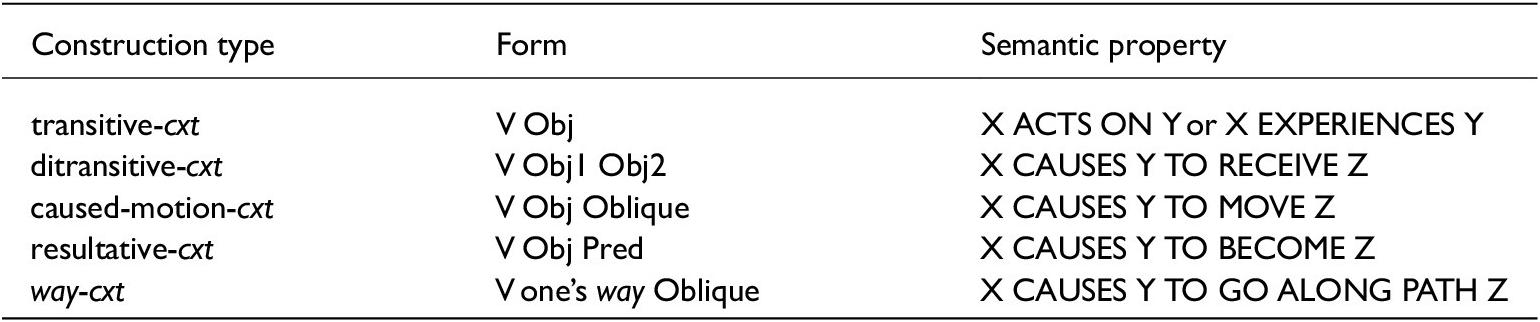
Within the CxG framework, argument structures are also considered constructions, and a verb’s inherent core meaning is distinct from the semantics linked to these argument structure constructions. This means that in CxG, a verb with its own core meaning can occur in different argument structure constructions, as illustrated in the following examples:

In these examples, the verb kick has a core meaning of striking forcibly with the foot. However, a range of distinct interpretations arises from the various argument structure constructions. When each of these constructional meanings in table 6 is linked to the matrix verb kick, the proper interpretations are evoked accordingly. In (21a), the transitive construction involves a direct action affecting an object. In (21b), the ditransitive construction suggests giving something to someone through the action. In (21c), the caused-motion construction indicates causing an object to move in a certain direction. In (21d), the resultative construction implies causing a change of state in an object. In (21e), the way-construction suggests movement along a path by means of the action.
Related construction and semantic properties

This demonstrates how different argument structure constructions modify the core meaning of kick to produce specific interpretations based on the syntactic context. The flexibility of verbs to participate in various argument structure constructions is a fundamental aspect of the CxG framework, showcasing how a single verb can generate multiple nuanced meanings.
For a formal account of the CPC, we propose that it consists of two distinct argument structure constructions: CPC-raising and CPC-control. First, consider the constructional constraints of CPC-raising below:

The constructional constraint in (22) indicates that syntactically CPC-raising takes two arguments (a nominal subject NP/CP and an -ing complement) and that semantically the construction denotes the proposition that it is necessary or worthy (relating to V) that the subject (x) undergoes the event depicted by the -ing complement (y). This constructional constraint ensures that the subject is understood only as the undergoer of the event described by the -ing complement. That being the case, the sentence the house needs painting can be paraphrased as it is necessary that the house be painted and the sentence the situation deserves watching can be paraphrased as it is worthy that the situation is watched.
Next, let us consider the CPC-control type, as illustrated below:

The constructional constraint in (23) states that the CPC-control construction takes two syntactic arguments: a subject NP and an -ing complement. Semantically, it expresses the proposition that the subject NP (x) either performs the event V on the event (y) that is acted upon the subject NP (x), or the subject NP (x) experiences the event V from the event (y) that is acted upon it. This constraint then ensures that the subject can be interpreted as either the actor or experiencer of the matrix verb, and, crucially, as the undergoer of the event described by the -ing complement, at the same time. For example, in the actor case, Payne awaits sentencing can be paraphrased as Payne performs the event of awaiting, which is directed toward the event of sentencing that affects him. In the experiencer case, Almost one trainee doctor in eight has suffered bullying at work can be paraphrased as the trainee doctor has experienced the event of suffering from the event of bullying acted upon him/her.
A significant advantage of distinguishing between the two CPC subconstructions, CPC-raising and CPC-control, is that it helps explain discrepancies in the syntactic realization of the subject. The prediction is that in CPC-raising the subject can be either an NP or a CP but in CPC-control, it can only be an NP. This prediction is indeed borne out in our data. Observe the examples in (24).

In (24a) the matrix subject is a CP while in (24b) it is the dummy pronoun it and it is linked to the extraposed CP at the end. In our data, examples like these are only found with the verbs that license CPC-raising, but not with those that license CPC-control. Therefore, the examples above provide an additional justification for the distinction between CPC-raising and CPC-control.
6. Bridging the two distinct CPC types and our findings
We now turn to how this CPC analysis connects our findings. As noted in section 4.5, no single pattern fully captures the interaction between matrix verbs and other elements in the CPC. However, focusing on the ‘raising’ vs. ‘control’ distinction helps clarify these varied behaviors.
6.1 Co-occurrence with an agent by-phrase
The distinctive collexeme analysis results revealed that matrix verbs like escape, await, avoid and prevent are strongly associated with the presence of an agent by-phrase; conversely, need and bear are strongly associated with its absence. Notably, most of the former fall under the CPC-control category (e.g. escape, await, avoid and prevent), whereas the latter belong to the CPC-raising category. This pattern suggests that although the agent by-phrase is generally not frequent in the CPC, its presence statistically prefers CPC-control to CPC-raising.
6.2. (Dis)preference for animate subjects
The distinctive collexeme analysis results also showed clear (dis)preference patterns regarding subject animacy. Matrix verbs strongly associated with animate subjects include await, avoid, deserve, want, suffer, escape and need, whereas bear and require strongly favor inanimate subjects. Again, most of the former belong to CPC-control (e.g. await, avoid, suffer and escape), while the latter fall under CPC-raising. This indicates that while animate subjects are generally not frequent in the CPC, statistically they favor CPC-control over CPC-raising.
6.3. Patterns in -ing complements
The covarying collexeme analysis results revealed that certain matrix verb (or verb types) and -ing complement pairs occur more frequently, forming distinct semantic frames in the CPC. CPC-control and CPC-raising structures exhibit different -ing complement patterns based on subject animacy, intentionality and event interpretation. CPC-control verbs, with animate subjects, select action-oriented complements linked to negative outcomes or obligations, such as escape–bombing, avoid–questioning or suffer–bruising. These emphasize external obligations requiring avoidance, anticipation or endurance. In contrast, CPC-raising verbs, typically with inanimate subjects, favor complements connoting passive transformations, evaluations or requirements, as seen in bear–repeating, require–priming or need–replacing. Since these subjects lack volitional agency, the complements highlight necessary changes rather than deliberate actions. The findings highlight how CPC-control verbs align with agentive, negative-event management, whereas CPC-raising verbs favor passive necessity. This distinction thus suggests the interplay between the matrix verb and subject type and event structure as key factors in the -ing complement selection.
7. Implications for the constructional change
The remaining question is how verbs that typically do not take an -ing complement in their passive form began to do so in the CPC and how they diverged into two subtypes of the CPC. We hypothesize that this shift originated with the strongest collexeme verbs, need and bear, and subsequently extended to other semantically similar verbs.
At this point, first, recall that according to Toyota (Reference Toyota2009), throughout the history of English, matrix verbs in the CPC can be categorized into three types in terms of chronological order:

Interestingly, the verbs need and bear, shown to be the two strongest collexeme verbs in our findings, fall into Type III, which has a long-standing history as well. Given their long-standing history and status as representative verbs in the CPC, we conjecture that the verb need with a non-thematic sense was initially recognized as the prototypical licensing verb of CPC-raising. Following this, verbs like want and require, which convey a similar meaning, began to be used in CPC-raising. In the case of bear, we speculate that it became a representative verb in CPC-raising as well, and that verbs like deserve and merit, conveying a similar sense, began to be used in the construction accordingly. This explains how verbs like need, want, require, bear, deserve and merit came to take the -ing complement in the CPC-raising structure.Footnote 10
Then, how is it that the CPC-control structure started to be employed with verbs like await and escape as in Tumor cells {await/escape} killing by immune cells? This can be better understood by considering the dual semantic nature of certain verbs like need, which can appear in both CPC-raising and CPC-control contexts due to its two interpretations. One interpretation is non-thematic (where the verb does not assign a thematic role to its subject), as in it is necessary that … This corresponds to CPC-raising. The other is thematic (where the verb assigns a thematic role to its subject), as in an entity is in need of something. This corresponds to CPC-control. These two senses are illustrated in (26a–b): (a) the non-thematic use of need, (b) the thematic use of need.

In (26a), the necessity is situational and external, as the subject (employers) does not have an intrinsic ‘need’ but instead fulfills a broader contextual requirement. In contrast, in (26b), the necessity is intrinsic to the subject (the children), as they inherently require supervision (watching over) and shelter (a place to sleep).Footnote 11
Given the prominent role of the collexeme verb need with its dual uses, it is plausible that it was initially employed in the CPC-raising structure before expanding to the CPC-control structure. Over time, other verbs, such as escape, await, avoid and prevent, began to adopt this structure and induce a CPC-control interpretation. Our hypothesis is consistent with Toyota (Reference Toyota2009), which suggests that verbs using the CPC-control structure emerged more recently than those in the CPC-raising structure. However, as Toyota’s study does not provide statistical evidence, we leave this issue for future research to explore further.
8. Conclusion
In this article, we examined the English CPC using authentic data from COCA, applying collostructional analyses to explore the construction’s real-life usage patterns. Our collostructional analyses revealed several intriguing findings regarding the preferred semantic classes of matrix verbs, the favored pairs of matrix verbs (or verb types) and the -ing complements, and also interactions between certain verbs (or verb types) and presence/absence of the agent by-phrase and subject (in)animacy.
To address the form–function mismatch (in which an active form encodes a passive meaning), we adopted a Construction Grammar approach. We identified two subtypes of the CPC, with certain shared and distinctive properties at the same time: CPC-raising and CPC-control. Despite their shared surface syntax, the two subtypes differ in how the thematic role is assigned to the subject. Additionally, this distinction helped us account for our varied corpus-based observations in a neater manner.
A key implication of this study is that our collexeme analysis sheds light on complementation change. We conjectured that this complementation change began with the collexeme verbs need and bear. These verbs, with their distinct semantic properties, laid the foundation for the -ing complement pattern in CPC-raising. Over time, this pattern extended to other semantically similar verbs (e.g. from the ‘non-thematic’ sense of need to the ‘non-thematic’ sense of want/require; from bear to deserve and merit). Furthermore, the dual sense of need, specifically its thematic sense, may have facilitated further extensions to other verbs with CPC-control. This observation underscores the influential role of these collexeme verbs in driving complementation changes in other verbs. This insight enriches our understanding of collexeme dynamics and provides a valuable context for broader mechanisms of language change.
However, a limitation of this study lies in our data collection process, which focused on 22 matrix verbs identified in Visser’s seminal research. While we identified 12 distinct matrix verbs in COCA, even Visser’s list may not be exhaustive.Footnote 12 This suggests that our study may have overlooked certain matrix verbs, limiting the comprehensiveness of the CPC sub-grouping based on semantic characteristics. Although our focus was on Visser’s list, future research could explore additional matrix verbs to further refine the grammatical properties of the CPC.
Acknowledgments
We thank the two anonymous reviewers for their thoughtful and constructive comments, which substantially improved the article. Earlier versions of this work were presented at the 2024 Summer Linguistics Joint Conference (Chungnam National University, 20–21 August 2024) and the 2025 KSLI Summer Conference (Kyungpook National University, 14 June 2025), and we are grateful to the audiences at both meetings for helpful questions and suggestions. We also thank Dr. Stanley Dubinsky and Dr. Anne Bezuidenhout for their encouragement, support and constructive feedback throughout the preparation of this article. We are grateful to Dr. Frances Blanchette for her collaboration on our related study of the Alternative Embedded Passive (AEP), including the companion article Blanchette et al. (Reference Blanchette, Dubinsky, Harman and Sim2024). Any remaining errors are our own.

 Open access

