


Ca is the most abundant mineral in the body, accounting for about 1–2 % of body weight and 39 % of total body minerals. Over 99 % of total body Ca is found in bones and teeth. The remainder is present in blood, extracellular fluid, muscle and other tissues, where it plays a role in mediating vascular contraction, vasodilation, muscle contraction, nerve transmission and glandular secretion(Reference Cashman1, 2). Since it is involved in many metabolic and cellular functions, Ca is essential for optimal growth and development(Reference Mesías, Seiquer and Navarro3). Adequate Ca intake during growth is extremely important to reach the optimum peak bone mass, which protects against osteoporosis during adulthood(Reference Stang and Story4).
In respect of the intense growth associated with this period and the need to attain the optimal peak bone mass, Ca deficiency in childhood and adolescent years could lead to a major problem in adulthood. Unfortunately, a lot of children and adolescents worldwide fail to achieve the recommended Ca intake. Korean children and adolescents are at high risk of low Ca intake because of their low consumption of dairy products, irregular meals and excessive weight-control practices(Reference Lee5, Reference Ha, Choi and Seo6). To date, there had been no previous large-scale studies examining the prevalence of low Ca intake in Korean children and adolescents.
In the present study we investigated the amount and major food sources of Ca intake, and the prevalence of inadequate Ca intake, in Korean children and adolescents.
Experimental methods
Study participants
The data for the present study were obtained from the Korean National Health and Nutrition Examination Survey (KNHANES), 2007–2010. This survey is a community-based cross-sectional survey conducted by the Division of Chronic Disease Surveillance, Korea Centers for Disease Control and Prevention to assess the health and nutritional status of a large representative sample of non-institutionalized civilians in South Korea. A stratified, multistage probability sampling design was used for the selection of household units.
A total of 33829 individuals younger than 19 years old participated in the 2007–2010 survey. We excluded respondents who did not attend the 24 h dietary recall interviews, FFQ or anthropometry investigations. After the exclusion, the sample for the cross-sectional analysis comprised a total of 7233 children and adolescents aged 1–18 years (3973 boys, 3260 girls). The study was conducted according to the guidelines laid down in the Declaration of Helsinki and all procedures involving human subjects were ethically approved by the Institutional Review Board at Inje University College of Medicine. Written informed consent was obtained from all participants or from their parents.
Data collection and study variables
The KNHANES consists of four survey parts: a health interview survey, a health behaviour survey, a health examination survey and a nutrition survey. Data were collected via household interviews, followed by standardized physical examinations performed by trained medical staff and blood sample collections at a mobile examination centre.
Demographic variables include age, gender, region and household income. Age was categorized according to the criteria used in the Korean Dietary Reference Intakes(Reference Yoon, Lee and Lim7): 1–2 years, 3–5 years, 6–8 years, 9–11 years, 12–14 years and 15–18 years. Among the sixteen districts of South Korea, eight major cities (Seoul, Gyeonggi, Busan, Daegu, Incheon, Gwangju, Daejeoun and Ulsan) were grouped as urban areas, and the other provinces (Gangwon, Chungbuk, Chungnam, Jeonbuk, Jeonnam, Gyeongbuk, Gyeongnam and Jeju) were grouped as rural areas. Household income was calculated by equivalized gross household income per month per year and grouped into four quartiles.
Obesity, overweight and underweight were categorized according to the age- and sex-specific percentiles for BMI of the Korean national reference standards(Reference Moon, Lee and Nam8). Underweight, normal weight, overweight and obesity were defined as a BMI percentile of <5th, ≥5th to <85th, ≥85th to <95th and ≥95th, respectively.
Assessments of participants’ daily Ca intake and contributing food sources were done using a 24 h dietary recall method. Participants recalled the type and amount of all foods they had consumed on the day before the interview, including snacks, beverages and ingredient information for all sauces and condiments. The amount of Ca in the diet was calculated according to the food composition tables for Koreans(9), a food portion/weight database of foods and dishes(10), a recipe database of eating out and school/industry feeding(11), and a database of processed and fast foods(11). Ca intake was categorized as inadequate when the daily Ca intake of the participant was less than the Estimated Average Requirement (EAR) of the Dietary Reference Intakes for Koreans 2010(Reference Yoon, Lee and Lim7) according to gender and age. The EAR for Ca is 390 mg/d, 470 mg/d, 580 mg/d, 670 mg/d, 800 mg/d and 750 mg/d for boys aged 1–2 years, 3–5 years, 6–8 years, 9–11 years, 12–14 years and 15–18 years, respectively; the corresponding values for girls are 390 mg/d, 470 mg/d, 580 mg/d, 670 mg/d, 740 mg/d and 660 mg/d(Reference Yoon, Lee and Lim7).
The food group categories were based on the categories of the food database used in KNHANES. Foods were grouped as: dairy products (milk, modified milk powder, formula, breast milk, goat's milk, yoghurt, ice cream, cheese, etc.); vegetables (kimchi, radish leaves, welsh onion, onion, radish, soyabean sprouts, carrot, spinach, etc.); grains (rice, barley, wheat and their products); seafood (boiled and dried anchovy, fish paste, dried and raw shrimp, loach, squid, opossum shrimp, mackerel, etc.); soya (soyabeans, tofu, fried tofu, bean-curd dregs, soya milk, bean flour, etc.); seaweed (sea mustard, laver, sea tangles, seaweed fulvescens, sea lettuce, seaweed fusiforme, etc.); eggs; flavourings (red pepper pastes, soyabean paste, soya sauce, salt, red pepper powder, etc.); fruits; meat & poultry (chicken, pork, beef, duck, etc.); nuts (sesame, perilla seeds, almonds, peanuts, chestnuts, walnuts, etc.); beverages (fruit and vegetable beverages, juice, carbonated drinks, cocoa beverage, teas, etc.); and others.
Frequency of drinking milk was assessed by the FFQ. The frequency was counted for every one cup (200 ml) of milk consumed by the participants.
Statistical analysis
We used the KNHANES sampling weight variables, stratum variables and the relevant primary sampling units for analysis that allowed an estimate representative of the entire Korean population samples.
The χ 2 test was used to compare the distribution of participants between the categorized variables by PROC SURVEYFREQ. Mean values of daily Ca intake were calculated by SURVEYMEANS, and PROC SURVEYREG was used to test the trend and the difference of means between the categorized variable. A P value <0·05 was considered significant. All analyses were performed using the statistical software package SAS version 9·2.
Results
The general characteristics and mean daily Ca intake of participants are presented in Table 1. The mean daily Ca intake was higher in boys (510·2 mg) than girls (431·7 mg, P < 0·0001). Participants who consumed milk more than five times weekly were more prevalent among boys than girls (56·2 % v. 46·5 %, P < 0·0001), whereas those who never consumed milk were more prevalent among girls than boys (23·0 % v. 13·8 %, P < 0·0001).
General characteristics of the study participants: 7233 children and adolescents (aged 1–18 years), Korean National Health and Nutrition Examination Survey (KNHANES), 2007–2010

Values are presented as number and percentage, except for daily Ca intake (mean and standard error). P values are derived from PROC SURVEYFREQ for categorical variables (age, BMI status, region, household income, and frequency of milk intake) and from the t test for daily Ca intake.
*Underweight, normal weight, overweight and obese defined as BMI <5th, ≥5th to <85th, ≥85th to <95th and ≥95th percentile, respectively, of the age- and sex-specific BMI percentiles of the Korean national reference standards(8).
†Seoul, Gyeonggi, Busan, Daegu, Incheon, Gwangju, Daejeoun and Ulsan were grouped as urban areas. Gangwon, Chungbuk, Chungnam, Jeonbuk, Jeonnam, Gyeongbuk, Gyeongnam and Jeju were grouped as rural areas.
‡Household income was calculated by equivalized gross household income per month in each year and grouped into four quartiles.
The amount of daily Ca intake was calculated as a percentage of the RDA (%RDA) for Koreans and is presented by age group in Table 2. Although the RDA for Ca increases with age (peaking at 12–14 years of age), the participants’ Ca intake as %RDA did not increase accordingly with age. Consequently, daily Ca intake presented as %RDA, which was 84·2–94·1 % in toddlers, decreased dramatically to 49·6–60·0 % in late adolescence.
Daily calcium intake (mg) of the study participants: 7233 children and adolescents (3973 boys, 3260 girls; aged 1–18 years), Korean National Health and Nutrition Examination Survey (KNHANES), 2007–2010
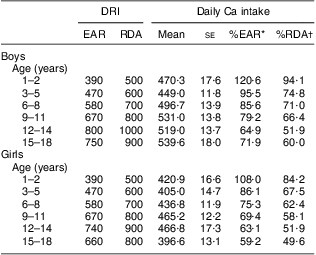
DRI, Dietary Reference Intake; EAR, Estimated Average Requirement.
Upper tolerance level of Ca intake is 2500 mg/d for all age groups.
*The amount of daily Ca intake calculated as a percentage of the EAR.
†The amount of daily Ca intake calculated as a percentage of the RDA.
Figure 1 demonstrates the prevalence of inadequate Ca intake by gender and age. The prevalence of inadequate Ca intake increased gradually from toddlers to adolescents in both boys and girls (P < 0·0001). The prevalence of inadequate Ca intake was significantly higher in girls (79·1 %) than in boys (71·6 %, P < 0·0001).
(colour online) The prevalence of calcium intake less than the Estimated Average Requirement by gender and age among 7233 children and adolescents (3973 boys, 3260 girls; aged 1–18 years), Korean National Health and Nutrition Examination Survey (KNHANES), 2007–2010. P < 0·0001 for the difference between boys and girls (derived from PROC SURVEYFREQ); P < 0·0001 for the trend by age group in both boys and girls (derived from PROC SURVEYREG)

Table 3 shows major food sources of Ca of the participants. The highest ranked food sources for Ca were dairy products (35·1 %), followed by vegetables (17·3 %), grains (11·3 %), seafood (9·9 %) and soya (6·4 %) in both boys and girls. The Ca intakes (mg/d) from most of the food sources were significantly higher in boys than in girls (P < 0·05), except for seaweed, fruits and beverages (P > 0·05).
Daily calcium intakes (mg) from major food sources among 7233 children and adolescents (3973 boys, 3260 girls; aged 1–18 years), Korean National Health and Nutrition Examination Survey (KNHANES) 2007–2010

Values are presented as mean and standard error and percentage contribution of Ca intake from food source to total daily intake. P values for the gender difference are derived from PROC SURVEYREG.
Figure 2 shows the percentage contributions from different food sources to total Ca intake according to participant age. Ca intake from dairy products decreased by 33 % (from 57 % at age 1–2 years to 24 % at age 15–18 years, P < 0·0001), while Ca intakes from vegetables (6·6 % to 22·3 %), grains (7·3 % to 13·7 %) and seafood (6·9 % to 10·4 %) increased significantly with age. Ca intakes from other food sources showed relatively small rises with age, except for Ca intakes from soya, seaweed and fruits (see online supplementary material).
(colour online) Contributions of food sources to total calcium intake by age among 7233 children and adolescents (3973 boys, 3260 girls; aged 1–18 years), Korean National Health and Nutrition Examination Survey (KNHANES), 2007–2010. *P < 0·05 for the trend by age group (derived from PROC SURVEYREG)

Discussion
In the present study we demonstrated that the prevalence of inadequate Ca intake among Korean children and adolescents is as high as 75·0 % and that it increases markedly with age from toddlers (45–55 %) to adolescents (78–86 %).
Recommended daily Ca intake differs according to ethnicity and nationality(Reference Wang and Li12), because ethnic differences in fractional Ca absorption rate and body physique influence Ca needs(Reference Lee, Cheng and Jiang13–Reference Braun, Palacios and Wigertz15). Several dietary factors can influence intestinal Ca absorption. Adequate vitamin D status is important for Ca absorption as the synthesis of calbindin, which increases active intestinal Ca transport, is dependent on calcitriol(Reference Lee, Cheng and Jiang13). Habitual low Ca intake increases the fractional Ca absorption rate by up-regulating active transcellular Ca transport in the duodenum(Reference Bronner and Pansu16). On the other hand, phytate and oxalate in vegetables may decrease the fractional Ca absorption rate(Reference Charoenkiatkul, Kriengsinyos and Tuntipopipat17, Reference Yeudall, Gibson and Cullinan18). Several studies have shown that Asian adolescents(Reference Lee, Cheng and Jiang13, Reference Lee, Leung and Fairweather-Tait19) and women(Reference Charoenkiatkul, Kriengsinyos and Tuntipopipat17) have higher fractional Ca absorption compared with Caucasians(Reference Heaney, Weaver and Fitzsimmons20, Reference Abrams and Stuff21), which seems to be related to the low Ca intake in Asians(2). However, prevalent vitamin D deficiency(Reference Nakamura, Nashimoto and Matsuyama22, Reference Kim, Oh and Namgung23) and the vegetable-rich diet among Asian populations(Reference Charoenkiatkul, Kriengsinyos and Tuntipopipat17, Reference Yeudall, Gibson and Cullinan18) may interfere with Ca absorption, resulting in poor mineral accretion and osteoporosis in later life. The 2011 report of the Institute of Medicine stated that the recommended Ca intake ranges from 700 mg/d (1–3 years) to 1300 mg/d (9–18 years) and the EAR from 500 mg/d (1–3 years) to 1100 mg/d (9–18 years) for American and Canadian children and adolescents(Reference Ross, Manson and Abrams24). On the other hand, the RDA (500–1000 mg/d) and EAR (390–800 mg/d) of Ca for Korean children(Reference Yoon, Lee and Lim7) are about 100–200 mg/d lower than those for American children. A report from the US National Health and Nutrition Examination Survey 2005–2006 demonstrated that the mean Ca intake in US children and adolescents (aged 1–18 years) was 950–1250 mg/d, and the 5th percentile value of Ca intake was 400–600 mg/d(25). By contrast, we found that the mean Ca intake in Korean children and adolescents was 400–540 mg/d, which corresponds to the 5th percentile of Ca intake in US children. In spite of the much lower EAR of Ca for Koreans, 50 % of toddlers and more than 80 % of adolescents did not meet the EAR. UK children and adolescents(Reference Whitton, Nicholson and Roberts26), whose RDA for Ca intake is close to that of Koreans, also have higher Ca intake (650–860 mg/d) than Korean children and adolescents.
Although little is known about the Ca intake in Korean children, a few studies from other Asian countries have shown lower Ca intake of children and adolescents as compared with Western counterparts. It has been reported that deficient Ca intake is highly prevalent among Chinese adolescents(Reference He, Zhai and Wang27) and primary-school children in Taiwan(Reference Wu, Pan and Yeh28) and Vietnam(Reference Ta, Nguyen and Kawakami29). Most of all, relatively low dairy consumption can explain the deficient Ca intake in Asian children. Dairy products are one of the most Ca-rich foods with high bioavailability, contributing up to 70 % of total daily Ca intake in Western countries(Reference Nicklas30). In the present study, dairy products were the main food source for Ca in Korean children and adolescents; however, its contribution was only 35 % of daily Ca intake. The Asian diet is traditionally non milk-based, and major food sources for Ca are vegetables with dark-green leaves, soya and small fish eaten with bones, which have relatively lower Ca contents than dairy products(Reference Lee and Jiang31). The high prevalence of lactose intolerance (80–90 %) among Asians and the limited supply of lactose-free milk in Asian markets also may limit the Ca intake(Reference Vesa, Marteau and Korpela32). Like many other Asians, Koreans’ milk consumption is lower than that of the Western population. The frequency of milk consumption in Koreans is 2·8 times weekly, with 80 % of individuals drinking less than one serving daily(33). The recommended milk intake for children and adolescents ranges from 300 to 750 ml/d in several countries(34–36)), and about two cups (400 ml) of milk daily are suggested by the Korean Nutrition Society(Reference Yoon, Lee and Lim7). However, only 50 % of the participants drink milk more than five times weekly in the present study.
Consistent with other studies(Reference Rajeshwari, Nicklas and Yang37–Reference Sanwalka, Khadilkar and Mughal39), the daily Ca intake of boys was about 100 mg higher than that of girls in the present study. The prevalence of inadequate Ca intake was higher in girls than in boys for all age groups. Higher milk consumption and larger portion size in the diet of boys compared with girls could explain this discrepancy.
Ca needs in children are considerably elevated with age as a result of the intensive bone and muscular developments. However, daily Ca intakes remained constant at 400–540 mg in the present study (age 1–18 years), and consequently daily Ca intake as %RDA decreased from 84–94 % (1–2 years) to 50–60 % (15–18 years) with age. The decreasing trend of Ca intake with age seems to be associated with the decreasing trend of dairy consumption. Dairy consumption, which provides 60 % of daily Ca in toddlers, decreases in teens down to 30 %. Although the contributions from vegetables and grains increase with age, Ca intake from all food sources excluding dairy products was as low as 260 mg/d. There are several food sources with high Ca content (mg per standard serving) in traditional Korean diets, such as tofu (75·6 mg/60 g), dried icefish (98·2 mg/10 g), dried anchovy (64·5 mg/5 g), radish leaves (149 mg/60 g) and mugwort (103·5 mg/45 g). Especially tofu(Reference Weaver and Plawecki40), small soft-boned fish(Reference Hansen, Thilsted and Sandström41) and Ca-fortified soya milk(Reference Tang, Walker and Wilcox42) have been proven to be good sources of Ca, as their Ca absorption is comparable to that from cow's milk. Dark-green leafy vegetables and soyabeans are also important Ca sources in Korean diets(Reference Park, Heo and Park43), although their Ca bioavailability is lower than that of dairy products(Reference Weaver and Plawecki40). Some vegetables with high Ca and low oxalate/phytate content, such as kale and broccoli, can contribute to the Ca needs of non-milk drinkers(Reference Charoenkiatkul, Kriengsinyos and Tuntipopipat17, Reference Weaver and Plawecki40). Since 50 % of total adult skeletal mass is achieved during adolescence, a positive Ca balance in this period is mandatory to achieve the maximum peak bone mass(Reference Loud and Gordon44). Children and adolescents whose Ca intake is below 500 mg/d need more than 50 % of intestinal Ca absorption rate to maintain Ca balance(Reference Wang and Li12). Considering the high prevalence (70 %) of vitamin D deficiency in Korean adolescents(Reference Kim, Oh and Namgung23), adequate Ca intake is important to achieve optimal bone accretion and growth. We suggest that interventions designed to promote improvements in Ca intake should emphasize strategies that encourage consumption of milk and other Ca-rich foods (tofu, small fish eaten with bones, dark-green leafy vegetables) and of also Ca- and vitamin D-fortified products (soya milk, cereals). As parental dietary habits associated with Ca intake, such as drinking milk themselves and having Ca-rich foods in their diet, can influence children's Ca intake, strategies should focus especially on parents. Also, further research using Ca bioavailability tests is needed to identify Korean ingredients as good sources for Ca.
There were some limitations in our study. First, the study was cross-sectional and therefore causality cannot be inferred. Second, the one day 24 h recall method used in the present study has some limitations in assessing long-term Ca intake. Last, Ca intake from supplements was not analysed in the KNHANES, so we could not assess the effect of Ca supplements. Nevertheless, to our knowledge, the present study is the first one that demonstrates the prevalence of low Ca intake and food sources for Ca in Korean children and adolescents by using the most recent national data.
Conclusion
Inadequate Ca intake was highly prevalent among healthy Korean children and adolescents. Due to the decrease of milk consumption with age, deficient Ca intake tended to be worse especially in adolescence. We suggest that additional efforts are needed to educate adolescents and their parents on the importance of Ca intake for healthy bones and to encourage the consumption of Ca-rich foods.
Acknowledgements
Sources of funding: This research was supported by the 2011 Inje University research grant. Inje University had no role in the design, analysis or writing of this article. Conflicts of interest: The authors declare that there are no conflicts of interests. Authors’ contributions: J.G.I., S.H.K. and M.-J.P. were responsible for the conception and design of the study. G.L. performed the data analysis and all authors had a role in interpretation of the data. J.G.I., S.H.K. and M.-J.P. drafted the manuscript and H.J. revised and commented on the draft. All authors read and approved the final manuscript. Acknowledgements: The authors thank the Korea Centers for Disease Control and Prevention for providing the data.



