





1. Introduction
Syntactic/structural priming occurs when a structure is made easier to understand or more likely to be used due to previous exposure (Bock, Reference Bock1986; see Pickering & Ferreira, Reference Pickering and Ferreira2008 for a review). This phenomenon occurs in both single-person contexts and dialogue tasks (e.g., Branigan et al., Reference Branigan, Pickering and Cleland2000), but is most often investigated in asocial contexts. Yet, individuals’ susceptibility to syntactic priming is believed to be related to priming’s social-communicative function. In their Interactive Alignment Account, Garrod and Pickering (Reference Garrod and Pickering2009) argue that conversation is a joint action, and its success can be explained by individuals aligning their mental representations through both linguistic and non-linguistic processes (see also Pickering & Garrod, Reference Pickering and Garrod2004). This account suggests that conversation partners align language processes at many levels of representation, such as the lexical (word choice), syntactic (grammatical structure choice), situational model and articulation levels. This Interactive Alignment Account suggests that individual differences in social attunement may also be related to individual differences in the magnitude of syntactic priming, particularly when such priming occurs in interactive contexts.
One social-cognitive ability that may be related to syntactic priming is perspective-taking, which is one’s ability to consider another’s knowledge, preferences and/or perceptual frame of reference (see Cole et al., Reference Cole, Millett, Samuel and Eacott2020 for discussion). Better perspective-taking leads to establishing and enriching common ground (mutually understood information) between conversation partners, which is one goal of conversation (Clark & Marshall, Reference Clark, Marshall, Joshi, Webber and Sag1981). Despite the importance of common ground, individuals often take an egocentric approach in conversations and vary in their ability to take the perspective of others (Brown-Schmidt, Reference Brown-Schmidt2009). Given that both linguistic alignment and perspective-taking function to enhance effective and efficient communication, those who are more sensitive to the perspective of others during conversation may also be more likely to linguistically align, and thus, be more likely to show structural priming effects.
To date, few studies have examined the relationship between syntactic alignment and perspective-taking abilities, and these studies have relied on perspective-taking measures that do not fully reflect the nuances of social interaction. In a sample of adults, Horton (Reference Horton2014) found that participants who rated themselves higher on perspective-taking (using the Interpersonal Reactivity Index [IRI]; Davis, Reference Davis1980) were more likely to be syntactically primed by their social partners’ speech than those with lower perspective-taking scores. Similarly, van Zwet and Unsworth (Reference van Zwet and Unsworth2024) found that children with higher perspective-taking scores when reasoning about third-party characters (using the Perspective Taking Test for Children; Aslan & Köksal-Akyol, Reference Aslan and Köksal-Akyol2016) were more likely to be syntactically primed in a two-person, card-matching game. These studies, however, used only a single, non-interactive measure of perspective-taking. It is possible that perspective-taking measures more embedded in social contexts would show stronger relationships with the magnitude of syntactic priming effects during interactive language use.
In the current study, we will measure syntactic priming using an interactive language task, as well as three measures that capture different facets of perspective-taking: the IRI (Davis, Reference Davis1980), the Social Mindfulness (SoMi) Scale (Van Doesum et al., Reference Van Doesum, Van Lange and Van Lange2013) and the DT (DT; Keysar et al., Reference Keysar, Barr, Balin and Brauner2000). Given the limited number of perspective-taking measures that reliably produce individual differences in neurotypical adults and the lack of a clear taxonomy of the composition of perspective-taking (e.g., Schaafsma et al., Reference Schaafsma, Pfaff, Spunt and Adolphs2015; Quesque & Rossetti, Reference Quesque and Rossetti2020; Warnell & Redcay, Reference Warnell and Redcay2019), we selected three tasks that have consistently produced variability and that tap into different facets of perspective-taking. The IRI is an introspective self-report measure where individuals report their empathic and perspective-taking tendencies (e.g., ‘I try to look at everybody’s side of a disagreement before I make a decision’). The IRI was the perspective-taking scale used by Horton (Reference Horton2014) and thus has been previously linked to variability in syntactic priming. The computer-based SoMi task involves considering the perspective of a hypothetical social partner, similar to the task used by van Zwet and Unsworth (Reference van Zwet and Unsworth2024). The DT assesses perspective in a highly interactive social setting, as it requires interacting with and taking the perspective of another person into account. Although these tasks vary on a variety of features, one salient dimension is the degree of social involvement, ranging from no involvement to hypothetical social involvement to real-time social involvement. If structural priming is related to having to accommodate an interlocutor in real-time, as Garrod and Pickering (Reference Garrod, Pickering and Gaskell2007) postulate, then more interactive tasks should show stronger relationships with structural priming than less- or non-interactive tasks.
In addition to measuring individual differences in perspective-taking, we will also consider multilingualism, or the amount of language exposure and use coming from different languages, as a sociolinguistic variable. Some evidence suggests that bilinguals score higher on various perspective-taking tasks than monolinguals (e.g., Greenberg et al., Reference Greenberg, Bellana and Bialystok2013; Ikizer & Ramírez-Esparza, Reference Ikizer and Ramírez-Esparza2018; Jávor, Reference Jávor2016; Navarro & Conway, Reference Navarro and Conway2021). For example, Gasiorek et al. (Reference Gasiorek, Dragojevic and Vincze2022) found that children who are raised in bilingual environments are more aware of their conversation partners’ needs than those from monolingual households. Additionally, bilingual adults are significantly better at avoiding initial interference from their own perspective during conversation (Rubio-Fernández & Glucksberg, Reference Rubio-Fernández and Glucksberg2012). Research also suggests that children merely exposed to more than one language have greater perspective-taking abilities during conversation than those without multilingual exposure (Fan et al., Reference Fan, Liberman, Keysar and Kinzler2015).
Rooted in this literature, van Zwet and Unsworth (Reference van Zwet and Unsworth2024) examined the influence of language status on perspective-taking and syntactic priming, but found no group differences in either. However, the bilingual children in their sample had lower language proficiency scores, which may have increased the cognitive load associated with language use in the syntactic priming task. This may have limited the impact of social attunement on priming (Iluz-Cohen & Armon-Lotem, Reference Iluz-Cohen and Armon-Lotem2013). Thus, we will probe the relationship between perspective-taking and syntactic priming using an adult sample who have obtained first-language proficiency.
Our primary predictions concern the relationship between syntactic priming and our perspective-taking tasks. Specifically, that (1) higher scores in perspective-taking (on all tasks) will be associated with higher scores on the structural priming task, and (2) stronger associations with structural priming will be observed for the more socially situated perspective-taking tasks (i.e., the DT relative to the SoMi, and the SoMi relative to the IRI).
In addition to these two hypotheses, we will conduct secondary analyses to examine the role of multilingualism. Given prior evidence, we predict that (3) perspective-taking scores will increase along with associated multilingualism and syntactic priming scores. We will test these predictions within a mediation model that will also allow us to examine whether perspective-taking mediates links between multilingualism and syntactic priming (by including both the direct and indirect effects).
2. Methods
2.1. Participants
We plan to recruit 150 participants based on an a priori power analysis in GPower 3 (Faul et al., Reference Faul, Erdfelder, Lang and Buchner2007, Reference Faul, Erdfelder, Buchner and Lang2009). This analysis yielded a projected sample size of 147 to obtain 80% power to detect a relationship between perspective-taking and priming scores. This estimate was based on odds ratio effect sizes from van Zwet and Unsworth (Reference van Zwet and Unsworth2024) and ditransitive priming rates from Horton (Reference Horton2014).
Participants will be recruited from the Psychology Human Participants pool at Texas State University, using an initial multiple-choice, screener question: ‘What language(s) were you exposed to as a young child?’ Those who respond by selecting the options ‘English’, ‘Spanish’ and ‘both English and another language’, will be invited to participate. Those who choose the option ‘Another language not listed’ will not be invited to participateFootnote 1. The composition of the participant pool is largely young adults, with an ethnicity breakdown of roughly 39% White, 43% Hispanic, 11% Black/African American, 2% Asian and 5% Other (i.e., Middle Eastern, Native American, multiethnic). Participants are compensated with course credit toward an assignment.
2.1.1. Exclusionary criteria
To be included in data analysis, participants will need to complete all trials of the face-to-face tasks (i.e., the DT, the priming task) and at least 90% of the items on the SoMi and IRI scales. Additionally, participants who fail to correctly respond to an attention check within the online Language History Questionnaire will be excluded. Further exclusionary criteria based on English proficiency scores are described below, with those measures.
2.2. Measures
2.2.1. Syntactic priming
Our syntactic priming paradigm is based on that in Branigan et al. (Reference Branigan, Pickering and Cleland2000) and Horton (Reference Horton2014). It is an interactive task where a participant and confederate, sitting on opposite sides of a divider, take turns describing simple line-drawing pictures on cards and finding pictures matching their partner’s descriptions. Both people are given two sets of cards: one set in a pile, to describe (with only a picture and target verb; Figure 1), and one set that is laid out in a grid in front of them. The confederate also has two sets of cards, but their ‘describe’ pile of cards actually has predetermined sentences printed on them that are not visible to the participant. The game begins with the confederate selecting the top card from their ‘describe’ pile and then reciting it to the participant. The participant then finds the card with the picture matching the sentence they heard from their grid of cards. The participant then selects the top card from their ‘describe’ pile and uses the verb printed on the card to form a sentence describing the picture. The confederate finds the card matching the description they heard, and the process continues until all the ‘describe’ cards have been drawn. On critical priming trials, the confederate’s card is manipulated such that they describe the pictured transfer event in either the prepositional object (PO: ‘the waitress tosses the ball to the soldier’) or double-object (DO: ‘the waitress tosses the soldier the ball’) form. The following target card the participant describes always shows another transfer event that can be described in either the PO or DO form, with a different verb. The structure produced on each target trial will be the outcome variable measuring priming.
Example target (left) and filler (right) description cards.
Note: Anticipated descriptions of the target are: ‘the painter tosses the apple to the swimmer’ (PO) or ‘the painter tosses the swimmer the apple’ (DO). The anticipated filler description is ‘the robber and the pirate cough’. The corresponding matching card for each pictured description card looks the same but lacks the printed verb.

There are 16 critical prime–target pairs that are each separated by two filler items (using different actions and objects than the experimental cards and not using the dative structure). The structure of the prime (PO or DO) for each of the priming trials will be counterbalanced across two experimental lists. The pictures on the cards each contain one or two entities (e.g., pirate, chef, ballerina, soldier, etc.) in the fillers, but always two entities in the targets. The dative verbs hand, give, throw, show, sell, loan, toss and offer each appear twice in the experimental items (once in each structure), but are never the same across prime and target. None of the verbs occurs twice in a row, and each structure (PO or DO) occurs no more than twice in a row before the alternative structure is used.
For the syntactic priming task coding, the target descriptions will be coded as either PO, DO or ‘Other’ (for responses that lack both entities and object in one of the structural orders). Other responses will be removed from data analysis. We will then use the prime condition information to code each target trial as a ‘match’ (same structure as the prime was produced) or ‘mismatch’(alternate structure from the prime was produced). These measures will be used in separate analyses described below.
2.2.2. Perspective-taking Measures
Interpersonal reactivity index. The IRI (Davis, Reference Davis1980) is a self-report measure composed of 28 Likert-scale questions meant to assess affective and cognitive aspects of perspective-taking. There are four subscales with seven items per subscale: Fantasy, Perspective-Taking, Empathic Concern and Personal Distress. An example item from the perspective-taking scale is ‘I sometimes try to understand my friends better by imagining how things look from their perspective’. Each subscale is reliable (Davis, Reference Davis1980) and has been validated (Davis, Reference Davis1983). As a replication of Horton (Reference Horton2014), we will administer the full IRI, and the main variable for analysis will be the score on the 7-item perspective-taking subscale. However, the global IRI score as well as scores on the other three subscales may be used in follow-up/exploratory analyses.
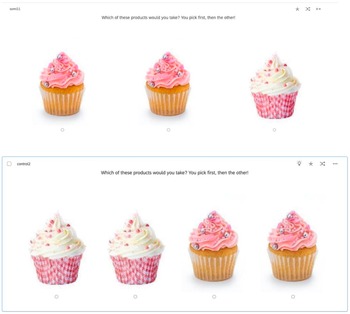
Social mindfulness paradigm. The SoMi paradigm (Van Doesum et al., Reference Van Doesum, Van Lange and Van Lange2013) is a computer-based paradigm where participants imagine interacting with a hypothetical social partner. On each trial, participants are told to select one object for themselves from a virtual array and are told that their partner will then have a chance to select an object from the remaining items. On the 12 critical trials, one object in the array is unique in some way (e.g., one white cupcake and two pink cupcakes). Thus, if the participant chooses the unique object, they leave their partner no real choice, which is thought to index decreased perspective-taking. In order to account for baseline participant preferences (e.g., for pink cupcakes), there are also 12 control trials that present two of each type of object (e.g., two pink cupcakes and two white cupcakes) (see Figure 2). To make the manipulation less obvious, there are also six filler trials that present three identical objects, and all trials are presented in a random order.
Example Critical (top) and Control (bottom) SoMi Trials.

Past research has examined two outcome measures from this task: first, simply the proportion of the 12 critical trials in which participants picked a non-unique item; and second, the proportion of critical trials in which the participant reversed their preference from the control trials (e.g., selected the pink cupcake to leave the interaction partner with a choice even though they selected a white cupcake in the control trial). Prior studies have found that these two measures are highly correlated (e.g., Mischkowski et al., Reference Mischkowski, Thielmann and Glöckner2018) and thus most research has only examined the critical trials in order to ensure that each participant has the same number of analyzable trials (as a different number of trials is excluded for each participant in the metric that takes control trials into account). For the purposes of this study, we focus on the traditional SoMi measure but conduct supplementary confirmatory analyses with the preference-controlled score (per recommendations in Mischkowski et al., Reference Mischkowski, Thielmann and Glöckner2018).
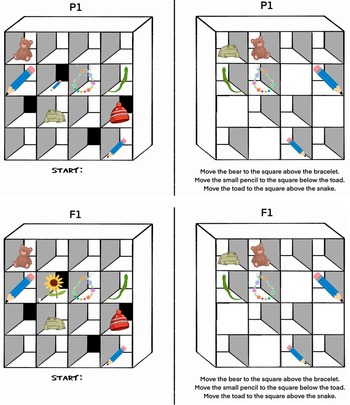
Director task. The DT (Keysar et al., Reference Keysar, Barr, Balin and Brauner2000; Navarro & Conway, Reference Navarro and Conway2021) is a referential communication task where a director (confederate) provides directions to the addressee (participant) about where to move objects on a 4x4 gridded shelf. Four of the shelf cubes have backings, so only the addressee is able to see the objects inside, while objects in the rest are visible to both the addressee and the director. Crucially, some of these objects appear as sets of different sizes (e.g., small, medium and large pencils). The six critical trials involve the director telling the participant to move the ‘large’ or ‘small’ object, but the true smallest or largest of the three is in a cube that the director cannot see. Thus, the participant must use the director’s perspective to infer that when they say ‘small’ or ‘large’ object, they mean the smallest or largest object visible to them (the director), even though that differs from the participant’s own (egocentric perspective). Six control trials involving different-sized objects that are all placed in mutually visible cubes will also be administered (see Figure 3). Each of the 12 trials also involves instructions to move two filler objects in the array. Each critical trial and its control trial use a unique set of objects; however, each trial is presented in a random order, so the item set/array changes from trial to trial.
Example critical (top) and control (bottom) DT trials.
Note: The left-hand image is the participant’s perspective at the beginning of the trial, and the right-hand image is the confederate’s script and perspective at the end of the trial. ‘P1’ indicates a critical trial, and ‘F1’ indicates a control trial to the experimenter.

Figure 3. Long description
Top-left panel labeled P1 shows a 4 by 4 grid with a bear in the top-left cell, a large pencil in the second cell of the top row, a bracelet in the third cell, a snake in the fourth cell, a small pencil in the first cell of the second row, a toad in the first cell of the third row, a red hat in the fourth cell of the third row, and a small pencil in the fourth cell of the fourth row. The bottom-left panel labeled F1 is similar but replaces the bracelet with a sunflower in the third cell of the top row. The top-right panel, also labeled P1, shows the end-state after instructions: the bear is now above the bracelet, the small pencil is below the toad, and the toad is above the snake. The bottom-right panel, labeled F1, shows the same final arrangement as the top-right, but the initial state included a sunflower instead of a bracelet. The right panels include the instructions: ‘Move the bear to the square above the bracelet. Move the small pencil to the square below the toad. Move the toad to the square above the snake.’
At the start of this task, the participant and confederate will be told that they were randomly assigned to either give instructions (director role, though never explicitly referred to as such in front of the participants) or move the objects (addressee). The confederate will always be the ‘instruction giver’ (director) and read from a prescribed set of instructions.
Video recording of the display will allow us to calculate an accuracy score and a time score for each participant. Performance will be coded as whether or not the correct object was moved on each trial, with the accuracy score calculated as the total number of correct critical trials, with larger scores indicating better perspective-taking. Participants’ accuracy on the control trials will be used as an exclusionary criterion. Participants scoring 3 or below on the control trials (more than two errors) will be excluded from analyses related to the DT. The time score will be calculated as the average time (from the offset of the direction to when the object was moved) for correctly moving critical objects minus the average time for correctly moving control objects, with shorter time scores indicating better perspective-taking.
Outside of the scope of this project, part of the Director’s Task will include a lexical alignment measure that does not interfere with critical trials. Specifically, the director will use a subordinate label (e.g., toad versus frog) to instruct the participant to move a non-critical item. At the end of each trial, participants will write down the names of objects moved, and lexical priming will be indexed by the participant writing down that subordinate label. This will be pilot data for another project and is not included in our analysis plan.
2.2.3. Language questionnaires
The language history questionnaire asks participants about their language background and status. It includes questions about known languages, age and time of exposure and perceived proficiency across different domains (e.g., speaking, reading, comprehension, writing). Responses to these questions will be used to calculate a multilingualism score (see Chen & Blanco-Elorrieta, Reference Chen and Blanco-Elorrieta2025), which offers a validated, continuous measure of how many languages a person knows. To assess English proficiency, we will administer the Multi-Lingual Naming Test (MINT) in English (Gollan et al., Reference Gollan, Weissberger, Runnqvist, Montoya and Cera2012). This is a picture-naming task measuring vocabulary and is highly correlated with proficiency. To get a measure of grammatical proficiency in English, we will administer the 30 grammar questions from the Michigan English Language Institute College English Test (MELICET). These questions entail reading a sentence with a missing word or phrase, and then choosing the best option (from four available choices) to fill in the missing part of the sentence.
2.2.4. Demographic questions
We will ask demographic questions, including age, gender and race/ethnicity.
2.3. Procedures
The full testing script is available on OSF (https://osf.io/kxq86). Upon arrival in the lab, the participant will briefly meet the confederate, presented as another participant. The confederate and the participant will first participate in either the syntactic priming task or the DT (counterbalanced across participants). In between these two interactive tasks, participants will complete computer-based questionnaires: the SoMi scale, demographics, language scales and the IRI. Participants will always complete the SoMi tasks first, followed by a randomized order of the remaining questionnaires. After completing the last task, participants will be debriefed. The session is expected to take roughly 90 minutes.
2.4. Data analysis plan
The alpha-level for all statistical analyses will be set at 0.05, and exact p-values will be reported. To ensure our sample has acceptable proficiency in English, participants who score two or more standard deviations below the mean on the MINT or the MELICET will be excluded from data analyses. Before testing our hypotheses of interest, we will determine whether our syntactic priming task yielded significant effects. A multi-level logistic regression will be run in R (using the lme4 package) with target structure as the outcome variable, prime structure as the fixed effect and participants and items as crossed-random effects. A significant priming effect would be indicated by the prime structure variable significantly predicting the target structure.
We will also first calculate traditional and preference-adjusted SoMi scores (Mischkowski et al., Reference Mischkowski, Thielmann and Glöckner2018), so that we can compare them to ensure they yield comparable scores. Thus, we will run a paired-samples t-test comparing the normalized SoMi and preference-adjusted SoMi scores. If there is no significant difference, this would indicate that they function similarly as individual differences measures, and to be consistent with the literature, we will use just the traditional SoMi scores in our analyses. If there is a difference, we will use the preference-adjusted score in our analyses.
2.4.1. Primary statistical analyses
After verifying a significant priming effect, we will test our first hypotheses (that priming is related to perspective-taking) in three models, one for each perspective-taking task. The outcome variable in these models will be the structural match variable, and the fixed effects will be one of the perspective-taking scores (IRI, DT or SoMi). Participants and items will be included as crossed random effects in each of these three models. To test our second hypothesis, that stronger associations with structural priming will be observed for the more socially situated perspective-taking tasks (i.e., the DT and SoMi) relative to the IRI, we will compare the Akaike weights (see De Cat, Reference De Cat2020) of all three models to determine if any measure of perspective-taking is more related to structural match than another.
In order to increase the interpretability of any null results, we will run Bayesian hierarchical models to calculate the Bayes Factors for each estimated effect in our main models. The Bayesian generalized linear mixed models (analogous to frequentist logistic hierarchical linear models presented above) will be estimated in R (R Core Team, 2023), using the brms package (Bürkner, Reference Bürkner2018) with a Bernoulli family and a logit link function. We will use a normal regularizing prior on the overall model intercept (centered at 0, with a standard deviation of .75, in log-odds), and a normal prior for our predictor slope (centered at 0, with a standard deviation of .1, in log-odds). The priors for the variance components will also be normal, set to 0, .1 (in log-odds). These priors set the expectation that the overall probability of producing a structure will be around .5, but that may vary in either direction for the different conditions and different participants/items. Models will be run with four chains and 20,000 iterations per chain (to support Bayes Factor estimation). The first 2,000 iterations of each chain will be used as a warm-up phase. Before implementation, a sensitivity analysis will be run to ensure that our priors captured the data appropriately. This includes testing uniform priors and mildly informative priors to ensure that our mildly informative priors did not overly sway the posteriors of the models. These varying sets of priors will also be used when computing Bayes Factors (Schad et al., Reference Schad, Nicenboim, Bürkner, Betancourt and Vasishth2023).
After testing both hypotheses using frequentist and Bayesian approaches (as needed), we will conduct secondary analyses to test our third hypothesis that perspective-taking and priming scores will be positively associated with multilingualism scores. We will examine these effects within a mediation analysis. We will identify which measure of perspective-taking has the strongest relation to syntactic priming for these analyses. The priming score in this analysis will be the proportion of critical trials where each participant’s target structure matched the prime. The statistics of interest will be the direct and indirect effects. The mediated relationship has yet to be observed in previous research but is tenable given current theoretical accounts of the relationship between bilingualism and social language abilities (van Zwet & Unsworth, Reference van Zwet and Unsworth2024).
3. Potential results
We predict perspective-taking scores will be positively predictive of producing a structural match (priming), speaking to the social-cognitive underpinnings of linguistic alignment. Task-specific Akaike weights when predicting structural match will be informative, as the three measures all tap different aspects of perspective-taking and have different degrees of social interaction. If the level of social embeddedness is the primary feature linking perspective-taking to syntactic priming, we may see a stairstep pattern, such that the link between the DT and priming is the strongest, followed by the SoMi, and then the IRI. Considering the lack of consensus about the core components of perspective-taking, however, additional patterns of results are possible. For example, if the DT is most strongly related to priming, but the SoMi and IRI show equivalent relations with priming, then this would imply that manifest referential perspective-taking abilities in real-time social tasks are important drivers for priming/alignment. If the IRI is found to relate most strongly with priming, then this would imply that self-reported trait-like differences in empathy and other-orientation are more essential to linguistic alignment. If SoMi is found to most strongly predict structural match, then this would suggest that social consideration of others allows for a social pathway to linguistic alignment. Although our tasks do not span the full range of all possible components of perspective-taking, our observations can help direct future research on when and why different aspects of perspective-taking are related to social language use, such as considering the use of theoretical versus practical tasks. Moreover, the large sample size and use of multiple perspective-taking tasks in the current study make even null findings informative. Though this study is motivated by previous findings from Horton (Reference Horton2014) and van Zwet and Unsworth (Reference van Zwet and Unsworth2024), both of those studies used only a single measure of perspective-taking and limited sample sizes.
While not yet established in the literature, we may find that multilingualism scores (positively) predict structural match on our priming task. This would support theoretical accounts that multilingual experiences enhance social language abilities (see van Zwet & Unsworth, Reference van Zwet and Unsworth2024). Such an interpretation would be more robust if we also find that multilingualism is positively associated with perspective-taking. Again, which measure (if any) this relationship manifests with will also be informative as to which social processes are enhanced in multilinguals: referential perspective-taking abilities (DT), empathy and other-orientation (IRI) and/or social consideration (SoMi).
Overall, the proposed study has significant potential to increase our knowledge of which aspects of perspective-taking, a social-cognitive factor, are related to linguistic priming and alignment. These findings will advance theoretical accounts of alignment (regardless of the results obtained), as well as integrate purely cognitive-based theories of linguistic use with socially situated explanations of communicative behavior. Furthermore, they supply additional observations about how individuals with different language backgrounds respond to social communication tasks.


 Open access

